IEEE TRANSACTIONS ON POWER ELECTRONICS, VOL. 20, NO. 5, SEPTEMBER 2005 1007
Design of Multiple-Input Power
Converter for Hybrid Vehicles
Luca Solero, Member, IEEE, Alessandro Lidozzi, Student Member, IEEE, and
Josè Antenor Pomilio, Senior Member, IEEE
Abstract—This paper deals with designing and sizing of a
multiple-input power electronic converter (MIPEC) to be used in
an electric vehicle propulsion system that includes a fuel cell (FC)
generator and a combined storage unit. The combined storage
unit is composed by an ultracapacitors tank (UC) and a battery
unit (BU). MIPEC is responsible for power-flow management
on-board the vehicle for each mode of operation. Specifications for
MIPEC designing come out from many considerations concerning
traction drive and reference driving cycle, on-board power source
and storage unit characteristics. However, to date sizing and
configuration of both storage units and on-board generators are
directly related to traction drive and driving profile (i.e., vehicle
performances and characteristics) and no relation with power
electronic interface is considered during preliminary design.
Then, power electronic interface is selected in order to fit traction
drive requirements with power source and storage unit char-
acteristics; as a consequence converter mode of operation lacks
of optimization, as well dynamic behavior and efficiency cannot
be maximized. In this paper, MIPEC design and power source
and storage unit selection are achieved at the same project stage
according to traction drive requirements. Experimental results on
60-kW power electronic interface are presented.
Index Terms—Control design, dc–dc converter, fuel cell, ultra-
capacitors.
I. INTRODUCTION
PRESENT research concerning electric vehicles (EV) and
hybrid-electric vehicles (HEV) concentrate in the search
for a compact, lightweight, and efficient energy storage system
that is both affordable and has acceptable cycle life. The trac-
tion system, composed by electric motor, inverter, and associ-
ated control circuitry is not the limiting factor to obtain high
performance and to permit large-scale production of such vehi-
cles. Attention is now increasingly focused on fuel cell (FC) and
hybrid technologies as a way of producing breakthrough vehi-
cles with alternative power plants. A number of auto makers see
fuel cell powered vehicles as the ultimate route to achieving sus-
tainable long-term alternative propulsion systems. A number of
drive-train architectures have recently been proposed to com-
bine two or more on-board generation units and storage units
Manuscript received February 17, 2004; revised February 11, 2005. Recom-
mended by Associate Editor X. Xu.
L. Solero and A. Lidozzi are with the Department of Mechanical
and Industrial Engineering, University of Rome, Rome, Italy (e-mail:
solero@uniroma3.it).
J. A. Pomilio is with the School of Electrical and Computer Engineering,
State University of Campinas, Campinas, Brazil (e-mail: antenor@dsce.fee.
unicamp.br).
Digital Object Identifier 10.1109/TPEL.2005.854020
and to overcome constraints related to fuel consumption, pol-
lution, vehicles’ long distance capability. Interfacing of traction
drive requirements with characteristics and modes of operation
of on-board generation units and storage units calls for suit-
able power electronic converter configuration and control. In
this paper, a three-inputs/one-output converter is proposed for
a propulsion system where the generation unit is a 18 kW FC
and the combined storage unit is formed by lead-acid batteries
and ultracapacitors (UCs); however, same converter configura-
tion is appropriate also for different either generation units or
storage units.
In terms of power sources, the proton exchange membrane
FCs are being increasingly accepted as the most appropriate
supply for EVs [1], [2] because they offer clean and efficient
energy without penalizing performance or driving range. A bat-
tery storage unit (BU) can be combined with the FC stack to
achieve the maximum efficiency for the FC system. The BU de-
livers the difference between the energy required by the trac-
tion drive and the energy supplied by the FC system. In such a
system the BU has to deal with power peaks being on demand
during either acceleration or braking phases. Such transients re-
sult in a hard constraint for the battery unit, which increases the
losses and temperature, and reduces its lifetime. Thereby, it is
desirable to minimize these power peaks by introducing an ad-
ditional auxiliary power device: the ultracapacitors [3], which
present high power density, obtain regeneration energy at high
efficiency during decelerations and supply the stored energy
during accelerations. In spite of reaching thousands of Farads,
the UCs support very low voltages (1–2.5 V). A stack of se-
ries-connected UCs can produce an equivalent capacitor of tens
of Farads that is able to hold up tens of Volts. The UC stack must
supply the power required in excess of the FC-BU system rated
power, provided that the ultracapacitors’ state of charge (SOC)
is greater than a minimum threshold. Whenever the power re-
quired to operate the vehicle is lower than the FC-BU rated
power, the ultracapacitors can be charged with the power in
excess. Whenever regenerative braking operations occur, energy
is put into the UC tank provided this device is not fully charged
yet.
The investigated propulsion system arrangement is shown in
Fig. 1, where the FC is the main generation unit and BU and
UCs form the combined storage unit. Under light load condi-
tions, due to the poor efficiency of the fuel cell, the battery is
used to supply the power to the load. The UC tank is used to
satisfy acceleration and regenerative braking requirements ac-
complishing system load transients and improving on-board BU
cyclic life. Additionally, it is responsible to control the dc-link
0885-8993/$20.00 © 2005 IEEE
1008 IEEE TRANSACTIONS ON POWER ELECTRONICS, VOL. 20, NO. 5, SEPTEMBER 2005
Fig. 1. Proposed hybrid drive-train.
voltage, while the other sources are current controlled in order to
limit the current variation ratio and to prevent excessive peaks.
The goal of this paper is to develop designing and sizing for
the dc–dc converters in order to achieve the best compromise
for FC generator and combined storage unit sizing, and system
dynamic behavior; thus it will be analyzed the influence of the
system components in choosing the best feedback variable for
each converter and to designing the satisfactory regulators.
II. MIPEC TOPOLOGY
As mentioned, a multiple-input power electronic converter
(MIPEC) is proposed to interface traction drive requirements
with characteristics of on-board generation units and storage
units. Both FC and UC typically present a lower terminal
voltage than the dc voltage necessary to feed the traction
inverter. Also for the BU would be of practical interest to use a
lower voltage, in order to minimize the series resistance. In such
cases it is necessary to use step-up converters for connecting the
sources with the common dc bus. Additionally, for the BU and
for the UCs it is necessary to have step-down operation in order
to recharge them and to accomplish regenerative braking, what
means that these converters must be bidirectional in current. A
convenient topology is shown in Fig. 2. Each dc–dc converter
can be built using a branch of a three-phase dc–ac converter,
what means that there are power modules and drives already
available in the market. Considering that the common dc-link
voltage is the highest, the bottom transistor, together with the
top diode, configures a boost converter, while the bottom diode
and the top transistor realize the buck converter. For the FC
converter the buck action must not occur because this apparatus
does not take charge from the dc-link. A filter capacitor is
connected at each source terminals in order to minimize the
circulation of high-frequency components through the supplies.
This filtering is as effective due to the presence of the sources
series resistance.
The converters can be voltage or current controlled, de-
pending on the source role in the overall system, and their
limitations. For example, it is important to limit the current
variation in the FC, as well as in the BU. As any capacitor,
the UC can be controlled in voltage mode, using a maximum
current protection. The reference signals for the control loops
Fig. 2. Proposed MIPEC topology.
are derived from many parameters: the instantaneous load
current, the dc-link voltage, the BU and UC state of charges,
the FC output power, etc. In the following the expressions for
reference signals, to be used in MIPEC control, are provided
const (1)
where and are, respectively, the dc-link and fuel cell
measured current, and are the current values
of charging and discharging for ultracapacitor tank and battery
unit whenever storage units’ SOC is either lower or higher of the
ordinary admitted range, , and are duty cycles of, re-
spectively, BU and FC converters and is the dc-link voltage.
First two expressions give reference currents for fuel cell and
battery unit converters, reference signals’ variation is controlled
on the basis of generator and storage unit characteristics. The ul-
tracapacitor converter is regulated to keep dc-link voltage either
constant or at the most suitable value for traction drive mode of
operation.
III. DYNAMIC MODELING
Dynamic modeling is necessary to evince the relationships
between system transient behavior and either on-board power
source or combined storage unit or traction drive parameters.
SOLERO et al.: DESIGN OF MULTIPLE-INPUT POWER CONVERTER 1009
Fig. 3. DC–DC converter for dynamic modeling.
Small signal modeling, considering the average value of the
state variables over one switching period, is a well-known
method to analyze time-varying nonlinear systems, like a
switched-mode power supply [4], [5]. The resulting model is
valid in a frequency range sufficiently below the switching
frequency. The state equations or the equivalent transfer func-
tion can be used to design the regulators in order to achieve a
desired system performance.
There are many methods to achieve dynamic modeling of
power converters and in this paper the one described in [6] is
used. However, some modifications to the well known state vari-
ables averaging method have been included in order to take
into account possible dependence of output variables from in-
puts’ vector. The proposed modifications allow to include par-
asitics of both converter power inductors and capacitors and to
take in consideration inner resistance of both vehicle on-board
power sources and storage units. Fig. 3 shows the single dc-dc
converter considered, including mentioned parasitics of power
components. If the converter works as step-up, the average value
of the currents , and are positive. In the step-down mode
(necessary to recharge BU and UC), the average values are nega-
tive. As the dynamic behavior as boost converter imposes more
severe restrictions for the control loop design, this case is an-
alyzed at the beginning and, afterwards, the buck operation is
verified.
As the power switches operate in complementary way, the
converter always operates in continuous conduction mode
(CCM). Notice that, in steady state, the duty-cycle depends
only on the voltages and (neglecting the parasitic resis-
tances). The average current is adjusted during the transients
and does not depend on the voltages.
A. State Variables Averaging Method
The state variables, usually the inductors current and the ca-
pacitors voltage, are represented in the vector . The sources are
represented in the vector . For the next analysis the sources are
supposed of fixed value. For each topologic situation, the differ-
ential equations should be obtained and put in the format
. These equations are valid during one topologic
combination, for example, while the transistor is on. During the
diode conduction, the equations will be .
As the circuit operates in CCM, there are only these two cases.
The same procedure is used to obtain the equations that de-
scribe the output variable: C , for
the first topologic state and C for
the second one.
The system behavior can be obtained averaging each matrix
by the duty-cycle, , in which it is valid
(2)
C C
(3)
It is possible to split the state variables, the output and
the control variable (duty-cycle) in their average value plus a
perturbation
(4)
Substituting (4) into (2) and (3), and neglecting the product
of two perturbations, it is possible to obtain the desired transfer
function and the output average value
C
C C
(5)
C (6)
where
C C C
B. Boost-Converter
Let us consider the boost converter, in the CCM, having a ca-
pacitive input filter and including parasitics of power inductors
and capacitors. The voltage source presents a series resistance
. The load is represented by a current source that, for the dy-
namic analysis, is an additional input. Fig. 3 shows the circuit
and Fig. 4 indicates both equivalent topologies.
Taking the voltage as the output variable, the transfer
function to the duty-cycle, that is the control variable, is calcu-
lated using the equations shown at the bottom of the next page.
Thus, the resulting transfer function is
C
C C (7)
where, in case of ideal converter, , and C C [7].
This expression is used to analyze UC converter dynamic be-
havior; as it will be more clearly detailed in the next paragraph,
the behavior of the resulting transfer function is different from
ideal converter transfer function mainly for the presence of an
additional zero; which is caused by output capacitor resistance
and capacitance C and it is usually positioned at quite
high frequency.
1010 IEEE TRANSACTIONS ON POWER ELECTRONICS, VOL. 20, NO. 5, SEPTEMBER 2005
(a)
(b)
Fig. 4. (a) Low-side switch conduction (either step-up switch or step-down
diode). (b) High-side switch conduction (either step-up diode or step-down
switch).
As FC and BU converters are controlled in current mode, it
is necessary to define in which point the current should be con-
trolled. The inductor current and the source current are the two
options which have been investigated. When the inductor cur-
rent is the controlled variable an additional low-pass filter in the
feedback path is required for low inductance value, thus making
quite difficult to design a regulator for having wide compensa-
tion band with secure phase margin. In case of source current as
controlled variable, the natural filtering introduced by the input
capacitor avoids the additional low-pass filter and regulator de-
sign has less constraints.
Taking the current as the output variable, no differences
are found in A and B matrices since they depend on circuit mod-
eling, whereas C, G, and E are the following:
C C
thus, the resulting function to the duty cycle is different from
ideal converter situation only for and it can be ex-
pressed as
C
(8)
When the current is the output variable matrices C, G, and
E are the following:
C C C
the resulting function to the duty cycle is different from the ideal
converter case for the presence of the G matrix and because
C
(9)
FC and BU converters’ dynamic behavior can be investigated
by using either (8) or (9). However, control of the source current
allows at least a reduced order filter in the feedback path; thus,
C C
C
C
C
C
C C
C
C C
SOLERO et al.: DESIGN OF MULTIPLE-INPUT POWER CONVERTER 1011
the resulting higher phase margin of the converter transfer func-
tion tolerates high gain regulators and dynamic of the converter
is improved.
IV. MIPEC DESIGN
Power sizing of both generation and storage units has been
achieved on the basis of standard driving cycle and desired per-
formances for a small size HEVs class. The chosen generation
unit is a 18-kW FC since it is able to deliver the average power
required by the most common combined urban-highway driving
cycles. Efficiency of FC generator dramatically decreases when
required power is less than 10–15% of the FC maximum deliv-
erable power; therefore, the FC generator should be switched off
and the BU is in charge of supplying the required power. Total
energy required for the BU, considering that it is also respon-
sible of on-board electric loads, is almost 7000 kJ; besides the
BU itself should be able to deliver 10 kW for at least 10 min in
order to assure 130 km/h cruising speed of the vehicle for the
mentioned time. A 30 kW–260 kJ UC tank is needed as it is re-
sponsible of great part of vehicle accelerations and regenerative
brakings, in fact current variations are limited for both FC gen-
erator and BU to reduce stress and to assure them a sufficient
life-time.
The commercial traction drive used in the proposed propul-
sion system is formed of a VSI-inverter and an induction motor,
and it is rated 216 V–140 A at dc-link. Selection of voltage and
current rated values for both generation and storage units must
comply with traction drive and MIPEC topology specifications,
in fact the number of elements that must be connected in series
to form either the FC generator or the BU or the UC tank has
minimum and maximum values related to both dc-link voltage
and acceptable duty cycle values for MIPEC switches. The fol-
lowing expressions can be used to find out the most suitable
number of elements to be connected in series
(10)
(11)
where and are the lowest and highest acceptable element
voltage, is the equivalent inner resistance for each element,
and are the minimum and maximum accepted values for
each unit under investigation, and are, respectively,
the lowest and highest value for switch duty cycle in boost mode
of operation, whereas the same meaning is related to and
in buck mode of operation. Investigation on commercial
products and the iterative applying of (10) and (11) for both
UC tank and BU, and only (10) for FC generator, led to define
generation and storage units’ configuration as shown in Table I.
Final FC generator configuration is rated 18 kW–160 A,
112 V (inner voltage drop is included) at rated power—and
elements number of 200 was chosen among the results satis-
fying (10) (i.e., 135 203) in order to limit at 0.5
in steady state condition and improve the switch utilization
factor. Similar considerations on improving switch utilization
factor led to choose 12 elements for 13 is the
solution to (10) and (11)—that is formed of Genesis batteries
TABLE I
GENERATION AND STORAGE UNITS CONFIGURATION
TABLE II
MIPEC POWER COMPONENTS
rated 12 V, 13 Ah. Cost saving and energy specification for
UC tank affected the choice of UC modules number; in fact
the best solution for (10) and (11) is 4 on the basis of the
switch utilization factor. However, on the basis of commercial
products available in the market it would result in over-sizing
the UC unit energy, thus three modules of Maxwell UCs each
rated 42 V, 145 F have been considered.
Traction drive dc-link voltage and current values of gener-
ation and storage units represent specifications for switching
components’ selection. Voltage ripple in dc-link is the param-
eter used for MIPEC output capacitance sizing, however it must
be ensured that selected capacitor tolerates RMS value of the
output ripple current [8]. Input capacitor and inductor are re-
sponsible of input current ripple reduction: choice of 15 kHz as
switching frequency led to components’ selection as shown in
Table II.
Parameters’ values shown in Tables I and II are used in
transfer functions (7)–(9) for MIPEC dynamic investigation.
It is found that output capacitors’ equivalent series resistance
(ESR) introduces a high frequency additional zero in the output
voltage transfer function with respect to ideal converter case
as it can be noticed in Fig. 5; being the frequency position of
the additional zero inversely related to the product C ,
1012 IEEE TRANSACTIONS ON POWER ELECTRONICS, VOL. 20, NO. 5, SEPTEMBER 2005
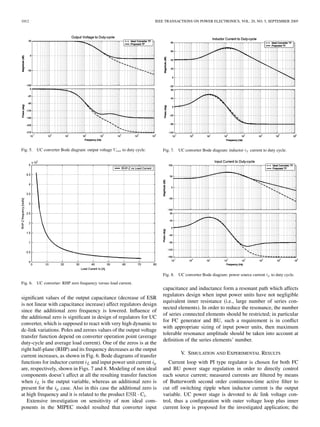
Fig. 5. UC converter Bode diagram: output voltage V to duty cycle.
Fig. 6. UC converter: RHP zero frequency versus load current.
significant values of the output capacitance (decrease of ESR
is not linear with capacitance increase) affect regulators design
since the additional zero frequency is lowered. Influence of
the additional zero is significant in design of regulators for UC
converter, which is supposed to react with very high dynamic to
dc-link variations. Poles and zeroes values of the output voltage
transfer function depend on converter operation point (average
duty-cycle and average load current). One of the zeros is at the
right half-plane (RHP) and its frequency decreases as the output
current increases, as shown in Fig. 6. Bode diagrams of transfer
functions for inductor current and input power unit current
are, respectively, shown in Figs. 7 and 8. Modeling of non ideal
components doesn’t affect at all the resulting transfer function
when is the output variable, whereas an additional zero is
present for the case. Also in this case the additional zero is
at high frequency and it is related to the product C .
Extensive investigation on sensitivity of non ideal com-
ponents in the MIPEC model resulted that converter input
Fig. 7. UC converter Bode diagram: inductor i current to duty cycle.
Fig. 8. UC converter Bode diagram: power source current i to duty cycle.
capacitance and inductance form a resonant path which affects
regulators design when input power units have not negligible
equivalent inner resistance (i.e., large number of series con-
nected elements). In order to reduce the resonance, the number
of series connected elements should be restricted; in particular
for FC generator and BU, such a requirement is in conflict
with appropriate sizing of input power units, then maximum
tolerable resonance amplitude should be taken into account at
definition of the series elements’ number.
V. SIMULATION AND EXPERIMENTAL RESULTS
Current loop with PI type regulator is chosen for both FC
and BU power stage regulation in order to directly control
each source current; measured currents are filtered by means
of Butterworth second order continuous-time active filter to
cut off switching ripple when inductor current is the output
variable. UC power stage is devoted to dc link voltage con-
trol, thus a configuration with outer voltage loop plus inner
current loop is proposed for the investigated application; the
SOLERO et al.: DESIGN OF MULTIPLE-INPUT POWER CONVERTER 1013
TABLE III
MIPEC REGULATORS PARAMETERS
Fig. 9. Simulation results: UC converter response (v and i ) at load current
step variation.
current loop has come out to be indispensable to control cur-
rent either fed or soaked by UC tank whenever any dc-link
voltage unbalance occurs. A well-designed fast control loop
can greatly improve the whole system dynamic performance
during load transients, as well the propulsion system makes
the best use of UCs own dynamic characteristics and high
power density. To this purpose a PI type regulator is chosen
for the current loop, whereas a two-zeros/three-poles regulator
has been designed for the voltage loop [7]. Both current and
voltage regulators have been tuned by means of Bode diagram
in order to achieve a satisfactory behavior for the whole system
regulator converter filter . Poles and zeros placement
has produced the following expressions for respectively current
regulators and voltage regulator transfer functions:
(12)
where the parameters for each regulator are shown in Table III,
and are, respectively, the current and the voltage
error, and and are the outputs of, respectively, the
current and the voltage regulator.
Control loops’ design has been investigated by means of
Matlab-Simulink models in which quantization of measures
and control discrete transfer functions have been taken in
consideration as well as both true calculus mode adopted on
DSP and control loop delays have been included. Dynamic
response and stability for each converter included in MIPEC
configuration have been tested at different reference signals
and load variations, achieved results show good dynamic per-
formance in every simulated operating condition. In Figs. 9
and 10, UC converter response is shown for load current step
Fig. 10. Simulation results: UC converter response (v and i ) at load
current step variation.
variation of 30 A, respectively, when and are used as
regulated variable in current loop. Both simulations show a
smooth regulation of the output voltage; however, the mode of
operation of a Butterworth second order continuous-time active
filter is considered when inductor current is controlled, whereas
no filtering of the controlled current is required to control the
power source current.
A fixed-point 16-b DSP from Analog Devices has been
used in order to implement the MIPEC whole control system.
MIPEC switching frequency is chosen to be 15 kHz according
to hardware components specifications; besides, a fixed length
of 133 s is chosen as maximum period required for the whole
control algorithm to be completely executed. As a consequence,
the maximum achievable sampling frequency of 7.5 kHz has
been chosen to implement regulators’ transfer functions in
discrete form for both BU and FC current loops; whereas the
frequency of 1.875 kHz has been used for the UC double loop.
In fact, a four times reduced frequency improves stiffness of
the UC control system by reducing the effects of the voltage
loop RHP-zero. DSP standard fixed point configuration was
adopted for the whole algorithm except for UC regulator
implemented by using the emulated floating point mode of
operation. Control algorithm includes time-variation limiting
of currents should be supplied by either FC generator or BU to
achieve a safe dynamic mode of operation for both the power
source and the main energy storage. UC power stage currents
have no time-variation limitation in order to achieve the most
effective output voltage regulation. DSP is also responsible
for system protection actions (i.e., overcurrents, overvoltages
and overtemperature). Experimental measurement revealed the
DSP takes 110 s to complete the control algorithm execution,
this value well fits the previously chosen maximum available
time. Figs. 11 and 12 show, respectively, the block diagram of
the whole system and the block diagram of the UC power stage
control in which are schematically depicted the regulators,
filters, AD converters and PWM generators. Block diagrams
of both FC and BU power stage control are similar to the one
shown in Fig. 12 where the voltage regulator should not be
included.
For experimental testing activity purpose, FC generator
has been simulated by means of a 20 kW regulated dc power
1014 IEEE TRANSACTIONS ON POWER ELECTRONICS, VOL. 20, NO. 5, SEPTEMBER 2005
Fig. 11. MIPEC control block diagram.
Fig. 12. Block diagram of the UC power stage control.
source, UC tank was accomplished with three BMOD0115A09
Maxwell modules (42 V, 145 F) in series connections, series
connection of 12 modules from Genesis (12 V, 13 Ah) form the
battery unit. Dynamic response for each power stage converter
has been tested; transients of UC power stage at step variation
of voltage reference have been investigated in detail at no-load
operation, which is the worst case for output voltage control as
MIPEC output capacitors provide a very low damping effect.
In Fig. 13, the UC converter experimental response is shown
for load current step variation of about 25 A when is used as
regulated variable in current loop. The comparison with time
response and output voltage regulation of Fig. 9 validates the
proposed theoretical approach for designing the regulators for
both current loop and voltage loop; however, non idealities
in cables, connections, and components of the experimental
set-up slightly change current and voltage transients, therefore,
the experimental testing shows a more damped behavior of the
system than the achieved simulations.
Fig. 13. Experimental results: UC converter response (v and i ) at load
current step variation.
Fig. 14. Experimental results: MIPEC load transient operation at 0–50 A load
current step variation.
Load testing has been carried out by operating all MIPEC
power stages at the same time. Figs. 14 and 15 show MIPEC
dynamic performance at load operation corresponding to resis-
tive load step variation respectively from no-load to 4.33 (i.e.,
50 A at 216 V) and from 4.33 to no-load; current variation
versus time limitation is implemented for both FC generator and
BU storage, UC converter acts in order to compensate the output
voltage variation. In case of quite low SOC for storage units, as
transient is completed, BU and UC would require to be charged
(at constant current) from FC generator.
Complete propulsion system has been loaded with several dif-
ferent driving cycles and tested at ENEA lab facilities. Fig. 16
shows the current waveforms for each input power source and
dc-link when almost 50 Nm torque step is applied to the traction
SOLERO et al.: DESIGN OF MULTIPLE-INPUT POWER CONVERTER 1015
Fig. 15. Experimental results: MIPEC load transient operation at 50-0 A load
current step variation.
Fig. 16. Experimental results: propulsion system transient operation at traction
motor torque step.
Fig. 17. Experimental results: propulsion system testing at modified urban
ECE-15 driving cycle.
motor; whereas Fig. 17 depicts same current waveforms when
the complete propulsion system is loaded with urban ECE-15
driving cycle, whose accelerations have been 40% increased in
order to achieve a more realistic testing. It can be noticed that
UCs run during short and severe both accelerations and brak-
ings, whereas gentle speed variations are accomplished by FC
generator.
VI. CONCLUSION
The topology for a three-inputs/one-output power converter
(MIPEC) devoted to HEVs applications has been presented.
On-board generation and storage units’ sizing as well MIPEC
design and prototypal realization have been carried on ac-
cording to specifications from traction drive and vehicle
performances. Dynamic modeling of the proposed converter
has been achieved to evince dependence of system transient
behavior from parameters of on-board generator, storage units
and traction drive. Simulations confirmed performances of
designed regulators and control strategy. A 60-kW MIPEC
prototype has been used for the hybrid propulsion system
where a 18-kW fuel cell is the main generation unit and
batteries and ultracapacitors form the combined storage unit.
Experimental testing of the whole system has been accom-
plished at a suitable HEV test-bed where applied traction drive
torque transients and several driving cycles proved MIPEC
good dynamic behavior.
ACKNOWLEDGMENT
The authors wish to thank A. Puccetti for supporting the ex-
perimental activities at ENEA laboratory facilities.
REFERENCES
[1] V. Raman, “The hydrogen fuel option for fuel cell vehicle fleets,” Fuel
Cell Power Transport., pp. SAE SP–1425, 1999.
[2] K. Dircks, “Recent advances in fuel cells for transportation applica-
tions,” Fuel Cell Power Transport., pp. SAE SP–1425, 1999.
[3] A. Rufer and P. Barrade, “Key developments for supercapacitive energy
storage: Power electronic converters, systems, and control,” in Proc. 2nd
Boostcap Meeting. Fribourg, Switzerland, 2005.
[4] A. Di Napoli, F. Crescimbini, F. G. Capponi, and L. Solero, “Control
strategy for multiple input dc–dc power converters devoted to hybrid
vehicle propulsion system,” in Proc. IEEE ISIE’02, L’Aquila, Italy, Jul.
2002, pp. 1036–1041.
[5] R. D. Middlebrook and S. Cuk, “A general unified approach to modeling
switching converter power stage,” in Proc. IEEE PESC, 1976, pp. 18–34.
[6] P. T. Krein, J. Bentsman, R. M. Bass, and B. L. Lesieutre, “On the use
of averaging for the analysis of power electronic systems,” IEEE Trans.
Power Electron., vol. 5, no. 2, pp. 182–190, Apr. 1990.
[7] J. A. Pomilio, L. Solero, F. Crescimbini, and A. Di Napoli, “Dynamic
modeling and regulators design for multiple input power converters for
the propulsion system of electric vehicles,” in Proc. COBEP’03, Fort-
aleza, Brazil, Sep. 2003, pp. 362–367.
[8] A. Di Napoli, F. Crescimbini, S. Rodo, and L. Solero, “Multiple input
DC-DC converter for fuel-cell powered hybrid vehicles,” in Proc. IEEE
PESC’02, Cairns, Australia, Jun. 2002.
1016 IEEE TRANSACTIONS ON POWER ELECTRONICS, VOL. 20, NO. 5, SEPTEMBER 2005
Luca Solero (M’98) received the M.S. degree in
electrical engineering from the University of Rome,
Rome, Italy, in 1994.
Since 1996, he has been with the Department
of Mechanical and Industrial Engineering, Uni-
versity of “Roma Tre,” where he is currently an
Assistant Professor. During 2002, he was a Visiting
Scholar at the Center for Power Electronics Systems
(CPES), Virginia Polytechnic Institute and Univer-
sity, Blacksburg. He has coauthored more than 60
published technical papers and has been involved
in several government and industry-sponsored projects in the fields of power
electronics and electrical drives. His research interests include power converter
topologies, permanent magnet motor drive and control systems design for
unconventional applications such as electric and hybrid vehicle, and renewable
energy systems.
Mr. Solero is a member of the IEEE Industry Applications, IEEE Power Elec-
tronics, and IEEE Industrial Electronics Societies.
Alessandro Lidozzi (S’04) received the M.S. degree
in electronic engineering from the University of
Rome, Rome, Italy, in 2003, where he is currently
pursuing the Ph.D. degree.
His research interests are mainly focused in multi-
converter based applications, dc–dc power converters
modeling and control, and nonlinear control of per-
manent magnet motor drives.
Mr. Lidozzi received the Student Award and a
Travel Grant from the International Symposium on
Industrial Electronics (ISIE) in 2004. He is member
of the IEEE Industrial Electronics Society.
José Antenor Pomilio (M’92–SM’02) was born in
Jundiaí, Brazil, in 1960. He received the B.S., M.S.,
and Ph.D. degrees in electrical engineering from the
University of Campinas, Brazil, in 1983, 1986, and
1991, respectively.
From 1988 to 1991, he was head of the Power
Electronics Group, Brazilian Synchrotron Labora-
tory. Currently, he is a Professor at the School of
Electrical and Computer Engineering, University of
Campinas, where he has been since 1984. In 1993
and 2003, he was Visiting Professor at the University
of Padova, Padova, Italy, and at the Third University of Rome, Rome, Italy,
respectively. His main interests are switching-mode power supplies, power
factor correction, electrical drives, and active power filters.
Dr. Pomilio is an Associate Editor of the IEEE TRANSACTIONS ON POWER
ELECTRONICS.

Tpel.2005.854020

  • 1.
    IEEE TRANSACTIONS ONPOWER ELECTRONICS, VOL. 20, NO. 5, SEPTEMBER 2005 1007 Design of Multiple-Input Power Converter for Hybrid Vehicles Luca Solero, Member, IEEE, Alessandro Lidozzi, Student Member, IEEE, and Josè Antenor Pomilio, Senior Member, IEEE Abstract—This paper deals with designing and sizing of a multiple-input power electronic converter (MIPEC) to be used in an electric vehicle propulsion system that includes a fuel cell (FC) generator and a combined storage unit. The combined storage unit is composed by an ultracapacitors tank (UC) and a battery unit (BU). MIPEC is responsible for power-flow management on-board the vehicle for each mode of operation. Specifications for MIPEC designing come out from many considerations concerning traction drive and reference driving cycle, on-board power source and storage unit characteristics. However, to date sizing and configuration of both storage units and on-board generators are directly related to traction drive and driving profile (i.e., vehicle performances and characteristics) and no relation with power electronic interface is considered during preliminary design. Then, power electronic interface is selected in order to fit traction drive requirements with power source and storage unit char- acteristics; as a consequence converter mode of operation lacks of optimization, as well dynamic behavior and efficiency cannot be maximized. In this paper, MIPEC design and power source and storage unit selection are achieved at the same project stage according to traction drive requirements. Experimental results on 60-kW power electronic interface are presented. Index Terms—Control design, dc–dc converter, fuel cell, ultra- capacitors. I. INTRODUCTION PRESENT research concerning electric vehicles (EV) and hybrid-electric vehicles (HEV) concentrate in the search for a compact, lightweight, and efficient energy storage system that is both affordable and has acceptable cycle life. The trac- tion system, composed by electric motor, inverter, and associ- ated control circuitry is not the limiting factor to obtain high performance and to permit large-scale production of such vehi- cles. Attention is now increasingly focused on fuel cell (FC) and hybrid technologies as a way of producing breakthrough vehi- cles with alternative power plants. A number of auto makers see fuel cell powered vehicles as the ultimate route to achieving sus- tainable long-term alternative propulsion systems. A number of drive-train architectures have recently been proposed to com- bine two or more on-board generation units and storage units Manuscript received February 17, 2004; revised February 11, 2005. Recom- mended by Associate Editor X. Xu. L. Solero and A. Lidozzi are with the Department of Mechanical and Industrial Engineering, University of Rome, Rome, Italy (e-mail: solero@uniroma3.it). J. A. Pomilio is with the School of Electrical and Computer Engineering, State University of Campinas, Campinas, Brazil (e-mail: antenor@dsce.fee. unicamp.br). Digital Object Identifier 10.1109/TPEL.2005.854020 and to overcome constraints related to fuel consumption, pol- lution, vehicles’ long distance capability. Interfacing of traction drive requirements with characteristics and modes of operation of on-board generation units and storage units calls for suit- able power electronic converter configuration and control. In this paper, a three-inputs/one-output converter is proposed for a propulsion system where the generation unit is a 18 kW FC and the combined storage unit is formed by lead-acid batteries and ultracapacitors (UCs); however, same converter configura- tion is appropriate also for different either generation units or storage units. In terms of power sources, the proton exchange membrane FCs are being increasingly accepted as the most appropriate supply for EVs [1], [2] because they offer clean and efficient energy without penalizing performance or driving range. A bat- tery storage unit (BU) can be combined with the FC stack to achieve the maximum efficiency for the FC system. The BU de- livers the difference between the energy required by the trac- tion drive and the energy supplied by the FC system. In such a system the BU has to deal with power peaks being on demand during either acceleration or braking phases. Such transients re- sult in a hard constraint for the battery unit, which increases the losses and temperature, and reduces its lifetime. Thereby, it is desirable to minimize these power peaks by introducing an ad- ditional auxiliary power device: the ultracapacitors [3], which present high power density, obtain regeneration energy at high efficiency during decelerations and supply the stored energy during accelerations. In spite of reaching thousands of Farads, the UCs support very low voltages (1–2.5 V). A stack of se- ries-connected UCs can produce an equivalent capacitor of tens of Farads that is able to hold up tens of Volts. The UC stack must supply the power required in excess of the FC-BU system rated power, provided that the ultracapacitors’ state of charge (SOC) is greater than a minimum threshold. Whenever the power re- quired to operate the vehicle is lower than the FC-BU rated power, the ultracapacitors can be charged with the power in excess. Whenever regenerative braking operations occur, energy is put into the UC tank provided this device is not fully charged yet. The investigated propulsion system arrangement is shown in Fig. 1, where the FC is the main generation unit and BU and UCs form the combined storage unit. Under light load condi- tions, due to the poor efficiency of the fuel cell, the battery is used to supply the power to the load. The UC tank is used to satisfy acceleration and regenerative braking requirements ac- complishing system load transients and improving on-board BU cyclic life. Additionally, it is responsible to control the dc-link 0885-8993/$20.00 © 2005 IEEE
  • 2.
    1008 IEEE TRANSACTIONSON POWER ELECTRONICS, VOL. 20, NO. 5, SEPTEMBER 2005 Fig. 1. Proposed hybrid drive-train. voltage, while the other sources are current controlled in order to limit the current variation ratio and to prevent excessive peaks. The goal of this paper is to develop designing and sizing for the dc–dc converters in order to achieve the best compromise for FC generator and combined storage unit sizing, and system dynamic behavior; thus it will be analyzed the influence of the system components in choosing the best feedback variable for each converter and to designing the satisfactory regulators. II. MIPEC TOPOLOGY As mentioned, a multiple-input power electronic converter (MIPEC) is proposed to interface traction drive requirements with characteristics of on-board generation units and storage units. Both FC and UC typically present a lower terminal voltage than the dc voltage necessary to feed the traction inverter. Also for the BU would be of practical interest to use a lower voltage, in order to minimize the series resistance. In such cases it is necessary to use step-up converters for connecting the sources with the common dc bus. Additionally, for the BU and for the UCs it is necessary to have step-down operation in order to recharge them and to accomplish regenerative braking, what means that these converters must be bidirectional in current. A convenient topology is shown in Fig. 2. Each dc–dc converter can be built using a branch of a three-phase dc–ac converter, what means that there are power modules and drives already available in the market. Considering that the common dc-link voltage is the highest, the bottom transistor, together with the top diode, configures a boost converter, while the bottom diode and the top transistor realize the buck converter. For the FC converter the buck action must not occur because this apparatus does not take charge from the dc-link. A filter capacitor is connected at each source terminals in order to minimize the circulation of high-frequency components through the supplies. This filtering is as effective due to the presence of the sources series resistance. The converters can be voltage or current controlled, de- pending on the source role in the overall system, and their limitations. For example, it is important to limit the current variation in the FC, as well as in the BU. As any capacitor, the UC can be controlled in voltage mode, using a maximum current protection. The reference signals for the control loops Fig. 2. Proposed MIPEC topology. are derived from many parameters: the instantaneous load current, the dc-link voltage, the BU and UC state of charges, the FC output power, etc. In the following the expressions for reference signals, to be used in MIPEC control, are provided const (1) where and are, respectively, the dc-link and fuel cell measured current, and are the current values of charging and discharging for ultracapacitor tank and battery unit whenever storage units’ SOC is either lower or higher of the ordinary admitted range, , and are duty cycles of, re- spectively, BU and FC converters and is the dc-link voltage. First two expressions give reference currents for fuel cell and battery unit converters, reference signals’ variation is controlled on the basis of generator and storage unit characteristics. The ul- tracapacitor converter is regulated to keep dc-link voltage either constant or at the most suitable value for traction drive mode of operation. III. DYNAMIC MODELING Dynamic modeling is necessary to evince the relationships between system transient behavior and either on-board power source or combined storage unit or traction drive parameters.
  • 3.
    SOLERO et al.:DESIGN OF MULTIPLE-INPUT POWER CONVERTER 1009 Fig. 3. DC–DC converter for dynamic modeling. Small signal modeling, considering the average value of the state variables over one switching period, is a well-known method to analyze time-varying nonlinear systems, like a switched-mode power supply [4], [5]. The resulting model is valid in a frequency range sufficiently below the switching frequency. The state equations or the equivalent transfer func- tion can be used to design the regulators in order to achieve a desired system performance. There are many methods to achieve dynamic modeling of power converters and in this paper the one described in [6] is used. However, some modifications to the well known state vari- ables averaging method have been included in order to take into account possible dependence of output variables from in- puts’ vector. The proposed modifications allow to include par- asitics of both converter power inductors and capacitors and to take in consideration inner resistance of both vehicle on-board power sources and storage units. Fig. 3 shows the single dc-dc converter considered, including mentioned parasitics of power components. If the converter works as step-up, the average value of the currents , and are positive. In the step-down mode (necessary to recharge BU and UC), the average values are nega- tive. As the dynamic behavior as boost converter imposes more severe restrictions for the control loop design, this case is an- alyzed at the beginning and, afterwards, the buck operation is verified. As the power switches operate in complementary way, the converter always operates in continuous conduction mode (CCM). Notice that, in steady state, the duty-cycle depends only on the voltages and (neglecting the parasitic resis- tances). The average current is adjusted during the transients and does not depend on the voltages. A. State Variables Averaging Method The state variables, usually the inductors current and the ca- pacitors voltage, are represented in the vector . The sources are represented in the vector . For the next analysis the sources are supposed of fixed value. For each topologic situation, the differ- ential equations should be obtained and put in the format . These equations are valid during one topologic combination, for example, while the transistor is on. During the diode conduction, the equations will be . As the circuit operates in CCM, there are only these two cases. The same procedure is used to obtain the equations that de- scribe the output variable: C , for the first topologic state and C for the second one. The system behavior can be obtained averaging each matrix by the duty-cycle, , in which it is valid (2) C C (3) It is possible to split the state variables, the output and the control variable (duty-cycle) in their average value plus a perturbation (4) Substituting (4) into (2) and (3), and neglecting the product of two perturbations, it is possible to obtain the desired transfer function and the output average value C C C (5) C (6) where C C C B. Boost-Converter Let us consider the boost converter, in the CCM, having a ca- pacitive input filter and including parasitics of power inductors and capacitors. The voltage source presents a series resistance . The load is represented by a current source that, for the dy- namic analysis, is an additional input. Fig. 3 shows the circuit and Fig. 4 indicates both equivalent topologies. Taking the voltage as the output variable, the transfer function to the duty-cycle, that is the control variable, is calcu- lated using the equations shown at the bottom of the next page. Thus, the resulting transfer function is C C C (7) where, in case of ideal converter, , and C C [7]. This expression is used to analyze UC converter dynamic be- havior; as it will be more clearly detailed in the next paragraph, the behavior of the resulting transfer function is different from ideal converter transfer function mainly for the presence of an additional zero; which is caused by output capacitor resistance and capacitance C and it is usually positioned at quite high frequency.
  • 4.
    1010 IEEE TRANSACTIONSON POWER ELECTRONICS, VOL. 20, NO. 5, SEPTEMBER 2005 (a) (b) Fig. 4. (a) Low-side switch conduction (either step-up switch or step-down diode). (b) High-side switch conduction (either step-up diode or step-down switch). As FC and BU converters are controlled in current mode, it is necessary to define in which point the current should be con- trolled. The inductor current and the source current are the two options which have been investigated. When the inductor cur- rent is the controlled variable an additional low-pass filter in the feedback path is required for low inductance value, thus making quite difficult to design a regulator for having wide compensa- tion band with secure phase margin. In case of source current as controlled variable, the natural filtering introduced by the input capacitor avoids the additional low-pass filter and regulator de- sign has less constraints. Taking the current as the output variable, no differences are found in A and B matrices since they depend on circuit mod- eling, whereas C, G, and E are the following: C C thus, the resulting function to the duty cycle is different from ideal converter situation only for and it can be ex- pressed as C (8) When the current is the output variable matrices C, G, and E are the following: C C C the resulting function to the duty cycle is different from the ideal converter case for the presence of the G matrix and because C (9) FC and BU converters’ dynamic behavior can be investigated by using either (8) or (9). However, control of the source current allows at least a reduced order filter in the feedback path; thus, C C C C C C C C C C C
  • 5.
    SOLERO et al.:DESIGN OF MULTIPLE-INPUT POWER CONVERTER 1011 the resulting higher phase margin of the converter transfer func- tion tolerates high gain regulators and dynamic of the converter is improved. IV. MIPEC DESIGN Power sizing of both generation and storage units has been achieved on the basis of standard driving cycle and desired per- formances for a small size HEVs class. The chosen generation unit is a 18-kW FC since it is able to deliver the average power required by the most common combined urban-highway driving cycles. Efficiency of FC generator dramatically decreases when required power is less than 10–15% of the FC maximum deliv- erable power; therefore, the FC generator should be switched off and the BU is in charge of supplying the required power. Total energy required for the BU, considering that it is also respon- sible of on-board electric loads, is almost 7000 kJ; besides the BU itself should be able to deliver 10 kW for at least 10 min in order to assure 130 km/h cruising speed of the vehicle for the mentioned time. A 30 kW–260 kJ UC tank is needed as it is re- sponsible of great part of vehicle accelerations and regenerative brakings, in fact current variations are limited for both FC gen- erator and BU to reduce stress and to assure them a sufficient life-time. The commercial traction drive used in the proposed propul- sion system is formed of a VSI-inverter and an induction motor, and it is rated 216 V–140 A at dc-link. Selection of voltage and current rated values for both generation and storage units must comply with traction drive and MIPEC topology specifications, in fact the number of elements that must be connected in series to form either the FC generator or the BU or the UC tank has minimum and maximum values related to both dc-link voltage and acceptable duty cycle values for MIPEC switches. The fol- lowing expressions can be used to find out the most suitable number of elements to be connected in series (10) (11) where and are the lowest and highest acceptable element voltage, is the equivalent inner resistance for each element, and are the minimum and maximum accepted values for each unit under investigation, and are, respectively, the lowest and highest value for switch duty cycle in boost mode of operation, whereas the same meaning is related to and in buck mode of operation. Investigation on commercial products and the iterative applying of (10) and (11) for both UC tank and BU, and only (10) for FC generator, led to define generation and storage units’ configuration as shown in Table I. Final FC generator configuration is rated 18 kW–160 A, 112 V (inner voltage drop is included) at rated power—and elements number of 200 was chosen among the results satis- fying (10) (i.e., 135 203) in order to limit at 0.5 in steady state condition and improve the switch utilization factor. Similar considerations on improving switch utilization factor led to choose 12 elements for 13 is the solution to (10) and (11)—that is formed of Genesis batteries TABLE I GENERATION AND STORAGE UNITS CONFIGURATION TABLE II MIPEC POWER COMPONENTS rated 12 V, 13 Ah. Cost saving and energy specification for UC tank affected the choice of UC modules number; in fact the best solution for (10) and (11) is 4 on the basis of the switch utilization factor. However, on the basis of commercial products available in the market it would result in over-sizing the UC unit energy, thus three modules of Maxwell UCs each rated 42 V, 145 F have been considered. Traction drive dc-link voltage and current values of gener- ation and storage units represent specifications for switching components’ selection. Voltage ripple in dc-link is the param- eter used for MIPEC output capacitance sizing, however it must be ensured that selected capacitor tolerates RMS value of the output ripple current [8]. Input capacitor and inductor are re- sponsible of input current ripple reduction: choice of 15 kHz as switching frequency led to components’ selection as shown in Table II. Parameters’ values shown in Tables I and II are used in transfer functions (7)–(9) for MIPEC dynamic investigation. It is found that output capacitors’ equivalent series resistance (ESR) introduces a high frequency additional zero in the output voltage transfer function with respect to ideal converter case as it can be noticed in Fig. 5; being the frequency position of the additional zero inversely related to the product C ,
  • 6.
    1012 IEEE TRANSACTIONSON POWER ELECTRONICS, VOL. 20, NO. 5, SEPTEMBER 2005 Fig. 5. UC converter Bode diagram: output voltage V to duty cycle. Fig. 6. UC converter: RHP zero frequency versus load current. significant values of the output capacitance (decrease of ESR is not linear with capacitance increase) affect regulators design since the additional zero frequency is lowered. Influence of the additional zero is significant in design of regulators for UC converter, which is supposed to react with very high dynamic to dc-link variations. Poles and zeroes values of the output voltage transfer function depend on converter operation point (average duty-cycle and average load current). One of the zeros is at the right half-plane (RHP) and its frequency decreases as the output current increases, as shown in Fig. 6. Bode diagrams of transfer functions for inductor current and input power unit current are, respectively, shown in Figs. 7 and 8. Modeling of non ideal components doesn’t affect at all the resulting transfer function when is the output variable, whereas an additional zero is present for the case. Also in this case the additional zero is at high frequency and it is related to the product C . Extensive investigation on sensitivity of non ideal com- ponents in the MIPEC model resulted that converter input Fig. 7. UC converter Bode diagram: inductor i current to duty cycle. Fig. 8. UC converter Bode diagram: power source current i to duty cycle. capacitance and inductance form a resonant path which affects regulators design when input power units have not negligible equivalent inner resistance (i.e., large number of series con- nected elements). In order to reduce the resonance, the number of series connected elements should be restricted; in particular for FC generator and BU, such a requirement is in conflict with appropriate sizing of input power units, then maximum tolerable resonance amplitude should be taken into account at definition of the series elements’ number. V. SIMULATION AND EXPERIMENTAL RESULTS Current loop with PI type regulator is chosen for both FC and BU power stage regulation in order to directly control each source current; measured currents are filtered by means of Butterworth second order continuous-time active filter to cut off switching ripple when inductor current is the output variable. UC power stage is devoted to dc link voltage con- trol, thus a configuration with outer voltage loop plus inner current loop is proposed for the investigated application; the
  • 7.
    SOLERO et al.:DESIGN OF MULTIPLE-INPUT POWER CONVERTER 1013 TABLE III MIPEC REGULATORS PARAMETERS Fig. 9. Simulation results: UC converter response (v and i ) at load current step variation. current loop has come out to be indispensable to control cur- rent either fed or soaked by UC tank whenever any dc-link voltage unbalance occurs. A well-designed fast control loop can greatly improve the whole system dynamic performance during load transients, as well the propulsion system makes the best use of UCs own dynamic characteristics and high power density. To this purpose a PI type regulator is chosen for the current loop, whereas a two-zeros/three-poles regulator has been designed for the voltage loop [7]. Both current and voltage regulators have been tuned by means of Bode diagram in order to achieve a satisfactory behavior for the whole system regulator converter filter . Poles and zeros placement has produced the following expressions for respectively current regulators and voltage regulator transfer functions: (12) where the parameters for each regulator are shown in Table III, and are, respectively, the current and the voltage error, and and are the outputs of, respectively, the current and the voltage regulator. Control loops’ design has been investigated by means of Matlab-Simulink models in which quantization of measures and control discrete transfer functions have been taken in consideration as well as both true calculus mode adopted on DSP and control loop delays have been included. Dynamic response and stability for each converter included in MIPEC configuration have been tested at different reference signals and load variations, achieved results show good dynamic per- formance in every simulated operating condition. In Figs. 9 and 10, UC converter response is shown for load current step Fig. 10. Simulation results: UC converter response (v and i ) at load current step variation. variation of 30 A, respectively, when and are used as regulated variable in current loop. Both simulations show a smooth regulation of the output voltage; however, the mode of operation of a Butterworth second order continuous-time active filter is considered when inductor current is controlled, whereas no filtering of the controlled current is required to control the power source current. A fixed-point 16-b DSP from Analog Devices has been used in order to implement the MIPEC whole control system. MIPEC switching frequency is chosen to be 15 kHz according to hardware components specifications; besides, a fixed length of 133 s is chosen as maximum period required for the whole control algorithm to be completely executed. As a consequence, the maximum achievable sampling frequency of 7.5 kHz has been chosen to implement regulators’ transfer functions in discrete form for both BU and FC current loops; whereas the frequency of 1.875 kHz has been used for the UC double loop. In fact, a four times reduced frequency improves stiffness of the UC control system by reducing the effects of the voltage loop RHP-zero. DSP standard fixed point configuration was adopted for the whole algorithm except for UC regulator implemented by using the emulated floating point mode of operation. Control algorithm includes time-variation limiting of currents should be supplied by either FC generator or BU to achieve a safe dynamic mode of operation for both the power source and the main energy storage. UC power stage currents have no time-variation limitation in order to achieve the most effective output voltage regulation. DSP is also responsible for system protection actions (i.e., overcurrents, overvoltages and overtemperature). Experimental measurement revealed the DSP takes 110 s to complete the control algorithm execution, this value well fits the previously chosen maximum available time. Figs. 11 and 12 show, respectively, the block diagram of the whole system and the block diagram of the UC power stage control in which are schematically depicted the regulators, filters, AD converters and PWM generators. Block diagrams of both FC and BU power stage control are similar to the one shown in Fig. 12 where the voltage regulator should not be included. For experimental testing activity purpose, FC generator has been simulated by means of a 20 kW regulated dc power
  • 8.
    1014 IEEE TRANSACTIONSON POWER ELECTRONICS, VOL. 20, NO. 5, SEPTEMBER 2005 Fig. 11. MIPEC control block diagram. Fig. 12. Block diagram of the UC power stage control. source, UC tank was accomplished with three BMOD0115A09 Maxwell modules (42 V, 145 F) in series connections, series connection of 12 modules from Genesis (12 V, 13 Ah) form the battery unit. Dynamic response for each power stage converter has been tested; transients of UC power stage at step variation of voltage reference have been investigated in detail at no-load operation, which is the worst case for output voltage control as MIPEC output capacitors provide a very low damping effect. In Fig. 13, the UC converter experimental response is shown for load current step variation of about 25 A when is used as regulated variable in current loop. The comparison with time response and output voltage regulation of Fig. 9 validates the proposed theoretical approach for designing the regulators for both current loop and voltage loop; however, non idealities in cables, connections, and components of the experimental set-up slightly change current and voltage transients, therefore, the experimental testing shows a more damped behavior of the system than the achieved simulations. Fig. 13. Experimental results: UC converter response (v and i ) at load current step variation. Fig. 14. Experimental results: MIPEC load transient operation at 0–50 A load current step variation. Load testing has been carried out by operating all MIPEC power stages at the same time. Figs. 14 and 15 show MIPEC dynamic performance at load operation corresponding to resis- tive load step variation respectively from no-load to 4.33 (i.e., 50 A at 216 V) and from 4.33 to no-load; current variation versus time limitation is implemented for both FC generator and BU storage, UC converter acts in order to compensate the output voltage variation. In case of quite low SOC for storage units, as transient is completed, BU and UC would require to be charged (at constant current) from FC generator. Complete propulsion system has been loaded with several dif- ferent driving cycles and tested at ENEA lab facilities. Fig. 16 shows the current waveforms for each input power source and dc-link when almost 50 Nm torque step is applied to the traction
  • 9.
    SOLERO et al.:DESIGN OF MULTIPLE-INPUT POWER CONVERTER 1015 Fig. 15. Experimental results: MIPEC load transient operation at 50-0 A load current step variation. Fig. 16. Experimental results: propulsion system transient operation at traction motor torque step. Fig. 17. Experimental results: propulsion system testing at modified urban ECE-15 driving cycle. motor; whereas Fig. 17 depicts same current waveforms when the complete propulsion system is loaded with urban ECE-15 driving cycle, whose accelerations have been 40% increased in order to achieve a more realistic testing. It can be noticed that UCs run during short and severe both accelerations and brak- ings, whereas gentle speed variations are accomplished by FC generator. VI. CONCLUSION The topology for a three-inputs/one-output power converter (MIPEC) devoted to HEVs applications has been presented. On-board generation and storage units’ sizing as well MIPEC design and prototypal realization have been carried on ac- cording to specifications from traction drive and vehicle performances. Dynamic modeling of the proposed converter has been achieved to evince dependence of system transient behavior from parameters of on-board generator, storage units and traction drive. Simulations confirmed performances of designed regulators and control strategy. A 60-kW MIPEC prototype has been used for the hybrid propulsion system where a 18-kW fuel cell is the main generation unit and batteries and ultracapacitors form the combined storage unit. Experimental testing of the whole system has been accom- plished at a suitable HEV test-bed where applied traction drive torque transients and several driving cycles proved MIPEC good dynamic behavior. ACKNOWLEDGMENT The authors wish to thank A. Puccetti for supporting the ex- perimental activities at ENEA laboratory facilities. REFERENCES [1] V. Raman, “The hydrogen fuel option for fuel cell vehicle fleets,” Fuel Cell Power Transport., pp. SAE SP–1425, 1999. [2] K. Dircks, “Recent advances in fuel cells for transportation applica- tions,” Fuel Cell Power Transport., pp. SAE SP–1425, 1999. [3] A. Rufer and P. Barrade, “Key developments for supercapacitive energy storage: Power electronic converters, systems, and control,” in Proc. 2nd Boostcap Meeting. Fribourg, Switzerland, 2005. [4] A. Di Napoli, F. Crescimbini, F. G. Capponi, and L. Solero, “Control strategy for multiple input dc–dc power converters devoted to hybrid vehicle propulsion system,” in Proc. IEEE ISIE’02, L’Aquila, Italy, Jul. 2002, pp. 1036–1041. [5] R. D. Middlebrook and S. Cuk, “A general unified approach to modeling switching converter power stage,” in Proc. IEEE PESC, 1976, pp. 18–34. [6] P. T. Krein, J. Bentsman, R. M. Bass, and B. L. Lesieutre, “On the use of averaging for the analysis of power electronic systems,” IEEE Trans. Power Electron., vol. 5, no. 2, pp. 182–190, Apr. 1990. [7] J. A. Pomilio, L. Solero, F. Crescimbini, and A. Di Napoli, “Dynamic modeling and regulators design for multiple input power converters for the propulsion system of electric vehicles,” in Proc. COBEP’03, Fort- aleza, Brazil, Sep. 2003, pp. 362–367. [8] A. Di Napoli, F. Crescimbini, S. Rodo, and L. Solero, “Multiple input DC-DC converter for fuel-cell powered hybrid vehicles,” in Proc. IEEE PESC’02, Cairns, Australia, Jun. 2002.
  • 10.
    1016 IEEE TRANSACTIONSON POWER ELECTRONICS, VOL. 20, NO. 5, SEPTEMBER 2005 Luca Solero (M’98) received the M.S. degree in electrical engineering from the University of Rome, Rome, Italy, in 1994. Since 1996, he has been with the Department of Mechanical and Industrial Engineering, Uni- versity of “Roma Tre,” where he is currently an Assistant Professor. During 2002, he was a Visiting Scholar at the Center for Power Electronics Systems (CPES), Virginia Polytechnic Institute and Univer- sity, Blacksburg. He has coauthored more than 60 published technical papers and has been involved in several government and industry-sponsored projects in the fields of power electronics and electrical drives. His research interests include power converter topologies, permanent magnet motor drive and control systems design for unconventional applications such as electric and hybrid vehicle, and renewable energy systems. Mr. Solero is a member of the IEEE Industry Applications, IEEE Power Elec- tronics, and IEEE Industrial Electronics Societies. Alessandro Lidozzi (S’04) received the M.S. degree in electronic engineering from the University of Rome, Rome, Italy, in 2003, where he is currently pursuing the Ph.D. degree. His research interests are mainly focused in multi- converter based applications, dc–dc power converters modeling and control, and nonlinear control of per- manent magnet motor drives. Mr. Lidozzi received the Student Award and a Travel Grant from the International Symposium on Industrial Electronics (ISIE) in 2004. He is member of the IEEE Industrial Electronics Society. José Antenor Pomilio (M’92–SM’02) was born in Jundiaí, Brazil, in 1960. He received the B.S., M.S., and Ph.D. degrees in electrical engineering from the University of Campinas, Brazil, in 1983, 1986, and 1991, respectively. From 1988 to 1991, he was head of the Power Electronics Group, Brazilian Synchrotron Labora- tory. Currently, he is a Professor at the School of Electrical and Computer Engineering, University of Campinas, where he has been since 1984. In 1993 and 2003, he was Visiting Professor at the University of Padova, Padova, Italy, and at the Third University of Rome, Rome, Italy, respectively. His main interests are switching-mode power supplies, power factor correction, electrical drives, and active power filters. Dr. Pomilio is an Associate Editor of the IEEE TRANSACTIONS ON POWER ELECTRONICS.