International Research Journal of Engineering and Technology (IRJET) e-ISSN: 2395-0056
Volume: 05 Issue: 08 | Aug 2018 www.irjet.net p-ISSN: 2395-0072
© 2018, IRJET | Impact Factor value: 7.211 | ISO 9001:2008 Certified Journal | Page 277
Block Chain Technology-An Overview
R.Anusha1, A.Angayarkanni2
1,2Asst.Prof,Department of Computer Science,M.O.P.Vaishnav College For Women(Autonomous),Chennai
---------------------------------------------------------------------***---------------------------------------------------------------------
Abstract - Blockchain is nothing more than a mere data
structure with distributedmultiversionconcurrencycontrol.
According to blockchain technology developers, there are
roughly a thousand companies in the world focusing on
blockchain-related innovations at the moment. Only a small
fraction of these companies are working on actual
blockchain technology development. Blockchain as a
technology has the potential to change the way how
transactions are conducted in everyday life. In addition, the
applications of Blockchain are not limited to
cryptocurrencies, but the technology could be possibly
applied in various environments where some forms of
transactions are done. Therefore, to identifyandunderstand
the current status of research conducted on Blockchain, it is
important to gather all the technical challenges and to
evaluate challenges and the most problematic issues in
Blockchain at the moment.
Key words : Blockchain, Cryptocurrency, Technical
challenges
1. INTRODUCTION
A decentralized transaction and data management
technology which was developed for bitcoin cryptocurrency
management is called as blockchain. The significantfeatures
of block chain technology are security, anonymity and data
integrity maintained during the transactions1. The goal of
Blockchain technology is to create a decentralized
environment where no third party is in control of the
transactions and data. Block chain is a distributed data
management solution which maintains all the transactions
with reference to the number of nodes participating in the
network by recording the data in a public ledger including
the information of all the completed transactions and
sharing the same to all the participating nodes in the
network. Blockchain is a transparent system which
maintains the anonymity of the nodes participating in the
network which makes it very secure and reliable2.
The rest of the paper is organized as follows. Section 2
introduces the background of Blockchain and Bitcoin.
Section 3 and 4, we describe the usecase and challenges in
Block Chain technology and Section 5,concludes the paper.
2. BITCOIN AND BLOCKCHAIN
The Bitcoin system was proposed in 2008 by Satoshi
Nakamoto, that went online in January 2009 . A trading
website called MtGox was started in 2010, making the
exchange of bitcoins and conventional money significantly
easier. The system operates as an online peer-to-peer
network, anyone can join by installing a client application
and connecting it to the network3. The unit of thecurrency is
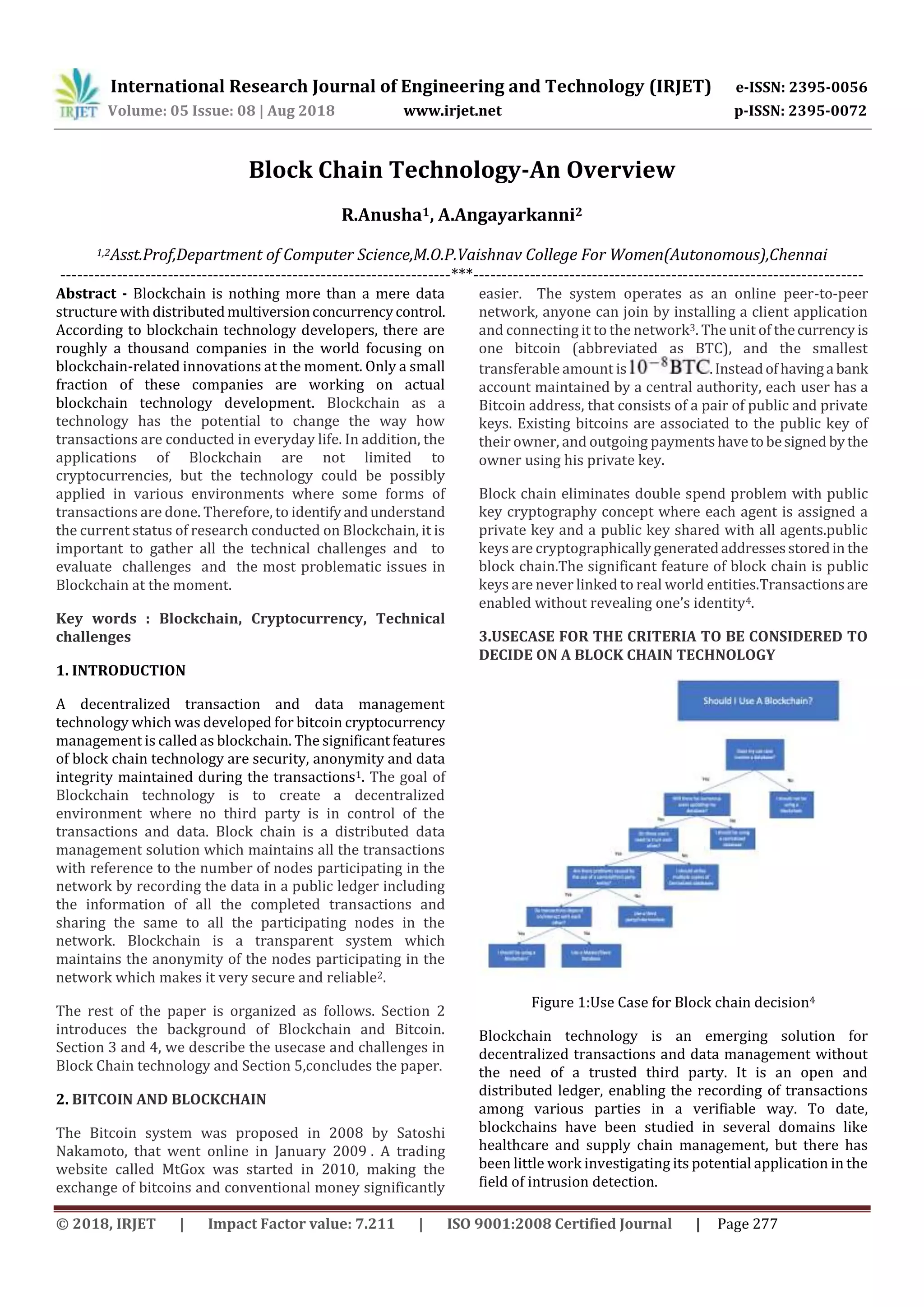
one bitcoin (abbreviated as BTC), and the smallest
transferable amount is .Insteadofhavinga bank
account maintained by a central authority, each user has a
Bitcoin address, that consists of a pair of public and private
keys. Existing bitcoins are associated to the public key of
their owner, and outgoing paymentshavetobesigned bythe
owner using his private key.
Block chain eliminates double spend problem with public
key cryptography concept where each agent is assigned a
private key and a public key shared with all agents.public
keys are cryptographicallygeneratedaddressesstoredin the
block chain.The significant feature of block chain is public
keys are never linked to real world entities.Transactionsare
enabled without revealing one’s identity4.
3.USECASE FOR THE CRITERIA TO BE CONSIDERED TO
DECIDE ON A BLOCK CHAIN TECHNOLOGY
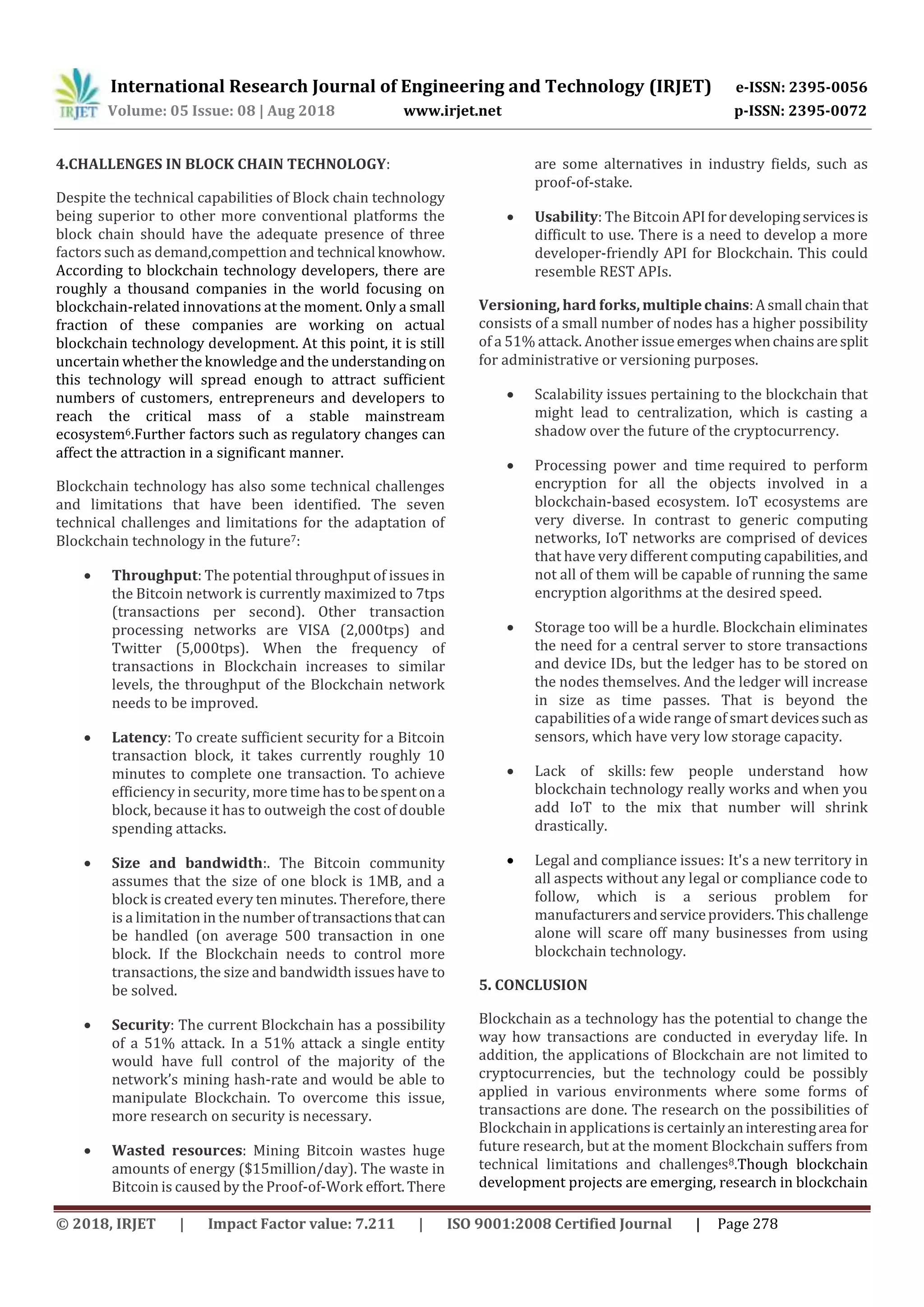
Figure 1:Use Case for Block chain decision4
Blockchain technology is an emerging solution for
decentralized transactions and data management without
the need of a trusted third party. It is an open and
distributed ledger, enabling the recording of transactions
among various parties in a verifiable way. To date,
blockchains have been studied in several domains like
healthcare and supply chain management, but there has
been little work investigating its potential application in the
field of intrusion detection.
International Research Journal of Engineering and Technology (IRJET) e-ISSN: 2395-0056
Volume: 05 Issue: 08 | Aug 2018 www.irjet.net p-ISSN: 2395-0072
© 2018, IRJET | Impact Factor value: 7.211 | ISO 9001:2008 Certified Journal | Page 278
4.CHALLENGES IN BLOCK CHAIN TECHNOLOGY:
Despite the technical capabilities of Block chain technology
being superior to other more conventional platforms the
block chain should have the adequate presence of three
factors such as demand,compettion and technical knowhow.
According to blockchain technology developers, there are
roughly a thousand companies in the world focusing on
blockchain-related innovations at the moment. Only a small
fraction of these companies are working on actual
blockchain technology development. At this point, it is still
uncertain whether the knowledge and the understanding on
this technology will spread enough to attract sufficient
numbers of customers, entrepreneurs and developers to
reach the critical mass of a stable mainstream
ecosystem6.Further factors such as regulatory changes can
affect the attraction in a significant manner.
Blockchain technology has also some technical challenges
and limitations that have been identified. The seven
technical challenges and limitations for the adaptation of
Blockchain technology in the future7:
 Throughput: The potential throughput of issues in
the Bitcoin network is currently maximized to 7tps
(transactions per second). Other transaction
processing networks are VISA (2,000tps) and
Twitter (5,000tps). When the frequency of
transactions in Blockchain increases to similar
levels, the throughput of the Blockchain network
needs to be improved.
 Latency: To create sufficient security for a Bitcoin
transaction block, it takes currently roughly 10
minutes to complete one transaction. To achieve
efficiency in security, more time hastobespentona
block, because it has to outweigh the cost of double
spending attacks.
 Size and bandwidth:. The Bitcoin community
assumes that the size of one block is 1MB, and a
block is created every ten minutes. Therefore, there
is a limitation in the number oftransactionsthatcan
be handled (on average 500 transaction in one
block. If the Blockchain needs to control more
transactions, the size and bandwidth issues have to
be solved.
 Security: The current Blockchain has a possibility
of a 51% attack. In a 51% attack a single entity
would have full control of the majority of the
network’s mining hash-rate and would be able to
manipulate Blockchain. To overcome this issue,
more research on security is necessary.
 Wasted resources: Mining Bitcoin wastes huge
amounts of energy ($15million/day). The waste in
Bitcoin is caused by the Proof-of-Work effort.There
are some alternatives in industry fields, such as
proof-of-stake.
 Usability: The Bitcoin APIfordevelopingservicesis
difficult to use. There is a need to develop a more
developer-friendly API for Blockchain. This could
resemble REST APIs.
Versioning, hard forks, multiplechains:Asmall chainthat
consists of a small number of nodes has a higher possibility
of a 51% attack. Another issueemergeswhenchainsaresplit
for administrative or versioning purposes.
 Scalability issues pertaining to the blockchain that
might lead to centralization, which is casting a
shadow over the future of the cryptocurrency.
 Processing power and time required to perform
encryption for all the objects involved in a
blockchain-based ecosystem. IoT ecosystems are
very diverse. In contrast to generic computing
networks, IoT networks are comprised of devices
that have very different computing capabilities,and
not all of them will be capable of running the same
encryption algorithms at the desired speed.
 Storage too will be a hurdle. Blockchain eliminates
the need for a central server to store transactions
and device IDs, but the ledger has to be stored on
the nodes themselves. And the ledger will increase
in size as time passes. That is beyond the
capabilities of a wide range of smart devicessuchas
sensors, which have very low storage capacity.
 Lack of skills: few people understand how
blockchain technology really works and when you
add IoT to the mix that number will shrink
drastically.
 Legal and compliance issues: It's a new territory in
all aspects without any legal or compliance code to
follow, which is a serious problem for
manufacturersandserviceproviders.Thischallenge
alone will scare off many businesses from using
blockchain technology.
5. CONCLUSION
Blockchain as a technology has the potential to change the
way how transactions are conducted in everyday life. In
addition, the applications of Blockchain are not limited to
cryptocurrencies, but the technology could be possibly
applied in various environments where some forms of
transactions are done. The research on the possibilities of
Blockchain in applications is certainlyaninterestingarea for
future research, but at the moment Blockchain suffers from
technical limitations and challenges8.Though blockchain
development projects are emerging, research in blockchain
International Research Journal of Engineering and Technology (IRJET) e-ISSN: 2395-0056
Volume: 05 Issue: 08 | Aug 2018 www.irjet.net p-ISSN: 2395-0072
© 2018, IRJET | Impact Factor value: 7.211 | ISO 9001:2008 Certified Journal | Page 279
is in its infancy. The essence of blockchain lies in itsabilityto
support trustworthy transactions via networked
computation in place of human monitorandcontrol.It would
be quite exciting for researchers to participate in realization
of blockchain impacts, and inevitably, we will see more
business research in blockchain in the next few years.
6 .REFERENCES
1. Where Is Current Research on Blockchain
Technology?- A Systematic Review , esse Yli-
Huumo,Deokyoon Ko,Sujin Choi ,Sooyong Park,Kari
Smolander published: October 3, 2016
2. https://doi.org/10.1371/journal.pone.0163477)
3. “Do the Rich Get Richer?”-An Empirical Analysisofthe
Bitcoin TransactionNetwork, KondorD,PósfaiM,Csabai
I, Vattay G 2014 PLoS ONE 9(2): e86197.
https://doi.org/10.1371/journal.pone.0086197)
4.Research handbook on digital transformations Xavier
Olleros and Majlinda Zhegu,Universite du Quebec
a,Montreal,Canada
5. https://blockchainatberkeley.blog/building-it-better-
a-simple-guide-to-blockchain-use-cases-de494a8f5b60
6.http://journals.plos.org/plosone/article?id=10.1371/j
ournal.pone.0163477
7. Understanding Blockchain by Melanie Swan- Chapter
1Breakdown
8.https://iot.ieee.org/newsletter/january-2017/iot-
and-blockchain-convergence-benefits-and-
challenges.html

IRJET- Probabilistic Stress Distribution in Thick Cylindrical Pipe using Finite Element Method

  • 1.
    International Research Journalof Engineering and Technology (IRJET) e-ISSN: 2395-0056 Volume: 05 Issue: 08 | Aug 2018 www.irjet.net p-ISSN: 2395-0072 © 2018, IRJET | Impact Factor value: 7.211 | ISO 9001:2008 Certified Journal | Page 277 Block Chain Technology-An Overview R.Anusha1, A.Angayarkanni2 1,2Asst.Prof,Department of Computer Science,M.O.P.Vaishnav College For Women(Autonomous),Chennai ---------------------------------------------------------------------***--------------------------------------------------------------------- Abstract - Blockchain is nothing more than a mere data structure with distributedmultiversionconcurrencycontrol. According to blockchain technology developers, there are roughly a thousand companies in the world focusing on blockchain-related innovations at the moment. Only a small fraction of these companies are working on actual blockchain technology development. Blockchain as a technology has the potential to change the way how transactions are conducted in everyday life. In addition, the applications of Blockchain are not limited to cryptocurrencies, but the technology could be possibly applied in various environments where some forms of transactions are done. Therefore, to identifyandunderstand the current status of research conducted on Blockchain, it is important to gather all the technical challenges and to evaluate challenges and the most problematic issues in Blockchain at the moment. Key words : Blockchain, Cryptocurrency, Technical challenges 1. INTRODUCTION A decentralized transaction and data management technology which was developed for bitcoin cryptocurrency management is called as blockchain. The significantfeatures of block chain technology are security, anonymity and data integrity maintained during the transactions1. The goal of Blockchain technology is to create a decentralized environment where no third party is in control of the transactions and data. Block chain is a distributed data management solution which maintains all the transactions with reference to the number of nodes participating in the network by recording the data in a public ledger including the information of all the completed transactions and sharing the same to all the participating nodes in the network. Blockchain is a transparent system which maintains the anonymity of the nodes participating in the network which makes it very secure and reliable2. The rest of the paper is organized as follows. Section 2 introduces the background of Blockchain and Bitcoin. Section 3 and 4, we describe the usecase and challenges in Block Chain technology and Section 5,concludes the paper. 2. BITCOIN AND BLOCKCHAIN The Bitcoin system was proposed in 2008 by Satoshi Nakamoto, that went online in January 2009 . A trading website called MtGox was started in 2010, making the exchange of bitcoins and conventional money significantly easier. The system operates as an online peer-to-peer network, anyone can join by installing a client application and connecting it to the network3. The unit of thecurrency is one bitcoin (abbreviated as BTC), and the smallest transferable amount is .Insteadofhavinga bank account maintained by a central authority, each user has a Bitcoin address, that consists of a pair of public and private keys. Existing bitcoins are associated to the public key of their owner, and outgoing paymentshavetobesigned bythe owner using his private key. Block chain eliminates double spend problem with public key cryptography concept where each agent is assigned a private key and a public key shared with all agents.public keys are cryptographicallygeneratedaddressesstoredin the block chain.The significant feature of block chain is public keys are never linked to real world entities.Transactionsare enabled without revealing one’s identity4. 3.USECASE FOR THE CRITERIA TO BE CONSIDERED TO DECIDE ON A BLOCK CHAIN TECHNOLOGY Figure 1:Use Case for Block chain decision4 Blockchain technology is an emerging solution for decentralized transactions and data management without the need of a trusted third party. It is an open and distributed ledger, enabling the recording of transactions among various parties in a verifiable way. To date, blockchains have been studied in several domains like healthcare and supply chain management, but there has been little work investigating its potential application in the field of intrusion detection.
  • 2.
    International Research Journalof Engineering and Technology (IRJET) e-ISSN: 2395-0056 Volume: 05 Issue: 08 | Aug 2018 www.irjet.net p-ISSN: 2395-0072 © 2018, IRJET | Impact Factor value: 7.211 | ISO 9001:2008 Certified Journal | Page 278 4.CHALLENGES IN BLOCK CHAIN TECHNOLOGY: Despite the technical capabilities of Block chain technology being superior to other more conventional platforms the block chain should have the adequate presence of three factors such as demand,compettion and technical knowhow. According to blockchain technology developers, there are roughly a thousand companies in the world focusing on blockchain-related innovations at the moment. Only a small fraction of these companies are working on actual blockchain technology development. At this point, it is still uncertain whether the knowledge and the understanding on this technology will spread enough to attract sufficient numbers of customers, entrepreneurs and developers to reach the critical mass of a stable mainstream ecosystem6.Further factors such as regulatory changes can affect the attraction in a significant manner. Blockchain technology has also some technical challenges and limitations that have been identified. The seven technical challenges and limitations for the adaptation of Blockchain technology in the future7:  Throughput: The potential throughput of issues in the Bitcoin network is currently maximized to 7tps (transactions per second). Other transaction processing networks are VISA (2,000tps) and Twitter (5,000tps). When the frequency of transactions in Blockchain increases to similar levels, the throughput of the Blockchain network needs to be improved.  Latency: To create sufficient security for a Bitcoin transaction block, it takes currently roughly 10 minutes to complete one transaction. To achieve efficiency in security, more time hastobespentona block, because it has to outweigh the cost of double spending attacks.  Size and bandwidth:. The Bitcoin community assumes that the size of one block is 1MB, and a block is created every ten minutes. Therefore, there is a limitation in the number oftransactionsthatcan be handled (on average 500 transaction in one block. If the Blockchain needs to control more transactions, the size and bandwidth issues have to be solved.  Security: The current Blockchain has a possibility of a 51% attack. In a 51% attack a single entity would have full control of the majority of the network’s mining hash-rate and would be able to manipulate Blockchain. To overcome this issue, more research on security is necessary.  Wasted resources: Mining Bitcoin wastes huge amounts of energy ($15million/day). The waste in Bitcoin is caused by the Proof-of-Work effort.There are some alternatives in industry fields, such as proof-of-stake.  Usability: The Bitcoin APIfordevelopingservicesis difficult to use. There is a need to develop a more developer-friendly API for Blockchain. This could resemble REST APIs. Versioning, hard forks, multiplechains:Asmall chainthat consists of a small number of nodes has a higher possibility of a 51% attack. Another issueemergeswhenchainsaresplit for administrative or versioning purposes.  Scalability issues pertaining to the blockchain that might lead to centralization, which is casting a shadow over the future of the cryptocurrency.  Processing power and time required to perform encryption for all the objects involved in a blockchain-based ecosystem. IoT ecosystems are very diverse. In contrast to generic computing networks, IoT networks are comprised of devices that have very different computing capabilities,and not all of them will be capable of running the same encryption algorithms at the desired speed.  Storage too will be a hurdle. Blockchain eliminates the need for a central server to store transactions and device IDs, but the ledger has to be stored on the nodes themselves. And the ledger will increase in size as time passes. That is beyond the capabilities of a wide range of smart devicessuchas sensors, which have very low storage capacity.  Lack of skills: few people understand how blockchain technology really works and when you add IoT to the mix that number will shrink drastically.  Legal and compliance issues: It's a new territory in all aspects without any legal or compliance code to follow, which is a serious problem for manufacturersandserviceproviders.Thischallenge alone will scare off many businesses from using blockchain technology. 5. CONCLUSION Blockchain as a technology has the potential to change the way how transactions are conducted in everyday life. In addition, the applications of Blockchain are not limited to cryptocurrencies, but the technology could be possibly applied in various environments where some forms of transactions are done. The research on the possibilities of Blockchain in applications is certainlyaninterestingarea for future research, but at the moment Blockchain suffers from technical limitations and challenges8.Though blockchain development projects are emerging, research in blockchain
  • 3.
    International Research Journalof Engineering and Technology (IRJET) e-ISSN: 2395-0056 Volume: 05 Issue: 08 | Aug 2018 www.irjet.net p-ISSN: 2395-0072 © 2018, IRJET | Impact Factor value: 7.211 | ISO 9001:2008 Certified Journal | Page 279 is in its infancy. The essence of blockchain lies in itsabilityto support trustworthy transactions via networked computation in place of human monitorandcontrol.It would be quite exciting for researchers to participate in realization of blockchain impacts, and inevitably, we will see more business research in blockchain in the next few years. 6 .REFERENCES 1. Where Is Current Research on Blockchain Technology?- A Systematic Review , esse Yli- Huumo,Deokyoon Ko,Sujin Choi ,Sooyong Park,Kari Smolander published: October 3, 2016 2. https://doi.org/10.1371/journal.pone.0163477) 3. “Do the Rich Get Richer?”-An Empirical Analysisofthe Bitcoin TransactionNetwork, KondorD,PósfaiM,Csabai I, Vattay G 2014 PLoS ONE 9(2): e86197. https://doi.org/10.1371/journal.pone.0086197) 4.Research handbook on digital transformations Xavier Olleros and Majlinda Zhegu,Universite du Quebec a,Montreal,Canada 5. https://blockchainatberkeley.blog/building-it-better- a-simple-guide-to-blockchain-use-cases-de494a8f5b60 6.http://journals.plos.org/plosone/article?id=10.1371/j ournal.pone.0163477 7. Understanding Blockchain by Melanie Swan- Chapter 1Breakdown 8.https://iot.ieee.org/newsletter/january-2017/iot- and-blockchain-convergence-benefits-and- challenges.html