Blockchain
An introduction
About Me
● Studied at IIT (2018)
● Senior Software Engineer at WSO2 Financial Solutions.
○ Works with PSD2/CDR Open Banking.
● Identity And Access Management enthusiast.
Tweet me @enigmamaker
Web: kaveenrodrigo.com
Email: u.k.k.rodrigo@gmail.com
What’s in store for today.
1. Why blockchain?
2. What’s a blockchain?
3. Applications.
4. Takeaway points.
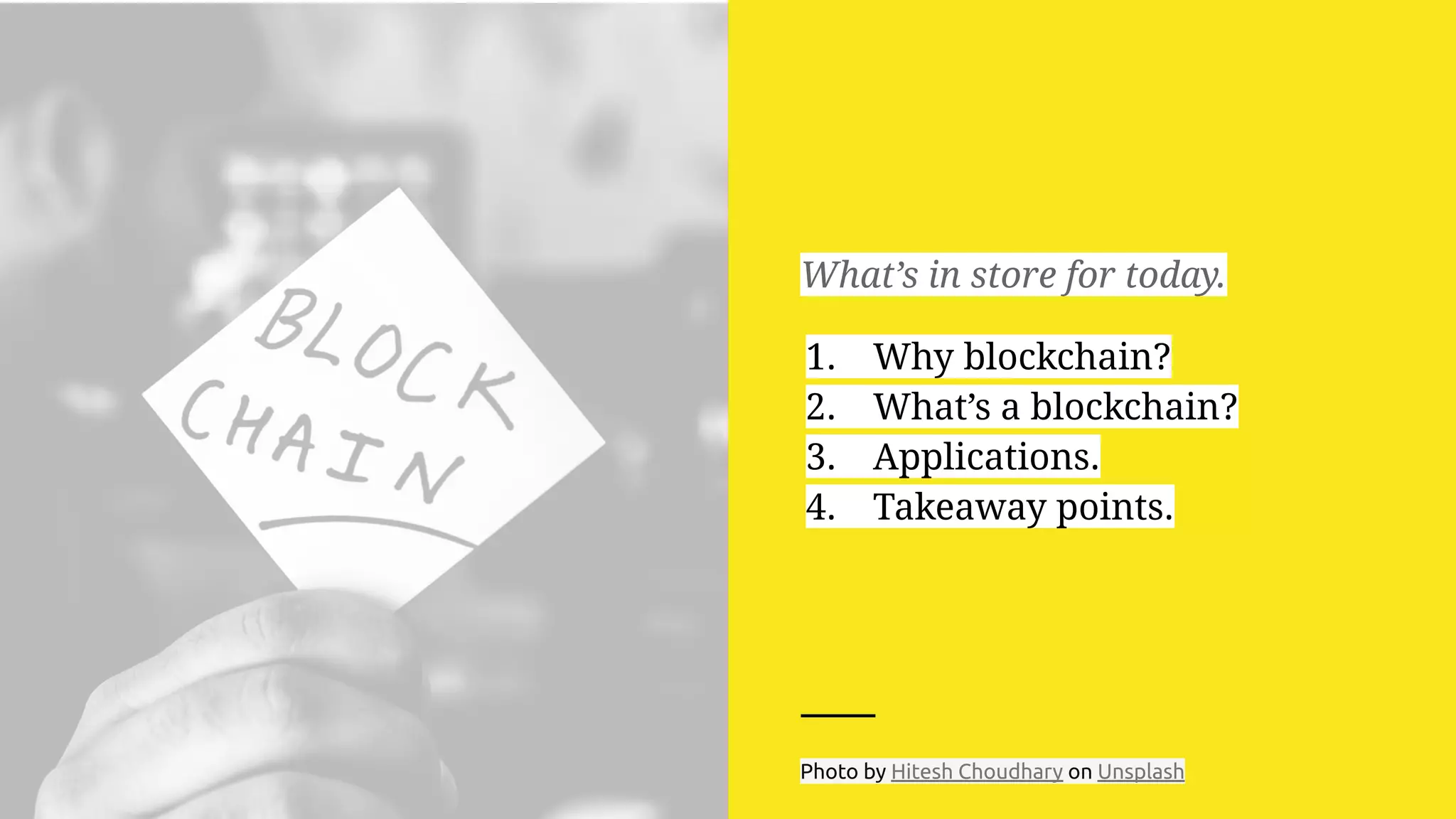
Photo by Hitesh Choudhary on Unsplash
Blockchain ≠ Cryptocurrency
Why
Blockchain?
The 3 pillars/layers
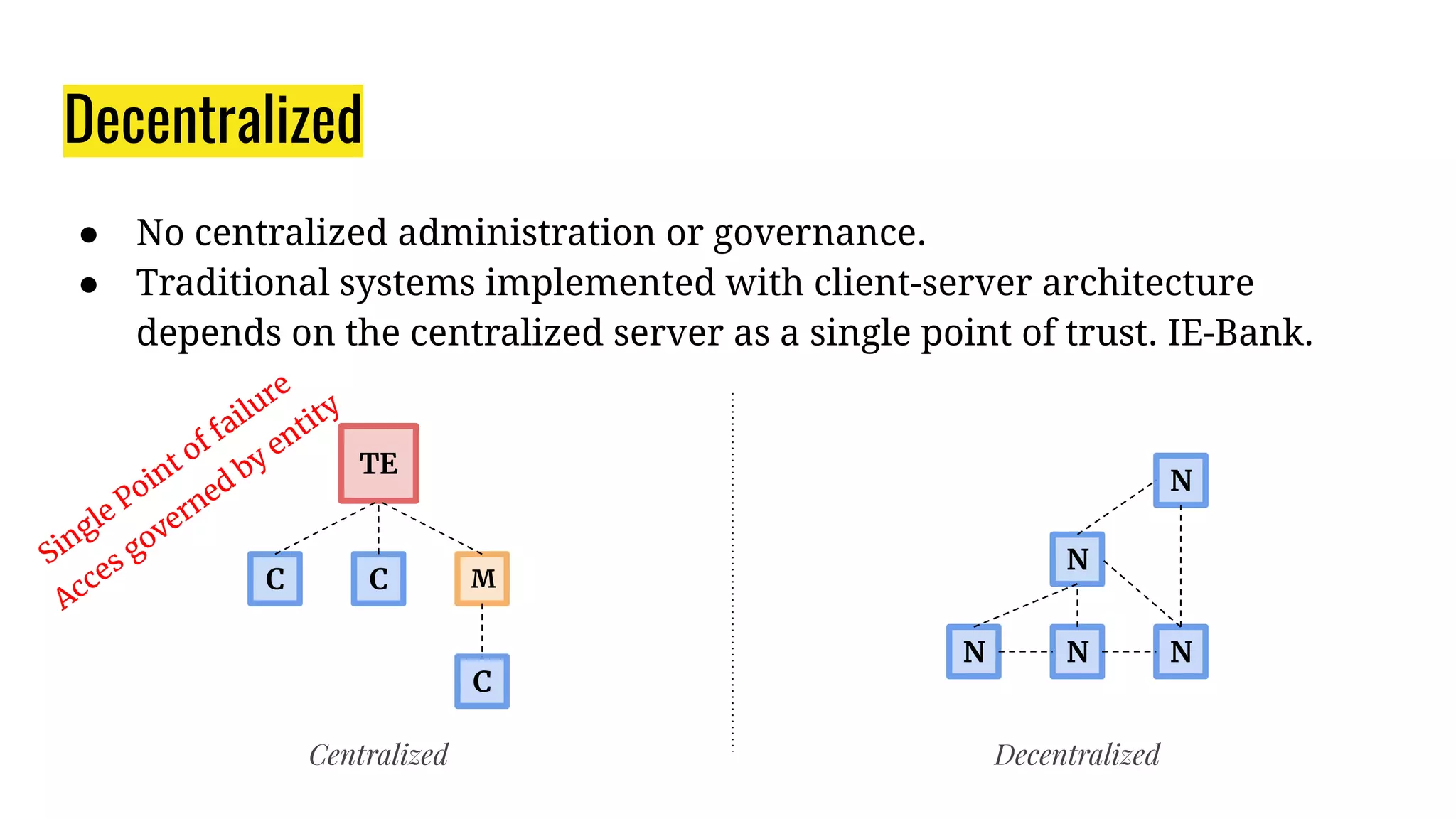
Decentralized
● No centralized administration or governance.
● Traditional systems implemented with client-server architecture
depends on the centralized server as a single point of trust. IE-Bank.
TE
C C M
C
N N N
N
N
Centralized Decentralized
Single Point of failure
Acces governed
by entity
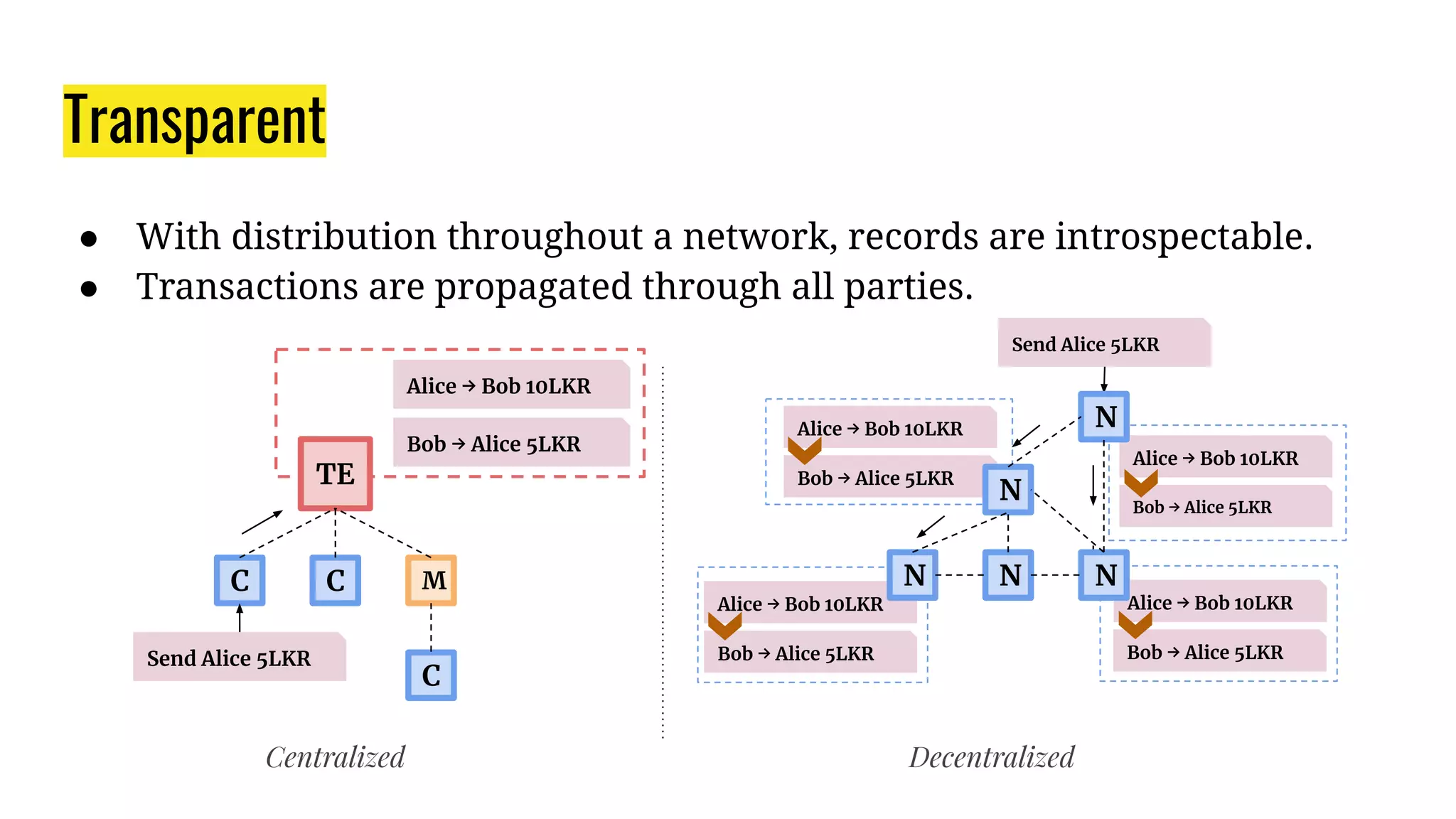
Transparent
● With distribution throughout a network, records are introspectable.
● Transactions are propagated through all parties.
TE
C C M
C
Centralized
Alice → Bob 10LKR
Send Alice 5LKR
Bob → Alice 5LKR
Alice → Bob 10LKR
Bob → Alice 5LKR
Alice → Bob 10LKR
Bob → Alice 5LKR
Decentralized
Send Alice 5LKR
Alice → Bob 10LKR
Bob → Alice 5LKR
Alice → Bob 10LKR
Bob → Alice 5LKR
N N N
N
N
Bob → Alice 5LKR
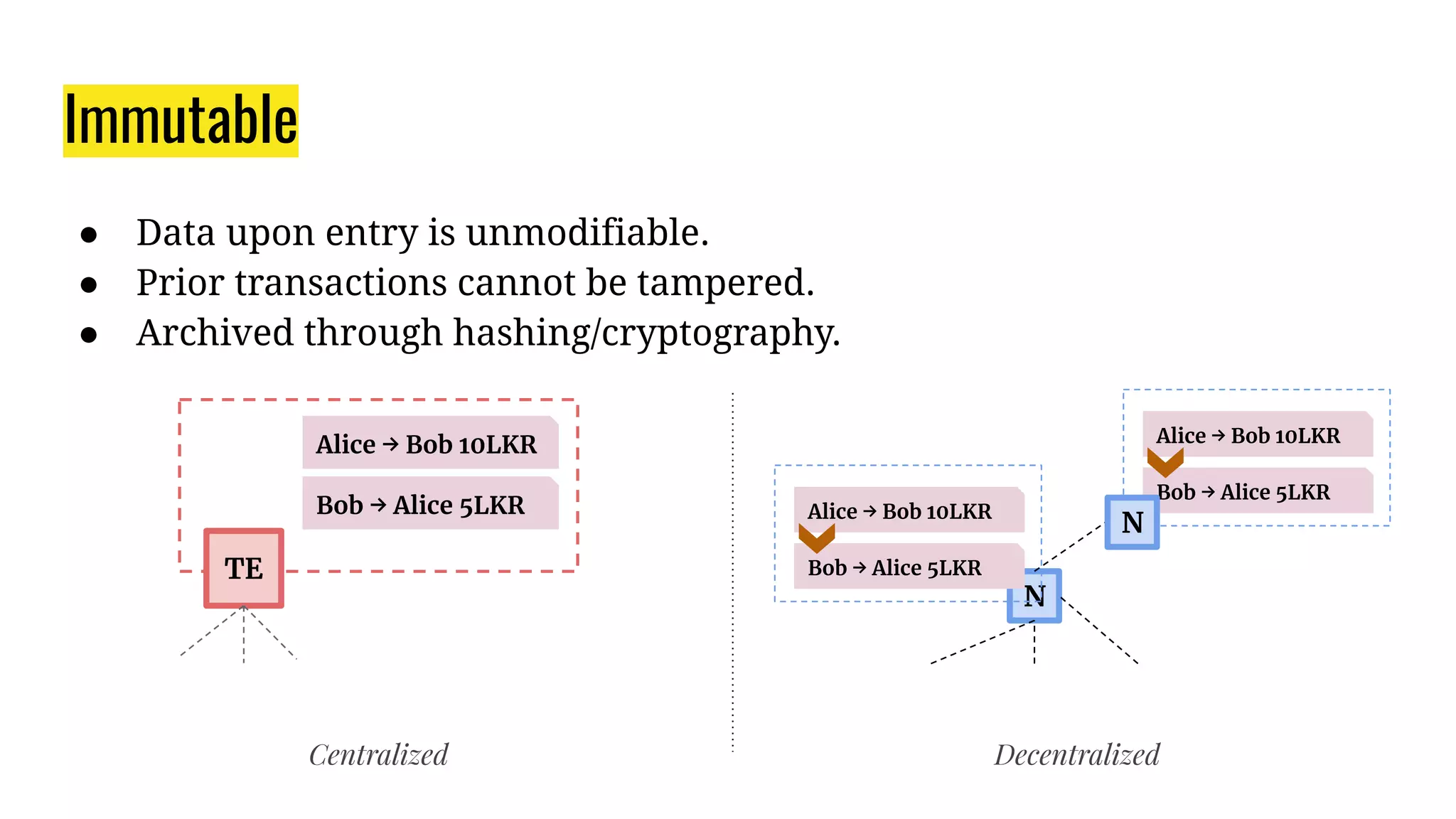
Immutable
● Data upon entry is unmodifiable.
● Prior transactions cannot be tampered.
● Archived through hashing/cryptography.
TE
Centralized Decentralized
Alice → Bob 10LKR
N
Bob → Alice 5LKR
Bob → Alice 5LKR
Alice → Bob 10LKR
N
Alice → Bob 10LKR
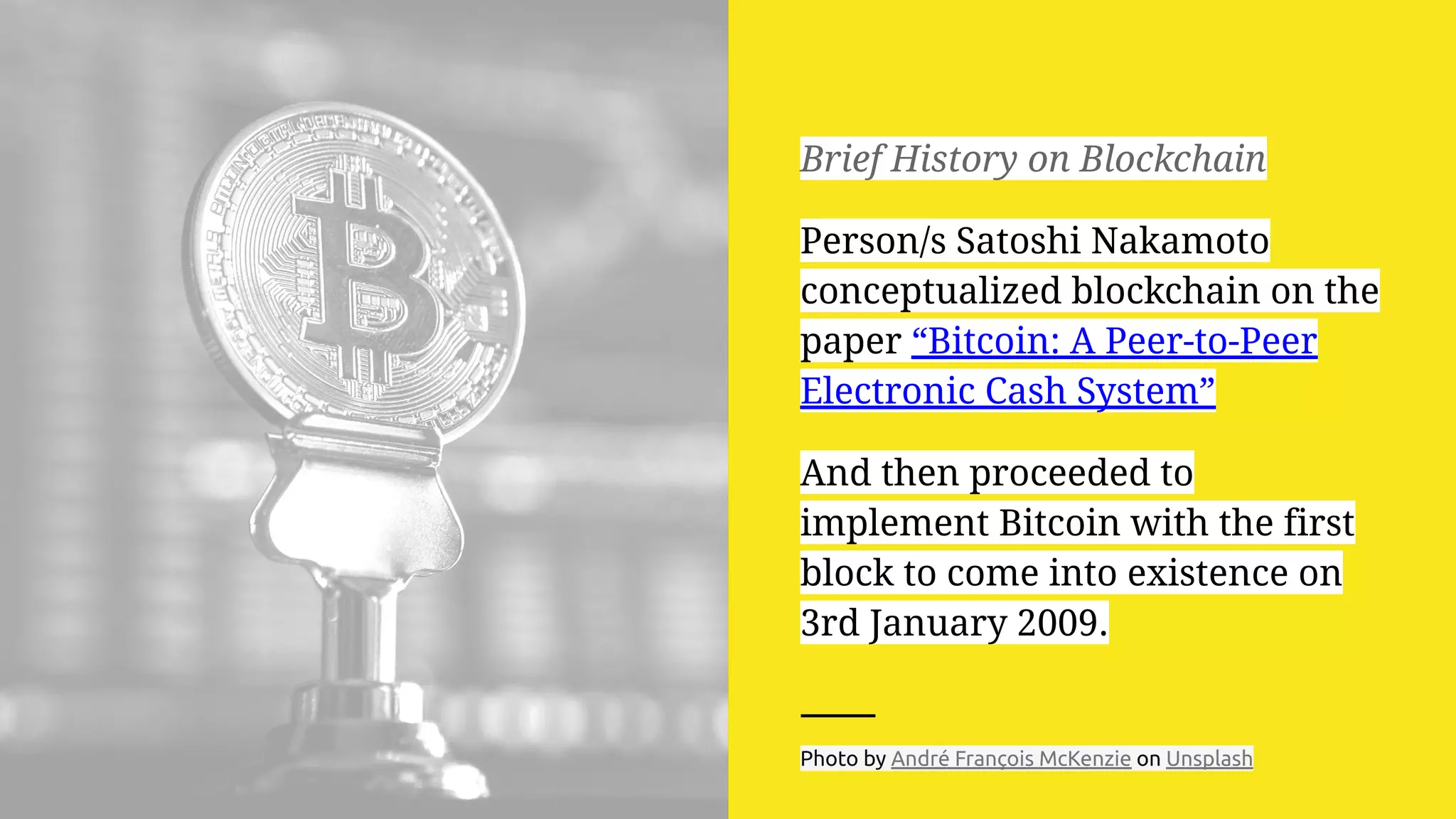
Brief History on Blockchain
Person/s Satoshi Nakamoto
conceptualized blockchain on the
paper “Bitcoin: A Peer-to-Peer
Electronic Cash System”
And then proceeded to
implement Bitcoin with the first
block to come into existence on
3rd January 2009.
Photo by André François McKenzie on Unsplash
What’s a
Blockchain?
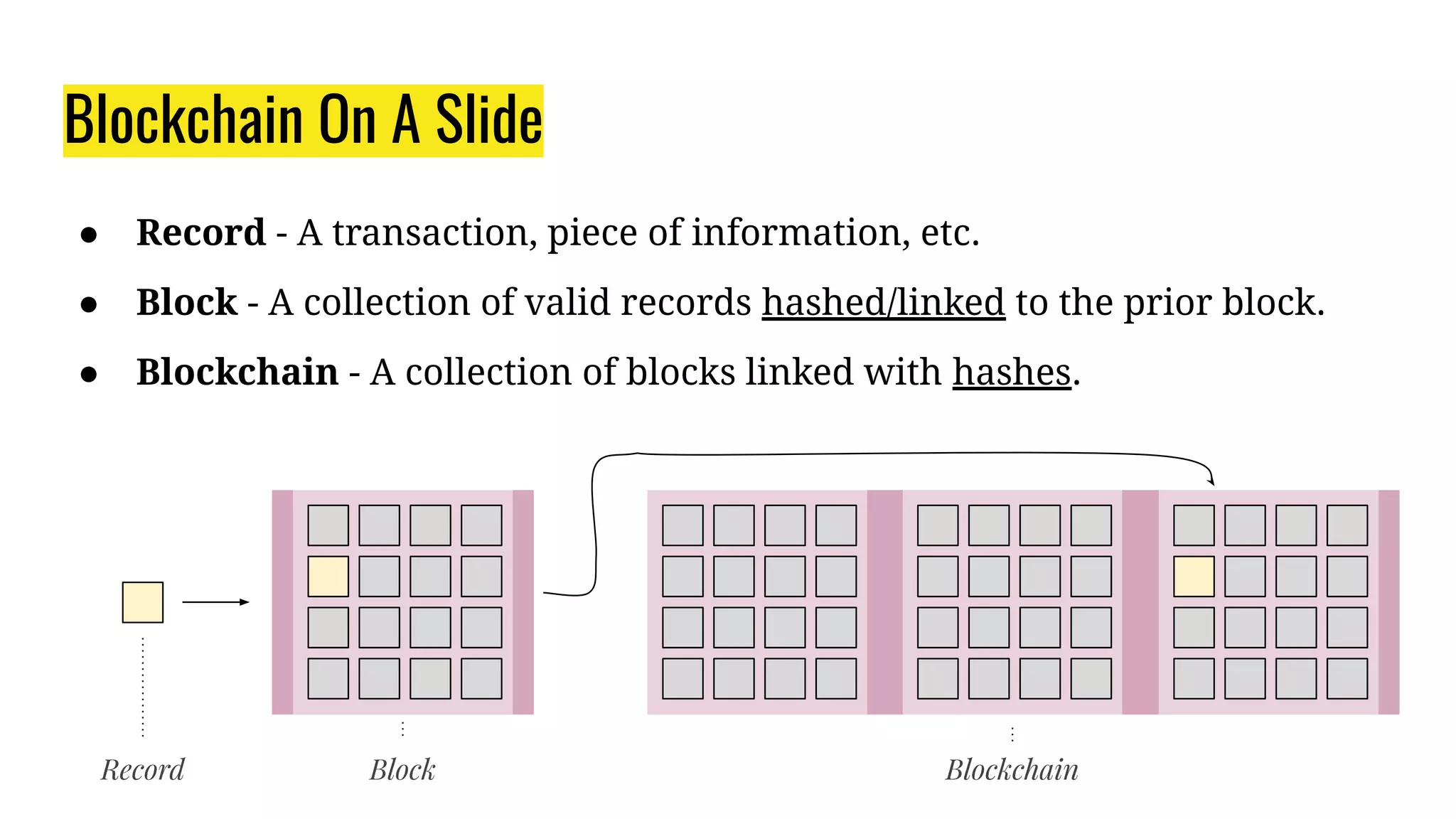
● Record - A transaction, piece of information, etc.
● Block - A collection of valid records hashed/linked to the prior block.
● Blockchain - A collection of blocks linked with hashes.
Blockchain On A Slide
Record Block Blockchain
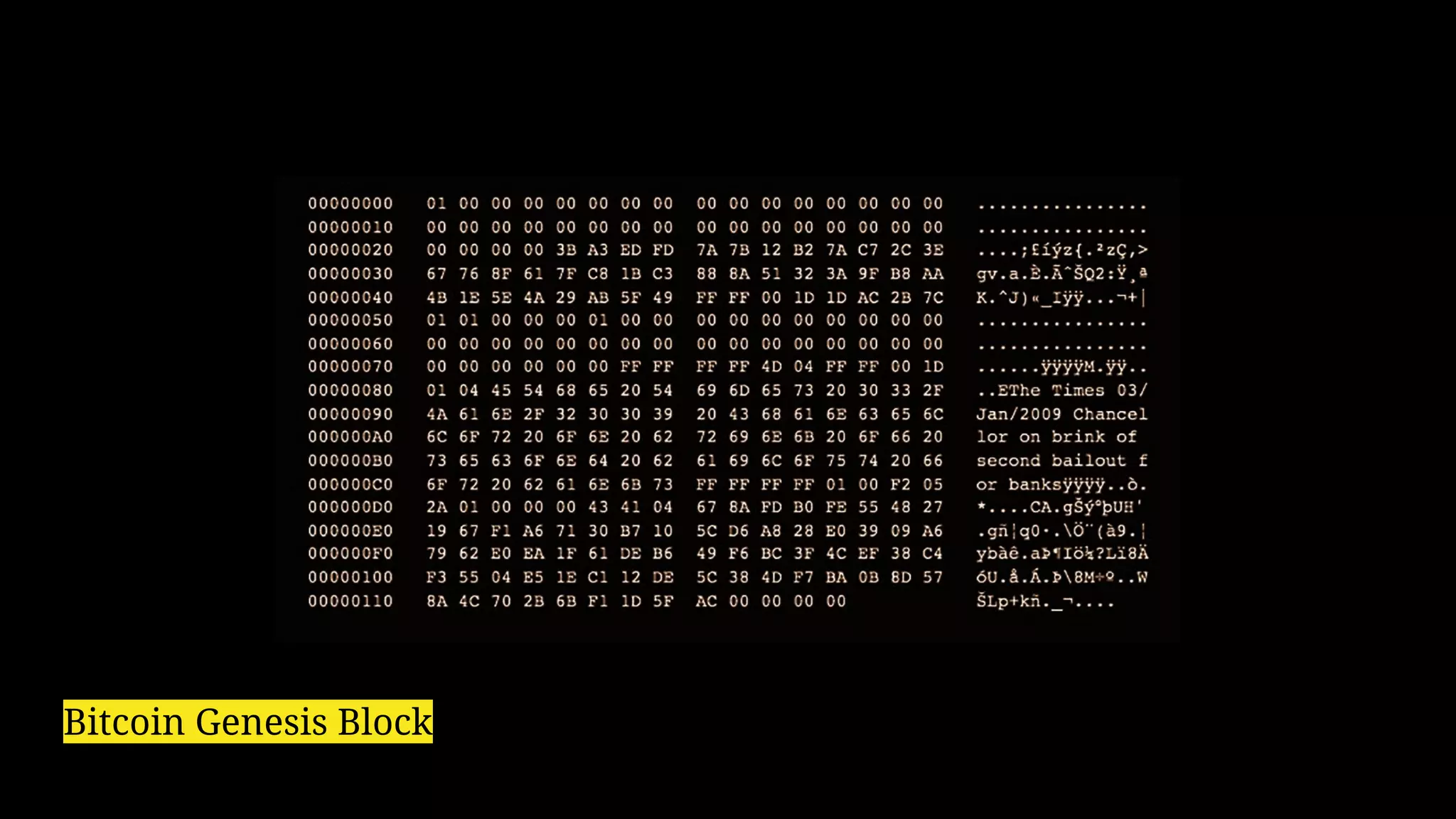
Bitcoin Genesis Block
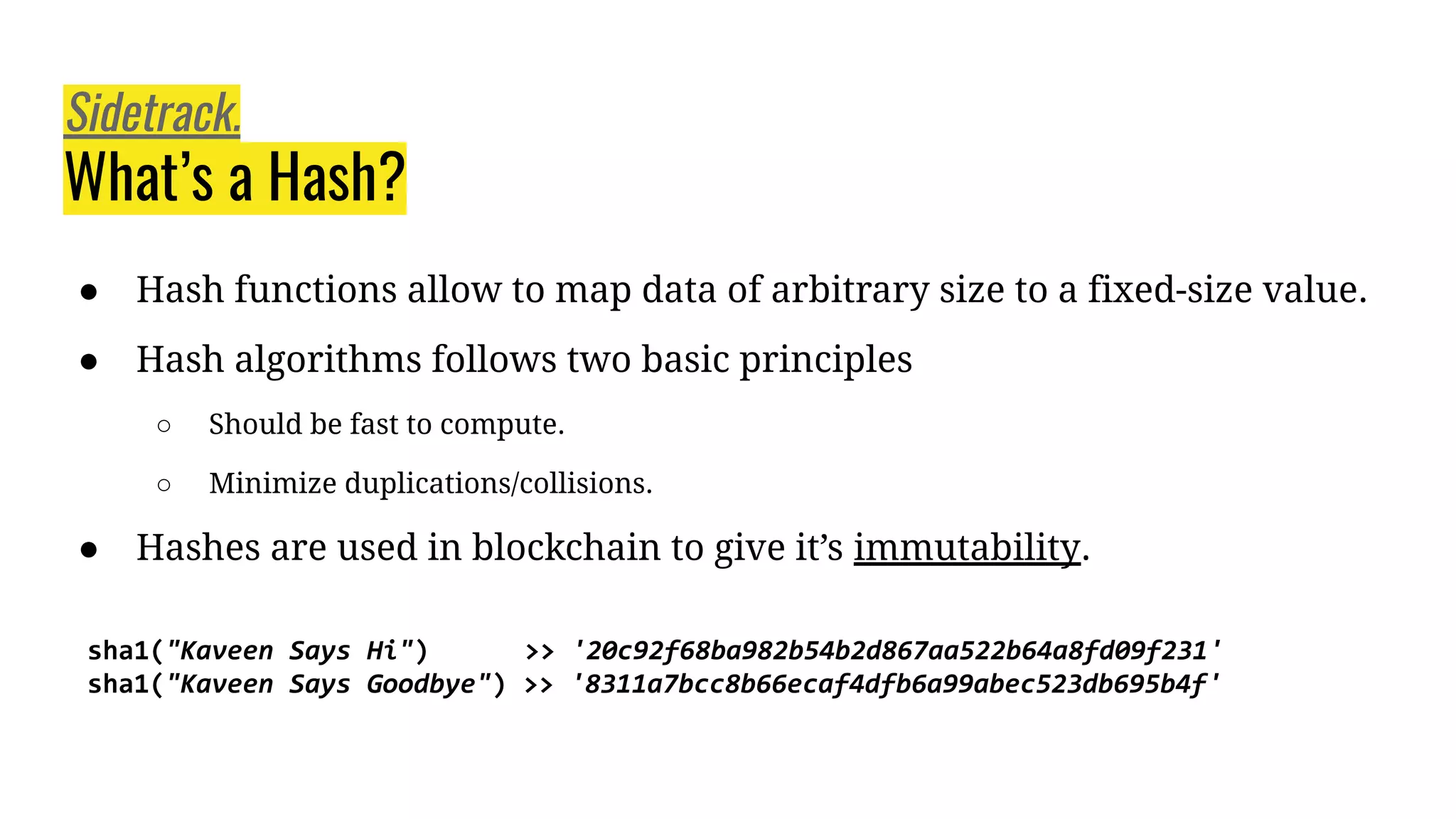
● Hash functions allow to map data of arbitrary size to a fixed-size value.
● Hash algorithms follows two basic principles
○ Should be fast to compute.
○ Minimize duplications/collisions.
● Hashes are used in blockchain to give it’s immutability.
Sidetrack.
What’s a Hash?
sha1("Kaveen Says Hi") >> '20c92f68ba982b54b2d867aa522b64a8fd09f231'
sha1("Kaveen Says Goodbye") >> '8311a7bcc8b66ecaf4dfb6a99abec523db695b4f'
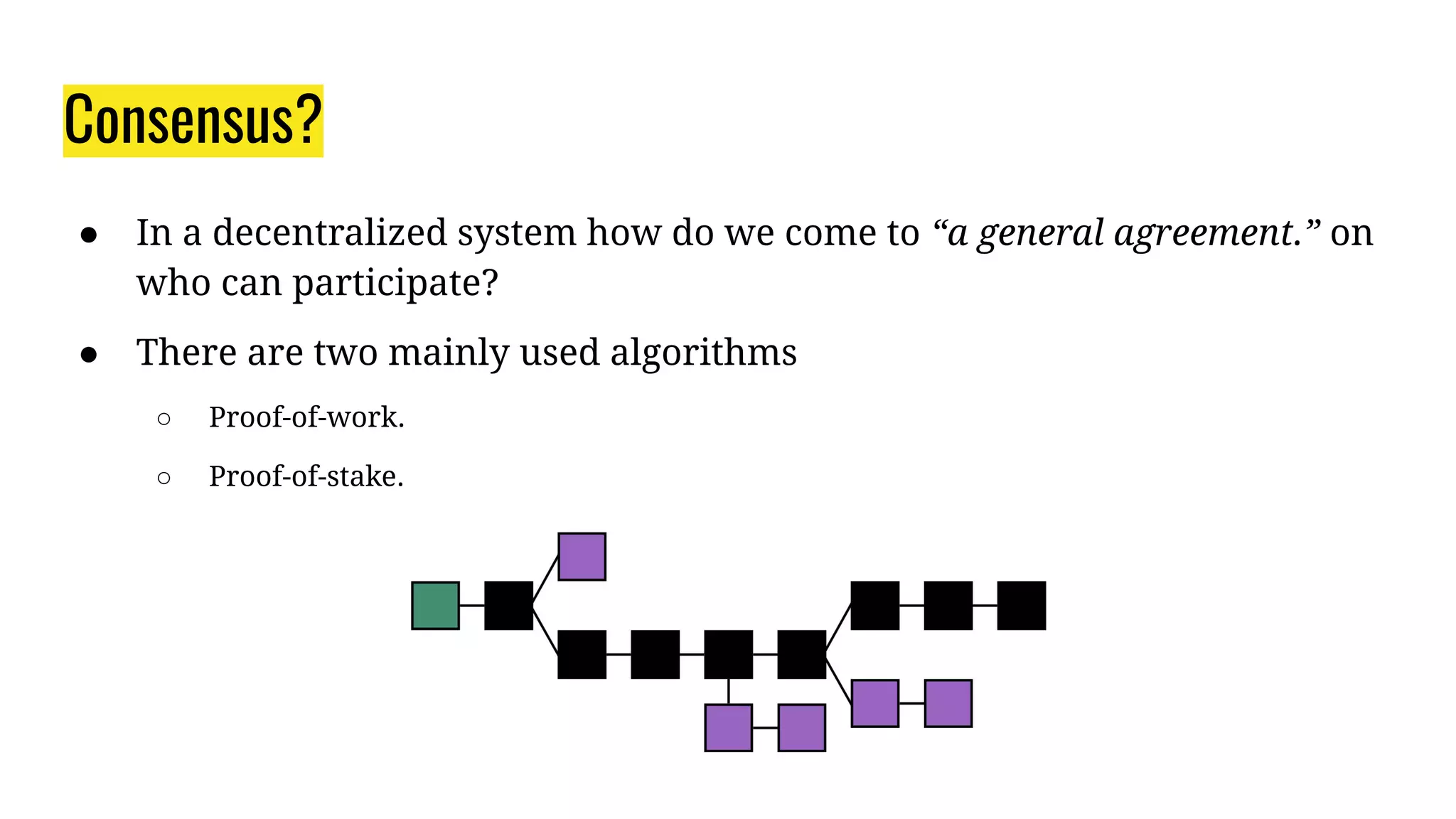
Consensus?
● In a decentralized system how do we come to “a general agreement.” on
who can participate?
● There are two mainly used algorithms
○ Proof-of-work.
○ Proof-of-stake.
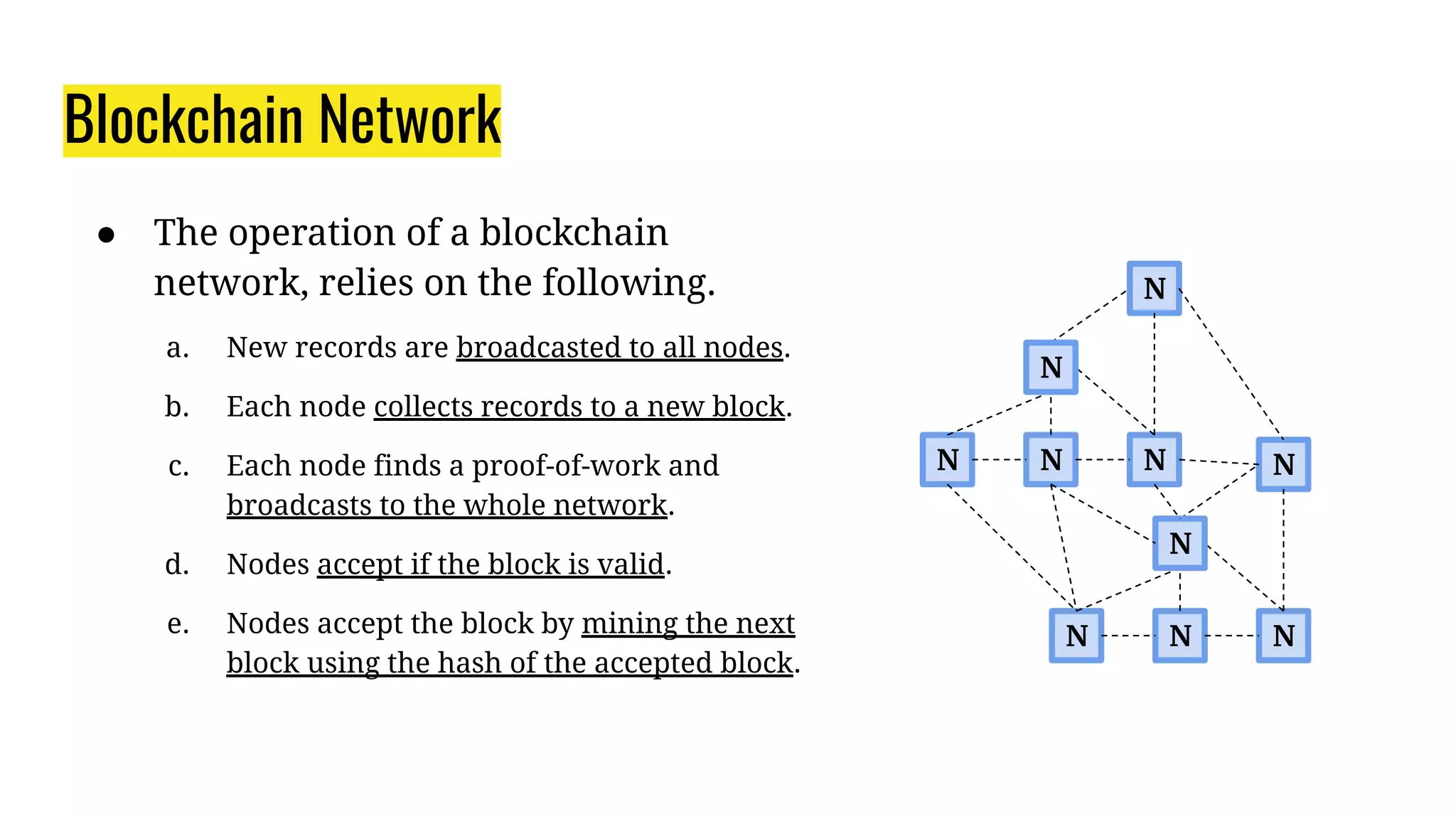
Blockchain Network
● The operation of a blockchain
network, relies on the following.
a. New records are broadcasted to all nodes.
b. Each node collects records to a new block.
c. Each node finds a proof-of-work and
broadcasts to the whole network.
d. Nodes accept if the block is valid.
e. Nodes accept the block by mining the next
block using the hash of the accepted block.
N N N
N
N
N N N
N
N
Smart Contracts
● “Smart Contracts” was coined by Nick Szabo, legal scholar and
cryptographer in 1994.
● Smart contract is a set of computer codes between two or more parties
that consist a defined rules if met produces and output.
● Properties of smart contracts.
○ Self-verifiable
○ Self-executable
○ Tamper Proof
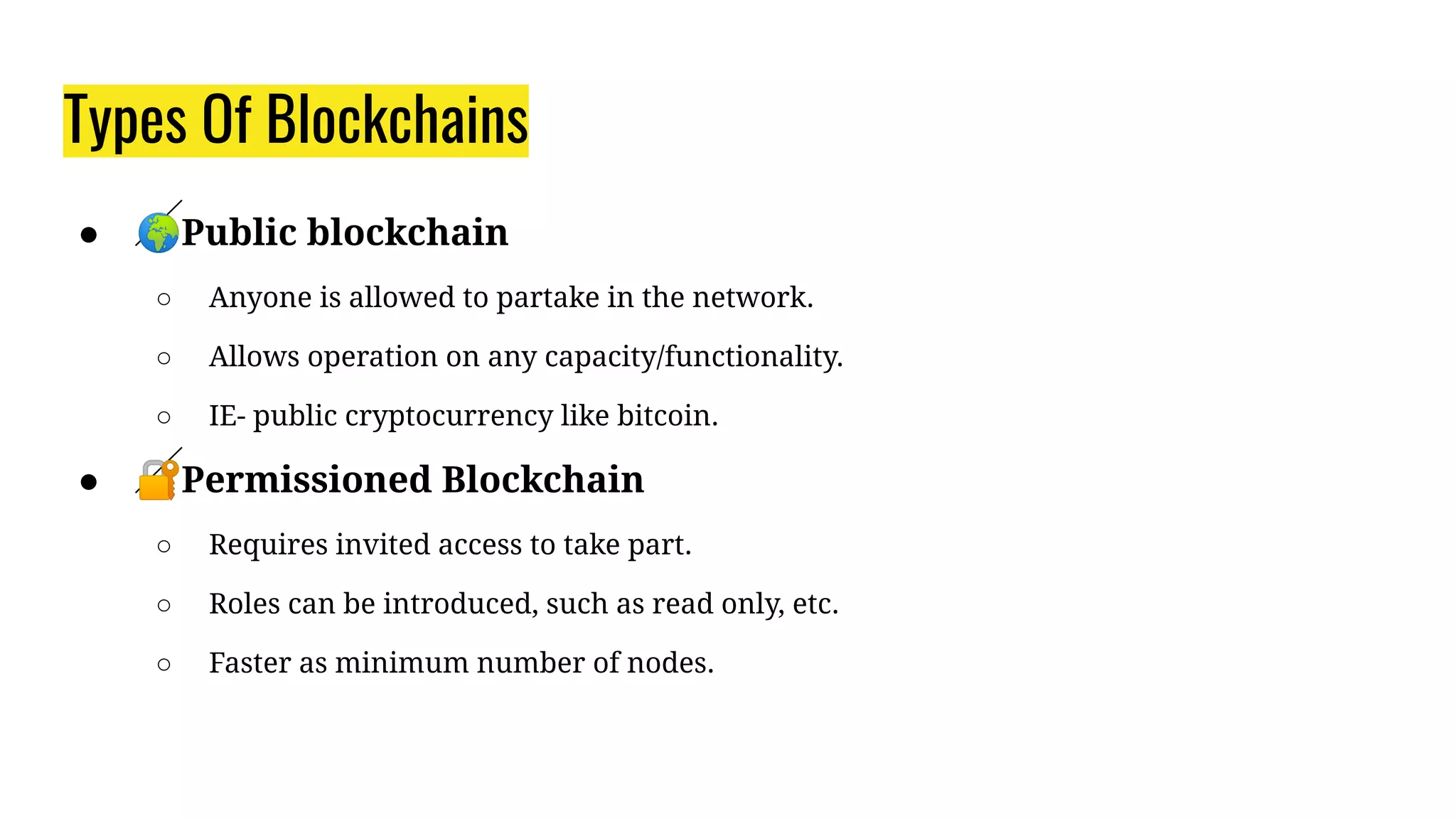
Types Of Blockchains
● 🌍Public blockchain
○ Anyone is allowed to partake in the network.
○ Allows operation on any capacity/functionality.
○ IE- public cryptocurrency like bitcoin.
● 🔐Permissioned Blockchain
○ Requires invited access to take part.
○ Roles can be introduced, such as read only, etc.
○ Faster as minimum number of nodes.
Distributed database of records
stored in immutable blocks
connected with prior blocks
forming a chain; for which the
validity is affirmed by peers of a
decentralized network secured
by cryptography.
Photo by Tobias Fischer on Unsplash
Applications.
Characteristics Of a successful
Blockchain Applications
● Reduces economic cost.
● Bridges the physical and
digital world.
● Involves collaboration of
multiple entities.
Photo by Austin Schmid on Unsplash
Digital Identity / Self-sovereign identity
● Self-sovereign identity rides on the concept that digital identities are
managed independently without a trust anchor.
● Modern day self-sovereign identity, try to accomplish
○ Existence - self controlled identities.
○ Transparency - Algorithms and functionalities is not hidden.
○ Consent - Ability to give consent for other parties.
○ Interoperability - Ability to be used across wide domains.
○ Portability - Data should be transferable and self contained.
http://www.lifewithalacrity.com/2016/04/the-path-to-self-soverereign-identity.html
Financial Domain
● Not just limited to cryptocurrency.
● With Smart-Contracts opens doors for new applications to emerge from
blockchain.
○ Asset Management - Trading and settling.
○ Cross border payments - Ability to trade over borders without middle men.
Peer to Peer Applications
● Peer to peer financing.
○ Transparent records of each actor on the chain.
○ KYC, credit reports can be verified and added to the chain.
● Ride sharing / room renting with no middle man.
○ Elimination of middlemen and service charges.
Applications.
Permissioned
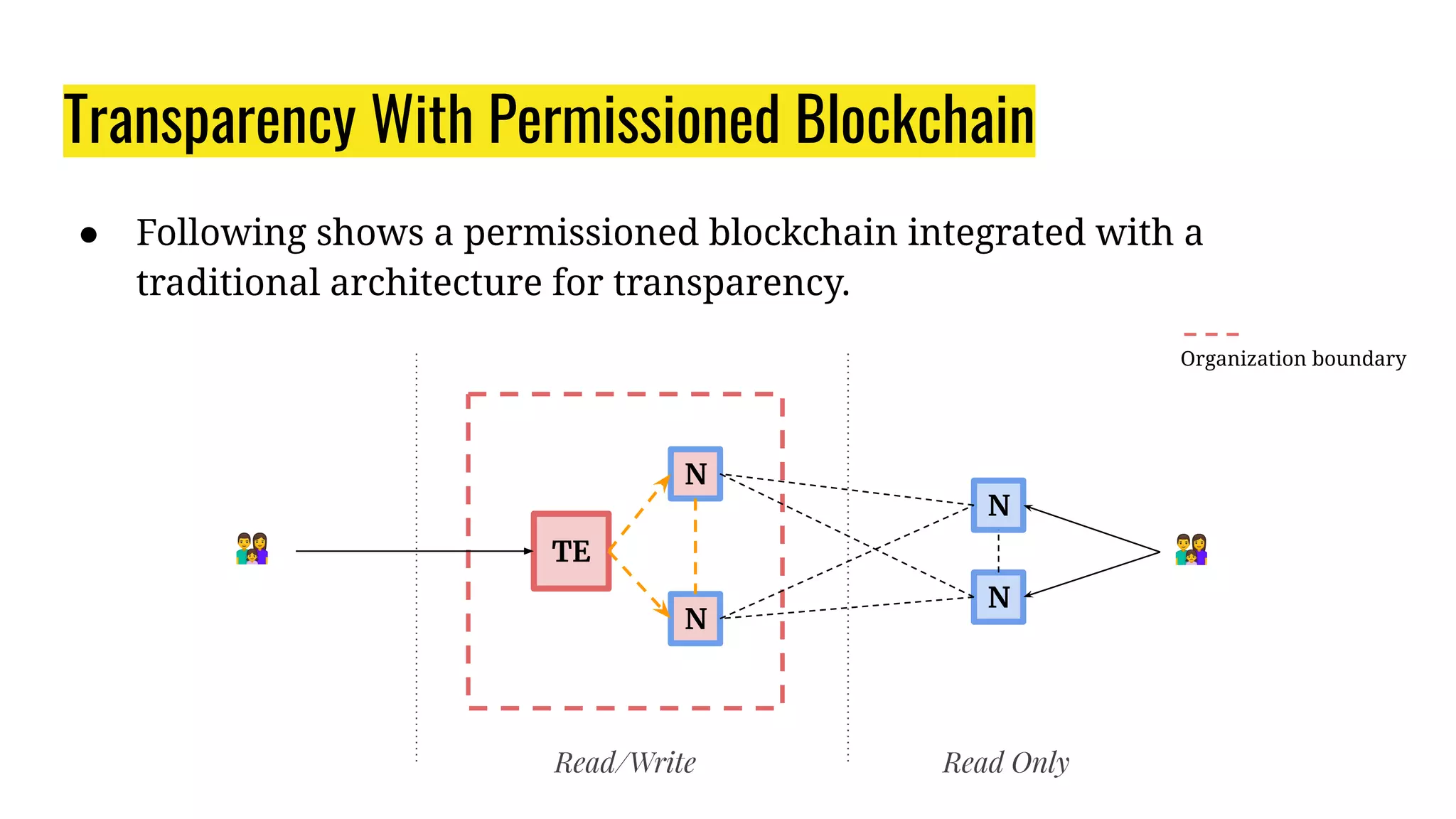
Transparency With Permissioned Blockchain
● Following shows a permissioned blockchain integrated with a
traditional architecture for transparency.
TE
N
N
N
N
👨‍👩‍👧
Read/Write Read Only
👨‍👩‍👧
Organization boundary
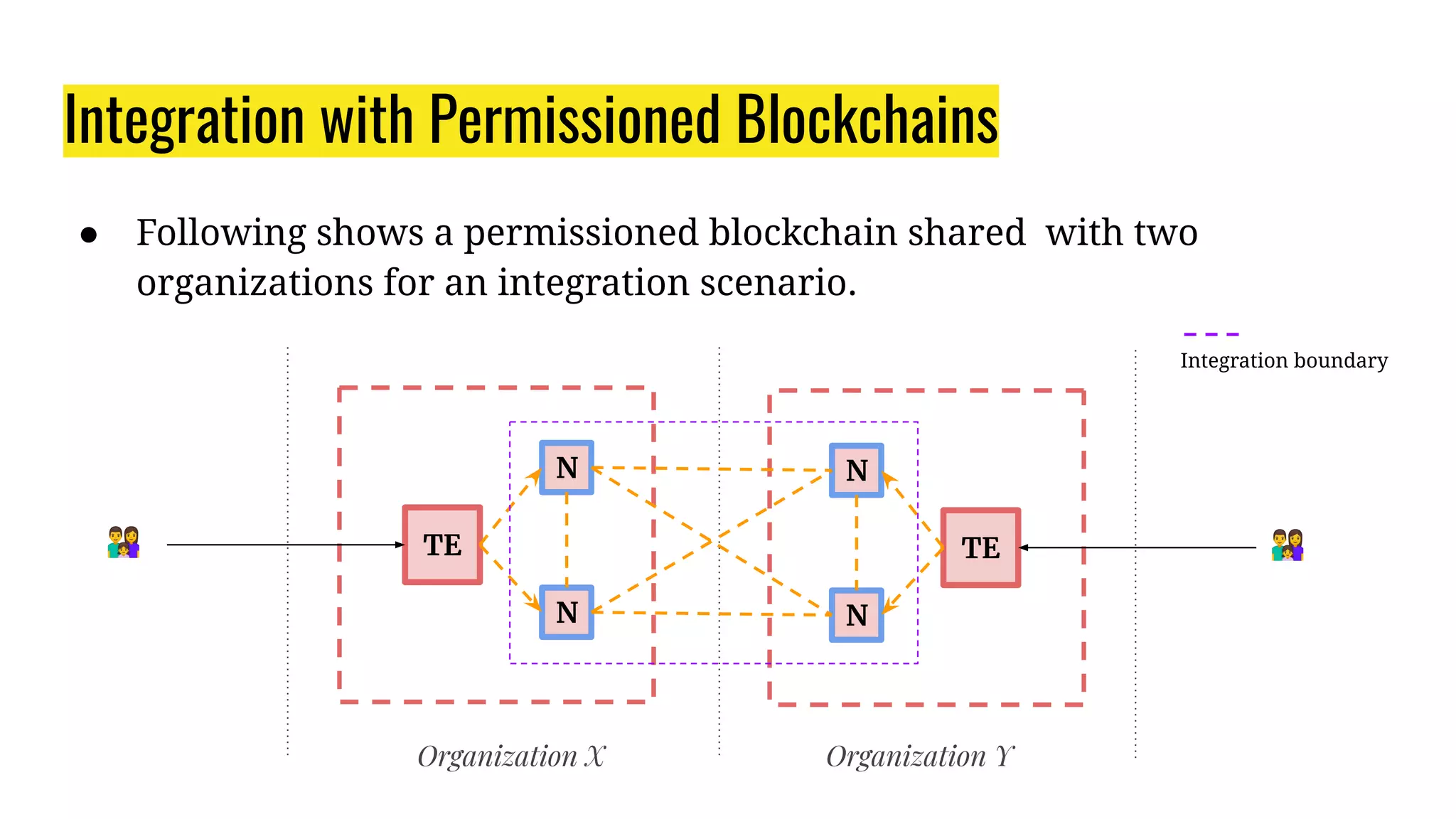
Integration with Permissioned Blockchains
● Following shows a permissioned blockchain shared with two
organizations for an integration scenario.
TE
N
N
👨‍👩‍👧
Organization X
TE
N
N
👨‍👩‍👧
Organization Y
Integration boundary
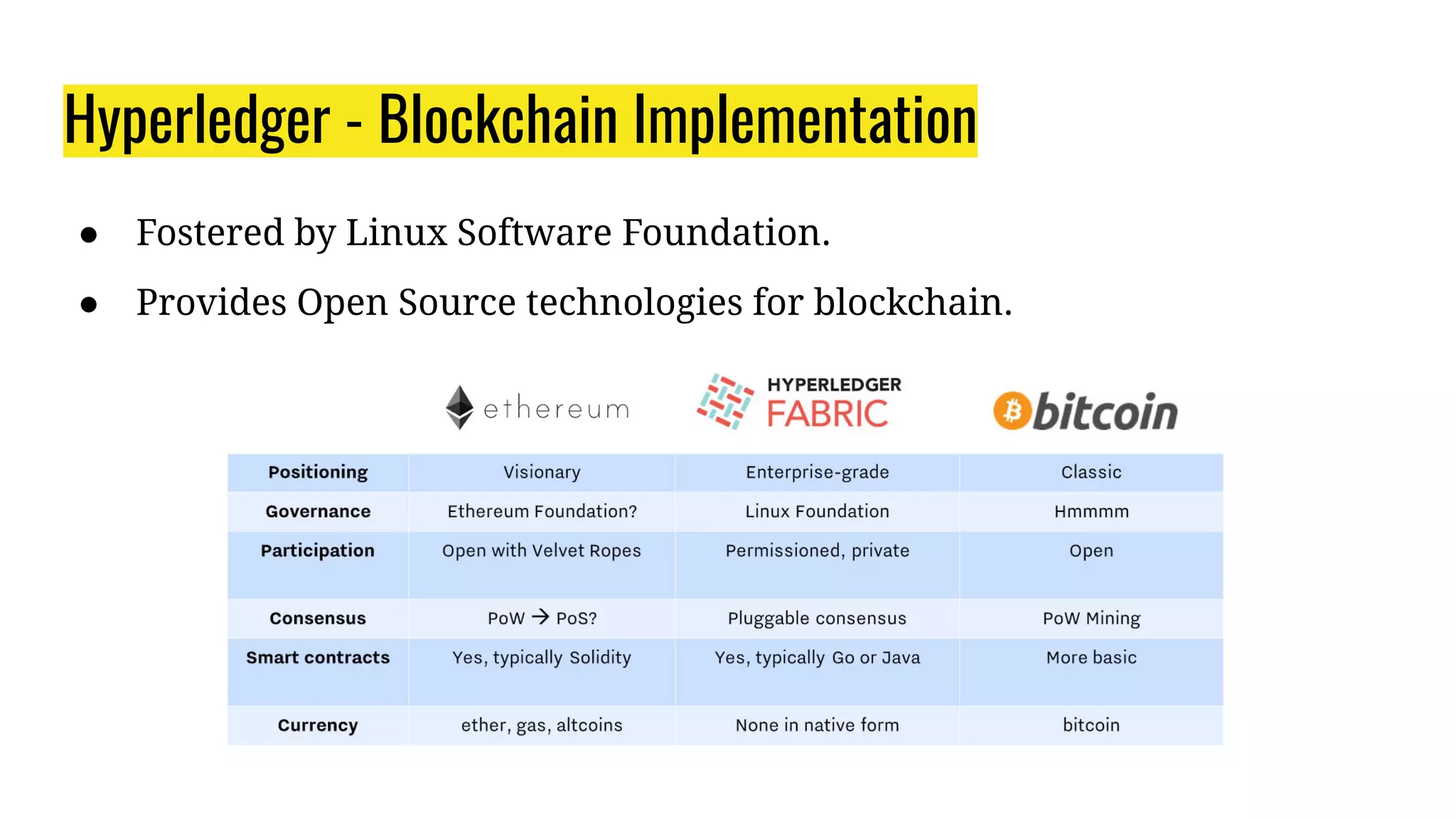
Hyperledger - Blockchain Implementation
● Fostered by Linux Software Foundation.
● Provides Open Source technologies for blockchain.
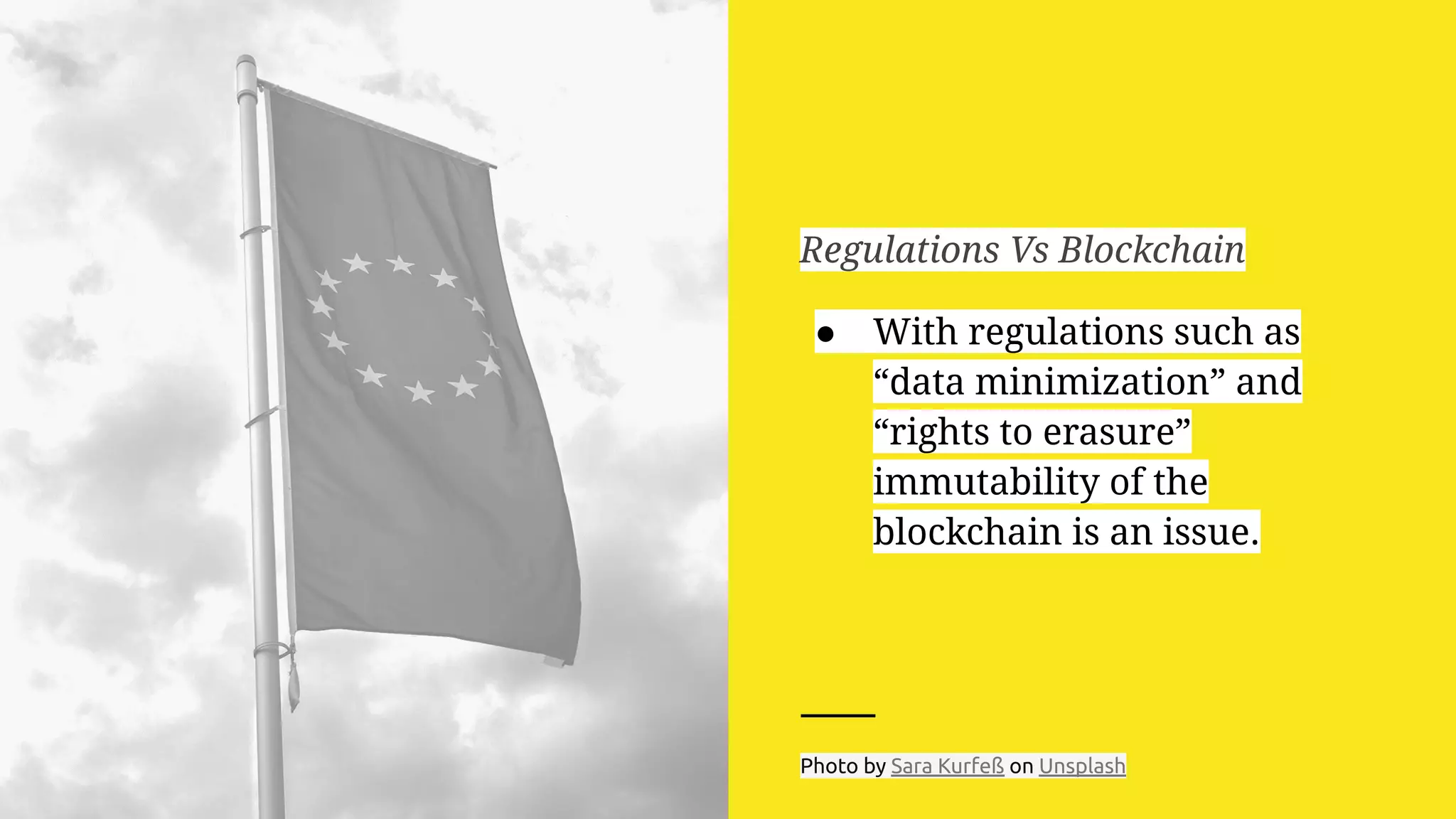
Regulations Vs Blockchain
● With regulations such as
“data minimization” and
“rights to erasure”
immutability of the
blockchain is an issue.
Photo by Sara Kurfeß on Unsplash
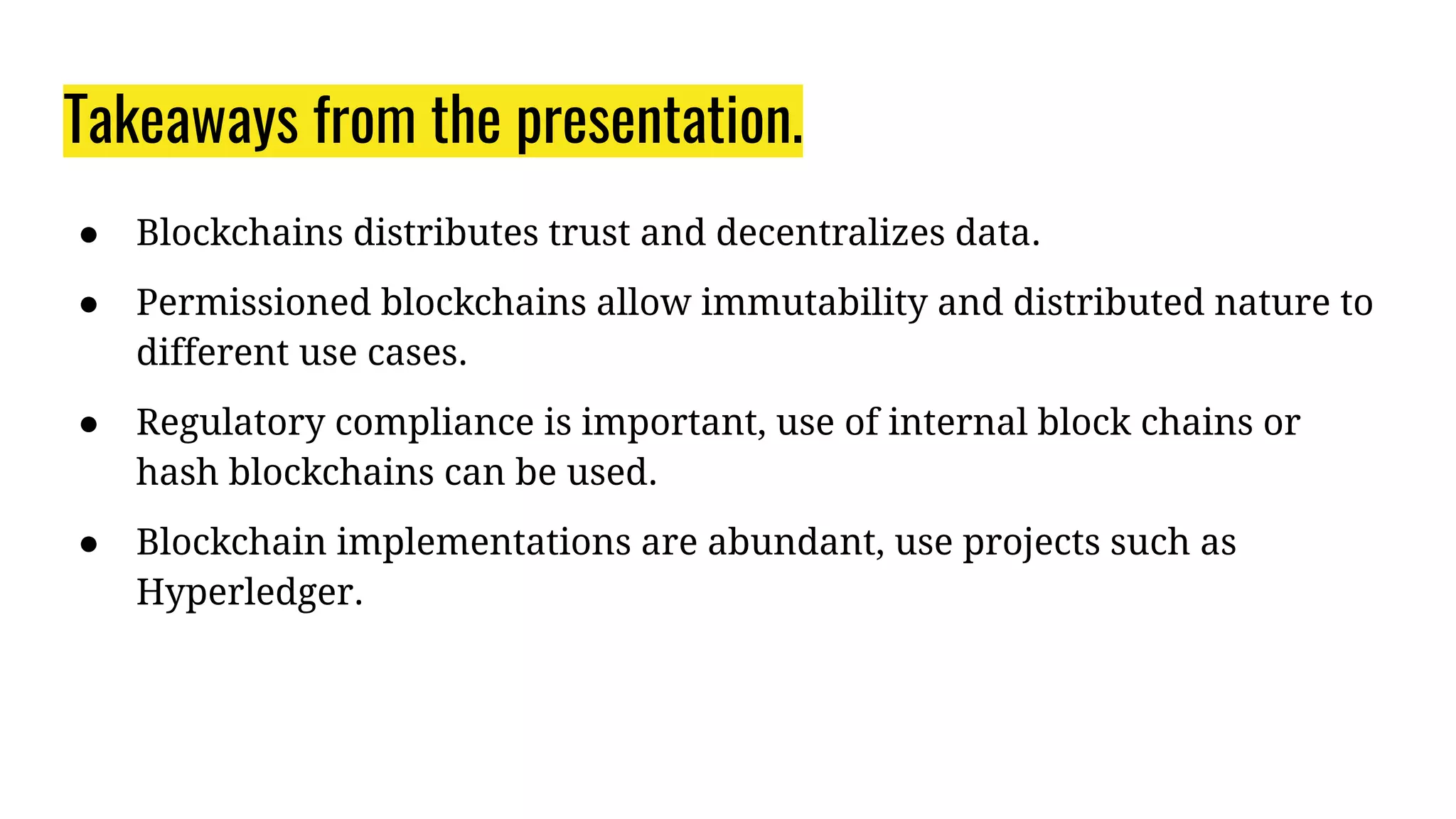
Takeaway points.
Takeaways from the presentation.
● Blockchains distributes trust and decentralizes data.
● Permissioned blockchains allow immutability and distributed nature to
different use cases.
● Regulatory compliance is important, use of internal block chains or
hash blockchains can be used.
● Blockchain implementations are abundant, use projects such as
Hyperledger.
Useful Links/Contact
Tweet me @enigmamaker
Web: kaveenrodrigo.com
Email: u.k.k.rodrigo@gmail.com
https://bitcoin.org/bitcoin.pdf
http://www.lifewithalacrity.com/2016/04/the-path-to-self-soverereign-identity.html
https://www.hyperledger.org/projects

Blockchain an introduction

  • 1.
  • 2.
    About Me ● Studiedat IIT (2018) ● Senior Software Engineer at WSO2 Financial Solutions. ○ Works with PSD2/CDR Open Banking. ● Identity And Access Management enthusiast. Tweet me @enigmamaker Web: kaveenrodrigo.com Email: u.k.k.rodrigo@gmail.com
  • 3.
    What’s in storefor today. 1. Why blockchain? 2. What’s a blockchain? 3. Applications. 4. Takeaway points. Photo by Hitesh Choudhary on Unsplash
  • 4.
  • 5.
  • 6.
    Decentralized ● No centralizedadministration or governance. ● Traditional systems implemented with client-server architecture depends on the centralized server as a single point of trust. IE-Bank. TE C C M C N N N N N Centralized Decentralized Single Point of failure Acces governed by entity
  • 7.
    Transparent ● With distributionthroughout a network, records are introspectable. ● Transactions are propagated through all parties. TE C C M C Centralized Alice → Bob 10LKR Send Alice 5LKR Bob → Alice 5LKR Alice → Bob 10LKR Bob → Alice 5LKR Alice → Bob 10LKR Bob → Alice 5LKR Decentralized Send Alice 5LKR Alice → Bob 10LKR Bob → Alice 5LKR Alice → Bob 10LKR Bob → Alice 5LKR N N N N N
  • 8.
    Bob → Alice5LKR Immutable ● Data upon entry is unmodifiable. ● Prior transactions cannot be tampered. ● Archived through hashing/cryptography. TE Centralized Decentralized Alice → Bob 10LKR N Bob → Alice 5LKR Bob → Alice 5LKR Alice → Bob 10LKR N Alice → Bob 10LKR
  • 9.
    Brief History onBlockchain Person/s Satoshi Nakamoto conceptualized blockchain on the paper “Bitcoin: A Peer-to-Peer Electronic Cash System” And then proceeded to implement Bitcoin with the first block to come into existence on 3rd January 2009. Photo by André François McKenzie on Unsplash
  • 10.
  • 11.
    ● Record -A transaction, piece of information, etc. ● Block - A collection of valid records hashed/linked to the prior block. ● Blockchain - A collection of blocks linked with hashes. Blockchain On A Slide Record Block Blockchain
  • 12.
  • 13.
    ● Hash functionsallow to map data of arbitrary size to a fixed-size value. ● Hash algorithms follows two basic principles ○ Should be fast to compute. ○ Minimize duplications/collisions. ● Hashes are used in blockchain to give it’s immutability. Sidetrack. What’s a Hash? sha1("Kaveen Says Hi") >> '20c92f68ba982b54b2d867aa522b64a8fd09f231' sha1("Kaveen Says Goodbye") >> '8311a7bcc8b66ecaf4dfb6a99abec523db695b4f'
  • 14.
    Consensus? ● In adecentralized system how do we come to “a general agreement.” on who can participate? ● There are two mainly used algorithms ○ Proof-of-work. ○ Proof-of-stake.
  • 15.
    Blockchain Network ● Theoperation of a blockchain network, relies on the following. a. New records are broadcasted to all nodes. b. Each node collects records to a new block. c. Each node finds a proof-of-work and broadcasts to the whole network. d. Nodes accept if the block is valid. e. Nodes accept the block by mining the next block using the hash of the accepted block. N N N N N N N N N N
  • 16.
    Smart Contracts ● “SmartContracts” was coined by Nick Szabo, legal scholar and cryptographer in 1994. ● Smart contract is a set of computer codes between two or more parties that consist a defined rules if met produces and output. ● Properties of smart contracts. ○ Self-verifiable ○ Self-executable ○ Tamper Proof
  • 17.
    Types Of Blockchains ●🌍Public blockchain ○ Anyone is allowed to partake in the network. ○ Allows operation on any capacity/functionality. ○ IE- public cryptocurrency like bitcoin. ● 🔐Permissioned Blockchain ○ Requires invited access to take part. ○ Roles can be introduced, such as read only, etc. ○ Faster as minimum number of nodes.
  • 18.
    Distributed database ofrecords stored in immutable blocks connected with prior blocks forming a chain; for which the validity is affirmed by peers of a decentralized network secured by cryptography. Photo by Tobias Fischer on Unsplash
  • 19.
  • 20.
    Characteristics Of asuccessful Blockchain Applications ● Reduces economic cost. ● Bridges the physical and digital world. ● Involves collaboration of multiple entities. Photo by Austin Schmid on Unsplash
  • 21.
    Digital Identity /Self-sovereign identity ● Self-sovereign identity rides on the concept that digital identities are managed independently without a trust anchor. ● Modern day self-sovereign identity, try to accomplish ○ Existence - self controlled identities. ○ Transparency - Algorithms and functionalities is not hidden. ○ Consent - Ability to give consent for other parties. ○ Interoperability - Ability to be used across wide domains. ○ Portability - Data should be transferable and self contained. http://www.lifewithalacrity.com/2016/04/the-path-to-self-soverereign-identity.html
  • 22.
    Financial Domain ● Notjust limited to cryptocurrency. ● With Smart-Contracts opens doors for new applications to emerge from blockchain. ○ Asset Management - Trading and settling. ○ Cross border payments - Ability to trade over borders without middle men.
  • 23.
    Peer to PeerApplications ● Peer to peer financing. ○ Transparent records of each actor on the chain. ○ KYC, credit reports can be verified and added to the chain. ● Ride sharing / room renting with no middle man. ○ Elimination of middlemen and service charges.
  • 24.
  • 25.
    Transparency With PermissionedBlockchain ● Following shows a permissioned blockchain integrated with a traditional architecture for transparency. TE N N N N 👨‍👩‍👧 Read/Write Read Only 👨‍👩‍👧 Organization boundary
  • 26.
    Integration with PermissionedBlockchains ● Following shows a permissioned blockchain shared with two organizations for an integration scenario. TE N N 👨‍👩‍👧 Organization X TE N N 👨‍👩‍👧 Organization Y Integration boundary
  • 27.
    Hyperledger - BlockchainImplementation ● Fostered by Linux Software Foundation. ● Provides Open Source technologies for blockchain.
  • 28.
    Regulations Vs Blockchain ●With regulations such as “data minimization” and “rights to erasure” immutability of the blockchain is an issue. Photo by Sara Kurfeß on Unsplash
  • 29.
  • 30.
    Takeaways from thepresentation. ● Blockchains distributes trust and decentralizes data. ● Permissioned blockchains allow immutability and distributed nature to different use cases. ● Regulatory compliance is important, use of internal block chains or hash blockchains can be used. ● Blockchain implementations are abundant, use projects such as Hyperledger.
  • 31.
    Useful Links/Contact Tweet me@enigmamaker Web: kaveenrodrigo.com Email: u.k.k.rodrigo@gmail.com https://bitcoin.org/bitcoin.pdf http://www.lifewithalacrity.com/2016/04/the-path-to-self-soverereign-identity.html https://www.hyperledger.org/projects