RN SHETTY TRUST®
RNS INSTITUTE OF TECHNOLOGY
Autonomous Institution Affiliated to VTU, Recognized by GOK, Approved by AICTE
(NAAC ‘A+ Grade’Accredited, NBAAccredited (UG - CSE, ECE, ISE, EIE and EEE)
Channasandra, Dr. Vishnuvardhan Road, Bengaluru - 560 098
Ph:(080)28611880,28611881 URL: www.rnsit.ac.in
RESEARCH METHODOLOGYAND INTELLECTUAL
PROPERTY RIGHTS[21RMI56]
1
Staff in Charge: Ms Vinutha G K
Designation: Assistant Professor
Carried out by
Hardik Goyal (1RN21IS055)
Chandan S M (1RN21IS036)
Understanding Blockchain
Technology
Author: Simanta Shekhar Sarmah
Affiliation: Alpha Clinical Systems, USA
Date of Publication: 2018-08-02
Introduction
• The research paper provides a comprehensive overview of
blockchain technology, covering its basics why it came into
existence, what problems it solves, and why or why not you should
use this technology instead of the traditional methods.
• The primary objective is to provide readers with a comprehensive
understanding of blockchain, including its history, architecture,
functionality, advantages, disadvantages, and applications in
different industries.
• The study on "Understanding Blockchain Technology" plays a crucial
role in promoting awareness, fostering innovation, and facilitating
informed decision-making in the context of blockchain adoption and
implementation.
Background
The history of blockchain can be traced back to several key developments and concepts
that laid the foundation for its emergence as a revolutionary technology. Here are some
pivotal points in the history of blockchain:
• Early Cryptographic Concepts: The roots of blockchain can be linked to early
cryptographic concepts. In 1976, a paper titled "New Directions in Cryptography"
discussed the concept of a distributed ledger, which set the stage for decentralized
record-keeping systems.
• Timestamping Data: In the early stages of blockchain's development, the concept of
timestamping data gained prominence. A paper titled "How to Time-Stamp a Digital
Document" by Stuart Haber and Scott Stornetta proposed the idea of timestamping data
instead of the medium, laying the groundwork for immutable record-keeping.
Background (Cont.)
• Digital Currency and Double Spending: The concept of digital currency and the
prevention of double spending played a crucial role in shaping blockchain
technology. Protocols such as e-cash schemes and the introduction of double
spending detection contributed to the evolution of blockchain
• Hashcash and B-money: In 1997, Adam Back introduced the concept of
"hashcash" as a solution to control spam emails, which influenced the
development of blockchain. Additionally, Wei Dai proposed "b-money," a model
based on peer-to-peer networks, further contributing to the conceptualization of
blockchain.
• Bitcoin and Satoshi Nakamoto: The pivotal moment in blockchain's history
came with the introduction of Bitcoin in 2008 through a whitepaper authored by
the pseudonymous Satoshi Nakamoto. Bitcoin's underlying technology, the
blockchain, revolutionized the way transactions were recorded and verified,
marking a significant milestone in the history of blockchain
Methodology
• The research paper does not explicitly mention the specific
research methodology used in conducting the study. However,
based on the content provided in the paper, we can infer that
the methodology likely involved an extensive review of
academic papers, articles, books, and other sources related to
blockchain technology. By synthesizing information from various
scholarly works, the paper presents a holistic view of
blockchain's background, architecture, functionality, and
industry applications.
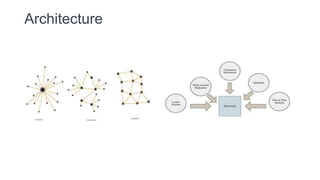
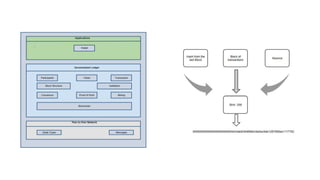
Architecture
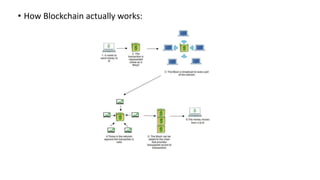
• How Blockchain actually works:
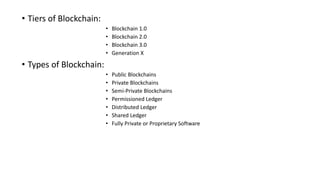
• Tiers of Blockchain:
• Blockchain 1.0
• Blockchain 2.0
• Blockchain 3.0
• Generation X
• Types of Blockchain:
• Public Blockchains
• Private Blockchains
• Semi-Private Blockchains
• Permissioned Ledger
• Distributed Ledger
• Shared Ledger
• Fully Private or Proprietary Software
Results
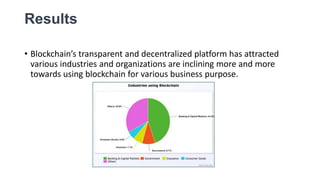
• Blockchain’s transparent and decentralized platform has attracted
various industries and organizations are inclining more and more
towards using blockchain for various business purpose.
Discussion
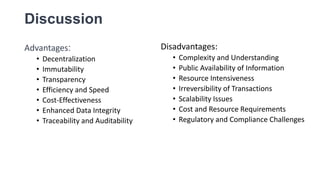
Advantages:
• Decentralization
• Immutability
• Transparency
• Efficiency and Speed
• Cost-Effectiveness
• Enhanced Data Integrity
• Traceability and Auditability
Disadvantages:
• Complexity and Understanding
• Public Availability of Information
• Resource Intensiveness
• Irreversibility of Transactions
• Scalability Issues
• Cost and Resource Requirements
• Regulatory and Compliance Challenges
Conclusion
Blockchain is a revolutionary concept as it has been
successfully able to bring the transparency among the users
and has become a game changer for many industries.
Blockchain encourages entrepreneurship by destroying
corruption and breaking down the walls of bureaucracy and establish
the ownership of common mass. This peer-to-peer technology has
opened the door to new possibilities and has provided a personal
ground for economic empowerment. It is too early to say what lies
ahead, but the future of blockchain looks promising and it can be
concluded that blockchain technology is here to stay
References
[1] Pilkington, Marc. "11 Blockchain Technol-Ogy: Principles and
Applications." Re-Search Handbook On Digital Transfor-Mations (2016):
225.
[2] Crosby, M., Pattanayak, P., Verma, S., & Kalyanaraman, V. (2016).
Blockchain Tech-Nology: Beyond Bitcoin. Applied Innova-Tion, 2, 6-10.
[3] Atzori, Marcella. "Blockchain Technology And Decentralized
Governance: Is The State Still Necessary?" (2015).
[4] Zheng, Zibin, Et Al. "An Overview of Block-Chain Technology:
Architecture, Consen-Sus, And Future Trends." Big Data (Bigdata Congress),
2017 Ieee International Congress On. Ieee, 2017.
[5] Malinova, Katya, and Andreas Park. "Market Design with Blockchain
Technology." (2017).
[6] Nguyen, Quoc Khanh. "Blockchain-a financial technology for future
sustainable development." Green Technology and Sustainable
Development (GTSD), International Conference on. IEEE, 2016.
[7] Ammous, Saifedean. "Blockchain Technology: What is it good for?."
(2016).
[8] Cachin, Christian. "Architecture of the hyperledger blockchain fabric."
Workshop on Distributed Cryptocurrencies and Consensus Ledgers. Vol.
310. 2016.
[9] Condos, James, William H. Sorrell, and Susan L. Donegan. "Blockchain
technology: Opportunities and risks." Vermont, January 15 (2016). [10]
Pilkington, Marc. "Blockchain technology: principles and applications.
Research handbook on digital transformations, edited by f. xavier olleros
and majlinda zhegu." (2016).
[11] Subash Thota, 2017. Analytics – Life Cycle. International Journal of
Multidisciplinary Research and Development, pp. 117-126.
http://www.allsubjectjournal.com/archives/2017/vol4/issue1 2/4-12-33.
[12] Nofer, Michael, et al. "Blockchain." Business & Information Systems
Engineering 59.3 (2017): 183-187.
[13] De Filippi, Primavera, and Samer Hassan. "Blockchain technology as a
regulatory technology: From code is law to law is code." arXiv preprint
arXiv:1801.02507 (2018).
[14] Ahram, Tareq, et al. "Blockchain technology innovations." Technology
& Engineering Management Conference (TEMSCON), 2017 IEEE. IEEE, 2017.
[15] Boucher, Philip. "What if blockchain technology revolutionised voting."
Unpublished manuscript, European Parliament (2016).
[16] Iansiti, Marco, and Karim R. Lakhani. "The truth about blockchain."
Harvard Business Review 95.1 (2017): 118-127.
[17] Sarmah, Simanta Shekhar. "Data Migration." Science and Technology
8.1 (2018): 1-10. [18] Foroglou, George, and Anna-Lali Tsilidou. "Further
applications of the blockchain." Columbia University PhD in Sustainable
Development 10 (2015).
[19] Mougayar, William. The business blockchain: promise, practice, and
application of the next Internet technology. John Wiley & Sons, 2016.
[20] Bashir, Imran. Mastering Blockchain. Packt Publishing Ltd, 2017.
[21] Iansiti, M., & Lakhani, K. R. (2017). The truth about blockchain.
Harvard Business Review, 95(1), 118-127.

blockchain. Intro to blockchain, about, how its implemented

  • 1.
    RN SHETTY TRUST® RNSINSTITUTE OF TECHNOLOGY Autonomous Institution Affiliated to VTU, Recognized by GOK, Approved by AICTE (NAAC ‘A+ Grade’Accredited, NBAAccredited (UG - CSE, ECE, ISE, EIE and EEE) Channasandra, Dr. Vishnuvardhan Road, Bengaluru - 560 098 Ph:(080)28611880,28611881 URL: www.rnsit.ac.in RESEARCH METHODOLOGYAND INTELLECTUAL PROPERTY RIGHTS[21RMI56] 1 Staff in Charge: Ms Vinutha G K Designation: Assistant Professor Carried out by Hardik Goyal (1RN21IS055) Chandan S M (1RN21IS036)
  • 2.
    Understanding Blockchain Technology Author: SimantaShekhar Sarmah Affiliation: Alpha Clinical Systems, USA Date of Publication: 2018-08-02
  • 3.
    Introduction • The researchpaper provides a comprehensive overview of blockchain technology, covering its basics why it came into existence, what problems it solves, and why or why not you should use this technology instead of the traditional methods. • The primary objective is to provide readers with a comprehensive understanding of blockchain, including its history, architecture, functionality, advantages, disadvantages, and applications in different industries. • The study on "Understanding Blockchain Technology" plays a crucial role in promoting awareness, fostering innovation, and facilitating informed decision-making in the context of blockchain adoption and implementation.
  • 4.
    Background The history ofblockchain can be traced back to several key developments and concepts that laid the foundation for its emergence as a revolutionary technology. Here are some pivotal points in the history of blockchain: • Early Cryptographic Concepts: The roots of blockchain can be linked to early cryptographic concepts. In 1976, a paper titled "New Directions in Cryptography" discussed the concept of a distributed ledger, which set the stage for decentralized record-keeping systems. • Timestamping Data: In the early stages of blockchain's development, the concept of timestamping data gained prominence. A paper titled "How to Time-Stamp a Digital Document" by Stuart Haber and Scott Stornetta proposed the idea of timestamping data instead of the medium, laying the groundwork for immutable record-keeping.
  • 5.
    Background (Cont.) • DigitalCurrency and Double Spending: The concept of digital currency and the prevention of double spending played a crucial role in shaping blockchain technology. Protocols such as e-cash schemes and the introduction of double spending detection contributed to the evolution of blockchain • Hashcash and B-money: In 1997, Adam Back introduced the concept of "hashcash" as a solution to control spam emails, which influenced the development of blockchain. Additionally, Wei Dai proposed "b-money," a model based on peer-to-peer networks, further contributing to the conceptualization of blockchain. • Bitcoin and Satoshi Nakamoto: The pivotal moment in blockchain's history came with the introduction of Bitcoin in 2008 through a whitepaper authored by the pseudonymous Satoshi Nakamoto. Bitcoin's underlying technology, the blockchain, revolutionized the way transactions were recorded and verified, marking a significant milestone in the history of blockchain
  • 6.
    Methodology • The researchpaper does not explicitly mention the specific research methodology used in conducting the study. However, based on the content provided in the paper, we can infer that the methodology likely involved an extensive review of academic papers, articles, books, and other sources related to blockchain technology. By synthesizing information from various scholarly works, the paper presents a holistic view of blockchain's background, architecture, functionality, and industry applications.
  • 7.
  • 9.
    • How Blockchainactually works:
  • 10.
    • Tiers ofBlockchain: • Blockchain 1.0 • Blockchain 2.0 • Blockchain 3.0 • Generation X • Types of Blockchain: • Public Blockchains • Private Blockchains • Semi-Private Blockchains • Permissioned Ledger • Distributed Ledger • Shared Ledger • Fully Private or Proprietary Software
  • 11.
    Results • Blockchain’s transparentand decentralized platform has attracted various industries and organizations are inclining more and more towards using blockchain for various business purpose.
  • 12.
    Discussion Advantages: • Decentralization • Immutability •Transparency • Efficiency and Speed • Cost-Effectiveness • Enhanced Data Integrity • Traceability and Auditability Disadvantages: • Complexity and Understanding • Public Availability of Information • Resource Intensiveness • Irreversibility of Transactions • Scalability Issues • Cost and Resource Requirements • Regulatory and Compliance Challenges
  • 13.
    Conclusion Blockchain is arevolutionary concept as it has been successfully able to bring the transparency among the users and has become a game changer for many industries. Blockchain encourages entrepreneurship by destroying corruption and breaking down the walls of bureaucracy and establish the ownership of common mass. This peer-to-peer technology has opened the door to new possibilities and has provided a personal ground for economic empowerment. It is too early to say what lies ahead, but the future of blockchain looks promising and it can be concluded that blockchain technology is here to stay
  • 14.
    References [1] Pilkington, Marc."11 Blockchain Technol-Ogy: Principles and Applications." Re-Search Handbook On Digital Transfor-Mations (2016): 225. [2] Crosby, M., Pattanayak, P., Verma, S., & Kalyanaraman, V. (2016). Blockchain Tech-Nology: Beyond Bitcoin. Applied Innova-Tion, 2, 6-10. [3] Atzori, Marcella. "Blockchain Technology And Decentralized Governance: Is The State Still Necessary?" (2015). [4] Zheng, Zibin, Et Al. "An Overview of Block-Chain Technology: Architecture, Consen-Sus, And Future Trends." Big Data (Bigdata Congress), 2017 Ieee International Congress On. Ieee, 2017. [5] Malinova, Katya, and Andreas Park. "Market Design with Blockchain Technology." (2017). [6] Nguyen, Quoc Khanh. "Blockchain-a financial technology for future sustainable development." Green Technology and Sustainable Development (GTSD), International Conference on. IEEE, 2016. [7] Ammous, Saifedean. "Blockchain Technology: What is it good for?." (2016). [8] Cachin, Christian. "Architecture of the hyperledger blockchain fabric." Workshop on Distributed Cryptocurrencies and Consensus Ledgers. Vol. 310. 2016. [9] Condos, James, William H. Sorrell, and Susan L. Donegan. "Blockchain technology: Opportunities and risks." Vermont, January 15 (2016). [10] Pilkington, Marc. "Blockchain technology: principles and applications. Research handbook on digital transformations, edited by f. xavier olleros and majlinda zhegu." (2016). [11] Subash Thota, 2017. Analytics – Life Cycle. International Journal of Multidisciplinary Research and Development, pp. 117-126. http://www.allsubjectjournal.com/archives/2017/vol4/issue1 2/4-12-33. [12] Nofer, Michael, et al. "Blockchain." Business & Information Systems Engineering 59.3 (2017): 183-187. [13] De Filippi, Primavera, and Samer Hassan. "Blockchain technology as a regulatory technology: From code is law to law is code." arXiv preprint arXiv:1801.02507 (2018). [14] Ahram, Tareq, et al. "Blockchain technology innovations." Technology & Engineering Management Conference (TEMSCON), 2017 IEEE. IEEE, 2017. [15] Boucher, Philip. "What if blockchain technology revolutionised voting." Unpublished manuscript, European Parliament (2016). [16] Iansiti, Marco, and Karim R. Lakhani. "The truth about blockchain." Harvard Business Review 95.1 (2017): 118-127. [17] Sarmah, Simanta Shekhar. "Data Migration." Science and Technology 8.1 (2018): 1-10. [18] Foroglou, George, and Anna-Lali Tsilidou. "Further applications of the blockchain." Columbia University PhD in Sustainable Development 10 (2015). [19] Mougayar, William. The business blockchain: promise, practice, and application of the next Internet technology. John Wiley & Sons, 2016. [20] Bashir, Imran. Mastering Blockchain. Packt Publishing Ltd, 2017. [21] Iansiti, M., & Lakhani, K. R. (2017). The truth about blockchain. Harvard Business Review, 95(1), 118-127.