Blockchain Advan
& its Applications
By
Eng. M. Mansour
NOV 2022
1. Blockchain Introduction & Overview.
2. Blockchain Advantages over Traditional Technologies.
3. Blockchain Consensus Mechanisms
4. Blockchain Applications
5. Blockchain Weaknesses
6. Conclusion
Outlines
1- Blockchain Introduction
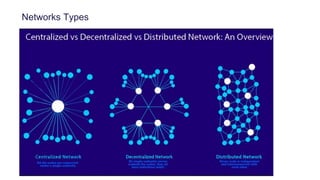
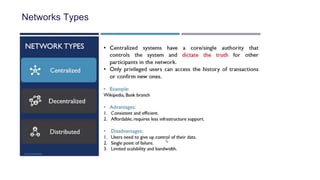
Networks Types
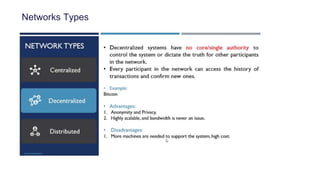
Networks Types
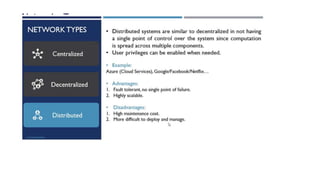
Networks Types
Networks Types
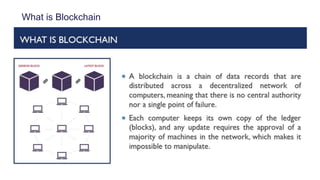
What is Blockchain
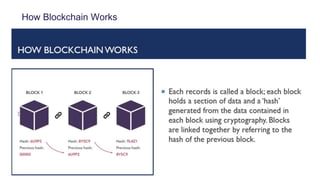
How Blockchain Works
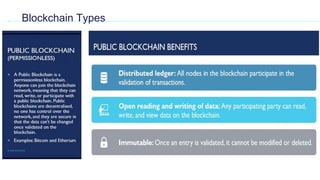
Blockchain Types
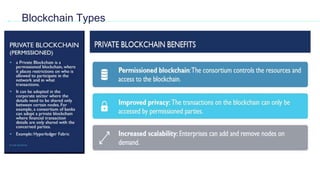
Blockchain Types
Blockchain Terminologies
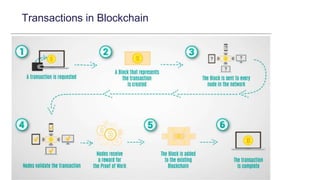
Users initiate
transactions
using their
Digital
Signatures
Users
Broadcast their
transactions to
Nodes
One or more
Nodes begin
validating each
transaction
Nodes
aggregate
validated
transactions
into Blocks
Nodes
Broadcast
Blocks to each
other
Consensus
protocol used
Block reflecting
“true state” is
chained to prior
Block
Transactions in Blockchain
Blockchain terminologies
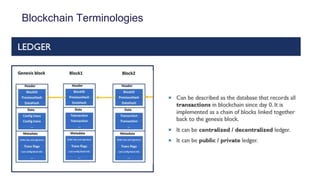
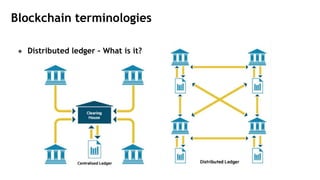
● Distributed ledger – What is it?
Distinction between databases and blockchain ledgers
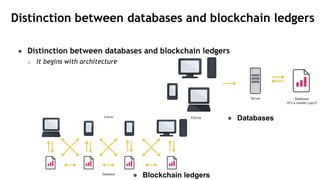
● Distinction between databases and blockchain ledgers
o It begins with architecture
● Databases
● Blockchain ledgers
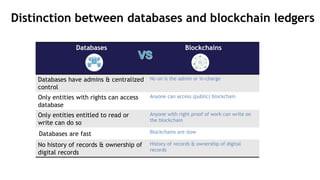
Distinction between databases and blockchain ledgers
Databases Blockchains
Databases have admins & centralized
control
No on is the admin or in-charge
Only entities with rights can access
database
Anyone can access (public) blockchain
Only entities entitled to read or
write can do so
Anyone with right proof of work can write on
the blockchain
Databases are fast Blockchains are slow
No history of records & ownership of
digital records
History of records & ownership of digital
records
2- Blockchain Advantages Vs
traditional Networks
Trustless.
Confidentiality.
Robustness, Reliability & Availability.
Verifiability & Auditability.
3- Consensus Mechanisms
Consensus components
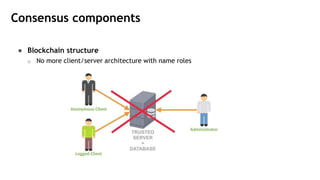
● Blockchain structure
o No more client/server architecture with name roles
Consensus components
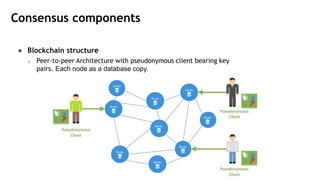
● Blockchain structure
o Peer-to-peer Architecture with pseudonymous client bearing key
pairs. Each node as a database copy.
Consensus components
● Principles and paradigms of distributed systems
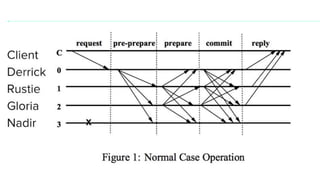
o Byzantine fault tolerance (BFT): the dependability of a fault-
tolerant computer system, particularly distributed computing
systems, where components may fail and there is imperfect
information on whether a component has failed.
o The objective of BFT is to defend against failures of system
components with or without symptoms that prevent other
components of the system from reaching an agreement among
themselves, where such an agreement is needed for the correct
operation of the system.
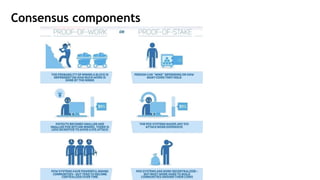
o One example of BFT in use is bitcoin. The bitcoin network works in
parallel to generate a blockchain with proof-of-work allowing the
system to overcome Byzantine failures and reach a coherent global
view of the system’s state.
Consensus components
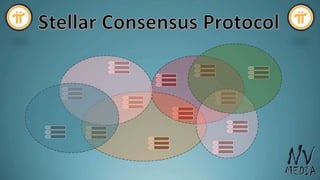
● Blockchain consensus algorithms
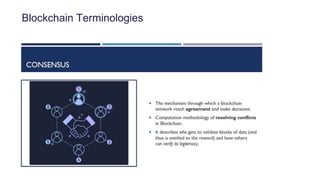
o Behind every cryptocurrency, there’s a consensus algorithm. No
consensus algorithm is perfect, but they each have their strengths.
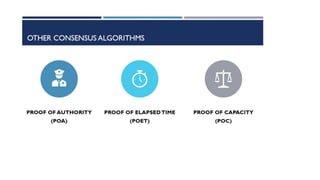
o Proof of Trust (PoT)
o Proof of Event (PoE)
o Proof of Reputation (PoR)
o Practical Byzantine fault tolerant Mechanism (PBFT)
o …
4- Blockchain Applications
Internet of Things
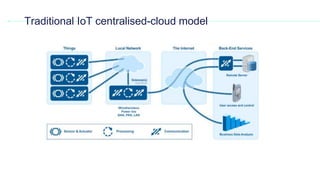
Traditional IoT centralised-cloud model
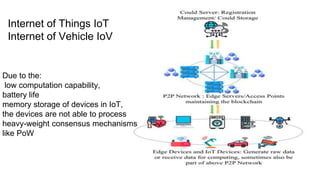
Internet of Things IoT
Internet of Vehicle IoV
Due to the:
low computation capability,
battery life
memory storage of devices in IoT,
the devices are not able to process
heavy-weight consensus mechanisms
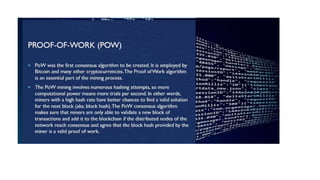
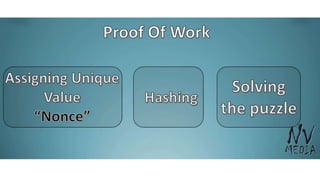
like PoW
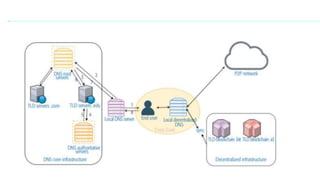
Domain Name System
Traditional DNS
● Distributed Denial of Service (DDoS) attacks
● Server damage caused by cyber attack / Shutdown of DNS servers by authorities or disasters
● Alteration of DNS records on server
● Attack on user to change DNS address mid-session
Blockchain DNS
● A blockchain DNS network would be decentralised, and as a result many nodes would need to be
disrupted in order to take down the entire system and disrupt service. Additionally, the larger the
network, the more secure it becomes.
● Due to DNS records being replicated across many nodes, shutting down one server will not affect
service as the rest of the network will still be active.
● Such a change on one server would require the change to be applied to the whole network,
therefore requiring network-wide consensus. This relates to the attribute of immutability referenced
in earlier cases.
● Due to cryptographic signature techniques, the user can be sure that the DNS data they receive
from a corresponding block are valid. The DNS request is encrypted and so attackers cannot easily
intercept it.
There are four notable vulnerabilities in the existing
centralized solution for DNS
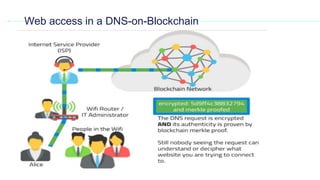
Web access in a DNS-on-Blockchain
structure
Data Storage
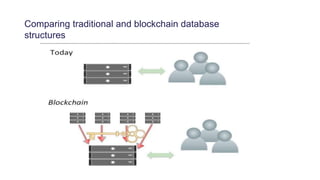
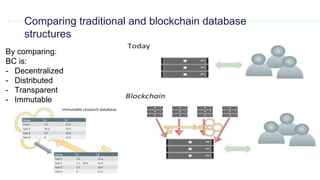
Comparing traditional and blockchain database
structures
Comparing traditional and blockchain database
structures
By comparing:
BC is:
- Decentralized
- Distributed
- Transparent
- Immutable
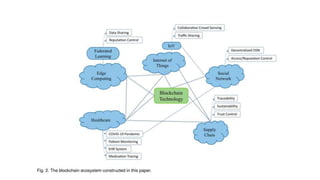
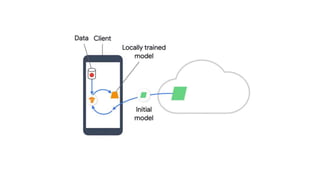
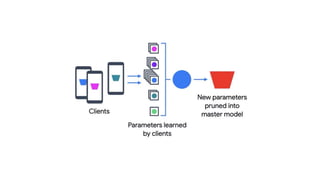
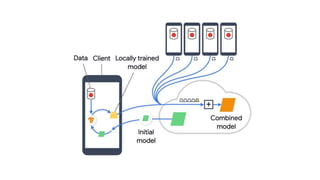
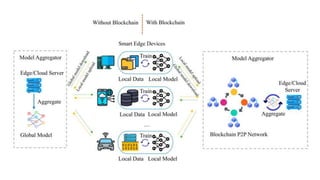
Federated Learning &
Blockchain
Healthcare & Blockchain
Supply Chain and Social
Network
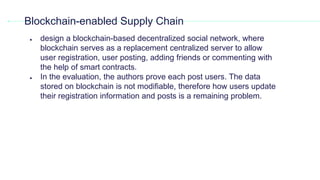
● design a blockchain-based decentralized social network, where
blockchain serves as a replacement centralized server to allow
user registration, user posting, adding friends or commenting with
the help of smart contracts.
● In the evaluation, the authors prove each post users. The data
stored on blockchain is not modifiable, therefore how users update
their registration information and posts is a remaining problem.
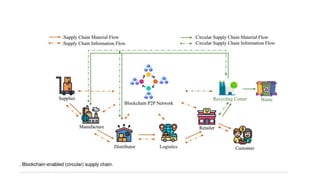
Blockchain-enabled Supply Chain
Supply Chain and
Blockchain
5- Blockchain Weakness
6- Discussion
● The communication or communication consumption are not affordable to many lightweight
applications since applications with resource-limited devices IoT/IoV are often not able to
consistently perform stable communications or computation tasks.
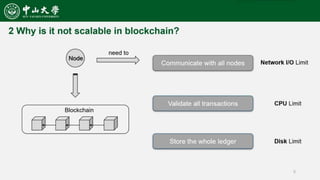
● Blockchain storage scalability limitation due to the transaction throughput, the transaction
processing latency, and the storage cost of blockchain cannot all satisfy the demands of many use
cases which need efficient consensus mechanisms, such as PoS, DPoS. New consensus mechanisms
are highly demanded by optimizing all three properties under much more general settings and use
cases.
● The main concern of companies to adopt blockchain in IoT services, healthcare systems or supply
chain systems is the cost of blockchain technology. Further extensive research can be done in
many other applications such as IoT, edge computing, supply chain and healthcare.
● Blockchain simulation tools are highly desired for helping evaluate the performance of blockchains
system, which provides intuitive results for industry to understand the performance and cost of
blockchain systems.
Discussion & General Foresight of Future Works
● Lower the cost of blockchain will promote the adoption of blockchain in industry. The cost to build
a blockchain generally comes from the development of blockchain client for each working node,
the computation resource to perform consensus mechanism, the storage resource to store the
blocks and the cost of incentive mechanism to reward working nodes if necessary. The cost for
developing blockchain client is mostly decided by software engineering market price. Therefore,
better consensus mechanisms and corresponding incentive mechanisms take great weights in
lowering the cost for blockchain industry.
● Blockchain is a third-party free, non-trust built, distributed data management approach. The
adoption of blockchain technology not only brings benefits, but also potential risks and security
weakness due to anonymity.
● Though most popular consensus mechanisms are proved able to resist dishonest users when the
ratio is under 51% or 1/3, the resistance to cyber-security attacks such as registration attack, data
leakage and encryption break-through is still a question. Different from the most famous successful
blockchain system such as Bitcoin and Ethereum which run on high-end computers, the blockchain
applications in IoT, edge computing, healthcare and supply chain usually involves tremendous edge
devices, such as mobile smart phones, IoT smart devices or network access points, which can be
easily compromised. Future academy and industry may work together to study those external
cyber-security attacks in blockchain systems.
Discussion & General Foresight of Future Works
● blockchain-enabled applications can put more functions on blockchain through smart contracts to
decentralize the computation power and take full advantages of blockchain technology.
● Blockchain is tamper-proof, that everything stored on blockchain can never be modified or deleted
in anyway, otherwise the chain rule will be broken due to the uniqueness of block hash. For the
application of social network, it is common that people can leave the social network and need to
erase all the social records.
● However, blockchain-enabled social networks are hard to achieve this as long as there is any data
of users stored on blockchain.
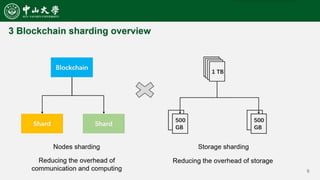
● Blockchain is decentralized that ideally requires every participant to store the full copy of
blockchain. Many use cases mentioned above cannot satisfy the ideal situation that the storage
cost will soon become unaffordable if the blockchain stores all data. In some use cases, such as
healthcare, it is not always secure to allow everyone holds full copy of data, since some sensitive
information of patients may not be supposed to be accessible to some particular parties. We
suggest future work may develop variants of current popular blockchain systems to meet the
demands of particular use cases.
Discussion & General Foresight of Future Works
References
[1] Dylan Rafferty, Kevin Curran, “The Role of Blockchain in Cyber Security”, Semiconductor
Science and Information Devices, VOL. 3, NO. 1, (2021).
[2] Xaio Li, Weili Wu, “Recent Advances of Blockchain and its Applications” (2022).
Any Questions
The End

Blockchain Advances & its Applications.pptx

  • 1.
    Blockchain Advan & itsApplications By Eng. M. Mansour NOV 2022
  • 2.
    1. Blockchain Introduction& Overview. 2. Blockchain Advantages over Traditional Technologies. 3. Blockchain Consensus Mechanisms 4. Blockchain Applications 5. Blockchain Weaknesses 6. Conclusion Outlines
  • 3.
  • 4.
  • 5.
  • 6.
  • 7.
  • 8.
  • 9.
  • 10.
  • 11.
  • 13.
  • 14.
  • 15.
  • 16.
  • 17.
  • 18.
  • 19.
  • 20.
  • 21.
    Users initiate transactions using their Digital Signatures Users Broadcasttheir transactions to Nodes One or more Nodes begin validating each transaction Nodes aggregate validated transactions into Blocks Nodes Broadcast Blocks to each other Consensus protocol used Block reflecting “true state” is chained to prior Block Transactions in Blockchain
  • 22.
  • 23.
    Distinction between databasesand blockchain ledgers ● Distinction between databases and blockchain ledgers o It begins with architecture ● Databases ● Blockchain ledgers
  • 24.
    Distinction between databasesand blockchain ledgers Databases Blockchains Databases have admins & centralized control No on is the admin or in-charge Only entities with rights can access database Anyone can access (public) blockchain Only entities entitled to read or write can do so Anyone with right proof of work can write on the blockchain Databases are fast Blockchains are slow No history of records & ownership of digital records History of records & ownership of digital records
  • 25.
    2- Blockchain AdvantagesVs traditional Networks Trustless. Confidentiality. Robustness, Reliability & Availability. Verifiability & Auditability.
  • 30.
  • 32.
    Consensus components ● Blockchainstructure o No more client/server architecture with name roles
  • 33.
    Consensus components ● Blockchainstructure o Peer-to-peer Architecture with pseudonymous client bearing key pairs. Each node as a database copy.
  • 34.
    Consensus components ● Principlesand paradigms of distributed systems o Byzantine fault tolerance (BFT): the dependability of a fault- tolerant computer system, particularly distributed computing systems, where components may fail and there is imperfect information on whether a component has failed. o The objective of BFT is to defend against failures of system components with or without symptoms that prevent other components of the system from reaching an agreement among themselves, where such an agreement is needed for the correct operation of the system. o One example of BFT in use is bitcoin. The bitcoin network works in parallel to generate a blockchain with proof-of-work allowing the system to overcome Byzantine failures and reach a coherent global view of the system’s state.
  • 39.
  • 40.
    Consensus components ● Blockchainconsensus algorithms o Behind every cryptocurrency, there’s a consensus algorithm. No consensus algorithm is perfect, but they each have their strengths. o Proof of Trust (PoT) o Proof of Event (PoE) o Proof of Reputation (PoR) o Practical Byzantine fault tolerant Mechanism (PBFT) o …
  • 43.
  • 45.
  • 46.
  • 47.
    Internet of ThingsIoT Internet of Vehicle IoV Due to the: low computation capability, battery life memory storage of devices in IoT, the devices are not able to process heavy-weight consensus mechanisms like PoW
  • 49.
  • 51.
    Traditional DNS ● DistributedDenial of Service (DDoS) attacks ● Server damage caused by cyber attack / Shutdown of DNS servers by authorities or disasters ● Alteration of DNS records on server ● Attack on user to change DNS address mid-session Blockchain DNS ● A blockchain DNS network would be decentralised, and as a result many nodes would need to be disrupted in order to take down the entire system and disrupt service. Additionally, the larger the network, the more secure it becomes. ● Due to DNS records being replicated across many nodes, shutting down one server will not affect service as the rest of the network will still be active. ● Such a change on one server would require the change to be applied to the whole network, therefore requiring network-wide consensus. This relates to the attribute of immutability referenced in earlier cases. ● Due to cryptographic signature techniques, the user can be sure that the DNS data they receive from a corresponding block are valid. The DNS request is encrypted and so attackers cannot easily intercept it. There are four notable vulnerabilities in the existing centralized solution for DNS
  • 52.
    Web access ina DNS-on-Blockchain structure
  • 53.
  • 54.
    Comparing traditional andblockchain database structures
  • 55.
    Comparing traditional andblockchain database structures By comparing: BC is: - Decentralized - Distributed - Transparent - Immutable
  • 58.
  • 67.
  • 70.
    Supply Chain andSocial Network
  • 71.
    ● design ablockchain-based decentralized social network, where blockchain serves as a replacement centralized server to allow user registration, user posting, adding friends or commenting with the help of smart contracts. ● In the evaluation, the authors prove each post users. The data stored on blockchain is not modifiable, therefore how users update their registration information and posts is a remaining problem. Blockchain-enabled Supply Chain
  • 72.
  • 74.
  • 75.
  • 76.
    ● The communicationor communication consumption are not affordable to many lightweight applications since applications with resource-limited devices IoT/IoV are often not able to consistently perform stable communications or computation tasks. ● Blockchain storage scalability limitation due to the transaction throughput, the transaction processing latency, and the storage cost of blockchain cannot all satisfy the demands of many use cases which need efficient consensus mechanisms, such as PoS, DPoS. New consensus mechanisms are highly demanded by optimizing all three properties under much more general settings and use cases. ● The main concern of companies to adopt blockchain in IoT services, healthcare systems or supply chain systems is the cost of blockchain technology. Further extensive research can be done in many other applications such as IoT, edge computing, supply chain and healthcare. ● Blockchain simulation tools are highly desired for helping evaluate the performance of blockchains system, which provides intuitive results for industry to understand the performance and cost of blockchain systems. Discussion & General Foresight of Future Works
  • 77.
    ● Lower thecost of blockchain will promote the adoption of blockchain in industry. The cost to build a blockchain generally comes from the development of blockchain client for each working node, the computation resource to perform consensus mechanism, the storage resource to store the blocks and the cost of incentive mechanism to reward working nodes if necessary. The cost for developing blockchain client is mostly decided by software engineering market price. Therefore, better consensus mechanisms and corresponding incentive mechanisms take great weights in lowering the cost for blockchain industry. ● Blockchain is a third-party free, non-trust built, distributed data management approach. The adoption of blockchain technology not only brings benefits, but also potential risks and security weakness due to anonymity. ● Though most popular consensus mechanisms are proved able to resist dishonest users when the ratio is under 51% or 1/3, the resistance to cyber-security attacks such as registration attack, data leakage and encryption break-through is still a question. Different from the most famous successful blockchain system such as Bitcoin and Ethereum which run on high-end computers, the blockchain applications in IoT, edge computing, healthcare and supply chain usually involves tremendous edge devices, such as mobile smart phones, IoT smart devices or network access points, which can be easily compromised. Future academy and industry may work together to study those external cyber-security attacks in blockchain systems. Discussion & General Foresight of Future Works
  • 78.
    ● blockchain-enabled applicationscan put more functions on blockchain through smart contracts to decentralize the computation power and take full advantages of blockchain technology. ● Blockchain is tamper-proof, that everything stored on blockchain can never be modified or deleted in anyway, otherwise the chain rule will be broken due to the uniqueness of block hash. For the application of social network, it is common that people can leave the social network and need to erase all the social records. ● However, blockchain-enabled social networks are hard to achieve this as long as there is any data of users stored on blockchain. ● Blockchain is decentralized that ideally requires every participant to store the full copy of blockchain. Many use cases mentioned above cannot satisfy the ideal situation that the storage cost will soon become unaffordable if the blockchain stores all data. In some use cases, such as healthcare, it is not always secure to allow everyone holds full copy of data, since some sensitive information of patients may not be supposed to be accessible to some particular parties. We suggest future work may develop variants of current popular blockchain systems to meet the demands of particular use cases. Discussion & General Foresight of Future Works
  • 79.
    References [1] Dylan Rafferty,Kevin Curran, “The Role of Blockchain in Cyber Security”, Semiconductor Science and Information Devices, VOL. 3, NO. 1, (2021). [2] Xaio Li, Weili Wu, “Recent Advances of Blockchain and its Applications” (2022).
  • 80.
  • 81.

Editor's Notes

  • #22 Explain how the distributed ledger works (from users to nodes until the block is validated and added into the chain). Source: “A brief introduction to blockchain”, Nancy LIAO, 2005
  • #23 Centralised Ledger: Most companies currently use a centralised database that lives in a fixed location. A centralised database essentially has a single point of failure. Distributed Ledger: A database that exists across several locations or among multiple participants, decentralized to eliminate the need for a central authority or intermediary to process, validate or authenticate transactions. The records are only ever stored in the ledger when the consensus has been reached by the parties involved.
  • #24 A database running on the World Wide Web is most often using a client-server network architecture. For a blockchain database, each participant maintains, calculates and updates new entries into the database. All nodes work together to ensure they are all coming to the same conclusions, providing in-built security for the network.
  • #25 This table summarizes the distinction between databases and blockchain ledgers.
  • #36 A Byzantine fault is any fault presenting different symptoms to different observers. A Byzantine failure is the loss of a system service due to a Byzantine fault in systems that require consensus.
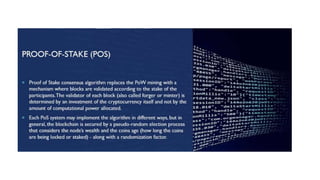
  • #41 This image explains the difference between proof-of-work and proof-of-stake.