
Tariqullah Khan
Professor Islamic Finance, College of Islamic Studies
HBKU
Views expressed are personal
tkhan@hbku.edu.qa
Digitization of Sukuk in the Light of
Crypto Currencies & Economic
and Regulatory Challenges
+ Blockchain by Dalal Mahmood
Based on Symposium on Digital Currencies from Sharia, Economic and Practical Perspectives
March 19, 2018, College of Islamic Studies, Hamad Bin Khalifa University
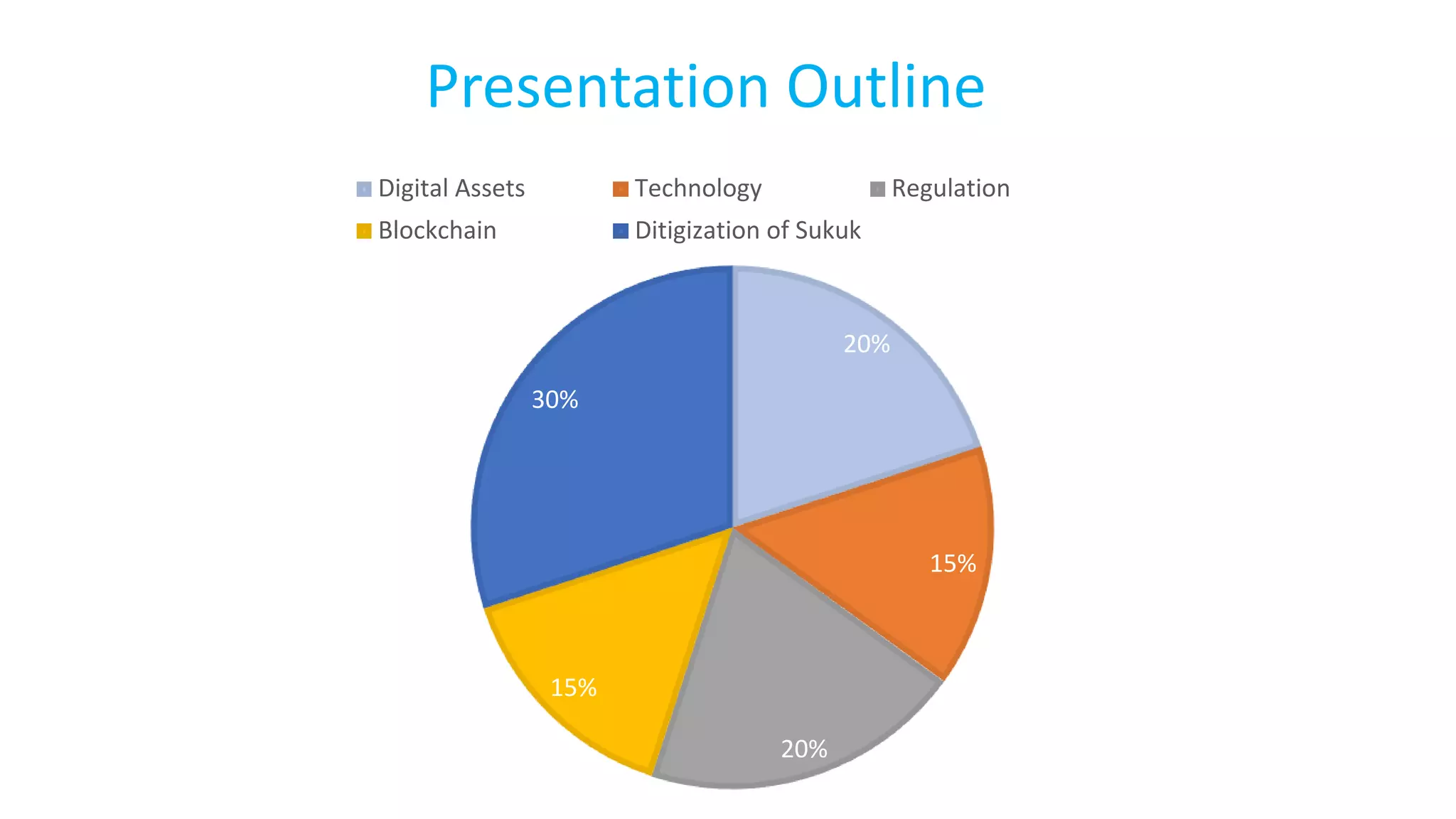
20%
15%
20%
15%
30%
Digital Assets Technology Regulation
Blockchain Ditigization of Sukuk
Presentation Outline
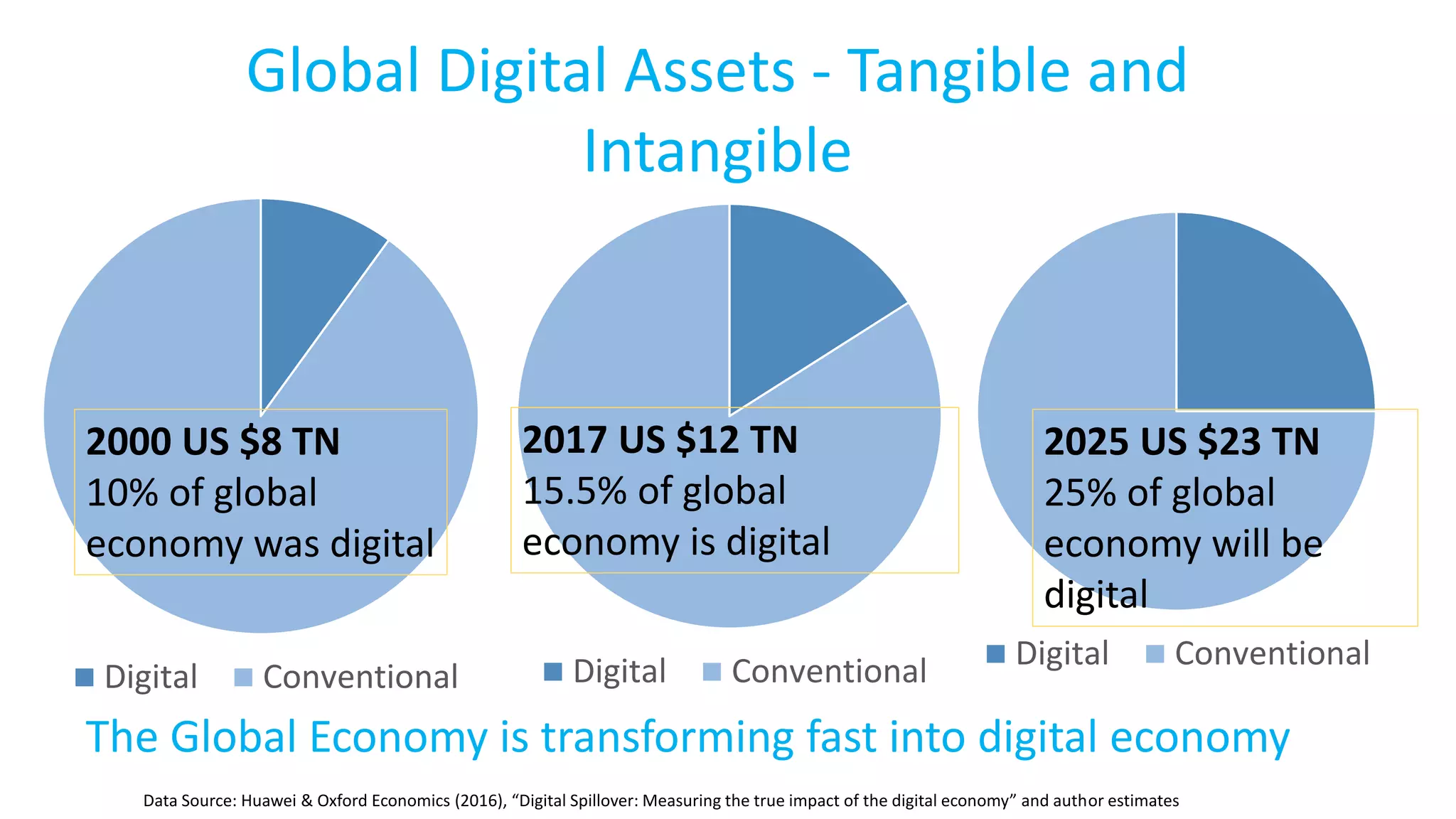
Digital Conventional
2017 US $12 TN
15.5% of global
economy is digital
Digital Conventional
2025 US $23 TN
25% of global
economy will be
digital
Digital Conventional
2000 US $8 TN
10% of global
economy was digital
Global Digital Assets - Tangible and
Intangible
Data Source: Huawei & Oxford Economics (2016), “Digital Spillover: Measuring the true impact of the digital economy” and author estimates
The Global Economy is transforming fast into digital economy
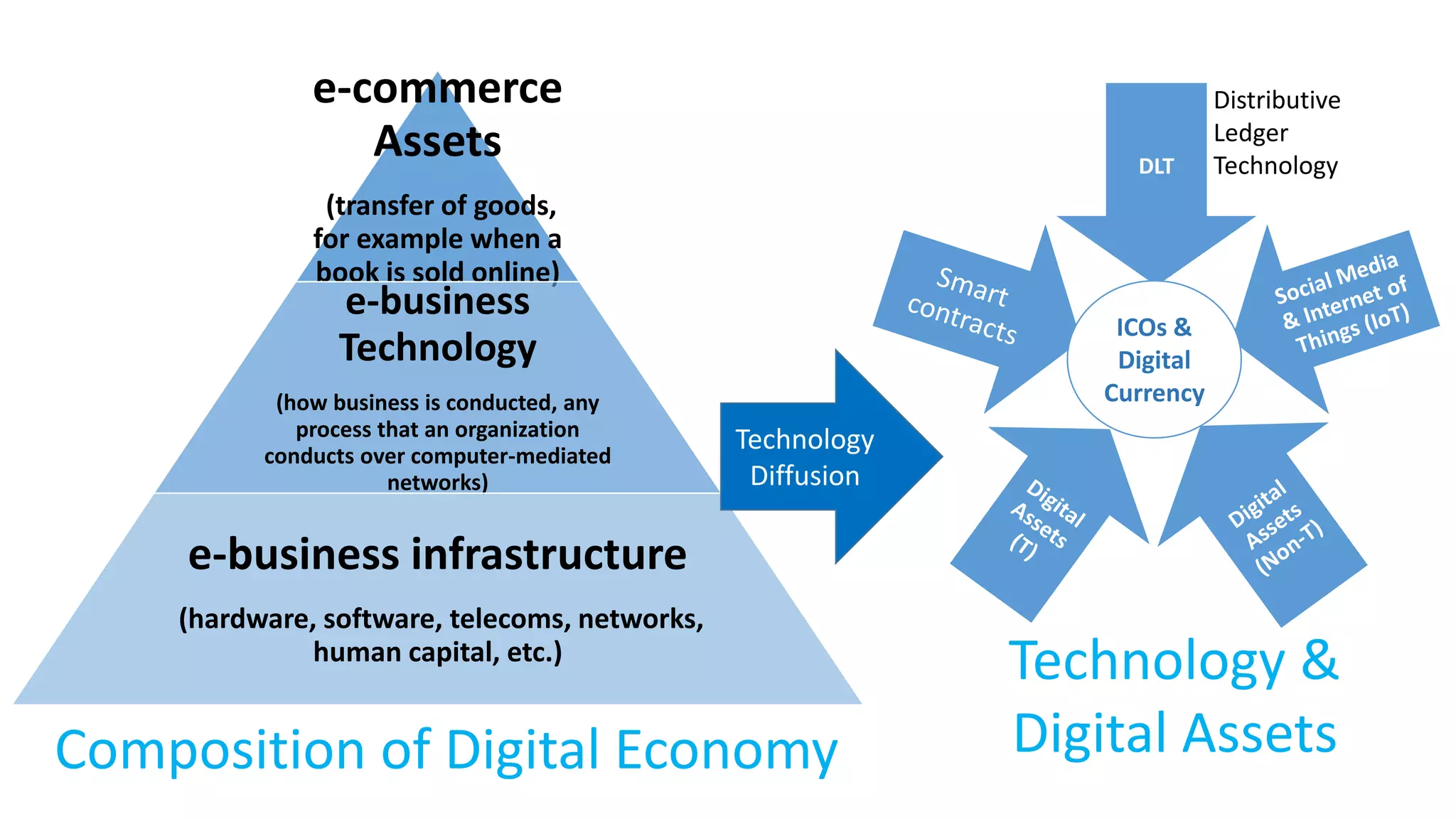
e-commerce
Assets
(transfer of goods,
for example when a
book is sold online)
e-business
Technology
(how business is conducted, any
process that an organization
conducts over computer-mediated
networks)
e-business infrastructure
(hardware, software, telecoms, networks,
human capital, etc.)
DLT
Composition of Digital Economy
Technology &
Digital Assets
Technology
Diffusion
ICOs &
Digital
Currency
Distributive
Ledger
Technology
Knowledge
Software
Information, Data & Big Data
Digital Tokens & Currencies
Designs
Patents & Trade Secrets
Art
Music
Entertainment & Media
Addresses
Virtual Property
Revealed perceptions and
preferences
Distributed
Ledger
Technology
Social
Media &
Internet
of Things
(IoT)
Intangible
digital
assets
Tangible
Digital
Assets
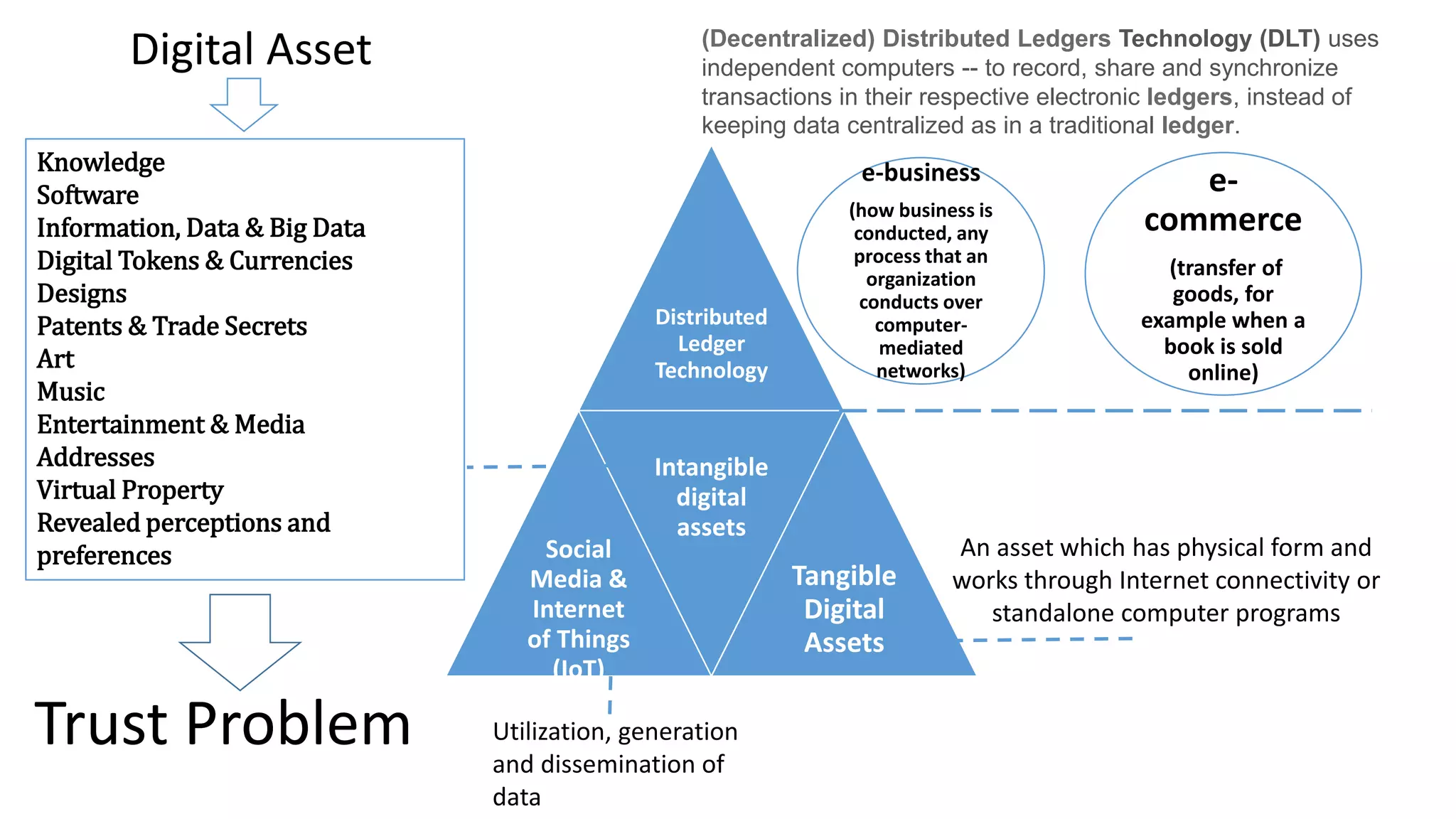
An asset which has physical form and
works through Internet connectivity or
standalone computer programs
e-business
(how business is
conducted, any
process that an
organization
conducts over
computer-
mediated
networks)
e-
commerce
(transfer of
goods, for
example when a
book is sold
online)
(Decentralized) Distributed Ledgers Technology (DLT) uses
independent computers -- to record, share and synchronize
transactions in their respective electronic ledgers, instead of
keeping data centralized as in a traditional ledger.
Trust Problem Utilization, generation
and dissemination of
data
Digital Asset
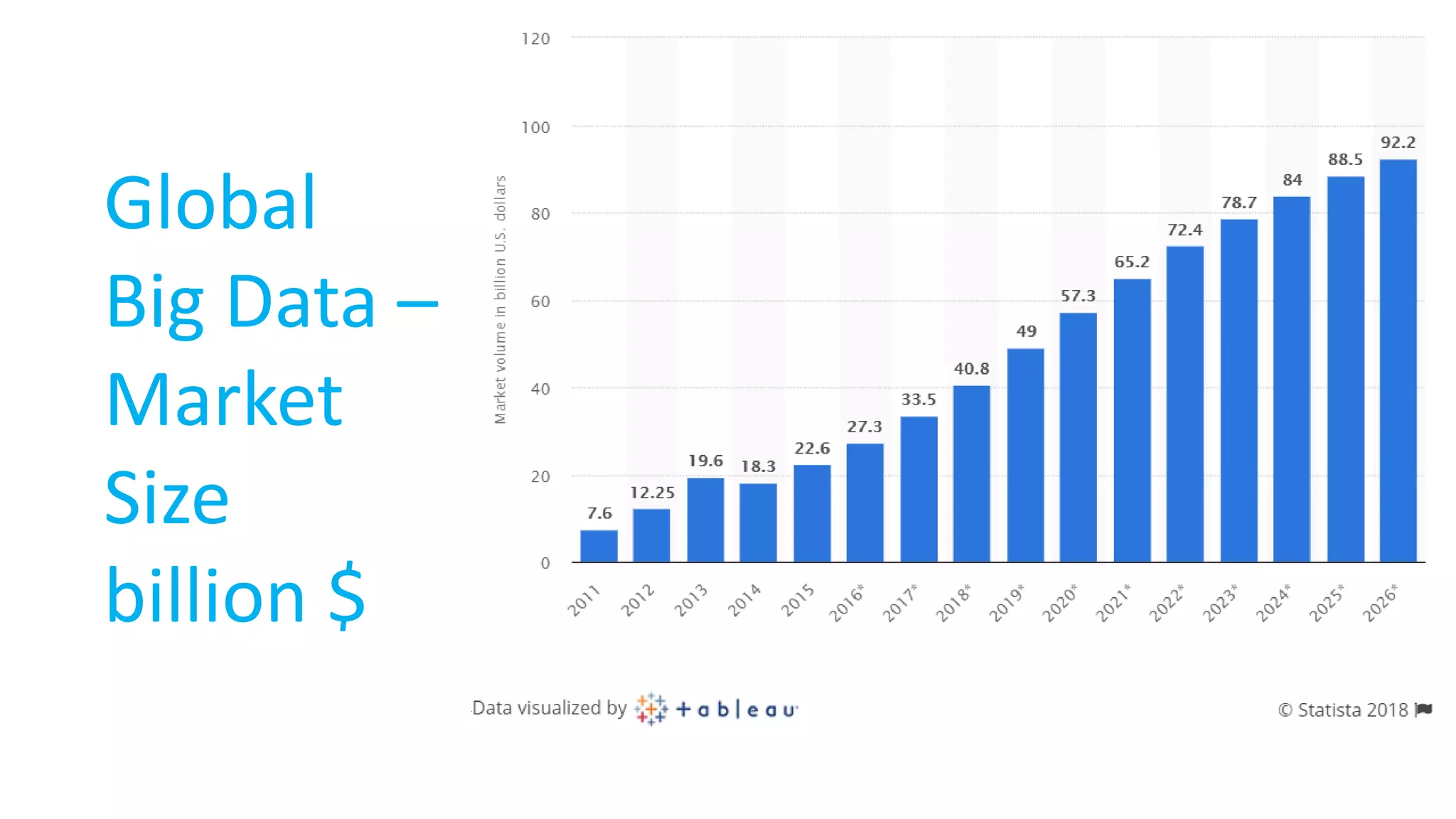
Global
Big Data –
Market
Size
billion $
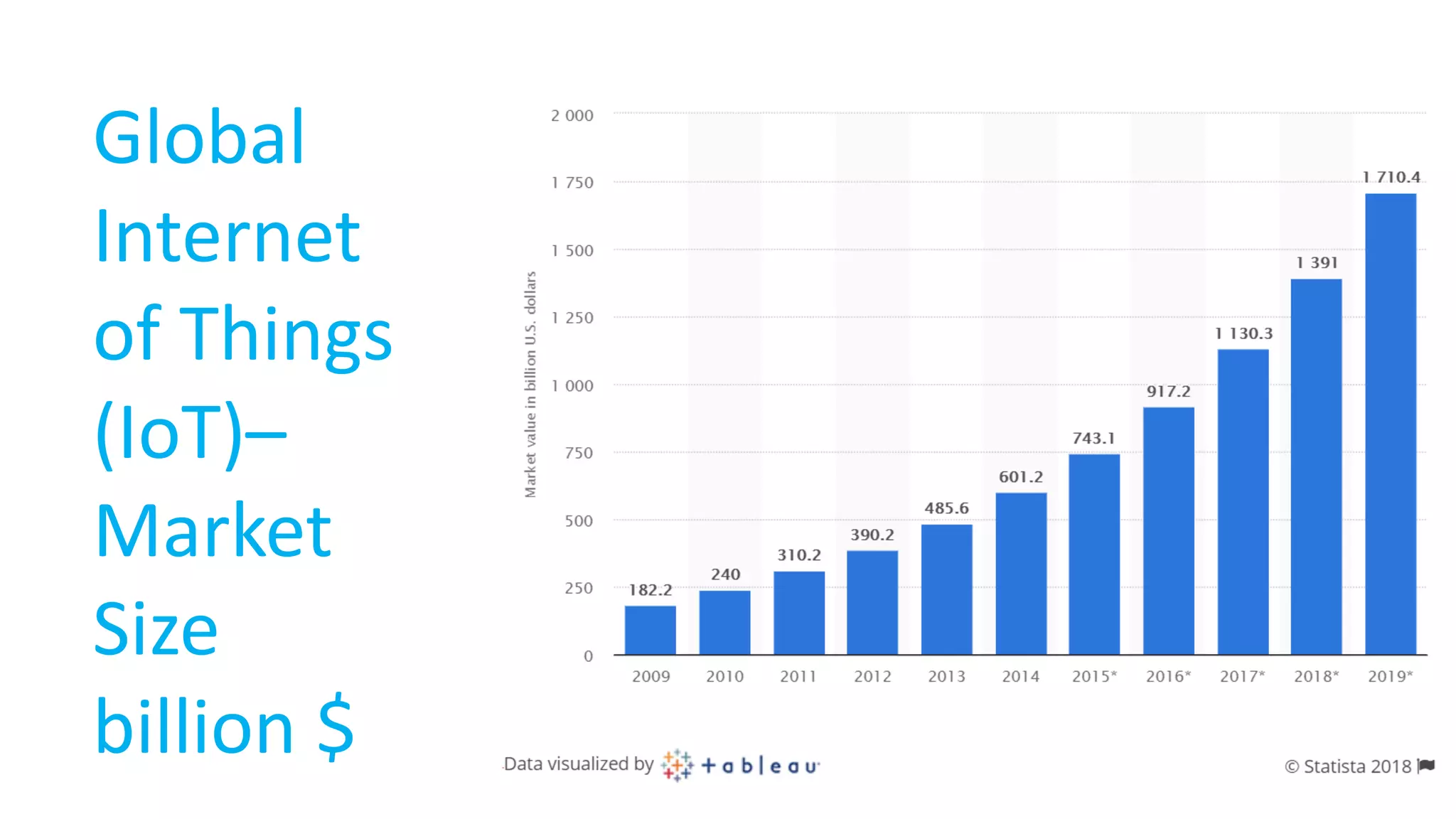
Global
Internet
of Things
(IoT)–
Market
Size
billion $
0
500
1000
1500
2000
2500
3000
3500
4000
4500
5000
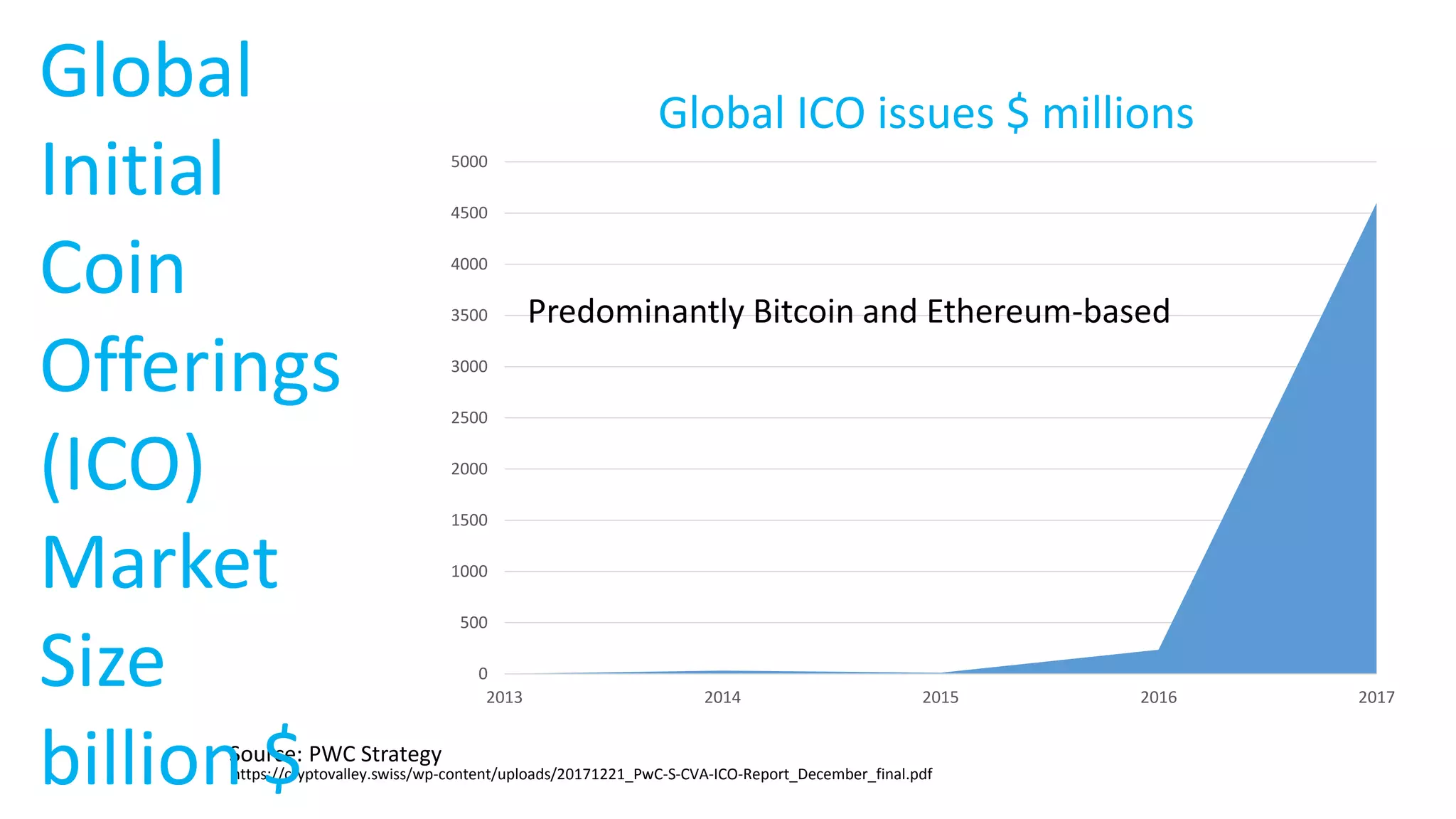
2013 2014 2015 2016 2017
Global ICO issues $ millions
Source: PWC Strategy
https://cryptovalley.swiss/wp-content/uploads/20171221_PwC-S-CVA-ICO-Report_December_final.pdf
Predominantly Bitcoin and Ethereum-based
Global
Initial
Coin
Offerings
(ICO)
Market
Size
billion $
https://cryptovalley.swiss/wp-content/uploads/20171221_PwC-S-CVA-ICO-Report_December_final.pdf
Source: PWC Strategy
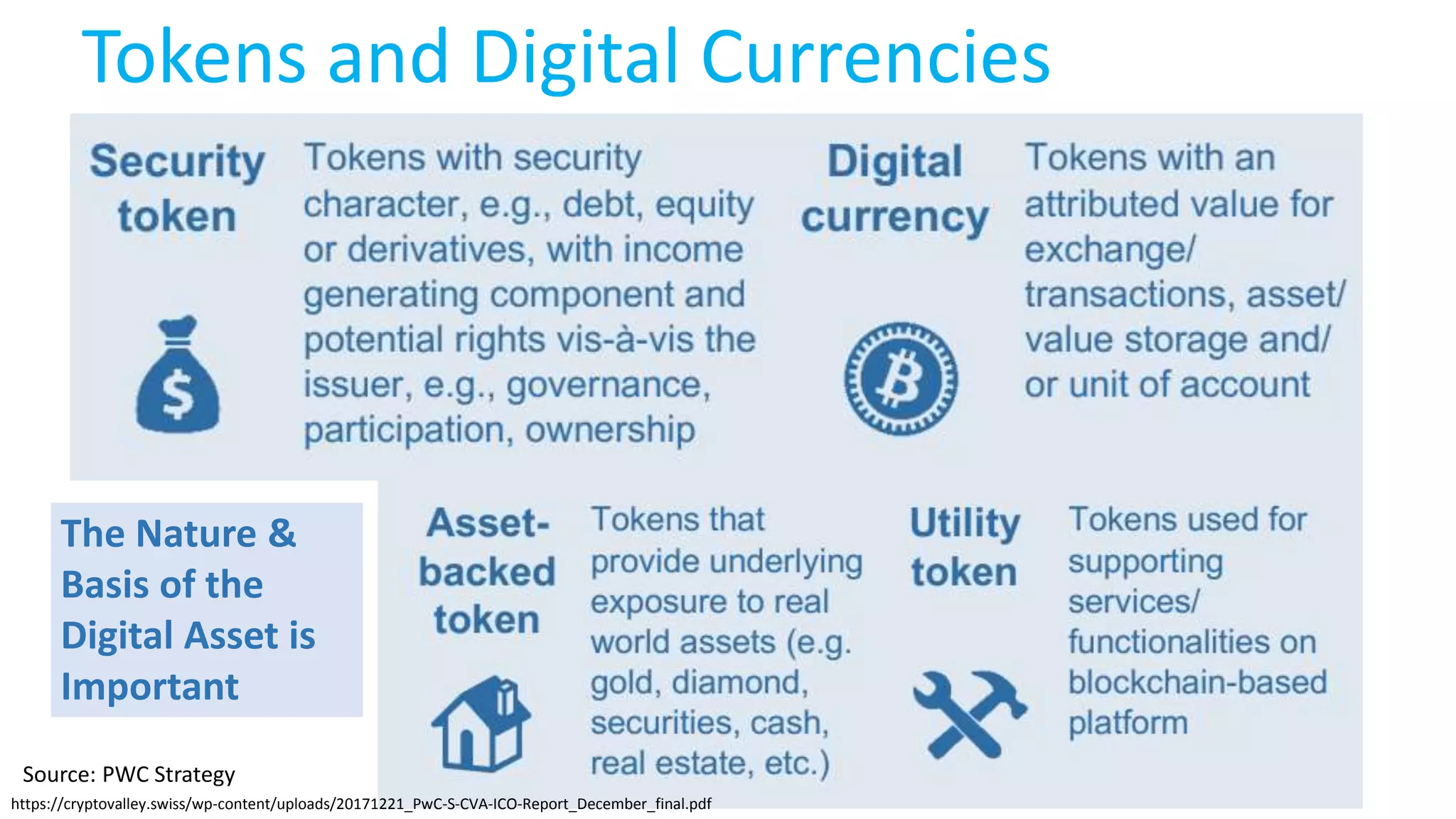
Tokens and Digital Currencies
The Nature &
Basis of the
Digital Asset is
Important
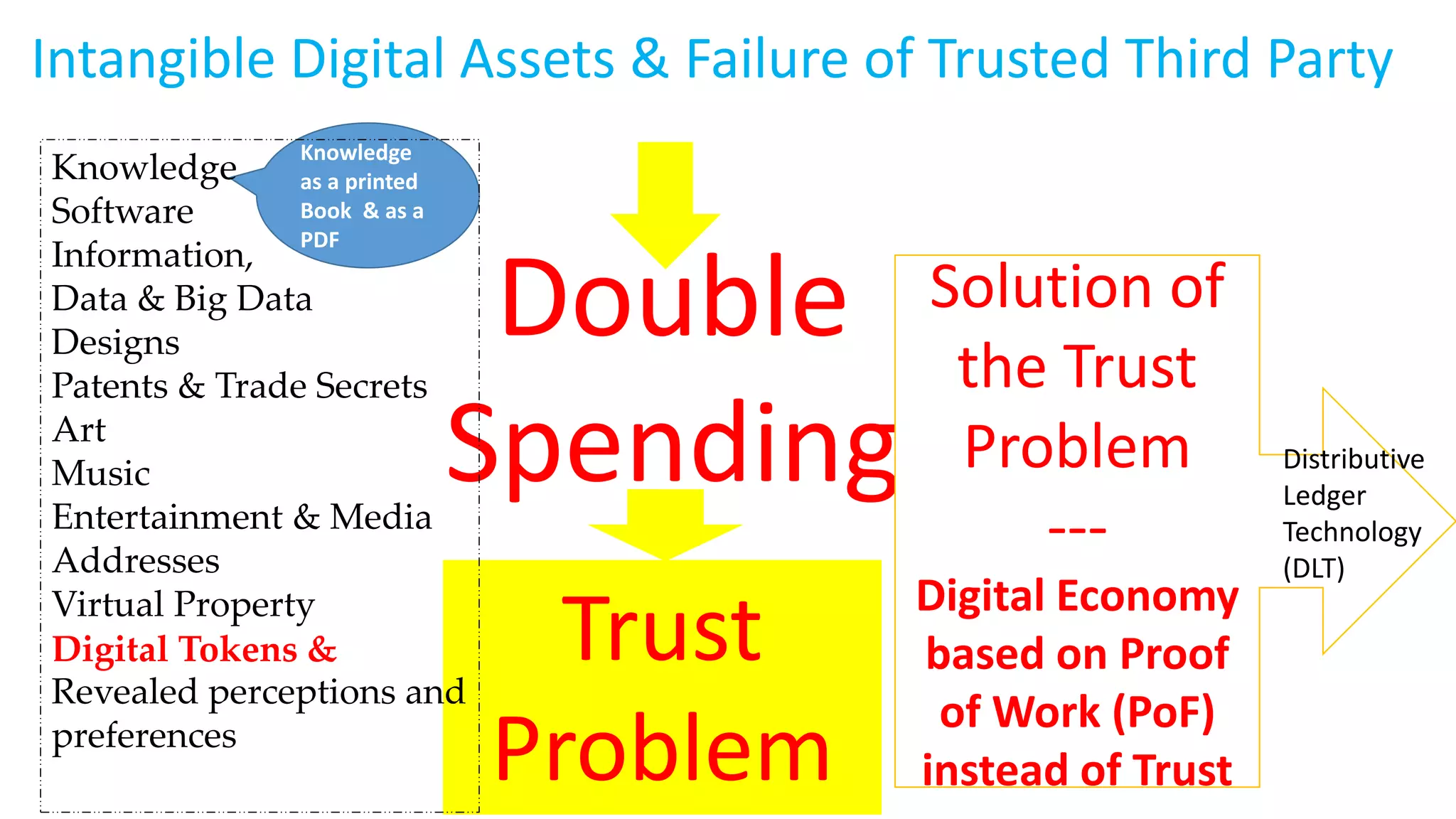
Intangible Digital Assets & Failure of Trusted Third Party
Double
Spending
Trust
Problem
Solution of
the Trust
Problem
---
Digital Economy
based on Proof
of Work (PoF)
instead of Trust
Distributive
Ledger
Technology
(DLT)
Knowledge
as a printed
Book & as a
PDF
Knowledge
Software
Information,
Data & Big Data
Designs
Patents & Trade Secrets
Art
Music
Entertainment & Media
Addresses
Virtual Property
Digital Tokens &
Revealed perceptions and
preferences
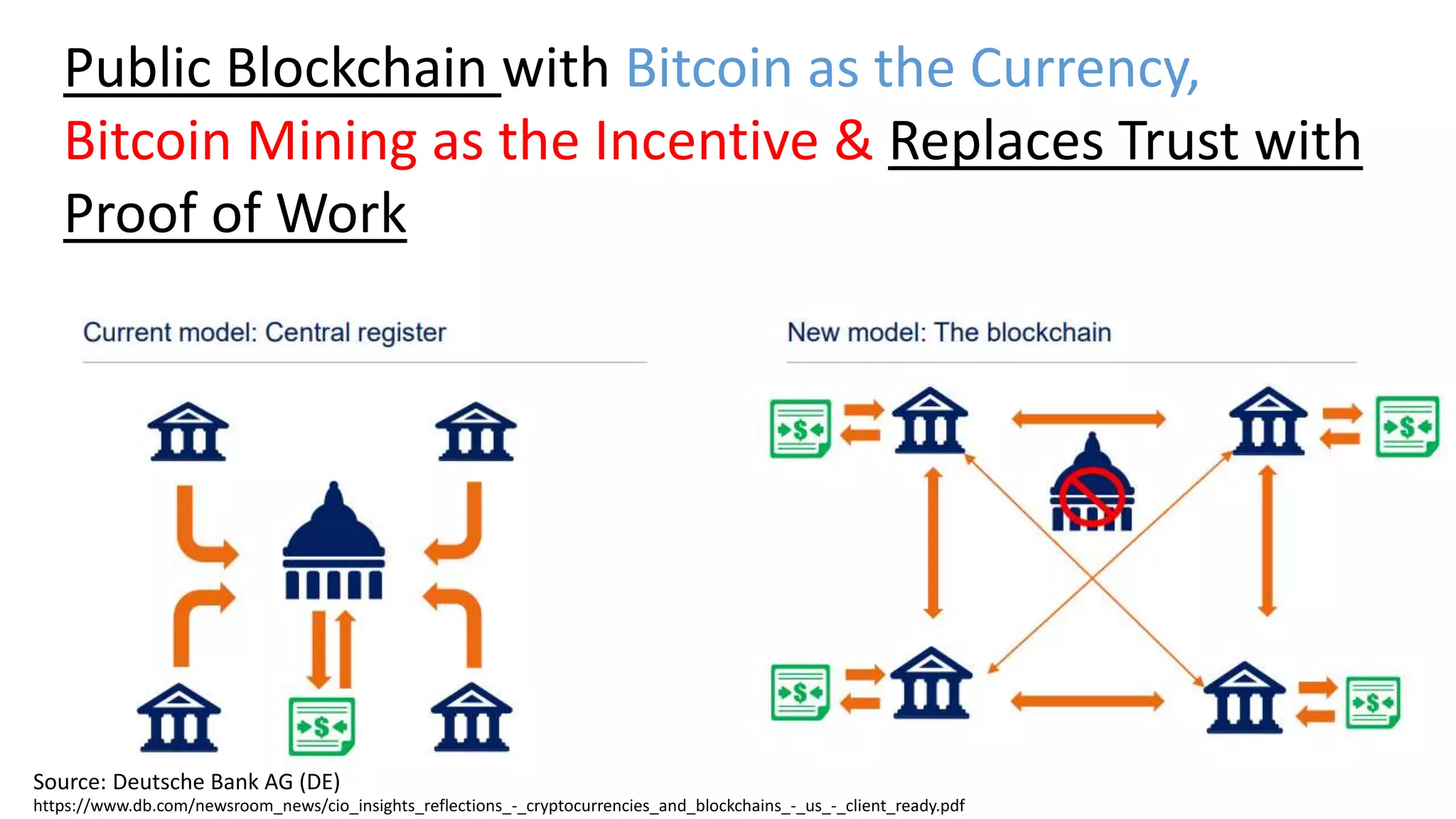
Public Blockchain with Bitcoin as the Currency,
Bitcoin Mining as the Incentive & Replaces Trust with
Proof of Work
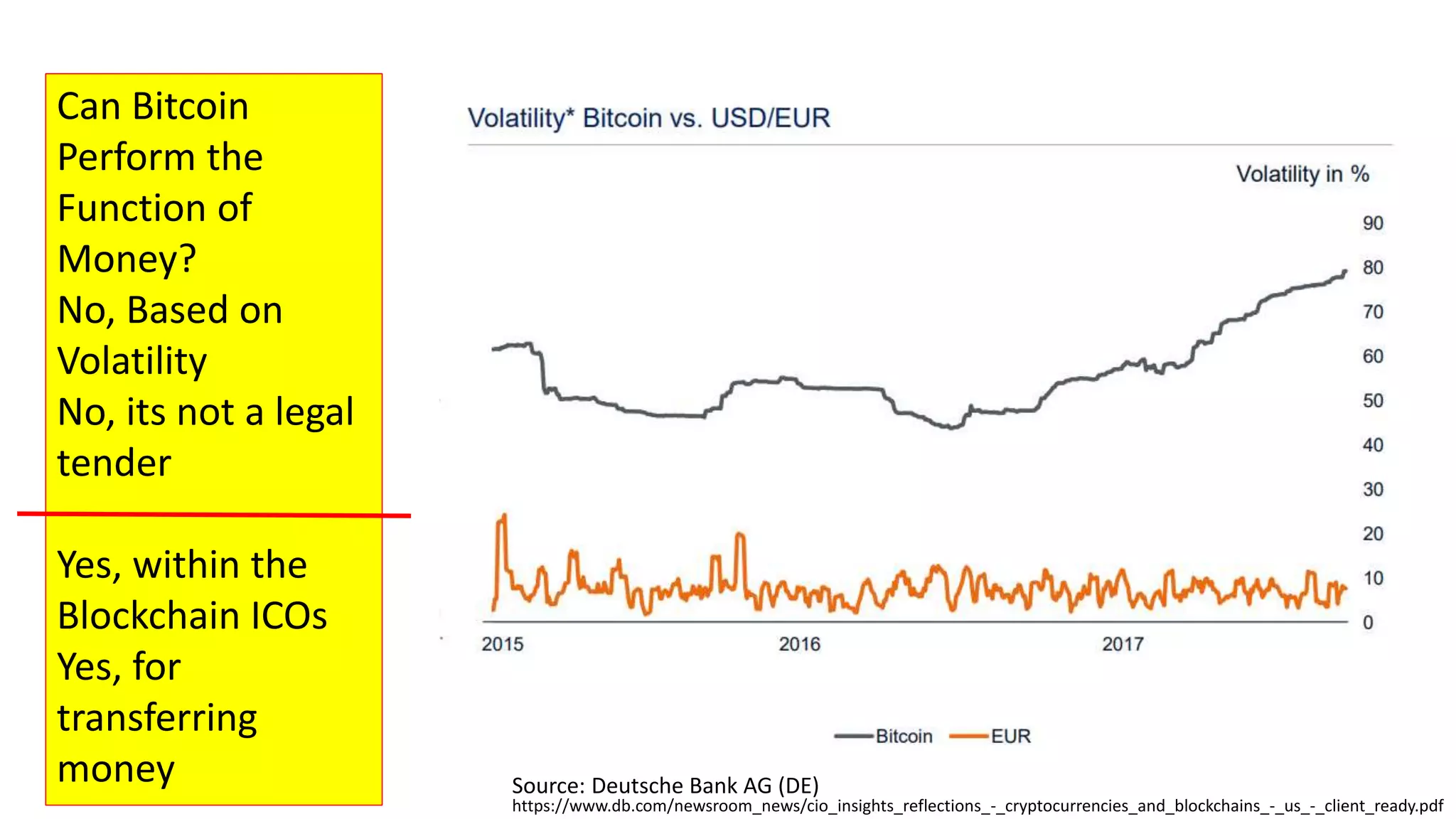
Source: Deutsche Bank AG (DE)
https://www.db.com/newsroom_news/cio_insights_reflections_-_cryptocurrencies_and_blockchains_-_us_-_client_ready.pdf
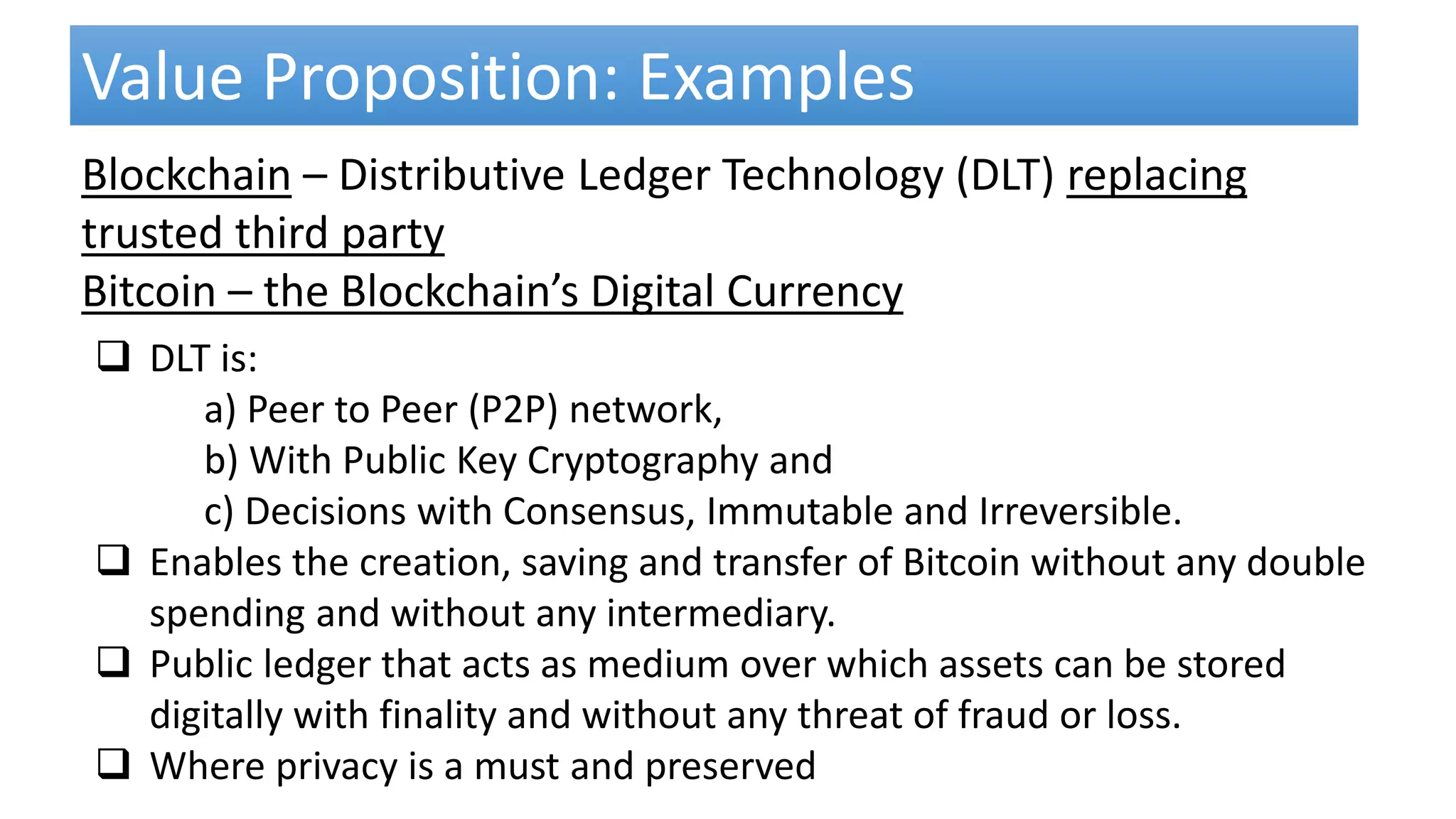
 DLT is:
a) Peer to Peer (P2P) network,
b) With Public Key Cryptography and
c) Decisions with Consensus, Immutable and Irreversible.
 Enables the creation, saving and transfer of Bitcoin without any double
spending and without any intermediary.
 Public ledger that acts as medium over which assets can be stored
digitally with finality and without any threat of fraud or loss.
 Where privacy is a must and preserved
Value Proposition: Examples
Blockchain – Distributive Ledger Technology (DLT) replacing
trusted third party
Bitcoin – the Blockchain’s Digital Currency
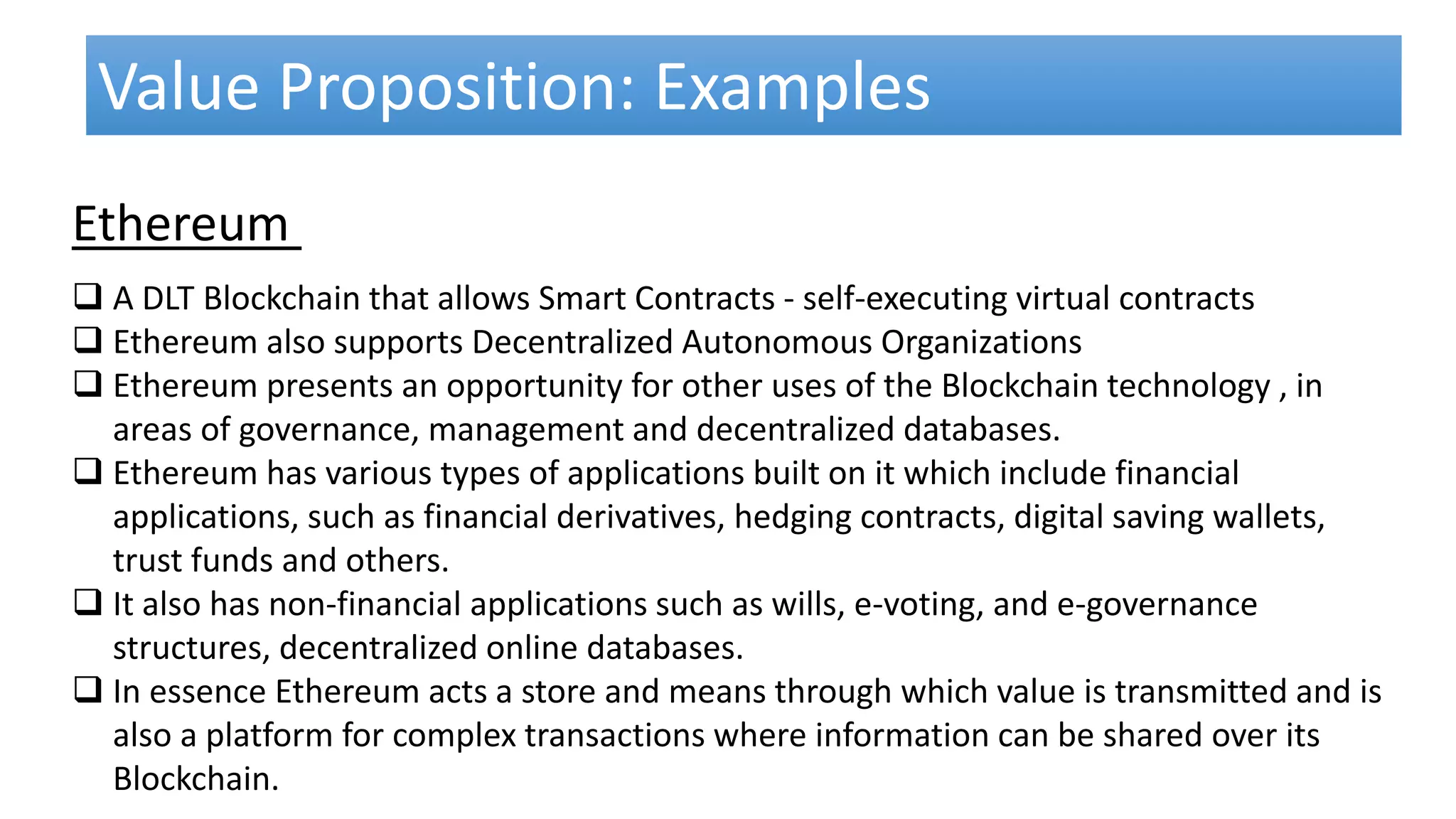
 A DLT Blockchain that allows Smart Contracts - self-executing virtual contracts
 Ethereum also supports Decentralized Autonomous Organizations
 Ethereum presents an opportunity for other uses of the Blockchain technology , in
areas of governance, management and decentralized databases.
 Ethereum has various types of applications built on it which include financial
applications, such as financial derivatives, hedging contracts, digital saving wallets,
trust funds and others.
 It also has non-financial applications such as wills, e-voting, and e-governance
structures, decentralized online databases.
 In essence Ethereum acts a store and means through which value is transmitted and is
also a platform for complex transactions where information can be shared over its
Blockchain.
Value Proposition: Examples
Ethereum
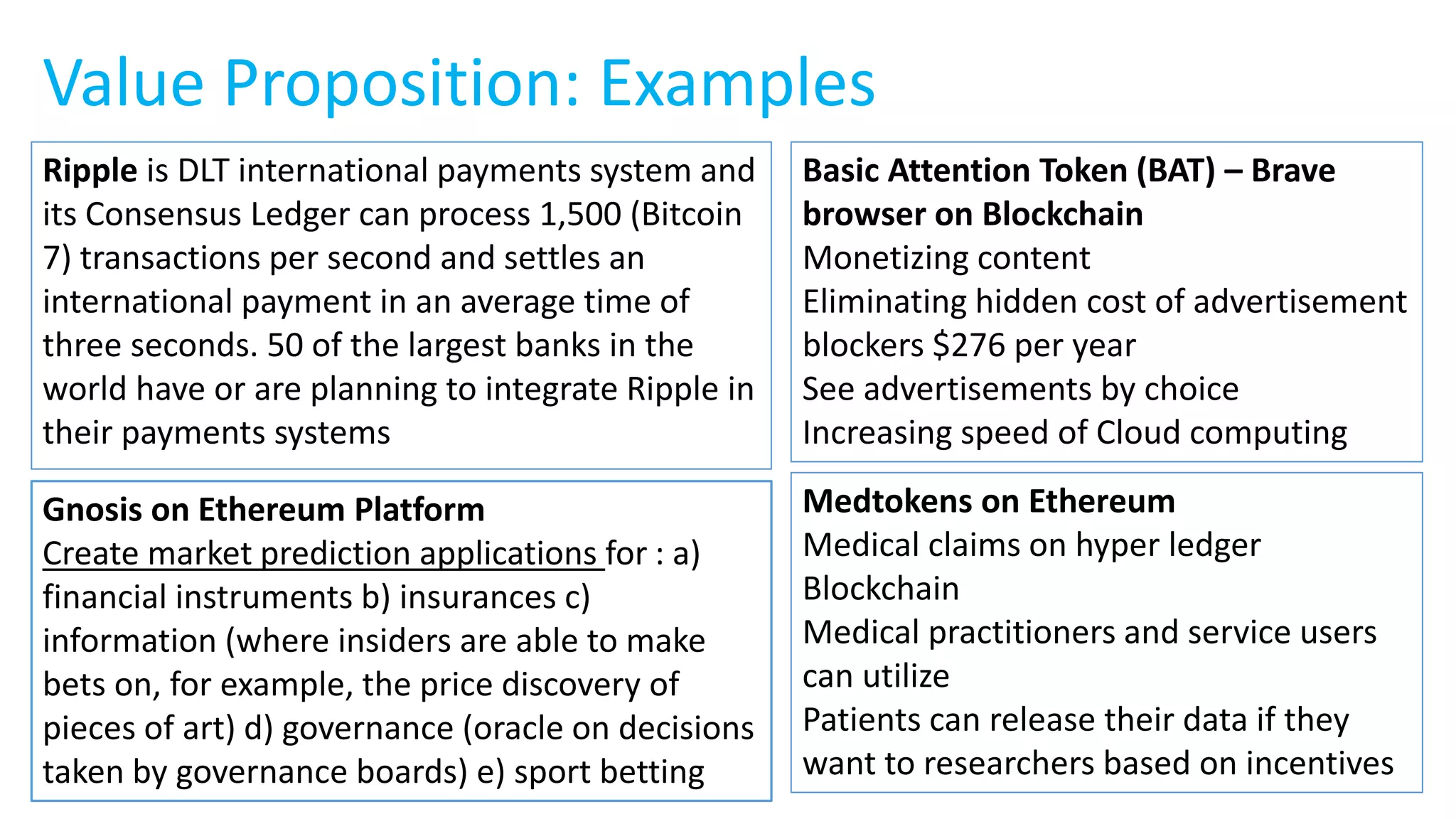
Gnosis on Ethereum Platform
Create market prediction applications for : a)
financial instruments b) insurances c)
information (where insiders are able to make
bets on, for example, the price discovery of
pieces of art) d) governance (oracle on decisions
taken by governance boards) e) sport betting
Ripple is DLT international payments system and
its Consensus Ledger can process 1,500 (Bitcoin
7) transactions per second and settles an
international payment in an average time of
three seconds. 50 of the largest banks in the
world have or are planning to integrate Ripple in
their payments systems
Value Proposition: Examples
Basic Attention Token (BAT) – Brave
browser on Blockchain
Monetizing content
Eliminating hidden cost of advertisement
blockers $276 per year
See advertisements by choice
Increasing speed of Cloud computing
Medtokens on Ethereum
Medical claims on hyper ledger
Blockchain
Medical practitioners and service users
can utilize
Patients can release their data if they
want to researchers based on incentives
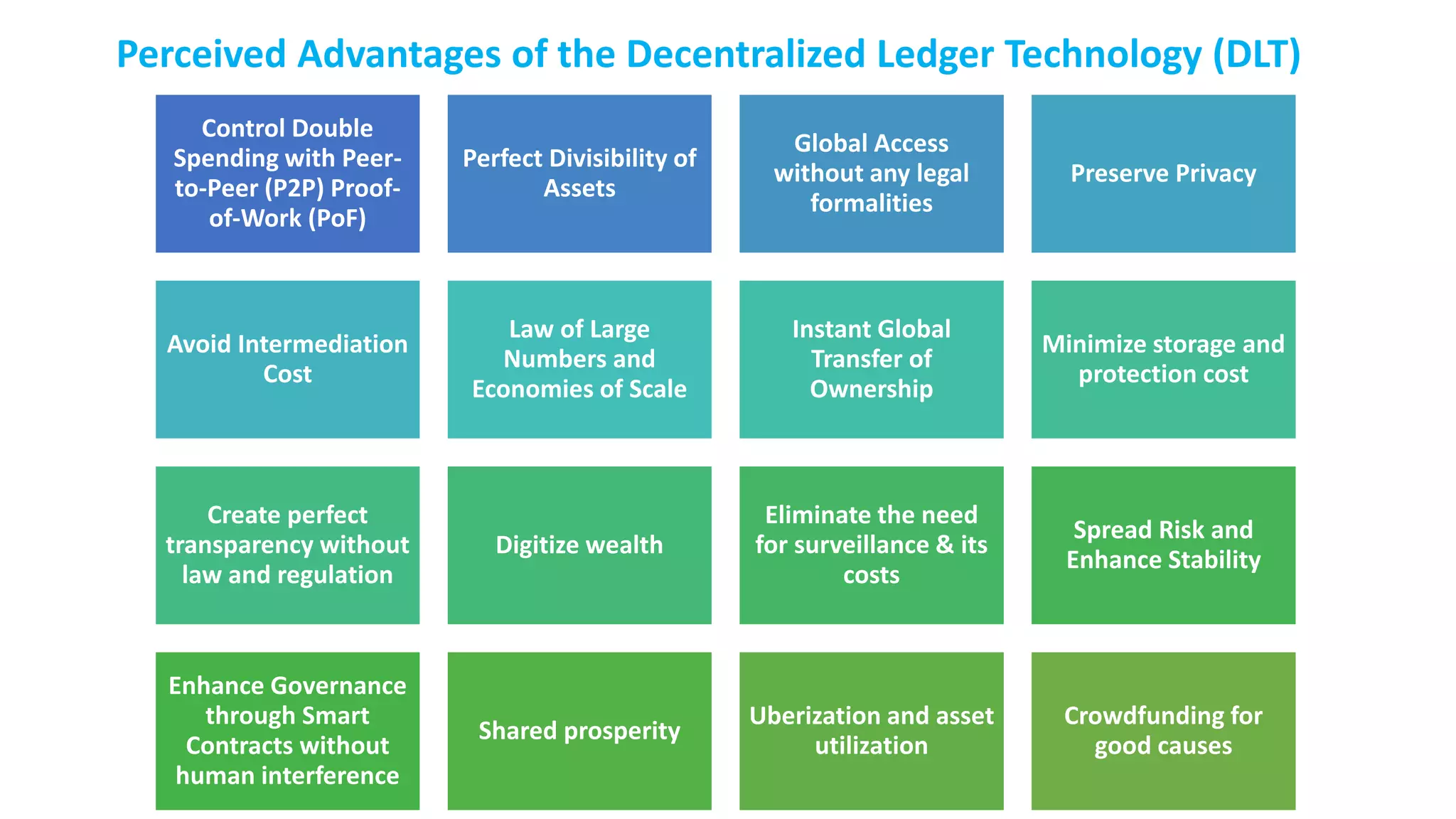
Control Double
Spending with Peer-
to-Peer (P2P) Proof-
of-Work (PoF)
Perfect Divisibility of
Assets
Global Access
without any legal
formalities
Preserve Privacy
Avoid Intermediation
Cost
Law of Large
Numbers and
Economies of Scale
Instant Global
Transfer of
Ownership
Minimize storage and
protection cost
Create perfect
transparency without
law and regulation
Digitize wealth
Eliminate the need
for surveillance & its
costs
Spread Risk and
Enhance Stability
Enhance Governance
through Smart
Contracts without
human interference
Shared prosperity
Uberization and asset
utilization
Crowdfunding for
good causes
Perceived Advantages of the Decentralized Ledger Technology (DLT)
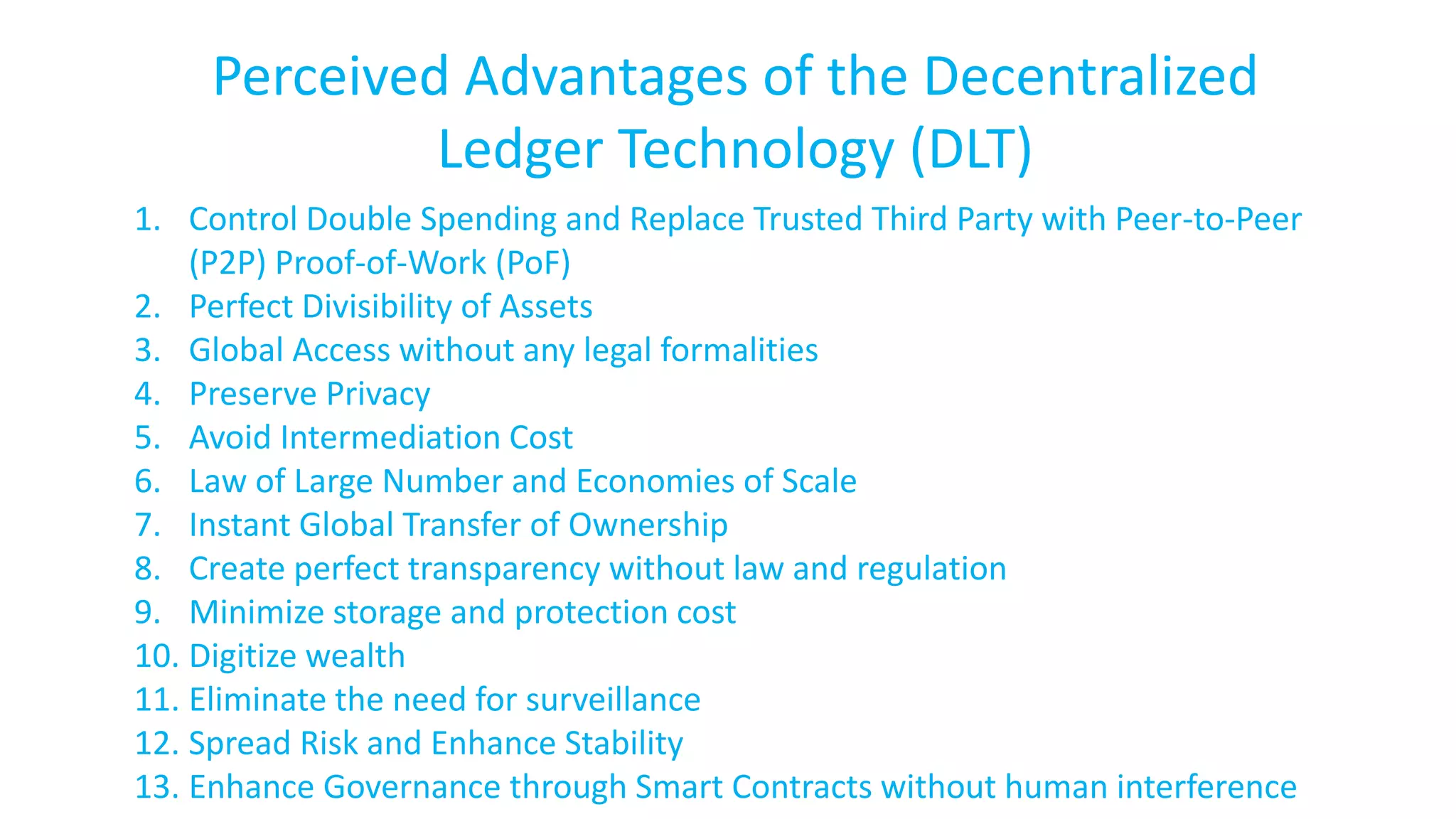
Perceived Advantages of the Decentralized
Ledger Technology (DLT)
1. Control Double Spending and Replace Trusted Third Party with Peer-to-Peer
(P2P) Proof-of-Work (PoF)
2. Perfect Divisibility of Assets
3. Global Access without any legal formalities
4. Preserve Privacy
5. Avoid Intermediation Cost
6. Law of Large Number and Economies of Scale
7. Instant Global Transfer of Ownership
8. Create perfect transparency without law and regulation
9. Minimize storage and protection cost
10. Digitize wealth
11. Eliminate the need for surveillance
12. Spread Risk and Enhance Stability
13. Enhance Governance through Smart Contracts without human interference
Regulatory Responses about Distributive
Ledger and Blockchain Technology
Globally, all important regulatory authorities are
encouraging the development of Distributive
Ledger Technology (DLT) as an innovation and most
regulators have established FinTech and Blockchain
Regulatory Sand Boxes for observation and support
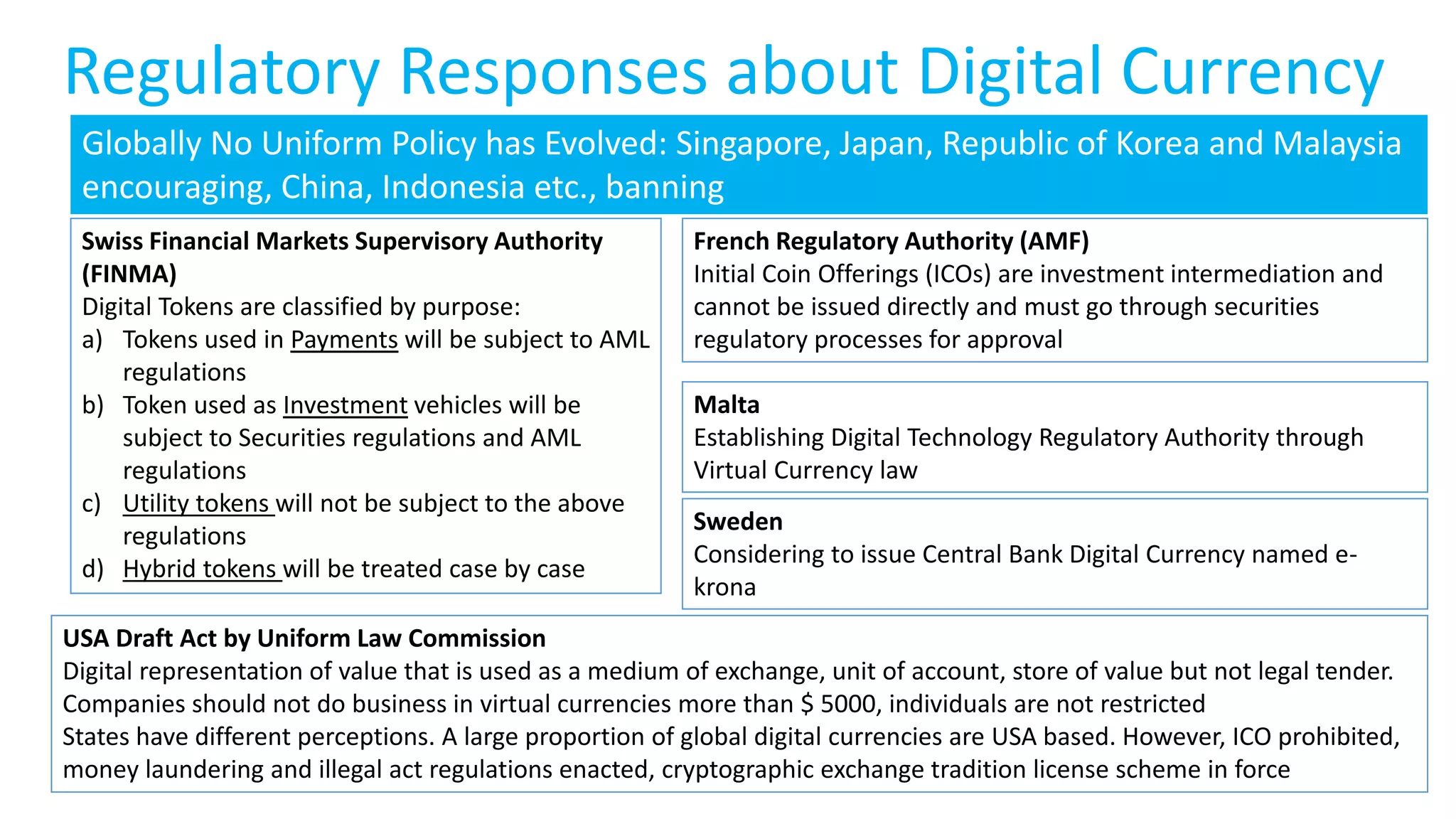
Swiss Financial Markets Supervisory Authority
(FINMA)
Digital Tokens are classified by purpose:
a) Tokens used in Payments will be subject to AML
regulations
b) Token used as Investment vehicles will be
subject to Securities regulations and AML
regulations
c) Utility tokens will not be subject to the above
regulations
d) Hybrid tokens will be treated case by case
French Regulatory Authority (AMF)
Initial Coin Offerings (ICOs) are investment intermediation and
cannot be issued directly and must go through securities
regulatory processes for approval
USA Draft Act by Uniform Law Commission
Digital representation of value that is used as a medium of exchange, unit of account, store of value but not legal tender.
Companies should not do business in virtual currencies more than $ 5000, individuals are not restricted
States have different perceptions. A large proportion of global digital currencies are USA based. However, ICO prohibited,
money laundering and illegal act regulations enacted, cryptographic exchange tradition license scheme in force
Regulatory Responses about Digital Currency
Globally No Uniform Policy has Evolved: Singapore, Japan, Republic of Korea and Malaysia
encouraging, China, Indonesia etc., banning
Malta
Establishing Digital Technology Regulatory Authority through
Virtual Currency law
Sweden
Considering to issue Central Bank Digital Currency named e-
krona
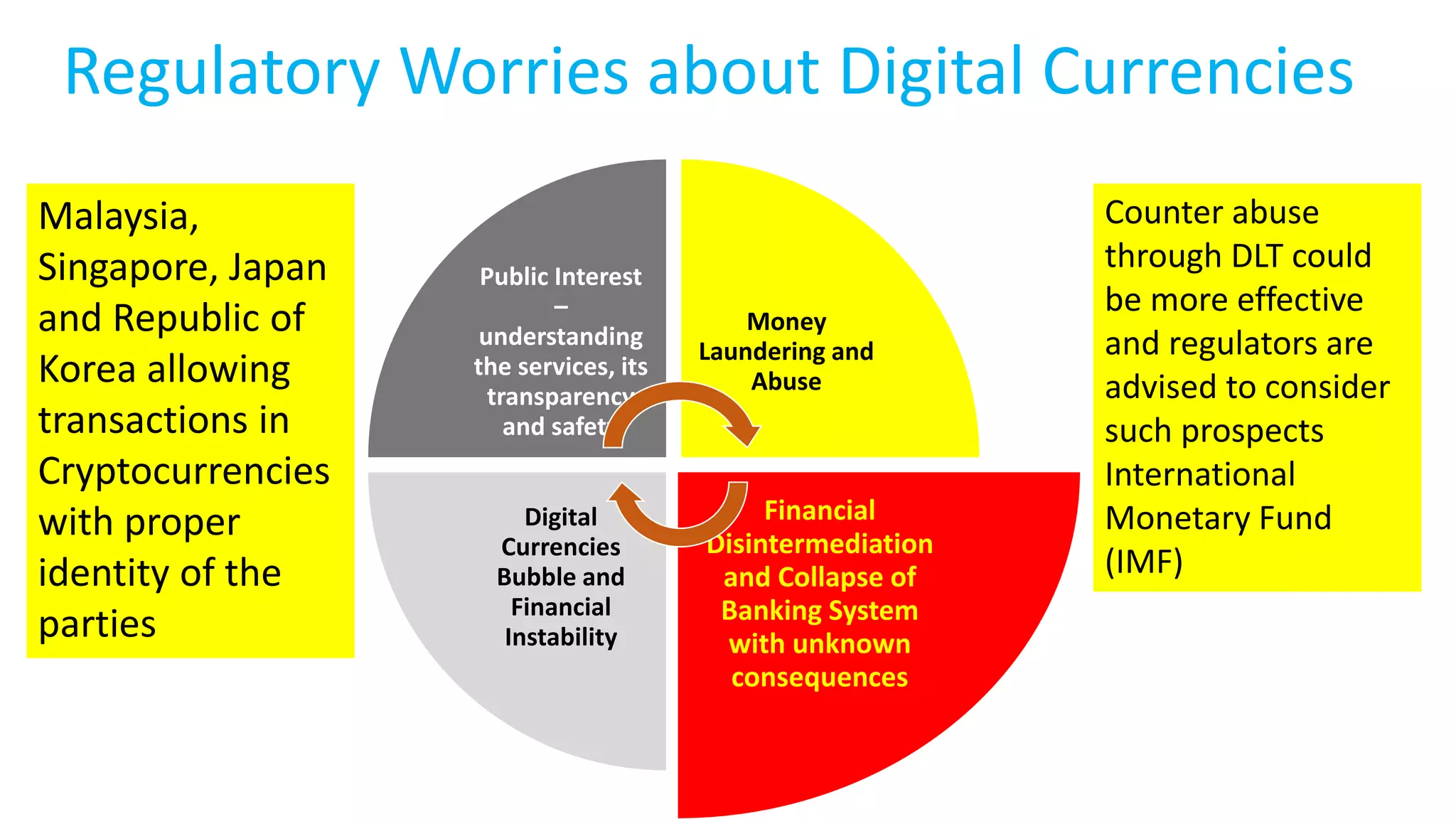
Regulatory Worries about Digital Currencies
Public Interest
–
understanding
the services, its
transparency
and safety
Money
Laundering and
Abuse
Financial
Disintermediation
and Collapse of
Banking System
with unknown
consequences
Digital
Currencies
Bubble and
Financial
Instability
Counter abuse
through DLT could
be more effective
and regulators are
advised to consider
such prospects
International
Monetary Fund
(IMF)
Malaysia,
Singapore, Japan
and Republic of
Korea allowing
transactions in
Cryptocurrencies
with proper
identity of the
parties
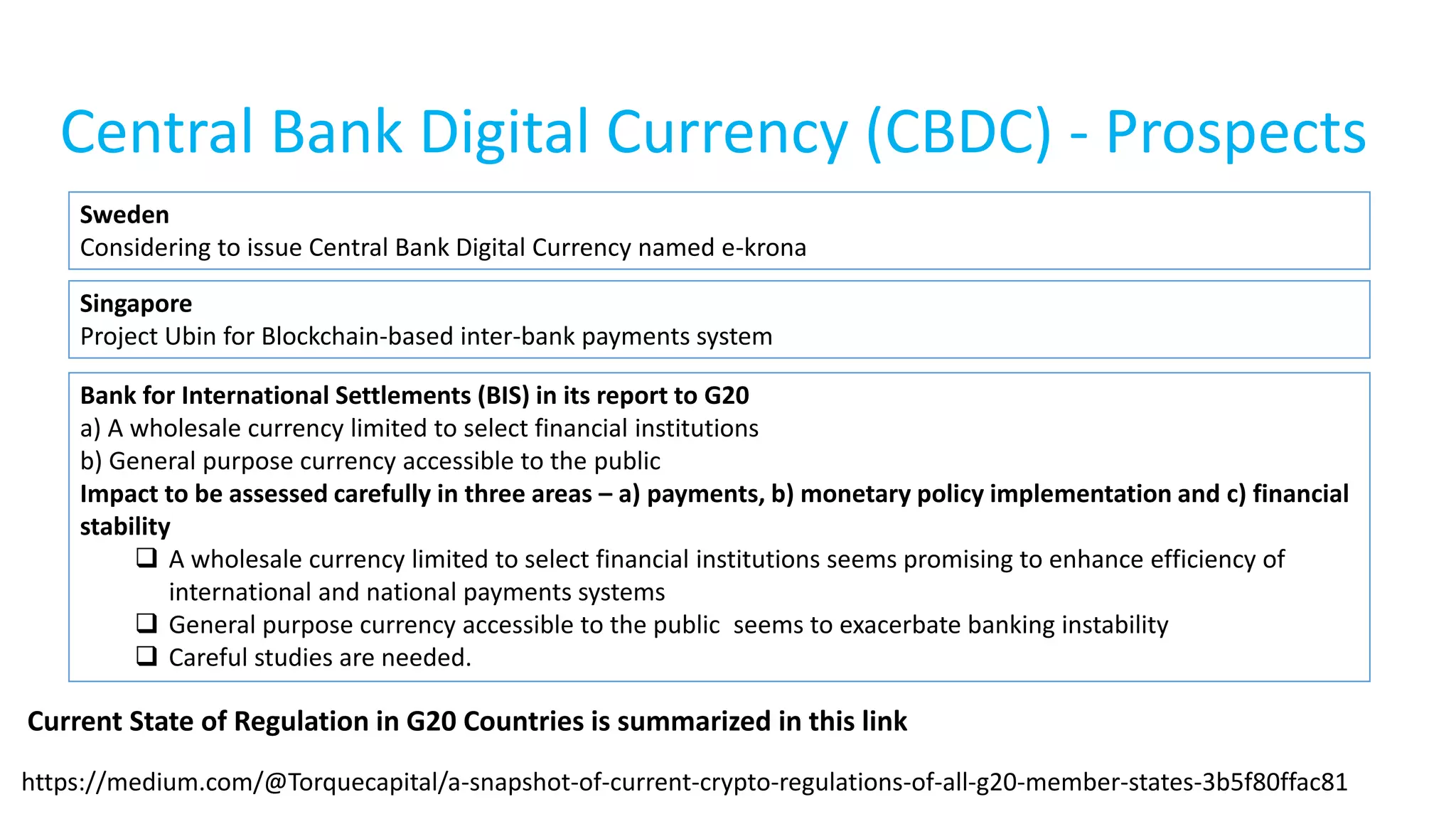
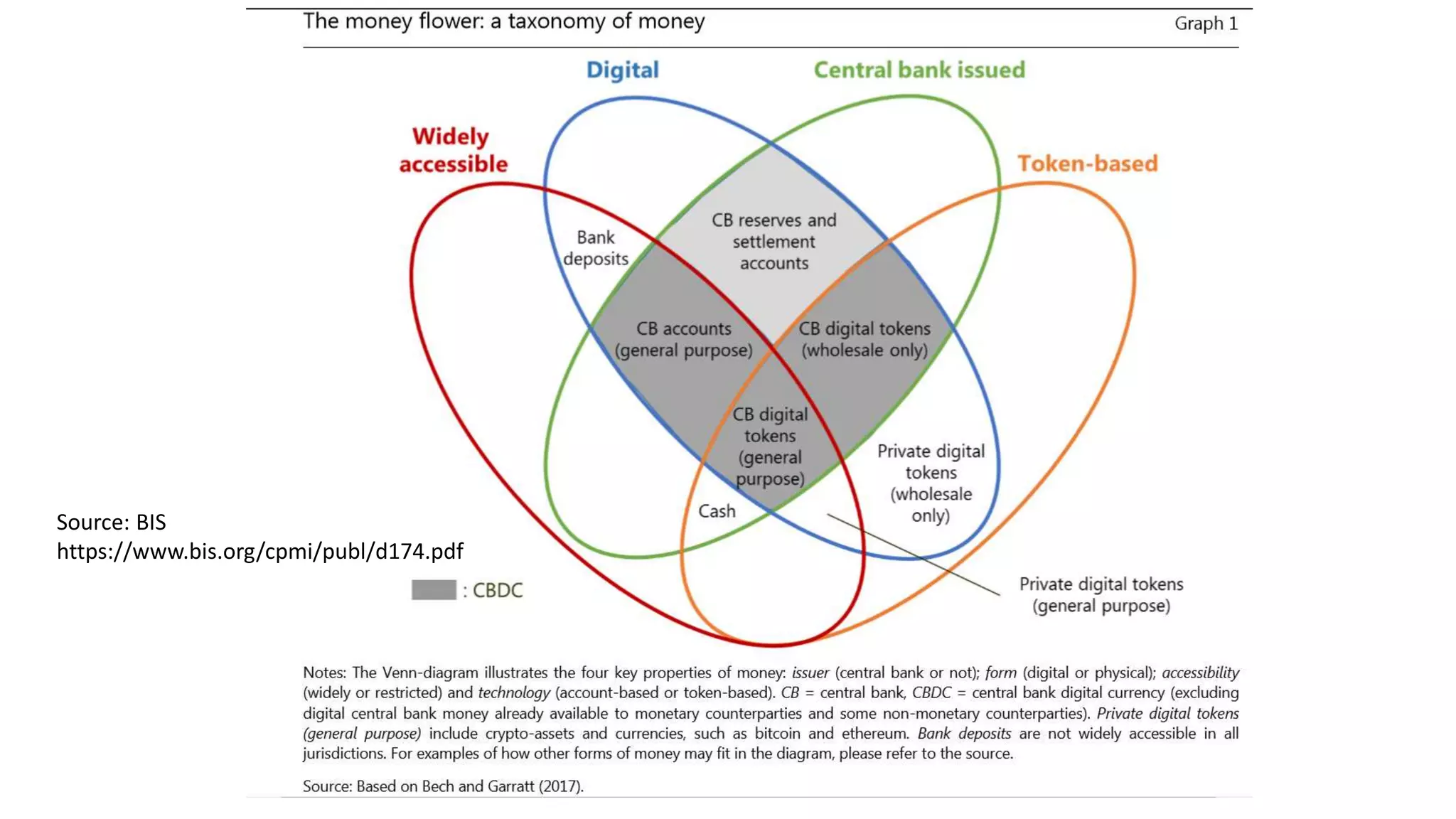
Central Bank Digital Currency (CBDC) - Prospects
Sweden
Considering to issue Central Bank Digital Currency named e-krona
Bank for International Settlements (BIS) in its report to G20
a) A wholesale currency limited to select financial institutions
b) General purpose currency accessible to the public
Impact to be assessed carefully in three areas – a) payments, b) monetary policy implementation and c) financial
stability
 A wholesale currency limited to select financial institutions seems promising to enhance efficiency of
international and national payments systems
 General purpose currency accessible to the public seems to exacerbate banking instability
 Careful studies are needed.
https://medium.com/@Torquecapital/a-snapshot-of-current-crypto-regulations-of-all-g20-member-states-3b5f80ffac81
Current State of Regulation in G20 Countries is summarized in this link
Singapore
Project Ubin for Blockchain-based inter-bank payments system
https://www.db.com/newsroom_news/cio_insights_reflections_-_cryptocurrencies_and_blockchains_-_us_-_client_ready.pdf
Source: Deutsche Bank AG (DE)
Can Bitcoin
Perform the
Function of
Money?
No, Based on
Volatility
No, its not a legal
tender
Yes, within the
Blockchain ICOs
Yes, for
transferring
money
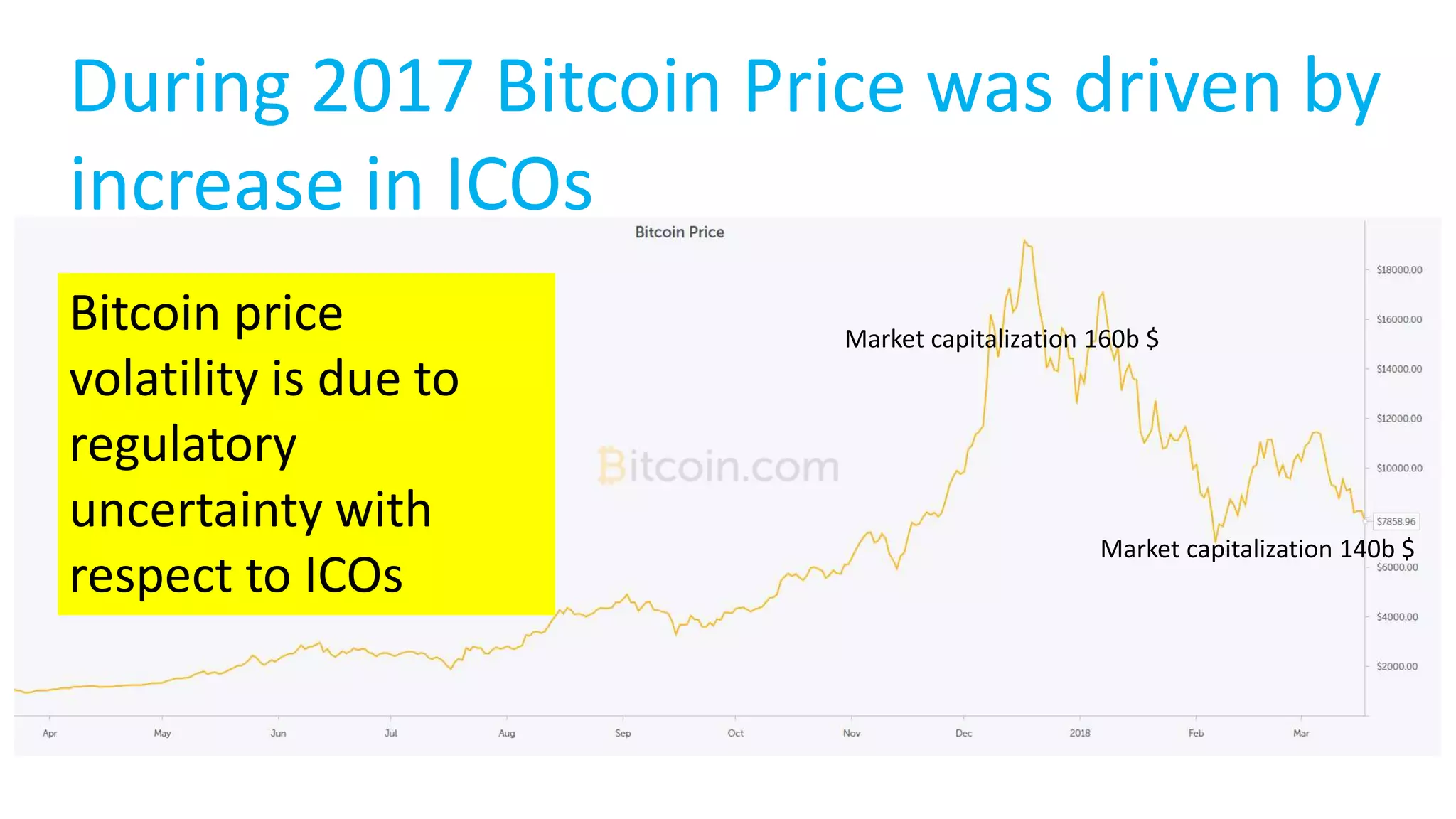
During 2017 Bitcoin Price was driven by
increase in ICOs
Market capitalization 160b $
Market capitalization 140b $
Bitcoin price
volatility is due to
regulatory
uncertainty with
respect to ICOs
Source: BIS
https://www.bis.org/cpmi/publ/d174.pdf
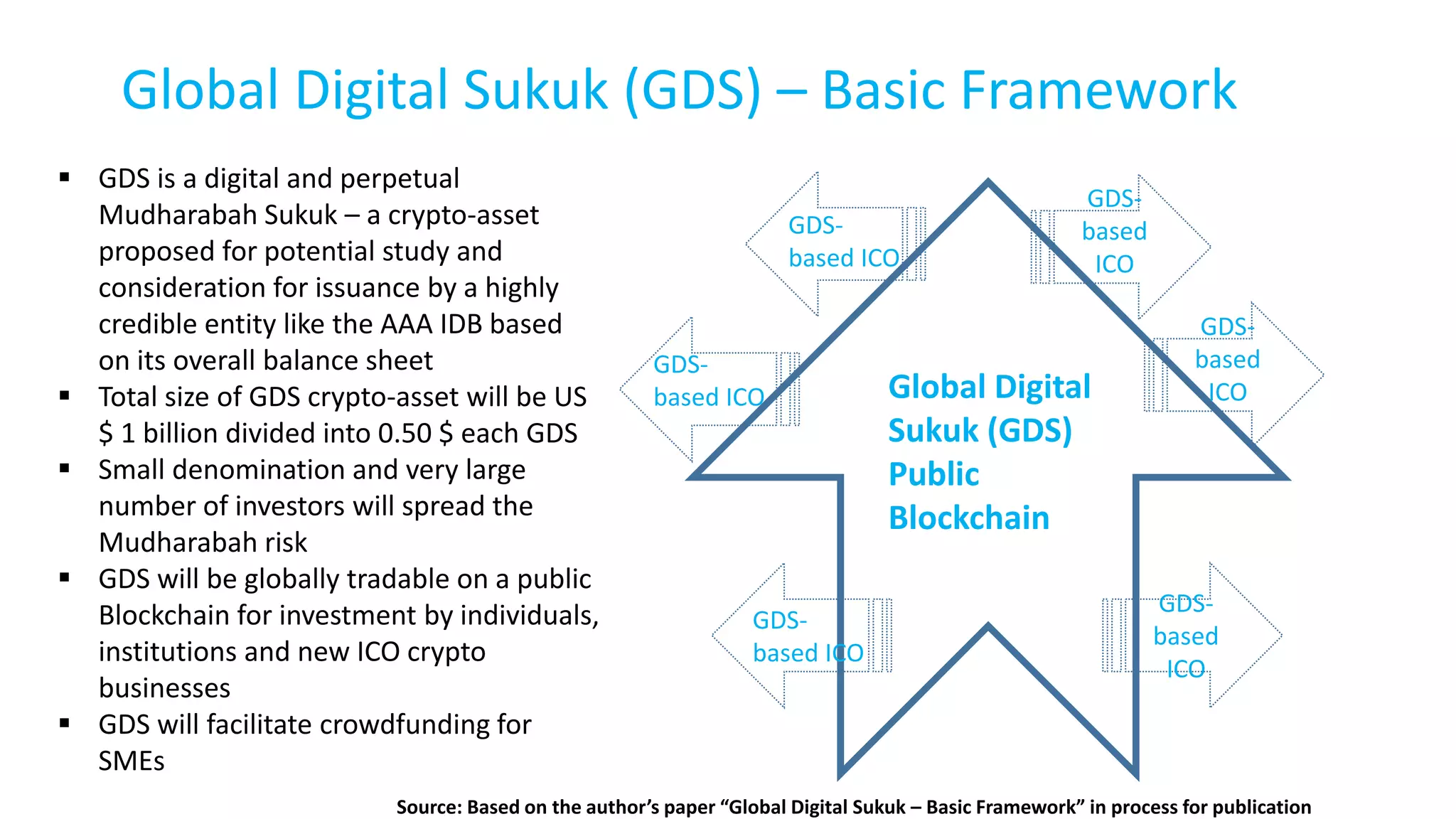
Global Digital Sukuk (GDS) – Basic Framework
 GDS is a digital and perpetual
Mudharabah Sukuk – a crypto-asset
proposed for potential study and
consideration for issuance by a highly
credible entity like the AAA IDB based
on its overall balance sheet
 Total size of GDS crypto-asset will be US
$ 1 billion divided into 0.50 $ each GDS
 Small denomination and very large
number of investors will spread the
Mudharabah risk
 GDS will be globally tradable on a public
Blockchain for investment by individuals,
institutions and new ICO crypto
businesses
 GDS will facilitate crowdfunding for
SMEs
Global Digital
Sukuk (GDS)
Public
Blockchain
GDS-
based
ICO
GDS-
based
ICO
GDS-
based
ICO
GDS-
based ICO
GDS-
based ICO
GDS-
based ICO
Source: Based on the author’s paper “Global Digital Sukuk – Basic Framework” in process for publication
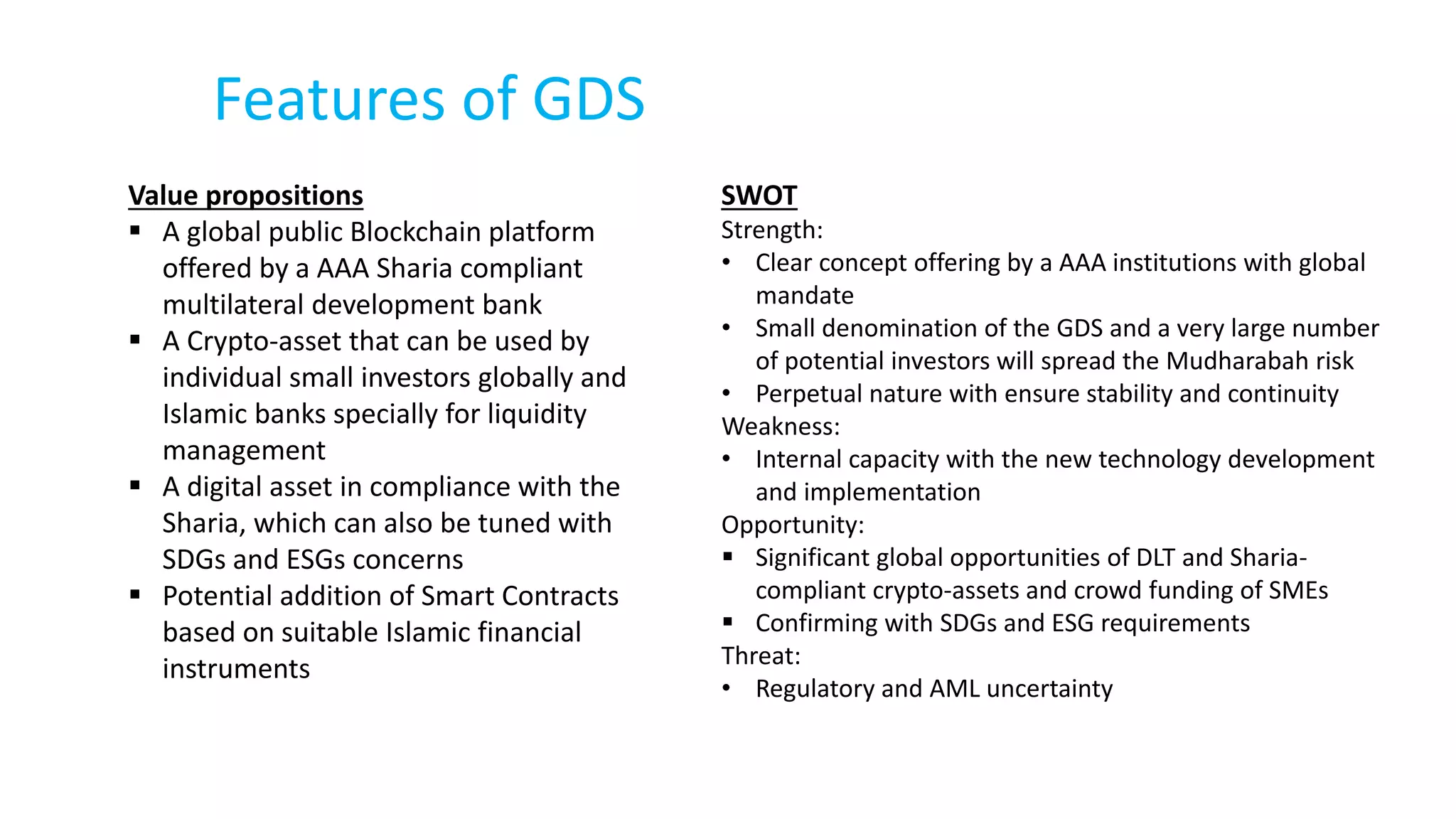
Features of GDS
Value propositions
 A global public Blockchain platform
offered by a AAA Sharia compliant
multilateral development bank
 A Crypto-asset that can be used by
individual small investors globally and
Islamic banks specially for liquidity
management
 A digital asset in compliance with the
Sharia, which can also be tuned with
SDGs and ESGs concerns
 Potential addition of Smart Contracts
based on suitable Islamic financial
instruments
SWOT
Strength:
• Clear concept offering by a AAA institutions with global
mandate
• Small denomination of the GDS and a very large number
of potential investors will spread the Mudharabah risk
• Perpetual nature with ensure stability and continuity
Weakness:
• Internal capacity with the new technology development
and implementation
Opportunity:
 Significant global opportunities of DLT and Sharia-
compliant crypto-assets and crowd funding of SMEs
 Confirming with SDGs and ESG requirements
Threat:
• Regulatory and AML uncertainty
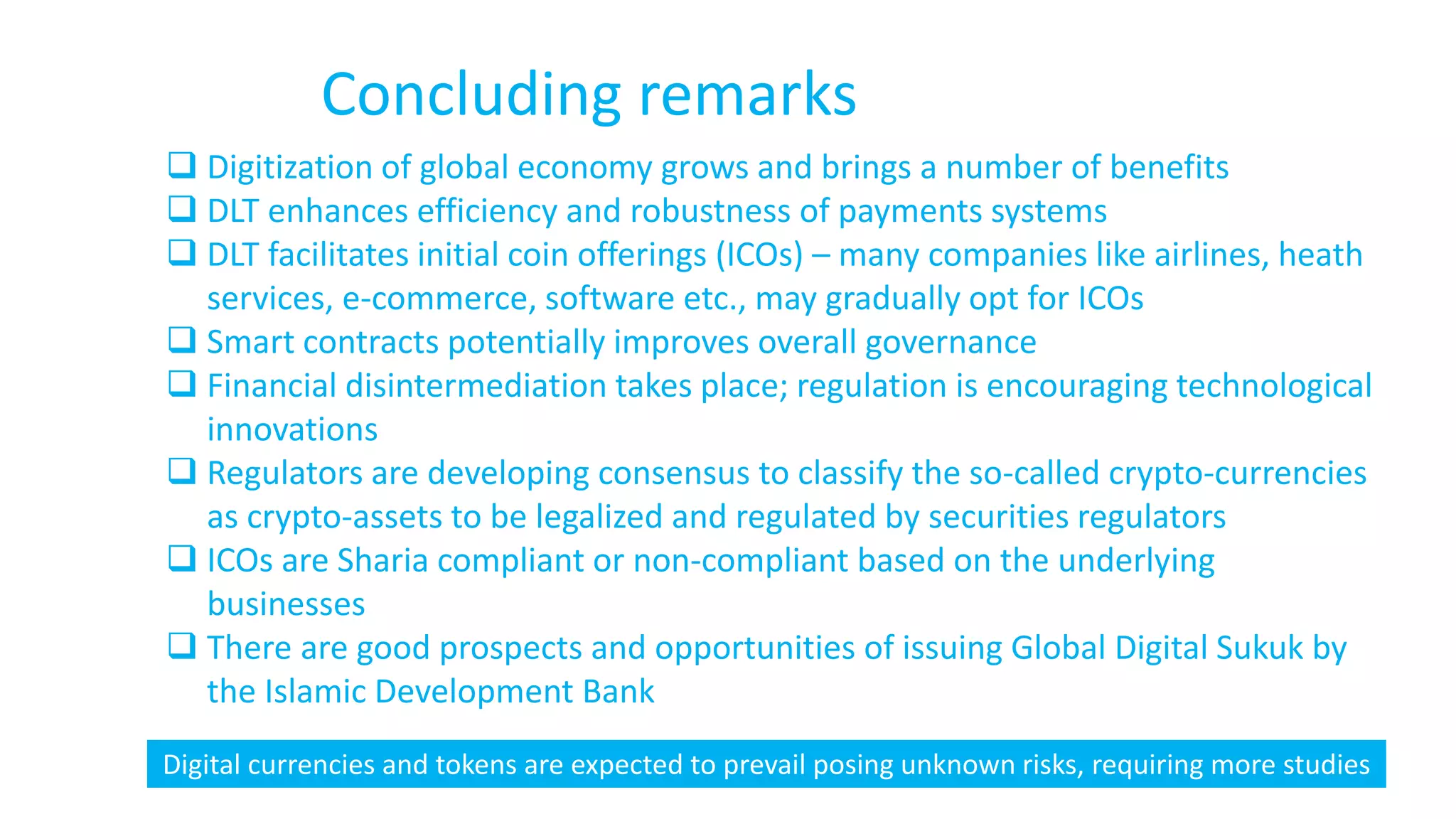
Concluding remarks
 Digitization of global economy grows and brings a number of benefits
 DLT enhances efficiency and robustness of payments systems
 DLT facilitates initial coin offerings (ICOs) – many companies like airlines, heath
services, e-commerce, software etc., may gradually opt for ICOs
 Smart contracts potentially improves overall governance
 Financial disintermediation takes place; regulation is encouraging technological
innovations
 Regulators are developing consensus to classify the so-called crypto-currencies
as crypto-assets to be legalized and regulated by securities regulators
 ICOs are Sharia compliant or non-compliant based on the underlying
businesses
 There are good prospects and opportunities of issuing Global Digital Sukuk by
the Islamic Development Bank
Digital currencies and tokens are expected to prevail posing unknown risks, requiring more studies
Blockchain
By Dalal Al Mahmood,
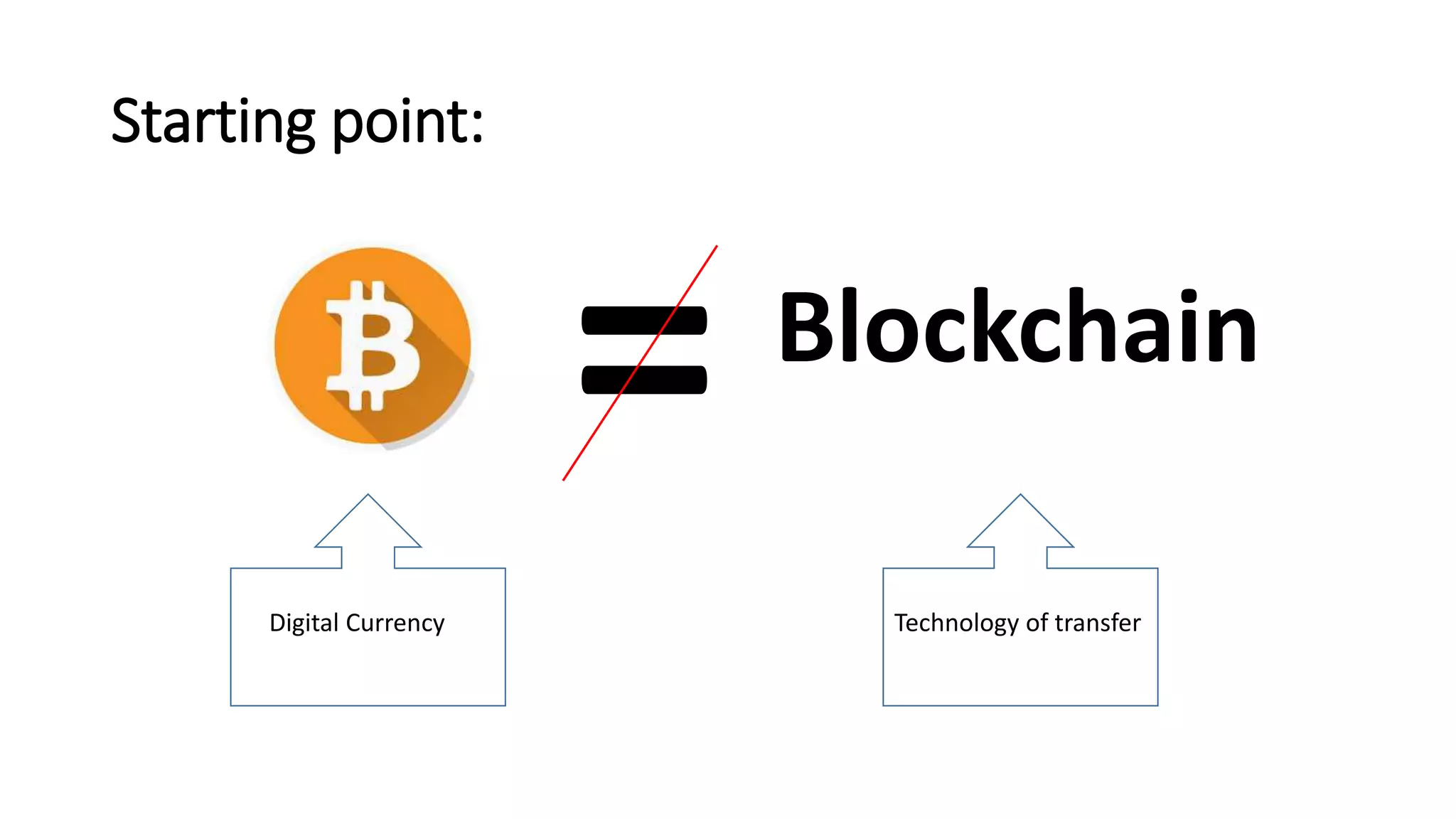
Starting point:
= Blockchain
Digital Currency Technology of transfer
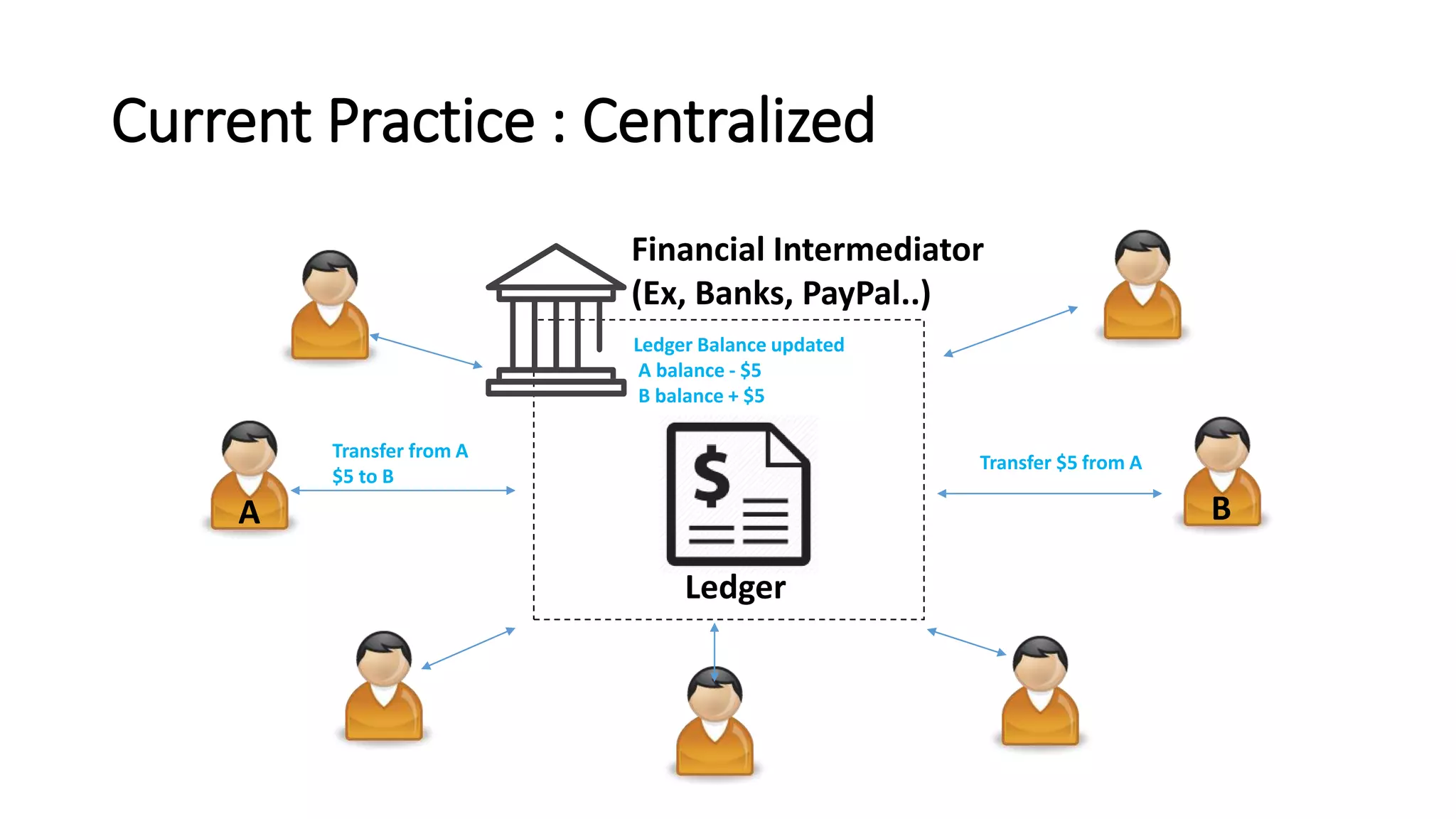
Current Practice : Centralized
Financial Intermediator
(Ex, Banks, PayPal..)
Ledger
Transfer from A
$5 to B
A B
Transfer $5 from A
Ledger Balance updated
A balance - $5
B balance + $5
Current Practice - Centralized ledger
 General Ledger: A general ledger is a company's set of numbered
accounts for its accounting records. The ledger provides a complete
record of financial transactions over the life of the company. The ledger
holds account information that is needed to prepare financial
statements and includes accounts for assets, liabilities, owners' equity,
revenues and expenses. (Investopedia)
 The current practice is that the general ledger stored and managed
using applications and databases referred to as ERP (Enterprise
Resource Planning) system or Core Banking system
 The applications also store the Bank/company customer information
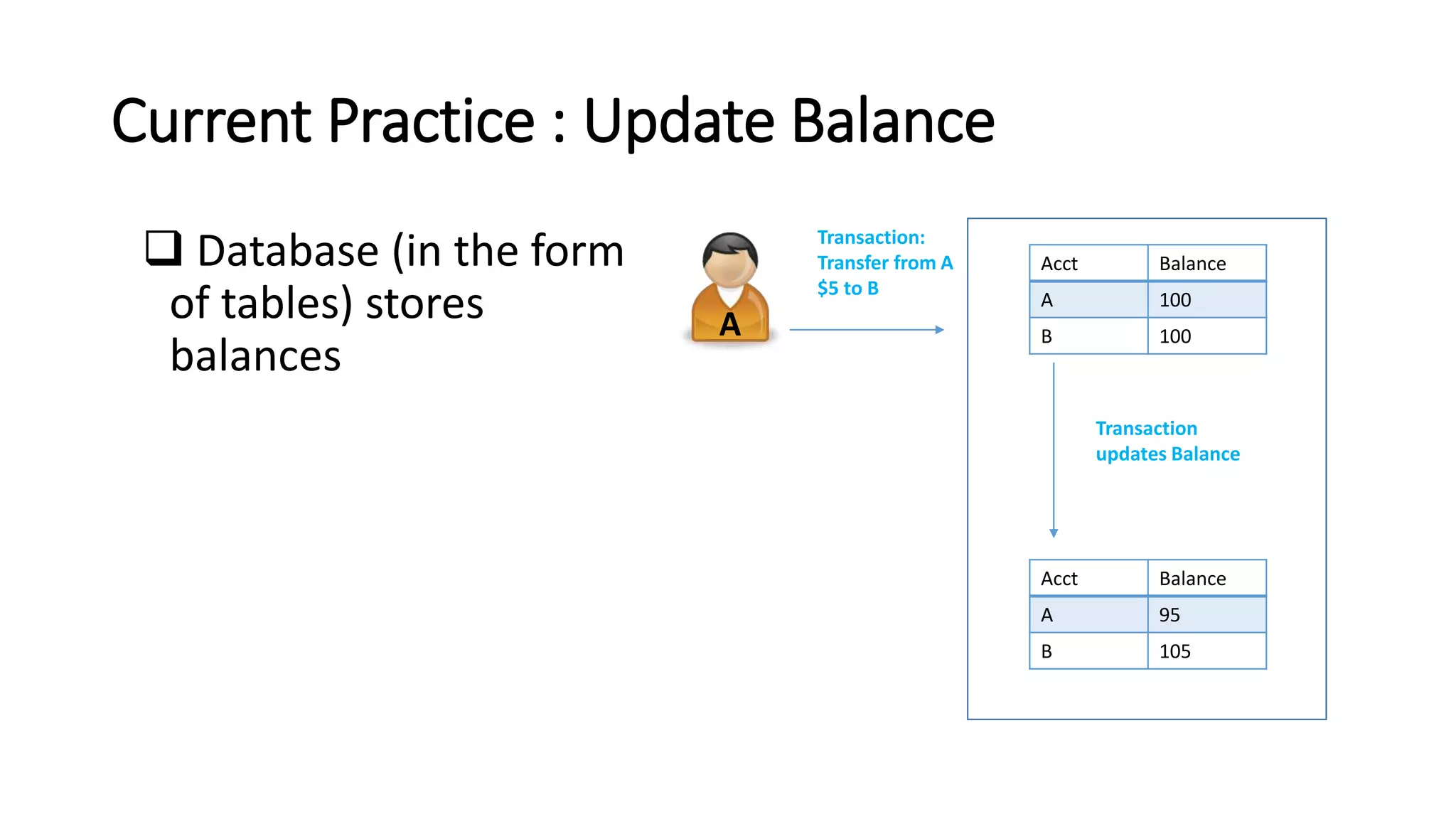
Current Practice : Update Balance
Transaction:
Transfer from A
$5 to B
A
Acct Balance
A 100
B 100
Acct Balance
A 95
B 105
Transaction
updates Balance
 Database (in the form
of tables) stores
balances
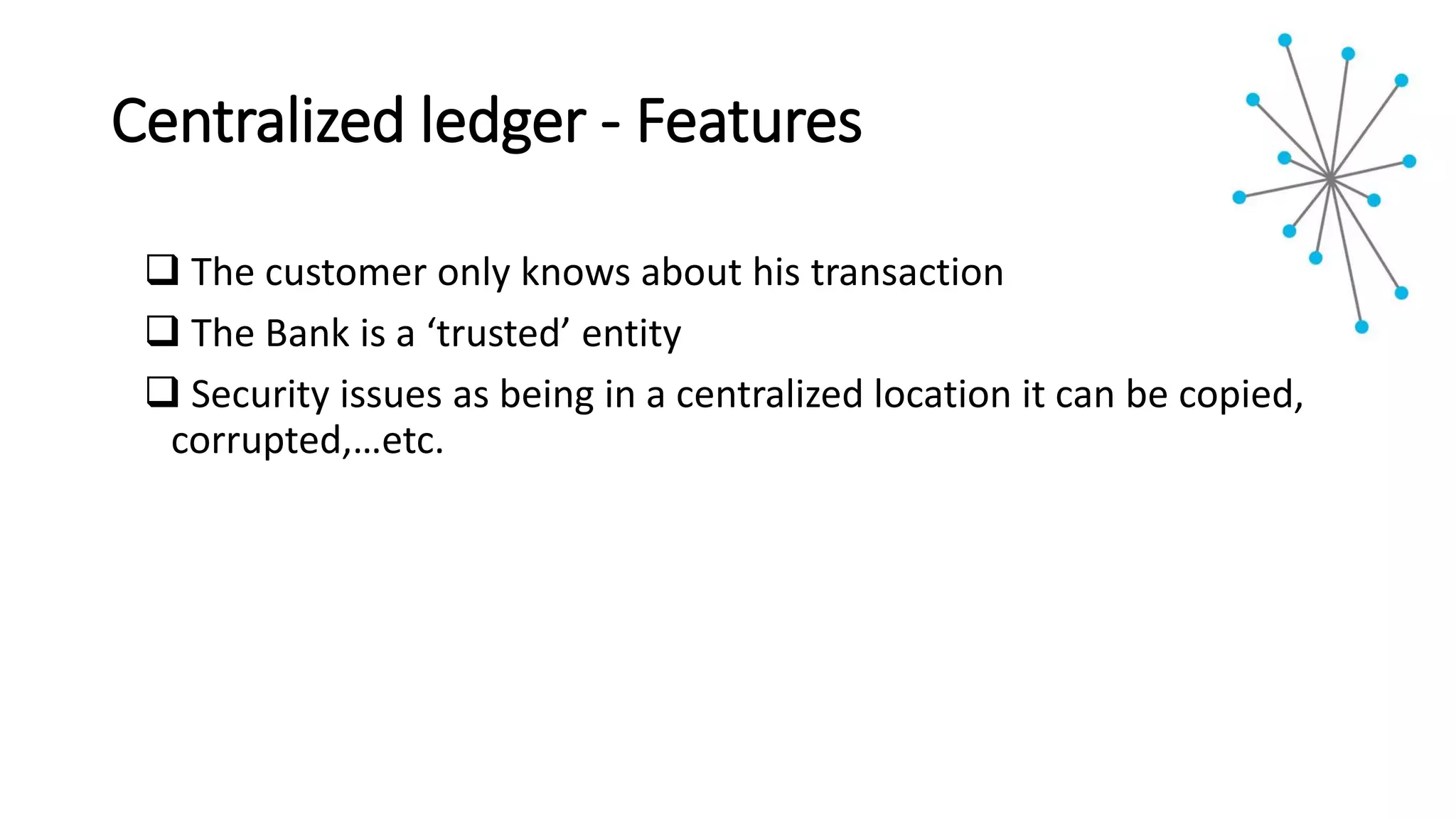
Centralized ledger - Features
 The customer only knows about his transaction
 The Bank is a ‘trusted’ entity
 Security issues as being in a centralized location it can be copied,
corrupted,…etc.
Concepts: The beginning (2008)
 Satoshi Nakamoto (Bitcoin founder)
A purely peer-to-peer version of electronic cash would allow online
payments to be sent directly from one party to another without going
through a financial institution. Digital signatures provide part of the
solution, but the main benefits are lost if a trusted third party is still
required to prevent double-spending. We propose a solution to the
double-spending problem using a peer-to-peer network. The network
timestamps transactions by hashing them into an ongoing chain of
hash-based proof-of-work, forming a record that cannot be changed
without redoing the proof-of-work. The longest chain not only serves as
proof of the sequence of events witnessed, but proof that it came from
the largest pool of CPU power.(1)
(1) Bitcoin: A Peer-to-Peer Electronic Cash System by Satoshi Nakamoto, satoshin@gmx.com, www.bitcoin.org
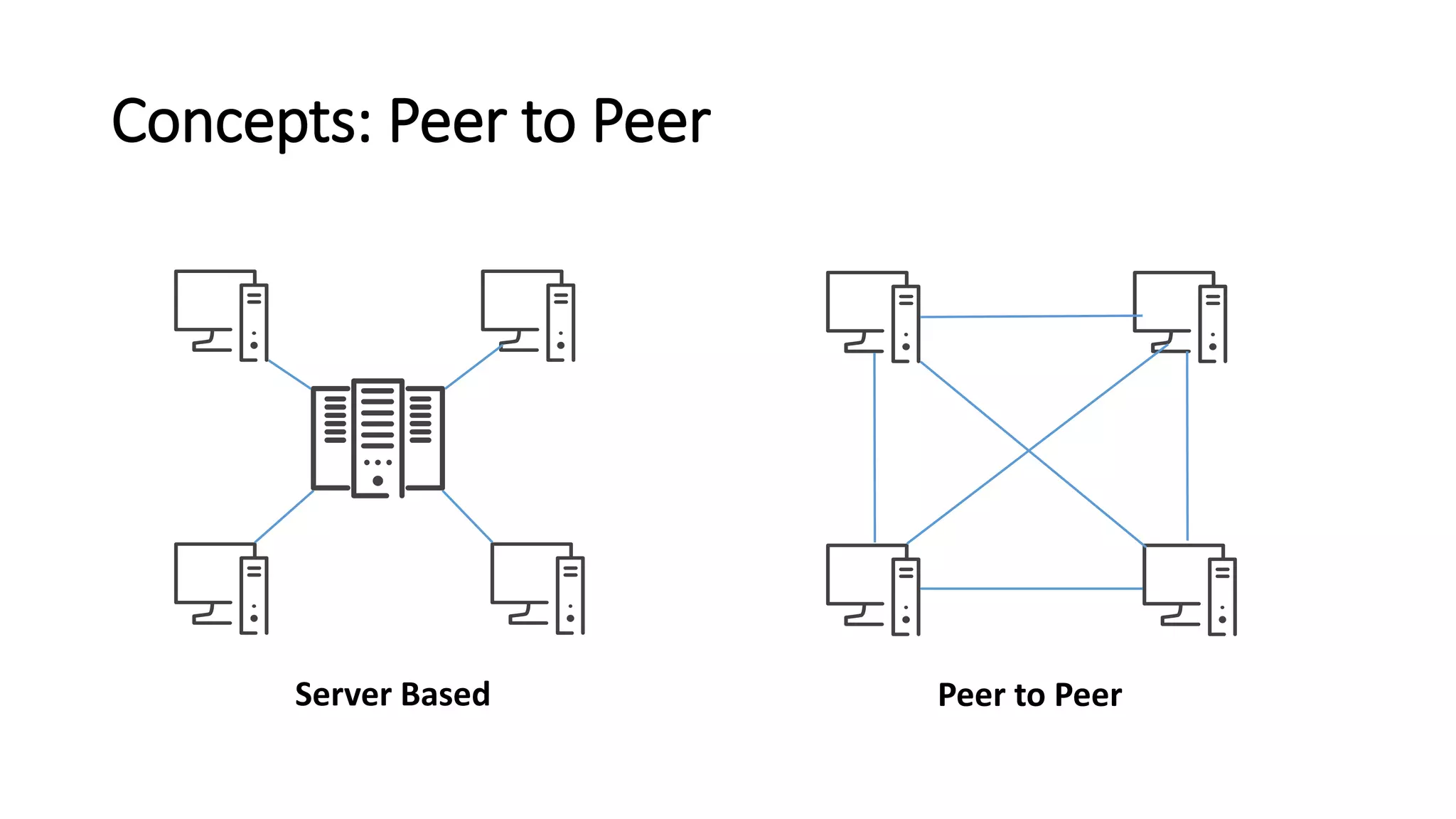
Concepts: Peer to Peer
Server Based Peer to Peer
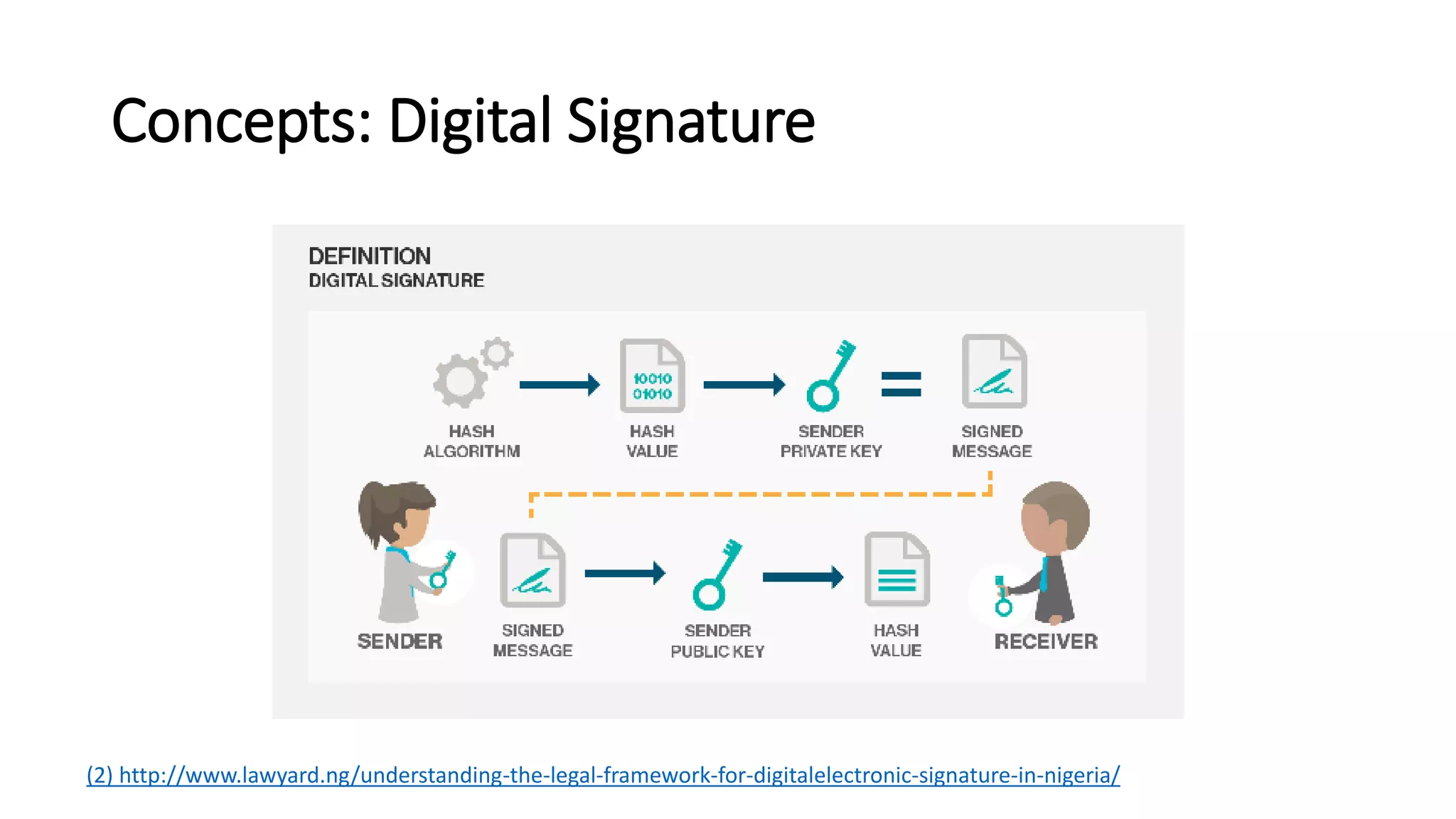
Concepts: Digital Signature
(2) http://www.lawyard.ng/understanding-the-legal-framework-for-digitalelectronic-signature-in-nigeria/
Concepts: Public & Private Keys
 Public & Private Keys:
• Public Key (Your address) it is made available to everyone via a publicly
accessible repository or directory.
• Private Key (Your Password) must remain confidential to its respective
owner.
• The Public and Private key pair comprise of two uniquely related
cryptographic keys (basically long random numbers). Below is an example
of a Public Key:
• 3048 0241 00C9 18FA CF8D EB2D EFD5 FD37 89B9 E069 EA97 FC20 5E35
F577 EE31 C4FB C6E4 4811 7D86 BC8F BAFA 362F 922B F01B 2F40 C744
2654 C0DD 2881 D673 CA2B 4003 C266 E2CD CB02 0301 0001
https://www.comodo.com/resources/small-business/digital-certificates2.php
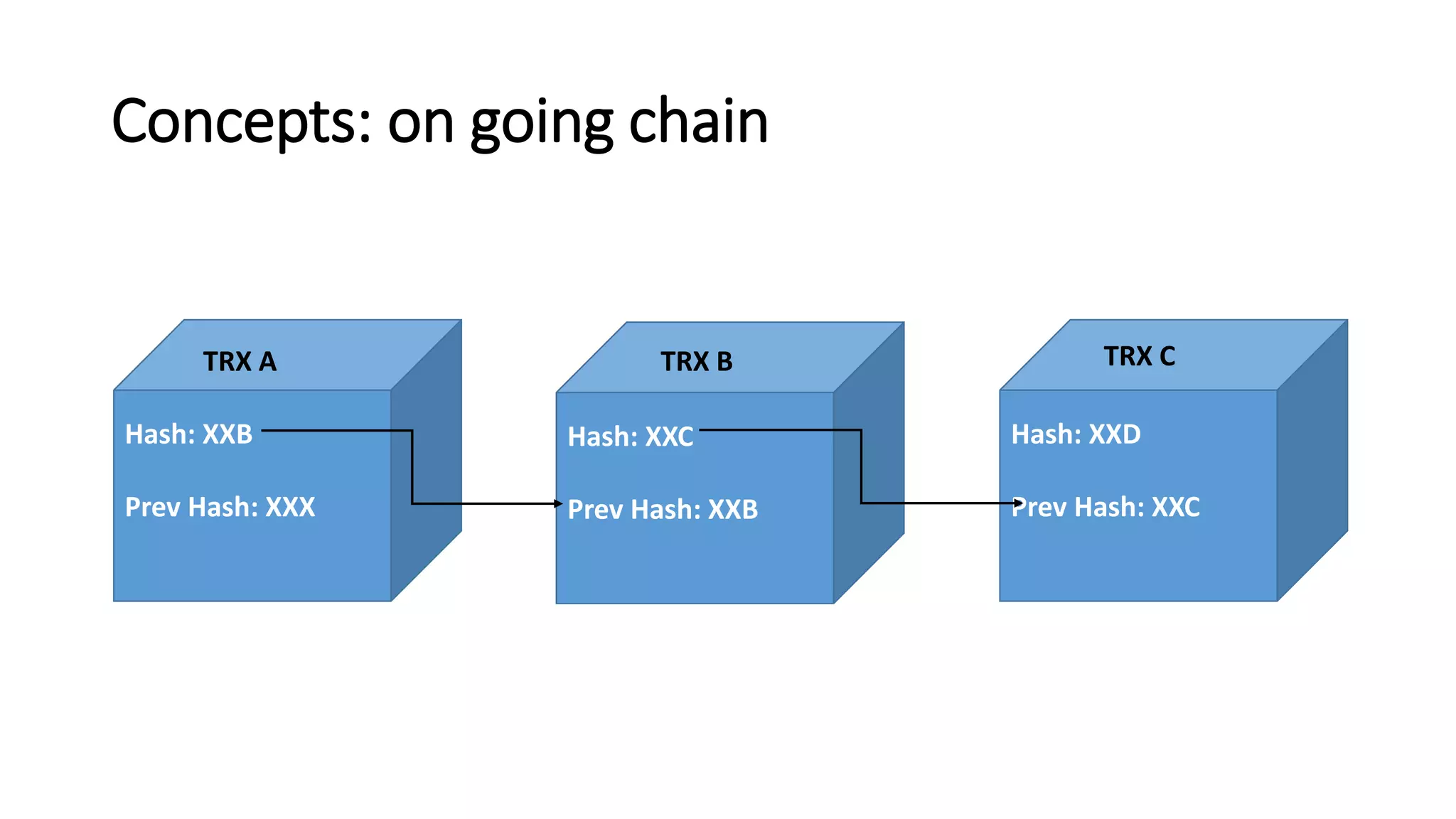
Concepts: on going chain
Hash: XXB
Prev Hash: XXX
Hash: XXC
Prev Hash: XXB
Hash: XXD
Prev Hash: XXC
TRX BTRX A TRX C
Distributed ledger
A distributed ledger is a database that is consensually shared and
synchronized across network spread across multiple sites,
institutions or geographies. It allows transactions to have public
"witnesses“, thereby making a cyberattack more difficult. The
participant at each node of the network can access the recordings
shared across that network and can own an identical copy of it.
Further, any changes or additions made to the ledger are reflected
and copied to all participants in a matter of seconds or minutes.
Underlying the distributed ledger technology is the blockchain,
which is the technology that underlies bitcoin. (Investopedia)
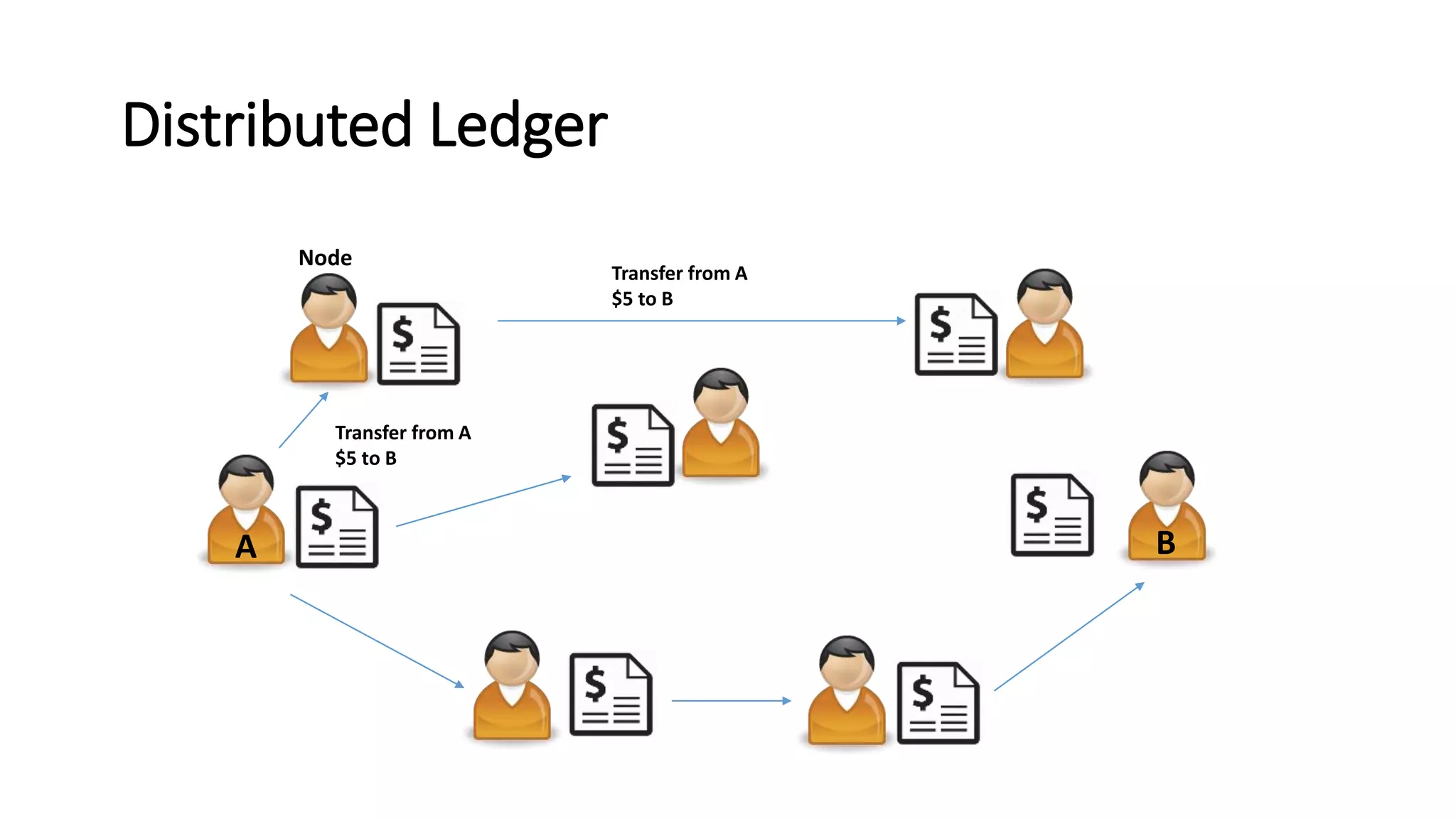
Distributed Ledger
Node
Transfer from A
$5 to B
A B
Transfer from A
$5 to B
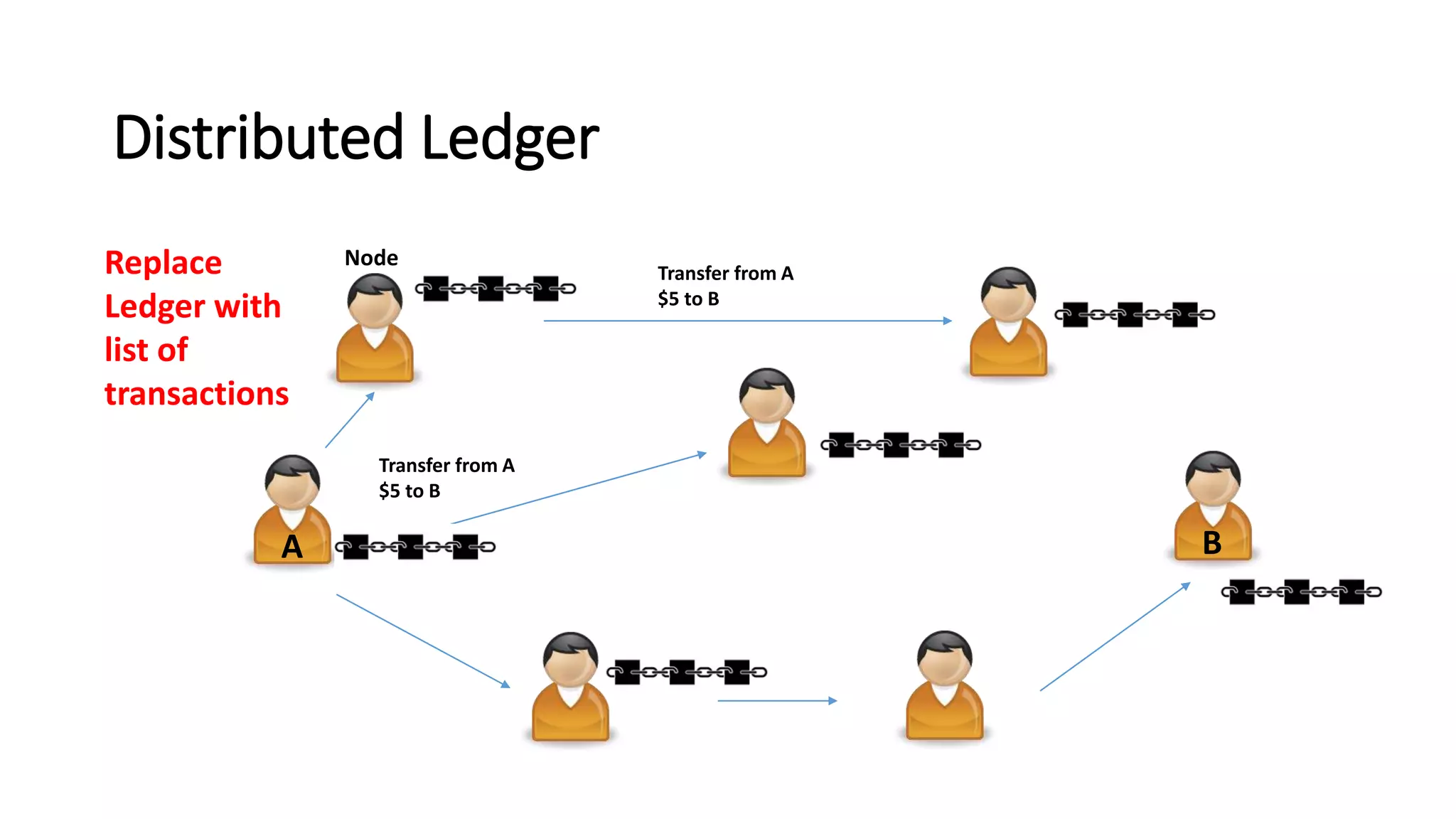
Distributed Ledger
Replace
Ledger with
list of
transactions
Node
Transfer from A
$5 to B
A B
Transfer from A
$5 to B
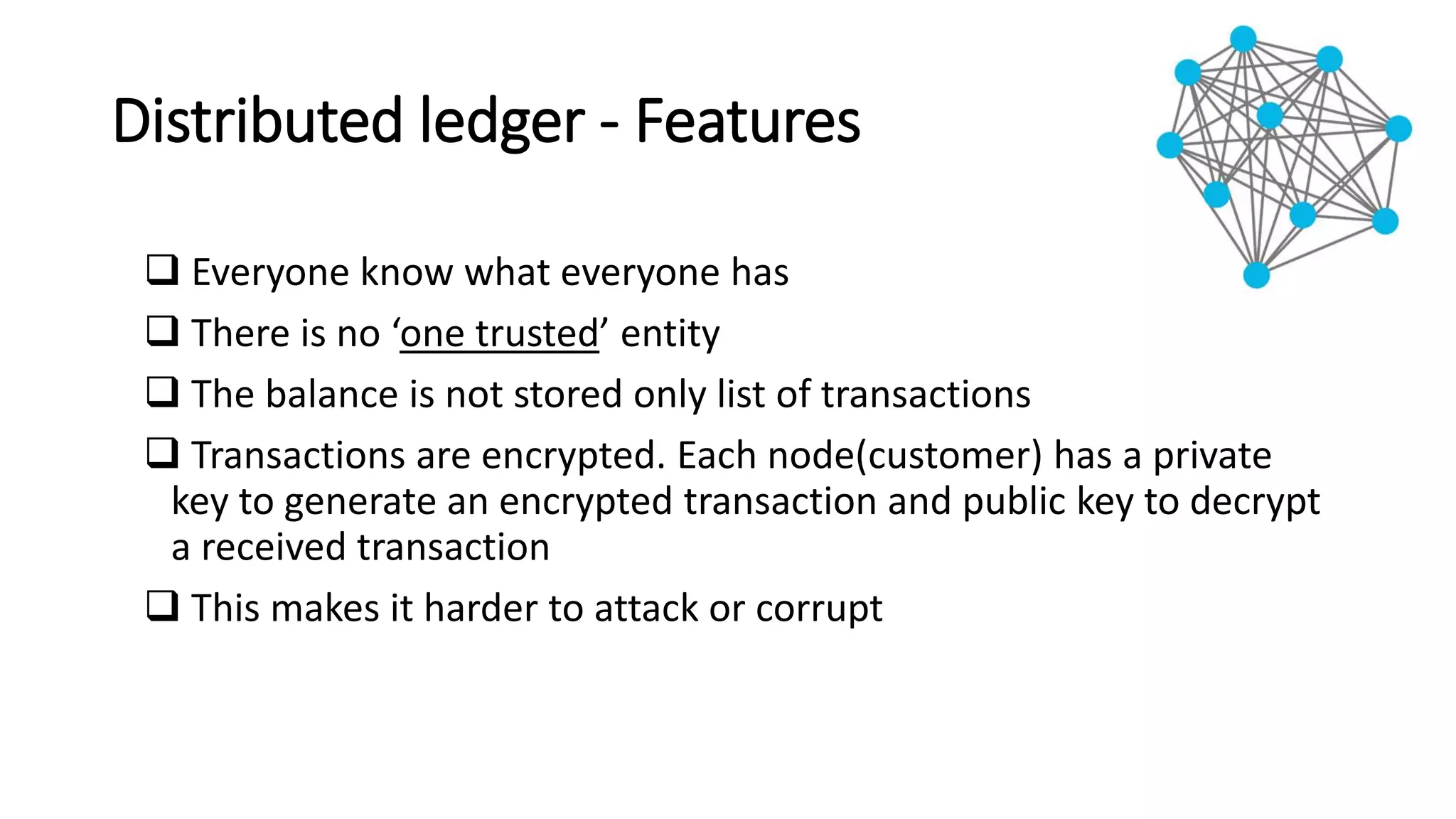
Distributed ledger - Features
 Everyone know what everyone has
 There is no ‘one trusted’ entity
 The balance is not stored only list of transactions
 Transactions are encrypted. Each node(customer) has a private
key to generate an encrypted transaction and public key to decrypt
a received transaction
 This makes it harder to attack or corrupt
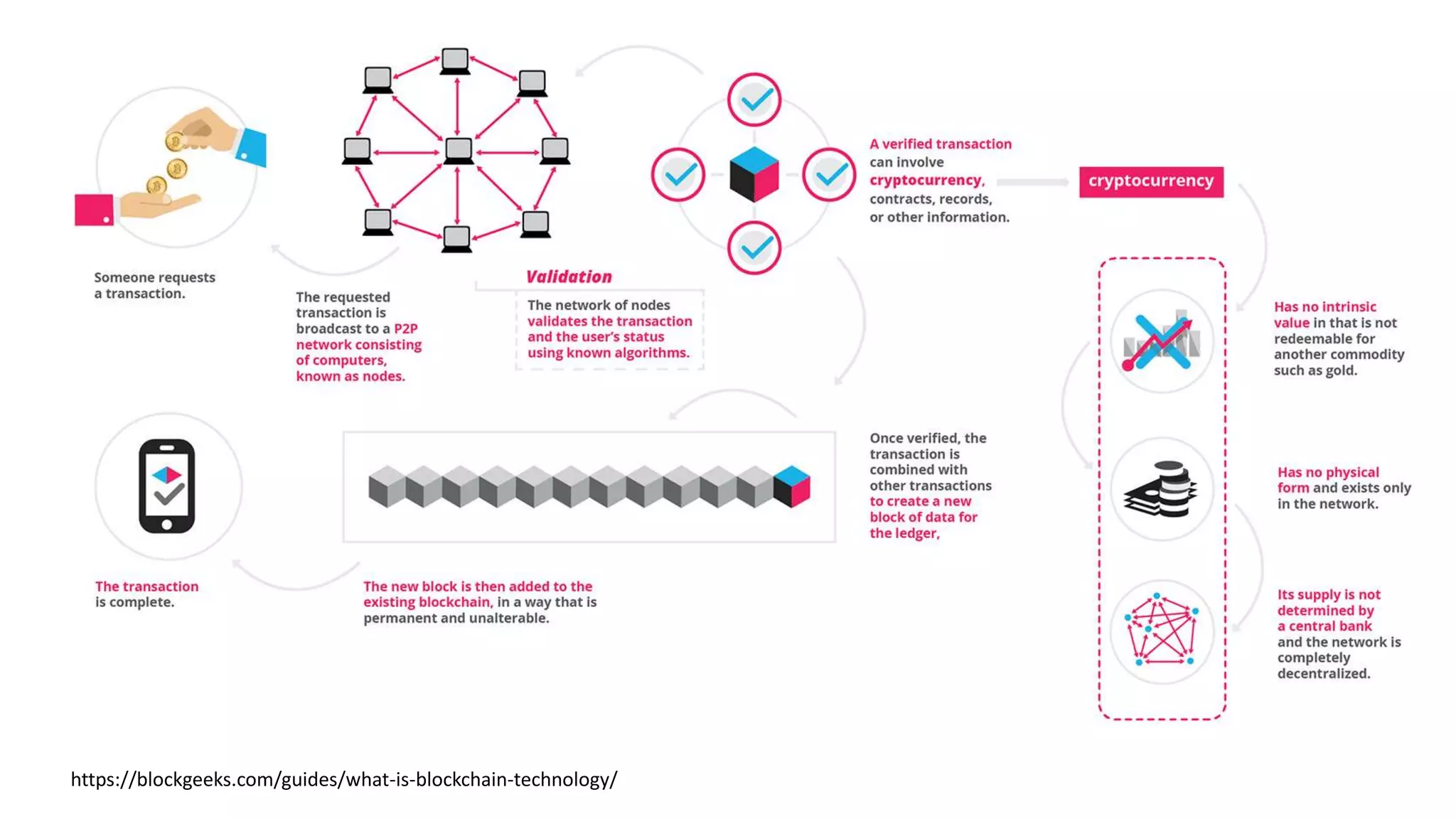
https://blockgeeks.com/guides/what-is-blockchain-technology/
Example Use cases
 Payments & Settlements
 Data Management (ALM & KYC)
 Protection of intellectual property
Thank you
Citations & References
1. Bitcoin: A Peer-to-Peer Electronic Cash System by Satoshi Nakamoto, satoshin@gmx.com, www.bitcoin.org
2. http://www.lawyard.ng/understanding-the-legal-framework-for-digitalelectronic-signature-in-nigeria/
3. https://www.comodo.com/resources/small-business/digital-certificates2.php
4. https://blockgeeks.com/guides/what-is-blockchain-technology/

Global Digital Sukuk (GDS) - A basic framework

  • 1.
    Tariqullah Khan Professor IslamicFinance, College of Islamic Studies HBKU Views expressed are personal tkhan@hbku.edu.qa Digitization of Sukuk in the Light of Crypto Currencies & Economic and Regulatory Challenges + Blockchain by Dalal Mahmood Based on Symposium on Digital Currencies from Sharia, Economic and Practical Perspectives March 19, 2018, College of Islamic Studies, Hamad Bin Khalifa University
  • 2.
    20% 15% 20% 15% 30% Digital Assets TechnologyRegulation Blockchain Ditigization of Sukuk Presentation Outline
  • 3.
    Digital Conventional 2017 US$12 TN 15.5% of global economy is digital Digital Conventional 2025 US $23 TN 25% of global economy will be digital Digital Conventional 2000 US $8 TN 10% of global economy was digital Global Digital Assets - Tangible and Intangible Data Source: Huawei & Oxford Economics (2016), “Digital Spillover: Measuring the true impact of the digital economy” and author estimates The Global Economy is transforming fast into digital economy
  • 4.
    e-commerce Assets (transfer of goods, forexample when a book is sold online) e-business Technology (how business is conducted, any process that an organization conducts over computer-mediated networks) e-business infrastructure (hardware, software, telecoms, networks, human capital, etc.) DLT Composition of Digital Economy Technology & Digital Assets Technology Diffusion ICOs & Digital Currency Distributive Ledger Technology
  • 5.
    Knowledge Software Information, Data &Big Data Digital Tokens & Currencies Designs Patents & Trade Secrets Art Music Entertainment & Media Addresses Virtual Property Revealed perceptions and preferences Distributed Ledger Technology Social Media & Internet of Things (IoT) Intangible digital assets Tangible Digital Assets An asset which has physical form and works through Internet connectivity or standalone computer programs e-business (how business is conducted, any process that an organization conducts over computer- mediated networks) e- commerce (transfer of goods, for example when a book is sold online) (Decentralized) Distributed Ledgers Technology (DLT) uses independent computers -- to record, share and synchronize transactions in their respective electronic ledgers, instead of keeping data centralized as in a traditional ledger. Trust Problem Utilization, generation and dissemination of data Digital Asset
  • 6.
  • 7.
  • 8.
    0 500 1000 1500 2000 2500 3000 3500 4000 4500 5000 2013 2014 20152016 2017 Global ICO issues $ millions Source: PWC Strategy https://cryptovalley.swiss/wp-content/uploads/20171221_PwC-S-CVA-ICO-Report_December_final.pdf Predominantly Bitcoin and Ethereum-based Global Initial Coin Offerings (ICO) Market Size billion $
  • 9.
  • 10.
    Intangible Digital Assets& Failure of Trusted Third Party Double Spending Trust Problem Solution of the Trust Problem --- Digital Economy based on Proof of Work (PoF) instead of Trust Distributive Ledger Technology (DLT) Knowledge as a printed Book & as a PDF Knowledge Software Information, Data & Big Data Designs Patents & Trade Secrets Art Music Entertainment & Media Addresses Virtual Property Digital Tokens & Revealed perceptions and preferences
  • 11.
    Public Blockchain withBitcoin as the Currency, Bitcoin Mining as the Incentive & Replaces Trust with Proof of Work Source: Deutsche Bank AG (DE) https://www.db.com/newsroom_news/cio_insights_reflections_-_cryptocurrencies_and_blockchains_-_us_-_client_ready.pdf
  • 12.
     DLT is: a)Peer to Peer (P2P) network, b) With Public Key Cryptography and c) Decisions with Consensus, Immutable and Irreversible.  Enables the creation, saving and transfer of Bitcoin without any double spending and without any intermediary.  Public ledger that acts as medium over which assets can be stored digitally with finality and without any threat of fraud or loss.  Where privacy is a must and preserved Value Proposition: Examples Blockchain – Distributive Ledger Technology (DLT) replacing trusted third party Bitcoin – the Blockchain’s Digital Currency
  • 13.
     A DLTBlockchain that allows Smart Contracts - self-executing virtual contracts  Ethereum also supports Decentralized Autonomous Organizations  Ethereum presents an opportunity for other uses of the Blockchain technology , in areas of governance, management and decentralized databases.  Ethereum has various types of applications built on it which include financial applications, such as financial derivatives, hedging contracts, digital saving wallets, trust funds and others.  It also has non-financial applications such as wills, e-voting, and e-governance structures, decentralized online databases.  In essence Ethereum acts a store and means through which value is transmitted and is also a platform for complex transactions where information can be shared over its Blockchain. Value Proposition: Examples Ethereum
  • 14.
    Gnosis on EthereumPlatform Create market prediction applications for : a) financial instruments b) insurances c) information (where insiders are able to make bets on, for example, the price discovery of pieces of art) d) governance (oracle on decisions taken by governance boards) e) sport betting Ripple is DLT international payments system and its Consensus Ledger can process 1,500 (Bitcoin 7) transactions per second and settles an international payment in an average time of three seconds. 50 of the largest banks in the world have or are planning to integrate Ripple in their payments systems Value Proposition: Examples Basic Attention Token (BAT) – Brave browser on Blockchain Monetizing content Eliminating hidden cost of advertisement blockers $276 per year See advertisements by choice Increasing speed of Cloud computing Medtokens on Ethereum Medical claims on hyper ledger Blockchain Medical practitioners and service users can utilize Patients can release their data if they want to researchers based on incentives
  • 15.
    Control Double Spending withPeer- to-Peer (P2P) Proof- of-Work (PoF) Perfect Divisibility of Assets Global Access without any legal formalities Preserve Privacy Avoid Intermediation Cost Law of Large Numbers and Economies of Scale Instant Global Transfer of Ownership Minimize storage and protection cost Create perfect transparency without law and regulation Digitize wealth Eliminate the need for surveillance & its costs Spread Risk and Enhance Stability Enhance Governance through Smart Contracts without human interference Shared prosperity Uberization and asset utilization Crowdfunding for good causes Perceived Advantages of the Decentralized Ledger Technology (DLT)
  • 16.
    Perceived Advantages ofthe Decentralized Ledger Technology (DLT) 1. Control Double Spending and Replace Trusted Third Party with Peer-to-Peer (P2P) Proof-of-Work (PoF) 2. Perfect Divisibility of Assets 3. Global Access without any legal formalities 4. Preserve Privacy 5. Avoid Intermediation Cost 6. Law of Large Number and Economies of Scale 7. Instant Global Transfer of Ownership 8. Create perfect transparency without law and regulation 9. Minimize storage and protection cost 10. Digitize wealth 11. Eliminate the need for surveillance 12. Spread Risk and Enhance Stability 13. Enhance Governance through Smart Contracts without human interference
  • 17.
    Regulatory Responses aboutDistributive Ledger and Blockchain Technology Globally, all important regulatory authorities are encouraging the development of Distributive Ledger Technology (DLT) as an innovation and most regulators have established FinTech and Blockchain Regulatory Sand Boxes for observation and support
  • 18.
    Swiss Financial MarketsSupervisory Authority (FINMA) Digital Tokens are classified by purpose: a) Tokens used in Payments will be subject to AML regulations b) Token used as Investment vehicles will be subject to Securities regulations and AML regulations c) Utility tokens will not be subject to the above regulations d) Hybrid tokens will be treated case by case French Regulatory Authority (AMF) Initial Coin Offerings (ICOs) are investment intermediation and cannot be issued directly and must go through securities regulatory processes for approval USA Draft Act by Uniform Law Commission Digital representation of value that is used as a medium of exchange, unit of account, store of value but not legal tender. Companies should not do business in virtual currencies more than $ 5000, individuals are not restricted States have different perceptions. A large proportion of global digital currencies are USA based. However, ICO prohibited, money laundering and illegal act regulations enacted, cryptographic exchange tradition license scheme in force Regulatory Responses about Digital Currency Globally No Uniform Policy has Evolved: Singapore, Japan, Republic of Korea and Malaysia encouraging, China, Indonesia etc., banning Malta Establishing Digital Technology Regulatory Authority through Virtual Currency law Sweden Considering to issue Central Bank Digital Currency named e- krona
  • 19.
    Regulatory Worries aboutDigital Currencies Public Interest – understanding the services, its transparency and safety Money Laundering and Abuse Financial Disintermediation and Collapse of Banking System with unknown consequences Digital Currencies Bubble and Financial Instability Counter abuse through DLT could be more effective and regulators are advised to consider such prospects International Monetary Fund (IMF) Malaysia, Singapore, Japan and Republic of Korea allowing transactions in Cryptocurrencies with proper identity of the parties
  • 20.
    Central Bank DigitalCurrency (CBDC) - Prospects Sweden Considering to issue Central Bank Digital Currency named e-krona Bank for International Settlements (BIS) in its report to G20 a) A wholesale currency limited to select financial institutions b) General purpose currency accessible to the public Impact to be assessed carefully in three areas – a) payments, b) monetary policy implementation and c) financial stability  A wholesale currency limited to select financial institutions seems promising to enhance efficiency of international and national payments systems  General purpose currency accessible to the public seems to exacerbate banking instability  Careful studies are needed. https://medium.com/@Torquecapital/a-snapshot-of-current-crypto-regulations-of-all-g20-member-states-3b5f80ffac81 Current State of Regulation in G20 Countries is summarized in this link Singapore Project Ubin for Blockchain-based inter-bank payments system
  • 21.
    https://www.db.com/newsroom_news/cio_insights_reflections_-_cryptocurrencies_and_blockchains_-_us_-_client_ready.pdf Source: Deutsche BankAG (DE) Can Bitcoin Perform the Function of Money? No, Based on Volatility No, its not a legal tender Yes, within the Blockchain ICOs Yes, for transferring money
  • 22.
    During 2017 BitcoinPrice was driven by increase in ICOs Market capitalization 160b $ Market capitalization 140b $ Bitcoin price volatility is due to regulatory uncertainty with respect to ICOs
  • 23.
  • 24.
    Global Digital Sukuk(GDS) – Basic Framework  GDS is a digital and perpetual Mudharabah Sukuk – a crypto-asset proposed for potential study and consideration for issuance by a highly credible entity like the AAA IDB based on its overall balance sheet  Total size of GDS crypto-asset will be US $ 1 billion divided into 0.50 $ each GDS  Small denomination and very large number of investors will spread the Mudharabah risk  GDS will be globally tradable on a public Blockchain for investment by individuals, institutions and new ICO crypto businesses  GDS will facilitate crowdfunding for SMEs Global Digital Sukuk (GDS) Public Blockchain GDS- based ICO GDS- based ICO GDS- based ICO GDS- based ICO GDS- based ICO GDS- based ICO Source: Based on the author’s paper “Global Digital Sukuk – Basic Framework” in process for publication
  • 25.
    Features of GDS Valuepropositions  A global public Blockchain platform offered by a AAA Sharia compliant multilateral development bank  A Crypto-asset that can be used by individual small investors globally and Islamic banks specially for liquidity management  A digital asset in compliance with the Sharia, which can also be tuned with SDGs and ESGs concerns  Potential addition of Smart Contracts based on suitable Islamic financial instruments SWOT Strength: • Clear concept offering by a AAA institutions with global mandate • Small denomination of the GDS and a very large number of potential investors will spread the Mudharabah risk • Perpetual nature with ensure stability and continuity Weakness: • Internal capacity with the new technology development and implementation Opportunity:  Significant global opportunities of DLT and Sharia- compliant crypto-assets and crowd funding of SMEs  Confirming with SDGs and ESG requirements Threat: • Regulatory and AML uncertainty
  • 26.
    Concluding remarks  Digitizationof global economy grows and brings a number of benefits  DLT enhances efficiency and robustness of payments systems  DLT facilitates initial coin offerings (ICOs) – many companies like airlines, heath services, e-commerce, software etc., may gradually opt for ICOs  Smart contracts potentially improves overall governance  Financial disintermediation takes place; regulation is encouraging technological innovations  Regulators are developing consensus to classify the so-called crypto-currencies as crypto-assets to be legalized and regulated by securities regulators  ICOs are Sharia compliant or non-compliant based on the underlying businesses  There are good prospects and opportunities of issuing Global Digital Sukuk by the Islamic Development Bank Digital currencies and tokens are expected to prevail posing unknown risks, requiring more studies
  • 27.
  • 28.
    Starting point: = Blockchain DigitalCurrency Technology of transfer
  • 29.
    Current Practice :Centralized Financial Intermediator (Ex, Banks, PayPal..) Ledger Transfer from A $5 to B A B Transfer $5 from A Ledger Balance updated A balance - $5 B balance + $5
  • 30.
    Current Practice -Centralized ledger  General Ledger: A general ledger is a company's set of numbered accounts for its accounting records. The ledger provides a complete record of financial transactions over the life of the company. The ledger holds account information that is needed to prepare financial statements and includes accounts for assets, liabilities, owners' equity, revenues and expenses. (Investopedia)  The current practice is that the general ledger stored and managed using applications and databases referred to as ERP (Enterprise Resource Planning) system or Core Banking system  The applications also store the Bank/company customer information
  • 31.
    Current Practice :Update Balance Transaction: Transfer from A $5 to B A Acct Balance A 100 B 100 Acct Balance A 95 B 105 Transaction updates Balance  Database (in the form of tables) stores balances
  • 32.
    Centralized ledger -Features  The customer only knows about his transaction  The Bank is a ‘trusted’ entity  Security issues as being in a centralized location it can be copied, corrupted,…etc.
  • 33.
    Concepts: The beginning(2008)  Satoshi Nakamoto (Bitcoin founder) A purely peer-to-peer version of electronic cash would allow online payments to be sent directly from one party to another without going through a financial institution. Digital signatures provide part of the solution, but the main benefits are lost if a trusted third party is still required to prevent double-spending. We propose a solution to the double-spending problem using a peer-to-peer network. The network timestamps transactions by hashing them into an ongoing chain of hash-based proof-of-work, forming a record that cannot be changed without redoing the proof-of-work. The longest chain not only serves as proof of the sequence of events witnessed, but proof that it came from the largest pool of CPU power.(1) (1) Bitcoin: A Peer-to-Peer Electronic Cash System by Satoshi Nakamoto, satoshin@gmx.com, www.bitcoin.org
  • 34.
    Concepts: Peer toPeer Server Based Peer to Peer
  • 35.
    Concepts: Digital Signature (2)http://www.lawyard.ng/understanding-the-legal-framework-for-digitalelectronic-signature-in-nigeria/
  • 36.
    Concepts: Public &Private Keys  Public & Private Keys: • Public Key (Your address) it is made available to everyone via a publicly accessible repository or directory. • Private Key (Your Password) must remain confidential to its respective owner. • The Public and Private key pair comprise of two uniquely related cryptographic keys (basically long random numbers). Below is an example of a Public Key: • 3048 0241 00C9 18FA CF8D EB2D EFD5 FD37 89B9 E069 EA97 FC20 5E35 F577 EE31 C4FB C6E4 4811 7D86 BC8F BAFA 362F 922B F01B 2F40 C744 2654 C0DD 2881 D673 CA2B 4003 C266 E2CD CB02 0301 0001 https://www.comodo.com/resources/small-business/digital-certificates2.php
  • 37.
    Concepts: on goingchain Hash: XXB Prev Hash: XXX Hash: XXC Prev Hash: XXB Hash: XXD Prev Hash: XXC TRX BTRX A TRX C
  • 38.
    Distributed ledger A distributedledger is a database that is consensually shared and synchronized across network spread across multiple sites, institutions or geographies. It allows transactions to have public "witnesses“, thereby making a cyberattack more difficult. The participant at each node of the network can access the recordings shared across that network and can own an identical copy of it. Further, any changes or additions made to the ledger are reflected and copied to all participants in a matter of seconds or minutes. Underlying the distributed ledger technology is the blockchain, which is the technology that underlies bitcoin. (Investopedia)
  • 39.
    Distributed Ledger Node Transfer fromA $5 to B A B Transfer from A $5 to B
  • 40.
    Distributed Ledger Replace Ledger with listof transactions Node Transfer from A $5 to B A B Transfer from A $5 to B
  • 41.
    Distributed ledger -Features  Everyone know what everyone has  There is no ‘one trusted’ entity  The balance is not stored only list of transactions  Transactions are encrypted. Each node(customer) has a private key to generate an encrypted transaction and public key to decrypt a received transaction  This makes it harder to attack or corrupt
  • 42.
  • 43.
    Example Use cases Payments & Settlements  Data Management (ALM & KYC)  Protection of intellectual property
  • 44.
  • 45.
    Citations & References 1.Bitcoin: A Peer-to-Peer Electronic Cash System by Satoshi Nakamoto, satoshin@gmx.com, www.bitcoin.org 2. http://www.lawyard.ng/understanding-the-legal-framework-for-digitalelectronic-signature-in-nigeria/ 3. https://www.comodo.com/resources/small-business/digital-certificates2.php 4. https://blockgeeks.com/guides/what-is-blockchain-technology/