International Research Journal of Engineering and Technology (IRJET) e-ISSN: 2395-0056
Volume: 06 Issue: 01 | Feb 2019 www.irjet.net p-ISSN: 2395-0072
© 2019, IRJET | Impact Factor value: 7.211 | ISO 9001:2008 Certified Journal | Page 4211
“IOT Color Based Product Sorting Machine”
Krishna Jadhav1, Gaurav Chaudhari2, Abhishek Jadhav3 , Shubham Kondekar4 , Prof. Nagre V.L.5
1,2,3,4 Student, Dept. of Electronics & Telecommunication, MGM’s Polytechnic, Aurangabad Maharashtra, India
5, Professor, Dept. of Electronics & Telecommunication, MGM’s Polytechnic, Aurangabad Maharashtra, India
---------------------------------------------------------------------***---------------------------------------------------------------------
Abstract - Color based product sorting has a wide usage
in fruits sorting as well as candy sorting industries. Now a
day’s industrial area requires demand for automation. Due
to automation human efforts are goes on decreasing day-by-
day. Since last decade .This system puts forward mechanism
to detect color and sort item through image processing. This
mechanism is used to sort the candies into particular bins or
baskets. Here, we are designing and implementing and
efficient color sorting using color sensor TCS 3200, Arduino
nano and servo motors.
Key Words: Internet of Things (IOT), color sensor,
Arduino nano, Wi-Fi module, Servo motors, Logic level
converter etc.
1. INTRODUCTION
We here, demonstrate the mechanism using a color
sensor using sorting mechanism using 3 bins. The system
uses Arduino nano connected to a controller circuit to
achieve this task. The controller circuit consists of a color
sensor attached to it that detect color of a small object in
front of it. As soon as the color is detected, a signal is send
to the sorter mechanism. This uses a motor to position the
sorting tube towards respective section. A feeder is then
used to push the object towards the tube. So that it gets
sorted and next object is pulled in by the feeder. The
action details are sending to the IOT server iotgecko
platform to keep track of the number of objects sorted in
each section. Thus we achieved a completely automated
IOT based sorting system. This project is developed with
the purpose of reduce labor cost, and human interference.
2. Technology for Object Sorting
2.1 Arduino Nano
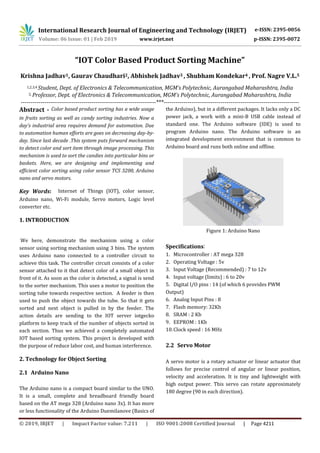
The Arduino nano is a compact board similar to the UNO.
It is a small, complete and breadboard friendly board
based on the AT mega 328 (Arduino nano 3x). It has more
or less functionality of the Arduino Duemilanove (Basics of
the Arduino), but in a different packages. It lacks only a DC
power jack, a work with a mini-B USB cable instead of
standard one. The Arduino software (IDE) is used to
program Arduino nano. The Arduino software is an
integrated development environment that is common to
Arduino board and runs both online and offline.
Figure 1: Arduino Nano
Specifications:
1. Microcontroller : AT mega 328
2. Operating Voltage : 5v
3. Input Voltage (Recommended) : 7 to 12v
4. Input voltage (limits) : 6 to 20v
5. Digital I/O pins : 14 (of which 6 provides PWM
Output)
6. Analog Input Pins : 8
7. Flash memory: 32Kb
8. SRAM : 2 Kb
9. EEPROM : 1Kb
10.Clock speed : 16 MHz
2.2 Servo Motor
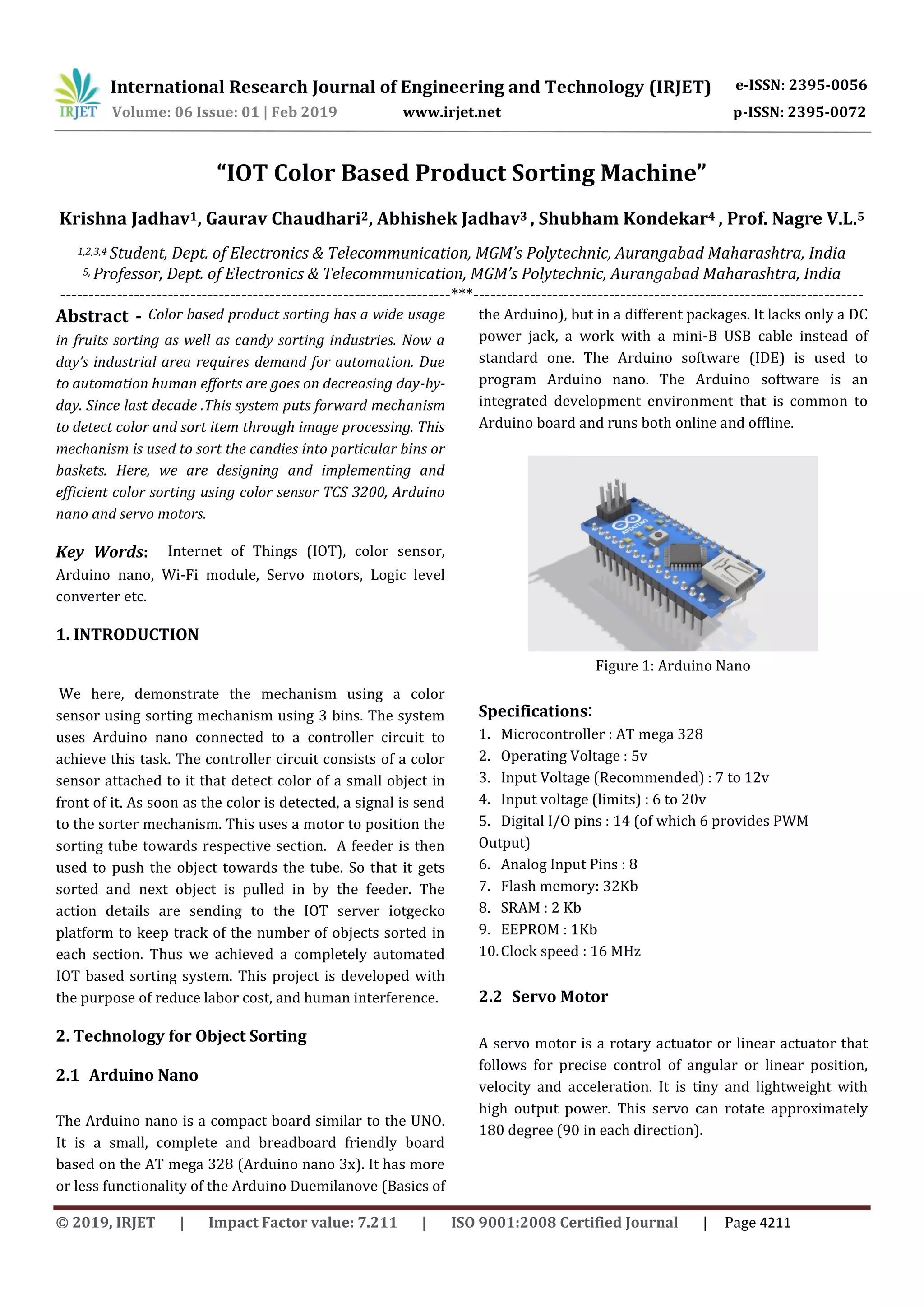
A servo motor is a rotary actuator or linear actuator that
follows for precise control of angular or linear position,
velocity and acceleration. It is tiny and lightweight with
high output power. This servo can rotate approximately
180 degree (90 in each direction).
International Research Journal of Engineering and Technology (IRJET) e-ISSN: 2395-0056
Volume: 06 Issue: 01 | Feb 2019 www.irjet.net p-ISSN: 2395-0072
© 2019, IRJET | Impact Factor value: 7.211 | ISO 9001:2008 Certified Journal | Page 4212
Figure 2: Servo motor
Specifications:
1. Operating voltage: 4.8 ~ 6.0v
2. Operating speed: 0.12 sec/60 degree
3. Output torque: 1.6 kg/cm (4.8v)
4. Weight: 9g
2.3 Color Sensor (TCS 3200)
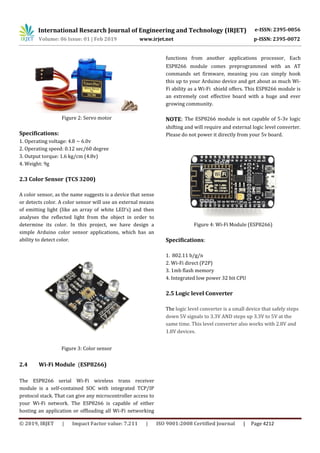
A color sensor, as the name suggests is a device that sense
or detects color. A color sensor will use an external means
of emitting light (like an array of white LED’s) and then
analyses the reflected light from the object in order to
determine its color. In this project, we have design a
simple Arduino color sensor applications, which has an
ability to detect color.
Figure 3: Color sensor
2.4 Wi-Fi Module (ESP8266)
The ESP8266 serial Wi-Fi wireless trans receiver
module is a self-contained SOC with integrated TCP/IP
protocol stack. That can give any microcontroller access to
your Wi-Fi network. The ESP8266 is capable of either
hosting an application or offloading all Wi-Fi networking
functions from another applications processor. Each
ESP8266 module comes preprogrammed with an AT
commands set firmware, meaning you can simply hook
this up to your Arduino device and get about as much Wi-
Fi ability as a Wi-Fi shield offers. This ESP8266 module is
an extremely cost effective board with a huge and ever
growing community.
NOTE: The ESP8266 module is not capable of 5-3v logic
shifting and will require and external logic level converter.
Please do not power it directly from your 5v board.
Figure 4: Wi-Fi Module (ESP8266)
Specifications:
1. 802.11 b/g/n
2. Wi-Fi direct (P2P)
3. 1mb flash memory
4. Integrated low power 32 bit CPU
2.5 Logic level Converter
The logic level converter is a small device that safely steps
down 5V signals to 3.3V AND steps up 3.3V to 5V at the
same time. This level converter also works with 2.8V and
1.8V devices.
International Research Journal of Engineering and Technology (IRJET) e-ISSN: 2395-0056
Volume: 06 Issue: 01 | Feb 2019 www.irjet.net p-ISSN: 2395-0072
© 2019, IRJET | Impact Factor value: 7.211 | ISO 9001:2008 Certified Journal | Page 4213
Figure 5: Logic level converter
3. Sorting Mechanism
The sorting mechanism and test are evaluated and the
data are recorded. To ensure the validity and accuracy of
the calculations, the R, G, B values are verified using color
software available in the market. When any color from
Red, Green or Blue is kept for detection in front of the
sensor then the desired color product is sorted in bins.
Figure 6: Sorting mechanism
4. Significance of IOT
The “Internet of Things” (IOT) is taking the world by storm
and becoming an increasingly growing topic of
conversation both in the workplace and outside of it. It’s a
concept that not only has the potential to impact how we
live but also we work. An end-to-end IOT system
comprises of the following
1. Hardware
2. Connectivity
3. Software
4. User interface
Hardware: Such as sensors or devices. These sensors and
devices collect data from the sorting machine (e.g. color
sensor) or perform actions in the environment by shining
a white light at an object and then recording the
reflected color. It can also record the intensity of the
reflection (brightness). Through red, green and
blue color filters the photodiode converts the amount of
light into current.
Connectivity: The hardware needs a way to transmit all
that data to the cloud (e.g. sending color data) or needs a
way to receive commands from the cloud. For some IOT
systems, there can be an intermediate step between
hardware and connecting to the cloud, such as a gateway,
router or Wi-Fi module.
Software: This software is hosted in the cloud and is
responsible for analyzing the data it’s collecting from the
sensors and making decisions
User interface: To make all of this useful, there needs to
be a way for users to interact with the IOT system (e.g. a
web app with a dashboard that shows different color
product bins and allows users to take action).
Now to facilitates communication, data flow, device
management, and the functionality of applications we
need a complete platform which is called IOT platform.
And it’s an very important part of IOT ecosystem.
Figure 7: Internet of Things (IOT)
International Research Journal of Engineering and Technology (IRJET) e-ISSN: 2395-0056
Volume: 06 Issue: 01 | Feb 2019 www.irjet.net p-ISSN: 2395-0072
© 2019, IRJET | Impact Factor value: 7.211 | ISO 9001:2008 Certified Journal | Page 4214
5. Proposed Work
Objects which are to be separated are fed in tube. A color
sensor sense the items coming in its sight and code for the
same is coded in Arduino in such a way that only the
desired object color are sensed in the bins at the end using
servo motor.
6. Results
The objects are sorted with respect to their color and
dropped into the respective bins. The use of automation in
color determination Sorting objects process becomes
simple due to which counting and sorting process reduced
manual efforts. This leads to improving accuracy as well as
save money and time.
References:
1. https://www.arduino.cc/
2. https://shop.pimoroni.com/products/arduino-nano
3. www.eeweb.com/featured-projects/arduino-color-
sorter-project
4. https://www.mepits.com/project/274/embedded-
projects/arduino-based-color-sorting-machine
5. https://circuitdigest.com/microcontroller-
projects/arduino-color-sensor-tcs3200
6. https://www.electronicshub.org/arduino-based-color-
detector/
BIOGRAPHIES
Krishna Jadhav (Diploma 3rd
year student) Department of
Electronics &
Telecommunication Engg,
MGM’s Polytechnic,N-6 CIDCO,
Aurangabad.431003
Gaurav Chaudhari (Diploma 3rd
year student) Department of
Electronics &
Telecommunication Engg,
MGM’s Polytechnic,N-6 CIDCO,
Aurangabad.431003
Abhishek Jadhav (Diploma 3rd
year student) Department of
Electronics &
Telecommunication Engg,
MGM’s Polytechnic,N-6 CIDCO,
Aurangabad.431003
Shubham Kondekar (Diploma
3rd year student) Department of
Electronics &
Telecommunication Engg,
MGM’s Polytechnic,N-6 CIDCO,
Aurangabad.431003
Prof. Nagre V.L. (Head of
Department) Department of
Electronics &
Telecommunication Engg. ,
MGM’s Polytechnic, N-6 CIDCO ,
Aurangabad. 431003

IRJET- IoT Color based Product Sorting Machine

  • 1.
    International Research Journalof Engineering and Technology (IRJET) e-ISSN: 2395-0056 Volume: 06 Issue: 01 | Feb 2019 www.irjet.net p-ISSN: 2395-0072 © 2019, IRJET | Impact Factor value: 7.211 | ISO 9001:2008 Certified Journal | Page 4211 “IOT Color Based Product Sorting Machine” Krishna Jadhav1, Gaurav Chaudhari2, Abhishek Jadhav3 , Shubham Kondekar4 , Prof. Nagre V.L.5 1,2,3,4 Student, Dept. of Electronics & Telecommunication, MGM’s Polytechnic, Aurangabad Maharashtra, India 5, Professor, Dept. of Electronics & Telecommunication, MGM’s Polytechnic, Aurangabad Maharashtra, India ---------------------------------------------------------------------***--------------------------------------------------------------------- Abstract - Color based product sorting has a wide usage in fruits sorting as well as candy sorting industries. Now a day’s industrial area requires demand for automation. Due to automation human efforts are goes on decreasing day-by- day. Since last decade .This system puts forward mechanism to detect color and sort item through image processing. This mechanism is used to sort the candies into particular bins or baskets. Here, we are designing and implementing and efficient color sorting using color sensor TCS 3200, Arduino nano and servo motors. Key Words: Internet of Things (IOT), color sensor, Arduino nano, Wi-Fi module, Servo motors, Logic level converter etc. 1. INTRODUCTION We here, demonstrate the mechanism using a color sensor using sorting mechanism using 3 bins. The system uses Arduino nano connected to a controller circuit to achieve this task. The controller circuit consists of a color sensor attached to it that detect color of a small object in front of it. As soon as the color is detected, a signal is send to the sorter mechanism. This uses a motor to position the sorting tube towards respective section. A feeder is then used to push the object towards the tube. So that it gets sorted and next object is pulled in by the feeder. The action details are sending to the IOT server iotgecko platform to keep track of the number of objects sorted in each section. Thus we achieved a completely automated IOT based sorting system. This project is developed with the purpose of reduce labor cost, and human interference. 2. Technology for Object Sorting 2.1 Arduino Nano The Arduino nano is a compact board similar to the UNO. It is a small, complete and breadboard friendly board based on the AT mega 328 (Arduino nano 3x). It has more or less functionality of the Arduino Duemilanove (Basics of the Arduino), but in a different packages. It lacks only a DC power jack, a work with a mini-B USB cable instead of standard one. The Arduino software (IDE) is used to program Arduino nano. The Arduino software is an integrated development environment that is common to Arduino board and runs both online and offline. Figure 1: Arduino Nano Specifications: 1. Microcontroller : AT mega 328 2. Operating Voltage : 5v 3. Input Voltage (Recommended) : 7 to 12v 4. Input voltage (limits) : 6 to 20v 5. Digital I/O pins : 14 (of which 6 provides PWM Output) 6. Analog Input Pins : 8 7. Flash memory: 32Kb 8. SRAM : 2 Kb 9. EEPROM : 1Kb 10.Clock speed : 16 MHz 2.2 Servo Motor A servo motor is a rotary actuator or linear actuator that follows for precise control of angular or linear position, velocity and acceleration. It is tiny and lightweight with high output power. This servo can rotate approximately 180 degree (90 in each direction).
  • 2.
    International Research Journalof Engineering and Technology (IRJET) e-ISSN: 2395-0056 Volume: 06 Issue: 01 | Feb 2019 www.irjet.net p-ISSN: 2395-0072 © 2019, IRJET | Impact Factor value: 7.211 | ISO 9001:2008 Certified Journal | Page 4212 Figure 2: Servo motor Specifications: 1. Operating voltage: 4.8 ~ 6.0v 2. Operating speed: 0.12 sec/60 degree 3. Output torque: 1.6 kg/cm (4.8v) 4. Weight: 9g 2.3 Color Sensor (TCS 3200) A color sensor, as the name suggests is a device that sense or detects color. A color sensor will use an external means of emitting light (like an array of white LED’s) and then analyses the reflected light from the object in order to determine its color. In this project, we have design a simple Arduino color sensor applications, which has an ability to detect color. Figure 3: Color sensor 2.4 Wi-Fi Module (ESP8266) The ESP8266 serial Wi-Fi wireless trans receiver module is a self-contained SOC with integrated TCP/IP protocol stack. That can give any microcontroller access to your Wi-Fi network. The ESP8266 is capable of either hosting an application or offloading all Wi-Fi networking functions from another applications processor. Each ESP8266 module comes preprogrammed with an AT commands set firmware, meaning you can simply hook this up to your Arduino device and get about as much Wi- Fi ability as a Wi-Fi shield offers. This ESP8266 module is an extremely cost effective board with a huge and ever growing community. NOTE: The ESP8266 module is not capable of 5-3v logic shifting and will require and external logic level converter. Please do not power it directly from your 5v board. Figure 4: Wi-Fi Module (ESP8266) Specifications: 1. 802.11 b/g/n 2. Wi-Fi direct (P2P) 3. 1mb flash memory 4. Integrated low power 32 bit CPU 2.5 Logic level Converter The logic level converter is a small device that safely steps down 5V signals to 3.3V AND steps up 3.3V to 5V at the same time. This level converter also works with 2.8V and 1.8V devices.
  • 3.
    International Research Journalof Engineering and Technology (IRJET) e-ISSN: 2395-0056 Volume: 06 Issue: 01 | Feb 2019 www.irjet.net p-ISSN: 2395-0072 © 2019, IRJET | Impact Factor value: 7.211 | ISO 9001:2008 Certified Journal | Page 4213 Figure 5: Logic level converter 3. Sorting Mechanism The sorting mechanism and test are evaluated and the data are recorded. To ensure the validity and accuracy of the calculations, the R, G, B values are verified using color software available in the market. When any color from Red, Green or Blue is kept for detection in front of the sensor then the desired color product is sorted in bins. Figure 6: Sorting mechanism 4. Significance of IOT The “Internet of Things” (IOT) is taking the world by storm and becoming an increasingly growing topic of conversation both in the workplace and outside of it. It’s a concept that not only has the potential to impact how we live but also we work. An end-to-end IOT system comprises of the following 1. Hardware 2. Connectivity 3. Software 4. User interface Hardware: Such as sensors or devices. These sensors and devices collect data from the sorting machine (e.g. color sensor) or perform actions in the environment by shining a white light at an object and then recording the reflected color. It can also record the intensity of the reflection (brightness). Through red, green and blue color filters the photodiode converts the amount of light into current. Connectivity: The hardware needs a way to transmit all that data to the cloud (e.g. sending color data) or needs a way to receive commands from the cloud. For some IOT systems, there can be an intermediate step between hardware and connecting to the cloud, such as a gateway, router or Wi-Fi module. Software: This software is hosted in the cloud and is responsible for analyzing the data it’s collecting from the sensors and making decisions User interface: To make all of this useful, there needs to be a way for users to interact with the IOT system (e.g. a web app with a dashboard that shows different color product bins and allows users to take action). Now to facilitates communication, data flow, device management, and the functionality of applications we need a complete platform which is called IOT platform. And it’s an very important part of IOT ecosystem. Figure 7: Internet of Things (IOT)
  • 4.
    International Research Journalof Engineering and Technology (IRJET) e-ISSN: 2395-0056 Volume: 06 Issue: 01 | Feb 2019 www.irjet.net p-ISSN: 2395-0072 © 2019, IRJET | Impact Factor value: 7.211 | ISO 9001:2008 Certified Journal | Page 4214 5. Proposed Work Objects which are to be separated are fed in tube. A color sensor sense the items coming in its sight and code for the same is coded in Arduino in such a way that only the desired object color are sensed in the bins at the end using servo motor. 6. Results The objects are sorted with respect to their color and dropped into the respective bins. The use of automation in color determination Sorting objects process becomes simple due to which counting and sorting process reduced manual efforts. This leads to improving accuracy as well as save money and time. References: 1. https://www.arduino.cc/ 2. https://shop.pimoroni.com/products/arduino-nano 3. www.eeweb.com/featured-projects/arduino-color- sorter-project 4. https://www.mepits.com/project/274/embedded- projects/arduino-based-color-sorting-machine 5. https://circuitdigest.com/microcontroller- projects/arduino-color-sensor-tcs3200 6. https://www.electronicshub.org/arduino-based-color- detector/ BIOGRAPHIES Krishna Jadhav (Diploma 3rd year student) Department of Electronics & Telecommunication Engg, MGM’s Polytechnic,N-6 CIDCO, Aurangabad.431003 Gaurav Chaudhari (Diploma 3rd year student) Department of Electronics & Telecommunication Engg, MGM’s Polytechnic,N-6 CIDCO, Aurangabad.431003 Abhishek Jadhav (Diploma 3rd year student) Department of Electronics & Telecommunication Engg, MGM’s Polytechnic,N-6 CIDCO, Aurangabad.431003 Shubham Kondekar (Diploma 3rd year student) Department of Electronics & Telecommunication Engg, MGM’s Polytechnic,N-6 CIDCO, Aurangabad.431003 Prof. Nagre V.L. (Head of Department) Department of Electronics & Telecommunication Engg. , MGM’s Polytechnic, N-6 CIDCO , Aurangabad. 431003