Abstract
In thispaper, we propose a system that takes the attendance of
students for classroom lecture. Our system takes the attendance
automatically using face recognition.
However, it is difficult to estimate the attendance precisely using
each result of face recognition independently because the face
detection rate is not sufficiently high.
In this paper, we propose a method for estimating the attendance
precisely using all the results of face recognition obtained by
continuous observation.
3.
Continuous observationimproves the performance for the estimation
of the attendance We constructed the lecture attendance system based
on face recognition, and applied the system to classroom lecture.
This paper first review the related works in the field of attendance
management and face recognition. Then, it introduces our system
structure and plan.
Finally, experiments are implemented to provide as evidence to
support our plan. The result shows that continuous observation
improved the performance for the estimation of the attendance.
4.
Existing System
Severalautomated attendance systems have been proposed based
on biometric recognition, barcode, QR code, and near field
communication python device.
However, the previous systems are inefficient in term of processing
time and low in accuracy.
5.
Disadvantage of ExistingSystem
Few disadvantages in this system include the costing, or the
funding, very good cameras of high definition are required, poor
image quality may limit the effectiveness of this system, size of the
image will matter because it becomes difficult to recognize the face
in small images, Face angles can limit the face recognition
reliability, massive storage is required for this system to work
effectively.
6.
PROPOSED SYSTEM :
This paper aims to propose an python based course attendance
system using face recognition.
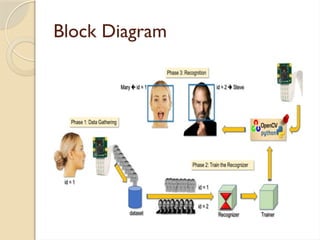
This model incorporates a camera that captures input image, an
algorithm to detect a face from the input image, encode it and
recognize the face and mark the attendance.
The system camera of an python captures the image and sends it to
the server where faces are recognized from the database and
attendance is calculated on basis of it.
7.
ADVANTAGE
The advantages ofthe face recognition system include faster
processing, automation of the identity, breach of privacy, massive data
storage, best results, enhanced security, real time face recognition of
students in schools and colleges, employees at corporate offices,
python unlock and many more in day to day life.
8.
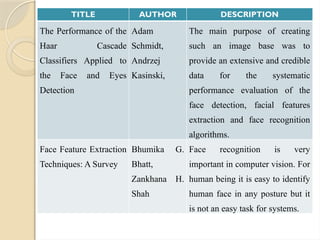
TITLE AUTHOR DESCRIPTION
ThePerformance of the
Haar Cascade
Classifiers Applied to
the Face and Eyes
Detection
Adam
Schmidt,
Andrzej
Kasinski,
The main purpose of creating
such an image base was to
provide an extensive and credible
data for the systematic
performance evaluation of the
face detection, facial features
extraction and face recognition
algorithms.
Face Feature Extraction
Techniques: A Survey
Bhumika G.
Bhatt,
Zankhana H.
Shah
Face recognition is very
important in computer vision. For
human being it is easy to identify
human face in any posture but it
is not an easy task for systems.
9.
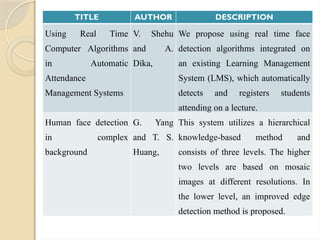
TITLE AUTHOR DESCRIPTION
UsingReal Time
Computer Algorithms
in Automatic
Attendance
Management Systems
V. Shehu
and A.
Dika,
We propose using real time face
detection algorithms integrated on
an existing Learning Management
System (LMS), which automatically
detects and registers students
attending on a lecture.
Human face detection
in complex
background
G. Yang
and T. S.
Huang,
This system utilizes a hierarchical
knowledge-based method and
consists of three levels. The higher
two levels are based on mosaic
images at different resolutions. In
the lower level, an improved edge
detection method is proposed.
CONCLUSION
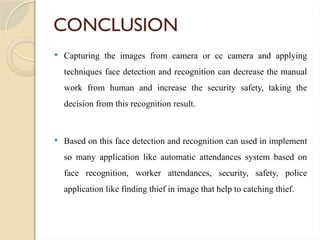
Capturing theimages from camera or cc camera and applying
techniques face detection and recognition can decrease the manual
work from human and increase the security safety, taking the
decision from this recognition result.
Based on this face detection and recognition can used in implement
so many application like automatic attendances system based on
face recognition, worker attendances, security, safety, police
application like finding thief in image that help to catching thief.
14.
In thissystem we have implemented an attendance system for a
lecture, section or laboratory by which lecturer or teaching assistant
a record student’s attendance.
It saves time and effort, especially if it is a lecture with huge
number of students.
This attendance system shows the use of facial recognition
techniques for the purpose of student attendance and for the further
process this record of student can be used in exam related issues.
15.
REFERENCE
[1]A Studyof Various Face Detection Methods , Ms.Varsha Gupta1 , Mr.
Dipesh Sharma2,ijarcce volume
3https://www.ijarcce.com/upload/2014/may/IJAR CCE7G%2 0%20a
%20varsha%20A%20Study%20of%20Vario us%20F
[2]Face Recognition Based on HOG and Fast PCA Algorithm Xiang-Yu Li(&)
and Zhen-Xian Lin.
[3]Attendance System Using Face Recognition and Class Monitoring System,
Arun Katara1, Mr. Sudesh2, V.Kolhe3http://www.ijritcc.org/download/browse/
Volume_ 5_Issues/February_17_Volume_5_Issue_2/14895658 66_ 1503-
2017.pdf
[4] Prof. P.K Biswas, Digital Image Processing
[5] C. Kotropoulos and I. Pitas, “Rule-based face detection in frontal views,”
Proc. Int’l Conf. Acoustics, Speech and Signal Processing, vol. 4, pp. 2537-
2540, 1997.
16.
[6] XinjunMa, Hongqiao Zhang, XinZang, “A face detection algorithm
based on modified skin-color model”, CCC, vol. 1, pp. 3896-3900, IEEE,
2013
[7] V. Shehu and A. Dika, “Using Real Time Computer Algorithms in
Automatic Attendance Management Systems.” IEEE, pp. 397 – 402, Jun.
2010.
[8] G. Yang and T. S. Huang, “Human face detection in complex
background,” Pattern Recognition Letter, vol. 27, no.1, pp. 53-63, 1994.
[9] M. A. Turk and A. P. Pentland, “Face Recognition Using Eigenfaces”in
Proc. IEEE Conference on Computer Vision and Pattern Recognition, pp.
586– 591. 1991
[10] W. Zhao, R. Chellappa, P. J. Phillips, and A. Rosenfeld, “Face
recognition: A literature survey,” ACM Computing Surveys, 2003, vol. 35,
no. 4, pp. 399-458

![REFERENCE
[1]A Study of Various Face Detection Methods , Ms.Varsha Gupta1 , Mr.
Dipesh Sharma2,ijarcce volume
3https://www.ijarcce.com/upload/2014/may/IJAR CCE7G%2 0%20a
%20varsha%20A%20Study%20of%20Vario us%20F
[2]Face Recognition Based on HOG and Fast PCA Algorithm Xiang-Yu Li(&)
and Zhen-Xian Lin.
[3]Attendance System Using Face Recognition and Class Monitoring System,
Arun Katara1, Mr. Sudesh2, V.Kolhe3http://www.ijritcc.org/download/browse/
Volume_ 5_Issues/February_17_Volume_5_Issue_2/14895658 66_ 1503-
2017.pdf
[4] Prof. P.K Biswas, Digital Image Processing
[5] C. Kotropoulos and I. Pitas, “Rule-based face detection in frontal views,”
Proc. Int’l Conf. Acoustics, Speech and Signal Processing, vol. 4, pp. 2537-
2540, 1997.](https://image.slidesharecdn.com/2cfbcf-250420101324-fb528564/85/attendnece-recommendation-for-requiewd-pptx-15-320.jpg)
![ [6] Xinjun Ma, Hongqiao Zhang, XinZang, “A face detection algorithm
based on modified skin-color model”, CCC, vol. 1, pp. 3896-3900, IEEE,
2013
[7] V. Shehu and A. Dika, “Using Real Time Computer Algorithms in
Automatic Attendance Management Systems.” IEEE, pp. 397 – 402, Jun.
2010.
[8] G. Yang and T. S. Huang, “Human face detection in complex
background,” Pattern Recognition Letter, vol. 27, no.1, pp. 53-63, 1994.
[9] M. A. Turk and A. P. Pentland, “Face Recognition Using Eigenfaces”in
Proc. IEEE Conference on Computer Vision and Pattern Recognition, pp.
586– 591. 1991
[10] W. Zhao, R. Chellappa, P. J. Phillips, and A. Rosenfeld, “Face
recognition: A literature survey,” ACM Computing Surveys, 2003, vol. 35,
no. 4, pp. 399-458](https://image.slidesharecdn.com/2cfbcf-250420101324-fb528564/85/attendnece-recommendation-for-requiewd-pptx-16-320.jpg)


![[DSC Europe 25] Milos Belcevic - Product Professional's Journey to Full-Stack...](https://cdn.slidesharecdn.com/ss_thumbnails/1zovd6fgsycdg4wvgvls-milos-belcevic-product-professionals-journey-to-full-stack-product-developer-260123083019-d993120d-thumbnail.jpg?width=640&height=640&fit=bounds)


![[DSC Europe 25] Borko Kozomora - Optimizing business workflows with advances ...](https://cdn.slidesharecdn.com/ss_thumbnails/hbgekyb0txw0xpo4yfml-borko-kozomora-leading-ai-transformation-260122103838-cc29ee38-thumbnail.jpg?width=640&height=640&fit=bounds)


