Automatic Attendance
using machine learning
Abstract
In this project we have implemented the automated attendance system
using Machine Learning. W e have projected our ideas to implement
“Automated Attendance System Based on Facial Recognition”, in
which it imbibes large applications. The application includes face
identification, which saves time and eliminates chances of proxy
attendance because of the face authorization. Hence, this system can be
implemented in afield whereattendanceplays an important role.
INTRODUCTION
Attendance is of prime importance for both the teacher and student of an educational organization. The problem arises
when we think about the traditional process of taking attendance in the classroom. Calling name or roll number of the
student for attendance not only wastes time, but also it requires energy. So an installation of an automatic attendance
system will solveall theseproblems. There aresomeautomatic attendancetaking systemswhich arecurrently being used
by multiple institutions. Example of one such system is the use of biometric technique. Although it is automatic and a
step ahead of the traditional method, it fails to meet the time constraint. The student has to wait in queue for giving
attendance, which is time taking. This project introduces an involuntary attendance marking system, devoid of any kind
of interference with the normal teaching procedure.An automatic attendance system by facial recognition using machine
learning is a smart and organized way for any organization which demands the regular maintenance of the attendance of
the employees, worker or students. This approach will save the money of organization, save time and spare you with the
frustration of the manual input of attendance, which is being followed since ages. The automatic approach of attendance
will increaseefficiency, by theimplementation of theelectronic, integrated timeand attendancesystem resulting in profit
in every aspect.
Objective
• The system is designed using PY THON using IDE(Anaconda
navigator). The proposed system uses HaarCascade algorithm
which is based on eigenface approach. This algorithm compares the
test image and training image and determines students who are
present and absent. The attendance record is maintained in an
databasewhich is updated automatically in thesystem.
Problem Statement
This project is being carried out due to the concerns that have been highlighted on the methods
which lectures use to take attendance during lectures. The use of clickers, ID cards swiping and
manually writing down names on a sheet of paper as a method to track student attendants has
prompted this project to be carried out. This is not in any way to criticize the various methods
used for student attendance, but to build a system that will detect the number of faces present in a
classroom as well as recognizing them. Also, a teacher will be able to tell if a student
was honest as these methods mentioned can beused by anyone for attendance records, but with
the face detection and recognition system in place, it will be easy to tell if a student is actually
present in the classroom or not.This system will not only improve classroom control during
lectures, itwill also possibly detectfaces for studentattendancepurposes.
LiteratureSurvey:
1.Automated AttendanceManagement System Based On Face Recognition Algorithms:
On this paper they propose an automated attendance management system. This system is basically based on face
detection and recognition algorithms, automatically detect the student when he enters the classroom and marks the
attendance by recognizing him. Because of LBPH outperforms other algorithms with better recognition rate and low
false positive rate the system is based on this algorithm. The system uses SVM and Bayesian as a classifier because
they arebetter when compared to distance classifiers. The workflow of thesystem architectureis when a person enters
the classroom his image is captured by the camera at the entrance. A face region is then extracted and pre-processed
for further processing. As not more than two persons can enter the classroom at a time face detection algorithm has
less work. The future work they are saying on this paper is to improve the recognition rate of algorithms when there
are unconscious changes in a person like tonsuring head, using a scarf, facial hair. The limitation of the system is it
only recognizes face up to 30 degrees angle variations which have to be improved further. Gait recognition should be
combined with facerecognition systems in order to achievebetter performanceof thesystem.
2.An Evaluation of Face Recognition Algorithms and Accuracy based on V ideo in
Unconstrained Factors :
There are three well-known algorithms that this paper will compare Eigenfaces, Fisherfaces,
and LBPH by using a database that contains a face of persons with a variety of position and
expression. According to theexperimentresults, LBPH got thehighestaccuracy on the possible
external factors like light exposure, noise, and the video resolution. However, this algorithm
has limitation due to the negative light exposure and high noise level more than the other
statistical methods. The recognition accuracy also tested with three various video resolutions
that are 720p, 480p, and 360p. The results show LBPH got the highest accuracy in 720p while
the others got the highest accuracy in 360p video resolution. LBPH can give reliable
recognition accuracy hence itusesa histogram similarity, butit was sensitivein somecases.
3.Class Room AttendanceSystem Using Facial Recognition System:
This paper aims to introducea new approach to identify a student using a
face recognition system in the classroom environment, i.e. the generation
of a3D Facial Model. This research is to attempt to providean automated
attendance system that recognizes students using face recognition
technology from an image/
video stream to record their attendance in
lectures or sections and evaluating their performanceaccordingly.
4. Real-T imeFaceRecognition For AttendanceMonitoring System:
On This paper they presented an automated attendance monitoring system with face
recognition in a real-time background world for with a database of student’s
information by using Personal Component Analysis (PCA) algorithm. This task is very
difficult as the real-time background subtraction in an image is still a challenge. And,
managing a database with multiple of student information’s is also a challenge to the
system. Implementing of this system basically involving three main phases, which
include face region detection, template extraction, and face recognition. Before the
feature extraction process, all input images are extracted and converted from RGB into
gray scaleimages. Then, thesystem starts thehistogram.
5.A Counterpart Approach to Attendance and Feedback System
using MachineL earning Techniques:
In this paper, theideaof two technologies namely Student Attendanceand
Feedback system has been implemented with amachinelearning approach.
This system automatically detects the student performance and maintains
the student's records like attendance and their feedback on the subjects
like Science, English, etc. Therefore the attendance of the student can be
made available by recognizing the face. On recognizing, the attendance
details and details aboutthemarks of thestudent is obtained as feedback.
6.Automated AttendanceSystem Using FaceRecognition:
Automated Attendance System using Face Recognition proposes that the system is
based on face detection and recognition algorithms, which is used to automatically
detects the student face when he/
she enters the class and the system is capable to
marks the attendanceby recognizing him. Viola-Jones Algorithm has been used for
face detection which detect human faceusing cascade classifier and PCA algorithm
for feature selection and SVM for classification. W hen it is compared to traditional
attendance marking this system saves the time and also helps to monitor the
students.
7.Class Room Attendance System Using Facial Recognition System:
Abhishek Jha proposed theface is theidentity of aperson. Themethods to exploit this
physical feature have seen a great chance of image processing techniques. The
accurate recognition of a person is the aim of a face recognition system and this
identification maybe used for coming processing. The methods can be facial
recognition are: International Conference on Audio and (AV BPA) and(AFGR). The
facial recognition process can be divided into two stages: processing before detection
where face detection and alignment and recognition occur through feature extraction
are facedetection, facealignment, featureextraction, face matching so on its providing
an automated attendance system for all the students that attend a certain lecture,
section, laboratory or exam at its specific time, thus saving time, effort and reduce
distractions and disturbances.
8.Robust FaceDetection om Still Images
Bhawna Dhupia, Nabil Litayem, Sadia Rubab proposed the widevariety of mobile devices available the
challengeis developing innovativemobilelearning solutions for class .But an important challengehereis
to confirm thepresenceof students in class. They areused two methods areelectronic attendancesystem
and mobile learning system. Attendance is a very basic task student during class using mobile send
teacher’s photo through email and teacher check email and mark attendance of the student. A platform
independent mobile learning system is a web based application and it provides an which is a mobile
implementation of student response system provide a quick feedback to teachers about student
performance. If sensing and web cam areused, fakeattendanceproblem is resolved, but if students sit on
the same seat as on a bench or student frequently changes seat than accuracy of face detection and
identification areaffected alargenumber of samples of each student highlight amajor problem.
9.FaceRecognition W ith Disparity Corrected Gabor PhaseDifferences:
Chrisford Ling, Patrick Laytner, Qinghan Xiao proposed the biometric systems have become an
increasingly popular solution for security related applications. Retina and fingerprint scanners upon to
accurately perform an wide range of tasks including authentication of personnel to restricted sites and
identification of individual persons. Facial recognition is a rapidly growing area its non-contact nature,a
human face, detecting a face in an image, the first step to perform facial recognition, is by no means a
simpletask, such as Principal Component Analysis (PCA), Hidden Markov Models (HMM), and HAAR-
like features, the skin color properties in several common color spaces such as RGB, Normalized RGB,
and HSV. HAAR-like features have been widely used in different ada boosting algorithms and object
detection, facedetection. An AdaBoost-based algorithm is used to select features that areused for facial
classification acollection of them to form astronger and morereliableclassifier of thebiometric system.
10.Automated Of Attendanceand Student Tracking W ith FaceRecognition And Ultrasonic Sensor:
Dennis Haufe, Manuel Gunther, Rolf P.W iirtz proposed the Gabor wavelet responses at single locations of
facial images arecollected into Gabor jets, which areextracted at several offset positions and assembled into a
Gabor graph G. Often, the identity of a probe image, it is compared with several gallery images and assigned
the identity of the most similar gallery image. Image comparison is traced back to the comparison of the two
Gabor graphs extracted from these images. Elastic bunch graph matching (EBGM), the correspondence
problem is solved locally by computing offset position corrections, so-called disparities. The CAS-PEAL
images are partitioned into a gallery of 1040 images with ambient illumination and neutral facial expression,
and different probe sets. W e here process the probe sets Expression and Lighting. The Expression probe set
contains 1570 images with ambient illumination, showing one of five facial expressions. The Lighting probe
set consists of images with neutral expression, but strong fluorescent illumination from fifteen different
directions and onefrontal incandescent illumination.
Problem Definition
To create a dynamic student portal that acts as a gateway for just-enough,
just-in-timeinformation for all students.
● To savetime and efforts that weresupposed to be put by instructors during
each lecture.
● To prevent unauthorized attendance registration using multi-factor
authentication.
Existing System
Image processing is a method to perform some operations on an image, in order to get an
enhanced imageor to extract some useful information from it. It is a type of signal processing in which
input is an imageand output may beimageor characteristics/
features associated with that image.
Limitations
1) It's very costly depending on thesystem used, thenumber of detectors purchased.
2) Timeconsuming
3) Lack of qualified professional
The main limitation is that if the object size is smaller than the pixel size, then it can not be applied
efficiently becausethen onepixel can contain two or moreobjects
Proposed System
Haar CascadeAlgorithm
Haar Cascade is a machine learning object detection algorithm used to
identify objects in an imageor video.
Thealgorithm has four stages:
1.Haar FeatureSelection
2.Creating Integral Images
3.Adaboost Training
4.Cascading Classifiers
Advantages
1.W ecan ableto train moreamount of data
2.High accuracy
Architecture
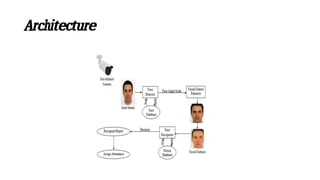
Capturing Student
Face
Apply Haar Cascade
algorithm
Face Detection and
Recognition Module
Result
Update the
Attendance in
database
Requirement Analysis
HardwareRequirements:
System : Pentium IV 2.4 GHz.
Hard Disk : 1TB
Floppy Drive : 1.44 Mb.
Monitor : 15 VGA Color.
Mouse : Logitech.
Ram : 8Gb.
SoftwareRequirements:
Operating system : W indows 10
Front End : Html
Bank End : Sqllite3
Coding Language : Python
IDE : AnacondaNavigator
Modules
REGISTER MODUL E :
In this module new user should register their face to get account
number. For that they need to fill their personal details like Username,
Password , Mail ID, year and Department.
Pre-Processing Module:
It is face normalized and desires, they are enhanced to improve the
performance of recognition system. Feature Extraction Module: After
performing some pre-processing (if-necessary), the normalized face
image is presented to the feature extraction module in order to find the
key features that are going to be used for classification. In other words,
this module is responsible for composing a feature vector that is well
enough to representthefaceimage.
FaceDetection
Face detection is important as the image taken through the camera given to
the system, face detection algorithm applies to identify the human faces in
that image, the number of image processing algorithms are introduce to
detect faces in an images and also the location of that detected faces. W e
haveused HOG method to detecthuman facesin given image.
FaceReconition :
Thereare68 specific points in ahuman face. In other words wecan say 68
face landmarks. The main function of this step is to detect landmarks of
faces and to position the image. A python script is used to automatically
detect the face landmarks and to position the face as much as possible
without distorting theimage.
Classification Module:
In this module, with the help of pattern classifier, extracted features of the
face image is compared with the ones stored in a face library or face
database. After doing this comparison, face image is classified as either
known or unknown. Training Set: Training sets are used during the
"learning phase" of the face recognition process in supervised face
classifiers. The feature extraction and the classification modules make
direct useof thefacelibrary.
Conclusion
In this system we have implemented an attendance system for a lecture, section or
laboratory by which lecturer or teaching assistant can record students’ attendance. It saves
time and effort, especially if it is a lecture with huge number of students. Automated
Attendance System has been envisioned for the purpose of reducing the drawbacks in the
traditional (manual) system. This attendance system demonstrates the use of machine
learning techniques in classroom. This system can not only merely help in the attendance
system, but also improve the goodwill of an institution. Students using mobile phone or not
attend class mentally means mark will be Reduced. For future work, the plan is to use
neural network based facerecognition in order to speed up theprocess.
REFERENCE
1)Shireesha Chintalapati; M. V. Raghunadh, "Automated Attendance Management System
Based On Face Recognition Algorithms", 2013 IEEE International Conference on
Computational Intelligence and Computing Research.
2) Phichaya Jaturawat; Manop Phankokkruad, "An Evaluation of Face Recognition
Algorithms and Accuracy based on Video in Unconstrained Factors", 2016 6th IEEE
International Conference on Control System, Computing and Engineering (ICCSCE)
3) Abhishek Jha: ABES Engineering College, Ghaziabad, "Class Room Attendance System
Using Facial Recognition System", The International Journal of Mathematics, Science,
Technology and Management (ISSN : 2319-8125) Vol. 2 Issue 3
4)S. SAYEED, J. HOSSEN, S.M.A. KALAIARASI, V. JAYAKUMAR, I. YUSOF, A. SAMRAJ,
"Real-Time Face Recognition For Attendance Monitoring System" Journal of Theoretical
and Applied Information Technology 15th January 2017. Vol.95. No.1
5)N.Sudhakar Reddy, M.V.Sumanth, S.Suresh Babu, "A Counterpart Approach to Attendance
and Feedback System using Machine Learning Techniques",Journal of Emerging
Technologies and Innovative Research (JETIR), Volume 5, Issue 12, Dec 2018.
6)Dan Wang, Rong Fu, Zuying Luo, "Classroom Attendance Auto-management
Based on Deep Learning",Advances in Social Science, Education and Humanities
Research, volume 123,ICESAME 2017.
7)Abhishek Jha, “Class Room Attendance System Using Facial Recognition System”,
IEEE The International Journal of Mathematics, Science, Technology and
Management (ISSN : 2319-8125) Vol. 2 Issue 3,2015.
8)Chirsford Ling, Patrick Laytner and Qinghan Xiao “Robust Face Detection om
Still Images”, in IEEE in 2014 IEEE Symp. on Comp. Intell. in Biometrics and Identity
management (CIBIM), pp. 76–80, Dec 2014.
9)Dennis Haufe, Rolf P.Wiirtz and Manuel Gunter “Face Recognition With Disparity
Corrected Gabor Phase Differences” pp. 411–418, Springer-Verlag, 2012.
10)Divyaharitha p, Gayathri B, Safiya Parvin A “Automated Of Attendance and
Student Tracking With Face Recognition And Ultrasonic Sensor” IEEE transaction
2013.

ppt.pdf

  • 1.
  • 2.
    Abstract In this projectwe have implemented the automated attendance system using Machine Learning. W e have projected our ideas to implement “Automated Attendance System Based on Facial Recognition”, in which it imbibes large applications. The application includes face identification, which saves time and eliminates chances of proxy attendance because of the face authorization. Hence, this system can be implemented in afield whereattendanceplays an important role.
  • 3.
    INTRODUCTION Attendance is ofprime importance for both the teacher and student of an educational organization. The problem arises when we think about the traditional process of taking attendance in the classroom. Calling name or roll number of the student for attendance not only wastes time, but also it requires energy. So an installation of an automatic attendance system will solveall theseproblems. There aresomeautomatic attendancetaking systemswhich arecurrently being used by multiple institutions. Example of one such system is the use of biometric technique. Although it is automatic and a step ahead of the traditional method, it fails to meet the time constraint. The student has to wait in queue for giving attendance, which is time taking. This project introduces an involuntary attendance marking system, devoid of any kind of interference with the normal teaching procedure.An automatic attendance system by facial recognition using machine learning is a smart and organized way for any organization which demands the regular maintenance of the attendance of the employees, worker or students. This approach will save the money of organization, save time and spare you with the frustration of the manual input of attendance, which is being followed since ages. The automatic approach of attendance will increaseefficiency, by theimplementation of theelectronic, integrated timeand attendancesystem resulting in profit in every aspect.
  • 4.
    Objective • The systemis designed using PY THON using IDE(Anaconda navigator). The proposed system uses HaarCascade algorithm which is based on eigenface approach. This algorithm compares the test image and training image and determines students who are present and absent. The attendance record is maintained in an databasewhich is updated automatically in thesystem.
  • 5.
    Problem Statement This projectis being carried out due to the concerns that have been highlighted on the methods which lectures use to take attendance during lectures. The use of clickers, ID cards swiping and manually writing down names on a sheet of paper as a method to track student attendants has prompted this project to be carried out. This is not in any way to criticize the various methods used for student attendance, but to build a system that will detect the number of faces present in a classroom as well as recognizing them. Also, a teacher will be able to tell if a student was honest as these methods mentioned can beused by anyone for attendance records, but with the face detection and recognition system in place, it will be easy to tell if a student is actually present in the classroom or not.This system will not only improve classroom control during lectures, itwill also possibly detectfaces for studentattendancepurposes.
  • 6.
    LiteratureSurvey: 1.Automated AttendanceManagement SystemBased On Face Recognition Algorithms: On this paper they propose an automated attendance management system. This system is basically based on face detection and recognition algorithms, automatically detect the student when he enters the classroom and marks the attendance by recognizing him. Because of LBPH outperforms other algorithms with better recognition rate and low false positive rate the system is based on this algorithm. The system uses SVM and Bayesian as a classifier because they arebetter when compared to distance classifiers. The workflow of thesystem architectureis when a person enters the classroom his image is captured by the camera at the entrance. A face region is then extracted and pre-processed for further processing. As not more than two persons can enter the classroom at a time face detection algorithm has less work. The future work they are saying on this paper is to improve the recognition rate of algorithms when there are unconscious changes in a person like tonsuring head, using a scarf, facial hair. The limitation of the system is it only recognizes face up to 30 degrees angle variations which have to be improved further. Gait recognition should be combined with facerecognition systems in order to achievebetter performanceof thesystem.
  • 7.
    2.An Evaluation ofFace Recognition Algorithms and Accuracy based on V ideo in Unconstrained Factors : There are three well-known algorithms that this paper will compare Eigenfaces, Fisherfaces, and LBPH by using a database that contains a face of persons with a variety of position and expression. According to theexperimentresults, LBPH got thehighestaccuracy on the possible external factors like light exposure, noise, and the video resolution. However, this algorithm has limitation due to the negative light exposure and high noise level more than the other statistical methods. The recognition accuracy also tested with three various video resolutions that are 720p, 480p, and 360p. The results show LBPH got the highest accuracy in 720p while the others got the highest accuracy in 360p video resolution. LBPH can give reliable recognition accuracy hence itusesa histogram similarity, butit was sensitivein somecases.
  • 8.
    3.Class Room AttendanceSystemUsing Facial Recognition System: This paper aims to introducea new approach to identify a student using a face recognition system in the classroom environment, i.e. the generation of a3D Facial Model. This research is to attempt to providean automated attendance system that recognizes students using face recognition technology from an image/ video stream to record their attendance in lectures or sections and evaluating their performanceaccordingly.
  • 9.
    4. Real-T imeFaceRecognitionFor AttendanceMonitoring System: On This paper they presented an automated attendance monitoring system with face recognition in a real-time background world for with a database of student’s information by using Personal Component Analysis (PCA) algorithm. This task is very difficult as the real-time background subtraction in an image is still a challenge. And, managing a database with multiple of student information’s is also a challenge to the system. Implementing of this system basically involving three main phases, which include face region detection, template extraction, and face recognition. Before the feature extraction process, all input images are extracted and converted from RGB into gray scaleimages. Then, thesystem starts thehistogram.
  • 10.
    5.A Counterpart Approachto Attendance and Feedback System using MachineL earning Techniques: In this paper, theideaof two technologies namely Student Attendanceand Feedback system has been implemented with amachinelearning approach. This system automatically detects the student performance and maintains the student's records like attendance and their feedback on the subjects like Science, English, etc. Therefore the attendance of the student can be made available by recognizing the face. On recognizing, the attendance details and details aboutthemarks of thestudent is obtained as feedback.
  • 11.
    6.Automated AttendanceSystem UsingFaceRecognition: Automated Attendance System using Face Recognition proposes that the system is based on face detection and recognition algorithms, which is used to automatically detects the student face when he/ she enters the class and the system is capable to marks the attendanceby recognizing him. Viola-Jones Algorithm has been used for face detection which detect human faceusing cascade classifier and PCA algorithm for feature selection and SVM for classification. W hen it is compared to traditional attendance marking this system saves the time and also helps to monitor the students.
  • 12.
    7.Class Room AttendanceSystem Using Facial Recognition System: Abhishek Jha proposed theface is theidentity of aperson. Themethods to exploit this physical feature have seen a great chance of image processing techniques. The accurate recognition of a person is the aim of a face recognition system and this identification maybe used for coming processing. The methods can be facial recognition are: International Conference on Audio and (AV BPA) and(AFGR). The facial recognition process can be divided into two stages: processing before detection where face detection and alignment and recognition occur through feature extraction are facedetection, facealignment, featureextraction, face matching so on its providing an automated attendance system for all the students that attend a certain lecture, section, laboratory or exam at its specific time, thus saving time, effort and reduce distractions and disturbances.
  • 13.
    8.Robust FaceDetection omStill Images Bhawna Dhupia, Nabil Litayem, Sadia Rubab proposed the widevariety of mobile devices available the challengeis developing innovativemobilelearning solutions for class .But an important challengehereis to confirm thepresenceof students in class. They areused two methods areelectronic attendancesystem and mobile learning system. Attendance is a very basic task student during class using mobile send teacher’s photo through email and teacher check email and mark attendance of the student. A platform independent mobile learning system is a web based application and it provides an which is a mobile implementation of student response system provide a quick feedback to teachers about student performance. If sensing and web cam areused, fakeattendanceproblem is resolved, but if students sit on the same seat as on a bench or student frequently changes seat than accuracy of face detection and identification areaffected alargenumber of samples of each student highlight amajor problem.
  • 14.
    9.FaceRecognition W ithDisparity Corrected Gabor PhaseDifferences: Chrisford Ling, Patrick Laytner, Qinghan Xiao proposed the biometric systems have become an increasingly popular solution for security related applications. Retina and fingerprint scanners upon to accurately perform an wide range of tasks including authentication of personnel to restricted sites and identification of individual persons. Facial recognition is a rapidly growing area its non-contact nature,a human face, detecting a face in an image, the first step to perform facial recognition, is by no means a simpletask, such as Principal Component Analysis (PCA), Hidden Markov Models (HMM), and HAAR- like features, the skin color properties in several common color spaces such as RGB, Normalized RGB, and HSV. HAAR-like features have been widely used in different ada boosting algorithms and object detection, facedetection. An AdaBoost-based algorithm is used to select features that areused for facial classification acollection of them to form astronger and morereliableclassifier of thebiometric system.
  • 15.
    10.Automated Of AttendanceandStudent Tracking W ith FaceRecognition And Ultrasonic Sensor: Dennis Haufe, Manuel Gunther, Rolf P.W iirtz proposed the Gabor wavelet responses at single locations of facial images arecollected into Gabor jets, which areextracted at several offset positions and assembled into a Gabor graph G. Often, the identity of a probe image, it is compared with several gallery images and assigned the identity of the most similar gallery image. Image comparison is traced back to the comparison of the two Gabor graphs extracted from these images. Elastic bunch graph matching (EBGM), the correspondence problem is solved locally by computing offset position corrections, so-called disparities. The CAS-PEAL images are partitioned into a gallery of 1040 images with ambient illumination and neutral facial expression, and different probe sets. W e here process the probe sets Expression and Lighting. The Expression probe set contains 1570 images with ambient illumination, showing one of five facial expressions. The Lighting probe set consists of images with neutral expression, but strong fluorescent illumination from fifteen different directions and onefrontal incandescent illumination.
  • 16.
    Problem Definition To createa dynamic student portal that acts as a gateway for just-enough, just-in-timeinformation for all students. ● To savetime and efforts that weresupposed to be put by instructors during each lecture. ● To prevent unauthorized attendance registration using multi-factor authentication.
  • 17.
    Existing System Image processingis a method to perform some operations on an image, in order to get an enhanced imageor to extract some useful information from it. It is a type of signal processing in which input is an imageand output may beimageor characteristics/ features associated with that image. Limitations 1) It's very costly depending on thesystem used, thenumber of detectors purchased. 2) Timeconsuming 3) Lack of qualified professional The main limitation is that if the object size is smaller than the pixel size, then it can not be applied efficiently becausethen onepixel can contain two or moreobjects
  • 18.
    Proposed System Haar CascadeAlgorithm HaarCascade is a machine learning object detection algorithm used to identify objects in an imageor video. Thealgorithm has four stages: 1.Haar FeatureSelection 2.Creating Integral Images 3.Adaboost Training 4.Cascading Classifiers Advantages 1.W ecan ableto train moreamount of data 2.High accuracy
  • 19.
  • 20.
    Capturing Student Face Apply HaarCascade algorithm Face Detection and Recognition Module Result Update the Attendance in database
  • 21.
    Requirement Analysis HardwareRequirements: System :Pentium IV 2.4 GHz. Hard Disk : 1TB Floppy Drive : 1.44 Mb. Monitor : 15 VGA Color. Mouse : Logitech. Ram : 8Gb. SoftwareRequirements: Operating system : W indows 10 Front End : Html Bank End : Sqllite3 Coding Language : Python IDE : AnacondaNavigator
  • 22.
    Modules REGISTER MODUL E: In this module new user should register their face to get account number. For that they need to fill their personal details like Username, Password , Mail ID, year and Department.
  • 23.
    Pre-Processing Module: It isface normalized and desires, they are enhanced to improve the performance of recognition system. Feature Extraction Module: After performing some pre-processing (if-necessary), the normalized face image is presented to the feature extraction module in order to find the key features that are going to be used for classification. In other words, this module is responsible for composing a feature vector that is well enough to representthefaceimage.
  • 24.
    FaceDetection Face detection isimportant as the image taken through the camera given to the system, face detection algorithm applies to identify the human faces in that image, the number of image processing algorithms are introduce to detect faces in an images and also the location of that detected faces. W e haveused HOG method to detecthuman facesin given image.
  • 25.
    FaceReconition : Thereare68 specificpoints in ahuman face. In other words wecan say 68 face landmarks. The main function of this step is to detect landmarks of faces and to position the image. A python script is used to automatically detect the face landmarks and to position the face as much as possible without distorting theimage.
  • 26.
    Classification Module: In thismodule, with the help of pattern classifier, extracted features of the face image is compared with the ones stored in a face library or face database. After doing this comparison, face image is classified as either known or unknown. Training Set: Training sets are used during the "learning phase" of the face recognition process in supervised face classifiers. The feature extraction and the classification modules make direct useof thefacelibrary.
  • 27.
    Conclusion In this systemwe have implemented an attendance system for a lecture, section or laboratory by which lecturer or teaching assistant can record students’ attendance. It saves time and effort, especially if it is a lecture with huge number of students. Automated Attendance System has been envisioned for the purpose of reducing the drawbacks in the traditional (manual) system. This attendance system demonstrates the use of machine learning techniques in classroom. This system can not only merely help in the attendance system, but also improve the goodwill of an institution. Students using mobile phone or not attend class mentally means mark will be Reduced. For future work, the plan is to use neural network based facerecognition in order to speed up theprocess.
  • 28.
    REFERENCE 1)Shireesha Chintalapati; M.V. Raghunadh, "Automated Attendance Management System Based On Face Recognition Algorithms", 2013 IEEE International Conference on Computational Intelligence and Computing Research. 2) Phichaya Jaturawat; Manop Phankokkruad, "An Evaluation of Face Recognition Algorithms and Accuracy based on Video in Unconstrained Factors", 2016 6th IEEE International Conference on Control System, Computing and Engineering (ICCSCE) 3) Abhishek Jha: ABES Engineering College, Ghaziabad, "Class Room Attendance System Using Facial Recognition System", The International Journal of Mathematics, Science, Technology and Management (ISSN : 2319-8125) Vol. 2 Issue 3 4)S. SAYEED, J. HOSSEN, S.M.A. KALAIARASI, V. JAYAKUMAR, I. YUSOF, A. SAMRAJ, "Real-Time Face Recognition For Attendance Monitoring System" Journal of Theoretical and Applied Information Technology 15th January 2017. Vol.95. No.1 5)N.Sudhakar Reddy, M.V.Sumanth, S.Suresh Babu, "A Counterpart Approach to Attendance and Feedback System using Machine Learning Techniques",Journal of Emerging Technologies and Innovative Research (JETIR), Volume 5, Issue 12, Dec 2018.
  • 29.
    6)Dan Wang, RongFu, Zuying Luo, "Classroom Attendance Auto-management Based on Deep Learning",Advances in Social Science, Education and Humanities Research, volume 123,ICESAME 2017. 7)Abhishek Jha, “Class Room Attendance System Using Facial Recognition System”, IEEE The International Journal of Mathematics, Science, Technology and Management (ISSN : 2319-8125) Vol. 2 Issue 3,2015. 8)Chirsford Ling, Patrick Laytner and Qinghan Xiao “Robust Face Detection om Still Images”, in IEEE in 2014 IEEE Symp. on Comp. Intell. in Biometrics and Identity management (CIBIM), pp. 76–80, Dec 2014. 9)Dennis Haufe, Rolf P.Wiirtz and Manuel Gunter “Face Recognition With Disparity Corrected Gabor Phase Differences” pp. 411–418, Springer-Verlag, 2012. 10)Divyaharitha p, Gayathri B, Safiya Parvin A “Automated Of Attendance and Student Tracking With Face Recognition And Ultrasonic Sensor” IEEE transaction 2013.