International Research Journal of Engineering and Technology (IRJET) e-ISSN: 2395-0056
Volume: 06 Issue: 11 | Nov 2019 www.irjet.net p-ISSN: 2395-0072
© 2019, IRJET | Impact Factor value: 7.34 | ISO 9001:2008 Certified Journal | Page 271
Design and Implementation of Automatic Traction System
KUNAL DHAYAGUDE1, AMRUTA AMBAVANE2, AMEY SAWANT3, PRASAD BIDRE4, ROHIT G. RAMTEKE5
-----------------------------------------------------------------------***--------------------------------------------------------------------
Abstract— In this Modern era, technology plays a vital
significant role in the overall development of the country.
With the recent development, automation is being
introduced in the traction system as well. Locomotives plays
an important role in the development and growth of
country, it has become essential to have the most efficient
and reliable traction system with more energy saving
techniques. The earliest traction systems had no signal
systems, so station employees had to use hand gestures to
train drivers indicating whether to stop or go on. Due to
which train collisions occurs because of drivers missed or
ignored the hand signals due to human error. To avoid such
errors, we have the new concept of automatic traction
system. Automatic name implies that our system will be
driverless, we have achieved speed control with the help of
Pulse width modulation (PWM) which is used to vary speed
of motor.
Keywords: Traction, Automatic, Train, Control, Sensor,
Emergency, Energy Saving.
1. INTRODUCTION
Over the years, technology has revolutionized our world.
Technology has created amazing tools and resources,
putting useful information at our fingertips. Modern
technology has made it possible for the discovery of many
multi-functional devices in almost all aspects of our life
including transportation. With all of these revolutions,
technology has also made our lives easier, faster, and better.
But even the technologies are growing faster, the population
is growing that fastertoo.
The population growth in India is of great vertical extent.
This trend means that public transport is in vogue like never
before. More than half the planet’s population lives in cities
and over the next 40 years that number is likely to reach
6bn, with the largest cities in emerging markets growing the
fastest.
Railway is a largest means of transportation in India and it is
ranked in the world as fourth largest railway network. So,
the existing metro system needs to be modernized and
equipped with automatic train control and safety system in
order to make them more efficient. This paper proposed the
development of driverless metro trainsystem.
The operation of the driverless metro train is controlled by a
central processor unit like Arduino controller. The speed of
the train is controlled by a H- Bridge. The operation of the
train is fully automatic i.e. there will be no operator or train
attendant for operating the train. The functions of the train
are carried out by fetching the programs in the Arduino by
usingthe Arduino IDE software.
Some other devices like vibration sensor, ultrasonic
sensor, PID sensor, night camera sensor, IR sensor, LDR
sensor, emergency brake button, LCD display to give
messages to the passenger, alarms to give indication to the
passenger for LCD messages and for indication of door
operation will also be included in the paper.
2. COMPARISON OF DIFFERENT GRADES OF
AUTOMATION
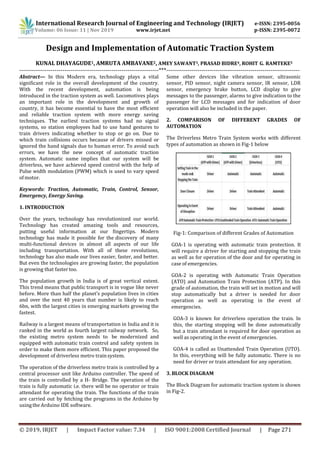
The Driverless Metro Train System works with different
types of automation as shown in Fig-1 below
Fig-1: Comparison of different Grades of Automation
GOA-1 is operating with automatic train protection. It
will require a driver for starting and stopping the train
as well as for operation of the door and for operating in
case of emergencies.
GOA-2 is operating with Automatic Train Operation
(ATO) and Automation Train Protection (ATP). In this
grade of automation, the train will set in motion and will
stop automatically but a driver is needed for door
operation as well as operating in the event of
emergencies.
GOA-3 is known for driverless operation the train. In
this, the starting stopping will be done automatically
but a train attendant is required for door operation as
well as operating in the event of emergencies.
GOA-4 is called as Unattended Train Operation (UTO).
In this, everything will be fully automatic. There is no
need for driver or train attendant for any operation.
3. BLOCK DIAGRAM
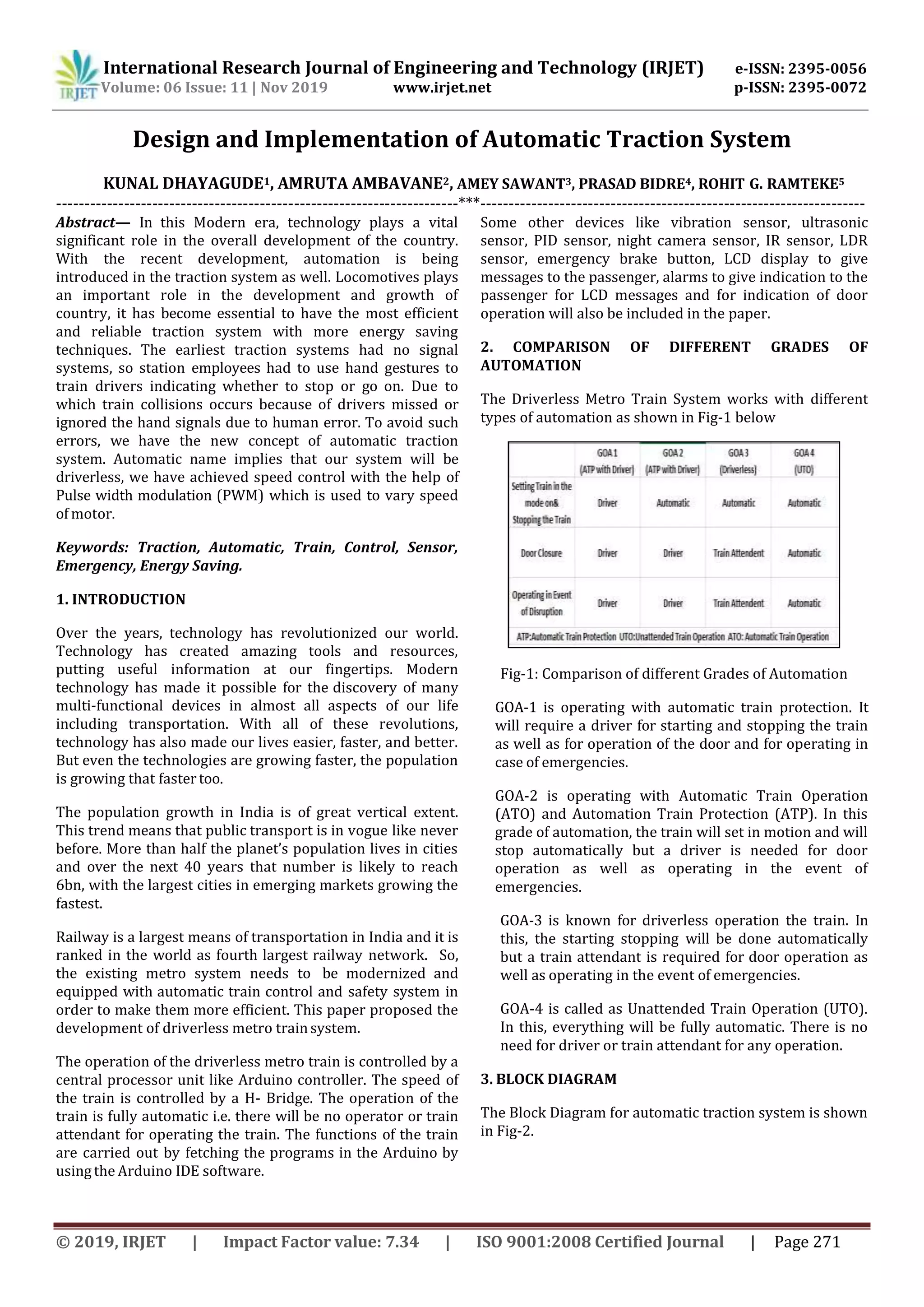
The Block Diagram for automatic traction system is shown
in Fig-2.
International Research Journal of Engineering and Technology (IRJET) e-ISSN: 2395-0056
Volume: 06 Issue: 11 | Nov 2019 www.irjet.net p-ISSN: 2395-0072
© 2019, IRJET | Impact Factor value: 7.34 | ISO 9001:2008 Certified Journal | Page 272
Fig-2 Block Diagram
A. Raspberry Pi 3
The Raspberry Pi 3 Model B is not like our typical
machine, in its cheapest form it is simply a credit-card
sized electronic board. It is used in many applications
like home automation system, to launch lightweight
Web Server, Build and control awesome robots and
many more.
B. Arduino Mega
Arduino Mega is used as a main controller of the system.
The operation of the train is performed using this
controller by fetching programs into it. Various
sensors are connected to this controller which
sends information to it in case of emergencies to take
necessary action or to stop the train.
C. DC Motor
DC Motor is used for driving the wheels of the train. We
are going to use DC series motor because the series
motor has the highest starting torque for a given power
rating, easiest control and fast braking.
D. Stepper Motor
The Stepper Motor is used to rotate the motor through a
fixed angular step in response to each input current
pulse received by its controller. The applications of
stepper motor include Small robotics, Gaming machines,
Printing presses, etc We are going to use Stepper Motor
to control the operation of the doors i.e. opening and
closing.
E. LCD display
It is used to display messages during departure and
arrival of the train on the station. Also it will display
warning messages in case of emergencies.
F. Buzzer
It is used to give an indication about the LCD messages
and will also ring on the operation of the door opening
or closing.
G. Smoke Sensor
The Smoke Sensor is a device used to detect Smoke
and Fires. It will sense the smoke if in case there is
sudden problem in the train or any short circuit which
took place and immediately give a command to the
control system to open the doors and if the smoke
continues to exist after the opening of the doors, then
there will be a command to stop the train
immediately.
H. PIR Sensor
A Passive Infrared (PIR) Sensor is an electronic sensor
that measures infrared light radiating from objects in
its field of view. PIR sensors detect general movement,
but do not give information on who or what moved.
For that purpose, an active IR sensor is required.
I. LDR Sensor
A light-dependent resistor (LDR) is a light- controlled
variable resistor. The resistance of a photoresistor
decreases with increasing incident light intensity; in
other words, it exhibits photoconductivity.
J. Ultrasonic Sensor
Ultrasonic sensors emit short, high-frequency sound
pulses at regular intervals. Ultrasonic sensor will
detect that any object is over crossing in front of the
train and will provide a feedback to the control system
to stop the train immediately. It emits an ultrasound at
40 000 Hz which travels through the air and if there is
an object or obstacle on its path It will bounce back to
the module.
K. Night Camera Sensor
We are going to use Night Camera Sensor for detecting
the signals. If the signal is red then it means that the
train should stop and if the signal is green means the
train should start moving.
L. Vibration Sensor
Vibration sensor will come into action if the train’s
vibration due to some problem exceed its predefined
value. This sensor will sense these vibrations and will
send a signal to Arduino to take the action regarding it
immediately for the safety of the passengers.
4. PROPOSEDMETHODOLOGY
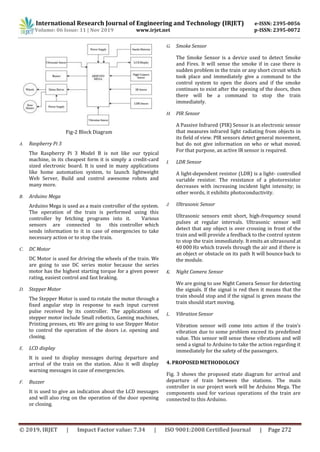
Fig. 3 shows the proposed state diagram for arrival and
departure of train between the stations. The main
controller in our project work will be Arduino Mega. The
components used for various operations of the train are
connected to this Arduino.
International Research Journal of Engineering and Technology (IRJET) e-ISSN: 2395-0056
Volume: 06 Issue: 11 | Nov 2019 www.irjet.net p-ISSN: 2395-0072
© 2019, IRJET | Impact Factor value: 7.34 | ISO 9001:2008 Certified Journal | Page 273
Fig-3 State Diagram of the train during arrival and
Departure
While departing from the station, the train will first get
supply from a source and it will be in a position to move or to
depart from the station. Till the time of departing, the doors
of the train will be open. Then the LCD will display that
“Train is departing in few minutes from the station” with a
buzzer ringing and after few seconds as per the
programming code the LCD will display that “Doors are
closing. Be aware! ”. The buzzer will ring for every operation
of the LCD. Once the doors are closed, the motor switches to
ON state and train departs from the station. While arriving
on the station, there will be a message indicating that “The
Train is arriving in few minutes on the Station.” with buzzer
operation. The motor state will change from ON state to OFF
state once the train arrives at the station. The LCD will then
display that “The Doors are opening”. Once the doors are
opened the passengers can safely come out of the train. We
are going to use Image Processing for signaling system and
for starting and stopping operation the train.
We have often seen people lying near the doors of the train
and jumping out on the platform during arrival on the
stations which is often dangerous. So to avoid this, we are
going to implement Automatic Door Operation. The greatest
advantage that lies in automatic door operation is safety of
the passengers travelling in the train.
This paper will include many other safety features that will
act in the event of disruptions during the interval between
which the train is travelling between the stations. It includes
ultrasonic sensor which will detect that any object is over
crossing in front of the train and will provide a feedback to
the control system to stop the train immediately. Also there
will be a smoke detector sensor for the purpose of
protection. If in case there is any sudden problem in the train
or any short circuit, then smoke will be produced, which will
then be detected by the smoke sensor and a signal will be
provided to arduino to stop the train and open the doors.
Likewise many protection sensors will be used which will
provide full safety to the passengers and an overall safe
operation.
5. EXPECTED OUTCOMES
The Automatic Traction System which we are going to
build is expected to be fully driverless at the first stage
.Then it should fulfil the below mentioned needs or
expectations.
(i) It should have the capability of starting and stopping
without human intervention.
(ii) The opening and closing of the doors should be
properly managed while departing and arriving on
the stations.
(iii) The LCD Display should display the messages about
the same without fail.
(iv)The buzzer should ring when the LCD messages are
displayed and also while the doors are opening or
closing.
(v) All the sensors which are equipped for various
purposes as disscussed above should work as per
their functions and must have the capability to send
the signal to the arduino in case ofemergencies.
(vi)The Speed control of the train is to done accurately.
(vii) The Emergency button when pushed should
immediately stop the Train in case of emergencies.
REFERENCES
1. Divyang Kaka, Harshad Sonawane, Hemang Jani,
Abhishek Patel, “Driverless Metro Train”,
International Research Journal of Engineering
and Technology, Vol. 05, Issue 03, Mar 2018.
2. M.D.Anil, Sangeetha.S, Divya.B, Niranjana.B,
Shruthi.K.S, “Advanced Railway Accident
Prevention System Using Sensors Network”,
International Journal of Advanced Research in
Computer and Communication Engineering, Vol.
03, Issue 05, May 2014.
3. S.Bhuvaneshwari, M.Hariprabhu, R.Deepika,
“Automatic Railway System Using Wireless
Sensor Network”, International Journal for
Research in Applied Science and Engineering
Technology, Vol. 03, Issue 11, November 2015.
4. Manoj Kumar.M, Hemavathi.R, H.Prasanna Kumar,
“Driverless Metro Train Shuttle between the
Stations using Lab VIEW”, International Journal of
Trend in Scientific Research and Development,
Vol. 02, Issue 01, Nov-Dec 2017.
5. Naga Swetha R, Yashwanth Badri, Mahesh,
Rabbani Basha, “Auto Metro Train To Shuttle
Between Stations”, International Journal Of
Current Engineering and Scientific Research, Vol.
05, Issue 04, 2018.
International Research Journal of Engineering and Technology (IRJET) e-ISSN: 2395-0056
Volume: 06 Issue: 11 | Nov 2019 www.irjet.net p-ISSN: 2395-0072
© 2019, IRJET | Impact Factor value: 7.34 | ISO 9001:2008 Certified Journal | Page 274
6. K.S.Shilpashree, Lokesha.H, Hadimani Shuvkuamr,
“Implementation of Image Processing on Raspberry
Pi”, International Journal of Advanced Research in
Computer and Communication Engineering, Vol. 04,
Issue 05, May 2015.
7. G.Senthilkumar, K.Gopalkrishnan, V.Sathish Kumar,
“Embedded Image Capturing System Using
Raspberry Pi System”, International Journal of
Emerging Trends and Technology in Computer
Science, Vol. 03, Issue 02, April 2014.

IRJET- Design and Implementation of Automatic Traction System

  • 1.
    International Research Journalof Engineering and Technology (IRJET) e-ISSN: 2395-0056 Volume: 06 Issue: 11 | Nov 2019 www.irjet.net p-ISSN: 2395-0072 © 2019, IRJET | Impact Factor value: 7.34 | ISO 9001:2008 Certified Journal | Page 271 Design and Implementation of Automatic Traction System KUNAL DHAYAGUDE1, AMRUTA AMBAVANE2, AMEY SAWANT3, PRASAD BIDRE4, ROHIT G. RAMTEKE5 -----------------------------------------------------------------------***-------------------------------------------------------------------- Abstract— In this Modern era, technology plays a vital significant role in the overall development of the country. With the recent development, automation is being introduced in the traction system as well. Locomotives plays an important role in the development and growth of country, it has become essential to have the most efficient and reliable traction system with more energy saving techniques. The earliest traction systems had no signal systems, so station employees had to use hand gestures to train drivers indicating whether to stop or go on. Due to which train collisions occurs because of drivers missed or ignored the hand signals due to human error. To avoid such errors, we have the new concept of automatic traction system. Automatic name implies that our system will be driverless, we have achieved speed control with the help of Pulse width modulation (PWM) which is used to vary speed of motor. Keywords: Traction, Automatic, Train, Control, Sensor, Emergency, Energy Saving. 1. INTRODUCTION Over the years, technology has revolutionized our world. Technology has created amazing tools and resources, putting useful information at our fingertips. Modern technology has made it possible for the discovery of many multi-functional devices in almost all aspects of our life including transportation. With all of these revolutions, technology has also made our lives easier, faster, and better. But even the technologies are growing faster, the population is growing that fastertoo. The population growth in India is of great vertical extent. This trend means that public transport is in vogue like never before. More than half the planet’s population lives in cities and over the next 40 years that number is likely to reach 6bn, with the largest cities in emerging markets growing the fastest. Railway is a largest means of transportation in India and it is ranked in the world as fourth largest railway network. So, the existing metro system needs to be modernized and equipped with automatic train control and safety system in order to make them more efficient. This paper proposed the development of driverless metro trainsystem. The operation of the driverless metro train is controlled by a central processor unit like Arduino controller. The speed of the train is controlled by a H- Bridge. The operation of the train is fully automatic i.e. there will be no operator or train attendant for operating the train. The functions of the train are carried out by fetching the programs in the Arduino by usingthe Arduino IDE software. Some other devices like vibration sensor, ultrasonic sensor, PID sensor, night camera sensor, IR sensor, LDR sensor, emergency brake button, LCD display to give messages to the passenger, alarms to give indication to the passenger for LCD messages and for indication of door operation will also be included in the paper. 2. COMPARISON OF DIFFERENT GRADES OF AUTOMATION The Driverless Metro Train System works with different types of automation as shown in Fig-1 below Fig-1: Comparison of different Grades of Automation GOA-1 is operating with automatic train protection. It will require a driver for starting and stopping the train as well as for operation of the door and for operating in case of emergencies. GOA-2 is operating with Automatic Train Operation (ATO) and Automation Train Protection (ATP). In this grade of automation, the train will set in motion and will stop automatically but a driver is needed for door operation as well as operating in the event of emergencies. GOA-3 is known for driverless operation the train. In this, the starting stopping will be done automatically but a train attendant is required for door operation as well as operating in the event of emergencies. GOA-4 is called as Unattended Train Operation (UTO). In this, everything will be fully automatic. There is no need for driver or train attendant for any operation. 3. BLOCK DIAGRAM The Block Diagram for automatic traction system is shown in Fig-2.
  • 2.
    International Research Journalof Engineering and Technology (IRJET) e-ISSN: 2395-0056 Volume: 06 Issue: 11 | Nov 2019 www.irjet.net p-ISSN: 2395-0072 © 2019, IRJET | Impact Factor value: 7.34 | ISO 9001:2008 Certified Journal | Page 272 Fig-2 Block Diagram A. Raspberry Pi 3 The Raspberry Pi 3 Model B is not like our typical machine, in its cheapest form it is simply a credit-card sized electronic board. It is used in many applications like home automation system, to launch lightweight Web Server, Build and control awesome robots and many more. B. Arduino Mega Arduino Mega is used as a main controller of the system. The operation of the train is performed using this controller by fetching programs into it. Various sensors are connected to this controller which sends information to it in case of emergencies to take necessary action or to stop the train. C. DC Motor DC Motor is used for driving the wheels of the train. We are going to use DC series motor because the series motor has the highest starting torque for a given power rating, easiest control and fast braking. D. Stepper Motor The Stepper Motor is used to rotate the motor through a fixed angular step in response to each input current pulse received by its controller. The applications of stepper motor include Small robotics, Gaming machines, Printing presses, etc We are going to use Stepper Motor to control the operation of the doors i.e. opening and closing. E. LCD display It is used to display messages during departure and arrival of the train on the station. Also it will display warning messages in case of emergencies. F. Buzzer It is used to give an indication about the LCD messages and will also ring on the operation of the door opening or closing. G. Smoke Sensor The Smoke Sensor is a device used to detect Smoke and Fires. It will sense the smoke if in case there is sudden problem in the train or any short circuit which took place and immediately give a command to the control system to open the doors and if the smoke continues to exist after the opening of the doors, then there will be a command to stop the train immediately. H. PIR Sensor A Passive Infrared (PIR) Sensor is an electronic sensor that measures infrared light radiating from objects in its field of view. PIR sensors detect general movement, but do not give information on who or what moved. For that purpose, an active IR sensor is required. I. LDR Sensor A light-dependent resistor (LDR) is a light- controlled variable resistor. The resistance of a photoresistor decreases with increasing incident light intensity; in other words, it exhibits photoconductivity. J. Ultrasonic Sensor Ultrasonic sensors emit short, high-frequency sound pulses at regular intervals. Ultrasonic sensor will detect that any object is over crossing in front of the train and will provide a feedback to the control system to stop the train immediately. It emits an ultrasound at 40 000 Hz which travels through the air and if there is an object or obstacle on its path It will bounce back to the module. K. Night Camera Sensor We are going to use Night Camera Sensor for detecting the signals. If the signal is red then it means that the train should stop and if the signal is green means the train should start moving. L. Vibration Sensor Vibration sensor will come into action if the train’s vibration due to some problem exceed its predefined value. This sensor will sense these vibrations and will send a signal to Arduino to take the action regarding it immediately for the safety of the passengers. 4. PROPOSEDMETHODOLOGY Fig. 3 shows the proposed state diagram for arrival and departure of train between the stations. The main controller in our project work will be Arduino Mega. The components used for various operations of the train are connected to this Arduino.
  • 3.
    International Research Journalof Engineering and Technology (IRJET) e-ISSN: 2395-0056 Volume: 06 Issue: 11 | Nov 2019 www.irjet.net p-ISSN: 2395-0072 © 2019, IRJET | Impact Factor value: 7.34 | ISO 9001:2008 Certified Journal | Page 273 Fig-3 State Diagram of the train during arrival and Departure While departing from the station, the train will first get supply from a source and it will be in a position to move or to depart from the station. Till the time of departing, the doors of the train will be open. Then the LCD will display that “Train is departing in few minutes from the station” with a buzzer ringing and after few seconds as per the programming code the LCD will display that “Doors are closing. Be aware! ”. The buzzer will ring for every operation of the LCD. Once the doors are closed, the motor switches to ON state and train departs from the station. While arriving on the station, there will be a message indicating that “The Train is arriving in few minutes on the Station.” with buzzer operation. The motor state will change from ON state to OFF state once the train arrives at the station. The LCD will then display that “The Doors are opening”. Once the doors are opened the passengers can safely come out of the train. We are going to use Image Processing for signaling system and for starting and stopping operation the train. We have often seen people lying near the doors of the train and jumping out on the platform during arrival on the stations which is often dangerous. So to avoid this, we are going to implement Automatic Door Operation. The greatest advantage that lies in automatic door operation is safety of the passengers travelling in the train. This paper will include many other safety features that will act in the event of disruptions during the interval between which the train is travelling between the stations. It includes ultrasonic sensor which will detect that any object is over crossing in front of the train and will provide a feedback to the control system to stop the train immediately. Also there will be a smoke detector sensor for the purpose of protection. If in case there is any sudden problem in the train or any short circuit, then smoke will be produced, which will then be detected by the smoke sensor and a signal will be provided to arduino to stop the train and open the doors. Likewise many protection sensors will be used which will provide full safety to the passengers and an overall safe operation. 5. EXPECTED OUTCOMES The Automatic Traction System which we are going to build is expected to be fully driverless at the first stage .Then it should fulfil the below mentioned needs or expectations. (i) It should have the capability of starting and stopping without human intervention. (ii) The opening and closing of the doors should be properly managed while departing and arriving on the stations. (iii) The LCD Display should display the messages about the same without fail. (iv)The buzzer should ring when the LCD messages are displayed and also while the doors are opening or closing. (v) All the sensors which are equipped for various purposes as disscussed above should work as per their functions and must have the capability to send the signal to the arduino in case ofemergencies. (vi)The Speed control of the train is to done accurately. (vii) The Emergency button when pushed should immediately stop the Train in case of emergencies. REFERENCES 1. Divyang Kaka, Harshad Sonawane, Hemang Jani, Abhishek Patel, “Driverless Metro Train”, International Research Journal of Engineering and Technology, Vol. 05, Issue 03, Mar 2018. 2. M.D.Anil, Sangeetha.S, Divya.B, Niranjana.B, Shruthi.K.S, “Advanced Railway Accident Prevention System Using Sensors Network”, International Journal of Advanced Research in Computer and Communication Engineering, Vol. 03, Issue 05, May 2014. 3. S.Bhuvaneshwari, M.Hariprabhu, R.Deepika, “Automatic Railway System Using Wireless Sensor Network”, International Journal for Research in Applied Science and Engineering Technology, Vol. 03, Issue 11, November 2015. 4. Manoj Kumar.M, Hemavathi.R, H.Prasanna Kumar, “Driverless Metro Train Shuttle between the Stations using Lab VIEW”, International Journal of Trend in Scientific Research and Development, Vol. 02, Issue 01, Nov-Dec 2017. 5. Naga Swetha R, Yashwanth Badri, Mahesh, Rabbani Basha, “Auto Metro Train To Shuttle Between Stations”, International Journal Of Current Engineering and Scientific Research, Vol. 05, Issue 04, 2018.
  • 4.
    International Research Journalof Engineering and Technology (IRJET) e-ISSN: 2395-0056 Volume: 06 Issue: 11 | Nov 2019 www.irjet.net p-ISSN: 2395-0072 © 2019, IRJET | Impact Factor value: 7.34 | ISO 9001:2008 Certified Journal | Page 274 6. K.S.Shilpashree, Lokesha.H, Hadimani Shuvkuamr, “Implementation of Image Processing on Raspberry Pi”, International Journal of Advanced Research in Computer and Communication Engineering, Vol. 04, Issue 05, May 2015. 7. G.Senthilkumar, K.Gopalkrishnan, V.Sathish Kumar, “Embedded Image Capturing System Using Raspberry Pi System”, International Journal of Emerging Trends and Technology in Computer Science, Vol. 03, Issue 02, April 2014.