Download to read offline
![International Research Journal of Engineering and Technology (IRJET) e-ISSN: 2395-0056
Volume: 05 Issue: 03 | Mar-2018 www.irjet.net p-ISSN: 2395-0072
© 2018, IRJET | Impact Factor value: 6.171 | ISO 9001:2008 Certified Journal | Page 647
Automatic metro train to shuttle between two stations
Prem chand bharti1, Ratnesh pandey2, Ashwini.v.mathurkar3 , Ashish mishra4 ,
Pradhyana.w.bawangade5 , Umesh bhandekar6
1,2,3,4,5,6 Dept. of electronics and communication engineering,
Priyadarshini Indira Gandhi college of engineering, Nagpur, Maharashtra, INDIA
---------------------------------------------------------------------***---------------------------------------------------------------------
Abstract -This paper illustrates the equipmentusedinmetro
train motion which are used in most of the progressed
countries. In this automatic metro train, we have provided
Arduino based controller that facilitates the programmed
stopping of the train from one station to another station. This
work presents the enhancement process of a framework for a
driverless train instigated using Arduino based controller.The
hardware circuit’s design, which are built on circuit boards,
are provided with various sensors for automation purposes.
The hardware is assembled in a toy-like train framework.
Driverless trains are outfitted with a control system, which is
programmed to make them follow a precise path. Stations on
such a path, timings of the train and distances between
stations are all predefined. Messages and warnings are
automatically generated and announced to the passengers.
This paper presents the development process of a framework
for a driverless train implemented using a ATMEGA328p
ARDUINO. The hardware circuits, which are built on
handmade PCB board are interfaced with various sensors for
automation purposes. The Arduino C programming language
is used for programming the Arduino.
Keywords: framework, automation, Arduino, actuators,
sensors.
1. INTRODUCTION
Recent technological advancements are being
assimilated in almost all point of our life including transit
transportation, where a lot of upgradation has been made.
Railroad transport, for fact, has undergone a huge
transformation, starting with the early steam operated
engines to the most recent bullet train.
Many developmentsin transit transporthasutilizedthe
existing infrastructure, where the existing metro system is
being modernized and equipped with automatic train
control and safety system in order to make them more
productive. Driverless automated concepts have been
adopted,
The intent of this project is to drive the train automatically
with the help of sensorsand safety of passengers is the basic
concern of our model-based prototype metro train. In this
work, part of this automation tasks is considered, and a
Arduino-based prototype is developed.worksuchasrunning
through a given path with predefined stations, and sensing
the arrival at the station and hence, proper stopping are
implemented in the framework. Information that are
synched with the train's movement through its path are
announced to passengers via a LCD display. Moreover,alarm
signalsare produced as appropriate. Controllingofthedoors
in terms of open and close and timings of such actions are
considered.
"Proposed New London Underground"HasExplainedabout
the driverless automated concept. .[1]
"Justifying automation" hasexplained about the operational
safety enhancement device usedtohelpautomateoperations
of trains. [2]
Metro Automation Facts, figures and trends has explained
about the modern trend used in the metro automation. [3]
J.M. Erbina, and C. Soulasa.[4] has proposed the Twenty
Years of Experiences with Driverless Metros has explained
about the experiences without driverless automated train
Development of Onboard Train Automatic Control System
for Korean Standard EMU. Processing's of the ISIE has
explained about the onboard train automatic control
system.[6]
Development of a Multi-train Operation Simulator with
Interactive Human Computer Interfaceshas explainedabout
the multi-train operation simulator with interactive human
computer interfaces [7].
Driverless CBTC has explained about specific requirements
for CBT systems to overcome operation challenges. WIT
Transactions on the Built Environment [8].
2. OBJECTIVES
1. This paper is intended to manifest the technology
used in metro train motion which are used in most of the
progressing countries.
2. This train is equipped with a controller thatenables
the automatic running of the train from one station to
another.
3. The objective of the proposed system is an
autonomous train and it eliminates the need of any driver.
Thus, any human error is ruled out. In this project ‘Arduino
382’ has been used as CPU.](https://image.slidesharecdn.com/irjet-v5i3144-190110103157/85/IRJET-Automatic-Metro-Train-to-Shuttle-Between-Two-Stations-1-320.jpg)
![International Research Journal of Engineering and Technology (IRJET) e-ISSN: 2395-0056
Volume: 05 Issue: 03 | Mar-2018 www.irjet.net p-ISSN: 2395-0072
© 2018, IRJET | Impact Factor value: 6.171 | ISO 9001:2008 Certified Journal | Page 647
Automatic metro train to shuttle between two stations
Prem chand bharti1, Ratnesh pandey2, Ashwini.v.mathurkar3 , Ashish mishra4 ,
Pradhyana.w.bawangade5 , Umesh bhandekar6
1,2,3,4,5,6 Dept. of electronics and communication engineering,
Priyadarshini Indira Gandhi college of engineering, Nagpur, Maharashtra, INDIA
---------------------------------------------------------------------***---------------------------------------------------------------------
Abstract -This paper illustrates the equipmentusedinmetro
train motion which are used in most of the progressed
countries. In this automatic metro train, we have provided
Arduino based controller that facilitates the programmed
stopping of the train from one station to another station. This
work presents the enhancement process of a framework for a
driverless train instigated using Arduino based controller.The
hardware circuit’s design, which are built on circuit boards,
are provided with various sensors for automation purposes.
The hardware is assembled in a toy-like train framework.
Driverless trains are outfitted with a control system, which is
programmed to make them follow a precise path. Stations on
such a path, timings of the train and distances between
stations are all predefined. Messages and warnings are
automatically generated and announced to the passengers.
This paper presents the development process of a framework
for a driverless train implemented using a ATMEGA328p
ARDUINO. The hardware circuits, which are built on
handmade PCB board are interfaced with various sensors for
automation purposes. The Arduino C programming language
is used for programming the Arduino.
Keywords: framework, automation, Arduino, actuators,
sensors.
1. INTRODUCTION
Recent technological advancements are being
assimilated in almost all point of our life including transit
transportation, where a lot of upgradation has been made.
Railroad transport, for fact, has undergone a huge
transformation, starting with the early steam operated
engines to the most recent bullet train.
Many developmentsin transit transporthasutilizedthe
existing infrastructure, where the existing metro system is
being modernized and equipped with automatic train
control and safety system in order to make them more
productive. Driverless automated concepts have been
adopted,
The intent of this project is to drive the train automatically
with the help of sensorsand safety of passengers is the basic
concern of our model-based prototype metro train. In this
work, part of this automation tasks is considered, and a
Arduino-based prototype is developed.worksuchasrunning
through a given path with predefined stations, and sensing
the arrival at the station and hence, proper stopping are
implemented in the framework. Information that are
synched with the train's movement through its path are
announced to passengers via a LCD display. Moreover,alarm
signalsare produced as appropriate. Controllingofthedoors
in terms of open and close and timings of such actions are
considered.
"Proposed New London Underground"HasExplainedabout
the driverless automated concept. .[1]
"Justifying automation" hasexplained about the operational
safety enhancement device usedtohelpautomateoperations
of trains. [2]
Metro Automation Facts, figures and trends has explained
about the modern trend used in the metro automation. [3]
J.M. Erbina, and C. Soulasa.[4] has proposed the Twenty
Years of Experiences with Driverless Metros has explained
about the experiences without driverless automated train
Development of Onboard Train Automatic Control System
for Korean Standard EMU. Processing's of the ISIE has
explained about the onboard train automatic control
system.[6]
Development of a Multi-train Operation Simulator with
Interactive Human Computer Interfaceshas explainedabout
the multi-train operation simulator with interactive human
computer interfaces [7].
Driverless CBTC has explained about specific requirements
for CBT systems to overcome operation challenges. WIT
Transactions on the Built Environment [8].
2. OBJECTIVES
1. This paper is intended to manifest the technology
used in metro train motion which are used in most of the
progressing countries.
2. This train is equipped with a controller thatenables
the automatic running of the train from one station to
another.
3. The objective of the proposed system is an
autonomous train and it eliminates the need of any driver.
Thus, any human error is ruled out. In this project ‘Arduino
382’ has been used as CPU.](https://image.slidesharecdn.com/irjet-v5i3144-190110103157/75/IRJET-Automatic-Metro-Train-to-Shuttle-Between-Two-Stations-1-2048.jpg)
![International Research Journal of Engineering and Technology (IRJET) e-ISSN: 2395-0056
Volume: 05 Issue: 03 | Mar-2018 www.irjet.net p-ISSN: 2395-0072
© 2018, IRJET | Impact Factor value: 6.171 | ISO 9001:2008 Certified Journal | Page 649
Fig -1: Final prototype Design
5. Result
An example of how embedded technology is used in
application, specifically in the transport sector is presented
in this paper.
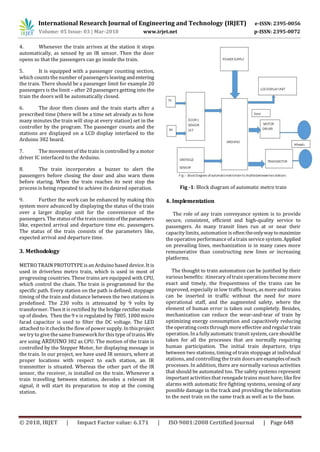
1. It is working on Arduino. It’s a robotic train with
sensors at both end.
2. If the train comes on to the station it stops
automatically at the station with the help of IR sensor
means that it has got an automatic start and stop
arrangement.
3. Then its count the number of peoplesenteringinthe
train. For e.g. there is the counting sensor which count
number of people entering in the train with timingsensor
(e.g. sensor count 20 peoples and there is timing sensor
with 30 second).
4. When the peoples enter in the train the sensor
count the no of people entering in the train, when
counting complete the train door automatically closed or
if in the 30 second the counting not completed the door
will automatically closed.
5. Then the train start to moving next station after
either completing the count of 20 people or after 30
second.
6. When the train arrives at the predefineddestination
train stops automatically and the door of the train opens
and then with the help of sensor again counting starts for
the people who exit from the train and then it checks the
number of people who enters in the train and after
checking. The counting begins after 30 second and it’s
again move to next stations. 7 .it also has an obstacle
sensor which determines the obstacle immediately
stopping the train.
Table -1: RESULT
INPUT SIGNAL OUTPUT
1st IR sensor 0 Train stops and door
opens (forward
direction)
2ND IR sensor 0 Train stops and door
opens (reverse direction)
1ST IR counting
sensor
0
1
Counts +1
2ND IR counting
sensor
1ST IR counting
sensor
1
0
Counts -1
2ND IR counting
sensor
6. Conclusion
The driverless train that is framework presented in this
paper is in fact a final year project. A general conclusion that
can be said about such engineering projects is that they are
presenting students to an open horizon of developments.
Such projects can only represent a minor part of what the
future and technology integration may look like for the
modernization of different service sectors including
transport. Researching and developing a working prototype
enhance self-confidence and assure that it is possible to
design a system and apply it for solving a particularproblem
by acquiring the necessary information. Moreover,
developing a prototype system can serve as a basis of a far
more sophisticated and advance form of controlsystemsuch
as a real driverless train system. In this paper we have
decried how metro train can be automated with the help of
paper presented above and it main advantageiscountingthe
no of passengers automatically as they enter the train. This
countinghelpsto reduce the overpopulation insidethetrain.
The counting on the other hand is displayed on 16*2 LCD
display.
REFERENCES: -
[1] B.W.C. Cooke. "Proposed New LondonUnderground".
The Railway Magazine (London) 101 (648): 279–281. April
1955.
[2] E. Fischer. "Justifying automation". Railway-
Technology.com. 23 August 2011.
[3] S. Cappaert-Blondelle. Metro AutomationFacts,Figues
and Trends. The International Association of Public
Transport (UITP). Technical report . Belgium. 2012.
[4] J.M. Erbina, and C. Soulasa. Twenty Years of
Experiences with Driverless Metros in France. VWT 19
proceedings. Dresden. 2003.](https://image.slidesharecdn.com/irjet-v5i3144-190110103157/85/IRJET-Automatic-Metro-Train-to-Shuttle-Between-Two-Stations-3-320.jpg)
![International Research Journal of Engineering and Technology (IRJET) e-ISSN: 2395-0056
Volume: 05 Issue: 03 | Mar-2018 www.irjet.net p-ISSN: 2395-0072
© 2018, IRJET | Impact Factor value: 6.171 | ISO 9001:2008 Certified Journal | Page 650
[5] Transportation system division. The Dubai Metro, the
World’s Longest Fully Automated Metro Network.
Mitsubishi Heavy Industries Technical Review Vol. 49.No.2
.June 2012.
[6] S. HAN, S. LEE, W.KIM. Development of OnboardTrain
Automatic Control System for Korean Standard EMU.
Processing's of the ISIE 2001 conference. 2001. Pusan,
KOREA.
[7] H. Jun, and S. Choi. Development of a Multi-train
Operation Simulator with Interactive Human Computer
Interfaces. International Conference on HybridInformation
Technology (ICHIT'06). 2006. Cheju Island, Korea.
[8] M. P. Georgescu. Driverless CBTC – specific
requirements for CBTC systems to overcome operation
challenges. WIT Transactions on The Built Environment,Vol
88. 2008. pp. 401-409.
[9] H. Yun, and K. Lee. Development of the Train Control
System Data Transmission Technology Using a Wi-Fi Mesh.
Proceeding if the ICTC 2011. Seoul . Sept 2011. Pp 406-410.
[10] M. Siemiatycki. Message in a Metro: Building Urban
Rail Infrastructure and Image in Delhi, India. International
Journal of Urban and Regional Research, vol. 30, pp. 289-92
. [11] M. Verle . PIC Microcontrollers - Programming in C.
mikroElektronika; 1st edition .2009.](https://image.slidesharecdn.com/irjet-v5i3144-190110103157/85/IRJET-Automatic-Metro-Train-to-Shuttle-Between-Two-Stations-4-320.jpg)

This document summarizes the development of an automatic metro train prototype that shuttles between two stations without a driver. The prototype uses an Arduino controller programmed to stop the train at each station based on signals from infrared sensors. It counts the number of passengers entering and exiting to ensure the train does not exceed capacity. When the train reaches a station, it automatically stops, opens the doors for a set time, then closes the doors and proceeds to the next station according to a predefined schedule. The goal is to develop a framework for a driverless train using sensors and a microcontroller that can safely and reliably transport passengers between stations.


