International Research Journal of Engineering and Technology (IRJET) e-ISSN: 2395-0056
Volume: 07 Issue: 12 | Dec 2020 www.irjet.net p-ISSN: 2395-0072
© 2020, IRJET | Impact Factor value: 7.529 | ISO 9001:2008 Certified Journal | Page 95
Cognitive based Emotion Analysis of a Child Reading a Book
Harshraj Todake1, Kalpesh Mhatre2, Sneha Mane3, Prof. Rasika Shintre4
1-3Student, Computer Engineering, SIGCE, Navi Mumbai, Maharashtra, India
4Asst. Professor, Computer Engineering, Smt. Indira Gandhi College of Engineering, Navi Mumbai,
Maharashtra, India
---------------------------------------------------------------------***----------------------------------------------------------------------
Abstract - - In this COVID-19 situation many schools have
started online coaching. Students are reading many books
online. There is no app that capture student’s expression
based on their reading which might be trouble sometime.
It’s a problem because children might give wrong expression
to the context which he is reading also it needs to observable
that to the sentence he is reading should give correct
expression. Sentiment analysis of sentence to the joy, anger,
fear, excited, sad, happy are ongoing process. Also
understanding human expression from face specifically
children is also required. In this project we are going to
develop a system which captures a children’s expression
from there face using CNN and the context they are reading
with the help of sentiment analysis.
Key Words: Data Mining, NLP, WordNet, SCAM, KMP
1. INTRODUCTION
Detection of emotion is a difficult area for researchers for
a very long time. We express our feelings with facial
expressions. Once we interact with others, our expressions
show some essential signs such as our level of interest, our
willingness to participate in speaking and to respond
continuously. It helps in improving social communication.
However, there are problems in detecting the emotions of
people with autism. Facial expression is the most natural
way of inner world revelation. It plays a vital role in our
social interactions. With it, we can express our feelings,
and infer other people’s attitude and intention. We are
capable of telling other people’s facial expressions at a
glance. Facial Expression Recognition (FER) system
enables machines to infer our intentions through reading
the facial expression, that is of great help for Human-
Computer Interaction (HCI). A typical FER system consists
of three stages: 1) First, face detection and localization. 2)
Next, extract expression information from located faces. 3)
Finally, a classifier (like an SVM) is trained on the
extracted information to output the final expression labels.
We provide a CNN-based approach to address the FER
problem in the following three steps: (i) first we describe
several different structured CNNs, these subnets are
trained separately on the training set; (ii) then these
trained CNNs are assembled together by removing the
output layers and concatenating the last but one layers
together.
1.1 OBJECTIVES
Our main objective of project is
1. Sentence classification: -The paragraph that children
reading needs to classified based on joy, anger, fear,
excited, sad, happy. For this purpose, we are going to train
the model using SVM, naïve bayes, random forest model.
Models will be generated from tweeter dataset and
sentence will be classified by giving input to this field.
2. Facial expression classification: Facial expression
images dataset can be found online fer dataset but this
dataset is for adult. For children dataset we will capture
the face of children. And train the dataset using CNN
(convolutional neural network) We will create a model
based on face emotion using CNN.
3. Application development: - we will develop flask based
application in which we will show a paragraph to person
and camera will be started at same time the text will be
shown to user at the same time face will be captured and
output will be generated log will be maintained and output
will be shown at the end time of after 3-4 minute.
1.2 SCOPE
Students: -This project can be used in any educational
program where children’s expression is important
Paragraph analysis on audience books publisher: -Suppose
we want to analyzed the books response and expression
this can be used for generating books rating.
INPUT: Text of paragraph and face expressions. (Fear,
happy, sad, normal, anxiety, anger)
PROCESS: sklearn, OpenCV, sentiment analysis Dlib, face
landmark detection python libraries.
1.3 FEATURES
1. This System help to find the emotion of child.
2. It will detect emotions using CNN and SVM
algorithms.
3. Emotion analysis based on Sentence is also possible.
International Research Journal of Engineering and Technology (IRJET) e-ISSN: 2395-0056
Volume: 07 Issue: 12 | Dec 2020 www.irjet.net p-ISSN: 2395-0072
© 2020, IRJET | Impact Factor value: 7.529 | ISO 9001:2008 Certified Journal | Page 96
2. LITERATURE SURVEY
Identification of Relations from IndoWordNet for
Indian Languages using Support Vector Machine
Inspection of the SVM classifier for identification of
relations in Indian Languages apart from English SVM
successfully implemented for identification of relations in
Indian Languages from the IndoWorldNet. This aims at
implementing SVM in the field of text classification
Sentiment Classification based on Ontology and SVM
Classifier
SVM has been used for sentiment classification by making
SVM act as a binary classifier to classify sentiments In the
document level and sentence level sentiment
classifications assume that each document or sentence
focus on a single object and contains only one opinion or
opinion from a single opinion holder SVM is better at text
classification and use of ontology makes SVM suitable for
the application
User Intention Understanding from Scratch
The main evaluation criterion of the performance is the
prediction accuracy of all users in the test set. We can
observe that on overall, the method Threshold-V achieves
the best accuracy of 67 percent. The drawback of the
system is that the use of a numerical classifier led to
unwanted overheads
The discipline of artificial intelligence is wide-spread
across various fields and has a wide variety of sub-
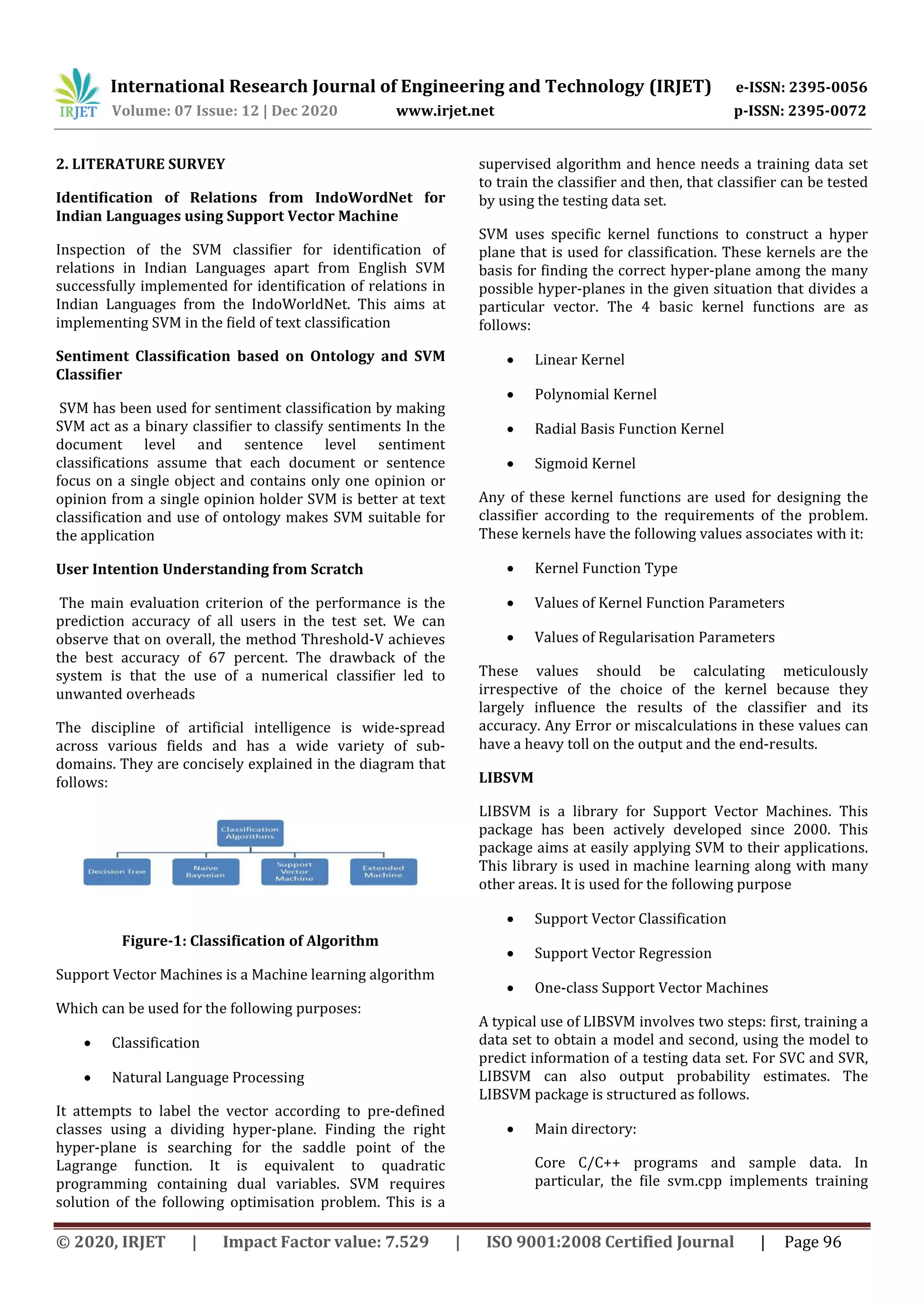
domains. They are concisely explained in the diagram that
follows:
Figure-1: Classification of Algorithm
Support Vector Machines is a Machine learning algorithm
Which can be used for the following purposes:
 Classification
 Natural Language Processing
It attempts to label the vector according to pre-defined
classes using a dividing hyper-plane. Finding the right
hyper-plane is searching for the saddle point of the
Lagrange function. It is equivalent to quadratic
programming containing dual variables. SVM requires
solution of the following optimisation problem. This is a
supervised algorithm and hence needs a training data set
to train the classifier and then, that classifier can be tested
by using the testing data set.
SVM uses specific kernel functions to construct a hyper
plane that is used for classification. These kernels are the
basis for finding the correct hyper-plane among the many
possible hyper-planes in the given situation that divides a
particular vector. The 4 basic kernel functions are as
follows:
 Linear Kernel
 Polynomial Kernel
 Radial Basis Function Kernel
 Sigmoid Kernel
Any of these kernel functions are used for designing the
classifier according to the requirements of the problem.
These kernels have the following values associates with it:
 Kernel Function Type
 Values of Kernel Function Parameters
 Values of Regularisation Parameters
These values should be calculating meticulously
irrespective of the choice of the kernel because they
largely influence the results of the classifier and its
accuracy. Any Error or miscalculations in these values can
have a heavy toll on the output and the end-results.
LIBSVM
LIBSVM is a library for Support Vector Machines. This
package has been actively developed since 2000. This
package aims at easily applying SVM to their applications.
This library is used in machine learning along with many
other areas. It is used for the following purpose
 Support Vector Classification
 Support Vector Regression
 One-class Support Vector Machines
A typical use of LIBSVM involves two steps: first, training a
data set to obtain a model and second, using the model to
predict information of a testing data set. For SVC and SVR,
LIBSVM can also output probability estimates. The
LIBSVM package is structured as follows.
 Main directory:
Core C/C++ programs and sample data. In
particular, the file svm.cpp implements training
International Research Journal of Engineering and Technology (IRJET) e-ISSN: 2395-0056
Volume: 07 Issue: 12 | Dec 2020 www.irjet.net p-ISSN: 2395-0072
© 2020, IRJET | Impact Factor value: 7.529 | ISO 9001:2008 Certified Journal | Page 97
and testing algorithms, where details are
described in this article.
 The tool sub-directory:
This sub-directory includes tools for checking
data format and for selecting SVM parameters.
 Other sub-directories contain pre-built binary
files and interfaces to other languages/software.
3. FLOWCHART
Figure-2: Flowchart
User have to register himself then after enter the
authentication details and if the user is invalid then he has
to move to reenter authentication details if user is valid
then the camera starts and the particular user have to read
the paragraph while reading preprocessing technique
start its work and extracts the features from the face with
the help of trained model. With the help of trained model,
we find the actual result.
4. ALGORITHMS
1. SVM (Support Vector Machine)
Support Vector Machines (SVM) have recently gained
prominence in the field of machine learning and pattern
classification. Classification is achieved by realizing a
linear or non-linear separation surface in the input space.
In Support Vector classification, the separating function
can be expressed as a linear combination of kernels
associated with the Support Vectors as
where xi denotes the training patterns, yi ∈ {+1, −1}
denotes the corresponding class labels and S denotes the
set of Support Vectors. The dual formulation
yields
where αi are the corresponding coefficients, b is the offset,
Qij = yiyjK (xi, xj) is a symmetric positive definite kernel
matrix and C is the parameter used to penalize error
points in the inseparable case. The Karush-Kuhn-Tucker
(KKT) conditions for the dual can be expressed as
This partitions the training set into S the Support Vector
set (0 < αi < C, gi = 0), E the error set (αi = C, gi < 0) and R
the well classified set (αi = 0, gi > 0) [2]. If the points in
error are penalized quadratically with a penalty factor C 0,
then, it has been shown that the problem reduces to that
of a separable case with C = ∞ [3]. The kernel function is
modified
where δij = 1 if i = j and δij = 0 otherwise. The advantage of
this formulation is that the SVM problem reduces to that of
a linearly separable case. It can be seen that training the
SVM involves solving a quadratic optimization problem
which requires the use of optimization routines from
numerical libraries. This step is computationally intensive,
can be subject to stability problems and is non-trivial to
implement.
2. CNN (Convolution Neural Network):
Convolutional Neural Networks are based on the Neural
Networks, they have neurons that are learnable weights
and biases. Each neuron gets some inputs from the input
layer and a dot product is performed and then non-
linearity is applied. They also have a loss function and all
the techniques we used for Neural Networks are also
applied here. ConvNet allows us to encode some
properties into the architecture. This makes the forward
function more efficient and reduces the parameters.
Convolutional Neural Network consists of three types of
layers, a convolutional layer, pooling layer, and fully-
connected layers.
Figure-3: CNN Layers
International Research Journal of Engineering and Technology (IRJET) e-ISSN: 2395-0056
Volume: 07 Issue: 12 | Dec 2020 www.irjet.net p-ISSN: 2395-0072
© 2020, IRJET | Impact Factor value: 7.529 | ISO 9001:2008 Certified Journal | Page 98
The convolutional layer learns features from the given
image. It is composed of several convolution kernels which
are used to compute feature maps. Each neuron of a
feature map is connected to neighbouring neurons in the
previous layer. This is called the receptive field of a single
unit/neuron. A new feature map can be obtained by
convolving the given input with a kernel and then applying
element-wise nonlinear activation function on the output
of the kernel.
Figure-4: CNN Formula
To generate a feature map the kernel is used by all spatial
locations of the input given to the input layer. The final
feature maps are obtained by different kernels in the CNN.
5. CONCLUSION
In this project, we will analyse the emotion distribution in
a children’s story corpus and have demonstrated that the
emotion of a sentence in children’s story is affected by its
context. An HMM based method has been proposed to
model the emotion sequence in an article. Important
features have been listed by comparing the emotional and
neutral sentences. Experiments demonstrated that the
proposed model is affected less by the training sets than
traditional methods. Classifier fusion has been applied to
achieve better classification results.
ACKNOWLEDGEMENT
The success and final outcome of this research required a
lot of guidance and assistance and we are extremely
privileged to have got this all. All that we have done is only
due to such supervision and assistance and we would not
forget to thank them.
We respect and thank Prof. Rasika Shintre, for providing
us insight and expertise that greatly assisted the research.
We are extremely thankful to her for providing such a nice
support and guidance.
REFERENCES
[1] M. Cabanac, "What is emotion?," Behavioural
processes, vol. 60, pp. 69-83, 2002.
[2] R. Roberts, "What an Emotion Is: a Sketch," The
Philosophical Review, vol. 97, 1988.
[3] E. Shouse, "Feeling, emotion, affect," M/c journal,
vol. 8, no. 6, p. 26, 2005.
[4] J. Zhao, X. Mao, and L. Chen, "Speech emotion
recognition using deep 1D & 2D CNN LSTM networks,"
Biomedical Signal Processing and Control, vol. 47, pp.
312-323, 2019.
[5] J. M. B. Fugate, A. J. O'Hare, and W. S. Emmanuel,
"Emotion words: Facing change," Journal of
Experimental Social Psychology, vol. 79, pp. 264-274,
2018.
[6] J. P. Powers and K. S. Labra, "Regulating emotion
through distancing: A taxonomy, neurocognitive
model, and supporting meta-analysis," Neuroscience
& Biobehavioural Reviews, vol. 96, pp. 155-173, 2019.
[7] R. B. Lopez and B. T. Denny, "Negative affect
mediates the relationship between use of emotion
regulation strategies and general health in college-
aged students," Personality and Individual
Differences, vol. 151, p. 109529, 2019.
[8] S. Albanie, A. Nagrani, A. Vedaldi, and A. J. a. p. a.
Zisserman, "Emotion recognition in speech using
cross-modal transfer in the wild," pp. 292-301, 2018.
[9] K.-Y. Huang, C.-H. Wu, Q.-B. Hong, M.-H. Su, and Y.-
H. Chen, "Speech Emotion Recognition Using Deep
Neural Network Considering Verbal and Nonverbal
Speech Sounds," in ICASSP 2019-2019 IEEE
International Conference on Acoustics, Speech and
Signal Processing (ICASSP), 2019, pp. 5866-5870:
IEEE.
BIOGRAPHIES
Harshraj Bhagwan Todake is
pursuing Bachelor degree (B.E.) in
Computer Engineering from Smt.
Indira Gandhi College of
Engineering, Navi Mumbai.
Kalpesh Bharat Mhatre is pursuing
Bachelor degree (B.E.) in
Computer Engineering from Smt.
Indira Gandhi College of
Engineering, Navi Mumbai.
International Research Journal of Engineering and Technology (IRJET) e-ISSN: 2395-0056
Volume: 07 Issue: 12 | Dec 2020 www.irjet.net p-ISSN: 2395-0072
© 2020, IRJET | Impact Factor value: 7.529 | ISO 9001:2008 Certified Journal | Page 99
Sneha Ashok Mane is pursuing
Bachelor degree (B.E.) in
Computer Engineering from Smt.
Indira Gandhi College of
Engineering, Navi Mumbai.
Prof. Rasika Shintre, Obtained the
Bachelor degree (B.E. Computer)
in the year 2011 from Ramrao
Adik Institute of Technology
(RAIT), Nerul and Master degree
(M.E. Computer) from Bharati
Vidyapeeth College of Engineering,
Navi Mumbai. She is Asst.
Professor in Smt. Indira Gandhi
College of Engineering having
about 8 years of experience. Her
area of interest includes Data
mining & information retrieval.

IRJET - Cognitive based Emotion Analysis of a Child Reading a Book

  • 1.
    International Research Journalof Engineering and Technology (IRJET) e-ISSN: 2395-0056 Volume: 07 Issue: 12 | Dec 2020 www.irjet.net p-ISSN: 2395-0072 © 2020, IRJET | Impact Factor value: 7.529 | ISO 9001:2008 Certified Journal | Page 95 Cognitive based Emotion Analysis of a Child Reading a Book Harshraj Todake1, Kalpesh Mhatre2, Sneha Mane3, Prof. Rasika Shintre4 1-3Student, Computer Engineering, SIGCE, Navi Mumbai, Maharashtra, India 4Asst. Professor, Computer Engineering, Smt. Indira Gandhi College of Engineering, Navi Mumbai, Maharashtra, India ---------------------------------------------------------------------***---------------------------------------------------------------------- Abstract - - In this COVID-19 situation many schools have started online coaching. Students are reading many books online. There is no app that capture student’s expression based on their reading which might be trouble sometime. It’s a problem because children might give wrong expression to the context which he is reading also it needs to observable that to the sentence he is reading should give correct expression. Sentiment analysis of sentence to the joy, anger, fear, excited, sad, happy are ongoing process. Also understanding human expression from face specifically children is also required. In this project we are going to develop a system which captures a children’s expression from there face using CNN and the context they are reading with the help of sentiment analysis. Key Words: Data Mining, NLP, WordNet, SCAM, KMP 1. INTRODUCTION Detection of emotion is a difficult area for researchers for a very long time. We express our feelings with facial expressions. Once we interact with others, our expressions show some essential signs such as our level of interest, our willingness to participate in speaking and to respond continuously. It helps in improving social communication. However, there are problems in detecting the emotions of people with autism. Facial expression is the most natural way of inner world revelation. It plays a vital role in our social interactions. With it, we can express our feelings, and infer other people’s attitude and intention. We are capable of telling other people’s facial expressions at a glance. Facial Expression Recognition (FER) system enables machines to infer our intentions through reading the facial expression, that is of great help for Human- Computer Interaction (HCI). A typical FER system consists of three stages: 1) First, face detection and localization. 2) Next, extract expression information from located faces. 3) Finally, a classifier (like an SVM) is trained on the extracted information to output the final expression labels. We provide a CNN-based approach to address the FER problem in the following three steps: (i) first we describe several different structured CNNs, these subnets are trained separately on the training set; (ii) then these trained CNNs are assembled together by removing the output layers and concatenating the last but one layers together. 1.1 OBJECTIVES Our main objective of project is 1. Sentence classification: -The paragraph that children reading needs to classified based on joy, anger, fear, excited, sad, happy. For this purpose, we are going to train the model using SVM, naïve bayes, random forest model. Models will be generated from tweeter dataset and sentence will be classified by giving input to this field. 2. Facial expression classification: Facial expression images dataset can be found online fer dataset but this dataset is for adult. For children dataset we will capture the face of children. And train the dataset using CNN (convolutional neural network) We will create a model based on face emotion using CNN. 3. Application development: - we will develop flask based application in which we will show a paragraph to person and camera will be started at same time the text will be shown to user at the same time face will be captured and output will be generated log will be maintained and output will be shown at the end time of after 3-4 minute. 1.2 SCOPE Students: -This project can be used in any educational program where children’s expression is important Paragraph analysis on audience books publisher: -Suppose we want to analyzed the books response and expression this can be used for generating books rating. INPUT: Text of paragraph and face expressions. (Fear, happy, sad, normal, anxiety, anger) PROCESS: sklearn, OpenCV, sentiment analysis Dlib, face landmark detection python libraries. 1.3 FEATURES 1. This System help to find the emotion of child. 2. It will detect emotions using CNN and SVM algorithms. 3. Emotion analysis based on Sentence is also possible.
  • 2.
    International Research Journalof Engineering and Technology (IRJET) e-ISSN: 2395-0056 Volume: 07 Issue: 12 | Dec 2020 www.irjet.net p-ISSN: 2395-0072 © 2020, IRJET | Impact Factor value: 7.529 | ISO 9001:2008 Certified Journal | Page 96 2. LITERATURE SURVEY Identification of Relations from IndoWordNet for Indian Languages using Support Vector Machine Inspection of the SVM classifier for identification of relations in Indian Languages apart from English SVM successfully implemented for identification of relations in Indian Languages from the IndoWorldNet. This aims at implementing SVM in the field of text classification Sentiment Classification based on Ontology and SVM Classifier SVM has been used for sentiment classification by making SVM act as a binary classifier to classify sentiments In the document level and sentence level sentiment classifications assume that each document or sentence focus on a single object and contains only one opinion or opinion from a single opinion holder SVM is better at text classification and use of ontology makes SVM suitable for the application User Intention Understanding from Scratch The main evaluation criterion of the performance is the prediction accuracy of all users in the test set. We can observe that on overall, the method Threshold-V achieves the best accuracy of 67 percent. The drawback of the system is that the use of a numerical classifier led to unwanted overheads The discipline of artificial intelligence is wide-spread across various fields and has a wide variety of sub- domains. They are concisely explained in the diagram that follows: Figure-1: Classification of Algorithm Support Vector Machines is a Machine learning algorithm Which can be used for the following purposes:  Classification  Natural Language Processing It attempts to label the vector according to pre-defined classes using a dividing hyper-plane. Finding the right hyper-plane is searching for the saddle point of the Lagrange function. It is equivalent to quadratic programming containing dual variables. SVM requires solution of the following optimisation problem. This is a supervised algorithm and hence needs a training data set to train the classifier and then, that classifier can be tested by using the testing data set. SVM uses specific kernel functions to construct a hyper plane that is used for classification. These kernels are the basis for finding the correct hyper-plane among the many possible hyper-planes in the given situation that divides a particular vector. The 4 basic kernel functions are as follows:  Linear Kernel  Polynomial Kernel  Radial Basis Function Kernel  Sigmoid Kernel Any of these kernel functions are used for designing the classifier according to the requirements of the problem. These kernels have the following values associates with it:  Kernel Function Type  Values of Kernel Function Parameters  Values of Regularisation Parameters These values should be calculating meticulously irrespective of the choice of the kernel because they largely influence the results of the classifier and its accuracy. Any Error or miscalculations in these values can have a heavy toll on the output and the end-results. LIBSVM LIBSVM is a library for Support Vector Machines. This package has been actively developed since 2000. This package aims at easily applying SVM to their applications. This library is used in machine learning along with many other areas. It is used for the following purpose  Support Vector Classification  Support Vector Regression  One-class Support Vector Machines A typical use of LIBSVM involves two steps: first, training a data set to obtain a model and second, using the model to predict information of a testing data set. For SVC and SVR, LIBSVM can also output probability estimates. The LIBSVM package is structured as follows.  Main directory: Core C/C++ programs and sample data. In particular, the file svm.cpp implements training
  • 3.
    International Research Journalof Engineering and Technology (IRJET) e-ISSN: 2395-0056 Volume: 07 Issue: 12 | Dec 2020 www.irjet.net p-ISSN: 2395-0072 © 2020, IRJET | Impact Factor value: 7.529 | ISO 9001:2008 Certified Journal | Page 97 and testing algorithms, where details are described in this article.  The tool sub-directory: This sub-directory includes tools for checking data format and for selecting SVM parameters.  Other sub-directories contain pre-built binary files and interfaces to other languages/software. 3. FLOWCHART Figure-2: Flowchart User have to register himself then after enter the authentication details and if the user is invalid then he has to move to reenter authentication details if user is valid then the camera starts and the particular user have to read the paragraph while reading preprocessing technique start its work and extracts the features from the face with the help of trained model. With the help of trained model, we find the actual result. 4. ALGORITHMS 1. SVM (Support Vector Machine) Support Vector Machines (SVM) have recently gained prominence in the field of machine learning and pattern classification. Classification is achieved by realizing a linear or non-linear separation surface in the input space. In Support Vector classification, the separating function can be expressed as a linear combination of kernels associated with the Support Vectors as where xi denotes the training patterns, yi ∈ {+1, −1} denotes the corresponding class labels and S denotes the set of Support Vectors. The dual formulation yields where αi are the corresponding coefficients, b is the offset, Qij = yiyjK (xi, xj) is a symmetric positive definite kernel matrix and C is the parameter used to penalize error points in the inseparable case. The Karush-Kuhn-Tucker (KKT) conditions for the dual can be expressed as This partitions the training set into S the Support Vector set (0 < αi < C, gi = 0), E the error set (αi = C, gi < 0) and R the well classified set (αi = 0, gi > 0) [2]. If the points in error are penalized quadratically with a penalty factor C 0, then, it has been shown that the problem reduces to that of a separable case with C = ∞ [3]. The kernel function is modified where δij = 1 if i = j and δij = 0 otherwise. The advantage of this formulation is that the SVM problem reduces to that of a linearly separable case. It can be seen that training the SVM involves solving a quadratic optimization problem which requires the use of optimization routines from numerical libraries. This step is computationally intensive, can be subject to stability problems and is non-trivial to implement. 2. CNN (Convolution Neural Network): Convolutional Neural Networks are based on the Neural Networks, they have neurons that are learnable weights and biases. Each neuron gets some inputs from the input layer and a dot product is performed and then non- linearity is applied. They also have a loss function and all the techniques we used for Neural Networks are also applied here. ConvNet allows us to encode some properties into the architecture. This makes the forward function more efficient and reduces the parameters. Convolutional Neural Network consists of three types of layers, a convolutional layer, pooling layer, and fully- connected layers. Figure-3: CNN Layers
  • 4.
    International Research Journalof Engineering and Technology (IRJET) e-ISSN: 2395-0056 Volume: 07 Issue: 12 | Dec 2020 www.irjet.net p-ISSN: 2395-0072 © 2020, IRJET | Impact Factor value: 7.529 | ISO 9001:2008 Certified Journal | Page 98 The convolutional layer learns features from the given image. It is composed of several convolution kernels which are used to compute feature maps. Each neuron of a feature map is connected to neighbouring neurons in the previous layer. This is called the receptive field of a single unit/neuron. A new feature map can be obtained by convolving the given input with a kernel and then applying element-wise nonlinear activation function on the output of the kernel. Figure-4: CNN Formula To generate a feature map the kernel is used by all spatial locations of the input given to the input layer. The final feature maps are obtained by different kernels in the CNN. 5. CONCLUSION In this project, we will analyse the emotion distribution in a children’s story corpus and have demonstrated that the emotion of a sentence in children’s story is affected by its context. An HMM based method has been proposed to model the emotion sequence in an article. Important features have been listed by comparing the emotional and neutral sentences. Experiments demonstrated that the proposed model is affected less by the training sets than traditional methods. Classifier fusion has been applied to achieve better classification results. ACKNOWLEDGEMENT The success and final outcome of this research required a lot of guidance and assistance and we are extremely privileged to have got this all. All that we have done is only due to such supervision and assistance and we would not forget to thank them. We respect and thank Prof. Rasika Shintre, for providing us insight and expertise that greatly assisted the research. We are extremely thankful to her for providing such a nice support and guidance. REFERENCES [1] M. Cabanac, "What is emotion?," Behavioural processes, vol. 60, pp. 69-83, 2002. [2] R. Roberts, "What an Emotion Is: a Sketch," The Philosophical Review, vol. 97, 1988. [3] E. Shouse, "Feeling, emotion, affect," M/c journal, vol. 8, no. 6, p. 26, 2005. [4] J. Zhao, X. Mao, and L. Chen, "Speech emotion recognition using deep 1D & 2D CNN LSTM networks," Biomedical Signal Processing and Control, vol. 47, pp. 312-323, 2019. [5] J. M. B. Fugate, A. J. O'Hare, and W. S. Emmanuel, "Emotion words: Facing change," Journal of Experimental Social Psychology, vol. 79, pp. 264-274, 2018. [6] J. P. Powers and K. S. Labra, "Regulating emotion through distancing: A taxonomy, neurocognitive model, and supporting meta-analysis," Neuroscience & Biobehavioural Reviews, vol. 96, pp. 155-173, 2019. [7] R. B. Lopez and B. T. Denny, "Negative affect mediates the relationship between use of emotion regulation strategies and general health in college- aged students," Personality and Individual Differences, vol. 151, p. 109529, 2019. [8] S. Albanie, A. Nagrani, A. Vedaldi, and A. J. a. p. a. Zisserman, "Emotion recognition in speech using cross-modal transfer in the wild," pp. 292-301, 2018. [9] K.-Y. Huang, C.-H. Wu, Q.-B. Hong, M.-H. Su, and Y.- H. Chen, "Speech Emotion Recognition Using Deep Neural Network Considering Verbal and Nonverbal Speech Sounds," in ICASSP 2019-2019 IEEE International Conference on Acoustics, Speech and Signal Processing (ICASSP), 2019, pp. 5866-5870: IEEE. BIOGRAPHIES Harshraj Bhagwan Todake is pursuing Bachelor degree (B.E.) in Computer Engineering from Smt. Indira Gandhi College of Engineering, Navi Mumbai. Kalpesh Bharat Mhatre is pursuing Bachelor degree (B.E.) in Computer Engineering from Smt. Indira Gandhi College of Engineering, Navi Mumbai.
  • 5.
    International Research Journalof Engineering and Technology (IRJET) e-ISSN: 2395-0056 Volume: 07 Issue: 12 | Dec 2020 www.irjet.net p-ISSN: 2395-0072 © 2020, IRJET | Impact Factor value: 7.529 | ISO 9001:2008 Certified Journal | Page 99 Sneha Ashok Mane is pursuing Bachelor degree (B.E.) in Computer Engineering from Smt. Indira Gandhi College of Engineering, Navi Mumbai. Prof. Rasika Shintre, Obtained the Bachelor degree (B.E. Computer) in the year 2011 from Ramrao Adik Institute of Technology (RAIT), Nerul and Master degree (M.E. Computer) from Bharati Vidyapeeth College of Engineering, Navi Mumbai. She is Asst. Professor in Smt. Indira Gandhi College of Engineering having about 8 years of experience. Her area of interest includes Data mining & information retrieval.