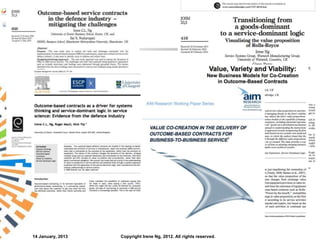
Introducing University of Warwick, WMG
and IIPSI
                                                 Irene C L Ng
                Professor of Marketing & Service Systems, WMG
            Director, International Institute of Product & Service
                                                       Innovation
                                          irene.ng@warwick.ac.uk
                                                       @ireneclng
                             http://uk.linkedin.com/in/ireneclng
                                                   bit.ly/vcssblog
                                  www.warwick.ac.uk/go/sswmg
                                                 www.ireneng.com
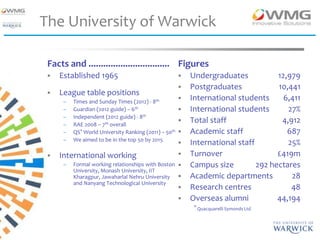
The University of Warwick

 Facts and ................................. Figures
    Established 1965                                   Undergraduates            12,979
                                                        Postgraduates             10,441
    League table positions
      –   Times and Sunday Times (2012) - 8th
                                                        International students      6,411
      –   Guardian (2012 guide) – 6th                   International students       27%
      –   Independent (2012 guide) - 8th

      –   RAE 2008 – 7th overall
                                                        Total staff                4,912
      –   QS* World University Ranking (2011) – 50th    Academic staff               687
      –   We aimed to be in the top 50 by 2015
                                                        International staff          25%
    International working                              Turnover                  £419m
      –   Formal working relationships with Boston      Campus size         292 hectares
          University, Monash University, IIT
          Kharagpur, Jawaharlal Nehru University        Academic departments          28
          and Nanyang Technological University
                                                        Research centres              48
                                                        Overseas alumni           44,194
                                                          * Quacquarelli Symonds Ltd
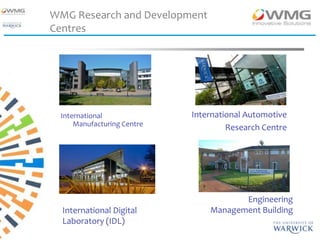
WMG Research and Development
Centres


 International              International Automotive
     Manufacturing Centre
                                     Research Centre


                                       Engineering
  International Digital         Management Building
  Laboratory (IDL)
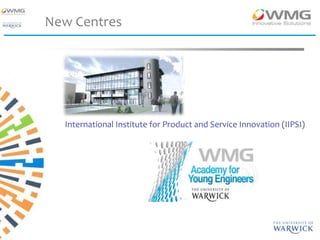
New Centres


  International Institute for Product and Service Innovation (IIPSI)
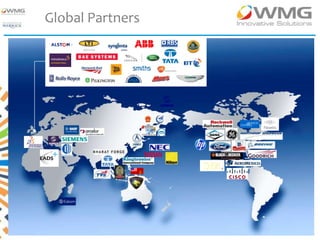
Global Partners


                  5
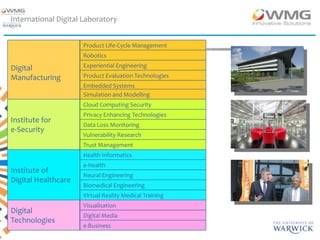
International Digital Laboratory


                     Product Life-Cycle Management
                     Robotics

Digital              Experiential Engineering
Manufacturing        Product Evaluation Technologies
                     Embedded Systems
                     Simulation and Modelling
                     Cloud Computing Security
                     Privacy Enhancing Technologies
Institute for
                     Data Loss Monitoring
e-Security
                     Vulnerability Research
                     Trust Management
                     Health Informatics
                     e-Health
Institute of
                     Neural Engineering
Digital Healthcare
                     Biomedical Engineering
                     Virtual Reality Medical Training
                     Visualisation
Digital
                     Digital Media
Technologies
                     e-Business
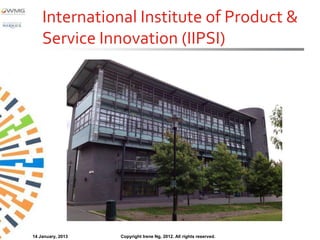
International Institute of Product &
    Service Innovation (IIPSI)


14 January, 2013   Copyright Irene Ng, 2012. All rights reserved.
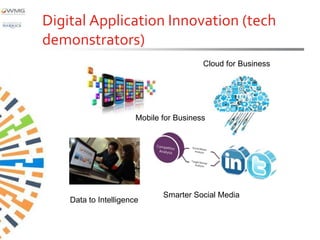
Digital Application Innovation (tech
demonstrators)
                                         Cloud for Business


                       Mobile for Business


                              Smarter Social Media
    Data to Intelligence
Polymer Innovation (sample tech
demonstrators)


 Adding Functionality to Plastic
 Parts
                                           Low Volume Production


                       Polymer Recycling
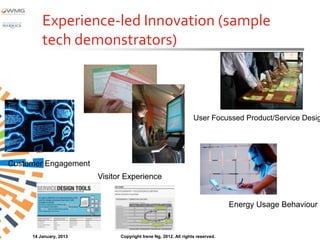
Experience-led Innovation (sample
         tech demonstrators)


                                                                 User Focussed Product/Service Desig


Customer Engagement
                        Visitor Experience


                                                                               Energy Usage Behaviour


     14 January, 2013         Copyright Irene Ng, 2012. All rights reserved.
IIPSI Service Systems & Business+ (bootstrapping
tech innovation with service science & business
models research and innovation)

 • Technology disruptions cause challenges to existing business
   models (e.g. Kodak)
 • Adaptability, transformation needed – both for their business
   models (the firm’s capability to serve the market) and their
   economic models (the way they derive their revenues and the
   market exchanges they participate in)
 • Business+ research into value creating service systems,
   digitisation/virtualisation, service science, S-Dlogic (e.g.
   Bombardier, Rolls Royce, GSK); also into pricing/revenue models,
   methodology for new transactions & markets
 • Transdisciplinary team of social science, technology, business &
   engineering
 • 4 RCUK/EPSRC DE projects, NEMODE virtual collaboration host
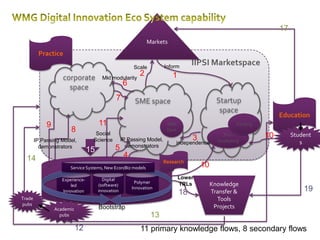
17
                                                               Markets
         Practice
                                                        Scale         Inform
                                                                                   IIPSI Marketspace
                                                           2             1
                    corporate            Mkt modularity
                                                    6
                      space
                                               7         SME space                            Startup
                                                                                               space
                                                                                                                     Education
             9                         11                              SME                            funding
                        8           Social
                                                                       Devt

                                   Science      IP Passing Model,                  3             Pre-           10        Student
        IP Passing Model,                                                 independence        incubating                     s
          demonstrators
                                  15           5 demonstrators
  14                                                4
                                                                      Research
                        Service Systems, New Econ/Biz models                           10
                    Experience-          Digital                              Lower
                                                         Polymer              TRLs          Knowledge
                        led            (software)
                    Innovation         innovation
                                                        Innovation
                                                                              18            Transfer &                        19
Trade                                                                                         Tools
pubs
                 Academic              Bootstrap                                             Projects
                   pubs                                          13
                            12                              11 primary knowledge flows, 8 secondary flows
Impact

    • created 12 new high tech start‐up
      businesses,
    • directly generated 70 new jobs,
    • trained over 450 small business in a range
      of digital technologies over the last 4 years
    • International publications, patents, tools
      etc.


14 January, 2013   Copyright Irene Ng, 2012. All rights reserved.
Outcome-based Contracts as a New
Business Model
          Research Insights from
          Aerospace/Defence contracts
Theoretical background

                  The ‘science’
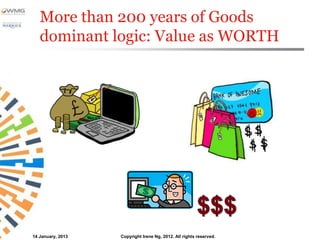
More than 200 years of Goods
   dominant logic: Value as WORTH


14 January, 2013   Copyright Irene Ng, 2012. All rights reserved.
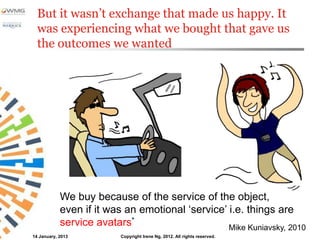
But it wasn’t exchange that made us happy. It
  was experiencing what we bought that gave us
  the outcomes we wanted


            We buy because of the service of the object,
            even if it was an emotional „service‟ i.e. things are
            service avatars*                      Mike Kuniavsky, 2010
14 January, 2013          Copyright Irene Ng, 2012. All rights reserved.
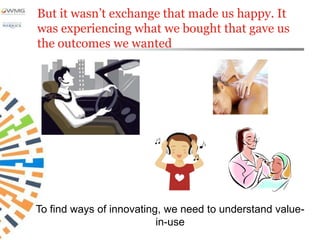
But it wasn’t exchange that made us happy. It
was experiencing what we bought that gave us
the outcomes we wanted


To find ways of innovating, we need to understand value-
                          in-use
So let’s look at this logically

                   • We buy products to
                     obtain benefits
                   • What are the benefits
                   • How do we get the
                     benefits?
                   • What is the role of the
                     firm? The customer?
                   • The GDLogic mentality
                     of organizations.
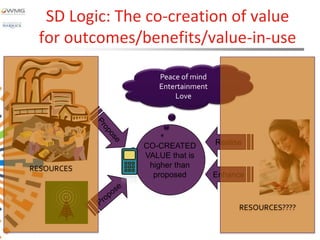
SD Logic: The co-creation of value
 for outcomes/benefits/value-in-use

                  Peace of mind
                  Entertainment
                      Love


               CO-CREATED         Realise
               VALUE that is
RESOURCES       higher than
                 proposed         Enhance


                                        RESOURCES????
1. Value is co-created: Customer resource to
co-create needs to be a feature of design &
innovation
                     Ng, Irene C.L. (2010) “The Future of Pricing and
                     Revenue Models”, Journal of Revenue and
                     Pricing Management, Vol. 9, No. 3, pp276-281

                     Ng, Irene C.L., and Laura Smith (2012), “An
                     Integrative Framework of Value” in Review of
                     Marketing Research Special issue on Toward a
                     Better Understanding of the Role of Value in
                     Markets and Marketing, Stephen L. Vargo and
                     Robert Lusch (Eds) Vol 9, pp 207-243
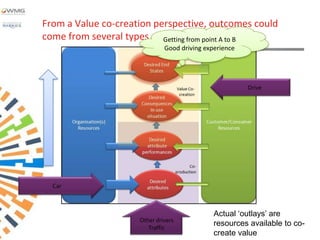
From a Value co-creation perspective, outcomes could
come from several types of contract point A to B
                           Getting from
                              Good driving experience


                                                        Drive


  Car


                                              Actual „outlays‟ are
                     Other drivers
                        Traffic
                                              resources available to co-
                                              create value
Key issues in value co-creation for
    outcomes
    • There is (perhaps) only a difference between a
      product and a service if you’ve already made the
      product
    • From an outcomes perspective, the key issue is
      (a) what should be the value proposition
      (combination product/service) (b) how does the
      firm participate in value (co)creation by the
      customer to achieve those outcomes and (c) how
      do we capture ‘worth’ ($$$). In other words –
      what’s the business model

14 January, 2013   Copyright Irene Ng, 2012. All rights reserved.
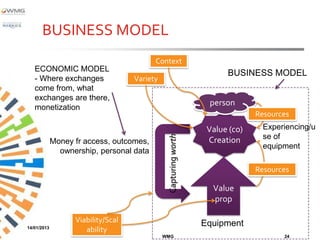
BUSINESS MODEL
                                          Context
   ECONOMIC MODEL
                                                                       BUSINESS MODEL
   - Where exchanges                Variety
   come from, what
   exchanges are there,
                                                                  person
   monetization
                                                                               Resources
                                                                  Value (co)     Experiencing/u
                                                                                 se of


                                               Capturing worth
             Money fr access, outcomes,                           Creation
                                                                                 equipment
               ownership, personal data

                                                                               Resources

                                                                   Value
                                                                   prop

                   Viability/Scal                                Equipment
14/01/2013
                      ability
                                              WMG                                     24
Outcome-based Contracts
• Some simple analogies
  – English lessons, holes in the wall
• More complex OBC
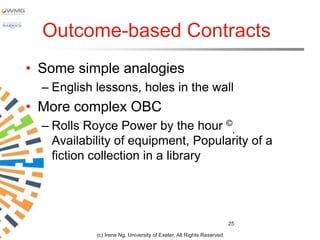
  – Rolls Royce Power by the hour ©,
    Availability of equipment, Popularity of a
    fiction collection in a library


                                                                      25

            (c) Irene Ng, University of Exeter, All Rights Reserved
Understanding Efficient and Effective
Value Co-Creation and the Marginal
Analysis of Service for Outcomes

      The Case of Rolls Royce
Smith, Laura, Irene CL Ng and Roger Maull, (2012) “The Three Value Cycles of
Equipment Based Service,” Production, Planning and Control, Vol 23, Issue 7, pp1-
18, DOI:10.1080/09537287.2011.640055

Ng, Irene C.L., Glenn Parry, Roger Maull, Laura Smith, Gerard Briscoe (2012),
“Transitioning from a Goods-Dominant to a Service-Dominant Logic: Visualising the
Value Proposition of Rolls Royce,” Journal of Service Management, Vol 23 (3),
pp416-439

Maull, Roger, Laura Smith and Irene C.L. Ng, (2012) “Servitization and Operations
Management: A Service-Dominant Logic Approach”, International Journal of
Operations and Production Management, forthcoming
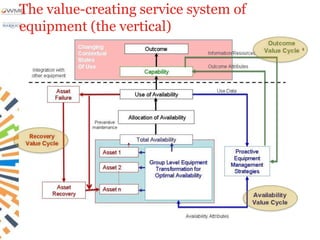
The value-creating service system of
equipment (the vertical)
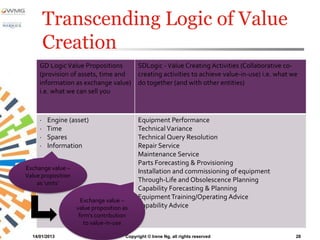
Transcending Logic of Value
         Creation
     GD Logic Value Propositions    SDLogic - Value Creating Activities (Collaborative co-
     (provision of assets, time and creating activities to achieve value-in-use) i.e. what we
     information as exchange value) do together (and with other entities)
     i.e. what we can sell you


     ·   Engine (asset)                      Equipment Performance
     ·   Time                                Technical Variance
     ·   Spares                              Technical Query Resolution
     ·   Information                         Repair Service
                                             Maintenance Service
                                             Parts Forecasting & Provisioning
Exchange value –
                                             Installation and commissioning of equipment
Value proposition
    as ‘units’                               Through-Life and Obsolescence Planning
                                             Capability Forecasting & Planning
                      Exchange value –
                                             Equipment Training/Operating Advice
                    value proposition as     Capability Advice
                     firm’s contribution
                        to value-in-use

  14/01/2013                           Copyright © Irene Ng, all rights reserved            28
Visualising Exchange and Contextual Value &
Resource Integration informed by SDLogic

• Visualising exchange value from value-in-use
      – Understanding customer choice through Conjoint
        Methodology
• Visualising Resource Integration
      – S-D Logic suggest that ”resources are not, they become.” (Vargo
        and Lusch, 2004, p.2)
      – resources are only active in enabling processes.
      – depiction of resources as activities and the focus on process in
        service is the domain of operations management (Silver, 2004;
        Ponsignon et al. 2011)
      – to visualise resources as activities we first developed a process
        model for each of the VCAs and then developed a discrete event
        simulation model to visualise the impact of changes in volume and
        variety of inputs on the resources.


14/01/2013                           WMG                                    29
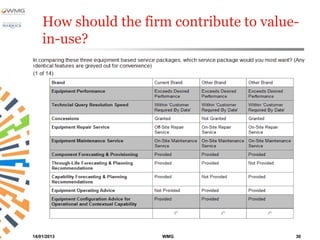
How should the firm contribute to value-
    in-use?


14/01/2013            WMG                  30
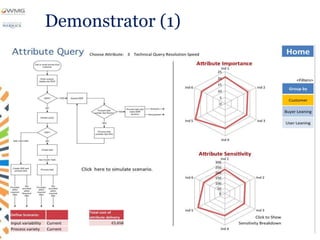
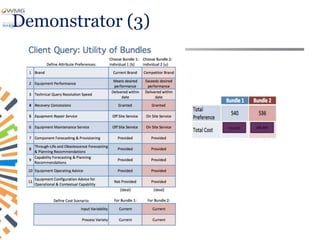
Demonstrator (1)
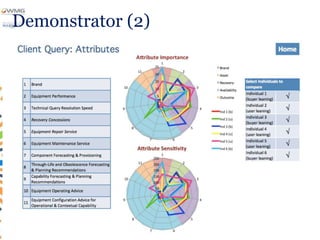
Demonstrator (2)
Demonstrator (3)


                   £99,999   £88,888
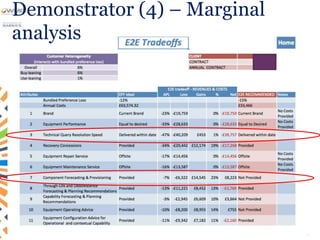
Demonstrator (4) – Marginal
analysis
Case study on value co-creation: BAE
Systems & outcome-based contracts


                  ATTAC Outcome-
                   based contract
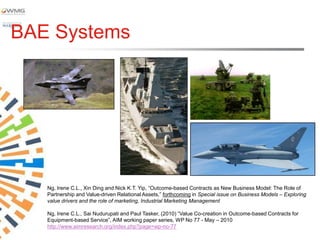
BAE Systems


   Ng, Irene C.L., Xin Ding and Nick K.T. Yip, “Outcome-based Contracts as New Business Model: The Role of
   Partnership and Value-driven Relational Assets,” forthcoming in Special issue on Business Models – Exploring
   value drivers and the role of marketing, Industrial Marketing Management

   Ng, Irene C.L., Sai Nudurupati and Paul Tasker, (2010) “Value Co-creation in Outcome-based Contracts for
   Equipment-based Service”, AIM working paper series, WP No 77 - May – 2010
   http://www.aimresearch.org/index.php?page=wp-no-77
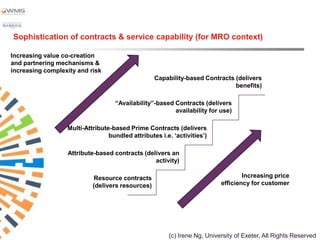
Sophistication of contracts & service capability (for MRO context)

Increasing value co-creation
and partnering mechanisms &
increasing complexity and risk
                                                  Capability-based Contracts (delivers
                                                                             benefits)

                                   “Availability”-based Contracts (delivers
                                                        availability for use)

                  Multi-Attribute-based Prime Contracts (delivers
                                 bundled attributes i.e. „activities‟)

                  Attribute-based contracts (delivers an
                                                activity)

                            Resource contracts                                    Increasing price
                           (delivers resources)                           efficiency for customer


                                                       (c) Irene Ng, University of Exeter, All Rights Reserved
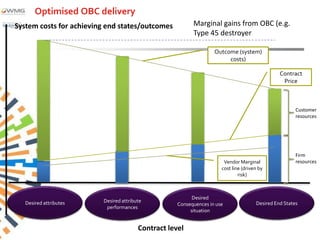
Optimised OBC delivery
System costs for achieving end states/outcomes            Marginal gains from OBC (e.g.
                                                          Type 45 destroyer

                                                                   Outcome (system)
                                                                        costs)

                                                                                                Contract
                                                                                                 Price


                                                                                                       Customer
                                                                                                       resources


                                                                                                       Firm
                                                                       Vendor Marginal                 resources
                                                                      cost line (driven by
                                                                              risk)


                                                          Desired
   Desired attributes    Desired attribute                                            Desired End States
                                                    Consequences in use
                          performances
                                                         situation


                                        Contract level
Some lessons


14 January, 2013         Copyright Irene Ng, 2012. All rights reserved.
(1) Why/when systemic costs go down
    & margins increase for OBC
    • Optimising marginal rate of technical
      substitution of skills & competencies
    • Understanding risks, location and marginal rate
      of risk impact on operational effectiveness &
      efficiency – information asymmetry – related to
      skills & competencies
    • Pain/gain shares
    • Low transaction costs (partnership competency)
    • Higher customer empowerment

14 January, 2013   Copyright Irene Ng, 2012. All rights reserved.
(2) 7 attributes of value co-creation
   (partnership competency)
• The system reflected seven attributes that enabled value co-creation
  towards outcomes (that enabled customer „use‟ to change delivery,
  enable agility, flexibility, absorption of variety)
     – Congruence of Expectations
     – Complementary Competencies
     – Process Alignment
     – Behavioural Transformation
     – Empowerment for Behavioral Transformation
     – Perceived Control
     – Behavioral Alignment
Ng, Irene C.L., Sai Nudurupati and Paul Tasker, (2010) “Value Co-creation in Outcome-based Contracts for Equipment-based
Service”, AIM working paper series, WP No 77 - May – 2010 http://www.aimresearch.org/index.php?page=wp-no-77 under second
revision for resubmission to Journal of Service Research
(3) Outcome-based Contracts are not
    the same as solutioning
    • Diferent org competency
    • Different system (open, collaborative)
    • Paradox of solutioning (engagement, emergence)
    • Solutioning is sometimes more expensive (due to
      location of risks and info asymmetry)
    • Complex outcomes vs functional complicated outcomes
    • Variety
    • COULD be pre-specified but on marginal cost of
      competencies


14 January, 2013    Copyright Irene Ng, 2012. All rights reserved.
(4) OBC change boundaries – focusing on value co-
   creation

  • Shifts the boundaries of service
  • Shifts the skills sets and capability of the firm –
    risks
  • Joint system capability of customer and firm –
    rather than drawing a boundary and sub-
    optimizing
  • Better re-configuration of resources and
    substitutability of resources
  • Major impact on human skills of the future:
    systems thinking, what we try to achieve
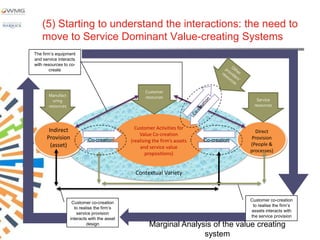
(5) Starting to understand the interactions: the need to
    move to Service Dominant Value-creating Systems
The firm‟s equipment
and service interacts
with resources to co-
        create


                                                     Customer
       Manufact                                      resources
         uring                                                                                Service
       resources                                                                             resources


       Indirect                                 Customer Activities for
                                                                                             Direct
                                                  Value Co-creation
      Provision             Co-creation       (realising the firm’s assets   Co-creation    Provision
        (asset)                                                                            (People &
                                                  and service value
                                                                                           processes)
                                                     propositions)


                                                Contextual Variety


                                                                                           Customer co-creation
                    Customer co-creation
                                                                                            to realise the firm‟s
                     to realise the firm‟s
                                                                                           assets interacts with
                       service provision
                                                                                           the service provision
                   interacts with the asset
                            design                     Marginal Analysis of the value creating
                                                                      system
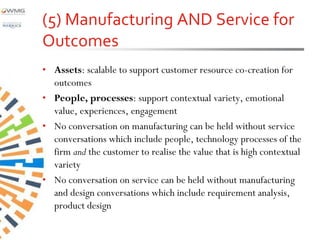
(5) Manufacturing AND Service for
Outcomes
• Assets: scalable to support customer resource co-creation for
  outcomes
• People, processes: support contextual variety, emotional
  value, experiences, engagement
• No conversation on manufacturing can be held without service
  conversations which include people, technology processes of the
  firm and the customer to realise the value that is high contextual
  variety
• No conversation on service can be held without manufacturing
  and design conversations which include requirement analysis,
  product design
Some extensions

              (aka – what we have
              been thinking about)
Boundaries

    • What do we learn from the iPhone
      as a platform
             – Every iPhone is the same
             – Every iPhone is different
    • Variety, stability & scalability
             – Between customer use resource, the
               firm’s service resource and product
               resource


14/01/2013                   WMG                 47
OBC: Issue of distributing & delegating skills
    and competencies between firm, customer

    • Boundary issue (product-service, service-
      customer, product-customer)
    • Influence on boundary: Contextually
      personalisable (variety issue) & stable in
      propositioning & growth (scalability issue)


14 January, 2013   Copyright Irene Ng, 2012. All rights reserved.
Other extensions

               New Economic Models
                for Outcome-based
                     Contracts
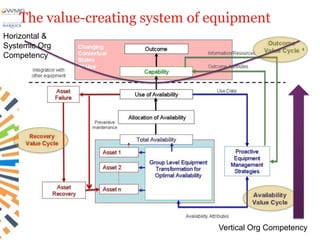
The value-creating system of equipment
Horizontal &
Systemic Org
Competency


                                  Vertical Org Competency
Systemic v Vertical business
    models
    • Influence on boundary: Challenge of
      systemic (H&V) and vertical business
      models – appropriating revenues from
      other verticals


14 January, 2013   Copyright Irene Ng, 2012. All rights reserved.
Outcome-based business &
    economic models

• Has a huge impact on sustainability (engines fly longer,
  washing machine last longer)
• Shifts the focus from manufacturing/production to
  complex service systems – human, processes, assets –
  to achieve to outcomes
• Important focus for the economy (e.g. UK) that has lost a
  lot of jobs to manufacturing, a focus to build better
  competencies and competitive advantage
• Increasingly possible because of sensor technologies
  and IoT. Buying closer to contexts (see tomorrow‟s
  presentation)
14 January, 2013   Copyright Irene Ng, 2012. All rights reserved.
Thank you


14 January, 2013   Copyright Irene Ng, 2012. All rights reserved.

Irene ngobc2013 final

  • 1.
    Introducing University ofWarwick, WMG and IIPSI Irene C L Ng Professor of Marketing & Service Systems, WMG Director, International Institute of Product & Service Innovation irene.ng@warwick.ac.uk @ireneclng http://uk.linkedin.com/in/ireneclng bit.ly/vcssblog www.warwick.ac.uk/go/sswmg www.ireneng.com
  • 2.
    The University ofWarwick Facts and ................................. Figures  Established 1965  Undergraduates 12,979  Postgraduates 10,441  League table positions – Times and Sunday Times (2012) - 8th  International students 6,411 – Guardian (2012 guide) – 6th  International students 27% – Independent (2012 guide) - 8th – RAE 2008 – 7th overall  Total staff 4,912 – QS* World University Ranking (2011) – 50th  Academic staff 687 – We aimed to be in the top 50 by 2015  International staff 25%  International working  Turnover £419m – Formal working relationships with Boston  Campus size 292 hectares University, Monash University, IIT Kharagpur, Jawaharlal Nehru University  Academic departments 28 and Nanyang Technological University  Research centres 48  Overseas alumni 44,194 * Quacquarelli Symonds Ltd
  • 3.
    WMG Research andDevelopment Centres International International Automotive Manufacturing Centre Research Centre Engineering International Digital Management Building Laboratory (IDL)
  • 4.
    New Centres International Institute for Product and Service Innovation (IIPSI)
  • 5.
  • 6.
    International Digital Laboratory Product Life-Cycle Management Robotics Digital Experiential Engineering Manufacturing Product Evaluation Technologies Embedded Systems Simulation and Modelling Cloud Computing Security Privacy Enhancing Technologies Institute for Data Loss Monitoring e-Security Vulnerability Research Trust Management Health Informatics e-Health Institute of Neural Engineering Digital Healthcare Biomedical Engineering Virtual Reality Medical Training Visualisation Digital Digital Media Technologies e-Business
  • 7.
    International Institute ofProduct & Service Innovation (IIPSI) 14 January, 2013 Copyright Irene Ng, 2012. All rights reserved.
  • 8.
    Digital Application Innovation(tech demonstrators) Cloud for Business Mobile for Business Smarter Social Media Data to Intelligence
  • 9.
    Polymer Innovation (sampletech demonstrators) Adding Functionality to Plastic Parts Low Volume Production Polymer Recycling
  • 10.
    Experience-led Innovation (sample tech demonstrators) User Focussed Product/Service Desig Customer Engagement Visitor Experience Energy Usage Behaviour 14 January, 2013 Copyright Irene Ng, 2012. All rights reserved.
  • 11.
    IIPSI Service Systems& Business+ (bootstrapping tech innovation with service science & business models research and innovation) • Technology disruptions cause challenges to existing business models (e.g. Kodak) • Adaptability, transformation needed – both for their business models (the firm’s capability to serve the market) and their economic models (the way they derive their revenues and the market exchanges they participate in) • Business+ research into value creating service systems, digitisation/virtualisation, service science, S-Dlogic (e.g. Bombardier, Rolls Royce, GSK); also into pricing/revenue models, methodology for new transactions & markets • Transdisciplinary team of social science, technology, business & engineering • 4 RCUK/EPSRC DE projects, NEMODE virtual collaboration host
  • 12.
    17 Markets Practice Scale Inform IIPSI Marketspace 2 1 corporate Mkt modularity 6 space 7 SME space Startup space Education 9 11 SME funding 8 Social Devt Science IP Passing Model, 3 Pre- 10 Student IP Passing Model, independence incubating s demonstrators 15 5 demonstrators 14 4 Research Service Systems, New Econ/Biz models 10 Experience- Digital Lower Polymer TRLs Knowledge led (software) Innovation innovation Innovation 18 Transfer & 19 Trade Tools pubs Academic Bootstrap Projects pubs 13 12 11 primary knowledge flows, 8 secondary flows
  • 13.
    Impact • created 12 new high tech start‐up businesses, • directly generated 70 new jobs, • trained over 450 small business in a range of digital technologies over the last 4 years • International publications, patents, tools etc. 14 January, 2013 Copyright Irene Ng, 2012. All rights reserved.
  • 14.
    Outcome-based Contracts asa New Business Model Research Insights from Aerospace/Defence contracts
  • 15.
    Theoretical background The ‘science’
  • 16.
    More than 200years of Goods dominant logic: Value as WORTH 14 January, 2013 Copyright Irene Ng, 2012. All rights reserved.
  • 17.
    But it wasn’texchange that made us happy. It was experiencing what we bought that gave us the outcomes we wanted We buy because of the service of the object, even if it was an emotional „service‟ i.e. things are service avatars* Mike Kuniavsky, 2010 14 January, 2013 Copyright Irene Ng, 2012. All rights reserved.
  • 18.
    But it wasn’texchange that made us happy. It was experiencing what we bought that gave us the outcomes we wanted To find ways of innovating, we need to understand value- in-use
  • 19.
    So let’s lookat this logically • We buy products to obtain benefits • What are the benefits • How do we get the benefits? • What is the role of the firm? The customer? • The GDLogic mentality of organizations.
  • 20.
    SD Logic: Theco-creation of value for outcomes/benefits/value-in-use Peace of mind Entertainment Love CO-CREATED Realise VALUE that is RESOURCES higher than proposed Enhance RESOURCES????
  • 21.
    1. Value isco-created: Customer resource to co-create needs to be a feature of design & innovation Ng, Irene C.L. (2010) “The Future of Pricing and Revenue Models”, Journal of Revenue and Pricing Management, Vol. 9, No. 3, pp276-281 Ng, Irene C.L., and Laura Smith (2012), “An Integrative Framework of Value” in Review of Marketing Research Special issue on Toward a Better Understanding of the Role of Value in Markets and Marketing, Stephen L. Vargo and Robert Lusch (Eds) Vol 9, pp 207-243
  • 22.
    From a Valueco-creation perspective, outcomes could come from several types of contract point A to B Getting from Good driving experience Drive Car Actual „outlays‟ are Other drivers Traffic resources available to co- create value
  • 23.
    Key issues invalue co-creation for outcomes • There is (perhaps) only a difference between a product and a service if you’ve already made the product • From an outcomes perspective, the key issue is (a) what should be the value proposition (combination product/service) (b) how does the firm participate in value (co)creation by the customer to achieve those outcomes and (c) how do we capture ‘worth’ ($$$). In other words – what’s the business model 14 January, 2013 Copyright Irene Ng, 2012. All rights reserved.
  • 24.
    BUSINESS MODEL Context ECONOMIC MODEL BUSINESS MODEL - Where exchanges Variety come from, what exchanges are there, person monetization Resources Value (co) Experiencing/u se of Capturing worth Money fr access, outcomes, Creation equipment ownership, personal data Resources Value prop Viability/Scal Equipment 14/01/2013 ability WMG 24
  • 25.
    Outcome-based Contracts • Somesimple analogies – English lessons, holes in the wall • More complex OBC – Rolls Royce Power by the hour ©, Availability of equipment, Popularity of a fiction collection in a library 25 (c) Irene Ng, University of Exeter, All Rights Reserved
  • 26.
    Understanding Efficient andEffective Value Co-Creation and the Marginal Analysis of Service for Outcomes The Case of Rolls Royce Smith, Laura, Irene CL Ng and Roger Maull, (2012) “The Three Value Cycles of Equipment Based Service,” Production, Planning and Control, Vol 23, Issue 7, pp1- 18, DOI:10.1080/09537287.2011.640055 Ng, Irene C.L., Glenn Parry, Roger Maull, Laura Smith, Gerard Briscoe (2012), “Transitioning from a Goods-Dominant to a Service-Dominant Logic: Visualising the Value Proposition of Rolls Royce,” Journal of Service Management, Vol 23 (3), pp416-439 Maull, Roger, Laura Smith and Irene C.L. Ng, (2012) “Servitization and Operations Management: A Service-Dominant Logic Approach”, International Journal of Operations and Production Management, forthcoming
  • 27.
    The value-creating servicesystem of equipment (the vertical)
  • 28.
    Transcending Logic ofValue Creation GD Logic Value Propositions SDLogic - Value Creating Activities (Collaborative co- (provision of assets, time and creating activities to achieve value-in-use) i.e. what we information as exchange value) do together (and with other entities) i.e. what we can sell you · Engine (asset) Equipment Performance · Time Technical Variance · Spares Technical Query Resolution · Information Repair Service Maintenance Service Parts Forecasting & Provisioning Exchange value – Installation and commissioning of equipment Value proposition as ‘units’ Through-Life and Obsolescence Planning Capability Forecasting & Planning Exchange value – Equipment Training/Operating Advice value proposition as Capability Advice firm’s contribution to value-in-use 14/01/2013 Copyright © Irene Ng, all rights reserved 28
  • 29.
    Visualising Exchange andContextual Value & Resource Integration informed by SDLogic • Visualising exchange value from value-in-use – Understanding customer choice through Conjoint Methodology • Visualising Resource Integration – S-D Logic suggest that ”resources are not, they become.” (Vargo and Lusch, 2004, p.2) – resources are only active in enabling processes. – depiction of resources as activities and the focus on process in service is the domain of operations management (Silver, 2004; Ponsignon et al. 2011) – to visualise resources as activities we first developed a process model for each of the VCAs and then developed a discrete event simulation model to visualise the impact of changes in volume and variety of inputs on the resources. 14/01/2013 WMG 29
  • 30.
    How should thefirm contribute to value- in-use? 14/01/2013 WMG 30
  • 31.
  • 32.
  • 33.
    Demonstrator (3) £99,999 £88,888
  • 34.
    Demonstrator (4) –Marginal analysis
  • 35.
    Case study onvalue co-creation: BAE Systems & outcome-based contracts ATTAC Outcome- based contract
  • 36.
    BAE Systems Ng, Irene C.L., Xin Ding and Nick K.T. Yip, “Outcome-based Contracts as New Business Model: The Role of Partnership and Value-driven Relational Assets,” forthcoming in Special issue on Business Models – Exploring value drivers and the role of marketing, Industrial Marketing Management Ng, Irene C.L., Sai Nudurupati and Paul Tasker, (2010) “Value Co-creation in Outcome-based Contracts for Equipment-based Service”, AIM working paper series, WP No 77 - May – 2010 http://www.aimresearch.org/index.php?page=wp-no-77
  • 37.
    Sophistication of contracts& service capability (for MRO context) Increasing value co-creation and partnering mechanisms & increasing complexity and risk Capability-based Contracts (delivers benefits) “Availability”-based Contracts (delivers availability for use) Multi-Attribute-based Prime Contracts (delivers bundled attributes i.e. „activities‟) Attribute-based contracts (delivers an activity) Resource contracts Increasing price (delivers resources) efficiency for customer (c) Irene Ng, University of Exeter, All Rights Reserved
  • 38.
    Optimised OBC delivery Systemcosts for achieving end states/outcomes Marginal gains from OBC (e.g. Type 45 destroyer Outcome (system) costs) Contract Price Customer resources Firm Vendor Marginal resources cost line (driven by risk) Desired Desired attributes Desired attribute Desired End States Consequences in use performances situation Contract level
  • 39.
    Some lessons 14 January,2013 Copyright Irene Ng, 2012. All rights reserved.
  • 40.
    (1) Why/when systemiccosts go down & margins increase for OBC • Optimising marginal rate of technical substitution of skills & competencies • Understanding risks, location and marginal rate of risk impact on operational effectiveness & efficiency – information asymmetry – related to skills & competencies • Pain/gain shares • Low transaction costs (partnership competency) • Higher customer empowerment 14 January, 2013 Copyright Irene Ng, 2012. All rights reserved.
  • 41.
    (2) 7 attributesof value co-creation (partnership competency) • The system reflected seven attributes that enabled value co-creation towards outcomes (that enabled customer „use‟ to change delivery, enable agility, flexibility, absorption of variety) – Congruence of Expectations – Complementary Competencies – Process Alignment – Behavioural Transformation – Empowerment for Behavioral Transformation – Perceived Control – Behavioral Alignment Ng, Irene C.L., Sai Nudurupati and Paul Tasker, (2010) “Value Co-creation in Outcome-based Contracts for Equipment-based Service”, AIM working paper series, WP No 77 - May – 2010 http://www.aimresearch.org/index.php?page=wp-no-77 under second revision for resubmission to Journal of Service Research
  • 42.
    (3) Outcome-based Contractsare not the same as solutioning • Diferent org competency • Different system (open, collaborative) • Paradox of solutioning (engagement, emergence) • Solutioning is sometimes more expensive (due to location of risks and info asymmetry) • Complex outcomes vs functional complicated outcomes • Variety • COULD be pre-specified but on marginal cost of competencies 14 January, 2013 Copyright Irene Ng, 2012. All rights reserved.
  • 43.
    (4) OBC changeboundaries – focusing on value co- creation • Shifts the boundaries of service • Shifts the skills sets and capability of the firm – risks • Joint system capability of customer and firm – rather than drawing a boundary and sub- optimizing • Better re-configuration of resources and substitutability of resources • Major impact on human skills of the future: systems thinking, what we try to achieve
  • 44.
    (5) Starting tounderstand the interactions: the need to move to Service Dominant Value-creating Systems The firm‟s equipment and service interacts with resources to co- create Customer Manufact resources uring Service resources resources Indirect Customer Activities for Direct Value Co-creation Provision Co-creation (realising the firm’s assets Co-creation Provision (asset) (People & and service value processes) propositions) Contextual Variety Customer co-creation Customer co-creation to realise the firm‟s to realise the firm‟s assets interacts with service provision the service provision interacts with the asset design Marginal Analysis of the value creating system
  • 45.
    (5) Manufacturing ANDService for Outcomes • Assets: scalable to support customer resource co-creation for outcomes • People, processes: support contextual variety, emotional value, experiences, engagement • No conversation on manufacturing can be held without service conversations which include people, technology processes of the firm and the customer to realise the value that is high contextual variety • No conversation on service can be held without manufacturing and design conversations which include requirement analysis, product design
  • 46.
    Some extensions (aka – what we have been thinking about)
  • 47.
    Boundaries • What do we learn from the iPhone as a platform – Every iPhone is the same – Every iPhone is different • Variety, stability & scalability – Between customer use resource, the firm’s service resource and product resource 14/01/2013 WMG 47
  • 48.
    OBC: Issue ofdistributing & delegating skills and competencies between firm, customer • Boundary issue (product-service, service- customer, product-customer) • Influence on boundary: Contextually personalisable (variety issue) & stable in propositioning & growth (scalability issue) 14 January, 2013 Copyright Irene Ng, 2012. All rights reserved.
  • 49.
    Other extensions New Economic Models for Outcome-based Contracts
  • 50.
    The value-creating systemof equipment Horizontal & Systemic Org Competency Vertical Org Competency
  • 51.
    Systemic v Verticalbusiness models • Influence on boundary: Challenge of systemic (H&V) and vertical business models – appropriating revenues from other verticals 14 January, 2013 Copyright Irene Ng, 2012. All rights reserved.
  • 52.
    Outcome-based business & economic models • Has a huge impact on sustainability (engines fly longer, washing machine last longer) • Shifts the focus from manufacturing/production to complex service systems – human, processes, assets – to achieve to outcomes • Important focus for the economy (e.g. UK) that has lost a lot of jobs to manufacturing, a focus to build better competencies and competitive advantage • Increasingly possible because of sensor technologies and IoT. Buying closer to contexts (see tomorrow‟s presentation)
  • 53.
    14 January, 2013 Copyright Irene Ng, 2012. All rights reserved.
  • 54.
    14 January, 2013 Copyright Irene Ng, 2012. All rights reserved.
  • 55.
    Thank you 14 January,2013 Copyright Irene Ng, 2012. All rights reserved.

Editor's Notes

  • #9 Product and Service Evaluation Energy Usage InitiativesVisitor Experience Technology Smarter Social MediaCloud Solutions Mobile TechnologyData Intelligence Smart MaterialsPlastic ElectronicsAdvanced ALM Capability
  • #10 Product and Service Evaluation Energy Usage InitiativesVisitor Experience Technology Smarter Social MediaCloud Solutions Mobile TechnologyData Intelligence Smart MaterialsPlastic ElectronicsAdvanced ALM Capability
  • #32 Links value to cost for each attribute - can assess these delivery processes and costs against the customer value for that specific feature/attribute …Importance and sensitivity of each attribute for different customersSimulation models to estimate resource utilisation and process costs (Impact of arrival variability (“when”) and request variability (“what”) on resources and costs)
  • #33 Individuals are different (i.e. User and Buyer)Importance of individual attributes across the customer community (Shows that different people in the customer community value service attributes differently) useful for bundling/packaging the offering
  • #34 Assess Value of service bundles against Costs of delivering these bundles: how much value I create with the customer and how much it costs me to create that valueIt is possible to manipulate service bundles to compare customer preferences and their impact on cost (total cost of delivery for a bundle / value)Bundle preferences could compared for one individual or between two individuals
  • #35 The tool brings the supply and demand data together to recommend an optimal bundle, balancing the total cost of delivery with the value proposed across the customer group (Best mix of requirements for the customer group,)3: Not delivered within date  value loss of 47%  40K  Cost savings: 453£  Marginal Loss: 40k. Keep it in the bundle7:  value loss of 7%  6k  costs reduction of 14k  Remove from bundle?