University Support for Industry Collaboration


             Peter Lancaster
Recap


  • KTN
    – Knowledge Transfer Network


  • KTP
    – Knowledge Transfer Partnerships


  • KTA
    – Knowledge Transfer Account
KTN


      • Fostering global economic
        performance and specifically
        economic competition in the
        UK.


      • Increasing the effectiveness of
        public services and policy.
      • Enhancing quality of life,
        health and creative output.
Knowledge Transfer Partnerships

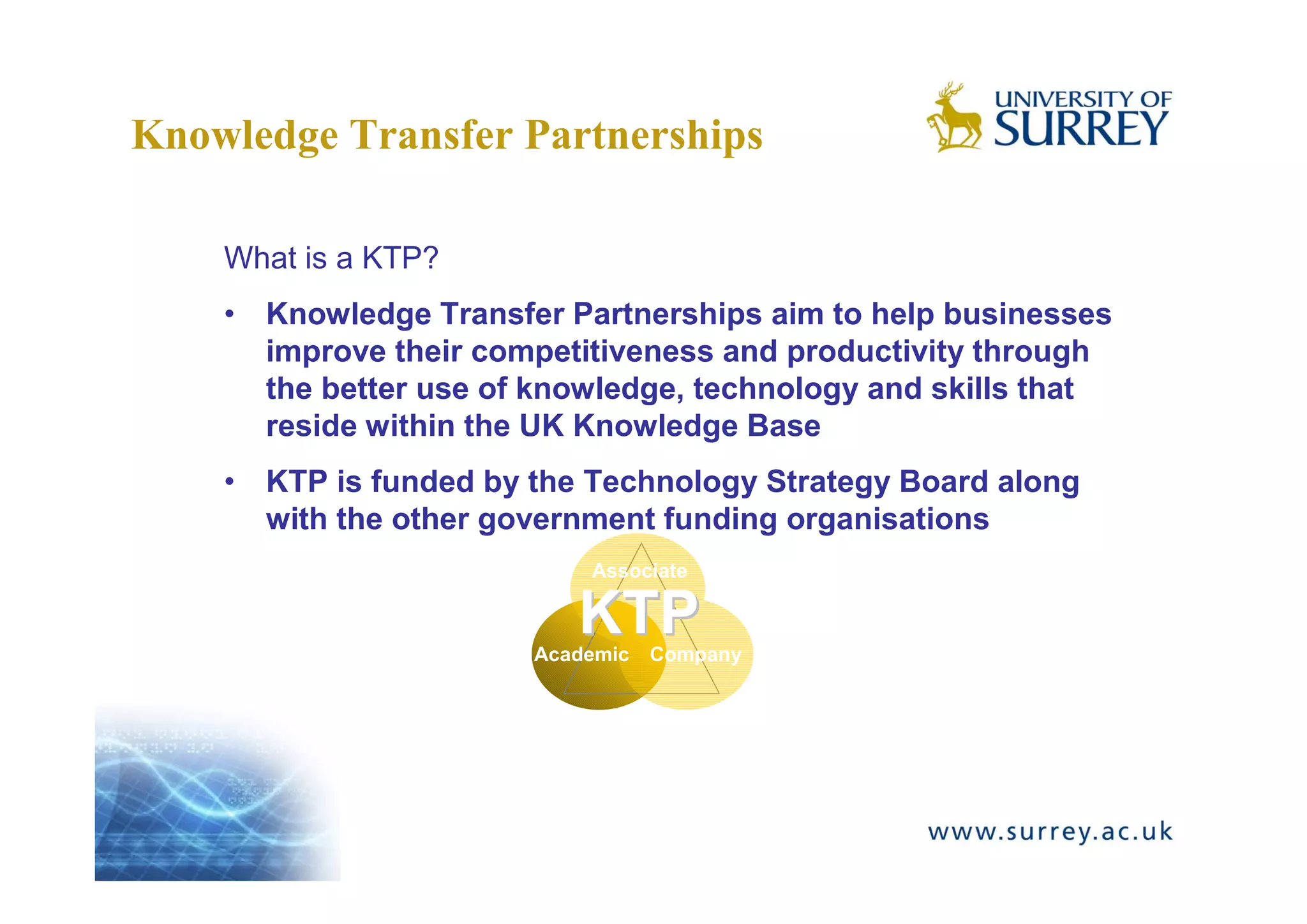
    What is a KTP?
    • Knowledge Transfer Partnerships aim to help businesses
      improve their competitiveness and productivity through
      the better use of knowledge, technology and skills that
      reside within the UK Knowledge Base
    • KTP is funded by the Technology Strategy Board along
      with the other government funding organisations
                           Associate

                          KTP
                       Academic   Company
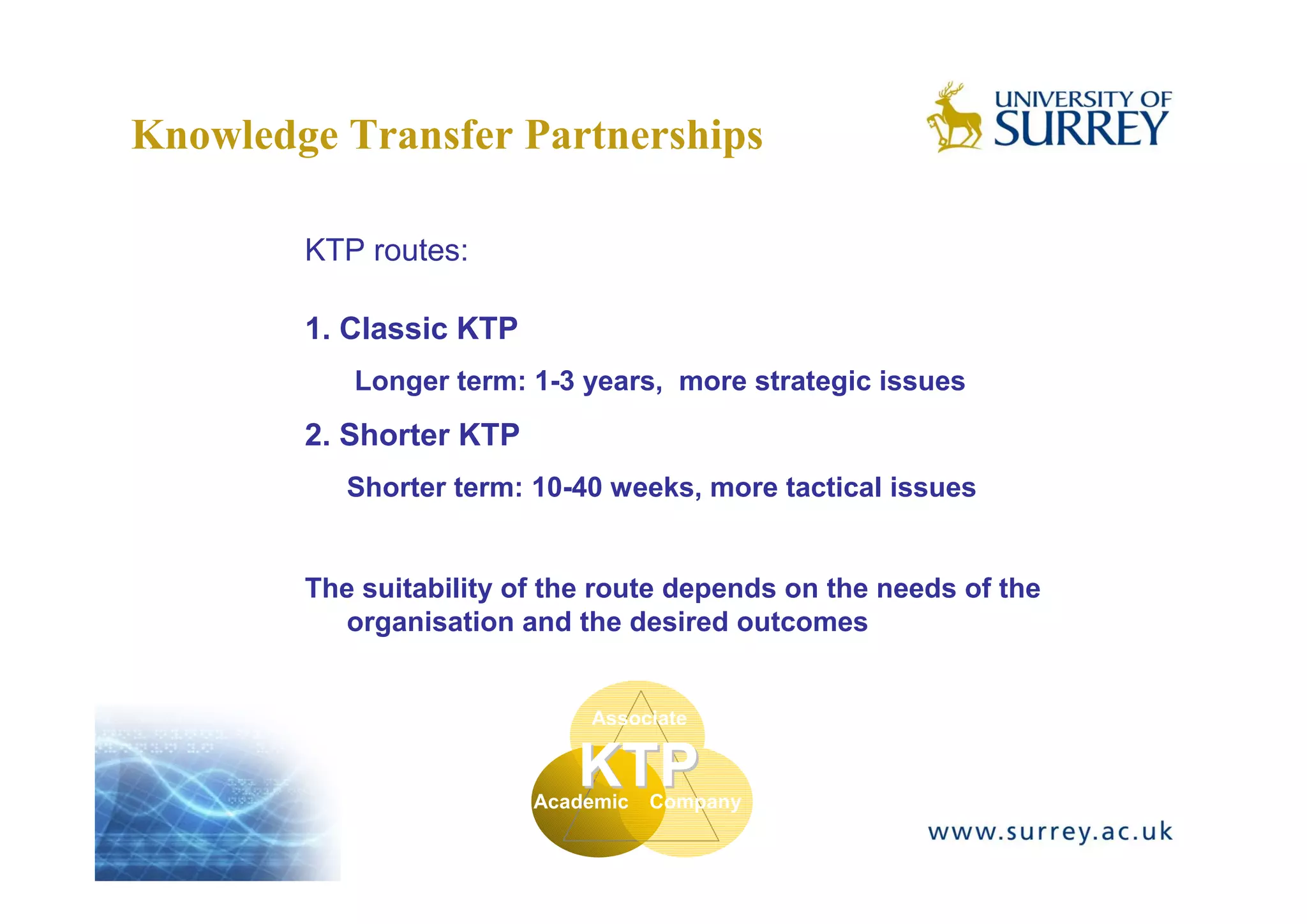
Knowledge Transfer Partnerships

        KTP routes:

        1. Classic KTP
           Longer term: 1-3 years, more strategic issues
        2. Shorter KTP
           Shorter term: 10-40 weeks, more tactical issues


        The suitability of the route depends on the needs of the
          organisation and the desired outcomes


                             Associate


                            KTP
                         Academic   Company
Industrial CASE Awards


  • Funding for PhD studentships where businesses take the
    lead in arranging projects with an academic partner of their
    choice.
  • Company decides the research project
  • £7K/year from the company
  • £22K/year from EPSRC/RDA etc.
IDC - Sustainability for Engineering
and Energy Systems


  • Engineering Doctorate Programme
  • Alternative to traditional PhDs
  • A four-year programme combines PhD-level research
    projects with taught courses
  • Students spend about 75% of their time working with a
    company
  • Company contribution - £12 K/year
Technology Strategy Board
Collaborative funding


  • Harnessing Large and Diverse Sources of Data – closes 21/10/10
  • Metadata: increasing the value of digital content – fast-track and
     mainstream competitions, briefing event on Thurs
  • Technology-Inspired Collaborative Research and
    Development – opens 12/10/10
      –   Advanced Materials
      –   Biosciences
      –   Electronics, Photonics and Electrical Systems
      –   High Value Manufacturing
      –   Information and Communications Technology
      –   Nanotechnology
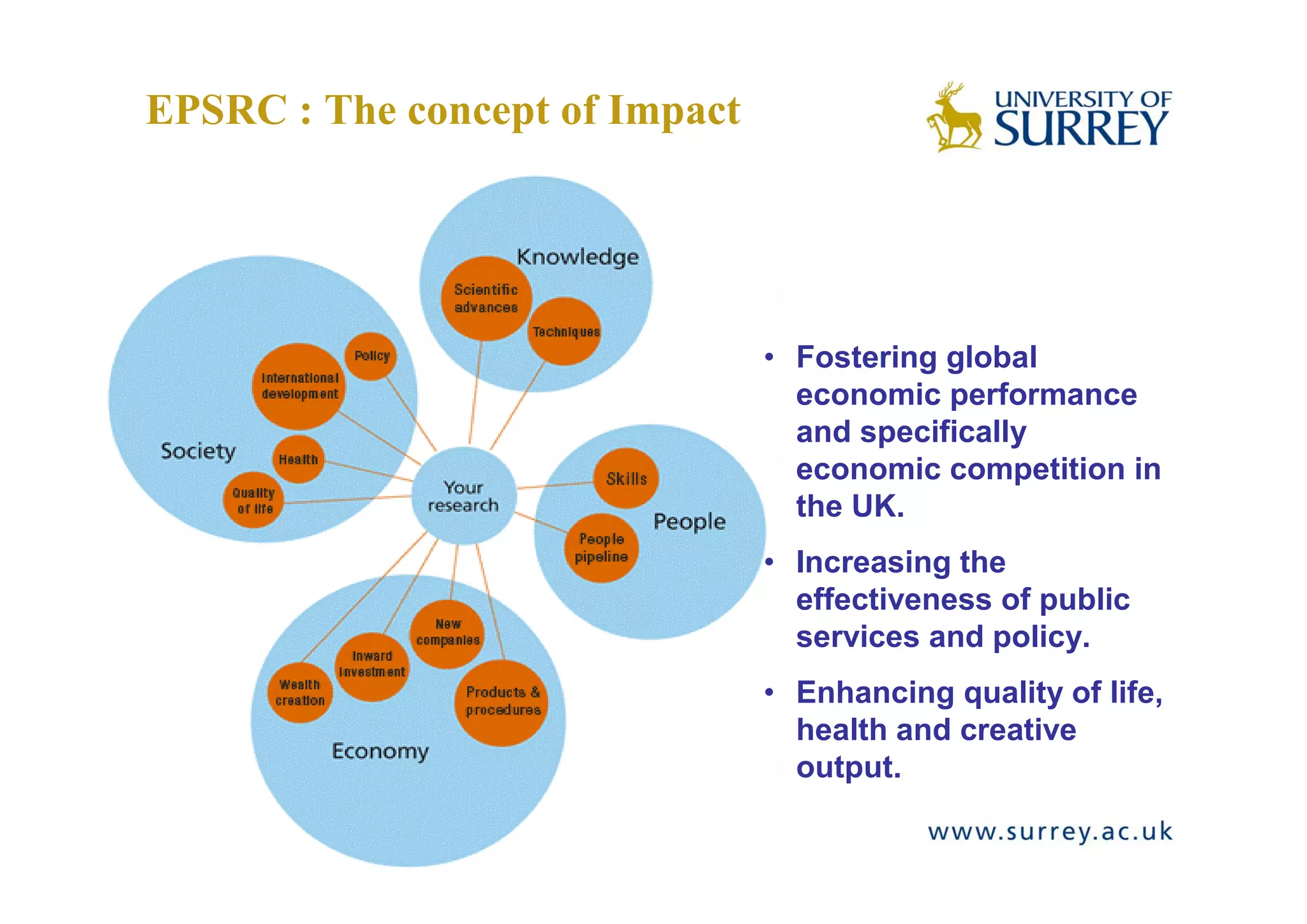
EPSRC : The concept of Impact


                                • Fostering global
                                  economic performance
                                  and specifically
                                  economic competition in
                                  the UK.
                                • Increasing the
                                  effectiveness of public
                                  services and policy.
                                • Enhancing quality of life,
                                  health and creative
                                  output.
EPSRC Follow on Fund
  • Turn research outputs into a commercial proposition.
  • Up to 12 months support for technical and business
    development activities
  • Demonstrate commercial feasibility and scientific/technical
    merit
  • Last call closed 6 August 2010
  • Next call: Closing date February 2011
Knowledge Transfer Account
(KTA)
Exploiting Excellence through Innovation
What does KTA do?


  1. Extending the Technology Readiness Level

  2. Making proven concepts ready for investments

  3. Solving specific industrial challenges
How?

  • Increasing Engagement

  • Accelerating Exploitation

  • Demonstrating Impact

       •   Communications & Signal Processing
       •   Nanotechnology & Photonics
       •   Next Generation Materials & Characterisation
Increasing Engagement


  •   Identify markets in which University research can be applied
  •   Identify and engage with suitable companies and organisations
  •   Facilitate knowledge exchange
  •   Interface between business needs and the knowledge base
  •   Build processes to enable closer engagement and knowledge
      exchange
Accelerating Exploitation

  • We have funds
     – But
  • Principle of co-funding
     – 50% contribution from large organisations
     – 25% contribution from SMEs
  • What for?
     – Proof-of-Concepts/prototyping
     – Placements
     – Training/CPD development
     – Targeted, specific market research
     – Demonstrators – larger, multi-partner projects
     – Horizon scanning workshops.
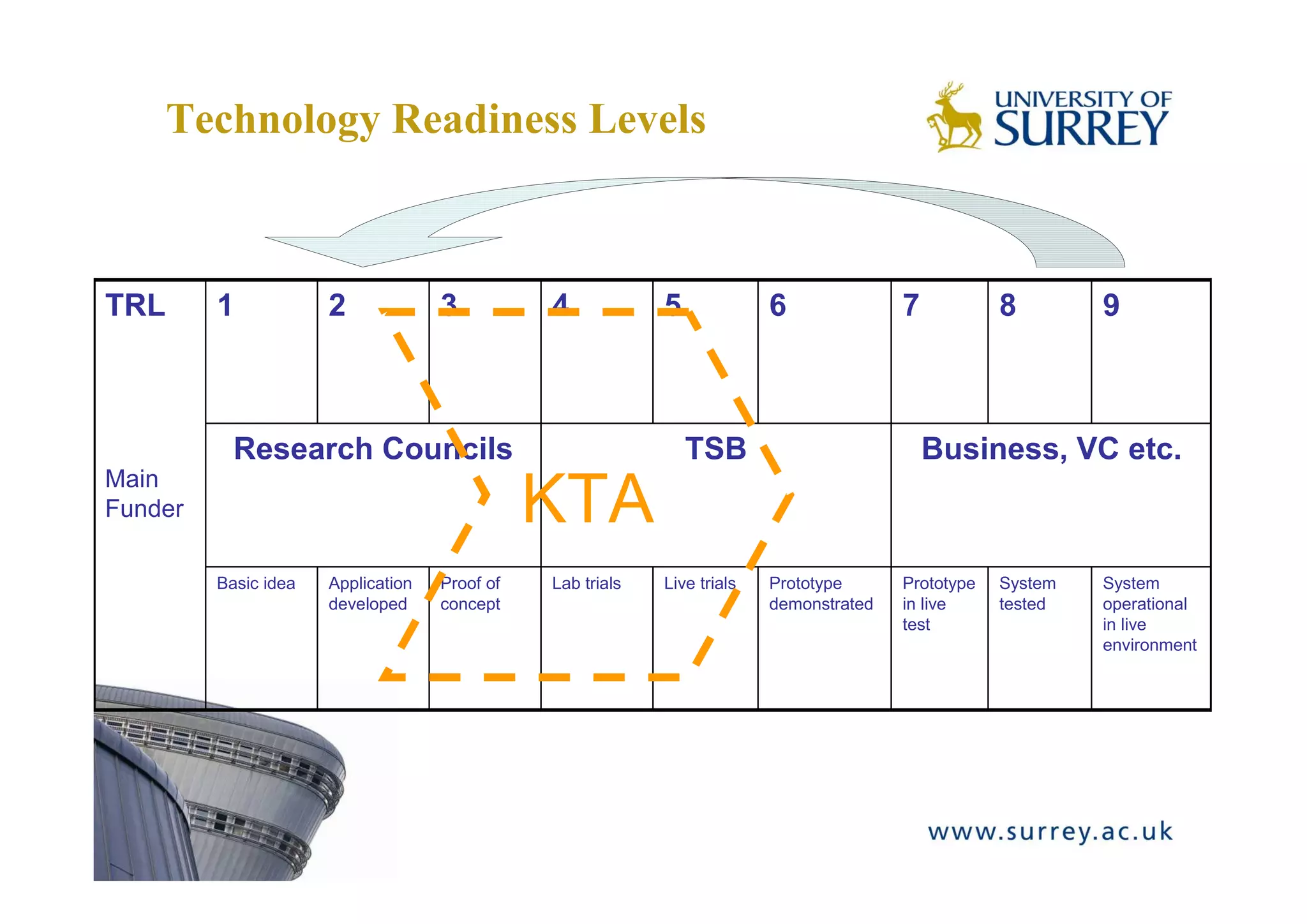
  • Filling in the TRL gap—levels 3-5
Technology Readiness Levels


TRL      1            2             3          4            5             6              7           8        9


           Research Councils                                    TSB                          Business, VC etc.
Main
Funder                                         KTA
         Basic idea   Application   Proof of   Lab trials   Live trials   Prototype      Prototype   System   System
                      developed     concept                               demonstrated   in live     tested   operational
                                                                                         test                 in live
                                                                                                              environment
Demonstrating Impact


  • Show what we can do

  • Create a sustainable and self-perpetuating environment
       For business and the University
Funded Projects
•   Integration of biologically inspired algorithms for real-time image analysis into
    commercial image-processing systems to enable field trials. With a local signal
    processing SME
•   Demonstrator hardware for improved induction-loop hearing aid system, solving the
    “cocktail-party problem” in meeting rooms and conferences. With RNID
•   Development of a technology demonstrator for computer game animation engine.
    Space technology spin-off. Joint funding with other agencies.
•   Application of novel analysis techniques to greenhouse gas modelling in the
    agricultural sector.
•   Trials at a major hospital of a new approach to screening retinal images for signs of
    diabetes
•   Part-funding a placement of a researcher at a film production house to transfer
    knowledge on video capture to the company and receive knowledge of commercial
    methods and priorities.
•   Development of investment potential profiling system, based on web-mining
    technology. With UKTI.
Pending Projects
•   Adaptation of concept proved in an open-source software package, for use with
    Microsoft Office
•   Development and commercial testing of algorithms for improving tracking of facial
    features
•   Development of a Future Networks Demonstrator to enable trialling of next-
    generation content delivery and internet services. Joint funding with other agencies.
•   Testing of an interactive, web-based learning system with local organisations
•   Market research to focus the potential adaptation of space robotics technologies to
    other market areas
Conclusion
  • KTA is industry friendly

  • It can fund significant proportion of the development
    cost

  • Reduces the risk to the company

  • It adopts both technology push and market pull
    approaches
Communications & Signal Processing
Platform

Knowledge Transfer Account (KTA)
Research Strengths of the Platform
Area

  • Centre for Communication Systems Research – CCSR

  • The Centre for Vision, Speech and Signal Processing – CVSSP

  • Computing

  • Surrey Space Centre

  • Centre for Environmental Strategy

  • Digital World Research Centre

  Others
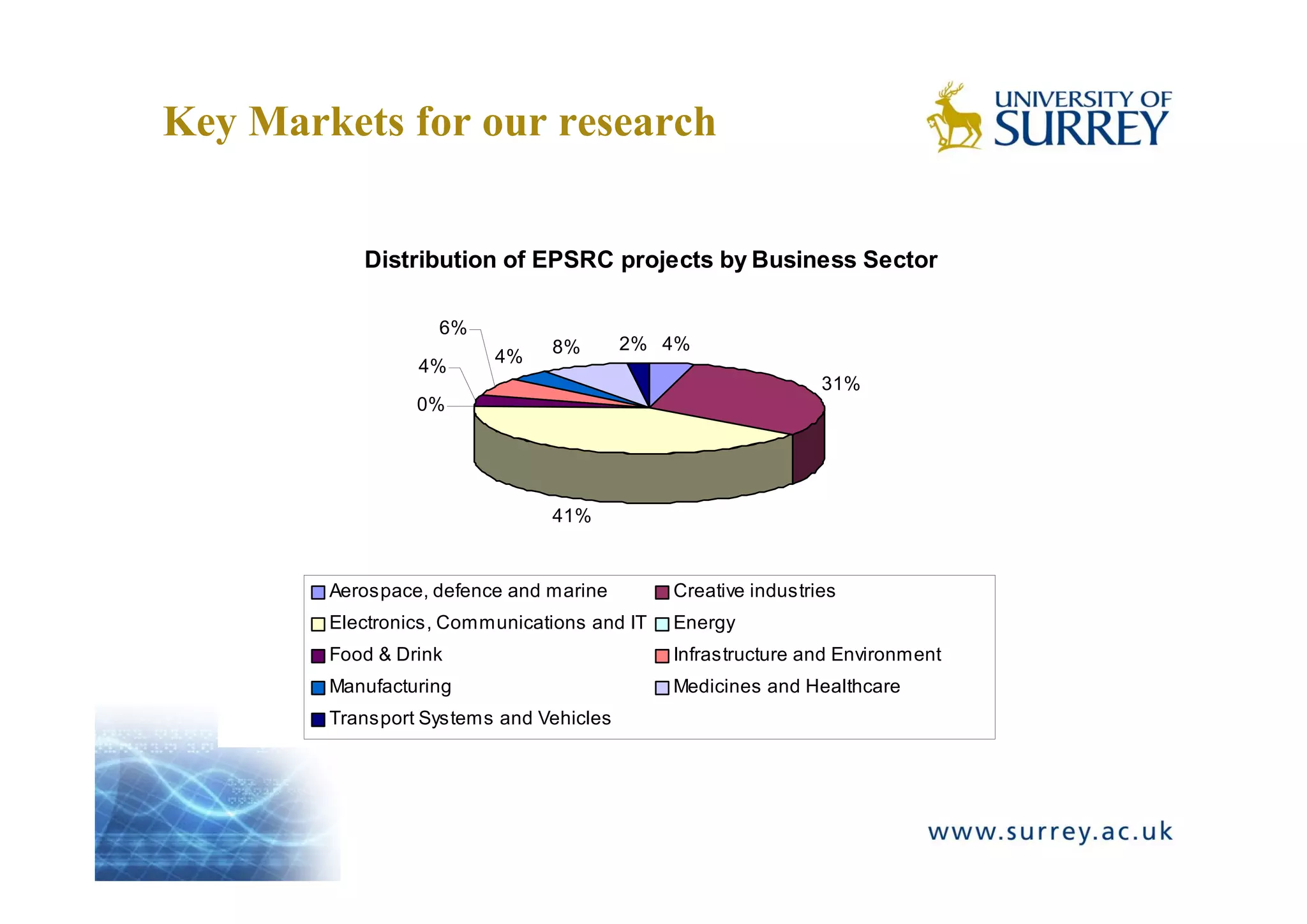
Key Markets for our research


           Distribution of EPSRC projects by Business Sector

                   6%
                               8%        2% 4%
                         4%
                 4%
                                                              31%
                 0%


                               41%


        Aerospace, defence and marine        Creative industries
        Electronics, Communications and IT   Energy
        Food & Drink                         Infrastructure and Environment
        Manufacturing                        Medicines and Healthcare
        Transport Systems and Vehicles
Communications & Signal Processing
  Research-Application mapping:
  •   Creative Industries:
       – Video processing with applications in television, film production,
         animation and games production
       – Optimisation of the transmission of digital content using various
         media and device types
       – Audio quality and perception
  •   High Value Services:
       – Complex systems, particularly relating to the interactions between
         computer systems, users and their environment
       – Secure communications systems
       – Image and video security and analysis
  •   Healthcare:
       – Signal and image processing for automated screening applications,
         and for assisted living applications
       – Communication systems as an enabler for applications such as tele-
         health
Communications & Signal Processing
  Research-Application mapping:
  • Environmental Sustainability:
       – Use of communications and systems analysis to enable energy &
         resource efficient systems
       – Novel methods for carbon footprint measurement.
       – Earth observation analysis
  •   Digital:
       –   Semantic web research
       –   Pervasive sensor networks and the “Internet of Things”
       –   Cognitive communications systems
       –   Next generation networks and communications
       –   Human factors in IT systems (trust, security, usability etc.)
       –   Sociological effects of digital media, content and dissemination
           systems
Centre for Communications Systems
Research – CCSR
Prof. Rahim Tafazolli, Director

         Mobile/wireless, fixed networks and satellite systems
         •   Advanced air-interfaces
         •   Flexible and self organising networks – ad-hoc, Femtocells
         •   Cognitive Radio and Dynamic Spectrum Allocation
         •   Energy and environmental systems design
         •   Future Generation Internet Studies
         •   Mobile antennas
         •   Propagation measurements and modelling – indoor/outdoor and
             satellite
         •   End-to-end security systems
         •   Sensor networks from protocols to services
         •   Web based service provision and service platforms
         •   Advanced satellite communications/networking and payload
             technologies
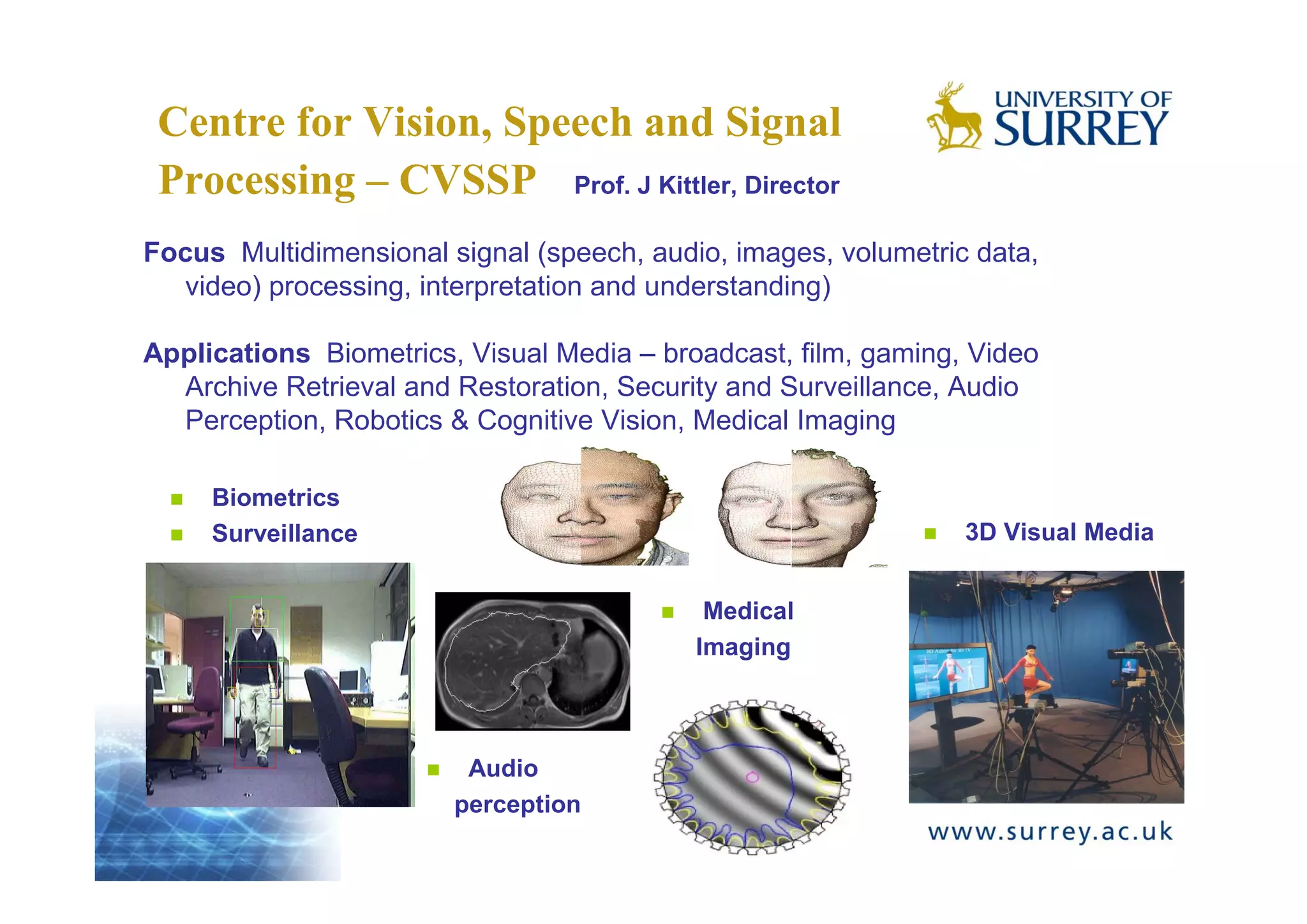
Centre for Vision, Speech and Signal
 Processing – CVSSP Prof. J Kittler, Director
Focus Multidimensional signal (speech, audio, images, volumetric data,
  video) processing, interpretation and understanding)

Applications Biometrics, Visual Media – broadcast, film, gaming, Video
  Archive Retrieval and Restoration, Security and Surveillance, Audio
  Perception, Robotics & Cognitive Vision, Medical Imaging

     Biometrics
     Surveillance                                               3D Visual Media


                                            Medical
                                           Imaging


                         Audio
                        perception
Computing
Prof. Paul Krause, Prof. of Software Engineering

               Formal Methods and Security
               • high-integrity systems development
               • formal analysis of security protocols
               • multimedia security

               Digital Ecosystems
               • mass-market interactive computing
               • P2P networks for open e-business communities
               • automated reasoning about software systems
               • complex reactive systems

               Nature Inspired Computing and Engineering
               • image processing and mining
               • information retrieval and knowledge extraction
               • modelling and analysis of genetic and metabolic networks for
               drug design and disease analysis
               • aerodynamic structure design
               • multi-criterion optimization and decision-making
Surrey Space Centre – SSC
Dr Craig Underwood, Director


            Signal Processing & Communications:
                – GNSS Reflectometry; Galileo Signal Processing
                – Control algorithms & techniques
                – Smart Antennas; High Efficiency RF
                – Data Encryption & Compression
                – Wireless Sensor Networks
                – Machine Vision for Navigation
                – Laser & RF Inter-Satellite Links
                – Wireless On-Board Data Bus
Centre for Environmental Strategy
CES - Professor Matthew Leach, Director
Approaches/themes:-
• sustainable systems: tools for analysis
      eg LCA, carbon footprinting, agent-based models, multi-criteria
      methods
• social research on sustainability
      values, attitudes, behaviours. Linked to departments of Psychology,
      Sociology, Economics
• policy/governance and corporate strategy for sustainability
      risk, roles of innovation, CSR, communication, regulation
Applied (largely) to:-
• systems analysis for lower carbon processes & products
• low carbon energy systems
• water resources and policy
• lifestyles and environment
Digital World Research Centre
Prof. David Frohlich, Director


 •   multi-disciplinary team:
     including sociology, anthropology, psychology, interaction design/HCI,
     media design, computer science and communications

 •   focusing on:
     user-centred innovation in digital technology for the consumer market

                                   citizen journalism as
                                   a route to digital
                                   inclusion


                                                           audio-visual story
                                                           sharing in an Indian
             IT use in older                               village community
             people
Contact

          Peter Lancaster
          peter.lancaster@npl.co.uk
          07738 895464

          Communications & Signal Processing
          University of Surrey Knowledge Transfer Account
          www.surrey.ac.uk/kta

          University of Surrey
          Research & Enterprise Support
          www.surrey.ac.uk/res

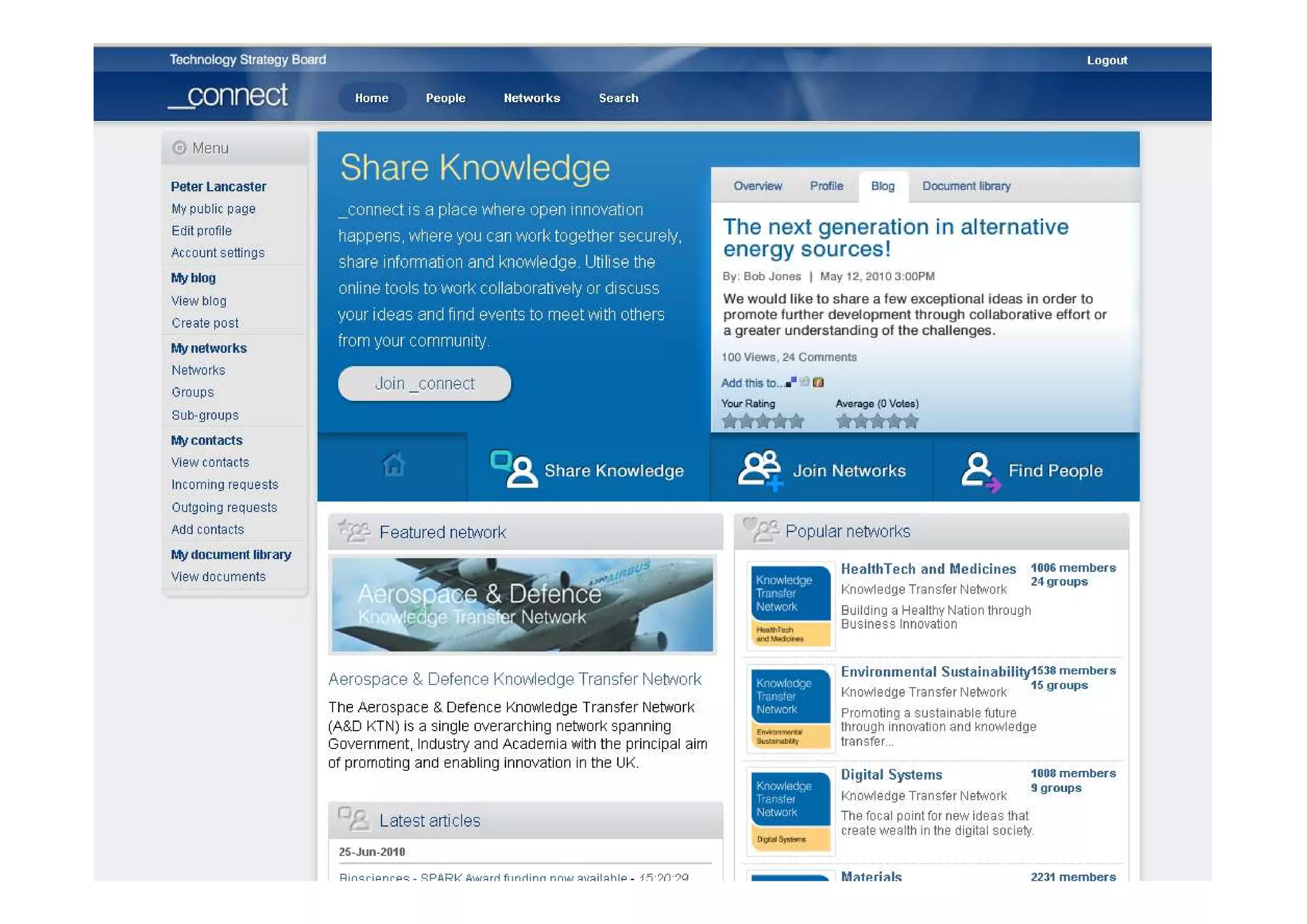
          Knowledge Transfer Networks
          http://ktn.innovateuk.org/

University support for industry collaboration

  • 1.
    University Support forIndustry Collaboration Peter Lancaster
  • 2.
    Recap •KTN – Knowledge Transfer Network • KTP – Knowledge Transfer Partnerships • KTA – Knowledge Transfer Account
  • 3.
    KTN • Fostering global economic performance and specifically economic competition in the UK. • Increasing the effectiveness of public services and policy. • Enhancing quality of life, health and creative output.
  • 4.
    Knowledge Transfer Partnerships What is a KTP? • Knowledge Transfer Partnerships aim to help businesses improve their competitiveness and productivity through the better use of knowledge, technology and skills that reside within the UK Knowledge Base • KTP is funded by the Technology Strategy Board along with the other government funding organisations Associate KTP Academic Company
  • 5.
    Knowledge Transfer Partnerships KTP routes: 1. Classic KTP Longer term: 1-3 years, more strategic issues 2. Shorter KTP Shorter term: 10-40 weeks, more tactical issues The suitability of the route depends on the needs of the organisation and the desired outcomes Associate KTP Academic Company
  • 6.
    Industrial CASE Awards • Funding for PhD studentships where businesses take the lead in arranging projects with an academic partner of their choice. • Company decides the research project • £7K/year from the company • £22K/year from EPSRC/RDA etc.
  • 7.
    IDC - Sustainabilityfor Engineering and Energy Systems • Engineering Doctorate Programme • Alternative to traditional PhDs • A four-year programme combines PhD-level research projects with taught courses • Students spend about 75% of their time working with a company • Company contribution - £12 K/year
  • 8.
    Technology Strategy Board Collaborativefunding • Harnessing Large and Diverse Sources of Data – closes 21/10/10 • Metadata: increasing the value of digital content – fast-track and mainstream competitions, briefing event on Thurs • Technology-Inspired Collaborative Research and Development – opens 12/10/10 – Advanced Materials – Biosciences – Electronics, Photonics and Electrical Systems – High Value Manufacturing – Information and Communications Technology – Nanotechnology
  • 9.
    EPSRC : Theconcept of Impact • Fostering global economic performance and specifically economic competition in the UK. • Increasing the effectiveness of public services and policy. • Enhancing quality of life, health and creative output.
  • 10.
    EPSRC Follow onFund • Turn research outputs into a commercial proposition. • Up to 12 months support for technical and business development activities • Demonstrate commercial feasibility and scientific/technical merit • Last call closed 6 August 2010 • Next call: Closing date February 2011
  • 11.
    Knowledge Transfer Account (KTA) ExploitingExcellence through Innovation
  • 12.
    What does KTAdo? 1. Extending the Technology Readiness Level 2. Making proven concepts ready for investments 3. Solving specific industrial challenges
  • 13.
    How? •Increasing Engagement • Accelerating Exploitation • Demonstrating Impact • Communications & Signal Processing • Nanotechnology & Photonics • Next Generation Materials & Characterisation
  • 14.
    Increasing Engagement • Identify markets in which University research can be applied • Identify and engage with suitable companies and organisations • Facilitate knowledge exchange • Interface between business needs and the knowledge base • Build processes to enable closer engagement and knowledge exchange
  • 15.
    Accelerating Exploitation • We have funds – But • Principle of co-funding – 50% contribution from large organisations – 25% contribution from SMEs • What for? – Proof-of-Concepts/prototyping – Placements – Training/CPD development – Targeted, specific market research – Demonstrators – larger, multi-partner projects – Horizon scanning workshops. • Filling in the TRL gap—levels 3-5
  • 16.
    Technology Readiness Levels TRL 1 2 3 4 5 6 7 8 9 Research Councils TSB Business, VC etc. Main Funder KTA Basic idea Application Proof of Lab trials Live trials Prototype Prototype System System developed concept demonstrated in live tested operational test in live environment
  • 17.
    Demonstrating Impact • Show what we can do • Create a sustainable and self-perpetuating environment For business and the University
  • 18.
    Funded Projects • Integration of biologically inspired algorithms for real-time image analysis into commercial image-processing systems to enable field trials. With a local signal processing SME • Demonstrator hardware for improved induction-loop hearing aid system, solving the “cocktail-party problem” in meeting rooms and conferences. With RNID • Development of a technology demonstrator for computer game animation engine. Space technology spin-off. Joint funding with other agencies. • Application of novel analysis techniques to greenhouse gas modelling in the agricultural sector. • Trials at a major hospital of a new approach to screening retinal images for signs of diabetes • Part-funding a placement of a researcher at a film production house to transfer knowledge on video capture to the company and receive knowledge of commercial methods and priorities. • Development of investment potential profiling system, based on web-mining technology. With UKTI.
  • 19.
    Pending Projects • Adaptation of concept proved in an open-source software package, for use with Microsoft Office • Development and commercial testing of algorithms for improving tracking of facial features • Development of a Future Networks Demonstrator to enable trialling of next- generation content delivery and internet services. Joint funding with other agencies. • Testing of an interactive, web-based learning system with local organisations • Market research to focus the potential adaptation of space robotics technologies to other market areas
  • 20.
    Conclusion •KTA is industry friendly • It can fund significant proportion of the development cost • Reduces the risk to the company • It adopts both technology push and market pull approaches
  • 21.
    Communications & SignalProcessing Platform Knowledge Transfer Account (KTA)
  • 22.
    Research Strengths ofthe Platform Area • Centre for Communication Systems Research – CCSR • The Centre for Vision, Speech and Signal Processing – CVSSP • Computing • Surrey Space Centre • Centre for Environmental Strategy • Digital World Research Centre Others
  • 23.
    Key Markets forour research Distribution of EPSRC projects by Business Sector 6% 8% 2% 4% 4% 4% 31% 0% 41% Aerospace, defence and marine Creative industries Electronics, Communications and IT Energy Food & Drink Infrastructure and Environment Manufacturing Medicines and Healthcare Transport Systems and Vehicles
  • 24.
    Communications & SignalProcessing Research-Application mapping: • Creative Industries: – Video processing with applications in television, film production, animation and games production – Optimisation of the transmission of digital content using various media and device types – Audio quality and perception • High Value Services: – Complex systems, particularly relating to the interactions between computer systems, users and their environment – Secure communications systems – Image and video security and analysis • Healthcare: – Signal and image processing for automated screening applications, and for assisted living applications – Communication systems as an enabler for applications such as tele- health
  • 25.
    Communications & SignalProcessing Research-Application mapping: • Environmental Sustainability: – Use of communications and systems analysis to enable energy & resource efficient systems – Novel methods for carbon footprint measurement. – Earth observation analysis • Digital: – Semantic web research – Pervasive sensor networks and the “Internet of Things” – Cognitive communications systems – Next generation networks and communications – Human factors in IT systems (trust, security, usability etc.) – Sociological effects of digital media, content and dissemination systems
  • 26.
    Centre for CommunicationsSystems Research – CCSR Prof. Rahim Tafazolli, Director Mobile/wireless, fixed networks and satellite systems • Advanced air-interfaces • Flexible and self organising networks – ad-hoc, Femtocells • Cognitive Radio and Dynamic Spectrum Allocation • Energy and environmental systems design • Future Generation Internet Studies • Mobile antennas • Propagation measurements and modelling – indoor/outdoor and satellite • End-to-end security systems • Sensor networks from protocols to services • Web based service provision and service platforms • Advanced satellite communications/networking and payload technologies
  • 27.
    Centre for Vision,Speech and Signal Processing – CVSSP Prof. J Kittler, Director Focus Multidimensional signal (speech, audio, images, volumetric data, video) processing, interpretation and understanding) Applications Biometrics, Visual Media – broadcast, film, gaming, Video Archive Retrieval and Restoration, Security and Surveillance, Audio Perception, Robotics & Cognitive Vision, Medical Imaging Biometrics Surveillance 3D Visual Media Medical Imaging Audio perception
  • 28.
    Computing Prof. Paul Krause,Prof. of Software Engineering Formal Methods and Security • high-integrity systems development • formal analysis of security protocols • multimedia security Digital Ecosystems • mass-market interactive computing • P2P networks for open e-business communities • automated reasoning about software systems • complex reactive systems Nature Inspired Computing and Engineering • image processing and mining • information retrieval and knowledge extraction • modelling and analysis of genetic and metabolic networks for drug design and disease analysis • aerodynamic structure design • multi-criterion optimization and decision-making
  • 29.
    Surrey Space Centre– SSC Dr Craig Underwood, Director Signal Processing & Communications: – GNSS Reflectometry; Galileo Signal Processing – Control algorithms & techniques – Smart Antennas; High Efficiency RF – Data Encryption & Compression – Wireless Sensor Networks – Machine Vision for Navigation – Laser & RF Inter-Satellite Links – Wireless On-Board Data Bus
  • 30.
    Centre for EnvironmentalStrategy CES - Professor Matthew Leach, Director Approaches/themes:- • sustainable systems: tools for analysis eg LCA, carbon footprinting, agent-based models, multi-criteria methods • social research on sustainability values, attitudes, behaviours. Linked to departments of Psychology, Sociology, Economics • policy/governance and corporate strategy for sustainability risk, roles of innovation, CSR, communication, regulation Applied (largely) to:- • systems analysis for lower carbon processes & products • low carbon energy systems • water resources and policy • lifestyles and environment
  • 31.
    Digital World ResearchCentre Prof. David Frohlich, Director • multi-disciplinary team: including sociology, anthropology, psychology, interaction design/HCI, media design, computer science and communications • focusing on: user-centred innovation in digital technology for the consumer market citizen journalism as a route to digital inclusion audio-visual story sharing in an Indian IT use in older village community people
  • 32.
    Contact Peter Lancaster peter.lancaster@npl.co.uk 07738 895464 Communications & Signal Processing University of Surrey Knowledge Transfer Account www.surrey.ac.uk/kta University of Surrey Research & Enterprise Support www.surrey.ac.uk/res Knowledge Transfer Networks http://ktn.innovateuk.org/