Where are we now?
IPv6 deployment update
13-15 August 2018 | Bandar Seri Begawan, BN
Klée Aiken
klee@apnic.net
Agenda
• IPv6 End-User Readiness
• IPv6 Performance
• Industry Trends
• Observations
IPv6 stats from: https://stats.labs.apnic.net/ipv6
Retrieved: 10 Aug 2018
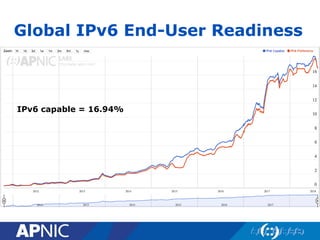
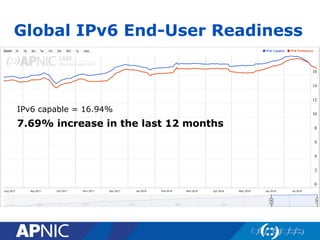
Global IPv6 End-User Readiness
IPv6 capable = 16.94%
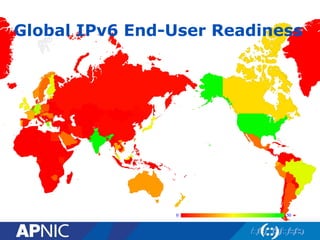
Global IPv6 End-User Readiness
7.69% increase in the last 12 months
IPv6 capable = 16.94%
Global IPv6 End-User Readiness
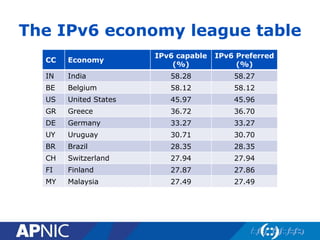
The IPv6 economy league table
CC Economy
IPv6 capable
(%)
IPv6 Preferred
(%)
IN India 58.28 58.27
BE Belgium 58.12 58.12
US United States 45.97 45.96
GR Greece 36.72 36.70
DE Germany 33.27 33.27
UY Uruguay 30.71 30.70
BR Brazil 28.35 28.35
CH Switzerland 27.94 27.94
FI Finland 27.87 27.86
MY Malaysia 27.49 27.49
CC Economy
IPv6 capable
(%)
IPv6 Preferred
(%)
MY Malaysia 27.49 27.49
TH Thailand 17.43 17.39
VN Vietnam 14.87 14.82
SG Singapore 7.53 7.51
ID Indonesia 0.11 0.11
PH Philippines 0.03 0.03
KH Cambodia 0.03 0.03
TL Timor-L’este 0.03 0.01
BN Brunei Darussalam 0.01 0.01
LA Lao 0.01 0.01
MM Myanmar 0.01 0.01
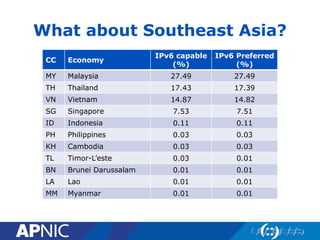
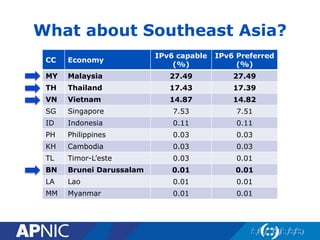
What about Southeast Asia?
CC Economy
IPv6 capable
(%)
IPv6 Preferred
(%)
MY Malaysia 27.49 27.49
TH Thailand 17.43 17.39
VN Vietnam 14.87 14.82
SG Singapore 7.53 7.51
ID Indonesia 0.11 0.11
PH Philippines 0.03 0.03
KH Cambodia 0.03 0.03
TL Timor-L’este 0.03 0.01
BN Brunei Darussalam 0.01 0.01
LA Lao 0.01 0.01
MM Myanmar 0.01 0.01
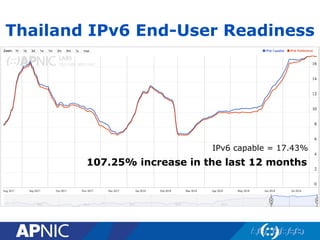
Thailand IPv6 End-User Readiness
IPv6 capable = 17.43%
107.25% increase in the last 12 months
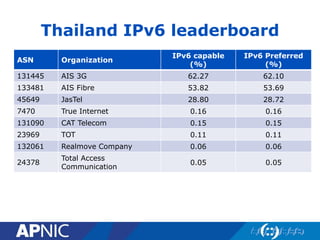
Thailand IPv6 leaderboard
ASN Organization
IPv6 capable
(%)
IPv6 Preferred
(%)
131445 AIS 3G 62.27 62.10
133481 AIS Fibre 53.82 53.69
45649 JasTel 28.80 28.72
7470 True Internet 0.16 0.16
131090 CAT Telecom 0.15 0.15
23969 TOT 0.11 0.11
132061 Realmove Company 0.06 0.06
24378
Total Access
Communication
0.05 0.05
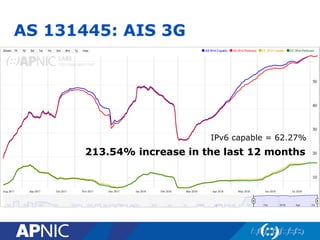
AS 131445: AIS 3G
IPv6 capable = 62.27%
213.54% increase in the last 12 months
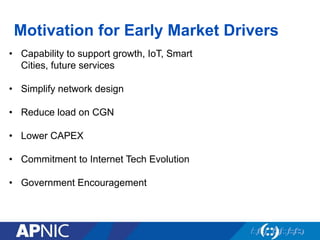
• Capability to support growth, IoT, Smart
Cities, future services
• Simplify network design
• Reduce load on CGN
• Lower CAPEX
• Commitment to Internet Tech Evolution
• Government Encouragement
Motivation for Early Market Drivers
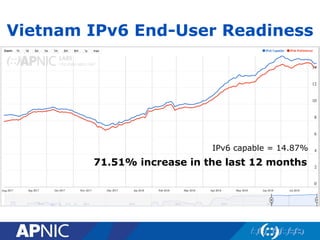
Vietnam IPv6 End-User Readiness
IPv6 capable = 14.87%
71.51% increase in the last 12 months
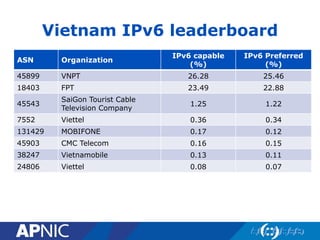
Vietnam IPv6 leaderboard
ASN Organization
IPv6 capable
(%)
IPv6 Preferred
(%)
45899 VNPT 26.28 25.46
18403 FPT 23.49 22.88
45543
SaiGon Tourist Cable
Television Company
1.25 1.22
7552 Viettel 0.36 0.34
131429 MOBIFONE 0.17 0.12
45903 CMC Telecom 0.16 0.15
38247 Vietnamobile 0.13 0.11
24806 Viettel 0.08 0.07
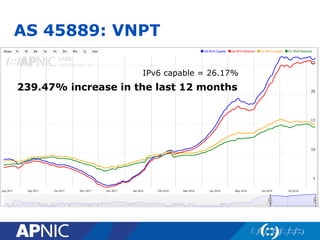
AS 45889: VNPT
IPv6 capable = 26.17%
239.47% increase in the last 12 months
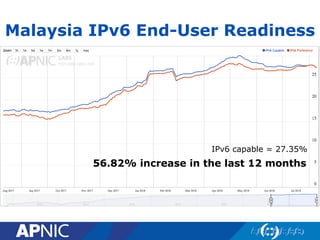
Malaysia IPv6 End-User Readiness
IPv6 capable = 27.35%
56.82% increase in the last 12 months
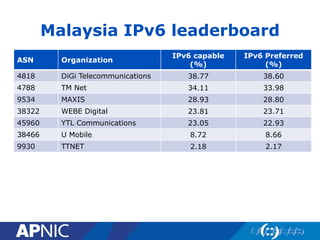
Malaysia IPv6 leaderboard
ASN Organization
IPv6 capable
(%)
IPv6 Preferred
(%)
4818 DiGi Telecommunications 38.77 38.60
4788 TM Net 34.11 33.98
9534 MAXIS 28.93 28.80
38322 WEBE Digital 23.81 23.71
45960 YTL Communications 23.05 22.93
38466 U Mobile 8.72 8.66
9930 TTNET 2.18 2.17
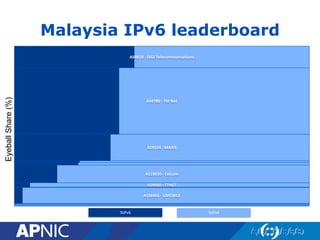
IPv6 capable = 16.8%
10.9% increase in the last 12 months
AS4818 - DiGi Telecommunications
AS4788 - TM Net
AS9534 - MAXIS
AS10030 - Celcom
AS9930 - TTNET
AS38466 - UMOBILE
%IPv6 %IPv4
EyeballShare(%)
Malaysia IPv6 leaderboard
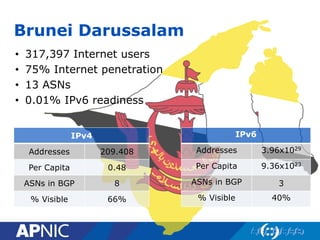
Brunei Darussalam
IPv4
Addresses 209.408
Per Capita 0.48
ASNs in BGP 8
% Visible 66%
IPv6
Addresses 3.96x1029
Per Capita 9.36x10²³
ASNs in BGP 3
% Visible 40%
• 317,397 Internet users
• 75% Internet penetration
• 13 ASNs
• 0.01% IPv6 readiness
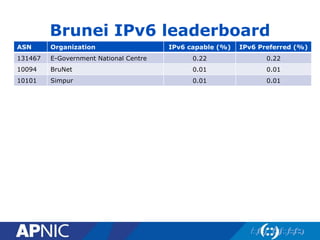
Brunei IPv6 leaderboard
ASN Organization IPv6 capable (%) IPv6 Preferred (%)
131467 E-Government National Centre 0.22 0.22
10094 BruNet 0.01 0.01
10101 Simpur 0.01 0.01
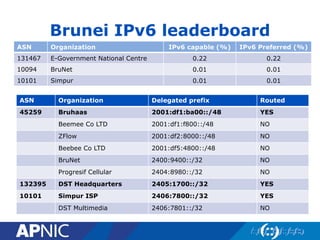
ASN Organization IPv6 capable (%) IPv6 Preferred (%)
131467 E-Government National Centre 0.22 0.22
10094 BruNet 0.01 0.01
10101 Simpur 0.01 0.01
ASN Organization Delegated prefix Routed
45259 Bruhaas 2001:df1:ba00::/48 YES
Beemee Co LTD 2001:df1:f800::/48 NO
ZFlow 2001:df2:8000::/48 NO
Beebee Co LTD 2001:df5:4800::/48 NO
BruNet 2400:9400::/32 NO
Progresif Cellular 2404:8980::/32 NO
132395 DST Headquarters 2405:1700::/32 YES
10101 Simpur ISP 2406:7800::/32 YES
DST Multimedia 2406:7801::/32 NO
Brunei IPv6 leaderboard
IPv6 in Action: Performance
• Is IPv6 as robust as IPv4?
– Do all TCP connection attempt succeed?
• Connection failure = No ACK for acknowledged SYN
– IPv4 connection failure sits at 0.2%
– IPv6 connection failure sits at 1.8%
[source : http://www.potaroo.net/presentations/2016-02-10-ad-measurement.pdf]
IPv6 in Action: Performance
• Is IPv6 as fast as IPv4? (IPv6 unicast)
– Comparison of RTT (e2e)
• Time since SYN till ACK (factors out any congestion issues)
– IPv6 is faster about half of the time
• 36-90ms faster
– IPv6 as fast as IPv4
[source : http://www.potaroo.net/presentations/2016-02-10-ad-measurement.pdf]
IPv6 in Action: Performance
• Is IPv6 as fast as IPv4? (IPv6 unicast)
– Comparison of RTT (e2e)
• Time since SYN till ACK (factors out any congestion issues)
– IPv6 is faster about half of the time
• 36-90ms faster
– IPv6 as fast as IPv4
[source: https://blog.apnic.net/2017/09/29/network-operator-perspective-ipv6-performance/]
• Testing HTTP Traffic
– TechArk Network Operator Measurement Activity (NOMA)
conducted preliminary tests of IPv6 performance for HTTP traffic
using RIPE Atlases.
– Found performance of IPv6 is better when measuring to a “near”
target
IPv6 in Action: Performance
• Is IPv6 as fast as IPv4? (IPv6 unicast)
– Comparison of RTT (e2e)
• Time since SYN till ACK (factors out any congestion issues)
– IPv6 is faster about half of the time
• 36-90ms faster
– IPv6 as fast as IPv4
[source : https://blog.apnic.net/2016/05/13/linkedin-ipv6-measurements/]
• IPv6 at LinkedIn
– For some select networks in Europe, LinkedIn is seeing up to 40%
performance improvements over IPv6, and in the US, up to 10%.
– TCP timeout on IPv4 over mobile carrier networks is as high as 4.6%
and IPv6 timeouts are on a much lower side at 1.6%.
IPv6 in Action: Content
[source : http://www.worldipv6launch.org/measurements/]
[source : http://gs.statcounter.com/platform-market-share/desktop-mobile-tablet]
Industry Trend: Devices
[source : http://gs.statcounter.com/platform-market-share/desktop-mobile-tablet]
Industry Trend: Devices
Mobiles are now
50% of all visible devices
Mobile access services represent
75% of all Access Provider revenue
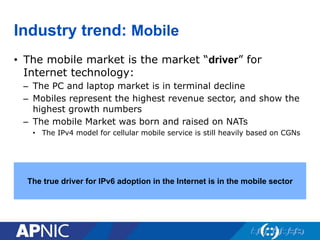
Industry trend: Mobile
• The mobile market is the market “driver” for
Internet technology:
– The PC and laptop market is in terminal decline
– Mobiles represent the highest revenue sector, and show the
highest growth numbers
– The mobile Market was born and raised on NATs
• The IPv4 model for cellular mobile service is still heavily based on CGNs
The true driver for IPv6 adoption in the Internet is in the mobile sector
IPv6 in Action: Mobile Devices
OS Version Available by
default
DHCPv6
Android 4.4 Yes No
iOS 4.1 Yes Yes
Windows
Phone
8.1 Yes Yes
[source : https://getipv6.info/display/IPv6/3GPP+Mobile+Networks]
• Android and Windows Phone support 464XLAT
• KaiOS, as installed on JioPhone, supports dual-stack IPv6
• Apple iOS IPv6-only network support since version 9. Reports of Carrier
Update for dual-stack since atleast iOS 11.3.
• Since 2016 all Apple AppStore apps must include IPv6 support
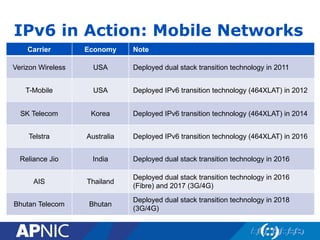
IPv6 in Action: Mobile Networks
Carrier Economy Note
Verizon Wireless USA Deployed dual stack transition technology in 2011
T-Mobile USA Deployed IPv6 transition technology (464XLAT) in 2012
SK Telecom Korea Deployed IPv6 transition technology (464XLAT) in 2014
Telstra Australia Deployed IPv6 transition technology (464XLAT) in 2016
Reliance Jio India Deployed dual stack transition technology in 2016
AIS Thailand
Deployed dual stack transition technology in 2016
(Fibre) and 2017 (3G/4G)
Bhutan Telecom Bhutan
Deployed dual stack transition technology in 2018
(3G/4G)
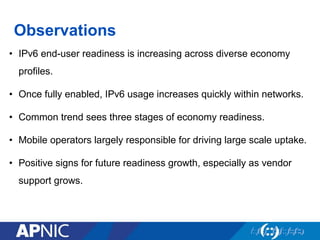
Observations
• IPv6 end-user readiness is increasing across diverse economy
profiles.
• Once fully enabled, IPv6 usage increases quickly within networks.
• Common trend sees three stages of economy readiness.
• Mobile operators largely responsible for driving large scale uptake.
• Positive signs for future readiness growth, especially as vendor
support grows.
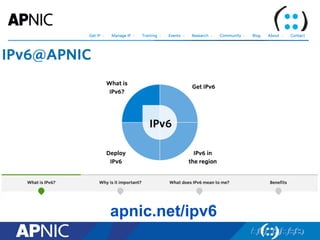
apnic.net/ipv6
Terima Kasih!
Thank You!

Where are we now? IPv6 deployment update

  • 1.
    Where are wenow? IPv6 deployment update 13-15 August 2018 | Bandar Seri Begawan, BN Klée Aiken klee@apnic.net
  • 2.
    Agenda • IPv6 End-UserReadiness • IPv6 Performance • Industry Trends • Observations IPv6 stats from: https://stats.labs.apnic.net/ipv6 Retrieved: 10 Aug 2018
  • 3.
    Global IPv6 End-UserReadiness IPv6 capable = 16.94%
  • 4.
    Global IPv6 End-UserReadiness 7.69% increase in the last 12 months IPv6 capable = 16.94%
  • 5.
  • 6.
    The IPv6 economyleague table CC Economy IPv6 capable (%) IPv6 Preferred (%) IN India 58.28 58.27 BE Belgium 58.12 58.12 US United States 45.97 45.96 GR Greece 36.72 36.70 DE Germany 33.27 33.27 UY Uruguay 30.71 30.70 BR Brazil 28.35 28.35 CH Switzerland 27.94 27.94 FI Finland 27.87 27.86 MY Malaysia 27.49 27.49
  • 7.
    CC Economy IPv6 capable (%) IPv6Preferred (%) MY Malaysia 27.49 27.49 TH Thailand 17.43 17.39 VN Vietnam 14.87 14.82 SG Singapore 7.53 7.51 ID Indonesia 0.11 0.11 PH Philippines 0.03 0.03 KH Cambodia 0.03 0.03 TL Timor-L’este 0.03 0.01 BN Brunei Darussalam 0.01 0.01 LA Lao 0.01 0.01 MM Myanmar 0.01 0.01 What about Southeast Asia?
  • 8.
    What about SoutheastAsia? CC Economy IPv6 capable (%) IPv6 Preferred (%) MY Malaysia 27.49 27.49 TH Thailand 17.43 17.39 VN Vietnam 14.87 14.82 SG Singapore 7.53 7.51 ID Indonesia 0.11 0.11 PH Philippines 0.03 0.03 KH Cambodia 0.03 0.03 TL Timor-L’este 0.03 0.01 BN Brunei Darussalam 0.01 0.01 LA Lao 0.01 0.01 MM Myanmar 0.01 0.01
  • 9.
    Thailand IPv6 End-UserReadiness IPv6 capable = 17.43% 107.25% increase in the last 12 months
  • 10.
    Thailand IPv6 leaderboard ASNOrganization IPv6 capable (%) IPv6 Preferred (%) 131445 AIS 3G 62.27 62.10 133481 AIS Fibre 53.82 53.69 45649 JasTel 28.80 28.72 7470 True Internet 0.16 0.16 131090 CAT Telecom 0.15 0.15 23969 TOT 0.11 0.11 132061 Realmove Company 0.06 0.06 24378 Total Access Communication 0.05 0.05
  • 11.
    AS 131445: AIS3G IPv6 capable = 62.27% 213.54% increase in the last 12 months
  • 12.
    • Capability tosupport growth, IoT, Smart Cities, future services • Simplify network design • Reduce load on CGN • Lower CAPEX • Commitment to Internet Tech Evolution • Government Encouragement Motivation for Early Market Drivers
  • 13.
    Vietnam IPv6 End-UserReadiness IPv6 capable = 14.87% 71.51% increase in the last 12 months
  • 14.
    Vietnam IPv6 leaderboard ASNOrganization IPv6 capable (%) IPv6 Preferred (%) 45899 VNPT 26.28 25.46 18403 FPT 23.49 22.88 45543 SaiGon Tourist Cable Television Company 1.25 1.22 7552 Viettel 0.36 0.34 131429 MOBIFONE 0.17 0.12 45903 CMC Telecom 0.16 0.15 38247 Vietnamobile 0.13 0.11 24806 Viettel 0.08 0.07
  • 15.
    AS 45889: VNPT IPv6capable = 26.17% 239.47% increase in the last 12 months
  • 16.
    Malaysia IPv6 End-UserReadiness IPv6 capable = 27.35% 56.82% increase in the last 12 months
  • 17.
    Malaysia IPv6 leaderboard ASNOrganization IPv6 capable (%) IPv6 Preferred (%) 4818 DiGi Telecommunications 38.77 38.60 4788 TM Net 34.11 33.98 9534 MAXIS 28.93 28.80 38322 WEBE Digital 23.81 23.71 45960 YTL Communications 23.05 22.93 38466 U Mobile 8.72 8.66 9930 TTNET 2.18 2.17
  • 18.
    IPv6 capable =16.8% 10.9% increase in the last 12 months AS4818 - DiGi Telecommunications AS4788 - TM Net AS9534 - MAXIS AS10030 - Celcom AS9930 - TTNET AS38466 - UMOBILE %IPv6 %IPv4 EyeballShare(%) Malaysia IPv6 leaderboard
  • 19.
    Brunei Darussalam IPv4 Addresses 209.408 PerCapita 0.48 ASNs in BGP 8 % Visible 66% IPv6 Addresses 3.96x1029 Per Capita 9.36x10²³ ASNs in BGP 3 % Visible 40% • 317,397 Internet users • 75% Internet penetration • 13 ASNs • 0.01% IPv6 readiness
  • 20.
    Brunei IPv6 leaderboard ASNOrganization IPv6 capable (%) IPv6 Preferred (%) 131467 E-Government National Centre 0.22 0.22 10094 BruNet 0.01 0.01 10101 Simpur 0.01 0.01
  • 21.
    ASN Organization IPv6capable (%) IPv6 Preferred (%) 131467 E-Government National Centre 0.22 0.22 10094 BruNet 0.01 0.01 10101 Simpur 0.01 0.01 ASN Organization Delegated prefix Routed 45259 Bruhaas 2001:df1:ba00::/48 YES Beemee Co LTD 2001:df1:f800::/48 NO ZFlow 2001:df2:8000::/48 NO Beebee Co LTD 2001:df5:4800::/48 NO BruNet 2400:9400::/32 NO Progresif Cellular 2404:8980::/32 NO 132395 DST Headquarters 2405:1700::/32 YES 10101 Simpur ISP 2406:7800::/32 YES DST Multimedia 2406:7801::/32 NO Brunei IPv6 leaderboard
  • 22.
    IPv6 in Action:Performance • Is IPv6 as robust as IPv4? – Do all TCP connection attempt succeed? • Connection failure = No ACK for acknowledged SYN – IPv4 connection failure sits at 0.2% – IPv6 connection failure sits at 1.8% [source : http://www.potaroo.net/presentations/2016-02-10-ad-measurement.pdf]
  • 23.
    IPv6 in Action:Performance • Is IPv6 as fast as IPv4? (IPv6 unicast) – Comparison of RTT (e2e) • Time since SYN till ACK (factors out any congestion issues) – IPv6 is faster about half of the time • 36-90ms faster – IPv6 as fast as IPv4 [source : http://www.potaroo.net/presentations/2016-02-10-ad-measurement.pdf]
  • 24.
    IPv6 in Action:Performance • Is IPv6 as fast as IPv4? (IPv6 unicast) – Comparison of RTT (e2e) • Time since SYN till ACK (factors out any congestion issues) – IPv6 is faster about half of the time • 36-90ms faster – IPv6 as fast as IPv4 [source: https://blog.apnic.net/2017/09/29/network-operator-perspective-ipv6-performance/] • Testing HTTP Traffic – TechArk Network Operator Measurement Activity (NOMA) conducted preliminary tests of IPv6 performance for HTTP traffic using RIPE Atlases. – Found performance of IPv6 is better when measuring to a “near” target
  • 25.
    IPv6 in Action:Performance • Is IPv6 as fast as IPv4? (IPv6 unicast) – Comparison of RTT (e2e) • Time since SYN till ACK (factors out any congestion issues) – IPv6 is faster about half of the time • 36-90ms faster – IPv6 as fast as IPv4 [source : https://blog.apnic.net/2016/05/13/linkedin-ipv6-measurements/] • IPv6 at LinkedIn – For some select networks in Europe, LinkedIn is seeing up to 40% performance improvements over IPv6, and in the US, up to 10%. – TCP timeout on IPv4 over mobile carrier networks is as high as 4.6% and IPv6 timeouts are on a much lower side at 1.6%.
  • 26.
    IPv6 in Action:Content [source : http://www.worldipv6launch.org/measurements/]
  • 27.
  • 28.
    [source : http://gs.statcounter.com/platform-market-share/desktop-mobile-tablet] IndustryTrend: Devices Mobiles are now 50% of all visible devices Mobile access services represent 75% of all Access Provider revenue
  • 29.
    Industry trend: Mobile •The mobile market is the market “driver” for Internet technology: – The PC and laptop market is in terminal decline – Mobiles represent the highest revenue sector, and show the highest growth numbers – The mobile Market was born and raised on NATs • The IPv4 model for cellular mobile service is still heavily based on CGNs The true driver for IPv6 adoption in the Internet is in the mobile sector
  • 30.
    IPv6 in Action:Mobile Devices OS Version Available by default DHCPv6 Android 4.4 Yes No iOS 4.1 Yes Yes Windows Phone 8.1 Yes Yes [source : https://getipv6.info/display/IPv6/3GPP+Mobile+Networks] • Android and Windows Phone support 464XLAT • KaiOS, as installed on JioPhone, supports dual-stack IPv6 • Apple iOS IPv6-only network support since version 9. Reports of Carrier Update for dual-stack since atleast iOS 11.3. • Since 2016 all Apple AppStore apps must include IPv6 support
  • 31.
    IPv6 in Action:Mobile Networks Carrier Economy Note Verizon Wireless USA Deployed dual stack transition technology in 2011 T-Mobile USA Deployed IPv6 transition technology (464XLAT) in 2012 SK Telecom Korea Deployed IPv6 transition technology (464XLAT) in 2014 Telstra Australia Deployed IPv6 transition technology (464XLAT) in 2016 Reliance Jio India Deployed dual stack transition technology in 2016 AIS Thailand Deployed dual stack transition technology in 2016 (Fibre) and 2017 (3G/4G) Bhutan Telecom Bhutan Deployed dual stack transition technology in 2018 (3G/4G)
  • 32.
    Observations • IPv6 end-userreadiness is increasing across diverse economy profiles. • Once fully enabled, IPv6 usage increases quickly within networks. • Common trend sees three stages of economy readiness. • Mobile operators largely responsible for driving large scale uptake. • Positive signs for future readiness growth, especially as vendor support grows.
  • 33.
  • 34.