
IPv6 – Implementation and
Advantages
•A.M. Jayasekara
•N.U. Wickamasinghe
•W.H.M.S.P.Wijetunge
• W.G.C.W. Kumara
AIM
Identifying methods of IPv6
implementation.
SAITM-RSEA2012
2
Content
•What is IP?
•IPv4
•IPv6
•Methods of IPv6 implementation.
SAITM-RSEA2012
3
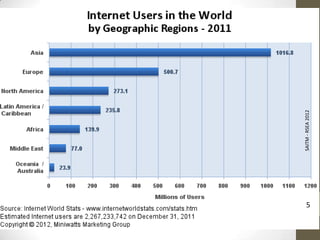
How many people use Internet
every day ?
SAITM-RSEA2012
4
SAITM-RSEA2012
5
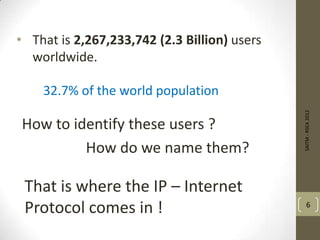
• That is 2,267,233,742 (2.3 Billion) users
worldwide.
SAITM-RSEA2012
6
32.7% of the world population
How to identify these users ?
How do we name them?
That is where the IP – Internet
Protocol comes in !
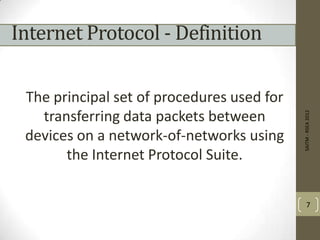
Internet Protocol - Definition
The principal set of procedures used for
transferring data packets between
devices on a network-of-networks using
the Internet Protocol Suite.
SAITM-RSEA2012
7
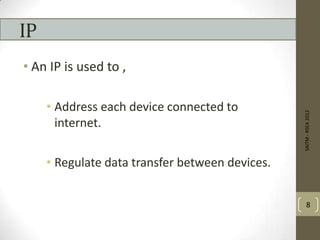
IP
• An IP is used to ,
• Address each device connected to
internet.
• Regulate data transfer between devices.
SAITM-RSEA2012
8
There are two commonly used IP versions at
the moment.
SAITM-RSEA2012
9
IPv4 – Internet
Protocol version 4
IPv6 – Internet
Protocol version 6
IPv4
• Uses 32bit addresses
• Which limits the address in to
4,294,967,296 (4.3 billion) addresses.
• Limited security
• No authentication or encryption at IP
level.
• Most commonly used version.
SAITM-RSEA2012
10
However By 2014, expected number of
devices that are connected to the internet
is estimated as 50 Billions.
SAITM-RSEA2012
11
That is 12 times more than current IPv4 can
support.
So what will happen ?
SAITM-RSEA2012
12
Do we find ourselves unable to connect to
the internet via new devices ?
The answer – NO!
Reason for developing IPv6 is to
address the IPv4 address exhaustion.
IPv6
 Designed to overcome limitations of
IPv4.
•Uses 128bit addresses
• 340 Undecilion (3.4x1038) addresses.
•High security
• Data encryption and authentication.
SAITM-RSEA2012
13
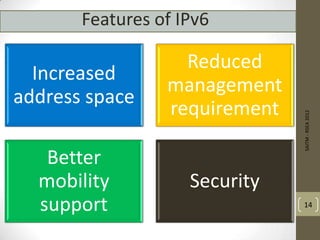
Increased
address space
Reduced
management
requirement
Better
mobility
support
Security
Features of IPv6
SAITM-RSEA2012
14
How do we start using IPv6 ?
SAITM-RSEA2012
15
Methods of IPv6 implementation
There are three main methods ,
• Dual-Stack
• Translation
• Tunneling
SAITM-RSEA2012
16
Dual-Stack
•It operates both IPv4 and IPv6
simultaneously on the same
infrastructure.
SAITM-RSEA2012
17
Simple.
Uses
minimum
resources.
Some
network
vendors and
servers do not
support IPv6.
SAITM-RSEA2012
18
Dual-Stack
Translation
• Converting IPv6 traffic into IPv4 traffic for
transportation and vice versa.
• Traffic is not encapsulated, it is directly
converted to the destination type.
• Two main methods are used in translate
method.
SAITM-RSEA2012
19
Translation Methods
• Network Address Translation Protocol
Translation (NAT-PT)
• NAT-PT method configure a translation
of an IPv4 address into an IPv6 address
and vise versa either statically or
dynamically.
SAITM-RSEA2012
20
Translation Methods
• NAT64
• NAT64 mechanism allows IPv6 hosts to
communicate with IPv4 servers.
• The IPv6 client embeds the IPv4 address
it wishes to communicate with and
sends its packets to the resulting
address.
SAITM-RSEA2012
21
Can deal
with
different
types of
protocols
Not a good
option when
IPv4 uses
NAT
SAITM-RSEA2012
22
Translation Methods
Tunneling
•Transporting IPv6 traffic through an
IPv4 network transparently.
•Few different tunneling methods
exists for IPv6.
SAITM-RSEA2012
23
Tunneling Methods
• Manual IPv6 Tunnels
• Manually created IPv6 tunnel is configured
between two routers, that each must support
both IPv4 and IPv6.
• 6to4 Tunnels
• It is IPv6 to be tunneled via IPv4.
• 6to4 allows for automatic IPv6-to-IPv4 address
translation, and treats the underlying IPv4
network as one big Non-Broadcast Multi-
Access network.
SAITM-RSEA2012
24
Used on top
of an existing
IPv4
network.
Hardware
must
support both
IPv4 & IPv6.
SAITM-RSEA2012
25
Tunneling Methods
Are we ready for IPv6 ?
SAITM-RSEA2012
26
IPv6 Readiness
• Compatibility with IPv6 networking is a
software or firmware issue.
• The American Registry for Internet
Numbers (ARIN) suggests that all Internet
servers to be prepared to serve IPv6-only
clients by January 2012.
SAITM-RSEA2012
27
IPv6 Readiness - Software
• Most personal computers running
recent operating system versions are IPv6-
ready.
• Most popular applications with network
capabilities are ready, and most others
could be easily upgraded with support
from the developers.
• Java applications adhering to Java 1.4
(February 2002) standards have support
for IPv6
SAITM-RSEA2012
28
IPv6 Readiness - Hardware
• Low-level equipment like network
adapters and network switches may not
be affected by the change.
• since they transmit link-layer frames
without inspecting the contents.
• Networking devices that obtain IP
addresses or perform routing based on IP
address do need IPv6 support.
SAITM-RSEA2012
29
Finally what should we do ?
SAITM-RSEA2012
30
Now, as available IPv4 addresses are almost
over it is the time for ISPs, large and small
companies and universities to start migrating
to IPv6.
Based on the results of this analysis of the
available technologies it is rewarding to
migrate from IPv4 to IPv6 based on user
requirements.
SAITM-RSEA2012
31
Thank You
SAITM-RSEA2012
32

Ipv6

  • 1.
    IPv6 – Implementationand Advantages •A.M. Jayasekara •N.U. Wickamasinghe •W.H.M.S.P.Wijetunge • W.G.C.W. Kumara
  • 2.
    AIM Identifying methods ofIPv6 implementation. SAITM-RSEA2012 2
  • 3.
    Content •What is IP? •IPv4 •IPv6 •Methodsof IPv6 implementation. SAITM-RSEA2012 3
  • 4.
    How many peopleuse Internet every day ? SAITM-RSEA2012 4
  • 5.
  • 6.
    • That is2,267,233,742 (2.3 Billion) users worldwide. SAITM-RSEA2012 6 32.7% of the world population How to identify these users ? How do we name them? That is where the IP – Internet Protocol comes in !
  • 7.
    Internet Protocol -Definition The principal set of procedures used for transferring data packets between devices on a network-of-networks using the Internet Protocol Suite. SAITM-RSEA2012 7
  • 8.
    IP • An IPis used to , • Address each device connected to internet. • Regulate data transfer between devices. SAITM-RSEA2012 8
  • 9.
    There are twocommonly used IP versions at the moment. SAITM-RSEA2012 9 IPv4 – Internet Protocol version 4 IPv6 – Internet Protocol version 6
  • 10.
    IPv4 • Uses 32bitaddresses • Which limits the address in to 4,294,967,296 (4.3 billion) addresses. • Limited security • No authentication or encryption at IP level. • Most commonly used version. SAITM-RSEA2012 10
  • 11.
    However By 2014,expected number of devices that are connected to the internet is estimated as 50 Billions. SAITM-RSEA2012 11 That is 12 times more than current IPv4 can support.
  • 12.
    So what willhappen ? SAITM-RSEA2012 12 Do we find ourselves unable to connect to the internet via new devices ? The answer – NO! Reason for developing IPv6 is to address the IPv4 address exhaustion.
  • 13.
    IPv6  Designed toovercome limitations of IPv4. •Uses 128bit addresses • 340 Undecilion (3.4x1038) addresses. •High security • Data encryption and authentication. SAITM-RSEA2012 13
  • 14.
  • 15.
    How do westart using IPv6 ? SAITM-RSEA2012 15
  • 16.
    Methods of IPv6implementation There are three main methods , • Dual-Stack • Translation • Tunneling SAITM-RSEA2012 16
  • 17.
    Dual-Stack •It operates bothIPv4 and IPv6 simultaneously on the same infrastructure. SAITM-RSEA2012 17
  • 18.
    Simple. Uses minimum resources. Some network vendors and servers donot support IPv6. SAITM-RSEA2012 18 Dual-Stack
  • 19.
    Translation • Converting IPv6traffic into IPv4 traffic for transportation and vice versa. • Traffic is not encapsulated, it is directly converted to the destination type. • Two main methods are used in translate method. SAITM-RSEA2012 19
  • 20.
    Translation Methods • NetworkAddress Translation Protocol Translation (NAT-PT) • NAT-PT method configure a translation of an IPv4 address into an IPv6 address and vise versa either statically or dynamically. SAITM-RSEA2012 20
  • 21.
    Translation Methods • NAT64 •NAT64 mechanism allows IPv6 hosts to communicate with IPv4 servers. • The IPv6 client embeds the IPv4 address it wishes to communicate with and sends its packets to the resulting address. SAITM-RSEA2012 21
  • 22.
    Can deal with different types of protocols Nota good option when IPv4 uses NAT SAITM-RSEA2012 22 Translation Methods
  • 23.
    Tunneling •Transporting IPv6 trafficthrough an IPv4 network transparently. •Few different tunneling methods exists for IPv6. SAITM-RSEA2012 23
  • 24.
    Tunneling Methods • ManualIPv6 Tunnels • Manually created IPv6 tunnel is configured between two routers, that each must support both IPv4 and IPv6. • 6to4 Tunnels • It is IPv6 to be tunneled via IPv4. • 6to4 allows for automatic IPv6-to-IPv4 address translation, and treats the underlying IPv4 network as one big Non-Broadcast Multi- Access network. SAITM-RSEA2012 24
  • 25.
    Used on top ofan existing IPv4 network. Hardware must support both IPv4 & IPv6. SAITM-RSEA2012 25 Tunneling Methods
  • 26.
    Are we readyfor IPv6 ? SAITM-RSEA2012 26
  • 27.
    IPv6 Readiness • Compatibilitywith IPv6 networking is a software or firmware issue. • The American Registry for Internet Numbers (ARIN) suggests that all Internet servers to be prepared to serve IPv6-only clients by January 2012. SAITM-RSEA2012 27
  • 28.
    IPv6 Readiness -Software • Most personal computers running recent operating system versions are IPv6- ready. • Most popular applications with network capabilities are ready, and most others could be easily upgraded with support from the developers. • Java applications adhering to Java 1.4 (February 2002) standards have support for IPv6 SAITM-RSEA2012 28
  • 29.
    IPv6 Readiness -Hardware • Low-level equipment like network adapters and network switches may not be affected by the change. • since they transmit link-layer frames without inspecting the contents. • Networking devices that obtain IP addresses or perform routing based on IP address do need IPv6 support. SAITM-RSEA2012 29
  • 30.
    Finally what shouldwe do ? SAITM-RSEA2012 30
  • 31.
    Now, as availableIPv4 addresses are almost over it is the time for ISPs, large and small companies and universities to start migrating to IPv6. Based on the results of this analysis of the available technologies it is rewarding to migrate from IPv4 to IPv6 based on user requirements. SAITM-RSEA2012 31
  • 32.