IPE 301E: Fundamental of Mechanical Engineering
Dr. M. Muhshin Aziz Khan
Professor, Dept. of IPE, SUST
Steam generation unit
Steam Generation Unit
 Boiler
 Usually a closed vessel made of
steel.
 Its function is to transfer the
heat produced by the
combustion of fuel to water
and ultimately to generate
steam.
 Also known as steam
generation unit.
 Purpose of Boiler
 The steam generated in the
boiler is then supplied:
 to an external combustion
engine i.e. steam engine and
steam turbines for power
generation,
 for industrial process work in
cotton mills, sugar mills,
textile industries etc., at low
pressures, and
 for heating the installations
and producing hot water for
hot water supply at much
lower pressures.
 Primary Requirements for a
Boiler
 The water must be contained
safely.
 The steam must be safely
delivered in desired condition (as
regard its pressure, temperature,
quality and required rate)
Steam Generation Unit
 Important Boiler Terms
 Shell
 Consists of one or more steel plates
 bent into a cylindrical form and
 riveted or welded together.
 The shell ends are closed with end
plates.
 Setting:
 The primary function is to
 confine heat to the boiler and
 form a passage for gases.
 It is made of brick work and may
form the wall of the furnace and
combustion chamber
 Grate
 it is a platform in the furnace upon
which fuel is burnt.
 Furnace
 It is the chamber formed by the
space above the grate and below the
boiler shell, in which combustion
takes place.
 Mountings
 The items which are used for safety
of boiler.
 Accessories
 The items which are used for
increasing the boiler efficiency.
Steam Generation Unit
 Classification of Steam Boilers
Though there are many classifications
of steam boilers, yet the following are
important:
 ACCORDING TO THE CONTENTS IN
THE TUBE
 Fire tube or smoke tube boiler
 Water tube boiler.
 ACCORDING TO POSITION OF
FURNACE
 Internally fired boilers
 Externally fired boilers
 ACCORDING TO AXIS OF FURNACE
 Vertical boilers
 Horizontal boilers
 ACCORDING TO NUMBER OF TUBES
 Single tube boilers
 Multi tube boilers
 ACCORDING TO METHOD OF
CIRCULATION OF WATER
 Natural circulation boilers
 Forced circulation boilers
 ACCORDING TO PRESSURE OF
STEAM
 High pressure boiler (> 80 bar)
 Low pressure boiler (≤ 80 bar)
 ACCORDING TO THE USE
 Stationary boilers
 Mobile boilers
Steam Generation Unit
 Fire tube boiler
 Flames and hot gases (flue gases:
products of combustion) pass
through the tubes, and
 Tubes are surrounded by water.
 Examples: Cochran Boiler,
Lancashire Boiler etc.
 Water tube boiler
 Water passes through the tube, and
 Flames and hot gases pass outside
the tubes.
 Examples: Babcock and Wilcox
Boiler, Stirling Boiler etc.
Comparison between water tube and fire tube boiler
Criterion Fire Tube Boiler Water Tube Boiler
Flow of hot
gases
Gases in tubes surrounded
by water outside.
Water in tubes and hot
gases flow outside.
Location of
furnace
Internal External
Floor area
for a given
output
Large Small
Capacity 10000 kg/hr 50000 kg/hr
Evaporation Slow Fast
Criterion Fire Tube Boiler Water Tube Boiler
Pressure
range
15 ~ 20 bar 170 ~ 200 bar
Efficiency 80% 92%
Safety
Large water content and
low steam generation.
Better safety.
Small water content and
large steam generation.
Needs expert attention.
Explosion
Lesser risk due to lower
pressure.
Higher risk due to higher
pressure.
Application
to large
power plant
Not suitable Suitable
Comparison ….Cont’d
Criterion Fire Tube Boiler Water Tube Boiler
Skill
requirement
Require less skill for
efficient and economic
working
Require more skill and
careful attention
Water
treatment
Not so necessary Necessary
Construction Difficult Simple
Shell
diameter
Large for same power. Small for same power.
Comparison ….Cont’d
Steam Generation Unit
 Classification of Steam Boilers
Though there are many classifications
of steam boilers, yet the following are
important:
 ACCORDING TO THE CONTENTS IN
THE TUBE
 Fire tube or smoke tube boiler
 Water tube boiler.
 ACCORDING TO POSITION OF
FURNACE
 Internally fired boilers
 Externally fired boilers
 ACCORDING TO AXIS OF FURNACE
 Vertical boilers
 Horizontal boilers
 ACCORDING TO NUMBER OF TUBES
 Single tube boilers
 Multi tube boilers
 ACCORDING TO METHOD OF
CIRCULATION OF WATER
 Natural circulation boilers
 Forced circulation boilers
 ACCORDING TO PRESSURE OF
STEAM
 High pressure boiler (> 80 bar)
 Low pressure boiler (≤ 80 bar)
 ACCORDING TO THE USE
 Stationary boilers
 Mobile boilers
Steam Generation Unit
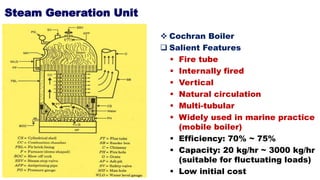
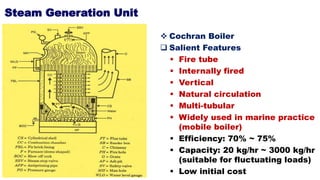
 Cochran Boiler
 Salient Features
 Fire tube
 Internally fired
 Vertical
 Natural circulation
 Multi-tubular
 Widely used in marine practice
(mobile boiler)
 Efficiency: 70% ~ 75%
 Capacity: 20 kg/hr ~ 3000 kg/hr
(suitable for fluctuating loads)
 Low initial cost
Steam Generation Unit
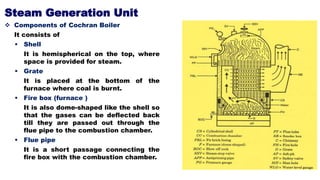
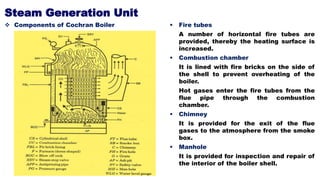
 Components of Cochran Boiler
It consists of
 Shell
It is hemispherical on the top, where
space is provided for steam.
 Grate
It is placed at the bottom of the
furnace where coal is burnt.
 Fire box (furnace )
It is also dome-shaped like the shell so
that the gases can be deflected back
till they are passed out through the
flue pipe to the combustion chamber.
 Flue pipe
It is a short passage connecting the
fire box with the combustion chamber.
Steam Generation Unit
 Components of Cochran Boiler  Fire tubes
A number of horizontal fire tubes are
provided, thereby the heating surface is
increased.
 Combustion chamber
It is lined with fire bricks on the side of
the shell to prevent overheating of the
boiler.
Hot gases enter the fire tubes from the
flue pipe through the combustion
chamber.
 Chimney
It is provided for the exit of the flue
gases to the atmosphere from the smoke
box.
 Manhole
It is provided for inspection and repair of
the interior of the boiler shell.
Steam Generation Unit
 Working Principle of Cochran Boiler
 Coal is fed into the grate through the
fire hole and burnt. Ash formed during
burning is collected in the ash pit
provided just below the grate and then
it is removed manually.
 The hot gases from the grate pass
through the flue pipe to the
combustion chamber.
 The hot gases from the combustion
chamber flow through the horizontal
fire tubes and transfer the heat to the
water by convection.
 The flue gases coming out of fire
tubes pass through the smoke box and
are exhausted to the atmosphere
through the chimney.
 Smoke box is provided with a door for
cleaning the fire tubes and smoke box.
Steam Generation Unit
 Cochran Boiler
 Salient Features
 Fire tube
 Internally fired
 Vertical
 Natural circulation
 Multi-tubular
 Widely used in marine practice
(mobile boiler)
 Efficiency: 70% ~ 75%
 Capacity: 20 kg/hr ~ 3000 kg/hr
(suitable for fluctuating loads)
 Low initial cost
Steam Generation Unit
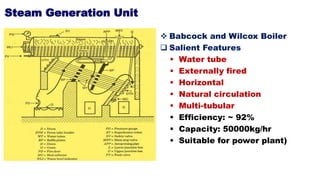
 Babcock and Wilcox Boiler
 Salient Features
 Water tube
 Externally fired
 Horizontal
 Natural circulation
 Multi-tubular
 Efficiency: ~ 92%
 Capacity: 50000kg/hr
 Suitable for power plant)
Steam Generation Unit
 Components of Babcock and Wilcox
Boiler
It consists of
 Steam and water drum (Boiler shell)
One half of the drum is filled up with
water and steam remains on the
other half.
It is about 8 meters in length and 2
meters in diameter.
 Water tubes
Water tubes are placed between the
drum and furnace in an inclined
position (at an angle of 10 to 15
degree) to promote water
circulation.
These tubes are connected to the
uptake-header and the down-comer.
Steam Generation Unit
 Components of Babcock and Wilcox
Boiler  Uptake- and downtake-headers
The drum is connected at one end to
the uptake-header by short tubes
and at the other end to the down-
take header by long tubes.
 Grate
Coal is fed through fire door to the
grate and is burnt.
 Furnace
It is kept just below the uptake
header.
 Baffles
The fire-brick baffles, two in number,
are provided to deflect the hot flue
gases.
Steam Generation Unit
 Components of Babcock and Wilcox
Boiler
 Super-heater
The boiler is fitted with a super-
heater tube which is placed just
under the drum and above the water
tubes.
 Mud box
Mud box is provided at the bottom
end of the down-take header.
The mud or sediments in the water
are
 collected in the mud box and
 blown-off time to time by means
of a blow–off cock.
 Inspection door
Inspection doors are provided for
cleaning and inspection of the boiler.
Steam Generation Unit
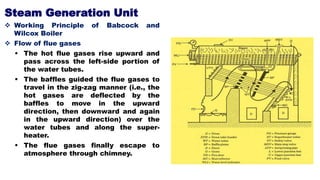
 Working Principle of Babcock and
Wilcox Boiler
 Flow of flue gases
 The hot flue gases rise upward and
pass across the left-side portion of
the water tubes.
 The baffles guided the flue gases to
travel in the zig-zag manner (i.e., the
hot gases are deflected by the
baffles to move in the upward
direction, then downward and again
in the upward direction) over the
water tubes and along the super-
heater.
 The flue gases finally escape to
atmosphere through chimney.
Steam Generation Unit
 Working Principle of Babcock and
Wilcox Boiler
 Water circulation
 Water tubes which is just above the
furnace is heated comparatively at a
higher temperature than the rest of
it.
 Water rises into the drum through
the uptake-header.
 In the drum, steam being lighter is
collected in the upper part of the
drum. The water from the drum
comes down through the down–take
header into the water tubes.
 A continuous circulation of water
from the drum to the water tubes
and water tubes to the drum is thus
maintained.
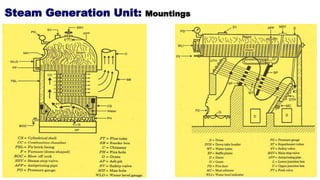
Steam Generation Unit: Mountings
Steam Generation Unit
 Functions of Boiler Mountings
 Blow-off cock
Used to discharge mud and other sediments
deposited in the bottom most part of the
water space in the boiler, while boiler is in
operation.
Can also be used to drain-off boiler water.
 It is mounted at the lowest part of the
boiler.
 Water level indicator
Required to indicate the safety level of water
inside the boiler shell.
 Consists of three cocks: Steam, Water and
Drain cocks.
 It is fitted in front of the boiler.
 Pressure gauge
Required to indicate the steam pressure
inside the boiler shell.
 It is fitted in front of the boiler.
 Pressure gauges generally used are of
Bourden type
 Safety valves
Required to release the internal boiler
pressure if the pressure exceeds a
predetermined safety level.
 It is attached to steam chest.
 Steam Stop Valve
Used to regulate flow of steam from boiler to
steam pipe and to shut off the steam
completely when required.
 It is fitted to the highest part of the shell.
 Fusible plug
Required to stop the boiler if the boiler gets
dry to prevent damage to the boiler.
 It is a metallic plug installed in the water
pathway.
 If the boiler temperature exceeds the
safety limit, it melts and allows shell water
to
 pass through and
 extinguish the furnace fire.
Steam Generation Unit
 Functions of Boiler Accessories
 Feed Water Pump
Used to deliver the water into the
boiler.
 The quantity of water supply
should be at least equal to that
evaporated and supplied.
 The pressure of feed water should
be 20% more than that in the
boiler.
 Feed pumps commonly used are
of two types:
 Centrifugal type
 Reciprocating type
 Superheater
Used to increase the temperature
of saturated steam without raising
its pressure.
 It is generally used as integral
part of the boiler.
 It extracts heat from hot flue
gases.
 It is placed in the path of hot
flue gases from the furnace.
 Advantages of superheated steam
 Eliminates the erosion of
turbine blade.
 Increases efficiency of steam
plant.
 Reduces the losses due to
condensation in the steam pipe.
Steam Generation Unit
 Functions of Boiler Accessories
 Economizer
Used to heat the feed water by using the
heat in exhaust flue gases before leaving
the chimney.
 It improves the economy of the boiler.
 Feed water is passed through the
tubes of the economizer while the hot
flue gases are passed over the tubes.
 Advantage of using an economizer:
 Causes 15% – 20% of the coal saving.
 Increases the steam generating
capacity.
 Prevents formation of scale in the
boiler water tubes.
 Minimizes the strains due to unequal
expansion.
 Air Preheater
Used to heat the air required for the
combustion.
 Installed between the economizer
and chimney.
 Air is drawn through the tubes of
the heater while the hot flue gases
are passed over the tubes.
 Air is then passed through the duct
to the furnace.
 Advantages of using a air preheater:
 Increases the boiler efficiency by
2% for each 30° - 40° rise in air
temp.
 Results in better combustion with
less soot, smoke and ash.
 Enables lower grade fuel to be
burnt with less excess air.

Ipe301 e steam generation unit

  • 1.
    IPE 301E: Fundamentalof Mechanical Engineering Dr. M. Muhshin Aziz Khan Professor, Dept. of IPE, SUST Steam generation unit
  • 2.
    Steam Generation Unit Boiler  Usually a closed vessel made of steel.  Its function is to transfer the heat produced by the combustion of fuel to water and ultimately to generate steam.  Also known as steam generation unit.  Purpose of Boiler  The steam generated in the boiler is then supplied:  to an external combustion engine i.e. steam engine and steam turbines for power generation,  for industrial process work in cotton mills, sugar mills, textile industries etc., at low pressures, and  for heating the installations and producing hot water for hot water supply at much lower pressures.  Primary Requirements for a Boiler  The water must be contained safely.  The steam must be safely delivered in desired condition (as regard its pressure, temperature, quality and required rate)
  • 3.
    Steam Generation Unit Important Boiler Terms  Shell  Consists of one or more steel plates  bent into a cylindrical form and  riveted or welded together.  The shell ends are closed with end plates.  Setting:  The primary function is to  confine heat to the boiler and  form a passage for gases.  It is made of brick work and may form the wall of the furnace and combustion chamber  Grate  it is a platform in the furnace upon which fuel is burnt.  Furnace  It is the chamber formed by the space above the grate and below the boiler shell, in which combustion takes place.  Mountings  The items which are used for safety of boiler.  Accessories  The items which are used for increasing the boiler efficiency.
  • 4.
    Steam Generation Unit Classification of Steam Boilers Though there are many classifications of steam boilers, yet the following are important:  ACCORDING TO THE CONTENTS IN THE TUBE  Fire tube or smoke tube boiler  Water tube boiler.  ACCORDING TO POSITION OF FURNACE  Internally fired boilers  Externally fired boilers  ACCORDING TO AXIS OF FURNACE  Vertical boilers  Horizontal boilers  ACCORDING TO NUMBER OF TUBES  Single tube boilers  Multi tube boilers  ACCORDING TO METHOD OF CIRCULATION OF WATER  Natural circulation boilers  Forced circulation boilers  ACCORDING TO PRESSURE OF STEAM  High pressure boiler (> 80 bar)  Low pressure boiler (≤ 80 bar)  ACCORDING TO THE USE  Stationary boilers  Mobile boilers
  • 5.
    Steam Generation Unit Fire tube boiler  Flames and hot gases (flue gases: products of combustion) pass through the tubes, and  Tubes are surrounded by water.  Examples: Cochran Boiler, Lancashire Boiler etc.  Water tube boiler  Water passes through the tube, and  Flames and hot gases pass outside the tubes.  Examples: Babcock and Wilcox Boiler, Stirling Boiler etc.
  • 6.
    Comparison between watertube and fire tube boiler Criterion Fire Tube Boiler Water Tube Boiler Flow of hot gases Gases in tubes surrounded by water outside. Water in tubes and hot gases flow outside. Location of furnace Internal External Floor area for a given output Large Small Capacity 10000 kg/hr 50000 kg/hr Evaporation Slow Fast
  • 7.
    Criterion Fire TubeBoiler Water Tube Boiler Pressure range 15 ~ 20 bar 170 ~ 200 bar Efficiency 80% 92% Safety Large water content and low steam generation. Better safety. Small water content and large steam generation. Needs expert attention. Explosion Lesser risk due to lower pressure. Higher risk due to higher pressure. Application to large power plant Not suitable Suitable Comparison ….Cont’d
  • 8.
    Criterion Fire TubeBoiler Water Tube Boiler Skill requirement Require less skill for efficient and economic working Require more skill and careful attention Water treatment Not so necessary Necessary Construction Difficult Simple Shell diameter Large for same power. Small for same power. Comparison ….Cont’d
  • 9.
    Steam Generation Unit Classification of Steam Boilers Though there are many classifications of steam boilers, yet the following are important:  ACCORDING TO THE CONTENTS IN THE TUBE  Fire tube or smoke tube boiler  Water tube boiler.  ACCORDING TO POSITION OF FURNACE  Internally fired boilers  Externally fired boilers  ACCORDING TO AXIS OF FURNACE  Vertical boilers  Horizontal boilers  ACCORDING TO NUMBER OF TUBES  Single tube boilers  Multi tube boilers  ACCORDING TO METHOD OF CIRCULATION OF WATER  Natural circulation boilers  Forced circulation boilers  ACCORDING TO PRESSURE OF STEAM  High pressure boiler (> 80 bar)  Low pressure boiler (≤ 80 bar)  ACCORDING TO THE USE  Stationary boilers  Mobile boilers
  • 10.
    Steam Generation Unit Cochran Boiler  Salient Features  Fire tube  Internally fired  Vertical  Natural circulation  Multi-tubular  Widely used in marine practice (mobile boiler)  Efficiency: 70% ~ 75%  Capacity: 20 kg/hr ~ 3000 kg/hr (suitable for fluctuating loads)  Low initial cost
  • 11.
    Steam Generation Unit Components of Cochran Boiler It consists of  Shell It is hemispherical on the top, where space is provided for steam.  Grate It is placed at the bottom of the furnace where coal is burnt.  Fire box (furnace ) It is also dome-shaped like the shell so that the gases can be deflected back till they are passed out through the flue pipe to the combustion chamber.  Flue pipe It is a short passage connecting the fire box with the combustion chamber.
  • 12.
    Steam Generation Unit Components of Cochran Boiler  Fire tubes A number of horizontal fire tubes are provided, thereby the heating surface is increased.  Combustion chamber It is lined with fire bricks on the side of the shell to prevent overheating of the boiler. Hot gases enter the fire tubes from the flue pipe through the combustion chamber.  Chimney It is provided for the exit of the flue gases to the atmosphere from the smoke box.  Manhole It is provided for inspection and repair of the interior of the boiler shell.
  • 13.
    Steam Generation Unit Working Principle of Cochran Boiler  Coal is fed into the grate through the fire hole and burnt. Ash formed during burning is collected in the ash pit provided just below the grate and then it is removed manually.  The hot gases from the grate pass through the flue pipe to the combustion chamber.  The hot gases from the combustion chamber flow through the horizontal fire tubes and transfer the heat to the water by convection.  The flue gases coming out of fire tubes pass through the smoke box and are exhausted to the atmosphere through the chimney.  Smoke box is provided with a door for cleaning the fire tubes and smoke box.
  • 14.
    Steam Generation Unit Cochran Boiler  Salient Features  Fire tube  Internally fired  Vertical  Natural circulation  Multi-tubular  Widely used in marine practice (mobile boiler)  Efficiency: 70% ~ 75%  Capacity: 20 kg/hr ~ 3000 kg/hr (suitable for fluctuating loads)  Low initial cost
  • 15.
    Steam Generation Unit Babcock and Wilcox Boiler  Salient Features  Water tube  Externally fired  Horizontal  Natural circulation  Multi-tubular  Efficiency: ~ 92%  Capacity: 50000kg/hr  Suitable for power plant)
  • 16.
    Steam Generation Unit Components of Babcock and Wilcox Boiler It consists of  Steam and water drum (Boiler shell) One half of the drum is filled up with water and steam remains on the other half. It is about 8 meters in length and 2 meters in diameter.  Water tubes Water tubes are placed between the drum and furnace in an inclined position (at an angle of 10 to 15 degree) to promote water circulation. These tubes are connected to the uptake-header and the down-comer.
  • 17.
    Steam Generation Unit Components of Babcock and Wilcox Boiler  Uptake- and downtake-headers The drum is connected at one end to the uptake-header by short tubes and at the other end to the down- take header by long tubes.  Grate Coal is fed through fire door to the grate and is burnt.  Furnace It is kept just below the uptake header.  Baffles The fire-brick baffles, two in number, are provided to deflect the hot flue gases.
  • 18.
    Steam Generation Unit Components of Babcock and Wilcox Boiler  Super-heater The boiler is fitted with a super- heater tube which is placed just under the drum and above the water tubes.  Mud box Mud box is provided at the bottom end of the down-take header. The mud or sediments in the water are  collected in the mud box and  blown-off time to time by means of a blow–off cock.  Inspection door Inspection doors are provided for cleaning and inspection of the boiler.
  • 19.
    Steam Generation Unit Working Principle of Babcock and Wilcox Boiler  Flow of flue gases  The hot flue gases rise upward and pass across the left-side portion of the water tubes.  The baffles guided the flue gases to travel in the zig-zag manner (i.e., the hot gases are deflected by the baffles to move in the upward direction, then downward and again in the upward direction) over the water tubes and along the super- heater.  The flue gases finally escape to atmosphere through chimney.
  • 20.
    Steam Generation Unit Working Principle of Babcock and Wilcox Boiler  Water circulation  Water tubes which is just above the furnace is heated comparatively at a higher temperature than the rest of it.  Water rises into the drum through the uptake-header.  In the drum, steam being lighter is collected in the upper part of the drum. The water from the drum comes down through the down–take header into the water tubes.  A continuous circulation of water from the drum to the water tubes and water tubes to the drum is thus maintained.
  • 21.
  • 22.
    Steam Generation Unit Functions of Boiler Mountings  Blow-off cock Used to discharge mud and other sediments deposited in the bottom most part of the water space in the boiler, while boiler is in operation. Can also be used to drain-off boiler water.  It is mounted at the lowest part of the boiler.  Water level indicator Required to indicate the safety level of water inside the boiler shell.  Consists of three cocks: Steam, Water and Drain cocks.  It is fitted in front of the boiler.  Pressure gauge Required to indicate the steam pressure inside the boiler shell.  It is fitted in front of the boiler.  Pressure gauges generally used are of Bourden type  Safety valves Required to release the internal boiler pressure if the pressure exceeds a predetermined safety level.  It is attached to steam chest.  Steam Stop Valve Used to regulate flow of steam from boiler to steam pipe and to shut off the steam completely when required.  It is fitted to the highest part of the shell.  Fusible plug Required to stop the boiler if the boiler gets dry to prevent damage to the boiler.  It is a metallic plug installed in the water pathway.  If the boiler temperature exceeds the safety limit, it melts and allows shell water to  pass through and  extinguish the furnace fire.
  • 23.
    Steam Generation Unit Functions of Boiler Accessories  Feed Water Pump Used to deliver the water into the boiler.  The quantity of water supply should be at least equal to that evaporated and supplied.  The pressure of feed water should be 20% more than that in the boiler.  Feed pumps commonly used are of two types:  Centrifugal type  Reciprocating type  Superheater Used to increase the temperature of saturated steam without raising its pressure.  It is generally used as integral part of the boiler.  It extracts heat from hot flue gases.  It is placed in the path of hot flue gases from the furnace.  Advantages of superheated steam  Eliminates the erosion of turbine blade.  Increases efficiency of steam plant.  Reduces the losses due to condensation in the steam pipe.
  • 24.
    Steam Generation Unit Functions of Boiler Accessories  Economizer Used to heat the feed water by using the heat in exhaust flue gases before leaving the chimney.  It improves the economy of the boiler.  Feed water is passed through the tubes of the economizer while the hot flue gases are passed over the tubes.  Advantage of using an economizer:  Causes 15% – 20% of the coal saving.  Increases the steam generating capacity.  Prevents formation of scale in the boiler water tubes.  Minimizes the strains due to unequal expansion.  Air Preheater Used to heat the air required for the combustion.  Installed between the economizer and chimney.  Air is drawn through the tubes of the heater while the hot flue gases are passed over the tubes.  Air is then passed through the duct to the furnace.  Advantages of using a air preheater:  Increases the boiler efficiency by 2% for each 30° - 40° rise in air temp.  Results in better combustion with less soot, smoke and ash.  Enables lower grade fuel to be burnt with less excess air.

Editor's Notes

  • #5 Internally fired: furnace becomes the integral part of the boiler structure. Externally fired: furnace is built outside the boiler shell and usually below it.
  • #7 Boiler capacity is defined as the amount of steam a particular boiler can supply per hour usually expressed in kg (of steam)/hr or tons/day
  • #8 The designated operating pressure of a boiler at which it can safely deliver the steam at its rated capacity. Boiler efficiency is the ratio of the quantity of heat utilized actually by the water and steam to the quantity of heat supplied
  • #10 Internally fired: furnace becomes the integral part of the boiler structure. Externally fired: furnace is built outside the boiler shell and usually below it.
  • #22 Mountings are the fittings, which are mounted on the boiler for its proper and safe functioning.
  • #24 Accessories are the devices, which are used as integral parts of a boiler to increase its efficiency. Feed water pump: Water in the boiler is continuously converted into steam being used. Pressure inside the boiler is high. Double acting reciprocating pump are commonly used.
  • #25 Both the economizer and the air preheater are used to recover the heat from exhaust flue gases. Economizer shortens the time required to convert water into steam Scale forms in economizer tubes which can cleaned easily. Feed water entering the boiler is hot.