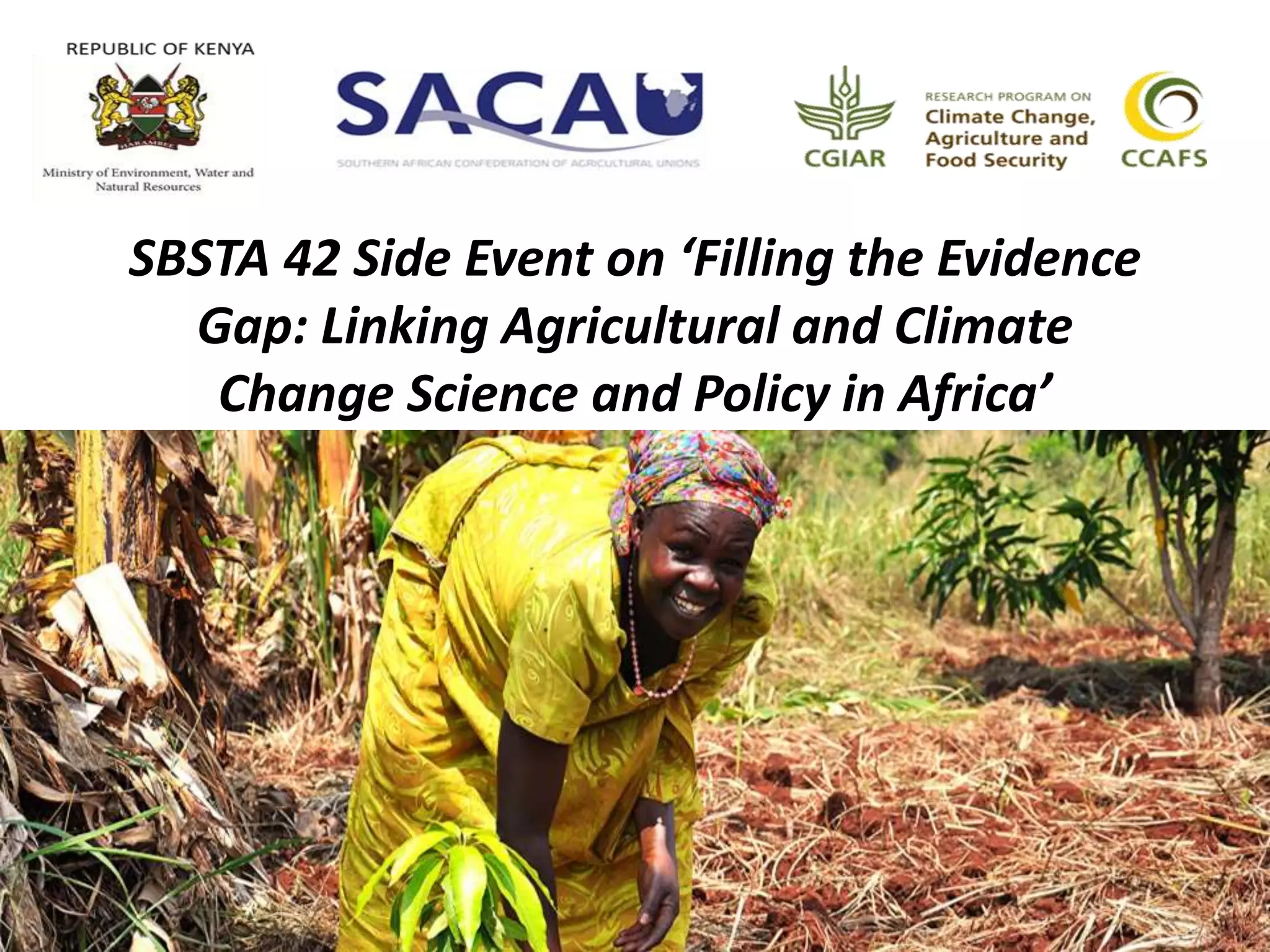
SBSTA 42 Side Event on ‘Filling the Evidence
Gap: Linking Agricultural and Climate
Change Science and Policy in Africa’
Kevin Coffey SBSAT 42 June 2015
Expanding the Contribution of
Early Warning to Climate-
Resilient Agricultural
Development in Africa
In an era of more frequent and more extreme weather events and climate
shocks, enhanced early warning systems provide a key opportunity to curb
erosion of development progress in rural sectors. Recommendations for
strengthening existing systems and developing news ones are:
Six Recommendations
1) Establish objective rules for early response to early warning information, based
on parametric triggers, contingency plans and contingency finance mechanisms
2) Broaden the range of users of early warning information and integrate into
development activities
3) Early warning systems should incorporate systematic feedback from users, and
change with the needs of stakeholders and new technology
4) Invest in the quality, accessibility and integration of data
5) Take greater advantage of seasonal prediction to increase the lead-time
6) Factor uncertainty into risk analysis, communication, and decision processes
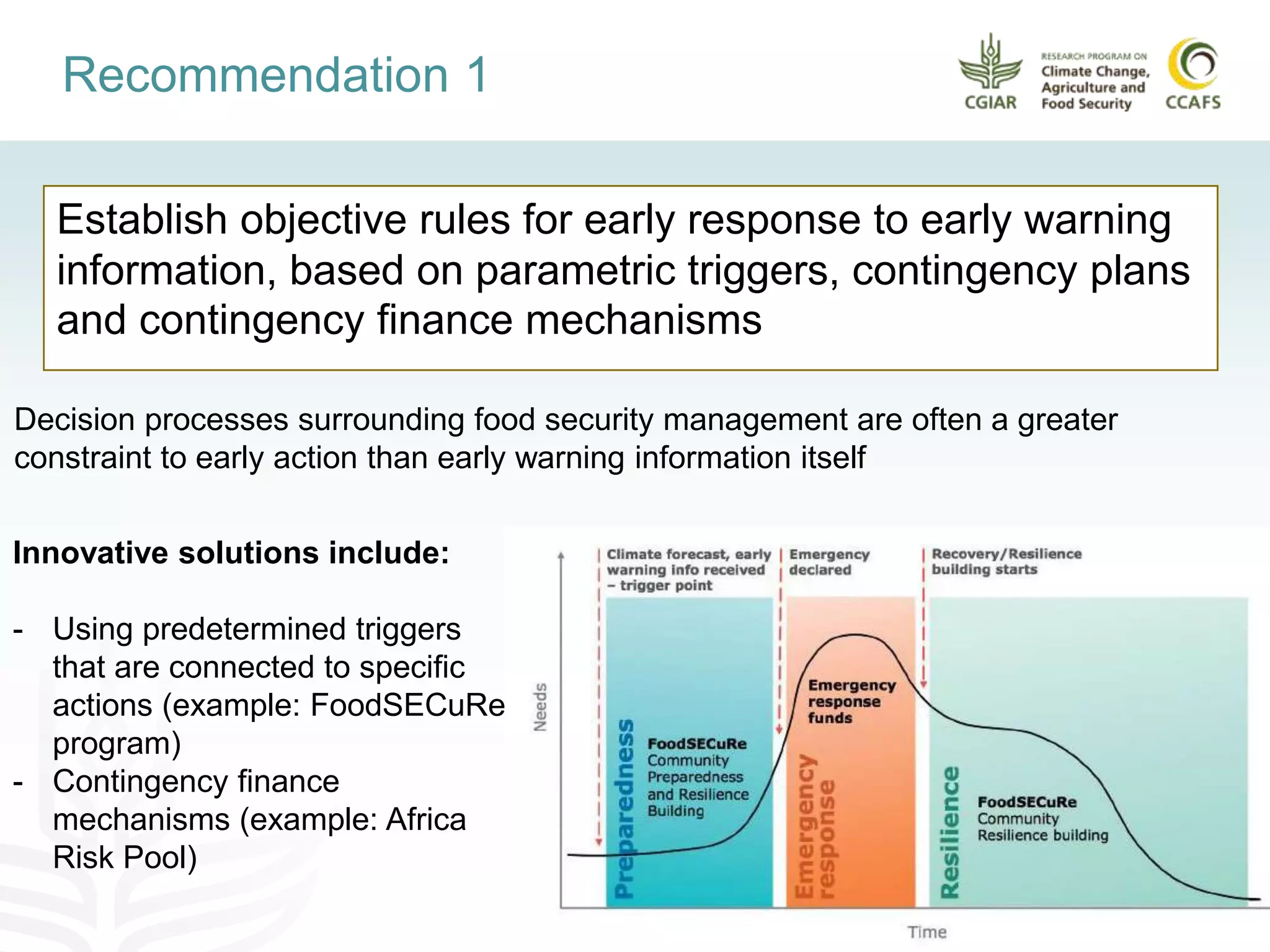
Establish objective rules for early response to early warning
information, based on parametric triggers, contingency plans
and contingency finance mechanisms
Recommendation 1
Innovative solutions include:
- Using predetermined triggers
that are connected to specific
actions (example: FoodSECuRe
program)
- Contingency finance
mechanisms (example: Africa
Risk Pool)
Decision processes surrounding food security management are often a greater
constraint to early action than early warning information itself
Broaden the range of users of early warning information and
integrate into development activities
Recommendation 2
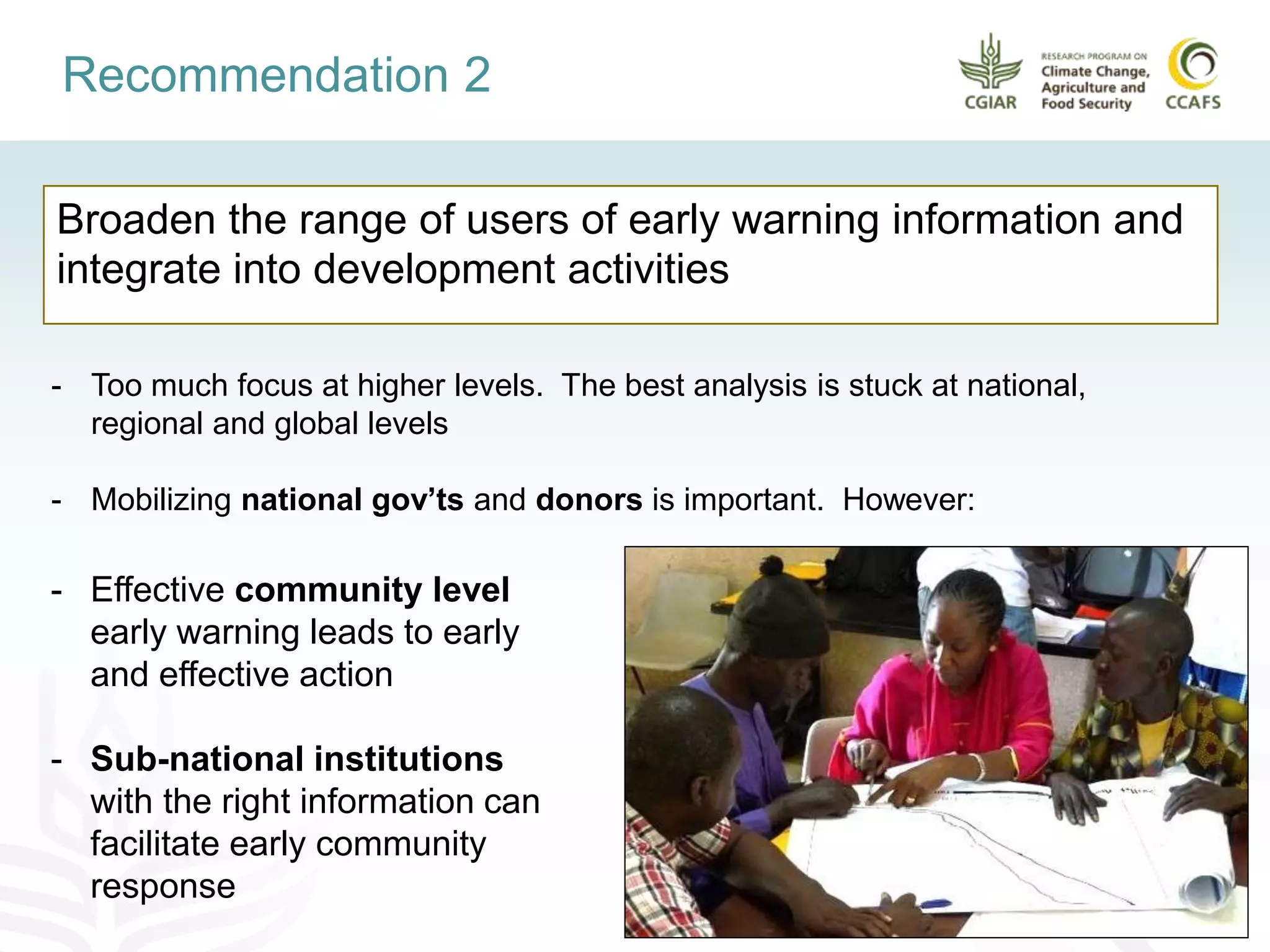
- Effective community level
early warning leads to early
and effective action
- Sub-national institutions
with the right information can
facilitate early community
response
- Too much focus at higher levels. The best analysis is stuck at national,
regional and global levels
- Mobilizing national gov’ts and donors is important. However:
Early warning systems should incorporate systematic
feedback from users, and change with the needs of
stakeholders and new technology
Recommendation 3
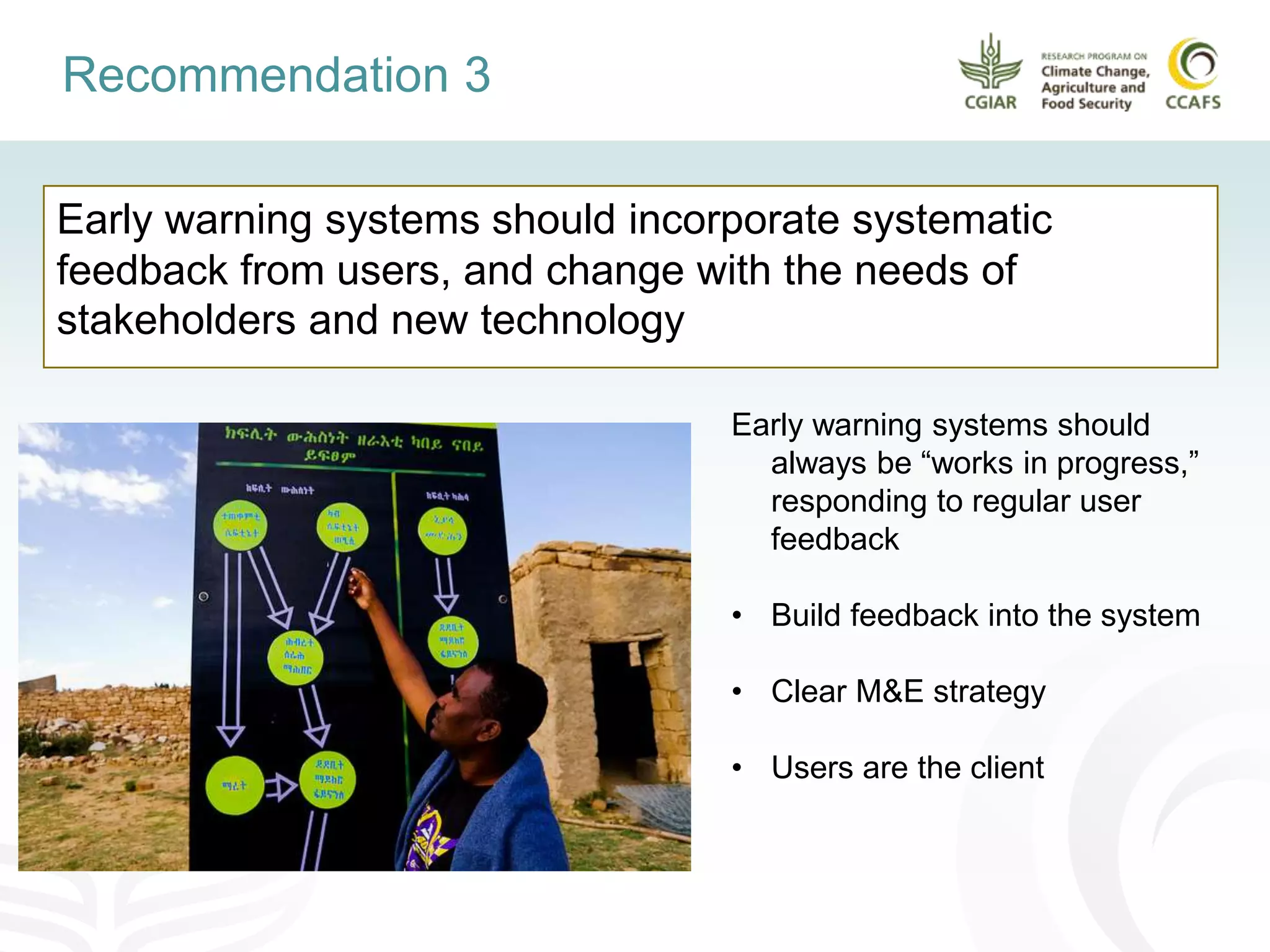
Early warning systems should
always be “works in progress,”
responding to regular user
feedback
• Build feedback into the system
• Clear M&E strategy
• Users are the client
Invest in the quality, accessibility and integration of data
Recommendation 4
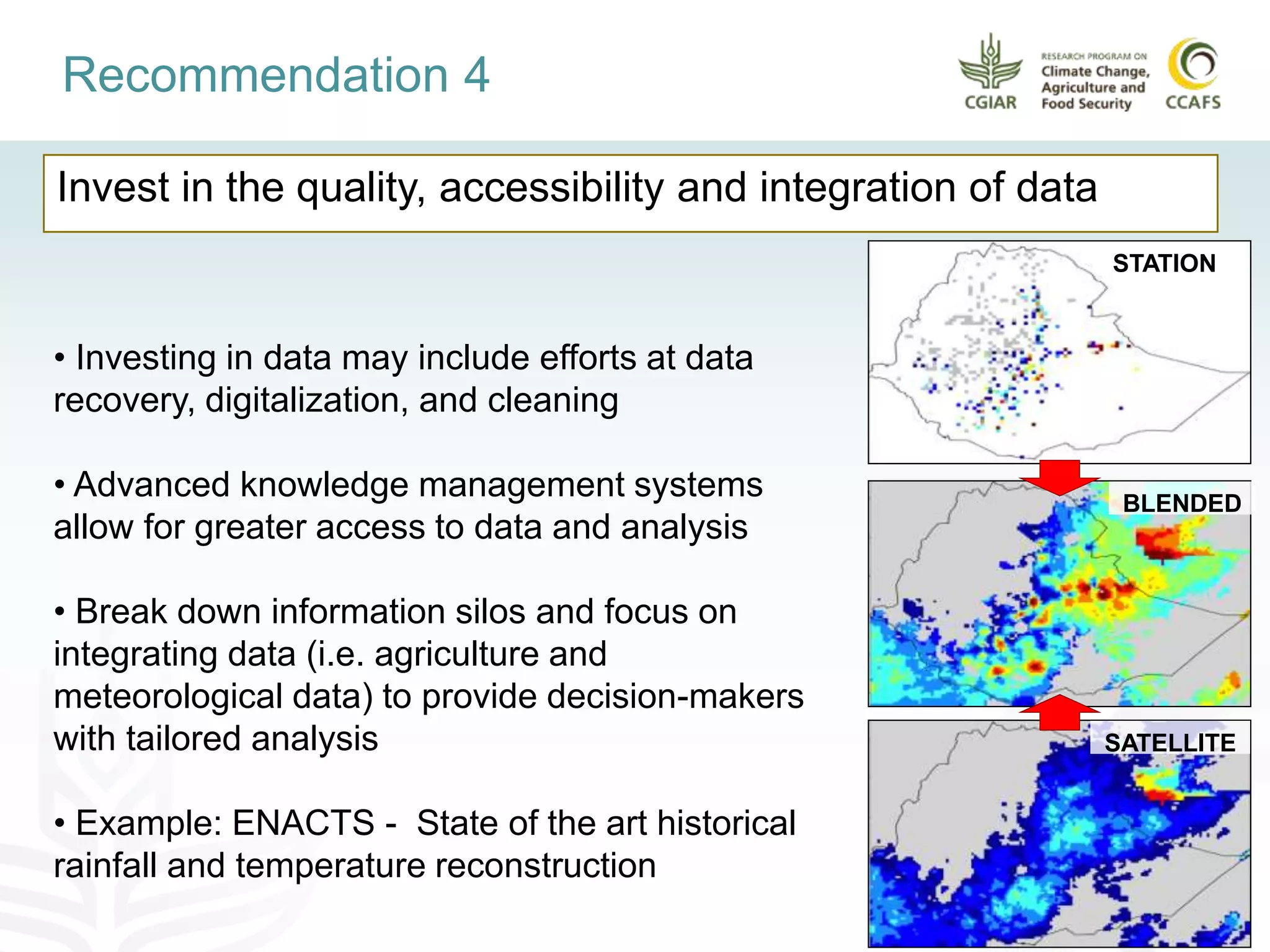
• Investing in data may include efforts at data
recovery, digitalization, and cleaning
• Advanced knowledge management systems
allow for greater access to data and analysis
• Break down information silos and focus on
integrating data (i.e. agriculture and
meteorological data) to provide decision-makers
with tailored analysis
• Example: ENACTS - State of the art historical
rainfall and temperature reconstruction
STATION
BLENDED
SATELLITE
Take greater advantage of seasonal prediction to increase
the lead-time
Recommendation 5
• Early season assessments in Africa typically take a more ad-hoc
approach to incorporating seasonal prediction
• Subjective assessments are difficult to calibrate in probabilistic terms and
can’t be used for triggering early action based on objective thresholds
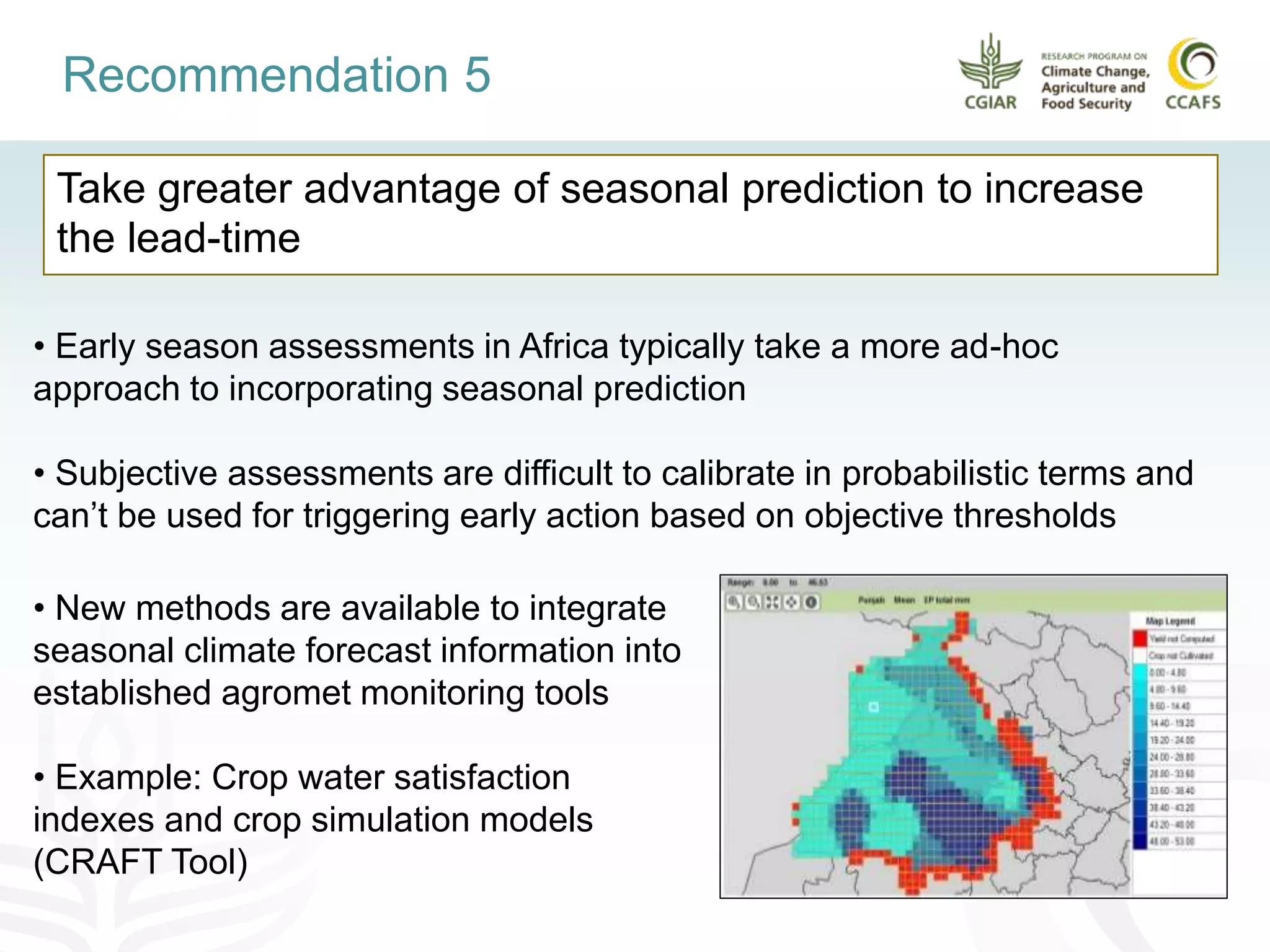
• New methods are available to integrate
seasonal climate forecast information into
established agromet monitoring tools
• Example: Crop water satisfaction
indexes and crop simulation models
(CRAFT Tool)
Factor uncertainty into risk analysis, communication, and
decision processes
Recommendation 6
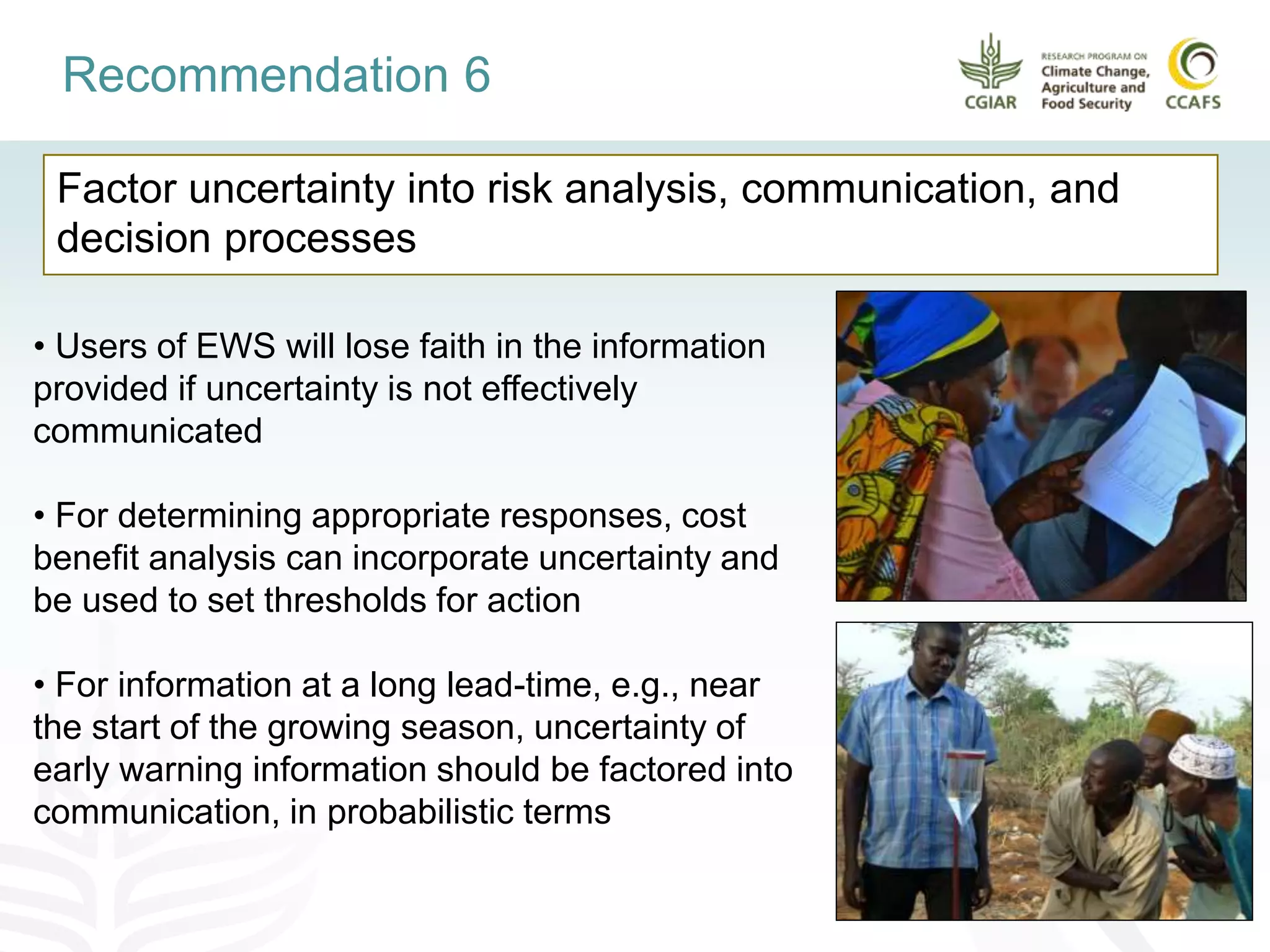
• Users of EWS will lose faith in the information
provided if uncertainty is not effectively
communicated
• For determining appropriate responses, cost
benefit analysis can incorporate uncertainty and
be used to set thresholds for action
• For information at a long lead-time, e.g., near
the start of the growing season, uncertainty of
early warning information should be factored into
communication, in probabilistic terms
Thank you!
Please See the CCAFS SBSTA Submission on Early Warning
for More Information
SBSTA 42 Side Event on ‘Filling the Evidence
Gap: Linking Agricultural and Climate
Change Science and Policy in Africa’
Julian Smith
International Development Lead
Fera
Impact of climate change on
African agriculture: focus
on pests and diseases
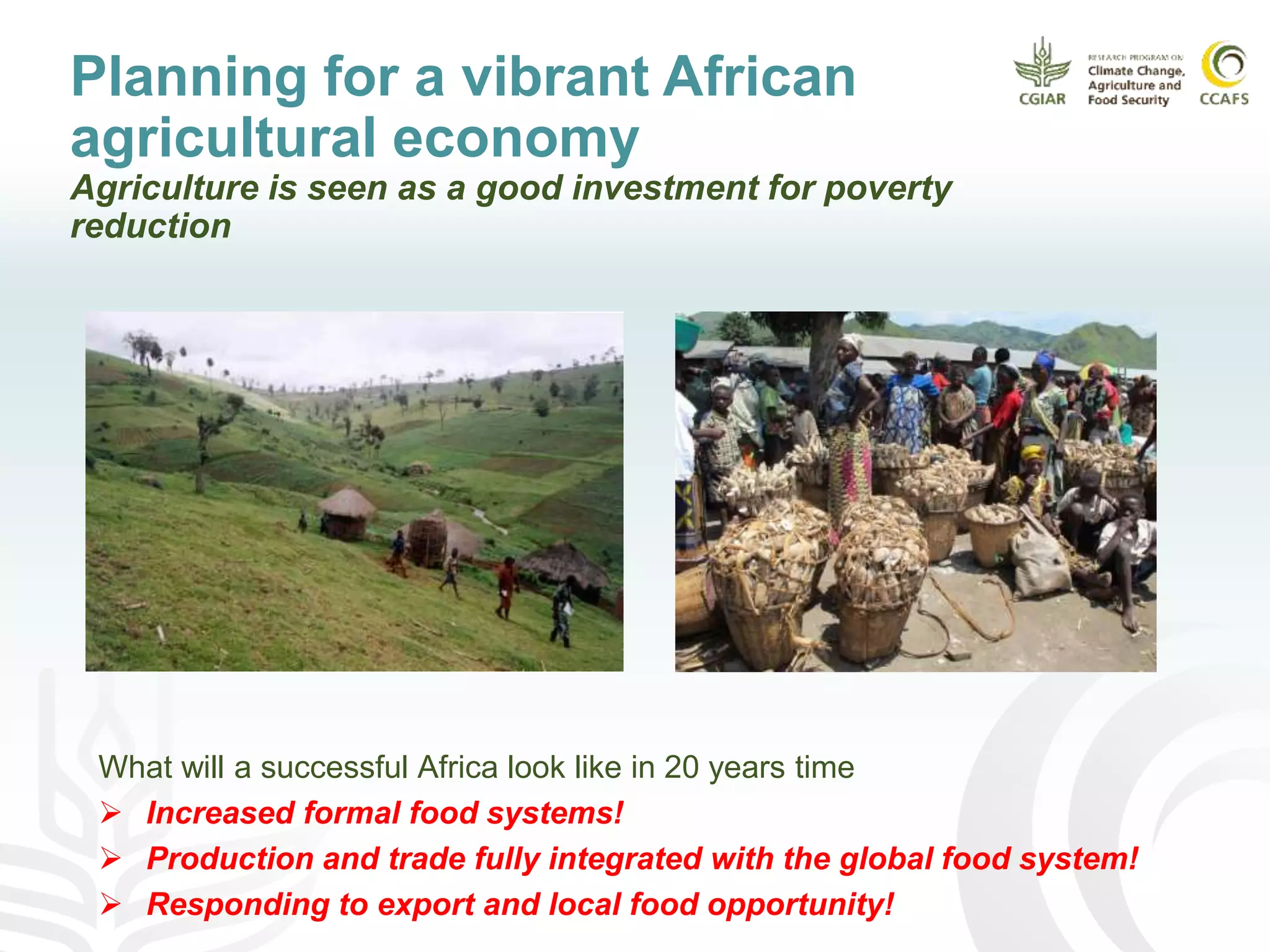
Planning for a vibrant African
agricultural economy
Agriculture is seen as a good investment for poverty
reduction
What will a successful Africa look like in 20 years time
 Increased formal food systems!
 Production and trade fully integrated with the global food system!
 Responding to export and local food opportunity!
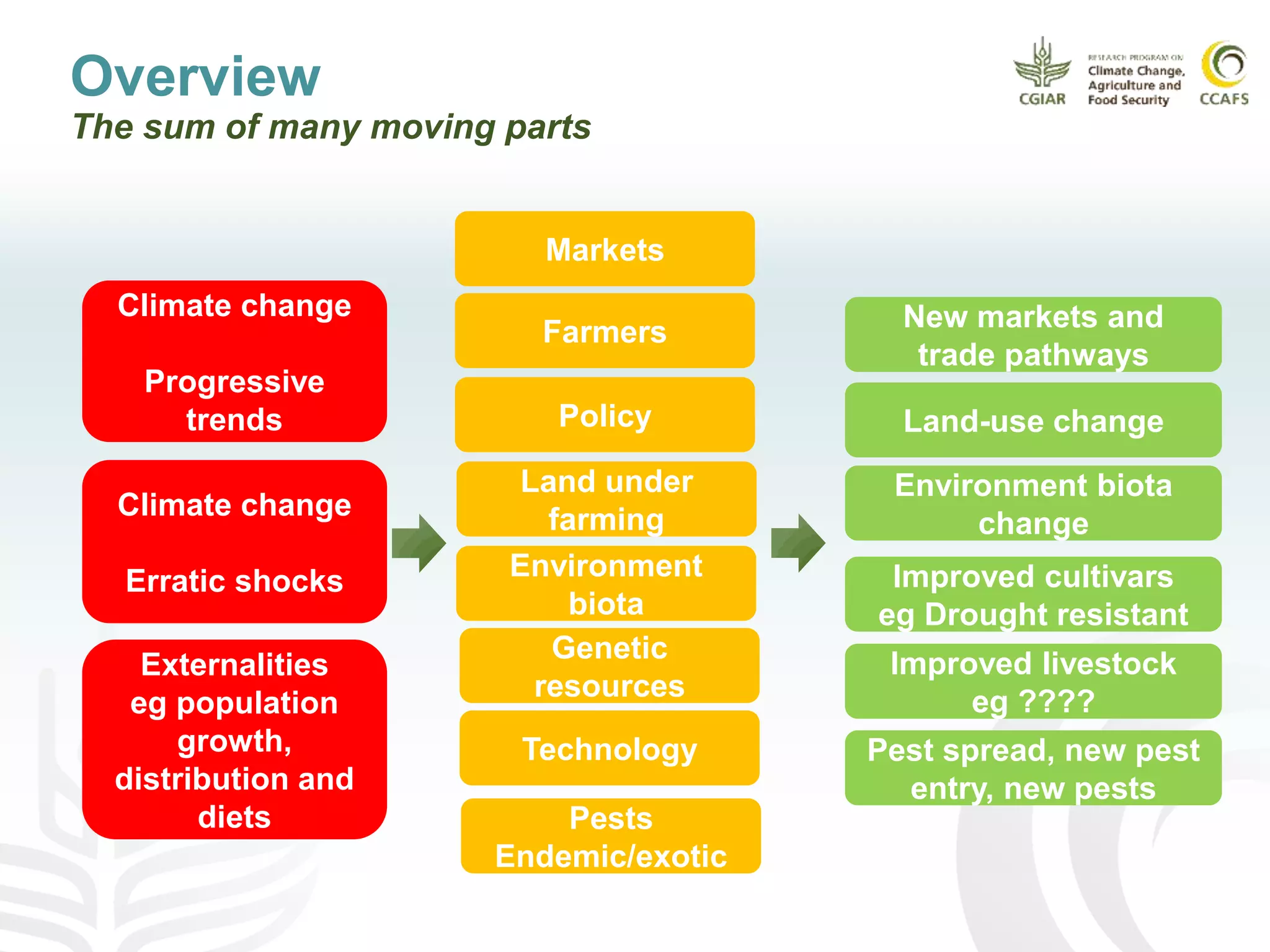
Overview
The sum of many moving parts
Climate change
Progressive
trends
Climate change
Erratic shocks
Markets
Farmers
Policy
Land under
farming
Externalities
eg population
growth,
distribution and
diets
New markets and
trade pathways
Land-use change
Genetic
resources
Environment
biota
Pests
Endemic/exotic
Technology Pest spread, new pest
entry, new pests
Improved cultivars
eg Drought resistant
Environment biota
change
Improved livestock
eg ????
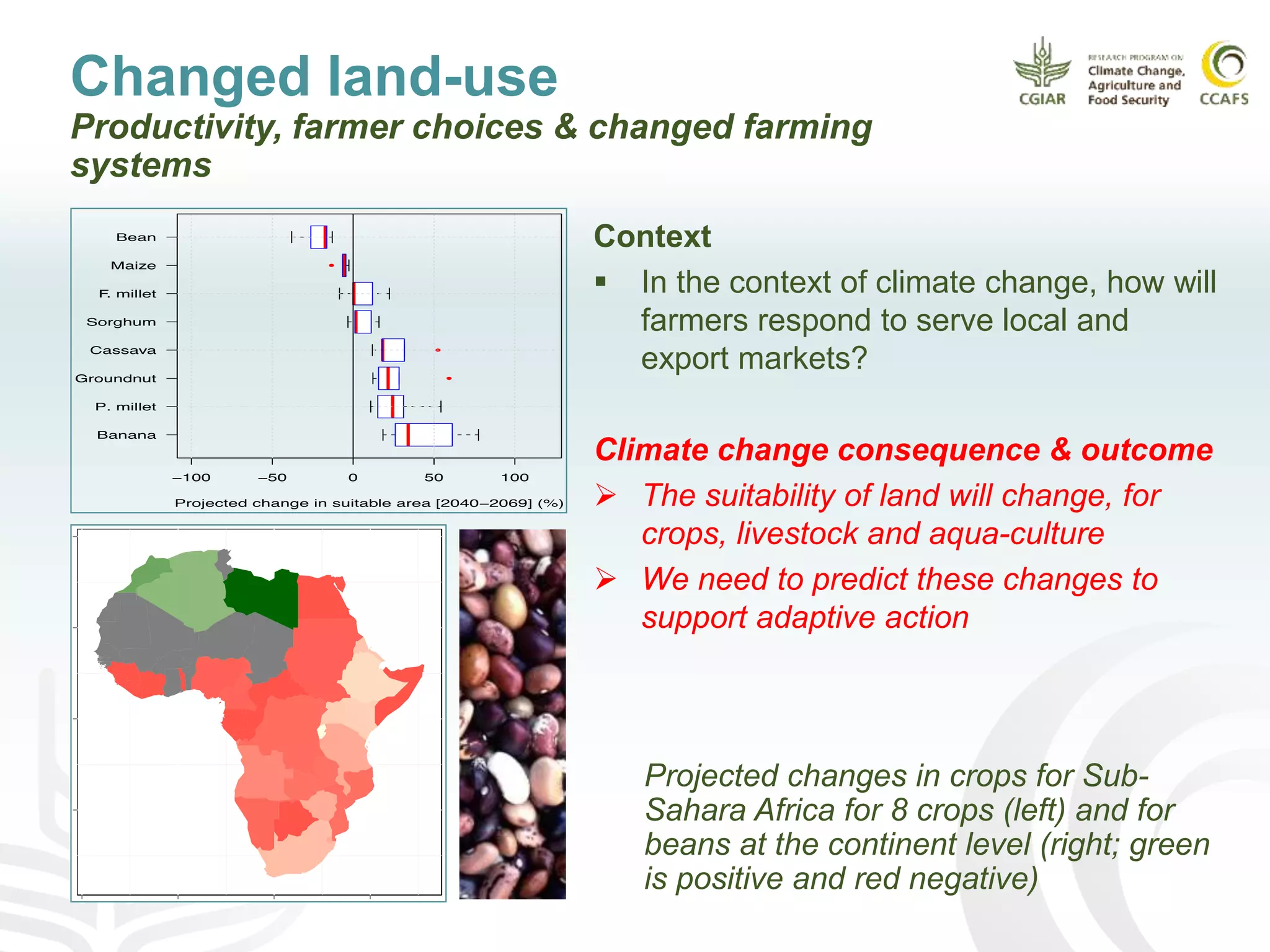
Changed land-use
Productivity, farmer choices & changed farming
systems
Projected changes in crops for Sub-
Sahara Africa for 8 crops (left) and for
beans at the continent level (right; green
is positive and red negative)
Context
 In the context of climate change, how will
farmers respond to serve local and
export markets?
Climate change consequence & outcome
 The suitability of land will change, for
crops, livestock and aqua-culture
 We need to predict these changes to
support adaptive action
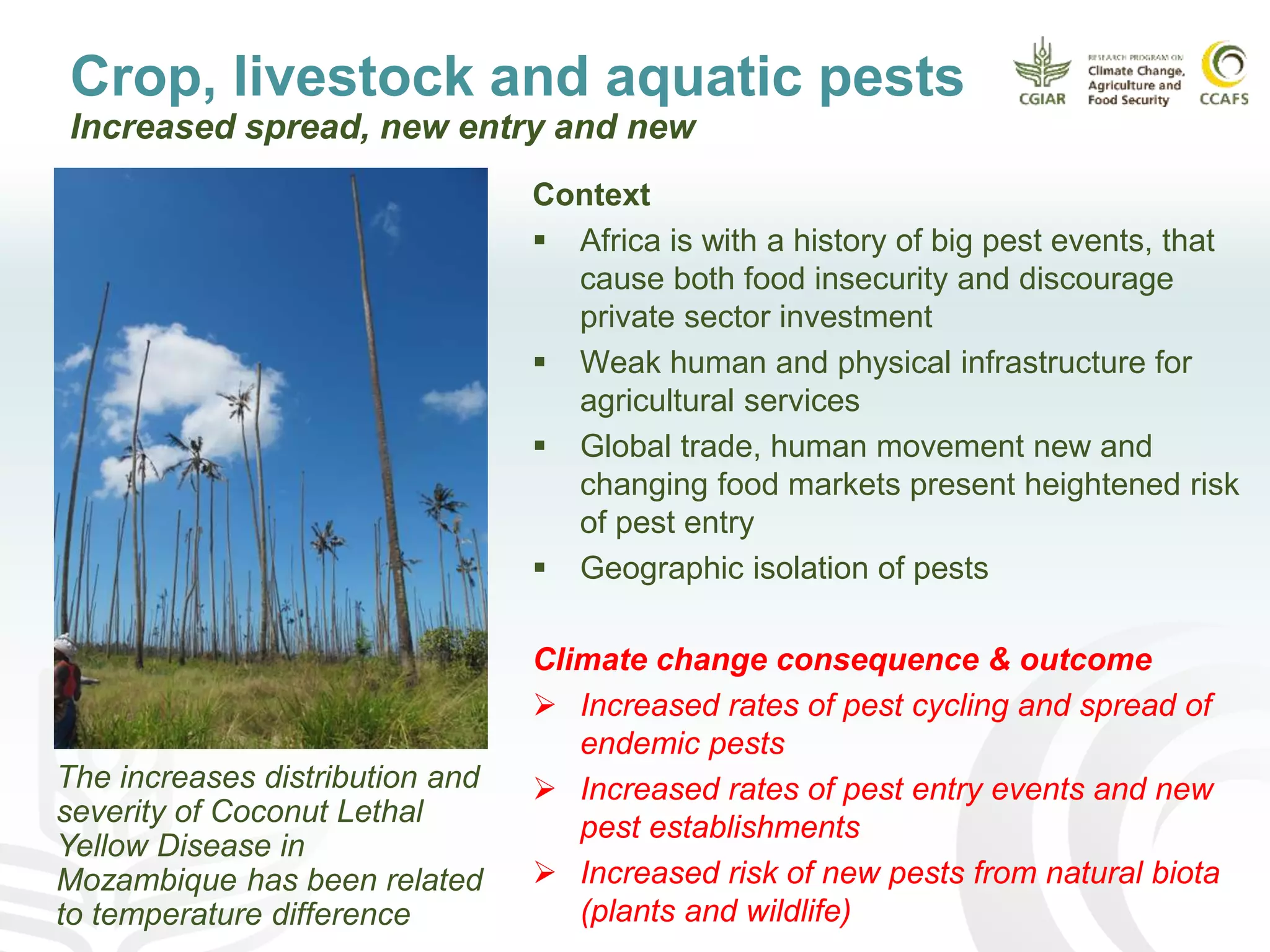
Crop, livestock and aquatic pests
Increased spread, new entry and new
Context
 Africa is with a history of big pest events, that
cause both food insecurity and discourage
private sector investment
 Weak human and physical infrastructure for
agricultural services
 Global trade, human movement new and
changing food markets present heightened risk
of pest entry
 Geographic isolation of pests
Climate change consequence & outcome
 Increased rates of pest cycling and spread of
endemic pests
 Increased rates of pest entry events and new
pest establishments
 Increased risk of new pests from natural biota
(plants and wildlife)
The increases distribution and
severity of Coconut Lethal
Yellow Disease in
Mozambique has been related
to temperature difference
Climate change – trend impacts
Livestock and East Coast Fever
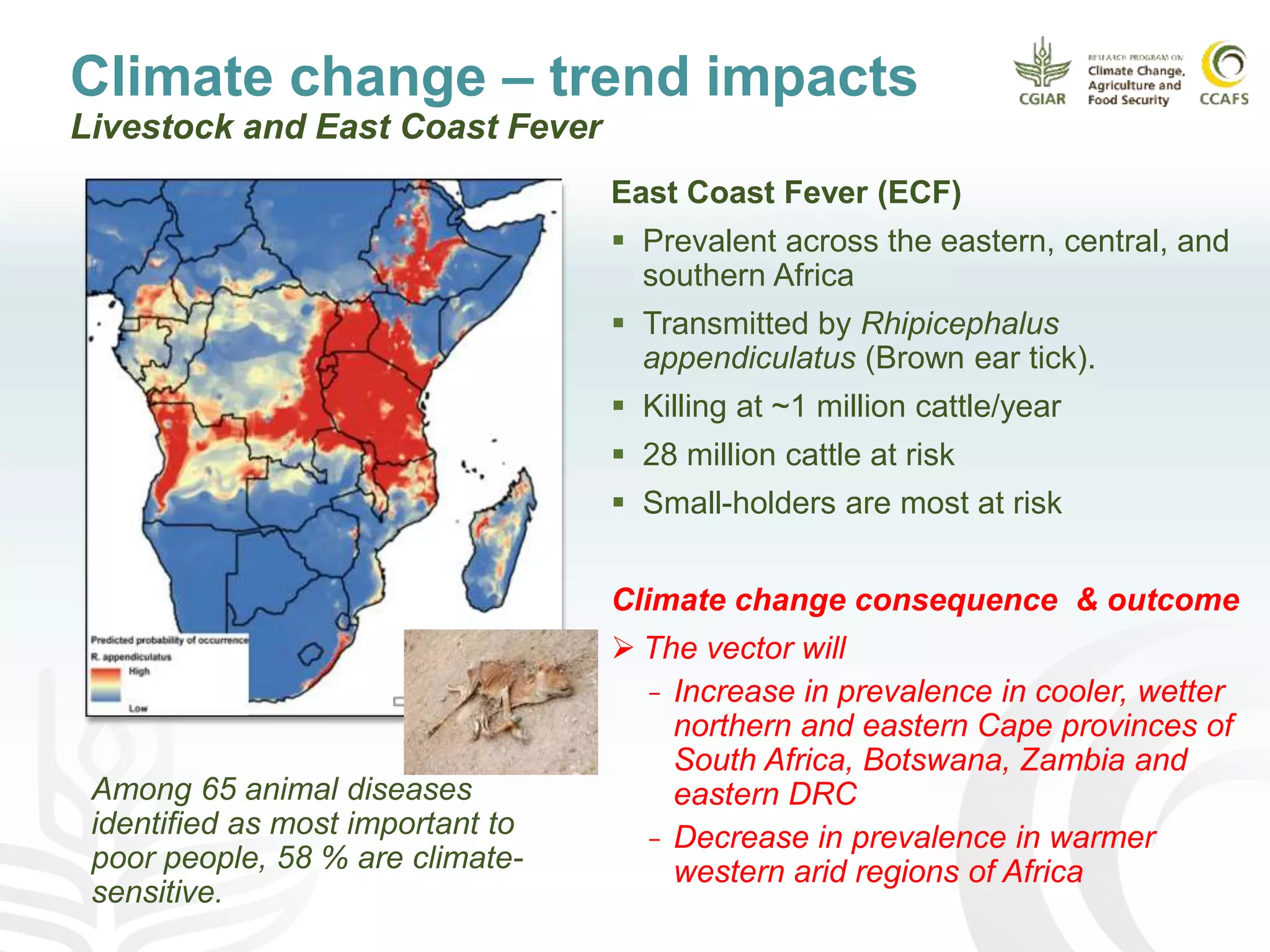
East Coast Fever (ECF)
 Prevalent across the eastern, central, and
southern Africa
 Transmitted by Rhipicephalus
appendiculatus (Brown ear tick).
 Killing at ~1 million cattle/year
 28 million cattle at risk
 Small-holders are most at risk
Climate change consequence & outcome
 The vector will
− Increase in prevalence in cooler, wetter
northern and eastern Cape provinces of
South Africa, Botswana, Zambia and
eastern DRC
− Decrease in prevalence in warmer
western arid regions of Africa
Among 65 animal diseases
identified as most important to
poor people, 58 % are climate-
sensitive.
Climate change – trend impacts
Crops and Potato tuber moth
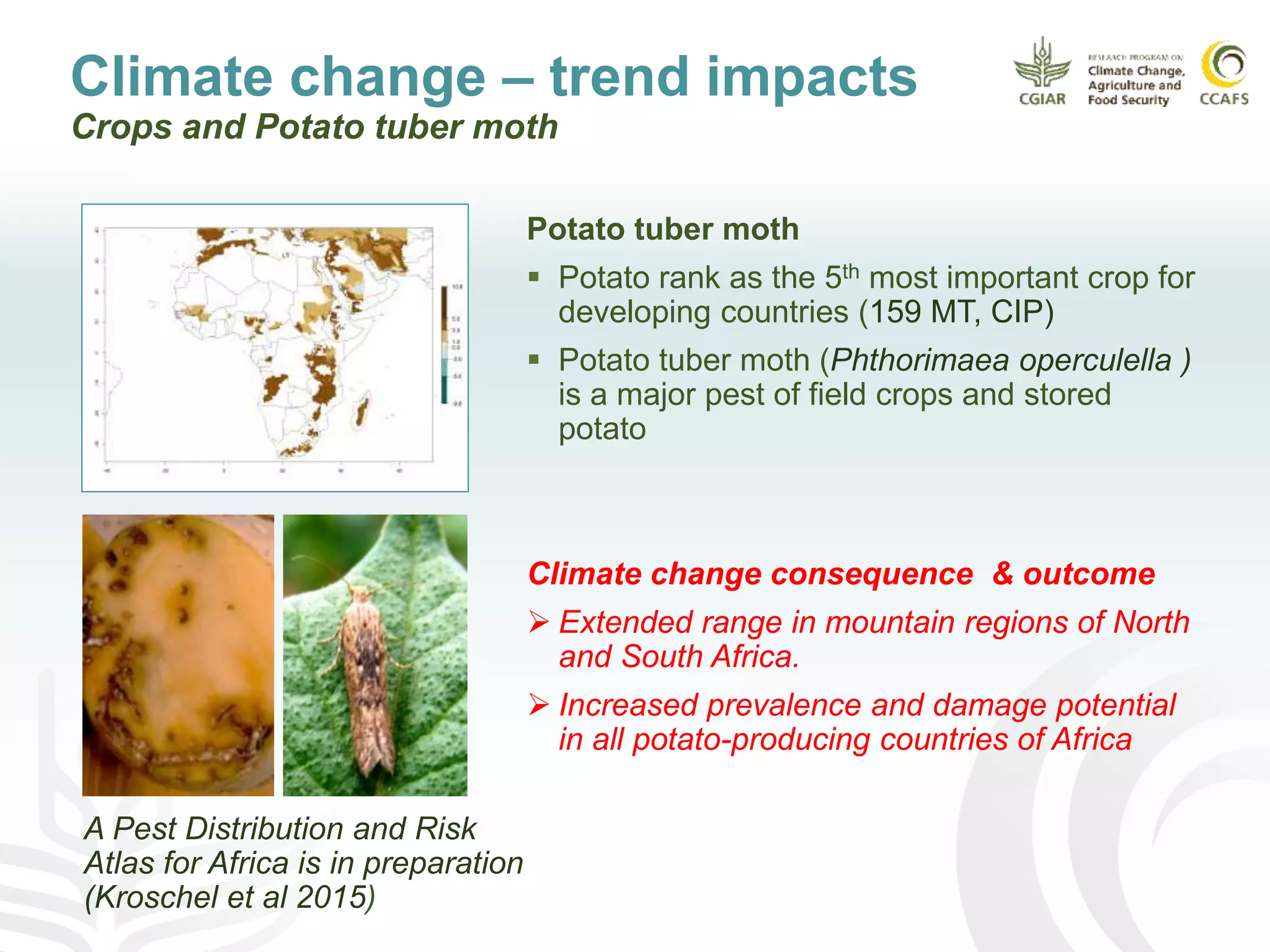
Potato tuber moth
 Potato rank as the 5th most important crop for
developing countries (159 MT, CIP)
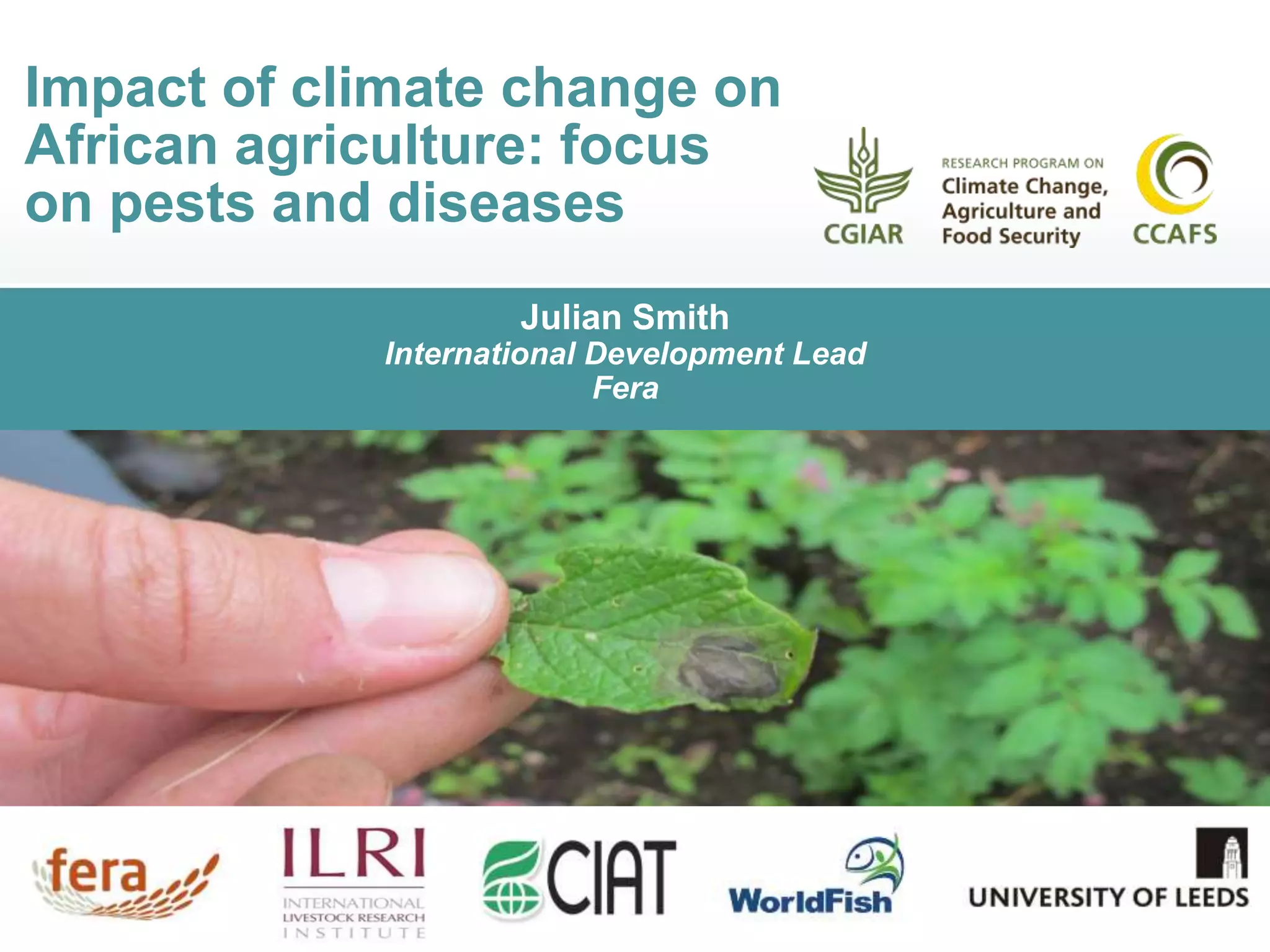
 Potato tuber moth (Phthorimaea operculella )
is a major pest of field crops and stored
potato
Climate change consequence & outcome
 Extended range in mountain regions of North
and South Africa.
 Increased prevalence and damage potential
in all potato-producing countries of Africa
A Pest Distribution and Risk
Atlas for Africa is in preparation
(Kroschel et al 2015)
Climate change – trend impacts
Aquaculture and Epizootic Ulcerative Syndrome
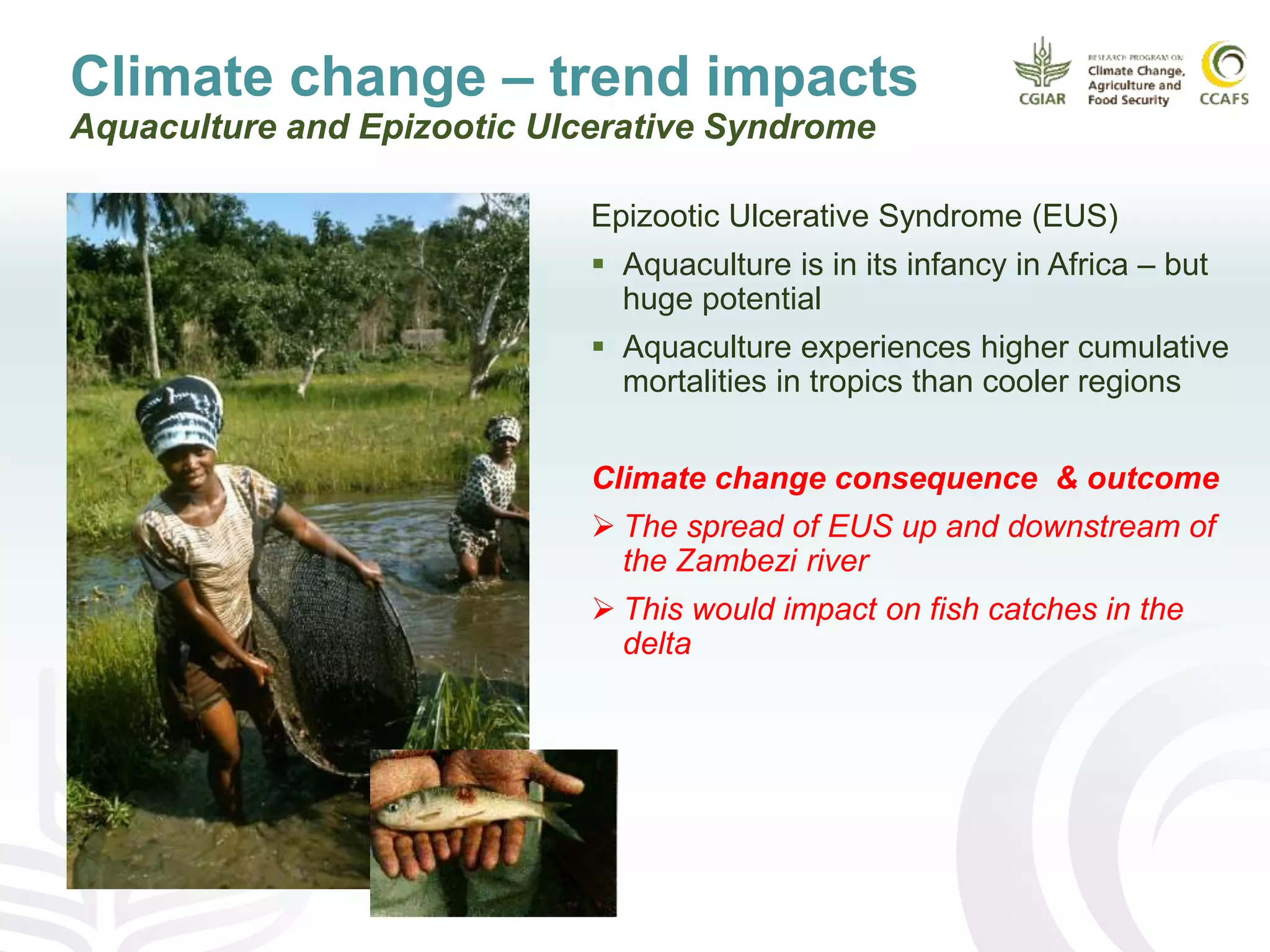
Epizootic Ulcerative Syndrome (EUS)
 Aquaculture is in its infancy in Africa – but
huge potential
 Aquaculture experiences higher cumulative
mortalities in tropics than cooler regions
Climate change consequence & outcome
 The spread of EUS up and downstream of
the Zambezi river
 This would impact on fish catches in the
delta
Climate change – shock impacts
Drought tolerance and Maize Lethal Necrosis
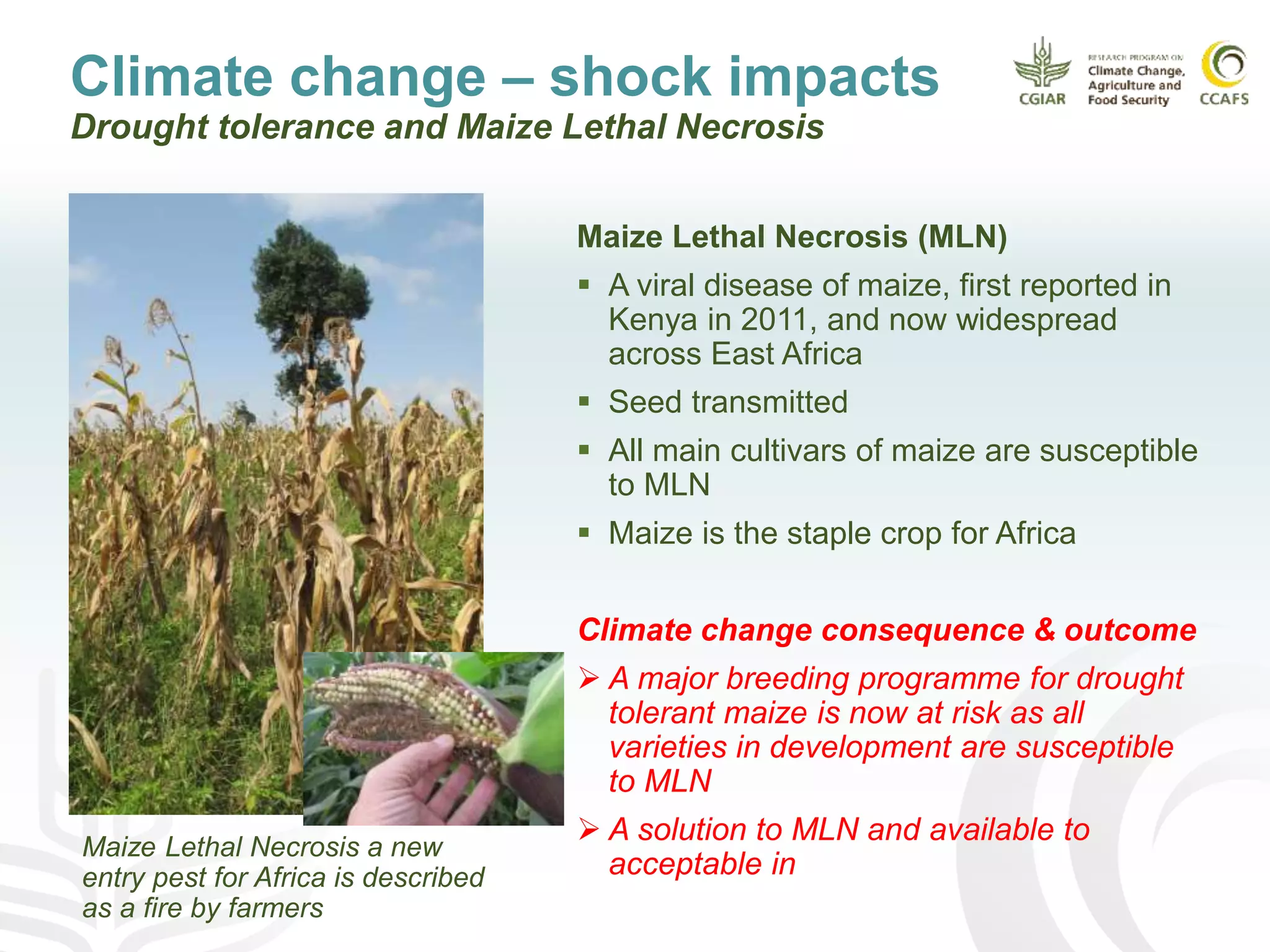
Maize Lethal Necrosis (MLN)
 A viral disease of maize, first reported in
Kenya in 2011, and now widespread
across East Africa
 Seed transmitted
 All main cultivars of maize are susceptible
to MLN
 Maize is the staple crop for Africa
Climate change consequence & outcome
 A major breeding programme for drought
tolerant maize is now at risk as all
varieties in development are susceptible
to MLN
 A solution to MLN and available to
acceptable in
Maize Lethal Necrosis a new
entry pest for Africa is described
as a fire by farmers
Climate change – shock impacts
Failed harvests and new trade pathways
New Trade routes
 Frequency of extreme weather events will
increase and harvests will fail more
frequently
 Markets will adapt via new import trade
pathways
 New pest threats will be associated with
these pathways
 Pests of key crops are geographically
isolated within and between continents
Climate change consequence
 The likelihood of pests gaining entry to new
regions is increased by new trade
pathways, especially when these are
responding to a shock and not with a
proper risk assessment
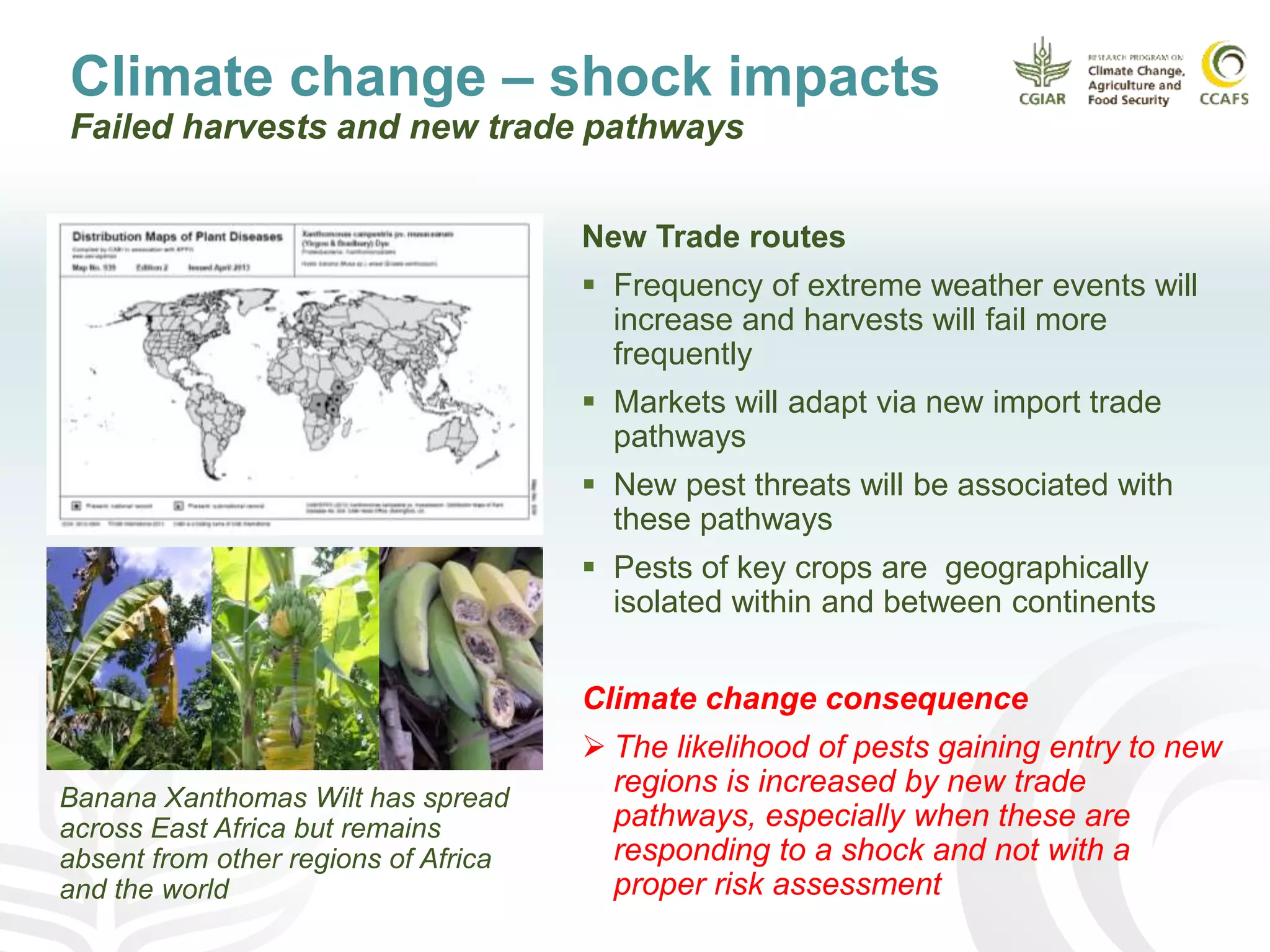
Banana Xanthomas Wilt has spread
across East Africa but remains
absent from other regions of Africa
and the world
Recommendations for action
Embedding resilience into future systems
 Enhance capacity of regional, national and local
organizations
 Promote multi country coordination approaches
 Improve data quality and quantity
 Support pre-emptive breeding
 Invest in resilience of production systems
 Invest in research and development
Thank you
For more information: See CCAFS Info Note:
Impact of climate change on African agriculture: focus on pests and diseases
SBSTA 42 Side Event on ‘Filling the Evidence
Gap: Linking Agricultural and Climate
Change Science and Policy in Africa’
Enabling research-to-policy dialogue for
adaptation to climate change in Africa: The
AfricaInteract experience.
By
Dr. Abdulai Jalloh,
Programme Manager, NRM
CORAF/WECARD
Presentation at the CCAFS side event : Filling the Evidence Gap:
Linking Agricultural and Climate Change Science and Policy in Africa
June 6, 2015,
Bonn, Germany
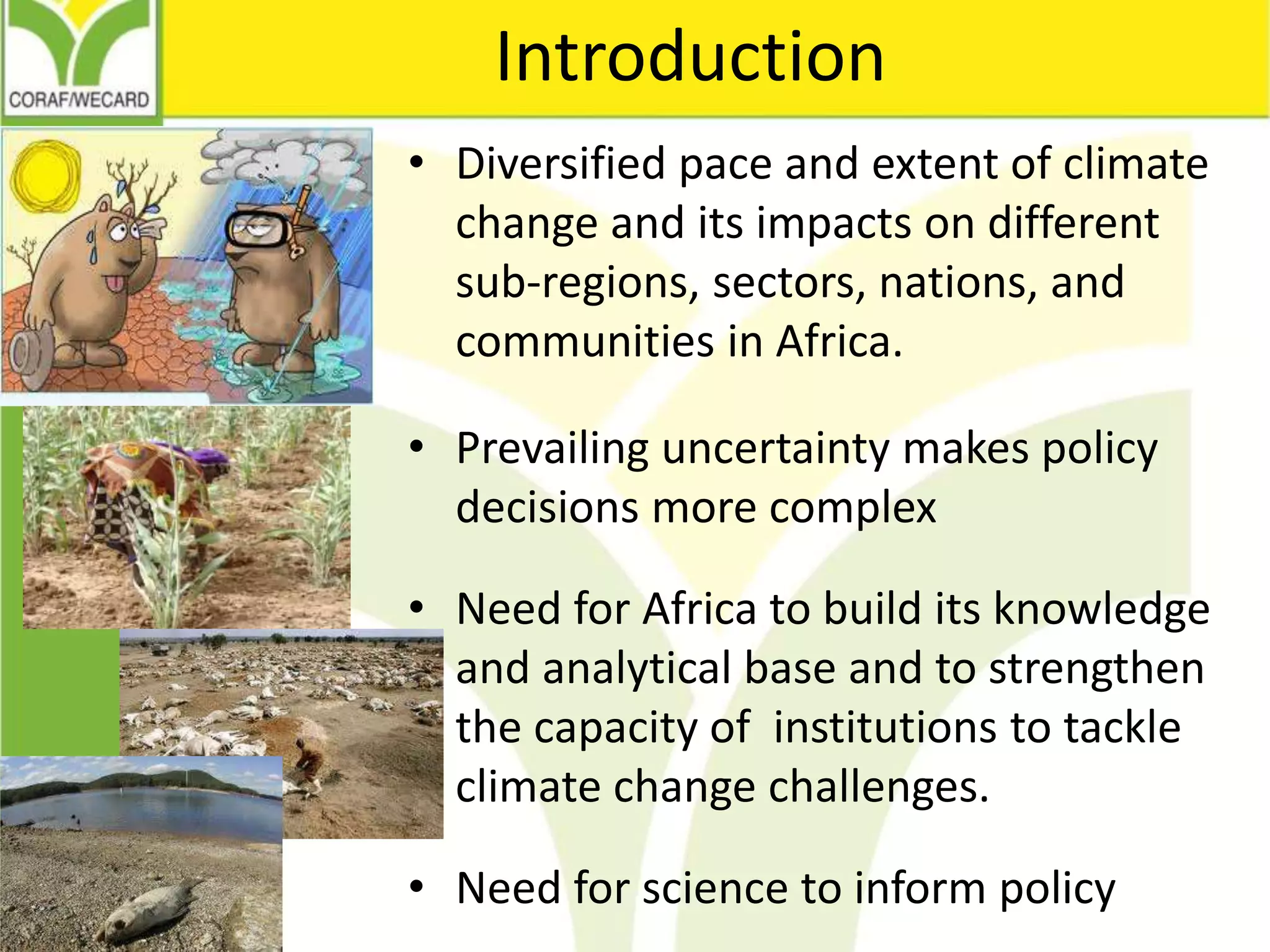
Introduction
• Diversified pace and extent of climate
change and its impacts on different
sub-regions, sectors, nations, and
communities in Africa.
• Prevailing uncertainty makes policy
decisions more complex
• Need for Africa to build its knowledge
and analytical base and to strengthen
the capacity of institutions to tackle
climate change challenges.
• Need for science to inform policy
• Promote and support
effective documentation and
sharing of information to
improve climate change
adaptation policy in Africa
• Identify policy gaps and
promote the integration of
climate change research into
development policies,
strategies, programs and
projects at continental and
sub-regional levels
AfricaInteract: Enabling research-policy- dialogue
for adaptation to climate change
Key activities
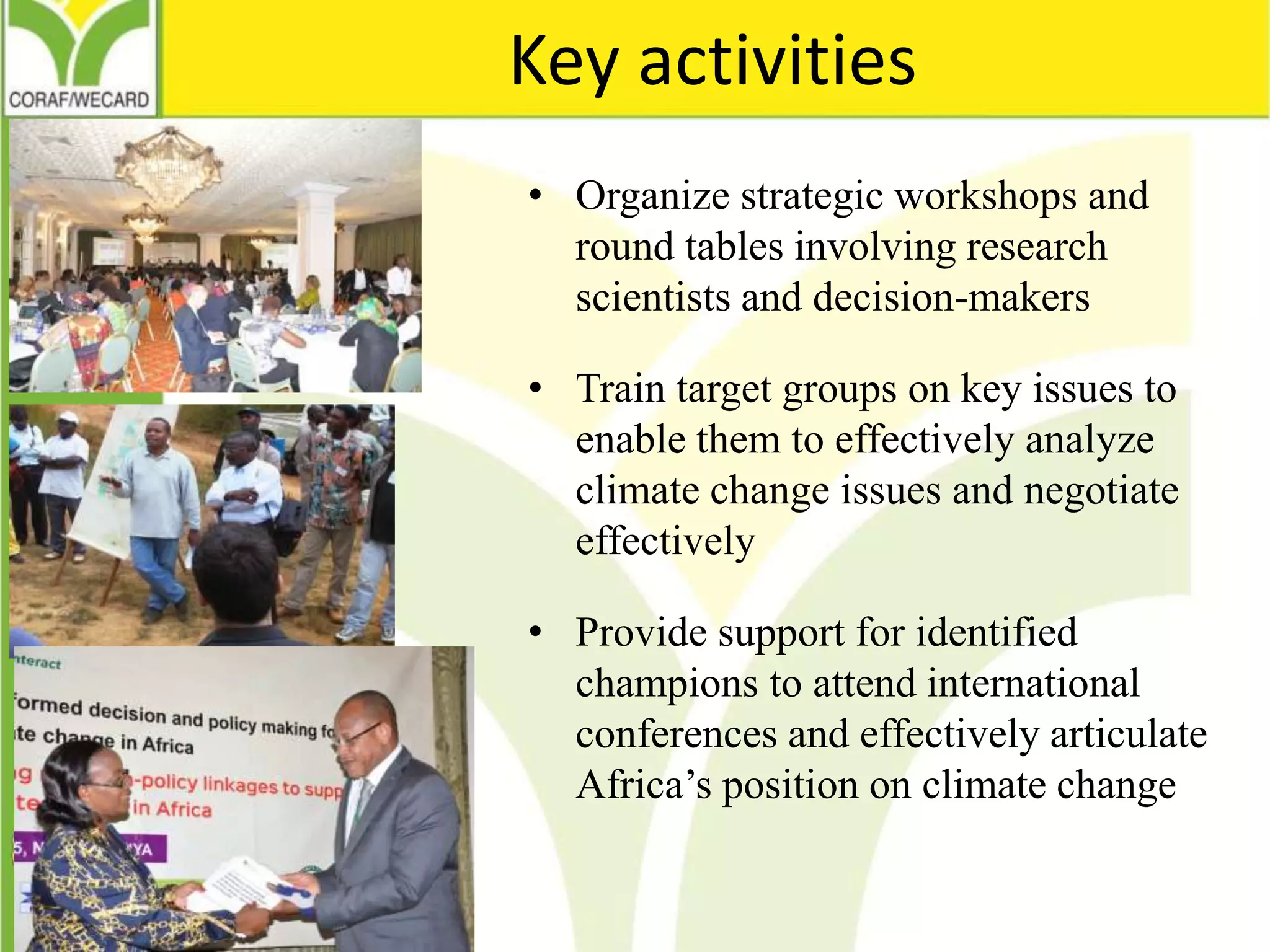
• Organize strategic workshops and
round tables involving research
scientists and decision-makers
• Train target groups on key issues to
enable them to effectively analyze
climate change issues and negotiate
effectively
• Provide support for identified
champions to attend international
conferences and effectively articulate
Africa’s position on climate change
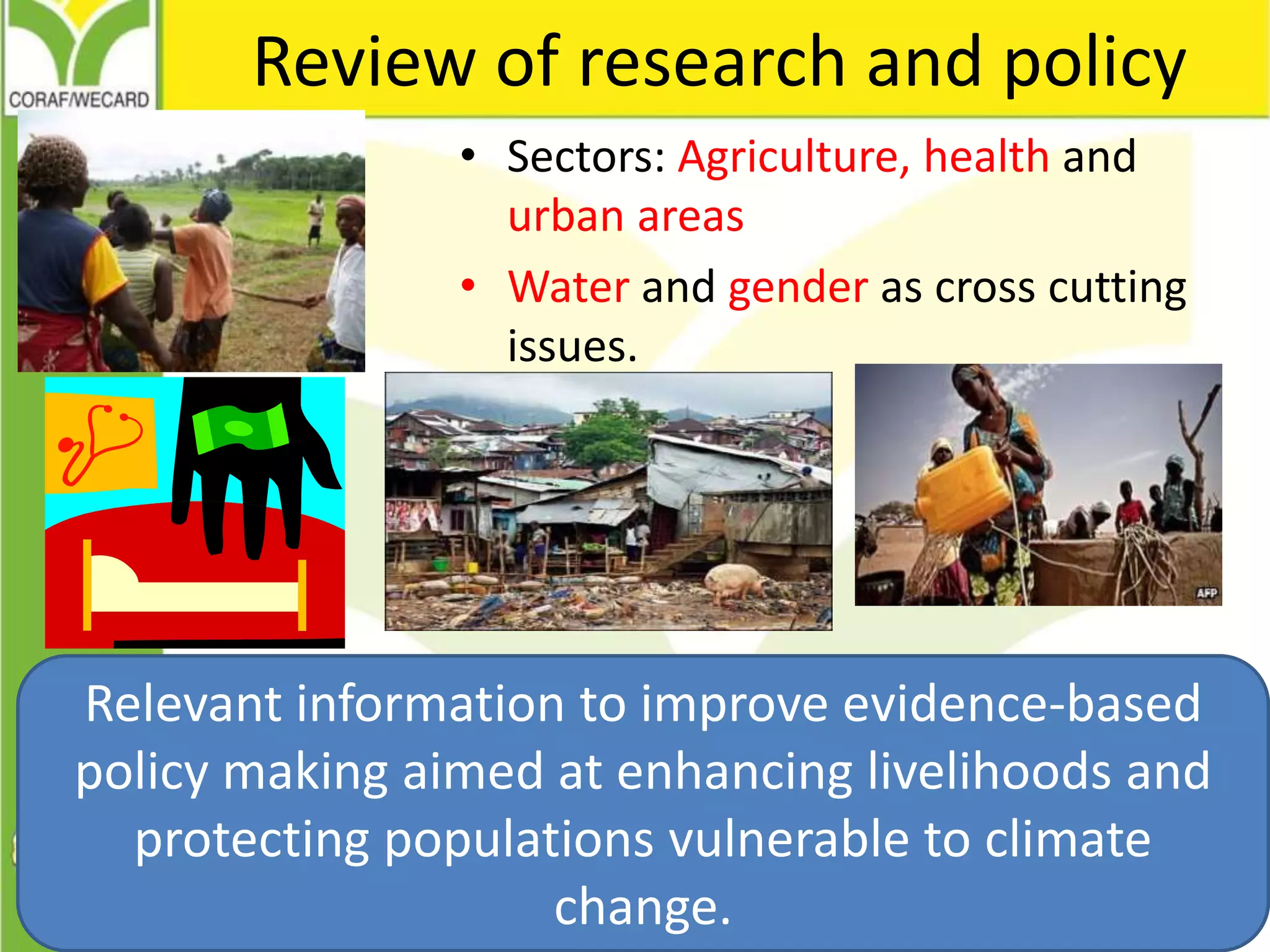
Review of research and policy
• Sectors: Agriculture, health and
urban areas
• Water and gender as cross cutting
issues.
Relevant information to improve evidence-based
policy making aimed at enhancing livelihoods and
protecting populations vulnerable to climate
change.
Findings – research/Poilcy
• Rapidly growing body of evidence on
impacts of climate change on agriculture,
particularly crop systems
• Increasing evidence of autonomous
adaptation by crop farmers, pastoralists
and fisherfolk, using local knowledge
• Much adaptation happens despite lack of
institutional support, but growing focus
around ‘climate-smart’ farming systems
• Impacts of climate change and variability
on agriculture is moderated by political,
economic and social factors
Agriculture: key recommendations
• Adaptation measures should be tested for
contribution to resilience across entire food chain
• Further research to field test promising ‘climate
smart’ agricultural technologies and practices
• Need to tackle root causes for vulnerability in the
agricultural sector such as resource access and
property rights, closely linked with gender concerns
• Need more focus on fisheries and pastoralist
systems as compared to crop farming systems
• Need for better coordination and coherence
between agriculture and environment ministries
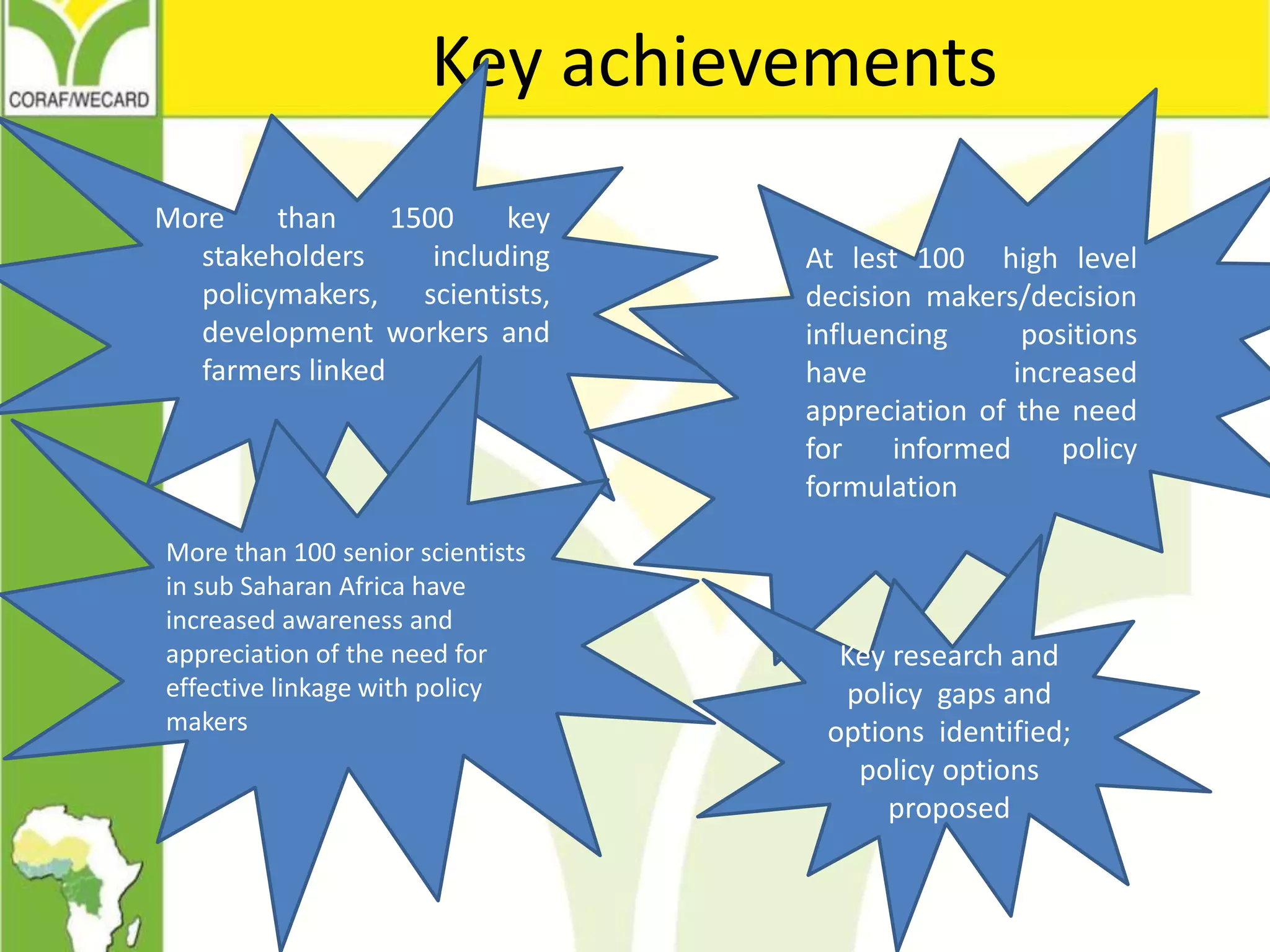
Key achievements
More than 1500 key
stakeholders including
policymakers, scientists,
development workers and
farmers linked
At lest 100 high level
decision makers/decision
influencing positions
have increased
appreciation of the need
for informed policy
formulation
More than 100 senior scientists
in sub Saharan Africa have
increased awareness and
appreciation of the need for
effective linkage with policy
makers
Key research and
policy gaps and
options identified;
policy options
proposed
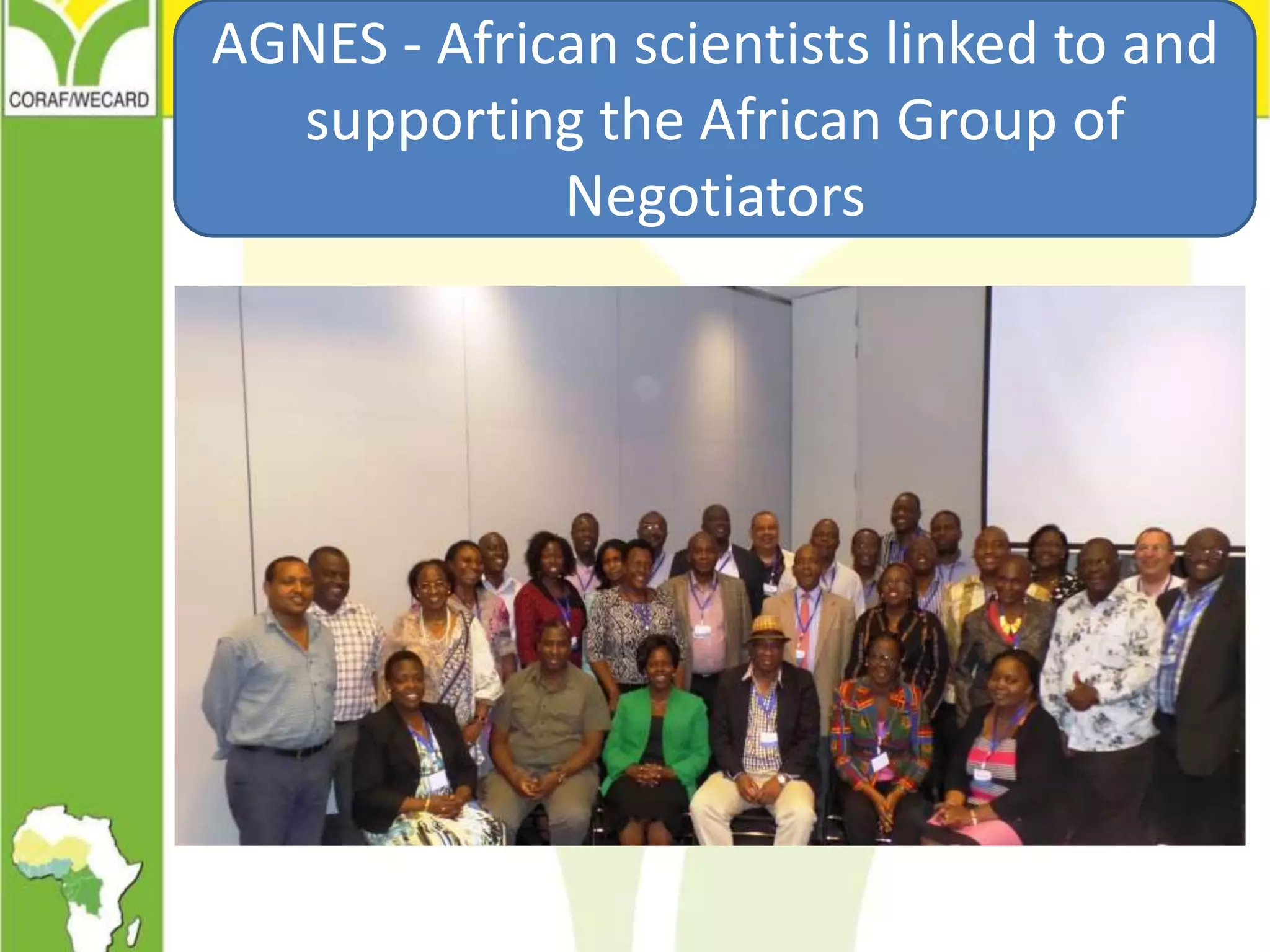
AGNES - African scientists linked to and
supporting the African Group of
Negotiators
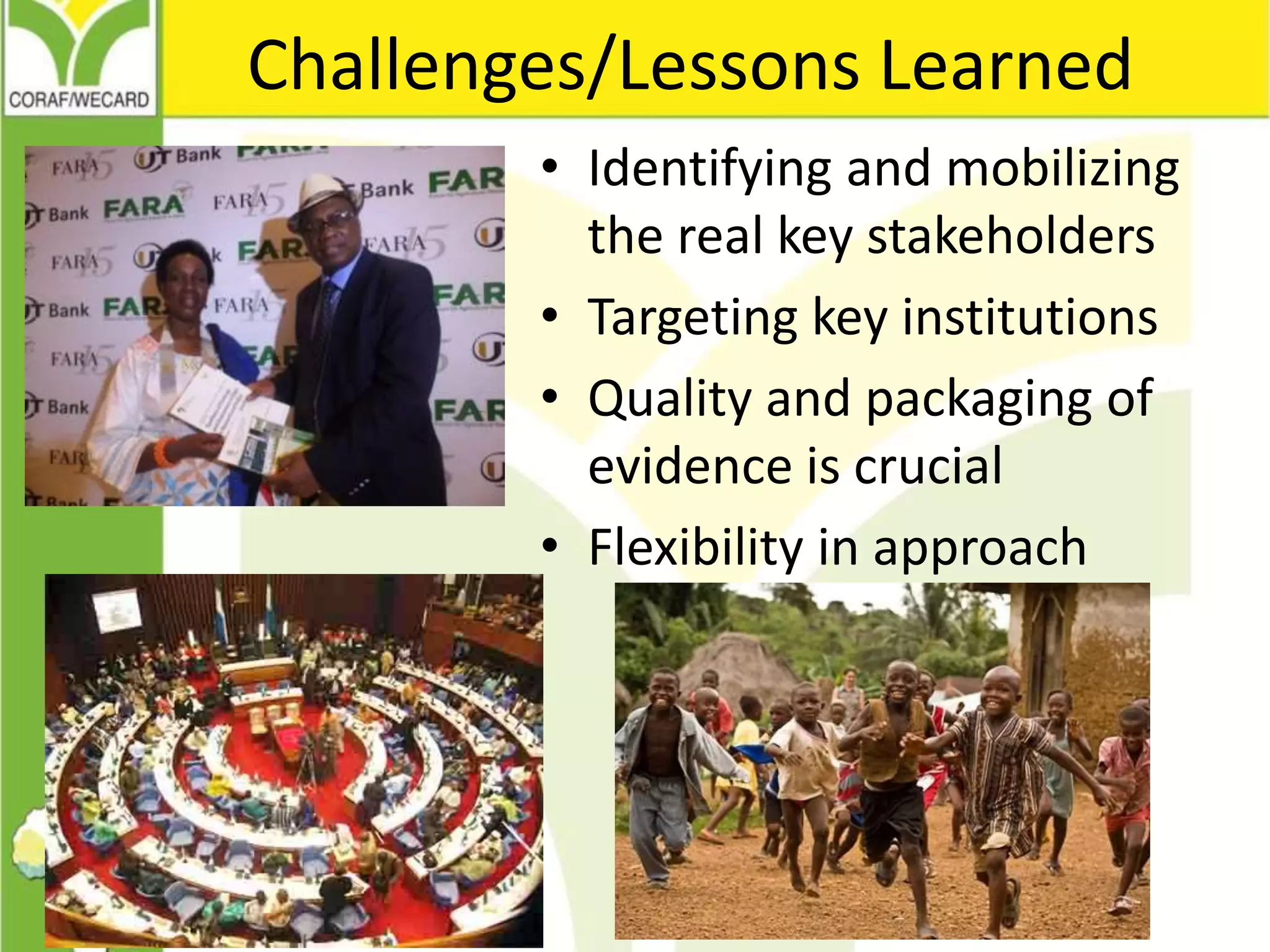
Challenges/Lessons Learned
• Identifying and mobilizing
the real key stakeholders
• Targeting key institutions
• Quality and packaging of
evidence is crucial
• Flexibility in approach
Thank you/Merci
http://africainteract.coraf.org/en/
SBSTA 42 Side Event on ‘Filling the Evidence
Gap: Linking Agricultural and Climate
Change Science and Policy in Africa’
Questions
Answers
&
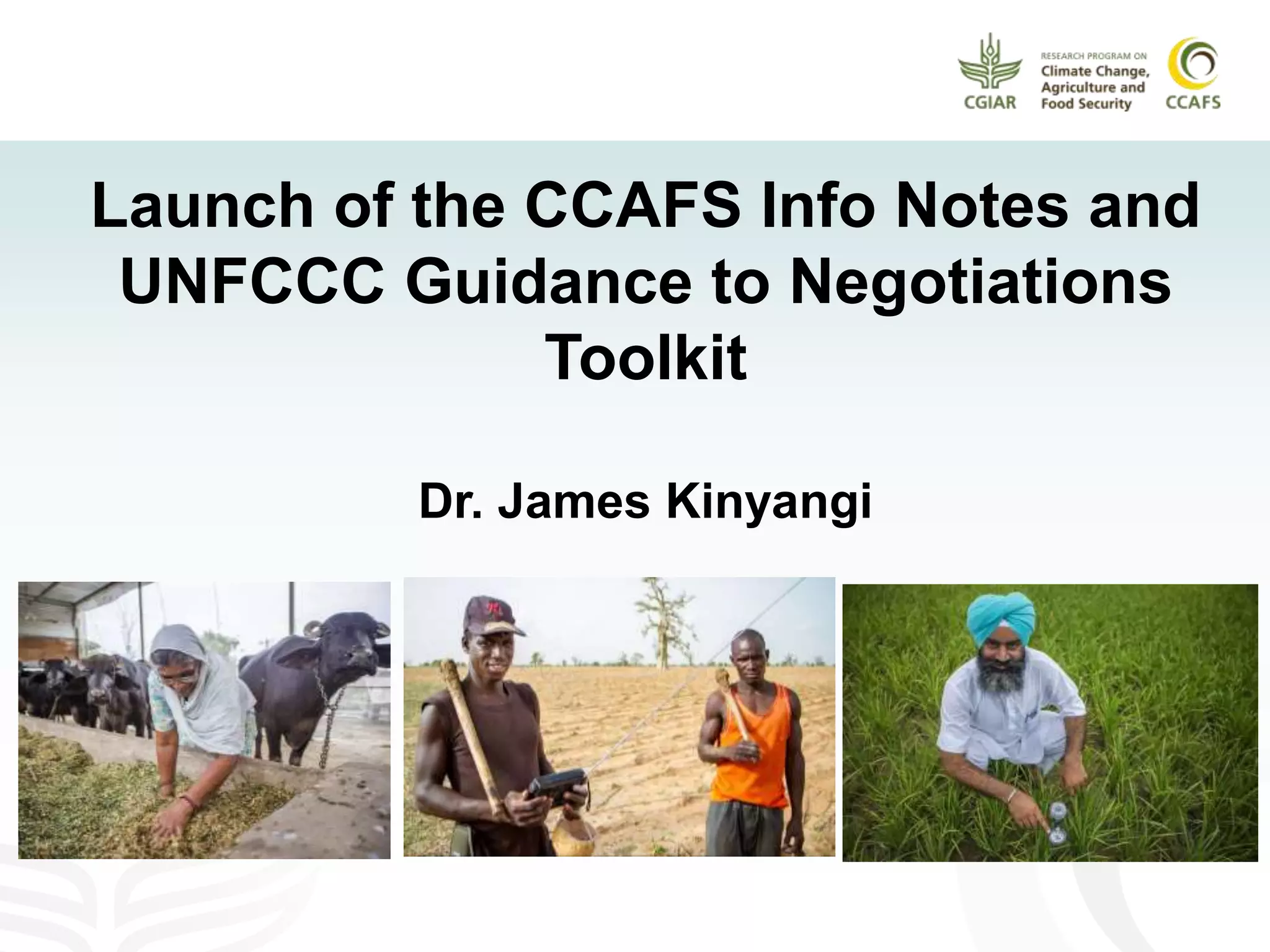
Launch of the CCAFS Info Notes and
UNFCCC Guidance to Negotiations
Toolkit
Dr. James Kinyangi
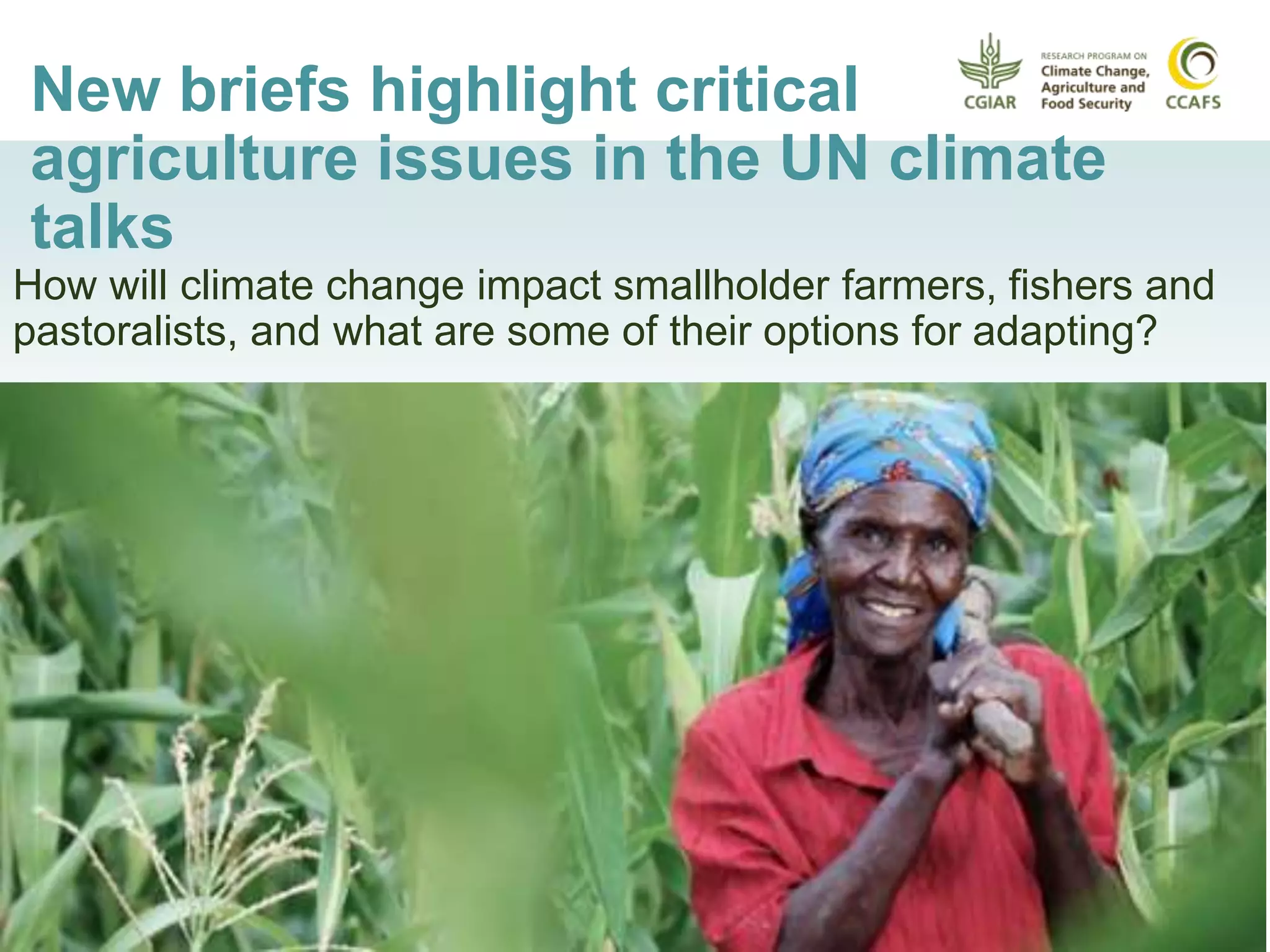
New briefs highlight critical
agriculture issues in the UN climate
talks
How will climate change impact smallholder farmers, fishers and
pastoralists, and what are some of their options for adapting?
DOWNLOAD THE INFO NOTES
SUMMARIZING THE SUBMISSIONS
Coffey K, Haile M, Halperin M, Wamukoya G, Hansen J, Kinyangi J, Tesfaye
Fantaye K, Dinesh D. 2015. Improving early warning systems for
agricultural resilience in Africa.
Dinesh D, Bett B, Boone R, Grace D, Kinyangi J, Lindahl J, Mohan CV,
Ramirez-Villegas J, Robinson R, Rosenstock T, Smith J and Thornton P.
2015. Impact of climate change on African agriculture: focus on pests
and diseases.
DOWNLOAD THE FULL SUBMISSIONS
AND BACKGROUND PAPERS
Coffey K, Menghestab H, Halperin M, Wamukoya G, Hansen J, Kinyangi J, Tesfaye
Fantaye K. 2015. Expanding the contribution of early warning to climate-resilient
agricultural development in Africa. CCAFS Working Paper no. 115
Grace D, Bett B, Lindahl J, Robinson T. 2015. Climate and Livestock Disease:
assessing the vulnerability of agricultural systems to livestock pests under
climate change scenarios. CCAFS Working Paper No. 116.
Mohan CV. 2015. Climate Change and Aquatic Animal Disease. CCAFS Working
Paper No. 117.
Ramirez-Villegas J, Thornton PK. 2015. Climate change impacts on African crop
production. CCAFS Working Paper No. 119.
Smith J. 2015. Crops, crop pests and climate change –why Africa needs to better
prepared. CCAFS Working Paper No. 114.
Thornton PK, Boone RB, Ramirez-Villegas J. 2015. Climate change impacts on
livestock. CCAFS Working Paper No. 120.
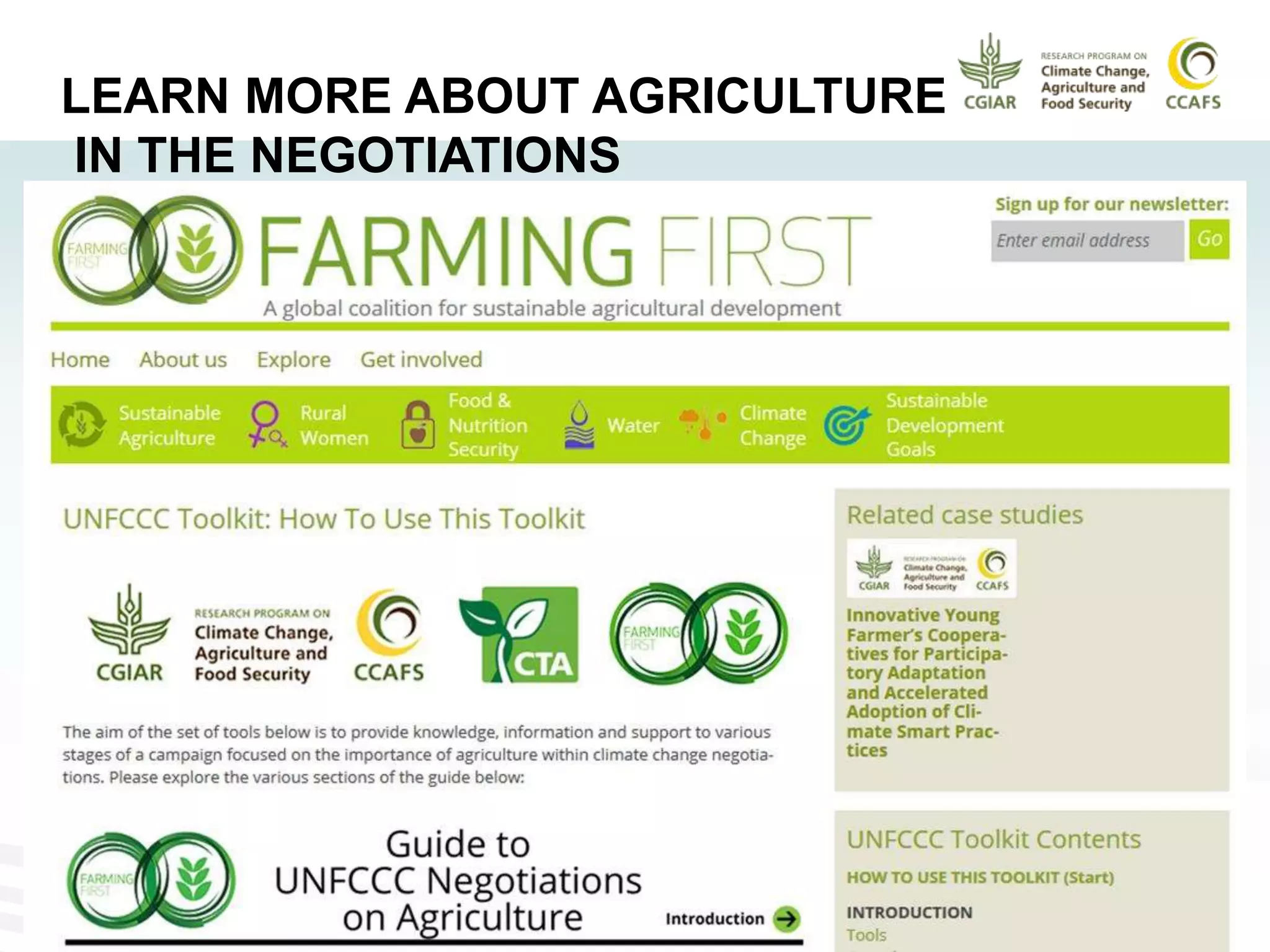
LEARN MORE ABOUT AGRICULTURE
IN THE NEGOTIATIONS
SBSTA 42 Side Event on ‘Filling the Evidence
Gap: Linking Agricultural and Climate
Change Science and Policy in Africa’

Combined presentations at the CCAFS official side event (June 6th 2015) at SBSTA 42

  • 1.
    SBSTA 42 SideEvent on ‘Filling the Evidence Gap: Linking Agricultural and Climate Change Science and Policy in Africa’
  • 2.
    Kevin Coffey SBSAT42 June 2015 Expanding the Contribution of Early Warning to Climate- Resilient Agricultural Development in Africa
  • 3.
    In an eraof more frequent and more extreme weather events and climate shocks, enhanced early warning systems provide a key opportunity to curb erosion of development progress in rural sectors. Recommendations for strengthening existing systems and developing news ones are: Six Recommendations 1) Establish objective rules for early response to early warning information, based on parametric triggers, contingency plans and contingency finance mechanisms 2) Broaden the range of users of early warning information and integrate into development activities 3) Early warning systems should incorporate systematic feedback from users, and change with the needs of stakeholders and new technology 4) Invest in the quality, accessibility and integration of data 5) Take greater advantage of seasonal prediction to increase the lead-time 6) Factor uncertainty into risk analysis, communication, and decision processes
  • 4.
    Establish objective rulesfor early response to early warning information, based on parametric triggers, contingency plans and contingency finance mechanisms Recommendation 1 Innovative solutions include: - Using predetermined triggers that are connected to specific actions (example: FoodSECuRe program) - Contingency finance mechanisms (example: Africa Risk Pool) Decision processes surrounding food security management are often a greater constraint to early action than early warning information itself
  • 5.
    Broaden the rangeof users of early warning information and integrate into development activities Recommendation 2 - Effective community level early warning leads to early and effective action - Sub-national institutions with the right information can facilitate early community response - Too much focus at higher levels. The best analysis is stuck at national, regional and global levels - Mobilizing national gov’ts and donors is important. However:
  • 6.
    Early warning systemsshould incorporate systematic feedback from users, and change with the needs of stakeholders and new technology Recommendation 3 Early warning systems should always be “works in progress,” responding to regular user feedback • Build feedback into the system • Clear M&E strategy • Users are the client
  • 7.
    Invest in thequality, accessibility and integration of data Recommendation 4 • Investing in data may include efforts at data recovery, digitalization, and cleaning • Advanced knowledge management systems allow for greater access to data and analysis • Break down information silos and focus on integrating data (i.e. agriculture and meteorological data) to provide decision-makers with tailored analysis • Example: ENACTS - State of the art historical rainfall and temperature reconstruction STATION BLENDED SATELLITE
  • 8.
    Take greater advantageof seasonal prediction to increase the lead-time Recommendation 5 • Early season assessments in Africa typically take a more ad-hoc approach to incorporating seasonal prediction • Subjective assessments are difficult to calibrate in probabilistic terms and can’t be used for triggering early action based on objective thresholds • New methods are available to integrate seasonal climate forecast information into established agromet monitoring tools • Example: Crop water satisfaction indexes and crop simulation models (CRAFT Tool)
  • 9.
    Factor uncertainty intorisk analysis, communication, and decision processes Recommendation 6 • Users of EWS will lose faith in the information provided if uncertainty is not effectively communicated • For determining appropriate responses, cost benefit analysis can incorporate uncertainty and be used to set thresholds for action • For information at a long lead-time, e.g., near the start of the growing season, uncertainty of early warning information should be factored into communication, in probabilistic terms
  • 10.
    Thank you! Please Seethe CCAFS SBSTA Submission on Early Warning for More Information
  • 11.
    SBSTA 42 SideEvent on ‘Filling the Evidence Gap: Linking Agricultural and Climate Change Science and Policy in Africa’
  • 12.
    Julian Smith International DevelopmentLead Fera Impact of climate change on African agriculture: focus on pests and diseases
  • 13.
    Planning for avibrant African agricultural economy Agriculture is seen as a good investment for poverty reduction What will a successful Africa look like in 20 years time  Increased formal food systems!  Production and trade fully integrated with the global food system!  Responding to export and local food opportunity!
  • 14.
    Overview The sum ofmany moving parts Climate change Progressive trends Climate change Erratic shocks Markets Farmers Policy Land under farming Externalities eg population growth, distribution and diets New markets and trade pathways Land-use change Genetic resources Environment biota Pests Endemic/exotic Technology Pest spread, new pest entry, new pests Improved cultivars eg Drought resistant Environment biota change Improved livestock eg ????
  • 15.
    Changed land-use Productivity, farmerchoices & changed farming systems Projected changes in crops for Sub- Sahara Africa for 8 crops (left) and for beans at the continent level (right; green is positive and red negative) Context  In the context of climate change, how will farmers respond to serve local and export markets? Climate change consequence & outcome  The suitability of land will change, for crops, livestock and aqua-culture  We need to predict these changes to support adaptive action
  • 16.
    Crop, livestock andaquatic pests Increased spread, new entry and new Context  Africa is with a history of big pest events, that cause both food insecurity and discourage private sector investment  Weak human and physical infrastructure for agricultural services  Global trade, human movement new and changing food markets present heightened risk of pest entry  Geographic isolation of pests Climate change consequence & outcome  Increased rates of pest cycling and spread of endemic pests  Increased rates of pest entry events and new pest establishments  Increased risk of new pests from natural biota (plants and wildlife) The increases distribution and severity of Coconut Lethal Yellow Disease in Mozambique has been related to temperature difference
  • 17.
    Climate change –trend impacts Livestock and East Coast Fever East Coast Fever (ECF)  Prevalent across the eastern, central, and southern Africa  Transmitted by Rhipicephalus appendiculatus (Brown ear tick).  Killing at ~1 million cattle/year  28 million cattle at risk  Small-holders are most at risk Climate change consequence & outcome  The vector will − Increase in prevalence in cooler, wetter northern and eastern Cape provinces of South Africa, Botswana, Zambia and eastern DRC − Decrease in prevalence in warmer western arid regions of Africa Among 65 animal diseases identified as most important to poor people, 58 % are climate- sensitive.
  • 18.
    Climate change –trend impacts Crops and Potato tuber moth Potato tuber moth  Potato rank as the 5th most important crop for developing countries (159 MT, CIP)  Potato tuber moth (Phthorimaea operculella ) is a major pest of field crops and stored potato Climate change consequence & outcome  Extended range in mountain regions of North and South Africa.  Increased prevalence and damage potential in all potato-producing countries of Africa A Pest Distribution and Risk Atlas for Africa is in preparation (Kroschel et al 2015)
  • 19.
    Climate change –trend impacts Aquaculture and Epizootic Ulcerative Syndrome Epizootic Ulcerative Syndrome (EUS)  Aquaculture is in its infancy in Africa – but huge potential  Aquaculture experiences higher cumulative mortalities in tropics than cooler regions Climate change consequence & outcome  The spread of EUS up and downstream of the Zambezi river  This would impact on fish catches in the delta
  • 20.
    Climate change –shock impacts Drought tolerance and Maize Lethal Necrosis Maize Lethal Necrosis (MLN)  A viral disease of maize, first reported in Kenya in 2011, and now widespread across East Africa  Seed transmitted  All main cultivars of maize are susceptible to MLN  Maize is the staple crop for Africa Climate change consequence & outcome  A major breeding programme for drought tolerant maize is now at risk as all varieties in development are susceptible to MLN  A solution to MLN and available to acceptable in Maize Lethal Necrosis a new entry pest for Africa is described as a fire by farmers
  • 21.
    Climate change –shock impacts Failed harvests and new trade pathways New Trade routes  Frequency of extreme weather events will increase and harvests will fail more frequently  Markets will adapt via new import trade pathways  New pest threats will be associated with these pathways  Pests of key crops are geographically isolated within and between continents Climate change consequence  The likelihood of pests gaining entry to new regions is increased by new trade pathways, especially when these are responding to a shock and not with a proper risk assessment Banana Xanthomas Wilt has spread across East Africa but remains absent from other regions of Africa and the world
  • 22.
    Recommendations for action Embeddingresilience into future systems  Enhance capacity of regional, national and local organizations  Promote multi country coordination approaches  Improve data quality and quantity  Support pre-emptive breeding  Invest in resilience of production systems  Invest in research and development
  • 23.
    Thank you For moreinformation: See CCAFS Info Note: Impact of climate change on African agriculture: focus on pests and diseases
  • 24.
    SBSTA 42 SideEvent on ‘Filling the Evidence Gap: Linking Agricultural and Climate Change Science and Policy in Africa’
  • 25.
    Enabling research-to-policy dialoguefor adaptation to climate change in Africa: The AfricaInteract experience. By Dr. Abdulai Jalloh, Programme Manager, NRM CORAF/WECARD Presentation at the CCAFS side event : Filling the Evidence Gap: Linking Agricultural and Climate Change Science and Policy in Africa June 6, 2015, Bonn, Germany
  • 26.
    Introduction • Diversified paceand extent of climate change and its impacts on different sub-regions, sectors, nations, and communities in Africa. • Prevailing uncertainty makes policy decisions more complex • Need for Africa to build its knowledge and analytical base and to strengthen the capacity of institutions to tackle climate change challenges. • Need for science to inform policy
  • 27.
    • Promote andsupport effective documentation and sharing of information to improve climate change adaptation policy in Africa • Identify policy gaps and promote the integration of climate change research into development policies, strategies, programs and projects at continental and sub-regional levels AfricaInteract: Enabling research-policy- dialogue for adaptation to climate change
  • 28.
    Key activities • Organizestrategic workshops and round tables involving research scientists and decision-makers • Train target groups on key issues to enable them to effectively analyze climate change issues and negotiate effectively • Provide support for identified champions to attend international conferences and effectively articulate Africa’s position on climate change
  • 29.
    Review of researchand policy • Sectors: Agriculture, health and urban areas • Water and gender as cross cutting issues. Relevant information to improve evidence-based policy making aimed at enhancing livelihoods and protecting populations vulnerable to climate change.
  • 30.
    Findings – research/Poilcy •Rapidly growing body of evidence on impacts of climate change on agriculture, particularly crop systems • Increasing evidence of autonomous adaptation by crop farmers, pastoralists and fisherfolk, using local knowledge • Much adaptation happens despite lack of institutional support, but growing focus around ‘climate-smart’ farming systems • Impacts of climate change and variability on agriculture is moderated by political, economic and social factors
  • 31.
    Agriculture: key recommendations •Adaptation measures should be tested for contribution to resilience across entire food chain • Further research to field test promising ‘climate smart’ agricultural technologies and practices • Need to tackle root causes for vulnerability in the agricultural sector such as resource access and property rights, closely linked with gender concerns • Need more focus on fisheries and pastoralist systems as compared to crop farming systems • Need for better coordination and coherence between agriculture and environment ministries
  • 32.
    Key achievements More than1500 key stakeholders including policymakers, scientists, development workers and farmers linked At lest 100 high level decision makers/decision influencing positions have increased appreciation of the need for informed policy formulation More than 100 senior scientists in sub Saharan Africa have increased awareness and appreciation of the need for effective linkage with policy makers Key research and policy gaps and options identified; policy options proposed
  • 33.
    AGNES - Africanscientists linked to and supporting the African Group of Negotiators
  • 34.
    Challenges/Lessons Learned • Identifyingand mobilizing the real key stakeholders • Targeting key institutions • Quality and packaging of evidence is crucial • Flexibility in approach
  • 35.
  • 36.
    SBSTA 42 SideEvent on ‘Filling the Evidence Gap: Linking Agricultural and Climate Change Science and Policy in Africa’
  • 37.
  • 38.
    Launch of theCCAFS Info Notes and UNFCCC Guidance to Negotiations Toolkit Dr. James Kinyangi
  • 39.
    New briefs highlightcritical agriculture issues in the UN climate talks How will climate change impact smallholder farmers, fishers and pastoralists, and what are some of their options for adapting?
  • 40.
    DOWNLOAD THE INFONOTES SUMMARIZING THE SUBMISSIONS Coffey K, Haile M, Halperin M, Wamukoya G, Hansen J, Kinyangi J, Tesfaye Fantaye K, Dinesh D. 2015. Improving early warning systems for agricultural resilience in Africa. Dinesh D, Bett B, Boone R, Grace D, Kinyangi J, Lindahl J, Mohan CV, Ramirez-Villegas J, Robinson R, Rosenstock T, Smith J and Thornton P. 2015. Impact of climate change on African agriculture: focus on pests and diseases.
  • 41.
    DOWNLOAD THE FULLSUBMISSIONS AND BACKGROUND PAPERS Coffey K, Menghestab H, Halperin M, Wamukoya G, Hansen J, Kinyangi J, Tesfaye Fantaye K. 2015. Expanding the contribution of early warning to climate-resilient agricultural development in Africa. CCAFS Working Paper no. 115 Grace D, Bett B, Lindahl J, Robinson T. 2015. Climate and Livestock Disease: assessing the vulnerability of agricultural systems to livestock pests under climate change scenarios. CCAFS Working Paper No. 116. Mohan CV. 2015. Climate Change and Aquatic Animal Disease. CCAFS Working Paper No. 117. Ramirez-Villegas J, Thornton PK. 2015. Climate change impacts on African crop production. CCAFS Working Paper No. 119. Smith J. 2015. Crops, crop pests and climate change –why Africa needs to better prepared. CCAFS Working Paper No. 114. Thornton PK, Boone RB, Ramirez-Villegas J. 2015. Climate change impacts on livestock. CCAFS Working Paper No. 120.
  • 42.
    LEARN MORE ABOUTAGRICULTURE IN THE NEGOTIATIONS
  • 43.
    SBSTA 42 SideEvent on ‘Filling the Evidence Gap: Linking Agricultural and Climate Change Science and Policy in Africa’