Breaking UpWhy she left me…
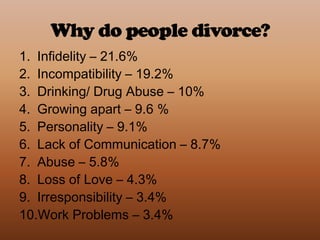
Why do people divorce?Infidelity – 21.6%Incompatibility – 19.2%Drinking/ Drug Abuse – 10%Growing apart – 9.6 %Personality – 9.1%Lack of Communication – 8.7%Abuse – 5.8%Loss of Love – 4.3%Irresponsibility – 3.4%Work Problems – 3.4%
What role do you think finances play in divorce?
Young Marriages
Young MarriagesImmaturityFinancial ResourcesPerceptions of Being Tied DownPoor reasons for getting married in the first place.To get away from family40 % divorce rate for those married between 18-1924% when married after 25
Do Opposites Attract?
OppositionsCultureEducationIntelligenceAttractivenessHealthCommitmentAttitudes toward Sex
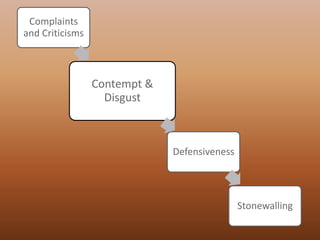
Four Horsemen of the ApocalypseGottman (1994)
 5 ComplaintsBehaviorPersonal CharacteristicsPerformanceAppearanceMeta-complaining
 5 ComplaintsBehaviorPersonal CharacteristicsPerformanceAppearanceMeta-complainingSatisfied couples complain about specific behaviors.
 5 ComplaintsBehaviorPersonal CharacteristicsPerformanceAppearanceMeta-complainingDissatisfied couples complain about personal characteristics
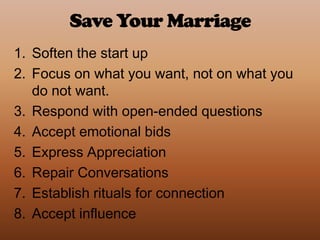
Save Your MarriageSoften the start upFocus on what you want, not on what you do not want.Respond with open-ended questionsAccept emotional bidsExpress AppreciationRepair ConversationsEstablish rituals for connectionAccept influence
How We Break UpBreaking Up – Part 2
Duck’s Model of Breaking Up
Intra-psychic Processes
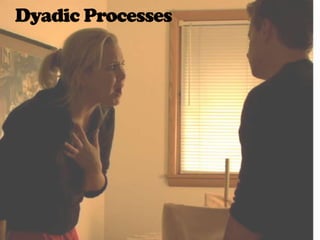
Dyadic Processes
Social Processes
Dark SideWhy can the social processes stage be the most detrimental to the relationship?
Grave Dressing
Resurrection
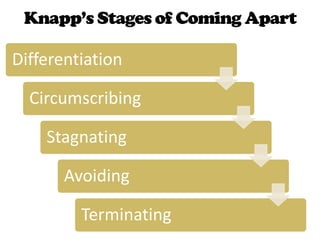
Knapp’s Stages of Coming Apart
What is the problem with Stage Models?
Catastrophe Theory
How do you break up?How would you prefer your significant other to dump you?
What about the kids?Kids of divorced parents:More likely to be depressedLess satisfied with lifeHave poor relationshipsMore likely to divorceMake less $$$Poor Health
Why are kids from divorced families more likely to divorce?
Good News!These differences are reduced when the divorced parents maintain a positive relationship It is better for the kids to divorce than to stay in a bad relationship.
What are some other benefits to breaking up?
The Final ExamTwo required questions:Define IPC (contrast against other forms of communication, break down the various parts)Theory application.Four essay questions out of several.One question from each chapter, so know four chapters really well
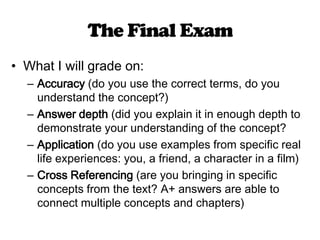
The Final ExamWhat I will grade on:Accuracy (do you use the correct terms, do you understand the concept?)Answer depth (did you explain it in enough depth to demonstrate your understanding of the concept?Application (do you use examples from specific real life experiences: you, a friend, a character in a film)Cross Referencing (are you bringing in specific concepts from the text? A+ answers are able to connect multiple concepts and chapters)

Ipc lesson plan 20 why relationships end

Editor's Notes

  • #4 It is often cited, however, rarely as the sole source of conlict. Also, it is usually based on how it is managed, not necessarily that there is not enough. (Though younger relationships sometimes site the lack of resources)
  • #5 What problems do you think young marriages experience?
  • #12 Before we start, it is important to note that complaining is not predictive of divorce. We ALL complain. The key here is the severity and length of complaining
  • #13 Before we start, it is important to note that complaining is not predictive of divorce. We ALL complain. The key here is the severity and length of complaining
  • #14 Before we start, it is important to note that complaining is not predictive of divorce. We ALL complain. The key here is the severity and length of complaining
  • #15 Communication tends to focus more on insults, sarcasm, and mockery. It creates the feeling of coldness, distance, and detachment.
  • #16 Denying and responsibility for difficultiesCounter-complainingWhiningAccusationsMind-reading (You don’t care how you make people feel)
  • #17 Men mostly do this. Bu essentially, we cut off all communication, basically giving up.
  • #18 be careful to be kind when complainingYour complaints will come across negative if notDon’t push your advice, instead, ask if they want it “How can I help.”Even when you are moody, do not deny emotional expressions like kisses and hugsBe sure to acknowledge what they bring to the relationshipWhen things get awkward, be sure to bring it back to the positive (joke, smile, apologize)Find a way to get some alone time, especially if you have kids and a busy job.
  • #19 During the initial stages, we begin to focus and ruminate over our partner’s negative characteristics.We start looking for justifications to break upExample  My friend began obsessing about how her BF was slow to reply to her texts and often would not return her phone callsThis begins a cycle of negativity  we can no longer think positively of the person.
  • #20 During this stage, we begin to communicate our negative thoughts toward each other.Complaining increases, tends to be on characteristics, not situationalExample  My friends began fighting all of the time. Mostly about how they wanted the other person to act (relational rules)
  • #21 During this stage, we “air” our differences to those outside of the relationship to seek social or emotional support.We often try to save positive face.Example  My friend called me to complain about her BF
  • #22 Your friends will still resent the other, even if you forgive him or her.Example  One of my friends complained that his girlfriend was controlling and would not let him have fun with his friends. Later that week, they made up, but all of his friends, myself included, stopped supporting their relationship.
  • #23 During this stage, the individual focuses on coping with the break upBegin to create narratives or stories to make sense of the break upFace Saving, especially to find a new partnerExample  “There is more to our break up than just that. He had a lot of issues and I just could not help him through it.”The narratives differ depending on the audience:My friend might tell me he is struggling and he misses her, but tells another female that it was no big deal.
  • #24 The final, “getting over it stage”. You have reframed the relationship as a growing momet.You have moved from anger to acceptanceYour narratives save face for not only you, but your ex.Example  She made me realize that I can be happy“I am leaving the relationship a better person”“She was a great girl, I know she will make someone incredibly happy.”
  • #25 Not supported by the researchWe often move in and outWe often skip steps
  • #26 This theory suggests that relationship more than likely will end suddenly with little or no warning.Even with the warning, most people do not detect it.Break-ups almost always are ended by an unplanned critical incident I.E. InfidelityOther times, the break up just happens.
  • #27 Refer to the handout.
  • #28 AccuracyC – uses language that shows an accurate understanding of the text,B – In addition, uses terminology and theoretical groundings taken from both class and discussions.A – In addition, refers to specific researchers and theories.DepthC – Answers all aspects of the questions.B – In addition, uses examples and citations to support your ideasA – In addition, the response reflects a critical understanding of the concept beyond simply explaining it.ApplicationC- The answer includes examples to support the answerB – In addition, the examples are specific narratives instead of general examples.A – In addition, the examples provide a unique lens through which to understand the concept.Cross ReferencingC – You use accurate language from the text and discussion.B – In addition, you are able to apply multiple concepts from a variety of chapters/discussions.A – In addition, your connections contribute to a critical interpretation of the concept being addressed.