IP Addresses
IP Addresses
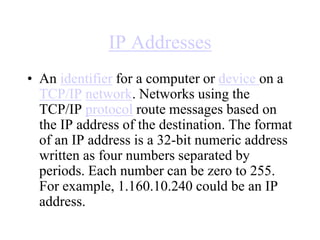
• An identifier for a computer or device on a
TCP/IP network. Networks using the
TCP/IP protocol route messages based on
the IP address of the destination. The format
of an IP address is a 32-bit numeric address
written as four numbers separated by
periods. Each number can be zero to 255.
For example, 1.160.10.240 could be an IP
address.
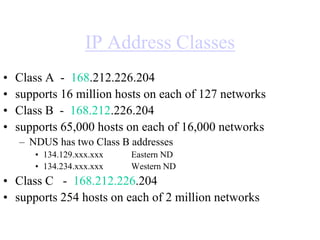
IP Address Classes
• Class A - 168.212.226.204
• supports 16 million hosts on each of 127 networks
• Class B - 168.212.226.204
• supports 65,000 hosts on each of 16,000 networks
– NDUS has two Class B addresses
• 134.129.xxx.xxx Eastern ND
• 134.234.xxx.xxx Western ND
• Class C - 168.212.226.204
• supports 254 hosts on each of 2 million networks
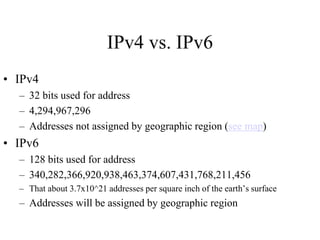
IPv4 vs. IPv6
• IPv4
– 32 bits used for address
– 4,294,967,296
– Addresses not assigned by geographic region (see map)
• IPv6
– 128 bits used for address
– 340,282,366,920,938,463,374,607,431,768,211,456
– That about 3.7x10^21 addresses per square inch of the earth’s surface
– Addresses will be assigned by geographic region
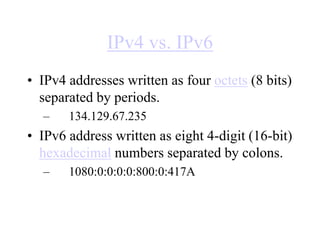
IPv4 vs. IPv6
• IPv4 addresses written as four octets (8 bits)
separated by periods.
– 134.129.67.235
• IPv6 address written as eight 4-digit (16-bit)
hexadecimal numbers separated by colons.
– 1080:0:0:0:0:800:0:417A
IPv4-to-IPv6
• IPv4 Compatible Address
– 0:0:0:0:0:0:w.x.y.z (or ::w.x.y.z)
– Is used by dual-stack nodes that are
communicating with IPv6 over an IPv4
infrastructure
– The last four octets (w.x.y.z) represent the
dotted decimal representation of an IPv4
address
Loopback address
• 127.0.0.0
– Network number that cannot be assigned to any
network
• 127.0.0.1
– The loopback address
– Used for diagnostic testing of the local TCP/IP
installation
Automatic Private IP Addressing
(APIPA)
• 169.254.x.x
• IP addresses are self-assigned when the
computer asks for an IP address and no one
responds.
• i.e. the computer cannot reach a DHCP
server over the network.
Network & Broadcast addresses
• You cannot assign a network number to a
computer or any other host on the network.
• You cannot assign the highest number on a
network to a host. This address is
interpreted as a broadcast message for the
subnet.
Reserved IP Network Numbers
Network number Subnet mask IP address range
10.0.0.0 255.0.0.0 10.0.0.1-10.255.255.255
172.16.0.0-172.31.0.0 255.255.0.0 172.16.0.1-172.31.255.255
192.168.0.0 255.255.255.0 192.168.0.1-192.168.255.255
Designed for use on a private network behind a Network Address Translation
(NAT) device, such as a firewall, proxy servers, or some routers.
A NAT device can be used to disguise local or internal IP addresses from outside
networks.
For more reserved addresses see:
http://en.wikipedia.org/wiki/Reserved_IP_addresses
Uniform Resource Locator
• http://www.ndsu.nodak.edu/pubweb/~latimer/index.html#events
• http:// communication protocol
• www.ndsu.nodak.edu web server hosting the page
• /ndsu/latimer/ path to the page on the host server
• index.html filename of the page
• #events anchor in the page
IP & Domain Name Examples
• IP: 134.129.67.85
• URL: gdc.busad.ndsu.nodak.edu
• IP: 134.129.67.235
• URL: dyn235.minard-67.ndsu.nodak.edu
ICANN
• Internet Corporation for Assigned Names and Numbers
• a private sector, nonprofit organization
• responsibility for IP address space allocation, protocol
parameter assignment, domain name system management
and root server system management functions previously
performed under U.S. Government contract
• ICANN's diverse board consists of nineteen Directors, nine
At-Large Directors, who serve one-year terms and will be
succeeded by At-Large Directors elected by an at-large
membership organization. None of the present interim
directors may sit on the board once the permanent members
are selected.
IP Address Registries
• Regional Internet Registries:
• American Registry for Internet Numbers, ARIN
• Réseaux IP Européens Network Coordination
Centre, RIPE NCC
• Asia Pacific Network Information Centre, APNIC
• Latin American and Caribbean Internet Addresses
Registry, LACNIC
Internet Assigned Numbers
Authority
http://www.iana.org/
• Generic Top-Level Domains
– http://www.iana.org/gtld/gtld.htm
• ccTLD Database (country codes)
– http://www.iana.org/cctld/cctld-whois.htm
• IP Address Services
– http://www.iana.org/ipaddress/ip-addresses.htm
New Top-Level Domain Names
(TLDs)
• ICANN is accepting applications for new TLDs.
– Application window Jan. 12, 2012 to Apr. 12, 2012
– Application fee: $185,000
– Annual fee: $25,000
• Intent is to move towards more descriptive names
• Companies (organizations) can create
– Brand domains e.g. .pepsi .coke
– Generic domains e.g. .car .green
• http://mashable.com/2011/06/20/icann-top-level-domains/

IP-Addresses.pptx

  • 1.
  • 2.
    IP Addresses • Anidentifier for a computer or device on a TCP/IP network. Networks using the TCP/IP protocol route messages based on the IP address of the destination. The format of an IP address is a 32-bit numeric address written as four numbers separated by periods. Each number can be zero to 255. For example, 1.160.10.240 could be an IP address.
  • 3.
    IP Address Classes •Class A - 168.212.226.204 • supports 16 million hosts on each of 127 networks • Class B - 168.212.226.204 • supports 65,000 hosts on each of 16,000 networks – NDUS has two Class B addresses • 134.129.xxx.xxx Eastern ND • 134.234.xxx.xxx Western ND • Class C - 168.212.226.204 • supports 254 hosts on each of 2 million networks
  • 4.
    IPv4 vs. IPv6 •IPv4 – 32 bits used for address – 4,294,967,296 – Addresses not assigned by geographic region (see map) • IPv6 – 128 bits used for address – 340,282,366,920,938,463,374,607,431,768,211,456 – That about 3.7x10^21 addresses per square inch of the earth’s surface – Addresses will be assigned by geographic region
  • 5.
    IPv4 vs. IPv6 •IPv4 addresses written as four octets (8 bits) separated by periods. – 134.129.67.235 • IPv6 address written as eight 4-digit (16-bit) hexadecimal numbers separated by colons. – 1080:0:0:0:0:800:0:417A
  • 6.
    IPv4-to-IPv6 • IPv4 CompatibleAddress – 0:0:0:0:0:0:w.x.y.z (or ::w.x.y.z) – Is used by dual-stack nodes that are communicating with IPv6 over an IPv4 infrastructure – The last four octets (w.x.y.z) represent the dotted decimal representation of an IPv4 address
  • 7.
    Loopback address • 127.0.0.0 –Network number that cannot be assigned to any network • 127.0.0.1 – The loopback address – Used for diagnostic testing of the local TCP/IP installation
  • 8.
    Automatic Private IPAddressing (APIPA) • 169.254.x.x • IP addresses are self-assigned when the computer asks for an IP address and no one responds. • i.e. the computer cannot reach a DHCP server over the network.
  • 9.
    Network & Broadcastaddresses • You cannot assign a network number to a computer or any other host on the network. • You cannot assign the highest number on a network to a host. This address is interpreted as a broadcast message for the subnet.
  • 10.
    Reserved IP NetworkNumbers Network number Subnet mask IP address range 10.0.0.0 255.0.0.0 10.0.0.1-10.255.255.255 172.16.0.0-172.31.0.0 255.255.0.0 172.16.0.1-172.31.255.255 192.168.0.0 255.255.255.0 192.168.0.1-192.168.255.255 Designed for use on a private network behind a Network Address Translation (NAT) device, such as a firewall, proxy servers, or some routers. A NAT device can be used to disguise local or internal IP addresses from outside networks. For more reserved addresses see: http://en.wikipedia.org/wiki/Reserved_IP_addresses
  • 11.
    Uniform Resource Locator •http://www.ndsu.nodak.edu/pubweb/~latimer/index.html#events • http:// communication protocol • www.ndsu.nodak.edu web server hosting the page • /ndsu/latimer/ path to the page on the host server • index.html filename of the page • #events anchor in the page
  • 12.
    IP & DomainName Examples • IP: 134.129.67.85 • URL: gdc.busad.ndsu.nodak.edu • IP: 134.129.67.235 • URL: dyn235.minard-67.ndsu.nodak.edu
  • 13.
    ICANN • Internet Corporationfor Assigned Names and Numbers • a private sector, nonprofit organization • responsibility for IP address space allocation, protocol parameter assignment, domain name system management and root server system management functions previously performed under U.S. Government contract • ICANN's diverse board consists of nineteen Directors, nine At-Large Directors, who serve one-year terms and will be succeeded by At-Large Directors elected by an at-large membership organization. None of the present interim directors may sit on the board once the permanent members are selected.
  • 14.
    IP Address Registries •Regional Internet Registries: • American Registry for Internet Numbers, ARIN • Réseaux IP Européens Network Coordination Centre, RIPE NCC • Asia Pacific Network Information Centre, APNIC • Latin American and Caribbean Internet Addresses Registry, LACNIC
  • 15.
    Internet Assigned Numbers Authority http://www.iana.org/ •Generic Top-Level Domains – http://www.iana.org/gtld/gtld.htm • ccTLD Database (country codes) – http://www.iana.org/cctld/cctld-whois.htm • IP Address Services – http://www.iana.org/ipaddress/ip-addresses.htm
  • 16.
    New Top-Level DomainNames (TLDs) • ICANN is accepting applications for new TLDs. – Application window Jan. 12, 2012 to Apr. 12, 2012 – Application fee: $185,000 – Annual fee: $25,000 • Intent is to move towards more descriptive names • Companies (organizations) can create – Brand domains e.g. .pepsi .coke – Generic domains e.g. .car .green • http://mashable.com/2011/06/20/icann-top-level-domains/