IP & Networking
Devices
What Is An IP Address ?
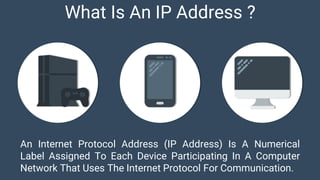
An Internet Protocol Address (IP Address) Is A Numerical
Label Assigned To Each Device Participating In A Computer
Network That Uses The Internet Protocol For Communication.
Representation Of IP Addresses• IP Address
• IPv4
• IPv6
IPv4
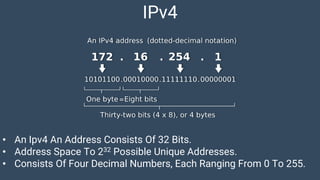
• An Ipv4 An Address Consists Of 32 Bits.
• Address Space To 232 Possible Unique Addresses.
• Consists Of Four Decimal Numbers, Each Ranging From 0 To 255.
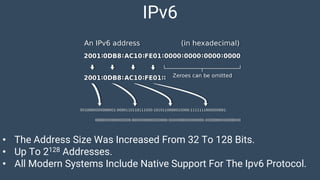
IPv6
• The Address Size Was Increased From 32 To 128 Bits.
• Up To 2128 Addresses.
• All Modern Systems Include Native Support For The Ipv6 Protocol.
Classification Of IP Addresses• IP Address
• Public IP
• Private IP
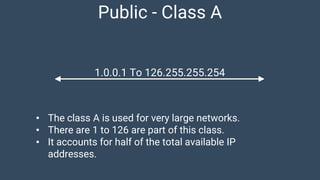
Public - Class A
• The class A is used for very large networks.
• There are 1 to 126 are part of this class.
• It accounts for half of the total available IP
addresses.
1.0.0.1 To 126.255.255.254
Public - Class B
• Used for medium sized networks.
• The IP address with a first octet from 128 to 191.
128.1.0.1 To 191.255.255.254
Public - Class C
• Class C is used for small to middle size networks.
• IP address with a first octet starts from 192-223.
192.0.0.0 To 223.255.255.254
Public - Class D
• Reserved for multicast groups
224.0.0.0 To 239.255.255.255
Public - Class E
• Reserved for future use, or Research and
Development Purposes.
240.0.0.0 To 254.255.255.254
Private IP Addresses
• These addresses are commonly used for home,
office, and enterprise local area networks (LANs).
• Addresses in the private space are not allocated to
any organization, anyone may use these addresses
without approval from a regional Internet registry.
10.0.0.0 To 10.255.255.255 ~
16,777,216
172.16.0.0 To 172.31.255.255 ~
1,048,576
192.168.0.0 To 192.168.255.255 ~
65,536
Networking Devices
Network Interface Card
• A network interface card (NIC) is a
circuit board or card that is installed in
a computer so that it can be
connected to a network.
Repeater
• A repeater is a device that receives a
digital signal on an electromagnetic or
optical transmission medium and
regenerates the signal along the next
leg of the medium.
• A series of repeaters make possible
the extension of a signal over a
distance.
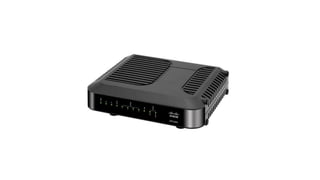
Modem
• A modem (modulator-demodulator) is
a network hardware device that
modulates one or more carrier wave
signals to encode digital information
for transmission and demodulates
signals to decode the transmitted
information.
• The goal is to produce a signal that
can be transmitted easily and decoded
to reproduce the original digital data.
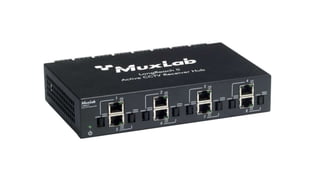
Hubs
• Used to link several computers
together and repeat a signal from one
port to all other ports
• Passive Hubs simply connect all ports
together and are not electrically
powered
• Active hubs use power to amplify and
clean the signal before broadcasting
Switches
• A switch is a device used to connect
different network segments together.
• Switches are capable of inspecting
frames.
• It receives processes and forward the
data.
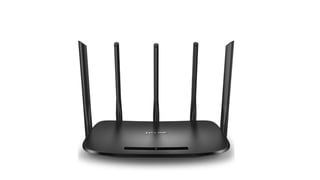
Routers
• Highly Intelligent Devices That
connect multiple network types
• Routers usually bridge multiple
networks
• Routers examine every incoming
packet and determines the destination
of the data
Thank You!

Internet Protocol (IP) And Different Networking Devices.

  • 1.
  • 2.
    What Is AnIP Address ? An Internet Protocol Address (IP Address) Is A Numerical Label Assigned To Each Device Participating In A Computer Network That Uses The Internet Protocol For Communication.
  • 3.
    Representation Of IPAddresses• IP Address • IPv4 • IPv6
  • 4.
    IPv4 • An Ipv4An Address Consists Of 32 Bits. • Address Space To 232 Possible Unique Addresses. • Consists Of Four Decimal Numbers, Each Ranging From 0 To 255.
  • 5.
    IPv6 • The AddressSize Was Increased From 32 To 128 Bits. • Up To 2128 Addresses. • All Modern Systems Include Native Support For The Ipv6 Protocol.
  • 6.
    Classification Of IPAddresses• IP Address • Public IP • Private IP
  • 7.
    Public - ClassA • The class A is used for very large networks. • There are 1 to 126 are part of this class. • It accounts for half of the total available IP addresses. 1.0.0.1 To 126.255.255.254
  • 8.
    Public - ClassB • Used for medium sized networks. • The IP address with a first octet from 128 to 191. 128.1.0.1 To 191.255.255.254
  • 9.
    Public - ClassC • Class C is used for small to middle size networks. • IP address with a first octet starts from 192-223. 192.0.0.0 To 223.255.255.254
  • 10.
    Public - ClassD • Reserved for multicast groups 224.0.0.0 To 239.255.255.255
  • 11.
    Public - ClassE • Reserved for future use, or Research and Development Purposes. 240.0.0.0 To 254.255.255.254
  • 12.
    Private IP Addresses •These addresses are commonly used for home, office, and enterprise local area networks (LANs). • Addresses in the private space are not allocated to any organization, anyone may use these addresses without approval from a regional Internet registry. 10.0.0.0 To 10.255.255.255 ~ 16,777,216 172.16.0.0 To 172.31.255.255 ~ 1,048,576 192.168.0.0 To 192.168.255.255 ~ 65,536
  • 13.
  • 14.
    Network Interface Card •A network interface card (NIC) is a circuit board or card that is installed in a computer so that it can be connected to a network.
  • 16.
    Repeater • A repeateris a device that receives a digital signal on an electromagnetic or optical transmission medium and regenerates the signal along the next leg of the medium. • A series of repeaters make possible the extension of a signal over a distance.
  • 19.
    Modem • A modem(modulator-demodulator) is a network hardware device that modulates one or more carrier wave signals to encode digital information for transmission and demodulates signals to decode the transmitted information. • The goal is to produce a signal that can be transmitted easily and decoded to reproduce the original digital data.
  • 21.
    Hubs • Used tolink several computers together and repeat a signal from one port to all other ports • Passive Hubs simply connect all ports together and are not electrically powered • Active hubs use power to amplify and clean the signal before broadcasting
  • 23.
    Switches • A switchis a device used to connect different network segments together. • Switches are capable of inspecting frames. • It receives processes and forward the data.
  • 25.
    Routers • Highly IntelligentDevices That connect multiple network types • Routers usually bridge multiple networks • Routers examine every incoming packet and determines the destination of the data
  • 28.