Under guidance of
Mr .A. J.Raja Sekhar mca
Assistant professor
Department of mca.
Presented by
T.D.Mohan babu
Mca fourth
semester
CONTENTS
 What is ip spoofing
 How ip spoofing works
 Why ip spoofing is used
 History
 Why ip spoofing is easy
 Application of ip spoofing
 Spoofing attacks
 Advantages
 Disadvantages
 conclusion
WHAT IS IP SPOOFING
 An IP(internet protocol)address is the address that
reveals the identity of your internet service provider
and your personal internet connection.
 The address can be viewed during internet
browsing
and in all of your correspondences that you send.
IP SPOOFING
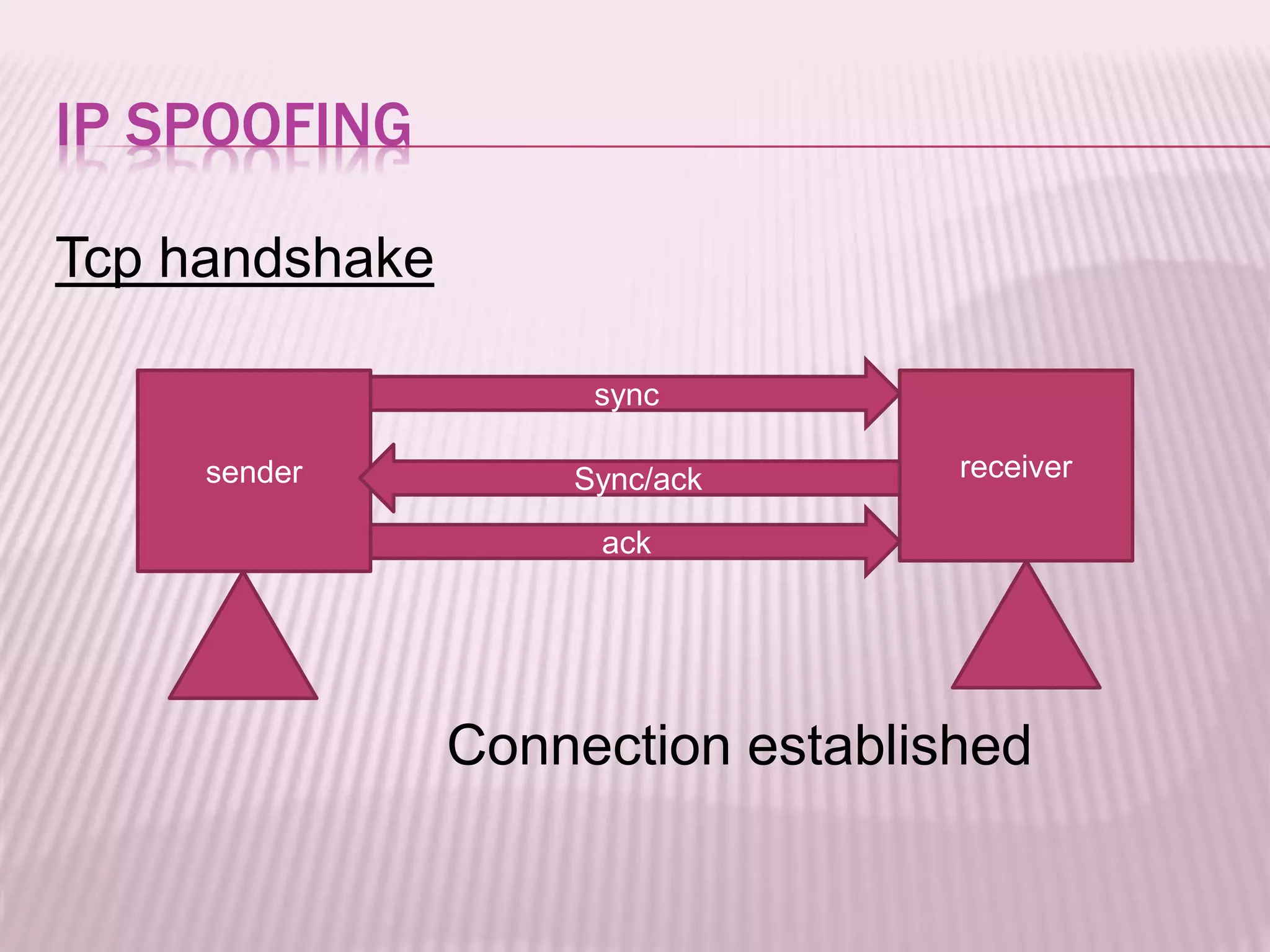
Tcp handshake
Connection established
sender receiver
sync
Sync/ack
ack
IP SPOOFING
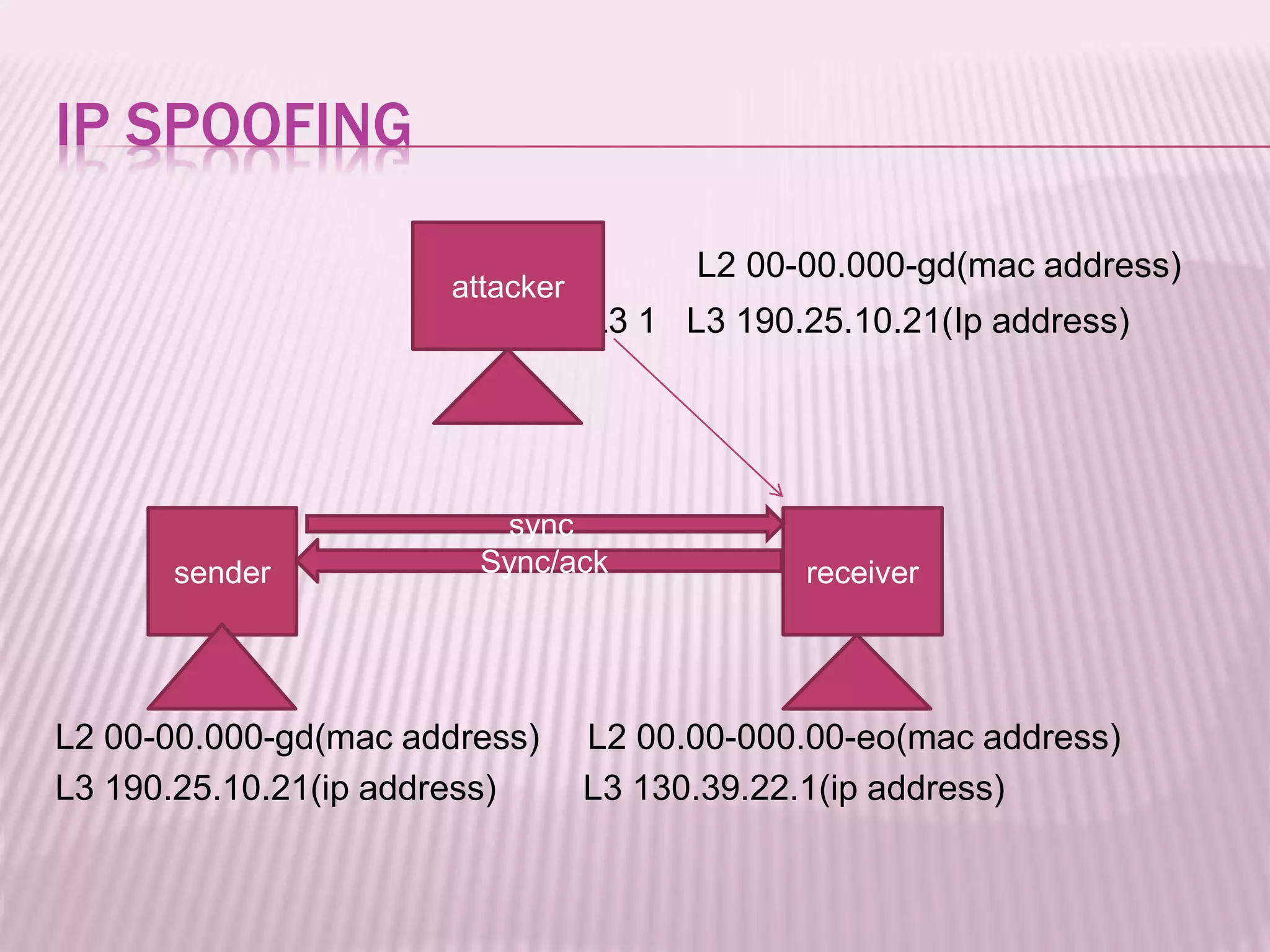
L2 00-00.000-gd(mac address)
L3 1 L3 190.25.10.21(Ip address)
L2 00-00.000-gd(mac address) L2 00.00-000.00-eo(mac address)
L3 190.25.10.21(ip address) L3 130.39.22.1(ip address)
attacker
sender receiver
sync
Sync/ack
HOW IP SPOOFING WORKS
 The internet protocol or IP is used for sending and
receiving data over the internet and computers that
are connected to a network.
 Each packet of information that is sent is identified
by the IP address which reveals the source of the
information.
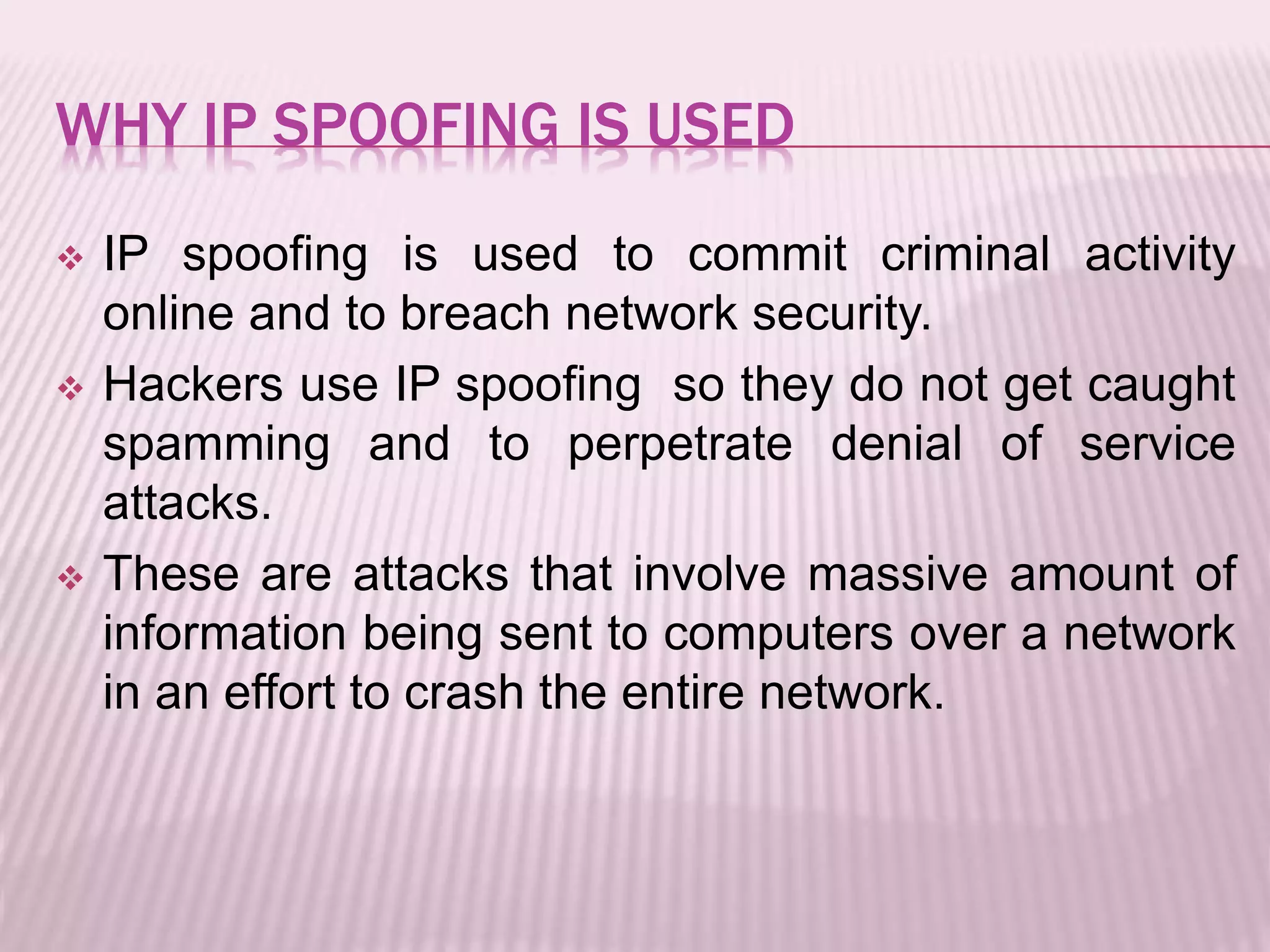
WHY IP SPOOFING IS USED
 IP spoofing is used to commit criminal activity
online and to breach network security.
 Hackers use IP spoofing so they do not get caught
spamming and to perpetrate denial of service
attacks.
 These are attacks that involve massive amount of
information being sent to computers over a network
in an effort to crash the entire network.
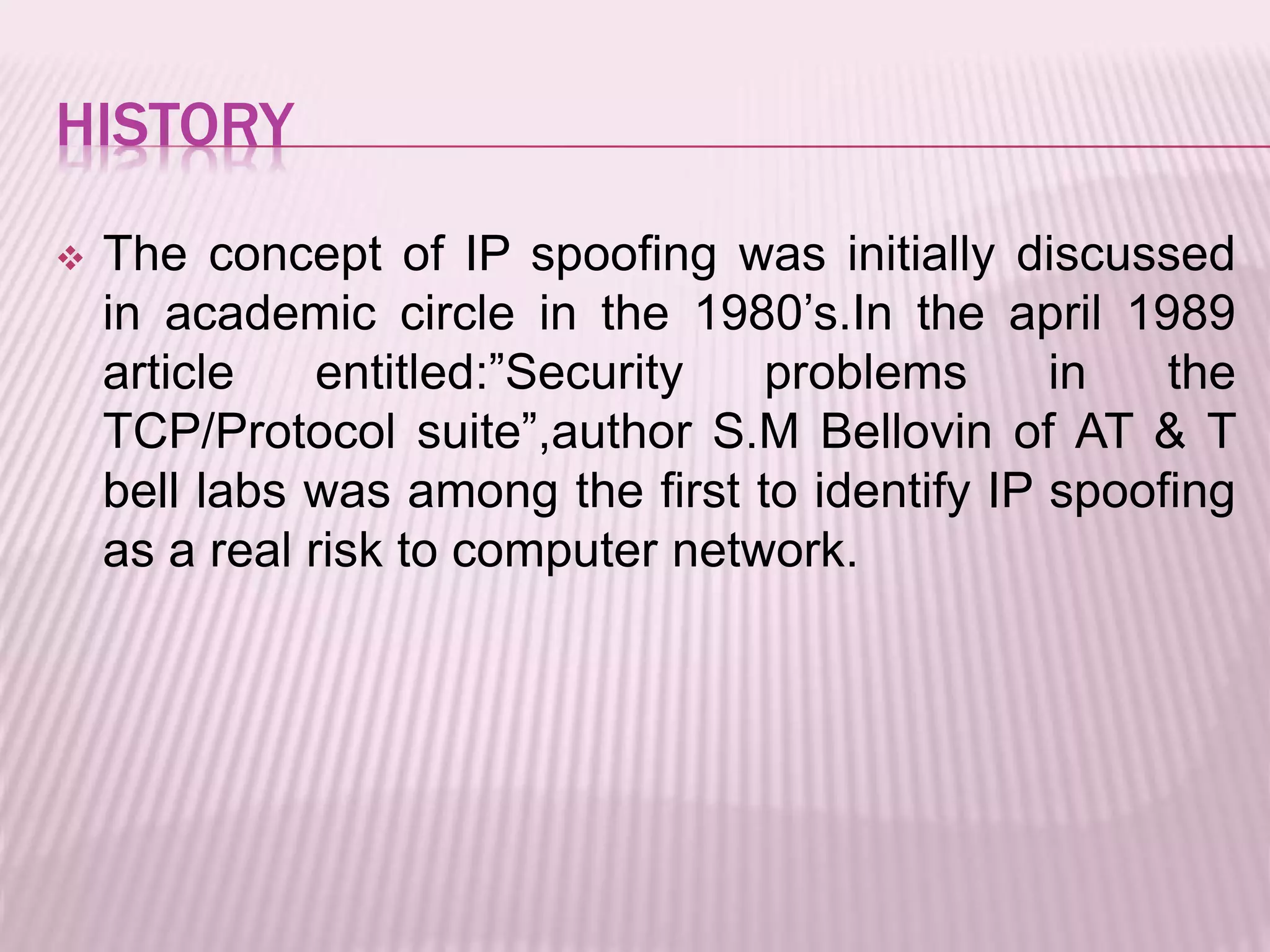
HISTORY
 The concept of IP spoofing was initially discussed
in academic circle in the 1980’s.In the april 1989
article entitled:”Security problems in the
TCP/Protocol suite”,author S.M Bellovin of AT & T
bell labs was among the first to identify IP spoofing
as a real risk to computer network.
WHY IP SPOOFING IS EASY
 Problem with the routers.
 Routers look at destination address only.
 Authentication based on source address only.
 To change source address field in IP header field is
easy.
APPLICATION OF IP SPOOFING
 Many other attacks rely on IP spoofing mechanism to
launch an attack, for example SMURF attack (also
known as ICMP flooding) is when an intruder sends a
large number of ICMP echo requests (pings) to the
broadcast address of the reflector subnet.
 The source addresses of these packets are spoofed
to be the address of the target victim. For each
packet sent by the attacker, hosts on the reflector
subnet respond to the target victim, thereby flooding
the victim network and causing congestion that
results in a denial of service (DoS).
SPOOFING ATTACKS
 There are a few variations on the types of attacks
that successfully employ IP spoofing. Although
some are relatively dated, others are very pertinent
to current security concerns.
1.Non-Blind Spoofing
2.Blind Spoofing
3.Man in the Middle Attack
4.Denial of service attack
ADVANTAGES
 Multiple Servers :
Sometimes you want to change where packets
heading into your network will go. Frequently this is
because you have only one IP address, but you
want people to be able to get into the boxes behind
the one with the `real' IP address.
 Transparent Proxying :
Sometimes you want to pretend that each packet
which passes through your Linux box is destined
for a program on the Linux box itself.
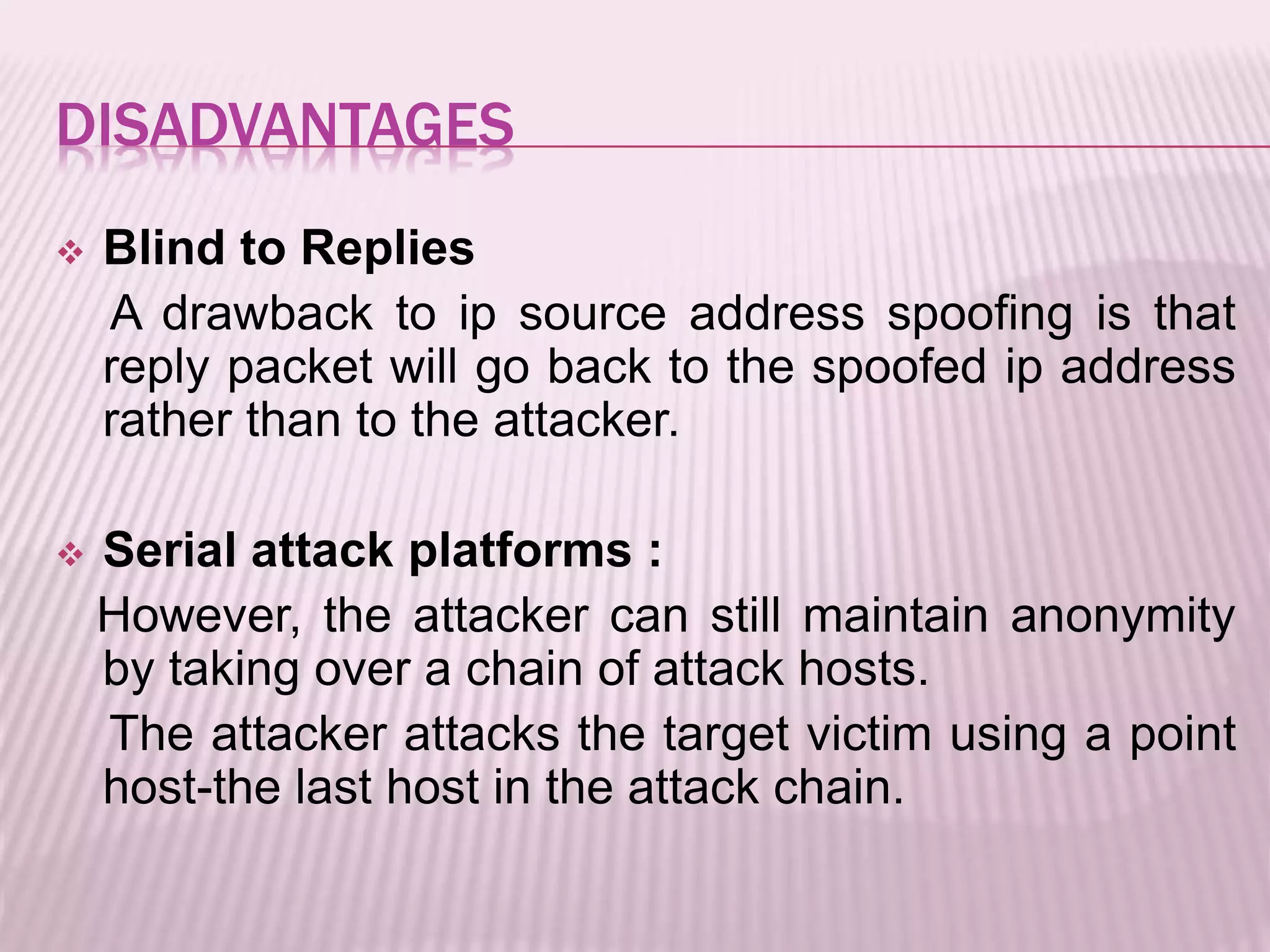
DISADVANTAGES
 Blind to Replies
A drawback to ip source address spoofing is that
reply packet will go back to the spoofed ip address
rather than to the attacker.
 Serial attack platforms :
However, the attacker can still maintain anonymity
by taking over a chain of attack hosts.
The attacker attacks the target victim using a point
host-the last host in the attack chain.
CONCLUSION
 IP spoofing is an exploitation of trust based
relationship and can be curbed effectively if proper
measures are used.
 understanding how and why spoofing attacks are
used, combined with a few simple prevention
methods, can help protect network from these
malicious cloaking and cracking techniques.
ip spoofing
ip spoofing

ip spoofing

  • 2.
    Under guidance of Mr.A. J.Raja Sekhar mca Assistant professor Department of mca. Presented by T.D.Mohan babu Mca fourth semester
  • 3.
    CONTENTS  What isip spoofing  How ip spoofing works  Why ip spoofing is used  History  Why ip spoofing is easy  Application of ip spoofing  Spoofing attacks  Advantages  Disadvantages  conclusion
  • 4.
    WHAT IS IPSPOOFING  An IP(internet protocol)address is the address that reveals the identity of your internet service provider and your personal internet connection.  The address can be viewed during internet browsing and in all of your correspondences that you send.
  • 5.
    IP SPOOFING Tcp handshake Connectionestablished sender receiver sync Sync/ack ack
  • 6.
    IP SPOOFING L2 00-00.000-gd(macaddress) L3 1 L3 190.25.10.21(Ip address) L2 00-00.000-gd(mac address) L2 00.00-000.00-eo(mac address) L3 190.25.10.21(ip address) L3 130.39.22.1(ip address) attacker sender receiver sync Sync/ack
  • 7.
    HOW IP SPOOFINGWORKS  The internet protocol or IP is used for sending and receiving data over the internet and computers that are connected to a network.  Each packet of information that is sent is identified by the IP address which reveals the source of the information.
  • 8.
    WHY IP SPOOFINGIS USED  IP spoofing is used to commit criminal activity online and to breach network security.  Hackers use IP spoofing so they do not get caught spamming and to perpetrate denial of service attacks.  These are attacks that involve massive amount of information being sent to computers over a network in an effort to crash the entire network.
  • 9.
    HISTORY  The conceptof IP spoofing was initially discussed in academic circle in the 1980’s.In the april 1989 article entitled:”Security problems in the TCP/Protocol suite”,author S.M Bellovin of AT & T bell labs was among the first to identify IP spoofing as a real risk to computer network.
  • 10.
    WHY IP SPOOFINGIS EASY  Problem with the routers.  Routers look at destination address only.  Authentication based on source address only.  To change source address field in IP header field is easy.
  • 11.
    APPLICATION OF IPSPOOFING  Many other attacks rely on IP spoofing mechanism to launch an attack, for example SMURF attack (also known as ICMP flooding) is when an intruder sends a large number of ICMP echo requests (pings) to the broadcast address of the reflector subnet.  The source addresses of these packets are spoofed to be the address of the target victim. For each packet sent by the attacker, hosts on the reflector subnet respond to the target victim, thereby flooding the victim network and causing congestion that results in a denial of service (DoS).
  • 12.
    SPOOFING ATTACKS  Thereare a few variations on the types of attacks that successfully employ IP spoofing. Although some are relatively dated, others are very pertinent to current security concerns. 1.Non-Blind Spoofing 2.Blind Spoofing 3.Man in the Middle Attack 4.Denial of service attack
  • 13.
    ADVANTAGES  Multiple Servers: Sometimes you want to change where packets heading into your network will go. Frequently this is because you have only one IP address, but you want people to be able to get into the boxes behind the one with the `real' IP address.  Transparent Proxying : Sometimes you want to pretend that each packet which passes through your Linux box is destined for a program on the Linux box itself.
  • 14.
    DISADVANTAGES  Blind toReplies A drawback to ip source address spoofing is that reply packet will go back to the spoofed ip address rather than to the attacker.  Serial attack platforms : However, the attacker can still maintain anonymity by taking over a chain of attack hosts. The attacker attacks the target victim using a point host-the last host in the attack chain.
  • 15.
    CONCLUSION  IP spoofingis an exploitation of trust based relationship and can be curbed effectively if proper measures are used.  understanding how and why spoofing attacks are used, combined with a few simple prevention methods, can help protect network from these malicious cloaking and cracking techniques.