IoT-Introduction
• describes the network of physical objects—“things”—that are embedded with sensors, software,
and other technologies for the purpose of connecting and exchanging data with other devices,
systems or application over the internet.
• By means of low-cost computing, the cloud, big data, analytics, and mobile technologies, physical
things can share and collect data with minimal human intervention.
• Primary goal of IOT is to “Connect the unconnected”
How does IoT work?
• An IoT ecosystem consists of web-enabled smart devices that use
embedded systems, such as processors, sensors and communication
hardware, to collect, send and act on data they acquire from their
environments.
• IoT devices share the sensor data they collect by connecting to an IoT
gateway or other edge device where data is either sent to the cloud to be
analyzed or analyzed locally. Sometimes, these devices communicate with
other related devices and act on the information they get from one
another.
• The devices do most of the work without human intervention, although
people can interact with the devices
Importance of IoT
• 1) More data means better decisions- analyse large trends
in the data to better improve the features of the device
• Ability to track and monitor things: keep an eye on the
current quality of goods
• Lighten the workload with automation-Having a device
doing most the work for us-save more time and cost.
• Increases efficiency by saving money and resources-
increased long term efficiency for both the company and
user.
• Better quality of life-Having your devices track and order
things for you, turn light switches off for you, and help
manage important tasks that you may not have the time to
do yourself certainly takes away a lot of stress,
What technologies have made IoT
possible?
• Access to low-cost, low-power sensor technology. Affordable and reliable
sensors are making IoT technology possible for more manufacturers.
• Connectivity. A host of network protocols for the internet has made it
easy to connect sensors to the cloud and to other “things” for efficient
data transfer.
• Cloud computing platforms. The increase in the availability of cloud
platforms enables both businesses and consumers to access the
infrastructure they need to scale up without actually having to manage it
all.
• Machine learning and analytics. With advances in machine learning and
analytics, along with access to varied and vast amounts of data stored in
the cloud, businesses can gather insights faster and more easily
• Artificial intelligence (AI). Advances in neural networks have brought
natural-language processing (NLP) to IoT devices (such as digital personal
assistants Alexa and Siri) and made them appealing, affordable, and viable
for home use.
Genesis of IoT
• The age of IoT is often said to have started between the years 2008
and 2009
• The person credited with the creation of the term “Internet of
Things” is Kevin Ashton.
• He was quoted as saying: “In the twentieth century, computers
were brains without senses—they only knew what we told them.”
Computers depended on humans to input data and knowledge
through typing, bar codes, and so on.
• IoT is changing this paradigm; in the twenty-first century,
computers are sensing things for themselves.
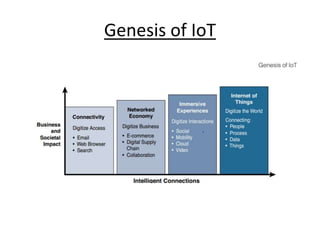
• The evolution of the Internet can be categorized into four phases-
these phases has had a profound impact on our society and our
lives.
Genesis of IoT
IoT Challenges
• Scalability
• Security
• Privacy
• Constrained devices and Networks
• Big Data and Data Analytics
• Interoperability
Scalability-One of the most pressing challenges
is scalability. As more and more devices become
connected, it becomes increasingly difficult to
manage and maintain these devices, and to
ensure that they are functioning optimally.
This requires the development of scalable
infrastructure and management tools, as well as
the deployment of AI and machine learning
algorithms that can help to automate many of
the tasks associated with IoT management
• Security And Personal Privacy- Security and
personal privacy are also major concerns in the
world of IoT. With billions of connected devices
collecting and transmitting sensitive information,
it is essential that these devices and their data
are protected from malicious attacks and hacking.
• This requires strong security measures, such as
encryption and secure protocols, as well as
regular software updates to fix vulnerabilities.
• There has been ongoing research in security
vulnerabilities and its improvements.
• Constrained devices and Networks- The
applications which produces massive scale
data and are connected longer distances, the
networking is always constrained. Lossy and
data rates are affected.
• Also massive data collected by the sensors
leads to bottleneck of network and slow down
the performance with respect to various
factors(speed, security, analytics etc)
• Data Analytics- most of IoT applications need
real time data analysis and response in real
time, whereas traditional IT network
performed on scheduled batch processing of
data.
• Interoperability - For IoT devices to be truly
useful, they must be able to communicate
with each other and work together
seamlessly.
• This requires standardization in the way that
these devices communicate, as well as the
development of common protocols and APIs.
• As the standardization process is still lacking,
interoperability of IoT with legacy devices
should be considered critical.
• Lack of government support- While many
countries have begun to recognize the
importance of IoT and its potential benefits,
many governments are still slow to provide the
necessary support and resources to help the
industry grow.
• Government and Regulatory bodies should come
up and bring up regulations by setting up a
standard committee for safety and security of
devices and people.
IoT and Digitization
• IoT and digitization are terms that are often used interchangeably.
• IoT focuses on connecting “things,” such as objects and machines, to a
computer network, such as the Internet.
• On the other hand, digitization encompasses the data they generate.
• Digitization is the process of converting information into a digital (i.e.
computer-readable) format.
• For example (i)the whole photography industry has been digitized- buying
of photo film and takes it to a retailer to get it developed
• (ii) the video rental industry-people went to a store to rent or purchase
videotapes or DVDs of movies.
• (iii) transportation service
• In the context of IoT, digitization brings together things, data, and business
process to make networked connections more relevant and valuable.
• IoT is a key enabler of digitization.
• The IoT platform enables the digitization of
physical products by collecting the data and
provides digital link for the transmission of the
digital data.
Convergence of IT and OT
• Until recently, information technology (IT) and operational
technology (OT) have for the most part lived in separate worlds.
• Convergence- Integration of two or more different technologies in a
single device or system.
• IT can be defined as the computer, data storage, and networking
infrastructure and processes that are used to create, process, store,
cloud, security, and exchange all forms of electronic data.
• OT systems monitor physical devices, events they carry and make
adjustments in industrial operations. (The physical devices includes
the objects, machines, industrial equipment, embedded computing
technologies, SCADA, smart devices and manufacturing systems)
IoT Impact
• IoT have fundamentally changed the way people
and businesses interact with their surroundings.
• This in turn has resulted in the optimization of
systems and delivers new services for both
people and business in several aspects which
increases the overall efficiency.
• Examples illustrate some of the benefits of IoT
and their impact in real life.(wrt energy and time
conserving, cost, quality lifestyle etc)
Connected Roadways
• we have all heard of self-driving cars, smart lighting system, gps navigation
and route optimization apps- they contribute for connected roadways.
• Roads can be upgraded with technologies to establish smart
communication, smart lighting and power transmission that can support
sustainability, improve safety and efficiency
• IoT Connectivity: Cities can connect roads to IoT devices, and gather
information-
• traffic network and weather data-how much traffic on specific area and
time – warns driver about traffic jam, inform authorities about the
accidents on roads, amount or type of toxic in the particular area
• light management – interactive lights, automatic switch off and on
• smart roads- report on road condition, WIFI Transmitter installed on light
poles- to provide broadband services to vehicles, charge electric vehicles
by embedded cables which generate magnetic fields and charge the
vehicles in motion.
Smart Connected Buildings
• A smart building uses its intelligence system to collect
data from environment throughdretererrsdrrrrrefds
installed devices and sensors.
• Applying that collected data using AI and ML makes the
building responsive to the needs of the user or building
manager.
• Key features of smart connected buildings include
smart HVAC systems that can operate on electrical
appliances and increase efficiency.
• Fire detection, Air quality Monitoring, lighting control,
electrical usage, temperature and humidity monitoring,
smart refrigerator, smart geyser, security features-
automated locking system.
Smart Connected Factories
• Industrial Revolution: major changes and
transition in manufacturing and industrial process
with new innovative technologies.
• A connected factory is one that uses sensors and
inexpensive cloud based storage band analyse
the data to process it according to the
requirement with most advanced and innovative
technologies.
• Connected factories help managers /owners to
manage production-prioritise the production
based on need, order raw materials, improve
quality of products etc.
IoT Architecture
• The European Telecommunications Standards
Institute (ETSI) created the M2M Technical
Committee in 2008. The goal of this
committee was to create a common
architecture that would help communication
between M2M.
• M2M system uses point to point
communication between machines, sensors
and hardware over cellular or wired networks.

IoT-Introduction.pptx

  • 1.
    IoT-Introduction • describes thenetwork of physical objects—“things”—that are embedded with sensors, software, and other technologies for the purpose of connecting and exchanging data with other devices, systems or application over the internet. • By means of low-cost computing, the cloud, big data, analytics, and mobile technologies, physical things can share and collect data with minimal human intervention. • Primary goal of IOT is to “Connect the unconnected” How does IoT work? • An IoT ecosystem consists of web-enabled smart devices that use embedded systems, such as processors, sensors and communication hardware, to collect, send and act on data they acquire from their environments. • IoT devices share the sensor data they collect by connecting to an IoT gateway or other edge device where data is either sent to the cloud to be analyzed or analyzed locally. Sometimes, these devices communicate with other related devices and act on the information they get from one another. • The devices do most of the work without human intervention, although people can interact with the devices
  • 2.
    Importance of IoT •1) More data means better decisions- analyse large trends in the data to better improve the features of the device • Ability to track and monitor things: keep an eye on the current quality of goods • Lighten the workload with automation-Having a device doing most the work for us-save more time and cost. • Increases efficiency by saving money and resources- increased long term efficiency for both the company and user. • Better quality of life-Having your devices track and order things for you, turn light switches off for you, and help manage important tasks that you may not have the time to do yourself certainly takes away a lot of stress,
  • 3.
    What technologies havemade IoT possible? • Access to low-cost, low-power sensor technology. Affordable and reliable sensors are making IoT technology possible for more manufacturers. • Connectivity. A host of network protocols for the internet has made it easy to connect sensors to the cloud and to other “things” for efficient data transfer. • Cloud computing platforms. The increase in the availability of cloud platforms enables both businesses and consumers to access the infrastructure they need to scale up without actually having to manage it all. • Machine learning and analytics. With advances in machine learning and analytics, along with access to varied and vast amounts of data stored in the cloud, businesses can gather insights faster and more easily • Artificial intelligence (AI). Advances in neural networks have brought natural-language processing (NLP) to IoT devices (such as digital personal assistants Alexa and Siri) and made them appealing, affordable, and viable for home use.
  • 4.
    Genesis of IoT •The age of IoT is often said to have started between the years 2008 and 2009 • The person credited with the creation of the term “Internet of Things” is Kevin Ashton. • He was quoted as saying: “In the twentieth century, computers were brains without senses—they only knew what we told them.” Computers depended on humans to input data and knowledge through typing, bar codes, and so on. • IoT is changing this paradigm; in the twenty-first century, computers are sensing things for themselves. • The evolution of the Internet can be categorized into four phases- these phases has had a profound impact on our society and our lives.
  • 5.
  • 6.
    IoT Challenges • Scalability •Security • Privacy • Constrained devices and Networks • Big Data and Data Analytics • Interoperability
  • 7.
    Scalability-One of themost pressing challenges is scalability. As more and more devices become connected, it becomes increasingly difficult to manage and maintain these devices, and to ensure that they are functioning optimally. This requires the development of scalable infrastructure and management tools, as well as the deployment of AI and machine learning algorithms that can help to automate many of the tasks associated with IoT management
  • 8.
    • Security AndPersonal Privacy- Security and personal privacy are also major concerns in the world of IoT. With billions of connected devices collecting and transmitting sensitive information, it is essential that these devices and their data are protected from malicious attacks and hacking. • This requires strong security measures, such as encryption and secure protocols, as well as regular software updates to fix vulnerabilities. • There has been ongoing research in security vulnerabilities and its improvements.
  • 9.
    • Constrained devicesand Networks- The applications which produces massive scale data and are connected longer distances, the networking is always constrained. Lossy and data rates are affected. • Also massive data collected by the sensors leads to bottleneck of network and slow down the performance with respect to various factors(speed, security, analytics etc)
  • 10.
    • Data Analytics-most of IoT applications need real time data analysis and response in real time, whereas traditional IT network performed on scheduled batch processing of data.
  • 11.
    • Interoperability -For IoT devices to be truly useful, they must be able to communicate with each other and work together seamlessly. • This requires standardization in the way that these devices communicate, as well as the development of common protocols and APIs. • As the standardization process is still lacking, interoperability of IoT with legacy devices should be considered critical.
  • 12.
    • Lack ofgovernment support- While many countries have begun to recognize the importance of IoT and its potential benefits, many governments are still slow to provide the necessary support and resources to help the industry grow. • Government and Regulatory bodies should come up and bring up regulations by setting up a standard committee for safety and security of devices and people.
  • 13.
    IoT and Digitization •IoT and digitization are terms that are often used interchangeably. • IoT focuses on connecting “things,” such as objects and machines, to a computer network, such as the Internet. • On the other hand, digitization encompasses the data they generate. • Digitization is the process of converting information into a digital (i.e. computer-readable) format. • For example (i)the whole photography industry has been digitized- buying of photo film and takes it to a retailer to get it developed • (ii) the video rental industry-people went to a store to rent or purchase videotapes or DVDs of movies. • (iii) transportation service • In the context of IoT, digitization brings together things, data, and business process to make networked connections more relevant and valuable.
  • 14.
    • IoT isa key enabler of digitization. • The IoT platform enables the digitization of physical products by collecting the data and provides digital link for the transmission of the digital data.
  • 15.
    Convergence of ITand OT • Until recently, information technology (IT) and operational technology (OT) have for the most part lived in separate worlds. • Convergence- Integration of two or more different technologies in a single device or system. • IT can be defined as the computer, data storage, and networking infrastructure and processes that are used to create, process, store, cloud, security, and exchange all forms of electronic data. • OT systems monitor physical devices, events they carry and make adjustments in industrial operations. (The physical devices includes the objects, machines, industrial equipment, embedded computing technologies, SCADA, smart devices and manufacturing systems)
  • 16.
    IoT Impact • IoThave fundamentally changed the way people and businesses interact with their surroundings. • This in turn has resulted in the optimization of systems and delivers new services for both people and business in several aspects which increases the overall efficiency. • Examples illustrate some of the benefits of IoT and their impact in real life.(wrt energy and time conserving, cost, quality lifestyle etc)
  • 17.
    Connected Roadways • wehave all heard of self-driving cars, smart lighting system, gps navigation and route optimization apps- they contribute for connected roadways. • Roads can be upgraded with technologies to establish smart communication, smart lighting and power transmission that can support sustainability, improve safety and efficiency • IoT Connectivity: Cities can connect roads to IoT devices, and gather information- • traffic network and weather data-how much traffic on specific area and time – warns driver about traffic jam, inform authorities about the accidents on roads, amount or type of toxic in the particular area • light management – interactive lights, automatic switch off and on • smart roads- report on road condition, WIFI Transmitter installed on light poles- to provide broadband services to vehicles, charge electric vehicles by embedded cables which generate magnetic fields and charge the vehicles in motion.
  • 18.
    Smart Connected Buildings •A smart building uses its intelligence system to collect data from environment throughdretererrsdrrrrrefds installed devices and sensors. • Applying that collected data using AI and ML makes the building responsive to the needs of the user or building manager. • Key features of smart connected buildings include smart HVAC systems that can operate on electrical appliances and increase efficiency. • Fire detection, Air quality Monitoring, lighting control, electrical usage, temperature and humidity monitoring, smart refrigerator, smart geyser, security features- automated locking system.
  • 19.
    Smart Connected Factories •Industrial Revolution: major changes and transition in manufacturing and industrial process with new innovative technologies. • A connected factory is one that uses sensors and inexpensive cloud based storage band analyse the data to process it according to the requirement with most advanced and innovative technologies. • Connected factories help managers /owners to manage production-prioritise the production based on need, order raw materials, improve quality of products etc.
  • 20.
    IoT Architecture • TheEuropean Telecommunications Standards Institute (ETSI) created the M2M Technical Committee in 2008. The goal of this committee was to create a common architecture that would help communication between M2M. • M2M system uses point to point communication between machines, sensors and hardware over cellular or wired networks.