International Research Journal of Engineering and Technology (IRJET) e-ISSN: 2395-0056
Volume: 10 Issue: 05 | May 2023 www.irjet.net p-ISSN: 2395-0072
© 2023, IRJET | Impact Factor value: 8.226 | ISO 9001:2008 Certified Journal | Page 1428
Developing Algorithm for Fault Detection and Classification for DC
Motor Using Predictive Maintenance
Karan Jagdish Chanchlani1, Dr. Dipesh H Makwana2
1Student, Instrumentation and Control Dept, LD College of Engineering, Ahmedabad, Gujarat,
India
2Associate Professor, Instrumentation and Control Dept, LD College of Engineering, Ahmedabad, Gujarat,
India
---------------------------------------------------------------------***---------------------------------------------------------------------
Abstract - Maximizingproductionquantityand qualitywhile
retaining the lowest possible production and maintenance
costs is the primary goal of an industrial facility or utility. This
can only be accomplished if the plant operates effectively;
hence, regular maintenance is required. There are numerous
tactics, but industry 4.0 predictive maintenance is among the
most important. Predictive maintenance assists in foreseeing
faults that will happen following data processing and alerts
the operator. Predictivemaintenancetechnology increases the
efficiency of plantmaintenance, lowersmaintenancecosts, and
extends the useful life of the equipment. This study examines
the design and development of the predictive maintenance
algorithm for anticipating both healthy and defective data
from real-time data from DC Motor Hardware
Key Words: Predictive Maintenance, DC Motor, Industry
4.0, Tree, MATLAB
1.INTRODUCTION
Since the early days of the industrial revolution,
maintenance has been primarily reactive, responding to
equipment breakdowns, resulting in unexpected downtime
and high maintenance costs. However, with technological
advancements, maintenance practises have become more
advanced and proactive. Nowadays, maintenance tasks are
performed proactively based on predetermined schedules
and utilise modern monitoring and diagnostic tools [1]. The
least ideal option is reactive maintenance, which includes
repairing equipment after it has failed. Preventive
maintenance, on the other hand, is performing routine
maintenance to avoid breakdowns. Predictive maintenance
uses advanced monitoring technology to detect possible
equipment breakdowns, allowing maintenance work to be
scheduled ahead of time. Industrial organisations may
ensure that their equipment functions at maximum capacity
by selecting the optimal maintenance technique,resultingin
greater productivity and reduced downtime.
Figure 1: Types of Maintenance (Ref: RealPars)
The least ideal option is reactive maintenance, which entails
repairing equipment after it has failed. Preventive
maintenance, on the other hand, is performing routine
maintenance in order to avoid breakdowns. Predictive
maintenance makes use of modern monitoring technologies
to predict possible equipment breakdowns, allowing
maintenance work to be scheduled ahead of time. Industrial
organisations may ensure that their equipment functions at
maximum capacitybyselectingtheappropriatemaintenance
strategy, resulting in greater productivity and reduced
downtime.
Predictive maintenance is important in Industry 4.0, the
fourth industrial revolution marked by the incorporation of
digital technologies into industrial processes show in fig 2
[2]. To optimise industrial processes, massive amounts of
data from sensors and other sources are collected and
analysed in Industry 4.0. In this context, predictive
maintenance combinescontemporarysensorsandanalytical
technologies to monitor system status and forecast repair
needs in real time. This preventive strategy decreases the
likelihood of accidental interruption. One of the benefits of
predictive maintenance in Industry 4.0 is the possibility of
shifting from reactive to proactive maintenance operations.
Manufacturers can reduce operating expenses, boost
equipment efficiency, and improve total output by
estimating future failures.
International Research Journal of Engineering and Technology (IRJET) e-ISSN: 2395-0056
Volume: 10 Issue: 05 | May 2023 www.irjet.net p-ISSN: 2395-0072
© 2023, IRJET | Impact Factor value: 8.226 | ISO 9001:2008 Certified Journal | Page 1429
Figure 2: Evolution of Maintenance (Ref: 2)
Predictive maintenance methods are classified into three
types: data-driven, model-based, and hybridapproaches[3].
Machine learning andstatistical approachesareusedindata-
driven waystoestimate equipmentfailuresandmaintenance
requirements based on data from multiple sources. Model-
based approaches use physics-based models to simulate
equipment behaviour and predict maintenance
requirements undervarious operatingsituations.To provide
more precise and dependable estimates of equipment
performanceandmaintenancerequirements,hybridsystems
combine data-driven and model-based methodologies.
There are many additional predictive maintenance
technologies available, such as vibration analysis using the
Fast Fourier transform [4], predicting power system health
through ageing mechanisms [5], and locating hot areas in
transformers using thermal imaging [6]. Predictive
maintenance can also be accomplished by anomaly
identification based on thermodynamic equations for
compressor discharge temperature [7], neural network
analysis of data patterns [8], and root cause analysis to
determine the underlying causes of equipment failures [9].
Predictive maintenance solutions based on prognostics and
health management (PHM) and condition-based
maintenance (CBM) methodologies are critical tools for
industries, especially in this age of rapidly evolving
information and communication technologies (ICTs) [10].
These strategies help firms manage maintenance more
effectively and reduce expenses by recognising possible
problems early on [11]. The notion of the Online System for
Condition Monitoring and Maintenance (OSA-CBM) is a
critical industry standard that allows for the early detection
of maintenance issues through online data analysis [12].
Industries can avoid equipment failures by embracing this
modern technology.
2. ARCHITECTURE OF PDM.
A predictive maintenance system's standard structure
involves several stages. The data acquisition layer enables
sensors and other devices to acquire operational data from
the equipment. The obtained data is pre-processed and
filtered in the data preparation layer to verify its quality. The
machine learning layer then enters the picture, where
algorithms are trained to detect patterns and anomalies in
the data. Finally, the maintenanceexecutionlayerisincharge
of doing any necessary repairs or replacements. This
architecture enables organizations to proactively discover
and repair equipment faults, avoiding costly downtime and
lowering maintenance costs. As shown in fig 3
Figure 3: Architecture of PdM
3. PREDICTIVE MAINTENANCE ALGORITHM.
A set of instructions used by a computer to solve a problem
or completea task is known as an algorithm. Itisasetofwell-
defined rules used in computer algorithms for a number of
objectives including data analysis, machine learning, and
optimization. Advanced data analyticsare used bypredictive
maintenance algorithms to predict equipment faults and
maintenance requirements. These algorithms look for
patterns and anomalies in historical and real-time data.
Predictive maintenance algorithms help minimize costly
breakdowns and enhance equipment reliability by
proactively recognizing possible concerns. In Predictive
Maintenance Algorithm there are main six steps. They are as
follows:
International Research Journal of Engineering and Technology (IRJET) e-ISSN: 2395-0056
Volume: 10 Issue: 05 | May 2023 www.irjet.net p-ISSN: 2395-0072
© 2023, IRJET | Impact Factor value: 8.226 | ISO 9001:2008 Certified Journal | Page 1430
Step 1: The initial step is to collect data fromdiversesources,
such as sensors, machines, and systems.
Step 2: The gathered data is then pre-processed to remove
any irrelevant or noisy dataand to convertitintoananalysis-
ready format.
Step 3: From the pre-processed data, features related to the
maintenance work are extracted.
Step 4: Using the retrieved features, a predictive model is
created that can detect anomalies and anticipate equipment
breakdowns.
Step 5: To ensureaccuracy and reliability, the created model
is validated using historical or test data.
Step 6: The final step is to put the predictive model into a
real-time production environment where it can monitor the
equipment and send out maintenance notifications.
4. IMPLEMENTATION OF PDM.
A. DC Motor Hardware System
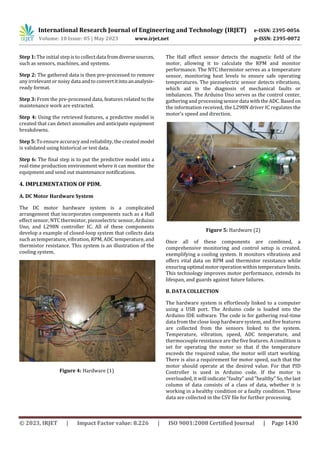
The DC motor hardware system is a complicated
arrangement that incorporates components such as a Hall
effect sensor, NTC thermistor, piezoelectric sensor, Arduino
Uno, and L298N controller IC. All of these components
develop a example of closed-loop system that collects data
such as temperature, vibration, RPM, ADC temperature, and
thermistor resistance. This system is an illustration of the
cooling system.
Figure 4: Hardware (1)
The Hall effect sensor detects the magnetic field of the
motor, allowing it to calculate the RPM and monitor
performance. The NTC thermistor serves as a temperature
sensor, monitoring heat levels to ensure safe operating
temperatures. The piezoelectric sensor detects vibrations,
which aid in the diagnosis of mechanical faults or
imbalances. The Arduino Uno serves as the control center,
gathering and processingsensordata withtheADC.Basedon
the information received, the L298N driver IC regulates the
motor's speed and direction.
Figure 5: Hardware (2)
Once all of these components are combined, a
comprehensive monitoring and control setup is created,
exemplifying a cooling system. It monitors vibrations and
offers vital data on RPM and thermistor resistance while
ensuring optimal motoroperationwithintemperaturelimits.
This technology improves motor performance, extends its
lifespan, and guards against future failures.
B. DATA COLLECTION
The hardware system is effortlessly linked to a computer
using a USB port. The Arduino code is loaded into the
Arduino IDE software. The code is for gathering real-time
data from the close loop hardware system, and five features
are collected from the sensors linked to the system.
Temperature, vibration, speed, ADC temperature, and
thermocouple resistance are the five features. A condition is
set for operating the motor so that if the temperature
exceeds the required value, the motor will start working.
There is also a requirement for motor speed, such that the
motor should operate at the desired value. For that PID
Controller is used in Arduino code. If the motor is
overloaded, it will indicate "faulty" and "healthy" So, the last
column of data consists of a class of data, whether it is
working in a healthy condition or a faulty condition. These
data are collected in the CSV file for further processing.
International Research Journal of Engineering and Technology (IRJET) e-ISSN: 2395-0056
Volume: 10 Issue: 05 | May 2023 www.irjet.net p-ISSN: 2395-0072
© 2023, IRJET | Impact Factor value: 8.226 | ISO 9001:2008 Certified Journal | Page 1431
C. DATA PROCESSING
In this section, the data gathered from the DC motor
hardware is processed using a machinelearningmethod.We
used MATLAB to create the predictive maintenance fault
detection and classification Programme. MATLABfeaturesa
predictive maintenance toolbox that includes theDiagnostic
Feature Designer tool and the Classification Learner
application. The Diagnostic Feature Designer tool is used to
extract the features, and the Classification Learner
application is used to train data using multiple machine
learning models. After gathering enough data to execute a
machine learning technique, the data is usedinclassification
learner software to train various types of machine learning
algorithms. 70% of the data is used for training and 30% for
testing, with five points of cross-validation. Further the data
is trained for all available machine learning models. The
model with the high accuracy and minimum time to train is
selected and the trained model is then exported for the
testing purpose. The machine learning model’saccuracyand
time is mentioned in the below table.
Table 1: Observation Table
After Training the data in the Classification Learner App. We
adopted the Decision Tree (DT) machine learning model for
training since it provides higher accuracy, moreobservation
per seconds and takes less time to trainthemodel thanother
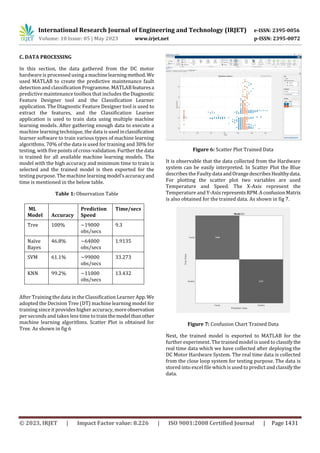
machine learning algorithms. Scatter Plot is obtained for
Tree. As shown in fig 6
Figure 6: Scatter Plot Trained Data
It is observable that the data collected from the Hardware
system can be easily interpreted. In Scatter Plot the Blue
describes the Faulty data andOrangedescribesHealthydata.
For plotting the scatter plot two variables are used
Temperature and Speed. The X-Axis represent the
Temperature and Y-AxisrepresentsRPM.AconfusionMatrix
is also obtained for the trained data. As shown in fig 7.
Figure 7: Confusion Chart Trained Data
Next, the trained model is exported to MATLAB for the
further experiment. The trained model is used to classifythe
real time data which we have collected after deploying the
DC Motor Hardware System. The real time data is collected
from the close loop system for testing purpose. The data is
stored into excel file which is used to predict and classifythe
data.
ML
Model Accuracy
Prediction
Speed
Time/secs
Tree 100% ~19000
obs/secs
9.3
Naïve
Bayes
46.8% ~64000
obs/secs
1.9135
SVM 61.1% ~99000
obs/secs
33.273
KNN 99.2% ~11000
obs/secs
13.432
International Research Journal of Engineering and Technology (IRJET) e-ISSN: 2395-0056
Volume: 10 Issue: 05 | May 2023 www.irjet.net p-ISSN: 2395-0072
© 2023, IRJET | Impact Factor value: 8.226 | ISO 9001:2008 Certified Journal | Page 1432
D. RESULTS
The results are show in the command which states the
number of predicted values of each class and also gives the
exact numbers of healthy and faulty data. It also generated
the confusion matrix for the testing data and Scatter Plot for
New Test Data after prediction is made. The accuracy of
prediction is >95%. As shown in fig 8,9,10.
Figure 8: Test Data Results
Figure 9: Test Confusion Matrix
Figure 10: Test Scatter Plot
5. CONCLUSIONS
In conclusion, using decision trees in MATLAB's
Classification Learner App offers a convenient and efficient
method for correctly identifying and categorizing faults in
DC motors. Industries can change their maintenance
procedures to improve performance, reduce costs, and
increase operational efficiency by utilizing decision trees'
adaptability. Decision trees' interpretability promotes
educated decision-making, proactive maintenance, and
downtimeminimization.All thingsconsidered,decisiontrees
provide a strong method to enhance the performance and
dependability of DC motors in many industries.
ACKNOWLEDGEMENT
I want to express my gratitude to my supervisor, Dr. Dipesh
Makwana, for his crucial advice and assistance during this
work. I am also thankful to Dr. Manish Thakker (Head of
Department), IC Department, LD College of Engineering, for
his support and contributions to this effort. Their assistance
has been invaluable in helping me meet my goals.
Furthermore, I'd like to thank my familyandfriendsfortheir
unwavering encouragement and support. Their words of
support and understanding have been a source of strength
for me during this work.
REFERENCES
[1] Predictive Maintenance Architecture, By Omkar
Motaghare, Anju S Pillai, K I Ramachandran, IEEE
[2] Predictive Maintenance 4.0 as next evolution step in
industrial maintenance development, by P Poor, J Basl, D
Zensik, IEEE
[3] Machine Learning Approach for predictive maintenance
in industry 4.0, by Marina Paolanti, Luca Romeo, Andrea
Felcieli, Adriano Mancini, Enamule Frontoni, IEEE
[4] Vibration Analysis of Electrical rotating machine using
FFT (A Method of PdM) by S S Patil, J A Gaikwad, IEEE
[5] Optimization of maintenance for power system
equipment’s using predictive maintenance byGBajracharya,
J J Smit, T. Koltunowicz, R. R. Negenborn, Z. Papp, D. Djairam,
B. De Schutter, IEEE
[6] Predictive Maintenance Approach for Transformers
Based on Hot Spot Detection In Thermal images, by Amit
Kaul, Joel S, IEEE
[7] Anomaly Detection of a Reciprocating Compressor using
Autoencoders by Chittkasem Charoenchitt, Poj Tangamchit,
IEEE
International Research Journal of Engineering and Technology (IRJET) e-ISSN: 2395-0056
Volume: 10 Issue: 05 | May 2023 www.irjet.net p-ISSN: 2395-0072
© 2023, IRJET | Impact Factor value: 8.226 | ISO 9001:2008 Certified Journal | Page 1433
[8] Performance Prediction using Neural Network and
Confidence Intervals: A Gas Turbine application by Silvia
Cisotto, Dr Randa Herzallah, IEEE
[9] Root Cause Analysis of compressor by machine learning
by Bram Steurtewagen, Dirk Van den Poel, IEEE
[10] Deployment of a Smart and Predictive Maintenance
System in an Industrial Case Study by Filipe Alves∗ , Hasmik
Badikyan∗ , António H.J. Moreira† , João Azevedo‡ , Pedro
Miguel Moreira‡ , Luís Romero‡ , Paulo Leitão∗, IEEE
[11] Challenges to IoT-enabled Predictive Maintenance for
Industry 4.0, by Michele Compare, Piero Baraldi, and Enrico
Zio, IEEE
[12] Maintenance4.0:IntelligentandPredictiveMaintenance
System Architecture by Ana Cachada∗ , José Barbosa∗,Paulo
Leitão∗ , Carla A. S. Geraldes†‡, Leonel Deusdado† , Jacinta
Costa† Carlos Teixeira• , João Teixeira• , António H.J.
Moreira¶ , Pedro Miguel Moreirak , Luís Romerok, IEEE

Developing Algorithm for Fault Detection and Classification for DC Motor Using Predictive Maintenance

  • 1.
    International Research Journalof Engineering and Technology (IRJET) e-ISSN: 2395-0056 Volume: 10 Issue: 05 | May 2023 www.irjet.net p-ISSN: 2395-0072 © 2023, IRJET | Impact Factor value: 8.226 | ISO 9001:2008 Certified Journal | Page 1428 Developing Algorithm for Fault Detection and Classification for DC Motor Using Predictive Maintenance Karan Jagdish Chanchlani1, Dr. Dipesh H Makwana2 1Student, Instrumentation and Control Dept, LD College of Engineering, Ahmedabad, Gujarat, India 2Associate Professor, Instrumentation and Control Dept, LD College of Engineering, Ahmedabad, Gujarat, India ---------------------------------------------------------------------***--------------------------------------------------------------------- Abstract - Maximizingproductionquantityand qualitywhile retaining the lowest possible production and maintenance costs is the primary goal of an industrial facility or utility. This can only be accomplished if the plant operates effectively; hence, regular maintenance is required. There are numerous tactics, but industry 4.0 predictive maintenance is among the most important. Predictive maintenance assists in foreseeing faults that will happen following data processing and alerts the operator. Predictivemaintenancetechnology increases the efficiency of plantmaintenance, lowersmaintenancecosts, and extends the useful life of the equipment. This study examines the design and development of the predictive maintenance algorithm for anticipating both healthy and defective data from real-time data from DC Motor Hardware Key Words: Predictive Maintenance, DC Motor, Industry 4.0, Tree, MATLAB 1.INTRODUCTION Since the early days of the industrial revolution, maintenance has been primarily reactive, responding to equipment breakdowns, resulting in unexpected downtime and high maintenance costs. However, with technological advancements, maintenance practises have become more advanced and proactive. Nowadays, maintenance tasks are performed proactively based on predetermined schedules and utilise modern monitoring and diagnostic tools [1]. The least ideal option is reactive maintenance, which includes repairing equipment after it has failed. Preventive maintenance, on the other hand, is performing routine maintenance to avoid breakdowns. Predictive maintenance uses advanced monitoring technology to detect possible equipment breakdowns, allowing maintenance work to be scheduled ahead of time. Industrial organisations may ensure that their equipment functions at maximum capacity by selecting the optimal maintenance technique,resultingin greater productivity and reduced downtime. Figure 1: Types of Maintenance (Ref: RealPars) The least ideal option is reactive maintenance, which entails repairing equipment after it has failed. Preventive maintenance, on the other hand, is performing routine maintenance in order to avoid breakdowns. Predictive maintenance makes use of modern monitoring technologies to predict possible equipment breakdowns, allowing maintenance work to be scheduled ahead of time. Industrial organisations may ensure that their equipment functions at maximum capacitybyselectingtheappropriatemaintenance strategy, resulting in greater productivity and reduced downtime. Predictive maintenance is important in Industry 4.0, the fourth industrial revolution marked by the incorporation of digital technologies into industrial processes show in fig 2 [2]. To optimise industrial processes, massive amounts of data from sensors and other sources are collected and analysed in Industry 4.0. In this context, predictive maintenance combinescontemporarysensorsandanalytical technologies to monitor system status and forecast repair needs in real time. This preventive strategy decreases the likelihood of accidental interruption. One of the benefits of predictive maintenance in Industry 4.0 is the possibility of shifting from reactive to proactive maintenance operations. Manufacturers can reduce operating expenses, boost equipment efficiency, and improve total output by estimating future failures.
  • 2.
    International Research Journalof Engineering and Technology (IRJET) e-ISSN: 2395-0056 Volume: 10 Issue: 05 | May 2023 www.irjet.net p-ISSN: 2395-0072 © 2023, IRJET | Impact Factor value: 8.226 | ISO 9001:2008 Certified Journal | Page 1429 Figure 2: Evolution of Maintenance (Ref: 2) Predictive maintenance methods are classified into three types: data-driven, model-based, and hybridapproaches[3]. Machine learning andstatistical approachesareusedindata- driven waystoestimate equipmentfailuresandmaintenance requirements based on data from multiple sources. Model- based approaches use physics-based models to simulate equipment behaviour and predict maintenance requirements undervarious operatingsituations.To provide more precise and dependable estimates of equipment performanceandmaintenancerequirements,hybridsystems combine data-driven and model-based methodologies. There are many additional predictive maintenance technologies available, such as vibration analysis using the Fast Fourier transform [4], predicting power system health through ageing mechanisms [5], and locating hot areas in transformers using thermal imaging [6]. Predictive maintenance can also be accomplished by anomaly identification based on thermodynamic equations for compressor discharge temperature [7], neural network analysis of data patterns [8], and root cause analysis to determine the underlying causes of equipment failures [9]. Predictive maintenance solutions based on prognostics and health management (PHM) and condition-based maintenance (CBM) methodologies are critical tools for industries, especially in this age of rapidly evolving information and communication technologies (ICTs) [10]. These strategies help firms manage maintenance more effectively and reduce expenses by recognising possible problems early on [11]. The notion of the Online System for Condition Monitoring and Maintenance (OSA-CBM) is a critical industry standard that allows for the early detection of maintenance issues through online data analysis [12]. Industries can avoid equipment failures by embracing this modern technology. 2. ARCHITECTURE OF PDM. A predictive maintenance system's standard structure involves several stages. The data acquisition layer enables sensors and other devices to acquire operational data from the equipment. The obtained data is pre-processed and filtered in the data preparation layer to verify its quality. The machine learning layer then enters the picture, where algorithms are trained to detect patterns and anomalies in the data. Finally, the maintenanceexecutionlayerisincharge of doing any necessary repairs or replacements. This architecture enables organizations to proactively discover and repair equipment faults, avoiding costly downtime and lowering maintenance costs. As shown in fig 3 Figure 3: Architecture of PdM 3. PREDICTIVE MAINTENANCE ALGORITHM. A set of instructions used by a computer to solve a problem or completea task is known as an algorithm. Itisasetofwell- defined rules used in computer algorithms for a number of objectives including data analysis, machine learning, and optimization. Advanced data analyticsare used bypredictive maintenance algorithms to predict equipment faults and maintenance requirements. These algorithms look for patterns and anomalies in historical and real-time data. Predictive maintenance algorithms help minimize costly breakdowns and enhance equipment reliability by proactively recognizing possible concerns. In Predictive Maintenance Algorithm there are main six steps. They are as follows:
  • 3.
    International Research Journalof Engineering and Technology (IRJET) e-ISSN: 2395-0056 Volume: 10 Issue: 05 | May 2023 www.irjet.net p-ISSN: 2395-0072 © 2023, IRJET | Impact Factor value: 8.226 | ISO 9001:2008 Certified Journal | Page 1430 Step 1: The initial step is to collect data fromdiversesources, such as sensors, machines, and systems. Step 2: The gathered data is then pre-processed to remove any irrelevant or noisy dataand to convertitintoananalysis- ready format. Step 3: From the pre-processed data, features related to the maintenance work are extracted. Step 4: Using the retrieved features, a predictive model is created that can detect anomalies and anticipate equipment breakdowns. Step 5: To ensureaccuracy and reliability, the created model is validated using historical or test data. Step 6: The final step is to put the predictive model into a real-time production environment where it can monitor the equipment and send out maintenance notifications. 4. IMPLEMENTATION OF PDM. A. DC Motor Hardware System The DC motor hardware system is a complicated arrangement that incorporates components such as a Hall effect sensor, NTC thermistor, piezoelectric sensor, Arduino Uno, and L298N controller IC. All of these components develop a example of closed-loop system that collects data such as temperature, vibration, RPM, ADC temperature, and thermistor resistance. This system is an illustration of the cooling system. Figure 4: Hardware (1) The Hall effect sensor detects the magnetic field of the motor, allowing it to calculate the RPM and monitor performance. The NTC thermistor serves as a temperature sensor, monitoring heat levels to ensure safe operating temperatures. The piezoelectric sensor detects vibrations, which aid in the diagnosis of mechanical faults or imbalances. The Arduino Uno serves as the control center, gathering and processingsensordata withtheADC.Basedon the information received, the L298N driver IC regulates the motor's speed and direction. Figure 5: Hardware (2) Once all of these components are combined, a comprehensive monitoring and control setup is created, exemplifying a cooling system. It monitors vibrations and offers vital data on RPM and thermistor resistance while ensuring optimal motoroperationwithintemperaturelimits. This technology improves motor performance, extends its lifespan, and guards against future failures. B. DATA COLLECTION The hardware system is effortlessly linked to a computer using a USB port. The Arduino code is loaded into the Arduino IDE software. The code is for gathering real-time data from the close loop hardware system, and five features are collected from the sensors linked to the system. Temperature, vibration, speed, ADC temperature, and thermocouple resistance are the five features. A condition is set for operating the motor so that if the temperature exceeds the required value, the motor will start working. There is also a requirement for motor speed, such that the motor should operate at the desired value. For that PID Controller is used in Arduino code. If the motor is overloaded, it will indicate "faulty" and "healthy" So, the last column of data consists of a class of data, whether it is working in a healthy condition or a faulty condition. These data are collected in the CSV file for further processing.
  • 4.
    International Research Journalof Engineering and Technology (IRJET) e-ISSN: 2395-0056 Volume: 10 Issue: 05 | May 2023 www.irjet.net p-ISSN: 2395-0072 © 2023, IRJET | Impact Factor value: 8.226 | ISO 9001:2008 Certified Journal | Page 1431 C. DATA PROCESSING In this section, the data gathered from the DC motor hardware is processed using a machinelearningmethod.We used MATLAB to create the predictive maintenance fault detection and classification Programme. MATLABfeaturesa predictive maintenance toolbox that includes theDiagnostic Feature Designer tool and the Classification Learner application. The Diagnostic Feature Designer tool is used to extract the features, and the Classification Learner application is used to train data using multiple machine learning models. After gathering enough data to execute a machine learning technique, the data is usedinclassification learner software to train various types of machine learning algorithms. 70% of the data is used for training and 30% for testing, with five points of cross-validation. Further the data is trained for all available machine learning models. The model with the high accuracy and minimum time to train is selected and the trained model is then exported for the testing purpose. The machine learning model’saccuracyand time is mentioned in the below table. Table 1: Observation Table After Training the data in the Classification Learner App. We adopted the Decision Tree (DT) machine learning model for training since it provides higher accuracy, moreobservation per seconds and takes less time to trainthemodel thanother machine learning algorithms. Scatter Plot is obtained for Tree. As shown in fig 6 Figure 6: Scatter Plot Trained Data It is observable that the data collected from the Hardware system can be easily interpreted. In Scatter Plot the Blue describes the Faulty data andOrangedescribesHealthydata. For plotting the scatter plot two variables are used Temperature and Speed. The X-Axis represent the Temperature and Y-AxisrepresentsRPM.AconfusionMatrix is also obtained for the trained data. As shown in fig 7. Figure 7: Confusion Chart Trained Data Next, the trained model is exported to MATLAB for the further experiment. The trained model is used to classifythe real time data which we have collected after deploying the DC Motor Hardware System. The real time data is collected from the close loop system for testing purpose. The data is stored into excel file which is used to predict and classifythe data. ML Model Accuracy Prediction Speed Time/secs Tree 100% ~19000 obs/secs 9.3 Naïve Bayes 46.8% ~64000 obs/secs 1.9135 SVM 61.1% ~99000 obs/secs 33.273 KNN 99.2% ~11000 obs/secs 13.432
  • 5.
    International Research Journalof Engineering and Technology (IRJET) e-ISSN: 2395-0056 Volume: 10 Issue: 05 | May 2023 www.irjet.net p-ISSN: 2395-0072 © 2023, IRJET | Impact Factor value: 8.226 | ISO 9001:2008 Certified Journal | Page 1432 D. RESULTS The results are show in the command which states the number of predicted values of each class and also gives the exact numbers of healthy and faulty data. It also generated the confusion matrix for the testing data and Scatter Plot for New Test Data after prediction is made. The accuracy of prediction is >95%. As shown in fig 8,9,10. Figure 8: Test Data Results Figure 9: Test Confusion Matrix Figure 10: Test Scatter Plot 5. CONCLUSIONS In conclusion, using decision trees in MATLAB's Classification Learner App offers a convenient and efficient method for correctly identifying and categorizing faults in DC motors. Industries can change their maintenance procedures to improve performance, reduce costs, and increase operational efficiency by utilizing decision trees' adaptability. Decision trees' interpretability promotes educated decision-making, proactive maintenance, and downtimeminimization.All thingsconsidered,decisiontrees provide a strong method to enhance the performance and dependability of DC motors in many industries. ACKNOWLEDGEMENT I want to express my gratitude to my supervisor, Dr. Dipesh Makwana, for his crucial advice and assistance during this work. I am also thankful to Dr. Manish Thakker (Head of Department), IC Department, LD College of Engineering, for his support and contributions to this effort. Their assistance has been invaluable in helping me meet my goals. Furthermore, I'd like to thank my familyandfriendsfortheir unwavering encouragement and support. Their words of support and understanding have been a source of strength for me during this work. REFERENCES [1] Predictive Maintenance Architecture, By Omkar Motaghare, Anju S Pillai, K I Ramachandran, IEEE [2] Predictive Maintenance 4.0 as next evolution step in industrial maintenance development, by P Poor, J Basl, D Zensik, IEEE [3] Machine Learning Approach for predictive maintenance in industry 4.0, by Marina Paolanti, Luca Romeo, Andrea Felcieli, Adriano Mancini, Enamule Frontoni, IEEE [4] Vibration Analysis of Electrical rotating machine using FFT (A Method of PdM) by S S Patil, J A Gaikwad, IEEE [5] Optimization of maintenance for power system equipment’s using predictive maintenance byGBajracharya, J J Smit, T. Koltunowicz, R. R. Negenborn, Z. Papp, D. Djairam, B. De Schutter, IEEE [6] Predictive Maintenance Approach for Transformers Based on Hot Spot Detection In Thermal images, by Amit Kaul, Joel S, IEEE [7] Anomaly Detection of a Reciprocating Compressor using Autoencoders by Chittkasem Charoenchitt, Poj Tangamchit, IEEE
  • 6.
    International Research Journalof Engineering and Technology (IRJET) e-ISSN: 2395-0056 Volume: 10 Issue: 05 | May 2023 www.irjet.net p-ISSN: 2395-0072 © 2023, IRJET | Impact Factor value: 8.226 | ISO 9001:2008 Certified Journal | Page 1433 [8] Performance Prediction using Neural Network and Confidence Intervals: A Gas Turbine application by Silvia Cisotto, Dr Randa Herzallah, IEEE [9] Root Cause Analysis of compressor by machine learning by Bram Steurtewagen, Dirk Van den Poel, IEEE [10] Deployment of a Smart and Predictive Maintenance System in an Industrial Case Study by Filipe Alves∗ , Hasmik Badikyan∗ , António H.J. Moreira† , João Azevedo‡ , Pedro Miguel Moreira‡ , Luís Romero‡ , Paulo Leitão∗, IEEE [11] Challenges to IoT-enabled Predictive Maintenance for Industry 4.0, by Michele Compare, Piero Baraldi, and Enrico Zio, IEEE [12] Maintenance4.0:IntelligentandPredictiveMaintenance System Architecture by Ana Cachada∗ , José Barbosa∗,Paulo Leitão∗ , Carla A. S. Geraldes†‡, Leonel Deusdado† , Jacinta Costa† Carlos Teixeira• , João Teixeira• , António H.J. Moreira¶ , Pedro Miguel Moreirak , Luís Romerok, IEEE