Copyright : Futuretext Ltd. London0
Slides for my talk on IoT and Machine Learning
Computational Intelligence Unconference UK July 2014 -
http://ciunconference.org/uk/2014/schedule.php
@ajitjaokar
ajit.jaokar@futuretext.com
Sign up at www.futuretext.com to get copies of papers on IoT and
Machine learning, Real time algorithms for IoT and Machine
learning algorithms for Smart cities
Copyright : Futuretext Ltd. London1
Ajit Jaokar
-
Machine Learning for IoT and Telecoms
futuretext applies machine learning techniques to complex problems in the
IoT (Internet of Things) and Telecoms domains.
We aim to provide a distinct competitive advantage to our customers through
application of machine learning techniques
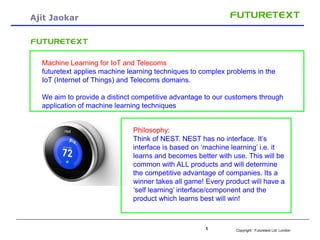
Philosophy:
Think of NEST. NEST has no interface. It’s
interface is based on ‘machine learning’ i.e. it
learns and becomes better with use. This will be
common with ALL products and will determine
the competitive advantage of companies. Its a
winner takes all game! Every product will have a
‘self learning’ interface/component and the
product which learns best will win!
Copyright : Futuretext Ltd. London2
Ajit Jaokar
-
www.futuretext.com
@AjitJaokar
ajit.jaokar@futuretext.com
Copyright : Futuretext Ltd. London3
Ajit Jaokar
-
Data is the new oil ...
Copyright : Futuretext Ltd. London4
Ajit Jaokar
-
The meek shall inherit the earth .. BUT not it’s mineral rights!
Data is out there and is free (Open data). It provides no competitive advantages.
Finding patterns in data is the holy grail (the oil!)
Copyright : Futuretext Ltd. London
Ajit Jaokar
-
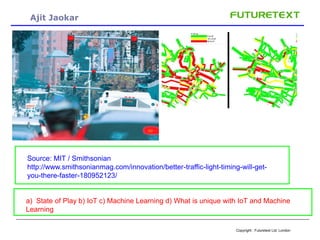
Source: MIT / Smithsonian
http://www.smithsonianmag.com/innovation/better-traffic-light-timing-will-get-
you-there-faster-180952123/
a) State of Play b) IoT c) Machine Learning d) What is unique with IoT and Machine
Learning
Copyright : Futuretext Ltd. London6
Ajit Jaokar
-
www.opengardensblog.futuretext.com
World Economic Forum
Spoken at MWC(5 times), CEBIT, CTIA, Web 2.0,
CNN, BBC, Oxford Uni, Uni St Gallen, European
Parliament. @feynlabs – teaching kids Computer
Science. Adivsory – Connected Liverpool
Copyright : Futuretext Ltd. London7
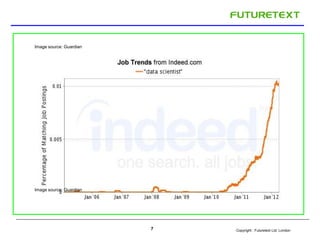
Image source: Guardian
Copyright : Futuretext Ltd. London8
Copyright : Futuretext Ltd. London9
Ajit Jaokar
IOT - THE INDUSTRY- STATE OF PLAY
Copyright : Futuretext Ltd. London10
Ajit Jaokar
State of play - 2014
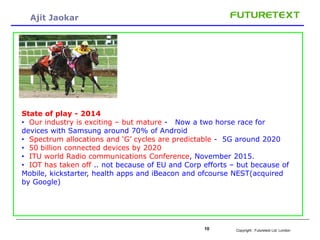
• Our industry is exciting – but mature - Now a two horse race for
devices with Samsung around 70% of Android
• Spectrum allocations and ‘G’ cycles are predictable - 5G around 2020
• 50 billion connected devices by 2020
• ITU world Radio communications Conference, November 2015.
• IOT has taken off .. not because of EU and Corp efforts – but because of
Mobile, kickstarter, health apps and iBeacon and ofcourse NEST(acquired
by Google)
Copyright : Futuretext Ltd. London11
Ajit Jaokar
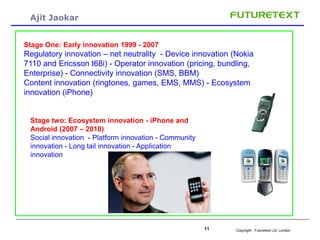
Stage One: Early innovation 1999 - 2007
Regulatory innovation – net neutrality - Device innovation (Nokia
7110 and Ericsson t68i) - Operator innovation (pricing, bundling,
Enterprise) - Connectivity innovation (SMS, BBM)
Content innovation (ringtones, games, EMS, MMS) - Ecosystem
innovation (iPhone)
Stage two: Ecosystem innovation - iPhone and
Android (2007 – 2010)
Social innovation - Platform innovation - Community
innovation - Long tail innovation - Application
innovation
Copyright : Futuretext Ltd. London12
Ajit Jaokar
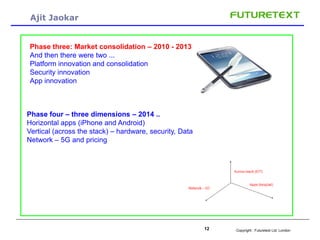
Phase three: Market consolidation – 2010 - 2013
And then there were two ...
Platform innovation and consolidation
Security innovation
App innovation
Phase four – three dimensions – 2014 ..
Horizontal apps (iPhone and Android)
Vertical (across the stack) – hardware, security, Data
Network – 5G and pricing
Copyright : Futuretext Ltd. London13
Ajit Jaokar
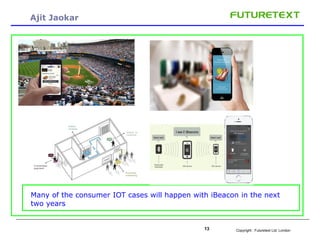
Many of the consumer IOT cases will happen with iBeacon in the next
two years
Copyright : Futuretext Ltd. London14
Ajit Jaokar
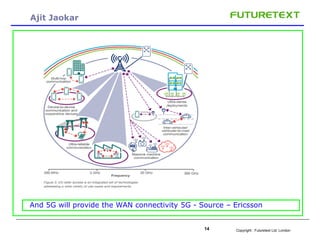
And 5G will provide the WAN connectivity 5G - Source – Ericsson
Copyright : Futuretext Ltd. London15
Ajit Jaokar
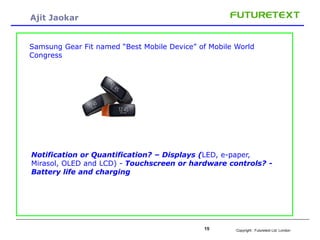
Samsung Gear Fit named “Best Mobile Device” of Mobile World
Congress
Notification or Quantification? – Displays (LED, e-paper,
Mirasol, OLED and LCD) - Touchscreen or hardware controls? -
Battery life and charging
Copyright : Futuretext Ltd. London16
Ajit Jaokar
Hotspot 2.0
Copyright : Futuretext Ltd. London17
Ajit Jaokar
Three parallel ecosystems
IOT is connecting things to the Internet – which is not the same as
connecting things to the cellular network!
The difference is money .. and customers realise it
IOT local/personal (iBeacon, Kickstarter, Health apps)
M2M – Machine to Machine
IOT – pervasive(5G, Hotspot 2.0)
Perspectives
• 2014 – 2015(radio conf) – 2020(5G, 2020)
• 2014 – iBeacon (motivate retailers to open WiFi)
• Hotspot 2.0 – connect cellular and wifi worlds
• Default wifi and local world?
• Operator world – (Big)Data, Corporate, pervasive apps – really happen
beyond 2020
• So 5G will be timed well. The ecosystems will develop and they will be
connected by 5G
Copyright : Futuretext Ltd. London18
Ajit Jaokar
IOT – INTERNET OF THINGS
Copyright : Futuretext Ltd. London19
As the term Internet of Things implies (IOT) – IOT is about Smart
objects
For an object (say a chair) to be ‘smart’ it must have three things
- An Identity (to be uniquely identifiable – via iPv6)
- A communication mechanism(i.e. a radio) and
- A set of sensors / actuators
For example –
the chair may have a pressure sensor indicating that it is occupied
Now, if it is able to know who is sitting – it could co-relate more data by
connecting to the person’s profile
If it is in a cafe, whole new data sets can be co-related (about the venue,
about who else is there etc)
Thus, IOT is all about Data ..
IoT != M2M (M2M is a subset of IoT)
Copyright : Futuretext Ltd. London20
Sensors lead to a LOT of Data (relative to mobile) .. (source David
wood blog)
By 2020, we are expected to have 50 billion connected devices
To put in context:
The first commercial citywide cellular network was launched in Japan by NTT
in 1979
The milestone of 1 billion mobile phone connections was reached in 2002
The 2 billion mobile phone connections milestone was reached in 2005
The 3 billion mobile phone connections milestone was reached in 2007
The 4 billion mobile phone connections milestone was reached in February
2009.
Gartner: IoT will unearth more than $1.9 trillion in revenue before 2020; Cisco thinks
there will be upwards of 50 billion connected devices by the same date; IDC estimates
technology and services revenue will grow worldwide to $7.3 trillion by 2017 (up
from $4.8 trillion in 2012).
Copyright : Futuretext Ltd. London21
So, 50 billion by 2020 is a large number
Smart cities can be seen as an application domain of IOT
In 2008, for the first time in history, more than half of the world’s
population will be living in towns and cities.
By 2030 this number will swell to almost 5 billion, with urban growth
concentrated in Africa and Asia with many mega-cities(10 million +
inhabitants).
By 2050, 70% of humanity will live in cities.
That’s a profound change and will lead to a different management approach
than what is possible today
Also, economic wealth of a nation could be seen as – Energy +
Entrepreneurship + Connectivity (sensor level + network level +
application level)
Hence, if IOT is seen as a part of a network, then it is a core component of
GDP.
Copyright : Futuretext Ltd. London22
Ajit Jaokar
Machine Learning
Copyright : Futuretext Ltd. London23
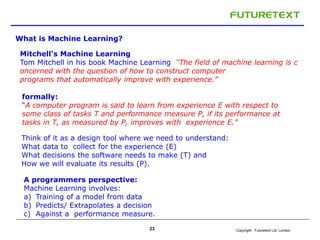
What is Machine Learning?
Mitchell's Machine Learning
Tom Mitchell in his book Machine Learning “The field of machine learning is c
oncerned with the question of how to construct computer
programs that automatically improve with experience.”
formally:
“A computer program is said to learn from experience E with respect to
some class of tasks T and performance measure P, if its performance at
tasks in T, as measured by P, improves with experience E.”
Think of it as a design tool where we need to understand:
What data to collect for the experience (E)
What decisions the software needs to make (T) and
How we will evaluate its results (P).
A programmers perspective:
Machine Learning involves:
a) Training of a model from data
b) Predicts/ Extrapolates a decision
c) Against a performance measure.
Copyright : Futuretext Ltd. London24
What Problems Can Machine Learning Address? (source Jason
Brownlee)
● Spam Detection:
● Credit Card Fraud Detection
• Digit Recognition:
● Speech Understanding:
● Face Detection:
• Product Recommendation:
● Medical Diagnosis:
● Stock Trading:
• Customer Segmentation
• Shape Detection
.
Copyright : Futuretext Ltd. London25
Types of Problems
•Classification: Data is labelled meaning it is assigned a class, for example
spam/non-spam or fraud/non-fraud. The decision being modelled is to
assign labels to new unlabelled pieces of data. This can be thought of as a
discrimination problem, modelling the differences or similarities between groups.
•Regression: Data is labelled with a real value rather
than a label. Examples that are easy to understand are time series data like the price of
a stock over time. The decision being modelled is the relationships between
inputs and outputs.
Clustering: Data is not labelled, but can be divided into groups based on
similarity and other measures of natural structure in the data.
An example from the above list would be organising pictures by faces without
names, where the human user has to assign names to groups, like iPhoto on the Mac.
●Rule Extraction: Data is used as the basis for the extraction of
propositional rules (antecedent/consequent or if-then).
Often necessary to work backwards from a Problem to the algorithm and then work with
Data. Hence, you need a depth of domain experience and also algorithm experience
Copyright : Futuretext Ltd. London26
What Algorithms Does Machine Learning Provide?
Regression
Instance-based Methods
Decision Tree Learning
Bayesian
Kernel Methods
Clustering methods
Association Rule Learning
Artificial Neural Networks
Deep Learning
Dimensionality Reduction
Ensemble Methods
Copyright : Futuretext Ltd. London27
Ajit Jaokar
IoT and Machine Learning
Copyright : Futuretext Ltd. London
Basic idea of machine learning is to build a mathematical model based on
training data(learning stage) – predict results for new data(prediction
stage) and tweak the model based on new conditions
What type of model? Predicitive, Classification, Clustering, Decision
Oriented, Associative
IoT and Machine Learning
 On one hand - IoT creates a lot of contextual data which complements existing
processes
 On the other hand – the Sheer scale of IoT calls for unique solutions
Types of problems:
• Apply existing Machine Learning algorithms to IoT data
• Use IoT data to complement existing processes
• Use the scale of IoT data to gain new insights
• Consider some unique characteristics of IoT data (ex streaming)
28
Copyright : Futuretext Ltd. London29
IoT : from traditional computing to ..
Gone from making Smart things smarter(traditional computing) to
a) Making dumb things smarter .. and
b) living things more robust
3 Domains:
Consumer, Enterprise, Public infrastructure
1) Consumer – bio sensors(real time tracking), Quantified self – focussing on
benefits
2) Enterprise – Complex machinery (preventative maintenance), asset efficiency –
reducing assets, increasing efficiency of existing assets. More from transactions to
relationships(real time context awareness).
3) Public infrastructure(Dynamically adjust traffic lights). Dis-economies of
scale(bad things also scale in cities) – Thanks John Hagel III
Copyright : Futuretext Ltd. London30
Three key areas:
a) Move from exception handling to patterns of exceptions over time.(are
some exceptions occurring repeatedly? Do I need to redsign my product, Is that a
new product?) –
b) Move from optimization to disruption – ownership to rental ship (Where are all
these dynamic assets?)
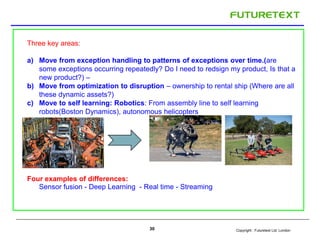
c) Move to self learning: Robotics: From assembly line to self learning
robots(Boston Dynamics), autonomous helicopters
Four examples of differences:
Sensor fusion - Deep Learning - Real time - Streaming
Copyright : Futuretext Ltd. London
Sensor fusion
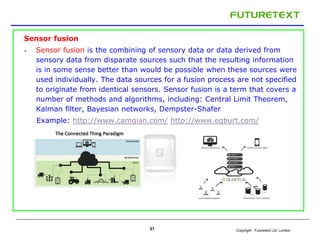
 Sensor fusion is the combining of sensory data or data derived from
sensory data from disparate sources such that the resulting information
is in some sense better than would be possible when these sources were
used individually. The data sources for a fusion process are not specified
to originate from identical sensors. Sensor fusion is a term that covers a
number of methods and algorithms, including: Central Limit Theorem,
Kalman filter, Bayesian networks, Dempster-Shafer
Example: http://www.camgian.com/ http://www.egburt.com/
31
Copyright : Futuretext Ltd. London
Deep learning
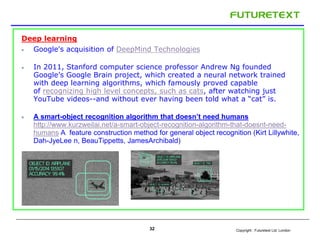
 Google's acquisition of DeepMind Technologies
 In 2011, Stanford computer science professor Andrew Ng founded
Google’s Google Brain project, which created a neural network trained
with deep learning algorithms, which famously proved capable
of recognizing high level concepts, such as cats, after watching just
YouTube videos--and without ever having been told what a “cat” is.
 A smart-object recognition algorithm that doesn’t need humans
http://www.kurzweilai.net/a-smart-object-recognition-algorithm-that-doesnt-need-
humans A feature construction method for general object recognition (Kirt Lillywhite,
Dah-JyeLee n, BeauTippetts, JamesArchibald)
32
Copyright : Futuretext Ltd. London33
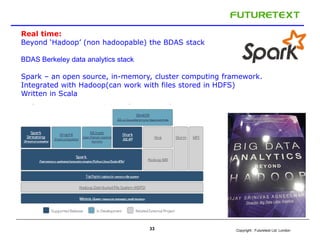
Real time:
Beyond ‘Hadoop’ (non hadoopable) the BDAS stack
BDAS Berkeley data analytics stack
Spark – an open source, in-memory, cluster computing framework.
Integrated with Hadoop(can work with files stored in HDFS)
Written in Scala
Copyright : Futuretext Ltd. London34
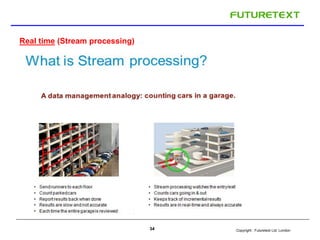
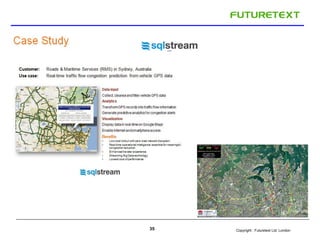
Real time (Stream processing)
Copyright : Futuretext Ltd. London35
Copyright : Futuretext Ltd. London36
Ajit Jaokar
-
www.futuretext.com
@AjitJaokar
ajit.jaokar@futuretext.com
Copyright : Futuretext Ltd. London37
@ajitjaokar
ajit.jaokar@futuretext.com
Sign up at www.futuretext.com to get copies of papers on IoT and
Machine learning, Real time algorithms for IoT and Machine
learning algorithms for Smart cities

IoT and machine learning - Computational Intelligence conference

  • 1.
    Copyright : FuturetextLtd. London0 Slides for my talk on IoT and Machine Learning Computational Intelligence Unconference UK July 2014 - http://ciunconference.org/uk/2014/schedule.php @ajitjaokar ajit.jaokar@futuretext.com Sign up at www.futuretext.com to get copies of papers on IoT and Machine learning, Real time algorithms for IoT and Machine learning algorithms for Smart cities
  • 2.
    Copyright : FuturetextLtd. London1 Ajit Jaokar - Machine Learning for IoT and Telecoms futuretext applies machine learning techniques to complex problems in the IoT (Internet of Things) and Telecoms domains. We aim to provide a distinct competitive advantage to our customers through application of machine learning techniques Philosophy: Think of NEST. NEST has no interface. It’s interface is based on ‘machine learning’ i.e. it learns and becomes better with use. This will be common with ALL products and will determine the competitive advantage of companies. Its a winner takes all game! Every product will have a ‘self learning’ interface/component and the product which learns best will win!
  • 3.
    Copyright : FuturetextLtd. London2 Ajit Jaokar - www.futuretext.com @AjitJaokar ajit.jaokar@futuretext.com
  • 4.
    Copyright : FuturetextLtd. London3 Ajit Jaokar - Data is the new oil ...
  • 5.
    Copyright : FuturetextLtd. London4 Ajit Jaokar - The meek shall inherit the earth .. BUT not it’s mineral rights! Data is out there and is free (Open data). It provides no competitive advantages. Finding patterns in data is the holy grail (the oil!)
  • 6.
    Copyright : FuturetextLtd. London Ajit Jaokar - Source: MIT / Smithsonian http://www.smithsonianmag.com/innovation/better-traffic-light-timing-will-get- you-there-faster-180952123/ a) State of Play b) IoT c) Machine Learning d) What is unique with IoT and Machine Learning
  • 7.
    Copyright : FuturetextLtd. London6 Ajit Jaokar - www.opengardensblog.futuretext.com World Economic Forum Spoken at MWC(5 times), CEBIT, CTIA, Web 2.0, CNN, BBC, Oxford Uni, Uni St Gallen, European Parliament. @feynlabs – teaching kids Computer Science. Adivsory – Connected Liverpool
  • 8.
    Copyright : FuturetextLtd. London7 Image source: Guardian Image source: Guardian
  • 9.
  • 10.
    Copyright : FuturetextLtd. London9 Ajit Jaokar IOT - THE INDUSTRY- STATE OF PLAY
  • 11.
    Copyright : FuturetextLtd. London10 Ajit Jaokar State of play - 2014 • Our industry is exciting – but mature - Now a two horse race for devices with Samsung around 70% of Android • Spectrum allocations and ‘G’ cycles are predictable - 5G around 2020 • 50 billion connected devices by 2020 • ITU world Radio communications Conference, November 2015. • IOT has taken off .. not because of EU and Corp efforts – but because of Mobile, kickstarter, health apps and iBeacon and ofcourse NEST(acquired by Google)
  • 12.
    Copyright : FuturetextLtd. London11 Ajit Jaokar Stage One: Early innovation 1999 - 2007 Regulatory innovation – net neutrality - Device innovation (Nokia 7110 and Ericsson t68i) - Operator innovation (pricing, bundling, Enterprise) - Connectivity innovation (SMS, BBM) Content innovation (ringtones, games, EMS, MMS) - Ecosystem innovation (iPhone) Stage two: Ecosystem innovation - iPhone and Android (2007 – 2010) Social innovation - Platform innovation - Community innovation - Long tail innovation - Application innovation
  • 13.
    Copyright : FuturetextLtd. London12 Ajit Jaokar Phase three: Market consolidation – 2010 - 2013 And then there were two ... Platform innovation and consolidation Security innovation App innovation Phase four – three dimensions – 2014 .. Horizontal apps (iPhone and Android) Vertical (across the stack) – hardware, security, Data Network – 5G and pricing
  • 14.
    Copyright : FuturetextLtd. London13 Ajit Jaokar Many of the consumer IOT cases will happen with iBeacon in the next two years
  • 15.
    Copyright : FuturetextLtd. London14 Ajit Jaokar And 5G will provide the WAN connectivity 5G - Source – Ericsson
  • 16.
    Copyright : FuturetextLtd. London15 Ajit Jaokar Samsung Gear Fit named “Best Mobile Device” of Mobile World Congress Notification or Quantification? – Displays (LED, e-paper, Mirasol, OLED and LCD) - Touchscreen or hardware controls? - Battery life and charging
  • 17.
    Copyright : FuturetextLtd. London16 Ajit Jaokar Hotspot 2.0
  • 18.
    Copyright : FuturetextLtd. London17 Ajit Jaokar Three parallel ecosystems IOT is connecting things to the Internet – which is not the same as connecting things to the cellular network! The difference is money .. and customers realise it IOT local/personal (iBeacon, Kickstarter, Health apps) M2M – Machine to Machine IOT – pervasive(5G, Hotspot 2.0) Perspectives • 2014 – 2015(radio conf) – 2020(5G, 2020) • 2014 – iBeacon (motivate retailers to open WiFi) • Hotspot 2.0 – connect cellular and wifi worlds • Default wifi and local world? • Operator world – (Big)Data, Corporate, pervasive apps – really happen beyond 2020 • So 5G will be timed well. The ecosystems will develop and they will be connected by 5G
  • 19.
    Copyright : FuturetextLtd. London18 Ajit Jaokar IOT – INTERNET OF THINGS
  • 20.
    Copyright : FuturetextLtd. London19 As the term Internet of Things implies (IOT) – IOT is about Smart objects For an object (say a chair) to be ‘smart’ it must have three things - An Identity (to be uniquely identifiable – via iPv6) - A communication mechanism(i.e. a radio) and - A set of sensors / actuators For example – the chair may have a pressure sensor indicating that it is occupied Now, if it is able to know who is sitting – it could co-relate more data by connecting to the person’s profile If it is in a cafe, whole new data sets can be co-related (about the venue, about who else is there etc) Thus, IOT is all about Data .. IoT != M2M (M2M is a subset of IoT)
  • 21.
    Copyright : FuturetextLtd. London20 Sensors lead to a LOT of Data (relative to mobile) .. (source David wood blog) By 2020, we are expected to have 50 billion connected devices To put in context: The first commercial citywide cellular network was launched in Japan by NTT in 1979 The milestone of 1 billion mobile phone connections was reached in 2002 The 2 billion mobile phone connections milestone was reached in 2005 The 3 billion mobile phone connections milestone was reached in 2007 The 4 billion mobile phone connections milestone was reached in February 2009. Gartner: IoT will unearth more than $1.9 trillion in revenue before 2020; Cisco thinks there will be upwards of 50 billion connected devices by the same date; IDC estimates technology and services revenue will grow worldwide to $7.3 trillion by 2017 (up from $4.8 trillion in 2012).
  • 22.
    Copyright : FuturetextLtd. London21 So, 50 billion by 2020 is a large number Smart cities can be seen as an application domain of IOT In 2008, for the first time in history, more than half of the world’s population will be living in towns and cities. By 2030 this number will swell to almost 5 billion, with urban growth concentrated in Africa and Asia with many mega-cities(10 million + inhabitants). By 2050, 70% of humanity will live in cities. That’s a profound change and will lead to a different management approach than what is possible today Also, economic wealth of a nation could be seen as – Energy + Entrepreneurship + Connectivity (sensor level + network level + application level) Hence, if IOT is seen as a part of a network, then it is a core component of GDP.
  • 23.
    Copyright : FuturetextLtd. London22 Ajit Jaokar Machine Learning
  • 24.
    Copyright : FuturetextLtd. London23 What is Machine Learning? Mitchell's Machine Learning Tom Mitchell in his book Machine Learning “The field of machine learning is c oncerned with the question of how to construct computer programs that automatically improve with experience.” formally: “A computer program is said to learn from experience E with respect to some class of tasks T and performance measure P, if its performance at tasks in T, as measured by P, improves with experience E.” Think of it as a design tool where we need to understand: What data to collect for the experience (E) What decisions the software needs to make (T) and How we will evaluate its results (P). A programmers perspective: Machine Learning involves: a) Training of a model from data b) Predicts/ Extrapolates a decision c) Against a performance measure.
  • 25.
    Copyright : FuturetextLtd. London24 What Problems Can Machine Learning Address? (source Jason Brownlee) ● Spam Detection: ● Credit Card Fraud Detection • Digit Recognition: ● Speech Understanding: ● Face Detection: • Product Recommendation: ● Medical Diagnosis: ● Stock Trading: • Customer Segmentation • Shape Detection .
  • 26.
    Copyright : FuturetextLtd. London25 Types of Problems •Classification: Data is labelled meaning it is assigned a class, for example spam/non-spam or fraud/non-fraud. The decision being modelled is to assign labels to new unlabelled pieces of data. This can be thought of as a discrimination problem, modelling the differences or similarities between groups. •Regression: Data is labelled with a real value rather than a label. Examples that are easy to understand are time series data like the price of a stock over time. The decision being modelled is the relationships between inputs and outputs. Clustering: Data is not labelled, but can be divided into groups based on similarity and other measures of natural structure in the data. An example from the above list would be organising pictures by faces without names, where the human user has to assign names to groups, like iPhoto on the Mac. ●Rule Extraction: Data is used as the basis for the extraction of propositional rules (antecedent/consequent or if-then). Often necessary to work backwards from a Problem to the algorithm and then work with Data. Hence, you need a depth of domain experience and also algorithm experience
  • 27.
    Copyright : FuturetextLtd. London26 What Algorithms Does Machine Learning Provide? Regression Instance-based Methods Decision Tree Learning Bayesian Kernel Methods Clustering methods Association Rule Learning Artificial Neural Networks Deep Learning Dimensionality Reduction Ensemble Methods
  • 28.
    Copyright : FuturetextLtd. London27 Ajit Jaokar IoT and Machine Learning
  • 29.
    Copyright : FuturetextLtd. London Basic idea of machine learning is to build a mathematical model based on training data(learning stage) – predict results for new data(prediction stage) and tweak the model based on new conditions What type of model? Predicitive, Classification, Clustering, Decision Oriented, Associative IoT and Machine Learning  On one hand - IoT creates a lot of contextual data which complements existing processes  On the other hand – the Sheer scale of IoT calls for unique solutions Types of problems: • Apply existing Machine Learning algorithms to IoT data • Use IoT data to complement existing processes • Use the scale of IoT data to gain new insights • Consider some unique characteristics of IoT data (ex streaming) 28
  • 30.
    Copyright : FuturetextLtd. London29 IoT : from traditional computing to .. Gone from making Smart things smarter(traditional computing) to a) Making dumb things smarter .. and b) living things more robust 3 Domains: Consumer, Enterprise, Public infrastructure 1) Consumer – bio sensors(real time tracking), Quantified self – focussing on benefits 2) Enterprise – Complex machinery (preventative maintenance), asset efficiency – reducing assets, increasing efficiency of existing assets. More from transactions to relationships(real time context awareness). 3) Public infrastructure(Dynamically adjust traffic lights). Dis-economies of scale(bad things also scale in cities) – Thanks John Hagel III
  • 31.
    Copyright : FuturetextLtd. London30 Three key areas: a) Move from exception handling to patterns of exceptions over time.(are some exceptions occurring repeatedly? Do I need to redsign my product, Is that a new product?) – b) Move from optimization to disruption – ownership to rental ship (Where are all these dynamic assets?) c) Move to self learning: Robotics: From assembly line to self learning robots(Boston Dynamics), autonomous helicopters Four examples of differences: Sensor fusion - Deep Learning - Real time - Streaming
  • 32.
    Copyright : FuturetextLtd. London Sensor fusion  Sensor fusion is the combining of sensory data or data derived from sensory data from disparate sources such that the resulting information is in some sense better than would be possible when these sources were used individually. The data sources for a fusion process are not specified to originate from identical sensors. Sensor fusion is a term that covers a number of methods and algorithms, including: Central Limit Theorem, Kalman filter, Bayesian networks, Dempster-Shafer Example: http://www.camgian.com/ http://www.egburt.com/ 31
  • 33.
    Copyright : FuturetextLtd. London Deep learning  Google's acquisition of DeepMind Technologies  In 2011, Stanford computer science professor Andrew Ng founded Google’s Google Brain project, which created a neural network trained with deep learning algorithms, which famously proved capable of recognizing high level concepts, such as cats, after watching just YouTube videos--and without ever having been told what a “cat” is.  A smart-object recognition algorithm that doesn’t need humans http://www.kurzweilai.net/a-smart-object-recognition-algorithm-that-doesnt-need- humans A feature construction method for general object recognition (Kirt Lillywhite, Dah-JyeLee n, BeauTippetts, JamesArchibald) 32
  • 34.
    Copyright : FuturetextLtd. London33 Real time: Beyond ‘Hadoop’ (non hadoopable) the BDAS stack BDAS Berkeley data analytics stack Spark – an open source, in-memory, cluster computing framework. Integrated with Hadoop(can work with files stored in HDFS) Written in Scala
  • 35.
    Copyright : FuturetextLtd. London34 Real time (Stream processing)
  • 36.
  • 37.
    Copyright : FuturetextLtd. London36 Ajit Jaokar - www.futuretext.com @AjitJaokar ajit.jaokar@futuretext.com
  • 38.
    Copyright : FuturetextLtd. London37 @ajitjaokar ajit.jaokar@futuretext.com Sign up at www.futuretext.com to get copies of papers on IoT and Machine learning, Real time algorithms for IoT and Machine learning algorithms for Smart cities