Predictive Maintenance
using Azure AI
Azure
Cloud AI
MTC Strategy Briefing for Oil & Gas, May 21, 2018, Houston, TX
Speakers: Ram Krishnan, Naveen Vig
Microsoft Cloud AI Solutions, Redmond, WA
Topics:
- Predictive Maintenance – key concepts
- Solution Template Demo
- http://github.com/azure/AI-PredictiveMaintenance
- Contact: azureaipdm@microsoft.com
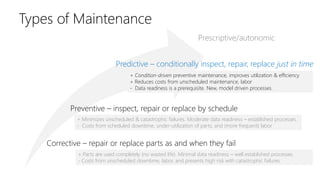
Types of Maintenance
Corrective – repair or replace parts as and when they fail
Preventive – inspect, repair or replace by schedule
Predictive – conditionally inspect, repair, replace just in time
Prescriptive/autonomic
+ Condition-driven preventive maintenance, improves utilization & efficiency
+ Reduces costs from unscheduled maintenance, labor
- Data readiness is a prerequisite. New, model driven processes.
+ Parts are used completely (no wasted life). Minimal data readiness – well established processes.
- Costs from unscheduled downtime, labor, and presents high risk with catastrophic failures
+ Minimizes unscheduled & catastrophic failures. Moderate data readiness – established processes.
- Costs from scheduled downtime, under-utilization of parts, and (more frequent) labor
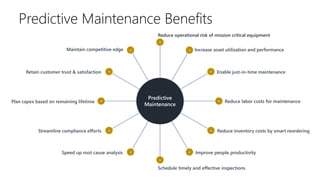
Predictive
Maintenance
+
+
+
+
+
+
+
+
+
+
+
+
Reduce operational risk of mission critical equipment
Increase asset utilization and performance
Predictive Maintenance Benefits
Enable just-in-time maintenance
Reduce labor costs for maintenance
Reduce inventory costs by smart reordering
Improve people productivity
Schedule timely and effective inspections
Speed up root cause analysis
Streamline compliance efforts
Plan capex based on remaining lifetime
Retain customer trust & satisfaction
Maintain competitive edge
• Predict a machine failure in the near future (next N time units)
• Estimate remaining useful life of a machine
• Predict failure along with the type of failure
• Predict the type of maintenance action
• Identify main causes of failure of an asset
• Other variations (Example: “when should this machine be serviced?”)
Predictive Maintenance Problems
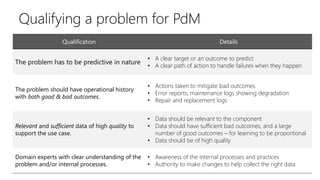
Qualifying a problem for PdM
Qualification Details
The problem has to be predictive in nature
• A clear target or an outcome to predict
• A clear path of action to handle failures when they happen
The problem should have operational history
with both good & bad outcomes.
• Actions taken to mitigate bad outcomes
• Error reports, maintenance logs showing degradation
• Repair and replacement logs
Relevant and sufficient data of high quality to
support the use case.
• Data should be relevant to the component
• Data should have sufficient bad outcomes, and a large
number of good outcomes – for learning to be proportional
• Data should be of high quality
Domain experts with clear understanding of the
problem and/or internal processes.
• Awareness of the internal processes and practices
• Authority to make changes to help collect the right data
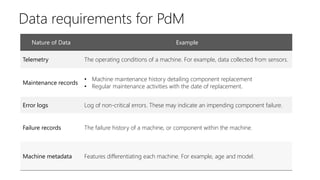
Data requirements for PdM
Nature of Data Example
Telemetry The operating conditions of a machine. For example, data collected from sensors.
Maintenance records
• Machine maintenance history detailing component replacement
• Regular maintenance activities with the date of replacement.
Error logs Log of non-critical errors. These may indicate an impending component failure.
Failure records The failure history of a machine, or component within the machine.
Machine metadata Features differentiating each machine. For example, age and model.
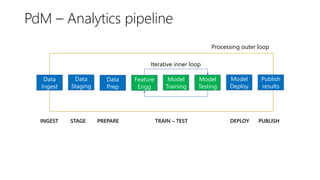
INGEST TRAIN – TEST DEPLOY PUBLISHSTAGE PREPARE
PdM – Analytics pipeline
Feature
Engg
Model
Training
Model
Testing
Data
Prep
Data
Staging
Model
Deploy
Data
Ingest
Publish
results
Iterative inner loop
Processing outer loop
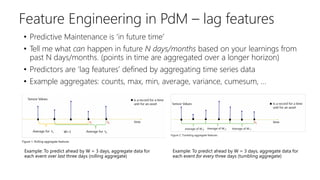
Feature Engineering in PdM – lag features
• Predictive Maintenance is ‘in future time’
• Tell me what can happen in future N days/months based on your learnings from
past N days/months. (points in time are aggregated over a longer horizon)
• Predictors are ‘lag features’ defined by aggregating time series data
• Example aggregates: counts, max, min, average, variance, cumesum, …
Example: To predict ahead by W = 3 days, aggregate data for
each event over last three days (rolling aggregate)
Example: To predict ahead by W = 3 days, aggregate data for
each event for every three days (tumbling aggregate)
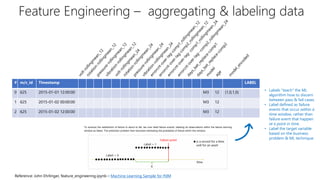
Feature Engineering – aggregating & labeling data
# m/c_id Timestamp LABEL
0 625 2015-01-01 12:00:00 M3 12 (1,0,1,0)
1 625 2015-01-02 00:00:00 M3 12
2 625 2015-01-02 12:00:00 M3 12
• Labels “teach” the ML
algorithm how to discern
between pass & fail cases.
• Label defined as failure
events that occur within a
time window, rather than
failure event that happen
at a point in time.
• Label the target variable
based on the business
problem & ML technique.
Reference: John Ehrlinger, feature_engineering.ipynb – Machine Learning Sample for PdM
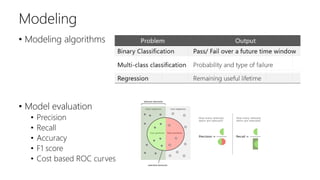
Modeling
• Modeling algorithms
• Model evaluation
• Precision
• Recall
• Accuracy
• F1 score
• Cost based ROC curves
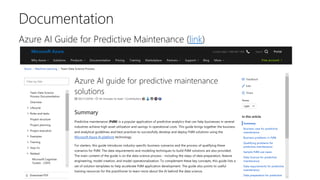
Documentation
Azure AI Guide for Predictive Maintenance (link)
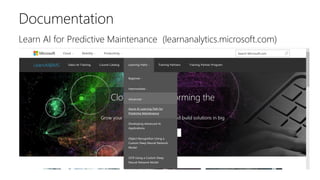
Documentation
Learn AI for Predictive Maintenance (learnanalytics.microsoft.com)
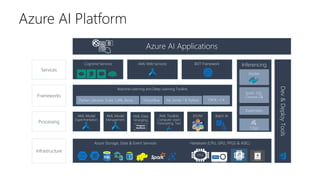
Azure AI Applications
Frameworks
Machine Learning and Deep Learning Toolkits
CNTK – C#Tensorflow ML Server – R, PythonPython Libraries: Scikit, Caffe, Keras, ..
Inferencing
Spark, SQL,
Cosmos DB
Kubernetes
Docker
Edge
Infrastructure
Azure Storage, Data & Event Services Hardware (CPU, GPU, FPGS & ASIC)
CPUs
Services
Cognitive Services AML Web Services BOT Framework
Processing
DSVMAML Model
Experimentation
AML Model
Management
Batch AIAML Data
Wrangling
AML Toolkits
Computer vision
Forecasting, Text
Dev&DeployTools
Azure AI Platform
Predictive Maintenance
using Azure AI
GENERATE
Storage
Blobs
Sensor
data from
devices
Sensor
Data
Generator







IoT Hub
INGEST TRAIN – TEST DEPLOY PUBLISH CONSUMESTAGE
Service Bus
Maintenance
& Error logs
PREPARE
Admin Dashboard
Data Science VM
Storage
Tables
KubernetesOnline Scoring Data
Predicted
Output
Logs &
Device
Metadata
Input data Train-Test data New data (to be scored) Output data (with predictions) Modeling operations


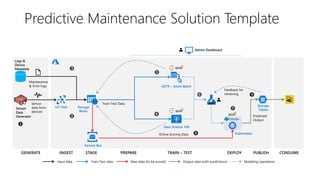
Predictive Maintenance Solution Template
AZTK – Azure Batch
Train-Test Data
Feedback for
retraining
GENERATE
Storage
Blobs
Sensor
data from
devices
Sensor
Data
Generator







IoT Hub
INGEST TRAIN – TEST DEPLOY PUBLISH CONSUMESTAGE
Service Bus
Maintenance
& Error logs
PREPARE
Admin Dashboard
Data Science VM Storage
Tables

Kubernetes
Batch Scoring Data
Online Scoring Data
Train-Test Data Predicted
Output
Logs &
Device
Metadata
Train-Test Data
Input data Train-Test data New data (to be scored) Output data (with predictions) Modeling operations


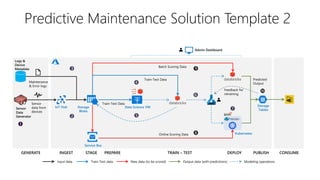
Predictive Maintenance Solution Template 2
Feedback for
retraining
GENERATE
Storage
Blobs
Sensor
data from
devices
Sensor
Data
Generator






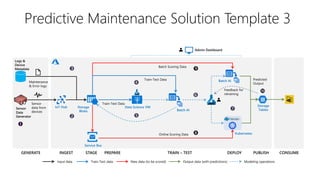
IoT Hub
INGEST TRAIN – TEST DEPLOY PUBLISH CONSUMESTAGE
Service Bus
Maintenance
& Error logs
PREPARE
Admin Dashboard

Data Science VM
Batch AI
Storage
Tables

Kubernetes
Batch AI
Batch Scoring Data
Online Scoring Data
Train-Test Data Predicted
Output
Logs &
Device
Metadata
Train-Test Data
Input data Train-Test data New data (to be scored) Output data (with predictions) Modeling operations

Predictive Maintenance Solution Template 3

Feedback for
retraining
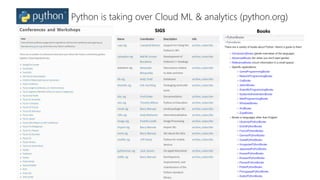
Python is taking over Cloud ML & analytics (python.org)
SIGS Books
MTC Strategy Briefing for Oil & Gas, May 21, 2018, Houston, TX
- Predictive Maintenance – key concepts
- Solution Template Demo
- Azure AI Guide for Predictive Maintenance
- http://github.com/azure/AI-PredictiveMaintenance
Contact:
azureaipdm@microsoft.com
Ram Krishnan – Senior Program Manager, Cloud AI Engineering (ramkri@microsoft.com)
Naveen Vig – Principal Solutions Architect, Cloud AI Engineering (navig@microsoft.com)
Summary
© 2017 Microsoft Corporation. All rights reserved. Microsoft, Windows, and other product names are or may be registered trademarks and/or trademarks in the U.S. and/or other
countries.
The information herein is for informational purposes only and represents the current view of Microsoft Corporation as of the date of this presentation. Because Microsoft must respond to
changing market conditions, it should not be interpreted to be a commitment on the part of Microsoft, and Microsoft cannot guarantee the accuracy of any information provided after the
date of this presentation. MICROSOFT MAKES NO WARRANTIES, EXPRESS, IMPLIED OR STATUTORY, AS TO THE INFORMATION IN THIS PRESENTATION.
2018

Mtc strategy-briefing-houston-pd m-05212018-3

  • 1.
    Predictive Maintenance using AzureAI Azure Cloud AI MTC Strategy Briefing for Oil & Gas, May 21, 2018, Houston, TX Speakers: Ram Krishnan, Naveen Vig Microsoft Cloud AI Solutions, Redmond, WA Topics: - Predictive Maintenance – key concepts - Solution Template Demo - http://github.com/azure/AI-PredictiveMaintenance - Contact: azureaipdm@microsoft.com
  • 2.
    Types of Maintenance Corrective– repair or replace parts as and when they fail Preventive – inspect, repair or replace by schedule Predictive – conditionally inspect, repair, replace just in time Prescriptive/autonomic + Condition-driven preventive maintenance, improves utilization & efficiency + Reduces costs from unscheduled maintenance, labor - Data readiness is a prerequisite. New, model driven processes. + Parts are used completely (no wasted life). Minimal data readiness – well established processes. - Costs from unscheduled downtime, labor, and presents high risk with catastrophic failures + Minimizes unscheduled & catastrophic failures. Moderate data readiness – established processes. - Costs from scheduled downtime, under-utilization of parts, and (more frequent) labor
  • 3.
    Predictive Maintenance + + + + + + + + + + + + Reduce operational riskof mission critical equipment Increase asset utilization and performance Predictive Maintenance Benefits Enable just-in-time maintenance Reduce labor costs for maintenance Reduce inventory costs by smart reordering Improve people productivity Schedule timely and effective inspections Speed up root cause analysis Streamline compliance efforts Plan capex based on remaining lifetime Retain customer trust & satisfaction Maintain competitive edge
  • 4.
    • Predict amachine failure in the near future (next N time units) • Estimate remaining useful life of a machine • Predict failure along with the type of failure • Predict the type of maintenance action • Identify main causes of failure of an asset • Other variations (Example: “when should this machine be serviced?”) Predictive Maintenance Problems
  • 5.
    Qualifying a problemfor PdM Qualification Details The problem has to be predictive in nature • A clear target or an outcome to predict • A clear path of action to handle failures when they happen The problem should have operational history with both good & bad outcomes. • Actions taken to mitigate bad outcomes • Error reports, maintenance logs showing degradation • Repair and replacement logs Relevant and sufficient data of high quality to support the use case. • Data should be relevant to the component • Data should have sufficient bad outcomes, and a large number of good outcomes – for learning to be proportional • Data should be of high quality Domain experts with clear understanding of the problem and/or internal processes. • Awareness of the internal processes and practices • Authority to make changes to help collect the right data
  • 6.
    Data requirements forPdM Nature of Data Example Telemetry The operating conditions of a machine. For example, data collected from sensors. Maintenance records • Machine maintenance history detailing component replacement • Regular maintenance activities with the date of replacement. Error logs Log of non-critical errors. These may indicate an impending component failure. Failure records The failure history of a machine, or component within the machine. Machine metadata Features differentiating each machine. For example, age and model.
  • 7.
    INGEST TRAIN –TEST DEPLOY PUBLISHSTAGE PREPARE PdM – Analytics pipeline Feature Engg Model Training Model Testing Data Prep Data Staging Model Deploy Data Ingest Publish results Iterative inner loop Processing outer loop
  • 8.
    Feature Engineering inPdM – lag features • Predictive Maintenance is ‘in future time’ • Tell me what can happen in future N days/months based on your learnings from past N days/months. (points in time are aggregated over a longer horizon) • Predictors are ‘lag features’ defined by aggregating time series data • Example aggregates: counts, max, min, average, variance, cumesum, … Example: To predict ahead by W = 3 days, aggregate data for each event over last three days (rolling aggregate) Example: To predict ahead by W = 3 days, aggregate data for each event for every three days (tumbling aggregate)
  • 9.
    Feature Engineering –aggregating & labeling data # m/c_id Timestamp LABEL 0 625 2015-01-01 12:00:00 M3 12 (1,0,1,0) 1 625 2015-01-02 00:00:00 M3 12 2 625 2015-01-02 12:00:00 M3 12 • Labels “teach” the ML algorithm how to discern between pass & fail cases. • Label defined as failure events that occur within a time window, rather than failure event that happen at a point in time. • Label the target variable based on the business problem & ML technique. Reference: John Ehrlinger, feature_engineering.ipynb – Machine Learning Sample for PdM
  • 10.
    Modeling • Modeling algorithms •Model evaluation • Precision • Recall • Accuracy • F1 score • Cost based ROC curves
  • 11.
    Documentation Azure AI Guidefor Predictive Maintenance (link)
  • 12.
    Documentation Learn AI forPredictive Maintenance (learnanalytics.microsoft.com)
  • 13.
    Azure AI Applications Frameworks MachineLearning and Deep Learning Toolkits CNTK – C#Tensorflow ML Server – R, PythonPython Libraries: Scikit, Caffe, Keras, .. Inferencing Spark, SQL, Cosmos DB Kubernetes Docker Edge Infrastructure Azure Storage, Data & Event Services Hardware (CPU, GPU, FPGS & ASIC) CPUs Services Cognitive Services AML Web Services BOT Framework Processing DSVMAML Model Experimentation AML Model Management Batch AIAML Data Wrangling AML Toolkits Computer vision Forecasting, Text Dev&DeployTools Azure AI Platform
  • 14.
  • 15.
    GENERATE Storage Blobs Sensor data from devices Sensor Data Generator        IoT Hub INGESTTRAIN – TEST DEPLOY PUBLISH CONSUMESTAGE Service Bus Maintenance & Error logs PREPARE Admin Dashboard Data Science VM Storage Tables KubernetesOnline Scoring Data Predicted Output Logs & Device Metadata Input data Train-Test data New data (to be scored) Output data (with predictions) Modeling operations   Predictive Maintenance Solution Template AZTK – Azure Batch Train-Test Data Feedback for retraining
  • 16.
    GENERATE Storage Blobs Sensor data from devices Sensor Data Generator        IoT Hub INGESTTRAIN – TEST DEPLOY PUBLISH CONSUMESTAGE Service Bus Maintenance & Error logs PREPARE Admin Dashboard Data Science VM Storage Tables  Kubernetes Batch Scoring Data Online Scoring Data Train-Test Data Predicted Output Logs & Device Metadata Train-Test Data Input data Train-Test data New data (to be scored) Output data (with predictions) Modeling operations   Predictive Maintenance Solution Template 2 Feedback for retraining
  • 17.
    GENERATE Storage Blobs Sensor data from devices Sensor Data Generator       IoT Hub INGESTTRAIN – TEST DEPLOY PUBLISH CONSUMESTAGE Service Bus Maintenance & Error logs PREPARE Admin Dashboard  Data Science VM Batch AI Storage Tables  Kubernetes Batch AI Batch Scoring Data Online Scoring Data Train-Test Data Predicted Output Logs & Device Metadata Train-Test Data Input data Train-Test data New data (to be scored) Output data (with predictions) Modeling operations  Predictive Maintenance Solution Template 3  Feedback for retraining
  • 18.
    Python is takingover Cloud ML & analytics (python.org) SIGS Books
  • 19.
    MTC Strategy Briefingfor Oil & Gas, May 21, 2018, Houston, TX - Predictive Maintenance – key concepts - Solution Template Demo - Azure AI Guide for Predictive Maintenance - http://github.com/azure/AI-PredictiveMaintenance Contact: azureaipdm@microsoft.com Ram Krishnan – Senior Program Manager, Cloud AI Engineering (ramkri@microsoft.com) Naveen Vig – Principal Solutions Architect, Cloud AI Engineering (navig@microsoft.com) Summary
  • 20.
    © 2017 MicrosoftCorporation. All rights reserved. Microsoft, Windows, and other product names are or may be registered trademarks and/or trademarks in the U.S. and/or other countries. The information herein is for informational purposes only and represents the current view of Microsoft Corporation as of the date of this presentation. Because Microsoft must respond to changing market conditions, it should not be interpreted to be a commitment on the part of Microsoft, and Microsoft cannot guarantee the accuracy of any information provided after the date of this presentation. MICROSOFT MAKES NO WARRANTIES, EXPRESS, IMPLIED OR STATUTORY, AS TO THE INFORMATION IN THIS PRESENTATION. 2018