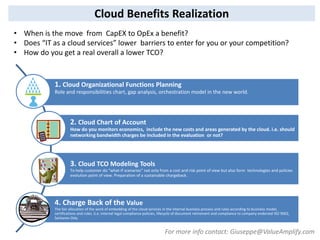
1. Cloud Organizational Functions Planning
Role and responsibilities chart, gap analysis, orchestration model in the new world.
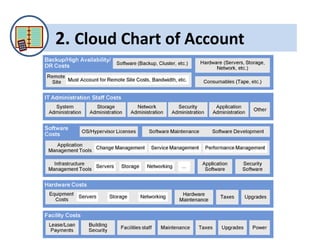
2. Cloud Chart of Account
How do you monitors economics, include the new costs and areas generated by the cloud. i.e. should
networking bandwidth charges be included in the evaluation or not?
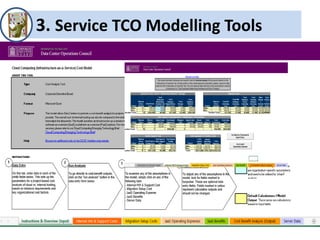
3. Service TCO Modelling Tools
To help customer do “what-if scenarios” not only from a cost and risk point of view but also form technologies and policies
evolution point of view. Preparation of a sustainable chargeback.
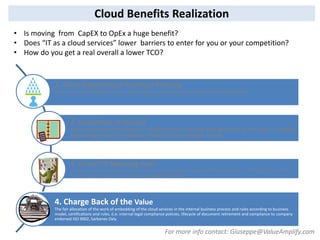
4. Charge Back of the Value
The fair allocation of the work of embedding of the cloud services in the internal business process and rules according to business model,
certifications and rules. (i.e. internal legal compliance policies, lifecycle of document retirement and compliance to company endorsed ISO 9002,
Sarbanes Oxly.
Cloud Benefits Realization
For more info contact: Giuseppe@ValueAmplify.com
• Is just moving from CapEX to OpEx a huge benefit?
• Does “IT as a cloud commodity services” changes IT Role and Responsibility?
• How do you get a real overall lower TCO?
THE ROADMAP TO FIND SOME OF THE ANSWERS:
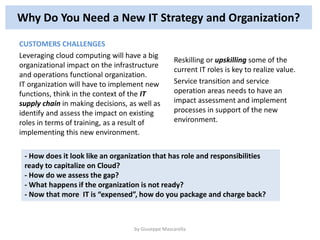
Why Do You Need a New IT Strategy and Organization?
CUSTOMERS CHALLENGES
Leveraging cloud computing will have a big
organizational impact on the infrastructure
and operations functional organization.
IT organization will have to implement new
functions, think in the context of the IT
supply chain in making decisions, as well as
identify and assess the impact on existing
roles in terms of training, as a result of
implementing this new environment.
Reskilling or upskilling some of the
current IT roles is key to realize value.
Service transition and service
operation areas needs to have an
impact assessment and implement
processes in support of the new
environment.
- How does it look like an organization that has role and responsibilities
ready to capitalize on Cloud?
- How do we assess the gap?
- What happens if the organization is not ready?
- Now that more IT is “expensed”, how do you package and charge back?
by Giuseppe Mascarella
3
Microsoft Confidential
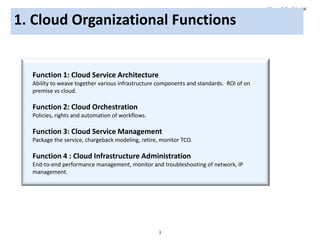
1. Cloud Organizational Functions
Function 1: Cloud Service Architecture
Ability to weave together various infrastructure components and standards. ROI of on
premise vs cloud.
Function 2: Cloud Orchestration
Policies, rights and automation of workflows.
Function 3: Cloud Service Management
Package the service, chargeback modeling, retire, monitor TCO.
Function 4 : Cloud Infrastructure Administration
End-to-end performance management, monitor and troubleshooting of network, IP
management.
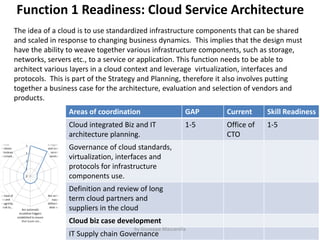
Function 1 Readiness: Cloud Service Architecture
The idea of a cloud is to use standardized infrastructure components that can be shared
and scaled in response to changing business dynamics. This implies that the design must
have the ability to weave together various infrastructure components, such as storage,
networks, servers etc., to a service or application. This function needs to be able to
architect various layers in a cloud context and leverage virtualization, interfaces and
protocols. This is part of the Strategy and Planning, therefore it also involves putting
together a business case for the architecture, evaluation and selection of vendors and
products.
Areas of coordination GAP Current Skill Readiness
Cloud integrated Biz and IT
architecture planning.
1-5 Office of
CTO
1-5
Governance of cloud standards,
virtualization, interfaces and
protocols for infrastructure
components use.
Definition and review of long
term cloud partners and
suppliers in the cloud
Cloud biz case development
IT Supply chain Governance
by Giuseppe Mascarella
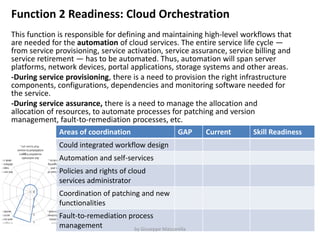
Function 2 Readiness: Cloud Orchestration
This function is responsible for defining and maintaining high-level workflows that
are needed for the automation of cloud services. The entire service life cycle —
from service provisioning, service activation, service assurance, service billing and
service retirement — has to be automated. Thus, automation will span server
platforms, network devices, portal applications, storage systems and other areas.
-During service provisioning, there is a need to provision the right infrastructure
components, configurations, dependencies and monitoring software needed for
the service.
-During service assurance, there is a need to manage the allocation and
allocation of resources, to automate processes for patching and version
management, fault-to-remediation processes, etc.
Areas of coordination GAP Current Skill Readiness
Could integrated workflow design
Automation and self-services
Policies and rights of cloud
services administrator
Coordination of patching and new
functionalities
Fault-to-remediation process
management by Giuseppe Mascarella
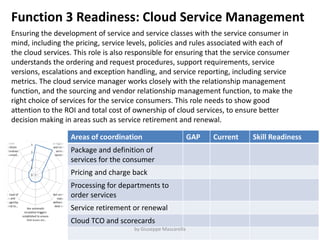
Function 3 Readiness: Cloud Service Management
Ensuring the development of service and service classes with the service consumer in
mind, including the pricing, service levels, policies and rules associated with each of
the cloud services. This role is also responsible for ensuring that the service consumer
understands the ordering and request procedures, support requirements, service
versions, escalations and exception handling, and service reporting, including service
metrics. The cloud service manager works closely with the relationship management
function, and the sourcing and vendor relationship management function, to make the
right choice of services for the service consumers. This role needs to show good
attention to the ROI and total cost of ownership of cloud services, to ensure better
decision making in areas such as service retirement and renewal.
Areas of coordination GAP Current Skill Readiness
Package and definition of
services for the consumer
Pricing and charge back
Processing for departments to
order services
Service retirement or renewal
Cloud TCO and scorecards
by Giuseppe Mascarella
Packaging of Cloud Services
Commercialization is the process of introducing a new product to end-customers or distributors/re-
sellers. The Commercialization process is typically a stage-wise process (each stage has its own key goals
and milestones) and it is vital to involve key stakeholders early, including potential or actual customers
Key questions related to commercialization include:
• What? What is the product or service description, components, value, etc
• When? Timing of product introduction
• Where? where to launch a product/service, ie, single location, one or several regions; national or
international?
(Questions about when and where are strongly influenced by goals, capital requirements, and
operational capacities. )
• Who? Initially, products are typically introduced to high affinity pilot customers identified through
research and test marketing. These high affinity groups should consist of innovators, early adopters,
heavy users and/or opinion leaders. This will ensure adoption by other buyers in the market place during
the product growth period.
• How? Create a commercialization plan including product descriptions, marketing plans, revenue
models, sales collateral
Commercialization to LOB of IT initiatives: like products sold to consumers or businesses by 3rd parties,
IT “products” may require traditional commercialization (on release) and ongoing product management.
This may include pricing/charge-back implementation, marketing communications, cost/revenue
accounting, etc.
by Giuseppe Mascarella
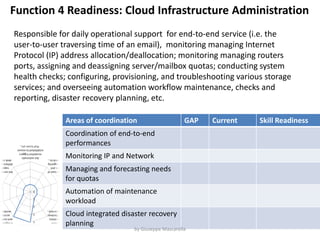
Function 4 Readiness: Cloud Infrastructure Administration
Responsible for daily operational support for end-to-end service (i.e. the
user-to-user traversing time of an email), monitoring managing Internet
Protocol (IP) address allocation/deallocation; monitoring managing routers
ports, assigning and deassigning server/mailbox quotas; conducting system
health checks; configuring, provisioning, and troubleshooting various storage
services; and overseeing automation workflow maintenance, checks and
reporting, disaster recovery planning, etc.
Areas of coordination GAP Current Skill Readiness
Coordination of end-to-end
performances
Monitoring IP and Network
Managing and forecasting needs
for quotas
Automation of maintenance
workload
Cloud integrated disaster recovery
planning
by Giuseppe Mascarella
Sample Questions for the CHECK-UP
1. [Function 1,2] For xx (email, lynch) do you have a process to review implications and
readiness of externally proposed FSC (Forwards Scheduled Changes)?
2. [Function 4] Does the process include an escalation procedure for validation from
networking, security, identity, application stakeholders?
3. [Function 2] Do you have a process to share It configuration required for MS to
troubleshoot problems?
4. [Function 2] What authorizations does MS needs to obtain to run a diagnostic to verify
service depending.
5. Who decided and coordinate with vendor Internal change freezes (i.e. financial
processing, global deployments, etc.)
6. In case of internal emergency do you have a plan for stabilizing and securing the MS
online service?
7. Public and internal DNS records for Microsoft Online Services (i.e. for Communicator,
email, SharePoint, etc.)
8. IP address or server name changes of your organization’s internal DNS servers or
Domain Controllers
9. Collocated Domain Controllers in the Microsoft data centers (i.e. patching, upgrading,
etc.)
10. Upgrade of your organization’s AD or Schema
11. Firewall Rules for connecting to Microsoft Online Services
by Giuseppe Mascarella
2. Cloud Chart of Account
by Giuseppe Mascarella
3. Service TCO Modelling Tools
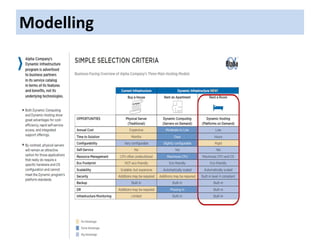
Modelling
by Giuseppe Mascarella
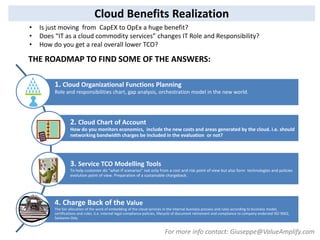
1. Cloud Organizational Functions Planning
Role and responsibilities chart, gap analysis, orchestration model in the new world.
2. Cloud Chart of Account
How do you monitors economics, include the new costs and areas generated by the cloud. i.e. should
networking bandwidth charges be included in the evaluation or not?
3. Cloud TCO Modeling Tools
To help customer do “what-if scenarios” not only from a cost and risk point of view but also form technologies and policies
evolution point of view. Preparation of a sustainable chargeback.
4. Charge Back of the Value
The fair allocation of the work of embedding of the cloud services in the internal business process and rules according to business
model, certifications and rules. (i.e. internal legal compliance policies, lifecycle of document retirement and compliance to company
endorsed ISO 9002, Sarbanes Oxly.
Cloud Benefits Realization
For more info contact: Giuseppe@ValueAmplify.com
• Is moving from CapEX to OpEx a huge benefit?
• Does “IT as a cloud services” lower barriers to enter for you or your competition?
• How do you get a real overall a lower TCO?
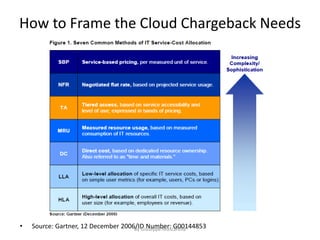
How to Frame the Cloud Chargeback Needs
• Source: Gartner, 12 December 2006/ID Number: G00144853by Giuseppe Mascarella
Direct Charge vs. Shared Services Costs
• Direct:
• Direct charges are those that can be solely attributed to a specific IT service or
business unit with no allocation formula employed.
These types of charges are often associated with final services such as SaaS
while in the past this method was used for charge back of hardware and
software acquired to support specific projects, dedicated devices (such as
those in single application servers) or outsourced services charged directly to
a business unit. The notion is that the costs in these cases are equal to the
recovery charge, because the costs have been isolated and are not shared
among business units
• Shared:
– Shared service costs are those that are allocated in a proportional manner
(formula) to multiple business units, such that the total costs are "shared" by
all users of the service. Many IT organizations are looking for a simple and
inexpensive way to fairly allocate shared costs. To accomplish this objective, a
solid understanding of how costs vary in relation to use is necessary.
by Giuseppe Mascarella
Fixed vs. Variable Cost Components
• Fixed: remain fairly constant (vary less than 10%) despite
significant change in workloads
– E.g. costs associated with capacity-spec’d resources (e.g. storage) or contractual obligations (e.g.
software licenses)
– For the majority of IT shared services, a high percentage of the costs are typically “fixed” by this
definition.
• Variable: vary directly with short-term changes in workload
• E.g. Additional WAN or bandwith associated with Lync usage, printing costs, which vary according to
use (paper, toner, etc), and application development, which varies widely.
• There is a general misconception by the IT organization and business units
that most IT service costs are more variable than reality dictates. This
misconception can lead to applying the wrong cost recovery model to a
specific service.
by Giuseppe Mascarella
Factoring the Use Component
• An analysis of fixed and variable costs for each service should yield a ratio that can be
applied to the cost recovery model. A form of fixed fee (access fee or subscription fee)
should be considered for the bulk of the fixed costs allocated proportionately to each
organization based on a highly stable metric.
– Examples: number of users, business accounts, locations and products.
• This approach recognizes that, regardless of business volumes, a significant proportion of
the costs are fixed and, as such, must be recouped regardless of use.
• For each service, the fixed cost ratio will vary, but, in most cases, will account for more than
50% of the monthly bill.
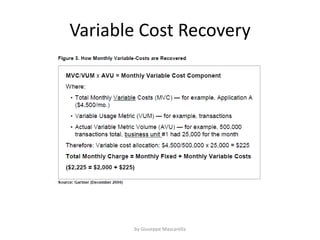
• Variable costs need to be factored in, but ideally should be limited to recouping only the
variable-cost component. Recovery of variable costs can be accomplished through
measured use or using a "tiered" use allocation scale.
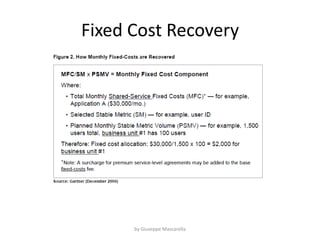
• Recommendation: use of a chargeback model that consistently recovers all fixed costs
(based on a fixed fee applied to a stable metric) and limits under/over-recovery to only the
variable-cost component
by Giuseppe Mascarella
Fixed Cost Recovery
by Giuseppe Mascarella
Variable Cost Recovery
by Giuseppe Mascarella
Recommendations
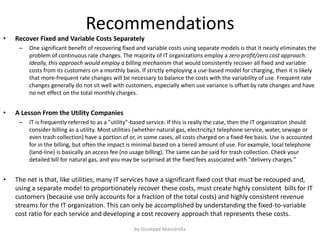
• Recover Fixed and Variable Costs Separately
– One significant benefit of recovering fixed and variable costs using separate models is that it nearly eliminates the
problem of continuous rate changes. The majority of IT organizations employ a zero profit/zero cost approach.
Ideally, this approach would employ a billing mechanism that would consistently recover all fixed and variable
costs from its customers on a monthly basis. If strictly employing a use-based model for charging, then it is likely
that more-frequent rate changes will be necessary to balance the costs with the variability of use. Frequent rate
changes generally do not sit well with customers, especially when use variance is offset by rate changes and have
no net effect on the total monthly charges.
• A Lesson From the Utility Companies
– IT is frequently referred to as a "utility"-based service. If this is really the case, then the IT organization should
consider billing as a utility. Most utilities (whether natural gas, electricity,t telephone service, water, sewage or
even trash collection) have a portion of or, in some cases, all costs charged on a fixed-fee basis. Use is accounted
for in the billing, but often the impact is minimal based on a tiered amount of use. For example, local telephone
(land-line) is basically an access fee (no usage billing). The same can be said for trash collection. Check your
detailed bill for natural gas, and you may be surprised at the fixed fees associated with "delivery charges."
• The net is that, like utilities, many IT services have a significant fixed cost that must be recouped and,
using a separate model to proportionately recover these costs, must create highly consistent bills for IT
customers (because use only accounts for a fraction of the total costs) and highly consistent revenue
streams for the IT organization. This can only be accomplished by understanding the fixed-to-variable
cost ratio for each service and developing a cost recovery approach that represents these costs.
by Giuseppe Mascarella
21
Microsoft Confidential
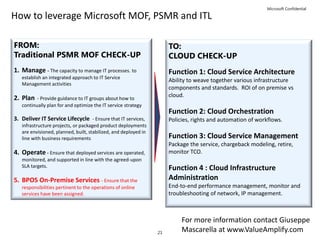
How to leverage Microsoft MOF, PSMR and ITL
FROM:
Traditional PSMR MOF CHECK-UP
1. Manage - The capacity to manage IT processes. to
establish an integrated approach to IT Service
Management activities
2. Plan - Provide guidance to IT groups about how to
continually plan for and optimize the IT service strategy
3. Deliver IT Service Lifecycle - Ensure that IT services,
infrastructure projects, or packaged product deployments
are envisioned, planned, built, stabilized, and deployed in
line with business requirements
4. Operate - Ensure that deployed services are operated,
monitored, and supported in line with the agreed-upon
SLA targets.
5. BPOS On-Premise Services - Ensure that the
responsibilities pertinent to the operations of online
services have been assigned.
TO:
CLOUD CHECK-UP
Function 1: Cloud Service Architecture
Ability to weave together various infrastructure
components and standards. ROI of on premise vs
cloud.
Function 2: Cloud Orchestration
Policies, rights and automation of workflows.
Function 3: Cloud Service Management
Package the service, chargeback modeling, retire,
monitor TCO.
Function 4 : Cloud Infrastructure
Administration
End-to-end performance management, monitor and
troubleshooting of network, IP management.
For more information contact Giuseppe
Mascarella at www.ValueAmplify.com
1. Cloud Organizational Functions Planning
Role and responsibilities chart, gap analysis, orchestration model in the new world.
2. Cloud Chart of Account
How do you monitors economics, include the new costs and areas generated by the cloud. i.e. should
networking bandwidth charges be included in the evaluation or not?
3. Cloud TCO Modeling Tools
To help customer do “what-if scenarios” not only from a cost and risk point of view but also form technologies and policies
evolution point of view. Preparation of a sustainable chargeback.
4. Charge Back of the Value
The fair allocation of the work of embedding of the cloud services in the internal business process and rules according to business model,
certifications and rules. (i.e. internal legal compliance policies, lifecycle of document retirement and compliance to company endorsed ISO 9002,
Sarbanes Oxly.
Cloud Benefits Realization
For more info contact: Giuseppe@ValueAmplify.com
• When is the move from CapEX to OpEx a benefit?
• Does “IT as a cloud services” lower barriers to enter for you or your competition?
• How do you get a real overall a lower TCO?

IT Strategy, Cloud Benefit Realization

  • 1.
    1. Cloud OrganizationalFunctions Planning Role and responsibilities chart, gap analysis, orchestration model in the new world. 2. Cloud Chart of Account How do you monitors economics, include the new costs and areas generated by the cloud. i.e. should networking bandwidth charges be included in the evaluation or not? 3. Service TCO Modelling Tools To help customer do “what-if scenarios” not only from a cost and risk point of view but also form technologies and policies evolution point of view. Preparation of a sustainable chargeback. 4. Charge Back of the Value The fair allocation of the work of embedding of the cloud services in the internal business process and rules according to business model, certifications and rules. (i.e. internal legal compliance policies, lifecycle of document retirement and compliance to company endorsed ISO 9002, Sarbanes Oxly. Cloud Benefits Realization For more info contact: Giuseppe@ValueAmplify.com • Is just moving from CapEX to OpEx a huge benefit? • Does “IT as a cloud commodity services” changes IT Role and Responsibility? • How do you get a real overall lower TCO? THE ROADMAP TO FIND SOME OF THE ANSWERS:
  • 2.
    Why Do YouNeed a New IT Strategy and Organization? CUSTOMERS CHALLENGES Leveraging cloud computing will have a big organizational impact on the infrastructure and operations functional organization. IT organization will have to implement new functions, think in the context of the IT supply chain in making decisions, as well as identify and assess the impact on existing roles in terms of training, as a result of implementing this new environment. Reskilling or upskilling some of the current IT roles is key to realize value. Service transition and service operation areas needs to have an impact assessment and implement processes in support of the new environment. - How does it look like an organization that has role and responsibilities ready to capitalize on Cloud? - How do we assess the gap? - What happens if the organization is not ready? - Now that more IT is “expensed”, how do you package and charge back? by Giuseppe Mascarella
  • 3.
    3 Microsoft Confidential 1. CloudOrganizational Functions Function 1: Cloud Service Architecture Ability to weave together various infrastructure components and standards. ROI of on premise vs cloud. Function 2: Cloud Orchestration Policies, rights and automation of workflows. Function 3: Cloud Service Management Package the service, chargeback modeling, retire, monitor TCO. Function 4 : Cloud Infrastructure Administration End-to-end performance management, monitor and troubleshooting of network, IP management.
  • 4.
    Function 1 Readiness:Cloud Service Architecture The idea of a cloud is to use standardized infrastructure components that can be shared and scaled in response to changing business dynamics. This implies that the design must have the ability to weave together various infrastructure components, such as storage, networks, servers etc., to a service or application. This function needs to be able to architect various layers in a cloud context and leverage virtualization, interfaces and protocols. This is part of the Strategy and Planning, therefore it also involves putting together a business case for the architecture, evaluation and selection of vendors and products. Areas of coordination GAP Current Skill Readiness Cloud integrated Biz and IT architecture planning. 1-5 Office of CTO 1-5 Governance of cloud standards, virtualization, interfaces and protocols for infrastructure components use. Definition and review of long term cloud partners and suppliers in the cloud Cloud biz case development IT Supply chain Governance by Giuseppe Mascarella
  • 5.
    Function 2 Readiness:Cloud Orchestration This function is responsible for defining and maintaining high-level workflows that are needed for the automation of cloud services. The entire service life cycle — from service provisioning, service activation, service assurance, service billing and service retirement — has to be automated. Thus, automation will span server platforms, network devices, portal applications, storage systems and other areas. -During service provisioning, there is a need to provision the right infrastructure components, configurations, dependencies and monitoring software needed for the service. -During service assurance, there is a need to manage the allocation and allocation of resources, to automate processes for patching and version management, fault-to-remediation processes, etc. Areas of coordination GAP Current Skill Readiness Could integrated workflow design Automation and self-services Policies and rights of cloud services administrator Coordination of patching and new functionalities Fault-to-remediation process management by Giuseppe Mascarella
  • 6.
    Function 3 Readiness:Cloud Service Management Ensuring the development of service and service classes with the service consumer in mind, including the pricing, service levels, policies and rules associated with each of the cloud services. This role is also responsible for ensuring that the service consumer understands the ordering and request procedures, support requirements, service versions, escalations and exception handling, and service reporting, including service metrics. The cloud service manager works closely with the relationship management function, and the sourcing and vendor relationship management function, to make the right choice of services for the service consumers. This role needs to show good attention to the ROI and total cost of ownership of cloud services, to ensure better decision making in areas such as service retirement and renewal. Areas of coordination GAP Current Skill Readiness Package and definition of services for the consumer Pricing and charge back Processing for departments to order services Service retirement or renewal Cloud TCO and scorecards by Giuseppe Mascarella
  • 7.
    Packaging of CloudServices Commercialization is the process of introducing a new product to end-customers or distributors/re- sellers. The Commercialization process is typically a stage-wise process (each stage has its own key goals and milestones) and it is vital to involve key stakeholders early, including potential or actual customers Key questions related to commercialization include: • What? What is the product or service description, components, value, etc • When? Timing of product introduction • Where? where to launch a product/service, ie, single location, one or several regions; national or international? (Questions about when and where are strongly influenced by goals, capital requirements, and operational capacities. ) • Who? Initially, products are typically introduced to high affinity pilot customers identified through research and test marketing. These high affinity groups should consist of innovators, early adopters, heavy users and/or opinion leaders. This will ensure adoption by other buyers in the market place during the product growth period. • How? Create a commercialization plan including product descriptions, marketing plans, revenue models, sales collateral Commercialization to LOB of IT initiatives: like products sold to consumers or businesses by 3rd parties, IT “products” may require traditional commercialization (on release) and ongoing product management. This may include pricing/charge-back implementation, marketing communications, cost/revenue accounting, etc. by Giuseppe Mascarella
  • 8.
    Function 4 Readiness:Cloud Infrastructure Administration Responsible for daily operational support for end-to-end service (i.e. the user-to-user traversing time of an email), monitoring managing Internet Protocol (IP) address allocation/deallocation; monitoring managing routers ports, assigning and deassigning server/mailbox quotas; conducting system health checks; configuring, provisioning, and troubleshooting various storage services; and overseeing automation workflow maintenance, checks and reporting, disaster recovery planning, etc. Areas of coordination GAP Current Skill Readiness Coordination of end-to-end performances Monitoring IP and Network Managing and forecasting needs for quotas Automation of maintenance workload Cloud integrated disaster recovery planning by Giuseppe Mascarella
  • 9.
    Sample Questions forthe CHECK-UP 1. [Function 1,2] For xx (email, lynch) do you have a process to review implications and readiness of externally proposed FSC (Forwards Scheduled Changes)? 2. [Function 4] Does the process include an escalation procedure for validation from networking, security, identity, application stakeholders? 3. [Function 2] Do you have a process to share It configuration required for MS to troubleshoot problems? 4. [Function 2] What authorizations does MS needs to obtain to run a diagnostic to verify service depending. 5. Who decided and coordinate with vendor Internal change freezes (i.e. financial processing, global deployments, etc.) 6. In case of internal emergency do you have a plan for stabilizing and securing the MS online service? 7. Public and internal DNS records for Microsoft Online Services (i.e. for Communicator, email, SharePoint, etc.) 8. IP address or server name changes of your organization’s internal DNS servers or Domain Controllers 9. Collocated Domain Controllers in the Microsoft data centers (i.e. patching, upgrading, etc.) 10. Upgrade of your organization’s AD or Schema 11. Firewall Rules for connecting to Microsoft Online Services by Giuseppe Mascarella
  • 10.
    2. Cloud Chartof Account by Giuseppe Mascarella
  • 11.
    3. Service TCOModelling Tools
  • 12.
  • 13.
    1. Cloud OrganizationalFunctions Planning Role and responsibilities chart, gap analysis, orchestration model in the new world. 2. Cloud Chart of Account How do you monitors economics, include the new costs and areas generated by the cloud. i.e. should networking bandwidth charges be included in the evaluation or not? 3. Cloud TCO Modeling Tools To help customer do “what-if scenarios” not only from a cost and risk point of view but also form technologies and policies evolution point of view. Preparation of a sustainable chargeback. 4. Charge Back of the Value The fair allocation of the work of embedding of the cloud services in the internal business process and rules according to business model, certifications and rules. (i.e. internal legal compliance policies, lifecycle of document retirement and compliance to company endorsed ISO 9002, Sarbanes Oxly. Cloud Benefits Realization For more info contact: Giuseppe@ValueAmplify.com • Is moving from CapEX to OpEx a huge benefit? • Does “IT as a cloud services” lower barriers to enter for you or your competition? • How do you get a real overall a lower TCO?
  • 14.
    How to Framethe Cloud Chargeback Needs • Source: Gartner, 12 December 2006/ID Number: G00144853by Giuseppe Mascarella
  • 15.
    Direct Charge vs.Shared Services Costs • Direct: • Direct charges are those that can be solely attributed to a specific IT service or business unit with no allocation formula employed. These types of charges are often associated with final services such as SaaS while in the past this method was used for charge back of hardware and software acquired to support specific projects, dedicated devices (such as those in single application servers) or outsourced services charged directly to a business unit. The notion is that the costs in these cases are equal to the recovery charge, because the costs have been isolated and are not shared among business units • Shared: – Shared service costs are those that are allocated in a proportional manner (formula) to multiple business units, such that the total costs are "shared" by all users of the service. Many IT organizations are looking for a simple and inexpensive way to fairly allocate shared costs. To accomplish this objective, a solid understanding of how costs vary in relation to use is necessary. by Giuseppe Mascarella
  • 16.
    Fixed vs. VariableCost Components • Fixed: remain fairly constant (vary less than 10%) despite significant change in workloads – E.g. costs associated with capacity-spec’d resources (e.g. storage) or contractual obligations (e.g. software licenses) – For the majority of IT shared services, a high percentage of the costs are typically “fixed” by this definition. • Variable: vary directly with short-term changes in workload • E.g. Additional WAN or bandwith associated with Lync usage, printing costs, which vary according to use (paper, toner, etc), and application development, which varies widely. • There is a general misconception by the IT organization and business units that most IT service costs are more variable than reality dictates. This misconception can lead to applying the wrong cost recovery model to a specific service. by Giuseppe Mascarella
  • 17.
    Factoring the UseComponent • An analysis of fixed and variable costs for each service should yield a ratio that can be applied to the cost recovery model. A form of fixed fee (access fee or subscription fee) should be considered for the bulk of the fixed costs allocated proportionately to each organization based on a highly stable metric. – Examples: number of users, business accounts, locations and products. • This approach recognizes that, regardless of business volumes, a significant proportion of the costs are fixed and, as such, must be recouped regardless of use. • For each service, the fixed cost ratio will vary, but, in most cases, will account for more than 50% of the monthly bill. • Variable costs need to be factored in, but ideally should be limited to recouping only the variable-cost component. Recovery of variable costs can be accomplished through measured use or using a "tiered" use allocation scale. • Recommendation: use of a chargeback model that consistently recovers all fixed costs (based on a fixed fee applied to a stable metric) and limits under/over-recovery to only the variable-cost component by Giuseppe Mascarella
  • 18.
    Fixed Cost Recovery byGiuseppe Mascarella
  • 19.
    Variable Cost Recovery byGiuseppe Mascarella
  • 20.
    Recommendations • Recover Fixedand Variable Costs Separately – One significant benefit of recovering fixed and variable costs using separate models is that it nearly eliminates the problem of continuous rate changes. The majority of IT organizations employ a zero profit/zero cost approach. Ideally, this approach would employ a billing mechanism that would consistently recover all fixed and variable costs from its customers on a monthly basis. If strictly employing a use-based model for charging, then it is likely that more-frequent rate changes will be necessary to balance the costs with the variability of use. Frequent rate changes generally do not sit well with customers, especially when use variance is offset by rate changes and have no net effect on the total monthly charges. • A Lesson From the Utility Companies – IT is frequently referred to as a "utility"-based service. If this is really the case, then the IT organization should consider billing as a utility. Most utilities (whether natural gas, electricity,t telephone service, water, sewage or even trash collection) have a portion of or, in some cases, all costs charged on a fixed-fee basis. Use is accounted for in the billing, but often the impact is minimal based on a tiered amount of use. For example, local telephone (land-line) is basically an access fee (no usage billing). The same can be said for trash collection. Check your detailed bill for natural gas, and you may be surprised at the fixed fees associated with "delivery charges." • The net is that, like utilities, many IT services have a significant fixed cost that must be recouped and, using a separate model to proportionately recover these costs, must create highly consistent bills for IT customers (because use only accounts for a fraction of the total costs) and highly consistent revenue streams for the IT organization. This can only be accomplished by understanding the fixed-to-variable cost ratio for each service and developing a cost recovery approach that represents these costs. by Giuseppe Mascarella
  • 21.
    21 Microsoft Confidential How toleverage Microsoft MOF, PSMR and ITL FROM: Traditional PSMR MOF CHECK-UP 1. Manage - The capacity to manage IT processes. to establish an integrated approach to IT Service Management activities 2. Plan - Provide guidance to IT groups about how to continually plan for and optimize the IT service strategy 3. Deliver IT Service Lifecycle - Ensure that IT services, infrastructure projects, or packaged product deployments are envisioned, planned, built, stabilized, and deployed in line with business requirements 4. Operate - Ensure that deployed services are operated, monitored, and supported in line with the agreed-upon SLA targets. 5. BPOS On-Premise Services - Ensure that the responsibilities pertinent to the operations of online services have been assigned. TO: CLOUD CHECK-UP Function 1: Cloud Service Architecture Ability to weave together various infrastructure components and standards. ROI of on premise vs cloud. Function 2: Cloud Orchestration Policies, rights and automation of workflows. Function 3: Cloud Service Management Package the service, chargeback modeling, retire, monitor TCO. Function 4 : Cloud Infrastructure Administration End-to-end performance management, monitor and troubleshooting of network, IP management. For more information contact Giuseppe Mascarella at www.ValueAmplify.com
  • 22.
    1. Cloud OrganizationalFunctions Planning Role and responsibilities chart, gap analysis, orchestration model in the new world. 2. Cloud Chart of Account How do you monitors economics, include the new costs and areas generated by the cloud. i.e. should networking bandwidth charges be included in the evaluation or not? 3. Cloud TCO Modeling Tools To help customer do “what-if scenarios” not only from a cost and risk point of view but also form technologies and policies evolution point of view. Preparation of a sustainable chargeback. 4. Charge Back of the Value The fair allocation of the work of embedding of the cloud services in the internal business process and rules according to business model, certifications and rules. (i.e. internal legal compliance policies, lifecycle of document retirement and compliance to company endorsed ISO 9002, Sarbanes Oxly. Cloud Benefits Realization For more info contact: Giuseppe@ValueAmplify.com • When is the move from CapEX to OpEx a benefit? • Does “IT as a cloud services” lower barriers to enter for you or your competition? • How do you get a real overall a lower TCO?