16/08/2024 Unit-1 Introduction to IoT 1
AN INTRODUCTION
By,
Ms.Deepa A,AP/CSD
Kongu Engineering College
16/08/2024 Unit-1 Introduction to IoT 2
IoT Enabling
Technologies
16/08/2024 Unit-1 Introduction to IoT 3
IoT Enabling technologies
•Wireless Sensor Network
•Cloud Computing
•Big Data Analytics
•Communication Protocols
•Embedded Systems
16/08/2024 Unit-1 Introduction to IoT 4
1. Wireless
Sensor Network
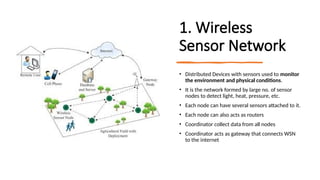
• Distributed Devices with sensors used to monitor
the environment and physical conditions.
• It is the network formed by large no. of sensor
nodes to detect light, heat, pressure, etc.
• Each node can have several sensors attached to it.
• Each node can also acts as routers
• Coordinator collect data from all nodes
• Coordinator acts as gateway that connects WSN
to the internet
16/08/2024 Unit-1 Introduction to IoT 5
2. Cloud
Computing
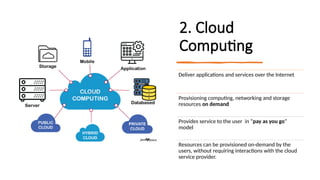
Deliver applications and services over the Internet
Provisioning computing, networking and storage
resources on demand
Provides service to the user in “pay as you go”
model
Resources can be provisioned on-demand by the
users, without requiring interactions with the cloud
service provider.
16/08/2024 Unit-1 Introduction to IoT 6
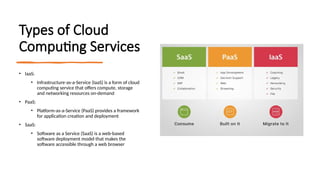
Types of Cloud
Computing Services
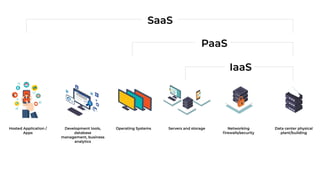
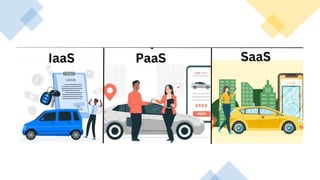
• IaaS:
• Infrastructure-as-a-Service (IaaS) is a form of cloud
computing service that offers compute, storage
and networking resources on-demand
• PaaS:
• Platform-as-a-Service (PaaS) provides a framework
for application creation and deployment
• SaaS:
• Software as a Service (SaaS) is a web-based
software deployment model that makes the
software accessible through a web browser
16/08/2024 Unit-1 Introduction to IoT 7
16/08/2024 Unit-1 Introduction to IoT 8
16/08/2024 Unit-1 Introduction to IoT 9
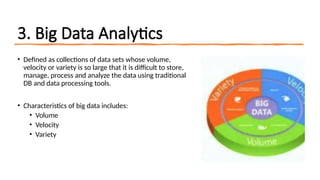
3. Big Data Analytics
• Defined as collections of data sets whose volume,
velocity or variety is so large that it is difficult to store,
manage, process and analyze the data using traditional
DB and data processing tools.
• Characteristics of big data includes:
• Volume
• Velocity
• Variety
16/08/2024 Unit-1 Introduction to IoT 10
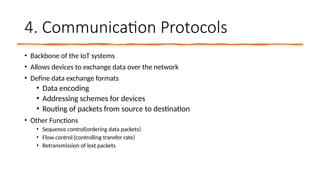
4. Communication Protocols
• Backbone of the IoT systems
• Allows devices to exchange data over the network
• Define data exchange formats
• Data encoding
• Addressing schemes for devices
• Routing of packets from source to destination
• Other Functions
• Sequence control(ordering data packets)
• Flow control (controlling transfer rate)
• Retransmission of lost packets
16/08/2024 Unit-1 Introduction to IoT 11
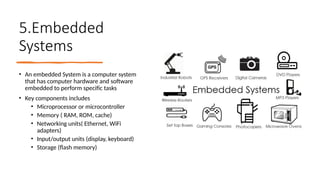
5.Embedded
Systems
• An embedded System is a computer system
that has computer hardware and software
embedded to perform specific tasks
• Key components includes
• Microprocessor or microcontroller
• Memory ( RAM, ROM, cache)
• Networking units( Ethernet, WiFi
adapters)
• Input/output units (display, keyboard)
• Storage (flash memory)
16/08/2024 Unit-1 Introduction to IoT 12
IoT Levels and
Deployment
Templates
16/08/2024 Unit-1 Introduction to IoT 13
• An IoT system comprises of the following components:
• Device- An IoT device allows identification, remote sensing, remote monitoring capabilities
• Resource- Resources are software components on the IoT device for accessing, processing and
storing sensor information or controlling actuators connected to the device
• Controller Service- Controller service is a native service that runs on the device and interacts
with the web services
• It sends data from the device to the web service and receives command from the application for controlling
the device
• Database- Database can be either local or in the cloud and stores the data generated by the IoT
device
• Web Service- It serve as a link between the IoT device, application, database and analysis
components.
• It can be implemented using REST or using WebSocket
• Analysis Component- analysis component is responsible for analyzing the IoT data and generate
results in a form which are easy for the user to understand
• Application-IoT applications provide an interface that the users can use to control and monitor
various aspects of the IoT systems.
• It also allow users to view the system status and view the processed data
16/08/2024 Unit-1 Introduction to IoT 14
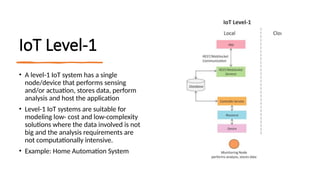
IoT Level-1
• A level-1 IoT system has a single
node/device that performs sensing
and/or actuation, stores data, perform
analysis and host the application
• Level-1 IoT systems are suitable for
modeling low- cost and low-complexity
solutions where the data involved is not
big and the analysis requirements are
not computationally intensive.
• Example: Home Automation System
16/08/2024 15
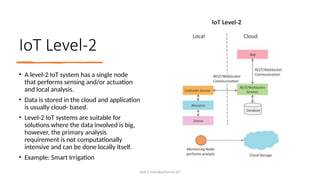
IoT Level-2
• A level-2 IoT system has a single node
that performs sensing and/or actuation
and local analysis.
• Data is stored in the cloud and application
is usually cloud- based.
• Level-2 IoT systems are suitable for
solutions where the data involved is big,
however, the primary analysis
requirement is not computationally
intensive and can be done locally itself.
• Example: Smart Irrigation
Unit-1 Introduction to IoT
16/08/2024 Unit-1 Introduction to IoT 16
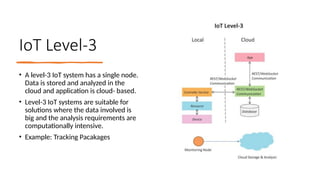
IoT Level-3
• A level-3 IoT system has a single node.
Data is stored and analyzed in the
cloud and application is cloud- based.
• Level-3 IoT systems are suitable for
solutions where the data involved is
big and the analysis requirements are
computationally intensive.
• Example: Tracking Pacakages
16/08/2024 Unit-1 Introduction to IoT 17
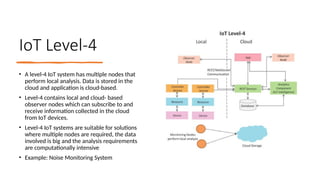
IoT Level-4
• A level-4 IoT system has multiple nodes that
perform local analysis. Data is stored in the
cloud and application is cloud-based.
• Level-4 contains local and cloud- based
observer nodes which can subscribe to and
receive information collected in the cloud
from IoT devices.
• Level-4 IoT systems are suitable for solutions
where multiple nodes are required, the data
involved is big and the analysis requirements
are computationally intensive
• Example: Noise Monitoring System
16/08/2024 Unit-1 Introduction to IoT 18
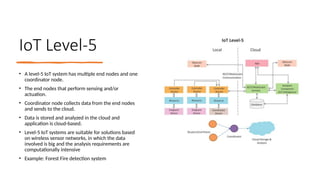
IoT Level-5
• A level-5 IoT system has multiple end nodes and one
coordinator node.
• The end nodes that perform sensing and/or
actuation.
• Coordinator node collects data from the end nodes
and sends to the cloud.
• Data is stored and analyzed in the cloud and
application is cloud-based.
• Level-5 IoT systems are suitable for solutions based
on wireless sensor networks, in which the data
involved is big and the analysis requirements are
computationally intensive
• Example: Forest Fire detection system
16/08/2024 Unit-1 Introduction to IoT 19
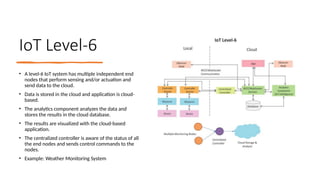
IoT Level-6
• A level-6 IoT system has multiple independent end
nodes that perform sensing and/or actuation and
send data to the cloud.
• Data is stored in the cloud and application is cloud-
based.
• The analytics component analyzes the data and
stores the results in the cloud database.
• The results are visualized with the cloud-based
application.
• The centralized controller is aware of the status of all
the end nodes and sends control commands to the
nodes.
• Example: Weather Monitoring System
16/08/2024 Unit-1 Introduction to IoT 20
IoT and M2M
16/08/2024 Unit-1 Introduction to IoT 21
M2M
• Machine-to-Machine (M2M) refers to networking of
machines (or devices) for the purpose of remote
monitoring and control and data exchange
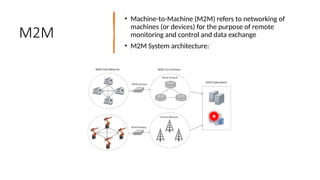
• M2M System architecture:
16/08/2024 Unit-1 Introduction to IoT 22
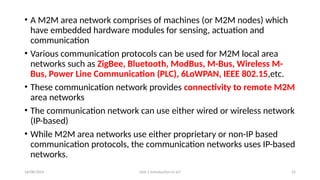
• A M2M area network comprises of machines (or M2M nodes) which
have embedded hardware modules for sensing, actuation and
communication
• Various communication protocols can be used for M2M local area
networks such as ZigBee, Bluetooth, ModBus, M-Bus, Wireless M-
Bus, Power Line Communication (PLC), 6LoWPAN, IEEE 802.15,etc.
• These communication network provides connectivity to remote M2M
area networks
• The communication network can use either wired or wireless network
(IP-based)
• While M2M area networks use either proprietary or non-IP based
communication protocols, the communication networks uses IP-based
networks.
16/08/2024 Unit-1 Introduction to IoT 23
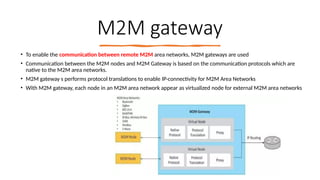
M2M gateway
• To enable the communication between remote M2M area networks, M2M gateways are used
• Communication between the M2M nodes and M2M Gateway is based on the communication protocols which are
native to the M2M area networks.
• M2M gateway s performs protocol translations to enable IP-connectivity for M2M Area Networks
• With M2M gateway, each node in an M2M area network appear as virtualized node for external M2M area networks
16/08/2024 Unit-1 Introduction to IoT 24
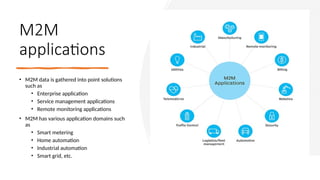
M2M
applications
• M2M data is gathered into point solutions
such as
• Enterprise application
• Service management applications
• Remote monitoring applications
• M2M has various application domains such
as
• Smart metering
• Home automation
• Industrial automation
• Smart grid, etc.
16/08/2024 Unit-1 Introduction to IoT 25
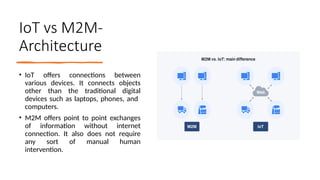
IoT vs M2M-
Architecture
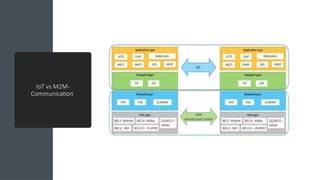
• IoT offers connections between
various devices. It connects objects
other than the traditional digital
devices such as laptops, phones, and
computers.
• M2M offers point to point exchanges
of information without internet
connection. It also does not require
any sort of manual human
intervention.
16/08/2024 Unit-1 Introduction to IoT 26
IoT vs M2M-
Communication
16/08/2024 Unit-1 Introduction to IoT 27
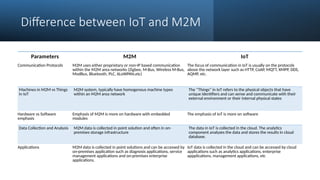
Difference between IoT and M2M
Parameters M2M IoT
Communication Protocols M2M uses either proprietary or non-IP based communication
within the M2M area networks (Zigbee, M-Bus, Wireless M-Bus,
ModBus, Bluetooth, PLC, 6LoWPAN,etc)
The focus of communication in IoT is usually on the protocols
above the network layer such as HTTP, CoAP, MQTT, XMPP, DDS,
AQMP, etc.
Machines in M2M vs Things
in IoT
M2M system, typically have homogenous machine types
within an M2M area network
The “Things” in IoT refers to the physical objects that have
unique identifiers and can sense and communicate with their
external environment or their internal physical states
Hardware vs Software
emphasis
Emphasis of M2M is more on hardware with embedded
modules
The emphasis of IoT is more on software
Data Collection and Analysis M2M data is collected in point solution and often in on-
premises storage infrastructure
The data in IoT is collected in the cloud. The analytics
component analyzes the data and stores the results in cloud
database.
Applications M2M data is collected in point solutions and can be accessed by
on-premises application such as diagnosis applications, service
management applications and on-premises enterprise
applications.
IoT data is collected in the cloud and can be accessed by cloud
applications such as analytics applications, enterprise
appplications, management applications, etc
16/08/2024 Unit-1 Introduction to IoT 28
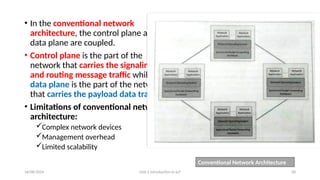
• In the conventional network
architecture, the control plane and
data plane are coupled.
• Control plane is the part of the
network that carries the signaling
and routing message traffic while the
data plane is the part of the network
that carries the payload data traffic.
• Limitations of conventional network
architecture:
Complex network devices
Management overhead
Limited scalability
Conventional Network Architecture
16/08/2024 Unit-1 Introduction to IoT 29
• Limitations of the conventional network can
be managed by two networking
architecture namely:
• SDN-Software-Defined Networking
• NFV-Network Virtual Function
16/08/2024 Unit-1 Introduction to IoT 30
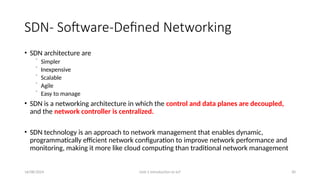
SDN- Software-Defined Networking
• SDN architecture are
⁻ Simpler
⁻ Inexpensive
⁻ Scalable
⁻ Agile
⁻ Easy to manage
• SDN is a networking architecture in which the control and data planes are decoupled,
and the network controller is centralized.
• SDN technology is an approach to network management that enables dynamic,
programmatically efficient network configuration to improve network performance and
monitoring, making it more like cloud computing than traditional network management
16/08/2024 Unit-1 Introduction to IoT 31
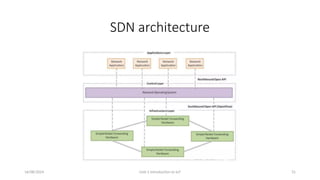
SDN architecture
16/08/2024 Unit-1 Introduction to IoT 32
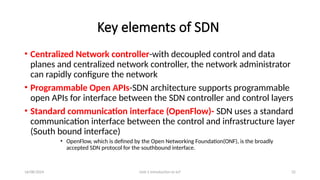
Key elements of SDN
• Centralized Network controller-with decoupled control and data
planes and centralized network controller, the network administrator
can rapidly configure the network
• Programmable Open APIs-SDN architecture supports programmable
open APIs for interface between the SDN controller and control layers
• Standard communication interface (OpenFlow)- SDN uses a standard
communication interface between the control and infrastructure layer
(South bound interface)
• OpenFlow, which is defined by the Open Networking Foundation(ONF), is the broadly
accepted SDN protocol for the southbound interface.
16/08/2024 Unit-1 Introduction to IoT 33
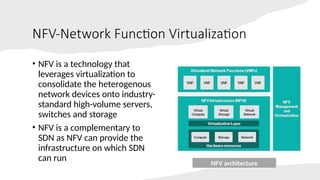
NFV-Network Function Virtualization
• NFV is a technology that
leverages virtualization to
consolidate the heterogenous
network devices onto industry-
standard high-volume servers,
switches and storage
• NFV is a complementary to
SDN as NFV can provide the
infrastructure on which SDN
can run NFV architecture
16/08/2024 Unit-1 Introduction to IoT 34
Key Elements of NFV
• Virtualized Network Function(VNF)- VNF is a software
implementation of a network function which can run over the NFV
infrastructure.
• NFV infrastructure(NFVI)- NFVI includes compute, network and
storage resources that are virtualized.
• NFV Management and Orchestration- NFV Management and
orchestration focuses on all virtualization-specific management tasks
and covers the orchestration and life cycle management of physical
and/or software resources that support the infrastructure
virtualization and life-cycle management of VNFs
16/08/2024 Unit-1 Introduction to IoT 35
• NFS comprises of network function implemented in software that run
on virtualized resources in cloud.
• NFV enables separation of network function which are implemented
in software from the underlying hardware.
• Virtualizing network functions reduces the equipment costs and also
reduces power consumption.
• NFV is applicable only to data plane and control plane functions in
fixed and mobile networks.
IoT Platform design
methodologies
08/16/2024 Unit-1 Introduction to IoT 36
16/08/2024 Unit-1 Introduction to IoT 37
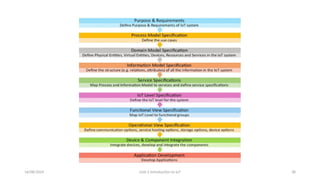
IoT Design methodology includes
• Purpose and Requirement specification
• Process specification
• Domain Model specification
• Information model specification
• Service specification
• IoT level specification
• Functional view specification
• Operational view specification
• Device and component integration
• Application Development
16/08/2024 Unit-1 Introduction to IoT 38
16/08/2024 Unit-1 Introduction to IoT 39
Step 1: Purpose and Requirement specification
• In this step, design or prepare the system purpose, behavior, and
requirements (such as data collection requirements, data analysis
requirements, system management requirements, data privacy and
security requirements, user interface requirements, ...) are captured.
Purpose
Behavior
System management requirement
Data Analysis requirement
Application Development requirement
Security requirement
16/08/2024 Unit-1 Introduction to IoT 40
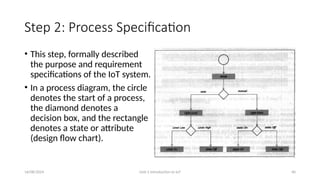
Step 2: Process Specification
• This step, formally described
the purpose and requirement
specifications of the IoT system.
• In a process diagram, the circle
denotes the start of a process,
the diamond denotes a
decision box, and the rectangle
denotes a state or attribute
(design flow chart).
16/08/2024 Unit-1 Introduction to IoT 41
Step 3: Domain Model Specification
• In this step, the IoT design methodology defines the Domain Model.
• The domain model describes the main concepts, entities, objects, attributes of
the objects, and relationships between objects of the IoT system to be designed.
• The domain model provides an abstract view of the IoT domain, which is
independent of any specific technology or platform.
• This domain model includes:
Physical entity
Virtual entity
Device
Resource
Service
16/08/2024 Unit-1 Introduction to IoT 42
Step 4: Information Model Specification
• This step defines Information Model.
• The Information Model defines the structure of all the information in
the IoT system.
• Example, attributes of Virtual Entities, relations, etc.
• The information model does not describe “how the information is
represented or stored”.
• The information model defines the list of the Virtual Entities, their
attributes, and the relations of the domain model.
16/08/2024 Unit-1 Introduction to IoT 43
Step 5: Service Specifications
• In this step, Service specifications define the services in the IoT system such as service
types, service inputs/output, service endpoints, service schedules, service
preconditions, and service effects.
• These services either change the state or attribute values or retrieve the current values.
• The Mode service is a RESTful web service that sets the mode to auto or manual (PUT
request) or retrieves the current mode (GET request).
• The mode is updated to/retrieved from the database.
• The State service is a RESTful web service that sets the light appliance state to on/off
(PUT request) or retrieves the current light state (GET request).
• The state is updated to/retrieved from the status database.
• The Controller service runs as a native service on the device.
16/08/2024 Unit-1 Introduction to IoT 44
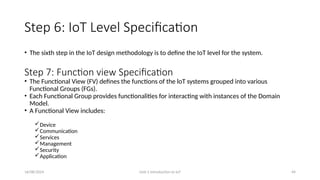
Step 6: IoT Level Specification
• The sixth step in the IoT design methodology is to define the IoT level for the system.
Step 7: Function view Specification
• The Functional View (FV) defines the functions of the loT systems grouped into various
Functional Groups (FGs).
• Each Functional Group provides functionalities for interacting with instances of the Domain
Model.
• A Functional View includes:
Device
Communication
Services
Management
Security
Application
16/08/2024 Unit-1 Introduction to IoT 45
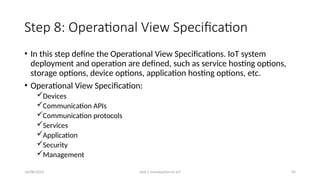
Step 8: Operational View Specification
• In this step define the Operational View Specifications. IoT system
deployment and operation are defined, such as service hosting options,
storage options, device options, application hosting options, etc.
• Operational View Specification:
Devices
Communication APIs
Communication protocols
Services
Application
Security
Management
16/08/2024 Unit-1 Introduction to IoT 46
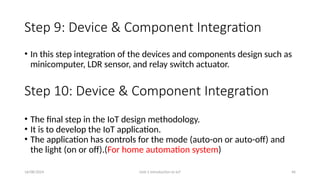
Step 9: Device & Component Integration
• In this step integration of the devices and components design such as
minicomputer, LDR sensor, and relay switch actuator.
Step 10: Device & Component Integration
• The final step in the IoT design methodology.
• It is to develop the IoT application.
• The application has controls for the mode (auto-on or auto-off) and
the light (on or off).(For home automation system)
16/08/2024 Unit-1 Introduction to IoT 47
Thank You

IoT enabling Technologies, Levels and Templates, M2M

  • 1.
    16/08/2024 Unit-1 Introductionto IoT 1 AN INTRODUCTION By, Ms.Deepa A,AP/CSD Kongu Engineering College
  • 2.
    16/08/2024 Unit-1 Introductionto IoT 2 IoT Enabling Technologies
  • 3.
    16/08/2024 Unit-1 Introductionto IoT 3 IoT Enabling technologies •Wireless Sensor Network •Cloud Computing •Big Data Analytics •Communication Protocols •Embedded Systems
  • 4.
    16/08/2024 Unit-1 Introductionto IoT 4 1. Wireless Sensor Network • Distributed Devices with sensors used to monitor the environment and physical conditions. • It is the network formed by large no. of sensor nodes to detect light, heat, pressure, etc. • Each node can have several sensors attached to it. • Each node can also acts as routers • Coordinator collect data from all nodes • Coordinator acts as gateway that connects WSN to the internet
  • 5.
    16/08/2024 Unit-1 Introductionto IoT 5 2. Cloud Computing Deliver applications and services over the Internet Provisioning computing, networking and storage resources on demand Provides service to the user in “pay as you go” model Resources can be provisioned on-demand by the users, without requiring interactions with the cloud service provider.
  • 6.
    16/08/2024 Unit-1 Introductionto IoT 6 Types of Cloud Computing Services • IaaS: • Infrastructure-as-a-Service (IaaS) is a form of cloud computing service that offers compute, storage and networking resources on-demand • PaaS: • Platform-as-a-Service (PaaS) provides a framework for application creation and deployment • SaaS: • Software as a Service (SaaS) is a web-based software deployment model that makes the software accessible through a web browser
  • 7.
  • 8.
  • 9.
    16/08/2024 Unit-1 Introductionto IoT 9 3. Big Data Analytics • Defined as collections of data sets whose volume, velocity or variety is so large that it is difficult to store, manage, process and analyze the data using traditional DB and data processing tools. • Characteristics of big data includes: • Volume • Velocity • Variety
  • 10.
    16/08/2024 Unit-1 Introductionto IoT 10 4. Communication Protocols • Backbone of the IoT systems • Allows devices to exchange data over the network • Define data exchange formats • Data encoding • Addressing schemes for devices • Routing of packets from source to destination • Other Functions • Sequence control(ordering data packets) • Flow control (controlling transfer rate) • Retransmission of lost packets
  • 11.
    16/08/2024 Unit-1 Introductionto IoT 11 5.Embedded Systems • An embedded System is a computer system that has computer hardware and software embedded to perform specific tasks • Key components includes • Microprocessor or microcontroller • Memory ( RAM, ROM, cache) • Networking units( Ethernet, WiFi adapters) • Input/output units (display, keyboard) • Storage (flash memory)
  • 12.
    16/08/2024 Unit-1 Introductionto IoT 12 IoT Levels and Deployment Templates
  • 13.
    16/08/2024 Unit-1 Introductionto IoT 13 • An IoT system comprises of the following components: • Device- An IoT device allows identification, remote sensing, remote monitoring capabilities • Resource- Resources are software components on the IoT device for accessing, processing and storing sensor information or controlling actuators connected to the device • Controller Service- Controller service is a native service that runs on the device and interacts with the web services • It sends data from the device to the web service and receives command from the application for controlling the device • Database- Database can be either local or in the cloud and stores the data generated by the IoT device • Web Service- It serve as a link between the IoT device, application, database and analysis components. • It can be implemented using REST or using WebSocket • Analysis Component- analysis component is responsible for analyzing the IoT data and generate results in a form which are easy for the user to understand • Application-IoT applications provide an interface that the users can use to control and monitor various aspects of the IoT systems. • It also allow users to view the system status and view the processed data
  • 14.
    16/08/2024 Unit-1 Introductionto IoT 14 IoT Level-1 • A level-1 IoT system has a single node/device that performs sensing and/or actuation, stores data, perform analysis and host the application • Level-1 IoT systems are suitable for modeling low- cost and low-complexity solutions where the data involved is not big and the analysis requirements are not computationally intensive. • Example: Home Automation System
  • 15.
    16/08/2024 15 IoT Level-2 •A level-2 IoT system has a single node that performs sensing and/or actuation and local analysis. • Data is stored in the cloud and application is usually cloud- based. • Level-2 IoT systems are suitable for solutions where the data involved is big, however, the primary analysis requirement is not computationally intensive and can be done locally itself. • Example: Smart Irrigation Unit-1 Introduction to IoT
  • 16.
    16/08/2024 Unit-1 Introductionto IoT 16 IoT Level-3 • A level-3 IoT system has a single node. Data is stored and analyzed in the cloud and application is cloud- based. • Level-3 IoT systems are suitable for solutions where the data involved is big and the analysis requirements are computationally intensive. • Example: Tracking Pacakages
  • 17.
    16/08/2024 Unit-1 Introductionto IoT 17 IoT Level-4 • A level-4 IoT system has multiple nodes that perform local analysis. Data is stored in the cloud and application is cloud-based. • Level-4 contains local and cloud- based observer nodes which can subscribe to and receive information collected in the cloud from IoT devices. • Level-4 IoT systems are suitable for solutions where multiple nodes are required, the data involved is big and the analysis requirements are computationally intensive • Example: Noise Monitoring System
  • 18.
    16/08/2024 Unit-1 Introductionto IoT 18 IoT Level-5 • A level-5 IoT system has multiple end nodes and one coordinator node. • The end nodes that perform sensing and/or actuation. • Coordinator node collects data from the end nodes and sends to the cloud. • Data is stored and analyzed in the cloud and application is cloud-based. • Level-5 IoT systems are suitable for solutions based on wireless sensor networks, in which the data involved is big and the analysis requirements are computationally intensive • Example: Forest Fire detection system
  • 19.
    16/08/2024 Unit-1 Introductionto IoT 19 IoT Level-6 • A level-6 IoT system has multiple independent end nodes that perform sensing and/or actuation and send data to the cloud. • Data is stored in the cloud and application is cloud- based. • The analytics component analyzes the data and stores the results in the cloud database. • The results are visualized with the cloud-based application. • The centralized controller is aware of the status of all the end nodes and sends control commands to the nodes. • Example: Weather Monitoring System
  • 20.
    16/08/2024 Unit-1 Introductionto IoT 20 IoT and M2M
  • 21.
    16/08/2024 Unit-1 Introductionto IoT 21 M2M • Machine-to-Machine (M2M) refers to networking of machines (or devices) for the purpose of remote monitoring and control and data exchange • M2M System architecture:
  • 22.
    16/08/2024 Unit-1 Introductionto IoT 22 • A M2M area network comprises of machines (or M2M nodes) which have embedded hardware modules for sensing, actuation and communication • Various communication protocols can be used for M2M local area networks such as ZigBee, Bluetooth, ModBus, M-Bus, Wireless M- Bus, Power Line Communication (PLC), 6LoWPAN, IEEE 802.15,etc. • These communication network provides connectivity to remote M2M area networks • The communication network can use either wired or wireless network (IP-based) • While M2M area networks use either proprietary or non-IP based communication protocols, the communication networks uses IP-based networks.
  • 23.
    16/08/2024 Unit-1 Introductionto IoT 23 M2M gateway • To enable the communication between remote M2M area networks, M2M gateways are used • Communication between the M2M nodes and M2M Gateway is based on the communication protocols which are native to the M2M area networks. • M2M gateway s performs protocol translations to enable IP-connectivity for M2M Area Networks • With M2M gateway, each node in an M2M area network appear as virtualized node for external M2M area networks
  • 24.
    16/08/2024 Unit-1 Introductionto IoT 24 M2M applications • M2M data is gathered into point solutions such as • Enterprise application • Service management applications • Remote monitoring applications • M2M has various application domains such as • Smart metering • Home automation • Industrial automation • Smart grid, etc.
  • 25.
    16/08/2024 Unit-1 Introductionto IoT 25 IoT vs M2M- Architecture • IoT offers connections between various devices. It connects objects other than the traditional digital devices such as laptops, phones, and computers. • M2M offers point to point exchanges of information without internet connection. It also does not require any sort of manual human intervention.
  • 26.
    16/08/2024 Unit-1 Introductionto IoT 26 IoT vs M2M- Communication
  • 27.
    16/08/2024 Unit-1 Introductionto IoT 27 Difference between IoT and M2M Parameters M2M IoT Communication Protocols M2M uses either proprietary or non-IP based communication within the M2M area networks (Zigbee, M-Bus, Wireless M-Bus, ModBus, Bluetooth, PLC, 6LoWPAN,etc) The focus of communication in IoT is usually on the protocols above the network layer such as HTTP, CoAP, MQTT, XMPP, DDS, AQMP, etc. Machines in M2M vs Things in IoT M2M system, typically have homogenous machine types within an M2M area network The “Things” in IoT refers to the physical objects that have unique identifiers and can sense and communicate with their external environment or their internal physical states Hardware vs Software emphasis Emphasis of M2M is more on hardware with embedded modules The emphasis of IoT is more on software Data Collection and Analysis M2M data is collected in point solution and often in on- premises storage infrastructure The data in IoT is collected in the cloud. The analytics component analyzes the data and stores the results in cloud database. Applications M2M data is collected in point solutions and can be accessed by on-premises application such as diagnosis applications, service management applications and on-premises enterprise applications. IoT data is collected in the cloud and can be accessed by cloud applications such as analytics applications, enterprise appplications, management applications, etc
  • 28.
    16/08/2024 Unit-1 Introductionto IoT 28 • In the conventional network architecture, the control plane and data plane are coupled. • Control plane is the part of the network that carries the signaling and routing message traffic while the data plane is the part of the network that carries the payload data traffic. • Limitations of conventional network architecture: Complex network devices Management overhead Limited scalability Conventional Network Architecture
  • 29.
    16/08/2024 Unit-1 Introductionto IoT 29 • Limitations of the conventional network can be managed by two networking architecture namely: • SDN-Software-Defined Networking • NFV-Network Virtual Function
  • 30.
    16/08/2024 Unit-1 Introductionto IoT 30 SDN- Software-Defined Networking • SDN architecture are ⁻ Simpler ⁻ Inexpensive ⁻ Scalable ⁻ Agile ⁻ Easy to manage • SDN is a networking architecture in which the control and data planes are decoupled, and the network controller is centralized. • SDN technology is an approach to network management that enables dynamic, programmatically efficient network configuration to improve network performance and monitoring, making it more like cloud computing than traditional network management
  • 31.
    16/08/2024 Unit-1 Introductionto IoT 31 SDN architecture
  • 32.
    16/08/2024 Unit-1 Introductionto IoT 32 Key elements of SDN • Centralized Network controller-with decoupled control and data planes and centralized network controller, the network administrator can rapidly configure the network • Programmable Open APIs-SDN architecture supports programmable open APIs for interface between the SDN controller and control layers • Standard communication interface (OpenFlow)- SDN uses a standard communication interface between the control and infrastructure layer (South bound interface) • OpenFlow, which is defined by the Open Networking Foundation(ONF), is the broadly accepted SDN protocol for the southbound interface.
  • 33.
    16/08/2024 Unit-1 Introductionto IoT 33 NFV-Network Function Virtualization • NFV is a technology that leverages virtualization to consolidate the heterogenous network devices onto industry- standard high-volume servers, switches and storage • NFV is a complementary to SDN as NFV can provide the infrastructure on which SDN can run NFV architecture
  • 34.
    16/08/2024 Unit-1 Introductionto IoT 34 Key Elements of NFV • Virtualized Network Function(VNF)- VNF is a software implementation of a network function which can run over the NFV infrastructure. • NFV infrastructure(NFVI)- NFVI includes compute, network and storage resources that are virtualized. • NFV Management and Orchestration- NFV Management and orchestration focuses on all virtualization-specific management tasks and covers the orchestration and life cycle management of physical and/or software resources that support the infrastructure virtualization and life-cycle management of VNFs
  • 35.
    16/08/2024 Unit-1 Introductionto IoT 35 • NFS comprises of network function implemented in software that run on virtualized resources in cloud. • NFV enables separation of network function which are implemented in software from the underlying hardware. • Virtualizing network functions reduces the equipment costs and also reduces power consumption. • NFV is applicable only to data plane and control plane functions in fixed and mobile networks.
  • 36.
    IoT Platform design methodologies 08/16/2024Unit-1 Introduction to IoT 36
  • 37.
    16/08/2024 Unit-1 Introductionto IoT 37 IoT Design methodology includes • Purpose and Requirement specification • Process specification • Domain Model specification • Information model specification • Service specification • IoT level specification • Functional view specification • Operational view specification • Device and component integration • Application Development
  • 38.
  • 39.
    16/08/2024 Unit-1 Introductionto IoT 39 Step 1: Purpose and Requirement specification • In this step, design or prepare the system purpose, behavior, and requirements (such as data collection requirements, data analysis requirements, system management requirements, data privacy and security requirements, user interface requirements, ...) are captured. Purpose Behavior System management requirement Data Analysis requirement Application Development requirement Security requirement
  • 40.
    16/08/2024 Unit-1 Introductionto IoT 40 Step 2: Process Specification • This step, formally described the purpose and requirement specifications of the IoT system. • In a process diagram, the circle denotes the start of a process, the diamond denotes a decision box, and the rectangle denotes a state or attribute (design flow chart).
  • 41.
    16/08/2024 Unit-1 Introductionto IoT 41 Step 3: Domain Model Specification • In this step, the IoT design methodology defines the Domain Model. • The domain model describes the main concepts, entities, objects, attributes of the objects, and relationships between objects of the IoT system to be designed. • The domain model provides an abstract view of the IoT domain, which is independent of any specific technology or platform. • This domain model includes: Physical entity Virtual entity Device Resource Service
  • 42.
    16/08/2024 Unit-1 Introductionto IoT 42 Step 4: Information Model Specification • This step defines Information Model. • The Information Model defines the structure of all the information in the IoT system. • Example, attributes of Virtual Entities, relations, etc. • The information model does not describe “how the information is represented or stored”. • The information model defines the list of the Virtual Entities, their attributes, and the relations of the domain model.
  • 43.
    16/08/2024 Unit-1 Introductionto IoT 43 Step 5: Service Specifications • In this step, Service specifications define the services in the IoT system such as service types, service inputs/output, service endpoints, service schedules, service preconditions, and service effects. • These services either change the state or attribute values or retrieve the current values. • The Mode service is a RESTful web service that sets the mode to auto or manual (PUT request) or retrieves the current mode (GET request). • The mode is updated to/retrieved from the database. • The State service is a RESTful web service that sets the light appliance state to on/off (PUT request) or retrieves the current light state (GET request). • The state is updated to/retrieved from the status database. • The Controller service runs as a native service on the device.
  • 44.
    16/08/2024 Unit-1 Introductionto IoT 44 Step 6: IoT Level Specification • The sixth step in the IoT design methodology is to define the IoT level for the system. Step 7: Function view Specification • The Functional View (FV) defines the functions of the loT systems grouped into various Functional Groups (FGs). • Each Functional Group provides functionalities for interacting with instances of the Domain Model. • A Functional View includes: Device Communication Services Management Security Application
  • 45.
    16/08/2024 Unit-1 Introductionto IoT 45 Step 8: Operational View Specification • In this step define the Operational View Specifications. IoT system deployment and operation are defined, such as service hosting options, storage options, device options, application hosting options, etc. • Operational View Specification: Devices Communication APIs Communication protocols Services Application Security Management
  • 46.
    16/08/2024 Unit-1 Introductionto IoT 46 Step 9: Device & Component Integration • In this step integration of the devices and components design such as minicomputer, LDR sensor, and relay switch actuator. Step 10: Device & Component Integration • The final step in the IoT design methodology. • It is to develop the IoT application. • The application has controls for the mode (auto-on or auto-off) and the light (on or off).(For home automation system)
  • 47.
    16/08/2024 Unit-1 Introductionto IoT 47 Thank You