Internet of Things: IoT
Enabling Technologies
09/01/25
Dr Pankaj Rangaree ECE
Dept. 1
• 67/70/73/74/77/78/82/85/87/93/98/A2/A4/
A6/B2/B8/19/
09/01/25 IoT Survey 2
Internet of Things (IoT)
• Internet of Things (IoT) is the internetworking of
physical devices, allows objects to be controlled
remotely and exchange information
• 25billion objects connected to the internet by 2020
• IoT is not merely about embedding software into
devices; It's about evaluating data, finding patterns,
and extracting value to make more strategic business
decisions
• Cyber-physical System (CPS) is a mechanism controlled
by software and integrated with internet and users
• Applications: autonomous automobiles, health
monitoring, robotic systems, smart grids, smart homes
09/01/25 IoT Survey 3
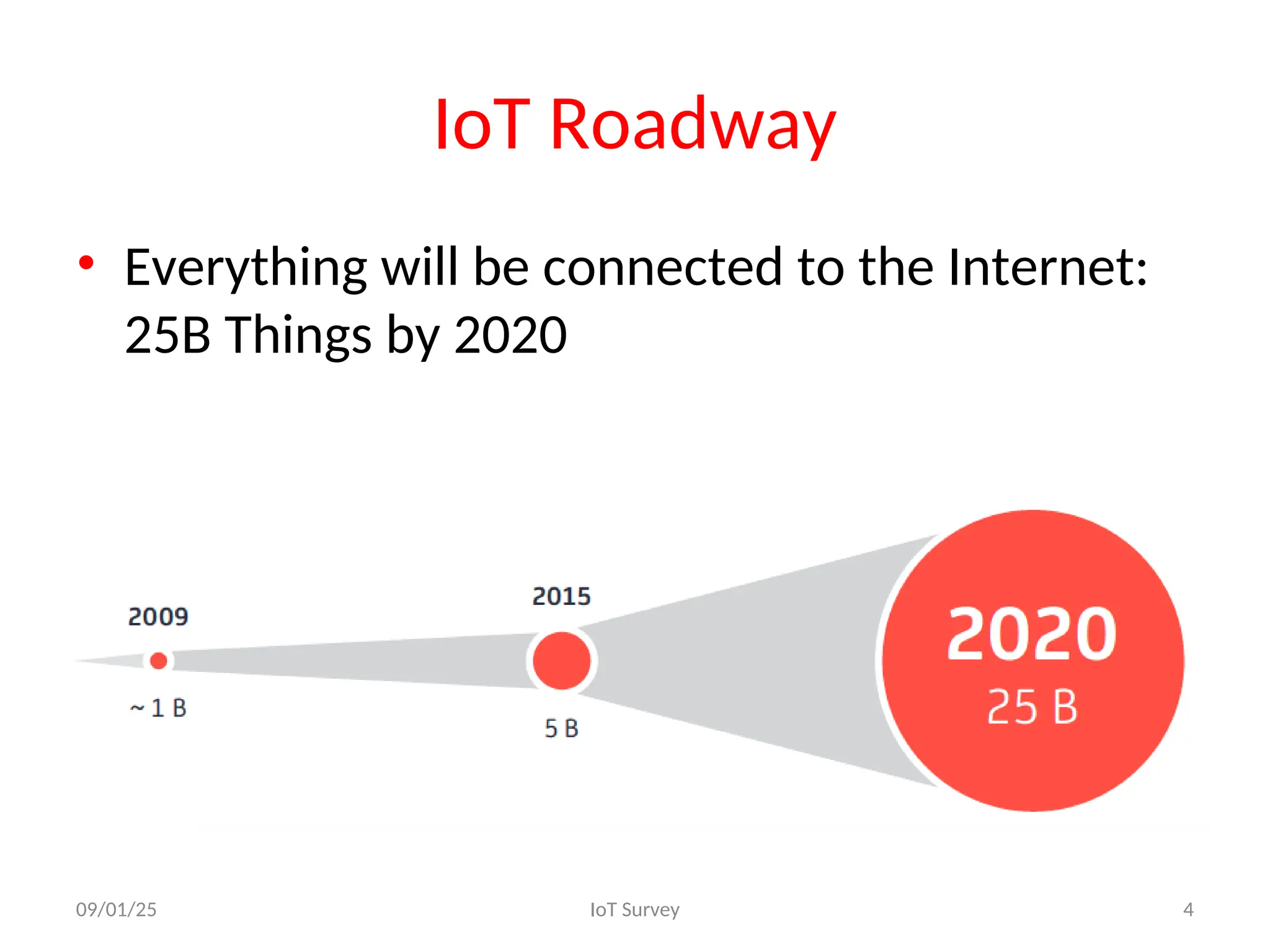
IoT Roadway
09/01/25 IoT Survey 4
• Everything will be connected to the Internet:
25B Things by 2020
Why is it Happening now?
• An IoT solution (smart home, factory) 10 years
ago:
– Expensive
– Custom made automation
• Now:
– Affordable hardware
– Smaller and powerful hardware, smart devices
– IoT protocols
– Cloud computing --> business model, cost effective,
mass data, secure, PaaS & SaaS Solutions
– Mass market awareness
09/01/25 IoT Survey 5
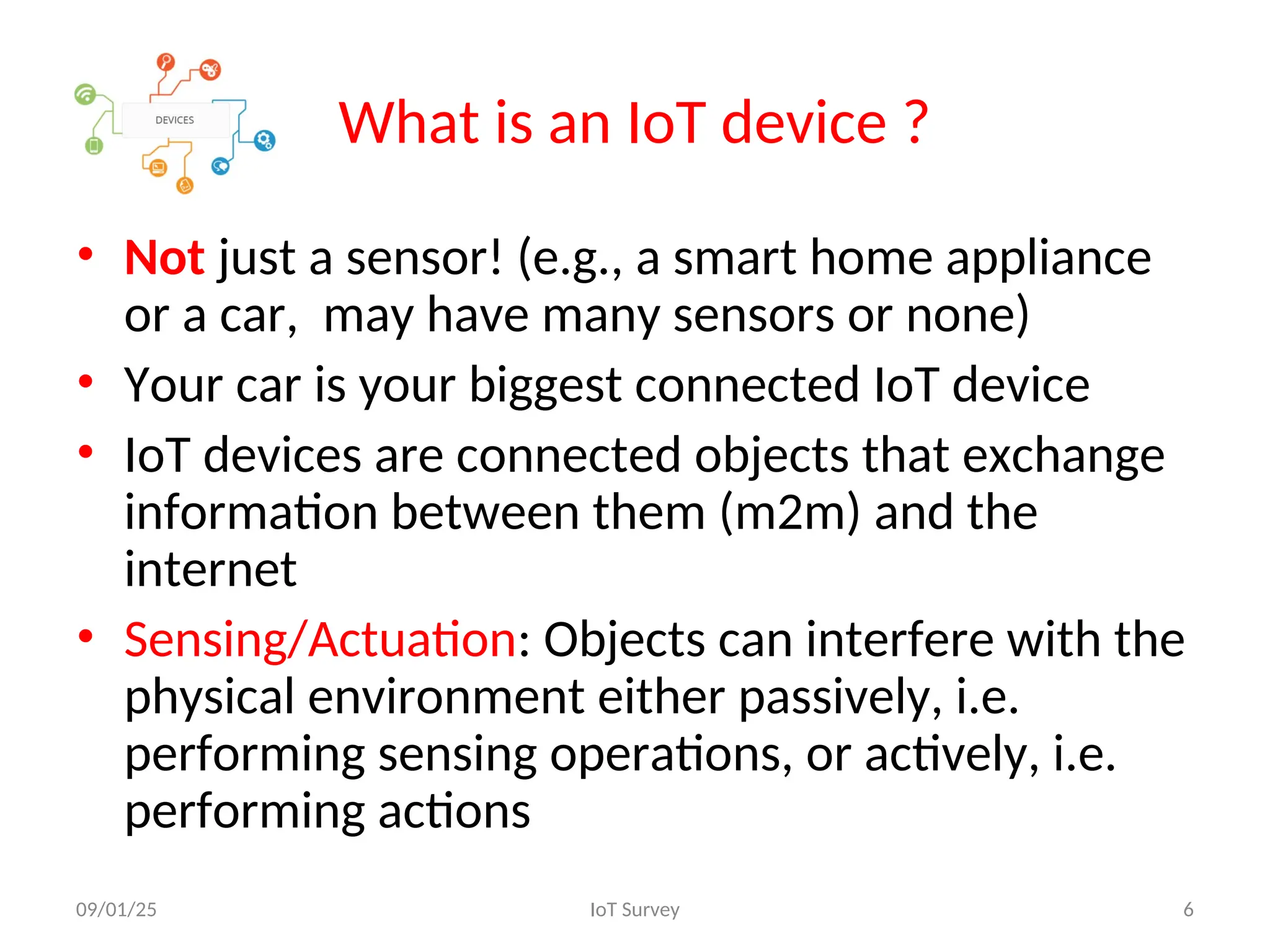
What is an IoT device ?
• Not just a sensor! (e.g., a smart home appliance
or a car, may have many sensors or none)
• Your car is your biggest connected IoT device
• IoT devices are connected objects that exchange
information between them (m2m) and the
internet
• Sensing/Actuation: Objects can interfere with the
physical environment either passively, i.e.
performing sensing operations, or actively, i.e.
performing actions
09/01/25 IoT Survey 6
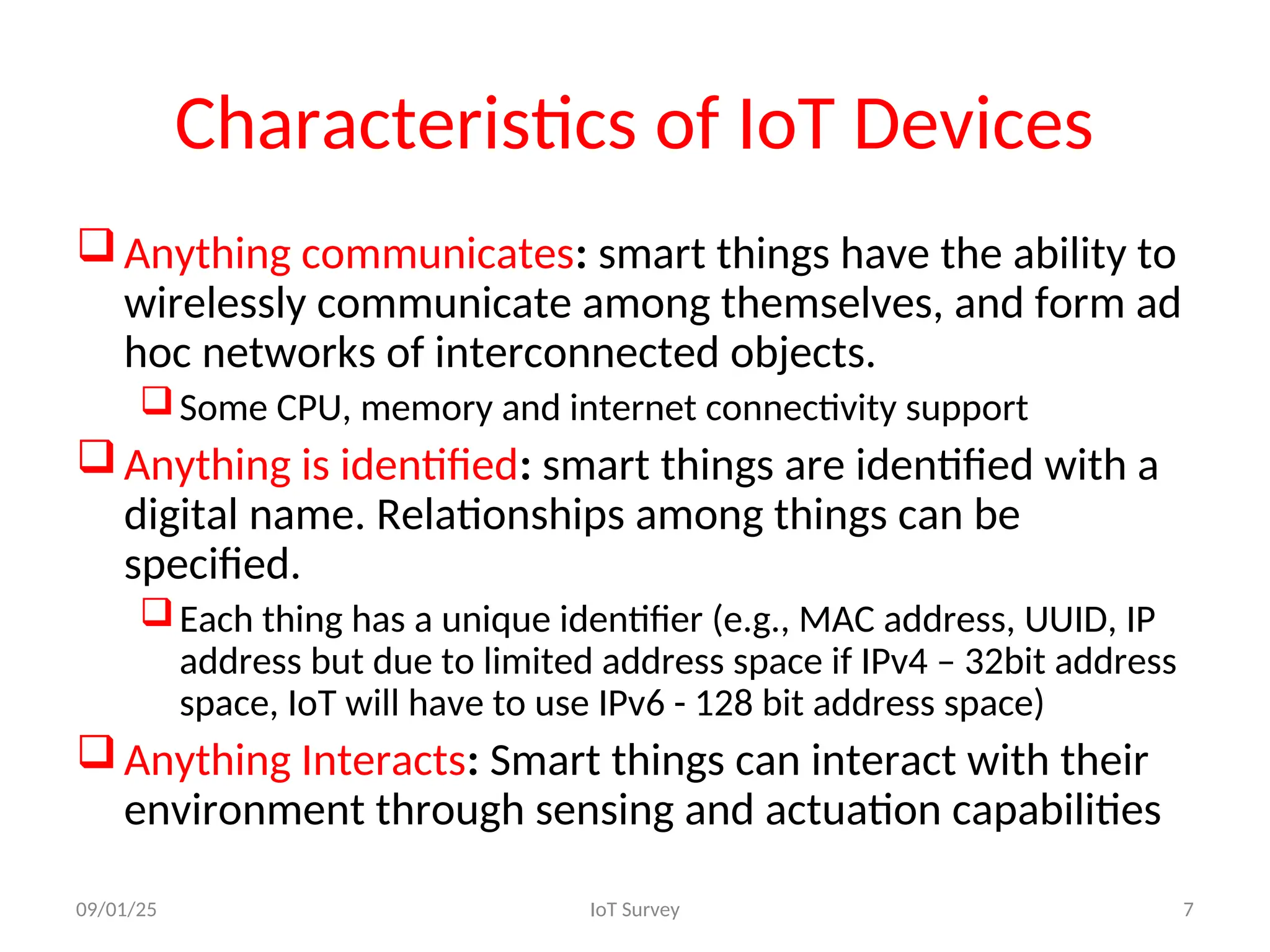
Characteristics of IoT Devices
Anything communicates: smart things have the ability to
wirelessly communicate among themselves, and form ad
hoc networks of interconnected objects.
Some CPU, memory and internet connectivity support
Anything is identified: smart things are identified with a
digital name. Relationships among things can be
specified.
Each thing has a unique identifier (e.g., MAC address, UUID, IP
address but due to limited address space if IPv4 – 32bit address
space, IoT will have to use IPv6 - 128 bit address space)
Anything Interacts: Smart things can interact with their
environment through sensing and actuation capabilities
09/01/25 IoT Survey 7
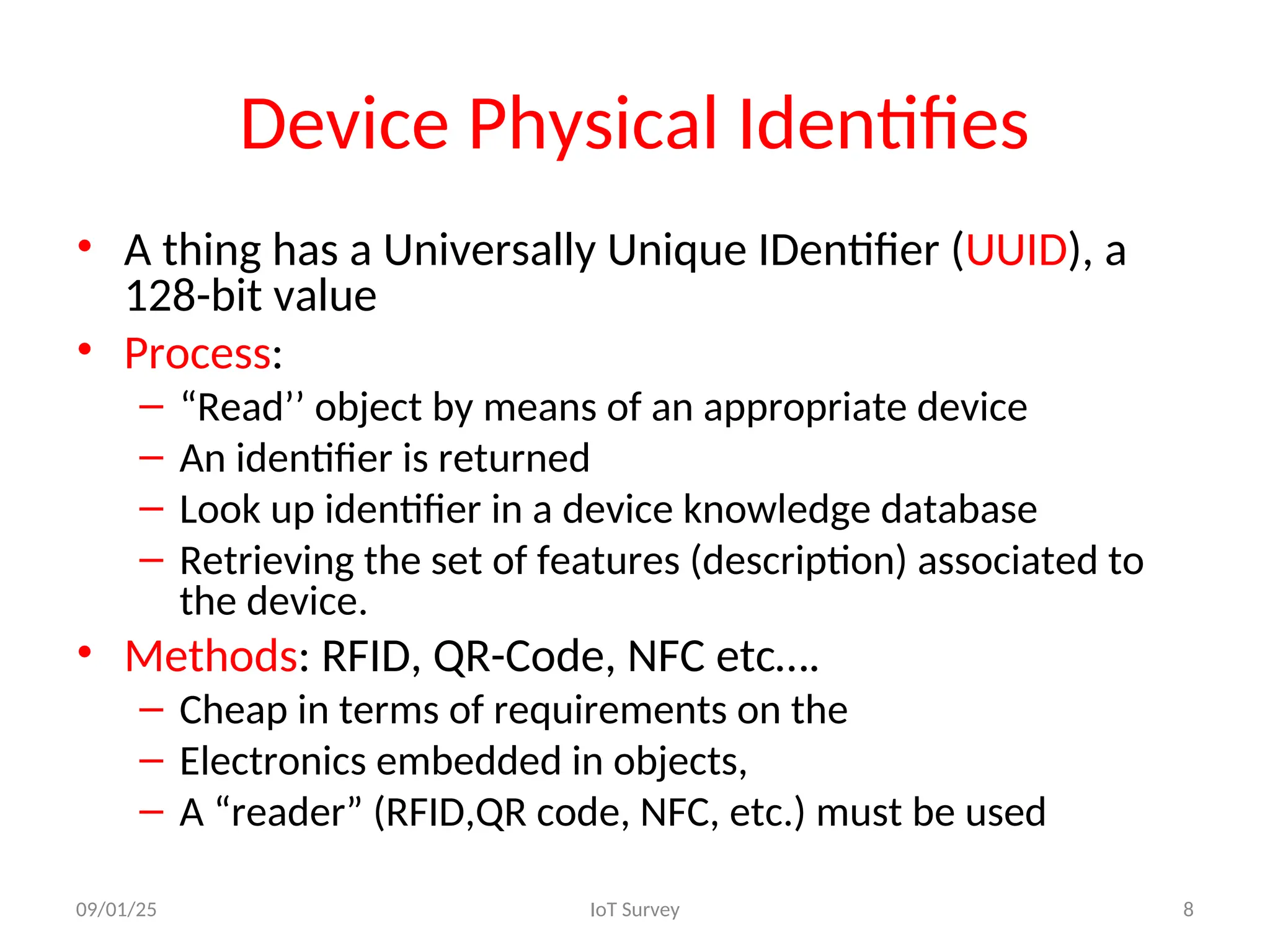
Device Physical Identifies
• A thing has a Universally Unique IDentifier (UUID), a
128-bit value
• Process:
– “Read’’ object by means of an appropriate device
– An identifier is returned
– Look up identifier in a device knowledge database
– Retrieving the set of features (description) associated to
the device.
• Methods: RFID, QR-Code, NFC etc….
– Cheap in terms of requirements on the
– Electronics embedded in objects,
– A “reader” (RFID,QR code, NFC, etc.) must be used
09/01/25 IoT Survey 8
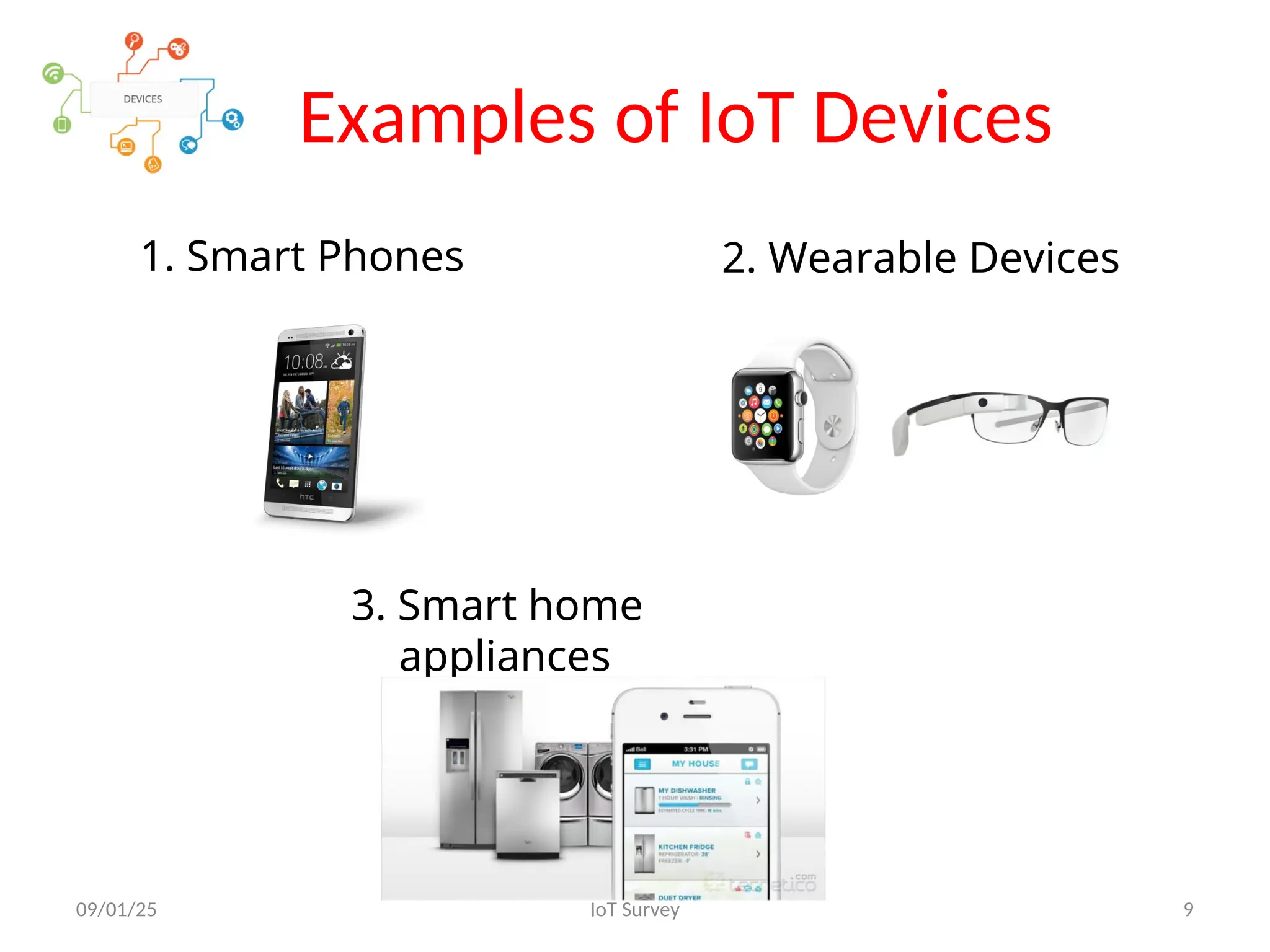
Examples of IoT Devices
1. Smart Phones 2. Wearable Devices
3. Smart home
appliances
09/01/25 IoT Survey 9
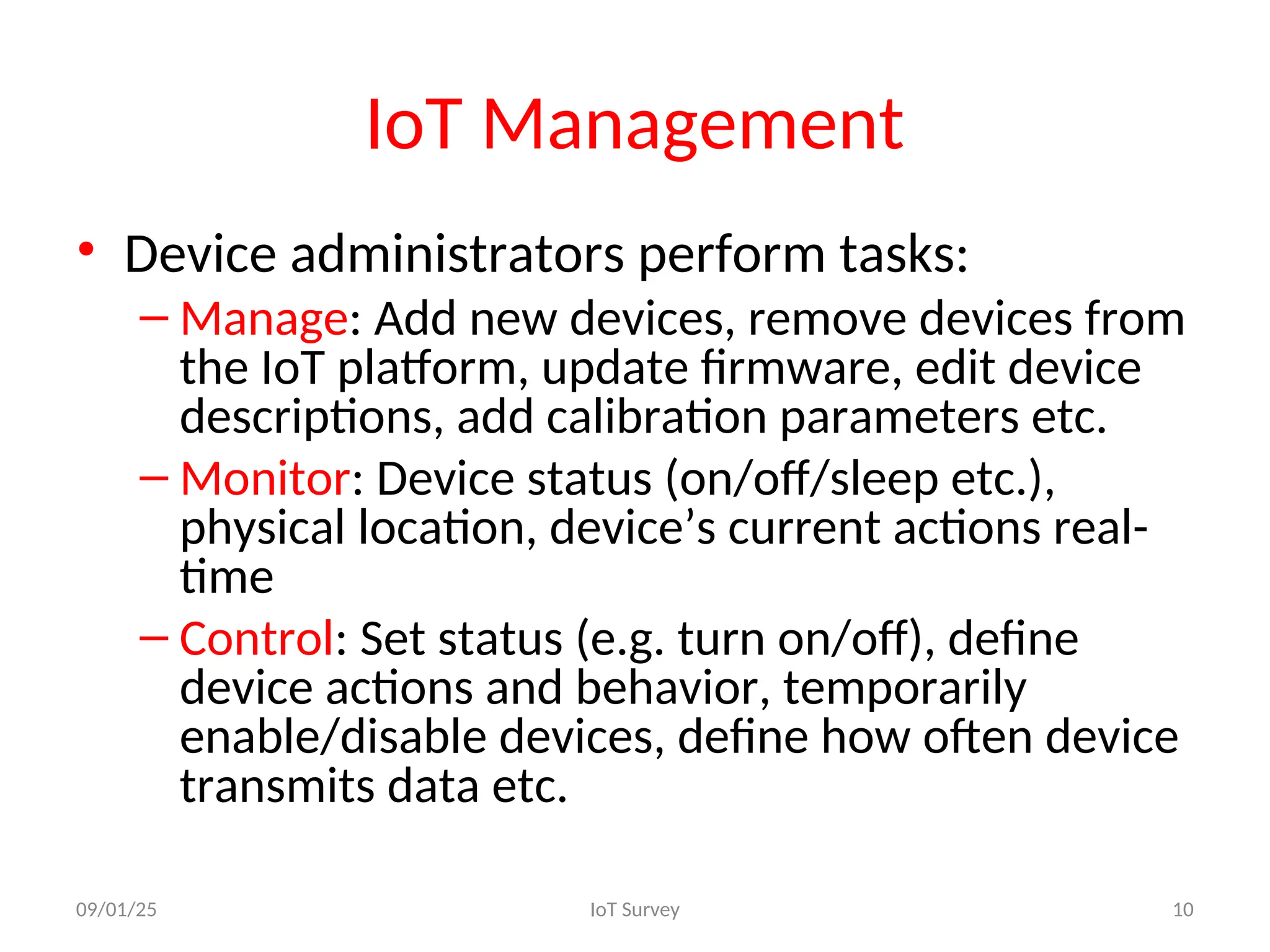
IoT Management
• Device administrators perform tasks:
– Manage: Add new devices, remove devices from
the IoT platform, update firmware, edit device
descriptions, add calibration parameters etc.
– Monitor: Device status (on/off/sleep etc.),
physical location, device’s current actions real-
time
– Control: Set status (e.g. turn on/off), define
device actions and behavior, temporarily
enable/disable devices, define how often device
transmits data etc.
09/01/25 IoT Survey 10
IoT Applications
• Environmental monitoring: take and process measurements from
environment e.g. water, atmosphere, soil conditions, earthquake
and tsunami warning systems
• Infrastructure management: monitor and control infrastructures
e.g. bridges, rail tracks, wind farms, crop farms, …
• Manufacturing for responding to production and supply-chain,
industrial operations and maintenance demands (industry 4.0)
• Energy Management: sensors at buildings optimize energy
production and energy consumption in smart homes, buildings and
cities (e.g. balance power generation)
• Healthcare: remote health monitoring, emergency notification
systems, assisted living for the elderly and chronic patients
• Home automation, Ambient Assisted Living (AAL), transportation
and traffic control and consumer applications (e.g. smart retail)
09/01/25 IoT Survey 11
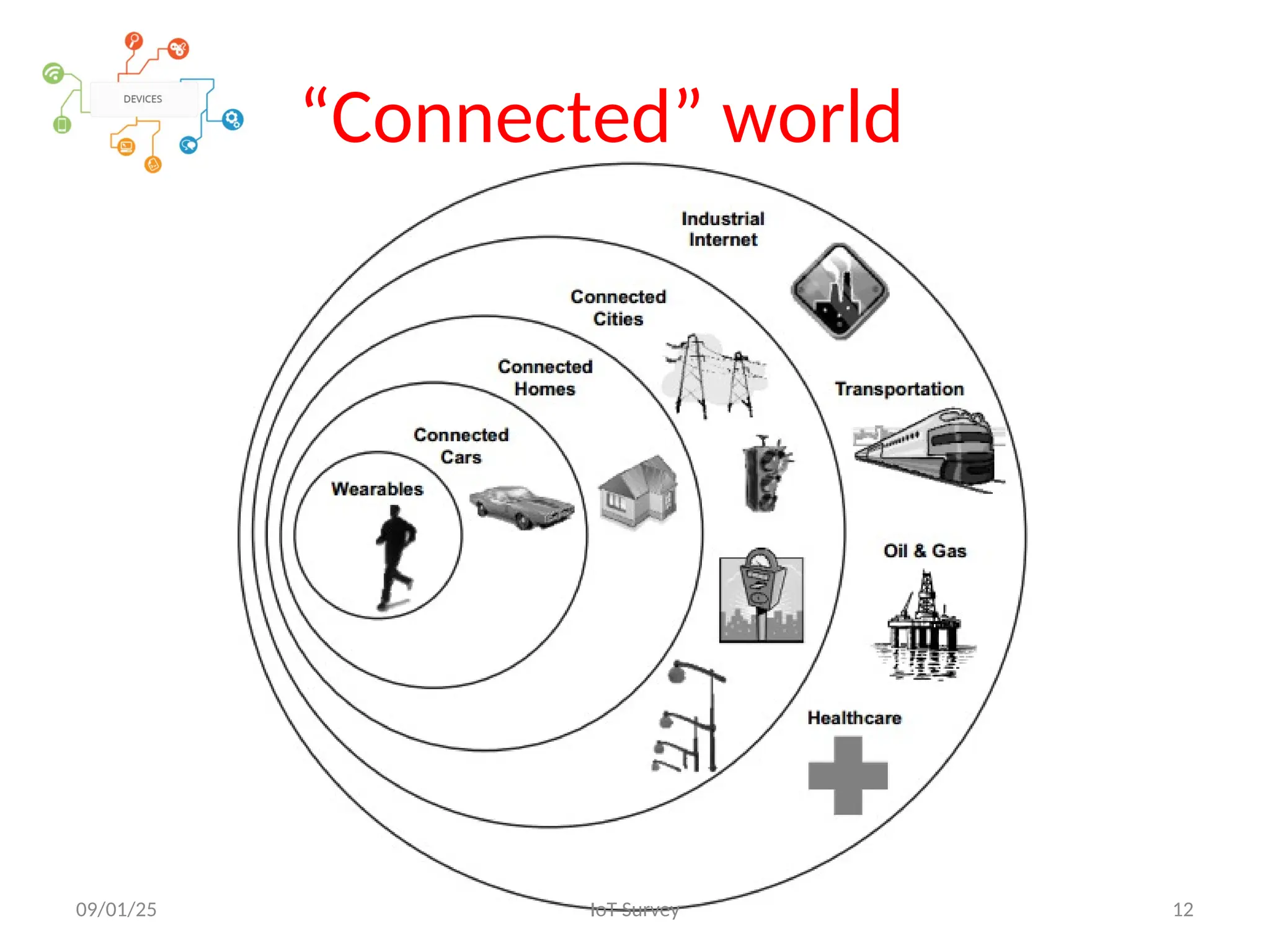
“Connected” world
09/01/25 IoT Survey 12
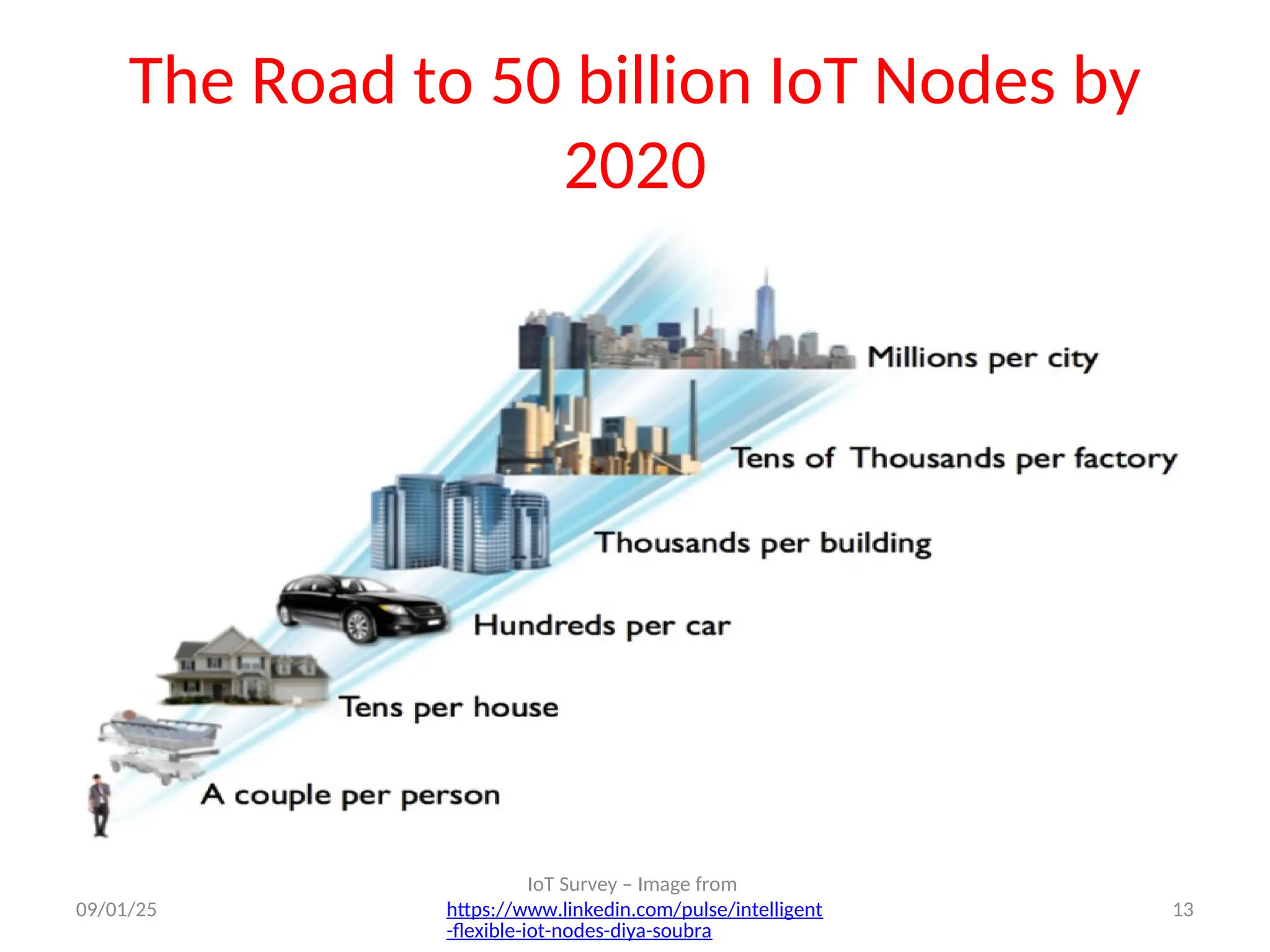
The Road to 50 billion IoT Nodes by
2020
09/01/25
IoT Survey – Image from
https://www.linkedin.com/pulse/intelligent
-flexible-iot-nodes-diya-soubra
13
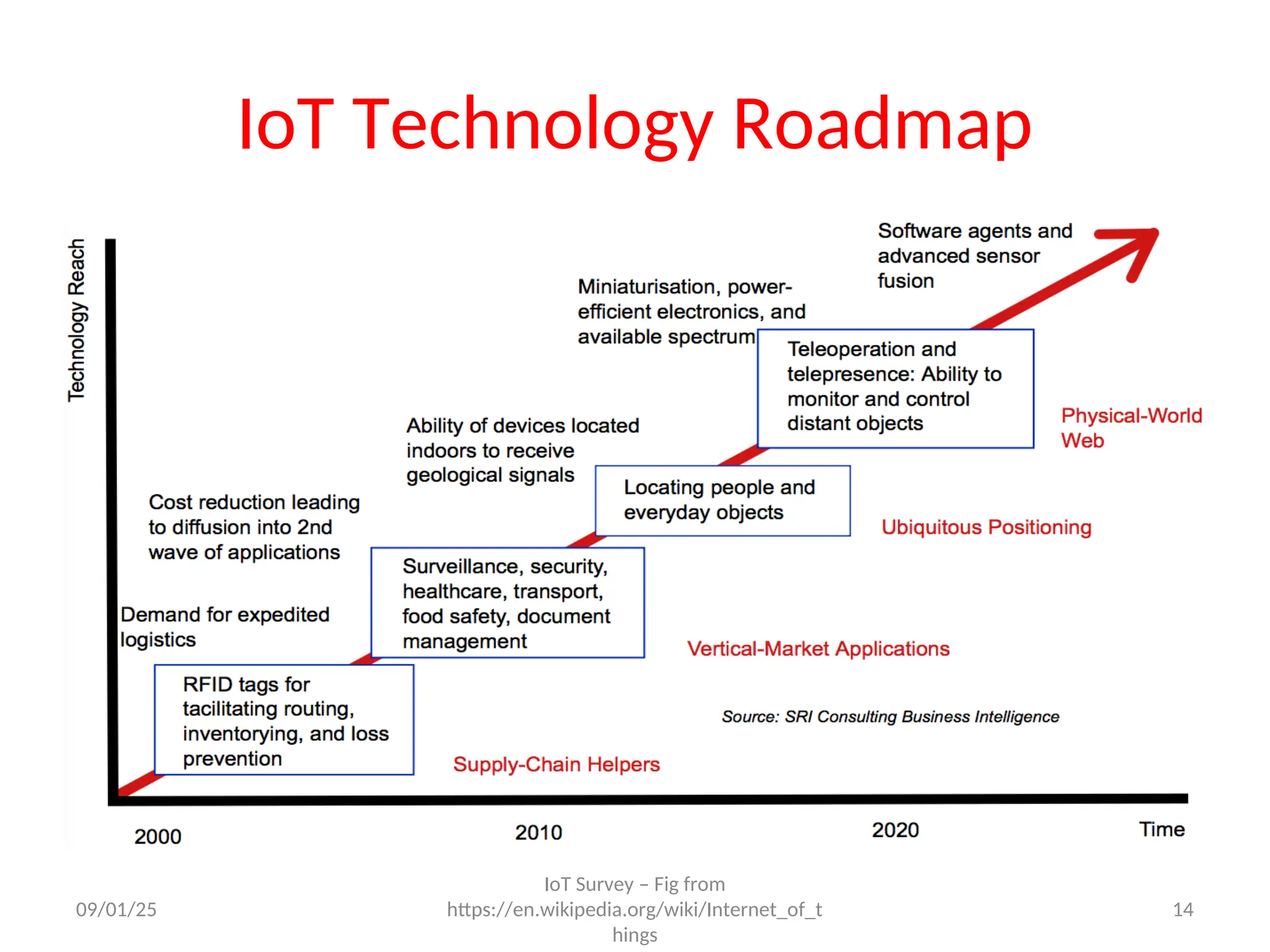
IoT Technology Roadmap
09/01/25
IoT Survey – Fig from
https://en.wikipedia.org/wiki/Internet_of_t
hings
14
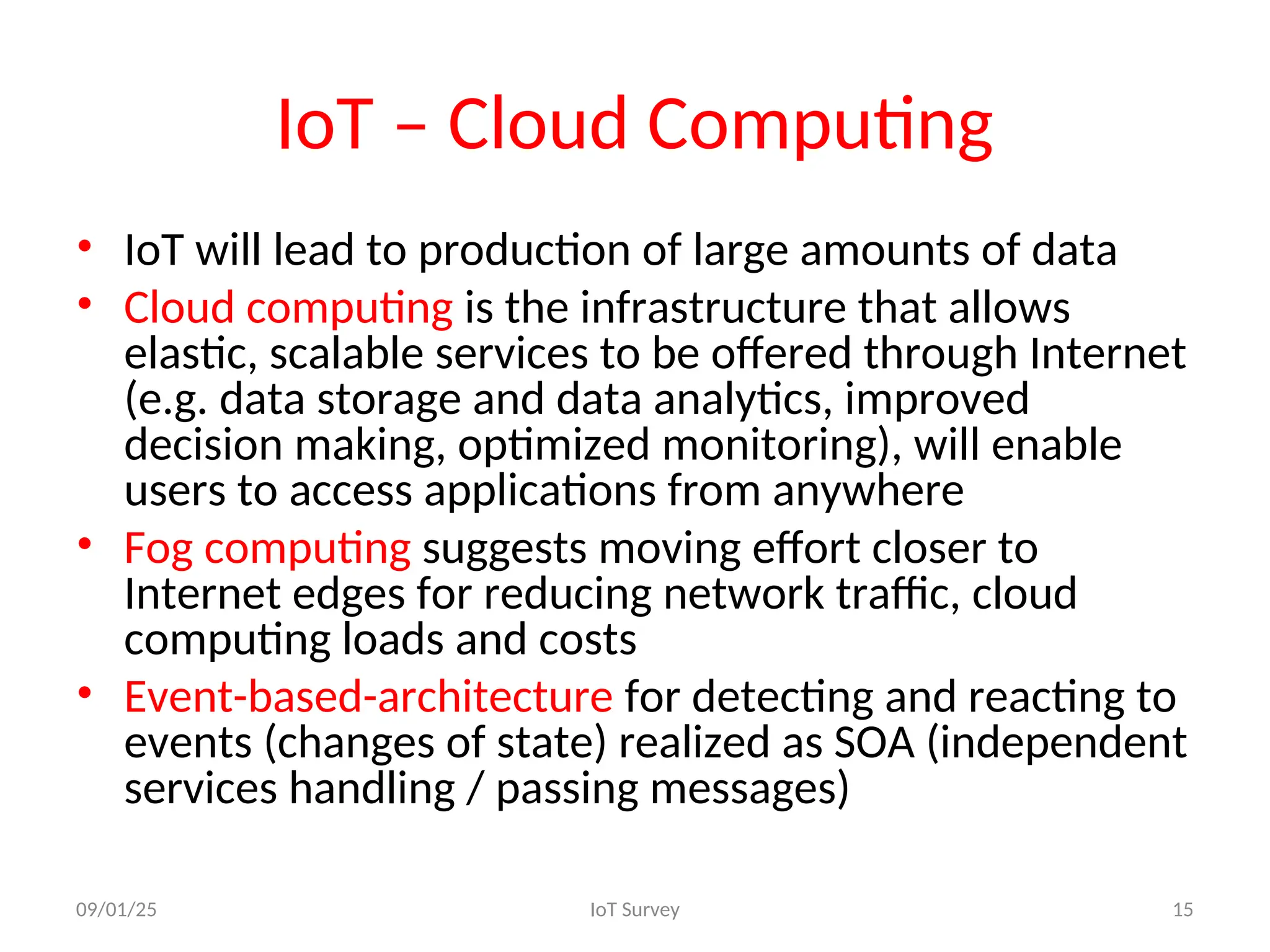
IoT – Cloud Computing
• IoT will lead to production of large amounts of data
• Cloud computing is the infrastructure that allows
elastic, scalable services to be offered through Internet
(e.g. data storage and data analytics, improved
decision making, optimized monitoring), will enable
users to access applications from anywhere
• Fog computing suggests moving effort closer to
Internet edges for reducing network traffic, cloud
computing loads and costs
• Event-based-architecture for detecting and reacting to
events (changes of state) realized as SOA (independent
services handling / passing messages)
09/01/25 IoT Survey 15
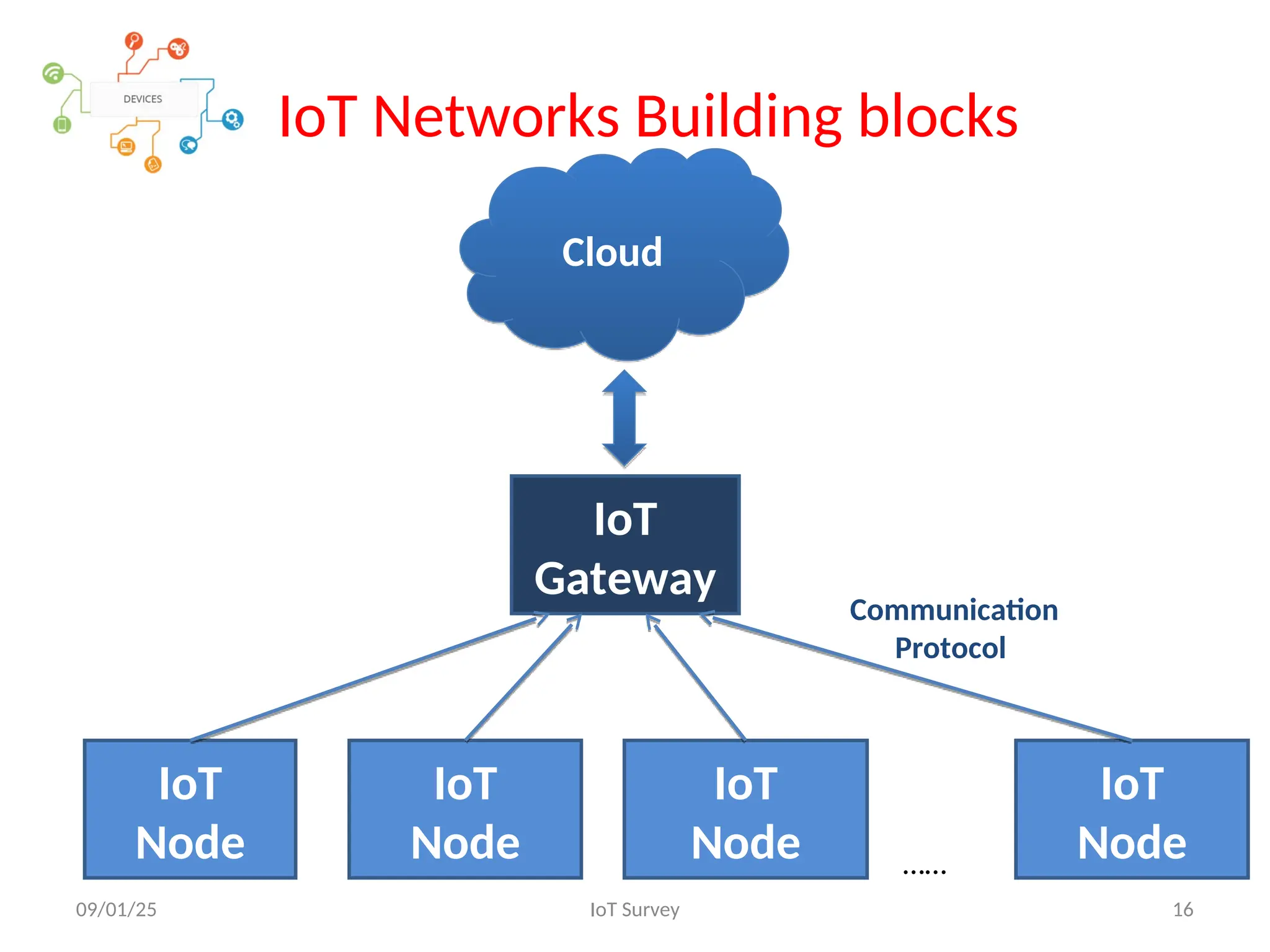
IoT Networks Building blocks
IoT
Node
IoT
Node
IoT
Node
IoT
Node
IoT
Gateway
……
09/01/25 IoT Survey 16
Communication
Protocol
Cloud
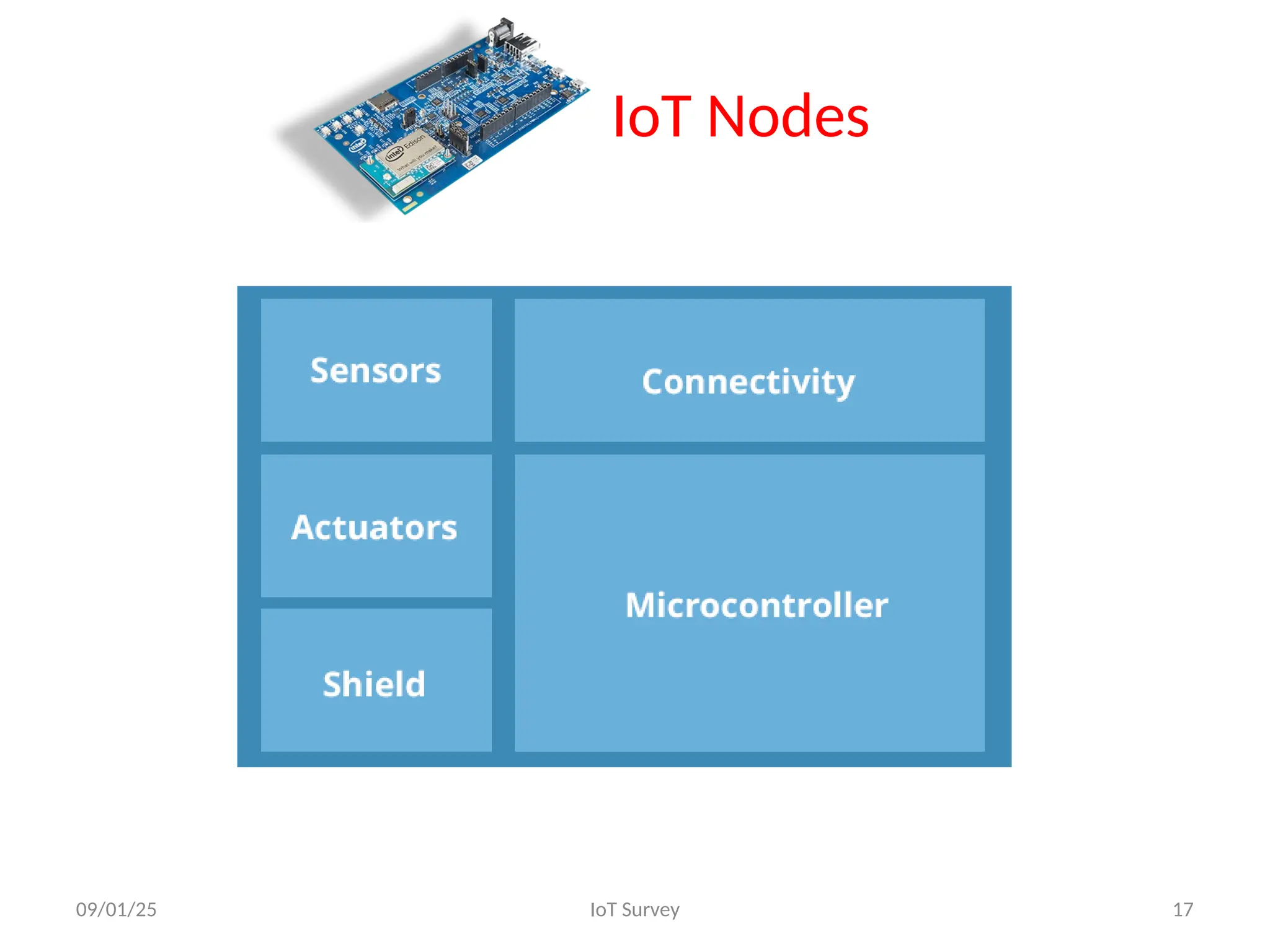
IoT Nodes
09/01/25 IoT Survey 17
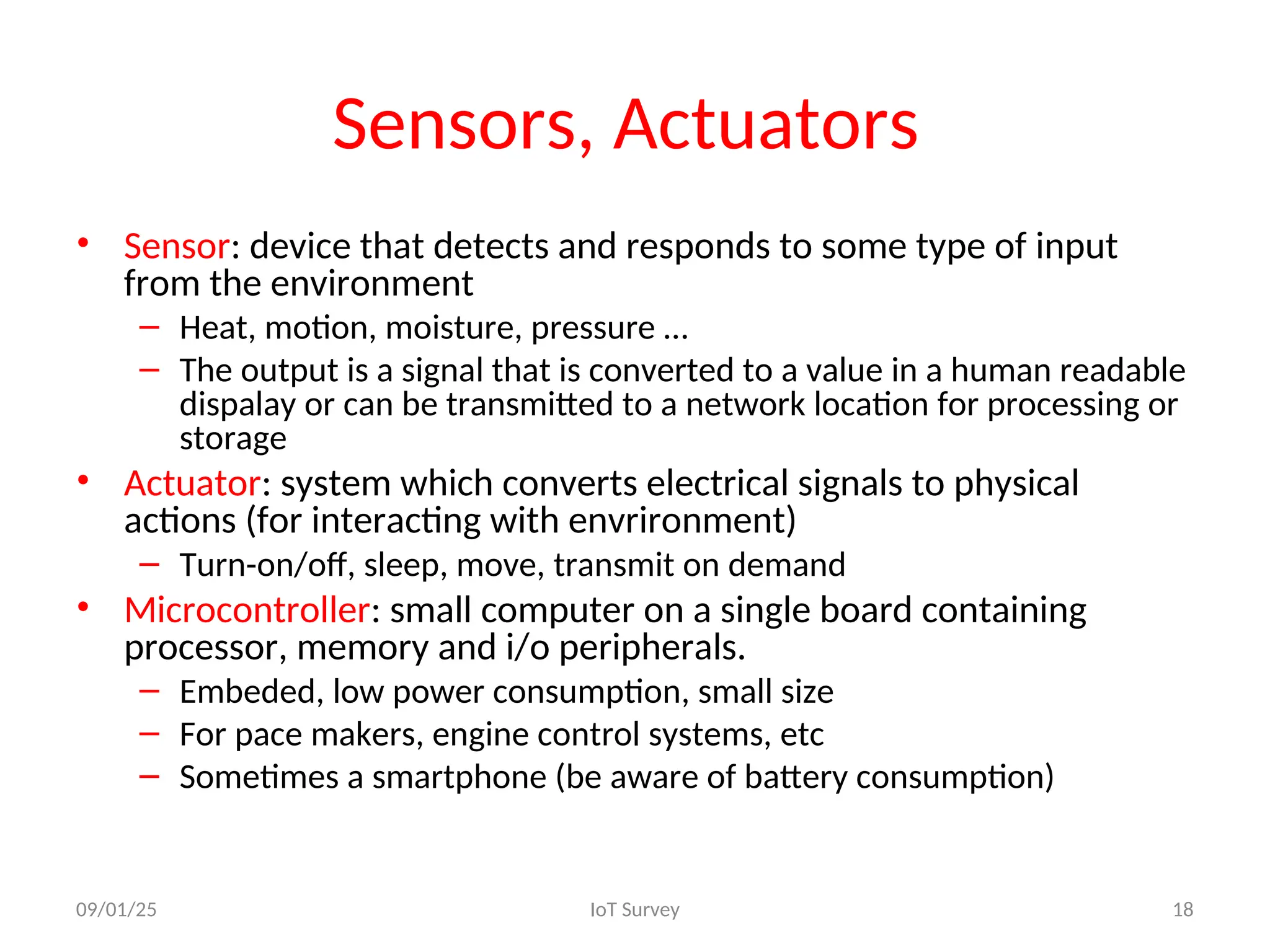
Sensors, Actuators
• Sensor: device that detects and responds to some type of input
from the environment
– Heat, motion, moisture, pressure …
– The output is a signal that is converted to a value in a human readable
dispalay or can be transmitted to a network location for processing or
storage
• Actuator: system which converts electrical signals to physical
actions (for interacting with envrironment)
– Turn-on/off, sleep, move, transmit on demand
• Microcontroller: small computer on a single board containing
processor, memory and i/o peripherals.
– Embeded, low power consumption, small size
– For pace makers, engine control systems, etc
– Sometimes a smartphone (be aware of battery consumption)
09/01/25 IoT Survey 18
IoT Node Actuators
• A type of motor that is responsible for moving
or controlling a mechanism or system
• Operated by a source of energy and converts
that energy into motion
• Do something depending on
– A threshold sensor value
– Reasoner results
– On demand (decision of the user)
– Beware of the energy consumption
09/01/25 IoT Survey 19
IoT Node Shields
09/01/25 IoT Survey 20
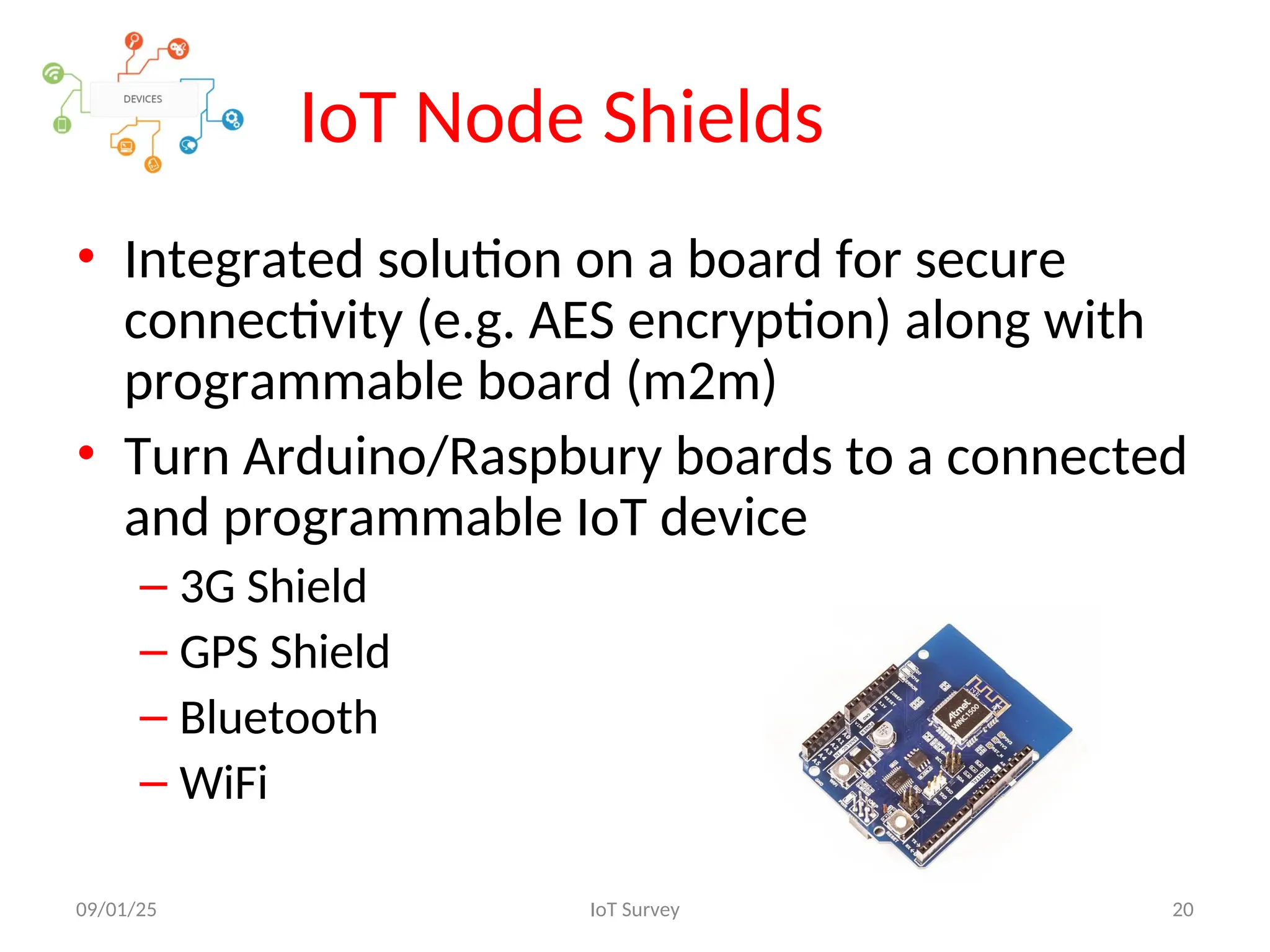
• Integrated solution on a board for secure
connectivity (e.g. AES encryption) along with
programmable board (m2m)
• Turn Arduino/Raspbury boards to a connected
and programmable IoT device
– 3G Shield
– GPS Shield
– Bluetooth
– WiFi
IoT Node Microcontrollers
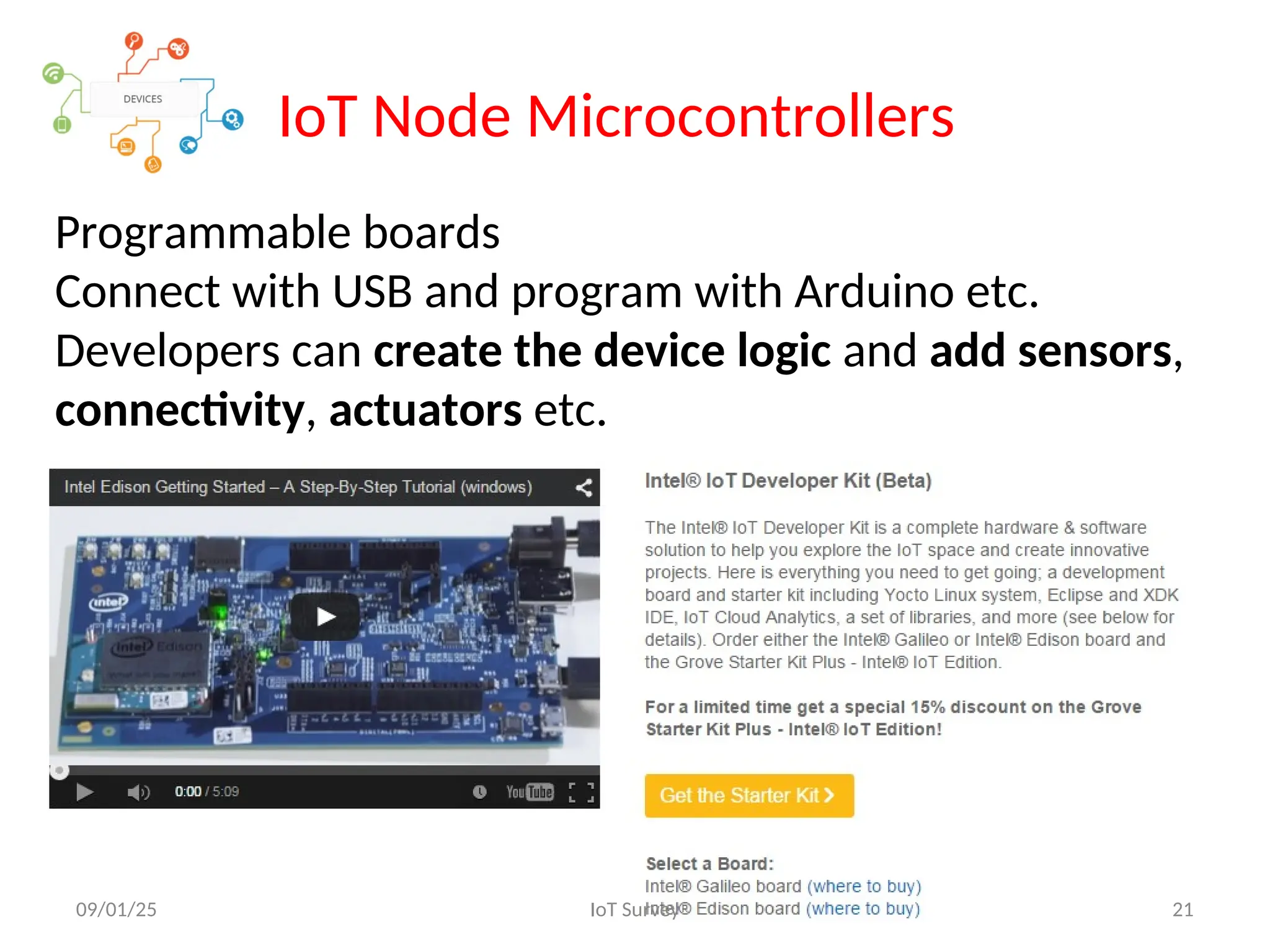
Programmable boards
Connect with USB and program with Arduino etc.
Developers can create the device logic and add sensors,
connectivity, actuators etc.
09/01/25 IoT Survey 21
IoT Node Microcontrollers
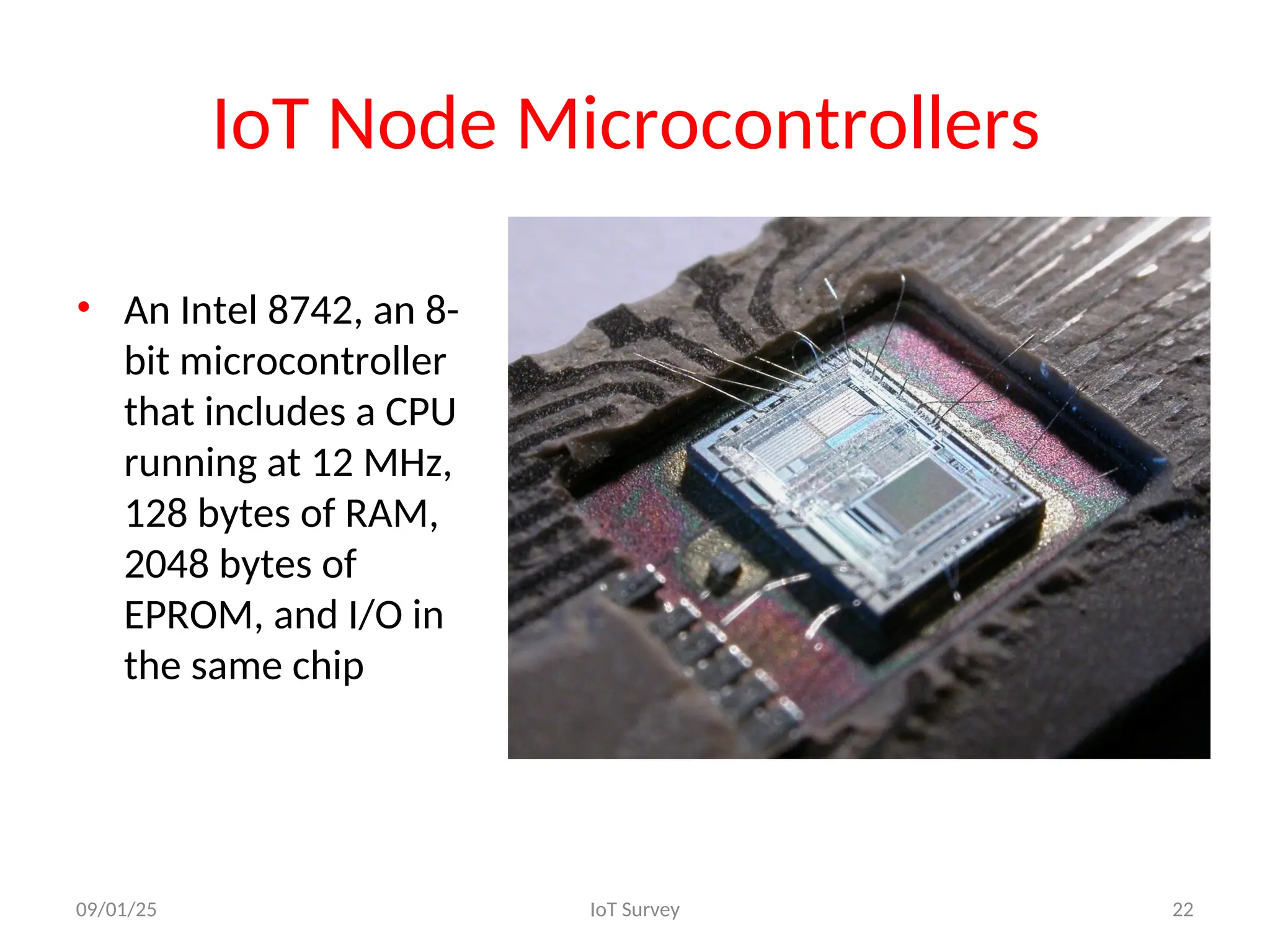
• An Intel 8742, an 8-
bit microcontroller
that includes a CPU
running at 12 MHz,
128 bytes of RAM,
2048 bytes of
EPROM, and I/O in
the same chip
09/01/25 IoT Survey 22
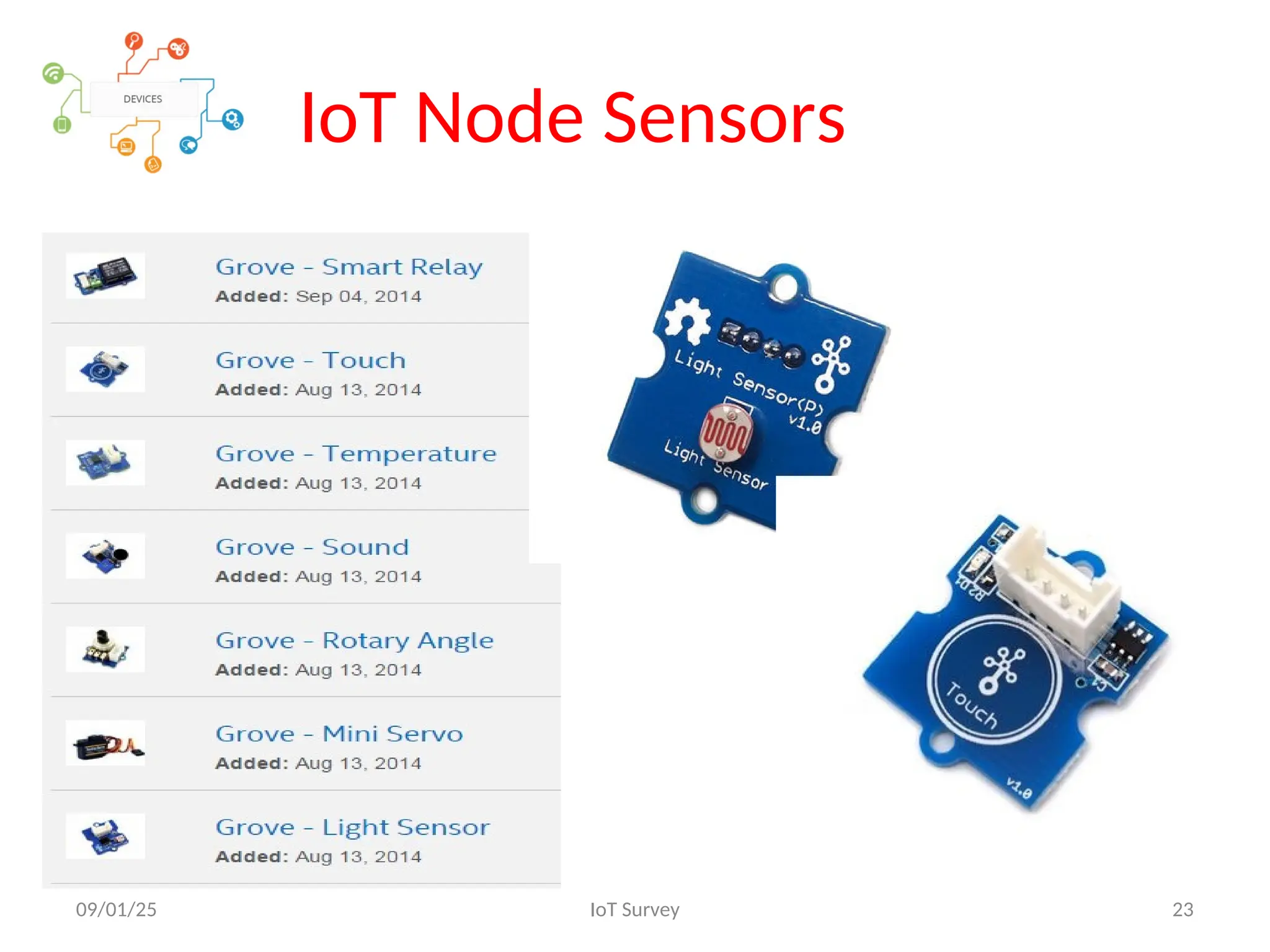
IoT Node Sensors
09/01/25 IoT Survey 23
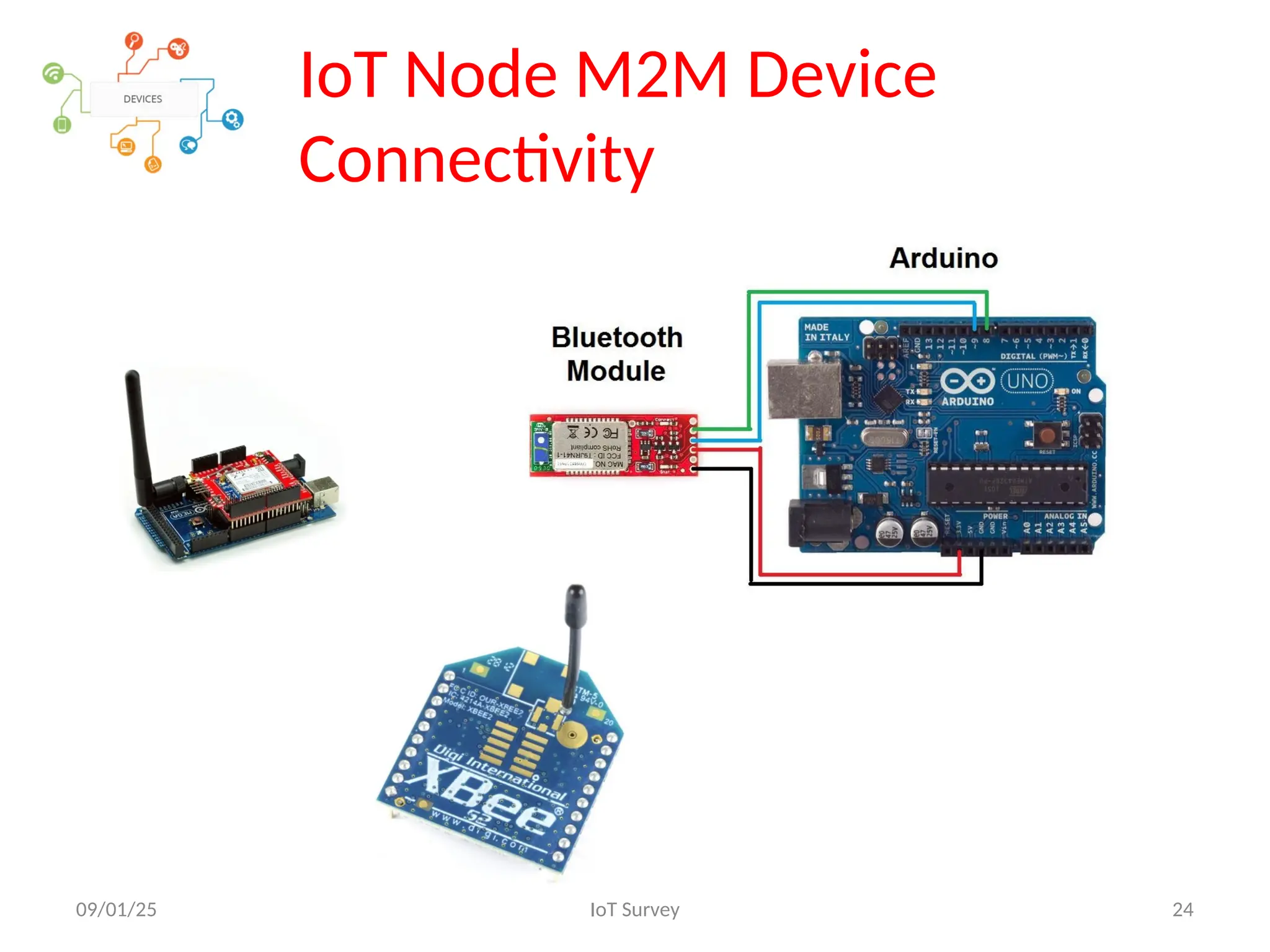
IoT Node M2M Device
Connectivity
09/01/25 IoT Survey 24
IoT Node Agent
• An embedded program that runs on an IoT
device and reports status of some asset or
environment values
• How it works:
– The agent “reads” status from sensors or local
connectivity to an asset
– Applies some rules or logic about how often to
send, how to aggregate info etc.
– Sends the info to the short-haul or long-haul
09/01/25 IoT Survey 25
IOT Node Operating Systems
• RIOT OS:
– Designed for maximum energy efficiency & hardware
independent development
– Support for 6LoWPAN, IPv6, TCP and UDP protocols
– Low resource requirements: Min RAM (~1.5kB) and Min
ROM (~ 5kB)
– Standard programming in C or C++
• Thingsquare:
– Software platform that product makers use to connect
their products with smartphones
– Runs on hardware with 64-256 kilobytes of flash and 16-32
kilobytes of RAM
09/01/25 IoT Survey 26
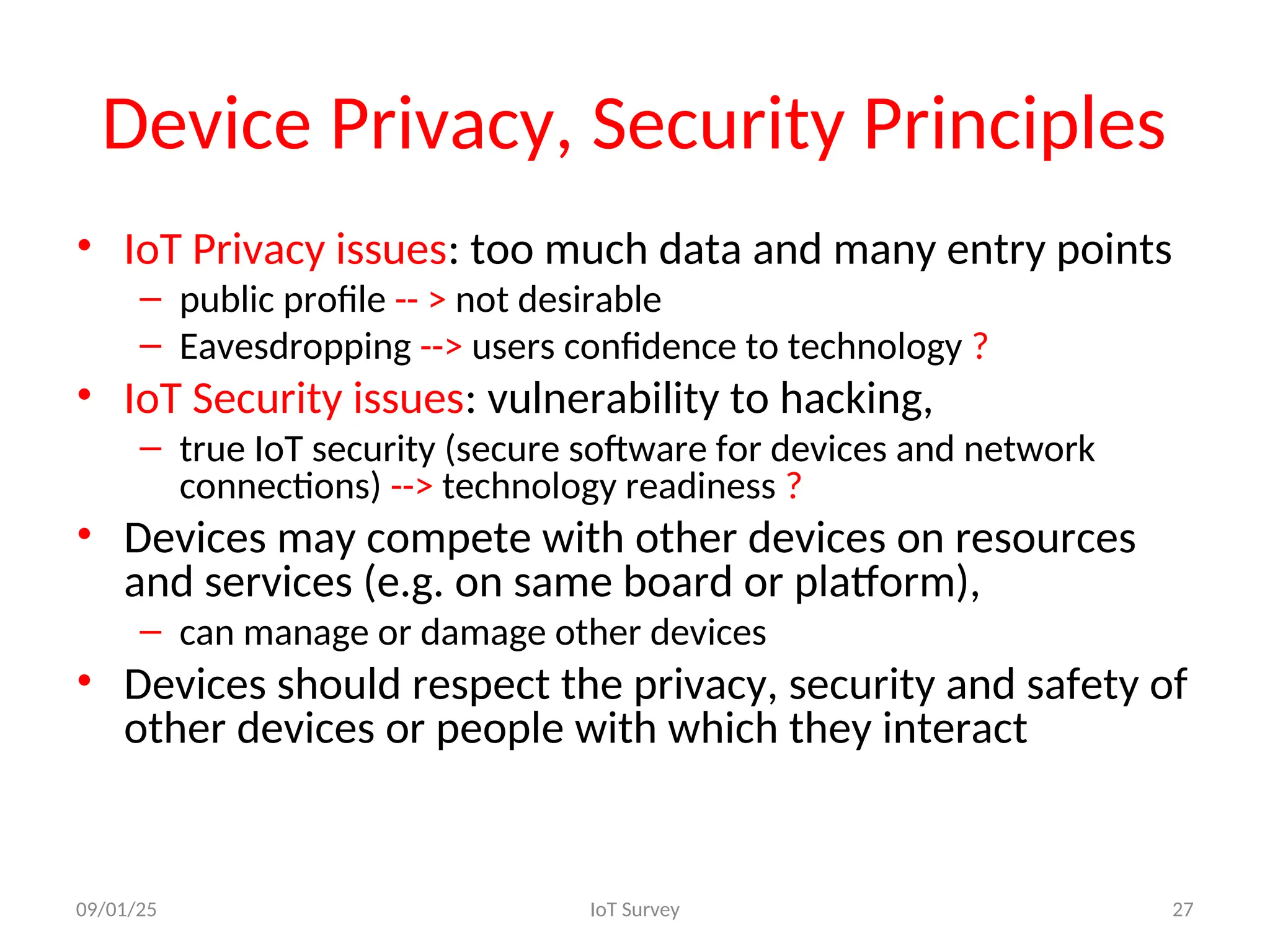
Device Privacy, Security Principles
• IoT Privacy issues: too much data and many entry points
– public profile -- > not desirable
– Eavesdropping --> users confidence to technology ?
• IoT Security issues: vulnerability to hacking,
– true IoT security (secure software for devices and network
connections) --> technology readiness ?
• Devices may compete with other devices on resources
and services (e.g. on same board or platform),
– can manage or damage other devices
• Devices should respect the privacy, security and safety of
other devices or people with which they interact
09/01/25 IoT Survey 27
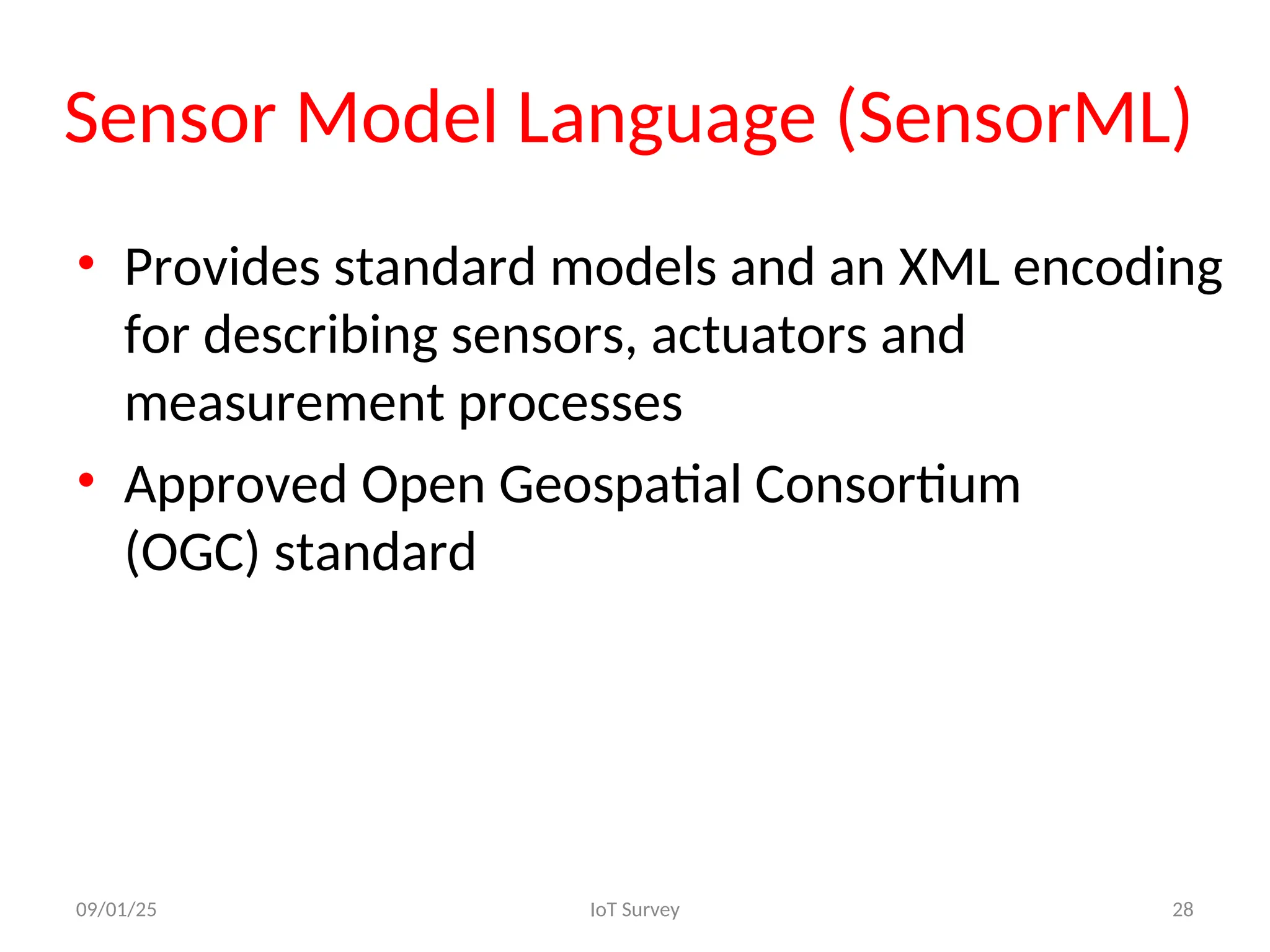
Sensor Model Language (SensorML)
• Provides standard models and an XML encoding
for describing sensors, actuators and
measurement processes
• Approved Open Geospatial Consortium
(OGC) standard
09/01/25 IoT Survey 28
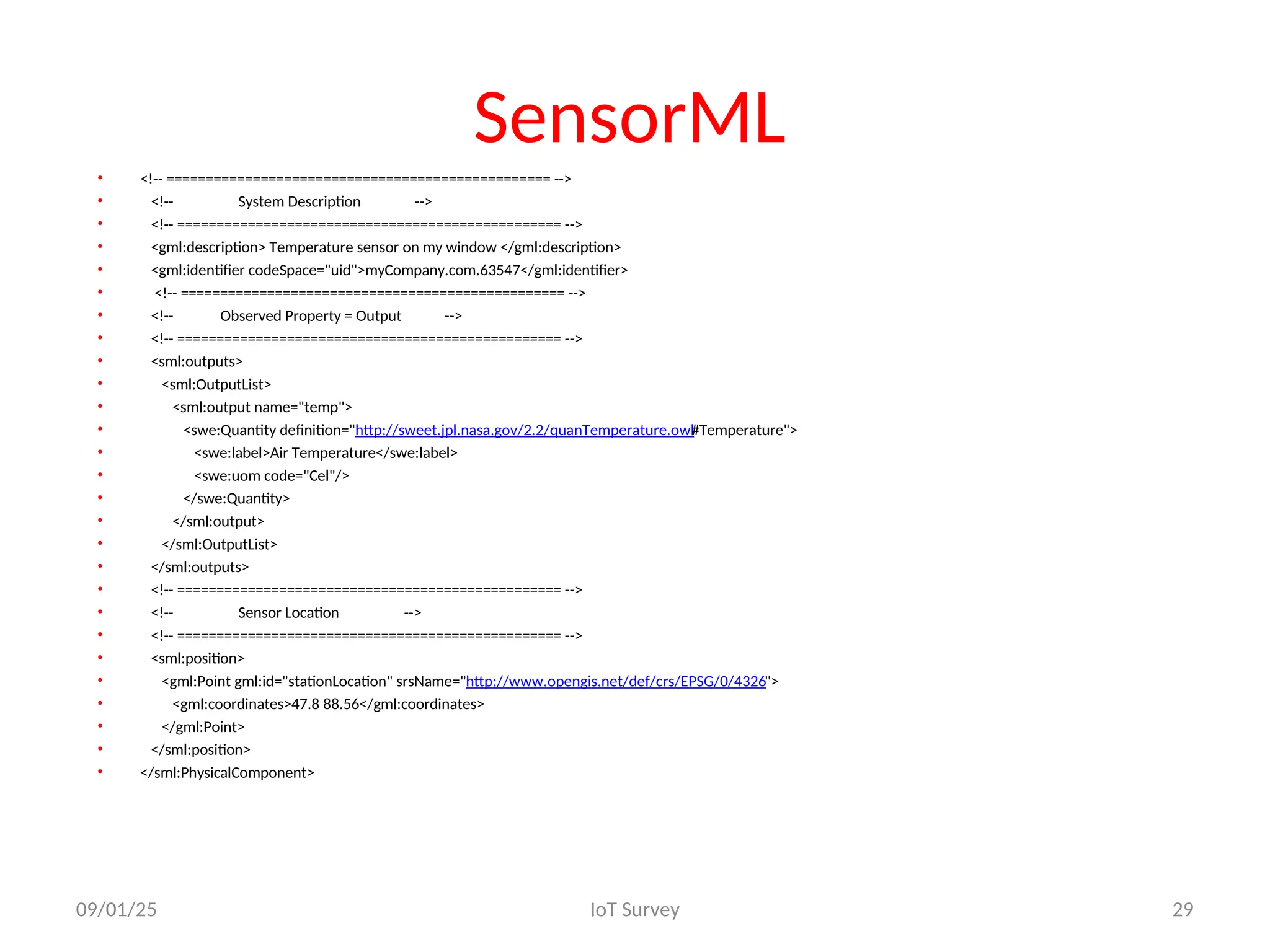
SensorML
• <!-- ================================================= -->
• <!-- System Description -->
• <!-- ================================================= -->
• <gml:description> Temperature sensor on my window </gml:description>
• <gml:identifier codeSpace="uid">myCompany.com.63547</gml:identifier>
• <!-- ================================================= -->
• <!-- Observed Property = Output -->
• <!-- ================================================= -->
• <sml:outputs>
• <sml:OutputList>
• <sml:output name="temp">
• <swe:Quantity definition="http://sweet.jpl.nasa.gov/2.2/quanTemperature.owl#Temperature">
• <swe:label>Air Temperature</swe:label>
• <swe:uom code="Cel"/>
• </swe:Quantity>
• </sml:output>
• </sml:OutputList>
• </sml:outputs>
• <!-- ================================================= -->
• <!-- Sensor Location -->
• <!-- ================================================= -->
• <sml:position>
• <gml:Point gml:id="stationLocation" srsName="http://www.opengis.net/def/crs/EPSG/0/4326">
• <gml:coordinates>47.8 88.56</gml:coordinates>
• </gml:Point>
• </sml:position>
• </sml:PhysicalComponent>
09/01/25 IoT Survey 29
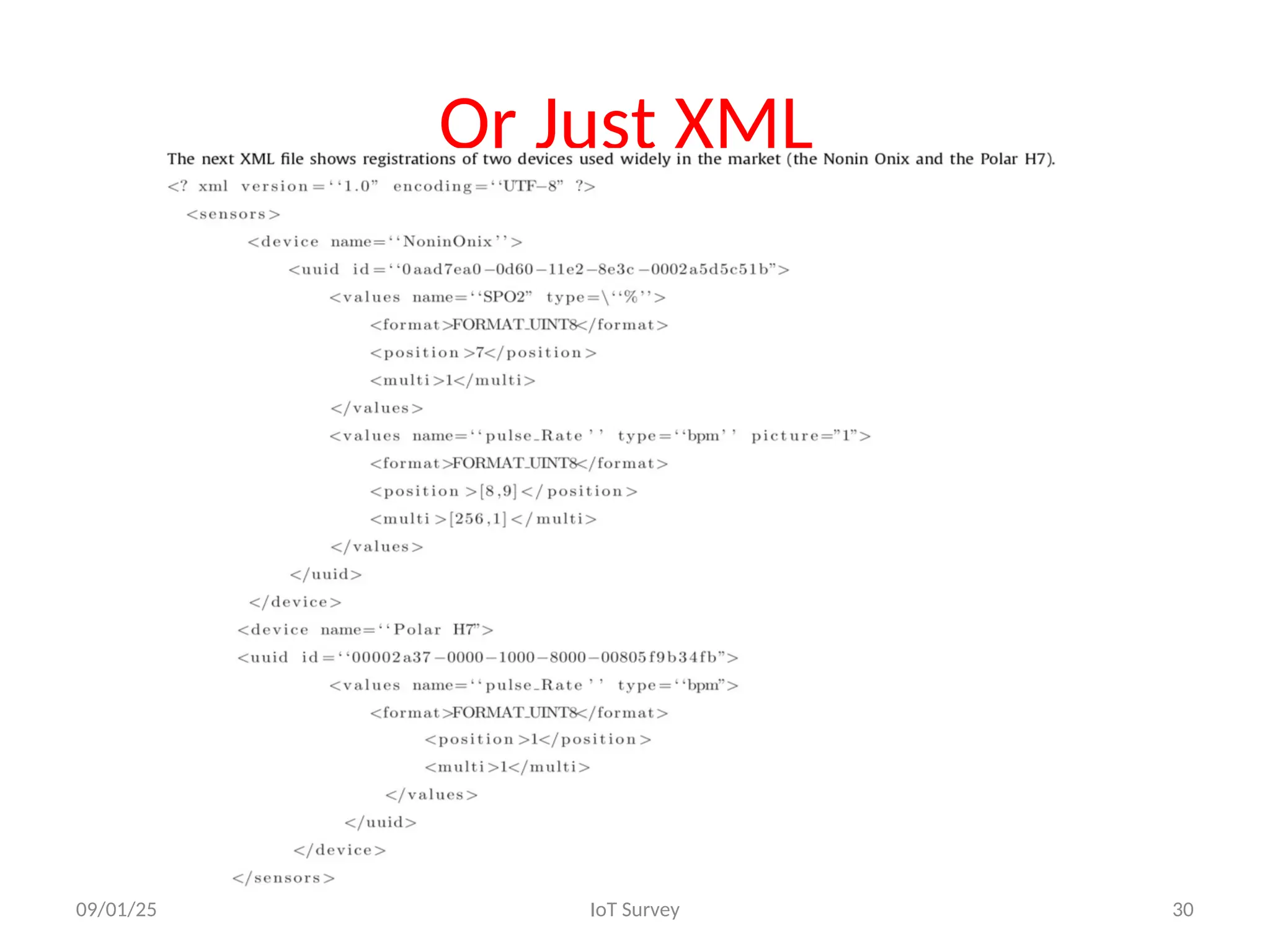
Or Just XML
09/01/25 IoT Survey 30
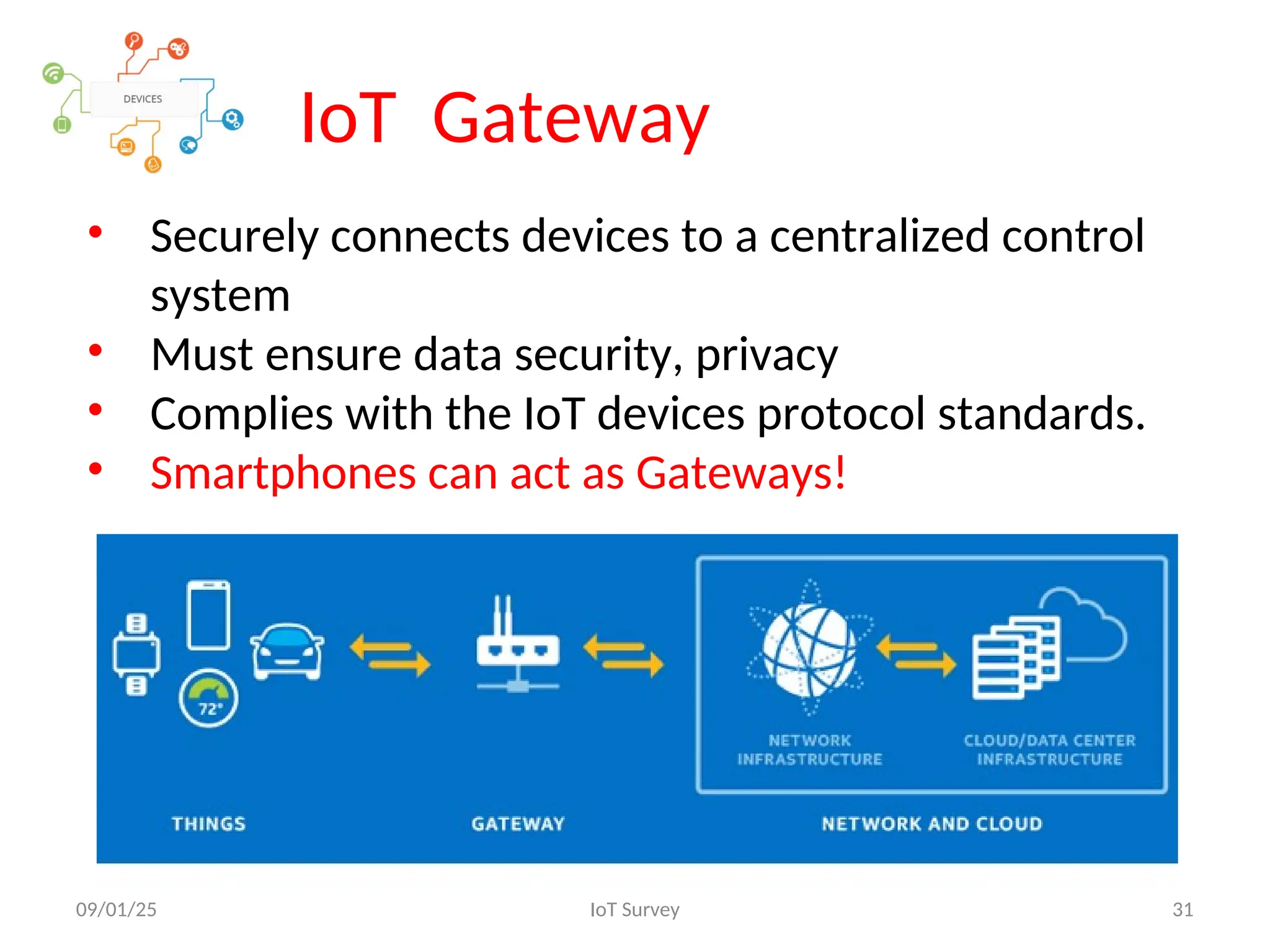
IoT Gateway
• Securely connects devices to a centralized control
system
• Must ensure data security, privacy
• Complies with the IoT devices protocol standards.
• Smartphones can act as Gateways!
09/01/25 IoT Survey 31
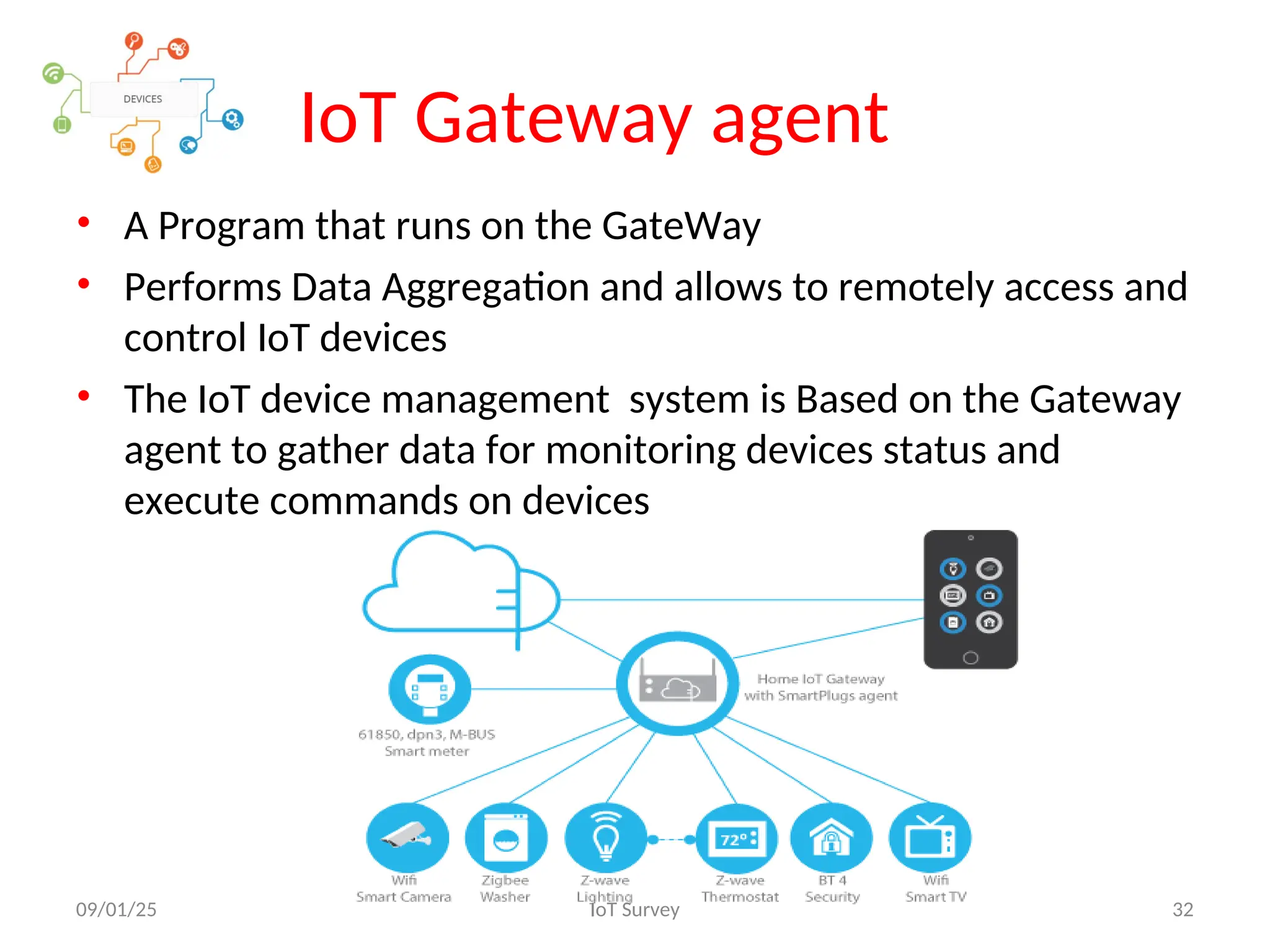
IoT Gateway agent
• A Program that runs on the GateWay
• Performs Data Aggregation and allows to remotely access and
control IoT devices
• The IoT device management system is Based on the Gateway
agent to gather data for monitoring devices status and
execute commands on devices
09/01/25 IoT Survey 32
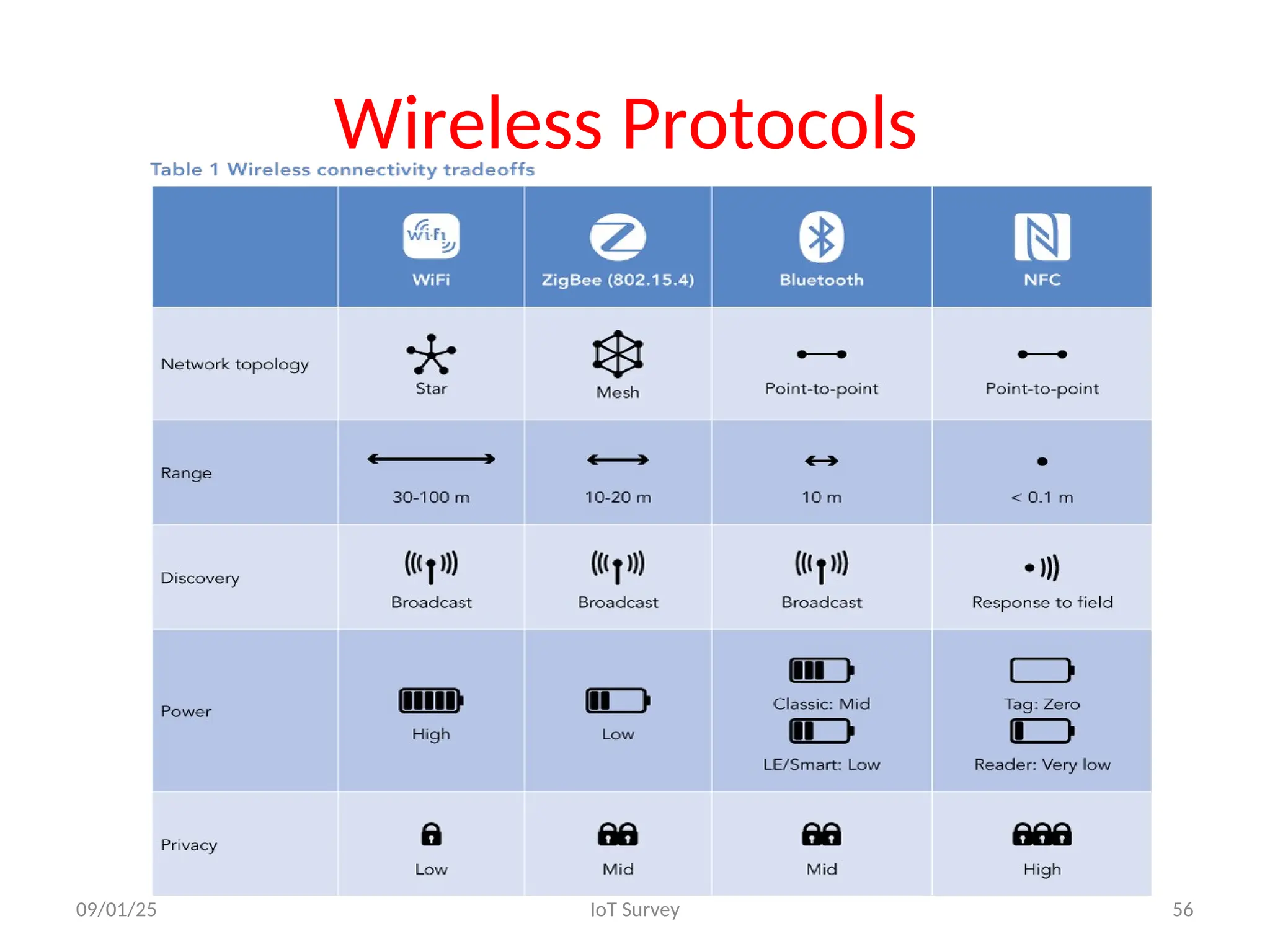
Wireless Protocols
• Factors to take into consideration when choosing
a wireless protocol:
– Range: Take in mind the distance between devices
that need to communicate
– Energy consumption
– Topology: Point to point, star or mesh e.g., if we need
all devices to communicate with each other we
cannot choose Bluetooth or Lora
– Privacy: Longer range means less privacy
– Data rate: Data transmition speed limit (e.g., 24mbps)
09/01/25 33
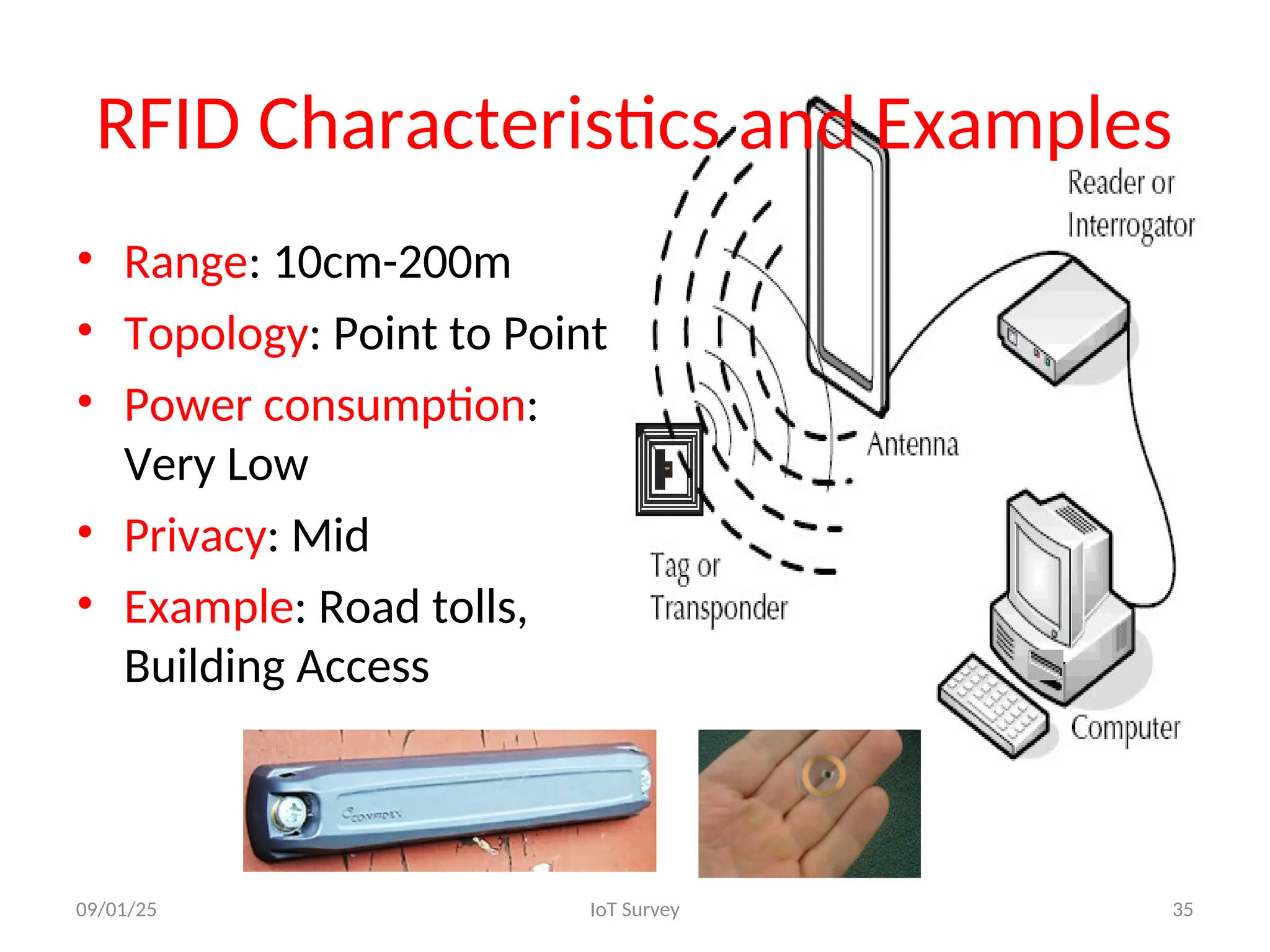
RFID
• Radio-Frequency IDentification (RFID) is the use of radio
waves to read and capture information stored on a tag
attached to an object
• A tag can be read from up to several meters away and does
not need to be within direct line-of-sight of the reader
• Uses tags, or labels attached to the objects to be identified.
• Uses “readers” to send a signal to the tag and read its
response. Readers transmit observations to a computer
system running RFID software
• RFID tags: 1) passive 2) active 3)battery assisted passive (if
tags are self powered they can transmit their data over
greater distances and they reply more quickly to the reader)
– The lower price per tag makes passive RFID systems attractive
09/01/25 34
RFID Characteristics and Examples
• Range: 10cm-200m
• Topology: Point to Point
• Power consumption:
Very Low
• Privacy: Mid
• Example: Road tolls,
Building Access
09/01/25 IoT Survey 35
Near Field Communication (NFC)
• Short-range wireless protocol that enable two electronic
devices (e.g. Smartphones) to communicate by bringing
them close to each other
• Each full NFC device can work in three modes:
– NFC card emulation—enables NFC-enabled devices such as
smartphones to act like smart cards, e.g., payment or ticketing
– NFC reader—enables NFC-enabled devices to read information
stored on inexpensive NFC tags embedded in labels or smart
posters, credit cards
– NFC peer-to-peer—enables two NFC-enabled devices to
communicate with each other to exchange information
• NFC devices can be active (e.g. smartphones) or passive
(e.g. NFC tags on credit cards for contactless transactions)
09/01/25 IoT Survey 36
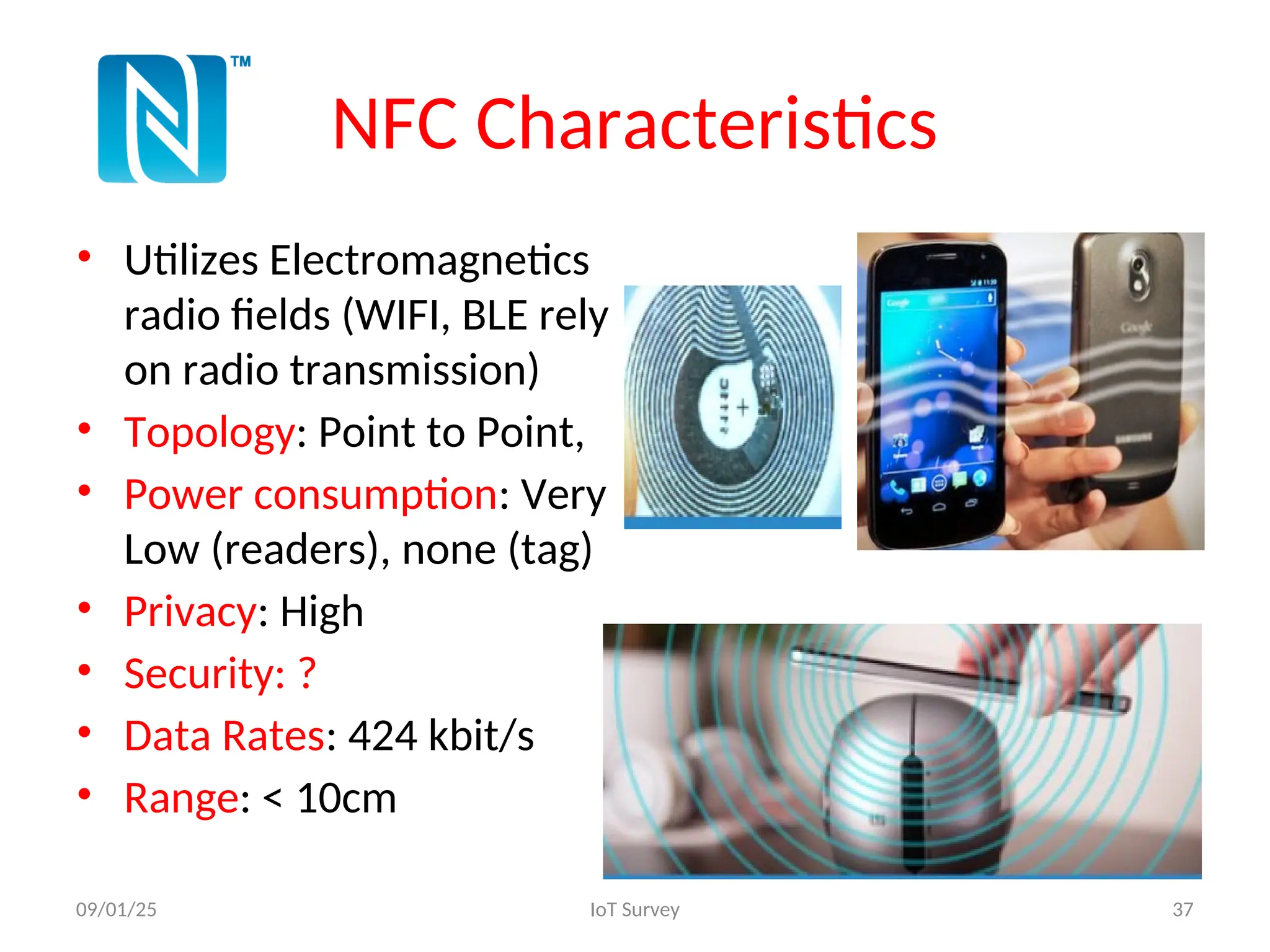
NFC Characteristics
• Utilizes Electromagnetics
radio fields (WIFI, BLE rely
on radio transmission)
• Topology: Point to Point,
• Power consumption: Very
Low (readers), none (tag)
• Privacy: High
• Security: ?
• Data Rates: 424 kbit/s
• Range: < 10cm
09/01/25 IoT Survey 37
ZigBee
• Low-cost, low-power, wireless mesh network standard
targeted at the wide development of long battery life
devices in wireless control and monitoring applications
• Characteristics:
– Topology: mesh, star, tree (one coordinator device)
– Range: 10-100m (line of sight); routers may extend
communication at network level
– Data Transfer Rate: 250 kbit/s
– Power consumption: Low
– Transmission distance: 10-100 meters
– Privacy: Mid
• Inexpensive, personal networks, Smart Home (home
automation), medical data collection from devices …
09/01/25 IoT Survey 38
Bluetooth
• Wireless standard for exchanging data over short
distances (using UHF radio waves from 2.4-2.485GHz)
• For fixed and mobile devices, building personal
networks (piconets), one coordinator device
• Characteristics:
– Range: 10m or greater
– Topology: Point to point
– Data Transfer Rate: 2.1 Mbit/s (BLE 1 Mbit/s)
– Power consumption: Mid (normal), low (BLE)
– Transmission distance: depends on device, typically small
– Privacy: Mid
09/01/25 IoT Survey 39
What makes Bluetooth better?
• Bluetooth is everywhere: built into nearly every phone,
laptop, desktop and tablet. Easy to connect a
keyboard, mouse, speakers or fitness band to phone or
computer.
• Bluetooth is low power: with the advent of Bluetooth
Smart (BLE or Bluetooth low energy), developers are
able to create smaller sensors that run off tiny coin-cell
batteries for months, and in some cases, years
Bluetooth is low cost: you can add Bluetooth for a
minimal cost. You will need to buy a module/system
on chip (SoC) and pay an administrative fee to use the
brand and license
09/01/25 IoT Survey 40
Bluetooth Low Energy v4.0 (BLE)
• Developed for IoT: easy mobile application development
and connectivity for cloud computing
• Activity monitoring, health monitoring (heart rate, glucose,
blood saturation level sensors), proximity sensors
• Key features of BLE:
– Industry-standard wireless protocol that allows for multi-vendor
interoperability
– Ultra-low peak, average and idle mode power consumption that
gives the ability to run for month(s) or years on standard coin-
cell batteries
– Standardized application development architecture that leads
to low development and operational costs
– Allows for some of the tightest security in the industry with 128-
bit AES data encryption
09/01/25 IoT Survey 41
BLE GATT – ATT -GAP
• BLE defines GAP mechanism and two protocols (GATT, ATT)
• Generic Access Profile (GAP) defines the mechanism for BLE
devices to communicate with each other
– Makes a device visible and allows other devices to connect with
other
– Controls connections and advertising and discovery process
– Once discovered the peripheral will stop advertising itself, can
be connected to one central device at a time
• Generic Attribute Profile (GATT): defines how data are
formatted and exchanged (two-way communication)
• GATT uses a Generic Attribute Protocol (ATT) that defines
services, their characteristics (e.g. sensed values) and ids
(16-bit ids) in a table
09/01/25 IoT Survey 42
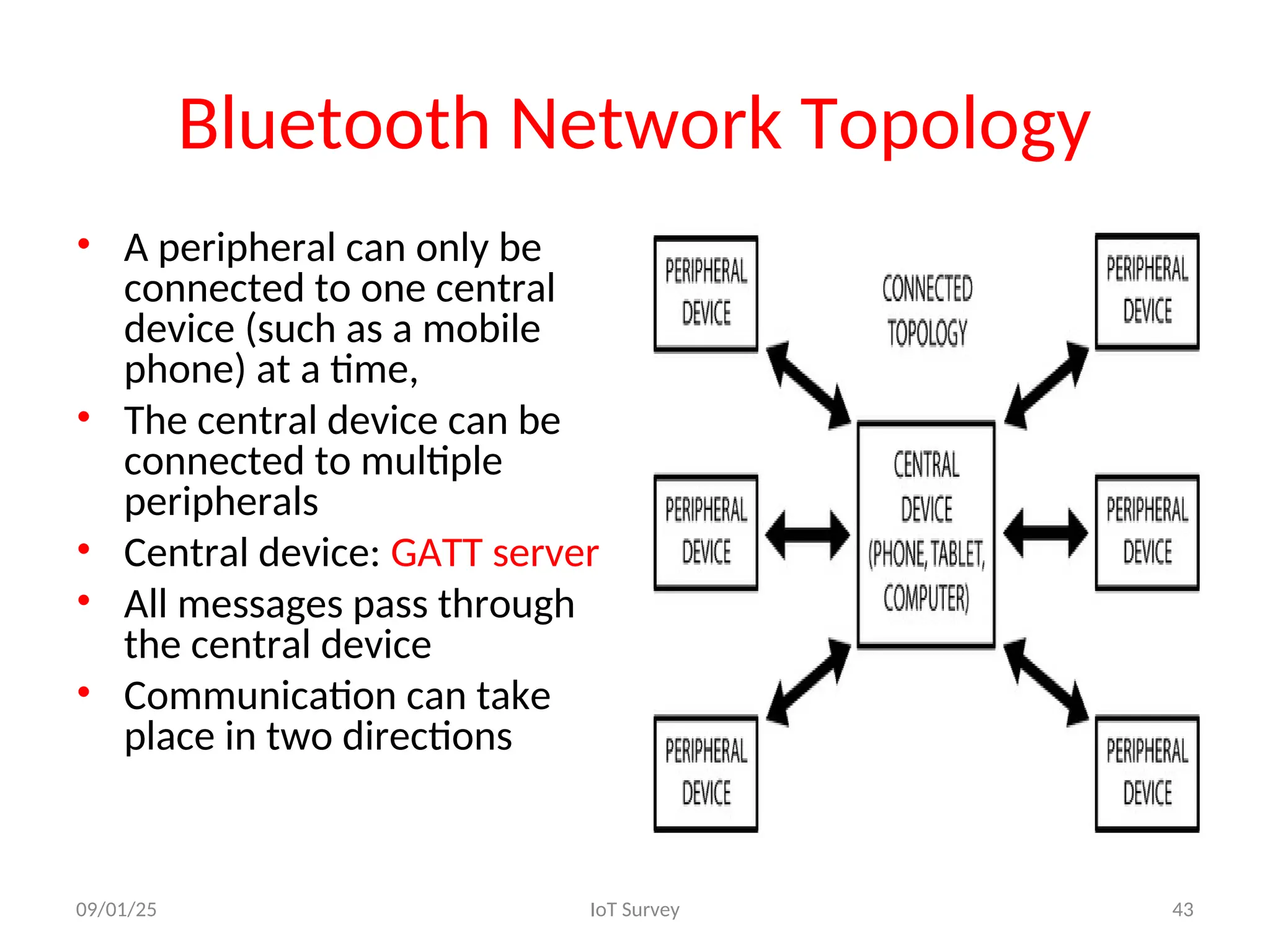
Bluetooth Network Topology
• A peripheral can only be
connected to one central
device (such as a mobile
phone) at a time,
• The central device can be
connected to multiple
peripherals
• Central device: GATT server
• All messages pass through
the central device
• Communication can take
place in two directions
09/01/25 IoT Survey 43
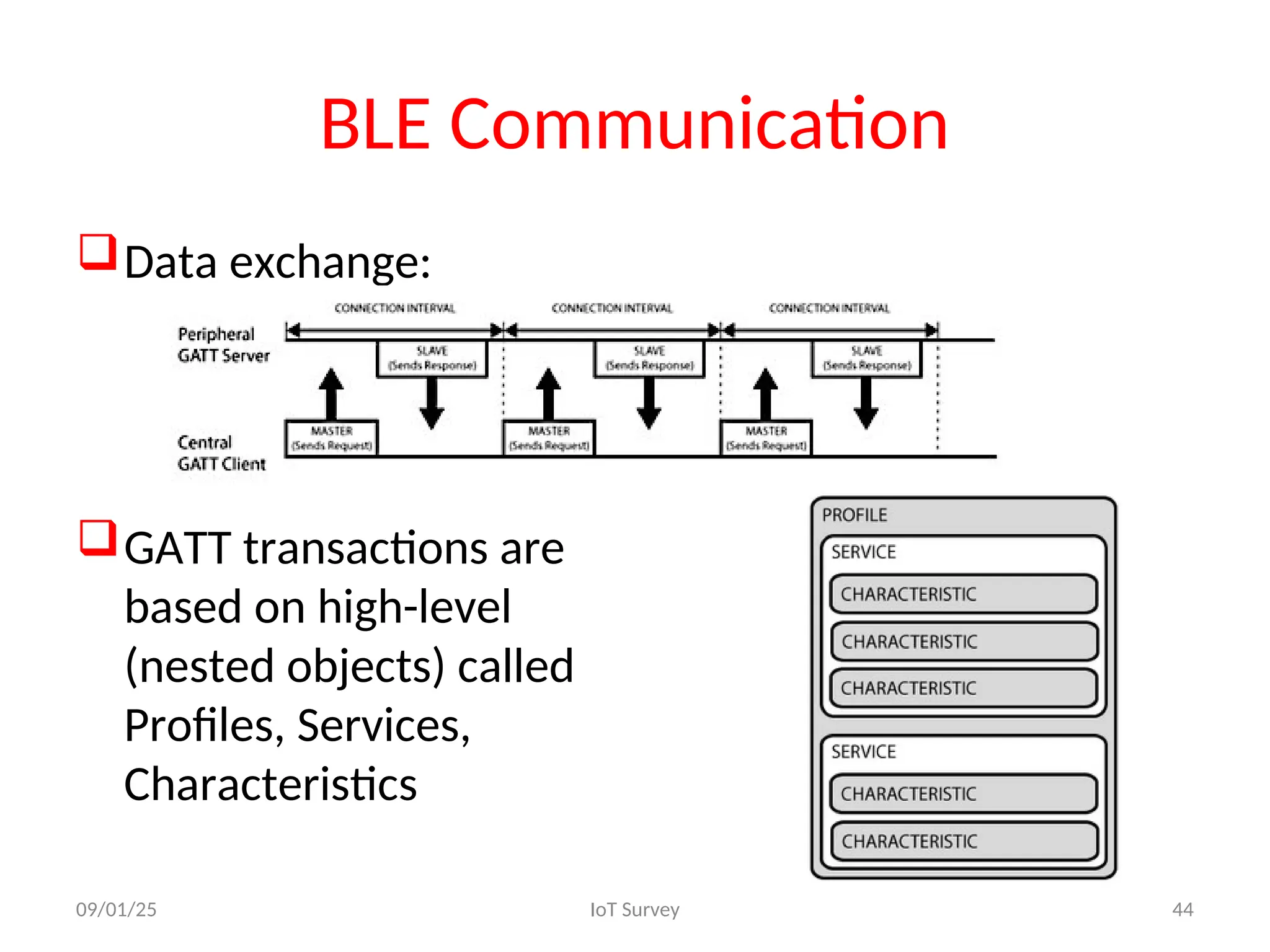
BLE Communication
Data exchange:
GATT transactions are
based on high-level
(nested objects) called
Profiles, Services,
Characteristics
09/01/25 IoT Survey 44
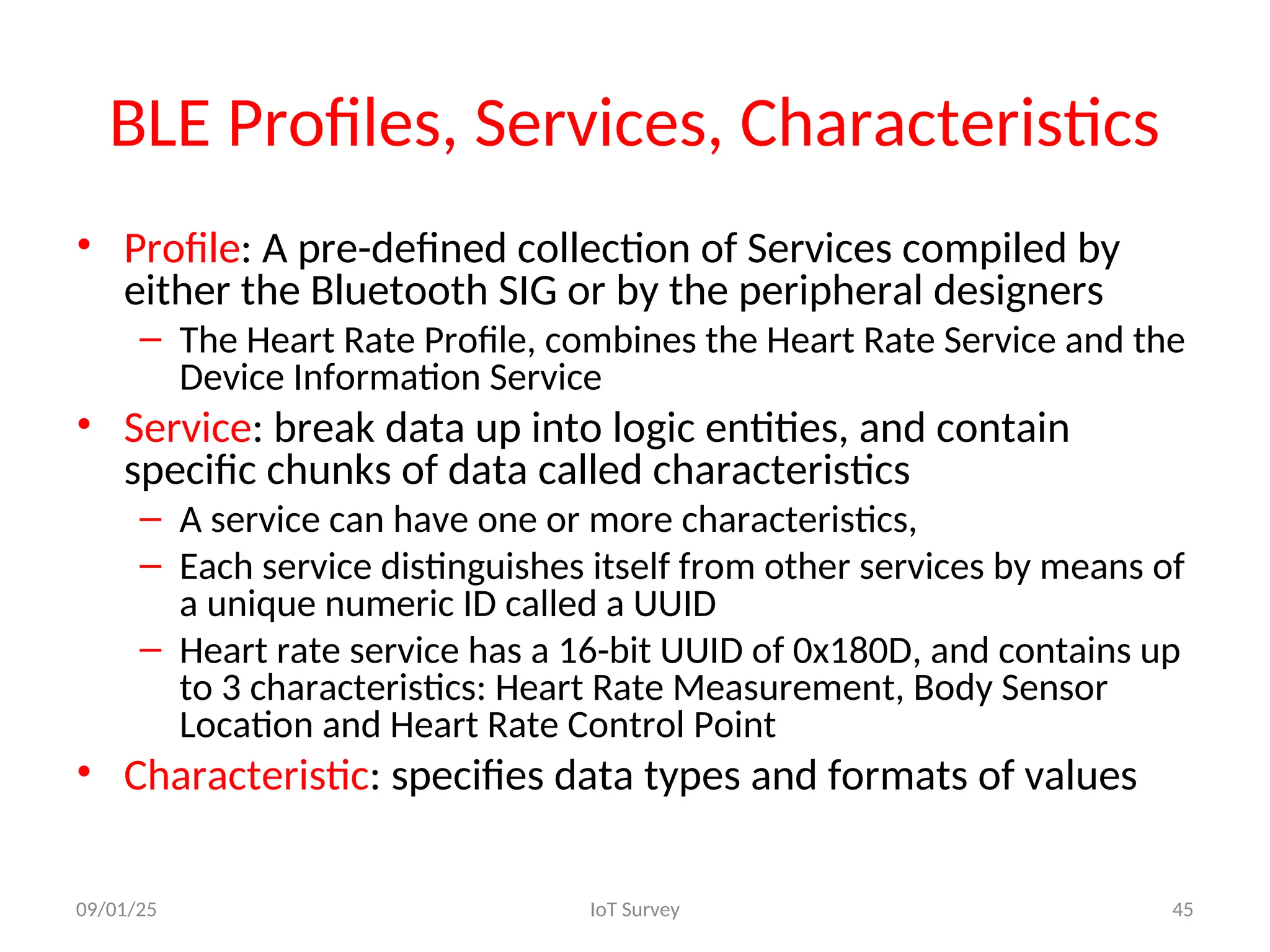
BLE Profiles, Services, Characteristics
• Profile: A pre-defined collection of Services compiled by
either the Bluetooth SIG or by the peripheral designers
– The Heart Rate Profile, combines the Heart Rate Service and the
Device Information Service
• Service: break data up into logic entities, and contain
specific chunks of data called characteristics
– A service can have one or more characteristics,
– Each service distinguishes itself from other services by means of
a unique numeric ID called a UUID
– Heart rate service has a 16-bit UUID of 0x180D, and contains up
to 3 characteristics: Heart Rate Measurement, Body Sensor
Location and Heart Rate Control Point
• Characteristic: specifies data types and formats of values
09/01/25 IoT Survey 45
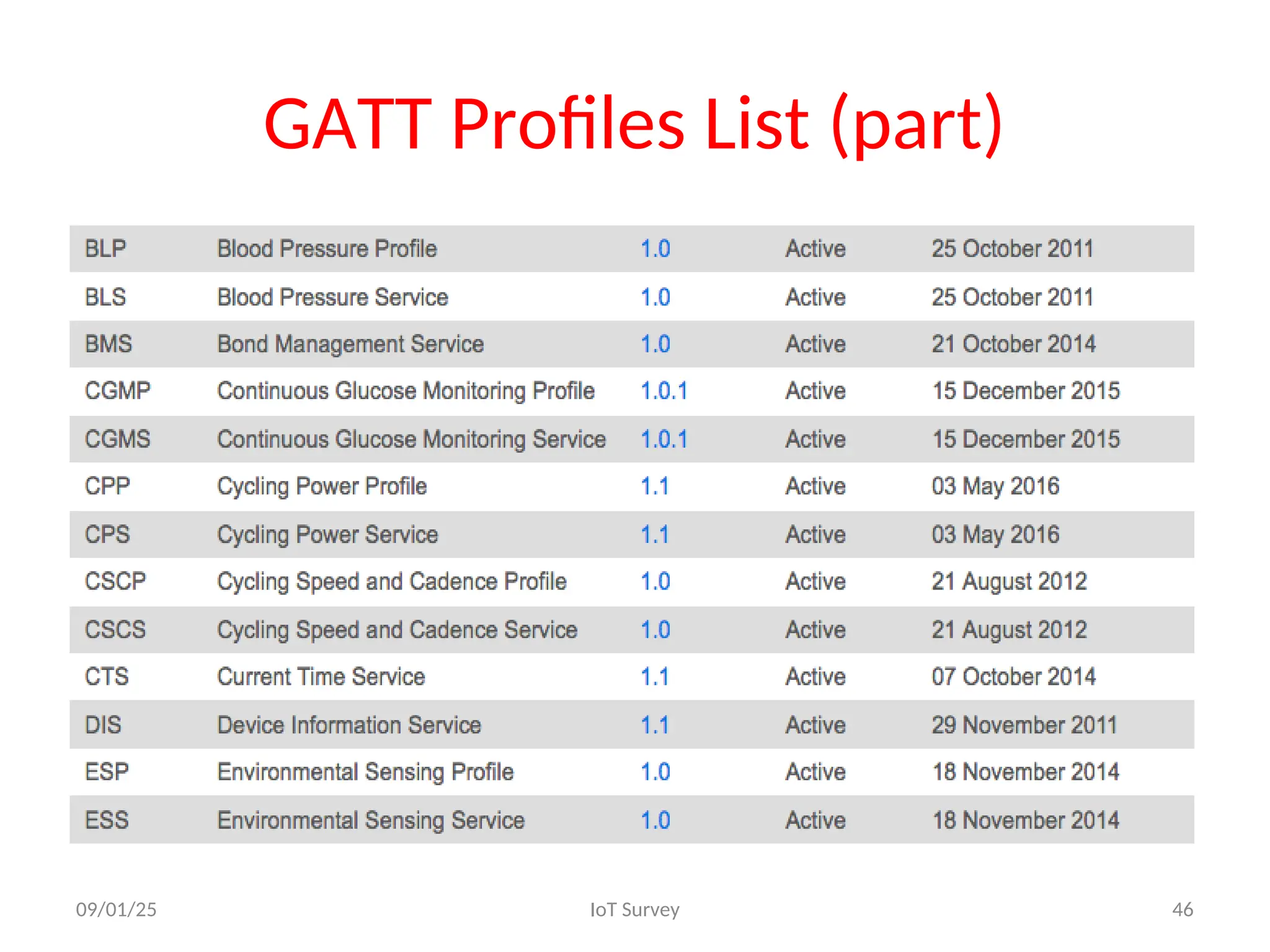
GATT Profiles List (part)
09/01/25 IoT Survey 46
Wi-Fi
• Allows devices to connect to a wireless LAN (WLAN)
network, mainly using the 2.4 gigahertz UHF and 5
gigahertz SHF radio bands.
• Wi-Fi compatible devices can connect to the Internet
via a WLAN network and a wireless access point
• Characteristics:
– Topology: star
– Data Transfer Rate: > 24 Mbit/s
– Power consumption: High
– Range: 30-100m
– Privacy: Low
09/01/25 IoT Survey 47
More Protocols
• Thread IPv6 for home networking
• Z-Wave for home networking
• Cellular for IoT operation in larger distances
(GSM 3G/4G)
09/01/25 IoT Survey 48
Low Power Wide Area Network
(LPWA) Protocols
• Target wide area networking (between WiFi and Cellular)
• Operate in License Free bands (Below 1GhZ)
– Range 1-50Km (rural), 1-10 (urban)
– Low transmission rates: 10-10Kbps
– Low Level protocol, Aloha protocol
– Low energy consumption
• Many versions: LoRa, Neul, SigFox, NB-IoT, LTE-M,
Weightless, DASH7, 6LoWPAN
– Different business model
– LoRa is open: Any manufacturer can build a LoRa module or
gateway or run a LoRa network but,
– SemTech is the only company that produces the radio
modulation chip
09/01/25 IoT Survey 49
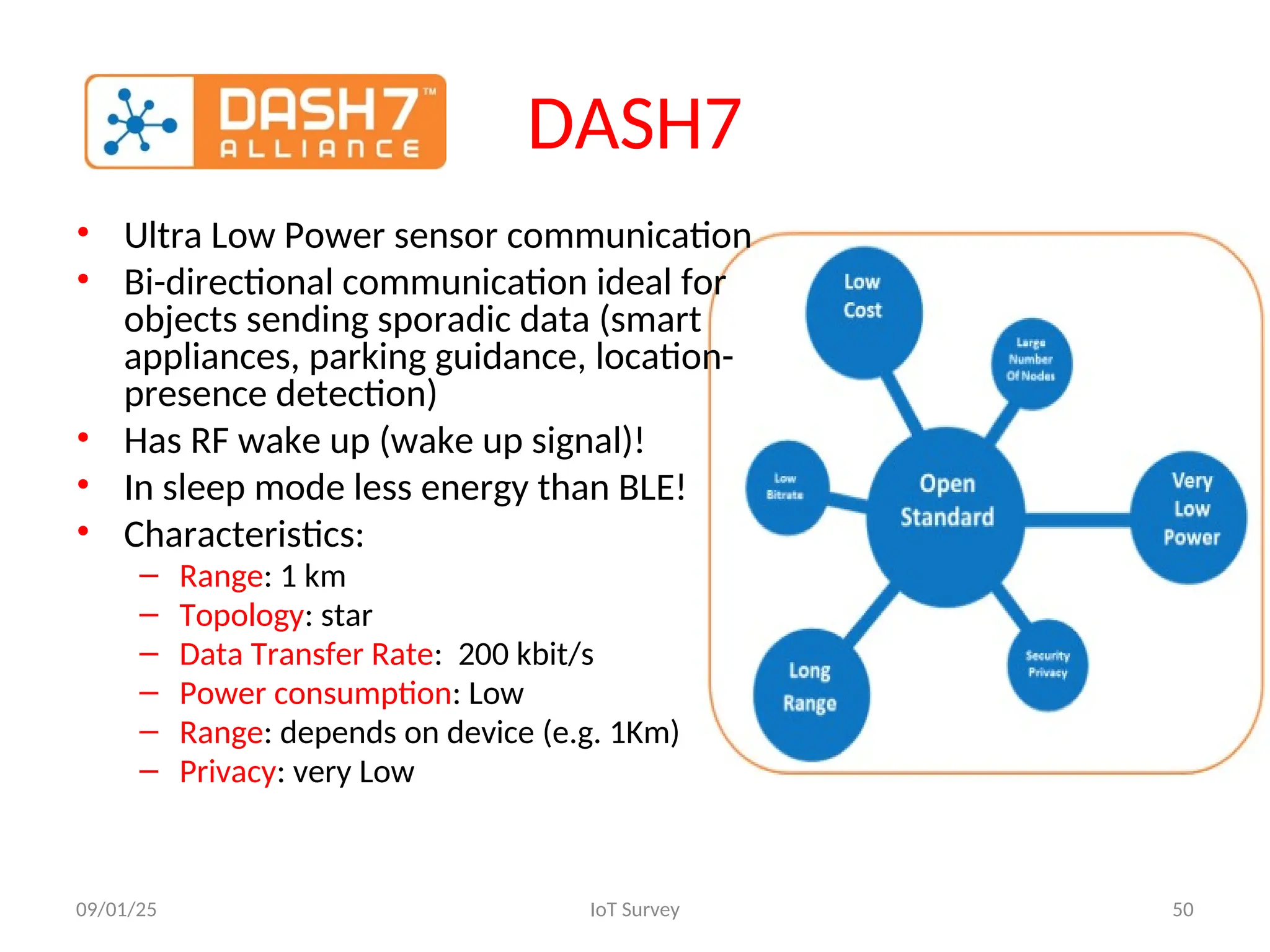
DASH7
• Ultra Low Power sensor communication
• Bi-directional communication ideal for
objects sending sporadic data (smart
appliances, parking guidance, location-
presence detection)
• Has RF wake up (wake up signal)!
• In sleep mode less energy than BLE!
• Characteristics:
– Range: 1 km
– Topology: star
– Data Transfer Rate: 200 kbit/s
– Power consumption: Low
– Range: depends on device (e.g. 1Km)
– Privacy: very Low
09/01/25 IoT Survey 50
6LoWPAN
• 6LoWPAN is a low-power wireless mesh network allowing
to connect directly to the Internet using open standards
– IPv6 over Low power Wireless Personal Area Networks
– Every node (a thing) has its own IPv6 address
– Originated from the idea that IP protocols should be applied
even to the smallest low-power devices, so that they can
participate in IoT
• Characteristics:
– Range: 20m
– Topology: star
– Power consumption: mid
– Privacy: mid
09/01/25 IoT Survey 51
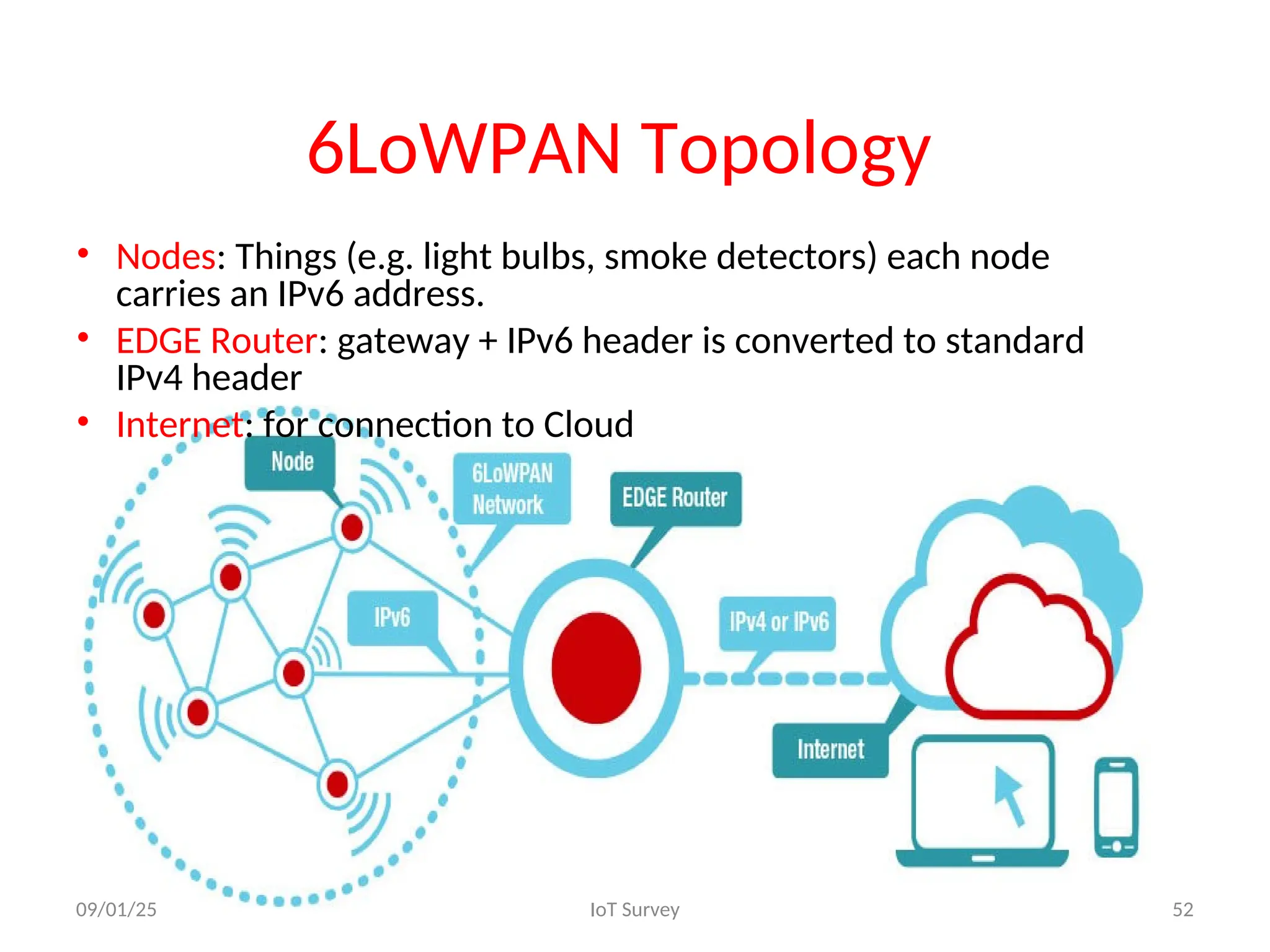
6LoWPAN Topology
• Nodes: Things (e.g. light bulbs, smoke detectors) each node
carries an IPv6 address.
• EDGE Router: gateway + IPv6 header is converted to standard
IPv4 header
• Internet: for connection to Cloud
09/01/25 IoT Survey 52
Weightless
• Proprietary wireless technology standard for
exchanging data between a base station and
thousands of machines around it using White space
(wavelength radio transmissions in unoccupied TV
transmission channels) with high levels of security
• Characteristics:
– Range: < 10 Km
– Topology: star
– Power consumption: mid
– Privacy: Very High
• Examples: traffic sensors, industrial monitoring
09/01/25 IoT Survey 53
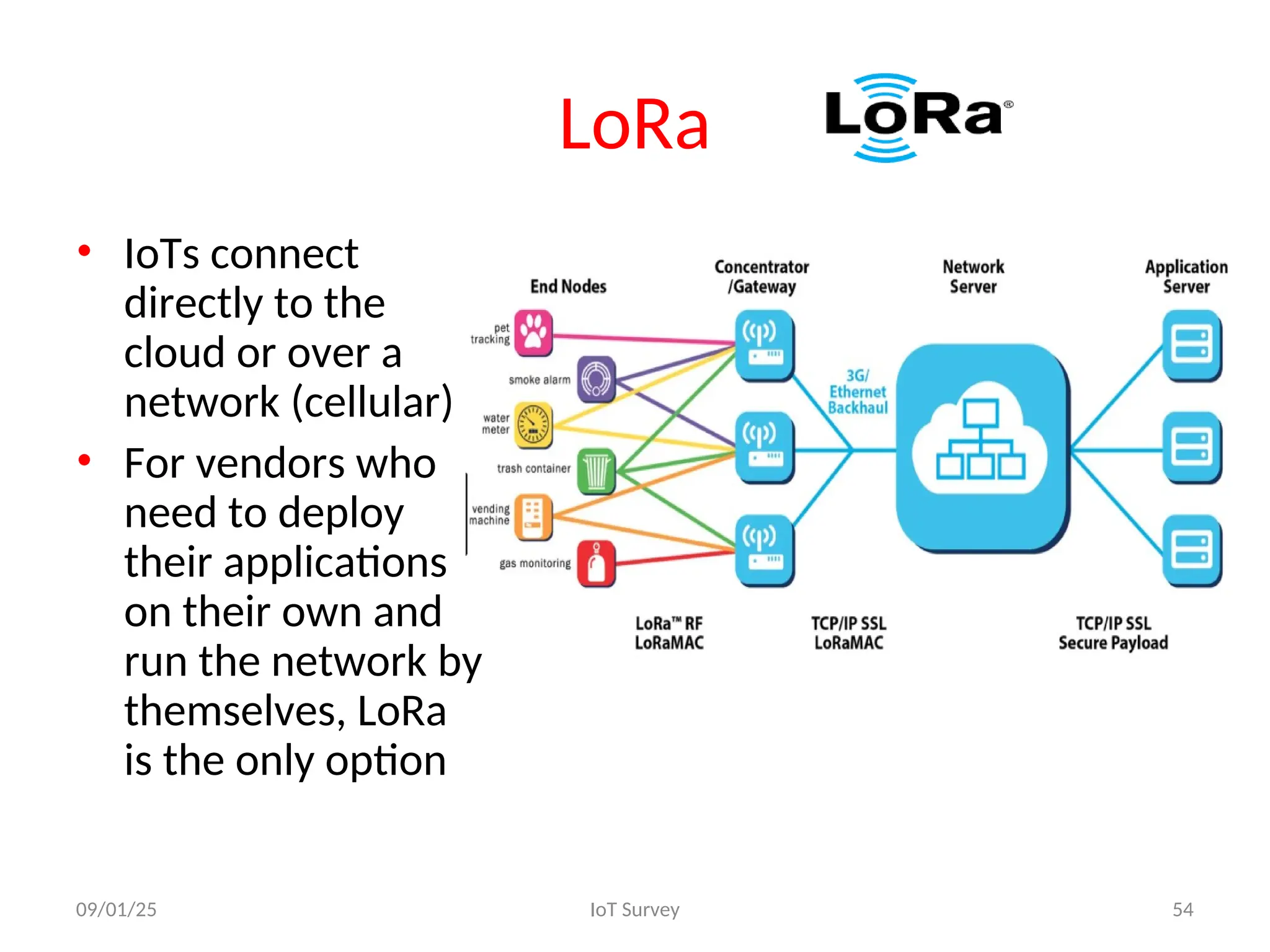
LoRa
09/01/25 IoT Survey 54
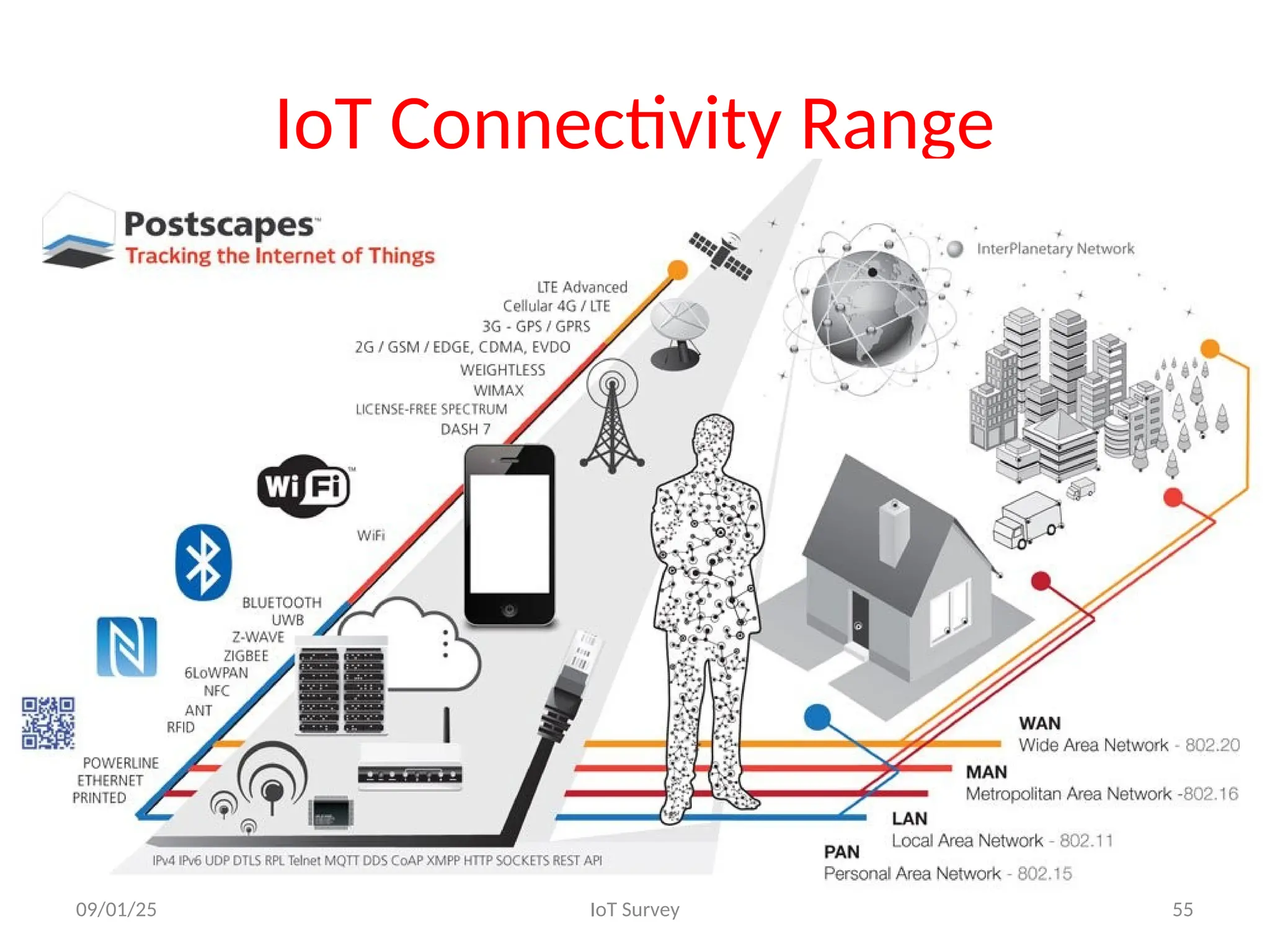
• IoTs connect
directly to the
cloud or over a
network (cellular)
• For vendors who
need to deploy
their applications
on their own and
run the network by
themselves, LoRa
is the only option
IoT Connectivity Range
09/01/25 IoT Survey 55
Wireless Protocols
09/01/25 IoT Survey 56
09/01/25 IoT Survey 57
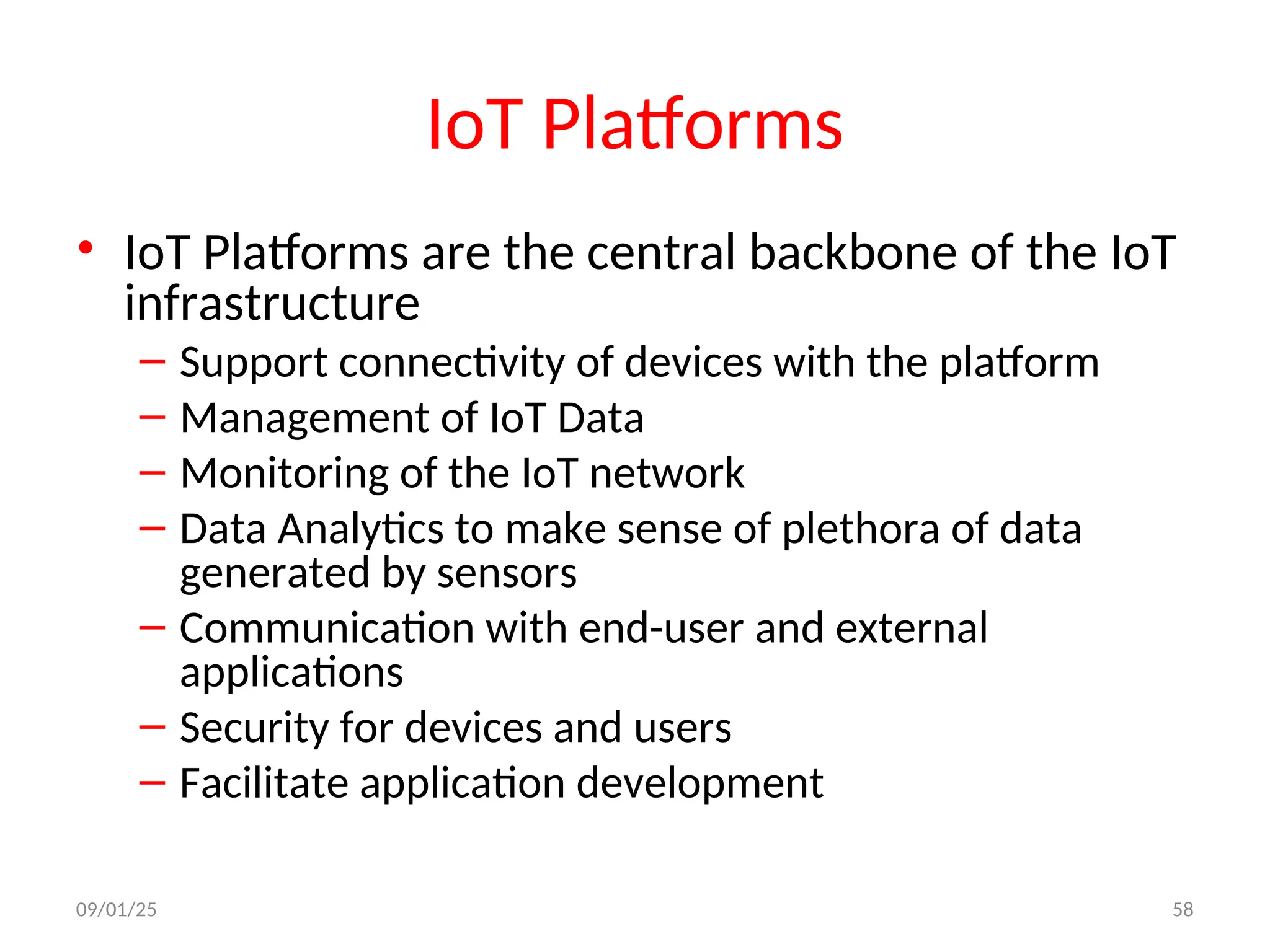
IoT Platforms
• IoT Platforms are the central backbone of the IoT
infrastructure
– Support connectivity of devices with the platform
– Management of IoT Data
– Monitoring of the IoT network
– Data Analytics to make sense of plethora of data
generated by sensors
– Communication with end-user and external
applications
– Security for devices and users
– Facilitate application development
09/01/25 58
IoT Landscape
• IoT technology is far from being standardised
– Different hardware units
– Many different connection protocols
– Many solutions are proprietary
• IoT landscape can be compared to the Internet
in the 90’s
– Browser standardization battle (Explorer, Netscape)
– Search Engine battle (Yahoo, AltaVista, Lycos,
Copernicus)
09/01/25 IoT Survey 59
IoT Platforms as Products
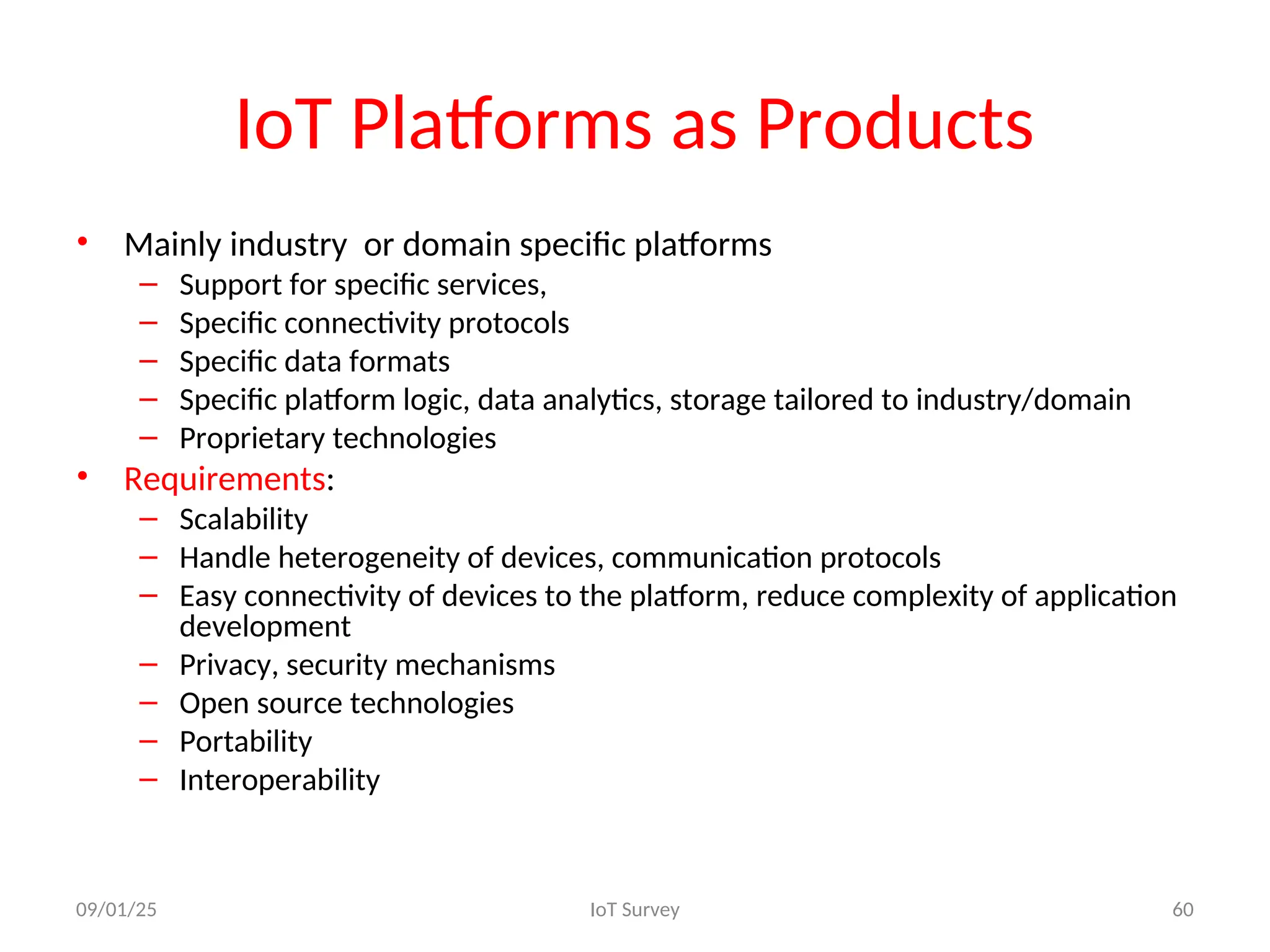
• Mainly industry or domain specific platforms
– Support for specific services,
– Specific connectivity protocols
– Specific data formats
– Specific platform logic, data analytics, storage tailored to industry/domain
– Proprietary technologies
• Requirements:
– Scalability
– Handle heterogeneity of devices, communication protocols
– Easy connectivity of devices to the platform, reduce complexity of application
development
– Privacy, security mechanisms
– Open source technologies
– Portability
– Interoperability
09/01/25 IoT Survey 60
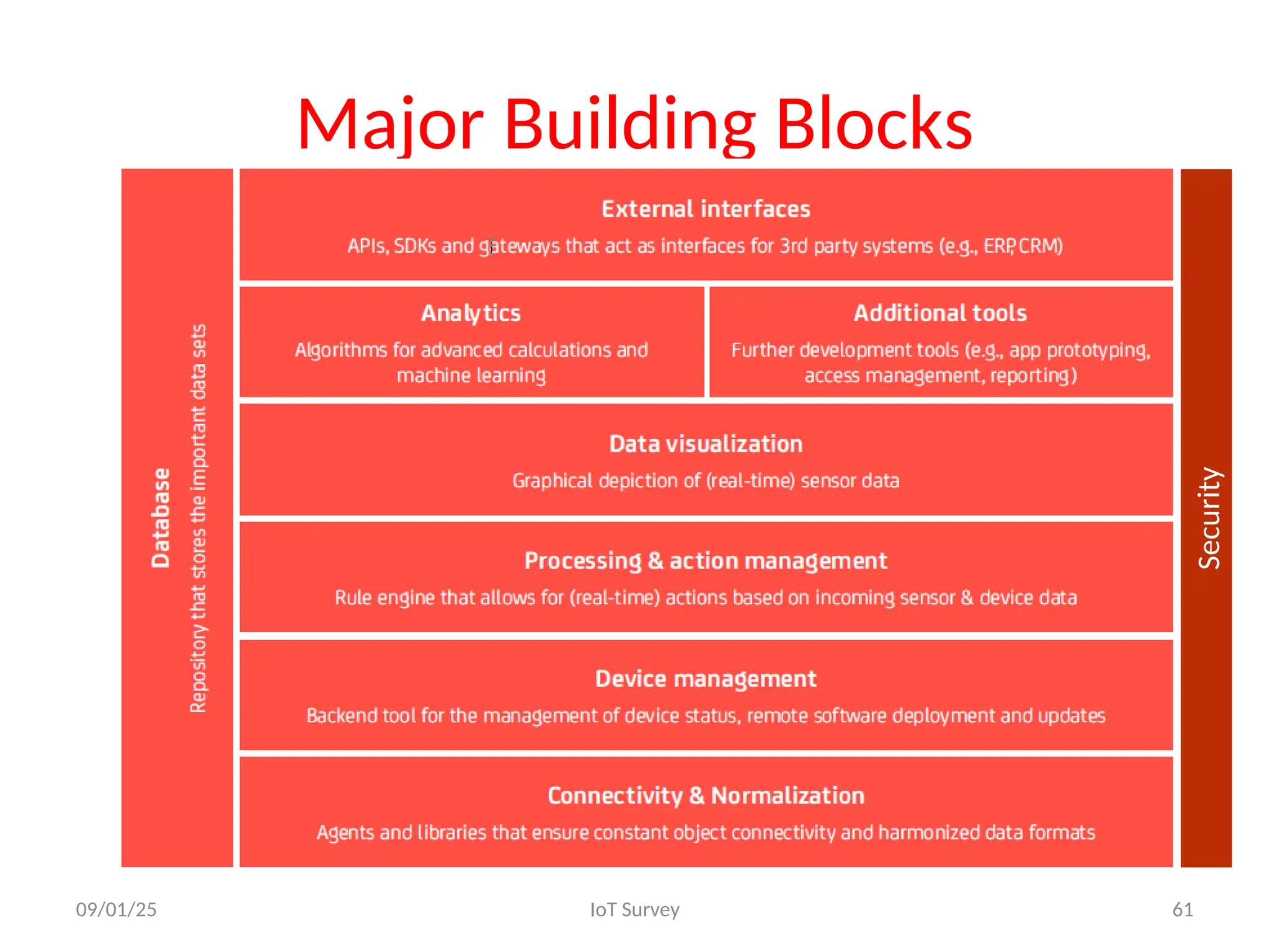
Major Building Blocks
09/01/25 IoT Survey 61
Security
Technological Depth
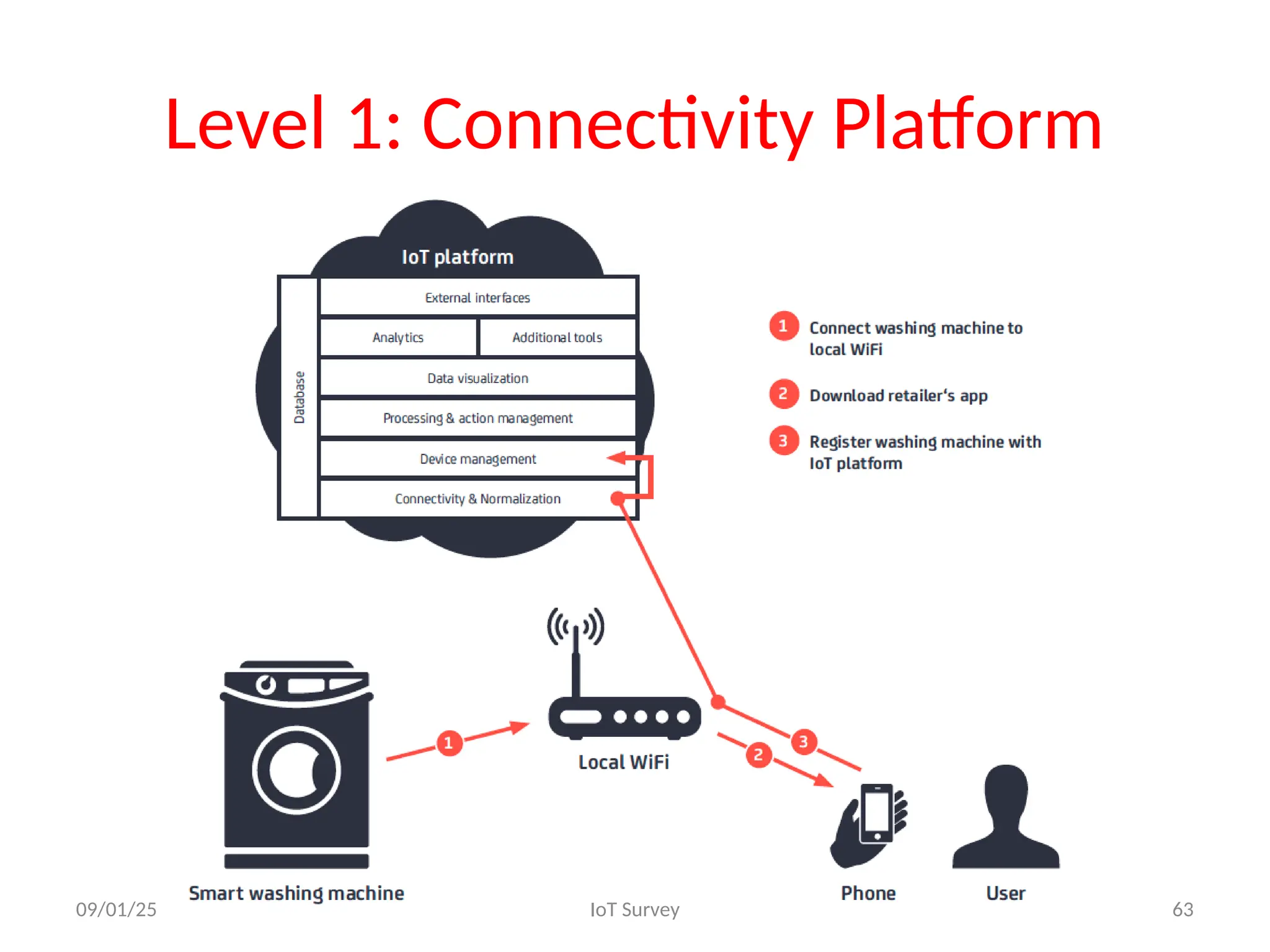
• Connectivity Platform: Simplest IoT platforms,
act as data collectors and provide simple
messaging bus
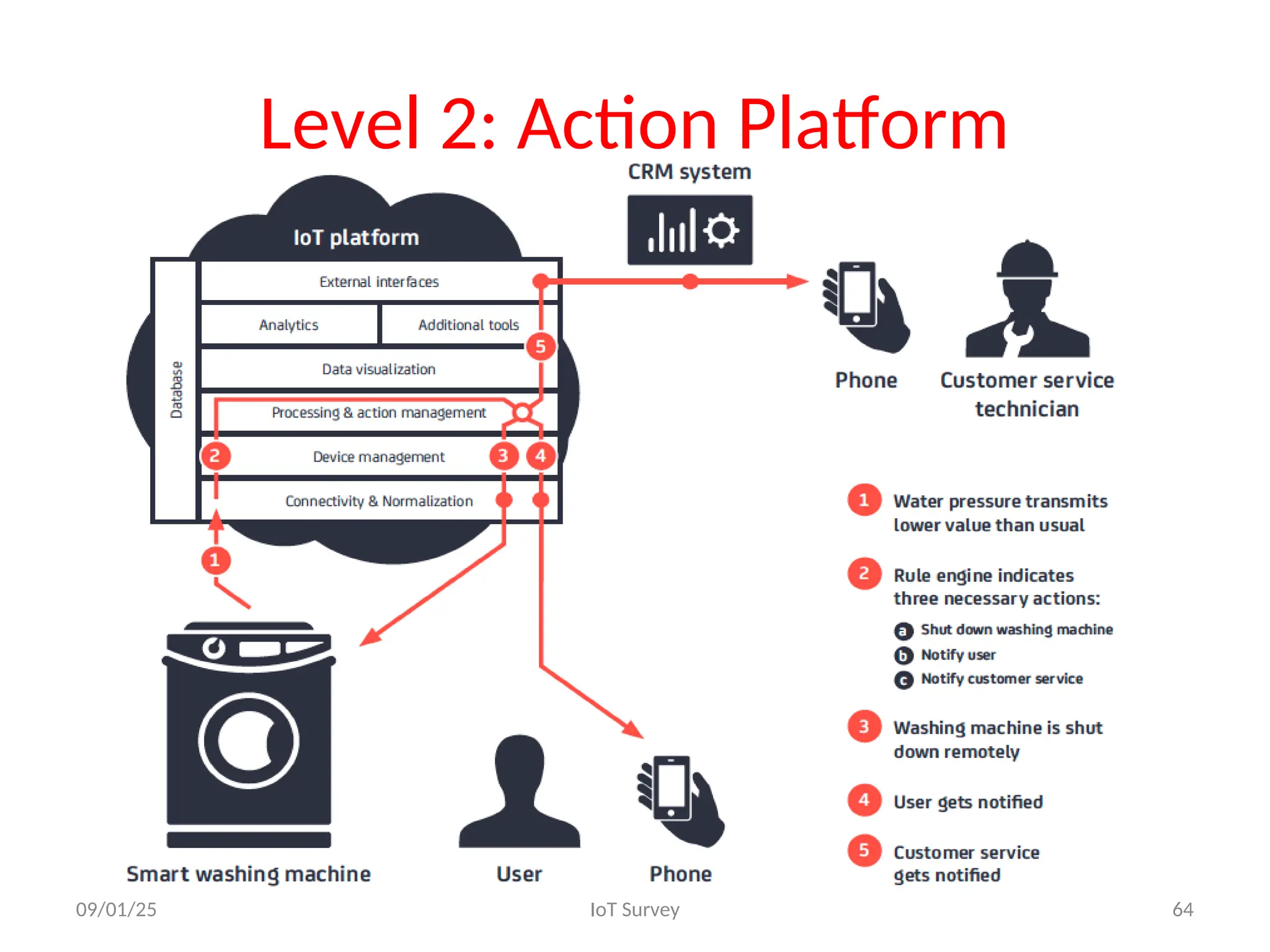
• Action Platform: Connectivity platform +
actions to handle events (e.g. water leaks)
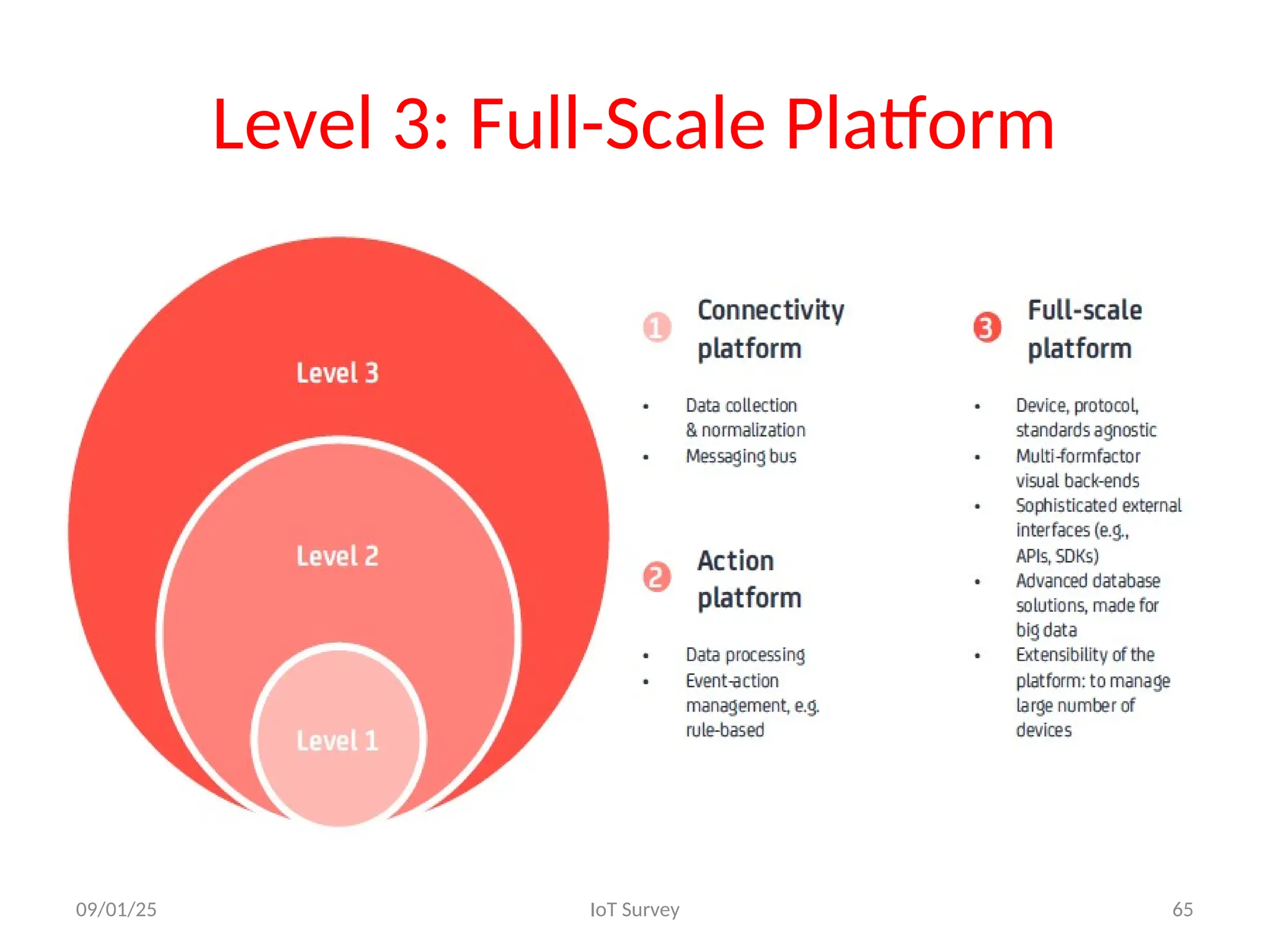
• Full-Scale Platform: Connectivity Platform +
Action Platform + Data Analytics, Reasoning,
Mashups, Complex Workflows
09/01/25 IoT Survey 62
Level 1: Connectivity Platform
09/01/25 IoT Survey 63
Level 2: Action Platform
09/01/25 IoT Survey 64
Level 3: Full-Scale Platform
09/01/25 IoT Survey 65
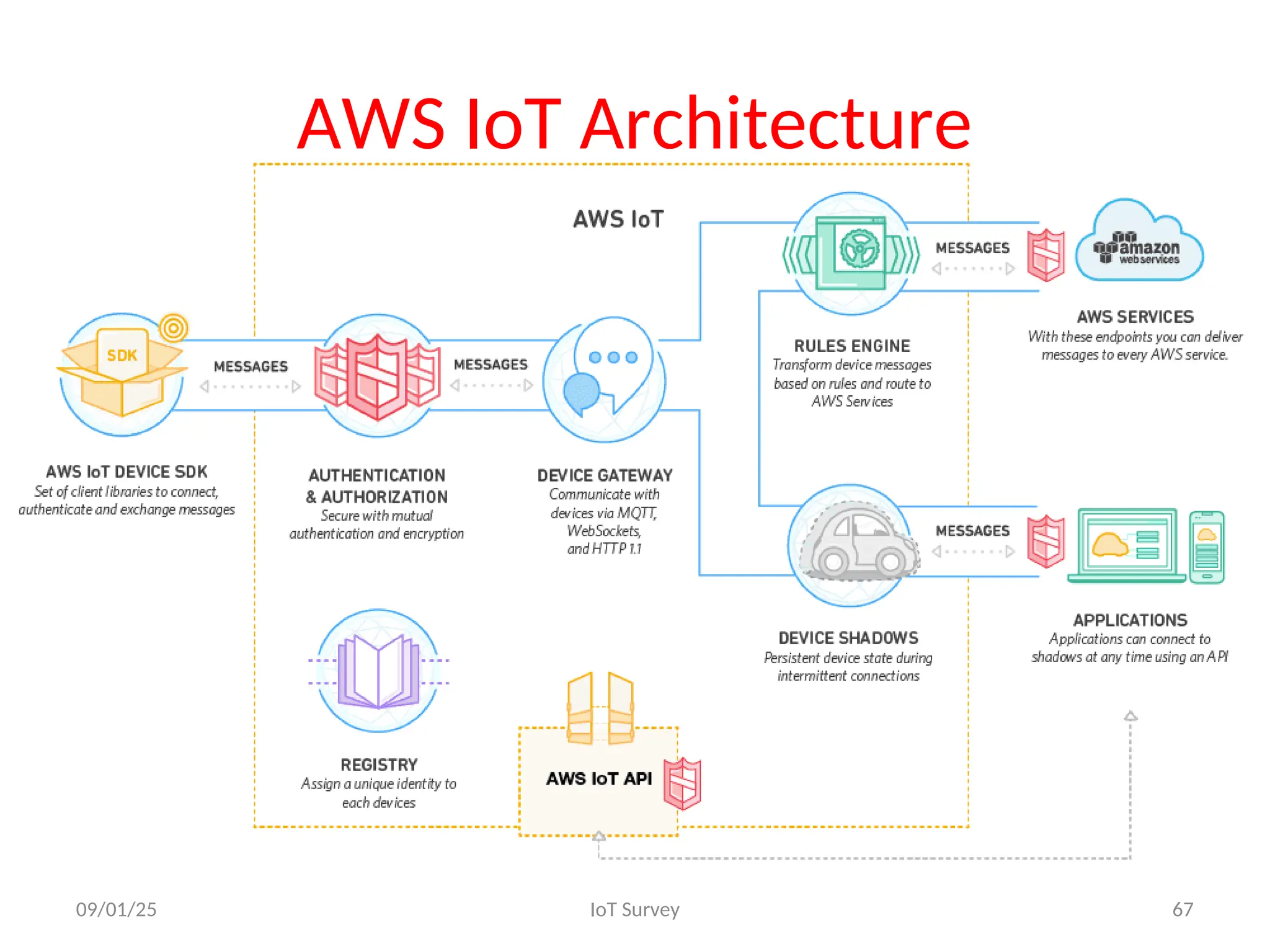
Amazon Web Services (AWS) IoT
• Makes it a lot easier for developers to connect sensors for multiple
applications ranging from automobiles to turbines to smart home
light bulbs
• Main features of AWS IoT platform are:
– Registry for recognizing devices
– Software Development Kit (SDK) for devices*
– Secure Device Gateway
– Rules engine for inbound message evaluation
– Device Shadows
• Device Shadows: JSON document that is used to store and retrieve
current information state for a thing (device, app)
• *Amazon has partnered with hardware manufacturers like Intel,
Texas Instruments, Broadcom and Qualcomm to create starter kits
compatible with their platform.
09/01/25 IoT Survey 66
AWS IoT Architecture
09/01/25 IoT Survey 67
Microsoft Azure IoT
• For processing the massive amount of
information generated by sensors
• Comes with Azure Stream Analytics (similar to
Storm) to process massive amounts of
information in real-time
• Features included in this platform are:
– Device shadowing
– A rules engine
– Identity registry
– Information monitoring
09/01/25 IoT Survey 68
Thing Worx IoT
• Designed for enterprise application
development It offers features like:
– Easy connectivity of devices to the platform
– Remove complexity of IoT application
development
– Sharing platform among developers for rapid
development
– Integrated machine learning for automating
complex big data analytics
09/01/25 IoT Survey 69
More IoT Platforms
• IBM IoT
• Intel IoT Platform
• Cisco IoT Cloud Connect
• Oracle Integrated Cloud
• General Electric Predix
• Xively IoT platform
• Salesforce IoT Cloud (creating sales orders , handling
Services-Request and order repairs automatically, Notifies
customers through texts directly on their devices)
• Carriots
• More information: Top10 IoT platforms
http://internetofthingswiki.com/top-10-iot-platforms/634/
09/01/25 IoT Survey 70
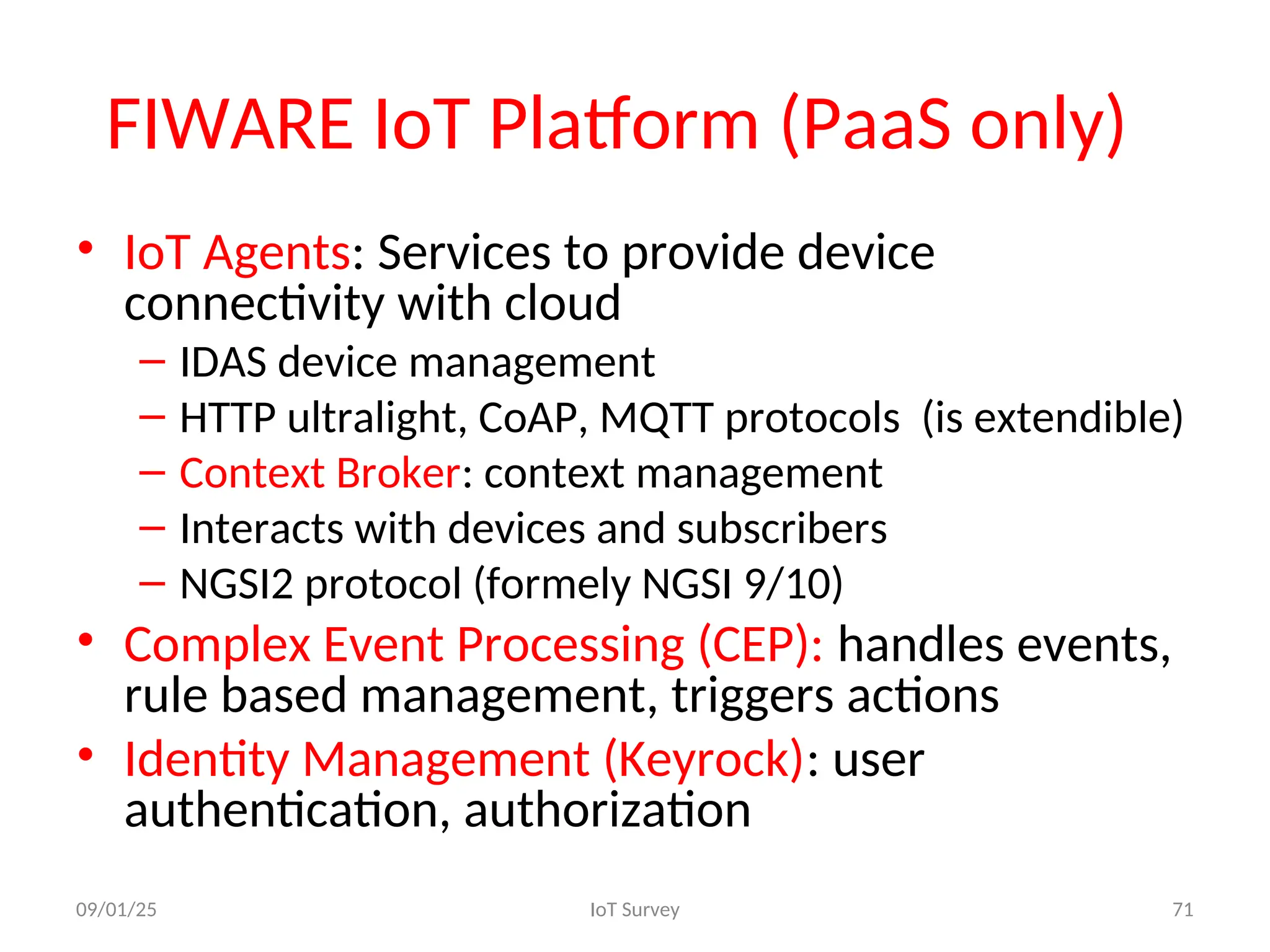
FIWARE IoT Platform (PaaS only)
• IoT Agents: Services to provide device
connectivity with cloud
– IDAS device management
– HTTP ultralight, CoAP, MQTT protocols (is extendible)
– Context Broker: context management
– Interacts with devices and subscribers
– NGSI2 protocol (formely NGSI 9/10)
• Complex Event Processing (CEP): handles events,
rule based management, triggers actions
• Identity Management (Keyrock): user
authentication, authorization
09/01/25 IoT Survey 71
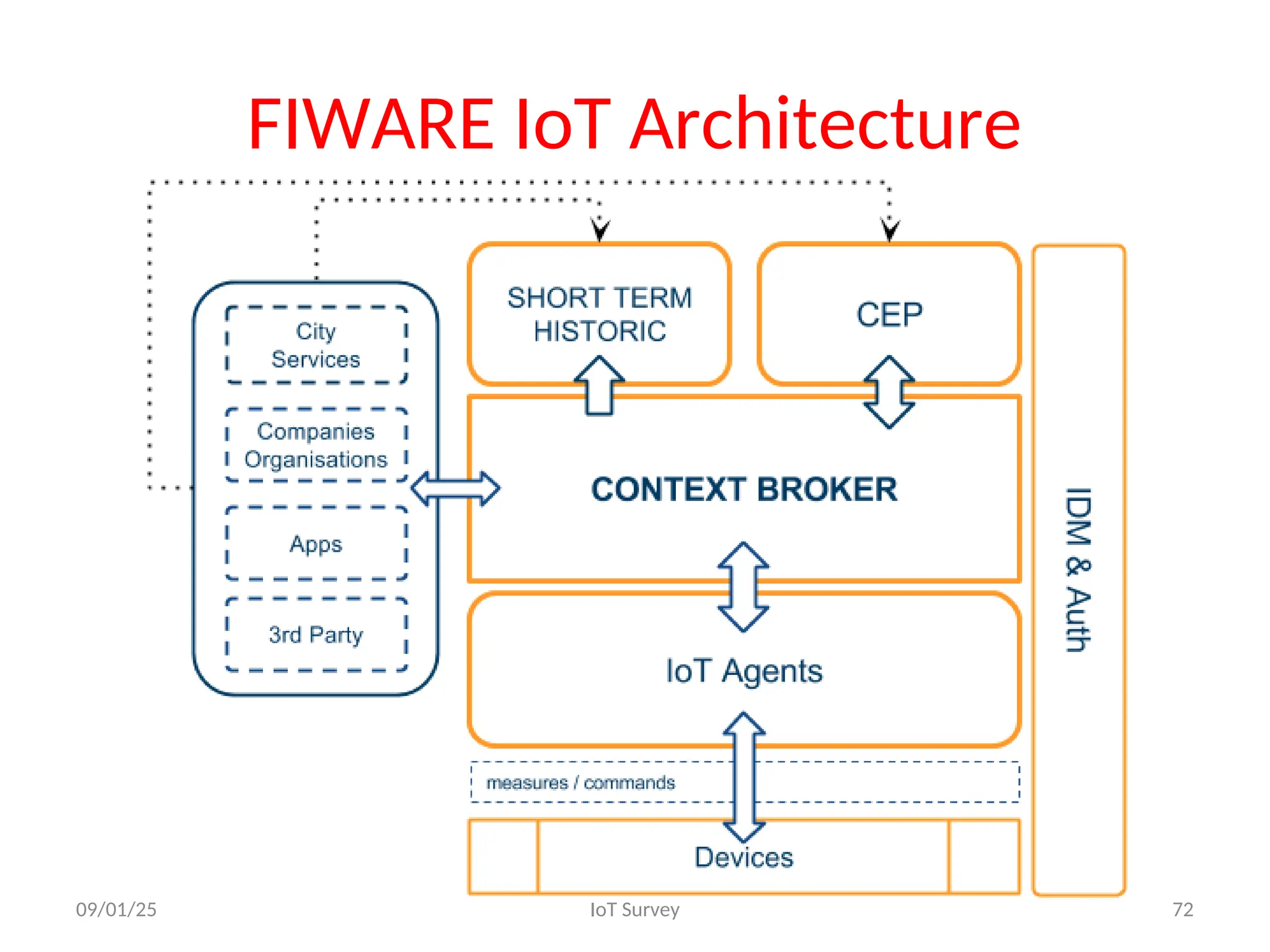
FIWARE IoT Architecture
09/01/25 IoT Survey 72
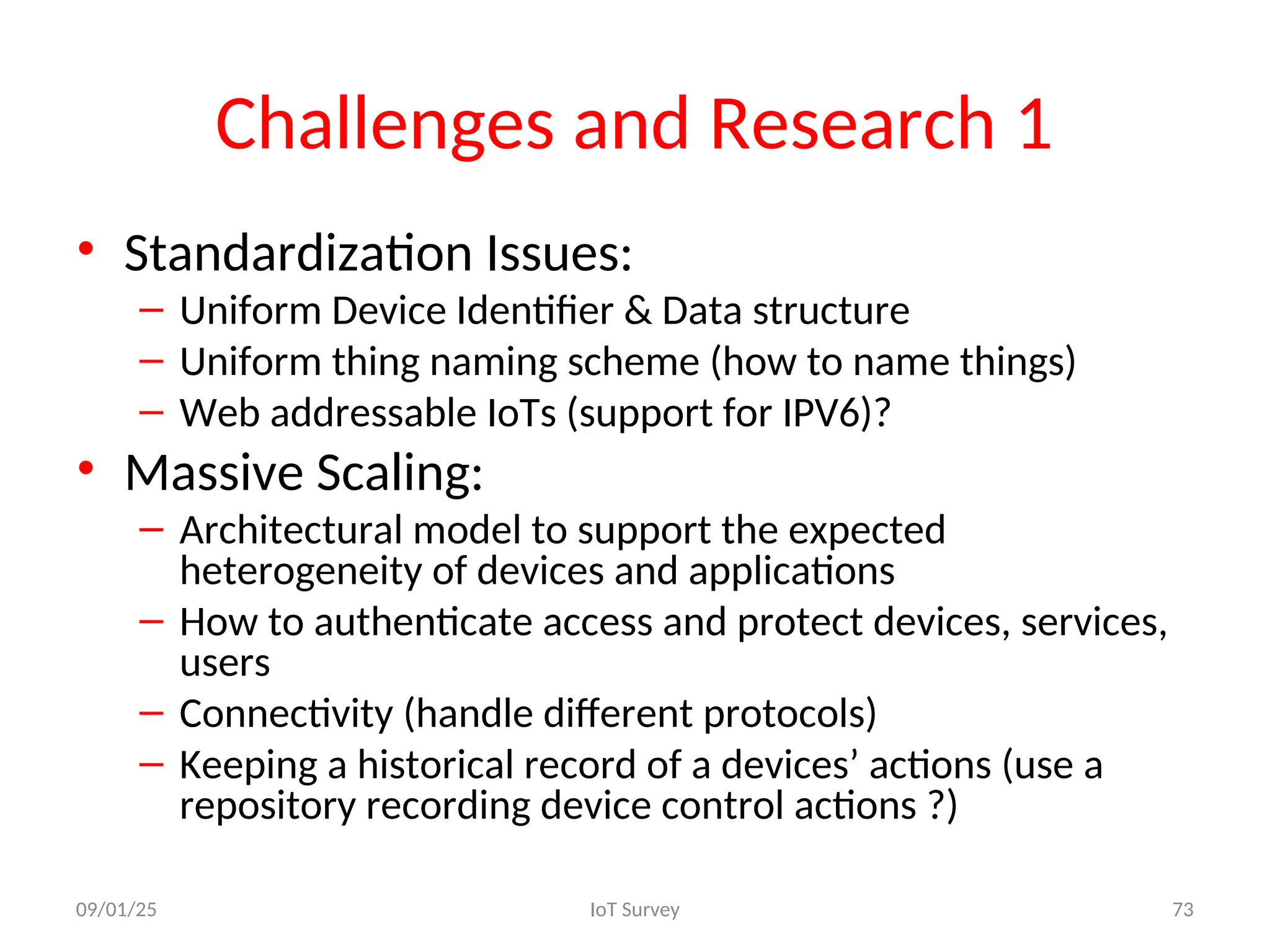
Challenges and Research 1
• Standardization Issues:
– Uniform Device Identifier & Data structure
– Uniform thing naming scheme (how to name things)
– Web addressable IoTs (support for IPV6)?
• Massive Scaling:
– Architectural model to support the expected
heterogeneity of devices and applications
– How to authenticate access and protect devices, services,
users
– Connectivity (handle different protocols)
– Keeping a historical record of a devices’ actions (use a
repository recording device control actions ?)
09/01/25 IoT Survey 73
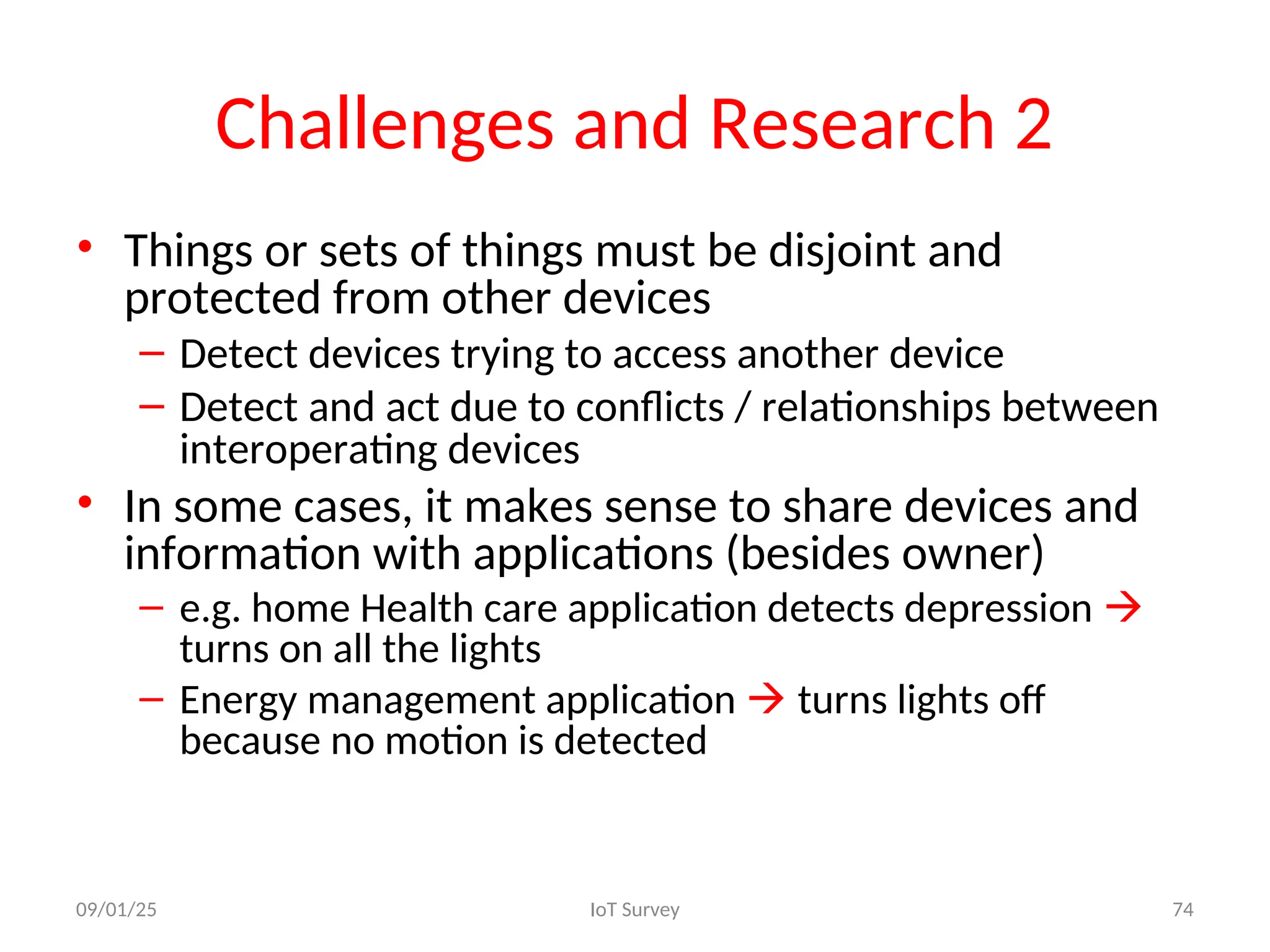
Challenges and Research 2
• Things or sets of things must be disjoint and
protected from other devices
– Detect devices trying to access another device
– Detect and act due to conflicts / relationships between
interoperating devices
• In some cases, it makes sense to share devices and
information with applications (besides owner)
– e.g. home Health care application detects depression 
turns on all the lights
– Energy management application  turns lights off
because no motion is detected
09/01/25 IoT Survey 74
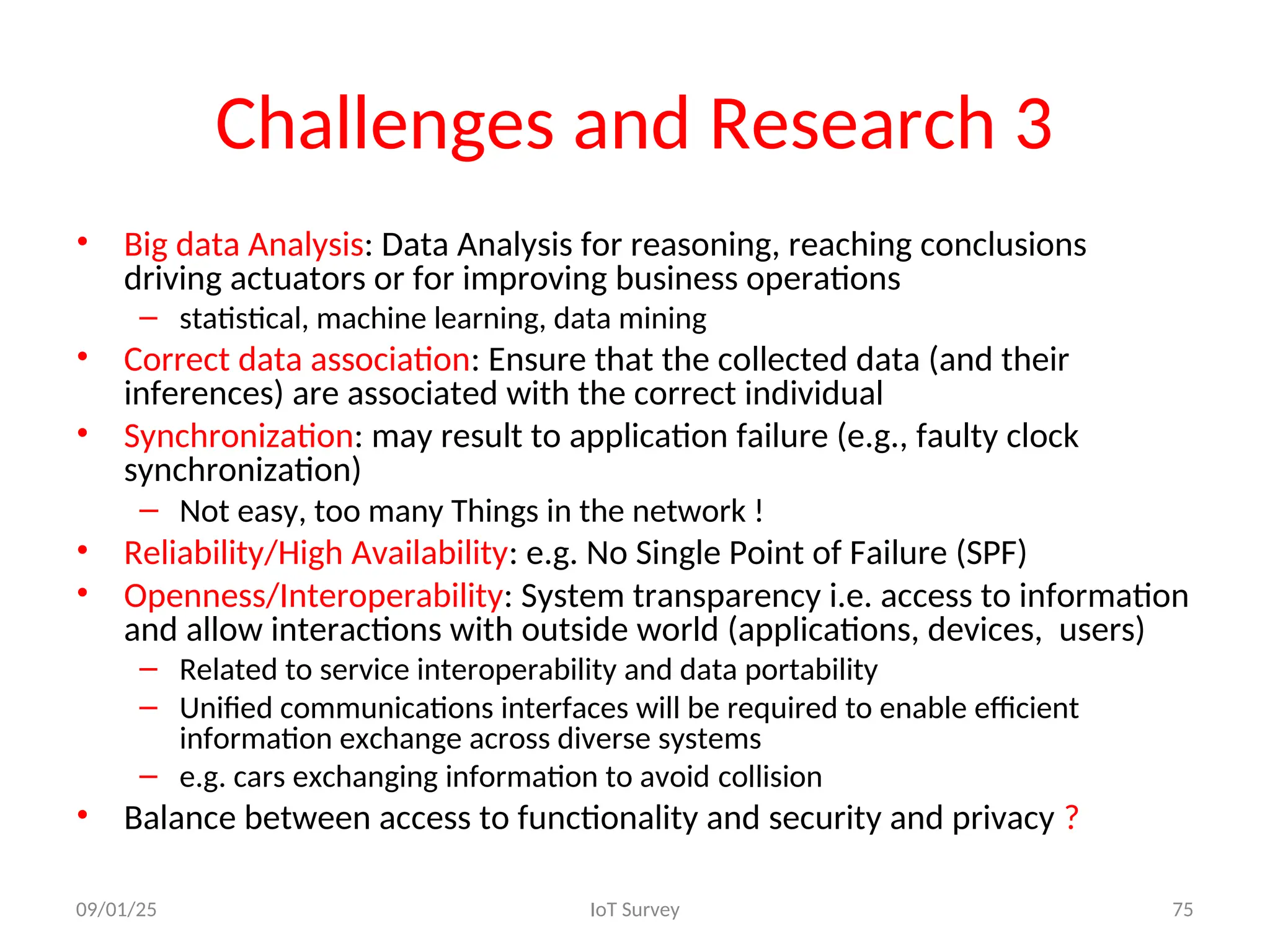
Challenges and Research 3
• Big data Analysis: Data Analysis for reasoning, reaching conclusions
driving actuators or for improving business operations
– statistical, machine learning, data mining
• Correct data association: Ensure that the collected data (and their
inferences) are associated with the correct individual
• Synchronization: may result to application failure (e.g., faulty clock
synchronization)
– Not easy, too many Things in the network !
• Reliability/High Availability: e.g. No Single Point of Failure (SPF)
• Openness/Interoperability: System transparency i.e. access to information
and allow interactions with outside world (applications, devices, users)
– Related to service interoperability and data portability
– Unified communications interfaces will be required to enable efficient
information exchange across diverse systems
– e.g. cars exchanging information to avoid collision
• Balance between access to functionality and security and privacy ?
09/01/25 IoT Survey 75
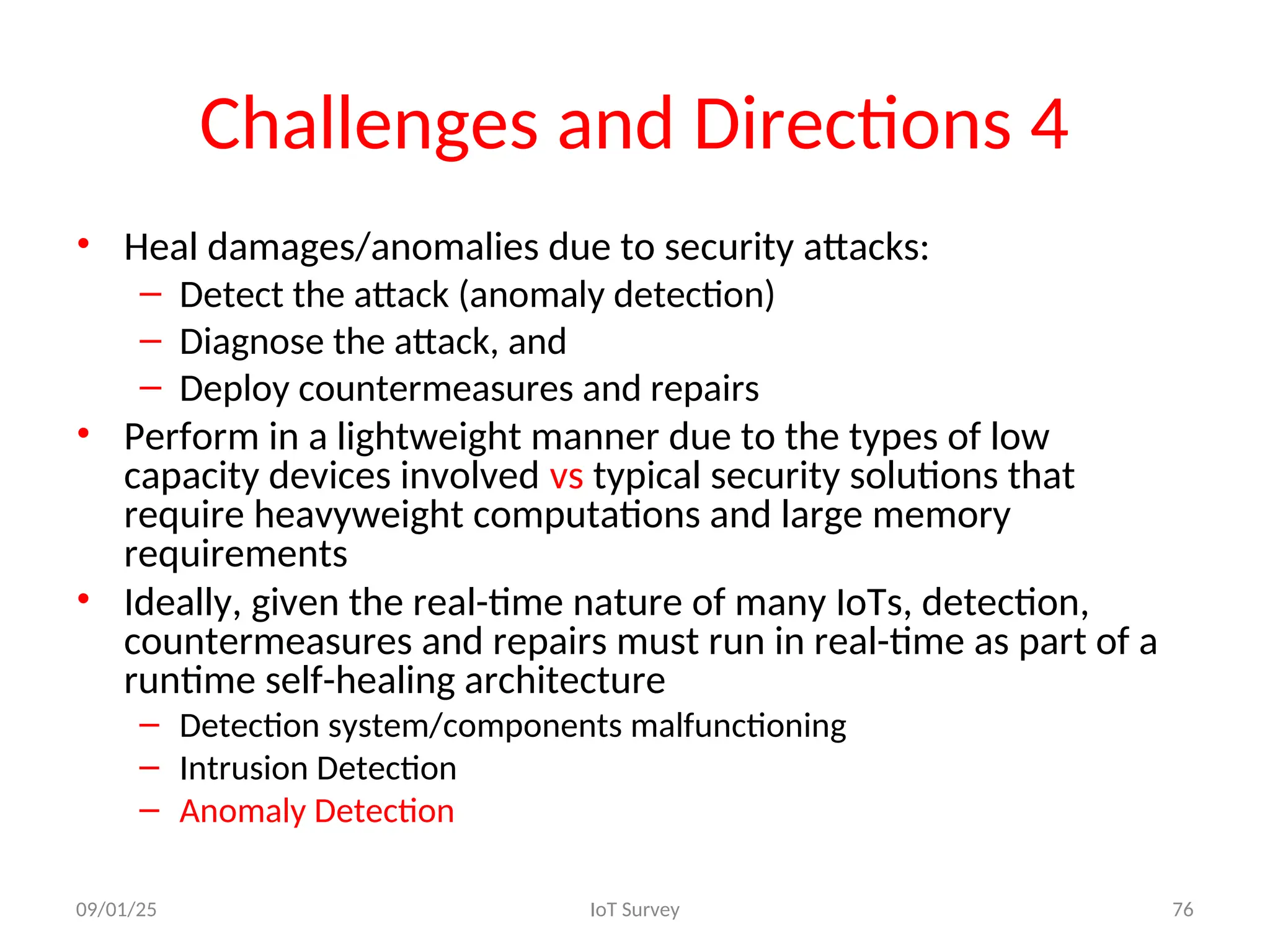
Challenges and Directions 4
• Heal damages/anomalies due to security attacks:
– Detect the attack (anomaly detection)
– Diagnose the attack, and
– Deploy countermeasures and repairs
• Perform in a lightweight manner due to the types of low
capacity devices involved vs typical security solutions that
require heavyweight computations and large memory
requirements
• Ideally, given the real-time nature of many IoTs, detection,
countermeasures and repairs must run in real-time as part of a
runtime self-healing architecture
– Detection system/components malfunctioning
– Intrusion Detection
– Anomaly Detection
09/01/25 IoT Survey 76
IoT solution examples
09/01/25 IoT Survey 77
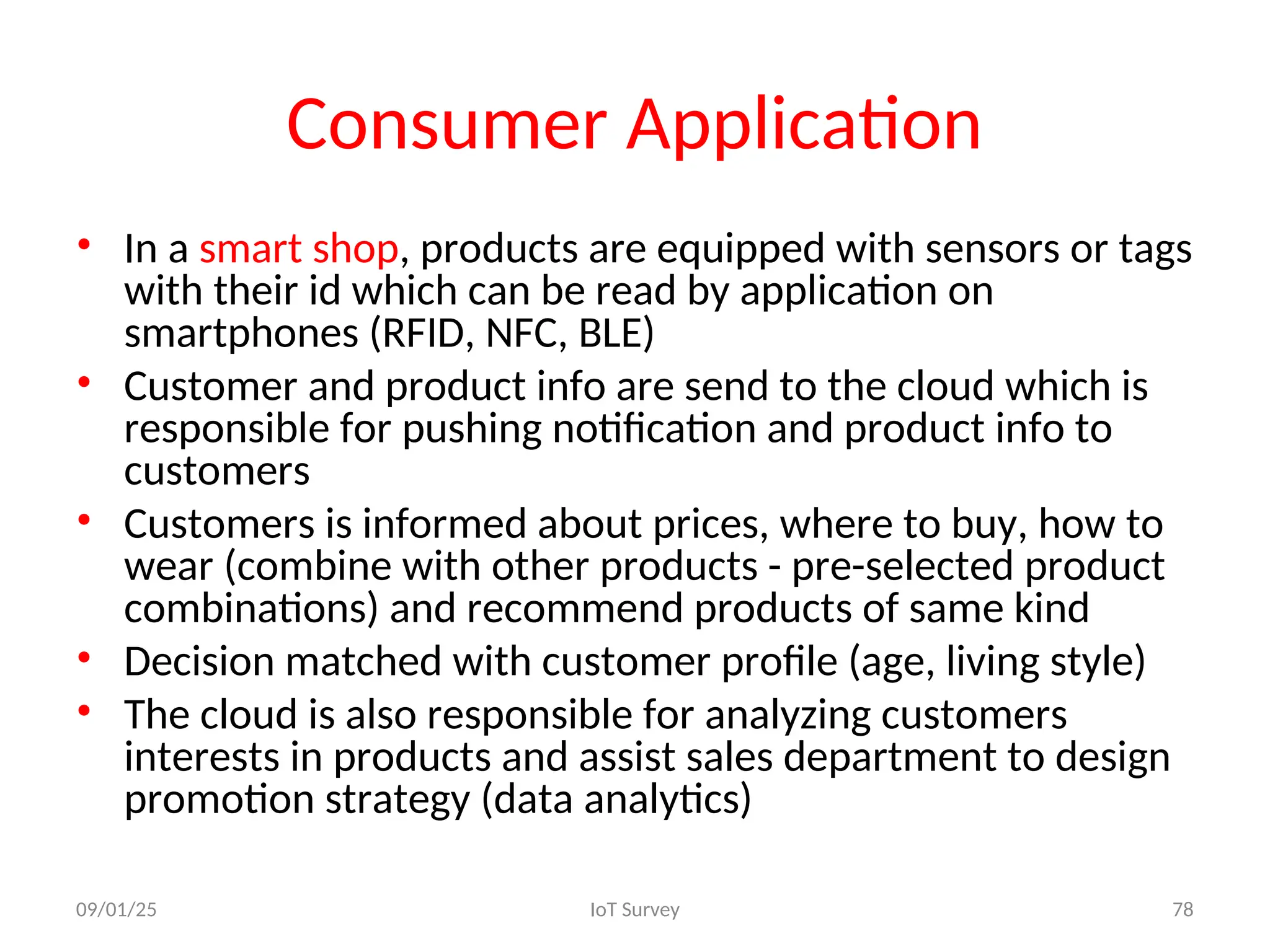
Consumer Application
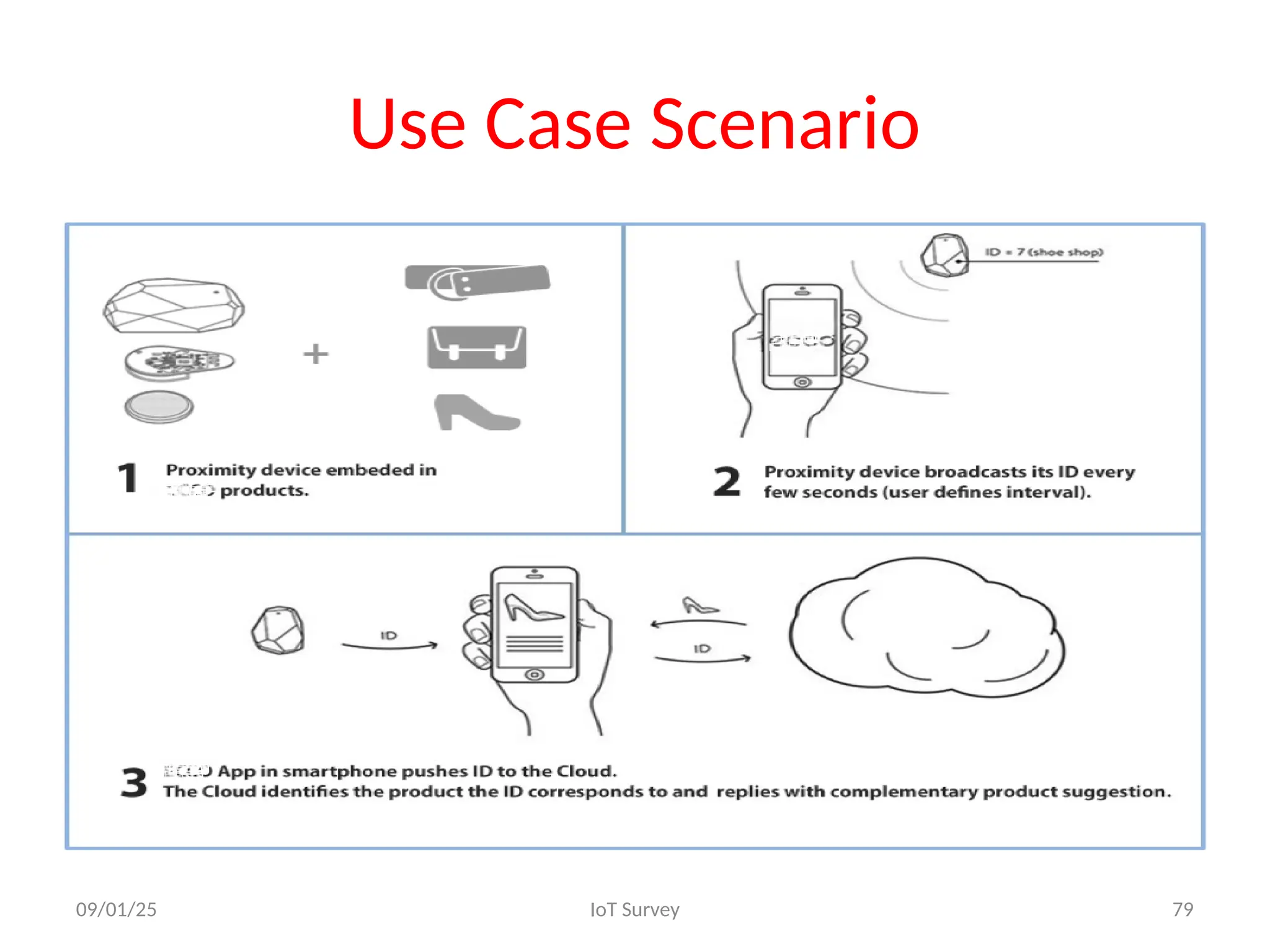
• In a smart shop, products are equipped with sensors or tags
with their id which can be read by application on
smartphones (RFID, NFC, BLE)
• Customer and product info are send to the cloud which is
responsible for pushing notification and product info to
customers
• Customers is informed about prices, where to buy, how to
wear (combine with other products - pre-selected product
combinations) and recommend products of same kind
• Decision matched with customer profile (age, living style)
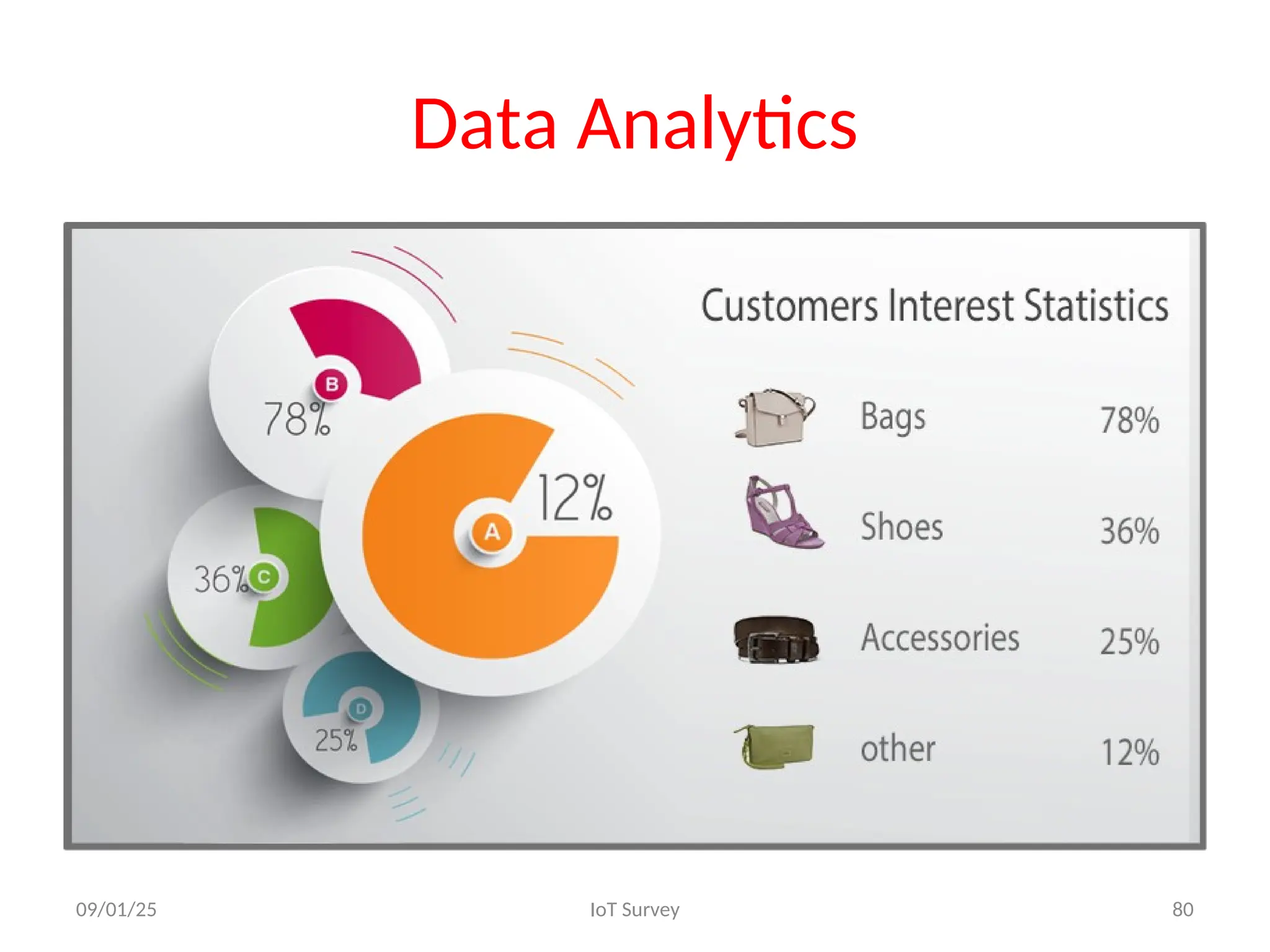
• The cloud is also responsible for analyzing customers
interests in products and assist sales department to design
promotion strategy (data analytics)
09/01/25 IoT Survey 78
Use Case Scenario
09/01/25 IoT Survey 79
Data Analytics
09/01/25 IoT Survey 80
Industry 4.0
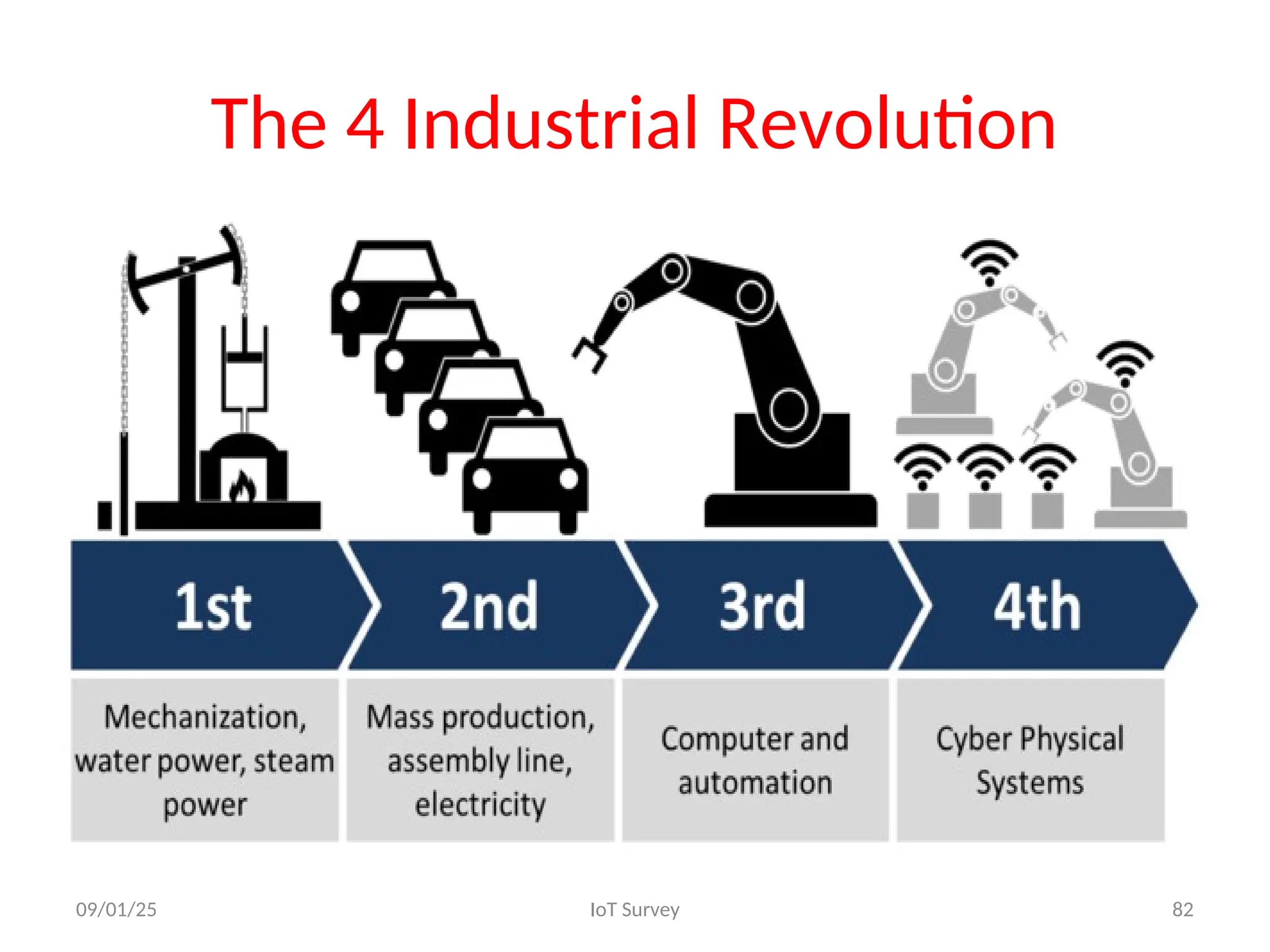
• Project of German Government which promotes
computerization of manufacturing through
automation, data exchange
• Synergy with CPS, IoT and Cloud Computing
• Smart factory: CPS monitor physical processes and
take decentralized decisions, communicate over
Internet with humans and with other processes (e.g. if
failure in one machine notify others to stall)
• Centralized decisions or services (e.g. production
planning or interferences, conflicting goals) are taken
at higher cloud computing level
09/01/25 IoT Survey 81
The 4 Industrial Revolution
09/01/25 IoT Survey 82
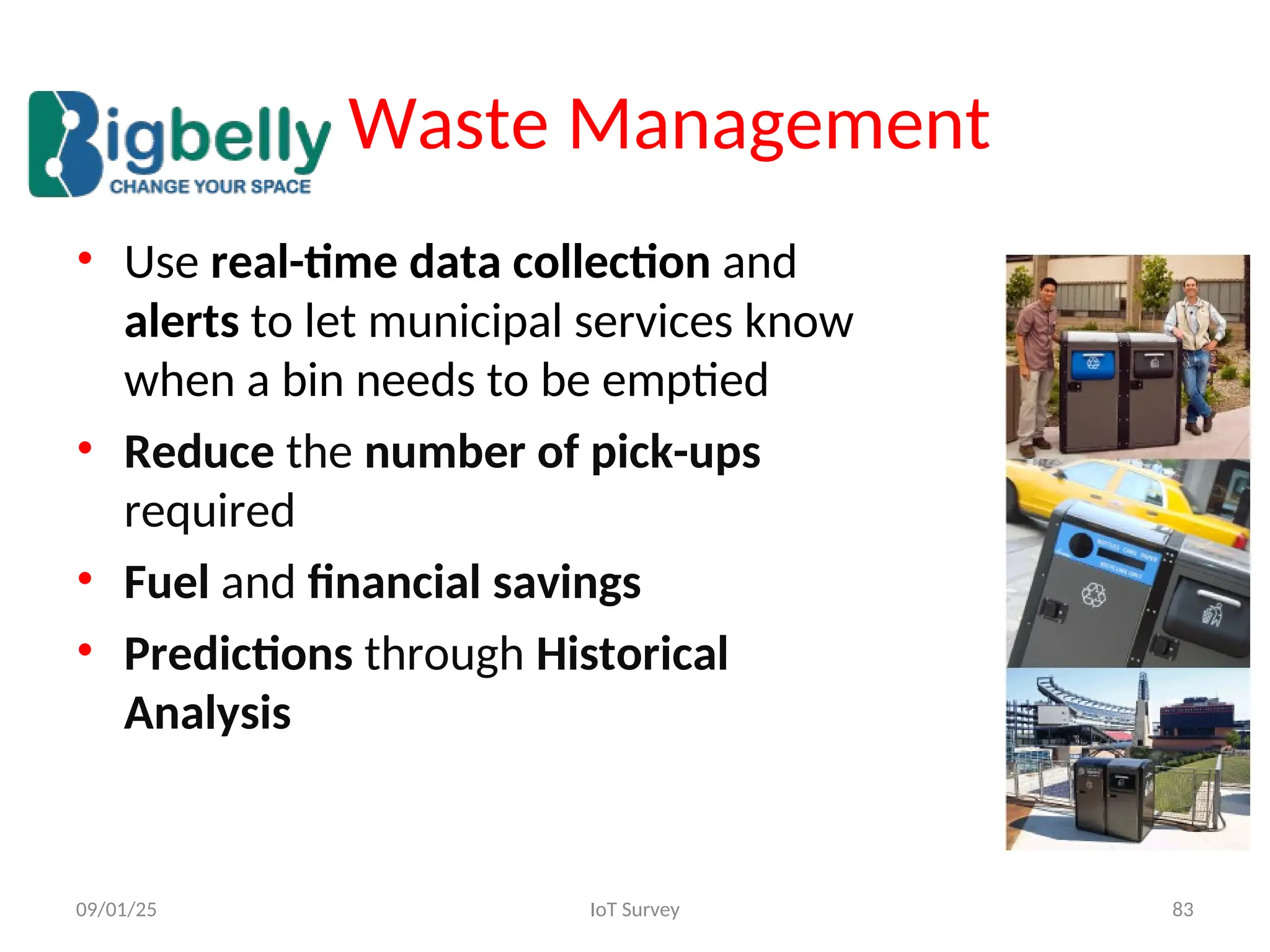
• Use real-time data collection and
alerts to let municipal services know
when a bin needs to be emptied
• Reduce the number of pick-ups
required
• Fuel and financial savings
• Predictions through Historical
Analysis
09/01/25 IoT Survey 83
Waste Management
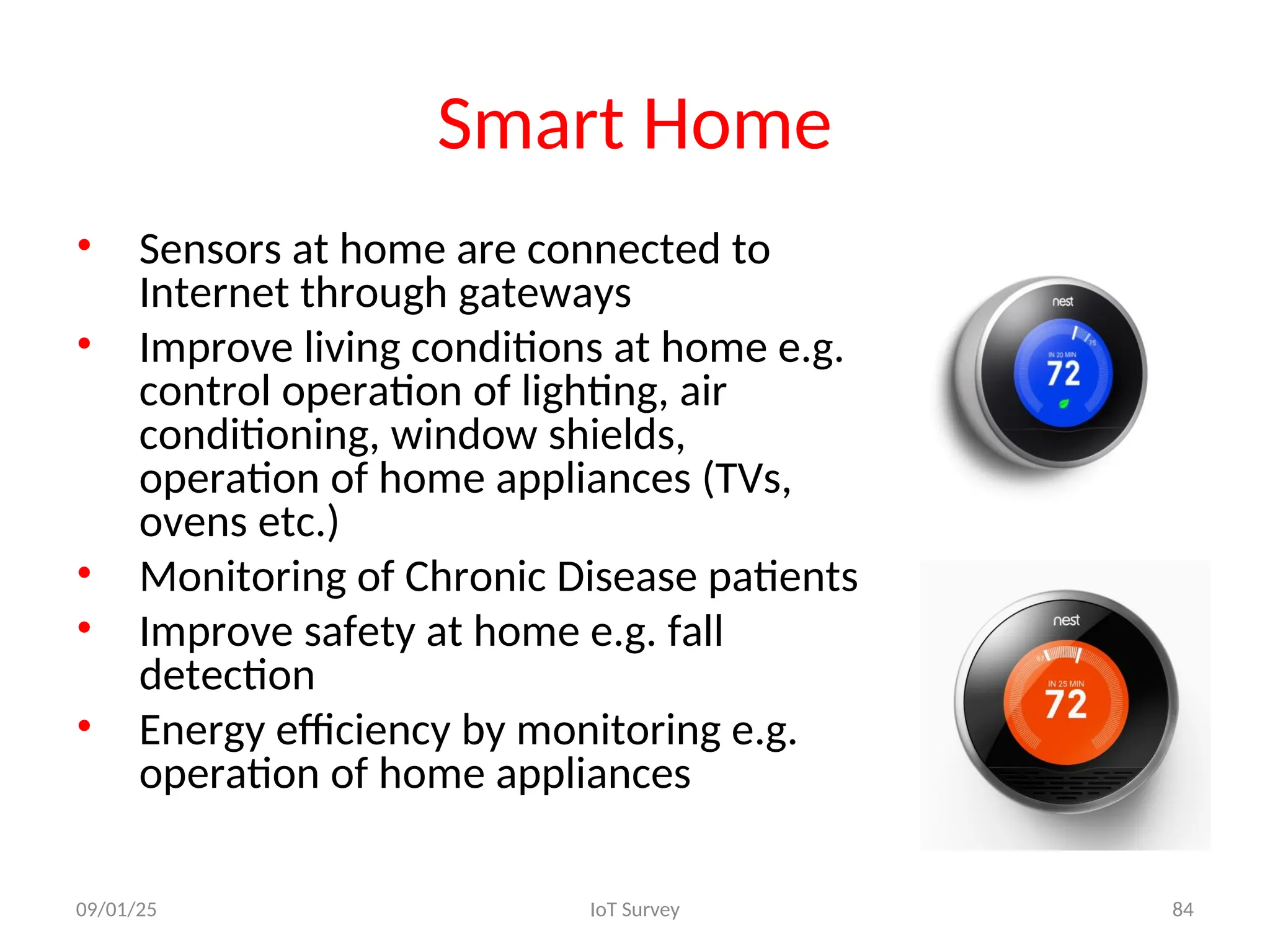
Smart Home
• Sensors at home are connected to
Internet through gateways
• Improve living conditions at home e.g.
control operation of lighting, air
conditioning, window shields,
operation of home appliances (TVs,
ovens etc.)
• Monitoring of Chronic Disease patients
• Improve safety at home e.g. fall
detection
• Energy efficiency by monitoring e.g.
operation of home appliances
09/01/25 IoT Survey 84
Machine Vision Inspection
• Using networked sensors, cameras, and lasers to
analyze manufacturing processes
• Determine if a part is good or bad based on its
physical characteristics
• Identify if it is the right component for the job
09/01/25 IoT Survey 85
09/01/25 IoT Survey 86
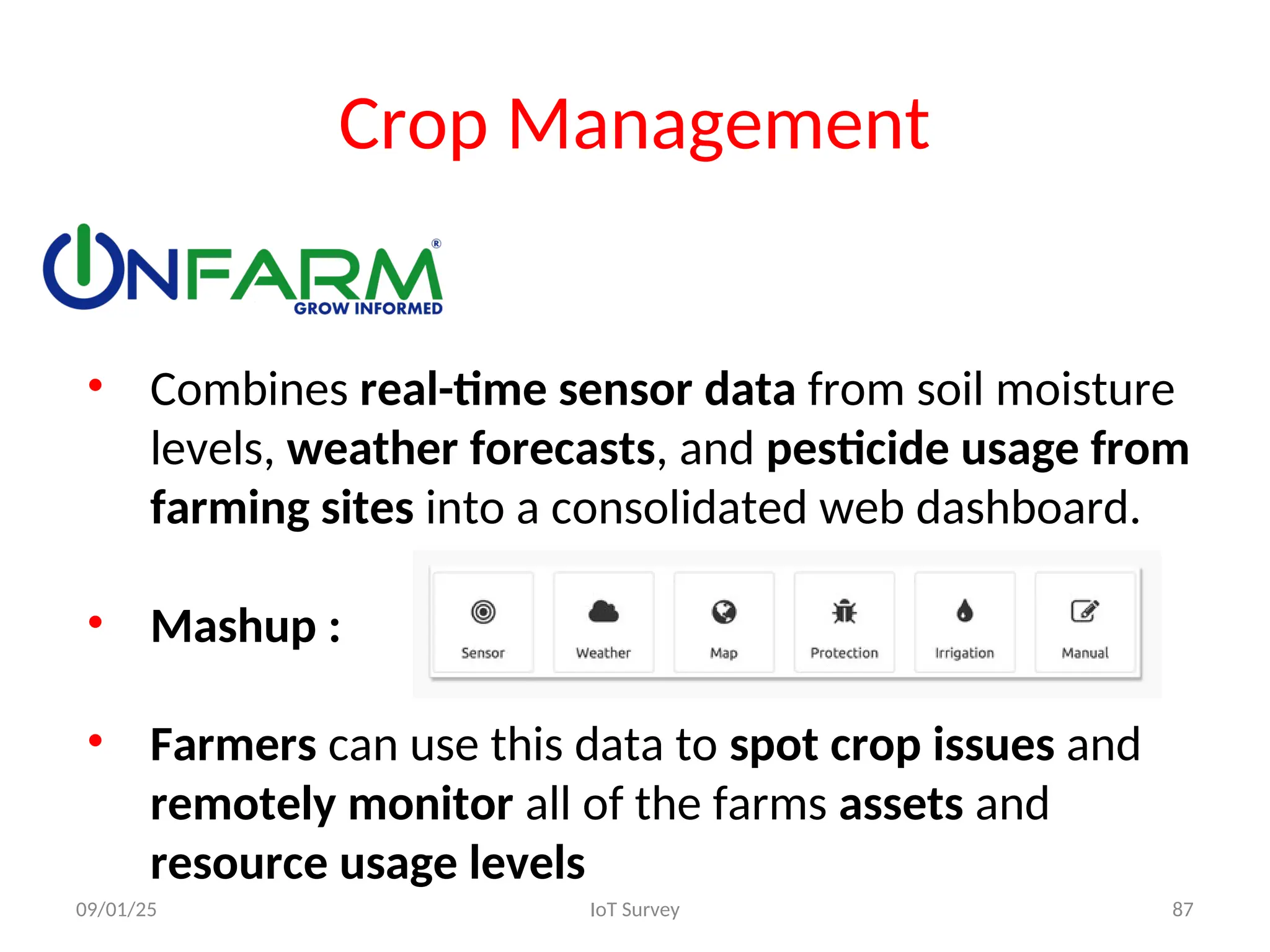
Crop Management
• Combines real-time sensor data from soil moisture
levels, weather forecasts, and pesticide usage from
farming sites into a consolidated web dashboard.
• Mashup :
• Farmers can use this data to spot crop issues and
remotely monitor all of the farms assets and
resource usage levels
09/01/25 IoT Survey 87
References
• http://www.businessinsider.com/what-is-the-internet-of-things-de
finition-2016-8?IR=T
• https://en.wikipedia.org/wiki/Internet_of_things
• http://www.iot-a.eu/public
• http://www.cisco.com/c/en/us/solutions/internet-of-things/
overview.html
• https://www.microsoft.com/en-us/cloud-platform/internet-of-
things
• http://www.mckinsey.com/industries/high-tech/our-insights/the-
internet-of-things
• http://www.ibm.com/internet-of-things/
• https://www.bcgperspectives.com/content/articles/
engineered_products_project_business_industry_40_future_produ
ctivity_growth_manufacturing_industries/
09/01/25 IoT Survey 88
References
• Making Sense of IoT by Kevin Ashton (Very interesting … ):
http://www.arubanetworks.com/assets/eo/HPE_Aruba_IoT_eBook
.pdf
• IoT Platforms: https://iot-analytics.com/product/iot-platforms-
white-paper/
• IOT Protocols: https://www.rs-online.com/designspark/eleven-
internet-of-things-iot-protocols-you-need-to-know-about
• LoRa Alliance: https://www.lora-alliance.org (read the white
papers: https://www.lora-alliance.org/lorawan-white-papers )
• LoRa Applications (SemTech): http://www.semtech.com/wireless-
rf/internet-of-things/lora-applications/briefs
• Smart Cities Transformed (SemTech):
http://www.semtech.com/wireless-rf/internet-of-things/download
s/Semtech_SmartCitiesTransformed_WhitePaper_FINAL.pdf
09/01/25 IoT Survey 89

unit 1 portiorgegegegrgergegergegergn.ppt

  • 1.
    Internet of Things:IoT Enabling Technologies 09/01/25 Dr Pankaj Rangaree ECE Dept. 1
  • 2.
  • 3.
    Internet of Things(IoT) • Internet of Things (IoT) is the internetworking of physical devices, allows objects to be controlled remotely and exchange information • 25billion objects connected to the internet by 2020 • IoT is not merely about embedding software into devices; It's about evaluating data, finding patterns, and extracting value to make more strategic business decisions • Cyber-physical System (CPS) is a mechanism controlled by software and integrated with internet and users • Applications: autonomous automobiles, health monitoring, robotic systems, smart grids, smart homes 09/01/25 IoT Survey 3
  • 4.
    IoT Roadway 09/01/25 IoTSurvey 4 • Everything will be connected to the Internet: 25B Things by 2020
  • 5.
    Why is itHappening now? • An IoT solution (smart home, factory) 10 years ago: – Expensive – Custom made automation • Now: – Affordable hardware – Smaller and powerful hardware, smart devices – IoT protocols – Cloud computing --> business model, cost effective, mass data, secure, PaaS & SaaS Solutions – Mass market awareness 09/01/25 IoT Survey 5
  • 6.
    What is anIoT device ? • Not just a sensor! (e.g., a smart home appliance or a car, may have many sensors or none) • Your car is your biggest connected IoT device • IoT devices are connected objects that exchange information between them (m2m) and the internet • Sensing/Actuation: Objects can interfere with the physical environment either passively, i.e. performing sensing operations, or actively, i.e. performing actions 09/01/25 IoT Survey 6
  • 7.
    Characteristics of IoTDevices Anything communicates: smart things have the ability to wirelessly communicate among themselves, and form ad hoc networks of interconnected objects. Some CPU, memory and internet connectivity support Anything is identified: smart things are identified with a digital name. Relationships among things can be specified. Each thing has a unique identifier (e.g., MAC address, UUID, IP address but due to limited address space if IPv4 – 32bit address space, IoT will have to use IPv6 - 128 bit address space) Anything Interacts: Smart things can interact with their environment through sensing and actuation capabilities 09/01/25 IoT Survey 7
  • 8.
    Device Physical Identifies •A thing has a Universally Unique IDentifier (UUID), a 128-bit value • Process: – “Read’’ object by means of an appropriate device – An identifier is returned – Look up identifier in a device knowledge database – Retrieving the set of features (description) associated to the device. • Methods: RFID, QR-Code, NFC etc…. – Cheap in terms of requirements on the – Electronics embedded in objects, – A “reader” (RFID,QR code, NFC, etc.) must be used 09/01/25 IoT Survey 8
  • 9.
    Examples of IoTDevices 1. Smart Phones 2. Wearable Devices 3. Smart home appliances 09/01/25 IoT Survey 9
  • 10.
    IoT Management • Deviceadministrators perform tasks: – Manage: Add new devices, remove devices from the IoT platform, update firmware, edit device descriptions, add calibration parameters etc. – Monitor: Device status (on/off/sleep etc.), physical location, device’s current actions real- time – Control: Set status (e.g. turn on/off), define device actions and behavior, temporarily enable/disable devices, define how often device transmits data etc. 09/01/25 IoT Survey 10
  • 11.
    IoT Applications • Environmentalmonitoring: take and process measurements from environment e.g. water, atmosphere, soil conditions, earthquake and tsunami warning systems • Infrastructure management: monitor and control infrastructures e.g. bridges, rail tracks, wind farms, crop farms, … • Manufacturing for responding to production and supply-chain, industrial operations and maintenance demands (industry 4.0) • Energy Management: sensors at buildings optimize energy production and energy consumption in smart homes, buildings and cities (e.g. balance power generation) • Healthcare: remote health monitoring, emergency notification systems, assisted living for the elderly and chronic patients • Home automation, Ambient Assisted Living (AAL), transportation and traffic control and consumer applications (e.g. smart retail) 09/01/25 IoT Survey 11
  • 12.
  • 13.
    The Road to50 billion IoT Nodes by 2020 09/01/25 IoT Survey – Image from https://www.linkedin.com/pulse/intelligent -flexible-iot-nodes-diya-soubra 13
  • 14.
    IoT Technology Roadmap 09/01/25 IoTSurvey – Fig from https://en.wikipedia.org/wiki/Internet_of_t hings 14
  • 15.
    IoT – CloudComputing • IoT will lead to production of large amounts of data • Cloud computing is the infrastructure that allows elastic, scalable services to be offered through Internet (e.g. data storage and data analytics, improved decision making, optimized monitoring), will enable users to access applications from anywhere • Fog computing suggests moving effort closer to Internet edges for reducing network traffic, cloud computing loads and costs • Event-based-architecture for detecting and reacting to events (changes of state) realized as SOA (independent services handling / passing messages) 09/01/25 IoT Survey 15
  • 16.
    IoT Networks Buildingblocks IoT Node IoT Node IoT Node IoT Node IoT Gateway …… 09/01/25 IoT Survey 16 Communication Protocol Cloud
  • 17.
  • 18.
    Sensors, Actuators • Sensor:device that detects and responds to some type of input from the environment – Heat, motion, moisture, pressure … – The output is a signal that is converted to a value in a human readable dispalay or can be transmitted to a network location for processing or storage • Actuator: system which converts electrical signals to physical actions (for interacting with envrironment) – Turn-on/off, sleep, move, transmit on demand • Microcontroller: small computer on a single board containing processor, memory and i/o peripherals. – Embeded, low power consumption, small size – For pace makers, engine control systems, etc – Sometimes a smartphone (be aware of battery consumption) 09/01/25 IoT Survey 18
  • 19.
    IoT Node Actuators •A type of motor that is responsible for moving or controlling a mechanism or system • Operated by a source of energy and converts that energy into motion • Do something depending on – A threshold sensor value – Reasoner results – On demand (decision of the user) – Beware of the energy consumption 09/01/25 IoT Survey 19
  • 20.
    IoT Node Shields 09/01/25IoT Survey 20 • Integrated solution on a board for secure connectivity (e.g. AES encryption) along with programmable board (m2m) • Turn Arduino/Raspbury boards to a connected and programmable IoT device – 3G Shield – GPS Shield – Bluetooth – WiFi
  • 21.
    IoT Node Microcontrollers Programmableboards Connect with USB and program with Arduino etc. Developers can create the device logic and add sensors, connectivity, actuators etc. 09/01/25 IoT Survey 21
  • 22.
    IoT Node Microcontrollers •An Intel 8742, an 8- bit microcontroller that includes a CPU running at 12 MHz, 128 bytes of RAM, 2048 bytes of EPROM, and I/O in the same chip 09/01/25 IoT Survey 22
  • 23.
  • 24.
    IoT Node M2MDevice Connectivity 09/01/25 IoT Survey 24
  • 25.
    IoT Node Agent •An embedded program that runs on an IoT device and reports status of some asset or environment values • How it works: – The agent “reads” status from sensors or local connectivity to an asset – Applies some rules or logic about how often to send, how to aggregate info etc. – Sends the info to the short-haul or long-haul 09/01/25 IoT Survey 25
  • 26.
    IOT Node OperatingSystems • RIOT OS: – Designed for maximum energy efficiency & hardware independent development – Support for 6LoWPAN, IPv6, TCP and UDP protocols – Low resource requirements: Min RAM (~1.5kB) and Min ROM (~ 5kB) – Standard programming in C or C++ • Thingsquare: – Software platform that product makers use to connect their products with smartphones – Runs on hardware with 64-256 kilobytes of flash and 16-32 kilobytes of RAM 09/01/25 IoT Survey 26
  • 27.
    Device Privacy, SecurityPrinciples • IoT Privacy issues: too much data and many entry points – public profile -- > not desirable – Eavesdropping --> users confidence to technology ? • IoT Security issues: vulnerability to hacking, – true IoT security (secure software for devices and network connections) --> technology readiness ? • Devices may compete with other devices on resources and services (e.g. on same board or platform), – can manage or damage other devices • Devices should respect the privacy, security and safety of other devices or people with which they interact 09/01/25 IoT Survey 27
  • 28.
    Sensor Model Language(SensorML) • Provides standard models and an XML encoding for describing sensors, actuators and measurement processes • Approved Open Geospatial Consortium (OGC) standard 09/01/25 IoT Survey 28
  • 29.
    SensorML • <!-- =================================================--> • <!-- System Description --> • <!-- ================================================= --> • <gml:description> Temperature sensor on my window </gml:description> • <gml:identifier codeSpace="uid">myCompany.com.63547</gml:identifier> • <!-- ================================================= --> • <!-- Observed Property = Output --> • <!-- ================================================= --> • <sml:outputs> • <sml:OutputList> • <sml:output name="temp"> • <swe:Quantity definition="http://sweet.jpl.nasa.gov/2.2/quanTemperature.owl#Temperature"> • <swe:label>Air Temperature</swe:label> • <swe:uom code="Cel"/> • </swe:Quantity> • </sml:output> • </sml:OutputList> • </sml:outputs> • <!-- ================================================= --> • <!-- Sensor Location --> • <!-- ================================================= --> • <sml:position> • <gml:Point gml:id="stationLocation" srsName="http://www.opengis.net/def/crs/EPSG/0/4326"> • <gml:coordinates>47.8 88.56</gml:coordinates> • </gml:Point> • </sml:position> • </sml:PhysicalComponent> 09/01/25 IoT Survey 29
  • 30.
    Or Just XML 09/01/25IoT Survey 30
  • 31.
    IoT Gateway • Securelyconnects devices to a centralized control system • Must ensure data security, privacy • Complies with the IoT devices protocol standards. • Smartphones can act as Gateways! 09/01/25 IoT Survey 31
  • 32.
    IoT Gateway agent •A Program that runs on the GateWay • Performs Data Aggregation and allows to remotely access and control IoT devices • The IoT device management system is Based on the Gateway agent to gather data for monitoring devices status and execute commands on devices 09/01/25 IoT Survey 32
  • 33.
    Wireless Protocols • Factorsto take into consideration when choosing a wireless protocol: – Range: Take in mind the distance between devices that need to communicate – Energy consumption – Topology: Point to point, star or mesh e.g., if we need all devices to communicate with each other we cannot choose Bluetooth or Lora – Privacy: Longer range means less privacy – Data rate: Data transmition speed limit (e.g., 24mbps) 09/01/25 33
  • 34.
    RFID • Radio-Frequency IDentification(RFID) is the use of radio waves to read and capture information stored on a tag attached to an object • A tag can be read from up to several meters away and does not need to be within direct line-of-sight of the reader • Uses tags, or labels attached to the objects to be identified. • Uses “readers” to send a signal to the tag and read its response. Readers transmit observations to a computer system running RFID software • RFID tags: 1) passive 2) active 3)battery assisted passive (if tags are self powered they can transmit their data over greater distances and they reply more quickly to the reader) – The lower price per tag makes passive RFID systems attractive 09/01/25 34
  • 35.
    RFID Characteristics andExamples • Range: 10cm-200m • Topology: Point to Point • Power consumption: Very Low • Privacy: Mid • Example: Road tolls, Building Access 09/01/25 IoT Survey 35
  • 36.
    Near Field Communication(NFC) • Short-range wireless protocol that enable two electronic devices (e.g. Smartphones) to communicate by bringing them close to each other • Each full NFC device can work in three modes: – NFC card emulation—enables NFC-enabled devices such as smartphones to act like smart cards, e.g., payment or ticketing – NFC reader—enables NFC-enabled devices to read information stored on inexpensive NFC tags embedded in labels or smart posters, credit cards – NFC peer-to-peer—enables two NFC-enabled devices to communicate with each other to exchange information • NFC devices can be active (e.g. smartphones) or passive (e.g. NFC tags on credit cards for contactless transactions) 09/01/25 IoT Survey 36
  • 37.
    NFC Characteristics • UtilizesElectromagnetics radio fields (WIFI, BLE rely on radio transmission) • Topology: Point to Point, • Power consumption: Very Low (readers), none (tag) • Privacy: High • Security: ? • Data Rates: 424 kbit/s • Range: < 10cm 09/01/25 IoT Survey 37
  • 38.
    ZigBee • Low-cost, low-power,wireless mesh network standard targeted at the wide development of long battery life devices in wireless control and monitoring applications • Characteristics: – Topology: mesh, star, tree (one coordinator device) – Range: 10-100m (line of sight); routers may extend communication at network level – Data Transfer Rate: 250 kbit/s – Power consumption: Low – Transmission distance: 10-100 meters – Privacy: Mid • Inexpensive, personal networks, Smart Home (home automation), medical data collection from devices … 09/01/25 IoT Survey 38
  • 39.
    Bluetooth • Wireless standardfor exchanging data over short distances (using UHF radio waves from 2.4-2.485GHz) • For fixed and mobile devices, building personal networks (piconets), one coordinator device • Characteristics: – Range: 10m or greater – Topology: Point to point – Data Transfer Rate: 2.1 Mbit/s (BLE 1 Mbit/s) – Power consumption: Mid (normal), low (BLE) – Transmission distance: depends on device, typically small – Privacy: Mid 09/01/25 IoT Survey 39
  • 40.
    What makes Bluetoothbetter? • Bluetooth is everywhere: built into nearly every phone, laptop, desktop and tablet. Easy to connect a keyboard, mouse, speakers or fitness band to phone or computer. • Bluetooth is low power: with the advent of Bluetooth Smart (BLE or Bluetooth low energy), developers are able to create smaller sensors that run off tiny coin-cell batteries for months, and in some cases, years Bluetooth is low cost: you can add Bluetooth for a minimal cost. You will need to buy a module/system on chip (SoC) and pay an administrative fee to use the brand and license 09/01/25 IoT Survey 40
  • 41.
    Bluetooth Low Energyv4.0 (BLE) • Developed for IoT: easy mobile application development and connectivity for cloud computing • Activity monitoring, health monitoring (heart rate, glucose, blood saturation level sensors), proximity sensors • Key features of BLE: – Industry-standard wireless protocol that allows for multi-vendor interoperability – Ultra-low peak, average and idle mode power consumption that gives the ability to run for month(s) or years on standard coin- cell batteries – Standardized application development architecture that leads to low development and operational costs – Allows for some of the tightest security in the industry with 128- bit AES data encryption 09/01/25 IoT Survey 41
  • 42.
    BLE GATT –ATT -GAP • BLE defines GAP mechanism and two protocols (GATT, ATT) • Generic Access Profile (GAP) defines the mechanism for BLE devices to communicate with each other – Makes a device visible and allows other devices to connect with other – Controls connections and advertising and discovery process – Once discovered the peripheral will stop advertising itself, can be connected to one central device at a time • Generic Attribute Profile (GATT): defines how data are formatted and exchanged (two-way communication) • GATT uses a Generic Attribute Protocol (ATT) that defines services, their characteristics (e.g. sensed values) and ids (16-bit ids) in a table 09/01/25 IoT Survey 42
  • 43.
    Bluetooth Network Topology •A peripheral can only be connected to one central device (such as a mobile phone) at a time, • The central device can be connected to multiple peripherals • Central device: GATT server • All messages pass through the central device • Communication can take place in two directions 09/01/25 IoT Survey 43
  • 44.
    BLE Communication Data exchange: GATTtransactions are based on high-level (nested objects) called Profiles, Services, Characteristics 09/01/25 IoT Survey 44
  • 45.
    BLE Profiles, Services,Characteristics • Profile: A pre-defined collection of Services compiled by either the Bluetooth SIG or by the peripheral designers – The Heart Rate Profile, combines the Heart Rate Service and the Device Information Service • Service: break data up into logic entities, and contain specific chunks of data called characteristics – A service can have one or more characteristics, – Each service distinguishes itself from other services by means of a unique numeric ID called a UUID – Heart rate service has a 16-bit UUID of 0x180D, and contains up to 3 characteristics: Heart Rate Measurement, Body Sensor Location and Heart Rate Control Point • Characteristic: specifies data types and formats of values 09/01/25 IoT Survey 45
  • 46.
    GATT Profiles List(part) 09/01/25 IoT Survey 46
  • 47.
    Wi-Fi • Allows devicesto connect to a wireless LAN (WLAN) network, mainly using the 2.4 gigahertz UHF and 5 gigahertz SHF radio bands. • Wi-Fi compatible devices can connect to the Internet via a WLAN network and a wireless access point • Characteristics: – Topology: star – Data Transfer Rate: > 24 Mbit/s – Power consumption: High – Range: 30-100m – Privacy: Low 09/01/25 IoT Survey 47
  • 48.
    More Protocols • ThreadIPv6 for home networking • Z-Wave for home networking • Cellular for IoT operation in larger distances • Cellular for IoT operation in larger distances (GSM 3G/4G) 09/01/25 IoT Survey 48
  • 49.
    Low Power WideArea Network (LPWA) Protocols • Target wide area networking (between WiFi and Cellular) • Operate in License Free bands (Below 1GhZ) – Range 1-50Km (rural), 1-10 (urban) – Low transmission rates: 10-10Kbps – Low Level protocol, Aloha protocol – Low energy consumption • Many versions: LoRa, Neul, SigFox, NB-IoT, LTE-M, Weightless, DASH7, 6LoWPAN – Different business model – LoRa is open: Any manufacturer can build a LoRa module or gateway or run a LoRa network but, – SemTech is the only company that produces the radio modulation chip 09/01/25 IoT Survey 49
  • 50.
    DASH7 • Ultra LowPower sensor communication • Bi-directional communication ideal for objects sending sporadic data (smart appliances, parking guidance, location- presence detection) • Has RF wake up (wake up signal)! • In sleep mode less energy than BLE! • Characteristics: – Range: 1 km – Topology: star – Data Transfer Rate: 200 kbit/s – Power consumption: Low – Range: depends on device (e.g. 1Km) – Privacy: very Low 09/01/25 IoT Survey 50
  • 51.
    6LoWPAN • 6LoWPAN isa low-power wireless mesh network allowing to connect directly to the Internet using open standards – IPv6 over Low power Wireless Personal Area Networks – Every node (a thing) has its own IPv6 address – Originated from the idea that IP protocols should be applied even to the smallest low-power devices, so that they can participate in IoT • Characteristics: – Range: 20m – Topology: star – Power consumption: mid – Privacy: mid 09/01/25 IoT Survey 51
  • 52.
    6LoWPAN Topology • Nodes:Things (e.g. light bulbs, smoke detectors) each node carries an IPv6 address. • EDGE Router: gateway + IPv6 header is converted to standard IPv4 header • Internet: for connection to Cloud 09/01/25 IoT Survey 52
  • 53.
    Weightless • Proprietary wirelesstechnology standard for exchanging data between a base station and thousands of machines around it using White space (wavelength radio transmissions in unoccupied TV transmission channels) with high levels of security • Characteristics: – Range: < 10 Km – Topology: star – Power consumption: mid – Privacy: Very High • Examples: traffic sensors, industrial monitoring 09/01/25 IoT Survey 53
  • 54.
    LoRa 09/01/25 IoT Survey54 • IoTs connect directly to the cloud or over a network (cellular) • For vendors who need to deploy their applications on their own and run the network by themselves, LoRa is the only option
  • 55.
  • 56.
  • 57.
  • 58.
    IoT Platforms • IoTPlatforms are the central backbone of the IoT infrastructure – Support connectivity of devices with the platform – Management of IoT Data – Monitoring of the IoT network – Data Analytics to make sense of plethora of data generated by sensors – Communication with end-user and external applications – Security for devices and users – Facilitate application development 09/01/25 58
  • 59.
    IoT Landscape • IoTtechnology is far from being standardised – Different hardware units – Many different connection protocols – Many solutions are proprietary • IoT landscape can be compared to the Internet in the 90’s – Browser standardization battle (Explorer, Netscape) – Search Engine battle (Yahoo, AltaVista, Lycos, Copernicus) 09/01/25 IoT Survey 59
  • 60.
    IoT Platforms asProducts • Mainly industry or domain specific platforms – Support for specific services, – Specific connectivity protocols – Specific data formats – Specific platform logic, data analytics, storage tailored to industry/domain – Proprietary technologies • Requirements: – Scalability – Handle heterogeneity of devices, communication protocols – Easy connectivity of devices to the platform, reduce complexity of application development – Privacy, security mechanisms – Open source technologies – Portability – Interoperability 09/01/25 IoT Survey 60
  • 61.
    Major Building Blocks 09/01/25IoT Survey 61 Security
  • 62.
    Technological Depth • ConnectivityPlatform: Simplest IoT platforms, act as data collectors and provide simple messaging bus • Action Platform: Connectivity platform + actions to handle events (e.g. water leaks) • Full-Scale Platform: Connectivity Platform + Action Platform + Data Analytics, Reasoning, Mashups, Complex Workflows 09/01/25 IoT Survey 62
  • 63.
    Level 1: ConnectivityPlatform 09/01/25 IoT Survey 63
  • 64.
    Level 2: ActionPlatform 09/01/25 IoT Survey 64
  • 65.
    Level 3: Full-ScalePlatform 09/01/25 IoT Survey 65
  • 66.
    Amazon Web Services(AWS) IoT • Makes it a lot easier for developers to connect sensors for multiple applications ranging from automobiles to turbines to smart home light bulbs • Main features of AWS IoT platform are: – Registry for recognizing devices – Software Development Kit (SDK) for devices* – Secure Device Gateway – Rules engine for inbound message evaluation – Device Shadows • Device Shadows: JSON document that is used to store and retrieve current information state for a thing (device, app) • *Amazon has partnered with hardware manufacturers like Intel, Texas Instruments, Broadcom and Qualcomm to create starter kits compatible with their platform. 09/01/25 IoT Survey 66
  • 67.
  • 68.
    Microsoft Azure IoT •For processing the massive amount of information generated by sensors • Comes with Azure Stream Analytics (similar to Storm) to process massive amounts of information in real-time • Features included in this platform are: – Device shadowing – A rules engine – Identity registry – Information monitoring 09/01/25 IoT Survey 68
  • 69.
    Thing Worx IoT •Designed for enterprise application development It offers features like: – Easy connectivity of devices to the platform – Remove complexity of IoT application development – Sharing platform among developers for rapid development – Integrated machine learning for automating complex big data analytics 09/01/25 IoT Survey 69
  • 70.
    More IoT Platforms •IBM IoT • Intel IoT Platform • Cisco IoT Cloud Connect • Oracle Integrated Cloud • General Electric Predix • Xively IoT platform • Salesforce IoT Cloud (creating sales orders , handling Services-Request and order repairs automatically, Notifies customers through texts directly on their devices) • Carriots • More information: Top10 IoT platforms http://internetofthingswiki.com/top-10-iot-platforms/634/ 09/01/25 IoT Survey 70
  • 71.
    FIWARE IoT Platform(PaaS only) • IoT Agents: Services to provide device connectivity with cloud – IDAS device management – HTTP ultralight, CoAP, MQTT protocols (is extendible) – Context Broker: context management – Interacts with devices and subscribers – NGSI2 protocol (formely NGSI 9/10) • Complex Event Processing (CEP): handles events, rule based management, triggers actions • Identity Management (Keyrock): user authentication, authorization 09/01/25 IoT Survey 71
  • 72.
  • 73.
    Challenges and Research1 • Standardization Issues: – Uniform Device Identifier & Data structure – Uniform thing naming scheme (how to name things) – Web addressable IoTs (support for IPV6)? • Massive Scaling: – Architectural model to support the expected heterogeneity of devices and applications – How to authenticate access and protect devices, services, users – Connectivity (handle different protocols) – Keeping a historical record of a devices’ actions (use a repository recording device control actions ?) 09/01/25 IoT Survey 73
  • 74.
    Challenges and Research2 • Things or sets of things must be disjoint and protected from other devices – Detect devices trying to access another device – Detect and act due to conflicts / relationships between interoperating devices • In some cases, it makes sense to share devices and information with applications (besides owner) – e.g. home Health care application detects depression  turns on all the lights – Energy management application  turns lights off because no motion is detected 09/01/25 IoT Survey 74
  • 75.
    Challenges and Research3 • Big data Analysis: Data Analysis for reasoning, reaching conclusions driving actuators or for improving business operations – statistical, machine learning, data mining • Correct data association: Ensure that the collected data (and their inferences) are associated with the correct individual • Synchronization: may result to application failure (e.g., faulty clock synchronization) – Not easy, too many Things in the network ! • Reliability/High Availability: e.g. No Single Point of Failure (SPF) • Openness/Interoperability: System transparency i.e. access to information and allow interactions with outside world (applications, devices, users) – Related to service interoperability and data portability – Unified communications interfaces will be required to enable efficient information exchange across diverse systems – e.g. cars exchanging information to avoid collision • Balance between access to functionality and security and privacy ? 09/01/25 IoT Survey 75
  • 76.
    Challenges and Directions4 • Heal damages/anomalies due to security attacks: – Detect the attack (anomaly detection) – Diagnose the attack, and – Deploy countermeasures and repairs • Perform in a lightweight manner due to the types of low capacity devices involved vs typical security solutions that require heavyweight computations and large memory requirements • Ideally, given the real-time nature of many IoTs, detection, countermeasures and repairs must run in real-time as part of a runtime self-healing architecture – Detection system/components malfunctioning – Intrusion Detection – Anomaly Detection 09/01/25 IoT Survey 76
  • 77.
  • 78.
    Consumer Application • Ina smart shop, products are equipped with sensors or tags with their id which can be read by application on smartphones (RFID, NFC, BLE) • Customer and product info are send to the cloud which is responsible for pushing notification and product info to customers • Customers is informed about prices, where to buy, how to wear (combine with other products - pre-selected product combinations) and recommend products of same kind • Decision matched with customer profile (age, living style) • The cloud is also responsible for analyzing customers interests in products and assist sales department to design promotion strategy (data analytics) 09/01/25 IoT Survey 78
  • 79.
  • 80.
  • 81.
    Industry 4.0 • Projectof German Government which promotes computerization of manufacturing through automation, data exchange • Synergy with CPS, IoT and Cloud Computing • Smart factory: CPS monitor physical processes and take decentralized decisions, communicate over Internet with humans and with other processes (e.g. if failure in one machine notify others to stall) • Centralized decisions or services (e.g. production planning or interferences, conflicting goals) are taken at higher cloud computing level 09/01/25 IoT Survey 81
  • 82.
    The 4 IndustrialRevolution 09/01/25 IoT Survey 82
  • 83.
    • Use real-timedata collection and alerts to let municipal services know when a bin needs to be emptied • Reduce the number of pick-ups required • Fuel and financial savings • Predictions through Historical Analysis 09/01/25 IoT Survey 83 Waste Management
  • 84.
    Smart Home • Sensorsat home are connected to Internet through gateways • Improve living conditions at home e.g. control operation of lighting, air conditioning, window shields, operation of home appliances (TVs, ovens etc.) • Monitoring of Chronic Disease patients • Improve safety at home e.g. fall detection • Energy efficiency by monitoring e.g. operation of home appliances 09/01/25 IoT Survey 84
  • 85.
    Machine Vision Inspection •Using networked sensors, cameras, and lasers to analyze manufacturing processes • Determine if a part is good or bad based on its physical characteristics • Identify if it is the right component for the job 09/01/25 IoT Survey 85
  • 86.
  • 87.
    Crop Management • Combinesreal-time sensor data from soil moisture levels, weather forecasts, and pesticide usage from farming sites into a consolidated web dashboard. • Mashup : • Farmers can use this data to spot crop issues and remotely monitor all of the farms assets and resource usage levels 09/01/25 IoT Survey 87
  • 88.
    References • http://www.businessinsider.com/what-is-the-internet-of-things-de finition-2016-8?IR=T • https://en.wikipedia.org/wiki/Internet_of_things •http://www.iot-a.eu/public • http://www.cisco.com/c/en/us/solutions/internet-of-things/ overview.html • https://www.microsoft.com/en-us/cloud-platform/internet-of- things • http://www.mckinsey.com/industries/high-tech/our-insights/the- internet-of-things • http://www.ibm.com/internet-of-things/ • https://www.bcgperspectives.com/content/articles/ engineered_products_project_business_industry_40_future_produ ctivity_growth_manufacturing_industries/ 09/01/25 IoT Survey 88
  • 89.
    References • Making Senseof IoT by Kevin Ashton (Very interesting … ): http://www.arubanetworks.com/assets/eo/HPE_Aruba_IoT_eBook .pdf • IoT Platforms: https://iot-analytics.com/product/iot-platforms- white-paper/ • IOT Protocols: https://www.rs-online.com/designspark/eleven- internet-of-things-iot-protocols-you-need-to-know-about • LoRa Alliance: https://www.lora-alliance.org (read the white papers: https://www.lora-alliance.org/lorawan-white-papers ) • LoRa Applications (SemTech): http://www.semtech.com/wireless- rf/internet-of-things/lora-applications/briefs • Smart Cities Transformed (SemTech): http://www.semtech.com/wireless-rf/internet-of-things/download s/Semtech_SmartCitiesTransformed_WhitePaper_FINAL.pdf 09/01/25 IoT Survey 89