Internet of Things
                      Applications/Services
                   Diogo Gomes <dgomes@ua.pt>


                          Technology Challenges for the Internet of
28/01/12 - dgomes@ua.pt
                               Things 2011 – Winter School
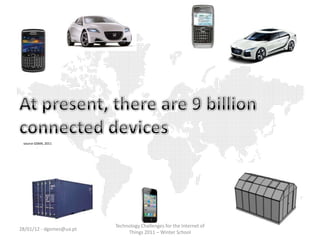
source GSMA, 2011


                          Technology Challenges for the Internet of
28/01/12 - dgomes@ua.pt
                               Things 2011 – Winter School
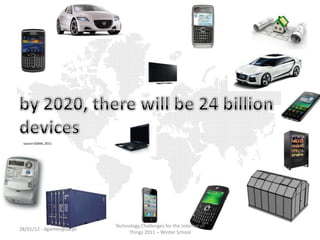
source GSMA, 2011


                          Technology Challenges for the Internet of
28/01/12 - dgomes@ua.pt
                               Things 2011 – Winter School
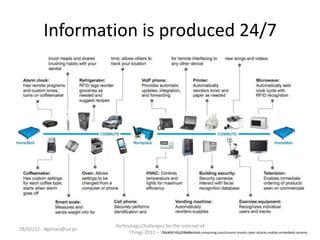
Information is produced 24/7


                          Technology Challenges for the Internet of
28/01/12 - dgomes@ua.pt
                               Things 2011 – Winterhttp://embedded-computing.com/current-trends-cyber-attacks-mobile-embedded-systems
                                              Source: School
What have we achieved so far…
• We have connected billions of devices to the
  Internet, but…
      – What are we doing with it ?
            • We are following a 1 sensor 1 application model
      – We have create vertical silos of information
            • Energy information is kept by the Energy Company
            • Home automation is a self-contained application
      – We have over engineered our solutions
            • e.g. wireless mesh networks in well served locations
            • e.g. using generic sensing platforms to monitor limited amount of
              variables


                              Technology Challenges for the Internet of
28/01/12 - dgomes@ua.pt
                                   Things 2011 – Winter School
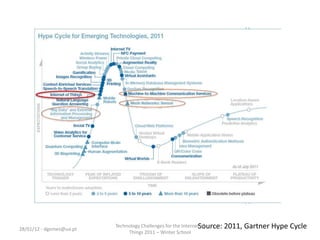
Technology Challenges for the InternetSource:
                                                                 of       2011, Gartner Hype Cycle
28/01/12 - dgomes@ua.pt
                               Things 2011 – Winter School
… what are we targeting?
• What is done with all this information?
• Who gathers this information?
• Who stores this information?

• Potential for new IoT Applications and Services
      – New players who do not own or operate any IoT
        devices
      – New players who are in charge of managing
        Information and providing new applications and
        services to users
                          Technology Challenges for the Internet of
28/01/12 - dgomes@ua.pt
                               Things 2011 – Winter School
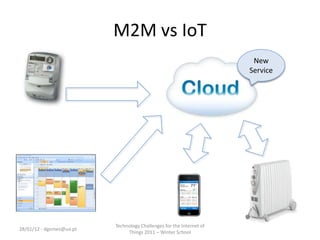
M2M vs IoT


                          Technology Challenges for the Internet of
28/01/12 - dgomes@ua.pt
                               Things 2011 – Winter School
M2M vs IoT
                                                                       New
                                                                      Service


                          Technology Challenges for the Internet of
28/01/12 - dgomes@ua.pt
                               Things 2011 – Winter School
IoT Services
• The vision of an Internet of Things has changed the
  concept of a service from traditional notion of web
  services.
• In the Internet of Things domain, the term ‘service’
  refers to enhancing real world resources with
  interaction support.
• These so-called “real world services” are provided by
  resources that are linked directly to the physical world.
• The resources have sensing, processing or actuating
  devices that provide information on entities in the real
  world, provide interactions or generate events about
  them.

                          Technology Challenges for the Internet of
28/01/12 - dgomes@ua.pt
                               Things 2011 – Winter School
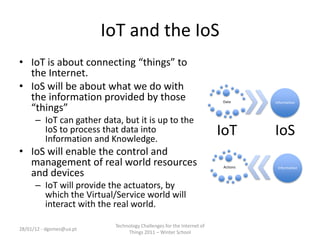
IoT and the IoS
• IoT is about connecting “things” to
  the Internet.
• IoS will be about what we do with
  the information provided by those                                    Data      Information
  “things”
      – IoT can gather data, but it is up to the
        IoS to process that data into
        Information and Knowledge.
                                                                       IoT       IoS
• IoS will enable the control and
  management of real world resources                                   Actions    Information
  and devices
      – IoT will provide the actuators, by
        which the Virtual/Service world will
        interact with the real world.

                           Technology Challenges for the Internet of
28/01/12 - dgomes@ua.pt
                                Things 2011 – Winter School
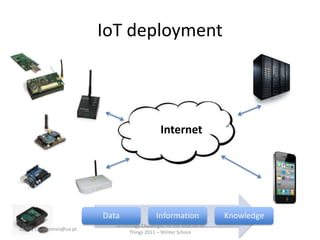
IoT deployment


                                                 Internet


                          Data                 Information               Knowledge
                             Technology Challenges for the Internet of
28/01/12 - dgomes@ua.pt
                                  Things 2011 – Winter School
IoS - Internet of Services
• IoS is about the software fabric that will connect
  service providers and consumers
• IoS will enable the exchange of information and
  knowledge between internet users (both human
  and machines)
• In order to achieve this goal, IoS requires data

• IoT will enable data to flow
  Anytime, Anyplace, with Anything and
  Anyone, ideally using Any path/network and Any
  service
                          Technology Challenges for the Internet of
28/01/12 - dgomes@ua.pt
                               Things 2011 – Winter School
How to connect the IoT to the IoS
• The IoT must export interfaces to the IoS
• Connecting devices to the Internet
      – Directly: e.g. 6lowpan
      – Indirectly: through service gateways
• IoT is very heterogeneous
      – Multiple Technologies, Multiple Information Sources
• How to overcome such heterogeneity ?
      – Through Semantic Interfaces
      – Through Data Mining
      – Through Machine Learning Techniques

                          Technology Challenges for the Internet of
28/01/12 - dgomes@ua.pt
                               Things 2011 – Winter School
Semantic Interfaces
• Semantic interoperability can be achieved between
  heterogeneous information systems (service providers
  and service requestors) in a multitude of ways.
      – development of comprehensive shared information
        models can facilitate semantic interoperability among the
        participant applications and businesses
            • Problem: it is rigid and inflexible when it comes to business
              processes
      – appropriate semantic mediators (translators) at each
        participant’s end, to facilitate the conversion to the
        information format which the participant understands
            • Problem: add’s complexity to all participants (many IoT devices to
              not have enough resources for these semantic mediators)


                              Technology Challenges for the Internet of
28/01/12 - dgomes@ua.pt
                                   Things 2011 – Winter School
Data Mining
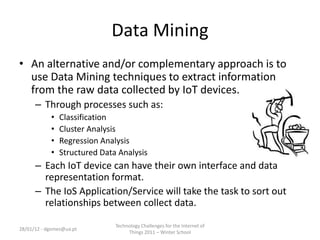
• An alternative and/or complementary approach is to
  use Data Mining techniques to extract information
  from the raw data collected by IoT devices.
      – Through processes such as:
            •   Classification
            •   Cluster Analysis
            •   Regression Analysis
            •   Structured Data Analysis
      – Each IoT device can have their own interface and data
        representation format.
      – The IoS Application/Service will take the task to sort out
        relationships between collect data.

                               Technology Challenges for the Internet of
28/01/12 - dgomes@ua.pt
                                    Things 2011 – Winter School
Machine Learning
• At a higher level we will find machine learning
  techniques that will assist us at creating
  relationships between the collected
  information, and at extracting knowledge
  from the IoT.
      – Relevant Machine Learning techniques include
            •   Sparse Dictionary Learning
            •   Representation learning
            •   Artificial neural networks
            •   Support Vector Machines

                            Technology Challenges for the Internet of
28/01/12 - dgomes@ua.pt
                                 Things 2011 – Winter School
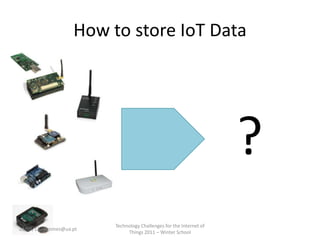
How to store IoT Data


                                                                      ?
                          Technology Challenges for the Internet of
28/01/12 - dgomes@ua.pt
                               Things 2011 – Winter School
What to do with all the collect
                    Information?
• When we consider that we have billions of
  connected devices all publishing information
  we are faced with data gathering and storage
  issues:
      – We require a distributed network capable of
        aggregating and processing information on the
        network before it reaches the storage servers
      – We require a highly efficient storage architecture
        that efficiently store and process all data collected
                          Technology Challenges for the Internet of
28/01/12 - dgomes@ua.pt
                               Things 2011 – Winter School
Storing Information
• There are currently two main solutions to store
  information
      – Relational Databases (traditionally referred to as SQL-
        based), which are based on the relational model in
        which information is stored in rows and grouped into
        tables
      – NoSQL Databases, a more recent technology that tries
        to overcome some of the relational databases
        problems related to performance and scalability at the
        expense of some of the ACID properties of relational
        databases.

                              Technology Challenges for the Internet of
28/01/12 - dgomes@ua.pt
                                   Things 2011 – Winter School
NoSQL Solutions
• NoSQL is not a class by itself, but a set a different
  technologies that do not adhere to the traditional
  relational model.
      – Key/Value Store
      – Wide Column Store
      – Document Oriented
• Most NoSQL storage systems are also
  schemaless, or schema-free, where no schema is
  configured or enforced when using the database.
      – This is an important aspect when considering the
        heterogeneity of IoT

                            Technology Challenges for the Internet of
28/01/12 - dgomes@ua.pt
                                 Things 2011 – Winter School
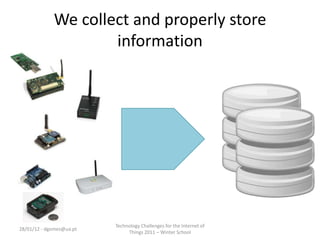
We collect and properly store
                     information


                          Technology Challenges for the Internet of
28/01/12 - dgomes@ua.pt
                               Things 2011 – Winter School
Creating IoT Services and Applications
• How to develop and execute applications on
  top of the collect information and knowledge?
• A middleware architecture approach is of
  importance in the IoT domain due to its role in
  simplifying the development of new services
  and integration of legacy technologies into
  new ones


                          Technology Challenges for the Internet of
28/01/12 - dgomes@ua.pt
                               Things 2011 – Winter School
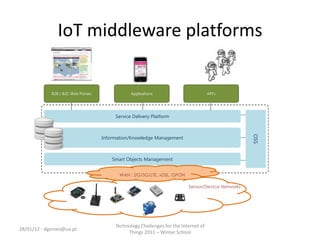
IoT middleware platforms


            B2B / B2C Web Portais               Applications                         API’s


                                         Service Delivery Platform


                                                                                                   OSS
                                    Information/Knowledge Management


                                        Smart Objects Management


                                           WAN : 2G/3G/LTE, xDSL, GPON

                                                                          Sensor/Device Networks


                                         Technology Challenges for the Internet of
28/01/12 - dgomes@ua.pt
                                              Things 2011 – Winter School
Service Creation and Deployment
• Most middleware architectures follow SOA
  approaches, and adhere to it’s
  principals, providing:
      – service composition environment.
      – abstracting the devices’ functionalities and
        communication capabilities,
      – provision of a common set of services


                          Technology Challenges for the Internet of
28/01/12 - dgomes@ua.pt
                               Things 2011 – Winter School
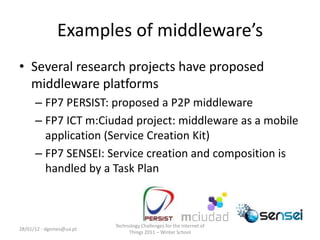
Examples of middleware’s
• Several research projects have proposed
  middleware platforms
      – FP7 PERSIST: proposed a P2P middleware
      – FP7 ICT m:Ciudad project: middleware as a mobile
        application (Service Creation Kit)
      – FP7 SENSEI: Service creation and composition is
        handled by a Task Plan


                          Technology Challenges for the Internet of
28/01/12 - dgomes@ua.pt
                               Things 2011 – Winter School
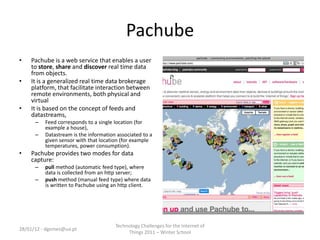
Pachube
•   Pachube is a web service that enables a user
    to store, share and discover real time data
    from objects.
•   It is a generalized real time data brokerage
    platform, that facilitate interaction between
    remote environments, both physical and
    virtual
•   It is based on the concept of feeds and
    datastreams,
      –   Feed corresponds to a single location (for
          example a house),
      –   Datastream is the information associated to a
          given sensor with that location (for example
          temperatures, power consumption).
•   Pachube provides two modes for data
    capture:
      –   pull method (automatic feed type), where
          data is collected from an http server;
      –   push method (manual feed type) where data
          is written to Pachube using an http client.


                                       Technology Challenges for the Internet of
28/01/12 - dgomes@ua.pt
                                            Things 2011 – Winter School
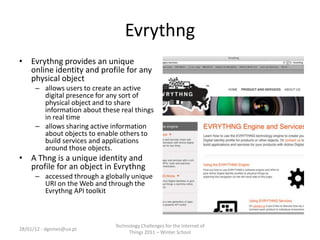
Evrythng
• Evrythng provides an unique
  online identity and profile for any
  physical object
      – allows users to create an active
        digital presence for any sort of
        physical object and to share
        information about these real things
        in real time
      – allows sharing active information
        about objects to enable others to
        build services and applications
        around those objects.
• A Thng is a unique identity and
  profile for an object in Evrythng
      – accessed through a globally unique
        URI on the Web and through the
        Evrythng API toolkit


                               Technology Challenges for the Internet of
28/01/12 - dgomes@ua.pt
                                    Things 2011 – Winter School
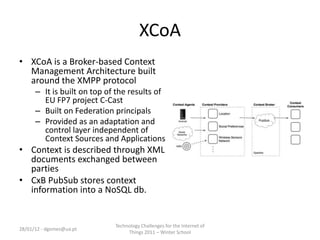
XCoA
• XCoA is a Broker-based Context
  Management Architecture built
  around the XMPP protocol
      – It is built on top of the results of
        EU FP7 project C-Cast
      – Built on Federation principals
      – Provided as an adaptation and
        control layer independent of
        Context Sources and Applications
• Context is described through XML
  documents exchanged between
  parties
• CxB PubSub stores context
  information into a NoSQL db.


                             Technology Challenges for the Internet of
28/01/12 - dgomes@ua.pt
                                  Things 2011 – Winter School
Standards
• Mostly focused on M2M
• ETSI
      – Proposes an Horizontal Architecture for M2M service
        deployment
      – Standardizing IT friendly API’s based on HTTP/REST
• 3GPP
      – Still focused on communication aspects
• OMA
      – BBF TR069 & OMA DM – data models for ETSI M2M
        device management
                          Technology Challenges for the Internet of
28/01/12 - dgomes@ua.pt
                               Things 2011 – Winter School
Standards
• W3C Semantic Sensor Networks Incubator Group (SSN-XG)
      – has developed an ontology for describing sensors.
      – models the sensor from device, process and system point of views.
      – It includes different operational, device related and quality of
        information attributes that are related to sensing devices.
      – describes the operational range, battery and power and
        environmental ranges that are specified for sensor devices.
      – Information gathered by a sensor is out of scope of SSN-XG
• W3C Ubiquitous Web Applications Group
      – Follow on to former Device Independence WG
      – Plus broadened focus on Ubiquitous Web Applications
      – Looking for people interested in working on
            • device abstraction layer for web applications
            • enabling applications across multiple devices
            • content adaptation for multi-channel delivery

                                Technology Challenges for the Internet of
28/01/12 - dgomes@ua.pt
                                     Things 2011 – Winter School
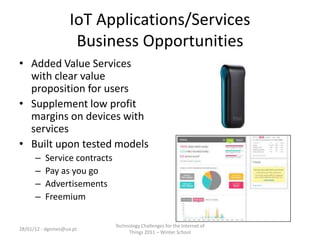
IoT Applications/Services
                     Business Opportunities
• Added Value Services
  with clear value
  proposition for users
• Supplement low profit
  margins on devices with
  services
• Built upon tested models
      –   Service contracts
      –   Pay as you go
      –   Advertisements
      –   Freemium

                              Technology Challenges for the Internet of
28/01/12 - dgomes@ua.pt
                                   Things 2011 – Winter School
Conclusion
• IoT is of no value without an interconnection with the
  IoS through service API’s
• IoT poses several important requirements on:
      –   Scalability
      –   Heterogeneous Interfaces
      –   Storage
      –   Middleware platforms
• There are several commercial and academic endeavors
  in the area of IoT Applications and Services, but not
  enough standardization.
• I’ve intentionally left Security, Privacy and Ethical issues
  out of this presentation 
                          Technology Challenges for the Internet of
28/01/12 - dgomes@ua.pt
                               Things 2011 – Winter School
“The most profound technologies are those that
disappear. They weave themselves into the
fabric of everyday life until they are
indistinguishable from it”.
      – (Mark Weiser in The Computer for the 21st Century)


                               Technology Challenges for the Internet of
28/01/12 - dgomes@ua.pt
                                    Things 2011 – Winter School
Thank you for your attention…


                                                                      …Questions?


                          Technology Challenges for the Internet of
28/01/12 - dgomes@ua.pt
                               Things 2011 – Winter School

IoT - Apps & Services

  • 1.
    Internet of Things Applications/Services Diogo Gomes <dgomes@ua.pt> Technology Challenges for the Internet of 28/01/12 - dgomes@ua.pt Things 2011 – Winter School
  • 2.
    source GSMA, 2011 Technology Challenges for the Internet of 28/01/12 - dgomes@ua.pt Things 2011 – Winter School
  • 3.
    source GSMA, 2011 Technology Challenges for the Internet of 28/01/12 - dgomes@ua.pt Things 2011 – Winter School
  • 4.
    Information is produced24/7 Technology Challenges for the Internet of 28/01/12 - dgomes@ua.pt Things 2011 – Winterhttp://embedded-computing.com/current-trends-cyber-attacks-mobile-embedded-systems Source: School
  • 5.
    What have weachieved so far… • We have connected billions of devices to the Internet, but… – What are we doing with it ? • We are following a 1 sensor 1 application model – We have create vertical silos of information • Energy information is kept by the Energy Company • Home automation is a self-contained application – We have over engineered our solutions • e.g. wireless mesh networks in well served locations • e.g. using generic sensing platforms to monitor limited amount of variables Technology Challenges for the Internet of 28/01/12 - dgomes@ua.pt Things 2011 – Winter School
  • 6.
    Technology Challenges forthe InternetSource: of 2011, Gartner Hype Cycle 28/01/12 - dgomes@ua.pt Things 2011 – Winter School
  • 7.
    … what arewe targeting? • What is done with all this information? • Who gathers this information? • Who stores this information? • Potential for new IoT Applications and Services – New players who do not own or operate any IoT devices – New players who are in charge of managing Information and providing new applications and services to users Technology Challenges for the Internet of 28/01/12 - dgomes@ua.pt Things 2011 – Winter School
  • 8.
    M2M vs IoT Technology Challenges for the Internet of 28/01/12 - dgomes@ua.pt Things 2011 – Winter School
  • 9.
    M2M vs IoT New Service Technology Challenges for the Internet of 28/01/12 - dgomes@ua.pt Things 2011 – Winter School
  • 10.
    IoT Services • Thevision of an Internet of Things has changed the concept of a service from traditional notion of web services. • In the Internet of Things domain, the term ‘service’ refers to enhancing real world resources with interaction support. • These so-called “real world services” are provided by resources that are linked directly to the physical world. • The resources have sensing, processing or actuating devices that provide information on entities in the real world, provide interactions or generate events about them. Technology Challenges for the Internet of 28/01/12 - dgomes@ua.pt Things 2011 – Winter School
  • 11.
    IoT and theIoS • IoT is about connecting “things” to the Internet. • IoS will be about what we do with the information provided by those Data Information “things” – IoT can gather data, but it is up to the IoS to process that data into Information and Knowledge. IoT IoS • IoS will enable the control and management of real world resources Actions Information and devices – IoT will provide the actuators, by which the Virtual/Service world will interact with the real world. Technology Challenges for the Internet of 28/01/12 - dgomes@ua.pt Things 2011 – Winter School
  • 12.
    IoT deployment Internet Data Information Knowledge Technology Challenges for the Internet of 28/01/12 - dgomes@ua.pt Things 2011 – Winter School
  • 13.
    IoS - Internetof Services • IoS is about the software fabric that will connect service providers and consumers • IoS will enable the exchange of information and knowledge between internet users (both human and machines) • In order to achieve this goal, IoS requires data • IoT will enable data to flow Anytime, Anyplace, with Anything and Anyone, ideally using Any path/network and Any service Technology Challenges for the Internet of 28/01/12 - dgomes@ua.pt Things 2011 – Winter School
  • 14.
    How to connectthe IoT to the IoS • The IoT must export interfaces to the IoS • Connecting devices to the Internet – Directly: e.g. 6lowpan – Indirectly: through service gateways • IoT is very heterogeneous – Multiple Technologies, Multiple Information Sources • How to overcome such heterogeneity ? – Through Semantic Interfaces – Through Data Mining – Through Machine Learning Techniques Technology Challenges for the Internet of 28/01/12 - dgomes@ua.pt Things 2011 – Winter School
  • 15.
    Semantic Interfaces • Semanticinteroperability can be achieved between heterogeneous information systems (service providers and service requestors) in a multitude of ways. – development of comprehensive shared information models can facilitate semantic interoperability among the participant applications and businesses • Problem: it is rigid and inflexible when it comes to business processes – appropriate semantic mediators (translators) at each participant’s end, to facilitate the conversion to the information format which the participant understands • Problem: add’s complexity to all participants (many IoT devices to not have enough resources for these semantic mediators) Technology Challenges for the Internet of 28/01/12 - dgomes@ua.pt Things 2011 – Winter School
  • 16.
    Data Mining • Analternative and/or complementary approach is to use Data Mining techniques to extract information from the raw data collected by IoT devices. – Through processes such as: • Classification • Cluster Analysis • Regression Analysis • Structured Data Analysis – Each IoT device can have their own interface and data representation format. – The IoS Application/Service will take the task to sort out relationships between collect data. Technology Challenges for the Internet of 28/01/12 - dgomes@ua.pt Things 2011 – Winter School
  • 17.
    Machine Learning • Ata higher level we will find machine learning techniques that will assist us at creating relationships between the collected information, and at extracting knowledge from the IoT. – Relevant Machine Learning techniques include • Sparse Dictionary Learning • Representation learning • Artificial neural networks • Support Vector Machines Technology Challenges for the Internet of 28/01/12 - dgomes@ua.pt Things 2011 – Winter School
  • 18.
    How to storeIoT Data ? Technology Challenges for the Internet of 28/01/12 - dgomes@ua.pt Things 2011 – Winter School
  • 19.
    What to dowith all the collect Information? • When we consider that we have billions of connected devices all publishing information we are faced with data gathering and storage issues: – We require a distributed network capable of aggregating and processing information on the network before it reaches the storage servers – We require a highly efficient storage architecture that efficiently store and process all data collected Technology Challenges for the Internet of 28/01/12 - dgomes@ua.pt Things 2011 – Winter School
  • 20.
    Storing Information • Thereare currently two main solutions to store information – Relational Databases (traditionally referred to as SQL- based), which are based on the relational model in which information is stored in rows and grouped into tables – NoSQL Databases, a more recent technology that tries to overcome some of the relational databases problems related to performance and scalability at the expense of some of the ACID properties of relational databases. Technology Challenges for the Internet of 28/01/12 - dgomes@ua.pt Things 2011 – Winter School
  • 21.
    NoSQL Solutions • NoSQLis not a class by itself, but a set a different technologies that do not adhere to the traditional relational model. – Key/Value Store – Wide Column Store – Document Oriented • Most NoSQL storage systems are also schemaless, or schema-free, where no schema is configured or enforced when using the database. – This is an important aspect when considering the heterogeneity of IoT Technology Challenges for the Internet of 28/01/12 - dgomes@ua.pt Things 2011 – Winter School
  • 22.
    We collect andproperly store information Technology Challenges for the Internet of 28/01/12 - dgomes@ua.pt Things 2011 – Winter School
  • 23.
    Creating IoT Servicesand Applications • How to develop and execute applications on top of the collect information and knowledge? • A middleware architecture approach is of importance in the IoT domain due to its role in simplifying the development of new services and integration of legacy technologies into new ones Technology Challenges for the Internet of 28/01/12 - dgomes@ua.pt Things 2011 – Winter School
  • 24.
    IoT middleware platforms B2B / B2C Web Portais Applications API’s Service Delivery Platform OSS Information/Knowledge Management Smart Objects Management WAN : 2G/3G/LTE, xDSL, GPON Sensor/Device Networks Technology Challenges for the Internet of 28/01/12 - dgomes@ua.pt Things 2011 – Winter School
  • 25.
    Service Creation andDeployment • Most middleware architectures follow SOA approaches, and adhere to it’s principals, providing: – service composition environment. – abstracting the devices’ functionalities and communication capabilities, – provision of a common set of services Technology Challenges for the Internet of 28/01/12 - dgomes@ua.pt Things 2011 – Winter School
  • 26.
    Examples of middleware’s •Several research projects have proposed middleware platforms – FP7 PERSIST: proposed a P2P middleware – FP7 ICT m:Ciudad project: middleware as a mobile application (Service Creation Kit) – FP7 SENSEI: Service creation and composition is handled by a Task Plan Technology Challenges for the Internet of 28/01/12 - dgomes@ua.pt Things 2011 – Winter School
  • 27.
    Pachube • Pachube is a web service that enables a user to store, share and discover real time data from objects. • It is a generalized real time data brokerage platform, that facilitate interaction between remote environments, both physical and virtual • It is based on the concept of feeds and datastreams, – Feed corresponds to a single location (for example a house), – Datastream is the information associated to a given sensor with that location (for example temperatures, power consumption). • Pachube provides two modes for data capture: – pull method (automatic feed type), where data is collected from an http server; – push method (manual feed type) where data is written to Pachube using an http client. Technology Challenges for the Internet of 28/01/12 - dgomes@ua.pt Things 2011 – Winter School
  • 28.
    Evrythng • Evrythng providesan unique online identity and profile for any physical object – allows users to create an active digital presence for any sort of physical object and to share information about these real things in real time – allows sharing active information about objects to enable others to build services and applications around those objects. • A Thng is a unique identity and profile for an object in Evrythng – accessed through a globally unique URI on the Web and through the Evrythng API toolkit Technology Challenges for the Internet of 28/01/12 - dgomes@ua.pt Things 2011 – Winter School
  • 29.
    XCoA • XCoA isa Broker-based Context Management Architecture built around the XMPP protocol – It is built on top of the results of EU FP7 project C-Cast – Built on Federation principals – Provided as an adaptation and control layer independent of Context Sources and Applications • Context is described through XML documents exchanged between parties • CxB PubSub stores context information into a NoSQL db. Technology Challenges for the Internet of 28/01/12 - dgomes@ua.pt Things 2011 – Winter School
  • 30.
    Standards • Mostly focusedon M2M • ETSI – Proposes an Horizontal Architecture for M2M service deployment – Standardizing IT friendly API’s based on HTTP/REST • 3GPP – Still focused on communication aspects • OMA – BBF TR069 & OMA DM – data models for ETSI M2M device management Technology Challenges for the Internet of 28/01/12 - dgomes@ua.pt Things 2011 – Winter School
  • 31.
    Standards • W3C SemanticSensor Networks Incubator Group (SSN-XG) – has developed an ontology for describing sensors. – models the sensor from device, process and system point of views. – It includes different operational, device related and quality of information attributes that are related to sensing devices. – describes the operational range, battery and power and environmental ranges that are specified for sensor devices. – Information gathered by a sensor is out of scope of SSN-XG • W3C Ubiquitous Web Applications Group – Follow on to former Device Independence WG – Plus broadened focus on Ubiquitous Web Applications – Looking for people interested in working on • device abstraction layer for web applications • enabling applications across multiple devices • content adaptation for multi-channel delivery Technology Challenges for the Internet of 28/01/12 - dgomes@ua.pt Things 2011 – Winter School
  • 32.
    IoT Applications/Services Business Opportunities • Added Value Services with clear value proposition for users • Supplement low profit margins on devices with services • Built upon tested models – Service contracts – Pay as you go – Advertisements – Freemium Technology Challenges for the Internet of 28/01/12 - dgomes@ua.pt Things 2011 – Winter School
  • 33.
    Conclusion • IoT isof no value without an interconnection with the IoS through service API’s • IoT poses several important requirements on: – Scalability – Heterogeneous Interfaces – Storage – Middleware platforms • There are several commercial and academic endeavors in the area of IoT Applications and Services, but not enough standardization. • I’ve intentionally left Security, Privacy and Ethical issues out of this presentation  Technology Challenges for the Internet of 28/01/12 - dgomes@ua.pt Things 2011 – Winter School
  • 34.
    “The most profoundtechnologies are those that disappear. They weave themselves into the fabric of everyday life until they are indistinguishable from it”. – (Mark Weiser in The Computer for the 21st Century) Technology Challenges for the Internet of 28/01/12 - dgomes@ua.pt Things 2011 – Winter School
  • 35.
    Thank you foryour attention… …Questions? Technology Challenges for the Internet of 28/01/12 - dgomes@ua.pt Things 2011 – Winter School

Editor's Notes

  • #10 Introduce CONTEXT
  • #21 ACID properties (Atomicity, Consistency, Isolation, Durability),
  • #24 We so far described out to extract information and storeBy definition, a middleware “is a software layer or a set of sub-layers interposed between the technological and the application levels
  • #26 Standardized Service Contracts, Service Loose Coupling, Service Abstraction, Service Reusability, Service Autonomy, Service Statelessness, Service Discoverability, Service Composability, Service-Orientation and Interoperability
  • #33 Fitbit (it’s just an accelerometer)