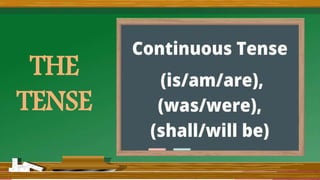
THE
TENSE
PRESENT CONTINUOUS TENSE
The Present Continuous tense tells about a situation or an event that is happening right
now, that is at the moment of speaking. To form the present continuous tense, we use the
verb be (in the present tense) and the –ing form of the verb.
Study this table to understand the different forms of the Present Continuous Tense.
Person and Number Subject Be
(Present)
Main Verb +
ing
I Person Singular I am reading
I Person Plural We are reading
II Person Singular You are reading
II Person Plural You are reading
III Person Singular He/She/It is reading
III Person Plural They are reading
The Present Continuous Tense is used ___
to describe an action that is in progress and the continuity of that action.
(E.g.) The child is looking out of the window.
to describe an action in progress but not necessarily at the time of speaking.
(E.g.) I am writing stories for children.
to express an action that is planned for the near future.
(E.g.) We are flying to Singapore next Sunday.
to indicate progressive changes, trends and developments.
(E.g.) The villagers are changing their lifestyle.
to emphasise the present moment or to indicate that a situation is temporary.
(E.g.) We are spending the winter at Chennai.
PAST CONTINUOUS TENSE
The Past Continuous tense tells about something that was going on at a particular time
in the past. To form the present continuous tense, we use the past form of the verb be +
the –ing form of the verb.
Study this table to understand the different forms of the Past Continuous Tense.
Person and Number Subject Be
(Past)
Main Verb +
ing
I Person Singular I was playing
I Person Plural We were playing
II Person Singular You were playing
II Person Plural You were playing
III Person Singular He/She/It was playing
III Person Plural They were playing
The Past Continuous Tense is used ___
to express an action that was happening in the past at the time of speaking.
(E.g.) The children were playing in the park.
to refer two contrasting activities in the past that were in progress at the same time.
(E.g.) While I was practising the guitar, my brother was doing his homework.
to draw attention to the repetition of an activity during a period of time in the past.
(E.g.) We were getting milk from a nearby village for a month
FUTURE CONTINUOUS TENSE
The Future Continuous tense is used to emphasise an action or event that will happen for
sometime in the future. To form the future continuous tense, we use will+ be + the –ing
form of the verb.
Study this table to understand the different forms of the Future Continuous Tense.
Person and Number Subject will be Main Verb +
ing
I Person Singular I will be completing
I Person Plural We will be completing
II Person Singular You will be completing
II Person Plural You will be completing
III Person Singular He/She/It will be completing
III Person Plural They will be completing
The Future Continuous Tense is used ___
 to express an event that is expected to take place in the normal course.
(E.g.) The plumber will be coming soon.
to talk about actions which will be in progress at a time in future.
(E.g.)This time tomorrow, We will be practising yoga.

Tenses - Continuous Form

  • 1.
  • 2.
    PRESENT CONTINUOUS TENSE ThePresent Continuous tense tells about a situation or an event that is happening right now, that is at the moment of speaking. To form the present continuous tense, we use the verb be (in the present tense) and the –ing form of the verb. Study this table to understand the different forms of the Present Continuous Tense. Person and Number Subject Be (Present) Main Verb + ing I Person Singular I am reading I Person Plural We are reading II Person Singular You are reading II Person Plural You are reading III Person Singular He/She/It is reading III Person Plural They are reading
  • 3.
    The Present ContinuousTense is used ___ to describe an action that is in progress and the continuity of that action. (E.g.) The child is looking out of the window. to describe an action in progress but not necessarily at the time of speaking. (E.g.) I am writing stories for children. to express an action that is planned for the near future. (E.g.) We are flying to Singapore next Sunday. to indicate progressive changes, trends and developments. (E.g.) The villagers are changing their lifestyle. to emphasise the present moment or to indicate that a situation is temporary. (E.g.) We are spending the winter at Chennai.
  • 4.
    PAST CONTINUOUS TENSE ThePast Continuous tense tells about something that was going on at a particular time in the past. To form the present continuous tense, we use the past form of the verb be + the –ing form of the verb. Study this table to understand the different forms of the Past Continuous Tense. Person and Number Subject Be (Past) Main Verb + ing I Person Singular I was playing I Person Plural We were playing II Person Singular You were playing II Person Plural You were playing III Person Singular He/She/It was playing III Person Plural They were playing
  • 5.
    The Past ContinuousTense is used ___ to express an action that was happening in the past at the time of speaking. (E.g.) The children were playing in the park. to refer two contrasting activities in the past that were in progress at the same time. (E.g.) While I was practising the guitar, my brother was doing his homework. to draw attention to the repetition of an activity during a period of time in the past. (E.g.) We were getting milk from a nearby village for a month
  • 6.
    FUTURE CONTINUOUS TENSE TheFuture Continuous tense is used to emphasise an action or event that will happen for sometime in the future. To form the future continuous tense, we use will+ be + the –ing form of the verb. Study this table to understand the different forms of the Future Continuous Tense. Person and Number Subject will be Main Verb + ing I Person Singular I will be completing I Person Plural We will be completing II Person Singular You will be completing II Person Plural You will be completing III Person Singular He/She/It will be completing III Person Plural They will be completing
  • 7.
    The Future ContinuousTense is used ___  to express an event that is expected to take place in the normal course. (E.g.) The plumber will be coming soon. to talk about actions which will be in progress at a time in future. (E.g.)This time tomorrow, We will be practising yoga.