Javier Varela Blanca
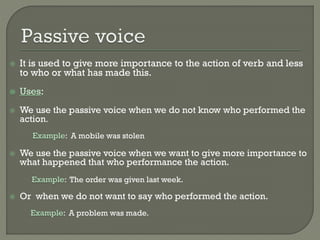
 It is used to give more importance to the action of verb and less
to who or what has made this.
:
 We use the passive voice when we do not know who performed the
action.
: A mobile was stolen
 We use the passive voice when we want to give more importance to
what happened that who performance the action.
: The order was given last week.
 Or when we do not want to say who performed the action.
: A problem was made.
 Form of the passive verb
 Subject + auxiliary verb (to be) + Past participle
:
 Present simple (am/are/is + pp): A letter is written
 Past simple (was/were + pp): A letter was burned.
 Present perfect (have/ has been + pp) : A car has been stolen.
 Past perfect simple (had been + pp): A car had been stolen
 Future (will be + pp):The chair will be repaired while we are wait.
 Future (am/are/is going to be + pp):The chair is going to be repaired
next week.
 Modal verbs ( modal + be + pp): That car must be bought
The computer can be destroyed
A specialist should be called to testify.
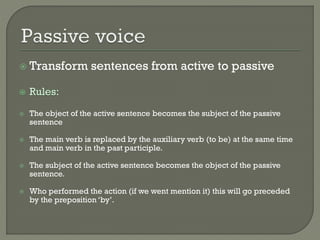
 Transform sentences from active to passive
 The object of the active sentence becomes the subject of the passive
sentence
 The main verb is replaced by the auxiliary verb (to be) at the same time
and main verb in the past participle.
 The subject of the active sentence becomes the object of the passive
sentence.
 Who performed the action (if we went mention it) this will go preceded
by the preposition ‘by’.
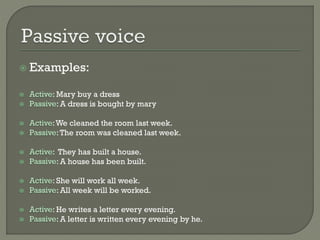
 Examples:
: Mary buy a dress
: A dress is bought by mary
:We cleaned the room last week.
:The room was cleaned last week.
: They has built a house.
: A house has been built.
: She will work all week.
: All week will be worked.
: He writes a letter every evening.
: A letter is written every evening by he.

The passive voice

  • 1.
  • 2.
     It isused to give more importance to the action of verb and less to who or what has made this. :  We use the passive voice when we do not know who performed the action. : A mobile was stolen  We use the passive voice when we want to give more importance to what happened that who performance the action. : The order was given last week.  Or when we do not want to say who performed the action. : A problem was made.
  • 3.
     Form ofthe passive verb  Subject + auxiliary verb (to be) + Past participle :  Present simple (am/are/is + pp): A letter is written  Past simple (was/were + pp): A letter was burned.  Present perfect (have/ has been + pp) : A car has been stolen.  Past perfect simple (had been + pp): A car had been stolen  Future (will be + pp):The chair will be repaired while we are wait.  Future (am/are/is going to be + pp):The chair is going to be repaired next week.  Modal verbs ( modal + be + pp): That car must be bought The computer can be destroyed A specialist should be called to testify.
  • 4.
     Transform sentencesfrom active to passive  The object of the active sentence becomes the subject of the passive sentence  The main verb is replaced by the auxiliary verb (to be) at the same time and main verb in the past participle.  The subject of the active sentence becomes the object of the passive sentence.  Who performed the action (if we went mention it) this will go preceded by the preposition ‘by’.
  • 5.
     Examples: : Marybuy a dress : A dress is bought by mary :We cleaned the room last week. :The room was cleaned last week. : They has built a house. : A house has been built. : She will work all week. : All week will be worked. : He writes a letter every evening. : A letter is written every evening by he.