Double object pronouns
FRENCH 3
These are tricky!
Double Object Pronouns occur when using both direct object pronouns and indirect object
pronouns with the same verb! You can’t use two direct or two indirect object pronouns in the
same sentence.
Whenever two object pronouns, adverbial pronouns, and/or reflexive pronouns are used in the
same sentence, they must occur in a specific order. There are actually two specific orders – (1) a
specific order for all verb tenses and moods; and (2) a slightly different specific order for
affirmative commands.
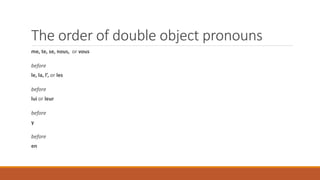
The order of double object pronouns
me, te, se, nous, or vous
before
le, la, l’, or les
before
lui or leur
before
y
before
en
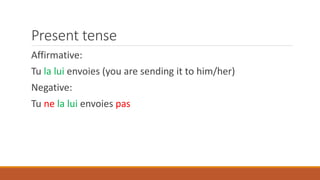
Present tense
Affirmative:
Tu la lui envoies (you are sending it to him/her)
Negative:
Tu ne la lui envoies pas
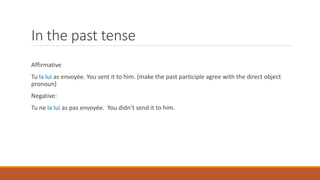
In the past tense
Affirmative
Tu la lui as envoyée. You sent it to him. (make the past participle agree with the direct object
pronoun)
Negative:
Tu ne la lui as pas envoyée. You didn’t send it to him.
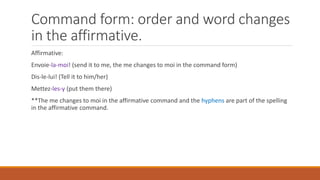
Command form: order and word changes
in the affirmative.
Affirmative:
Envoie-la-moi! (send it to me, the me changes to moi in the command form)
Dis-le-lui! (Tell it to him/her)
Mettez-les-y (put them there)
**The me changes to moi in the affirmative command and the hyphens are part of the spelling
in the affirmative command.
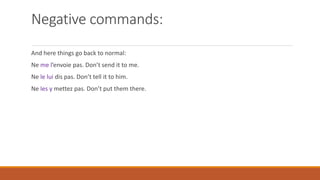
Negative commands:
And here things go back to normal:
Ne me l’envoie pas. Don’t send it to me.
Ne le lui dis pas. Don’t tell it to him.
Ne les y mettez pas. Don’t put them there.
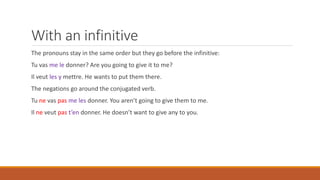
With an infinitive
The pronouns stay in the same order but they go before the infinitive:
Tu vas me le donner? Are you going to give it to me?
Il veut les y mettre. He wants to put them there.
The negations go around the conjugated verb.
Tu ne vas pas me les donner. You aren’t going to give them to me.
Il ne veut pas t’en donner. He doesn’t want to give any to you.
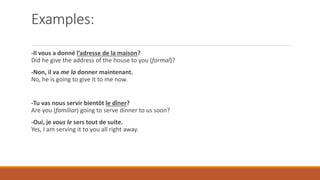
Examples:
-Il vous a donné l’adresse de la maison?
Did he give the address of the house to you (formal)?
-Non, il va me la donner maintenant.
No, he is going to give it to me now.
-Tu vas nous servir bientôt le dîner?
Are you (familiar) going to serve dinner to us soon?
-Oui, je vous le sers tout de suite.
Yes, I am serving it to you all right away.
Et voilà!!
J’espère que ceci vous aide!
Just remember the order of the object pronouns and that the order ONLY changes for the
affirmative commands.
But in the affirmative (not negative)command form,
the me changes to moi and the order is
Le
La + lui + moi, nous, toi
Les leur

Double obj pronouns

  • 1.
  • 2.
    These are tricky! DoubleObject Pronouns occur when using both direct object pronouns and indirect object pronouns with the same verb! You can’t use two direct or two indirect object pronouns in the same sentence. Whenever two object pronouns, adverbial pronouns, and/or reflexive pronouns are used in the same sentence, they must occur in a specific order. There are actually two specific orders – (1) a specific order for all verb tenses and moods; and (2) a slightly different specific order for affirmative commands.
  • 3.
    The order ofdouble object pronouns me, te, se, nous, or vous before le, la, l’, or les before lui or leur before y before en
  • 4.
    Present tense Affirmative: Tu lalui envoies (you are sending it to him/her) Negative: Tu ne la lui envoies pas
  • 5.
    In the pasttense Affirmative Tu la lui as envoyée. You sent it to him. (make the past participle agree with the direct object pronoun) Negative: Tu ne la lui as pas envoyée. You didn’t send it to him.
  • 6.
    Command form: orderand word changes in the affirmative. Affirmative: Envoie-la-moi! (send it to me, the me changes to moi in the command form) Dis-le-lui! (Tell it to him/her) Mettez-les-y (put them there) **The me changes to moi in the affirmative command and the hyphens are part of the spelling in the affirmative command.
  • 7.
    Negative commands: And herethings go back to normal: Ne me l’envoie pas. Don’t send it to me. Ne le lui dis pas. Don’t tell it to him. Ne les y mettez pas. Don’t put them there.
  • 8.
    With an infinitive Thepronouns stay in the same order but they go before the infinitive: Tu vas me le donner? Are you going to give it to me? Il veut les y mettre. He wants to put them there. The negations go around the conjugated verb. Tu ne vas pas me les donner. You aren’t going to give them to me. Il ne veut pas t’en donner. He doesn’t want to give any to you.
  • 9.
    Examples: -Il vous adonné l’adresse de la maison? Did he give the address of the house to you (formal)? -Non, il va me la donner maintenant. No, he is going to give it to me now. -Tu vas nous servir bientôt le dîner? Are you (familiar) going to serve dinner to us soon? -Oui, je vous le sers tout de suite. Yes, I am serving it to you all right away.
  • 10.
    Et voilà!! J’espère quececi vous aide! Just remember the order of the object pronouns and that the order ONLY changes for the affirmative commands. But in the affirmative (not negative)command form, the me changes to moi and the order is Le La + lui + moi, nous, toi Les leur