Chapter Five
Portfolio Theory
1
Introduction
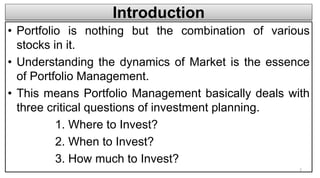
• Portfolio is nothing but the combination of various
stocks in it.
• Understanding the dynamics of Market is the essence
of Portfolio Management.
• This means Portfolio Management basically deals with
three critical questions of investment planning.
1. Where to Invest?
2. When to Invest?
3. How much to Invest?
2
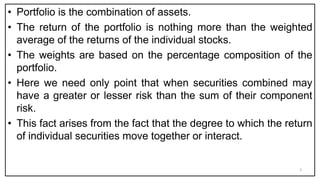
• Portfolio is the combination of assets.
• The return of the portfolio is nothing more than the weighted
average of the returns of the individual stocks.
• The weights are based on the percentage composition of the
portfolio.
• Here we need only point that when securities combined may
have a greater or lesser risk than the sum of their component
risk.
• This fact arises from the fact that the degree to which the return
of individual securities move together or interact.
3
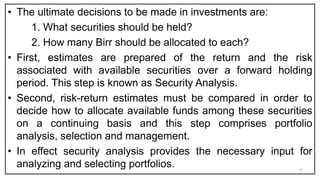
• The ultimate decisions to be made in investments are:
1. What securities should be held?
2. How many Birr should be allocated to each?
• First, estimates are prepared of the return and the risk
associated with available securities over a forward holding
period. This step is known as Security Analysis.
• Second, risk-return estimates must be compared in order to
decide how to allocate available funds among these securities
on a continuing basis and this step comprises portfolio
analysis, selection and management.
• In effect security analysis provides the necessary input for
analyzing and selecting portfolios. 4
Diversification and portfolio risk
• Diversification allows investor to reduce the level of the overall risk
of a portfolio by eliminating the impact of individual risk.
• Efficiently diversified portfolios are those which provide the lowest
possible risk for any level of expected return (or the highest return
for any level of risk).
• Principle of diversification states spreading an investment across a
number of assets will eliminate some, but not all, of the risk.
– Diversification is not putting all your eggs in one basket.
5
• A principle of diversification states that spreading an
investment across a number of assets; will eliminate some but
not all of the risk.
• Unsystematic risk is essentially eliminated by diversification, so
portfolio with many assets has almost no unsystematic risk.
Total risk = Systematic risk + unsystematic risk
6
Types of Diversification
1. Random or naive diversification and
2. Efficient diversification
1. Random or naive diversification:
– It refers to the act of randomly diversifying without regard to relevant
investment characteristics such as expected return and industry
classification.
– An investor simply selects relatively large number of securities
randomly.
– Unfortunately, in such case, the benefits of random diversification do
not continue as we add more securities, the reduction becomes
smaller and smaller.
7
2. Efficient diversification
–Efficient diversification takes place in an efficient portfolio
that has the smallest portfolio risk for a given level of
expected return or the largest expected return for a given
level of risk.
–Investors can specify a portfolio risk level they are willing to
assume and maximize the expected return on the portfolio
for this level of risk.
–Rational investors look for efficient portfolios, because these
portfolios are optimized on the two dimensions of most
importance to investors- return and risk.
8
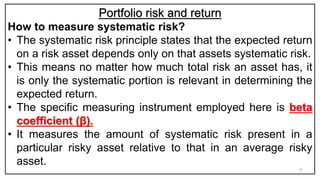
Portfolio risk and return
How to measure systematic risk?
• The systematic risk principle states that the expected return
on a risk asset depends only on that assets systematic risk.
• This means no matter how much total risk an asset has, it
is only the systematic portion is relevant in determining the
expected return.
• The specific measuring instrument employed here is beta
coefficient (β).
• It measures the amount of systematic risk present in a
particular risky asset relative to that in an average risky
asset.
9
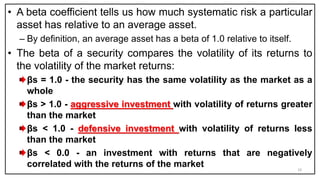
• A beta coefficient tells us how much systematic risk a particular
asset has relative to an average asset.
– By definition, an average asset has a beta of 1.0 relative to itself.
• The beta of a security compares the volatility of its returns to
the volatility of the market returns:
βs = 1.0 - the security has the same volatility as the market as a
whole
βs > 1.0 - aggressive investment with volatility of returns greater
than the market
βs < 1.0 - defensive investment with volatility of returns less
than the market
βs < 0.0 - an investment with returns that are negatively
correlated with the returns of the market 10
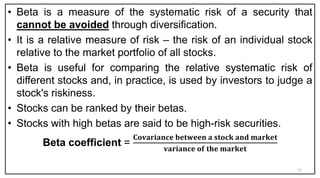
• Beta is a measure of the systematic risk of a security that
cannot be avoided through diversification.
• It is a relative measure of risk – the risk of an individual stock
relative to the market portfolio of all stocks.
• Beta is useful for comparing the relative systematic risk of
different stocks and, in practice, is used by investors to judge a
stock's riskiness.
• Stocks can be ranked by their betas.
• Stocks with high betas are said to be high-risk securities.
Beta coefficient =
𝐂𝐨𝐯𝐚𝐫𝐢𝐚𝐧𝐜𝐞 𝐛𝐞𝐭𝐰𝐞𝐞𝐧 𝐚 𝐬𝐭𝐨𝐜𝐤 𝐚𝐧𝐝 𝐦𝐚𝐫𝐤𝐞𝐭
𝐯𝐚𝐫𝐢𝐚𝐧𝐜𝐞 𝐨𝐟 𝐭𝐡𝐞 𝐦𝐚𝐫𝐤𝐞𝐭
11
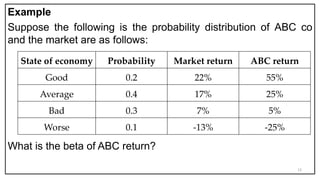
Example
Suppose the following is the probability distribution of ABC co
and the market are as follows:
What is the beta of ABC return?
12
State of economy Probability Market return ABC return
Good 0.2 22% 55%
Average 0.4 17% 25%
Bad 0.3 7% 5%
Worse 0.1 -13% -25%
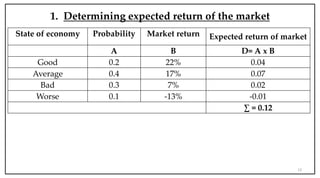
1. Determining expected return of the market
13
State of economy Probability Market return Expected return of market
A B D= A x B
Good 0.2 22% 0.04
Average 0.4 17% 0.07
Bad 0.3 7% 0.02
Worse 0.1 -13% -0.01
∑ = 0.12
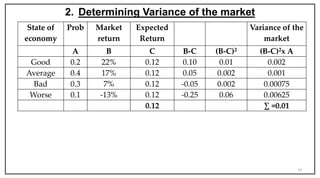
2. Determining Variance of the market
14
State of
economy
Prob Market
return
Expected
Return
Variance of the
market
A B C B-C (B-C)2 (B-C)2x A
Good 0.2 22% 0.12 0.10 0.01 0.002
Average 0.4 17% 0.12 0.05 0.002 0.001
Bad 0.3 7% 0.12 -0.05 0.002 0.00075
Worse 0.1 -13% 0.12 -0.25 0.06 0.00625
0.12 ∑ =0.01
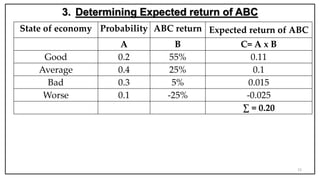
3. Determining Expected return of ABC
15
State of economy Probability ABC return Expected return of ABC
A B C= A x B
Good 0.2 55% 0.11
Average 0.4 25% 0.1
Bad 0.3 5% 0.015
Worse 0.1 -25% -0.025
∑ = 0.20
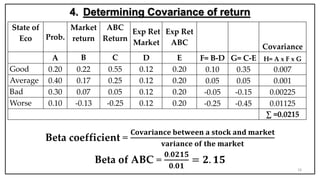
4. Determining Covariance of return
Beta coefficient =
𝐂𝐨𝐯𝐚𝐫𝐢𝐚𝐧𝐜𝐞 𝐛𝐞𝐭𝐰𝐞𝐞𝐧 𝐚 𝐬𝐭𝐨𝐜𝐤 𝐚𝐧𝐝 𝐦𝐚𝐫𝐤𝐞𝐭
𝐯𝐚𝐫𝐢𝐚𝐧𝐜𝐞 𝐨𝐟 𝐭𝐡𝐞 𝐦𝐚𝐫𝐤𝐞𝐭
Beta of ABC =
𝟎.𝟎𝟐𝟏𝟓
𝟎.𝟎𝟏
= 𝟐. 𝟏𝟓
16
State of
Eco Prob.
Market
return
ABC
Return
Exp Ret
Market
Exp Ret
ABC
Covariance
A B C D E F= B-D G= C-E H= A x F x G
Good 0.20 0.22 0.55 0.12 0.20 0.10 0.35 0.007
Average 0.40 0.17 0.25 0.12 0.20 0.05 0.05 0.001
Bad 0.30 0.07 0.05 0.12 0.20 -0.05 -0.15 0.00225
Worse 0.10 -0.13 -0.25 0.12 0.20 -0.25 -0.45 0.01125
∑ =0.0215
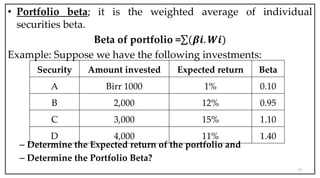
• Portfolio beta; it is the weighted average of individual
securities beta.
Beta of portfolio = (𝜷𝒊. 𝑾𝒊)
Example: Suppose we have the following investments:
– Determine the Expected return of the portfolio and
– Determine the Portfolio Beta?
17
Security Amount invested Expected return Beta
A Birr 1000 1% 0.10
B 2,000 12% 0.95
C 3,000 15% 1.10
D 4,000 11% 1.40
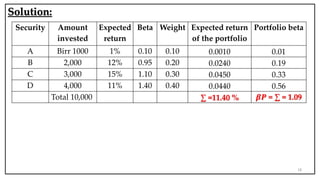
Solution:
18
Security Amount
invested
Expected
return
Beta Weight Expected return
of the portfolio
Portfolio beta
A Birr 1000 1% 0.10 0.10 0.0010 0.01
B 2,000 12% 0.95 0.20 0.0240 0.19
C 3,000 15% 1.10 0.30 0.0450 0.33
D 4,000 11% 1.40 0.40 0.0440 0.56
Total 10,000 ∑ =11.40 % 𝜷𝑷 = ∑ = 1.09
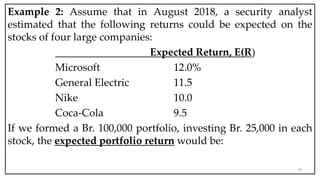
Example 2: Assume that in August 2018, a security analyst
estimated that the following returns could be expected on the
stocks of four large companies:
Expected Return, E(R)
Microsoft 12.0%
General Electric 11.5
Nike 10.0
Coca-Cola 9.5
If we formed a Br. 100,000 portfolio, investing Br. 25,000 in each
stock, the expected portfolio return would be:
19
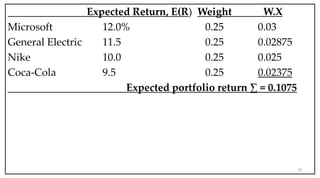
Expected Return, E(R) Weight W.X
Microsoft 12.0% 0.25 0.03
General Electric 11.5 0.25 0.02875
Nike 10.0 0.25 0.025
Coca-Cola 9.5 0.25 0.02375
Expected portfolio return ∑ = 0.1075
20
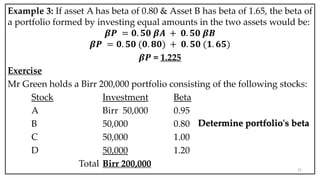
Example 3: If asset A has beta of 0.80 & Asset B has beta of 1.65, the beta of
a portfolio formed by investing equal amounts in the two assets would be:
𝜷𝑷 = 𝟎. 𝟓𝟎 𝜷𝑨 + 𝟎. 𝟓𝟎 𝜷𝑩
𝜷𝑷 = 𝟎. 𝟓𝟎 (𝟎. 𝟖𝟎) + 𝟎. 𝟓𝟎 (𝟏. 𝟔𝟓)
𝜷𝑷 = 1.225
Exercise
Mr Green holds a Birr 200,000 portfolio consisting of the following stocks:
Stock Investment Beta
A Birr 50,000 0.95
B 50,000 0.80
C 50,000 1.00
D 50,000 1.20
Total Birr 200,000 21
Determine portfolio's beta
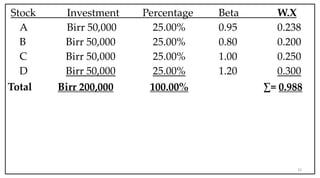
Stock Investment Percentage Beta W.X
A Birr 50,000 25.00% 0.95 0.238
B Birr 50,000 25.00% 0.80 0.200
C Birr 50,000 25.00% 1.00 0.250
D Birr 50,000 25.00% 1.20 0.300
Total Birr 200,000 100.00% ∑= 0.988
22
Capital allocation between risky and risk free assets
• History shows us that long-term bonds have been riskier
investments than investments in Treasury bills and that stock
investments have been riskier still.
• On the other hand, the riskier investments have offered higher
average returns.
• Investors, of course, do not make all-or-nothing choices from
these investment classes.
• They can and do construct their portfolios using securities
from all asset classes.
• Some of the portfolio may be in risk-free, some in high-risk
stocks. 23
• Therefore, we start our discussion of the risk–return trade-off
available to investors by examining the most basic asset
allocation choice: the choice of how much of the portfolio to
place in risk-free money market securities versus other risky
asset classes.
24
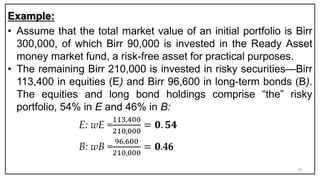
Example:
• Assume that the total market value of an initial portfolio is Birr
300,000, of which Birr 90,000 is invested in the Ready Asset
money market fund, a risk-free asset for practical purposes.
• The remaining Birr 210,000 is invested in risky securities—Birr
113,400 in equities (E) and Birr 96,600 in long-term bonds (B).
The equities and long bond holdings comprise “the” risky
portfolio, 54% in E and 46% in B:
E: wE =
113,400
210,000
= 𝟎. 𝟓𝟒
B: wB =
96,600
210,000
= 𝟎.46
25
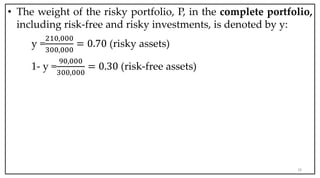
• The weight of the risky portfolio, P, in the complete portfolio,
including risk-free and risky investments, is denoted by y:
y =
210,000
300,000
= 0.70 (risky assets)
1- y =
90,000
300,000
= 0.30 (risk-free assets)
26
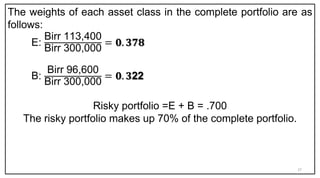
The weights of each asset class in the complete portfolio are as
follows:
E:
Birr 113,400
Birr 300,000
= 𝟎. 𝟑𝟕𝟖
B:
Birr 96,600
Birr 300,000
= 𝟎. 𝟑22
Risky portfolio =E + B = .700
The risky portfolio makes up 70% of the complete portfolio.
27
End of
Chapter 4
28

Invt Chapter 5 ppt.pptx best presentation

  • 1.
  • 2.
    Introduction • Portfolio isnothing but the combination of various stocks in it. • Understanding the dynamics of Market is the essence of Portfolio Management. • This means Portfolio Management basically deals with three critical questions of investment planning. 1. Where to Invest? 2. When to Invest? 3. How much to Invest? 2
  • 3.
    • Portfolio isthe combination of assets. • The return of the portfolio is nothing more than the weighted average of the returns of the individual stocks. • The weights are based on the percentage composition of the portfolio. • Here we need only point that when securities combined may have a greater or lesser risk than the sum of their component risk. • This fact arises from the fact that the degree to which the return of individual securities move together or interact. 3
  • 4.
    • The ultimatedecisions to be made in investments are: 1. What securities should be held? 2. How many Birr should be allocated to each? • First, estimates are prepared of the return and the risk associated with available securities over a forward holding period. This step is known as Security Analysis. • Second, risk-return estimates must be compared in order to decide how to allocate available funds among these securities on a continuing basis and this step comprises portfolio analysis, selection and management. • In effect security analysis provides the necessary input for analyzing and selecting portfolios. 4
  • 5.
    Diversification and portfoliorisk • Diversification allows investor to reduce the level of the overall risk of a portfolio by eliminating the impact of individual risk. • Efficiently diversified portfolios are those which provide the lowest possible risk for any level of expected return (or the highest return for any level of risk). • Principle of diversification states spreading an investment across a number of assets will eliminate some, but not all, of the risk. – Diversification is not putting all your eggs in one basket. 5
  • 6.
    • A principleof diversification states that spreading an investment across a number of assets; will eliminate some but not all of the risk. • Unsystematic risk is essentially eliminated by diversification, so portfolio with many assets has almost no unsystematic risk. Total risk = Systematic risk + unsystematic risk 6
  • 7.
    Types of Diversification 1.Random or naive diversification and 2. Efficient diversification 1. Random or naive diversification: – It refers to the act of randomly diversifying without regard to relevant investment characteristics such as expected return and industry classification. – An investor simply selects relatively large number of securities randomly. – Unfortunately, in such case, the benefits of random diversification do not continue as we add more securities, the reduction becomes smaller and smaller. 7
  • 8.
    2. Efficient diversification –Efficientdiversification takes place in an efficient portfolio that has the smallest portfolio risk for a given level of expected return or the largest expected return for a given level of risk. –Investors can specify a portfolio risk level they are willing to assume and maximize the expected return on the portfolio for this level of risk. –Rational investors look for efficient portfolios, because these portfolios are optimized on the two dimensions of most importance to investors- return and risk. 8
  • 9.
    Portfolio risk andreturn How to measure systematic risk? • The systematic risk principle states that the expected return on a risk asset depends only on that assets systematic risk. • This means no matter how much total risk an asset has, it is only the systematic portion is relevant in determining the expected return. • The specific measuring instrument employed here is beta coefficient (β). • It measures the amount of systematic risk present in a particular risky asset relative to that in an average risky asset. 9
  • 10.
    • A betacoefficient tells us how much systematic risk a particular asset has relative to an average asset. – By definition, an average asset has a beta of 1.0 relative to itself. • The beta of a security compares the volatility of its returns to the volatility of the market returns: βs = 1.0 - the security has the same volatility as the market as a whole βs > 1.0 - aggressive investment with volatility of returns greater than the market βs < 1.0 - defensive investment with volatility of returns less than the market βs < 0.0 - an investment with returns that are negatively correlated with the returns of the market 10
  • 11.
    • Beta isa measure of the systematic risk of a security that cannot be avoided through diversification. • It is a relative measure of risk – the risk of an individual stock relative to the market portfolio of all stocks. • Beta is useful for comparing the relative systematic risk of different stocks and, in practice, is used by investors to judge a stock's riskiness. • Stocks can be ranked by their betas. • Stocks with high betas are said to be high-risk securities. Beta coefficient = 𝐂𝐨𝐯𝐚𝐫𝐢𝐚𝐧𝐜𝐞 𝐛𝐞𝐭𝐰𝐞𝐞𝐧 𝐚 𝐬𝐭𝐨𝐜𝐤 𝐚𝐧𝐝 𝐦𝐚𝐫𝐤𝐞𝐭 𝐯𝐚𝐫𝐢𝐚𝐧𝐜𝐞 𝐨𝐟 𝐭𝐡𝐞 𝐦𝐚𝐫𝐤𝐞𝐭 11
  • 12.
    Example Suppose the followingis the probability distribution of ABC co and the market are as follows: What is the beta of ABC return? 12 State of economy Probability Market return ABC return Good 0.2 22% 55% Average 0.4 17% 25% Bad 0.3 7% 5% Worse 0.1 -13% -25%
  • 13.
    1. Determining expectedreturn of the market 13 State of economy Probability Market return Expected return of market A B D= A x B Good 0.2 22% 0.04 Average 0.4 17% 0.07 Bad 0.3 7% 0.02 Worse 0.1 -13% -0.01 ∑ = 0.12
  • 14.
    2. Determining Varianceof the market 14 State of economy Prob Market return Expected Return Variance of the market A B C B-C (B-C)2 (B-C)2x A Good 0.2 22% 0.12 0.10 0.01 0.002 Average 0.4 17% 0.12 0.05 0.002 0.001 Bad 0.3 7% 0.12 -0.05 0.002 0.00075 Worse 0.1 -13% 0.12 -0.25 0.06 0.00625 0.12 ∑ =0.01
  • 15.
    3. Determining Expectedreturn of ABC 15 State of economy Probability ABC return Expected return of ABC A B C= A x B Good 0.2 55% 0.11 Average 0.4 25% 0.1 Bad 0.3 5% 0.015 Worse 0.1 -25% -0.025 ∑ = 0.20
  • 16.
    4. Determining Covarianceof return Beta coefficient = 𝐂𝐨𝐯𝐚𝐫𝐢𝐚𝐧𝐜𝐞 𝐛𝐞𝐭𝐰𝐞𝐞𝐧 𝐚 𝐬𝐭𝐨𝐜𝐤 𝐚𝐧𝐝 𝐦𝐚𝐫𝐤𝐞𝐭 𝐯𝐚𝐫𝐢𝐚𝐧𝐜𝐞 𝐨𝐟 𝐭𝐡𝐞 𝐦𝐚𝐫𝐤𝐞𝐭 Beta of ABC = 𝟎.𝟎𝟐𝟏𝟓 𝟎.𝟎𝟏 = 𝟐. 𝟏𝟓 16 State of Eco Prob. Market return ABC Return Exp Ret Market Exp Ret ABC Covariance A B C D E F= B-D G= C-E H= A x F x G Good 0.20 0.22 0.55 0.12 0.20 0.10 0.35 0.007 Average 0.40 0.17 0.25 0.12 0.20 0.05 0.05 0.001 Bad 0.30 0.07 0.05 0.12 0.20 -0.05 -0.15 0.00225 Worse 0.10 -0.13 -0.25 0.12 0.20 -0.25 -0.45 0.01125 ∑ =0.0215
  • 17.
    • Portfolio beta;it is the weighted average of individual securities beta. Beta of portfolio = (𝜷𝒊. 𝑾𝒊) Example: Suppose we have the following investments: – Determine the Expected return of the portfolio and – Determine the Portfolio Beta? 17 Security Amount invested Expected return Beta A Birr 1000 1% 0.10 B 2,000 12% 0.95 C 3,000 15% 1.10 D 4,000 11% 1.40
  • 18.
    Solution: 18 Security Amount invested Expected return Beta WeightExpected return of the portfolio Portfolio beta A Birr 1000 1% 0.10 0.10 0.0010 0.01 B 2,000 12% 0.95 0.20 0.0240 0.19 C 3,000 15% 1.10 0.30 0.0450 0.33 D 4,000 11% 1.40 0.40 0.0440 0.56 Total 10,000 ∑ =11.40 % 𝜷𝑷 = ∑ = 1.09
  • 19.
    Example 2: Assumethat in August 2018, a security analyst estimated that the following returns could be expected on the stocks of four large companies: Expected Return, E(R) Microsoft 12.0% General Electric 11.5 Nike 10.0 Coca-Cola 9.5 If we formed a Br. 100,000 portfolio, investing Br. 25,000 in each stock, the expected portfolio return would be: 19
  • 20.
    Expected Return, E(R)Weight W.X Microsoft 12.0% 0.25 0.03 General Electric 11.5 0.25 0.02875 Nike 10.0 0.25 0.025 Coca-Cola 9.5 0.25 0.02375 Expected portfolio return ∑ = 0.1075 20
  • 21.
    Example 3: Ifasset A has beta of 0.80 & Asset B has beta of 1.65, the beta of a portfolio formed by investing equal amounts in the two assets would be: 𝜷𝑷 = 𝟎. 𝟓𝟎 𝜷𝑨 + 𝟎. 𝟓𝟎 𝜷𝑩 𝜷𝑷 = 𝟎. 𝟓𝟎 (𝟎. 𝟖𝟎) + 𝟎. 𝟓𝟎 (𝟏. 𝟔𝟓) 𝜷𝑷 = 1.225 Exercise Mr Green holds a Birr 200,000 portfolio consisting of the following stocks: Stock Investment Beta A Birr 50,000 0.95 B 50,000 0.80 C 50,000 1.00 D 50,000 1.20 Total Birr 200,000 21 Determine portfolio's beta
  • 22.
    Stock Investment PercentageBeta W.X A Birr 50,000 25.00% 0.95 0.238 B Birr 50,000 25.00% 0.80 0.200 C Birr 50,000 25.00% 1.00 0.250 D Birr 50,000 25.00% 1.20 0.300 Total Birr 200,000 100.00% ∑= 0.988 22
  • 23.
    Capital allocation betweenrisky and risk free assets • History shows us that long-term bonds have been riskier investments than investments in Treasury bills and that stock investments have been riskier still. • On the other hand, the riskier investments have offered higher average returns. • Investors, of course, do not make all-or-nothing choices from these investment classes. • They can and do construct their portfolios using securities from all asset classes. • Some of the portfolio may be in risk-free, some in high-risk stocks. 23
  • 24.
    • Therefore, westart our discussion of the risk–return trade-off available to investors by examining the most basic asset allocation choice: the choice of how much of the portfolio to place in risk-free money market securities versus other risky asset classes. 24
  • 25.
    Example: • Assume thatthe total market value of an initial portfolio is Birr 300,000, of which Birr 90,000 is invested in the Ready Asset money market fund, a risk-free asset for practical purposes. • The remaining Birr 210,000 is invested in risky securities—Birr 113,400 in equities (E) and Birr 96,600 in long-term bonds (B). The equities and long bond holdings comprise “the” risky portfolio, 54% in E and 46% in B: E: wE = 113,400 210,000 = 𝟎. 𝟓𝟒 B: wB = 96,600 210,000 = 𝟎.46 25
  • 26.
    • The weightof the risky portfolio, P, in the complete portfolio, including risk-free and risky investments, is denoted by y: y = 210,000 300,000 = 0.70 (risky assets) 1- y = 90,000 300,000 = 0.30 (risk-free assets) 26
  • 27.
    The weights ofeach asset class in the complete portfolio are as follows: E: Birr 113,400 Birr 300,000 = 𝟎. 𝟑𝟕𝟖 B: Birr 96,600 Birr 300,000 = 𝟎. 𝟑22 Risky portfolio =E + B = .700 The risky portfolio makes up 70% of the complete portfolio. 27
  • 28.