Chapter one
The concepts of international marketing
Introduction
 The modern world is organized on the theory that each nation
state is sovereign and independent from other countries.
 In reality, however, no country can completely isolate its internal
affairs from external forces.
 Even the most inward-looking regimes realized the limitations of
their own resources as well as the benefits of opening up their
borders.
 Today most business activities are global in scope.
Cont…
Whether or not a company wants to participate directly
in international business, it can not escape the effect of
the ever-increasing number of domestic firms exporting,
importing, and/or manufacturing abroad; the number of
foreign-based firms operating in most markets; the
growth of regional trade areas; the rapid growth of world
markets; and the increasing number of competitors for
global markets.
Cont…
 Of all the trends affecting global business today, some of them
stand out as the most dynamic and as the ones that are influencing
the shape of international business:
a) The interdependence of the world economies.
b) The rapid growth of regional free trade areas such as EU,
NAFTA, ASEAN and APEC.
c) The increase in wealth and growth in most parts of the world,
causing enhanced purchasing power.
d) Availability of advanced methods of communication and
transportation due to developments in information technology
etc.
Cont…
These forces affecting the international business have
led to a dramatic growth in international trade and have
contributed to a perception that world has become a
smaller and interdependent place.
If we look at the Swiss Multinational Company, Nestlé,
‘The Food Company of the World’, it claims its products
are sold in every country in the world.
It has factories in more than 80 countries and it has
many brands that are recognized all over the world.
Cont…
 The challenge of international marketing is to develop strategic
plans that are competitive in these intensifying global markets.
 Strategic marketing is a method through which an organization
differentiates itself from its competition by focusing on its
strengths to provide better service and value to its customers.
 Strategic marketing concerns the choice of policies aiming at
improving the competitive position of the firm, taking account of
challenges and opportunities proposed by the competitive
environment.
Cont…
 The difficulties created by different environments and culture
are the international marketer’s primary concern.
 The primary obstacles to success in international marketing
are a person’s self-reference criterion (SRC) and an associated
ethnocentrism.
 The SRC is an unconscious reference to one’s own cultural
values, experiences, and knowledge as a basis for decisions.
 Closely connected is ethnocentrism, that is, the notion that
people in one’s own company, culture, or country know best
how to do things.
Cont…
 A study of international marketing should begin with an
understanding of what marketing is and how it operates in an
international context.
 We hope you can remember the concepts of general marketing you
have seen in your principles of marketing.
Lets define what “marketing “means?
 "Marketing is the human activity directed at satisfying needs &
wants through exchange process" (Philip Kotler).
 "Marketing management is the process of planning and executing
the conception, pricing, promotion, and distribution of ideas,
goods, and services to create an exchange that satisfy individual
and organizational goals." (Philip Kotler).
 International marketing: is the performance of business
activities that designed to plan, price, promote, and
direct the flow of a company’s goods and services to
consumers or users in more than one nation for a profit.
 It is marketing across boundaries.
 International marketing: can also be defined as the
process of planning and conducting transactions across
the national borders to create exchange that satisfies
the objectives of individuals and organizations.
 The basic nature of marketing does not changed when it extends
beyond national boundaries, but international marketing, unlike
domestic marketing, requires operating simultaneously in more
than one kind of environment.
 Operations in different environment must be coordinated, and the
experience gained in one country is used for making decisions in
another country.
 Domestic marketing: is concerned with the marketing practices
within the researchers or Marketers home country (domestic
market).”
Cont…
A. Domestic Marketing
 Awareness of domestic market is high, hence one can often do
without market research.
 As the control is over a single set up, administration is relatively
easy
 As the product is designed for the market, question of adapting
does not raise
 Single market, single message, question of adaptation limited to
sub segments, media choice, known with certainty
Cont…
 International marketing
 Market research is very important
 Multiple markets, multiple mix of marketing variables demand a
new set up of administrative machinery.
 Product has to be adapted to every market segment
 Multiple market, multiple message depending on the emphasis
demanded by each market message may be adapted to new
markets or could be universal-complex media availability etc.
 There is two levels of uncontrollable uncertainity.
 (Discuss the meaning of adaption &adoption)
Cont…
Export Marketing
This covers all marketing activities involved in exporting of
organizations product to other countries.
The primary focus of the organization is the domestic
marketing but it also tries to search market outside home
country and try to adapt the product to local requirement
through product modification.
The product is produced in the domestic market.
The management tries to sell surplus product outside the home
market.
Cont…
Export marketing means exporting goods to other
countries of the world as per the procedures framed by the
exporting country as well as by the importing country.
According to B. S. Rathor “Export marketing includes the
management of marketing activities for products which
cross the national boundaries of a country”.
“Export marketing means marketing of goods and
services beyond the national boundaries”.
International Trade Concept and Theory
 International Trade: is the exchange of goods and services
between one country (and its resident) and other countries (and
their residents).
 International trade is the exchange of capital, goods, and services
across international borders.
 The theory, indeed form the basis from which we understand why
two nations engage in trade.
 Export, In International Trade, "exports" refers to selling goods
and services produced in the home country to other countries.
Cont…
“Import In International Trade, “imports" refers to
buying goods and services produced in a foreign country
to other countries.
A nation trades because it expects to gain something from
its trading partner. One may ask whether trade is like a
zero-sum game, in the sense that one must lose so that
another will gain.
Discuss what does it “zero sum game and positive sum
game mean”?
Cont…
 There are a number of factors that influence a county’s
decision to import or export certain products.
 Some countries can produce items that most countries cannot.
 In this case they will want to export the product since they will
be able to gain a large part of the global market.
 Theories of trade: are those theories that explain why and how
international trade benefits countries involved in it. Many such
theories advanced so far.
 Some that gained popularity, however, are the following ones:
Absolute advantage
 A nation is said to have an Absolute Advantage (AA) over another
nation when its cost of production of the good is less than the other
nation’s cost of production of the good (Adam Smith 1723-1790).
 Smith’s theory was that trade between countries was based on who
had the absolute advantage in producing a good or service.
 Absolute advantage is defined as the ability to produce a specific
product more efficiently than any other nation.
 Eg. Ethiopian climate is appropriate for coffee production and not
appropriate for the production of wheat/sinde and the reverse is
true for canada. Can they engaged in trade? How?
 A nation is said to have a Comparative Advantage over another nation in
the manufacturing of a good when its opportunity cost in the
manufacture of that good is less than the opportunity cost of the other
nation’s manufacture of the same good (David Ricardo 1772-1823).
 He believed that even if a country could produce their own goods and
services more economically than other countries they may still decide to
trade with another country.
 Whenever an individual or a country decides to do one thing they are
also choosing not to do something else, since countries and
individuals have limited time and resources.
Cont…
 Comparative advantage is the ability of a nation to produce a specific
product more efficiently than any other product
 The opportunity cost is the value of the next best alternative. It is the
value you are giving up to do something else with the resource.
 If the profit from growing potato would be birr 10,000 and the profit
from growing Teff would be birr 20, 000 the opportunity cost of not
growing Teff would be birr 20,000.
 In this example you may choose to grow wheat only if the profit you
could make from wheat would be at least birr 20, 000 since that is the
potential profit (opportunity cost) you are giving up by not growing Teff.
Management orientation/outlooks
 Managers consciously or unconsciously will be influenced by their
philosophy of the world in respect of international marketing.
According to Dr. Howard p. there are three stages of outlook of
international marketing.
 Ethnocentric Orientation
 A person who assumes his/her home country is superior compared
to the rest of the world in marketing strategy and practice as
compared to others is said to have an ethnocentric orientation. The
ethnocentric oriented personnel similarities in markets and assume
the products and practices that succeeded in the home country will
be successful anywhere.
Cont…
 Polycentric Orientation
 The polycentric orientation is the opposite of ethnocentrism. The
term polycentric describes management’s often-unconscious
belief or assumption that each country in which a company does
business is unique.
 Region centric and Geocentric Orientations
 The geocentric orientation represents a synthesis of
ethnocentrism and polycentrism; it is a “worldview” that sees
similarities and differences in markets and countries and seeks to
create a global strategy that is fully responsive to local needs and
wants.
Cont…
 A regiocentric manager might be said to have a worldview on a
regional scale.
 For example, a U.S. company that focuses on the countries
included in the North American Free Trade Agreement (NAFTA)—
the United States, Canada, and Mexico --- has a regiocentric
orientation. Similarly, a European company that focuses its
attention on the EU or Europe is regiocentric.
International marketing involvement
 There are 4 phases of international marketing involvement; which
are no direct foreign marketing, infrequent foreign marketing,
regular foreign market and international marketing.
 In no direct foreign marketing stage, the company may not actively
involve in international marketing. But yet there are still have
possibility of the product to sell in oversea through the distributor
or wholesaler without the knowledge of the producer. Products
reach foreign markets indirectly–Trading companies–Foreign
customers who contact firm–Wholesalers–Distributors–Web sites
Cont…
 Infrequent foreign marketing: caused by temporary surplus.
Firm has little or no intention of maintaining continuous
market representation.
 Regular foreign marketing: Firm has production capacity
devoted to foreign markets. The primary focus of operations
and production is to service domestic market needs. Based on
overseas demand.
 International marketing: is a phase in which domestic
companies have the capacity to produce goods to sell abroad
on persistent basis and have the possibility to operate globally
as well.
International marketing information system
International marketing information system is a complex
system, within the organizational structure, focused on
information flow from a company towards the
environment and vice versa.
IMIS should integrate, lead and organize all
communications between company and the environment.
It is the system designed to capture, store, update, analyze,
and display information about worldwide business activity.
Cont…
 The company`s environment should be widely seen, that
takes information from all or most of the world market by
various market segments, other industries, various centers of
decision‐making and the like.
 The tasks of the IMIS, in addition to the above, are monitoring
of business performance of organizational units of enterprises
in various markets, as well as the transmission of ideas and
experiences from other countries and regions of the
world to the organization.
Cont…
 Collecting and processing data and information, and submission of
processed information in decision‐making must be timely.
 This provides rationality in business decisions making.
 Marketing information can lead marketing manager to:
Develop new products
Improve existing products
Make changes in promotion, price and distribution
strategies and tactics etc
 IMIS should take a more important position in the
organizational structure of companies that are proactive and
market‐oriented.
Opportunities and challenges of international marketing
 Challenges
 Increasing global competition
 Income gap
 Environmental deterioration—pollution, over flooding,
desertification etc.
 Infrastructural neglect / shortage—absence of roads, telephone
and transportation services.
 Rapid technological changes
 Shortages of skilled man power
Cont…
 Opportunities
 It is possible to get sufficient market / expand the market
territory
 Survival and growth,,,,(Volume of sale increases)
 Sales and profit
 Diversification and employment
 Inflation and Price Moderation
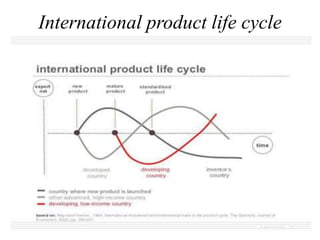
International product life cycle
 Describes the diffusion process of an innovation across national
boundaries.
 Products go through a cycle during which high income and mass
consumption countries initially export, then they gradually loss
their export market position and finally become importers of new
products from the country of invention and then shift from the position of
importers to exporters.
 Finally, least developing countries shift from being importers to
exporters of the product. These shifts correspond to the stages in the
product life cycle.
 Advanced nation becomes a victim of its own creation.
International product life cycle
Concept of foreign exchange and Balance of payment
 Foreign exchange transactions involve the purchase or sale of
one national currency against another.
 Purchase of foreign goods and services can be thought of as
involving two sequential transactions: purchase of foreign
currency and purchase of foreign goods. Purchase of foreign
currency is made through the foreign exchange rate.
 Thus, an exchange rate is the rate at which one currency is
converted into another, or a ratio that measures the value of one
currency in terms of another currency. The foreign exchange
rate is simply a price: the price of one national currency as
expressed by the value of another.
Cont…
 The balance of payments is the record of all international trade
and financial transactions made by a country's residents.
 The balance of payments (BOP) is the method countries use to
monitor all international monetary transactions at a specific
period of time. Usually, the BOP is calculated every quarter and
every calendar year.
 A balance of payments deficit means the country imports more
goods, services and capital than it exports.
 A balance of payments surplus means the country exports more
than it imports.
 Trade barriers: are restrictions on free flow of goods and service by
government. We can classify trade barriers in two:
a. Tariff barrier
b. Non-Tariff barrier or administrative barrier.
 There are various reasons site by government why they are imposing
measures to restrict free flow of goods and services in their
boundary.
 To Protect infant home industry from advanced foreign competitors
Cont…
 To conserve foreign currency: Uncontrolled import might result
in shortage of hard currency
 To protect national economy from dumping; Dumping is selling
products below production cost. This is done by multinational
companies to get out domestic manufacturers from competition;
governments are imposing various fines to curb this situation.
 To make economy self-reliant: Governments are protecting
domestic industry to give time and opportunity for the industry
so that they could compete in the future when the economy is
open.
 Tariffs are taxes imposed on goods crossing one country. There
are various classification of tariffs based on various criteria.
 Based on Direction
a. Import Tariff- is tariff imposed on imported goods to the country.
Tariff is levied on products which are entering in the country.
b. Export Tariff- is tariff levied on export of scarce resource to other
countries.
 This is levied on products which are going out of the country
when there is insatiable demand in the home market.
Cont…
Based on Purpose
a. Protective Tariff- the purpose of the tariff is to protect home
country industry from foreign competitors heavy tariff will be
levied to make that product more expense as compared to domestic
competitors.
b. Revenue Tariff- the purpose is to generate tax revenue’s for the
government. Compared to a protective tariff it is relatively low.
 Based on length
a. Tariff Surcharge- is protective tariff which is temporarily imposed
for short period of time to stabilize local economy.
Cont…
 Countervailing Duty- a permanent surcharge, imposed on certain
imports when products are subsidized by foreign governments until the
foreign government stop its subsidy.
 Based on Rates
a. Specific duties-are duties which are charged fixed amount of money per
volume or per weight. The duty is calculated based on standard physical
unit of a product. Product cost or price is not used to calculate this tariff.
b. Ad valorem duties- in this duty the tariff is calculated based on the
invoice value of the product. The percentage is fixed.
c. Combined rates- are a combination of specific duty and ad valorem.
Cont…
 Based on Production, Distribution, Consumption
a. Single Stage sales tax- a tax is collected only at once in the supply
value chain. Tax is not collected until the product is sold by final
consumer.
b. Value added Tax (VAT) is a multistage, non-cumulative tax on
multiple channels. At every stage the product is sold to other party
tax is charged on the added value by deducting the tax already
paid. This is applied to any type of firms which have more than
ETB 500,000 turnover transaction.
c. Excise tax- a one time tax levied on sale of specific type of product
E.g. on alcohol.
Cont…
d. Cascade Tax- are collected at each stage in the manufacturing
and distribution chain and tax is calculated on the total value of a
product including taxe paid earlier in the value chain.
 Types of Non-Tariff Barriers/administrative tarrifs
 Non-tariff: barriers include all measures, other than traditional
tariffs, that are used to distort international trade flows.
 There are various types of Non Tariff barriers the most common
includes:
a. Quotas: are restricting the amount of product imported in the
country to protect the local firms from fierce competition.
Cont…
b. Customs and entry procedures: like inspection, valuation etc
c. Financial Control: like
 Exchange control: limiting the amount of hard currency
 Multiple exchange rates- For encouraging export for
manufacturers the national bank sale hard currency to import raw
materials. To discourage import the banks sale hard currency at
higher rate.
 Credit restrictions etc
THE END OF CHAPTER ONE
THANK YOU

International marketing presentation.pptx

  • 1.
    Chapter one The conceptsof international marketing Introduction  The modern world is organized on the theory that each nation state is sovereign and independent from other countries.  In reality, however, no country can completely isolate its internal affairs from external forces.  Even the most inward-looking regimes realized the limitations of their own resources as well as the benefits of opening up their borders.  Today most business activities are global in scope.
  • 2.
    Cont… Whether or nota company wants to participate directly in international business, it can not escape the effect of the ever-increasing number of domestic firms exporting, importing, and/or manufacturing abroad; the number of foreign-based firms operating in most markets; the growth of regional trade areas; the rapid growth of world markets; and the increasing number of competitors for global markets.
  • 3.
    Cont…  Of allthe trends affecting global business today, some of them stand out as the most dynamic and as the ones that are influencing the shape of international business: a) The interdependence of the world economies. b) The rapid growth of regional free trade areas such as EU, NAFTA, ASEAN and APEC. c) The increase in wealth and growth in most parts of the world, causing enhanced purchasing power. d) Availability of advanced methods of communication and transportation due to developments in information technology etc.
  • 4.
    Cont… These forces affectingthe international business have led to a dramatic growth in international trade and have contributed to a perception that world has become a smaller and interdependent place. If we look at the Swiss Multinational Company, Nestlé, ‘The Food Company of the World’, it claims its products are sold in every country in the world. It has factories in more than 80 countries and it has many brands that are recognized all over the world.
  • 5.
    Cont…  The challengeof international marketing is to develop strategic plans that are competitive in these intensifying global markets.  Strategic marketing is a method through which an organization differentiates itself from its competition by focusing on its strengths to provide better service and value to its customers.  Strategic marketing concerns the choice of policies aiming at improving the competitive position of the firm, taking account of challenges and opportunities proposed by the competitive environment.
  • 6.
    Cont…  The difficultiescreated by different environments and culture are the international marketer’s primary concern.  The primary obstacles to success in international marketing are a person’s self-reference criterion (SRC) and an associated ethnocentrism.  The SRC is an unconscious reference to one’s own cultural values, experiences, and knowledge as a basis for decisions.  Closely connected is ethnocentrism, that is, the notion that people in one’s own company, culture, or country know best how to do things.
  • 7.
    Cont…  A studyof international marketing should begin with an understanding of what marketing is and how it operates in an international context.  We hope you can remember the concepts of general marketing you have seen in your principles of marketing. Lets define what “marketing “means?  "Marketing is the human activity directed at satisfying needs & wants through exchange process" (Philip Kotler).  "Marketing management is the process of planning and executing the conception, pricing, promotion, and distribution of ideas, goods, and services to create an exchange that satisfy individual and organizational goals." (Philip Kotler).
  • 8.
     International marketing:is the performance of business activities that designed to plan, price, promote, and direct the flow of a company’s goods and services to consumers or users in more than one nation for a profit.  It is marketing across boundaries.  International marketing: can also be defined as the process of planning and conducting transactions across the national borders to create exchange that satisfies the objectives of individuals and organizations.
  • 9.
     The basicnature of marketing does not changed when it extends beyond national boundaries, but international marketing, unlike domestic marketing, requires operating simultaneously in more than one kind of environment.  Operations in different environment must be coordinated, and the experience gained in one country is used for making decisions in another country.  Domestic marketing: is concerned with the marketing practices within the researchers or Marketers home country (domestic market).”
  • 10.
    Cont… A. Domestic Marketing Awareness of domestic market is high, hence one can often do without market research.  As the control is over a single set up, administration is relatively easy  As the product is designed for the market, question of adapting does not raise  Single market, single message, question of adaptation limited to sub segments, media choice, known with certainty
  • 11.
    Cont…  International marketing Market research is very important  Multiple markets, multiple mix of marketing variables demand a new set up of administrative machinery.  Product has to be adapted to every market segment  Multiple market, multiple message depending on the emphasis demanded by each market message may be adapted to new markets or could be universal-complex media availability etc.  There is two levels of uncontrollable uncertainity.  (Discuss the meaning of adaption &adoption)
  • 12.
    Cont… Export Marketing This coversall marketing activities involved in exporting of organizations product to other countries. The primary focus of the organization is the domestic marketing but it also tries to search market outside home country and try to adapt the product to local requirement through product modification. The product is produced in the domestic market. The management tries to sell surplus product outside the home market.
  • 13.
    Cont… Export marketing meansexporting goods to other countries of the world as per the procedures framed by the exporting country as well as by the importing country. According to B. S. Rathor “Export marketing includes the management of marketing activities for products which cross the national boundaries of a country”. “Export marketing means marketing of goods and services beyond the national boundaries”.
  • 14.
    International Trade Conceptand Theory  International Trade: is the exchange of goods and services between one country (and its resident) and other countries (and their residents).  International trade is the exchange of capital, goods, and services across international borders.  The theory, indeed form the basis from which we understand why two nations engage in trade.  Export, In International Trade, "exports" refers to selling goods and services produced in the home country to other countries.
  • 15.
    Cont… “Import In InternationalTrade, “imports" refers to buying goods and services produced in a foreign country to other countries. A nation trades because it expects to gain something from its trading partner. One may ask whether trade is like a zero-sum game, in the sense that one must lose so that another will gain. Discuss what does it “zero sum game and positive sum game mean”?
  • 16.
    Cont…  There area number of factors that influence a county’s decision to import or export certain products.  Some countries can produce items that most countries cannot.  In this case they will want to export the product since they will be able to gain a large part of the global market.  Theories of trade: are those theories that explain why and how international trade benefits countries involved in it. Many such theories advanced so far.  Some that gained popularity, however, are the following ones:
  • 17.
    Absolute advantage  Anation is said to have an Absolute Advantage (AA) over another nation when its cost of production of the good is less than the other nation’s cost of production of the good (Adam Smith 1723-1790).  Smith’s theory was that trade between countries was based on who had the absolute advantage in producing a good or service.  Absolute advantage is defined as the ability to produce a specific product more efficiently than any other nation.  Eg. Ethiopian climate is appropriate for coffee production and not appropriate for the production of wheat/sinde and the reverse is true for canada. Can they engaged in trade? How?
  • 18.
     A nationis said to have a Comparative Advantage over another nation in the manufacturing of a good when its opportunity cost in the manufacture of that good is less than the opportunity cost of the other nation’s manufacture of the same good (David Ricardo 1772-1823).  He believed that even if a country could produce their own goods and services more economically than other countries they may still decide to trade with another country.  Whenever an individual or a country decides to do one thing they are also choosing not to do something else, since countries and individuals have limited time and resources.
  • 19.
    Cont…  Comparative advantageis the ability of a nation to produce a specific product more efficiently than any other product  The opportunity cost is the value of the next best alternative. It is the value you are giving up to do something else with the resource.  If the profit from growing potato would be birr 10,000 and the profit from growing Teff would be birr 20, 000 the opportunity cost of not growing Teff would be birr 20,000.  In this example you may choose to grow wheat only if the profit you could make from wheat would be at least birr 20, 000 since that is the potential profit (opportunity cost) you are giving up by not growing Teff.
  • 20.
    Management orientation/outlooks  Managersconsciously or unconsciously will be influenced by their philosophy of the world in respect of international marketing. According to Dr. Howard p. there are three stages of outlook of international marketing.  Ethnocentric Orientation  A person who assumes his/her home country is superior compared to the rest of the world in marketing strategy and practice as compared to others is said to have an ethnocentric orientation. The ethnocentric oriented personnel similarities in markets and assume the products and practices that succeeded in the home country will be successful anywhere.
  • 21.
    Cont…  Polycentric Orientation The polycentric orientation is the opposite of ethnocentrism. The term polycentric describes management’s often-unconscious belief or assumption that each country in which a company does business is unique.  Region centric and Geocentric Orientations  The geocentric orientation represents a synthesis of ethnocentrism and polycentrism; it is a “worldview” that sees similarities and differences in markets and countries and seeks to create a global strategy that is fully responsive to local needs and wants.
  • 22.
    Cont…  A regiocentricmanager might be said to have a worldview on a regional scale.  For example, a U.S. company that focuses on the countries included in the North American Free Trade Agreement (NAFTA)— the United States, Canada, and Mexico --- has a regiocentric orientation. Similarly, a European company that focuses its attention on the EU or Europe is regiocentric.
  • 23.
    International marketing involvement There are 4 phases of international marketing involvement; which are no direct foreign marketing, infrequent foreign marketing, regular foreign market and international marketing.  In no direct foreign marketing stage, the company may not actively involve in international marketing. But yet there are still have possibility of the product to sell in oversea through the distributor or wholesaler without the knowledge of the producer. Products reach foreign markets indirectly–Trading companies–Foreign customers who contact firm–Wholesalers–Distributors–Web sites
  • 24.
    Cont…  Infrequent foreignmarketing: caused by temporary surplus. Firm has little or no intention of maintaining continuous market representation.  Regular foreign marketing: Firm has production capacity devoted to foreign markets. The primary focus of operations and production is to service domestic market needs. Based on overseas demand.  International marketing: is a phase in which domestic companies have the capacity to produce goods to sell abroad on persistent basis and have the possibility to operate globally as well.
  • 25.
    International marketing informationsystem International marketing information system is a complex system, within the organizational structure, focused on information flow from a company towards the environment and vice versa. IMIS should integrate, lead and organize all communications between company and the environment. It is the system designed to capture, store, update, analyze, and display information about worldwide business activity.
  • 26.
    Cont…  The company`senvironment should be widely seen, that takes information from all or most of the world market by various market segments, other industries, various centers of decision‐making and the like.  The tasks of the IMIS, in addition to the above, are monitoring of business performance of organizational units of enterprises in various markets, as well as the transmission of ideas and experiences from other countries and regions of the world to the organization.
  • 27.
    Cont…  Collecting andprocessing data and information, and submission of processed information in decision‐making must be timely.  This provides rationality in business decisions making.  Marketing information can lead marketing manager to: Develop new products Improve existing products Make changes in promotion, price and distribution strategies and tactics etc  IMIS should take a more important position in the organizational structure of companies that are proactive and market‐oriented.
  • 28.
    Opportunities and challengesof international marketing  Challenges  Increasing global competition  Income gap  Environmental deterioration—pollution, over flooding, desertification etc.  Infrastructural neglect / shortage—absence of roads, telephone and transportation services.  Rapid technological changes  Shortages of skilled man power
  • 29.
    Cont…  Opportunities  Itis possible to get sufficient market / expand the market territory  Survival and growth,,,,(Volume of sale increases)  Sales and profit  Diversification and employment  Inflation and Price Moderation
  • 30.
    International product lifecycle  Describes the diffusion process of an innovation across national boundaries.  Products go through a cycle during which high income and mass consumption countries initially export, then they gradually loss their export market position and finally become importers of new products from the country of invention and then shift from the position of importers to exporters.  Finally, least developing countries shift from being importers to exporters of the product. These shifts correspond to the stages in the product life cycle.  Advanced nation becomes a victim of its own creation.
  • 31.
  • 32.
    Concept of foreignexchange and Balance of payment  Foreign exchange transactions involve the purchase or sale of one national currency against another.  Purchase of foreign goods and services can be thought of as involving two sequential transactions: purchase of foreign currency and purchase of foreign goods. Purchase of foreign currency is made through the foreign exchange rate.  Thus, an exchange rate is the rate at which one currency is converted into another, or a ratio that measures the value of one currency in terms of another currency. The foreign exchange rate is simply a price: the price of one national currency as expressed by the value of another.
  • 33.
    Cont…  The balanceof payments is the record of all international trade and financial transactions made by a country's residents.  The balance of payments (BOP) is the method countries use to monitor all international monetary transactions at a specific period of time. Usually, the BOP is calculated every quarter and every calendar year.  A balance of payments deficit means the country imports more goods, services and capital than it exports.  A balance of payments surplus means the country exports more than it imports.
  • 34.
     Trade barriers:are restrictions on free flow of goods and service by government. We can classify trade barriers in two: a. Tariff barrier b. Non-Tariff barrier or administrative barrier.  There are various reasons site by government why they are imposing measures to restrict free flow of goods and services in their boundary.  To Protect infant home industry from advanced foreign competitors
  • 35.
    Cont…  To conserveforeign currency: Uncontrolled import might result in shortage of hard currency  To protect national economy from dumping; Dumping is selling products below production cost. This is done by multinational companies to get out domestic manufacturers from competition; governments are imposing various fines to curb this situation.  To make economy self-reliant: Governments are protecting domestic industry to give time and opportunity for the industry so that they could compete in the future when the economy is open.
  • 36.
     Tariffs aretaxes imposed on goods crossing one country. There are various classification of tariffs based on various criteria.  Based on Direction a. Import Tariff- is tariff imposed on imported goods to the country. Tariff is levied on products which are entering in the country. b. Export Tariff- is tariff levied on export of scarce resource to other countries.  This is levied on products which are going out of the country when there is insatiable demand in the home market.
  • 37.
    Cont… Based on Purpose a.Protective Tariff- the purpose of the tariff is to protect home country industry from foreign competitors heavy tariff will be levied to make that product more expense as compared to domestic competitors. b. Revenue Tariff- the purpose is to generate tax revenue’s for the government. Compared to a protective tariff it is relatively low.  Based on length a. Tariff Surcharge- is protective tariff which is temporarily imposed for short period of time to stabilize local economy.
  • 38.
    Cont…  Countervailing Duty-a permanent surcharge, imposed on certain imports when products are subsidized by foreign governments until the foreign government stop its subsidy.  Based on Rates a. Specific duties-are duties which are charged fixed amount of money per volume or per weight. The duty is calculated based on standard physical unit of a product. Product cost or price is not used to calculate this tariff. b. Ad valorem duties- in this duty the tariff is calculated based on the invoice value of the product. The percentage is fixed. c. Combined rates- are a combination of specific duty and ad valorem.
  • 39.
    Cont…  Based onProduction, Distribution, Consumption a. Single Stage sales tax- a tax is collected only at once in the supply value chain. Tax is not collected until the product is sold by final consumer. b. Value added Tax (VAT) is a multistage, non-cumulative tax on multiple channels. At every stage the product is sold to other party tax is charged on the added value by deducting the tax already paid. This is applied to any type of firms which have more than ETB 500,000 turnover transaction. c. Excise tax- a one time tax levied on sale of specific type of product E.g. on alcohol.
  • 40.
    Cont… d. Cascade Tax-are collected at each stage in the manufacturing and distribution chain and tax is calculated on the total value of a product including taxe paid earlier in the value chain.  Types of Non-Tariff Barriers/administrative tarrifs  Non-tariff: barriers include all measures, other than traditional tariffs, that are used to distort international trade flows.  There are various types of Non Tariff barriers the most common includes: a. Quotas: are restricting the amount of product imported in the country to protect the local firms from fierce competition.
  • 41.
    Cont… b. Customs andentry procedures: like inspection, valuation etc c. Financial Control: like  Exchange control: limiting the amount of hard currency  Multiple exchange rates- For encouraging export for manufacturers the national bank sale hard currency to import raw materials. To discourage import the banks sale hard currency at higher rate.  Credit restrictions etc THE END OF CHAPTER ONE THANK YOU