Part V: Strategy Formulation
Part I:
Part II:
Part III:
Part IV:
Foundations of Strategic Management and the StrategyProcess
Mission, Vision and Goals of the Corporation
Internal Strategic Analysis
External Strategic Analysis
Part V: Strategy Formulation
Part VI: Strategy Implementation
Part VII:, StrategyEvaluation
Part VIII : Corporate Social Responsibility
Strategic Management Process
Source: Wheelen, Hunger (2012), ch. 1.5
Strategy
formulation
Strategy
implementation
Evaluation and
control
Environmental
scanning
1 2
3
4
Goal setting*
0
Formulation Of Strategy
Strategy formulation is what an organization is going to do – example;
choosing cost leadership strategy/differentiation etc.
Strategies exist at different levels in an organization & are classified
into three major categories according to their scope of coverage i.e.,
they are classified into:
❑ Corporate,
❑ Business and
❑ Functional level strategies
Corporate Level Strategy
It specifies actions a firm takes to gain a competitive advantage
by selecting & managing a group of different businesses
competing in different product markets.
A corporate-level strategy is concerned with two key
questions:
❑ What business should the firm be in?
❑ How should the corporate office manage its group of
businesses?
Based on Wheelen, Hunger (2012), ch. 7.1, 7.2
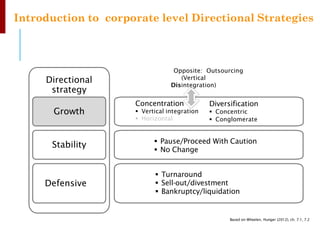
Directional
strategy
Growth
Stability
Defensive
▪ Pause/Proceed With Caution
▪ No Change
▪ Turnaround
▪ Sell-out/divestment
▪ Bankruptcy/liquidation
Concentration
▪ Vertical integration
▪ Horizontal
Diversification
▪ Concentric
▪ Conglomerate
Introduction to corporate level Directional Strategies
Opposite: Outsourcing
(Vertical
Disintegration)
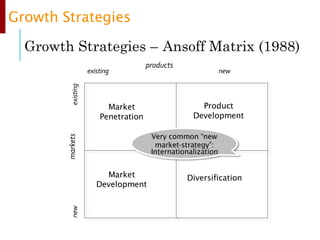
Market
Penetration
Product
Development
Market
Development
Diversification
existing new
new
existing
products
markets
Growth Strategies – Ansoff Matrix (1988)
Growth Strategies
Very common “new
market-strategy”:
Internationalization
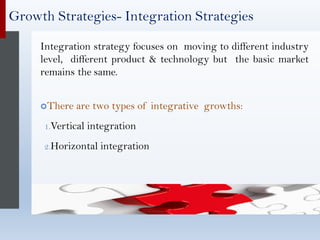
Growth Strategies- Integration Strategies
Integration strategy focuses on moving to different industry
level, different product & technology but the basic market
remains the same.
There are two types of integrative growths:
1.Vertical integration
2.Horizontal integration
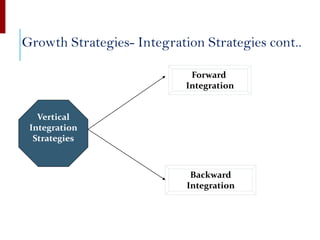
Growth Strategies- Integration Strategies cont..
Vertical
Integration
Strategies
Forward
Integration
Backward
Integration
Integration Strategy Cont’d …
Vertical Integration
Vertical Integration involves extending an organization’s present business in
two possible directions.
❑ Forward integration moves the organization into distributing its own
products or services (Gaining ownership or increased control over
distributors or retailers)
❑ Backward integration moves an organization into supplying some or
all the products or services used in producing its present products or
services (Seeking ownership or increased control of a firm’s
suppliers)
Integration Strategy Cont’d …
Horizontal integration
Horizontal integration occurs when an organization adds one or
more businesses that produce similar products or services and that
are operating at the same stage in the product market chain.
▪ Its Seeking ownership or increased control over competitors.
❑ Almost all horizontal integration is accomplished by buying
another organization in the same business.
Horizontal Vs Vertical Integration
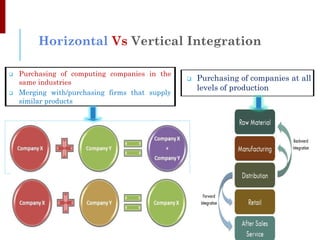
❑ Purchasing of computing companies in the
same industries
❑ Merging with/purchasing firms that supply
similar products
❑ Purchasing of companies at all
levels of production
Diversification
The entry of a firm or business unit into new lines of activity, either by
processes of internal business development or through other ways acquisition,
which entail changes in its administrative structure, systems and other
management processes
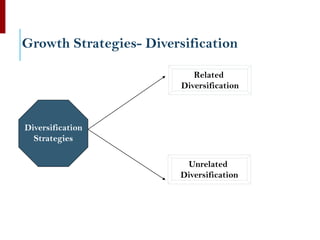
Growth Strategies- Diversification
Diversification
Strategies
Related
Diversification
Unrelated
Diversification
Diversification Strategies
▪ Related diversification : adding new but related products or
services
▪ Unrelated diversification : adding new, unrelated products or
services
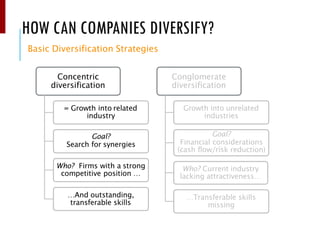
HOW CAN COMPANIES DIVERSIFY?
Basic Diversification Strategies
Concentric
diversification
= Growth into related
industry
Goal?
Search for synergies
Who? Firms with a strong
competitive position …
…And outstanding,
transferable skills
Conglomerate
diversification
Growth into unrelated
industries
Goal?
Financial considerations
(cash flow/risk reduction)
Who? Current industry
lacking attractiveness…
…Transferable skills
missing
HOW CAN COMPANIES DIVERSIFY?
Basic Diversification Strategies
Concentric
diversification
= Growth into related
industry
Goal?
Search for synergies
Who? Firms with a strong
competitive position …
…And outstanding,
transferable skills
Conglomerate
diversification
Growth into unrelated
industries
Goal?
Financial considerations
(cash flow/risk reduction)
Who? Current industry
lacking attractiveness…
…Transferable skills
missing
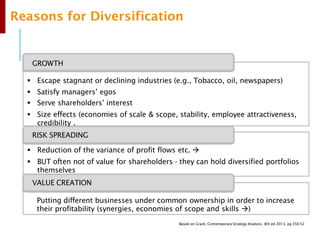
GROWTH
▪ Escape stagnant or declining industries (e.g., Tobacco, oil, newspapers)
▪ Satisfy managers’ egos
▪ Serve shareholders’ interest
▪ Size effects (economies of scale & scope, stability, employee attractiveness,
credibility .
RISK SPREADING
▪ Reduction of the variance of profit flows etc. →
▪ BUT often not of value for shareholders - they can hold diversified portfolios
themselves
VALUE CREATION
Putting different businesses under common ownership in order to increase
their profitability (synergies, economies of scope and skills →)
Based on Grant, Contemporary Strategy Analysis, 8th ed 2013, pp 350-52
Reasons for Diversification
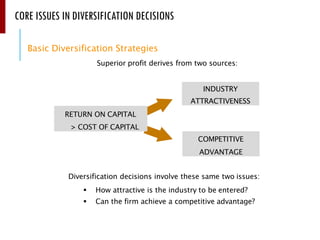
CORE ISSUES IN DIVERSIFICATION DECISIONS
Basic Diversification Strategies
Superior profit derives from two sources:
INDUSTRY
ATTRACTIVENESS
Diversification decisions involve these same two issues:
▪ How attractive is the industry to be entered?
▪ Can the firm achieve a competitive advantage?
RETURN ON CAPITAL
> COST OF CAPITAL
COMPETITIVE
ADVANTAGE
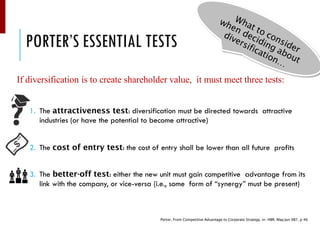
If diversification is to create shareholder value, it must meet three tests:
1. The attractiveness test: diversification must be directed towards attractive
industries (or have the potential to become attractive)
2. The cost of entry test: the cost of entry shall be lower than all future profits
3. The better-off test: either the new unit must gain competitive advantage from its
link with the company, or vice-versa (i.e., some form of “synergy” must be present)
PORTER’S ESSENTIAL TESTS
Porter, From Competitive Advantage to Corporate Strategy, in: HBR, May-Jun 987, p 46
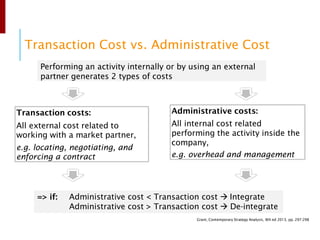
Transaction Cost vs. Administrative Cost
Grant, Contemporary Strategy Analysis, 8th ed 2013, pp. 297-298
Performing an activity internally or by using an external
partner generates 2 types of costs
Transaction costs:
All external cost related to
working with a market partner,
e.g. locating, negotiating, and
enforcing a contract
Administrative costs:
All internal cost related
performing the activity inside the
company,
e.g. overhead and management
=> if: Administrative cost < Transaction cost → Integrate
Administrative cost > Transaction cost → De-integrate
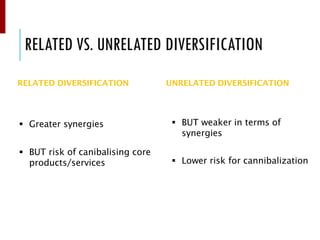
RELATED VS. UNRELATED DIVERSIFICATION
RELATED DIVERSIFICATION UNRELATED DIVERSIFICATION
▪ BUT weaker in terms of
synergies
▪ Lower risk for cannibalization
▪ Greater synergies
▪ BUT risk of canibalising core
products/services
Prof. Dr. Anna Rosin
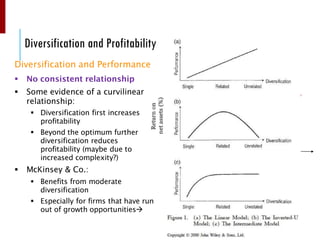
Diversification and Profitability
Diversification and Performance
▪ No consistent relationship
▪ Some evidence of a curvilinear
relationship:
▪ Diversification first increases
profitability
▪ Beyond the optimum further
diversification reduces
profitability (maybe due to
increased complexity?)
▪ McKinsey & Co.:
▪ Benefits from moderate
diversification
▪ Especially for firms that have run
out of growth opportunities→
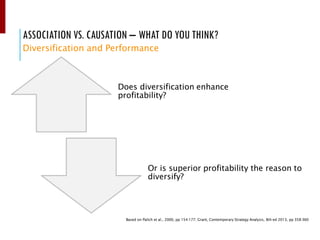
ASSOCIATION VS. CAUSATION – WHAT DO YOU THINK?
Diversification and Performance
Based on Palich et al., 2000, pp 154-177; Grant, Contemporary Strategy Analysis, 8th ed 2013, pp 358-360
Does diversification enhance
profitability?
Or is superior profitability the reason to
diversify?
All the previously discussed growth strategies could be
implemented either through internal growth or external
growth (acquisition, merger, or joint ventures).
Internal Growth
❑ Internal growth occurs when a company expands its
current market share, its markets, or its products through
the use of internal resources.
❑ Generally, internal growth strategies work well for
companies want to grow via product development or
market development.
Means of Diversification
Merger and Acquisition
Merger – is a strategy through which two or more firms agree to
integrate their operations on a relatively co-equal basis
▪ Therefore, in merger, a single new company will be established with
new name, organizational structure, issuing new stock & other changes
▪ However, the shareholders of the former firms will become
shareholders of the new enlarged organization
❑ Acquisition – a strategy through which one firm buys a
controlling of 100% interest in another firm with the
intent of making the acquired firm a subsidiary business
within its portfolio.
❑ Therefore, an acquisition is a marriage of unequal
partners with one organization buying the other.
❑ The shareholders of the acquired firm cease to be
owners of the acquiring company – unless payment is
made in terms of shares.
Merger and Acquisition cont’d …
Merger And Acquisition Cont’d …
What are the main reasons of an acquisition or merger strategy?
❑ The main reasons why firms use these strategies is to strategic
competitiveness & earn above average returns
❑ These can be achieved through increasing the market value of the stock
– synergistic effect.
Merger and Acquisition cont’d …
▪ Securing or protecting sources of raw materials/components
▪ To gain access to distribution channels
▪ To make use of underutilized resources of the company
▪ To increase market power – horizontal, vertical & related
acquisitions
▪ To enter a new market, offer new products & avoiding cost of new
product development (Acquisition as substitute for innovation)
▪ To overcome entry barriers(cross-border acquisition )etc.
There Could Be Other Reasons
Joint Ventures
❑ A joint Venture occurs when two or more organizations
pool their resources for a given project or a business
product.
❑ A joint venture can be on either a temporary or permanent
basis
❑ Joint ventures are especially popular between firms in
different countries
Joint Ventures cont’d …
There are several reasons why a joint venture may be attractive to
respective participants:
▪ By pooling their resources, the organizations may be capable of
doing things that they could not do separately
▪ By joining with another firm or firms, the companies share the
risk of the venture.
▪ Certain gov.t sponsored aggressively encouraged joint ventures
for the purpose involving minority business.
▪ International companies are often encouraged by host countries
to enter joint ventures with local companies
2. STABILITY STRATEGY
It is also called neutral strategy occurs when an organization is
satisfied with its current situation & wants to maintain the status quo.
Reasons for using stability strategy: The company is doing well “if it
works, don’t fix it”
The management wants to avoid additional hassles associated with
growth
Resources has been exhausted because of earlier growth strategies
3. DEFENSIVE STRATEGIES
Defensive Strategies most often
used as a short-term solution to:
❑ Reverse a negative trend
❑ Overcome a crisis or problem
situation
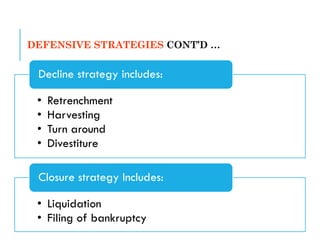
It could be classified into decline
&closure strategies
DEFENSIVE STRATEGIES CONT’D …
• Retrenchment
• Harvesting
• Turn around
• Divestiture
Decline strategy includes:
• Liquidation
• Filing of bankruptcy
Closure strategy Includes:
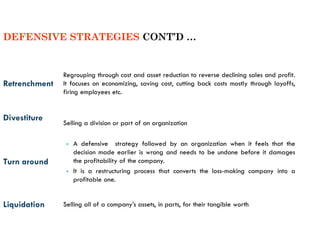
Retrenchment
Regrouping through cost and asset reduction to reverse declining sales and profit.
It focuses on economizing, saving cost, cutting back costs mostly through layoffs,
firing employees etc.
Divestiture
Selling a division or part of an organization
Turn around
▪ A defensive strategy followed by an organization when it feels that the
decision made earlier is wrong and needs to be undone before it damages
the profitability of the company.
▪ It is a restructuring process that converts the loss-making company into a
profitable one.
Liquidation Selling all of a company’s assets, in parts, for their tangible worth
DEFENSIVE STRATEGIES CONT’D …
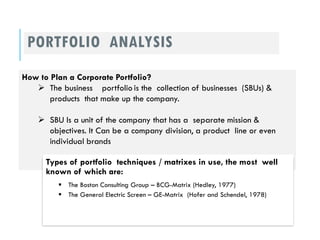
PORTFOLIO ANALYSIS
How to Plan a Corporate Portfolio?
➢ The business portfolio is the collection of businesses (SBUs) &
products that make up the company.
➢ SBU Is a unit of the company that has a separate mission &
objectives. It Can be a company division, a product line or even
individual brands
Types of portfolio techniques / matrixes in use, the most well
known of which are:
▪ The Boston Consulting Group – BCG-Matrix (Hedley, 1977)
▪ The General Electric Screen – GE-Matrix (Hofer and Schendel, 1978)
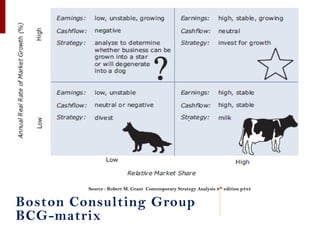
Boston Consulting Group
BCG-matrix
Source : Robert M. Grant Contemporary Strategy Analysis 8th edition p343
The Boston Consulting Group
(BCG) Matrix Cont’d …
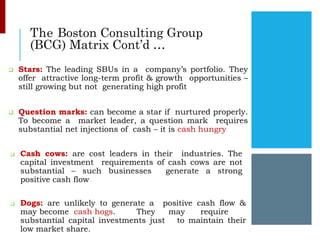
❑ Stars: The leading SBUs in a company’s portfolio. They
offer attractive long-term profit & growth opportunities –
still growing but not generating high profit
❑ Question marks: can become a star if nurtured properly.
To become a market leader, a question mark requires
substantial net injections of cash – it is cash hungry
❑ Cash cows: are cost leaders in their industries. The
capital investment requirements of cash cows are not
substantial – such businesses generate a strong
positive cash flow
❑ Dogs: are unlikely to generate a positive cash flow &
may become cash hogs. They may require
substantial capital investments just to maintain their
low market share.
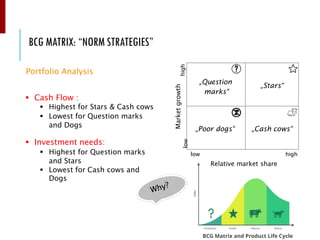
BCG MATRIX: “NORM STRATEGIES”
„Question
marks“
„Stars“
„Poor dogs“ „Cash cows“
Market
growth
high
low
low high
Relative market share
Portfolio Analysis
▪ Cash Flow :
▪ Highest for Stars & Cash cows
▪ Lowest for Question marks
and Dogs
▪ Investment needs:
▪ Highest for Question marks
and Stars
▪ Lowest for Cash cows and
Dogs
BCG Matrix and Product Life Cycle
The firm’s business – level strategy is a
deliberate choice about how it will perform
the value chain’s primary and support
activities to create unique value
Purpose of business – level strategy is to
create differences between the firm’s
position and those of its competitors
Business-level Strategy
Business-level Strategic Issues
In selecting business-level strategy, the firm should
determine:
Who will be served? Refers to types of customers
What needs those target customers have that the firm will
satisfy? Refers to the benefits & features of products
How those needs will be satisfied? Refers to core
competencies
In Making A Business –
Level Strategy …
The firm faces a choice between
Performing Activities Differently (Low-Cost Leadership)
Or
Performing Different Activities (Differentiation)
Or
Some Combination Of Them!
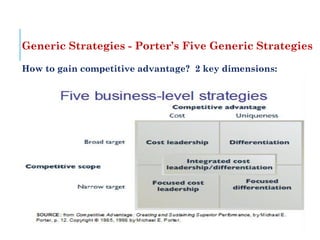
Generic Strategies - Porter’s Five Generic Strategies
How to gain competitive advantage? 2 key dimensions:
Alternative Approaches
Business Strategy
▪ Can approaches once considered as “stuck in the middle” be attractive
today?
 Hybrid Strategies, e.g. considered by the “Strategy Clock”
▪ Is the “Positioning approach” still sufficient?
 Delta-Model
 Blue Ocean
https://upload.wikimedia.org/wikipedia/commons/thumb/a/a8/Swedish_Windsor_Chairs.jpg/640px-Swedish_Windsor_Chairs.jpg + flaticon
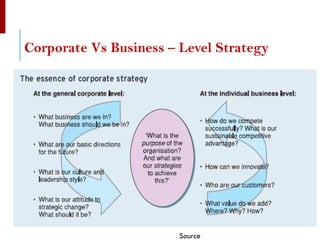
Corporate Vs Business – Level Strategy
Source
Questions?

SCRIPT+V_Strategy+Formulation. Presentation pdf

  • 1.
    Part V: StrategyFormulation Part I: Part II: Part III: Part IV: Foundations of Strategic Management and the StrategyProcess Mission, Vision and Goals of the Corporation Internal Strategic Analysis External Strategic Analysis Part V: Strategy Formulation Part VI: Strategy Implementation Part VII:, StrategyEvaluation Part VIII : Corporate Social Responsibility
  • 2.
    Strategic Management Process Source:Wheelen, Hunger (2012), ch. 1.5 Strategy formulation Strategy implementation Evaluation and control Environmental scanning 1 2 3 4 Goal setting* 0
  • 3.
    Formulation Of Strategy Strategyformulation is what an organization is going to do – example; choosing cost leadership strategy/differentiation etc. Strategies exist at different levels in an organization & are classified into three major categories according to their scope of coverage i.e., they are classified into: ❑ Corporate, ❑ Business and ❑ Functional level strategies
  • 4.
    Corporate Level Strategy Itspecifies actions a firm takes to gain a competitive advantage by selecting & managing a group of different businesses competing in different product markets. A corporate-level strategy is concerned with two key questions: ❑ What business should the firm be in? ❑ How should the corporate office manage its group of businesses?
  • 5.
    Based on Wheelen,Hunger (2012), ch. 7.1, 7.2 Directional strategy Growth Stability Defensive ▪ Pause/Proceed With Caution ▪ No Change ▪ Turnaround ▪ Sell-out/divestment ▪ Bankruptcy/liquidation Concentration ▪ Vertical integration ▪ Horizontal Diversification ▪ Concentric ▪ Conglomerate Introduction to corporate level Directional Strategies Opposite: Outsourcing (Vertical Disintegration)
  • 6.
    Market Penetration Product Development Market Development Diversification existing new new existing products markets Growth Strategies– Ansoff Matrix (1988) Growth Strategies Very common “new market-strategy”: Internationalization
  • 7.
    Growth Strategies- IntegrationStrategies Integration strategy focuses on moving to different industry level, different product & technology but the basic market remains the same. There are two types of integrative growths: 1.Vertical integration 2.Horizontal integration
  • 8.
    Growth Strategies- IntegrationStrategies cont.. Vertical Integration Strategies Forward Integration Backward Integration
  • 9.
    Integration Strategy Cont’d… Vertical Integration Vertical Integration involves extending an organization’s present business in two possible directions. ❑ Forward integration moves the organization into distributing its own products or services (Gaining ownership or increased control over distributors or retailers) ❑ Backward integration moves an organization into supplying some or all the products or services used in producing its present products or services (Seeking ownership or increased control of a firm’s suppliers)
  • 10.
    Integration Strategy Cont’d… Horizontal integration Horizontal integration occurs when an organization adds one or more businesses that produce similar products or services and that are operating at the same stage in the product market chain. ▪ Its Seeking ownership or increased control over competitors. ❑ Almost all horizontal integration is accomplished by buying another organization in the same business.
  • 11.
    Horizontal Vs VerticalIntegration ❑ Purchasing of computing companies in the same industries ❑ Merging with/purchasing firms that supply similar products ❑ Purchasing of companies at all levels of production
  • 12.
    Diversification The entry ofa firm or business unit into new lines of activity, either by processes of internal business development or through other ways acquisition, which entail changes in its administrative structure, systems and other management processes
  • 13.
  • 14.
    Diversification Strategies ▪ Relateddiversification : adding new but related products or services ▪ Unrelated diversification : adding new, unrelated products or services
  • 15.
    HOW CAN COMPANIESDIVERSIFY? Basic Diversification Strategies Concentric diversification = Growth into related industry Goal? Search for synergies Who? Firms with a strong competitive position … …And outstanding, transferable skills Conglomerate diversification Growth into unrelated industries Goal? Financial considerations (cash flow/risk reduction) Who? Current industry lacking attractiveness… …Transferable skills missing
  • 16.
    HOW CAN COMPANIESDIVERSIFY? Basic Diversification Strategies Concentric diversification = Growth into related industry Goal? Search for synergies Who? Firms with a strong competitive position … …And outstanding, transferable skills Conglomerate diversification Growth into unrelated industries Goal? Financial considerations (cash flow/risk reduction) Who? Current industry lacking attractiveness… …Transferable skills missing
  • 17.
    GROWTH ▪ Escape stagnantor declining industries (e.g., Tobacco, oil, newspapers) ▪ Satisfy managers’ egos ▪ Serve shareholders’ interest ▪ Size effects (economies of scale & scope, stability, employee attractiveness, credibility . RISK SPREADING ▪ Reduction of the variance of profit flows etc. → ▪ BUT often not of value for shareholders - they can hold diversified portfolios themselves VALUE CREATION Putting different businesses under common ownership in order to increase their profitability (synergies, economies of scope and skills →) Based on Grant, Contemporary Strategy Analysis, 8th ed 2013, pp 350-52 Reasons for Diversification
  • 18.
    CORE ISSUES INDIVERSIFICATION DECISIONS Basic Diversification Strategies Superior profit derives from two sources: INDUSTRY ATTRACTIVENESS Diversification decisions involve these same two issues: ▪ How attractive is the industry to be entered? ▪ Can the firm achieve a competitive advantage? RETURN ON CAPITAL > COST OF CAPITAL COMPETITIVE ADVANTAGE
  • 19.
    If diversification isto create shareholder value, it must meet three tests: 1. The attractiveness test: diversification must be directed towards attractive industries (or have the potential to become attractive) 2. The cost of entry test: the cost of entry shall be lower than all future profits 3. The better-off test: either the new unit must gain competitive advantage from its link with the company, or vice-versa (i.e., some form of “synergy” must be present) PORTER’S ESSENTIAL TESTS Porter, From Competitive Advantage to Corporate Strategy, in: HBR, May-Jun 987, p 46
  • 20.
    Transaction Cost vs.Administrative Cost Grant, Contemporary Strategy Analysis, 8th ed 2013, pp. 297-298 Performing an activity internally or by using an external partner generates 2 types of costs Transaction costs: All external cost related to working with a market partner, e.g. locating, negotiating, and enforcing a contract Administrative costs: All internal cost related performing the activity inside the company, e.g. overhead and management => if: Administrative cost < Transaction cost → Integrate Administrative cost > Transaction cost → De-integrate
  • 21.
    RELATED VS. UNRELATEDDIVERSIFICATION RELATED DIVERSIFICATION UNRELATED DIVERSIFICATION ▪ BUT weaker in terms of synergies ▪ Lower risk for cannibalization ▪ Greater synergies ▪ BUT risk of canibalising core products/services
  • 22.
    Prof. Dr. AnnaRosin Diversification and Profitability Diversification and Performance ▪ No consistent relationship ▪ Some evidence of a curvilinear relationship: ▪ Diversification first increases profitability ▪ Beyond the optimum further diversification reduces profitability (maybe due to increased complexity?) ▪ McKinsey & Co.: ▪ Benefits from moderate diversification ▪ Especially for firms that have run out of growth opportunities→
  • 23.
    ASSOCIATION VS. CAUSATION– WHAT DO YOU THINK? Diversification and Performance Based on Palich et al., 2000, pp 154-177; Grant, Contemporary Strategy Analysis, 8th ed 2013, pp 358-360 Does diversification enhance profitability? Or is superior profitability the reason to diversify?
  • 24.
    All the previouslydiscussed growth strategies could be implemented either through internal growth or external growth (acquisition, merger, or joint ventures). Internal Growth ❑ Internal growth occurs when a company expands its current market share, its markets, or its products through the use of internal resources. ❑ Generally, internal growth strategies work well for companies want to grow via product development or market development. Means of Diversification
  • 25.
    Merger and Acquisition Merger– is a strategy through which two or more firms agree to integrate their operations on a relatively co-equal basis ▪ Therefore, in merger, a single new company will be established with new name, organizational structure, issuing new stock & other changes ▪ However, the shareholders of the former firms will become shareholders of the new enlarged organization
  • 26.
    ❑ Acquisition –a strategy through which one firm buys a controlling of 100% interest in another firm with the intent of making the acquired firm a subsidiary business within its portfolio. ❑ Therefore, an acquisition is a marriage of unequal partners with one organization buying the other. ❑ The shareholders of the acquired firm cease to be owners of the acquiring company – unless payment is made in terms of shares. Merger and Acquisition cont’d …
  • 27.
    Merger And AcquisitionCont’d … What are the main reasons of an acquisition or merger strategy? ❑ The main reasons why firms use these strategies is to strategic competitiveness & earn above average returns ❑ These can be achieved through increasing the market value of the stock – synergistic effect.
  • 28.
    Merger and Acquisitioncont’d … ▪ Securing or protecting sources of raw materials/components ▪ To gain access to distribution channels ▪ To make use of underutilized resources of the company ▪ To increase market power – horizontal, vertical & related acquisitions ▪ To enter a new market, offer new products & avoiding cost of new product development (Acquisition as substitute for innovation) ▪ To overcome entry barriers(cross-border acquisition )etc. There Could Be Other Reasons
  • 29.
    Joint Ventures ❑ Ajoint Venture occurs when two or more organizations pool their resources for a given project or a business product. ❑ A joint venture can be on either a temporary or permanent basis ❑ Joint ventures are especially popular between firms in different countries
  • 30.
    Joint Ventures cont’d… There are several reasons why a joint venture may be attractive to respective participants: ▪ By pooling their resources, the organizations may be capable of doing things that they could not do separately ▪ By joining with another firm or firms, the companies share the risk of the venture. ▪ Certain gov.t sponsored aggressively encouraged joint ventures for the purpose involving minority business. ▪ International companies are often encouraged by host countries to enter joint ventures with local companies
  • 31.
    2. STABILITY STRATEGY Itis also called neutral strategy occurs when an organization is satisfied with its current situation & wants to maintain the status quo. Reasons for using stability strategy: The company is doing well “if it works, don’t fix it” The management wants to avoid additional hassles associated with growth Resources has been exhausted because of earlier growth strategies
  • 32.
    3. DEFENSIVE STRATEGIES DefensiveStrategies most often used as a short-term solution to: ❑ Reverse a negative trend ❑ Overcome a crisis or problem situation It could be classified into decline &closure strategies
  • 33.
    DEFENSIVE STRATEGIES CONT’D… • Retrenchment • Harvesting • Turn around • Divestiture Decline strategy includes: • Liquidation • Filing of bankruptcy Closure strategy Includes:
  • 34.
    Retrenchment Regrouping through costand asset reduction to reverse declining sales and profit. It focuses on economizing, saving cost, cutting back costs mostly through layoffs, firing employees etc. Divestiture Selling a division or part of an organization Turn around ▪ A defensive strategy followed by an organization when it feels that the decision made earlier is wrong and needs to be undone before it damages the profitability of the company. ▪ It is a restructuring process that converts the loss-making company into a profitable one. Liquidation Selling all of a company’s assets, in parts, for their tangible worth DEFENSIVE STRATEGIES CONT’D …
  • 35.
    PORTFOLIO ANALYSIS How toPlan a Corporate Portfolio? ➢ The business portfolio is the collection of businesses (SBUs) & products that make up the company. ➢ SBU Is a unit of the company that has a separate mission & objectives. It Can be a company division, a product line or even individual brands Types of portfolio techniques / matrixes in use, the most well known of which are: ▪ The Boston Consulting Group – BCG-Matrix (Hedley, 1977) ▪ The General Electric Screen – GE-Matrix (Hofer and Schendel, 1978)
  • 36.
    Boston Consulting Group BCG-matrix Source: Robert M. Grant Contemporary Strategy Analysis 8th edition p343
  • 37.
    The Boston ConsultingGroup (BCG) Matrix Cont’d … ❑ Stars: The leading SBUs in a company’s portfolio. They offer attractive long-term profit & growth opportunities – still growing but not generating high profit ❑ Question marks: can become a star if nurtured properly. To become a market leader, a question mark requires substantial net injections of cash – it is cash hungry ❑ Cash cows: are cost leaders in their industries. The capital investment requirements of cash cows are not substantial – such businesses generate a strong positive cash flow ❑ Dogs: are unlikely to generate a positive cash flow & may become cash hogs. They may require substantial capital investments just to maintain their low market share.
  • 38.
    BCG MATRIX: “NORMSTRATEGIES” „Question marks“ „Stars“ „Poor dogs“ „Cash cows“ Market growth high low low high Relative market share Portfolio Analysis ▪ Cash Flow : ▪ Highest for Stars & Cash cows ▪ Lowest for Question marks and Dogs ▪ Investment needs: ▪ Highest for Question marks and Stars ▪ Lowest for Cash cows and Dogs BCG Matrix and Product Life Cycle
  • 39.
    The firm’s business– level strategy is a deliberate choice about how it will perform the value chain’s primary and support activities to create unique value Purpose of business – level strategy is to create differences between the firm’s position and those of its competitors Business-level Strategy
  • 40.
    Business-level Strategic Issues Inselecting business-level strategy, the firm should determine: Who will be served? Refers to types of customers What needs those target customers have that the firm will satisfy? Refers to the benefits & features of products How those needs will be satisfied? Refers to core competencies
  • 41.
    In Making ABusiness – Level Strategy … The firm faces a choice between Performing Activities Differently (Low-Cost Leadership) Or Performing Different Activities (Differentiation) Or Some Combination Of Them!
  • 42.
    Generic Strategies -Porter’s Five Generic Strategies How to gain competitive advantage? 2 key dimensions:
  • 43.
    Alternative Approaches Business Strategy ▪Can approaches once considered as “stuck in the middle” be attractive today?  Hybrid Strategies, e.g. considered by the “Strategy Clock” ▪ Is the “Positioning approach” still sufficient?  Delta-Model  Blue Ocean https://upload.wikimedia.org/wikipedia/commons/thumb/a/a8/Swedish_Windsor_Chairs.jpg/640px-Swedish_Windsor_Chairs.jpg + flaticon
  • 44.
    Corporate Vs Business– Level Strategy Source
  • 45.