1
BONDS & GENERAL
INVESTMENT GLOSSARY
THE RICHER RETIREMENT SPECIALISTS
2
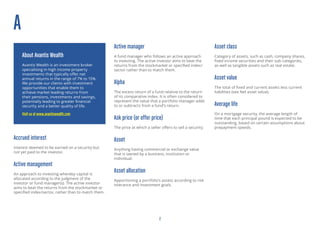
A
Accrued interest
Interest deemed to be earned on a security but
not yet paid to the investor.
Active management
An approach to investing whereby capital is
allocated according to the judgment of the
investor or fund manager(s). The active investor
aims to beat the returns from the stockmarket or
specified index/sector, rather than to match them.
Active manager
A fund manager who follows an active approach
to investing. The active investor aims to beat the
returns from the stockmarket or specified index/
sector rather than to match them.
Alpha
The excess return of a fund relative to the return
of its comparative index. It is often considered to
represent the value that a portfolio manager adds
to or subtracts from a fund’s return.
Ask price (or offer price)
The price at which a seller offers to sell a security.
Asset
Anything having commercial or exchange value
that is owned by a business, institution or
individual.
Asset allocation
Apportioning a portfolio’s assets according to risk
tolerance and investment goals.
Asset class
Category of assets, such as cash, company shares,
fixed income securities and their sub-categories,
as well as tangible assets such as real estate.
Asset value
The total of fixed and current assets less current
liabilities (see Net asset value).
Average life
On a mortgage security, the average length of
time that each principal pound is expected to be
outstanding, based on certain assumptions about
prepayment speeds.
About Avantis Wealth
Avantis Wealth is an investment broker
specialising in high income property
investments that typically offer net
annual returns in the range of 7% to 15%.
We provide our clients with investment
opportunities that enable them to
achieve market leading returns from
their pensions, investments and savings,
potentially leading to greater financial
security and a better quality of life.
Visit us at www.avantiswealth.com
3
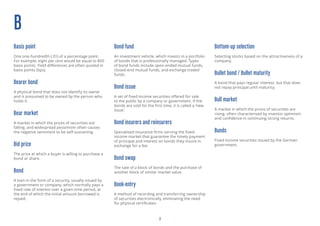
B
Basis point
One one-hundredth (.01) of a percentage point.
For example, eight per cent would be equal to 800
basis points. Yield differences are often quoted in
basis points (bps).
Bearer bond
A physical bond that does not identify its owner
and is presumed to be owned by the person who
holds it.
Bear market
A market in which the prices of securities are
falling, and widespread pessimism often causes
the negative sentiment to be self-sustaining.
Bid price
The price at which a buyer is willing to purchase a
bond or share.
Bond
A loan in the form of a security, usually issued by
a government or company, which normally pays a
fixed rate of interest over a given time period, at
the end of which the initial amount borrowed is
repaid.
Bond fund
An investment vehicle, which invests in a portfolio
of bonds that is professionally managed. Types
of bond funds include open-ended mutual funds,
closed-end mutual funds, and exchange traded
funds.
Bond issue
A set of fixed income securities offered for sale
to the public by a company or government. If the
bonds are sold for the first time, it is called a ‘new
issue’.
Bond insurers and reinsurers
Specialised insurance firms serving the fixed-
income market that guarantee the timely payment
of principal and interest on bonds they insure in
exchange for a fee.
Bond swap
The sale of a block of bonds and the purchase of
another block of similar market value.
Book-entry
A method of recording and transferring ownership
of securities electronically, eliminating the need
for physical certificates.
Bottom-up selection
Selecting stocks based on the attractiveness of a
company.
Bullet bond / Bullet maturity
A bond that pays regular interest, but that does
not repay principal until maturity.
Bull market
A market in which the prices of securities are
rising, often characterised by investor optimism
and confidence in continuing strong returns.
Bunds
Fixed income securities issued by the German
government.
4
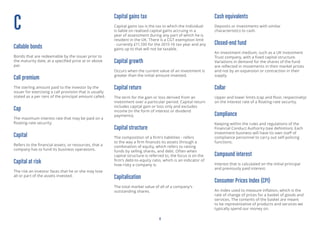
C
Callable bonds
Bonds that are redeemable by the issuer prior to
the maturity date, at a specified price at or above
par.
Call premium
The dollar amount paid to the investor by the
issuer for exercising a call provision that is usually
stated as a per cent of the principal amount called.
Cap
The maximum interest rate that may be paid on a
floating-rate security.
Capital
Refers to the financial assets, or resources, that a
company has to fund its business operations.
Capital at risk
The risk an investor faces that he or she may lose
all or part of the assets invested.
Capital gains tax
Capital gains tax is the tax to which the individual
is liable on realised capital gains accruing in a
year of assessment during any part of which he is
resident in the UK. There is a CGT exemption limit
- currently £11,100 for the 2015-16 tax year and any
gains up to that will not be taxable.
Capital growth
Occurs when the current value of an investment is
greater than the initial amount invested.
Capital return
The term for the gain or loss derived from an
investment over a particular period. Capital return
includes capital gain or loss only and excludes
income (in the form of interest or dividend
payments).
Capital structure
The composition of a firm’s liabilities - refers
to the way a firm finances its assets through a
combination of equity, which refers to raising
funds by selling shares, and debt. Often when
capital structure is referred to, the focus is on the
firm’s debt-to-equity ratio, which is an indicator of
how risky a company is.
Capitalisation
The total market value of all of a company’s
outstanding shares.
Cash equivalents
Deposits or investments with similar
characteristics to cash.
Closed-end fund
An investment medium, such as a UK Investment
Trust company, with a fixed capital structure.
Variations in demand for the shares of the fund
are reflected in movements in their market prices
and not by an expansion or contraction in their
supply.
Collar
Upper and lower limits (cap and floor, respectively)
on the interest rate of a floating-rate security.
Compliance
Keeping within the rules and regulations of the
Financial Conduct Authority (see definition). Each
investment business will have its own staff of
compliance personnel to carry out self-policing
functions.
Compound interest
Interest that is calculated on the initial principal
and previously paid interest.
Consumer Prices Index (CPI)
An index used to measure inflation, which is the
rate of change of prices for a basket of goods and
services. The contents of the basket are meant
to be representative of products and services we
typically spend our money on.
5
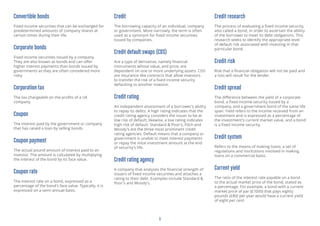
Convertible bonds
Fixed income securities that can be exchanged for
predetermined amounts of company shares at
certain times during their life.
Corporate bonds
Fixed income securities issued by a company.
They are also known as bonds and can offer
higher interest payments than bonds issued by
governments as they are often considered more
risky.
Corporation tax
The tax chargeable on the profits of a UK
company.
Coupon
The interest paid by the government or company
that has raised a loan by selling bonds.
Coupon payment
The actual pound amount of interest paid to an
investor. The amount is calculated by multiplying
the interest of the bond by its face value.
Coupon rate
The interest rate on a bond, expressed as a
percentage of the bond’s face value. Typically, it is
expressed on a semi-annual basis.
Credit
The borrowing capacity of an individual, company
or government. More narrowly, the term is often
used as a synonym for fixed income securities
issued by companies.
Credit default swaps (CDS)
Are a type of derivative, namely financial
instruments whose value, and price, are
dependent on one or more underlying assets. CDS
are insurance-like contracts that allow investors
to transfer the risk of a fixed income security
defaulting to another investor.
Credit rating
An independent assessment of a borrower’s ability
to repay its debts. A high rating indicates that the
credit rating agency considers the issuer to be at
low risk of default; likewise, a low rating indicates
high risk of default. Standard & Poor’s, Fitch and
Moody’s are the three most prominent credit
rating agencies. Default means that a company or
government is unable to meet interest payments
or repay the inital investment amount at the end
of security’s life.
Credit rating agency
A company that analyses the financial strength of
issuers of fixed income securities and attaches a
rating to their debt. Examples include Standard &
Poor’s and Moody’s.
Credit research
The process of evaluating a fixed income security,
also called a bond, in order to ascertain the ability
of the borrower to meet its debt obligations. This
research seeks to identify the appropriate level
of default risk associated with investing in that
particular bond.
Credit risk
Risk that a financial obligation will not be paid and
a loss will result for the lender.
Credit spread
The difference between the yield of a corporate
bond, a fixed income security issued by a
company, and a government bond of the same life
span. Yield refers to the income received from an
investment and is expressed as a percentage of
the investment’s current market value, and a bond
is a fixed income security.
Credit system
Refers to the means of making loans; a set of
regulations and institutions involved in making
loans on a commercial basis.
Current yield
The ratio of the interest rate payable on a bond
to the actual market price of the bond, stated as
a percentage. For example, a bond with a current
market price of par (£1000) that pays eighty
pounds (£80) per year would have a current yield
of eight per cent.
6
D
Dated date (or Issue date)
The date of a bond issue from which a bond
begins to accrue interest.
Default
When a borrower does not maintain interest
payments or repay the amount borrowed when
due.
Default risk
Risk that a debtholder will not receive interest and
full repayment of the loan when due.
Derivatives
Financial instruments whose value, and price, are
dependent on one or more underlying assets.
Derivatives can be used to gain exposure to, or
to help protect against, expected changes in the
value of the underlying investments. Derivatives
may be traded on a regulated exchange or traded
over the counter.
Developed economy/market
Well-established economies with a high degree of
industrialisation, standard of living and security.
Diluted net asset value
A method of calculating the net asset value of a
company that has issued and has outstanding
convertible loan stocks (see definition), warrants
(see definition) or options. The calculation
assumes that the holders have exercised their
right to convert or subscribe, thus increasing the
number of shares among which the assets are
divided.
Discount
The condition under which the par value of a bond
exceeds its market price. For example, a £1,000
par amount bond, which is valued at £980 would
be said to be trading at a 2% discount [(£1000-
£980)/£1000=2%].
Discount note
Short-term obligations issued at a discount from
face value, with maturities ranging from one to
360 days. Discount notes have no periodic interest
payments; the investor receives the note’s face
value at maturity. For example, a one year, £1,000
face value discount note purchased at issue at a
price of £950, would yield £50 or 5.26 per cent
(£50/£950).
Distribution
Refers to the periodical paying-out of interest or
dividends received by funds to their shareholders.
Dividends represent a share in the profits of
a company and are paid out to the owners of
company shares at certain times during the year.
Distribution yield
Expresses the amount that is expected to be
distributed over the next 12 months by a fund as
a percentage of the share price of this fund as at a
certain date.
Diversification
The practice of investing in a variety of assets.
This is a risk management technique where, in
a well-diversified portfolio, any loss from an
individual holding should be offset by gains in
other holdings, thereby lessening the impact on
the overall portfolio.
Dividend
Dividends represent a share in the profits of
the company and are paid out to a company’s
shareholders at set times of the year.
Duration risk
The longer a fixed income security, also called a
bond, or bond fund’s duration, the more sensitive
and therefore at risk it is to changes in interest
rates.
7
E
Earnings per share
An indicator of a company’s profitability -
calculated as the net profit of a company divided
by the number of shares in issue.
Embedded option
A provision that gives the issuer or the bondholder
an option, but not the obligation, to take an
action against the other party. The most common
embedded option is a call option, giving the issuer
the right to call, or redeem, the principal of a bond
before the scheduled maturity date.
Emerging economy or market
Economies in the process of rapid growth and
increasing industrialisation. Investments in
emerging markets are generally considered to be
riskier than those in developed markets.
Episode
A phase during which investors allow their
emotions to affect their decision making, which
can cause financial markets to move irrationally.
Equities
Shares of ownership in a company.
Equity capital
That part of a company’s capital entitled to the
residue of capital and income after all prior claims
have been discharged. Usually equity capital is
expressed as ordinary shares or stock units, but
it may be a combination of different classes of
capital (e.g. ordinary and deferred, ‘A’ ordinary and
‘B’ ordinary shares).
Exchange traded
Can be said of any asset traded on an exchange,
such as company shares on a stock exchange.
Exchange-traded fund
A fund that tracks an index, a commodity or a
basket of assets. It is passively-managed like an
index fund, but traded like a stock on an exchange,
experiencing price changes throughout the day
as they are bought and sold. Bond ETFs like bond
mutual funds, hold a portfolio of bonds and can
differ widely in their investment strategies.
Ex-dividend date
The date on which declared distributions officially
belong to underlying investors, rather than the
fund, usually the first business day of the month.
Exposure
The proportion of a fund invested in a particular
share/fixed income security, sector/region, usually
expressed as a percentage of the overall portfolio.
Extension risk
The risk that investors’ principal will be committed
for a longer period of time than expected. In the
context of mortgage- or asset-backed securities,
this may be due to rising interest rates or other
factors that slow the rate at which loans are
repaid.
8
F
Face (or Par value or Principal value)
The principal amount of a security that appears on
the face of the instrument.
Financial Conduct Authority (FCA)
The independent body that regulates the financial
services industry in the UK. It was given statutory
powers by the Financial Services and Markets Act
2000.
Financial Times Stock Exchange Actuaries All-
Share Index (The All-Share)
A broadly based index covering listed UK
industrial, commercial and financial companies,
including Investment Trusts.
Financial Times Stock Exchange 100 Index
(FTSE 100)
A computerised Stock Exchange index launched on
13th February 1984 (3rd January 1984=1,000). It is
a weighted arithmetic index based on the minute-
by-minute share price movements of 100 of the
most highly capitalised companies listed on the
London Stock Exchange.
Fiscal policy
Government policy on taxation, spending and
borrowing.
Fixed income security
A loan in the form of a security, usually issued by
by a government or company, which normally pays
a fixed rate of interest over a given time period, at
the end of which the initial amount borrowed is
repaid.
Fixed rate bond
A long-term bond with a set interest rate to
maturity.
Floating rate notes (FRNs)
Securites whose interest (income) payments are
periodically adjusted depending on the change in
a reference interest rate.
Floor
The lower limit for the interest rate on a floating-
rate bond.
F.R.E.S.H. investment philosophy
The F.R.E.S.H. investment philosophy
was developed by Rod Thomas FCA,
to select only the best property
investments to offer clients. F.R.E.S.H.
investments satisfy the following criteria:
•	 Fixed returns – this means that you
know in advance the income that you
receive in years to come.
•	 Regular high income – we expect
investments to provide regular
income, unless compound growth is
chosen.
•	 Exit strategy defined – getting into an
investment is easy. We also want our
clients to be able to exit at the end of
the investment without drama.
•	 Security – we require all investments
to be legally secured.
•	 Hands-off – all our investments
are fully managed and require zero
involvement.
Visit www.avantiswealth.com for more information on
our unique investment philosophy
9
Foreign exchange
The exchange of one currency for another, or the
conversion of one currency into another currency.
Foreign exchange also refers to the global market
where currencies are traded virtually around
the clock. The term foreign exchange is usually
abbreviated as ‘forex’ and occasionally as ‘FX’.
Foreign exchange (FX) strategy
Can be considered as an asset class in its own
right, along with company shares, fixed income
securities, property and cash. Currencies can
therefore be used as a source of investment
returns.
Forward contract
A contract between two parties to buy or sell a
particular commodity or financial instrument at
a pre-determined price at a future date. Foward
contracts are negotiated between two parties and
are traded privately, or usually referred to as ‘over-
the-counter’.
Fundamentals (company)
A basic principle, rule, law, or the like, that serves
as the groundwork of a system. A company’s
fundamentals pertain specifically to that company,
and are factors such as its business model,
earnings, balance sheet and debt.
Fundamentals (economic)
A basic principle, rule, law, or the like, that
serves as the groundwork of a system. Economic
fundamentals are factors such as inflation,
employment, economic growth.
Futures
A futures contract is a contract between two
parties to buy or sell a particular commodity or
financial instrument at a pre-determined price at
a future date. Futures are traded on a regulated
exchange.
Future value
The value of an asset at a specified date in the
future, calculated using a specified rate of return.
10
G
Gearing
Is the level of a company’s debt in relation to its
assets. A company with significantly more debt
than capital is considered to be geared.
Gilts
Fixed income securities issued by the UK
government.
Government bonds
Fixed income securities issued by governments,
that normally pay a fixed rate of interest over a
given time period, at the end of which the initial
investment is repaid.
Gross redemption yield
Return on a fixed interest security, or any
investment with a known life, expressed as
an annual percentage. Redemption yield
measures the capital as well as income return on
investments with a fixed life.
Gross yield on assets
The total gross revenue that would be earned in a
complete year from all securities and investments
held as a percentage of total assets less current
liabilities.
H
Hedging
A method of reducing unnecessary or unintended
risk.
High grade bond
See Investment-grade bond.
High water mark (HWM)
The highest level that a fund’s NAV (net asset
value) has reached at the end of any 12-month
accounting period.
High yield bonds
Fixed income securities issued by companies
with a low credit rating from a recognised credit
rating agency. They are considered to be at higher
risk of default than better quality, ie higher-rated
fixed income securities but have the potential for
higher rewards. Default means that a company or
government is unable to meet interest payments
or repay the initial investment amount at the end
of security’s life.
Hurdle rate
Indicates the compound rate of growth of the total
assets required each year between now and the
wind-up date if they are to be sufficient to repay
the shareholders the predetermined redemption
price. Any class of share ranking for prior payment
should be taken into account in this calculation.
11
I
Income yield
Refers to the income received from an investment
and is usually expressed annually as a percentage
based on the investment’s cost, its current market
value or face value.
Index
An index represents a particular market or a
portion of it, serving as a performance indicator
for that market.
Index tracking
A fund management strategy that aims to match
the returns from a particular index.
Index-linked bonds
Fixed income securities where both the value of
the loan and the interest payments are adjusted in
line with inflation over the life of the security. Also
referred to as inflation-linked bonds.
Index-linked fund
A mutual fund that invests in index-linked bonds.
The latter are fixed income securities where both
the value of the loan and the interest payments
are adjusted in line with inflation over the life of
the securitiy.
Inflation
The rate of increase in the cost of living. Inflation
is usually quoted as an annual percentage,
comparing the average price this month with the
same month a year earlier.
Inflation risk
The risk that inflation will reduce the return of an
investment in real terms.
Inflation-linked bonds
Fixed income securities where both the value of
the loan and the interest payments are adjusted in
line with inflation over the life of the security. Also
referred to as index-linked bonds.
Initial public offering (IPO)
The first sale of shares by a private company to
the public.
Interest
Compensation paid or to be paid for the use of
assets, generally expressed as a percentage rate
of par.
Interest rate risk
The risk that a fixed income investment will lose
value if interest rates rise.
Interest rate swap
An agreement between two parties to swap a
fixed interest payment with a variable interest
payment over a specified period of time.
Investment grade bonds
Fixed income securities issued by a company with
a medium or high credit rating from a recognised
credit rating agency. They are considered to be
at lower risk from default than those issued by
companies with lower credit ratings. Default
means that a company or government is unable
to meet interest payments or repay the inital
investment amount at the end of a security’s life.
Investment Trust company
A public limited company that uses the funds
provided by its shareholders to invest in other
companies.
Issue date
See Dated date.
Issuer
An entity that sells securities, such as fixed income
securities and company shares.
12
J
Junk bond
See High-yield bond.
K
Key Investor Information Documents (KIIDs)
These documents provide you with key investor
information about the funds. It is not marketing
material. The information is required by law to
help you understand the nature and the risks of
investing in each fund. You are advised to read
it so you can make an informed decision about
whether to invest.
13
L
Leverage
When referring to a company, leverage is the level
of a company’s debt in relation to its assets. A
company with significantly more debt than capital
is considered to be leveraged. It can also refer to
a fund that borrows money or uses derivatives to
magnify an investment position.
Liquidity
A company is considered highly liquid if it has
plenty of cash at its disposal. A company’s shares
are considered highly liquid if they can be easily
bought or sold since large amounts are regularly
traded.
Listed investments
Investments which have an official listing on one
of the world’s recognised stock markets.
LIBOR (London Interbank Offered Rate)
The interest rates banks charge each other for
short-term eurodollar loans. LIBOR is frequently
used as the base for resetting rates on floating-
rate securities.
Liquidity (or marketability)
A measure of the relative ease and speed with
which a security can be purchased or sold in a
secondary market.
Loan note
An extended form of an IOU from one party to
another that enables a payee to receive payments
(possibly with interest) over a set period of time,
ending with the date at which the entire loan is to
be repaid.
Long position
Refers to ownership of a security held in the
expectation that the security will rise in value.
14
M
Macroeconomic
Refers to the performance and behaviour of
an economy at the regional or national level.
Macroeconomic factors such as economic output,
unemployment, inflation and investment are key
indicators of economic performance. Sometimes
abbreviated to ‘macro’.
Marketability
See Liquidity.
Management charge
The cost of managing the investments of a fund,
charged annually against its income and/or capital.
Market capitalisation
The value of a company as determined by
multiplying the number of shares in issue by the
price of the shares.
Market price
There are two prices quoted to dealers by
stockbrokers: the higher or offer price at which
they will sell you shares and the lower or bid price
at which they will buy your shares. The difference
between the two is known as the ‘spread’ or ‘turn’
(see Mid-market price).
Maturity
The length of time until the initial investment
amount of a fixed income security is due to be
repaid to the holder of the security.
Modified duration
A measure of the sensitivity of a fixed income
security, called a bond, or bond fund to changes
in interest rates. The longer a bond or bond fund’s
duration, the more sensitive it is to interest rate
movements.
Monetary easing
When central banks lower interest rates or buy
securities on the open market to increase the
money in circulation.
Monetary policy
A central bank’s regulation of money in circulation
and interest rates.
Monetary tightening
When central banks raise interest rates or sell
securities on the open market to decrease the
money in circulation.
Mortgage-backed bonds or securities (MBS)
Mortgage-backed securities, called MBS are bonds
or notes backed by mortgages on residential or
commercial properties—an investor is purchasing
an interest in pools of loans or other financial
assets. As the underlying loans are paid off by the
borrowers, the investors in MBS receive payments
of interest and principal over time.
Mutual fund (or Open-end fund)
Investment companies that invest pooled cash
of many investors to meet the fund’s stated
investment objective. Mutual funds stand ready
to sell and redeem their shares at any time at the
fund’s current net asset value: total fund assets
divided by shares outstanding.
15
N
Near cash
Deposits or investments with similar
characteristics to cash.
Net
The proportion of a fund invested in, for example,
different sectors. Derivatives are included. The
latter are financial instruments whose value, and
price, are dependent on one or more underlying
assets.
Net asset value (NAV)
The net worth of a company’s equity capital
usually expressed in pence per share.
NAV total return
Measures the performance of shareholders’ funds
per share and thus assesses the management
of the company. It is the theoretical total return
on shareholders’ funds per share, reflecting the
change in NAV assuming that net dividends paid to
shareholders were reinvested in the NAV (see also
Share price total return).
Nominee company
A company formed by a bank or other
organisation for the purpose of holding shares on
behalf of the beneficial owner. Nominee company
employees carry out all the paperwork and other
work associated with the documentation of
shareholding and arrange for necessary transfers
when a share is sold.
Non-callable bond
A bond that cannot be called for redemption by
the issuer before its specified maturity date.
16
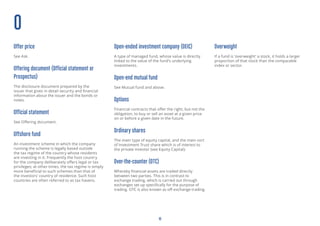
O
Offer price
See Ask.
Offering document (Official statement or
Prospectus)
The disclosure document prepared by the
issuer that gives in detail security and financial
information about the issuer and the bonds or
notes.
Official statement
See Offering document.
Offshore fund
An investment scheme in which the company
running the scheme is legally based outside
the tax regime of the country whose residents
are investing in it. Frequently the host country
for the company deliberately offers legal or tax
privileges; at other times, the tax regime is simply
more beneficial to such schemes than that of
the investors’ country of residence. Such host
countries are often referred to as tax havens.
Open-ended investment company (OEIC)
A type of managed fund, whose value is directly
linked to the value of the fund’s underlying
investments.
Open-end mutual fund
See Mutual fund and above.
Options
Financial contracts that offer the right, but not the
obligation, to buy or sell an asset at a given price
on or before a given date in the future.
Ordinary shares
The main type of equity capital, and the main sort
of Investment Trust share which is of interest to
the private investor (see Equity Capital).
Over-the-counter (OTC)
Whereby financial assets are traded directly
between two parties. This is in contrast to
exchange trading, which is carried out through
exchanges set up specifically for the purpose
of trading. OTC is also known as off-exchange
trading.
Overweight
If a fund is ‘overweight’ a stock, it holds a larger
proportion of that stock than the comparable
index or sector.
17
P
Par value
See Face.
Passive management
An approach to investing whereby capital
is allocated according to the stock or sector
weightings of an index. Passive management is
also referred to as ‘indexing’ or ‘tracking’.
Passive manager
A fund manager who takes a passive approach to
investing. The passive investor aims to match the
returns from the stockmarket or specified index/
sector, rather than to beat them.
Paying agent
The entity, usually a designated bank or the
office of the treasurer of the issuer, that pays the
principal and interest of a bond.
Payment date
The date on which distributions will be paid by the
fund to investors, usually the last business day of
the month.
Pension Review
A pension review will show you what
your existing pension(s) may give you in
retirement. Unfortunately, this might be
less than you expect, and less than you
need. If you’re worried about not having
enough income to maintain your lifestyle
in retirement, apply for a complimentary
pension review with Avantis Wealth and
our preferred IFA today. It’s quick, easy,
and will leave you in a strong position to
make good decisions about the future.
The pension review will show you:
•	 The five year performance of your
fund
•	 Costs and charges you are incurring
•	 The current value of your pension
fund
•	 Your possible income on retirement
if you make no changes
As a result you will be in an informed
position to explore options and make
good decisions about the future of your
pension.
Request your complimentary pension review at
www.avantiswealth.com/pensions/pension-review
18
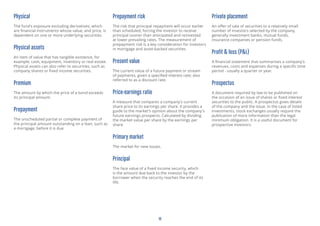
Physical
The fund’s exposure excluding derivatives, which
are financial instruments whose value, and price, is
dependent on one or more underlying securities.
Physical assets
An item of value that has tangible existence, for
example, cash, equipment, inventory or real estate.
Physical assets can also refer to securities, such as
company shares or fixed income securities.
Premium
The amount by which the price of a bond exceeds
its principal amount.
Prepayment
The unscheduled partial or complete payment of
the principal amount outstanding on a loan, such as
a mortgage, before it is due.
Prepayment risk
The risk that principal repayment will occur earlier
than scheduled, forcing the investor to receive
principal sooner than anticipated and reinvested
at lower prevailing rates. The measurement of
prepayment risk is a key consideration for investors
in mortgage and asset-backed securities.
Present value
The current value of a future payment or stream
of payments, given a specified interest rate; also
referred to as a discount rate.
Price-earnings ratio
A measure that compares a company’s current
share price to its earnings per share. It provides a
guide to the market’s opinion about the company’s
future earnings prospects. Calculated by dividing
the market value per share by the earnings per
share.
Primary market
The market for new issues.
Principal
The face value of a fixed income security, which
is the amount due back to the investor by the
borrower when the security reaches the end of its
life.
Private placement
An offer of sale of securities to a relatively small
number of investors selected by the company,
generally investment banks, mutual funds,
insurance companies or pension funds.
Profit & loss (P&L)
A financial statement that summarises a company’s
revenues, costs and expenses during a specific time
period - usually a quarter or year.
Prospectus
A document required by law to be published on
the occasion of an issue of shares or fixed interest
securities to the public. A prospectus gives details
of the company and the issue. In the case of listed
investments, stock exchanges usually require the
publication of more information than the legal
minimum obligation. It is a useful document for
prospective investors.
19
R
Ratings
Designations used by credit rating agencies to give
relative indications as to opinions of credit quality.
Real yield
The return of an investment, adjusted for changes
in prices in an economy.
Redemption value
The amount at which a prior charge is due to
be repaid on the expiry of the loan period or
on liquidation (see definition). Prior charges are
usually repaid at par, but in some cases they may
be redeemed above par as a bonus to holders.
Redemption yield
Return on a fixed interest security or any
investment with a known life expressed as
an annual percentage. Redemption yield
measures the capital as well as income return on
investments with a fixed life.
Registered bond
A bond whose owner is registered with the issuer
or its agent. Transfer of ownership can only be
accomplished if the bonds are properly endorsed
by the registered owner.
Reinvestment risk
The risk that interest income or principal
repayments will have to be reinvested at lower
rates in a declining rate environment.
Retail Prices Index (RPI)
A UK inflation index that measures the rate
of change of prices for a basket of goods and
services in the UK, including mortgage payments
and council tax.
Revenue
Income from investments is the main item of
revenue of an Investment Trust but it will take into
account the difference between franked income
and un-franked income and between income
arising from investments in the United Kingdom,
from overseas and from unlisted investments.
Revenue bond
A municipal bond payable from income derived
from tolls, charges or rents paid by users of the
facility constructed with the proceeds of the bond
issue.
Risk
The measurable probability that an actual return
will be different than expected. There are many
types of risk such as market risk, credit risk,
interest rate risk, exchange rate risk, liquidity risk,
and political risk.
Risk management
The term used to describe the activities the fund
manager undertakes to limit the risk of a loss in a
fund.
Risk premium
The difference between the return from a risk-free
asset, such as a high-quality government bond or
cash, and the return from an investment in any
other asset. The risk premium can be considered
the ‘price’ or ‘pay-off’ for taking on increased risk.
A higher risk premium implies higher risk.
Risk/reward ratio
A ratio comparing the expected returns of an
investment with the amount of risk undertaken.
Risk-free asset
An asset that notionally carries no risk of non-
payment by the borrower such as a high-quality
fixed income security issued by a government or
cash.
20
S
Sovereign debt
Debt of a government.
Standard deviation
A statistical measure of dispersion of a set of data
from its mean, indicating the spread of a fund’s
returns over a certain period of time.
Sub-investment grade bonds
Fixed income securities issued by a company
with a low rating from a recognised credit rating
agency. They are considered to be at higher risk
from default than those issued by companies
with higher credit ratings. Default means that a
company or government is unable to meet interest
payments or repay the inital investment amount
at the end of a security’s life.
Safe-haven assets
Refers to assets that investors perceive to be
relatively safe from suffering a loss in times of
market turmoil.
Savings scheme
A facility to enable purchases of company shares
to be made easily by the investment of regular
(usually monthly) sums of money or by occasional
lump sum contributions.
Secondary market
Market for issues previously offered or sold.
Secured bond
A bond that is backed by collateral.
Security
Financial term for a paper asset – usually a share
in a company or a fixed income security also
known as a bond.
Senior bond
A bond that has a higher priority than another
bond’s claim to the same class of assets.
Settlement date
The date for the delivery of bonds and payment of
funds agreed to in a transaction.
Share price total return
The share price return including reinvestment
of dividends in additional shares at their market
price (see also NAV total return).
Short position
A way for a fund manager to express his or her
view that the market might fall in value.
Short selling
This often refers to the practice whereby an
investor sells an asset they do not own. The
investor borrows the asset from someone who
does own it and pays a fee. The investor must
eventually return the borrowed asset by buying it
in the open market. If the asset has fallen in price,
the investor buys it for less than they sold it for,
thus making a profit. The contrary may also occur.
Short-dated corporate bonds
Fixed income securities issued by companies and
repaid over relatively short periods.
Short-dated government bonds
Fixed income securities issued by governments
and repaid over relatively short periods.
Sinking fund
Money set aside by an issuer of bonds on a regular
basis, for the specific purpose of redeeming debt.
Bonds with such a feature are known as “sinkers.”
21
Stamp duty
A tax payable on purchase of ordinary shares,
preference shares and convertible loan stocks
(and on certain other transactions). Other loan
stocks, including debentures, are exempt.
Supplementary Information Document (SID)
These documents set out additional information
in relation to Complaints, Compensation (that
might be available from the Financial Services
Compensation Scheme) and Cancellation, where
applicable. These should be read in conjunction
with the appropriate Key Investor Information
Document (KIID).
Subordinated bond
A bond that has a lower priority than another
bond’s claim to the same assets.
22
T
Tax credit
Companies are required to deduct tax when
paying a dividend. The company pays over the
tax it has deducted to the Inland Revenue as
Advance Corporation Tax (ACT) and issues the
investor with a voucher showing the amount of tax
which has been deducted. The investor records
the gross amount in his tax return and receives
credit against his total tax bill for the tax which the
company has paid on his behalf.
Total Expense Ratio (TER)
Total annual charges are expressed as the Total
Expense Ratio (TER).
Total return
The term for the gain or loss derived from an
investment over a particular period. Total return
includes income (in the form of interest or
dividend payments) and capital gains.
Trade date
The date upon which a bond is purchased or sold.
Transaction cost
The cost of trading, such as brokerage, clearing
and exchange fees as well as taxes such as stamp
duty.
Transfer agent
The party appointed by an issuer to maintain
records of bondholders, cancel and issue
certificates, and address issues arising from lost,
destroyed or stolen certificates.
Treasuries
Fixed income securities issued by the US
government.
Triple A or AAA rated
The highest possible rating a fixed income
security, also called a bond, can be assigned by
credit rating agencies. Bonds that are rated AAA
are perceived to have the lowest risk of default.
Default means that a company or government is
unable to meet interest payments or repay the
initial investment amount at the end of a security’s
life.
Trustee
An institution, usually a bank, designated by
the issuer as the custodian of funds and official
representative of bondholders. Trustees are
appointed to ensure compliance with the trust
indenture and represent bondholders to enforce
their contract with the issuers.
23
U
UCITS
Stands for Undertakings for Collective
Investments in Transferable Securities. This is the
European regulatory framework for an investment
vehicle that can be marketed across the European
Union and is designed to enhance the single
market in financial assets while maintaining high
levels of investor protection.
Unconstrained
The term used to describe the mandate of a
fund whereby the manager has the freedom to
invest according to his or her own strategy, not
being obliged to allocate capital according to the
weightings of any index, for example.
Underlying value
The fundamental value of a company, reflecting
both tangible and intangible assets, rather than
the current market value.
Underlying yield
Refers to the income received by a managed fund,
and is usually expressed annually as a percentage
based on the fund’s current value.
Underweight
If a portfolio is ‘underweight’ a stock, it holds
a smaller proportion of that stock than the
comparable index or sector.
Unfranked income
Unfranked income includes income from all
untaxed sources.
Unit trust
A type of managed fund, whose value is directly
linked to the value of the fund’s underlying
investments.
Unsecured bond
A bond that is not secured by collateral.
24
V
Valuation
The worth of an asset or company based on its
current price.
Valuation metrics
Measures used for determining the current worth
of an asset or company.
Volatile
When the value of a particular share, market or
sector swings up and down fairly frequently and/
or significantly, it is considered volatile.
Volatility
A measure of the variability of returns of an asset.
W
Valuation
The worth of an asset or company based on its
current price.
Valuation metrics
Measures used for determining the current worth
of an asset or company.
Volatile
When the value of a particular share, market or
sector swings up and down fairly frequently and/
or significantly, it is considered volatile.
Volatility
A measure of the variability of returns of an asset.
25
Y
Yield
The annual percentage rate of return earned on
a bond calculated by dividing the coupon interest
rate by its purchase price.
Yield curve
A line tracing relative yields on a type of bond
over a spectrum of maturities ranging from three
months to 30 years.
Yield to call
A yield on a bond calculated by dividing the value
all interest payments that will be paid until the
call date, plus interest on interest, by the principal
amount received on the call date at the call price,
taking into consideration whatever gain or loss is
realised from the bond at the call date. Example:
You pay £900 for a five year bond with a face
value of £1,000. The bond pays an annual coupon
of ten per cent. This bond is called at year three
for £1,100. The yield to call of this bond is 18.4
per cent. This reflects the three years of coupon
payments and the difference between the price
paid and the call price. Had the
bond not been called, the yield to maturity would
have been 12.8 per cent.
Yield to maturity
A yield on a bond calculated by dividing the value
of all the interest payments that will be paid until
the maturity date, plus interest on interest, by the
principal amount received at the maturity date,
taking in to consideration whatever gain or loss
is realised from the bond at the maturity date.
Example: You pay £900 for a five year bond at a
face value of £1,000. The bond pays an annual
coupon of ten per cent.
Here the yield to maturity is 12.8 per cent. This
reflects the coupon payments and the difference
between the price and the face value of the bond.
Yield (bonds)
This refers to the interest received from a fixed
income security and is usually expressed annually
as a percentage based on the investment’s cost,
its current market value or its face value.
Yield (equity)
Refers to the dividends received by a holder of
company shares and is usually expressed annually
as a percentage based on the investment’s cost,
its current market value or face value. Dividends
represent a share in the profits of the company
and are paid out to a company’s shareholders at
set times of the year.
Yield (income)
Refers to the income received from an investment
and is usually expressed annually as a percentage
based on the investment’s cost, its current market
value or face value.
26
Z
Zero-coupon bond
A bond which does not make periodic interest
payments; instead the investor receives one
payment, which includes principal and interest, at
redemption (call or maturity). See Discount note.
Zero dividend preference share
A share with no right to receive a dividend. It is
entitled instead to a fixed sum on repayment.
This figure is usually expressed as an annual
percentage and accrues annually.
27
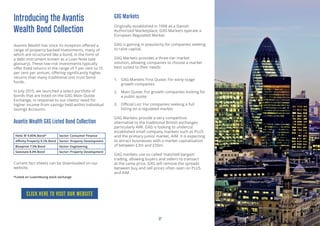
Introducing the Avantis
Wealth Bond Collection
Avantis Wealth has since its inception offered a
range of property backed investments, many of
which are structured like a bond, in the form of
a debt instrument known as a Loan Note (see
glossary). These low-risk investments typically
offer fixed returns in the range of 7 per cent to 15
per cent per annum, offering significantly higher
returns than many traditional unit trust bond
funds.
In July 2015, we launched a select portfolio of
bonds that are listed on the GXG Main Quote
Exchange, in response to our clients’ need for
higher income from savings held within Individual
Savings Accounts.
Avantis Wealth GXG Listed Bond Collection
Current fact sheets can be downloaded on our
website.
GXG Markets
Originally established in 1998 as a Danish
Authorised Marketplace, GXG Markets operate a
European Regulated Market.
GXG is gaining in popularity for companies seeking
to raise capital.
GXG Markets provides a three-tier market
solution, allowing companies to choose a market
best suited to their needs:
1.	 GXG Markets First Quote: For early-stage
growth companies
2.	 Main Quote: For growth companies looking for
a public quote
3.	 Official List: For companies seeking a full
listing on a regulated market
GXG Markets provide a very competitive
alternative to the traditional British exchanges
particularly AIM. GXG is looking to undercut
established small company markets such as PLUS
and the primary junior market, AIM. It is expecting
to attract businesses with a market capitalisation
of between £3m and £50m.
GXG markets use so called ‘matched bargain’
trading, allowing buyers and sellers to transact
at the same price. GXG will remove the spreads
between buy and sell prices often seen on PLUS
and AIM.
Helix ‘B’ 9.85% Bond Sector: Consumer Finance
Affinity Property 9.2% Bond Sector: Property Development
Blueprint 7.5% Bond Sector: Engineering
Swestate 8.0% Bond Sector: Property Development
CLICK HERE TO VISIT OUR WEBSITE
THE RICHER RETIREMENT SPECIALISTS
DISCLAIMER
Avantis Wealth Ltd is not authorised or regulated by the Financial Conduct Authority (FCA). This is not a financial promotion or an invitation to invest.
Avantis Wealth Ltd does not provide any financial or investment advice. We provide a referral to a regulated advisor who will offer appropriate advice, or to the company offering an investment who will determine your suitability for
the investment prior to any offer being made. We strongly recommend that you seek appropriate professional advice before entering into any contract. The value of any investments can go down as well as up and you might not get
back what you put in. You may have difficulty selling any investment at a reasonable price and in some circumstances it might be difficult to sell at any price.
Do not invest unless you have carefully thought about whether you can afford it and whether it is right for you and if necessary consult with a professional adviser in accordance with the Financial Services and Markets Act 2000. These
products are not regulated by the FCA or covered by the Financial Services Compensation Scheme and you will not have access to the financial ombudsman service.
This page does not constitute an offer to invest but is for information only. Persons expressing an interest in the bond will receive an invitation document, which they should read and ensure they fully understand prior to making any
decision to subscribe. Persons in any doubt regarding the risks associated with investments of this nature should consult a suitable qualified and authorised advisor.
VERSION: BGIG-1.0
To arrange a pension review with us or to
find out about our high income investment
opportunities please get in touch.
FREEPHONE: 0800 612 0880 LANDLINE: 01273 447 299
INVEST@AVANTISWEALTH.COM WWW.AVANTISWEALTH.COM

Investment glossary

  • 1.
    1 BONDS & GENERAL INVESTMENTGLOSSARY THE RICHER RETIREMENT SPECIALISTS
  • 2.
    2 A Accrued interest Interest deemedto be earned on a security but not yet paid to the investor. Active management An approach to investing whereby capital is allocated according to the judgment of the investor or fund manager(s). The active investor aims to beat the returns from the stockmarket or specified index/sector, rather than to match them. Active manager A fund manager who follows an active approach to investing. The active investor aims to beat the returns from the stockmarket or specified index/ sector rather than to match them. Alpha The excess return of a fund relative to the return of its comparative index. It is often considered to represent the value that a portfolio manager adds to or subtracts from a fund’s return. Ask price (or offer price) The price at which a seller offers to sell a security. Asset Anything having commercial or exchange value that is owned by a business, institution or individual. Asset allocation Apportioning a portfolio’s assets according to risk tolerance and investment goals. Asset class Category of assets, such as cash, company shares, fixed income securities and their sub-categories, as well as tangible assets such as real estate. Asset value The total of fixed and current assets less current liabilities (see Net asset value). Average life On a mortgage security, the average length of time that each principal pound is expected to be outstanding, based on certain assumptions about prepayment speeds. About Avantis Wealth Avantis Wealth is an investment broker specialising in high income property investments that typically offer net annual returns in the range of 7% to 15%. We provide our clients with investment opportunities that enable them to achieve market leading returns from their pensions, investments and savings, potentially leading to greater financial security and a better quality of life. Visit us at www.avantiswealth.com
  • 3.
    3 B Basis point One one-hundredth(.01) of a percentage point. For example, eight per cent would be equal to 800 basis points. Yield differences are often quoted in basis points (bps). Bearer bond A physical bond that does not identify its owner and is presumed to be owned by the person who holds it. Bear market A market in which the prices of securities are falling, and widespread pessimism often causes the negative sentiment to be self-sustaining. Bid price The price at which a buyer is willing to purchase a bond or share. Bond A loan in the form of a security, usually issued by a government or company, which normally pays a fixed rate of interest over a given time period, at the end of which the initial amount borrowed is repaid. Bond fund An investment vehicle, which invests in a portfolio of bonds that is professionally managed. Types of bond funds include open-ended mutual funds, closed-end mutual funds, and exchange traded funds. Bond issue A set of fixed income securities offered for sale to the public by a company or government. If the bonds are sold for the first time, it is called a ‘new issue’. Bond insurers and reinsurers Specialised insurance firms serving the fixed- income market that guarantee the timely payment of principal and interest on bonds they insure in exchange for a fee. Bond swap The sale of a block of bonds and the purchase of another block of similar market value. Book-entry A method of recording and transferring ownership of securities electronically, eliminating the need for physical certificates. Bottom-up selection Selecting stocks based on the attractiveness of a company. Bullet bond / Bullet maturity A bond that pays regular interest, but that does not repay principal until maturity. Bull market A market in which the prices of securities are rising, often characterised by investor optimism and confidence in continuing strong returns. Bunds Fixed income securities issued by the German government.
  • 4.
    4 C Callable bonds Bonds thatare redeemable by the issuer prior to the maturity date, at a specified price at or above par. Call premium The dollar amount paid to the investor by the issuer for exercising a call provision that is usually stated as a per cent of the principal amount called. Cap The maximum interest rate that may be paid on a floating-rate security. Capital Refers to the financial assets, or resources, that a company has to fund its business operations. Capital at risk The risk an investor faces that he or she may lose all or part of the assets invested. Capital gains tax Capital gains tax is the tax to which the individual is liable on realised capital gains accruing in a year of assessment during any part of which he is resident in the UK. There is a CGT exemption limit - currently £11,100 for the 2015-16 tax year and any gains up to that will not be taxable. Capital growth Occurs when the current value of an investment is greater than the initial amount invested. Capital return The term for the gain or loss derived from an investment over a particular period. Capital return includes capital gain or loss only and excludes income (in the form of interest or dividend payments). Capital structure The composition of a firm’s liabilities - refers to the way a firm finances its assets through a combination of equity, which refers to raising funds by selling shares, and debt. Often when capital structure is referred to, the focus is on the firm’s debt-to-equity ratio, which is an indicator of how risky a company is. Capitalisation The total market value of all of a company’s outstanding shares. Cash equivalents Deposits or investments with similar characteristics to cash. Closed-end fund An investment medium, such as a UK Investment Trust company, with a fixed capital structure. Variations in demand for the shares of the fund are reflected in movements in their market prices and not by an expansion or contraction in their supply. Collar Upper and lower limits (cap and floor, respectively) on the interest rate of a floating-rate security. Compliance Keeping within the rules and regulations of the Financial Conduct Authority (see definition). Each investment business will have its own staff of compliance personnel to carry out self-policing functions. Compound interest Interest that is calculated on the initial principal and previously paid interest. Consumer Prices Index (CPI) An index used to measure inflation, which is the rate of change of prices for a basket of goods and services. The contents of the basket are meant to be representative of products and services we typically spend our money on.
  • 5.
    5 Convertible bonds Fixed incomesecurities that can be exchanged for predetermined amounts of company shares at certain times during their life. Corporate bonds Fixed income securities issued by a company. They are also known as bonds and can offer higher interest payments than bonds issued by governments as they are often considered more risky. Corporation tax The tax chargeable on the profits of a UK company. Coupon The interest paid by the government or company that has raised a loan by selling bonds. Coupon payment The actual pound amount of interest paid to an investor. The amount is calculated by multiplying the interest of the bond by its face value. Coupon rate The interest rate on a bond, expressed as a percentage of the bond’s face value. Typically, it is expressed on a semi-annual basis. Credit The borrowing capacity of an individual, company or government. More narrowly, the term is often used as a synonym for fixed income securities issued by companies. Credit default swaps (CDS) Are a type of derivative, namely financial instruments whose value, and price, are dependent on one or more underlying assets. CDS are insurance-like contracts that allow investors to transfer the risk of a fixed income security defaulting to another investor. Credit rating An independent assessment of a borrower’s ability to repay its debts. A high rating indicates that the credit rating agency considers the issuer to be at low risk of default; likewise, a low rating indicates high risk of default. Standard & Poor’s, Fitch and Moody’s are the three most prominent credit rating agencies. Default means that a company or government is unable to meet interest payments or repay the inital investment amount at the end of security’s life. Credit rating agency A company that analyses the financial strength of issuers of fixed income securities and attaches a rating to their debt. Examples include Standard & Poor’s and Moody’s. Credit research The process of evaluating a fixed income security, also called a bond, in order to ascertain the ability of the borrower to meet its debt obligations. This research seeks to identify the appropriate level of default risk associated with investing in that particular bond. Credit risk Risk that a financial obligation will not be paid and a loss will result for the lender. Credit spread The difference between the yield of a corporate bond, a fixed income security issued by a company, and a government bond of the same life span. Yield refers to the income received from an investment and is expressed as a percentage of the investment’s current market value, and a bond is a fixed income security. Credit system Refers to the means of making loans; a set of regulations and institutions involved in making loans on a commercial basis. Current yield The ratio of the interest rate payable on a bond to the actual market price of the bond, stated as a percentage. For example, a bond with a current market price of par (£1000) that pays eighty pounds (£80) per year would have a current yield of eight per cent.
  • 6.
    6 D Dated date (orIssue date) The date of a bond issue from which a bond begins to accrue interest. Default When a borrower does not maintain interest payments or repay the amount borrowed when due. Default risk Risk that a debtholder will not receive interest and full repayment of the loan when due. Derivatives Financial instruments whose value, and price, are dependent on one or more underlying assets. Derivatives can be used to gain exposure to, or to help protect against, expected changes in the value of the underlying investments. Derivatives may be traded on a regulated exchange or traded over the counter. Developed economy/market Well-established economies with a high degree of industrialisation, standard of living and security. Diluted net asset value A method of calculating the net asset value of a company that has issued and has outstanding convertible loan stocks (see definition), warrants (see definition) or options. The calculation assumes that the holders have exercised their right to convert or subscribe, thus increasing the number of shares among which the assets are divided. Discount The condition under which the par value of a bond exceeds its market price. For example, a £1,000 par amount bond, which is valued at £980 would be said to be trading at a 2% discount [(£1000- £980)/£1000=2%]. Discount note Short-term obligations issued at a discount from face value, with maturities ranging from one to 360 days. Discount notes have no periodic interest payments; the investor receives the note’s face value at maturity. For example, a one year, £1,000 face value discount note purchased at issue at a price of £950, would yield £50 or 5.26 per cent (£50/£950). Distribution Refers to the periodical paying-out of interest or dividends received by funds to their shareholders. Dividends represent a share in the profits of a company and are paid out to the owners of company shares at certain times during the year. Distribution yield Expresses the amount that is expected to be distributed over the next 12 months by a fund as a percentage of the share price of this fund as at a certain date. Diversification The practice of investing in a variety of assets. This is a risk management technique where, in a well-diversified portfolio, any loss from an individual holding should be offset by gains in other holdings, thereby lessening the impact on the overall portfolio. Dividend Dividends represent a share in the profits of the company and are paid out to a company’s shareholders at set times of the year. Duration risk The longer a fixed income security, also called a bond, or bond fund’s duration, the more sensitive and therefore at risk it is to changes in interest rates.
  • 7.
    7 E Earnings per share Anindicator of a company’s profitability - calculated as the net profit of a company divided by the number of shares in issue. Embedded option A provision that gives the issuer or the bondholder an option, but not the obligation, to take an action against the other party. The most common embedded option is a call option, giving the issuer the right to call, or redeem, the principal of a bond before the scheduled maturity date. Emerging economy or market Economies in the process of rapid growth and increasing industrialisation. Investments in emerging markets are generally considered to be riskier than those in developed markets. Episode A phase during which investors allow their emotions to affect their decision making, which can cause financial markets to move irrationally. Equities Shares of ownership in a company. Equity capital That part of a company’s capital entitled to the residue of capital and income after all prior claims have been discharged. Usually equity capital is expressed as ordinary shares or stock units, but it may be a combination of different classes of capital (e.g. ordinary and deferred, ‘A’ ordinary and ‘B’ ordinary shares). Exchange traded Can be said of any asset traded on an exchange, such as company shares on a stock exchange. Exchange-traded fund A fund that tracks an index, a commodity or a basket of assets. It is passively-managed like an index fund, but traded like a stock on an exchange, experiencing price changes throughout the day as they are bought and sold. Bond ETFs like bond mutual funds, hold a portfolio of bonds and can differ widely in their investment strategies. Ex-dividend date The date on which declared distributions officially belong to underlying investors, rather than the fund, usually the first business day of the month. Exposure The proportion of a fund invested in a particular share/fixed income security, sector/region, usually expressed as a percentage of the overall portfolio. Extension risk The risk that investors’ principal will be committed for a longer period of time than expected. In the context of mortgage- or asset-backed securities, this may be due to rising interest rates or other factors that slow the rate at which loans are repaid.
  • 8.
    8 F Face (or Parvalue or Principal value) The principal amount of a security that appears on the face of the instrument. Financial Conduct Authority (FCA) The independent body that regulates the financial services industry in the UK. It was given statutory powers by the Financial Services and Markets Act 2000. Financial Times Stock Exchange Actuaries All- Share Index (The All-Share) A broadly based index covering listed UK industrial, commercial and financial companies, including Investment Trusts. Financial Times Stock Exchange 100 Index (FTSE 100) A computerised Stock Exchange index launched on 13th February 1984 (3rd January 1984=1,000). It is a weighted arithmetic index based on the minute- by-minute share price movements of 100 of the most highly capitalised companies listed on the London Stock Exchange. Fiscal policy Government policy on taxation, spending and borrowing. Fixed income security A loan in the form of a security, usually issued by by a government or company, which normally pays a fixed rate of interest over a given time period, at the end of which the initial amount borrowed is repaid. Fixed rate bond A long-term bond with a set interest rate to maturity. Floating rate notes (FRNs) Securites whose interest (income) payments are periodically adjusted depending on the change in a reference interest rate. Floor The lower limit for the interest rate on a floating- rate bond. F.R.E.S.H. investment philosophy The F.R.E.S.H. investment philosophy was developed by Rod Thomas FCA, to select only the best property investments to offer clients. F.R.E.S.H. investments satisfy the following criteria: • Fixed returns – this means that you know in advance the income that you receive in years to come. • Regular high income – we expect investments to provide regular income, unless compound growth is chosen. • Exit strategy defined – getting into an investment is easy. We also want our clients to be able to exit at the end of the investment without drama. • Security – we require all investments to be legally secured. • Hands-off – all our investments are fully managed and require zero involvement. Visit www.avantiswealth.com for more information on our unique investment philosophy
  • 9.
    9 Foreign exchange The exchangeof one currency for another, or the conversion of one currency into another currency. Foreign exchange also refers to the global market where currencies are traded virtually around the clock. The term foreign exchange is usually abbreviated as ‘forex’ and occasionally as ‘FX’. Foreign exchange (FX) strategy Can be considered as an asset class in its own right, along with company shares, fixed income securities, property and cash. Currencies can therefore be used as a source of investment returns. Forward contract A contract between two parties to buy or sell a particular commodity or financial instrument at a pre-determined price at a future date. Foward contracts are negotiated between two parties and are traded privately, or usually referred to as ‘over- the-counter’. Fundamentals (company) A basic principle, rule, law, or the like, that serves as the groundwork of a system. A company’s fundamentals pertain specifically to that company, and are factors such as its business model, earnings, balance sheet and debt. Fundamentals (economic) A basic principle, rule, law, or the like, that serves as the groundwork of a system. Economic fundamentals are factors such as inflation, employment, economic growth. Futures A futures contract is a contract between two parties to buy or sell a particular commodity or financial instrument at a pre-determined price at a future date. Futures are traded on a regulated exchange. Future value The value of an asset at a specified date in the future, calculated using a specified rate of return.
  • 10.
    10 G Gearing Is the levelof a company’s debt in relation to its assets. A company with significantly more debt than capital is considered to be geared. Gilts Fixed income securities issued by the UK government. Government bonds Fixed income securities issued by governments, that normally pay a fixed rate of interest over a given time period, at the end of which the initial investment is repaid. Gross redemption yield Return on a fixed interest security, or any investment with a known life, expressed as an annual percentage. Redemption yield measures the capital as well as income return on investments with a fixed life. Gross yield on assets The total gross revenue that would be earned in a complete year from all securities and investments held as a percentage of total assets less current liabilities. H Hedging A method of reducing unnecessary or unintended risk. High grade bond See Investment-grade bond. High water mark (HWM) The highest level that a fund’s NAV (net asset value) has reached at the end of any 12-month accounting period. High yield bonds Fixed income securities issued by companies with a low credit rating from a recognised credit rating agency. They are considered to be at higher risk of default than better quality, ie higher-rated fixed income securities but have the potential for higher rewards. Default means that a company or government is unable to meet interest payments or repay the initial investment amount at the end of security’s life. Hurdle rate Indicates the compound rate of growth of the total assets required each year between now and the wind-up date if they are to be sufficient to repay the shareholders the predetermined redemption price. Any class of share ranking for prior payment should be taken into account in this calculation.
  • 11.
    11 I Income yield Refers tothe income received from an investment and is usually expressed annually as a percentage based on the investment’s cost, its current market value or face value. Index An index represents a particular market or a portion of it, serving as a performance indicator for that market. Index tracking A fund management strategy that aims to match the returns from a particular index. Index-linked bonds Fixed income securities where both the value of the loan and the interest payments are adjusted in line with inflation over the life of the security. Also referred to as inflation-linked bonds. Index-linked fund A mutual fund that invests in index-linked bonds. The latter are fixed income securities where both the value of the loan and the interest payments are adjusted in line with inflation over the life of the securitiy. Inflation The rate of increase in the cost of living. Inflation is usually quoted as an annual percentage, comparing the average price this month with the same month a year earlier. Inflation risk The risk that inflation will reduce the return of an investment in real terms. Inflation-linked bonds Fixed income securities where both the value of the loan and the interest payments are adjusted in line with inflation over the life of the security. Also referred to as index-linked bonds. Initial public offering (IPO) The first sale of shares by a private company to the public. Interest Compensation paid or to be paid for the use of assets, generally expressed as a percentage rate of par. Interest rate risk The risk that a fixed income investment will lose value if interest rates rise. Interest rate swap An agreement between two parties to swap a fixed interest payment with a variable interest payment over a specified period of time. Investment grade bonds Fixed income securities issued by a company with a medium or high credit rating from a recognised credit rating agency. They are considered to be at lower risk from default than those issued by companies with lower credit ratings. Default means that a company or government is unable to meet interest payments or repay the inital investment amount at the end of a security’s life. Investment Trust company A public limited company that uses the funds provided by its shareholders to invest in other companies. Issue date See Dated date. Issuer An entity that sells securities, such as fixed income securities and company shares.
  • 12.
    12 J Junk bond See High-yieldbond. K Key Investor Information Documents (KIIDs) These documents provide you with key investor information about the funds. It is not marketing material. The information is required by law to help you understand the nature and the risks of investing in each fund. You are advised to read it so you can make an informed decision about whether to invest.
  • 13.
    13 L Leverage When referring toa company, leverage is the level of a company’s debt in relation to its assets. A company with significantly more debt than capital is considered to be leveraged. It can also refer to a fund that borrows money or uses derivatives to magnify an investment position. Liquidity A company is considered highly liquid if it has plenty of cash at its disposal. A company’s shares are considered highly liquid if they can be easily bought or sold since large amounts are regularly traded. Listed investments Investments which have an official listing on one of the world’s recognised stock markets. LIBOR (London Interbank Offered Rate) The interest rates banks charge each other for short-term eurodollar loans. LIBOR is frequently used as the base for resetting rates on floating- rate securities. Liquidity (or marketability) A measure of the relative ease and speed with which a security can be purchased or sold in a secondary market. Loan note An extended form of an IOU from one party to another that enables a payee to receive payments (possibly with interest) over a set period of time, ending with the date at which the entire loan is to be repaid. Long position Refers to ownership of a security held in the expectation that the security will rise in value.
  • 14.
    14 M Macroeconomic Refers to theperformance and behaviour of an economy at the regional or national level. Macroeconomic factors such as economic output, unemployment, inflation and investment are key indicators of economic performance. Sometimes abbreviated to ‘macro’. Marketability See Liquidity. Management charge The cost of managing the investments of a fund, charged annually against its income and/or capital. Market capitalisation The value of a company as determined by multiplying the number of shares in issue by the price of the shares. Market price There are two prices quoted to dealers by stockbrokers: the higher or offer price at which they will sell you shares and the lower or bid price at which they will buy your shares. The difference between the two is known as the ‘spread’ or ‘turn’ (see Mid-market price). Maturity The length of time until the initial investment amount of a fixed income security is due to be repaid to the holder of the security. Modified duration A measure of the sensitivity of a fixed income security, called a bond, or bond fund to changes in interest rates. The longer a bond or bond fund’s duration, the more sensitive it is to interest rate movements. Monetary easing When central banks lower interest rates or buy securities on the open market to increase the money in circulation. Monetary policy A central bank’s regulation of money in circulation and interest rates. Monetary tightening When central banks raise interest rates or sell securities on the open market to decrease the money in circulation. Mortgage-backed bonds or securities (MBS) Mortgage-backed securities, called MBS are bonds or notes backed by mortgages on residential or commercial properties—an investor is purchasing an interest in pools of loans or other financial assets. As the underlying loans are paid off by the borrowers, the investors in MBS receive payments of interest and principal over time. Mutual fund (or Open-end fund) Investment companies that invest pooled cash of many investors to meet the fund’s stated investment objective. Mutual funds stand ready to sell and redeem their shares at any time at the fund’s current net asset value: total fund assets divided by shares outstanding.
  • 15.
    15 N Near cash Deposits orinvestments with similar characteristics to cash. Net The proportion of a fund invested in, for example, different sectors. Derivatives are included. The latter are financial instruments whose value, and price, are dependent on one or more underlying assets. Net asset value (NAV) The net worth of a company’s equity capital usually expressed in pence per share. NAV total return Measures the performance of shareholders’ funds per share and thus assesses the management of the company. It is the theoretical total return on shareholders’ funds per share, reflecting the change in NAV assuming that net dividends paid to shareholders were reinvested in the NAV (see also Share price total return). Nominee company A company formed by a bank or other organisation for the purpose of holding shares on behalf of the beneficial owner. Nominee company employees carry out all the paperwork and other work associated with the documentation of shareholding and arrange for necessary transfers when a share is sold. Non-callable bond A bond that cannot be called for redemption by the issuer before its specified maturity date.
  • 16.
    16 O Offer price See Ask. Offeringdocument (Official statement or Prospectus) The disclosure document prepared by the issuer that gives in detail security and financial information about the issuer and the bonds or notes. Official statement See Offering document. Offshore fund An investment scheme in which the company running the scheme is legally based outside the tax regime of the country whose residents are investing in it. Frequently the host country for the company deliberately offers legal or tax privileges; at other times, the tax regime is simply more beneficial to such schemes than that of the investors’ country of residence. Such host countries are often referred to as tax havens. Open-ended investment company (OEIC) A type of managed fund, whose value is directly linked to the value of the fund’s underlying investments. Open-end mutual fund See Mutual fund and above. Options Financial contracts that offer the right, but not the obligation, to buy or sell an asset at a given price on or before a given date in the future. Ordinary shares The main type of equity capital, and the main sort of Investment Trust share which is of interest to the private investor (see Equity Capital). Over-the-counter (OTC) Whereby financial assets are traded directly between two parties. This is in contrast to exchange trading, which is carried out through exchanges set up specifically for the purpose of trading. OTC is also known as off-exchange trading. Overweight If a fund is ‘overweight’ a stock, it holds a larger proportion of that stock than the comparable index or sector.
  • 17.
    17 P Par value See Face. Passivemanagement An approach to investing whereby capital is allocated according to the stock or sector weightings of an index. Passive management is also referred to as ‘indexing’ or ‘tracking’. Passive manager A fund manager who takes a passive approach to investing. The passive investor aims to match the returns from the stockmarket or specified index/ sector, rather than to beat them. Paying agent The entity, usually a designated bank or the office of the treasurer of the issuer, that pays the principal and interest of a bond. Payment date The date on which distributions will be paid by the fund to investors, usually the last business day of the month. Pension Review A pension review will show you what your existing pension(s) may give you in retirement. Unfortunately, this might be less than you expect, and less than you need. If you’re worried about not having enough income to maintain your lifestyle in retirement, apply for a complimentary pension review with Avantis Wealth and our preferred IFA today. It’s quick, easy, and will leave you in a strong position to make good decisions about the future. The pension review will show you: • The five year performance of your fund • Costs and charges you are incurring • The current value of your pension fund • Your possible income on retirement if you make no changes As a result you will be in an informed position to explore options and make good decisions about the future of your pension. Request your complimentary pension review at www.avantiswealth.com/pensions/pension-review
  • 18.
    18 Physical The fund’s exposureexcluding derivatives, which are financial instruments whose value, and price, is dependent on one or more underlying securities. Physical assets An item of value that has tangible existence, for example, cash, equipment, inventory or real estate. Physical assets can also refer to securities, such as company shares or fixed income securities. Premium The amount by which the price of a bond exceeds its principal amount. Prepayment The unscheduled partial or complete payment of the principal amount outstanding on a loan, such as a mortgage, before it is due. Prepayment risk The risk that principal repayment will occur earlier than scheduled, forcing the investor to receive principal sooner than anticipated and reinvested at lower prevailing rates. The measurement of prepayment risk is a key consideration for investors in mortgage and asset-backed securities. Present value The current value of a future payment or stream of payments, given a specified interest rate; also referred to as a discount rate. Price-earnings ratio A measure that compares a company’s current share price to its earnings per share. It provides a guide to the market’s opinion about the company’s future earnings prospects. Calculated by dividing the market value per share by the earnings per share. Primary market The market for new issues. Principal The face value of a fixed income security, which is the amount due back to the investor by the borrower when the security reaches the end of its life. Private placement An offer of sale of securities to a relatively small number of investors selected by the company, generally investment banks, mutual funds, insurance companies or pension funds. Profit & loss (P&L) A financial statement that summarises a company’s revenues, costs and expenses during a specific time period - usually a quarter or year. Prospectus A document required by law to be published on the occasion of an issue of shares or fixed interest securities to the public. A prospectus gives details of the company and the issue. In the case of listed investments, stock exchanges usually require the publication of more information than the legal minimum obligation. It is a useful document for prospective investors.
  • 19.
    19 R Ratings Designations used bycredit rating agencies to give relative indications as to opinions of credit quality. Real yield The return of an investment, adjusted for changes in prices in an economy. Redemption value The amount at which a prior charge is due to be repaid on the expiry of the loan period or on liquidation (see definition). Prior charges are usually repaid at par, but in some cases they may be redeemed above par as a bonus to holders. Redemption yield Return on a fixed interest security or any investment with a known life expressed as an annual percentage. Redemption yield measures the capital as well as income return on investments with a fixed life. Registered bond A bond whose owner is registered with the issuer or its agent. Transfer of ownership can only be accomplished if the bonds are properly endorsed by the registered owner. Reinvestment risk The risk that interest income or principal repayments will have to be reinvested at lower rates in a declining rate environment. Retail Prices Index (RPI) A UK inflation index that measures the rate of change of prices for a basket of goods and services in the UK, including mortgage payments and council tax. Revenue Income from investments is the main item of revenue of an Investment Trust but it will take into account the difference between franked income and un-franked income and between income arising from investments in the United Kingdom, from overseas and from unlisted investments. Revenue bond A municipal bond payable from income derived from tolls, charges or rents paid by users of the facility constructed with the proceeds of the bond issue. Risk The measurable probability that an actual return will be different than expected. There are many types of risk such as market risk, credit risk, interest rate risk, exchange rate risk, liquidity risk, and political risk. Risk management The term used to describe the activities the fund manager undertakes to limit the risk of a loss in a fund. Risk premium The difference between the return from a risk-free asset, such as a high-quality government bond or cash, and the return from an investment in any other asset. The risk premium can be considered the ‘price’ or ‘pay-off’ for taking on increased risk. A higher risk premium implies higher risk. Risk/reward ratio A ratio comparing the expected returns of an investment with the amount of risk undertaken. Risk-free asset An asset that notionally carries no risk of non- payment by the borrower such as a high-quality fixed income security issued by a government or cash.
  • 20.
    20 S Sovereign debt Debt ofa government. Standard deviation A statistical measure of dispersion of a set of data from its mean, indicating the spread of a fund’s returns over a certain period of time. Sub-investment grade bonds Fixed income securities issued by a company with a low rating from a recognised credit rating agency. They are considered to be at higher risk from default than those issued by companies with higher credit ratings. Default means that a company or government is unable to meet interest payments or repay the inital investment amount at the end of a security’s life. Safe-haven assets Refers to assets that investors perceive to be relatively safe from suffering a loss in times of market turmoil. Savings scheme A facility to enable purchases of company shares to be made easily by the investment of regular (usually monthly) sums of money or by occasional lump sum contributions. Secondary market Market for issues previously offered or sold. Secured bond A bond that is backed by collateral. Security Financial term for a paper asset – usually a share in a company or a fixed income security also known as a bond. Senior bond A bond that has a higher priority than another bond’s claim to the same class of assets. Settlement date The date for the delivery of bonds and payment of funds agreed to in a transaction. Share price total return The share price return including reinvestment of dividends in additional shares at their market price (see also NAV total return). Short position A way for a fund manager to express his or her view that the market might fall in value. Short selling This often refers to the practice whereby an investor sells an asset they do not own. The investor borrows the asset from someone who does own it and pays a fee. The investor must eventually return the borrowed asset by buying it in the open market. If the asset has fallen in price, the investor buys it for less than they sold it for, thus making a profit. The contrary may also occur. Short-dated corporate bonds Fixed income securities issued by companies and repaid over relatively short periods. Short-dated government bonds Fixed income securities issued by governments and repaid over relatively short periods. Sinking fund Money set aside by an issuer of bonds on a regular basis, for the specific purpose of redeeming debt. Bonds with such a feature are known as “sinkers.”
  • 21.
    21 Stamp duty A taxpayable on purchase of ordinary shares, preference shares and convertible loan stocks (and on certain other transactions). Other loan stocks, including debentures, are exempt. Supplementary Information Document (SID) These documents set out additional information in relation to Complaints, Compensation (that might be available from the Financial Services Compensation Scheme) and Cancellation, where applicable. These should be read in conjunction with the appropriate Key Investor Information Document (KIID). Subordinated bond A bond that has a lower priority than another bond’s claim to the same assets.
  • 22.
    22 T Tax credit Companies arerequired to deduct tax when paying a dividend. The company pays over the tax it has deducted to the Inland Revenue as Advance Corporation Tax (ACT) and issues the investor with a voucher showing the amount of tax which has been deducted. The investor records the gross amount in his tax return and receives credit against his total tax bill for the tax which the company has paid on his behalf. Total Expense Ratio (TER) Total annual charges are expressed as the Total Expense Ratio (TER). Total return The term for the gain or loss derived from an investment over a particular period. Total return includes income (in the form of interest or dividend payments) and capital gains. Trade date The date upon which a bond is purchased or sold. Transaction cost The cost of trading, such as brokerage, clearing and exchange fees as well as taxes such as stamp duty. Transfer agent The party appointed by an issuer to maintain records of bondholders, cancel and issue certificates, and address issues arising from lost, destroyed or stolen certificates. Treasuries Fixed income securities issued by the US government. Triple A or AAA rated The highest possible rating a fixed income security, also called a bond, can be assigned by credit rating agencies. Bonds that are rated AAA are perceived to have the lowest risk of default. Default means that a company or government is unable to meet interest payments or repay the initial investment amount at the end of a security’s life. Trustee An institution, usually a bank, designated by the issuer as the custodian of funds and official representative of bondholders. Trustees are appointed to ensure compliance with the trust indenture and represent bondholders to enforce their contract with the issuers.
  • 23.
    23 U UCITS Stands for Undertakingsfor Collective Investments in Transferable Securities. This is the European regulatory framework for an investment vehicle that can be marketed across the European Union and is designed to enhance the single market in financial assets while maintaining high levels of investor protection. Unconstrained The term used to describe the mandate of a fund whereby the manager has the freedom to invest according to his or her own strategy, not being obliged to allocate capital according to the weightings of any index, for example. Underlying value The fundamental value of a company, reflecting both tangible and intangible assets, rather than the current market value. Underlying yield Refers to the income received by a managed fund, and is usually expressed annually as a percentage based on the fund’s current value. Underweight If a portfolio is ‘underweight’ a stock, it holds a smaller proportion of that stock than the comparable index or sector. Unfranked income Unfranked income includes income from all untaxed sources. Unit trust A type of managed fund, whose value is directly linked to the value of the fund’s underlying investments. Unsecured bond A bond that is not secured by collateral.
  • 24.
    24 V Valuation The worth ofan asset or company based on its current price. Valuation metrics Measures used for determining the current worth of an asset or company. Volatile When the value of a particular share, market or sector swings up and down fairly frequently and/ or significantly, it is considered volatile. Volatility A measure of the variability of returns of an asset. W Valuation The worth of an asset or company based on its current price. Valuation metrics Measures used for determining the current worth of an asset or company. Volatile When the value of a particular share, market or sector swings up and down fairly frequently and/ or significantly, it is considered volatile. Volatility A measure of the variability of returns of an asset.
  • 25.
    25 Y Yield The annual percentagerate of return earned on a bond calculated by dividing the coupon interest rate by its purchase price. Yield curve A line tracing relative yields on a type of bond over a spectrum of maturities ranging from three months to 30 years. Yield to call A yield on a bond calculated by dividing the value all interest payments that will be paid until the call date, plus interest on interest, by the principal amount received on the call date at the call price, taking into consideration whatever gain or loss is realised from the bond at the call date. Example: You pay £900 for a five year bond with a face value of £1,000. The bond pays an annual coupon of ten per cent. This bond is called at year three for £1,100. The yield to call of this bond is 18.4 per cent. This reflects the three years of coupon payments and the difference between the price paid and the call price. Had the bond not been called, the yield to maturity would have been 12.8 per cent. Yield to maturity A yield on a bond calculated by dividing the value of all the interest payments that will be paid until the maturity date, plus interest on interest, by the principal amount received at the maturity date, taking in to consideration whatever gain or loss is realised from the bond at the maturity date. Example: You pay £900 for a five year bond at a face value of £1,000. The bond pays an annual coupon of ten per cent. Here the yield to maturity is 12.8 per cent. This reflects the coupon payments and the difference between the price and the face value of the bond. Yield (bonds) This refers to the interest received from a fixed income security and is usually expressed annually as a percentage based on the investment’s cost, its current market value or its face value. Yield (equity) Refers to the dividends received by a holder of company shares and is usually expressed annually as a percentage based on the investment’s cost, its current market value or face value. Dividends represent a share in the profits of the company and are paid out to a company’s shareholders at set times of the year. Yield (income) Refers to the income received from an investment and is usually expressed annually as a percentage based on the investment’s cost, its current market value or face value.
  • 26.
    26 Z Zero-coupon bond A bondwhich does not make periodic interest payments; instead the investor receives one payment, which includes principal and interest, at redemption (call or maturity). See Discount note. Zero dividend preference share A share with no right to receive a dividend. It is entitled instead to a fixed sum on repayment. This figure is usually expressed as an annual percentage and accrues annually.
  • 27.
    27 Introducing the Avantis WealthBond Collection Avantis Wealth has since its inception offered a range of property backed investments, many of which are structured like a bond, in the form of a debt instrument known as a Loan Note (see glossary). These low-risk investments typically offer fixed returns in the range of 7 per cent to 15 per cent per annum, offering significantly higher returns than many traditional unit trust bond funds. In July 2015, we launched a select portfolio of bonds that are listed on the GXG Main Quote Exchange, in response to our clients’ need for higher income from savings held within Individual Savings Accounts. Avantis Wealth GXG Listed Bond Collection Current fact sheets can be downloaded on our website. GXG Markets Originally established in 1998 as a Danish Authorised Marketplace, GXG Markets operate a European Regulated Market. GXG is gaining in popularity for companies seeking to raise capital. GXG Markets provides a three-tier market solution, allowing companies to choose a market best suited to their needs: 1. GXG Markets First Quote: For early-stage growth companies 2. Main Quote: For growth companies looking for a public quote 3. Official List: For companies seeking a full listing on a regulated market GXG Markets provide a very competitive alternative to the traditional British exchanges particularly AIM. GXG is looking to undercut established small company markets such as PLUS and the primary junior market, AIM. It is expecting to attract businesses with a market capitalisation of between £3m and £50m. GXG markets use so called ‘matched bargain’ trading, allowing buyers and sellers to transact at the same price. GXG will remove the spreads between buy and sell prices often seen on PLUS and AIM. Helix ‘B’ 9.85% Bond Sector: Consumer Finance Affinity Property 9.2% Bond Sector: Property Development Blueprint 7.5% Bond Sector: Engineering Swestate 8.0% Bond Sector: Property Development CLICK HERE TO VISIT OUR WEBSITE
  • 28.
    THE RICHER RETIREMENTSPECIALISTS DISCLAIMER Avantis Wealth Ltd is not authorised or regulated by the Financial Conduct Authority (FCA). This is not a financial promotion or an invitation to invest. Avantis Wealth Ltd does not provide any financial or investment advice. We provide a referral to a regulated advisor who will offer appropriate advice, or to the company offering an investment who will determine your suitability for the investment prior to any offer being made. We strongly recommend that you seek appropriate professional advice before entering into any contract. The value of any investments can go down as well as up and you might not get back what you put in. You may have difficulty selling any investment at a reasonable price and in some circumstances it might be difficult to sell at any price. Do not invest unless you have carefully thought about whether you can afford it and whether it is right for you and if necessary consult with a professional adviser in accordance with the Financial Services and Markets Act 2000. These products are not regulated by the FCA or covered by the Financial Services Compensation Scheme and you will not have access to the financial ombudsman service. This page does not constitute an offer to invest but is for information only. Persons expressing an interest in the bond will receive an invitation document, which they should read and ensure they fully understand prior to making any decision to subscribe. Persons in any doubt regarding the risks associated with investments of this nature should consult a suitable qualified and authorised advisor. VERSION: BGIG-1.0 To arrange a pension review with us or to find out about our high income investment opportunities please get in touch. FREEPHONE: 0800 612 0880 LANDLINE: 01273 447 299 INVEST@AVANTISWEALTH.COM WWW.AVANTISWEALTH.COM