Banking/ Stocks&shares / Bonds
Kyooho Jang, Jeeye Jang, Jeongeun Kwon
Unit 14. Banking


       BUSINESS ADMINISTRATION

       201100210 Kwon Jeong Eun
Banking
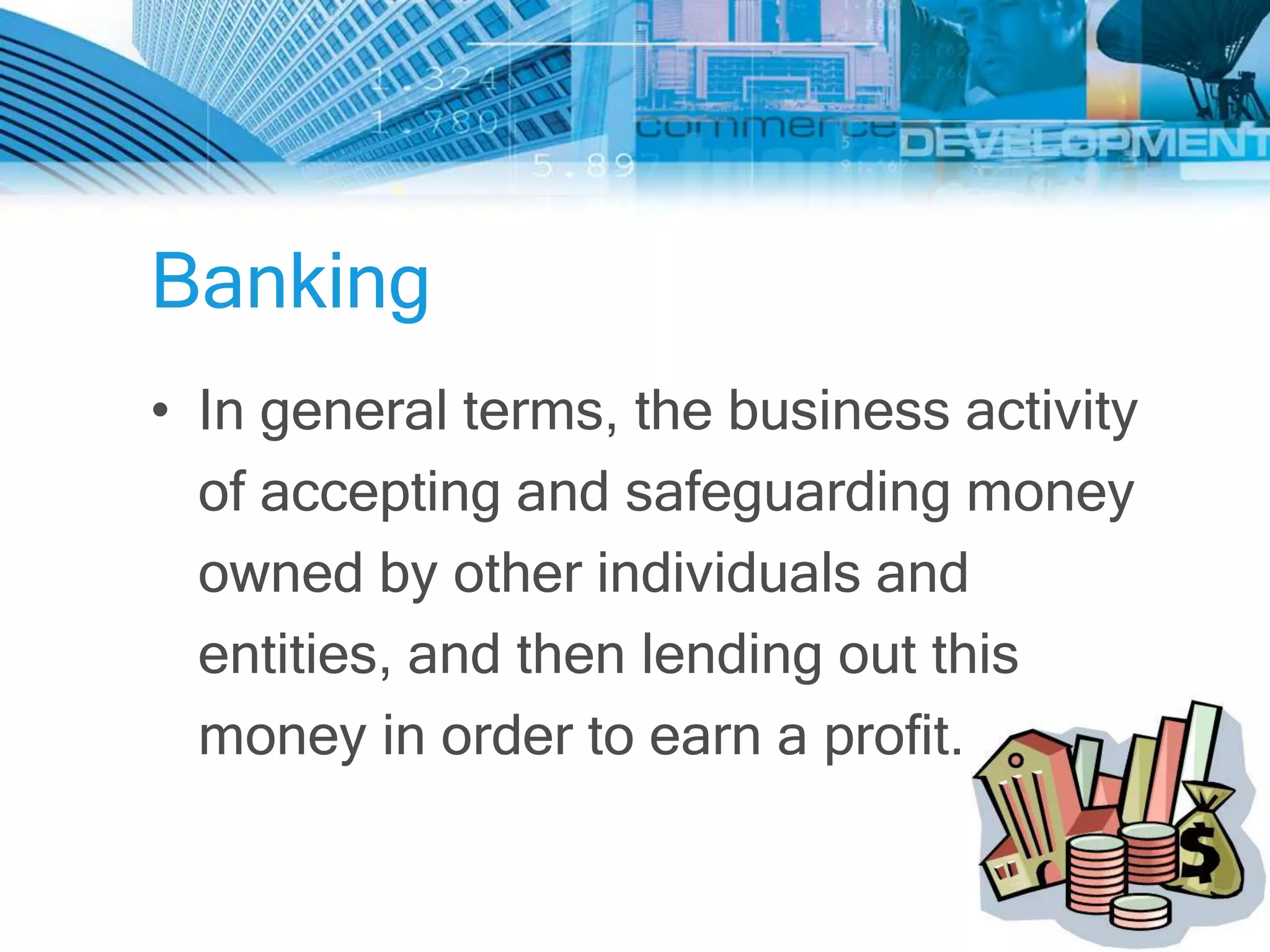
• In general terms, the business activity
  of accepting and safeguarding money
  owned by other individuals and
  entities, and then lending out this
  money in order to earn a profit.
Vocabulary
• Liquidity
  available cash, and how easily other assets can be turned into cash

• Stockbroking
  buying and selling stocks or shares for clients
• Solvency
  ability to pay liabilities when they become due
• Conglomerate
  a group of joined companies, operating in different fields
• Collateral
  anything that acts as a security or a guarantee for a loan
UNIT 15. STOCKS and SHARES


            BUSINESS ADMINISTRATION
                           201103007
                           Jeeye Jang
How the Stock Market Works
• One day, customer demand more
  products.
• Form his own corporation to sell
  shares in his business and raise the
  capital he needs.
How the Stock Market Works
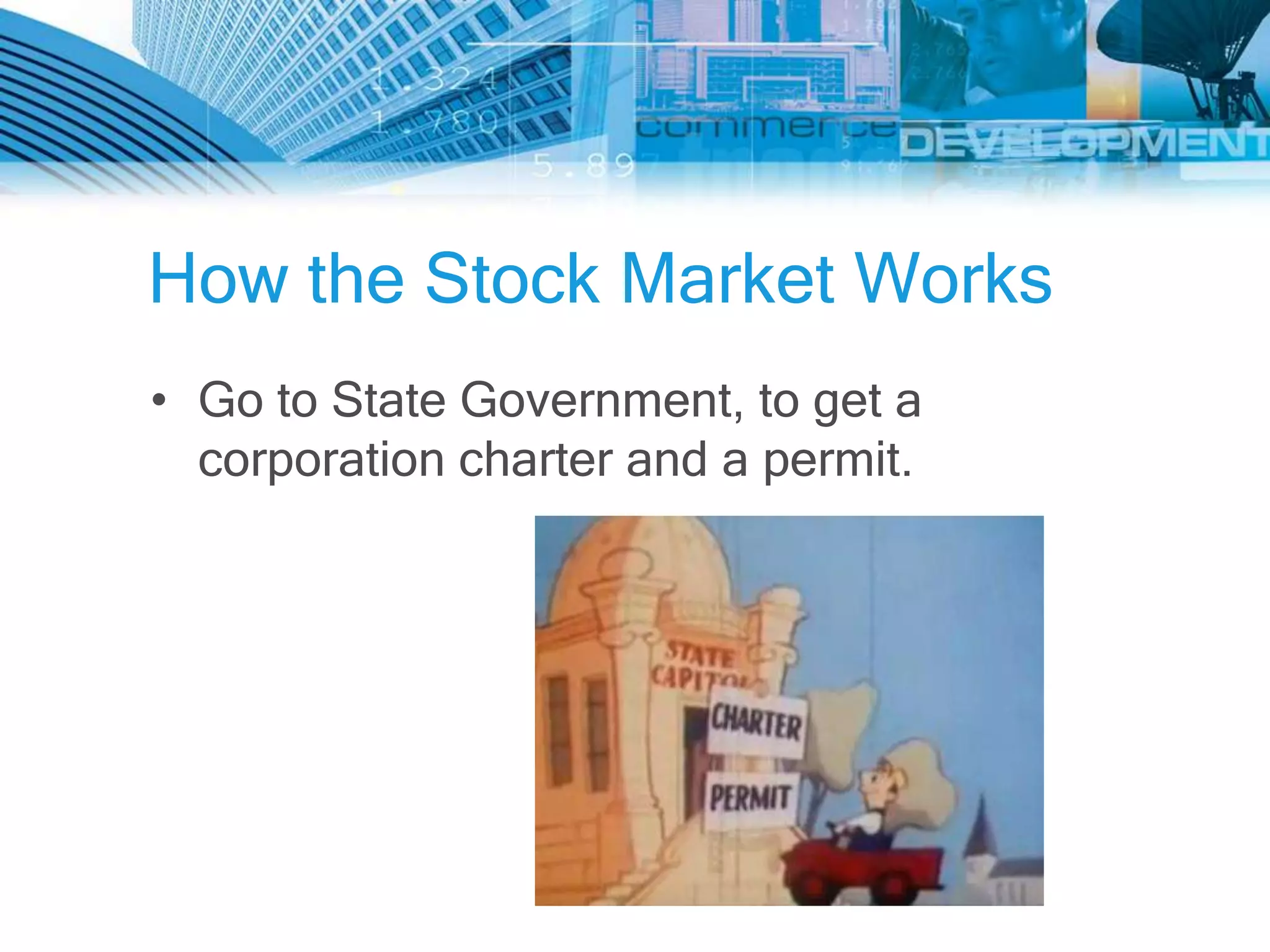
• Go to State Government, to get a
  corporation charter and a permit.
How the Stock Market Works
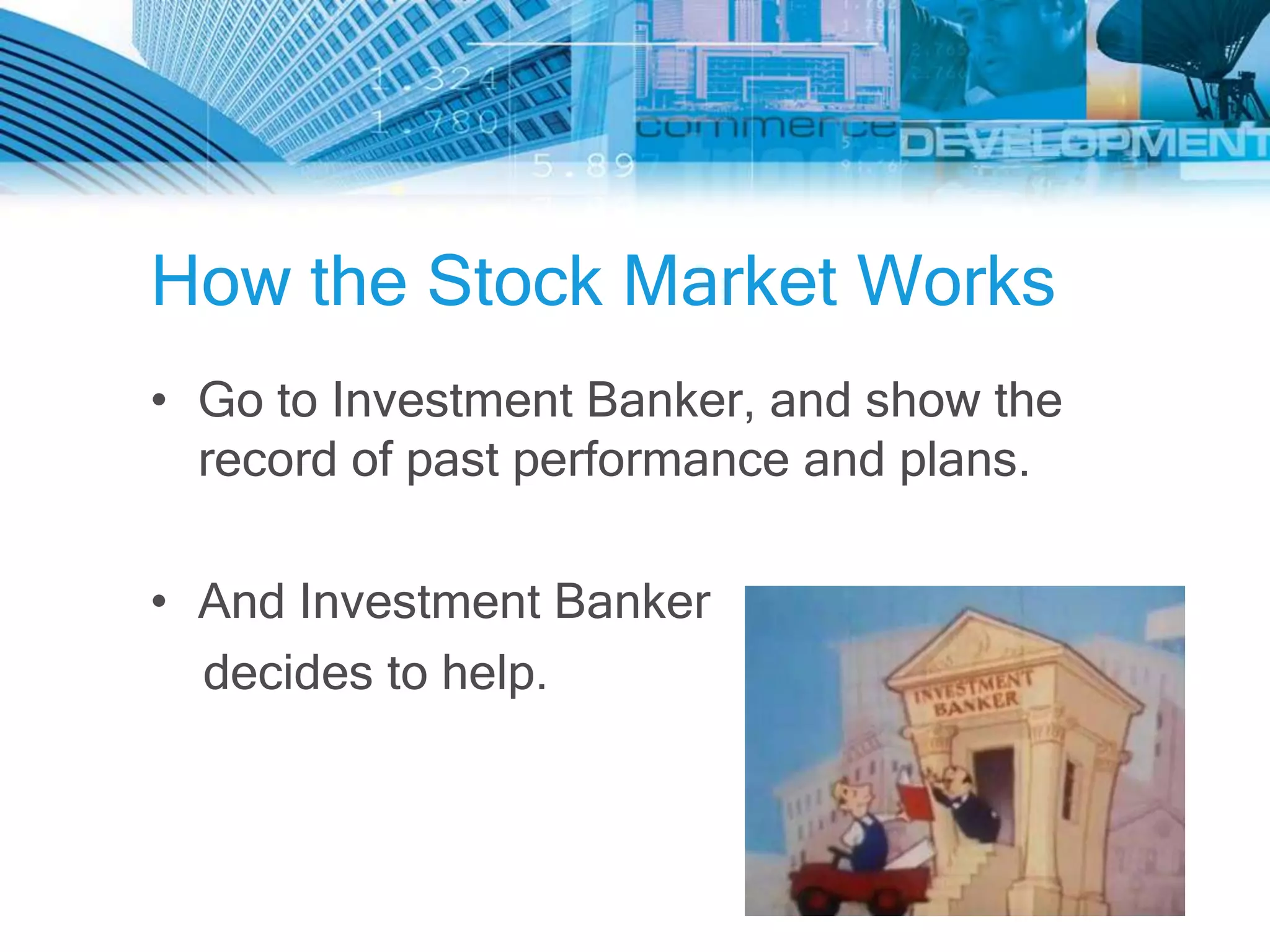
• Go to Investment Banker, and show the
  record of past performance and plans.

• And Investment Banker
  decides to help.
How the Stock Market Works
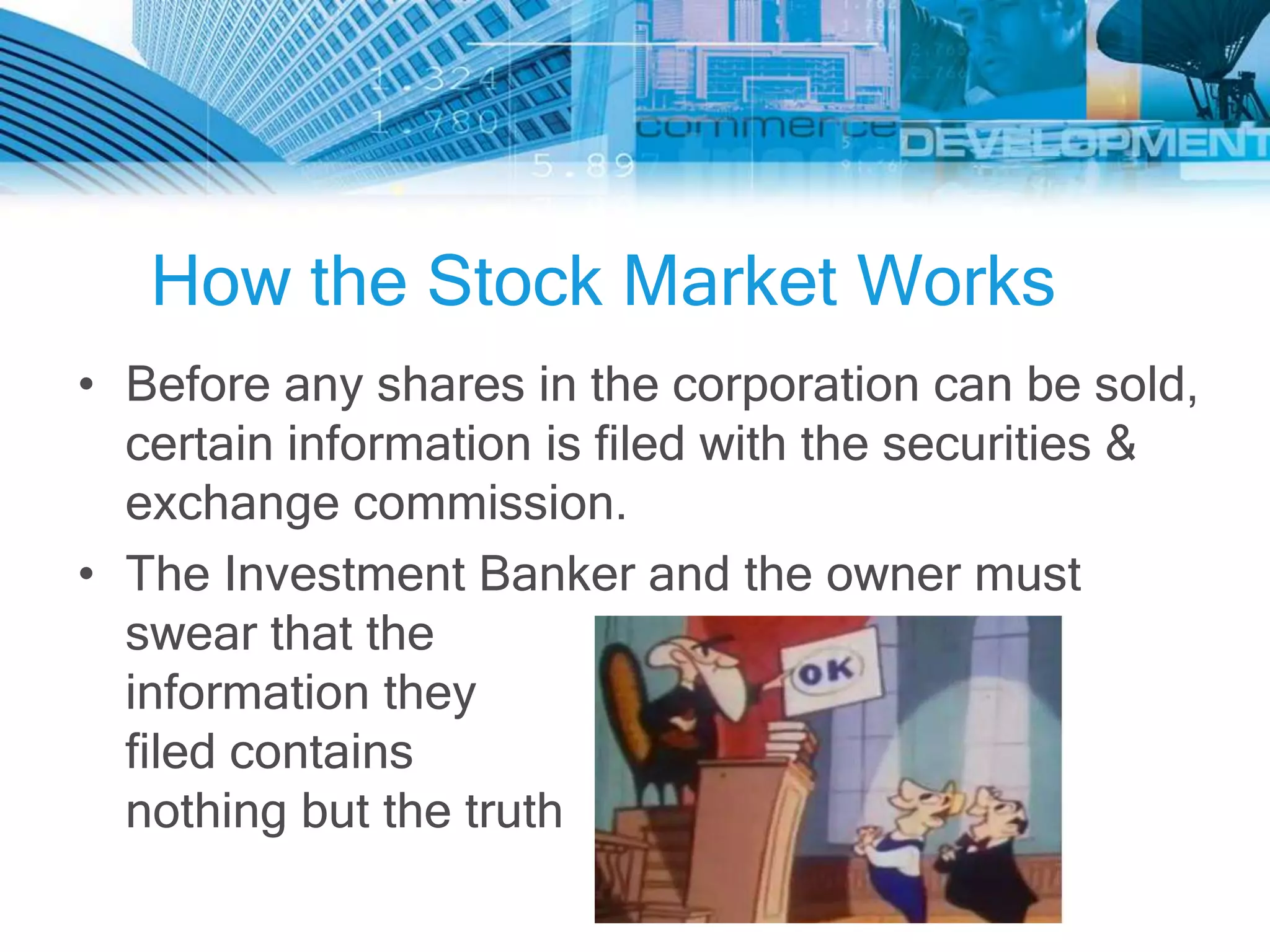
• Before any shares in the corporation can be sold,
  certain information is filed with the securities &
  exchange commission.
• The Investment Banker and the owner must
  swear that the
  information they
  filed contains
  nothing but the truth
How the Stock Market Works
• After registration, Investment Banker pays
  the owner exchange for a certain number
  of shares of corporation.
How the Stock Market Works
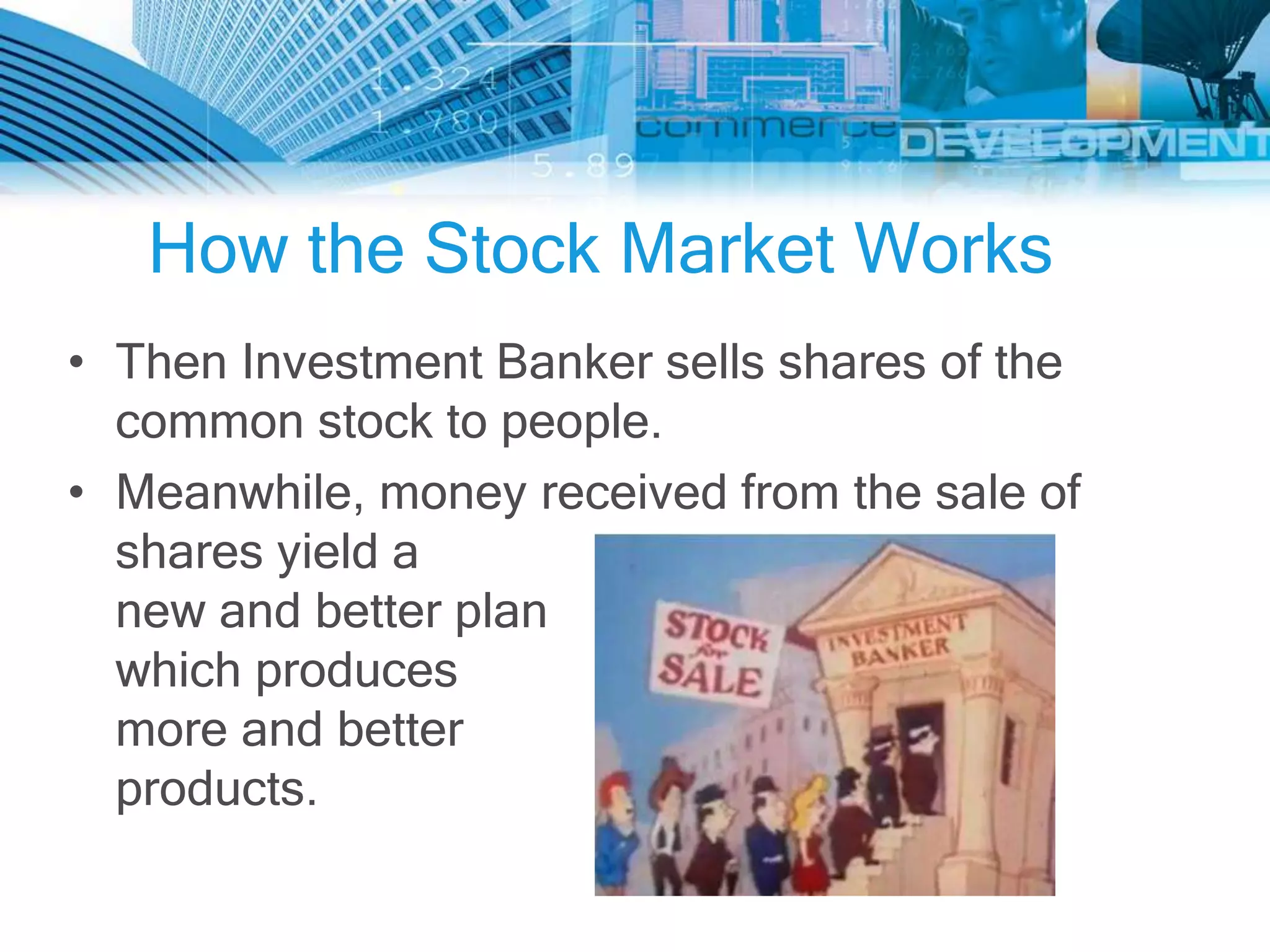
• Then Investment Banker sells shares of the
  common stock to people.
• Meanwhile, money received from the sale of
  shares yield a
  new and better plan
  which produces
  more and better
  products.
How the Stock Market Works
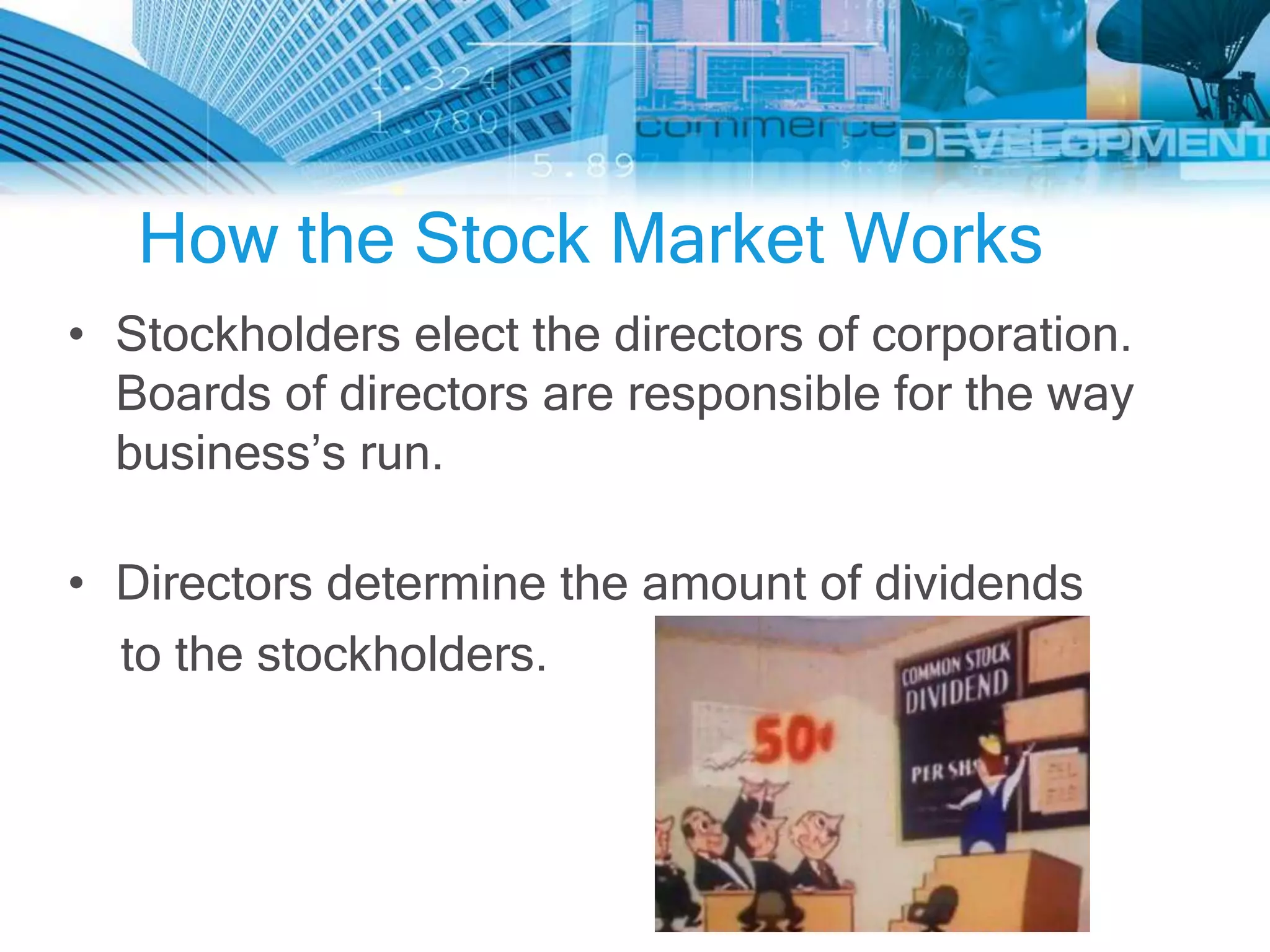
• Stockholders elect the directors of corporation.
  Boards of directors are responsible for the way
  business’s run.

• Directors determine the amount of dividends
  to the stockholders.
How the Stock Market Works
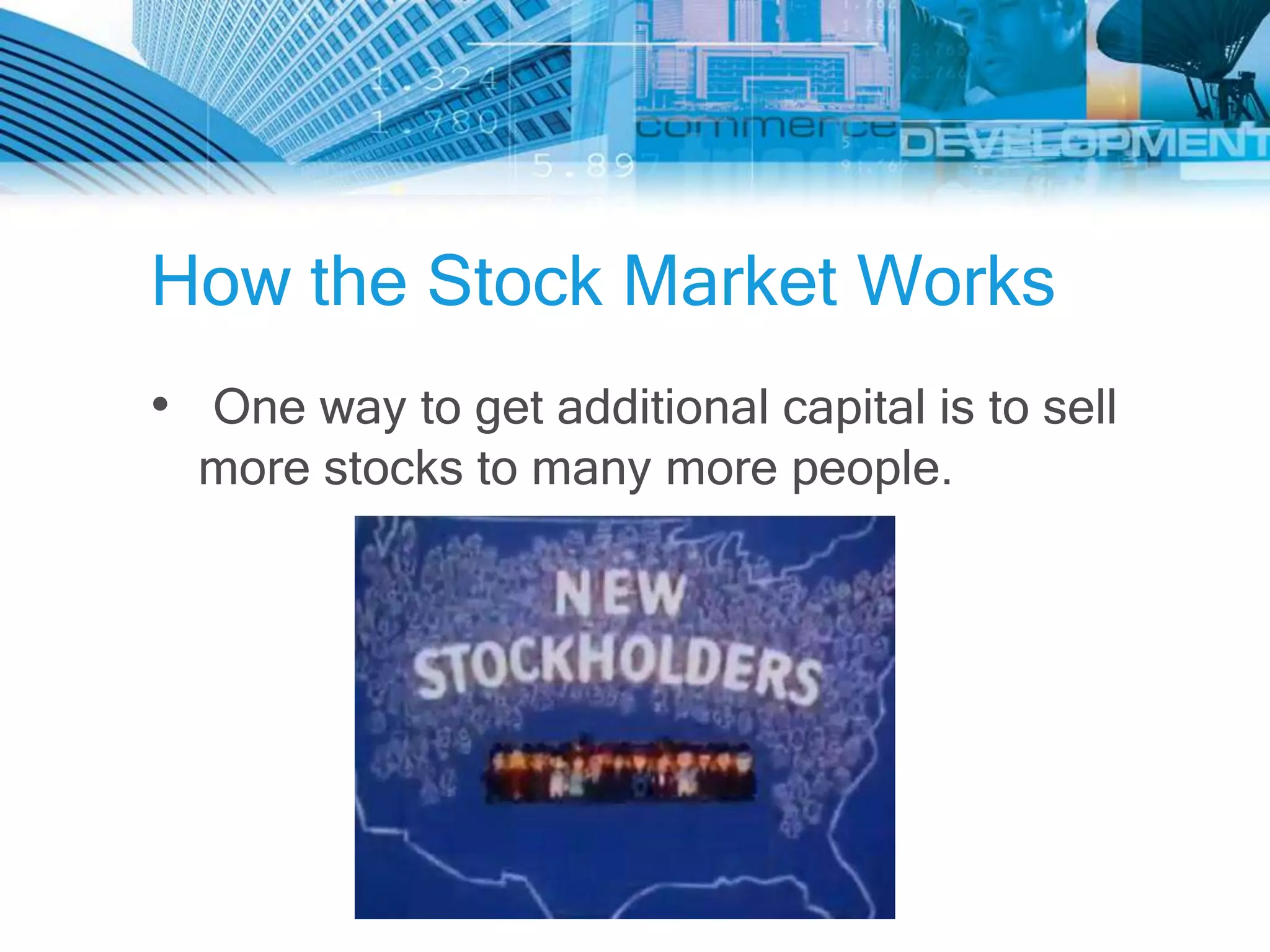
• One way to get additional capital is to sell
  more stocks to many more people.
Limited company

• Legal entity that is separate from it’s owners, and is only
  liable for the amount of capital that has been invested in
  it.

• Co.,Ltd

• cf. UNLIMITED COMPANY ??
- Partners are liable for the company without a limit.
Private limited company
      Memorandum of Association/Certificate of
                  Incorporation
- company’s name, purpose, registered office, authorized share
  capital
             Articles of Association/Bylaws
- set out the duties of directors and the rights of
  shareholders/stockholders
Public limited company
Successful companies can apply to a stock
exchange to become a public limited company/listed
Company

Have to send their shareholders
an independently audited
report every year, containing
the year’s trading results
and a statement of their financial
position.
Rights issue                Bonus issue

• Companies can         • Issue new shares
  issue new shares        to shareholders
  when they want to       instead of paying
  raise more money        dividends when
  for expansion.          they chose to
  They are offered to
                          capitalize part of
  existing
  shareholders at first   their profit.
  at less than market
  price.
Value of shares
• Share owners can vote at a company’s Annual
  General Meeting/Annual Meeting of Stockholders.


• Share owners receive a proportion of distributed
  profits on the form of dividend or company’s
  residual value if it goes into liquidation
Unit 15. Bonds


       BUSINESS ADMINISTRATION

       200602803 Jang Kyooho
BONDS
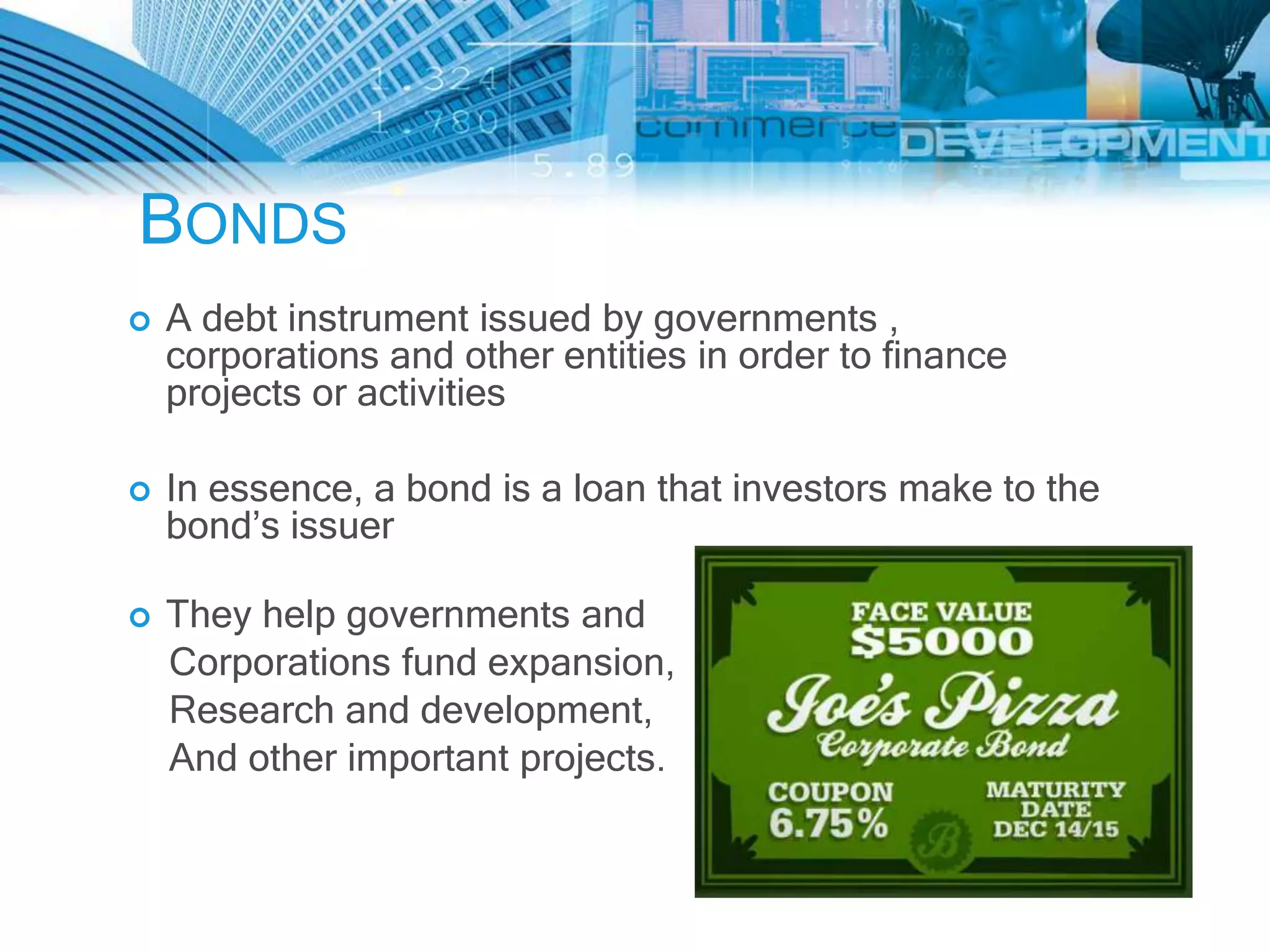
   A debt instrument issued by governments ,
    corporations and other entities in order to finance
    projects or activities

   In essence, a bond is a loan that investors make to the
    bond’s issuer

   They help governments and
    Corporations fund expansion,
    Research and development,
    And other important projects.
Bond Investing
   Bond investing is the purchase of the bonds or debt of a company
    or government.

   Treasury bonds – issued by Government

   Corporate bond - Companies issue corporate bonds to borrow
    money from investors instead of securing a loan from a bank.
Vocabulary
   Equity financing : issuing shares

   Debt financing : issuing bonds

   Bearer certificate : a security whose owner is no registered with the
    issuer

   Liquid : easily sold(turned into cash)

   Par : nominal or face value(100%)

   Coupon : the rate of interest paid by a fixed interest security

   Yield : the rate of income an investor receives taking into account a
    security’s current price.
Quiz Show 
• An arrangement by which a customer
  can withdraw more from a bank
  account than has been deposited in it,
  up to an agreed limit – 50 points

 A. Overdraft (O)
 B. Debit card
• A plastic card issued to bank
  customers for use in cash dispensers
  - 50 points
  A. Cash card (O)
  B. Credit card
• A company considered to be without
  risk – 50 points

  A. Conglomerate (O)
  B. Blue chip
• Anything that acts as a security or a
  guarantee for a loan – 50 points

 A. Liquidity
 B. Collateral (O)
Right issue

• They are newly issued and offered to
  existing share holders.

• 100 points
Memorandum of
Association/Certificate of Incorporation

• It is written for borrowing money. It
  involves company’s name, purpose, the
  amount of authorized share capital.

• 200 points
Co.,ltd
• The abbreviation of limited company

• 70 points
Value of shares (50 points each)
• Share owners can vote at a company’s Annual
  General Meeting/Annual Meeting of Stockholders.

• Share owners receive a proportion of distributed
  profits on the form of dividend or company’s
  r.esidual value if it goes into liquidation
Bearer certificate

• a security whose owner is no
  registered with the issuer

• 100 points
Yield

• the rate of income an investor
  receives taking into account a
  security’s current price.

• 100 points
Debt financing

• issuing bonds

• 50 points
Coupon

• the rate of interest paid by a fixed
  interest security

• 50 points
Thank you very much
        

Bep (1)

  • 1.
    Banking/ Stocks&shares /Bonds Kyooho Jang, Jeeye Jang, Jeongeun Kwon
  • 2.
    Unit 14. Banking BUSINESS ADMINISTRATION 201100210 Kwon Jeong Eun
  • 3.
    Banking • In generalterms, the business activity of accepting and safeguarding money owned by other individuals and entities, and then lending out this money in order to earn a profit.
  • 4.
    Vocabulary • Liquidity available cash, and how easily other assets can be turned into cash • Stockbroking buying and selling stocks or shares for clients • Solvency ability to pay liabilities when they become due • Conglomerate a group of joined companies, operating in different fields • Collateral anything that acts as a security or a guarantee for a loan
  • 5.
    UNIT 15. STOCKSand SHARES BUSINESS ADMINISTRATION 201103007 Jeeye Jang
  • 6.
    How the StockMarket Works • One day, customer demand more products. • Form his own corporation to sell shares in his business and raise the capital he needs.
  • 7.
    How the StockMarket Works • Go to State Government, to get a corporation charter and a permit.
  • 8.
    How the StockMarket Works • Go to Investment Banker, and show the record of past performance and plans. • And Investment Banker decides to help.
  • 9.
    How the StockMarket Works • Before any shares in the corporation can be sold, certain information is filed with the securities & exchange commission. • The Investment Banker and the owner must swear that the information they filed contains nothing but the truth
  • 10.
    How the StockMarket Works • After registration, Investment Banker pays the owner exchange for a certain number of shares of corporation.
  • 11.
    How the StockMarket Works • Then Investment Banker sells shares of the common stock to people. • Meanwhile, money received from the sale of shares yield a new and better plan which produces more and better products.
  • 12.
    How the StockMarket Works • Stockholders elect the directors of corporation. Boards of directors are responsible for the way business’s run. • Directors determine the amount of dividends to the stockholders.
  • 13.
    How the StockMarket Works • One way to get additional capital is to sell more stocks to many more people.
  • 14.
    Limited company • Legalentity that is separate from it’s owners, and is only liable for the amount of capital that has been invested in it. • Co.,Ltd • cf. UNLIMITED COMPANY ?? - Partners are liable for the company without a limit.
  • 15.
    Private limited company Memorandum of Association/Certificate of Incorporation - company’s name, purpose, registered office, authorized share capital Articles of Association/Bylaws - set out the duties of directors and the rights of shareholders/stockholders
  • 16.
    Public limited company Successfulcompanies can apply to a stock exchange to become a public limited company/listed Company Have to send their shareholders an independently audited report every year, containing the year’s trading results and a statement of their financial position.
  • 17.
    Rights issue Bonus issue • Companies can • Issue new shares issue new shares to shareholders when they want to instead of paying raise more money dividends when for expansion. they chose to They are offered to capitalize part of existing shareholders at first their profit. at less than market price.
  • 18.
    Value of shares •Share owners can vote at a company’s Annual General Meeting/Annual Meeting of Stockholders. • Share owners receive a proportion of distributed profits on the form of dividend or company’s residual value if it goes into liquidation
  • 19.
    Unit 15. Bonds BUSINESS ADMINISTRATION 200602803 Jang Kyooho
  • 20.
    BONDS  A debt instrument issued by governments , corporations and other entities in order to finance projects or activities  In essence, a bond is a loan that investors make to the bond’s issuer  They help governments and Corporations fund expansion, Research and development, And other important projects.
  • 21.
    Bond Investing  Bond investing is the purchase of the bonds or debt of a company or government.  Treasury bonds – issued by Government  Corporate bond - Companies issue corporate bonds to borrow money from investors instead of securing a loan from a bank.
  • 22.
    Vocabulary  Equity financing : issuing shares  Debt financing : issuing bonds  Bearer certificate : a security whose owner is no registered with the issuer  Liquid : easily sold(turned into cash)  Par : nominal or face value(100%)  Coupon : the rate of interest paid by a fixed interest security  Yield : the rate of income an investor receives taking into account a security’s current price.
  • 23.
  • 24.
    • An arrangementby which a customer can withdraw more from a bank account than has been deposited in it, up to an agreed limit – 50 points A. Overdraft (O) B. Debit card
  • 25.
    • A plasticcard issued to bank customers for use in cash dispensers - 50 points A. Cash card (O) B. Credit card
  • 26.
    • A companyconsidered to be without risk – 50 points A. Conglomerate (O) B. Blue chip
  • 27.
    • Anything thatacts as a security or a guarantee for a loan – 50 points A. Liquidity B. Collateral (O)
  • 28.
    Right issue • Theyare newly issued and offered to existing share holders. • 100 points
  • 29.
    Memorandum of Association/Certificate ofIncorporation • It is written for borrowing money. It involves company’s name, purpose, the amount of authorized share capital. • 200 points
  • 30.
    Co.,ltd • The abbreviationof limited company • 70 points
  • 31.
    Value of shares(50 points each) • Share owners can vote at a company’s Annual General Meeting/Annual Meeting of Stockholders. • Share owners receive a proportion of distributed profits on the form of dividend or company’s r.esidual value if it goes into liquidation
  • 32.
    Bearer certificate • asecurity whose owner is no registered with the issuer • 100 points
  • 33.
    Yield • the rateof income an investor receives taking into account a security’s current price. • 100 points
  • 34.
    Debt financing • issuingbonds • 50 points
  • 35.
    Coupon • the rateof interest paid by a fixed interest security • 50 points
  • 36.