The function of composition and inversmathematic lessonFrom pyse groupLET’S STUDY,GUYS!!!
The kinds of the nature of the function The function of surjectiveThe function of injektiveThe function of bijektiveNote: don’t memorize it!! Please,just understand it! Exercise and exercise!
The function of surjectiveLook this figure:Observe it!!ABCDELook the next to compare!!
It’s not surjectiveCompare it with previous!!Observe the codomain and the range!!! So, what is the surjective???ABCDEFG
The function of injectiveABCABCD
It’s not injectiveCompare and define!!!ABCDABCD
The function of bijectiveABCDABCD
What is the definition???Bijective injective+surjective.Do you understand???I hope you understand. 
The algebraic operation on functionOperation used is added,subtraction,multiplication,and division.We can write like this:(f+g)(x)=f(x)+g(x)(f-g)(x)=f(x)-g(x)(fxg)(x)=f(x)xg(x)(f:g)(x)=f(x):g(x)Look the example for the next!!!
example f(x)=3x+4 and g(x)=2x-2Find: a)(f+g)(x)…………..b)(f-g)(x)(f+g)(x)=f(x)+g(x)= (3x+4)+(2x-2)=5x+2(Find it yourself!)You can try other operationals!!4points for you if you want to try
Composition functionWe will find the meaning of  f o g or g o f.We can read it by f circle g or g circle f.For example that I have f(x)=x+1 and g(x)= x^2 (x square). Then , we have known that f(x)=x+1, f(1)=1+1=2, so we can change the x with g(x)!It will be f(g(x))=g(x)+1=x^2+1.   and we can say h(x)=f(g(x))………………this result can be called “f circle g”……………………………and now, what is “g circle f”????This is g circle f:Find in the next slide!!!
“g circle f”Ok, the way to reach is same!! f(x)=x+1 g(x)=x^2…………………………..and x must be changed by f(x) g(f(x))=(x+1)^2………………………it called g circle f!!!!Try to understand!! It’s easy!!………
The terms of two functions that can be composed.The intesection is g and h.Domain  gCodomain fCodomain/range g ,but domain fEFIJABCDKLMNGHGet the explain in the next slide!!!
explainThe function can be composed if the two functions have the intersection.for example:   (look the figure) g=((a,e),(b,f),(c,g),(d,h)) f=((g,k),(h,l),(I,m),(j.n))So,we can get f  o  g=((c,k),(d.l))What is the term????????6points for you if you understand!
Inverse functionFor example:A=(1,3,5)B=(2,4,6)And, f:AB,so C:C=((1,2),(3,4),(5,6))determine the inverse function f, and investigate whether that inverse function is an inverse function!Invers C is  f-1:BA, sof-1=((2,1),(4,3),(6,5))because all members are mapped, then this is an inverse function.
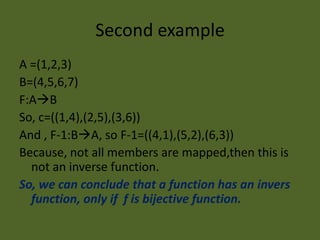
Second exampleA =(1,2,3)B=(4,5,6,7)F:ABSo, c=((1,4),(2,5),(3,6))And , F-1:BA, so F-1=((4,1),(5,2),(6,3))Because, not all members are mapped,then this is not an inverse function. So, we can conclude that a function has an invers function, only if  f is bijective function.
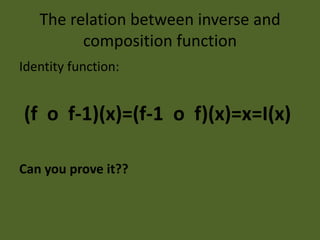
The relation between inverse and composition functionIdentity function: (f  o  f-1)(x)=(f-1  o  f)(x)=x=I(x)Can you prove it??
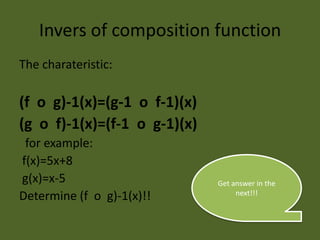
Invers of composition functionThe charateristic:(f  o  g)-1(x)=(g-1  o  f-1)(x)(g  o  f)-1(x)=(f-1  o  g-1)(x)  for example: f(x)=5x+8 g(x)=x-5Determine (f  o  g)-1(x)!!Get answer in the next!!!
answer(f  o  g)(x)=f(g(x))=5x-17 f(g(x))=y=5x-17X=(y+17)/5And X=(f  o  g)-1(x).Ok, it’s over!!100points if you understand all in this chapter!!

invers

  • 1.
    The function ofcomposition and inversmathematic lessonFrom pyse groupLET’S STUDY,GUYS!!!
  • 2.
    The kinds ofthe nature of the function The function of surjectiveThe function of injektiveThe function of bijektiveNote: don’t memorize it!! Please,just understand it! Exercise and exercise!
  • 3.
    The function ofsurjectiveLook this figure:Observe it!!ABCDELook the next to compare!!
  • 4.
    It’s not surjectiveCompareit with previous!!Observe the codomain and the range!!! So, what is the surjective???ABCDEFG
  • 5.
    The function ofinjectiveABCABCD
  • 6.
    It’s not injectiveCompareand define!!!ABCDABCD
  • 7.
    The function ofbijectiveABCDABCD
  • 8.
    What is thedefinition???Bijective injective+surjective.Do you understand???I hope you understand. 
  • 9.
    The algebraic operationon functionOperation used is added,subtraction,multiplication,and division.We can write like this:(f+g)(x)=f(x)+g(x)(f-g)(x)=f(x)-g(x)(fxg)(x)=f(x)xg(x)(f:g)(x)=f(x):g(x)Look the example for the next!!!
  • 10.
    example f(x)=3x+4 andg(x)=2x-2Find: a)(f+g)(x)…………..b)(f-g)(x)(f+g)(x)=f(x)+g(x)= (3x+4)+(2x-2)=5x+2(Find it yourself!)You can try other operationals!!4points for you if you want to try
  • 11.
    Composition functionWe willfind the meaning of f o g or g o f.We can read it by f circle g or g circle f.For example that I have f(x)=x+1 and g(x)= x^2 (x square). Then , we have known that f(x)=x+1, f(1)=1+1=2, so we can change the x with g(x)!It will be f(g(x))=g(x)+1=x^2+1. and we can say h(x)=f(g(x))………………this result can be called “f circle g”……………………………and now, what is “g circle f”????This is g circle f:Find in the next slide!!!
  • 12.
    “g circle f”Ok,the way to reach is same!! f(x)=x+1 g(x)=x^2…………………………..and x must be changed by f(x) g(f(x))=(x+1)^2………………………it called g circle f!!!!Try to understand!! It’s easy!!………
  • 13.
    The terms oftwo functions that can be composed.The intesection is g and h.Domain gCodomain fCodomain/range g ,but domain fEFIJABCDKLMNGHGet the explain in the next slide!!!
  • 14.
    explainThe function canbe composed if the two functions have the intersection.for example: (look the figure) g=((a,e),(b,f),(c,g),(d,h)) f=((g,k),(h,l),(I,m),(j.n))So,we can get f o g=((c,k),(d.l))What is the term????????6points for you if you understand!
  • 15.
    Inverse functionFor example:A=(1,3,5)B=(2,4,6)And,f:AB,so C:C=((1,2),(3,4),(5,6))determine the inverse function f, and investigate whether that inverse function is an inverse function!Invers C is f-1:BA, sof-1=((2,1),(4,3),(6,5))because all members are mapped, then this is an inverse function.
  • 16.
    Second exampleA =(1,2,3)B=(4,5,6,7)F:ABSo,c=((1,4),(2,5),(3,6))And , F-1:BA, so F-1=((4,1),(5,2),(6,3))Because, not all members are mapped,then this is not an inverse function. So, we can conclude that a function has an invers function, only if f is bijective function.
  • 17.
    The relation betweeninverse and composition functionIdentity function: (f o f-1)(x)=(f-1 o f)(x)=x=I(x)Can you prove it??
  • 18.
    Invers of compositionfunctionThe charateristic:(f o g)-1(x)=(g-1 o f-1)(x)(g o f)-1(x)=(f-1 o g-1)(x) for example: f(x)=5x+8 g(x)=x-5Determine (f o g)-1(x)!!Get answer in the next!!!
  • 19.
    answer(f o g)(x)=f(g(x))=5x-17 f(g(x))=y=5x-17X=(y+17)/5And X=(f o g)-1(x).Ok, it’s over!!100points if you understand all in this chapter!!