Introduction
EE 520: Image Analysis &
Computer Vision
General Stuff
• Class time - MW 10-2, Tu-Th 10-2?
• Office hours – by appointment for this week
• Web:
http://www.ece.iastate.edu/~namrata/EE520/
• Evaluation
– 40% midterm, 30% each for 2 projects
– Project: report + 30 min presentation + code
– Homework – not graded – simple MATLAB
experiments of what is taught in class
• Your research areas?
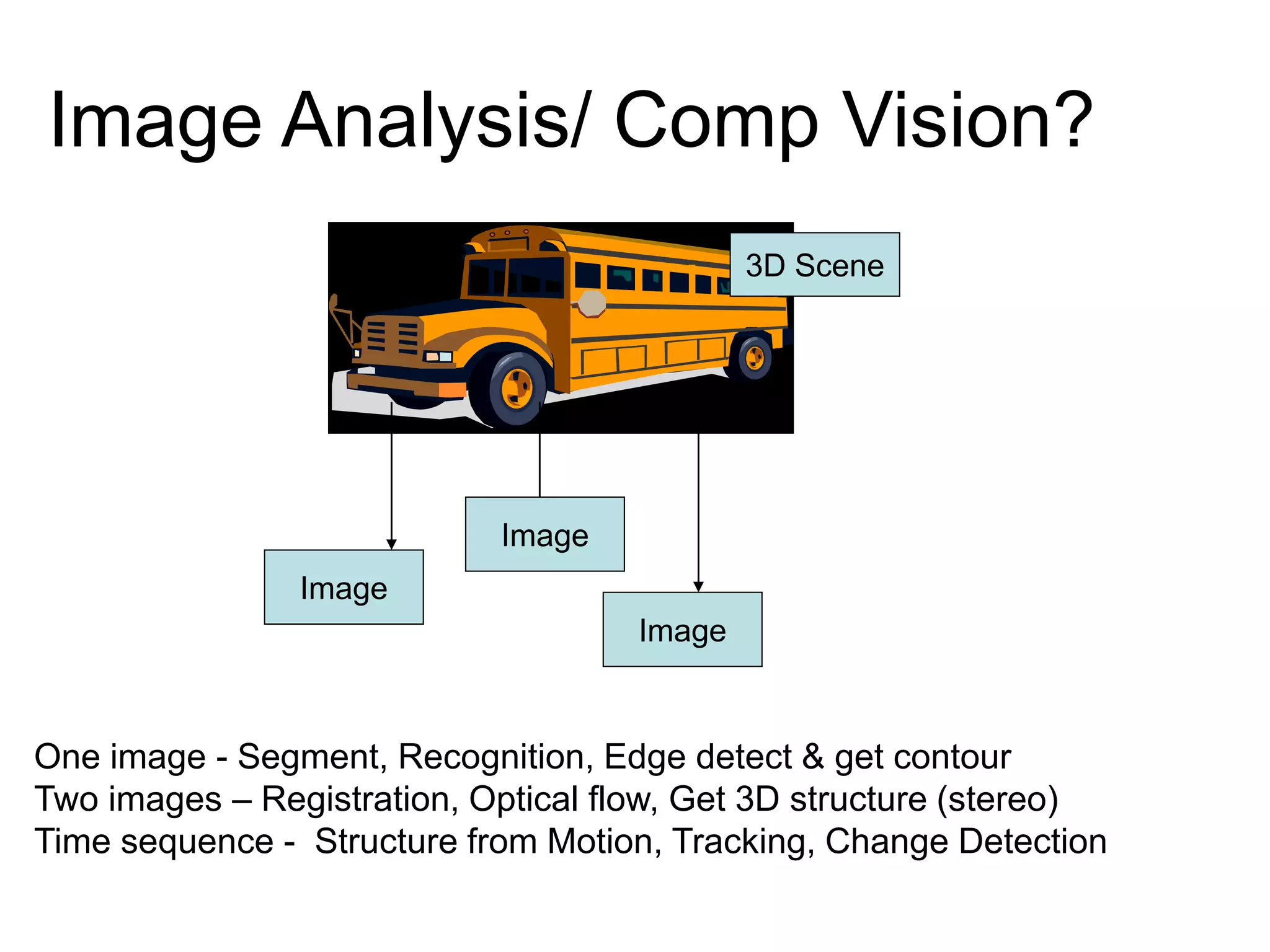
Image Analysis/ Comp Vision?
Image
Image
Image
3D Scene
One image - Segment, Recognition, Edge detect & get contour
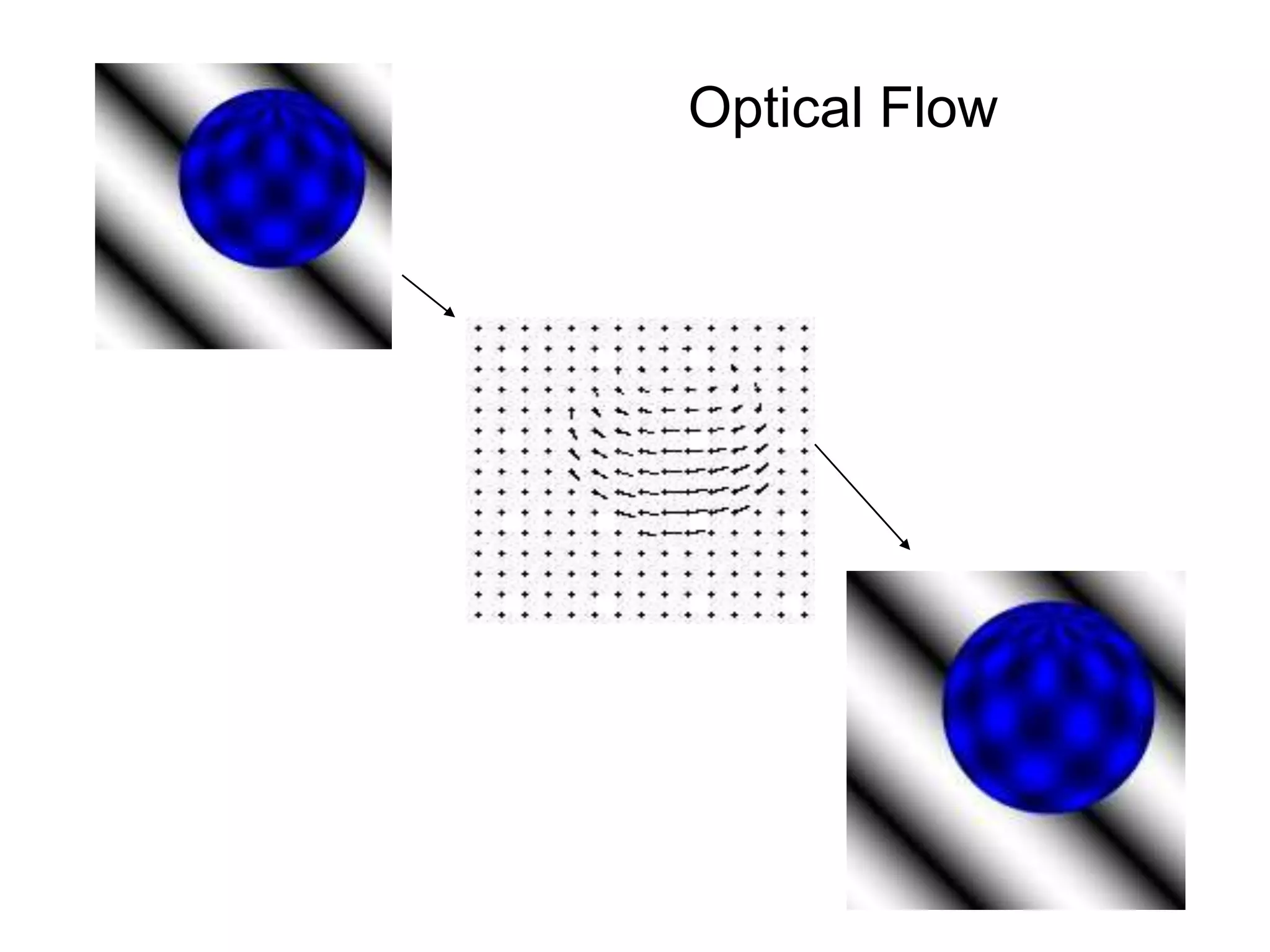
Two images – Registration, Optical flow, Get 3D structure (stereo)
Time sequence - Structure from Motion, Tracking, Change Detection
2D Image Analysis: Feature extraction
• Intensity
• Edges – threshold image derivative
• Texture – repeated basic “primitives” & spatial
relation, view at different scales
• Motion – Threshold frame difference
• Motion – Optical flow (where did pixel (i,j) move)
• Shape, Local histogram, PCA, image transforms
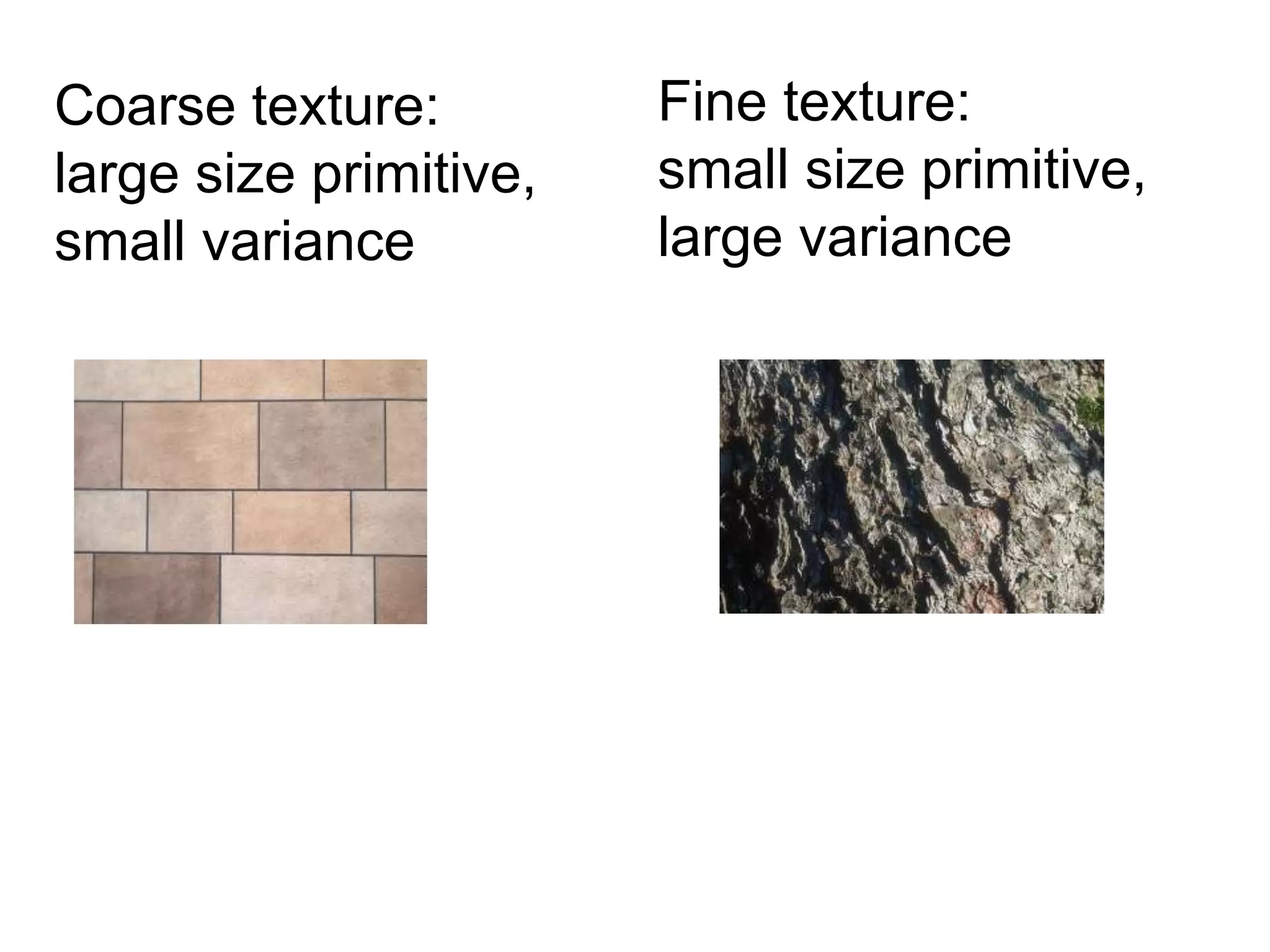
Coarse texture:
large size primitive,
small variance
Fine texture:
small size primitive,
large variance
Optical Flow
2D Image Analysis
• Segmentation – Estimate outer contour
(boundary) of the object from the image
• Registration – Estimate a global
transformation (Affine, Similarity,
Euclidean) relating 2 images
– taken from different views, different modalities
or different times
2D Image Analysis
• Shape – geometric information after removing
scale, translation, rotation
• Recognition / Classification / Detection
– e.g. Faces, Objects, Vehicles, Activity (video)
– Use intensity, shape, texture, motion,…
• Tracking – Estimate from a time seq. of images
– Global motion or
– Global motion & Local deformation (shape change)
– Change detection – change in the system model
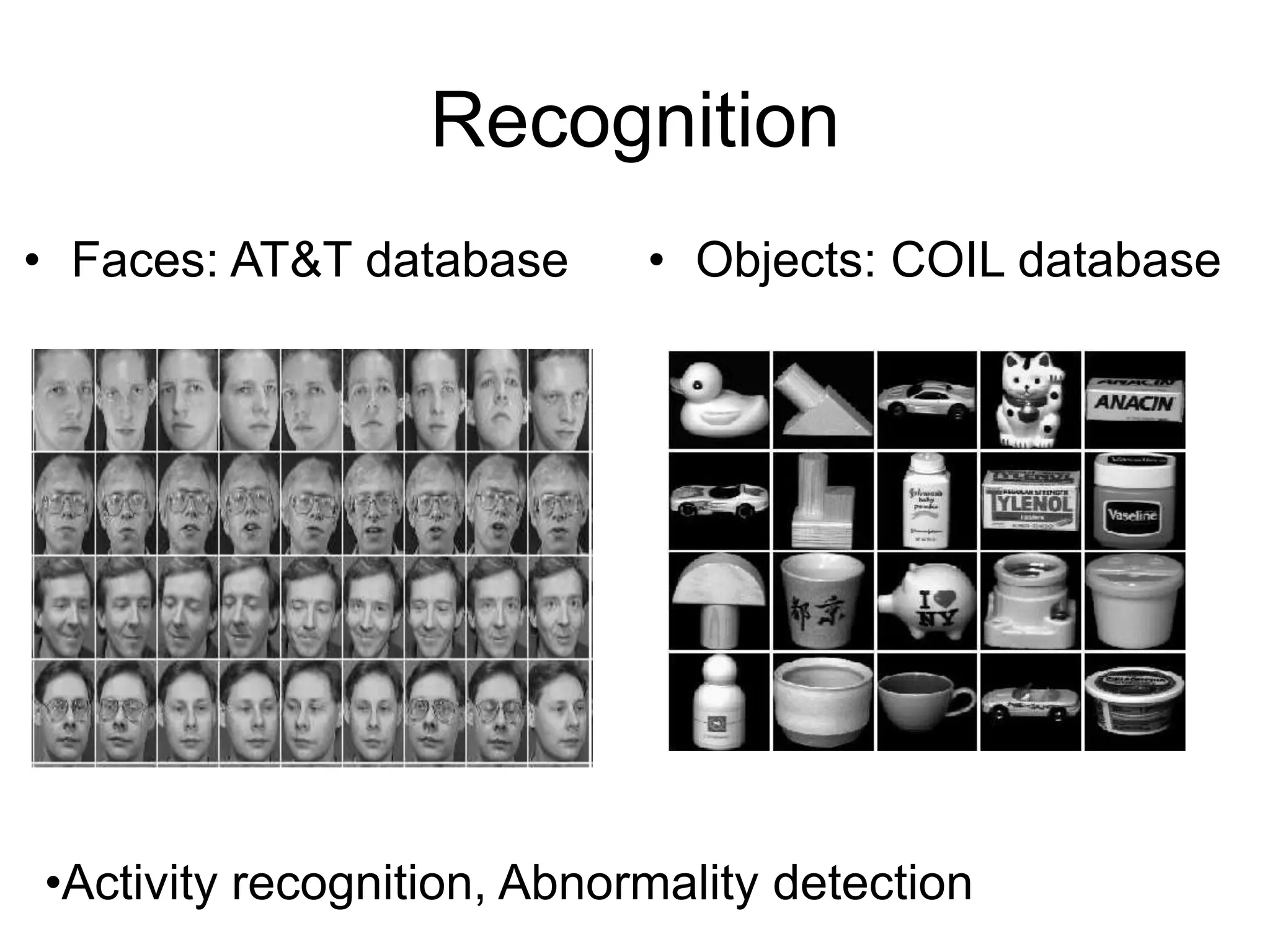
Recognition
• Faces: AT&T database • Objects: COIL database
•Activity recognition, Abnormality detection
Representing Shape
• Landmarks – points of high curvature or
intensity or motion blobs or of “interest”
• Continuous curve – parametric finite dim.
representation e.g. B-spline, angle repr.
• Continuous curve – infinite dim.
representation – level set method
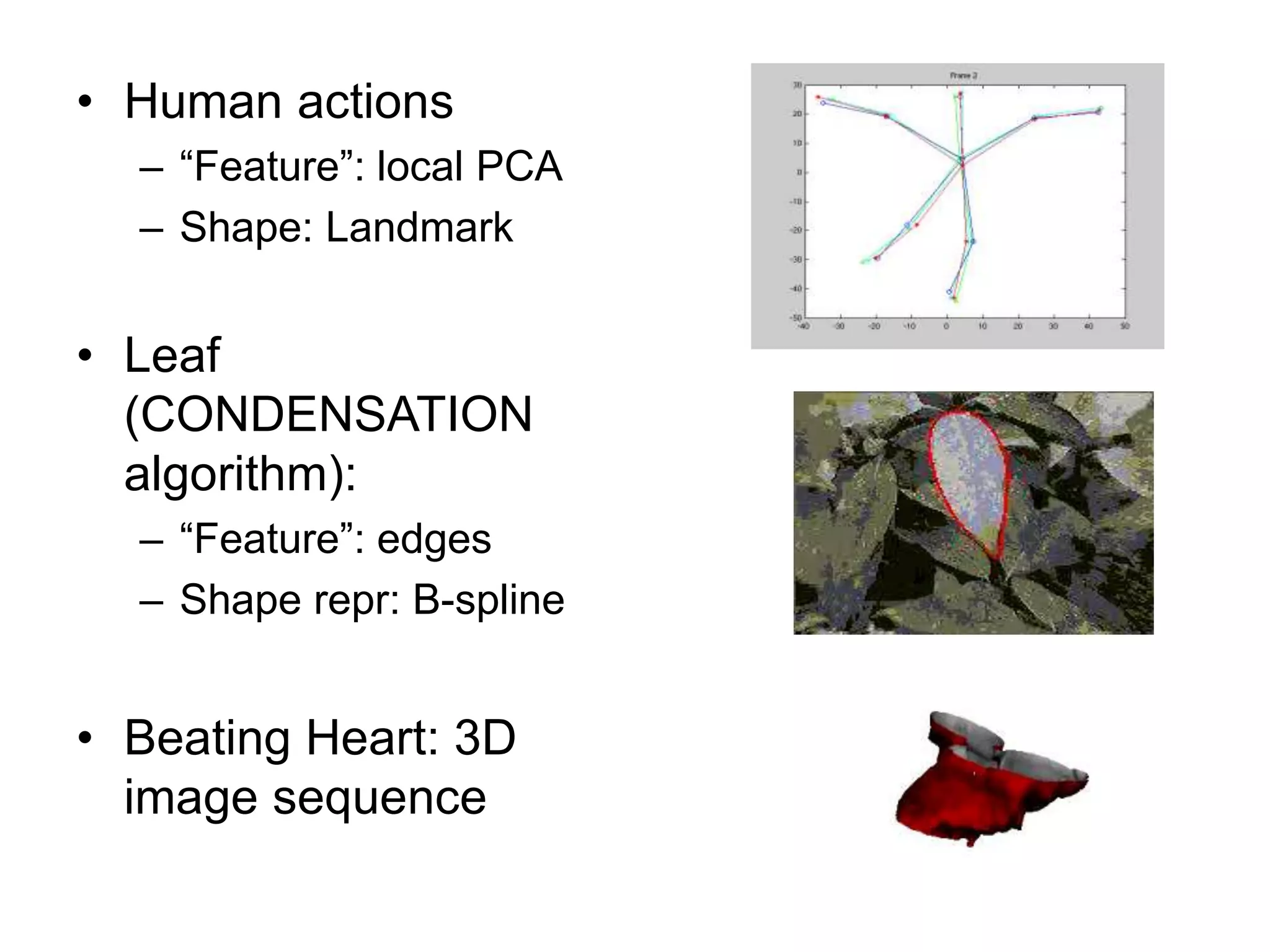
Tracking motion & deformation
• Fish :
– “Feature”– Image intensity,
– Shape repr.: Level set method
– Initialiazation: Segmentation
• Group of People
– “Feature” – Motion detection
– Shape repr: Landmark shape
– Also do change detection
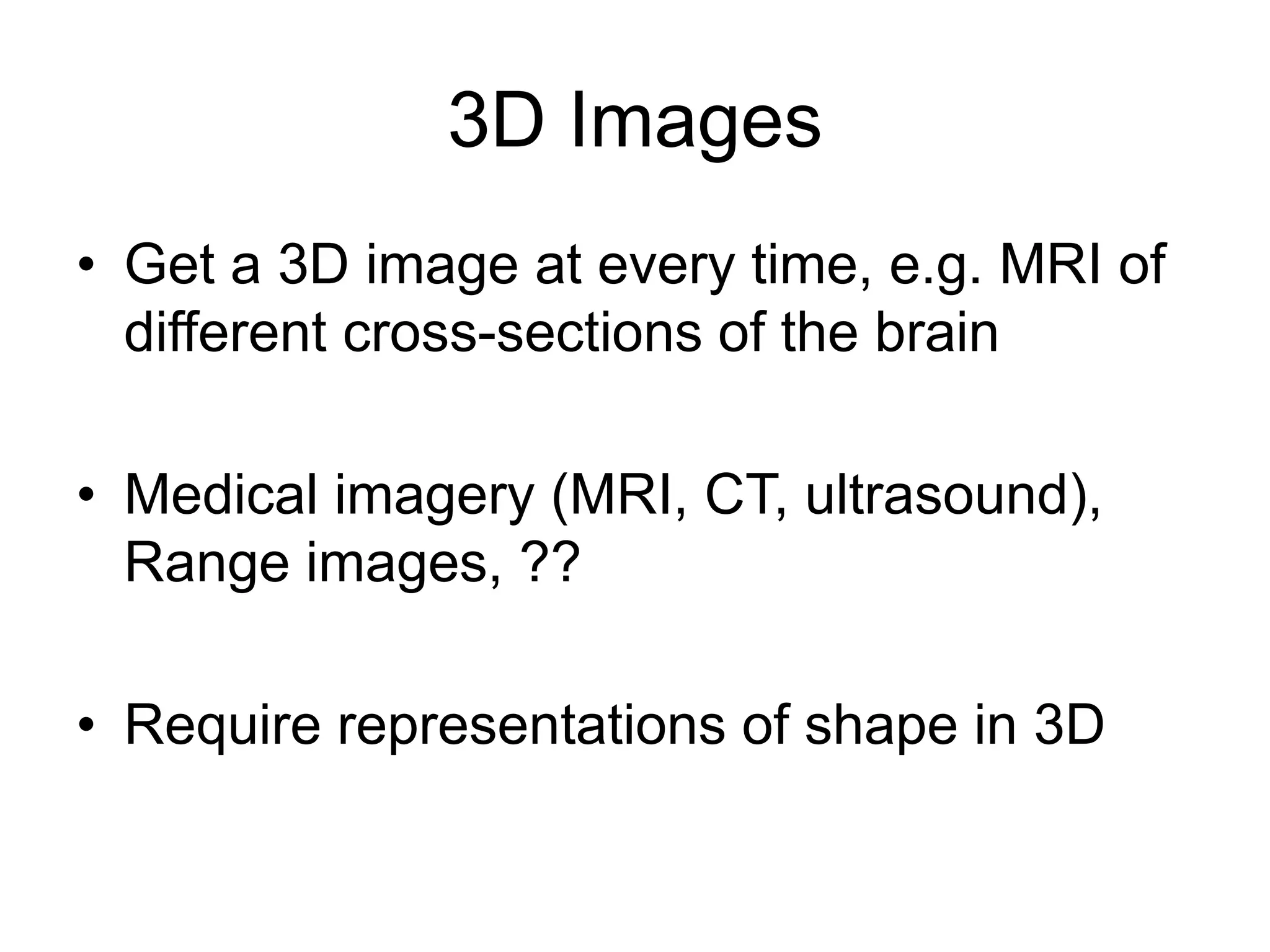
• Human actions
– “Feature”: local PCA
– Shape: Landmark
• Leaf
(CONDENSATION
algorithm):
– “Feature”: edges
– Shape repr: B-spline
• Beating Heart: 3D
image sequence
2D images  3D structure
• Infer 3D scene structure from a set of 2D images
• “Structure”: X,Y,Z coordinates of object
• Inference based on a “Camera model”
• Structure from Stereo - 2 or more views of object
• Structure from Motion – moving object
– Also implicitly tracks the 3D global motion
3D Images
• Get a 3D image at every time, e.g. MRI of
different cross-sections of the brain
• Medical imagery (MRI, CT, ultrasound),
Range images, ??
• Require representations of shape in 3D
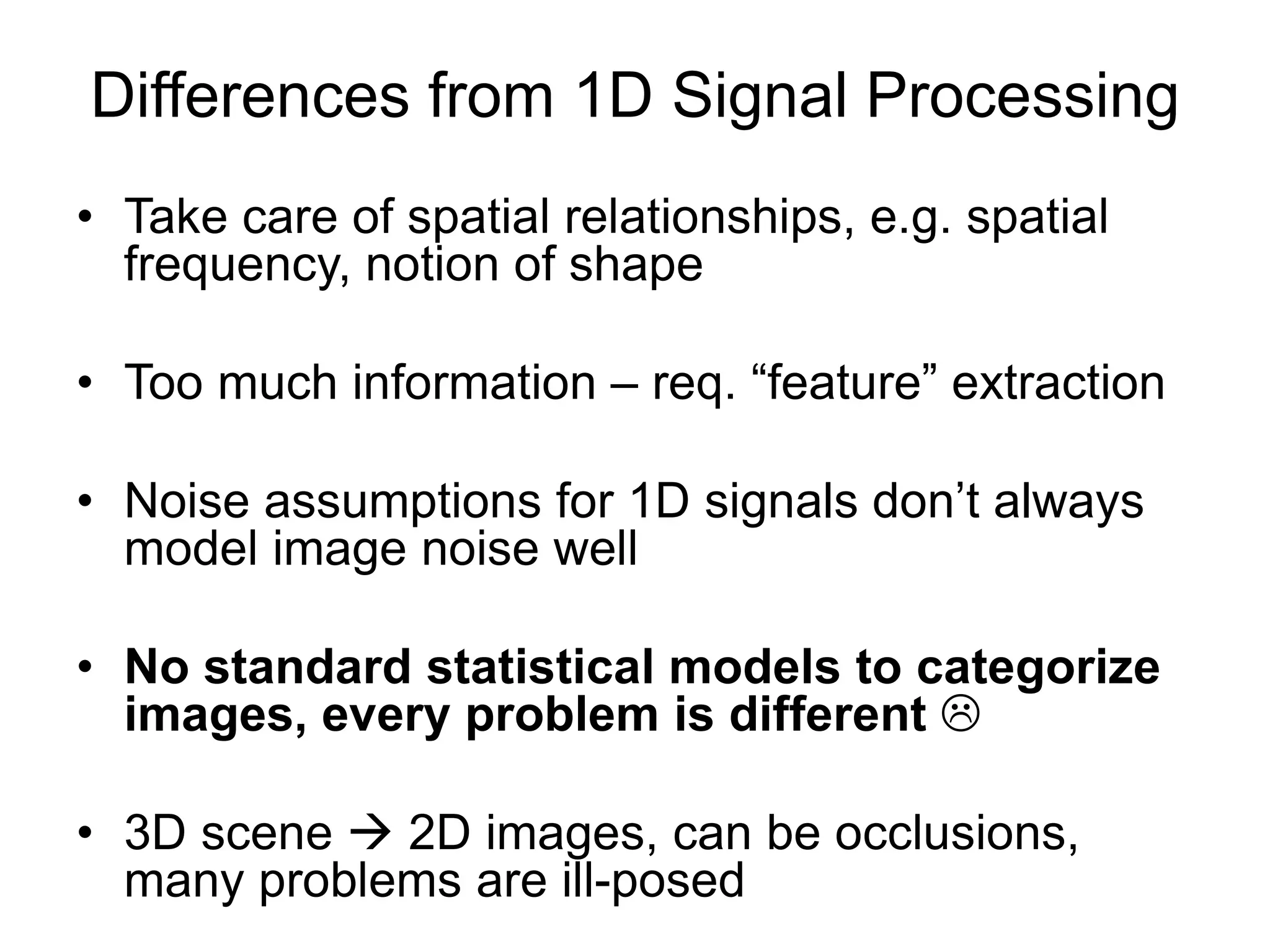
Differences from 1D Signal Processing
• Take care of spatial relationships, e.g. spatial
frequency, notion of shape
• Too much information – req. “feature” extraction
• Noise assumptions for 1D signals don’t always
model image noise well
• No standard statistical models to categorize
images, every problem is different 
• 3D scene  2D images, can be occlusions,
many problems are ill-posed

intro.ppt

  • 1.
    Introduction EE 520: ImageAnalysis & Computer Vision
  • 2.
    General Stuff • Classtime - MW 10-2, Tu-Th 10-2? • Office hours – by appointment for this week • Web: http://www.ece.iastate.edu/~namrata/EE520/ • Evaluation – 40% midterm, 30% each for 2 projects – Project: report + 30 min presentation + code – Homework – not graded – simple MATLAB experiments of what is taught in class • Your research areas?
  • 3.
    Image Analysis/ CompVision? Image Image Image 3D Scene One image - Segment, Recognition, Edge detect & get contour Two images – Registration, Optical flow, Get 3D structure (stereo) Time sequence - Structure from Motion, Tracking, Change Detection
  • 4.
    2D Image Analysis:Feature extraction • Intensity • Edges – threshold image derivative • Texture – repeated basic “primitives” & spatial relation, view at different scales • Motion – Threshold frame difference • Motion – Optical flow (where did pixel (i,j) move) • Shape, Local histogram, PCA, image transforms
  • 5.
    Coarse texture: large sizeprimitive, small variance Fine texture: small size primitive, large variance
  • 6.
  • 7.
    2D Image Analysis •Segmentation – Estimate outer contour (boundary) of the object from the image • Registration – Estimate a global transformation (Affine, Similarity, Euclidean) relating 2 images – taken from different views, different modalities or different times
  • 8.
    2D Image Analysis •Shape – geometric information after removing scale, translation, rotation • Recognition / Classification / Detection – e.g. Faces, Objects, Vehicles, Activity (video) – Use intensity, shape, texture, motion,… • Tracking – Estimate from a time seq. of images – Global motion or – Global motion & Local deformation (shape change) – Change detection – change in the system model
  • 9.
    Recognition • Faces: AT&Tdatabase • Objects: COIL database •Activity recognition, Abnormality detection
  • 10.
    Representing Shape • Landmarks– points of high curvature or intensity or motion blobs or of “interest” • Continuous curve – parametric finite dim. representation e.g. B-spline, angle repr. • Continuous curve – infinite dim. representation – level set method
  • 11.
    Tracking motion &deformation • Fish : – “Feature”– Image intensity, – Shape repr.: Level set method – Initialiazation: Segmentation • Group of People – “Feature” – Motion detection – Shape repr: Landmark shape – Also do change detection
  • 12.
    • Human actions –“Feature”: local PCA – Shape: Landmark • Leaf (CONDENSATION algorithm): – “Feature”: edges – Shape repr: B-spline • Beating Heart: 3D image sequence
  • 13.
    2D images 3D structure • Infer 3D scene structure from a set of 2D images • “Structure”: X,Y,Z coordinates of object • Inference based on a “Camera model” • Structure from Stereo - 2 or more views of object • Structure from Motion – moving object – Also implicitly tracks the 3D global motion
  • 14.
    3D Images • Geta 3D image at every time, e.g. MRI of different cross-sections of the brain • Medical imagery (MRI, CT, ultrasound), Range images, ?? • Require representations of shape in 3D
  • 15.
    Differences from 1DSignal Processing • Take care of spatial relationships, e.g. spatial frequency, notion of shape • Too much information – req. “feature” extraction • Noise assumptions for 1D signals don’t always model image noise well • No standard statistical models to categorize images, every problem is different  • 3D scene  2D images, can be occlusions, many problems are ill-posed