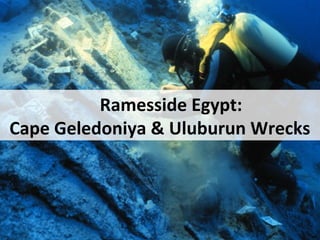
Ramesside Egypt:
Cape Geledoniya & Uluburun Wrecks
Models of Trade
Independent Merchants
•Wealthy merchant class drove trade between civilisations
•E.g. Sinaru (Ras Sharma tablets 16.238+254 “From the present
Ammistamru, son of Niqmepa, King of Ugarit, exempts Sinaranu, son
of Siginu… his grain, his beer, his olive oil to the palace he shall not
deliver. His ship is exempt when it arrives in Crete.”)
Royal gift Exchange
•Exchange of precious commodities in the form of gifts between kings
•Armarna Letters (EA 24 “And now my brother is going to see the
things that I have dispatched to my brother. Thus I will dispatch to my
brother gifts”)
‘Kula Ring’
•Royal trade as a way of subsidising private commerce
X Cape Gelidonya
(ca. 1200 BCE)
Dating Cape Gelidonya:
Radiocarbon dating on organics and
relative dating on pottery=ca. 1200 BCE
basketry
Again, Aegean pottery (Mycenaean
stirrup jars) useful for dating the shipwreck
All that remains of the ship (!): a single tenon (with a peg hole)
Dimensions of the wreck site: 10 meters (length)
3-4 meters (breadth)
**the ship was probably smaller than Uluburun = 15:5 m
X Cape Gelidonya
(ca. 1200 BCE)
Less than 1 ton of metal, including baskets of scrap metal
and small quantities of tin—and very few ceramic
storage/transport containers, and no high prestige ‘luxury’ objects
Baskets of scrap metal and tools for metal working, including a swage
(a kind of mould) stone hammers and anvils (this kind of thing is not
observed on Uluburun)
X Cape
Gelidonya
(ca. 1200 BCE)
Weights and seals, all broadly of Syro-Palestinian origin and found
near to one another
• The interpretive significance of the Cape Gelidonya shipwreck (when it was
published in 1967)
• Distribution of exported Aegean ceramics (1400-1200 BCE)
• Before Cape Gelidonya it was widely believed that the Minoans and Mycenaeans
were the dominant traders in the Late Bronze Age eastern Mediterranean
Minos is the earliest of those known to us by hearsay who made a navy. He exercised a power over the greater part of
what is now known as the Hellenic Sea. He ruled over the Cyclades Islands and was the first to colonise many of
them, driving out the Karians [The earliest ruler known to have possessed a fleet was Minos. He made himself
master of the people from the southern coast of modern turkey] and setting up his own sons as leaders. He just as
reasonably tried to clear away piracy from the sea, as much as he was able, so that the revenues should come to him
more easily.
- Thucydides, The Peloponnesian War 1.14
• Cape Gelidonya revealed for the first time the shipment of a bulk cargo,
including metal which is very elusive in the ‘terrestrial’ archaeological record,
and vital to Bronze Age societies and economies
X
Uluburu
n
shipwrec
k19 Aegean Stirrup Jars
149 Canaanite jars
9 Cypriot pithoi
Trajectory of the Uluburun ship
The Objects
Pair of copper
oxhide ingots
Unique two handled
copper ingot
Copper bun
ingot
Nefertiti’s gold scarab
“And now my brother is going to see the things that I have dispatched to my brother. Thus I
will
dispatch to my brother *gifts+.”
(Amarna Letters 24 III 61-3.)
Desirable objects and materials recovered from the Uluburun shipwreck
(similar objects and materials listed in gift giving inventories): this is a directional
The Pottery
Hundreds of Cypriot bowls and lamps packed in these large Cypriot
pithoi (a ‘tramping’ cargo)
Syro-Palestinian and Cypriot objects that may have seen use,
or were intended to be used on board
X
Uluburun
shipwreck
Large sandstone anchor
The Anchors
Small limestone anchor
Raising the anchors
The Objects
Mycenaean sword (left)
Canaanite dagger (mid)
Canaanite sword (right)
Agate and faience
beads
Mycenaean steatite
lentoid seal (above)
and Egyptian steatite
plaque.
Cobalt glass ingots
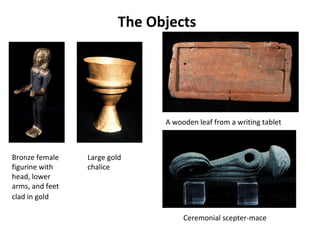
The Objects
A wooden leaf from a writing tablet
Bronze female
figurine with
head, lower
arms, and feet
clad in gold
Ceremonial scepter-mace
Large gold
chalice
Objects that had definitely seen use on the
journey
Cypriot manufactured wall bracket and
lamp
showing evidence for burning
fastened to the mast?
Trumpet and finger cymbal (Syro-
Knucklebones
(astragali)
Some time for
leisure
Drinking straw (as seen in Egyptian representations, a drinking
Syrian)
Seals (x2)
Objects of Aegean manufacture that may have seen shipboard
use,
or had been intended for shipboard use
Drinking service
Razors (x3)
Spear
points
(x22)
Swords (x2)
Knives (x3)
• Suggestion that the last port of call was perhaps Ugarit and
before that, a port on Cyprus.
• E. Cline: the cargo of the ship is an important manifestation
of trade between the LH/LM IIIA2 Aegean and the greater
Levant.
• Bachhuber: “elements of the Uluburun cargo appear to be
manifestations of elite exchange, the ship seems to be
sailing towards the Aegean. “
The Origins of the Ship
The Origins of the Crew
• Bachhuber: the nature of the Uluburun cargo can lay
a foundation from which we can begin to speculate
about the origins of its personnel.
• How do you determine the relationship between
material culture & ethnicity?
• Language
• Religion
• Identification with a specific territory
• A shared myth of origin
Conclusion
• Bass: the wreck appears to be an indication of a
sea-route for the east to west transport of copper
in the eastern Mediterranean throughout the
Late Bronze Age
• Bachhuber: there is enough evidence to suggest
the ship was on route to the Aegean, from the
Near East
• INA: The presence of at least two Mycenaeans on
board is indicated while the ship & its crew are
thought to be of Canaanite or Cypriot origin
1. Where was the ship built?
2. What was the home port of the ship?
3. Where was the ship going?
4. Who was on board the ship?
(What were their occupations and what countries were they from?)
5. Where did the trade items on the ship come from?
6. What type of trade was taking place?
(Was this a royal cargo or individual merchants trading?)
7. What can this ship and the commodities on it tell us about Mediterranean trade?
8. Was this an established trade route?
9. When did the ship sink?
10. What do the items on this ship tell us about the cultures around the Mediterranean?
References
• BACHHUBER ,C. (2006) Aegean interest on the Uluburun ship.
American Journal of Archaeology, Vol.110 No.3 pp.345-363.
• BASS, G. (1986) A Bronze Age shipwreck at Ulu Burun (Kas):
1984 campaign. American Journal of Archaeology, Vol. 90 No.3,
pp.269-296.
• HALDANE, C. (1993) Direct evidence for organic cargoes in the
Late Bronze Age. World Archaeology, Vol. 24, No. 3, pp.348-
360.
• INSTITUTE OF NAUTICAL ARCHAEOLOGY, (2006) Bronze Age
Shipwreck Excavation at Uluburun [Online] Available:
http://ina.tamu.edu/ Accessed: 28 October 2006.

Ramesside Shipwrecks

  • 1.
  • 2.
    Models of Trade IndependentMerchants •Wealthy merchant class drove trade between civilisations •E.g. Sinaru (Ras Sharma tablets 16.238+254 “From the present Ammistamru, son of Niqmepa, King of Ugarit, exempts Sinaranu, son of Siginu… his grain, his beer, his olive oil to the palace he shall not deliver. His ship is exempt when it arrives in Crete.”) Royal gift Exchange •Exchange of precious commodities in the form of gifts between kings •Armarna Letters (EA 24 “And now my brother is going to see the things that I have dispatched to my brother. Thus I will dispatch to my brother gifts”) ‘Kula Ring’ •Royal trade as a way of subsidising private commerce
  • 4.
    X Cape Gelidonya (ca.1200 BCE) Dating Cape Gelidonya: Radiocarbon dating on organics and relative dating on pottery=ca. 1200 BCE basketry Again, Aegean pottery (Mycenaean stirrup jars) useful for dating the shipwreck
  • 5.
    All that remainsof the ship (!): a single tenon (with a peg hole) Dimensions of the wreck site: 10 meters (length) 3-4 meters (breadth) **the ship was probably smaller than Uluburun = 15:5 m
  • 6.
    X Cape Gelidonya (ca.1200 BCE) Less than 1 ton of metal, including baskets of scrap metal and small quantities of tin—and very few ceramic storage/transport containers, and no high prestige ‘luxury’ objects
  • 7.
    Baskets of scrapmetal and tools for metal working, including a swage (a kind of mould) stone hammers and anvils (this kind of thing is not observed on Uluburun)
  • 8.
    X Cape Gelidonya (ca. 1200BCE) Weights and seals, all broadly of Syro-Palestinian origin and found near to one another
  • 9.
    • The interpretivesignificance of the Cape Gelidonya shipwreck (when it was published in 1967) • Distribution of exported Aegean ceramics (1400-1200 BCE) • Before Cape Gelidonya it was widely believed that the Minoans and Mycenaeans were the dominant traders in the Late Bronze Age eastern Mediterranean Minos is the earliest of those known to us by hearsay who made a navy. He exercised a power over the greater part of what is now known as the Hellenic Sea. He ruled over the Cyclades Islands and was the first to colonise many of them, driving out the Karians [The earliest ruler known to have possessed a fleet was Minos. He made himself master of the people from the southern coast of modern turkey] and setting up his own sons as leaders. He just as reasonably tried to clear away piracy from the sea, as much as he was able, so that the revenues should come to him more easily. - Thucydides, The Peloponnesian War 1.14 • Cape Gelidonya revealed for the first time the shipment of a bulk cargo, including metal which is very elusive in the ‘terrestrial’ archaeological record, and vital to Bronze Age societies and economies
  • 10.
    X Uluburu n shipwrec k19 Aegean StirrupJars 149 Canaanite jars 9 Cypriot pithoi Trajectory of the Uluburun ship
  • 14.
    The Objects Pair ofcopper oxhide ingots Unique two handled copper ingot Copper bun ingot Nefertiti’s gold scarab
  • 16.
    “And now mybrother is going to see the things that I have dispatched to my brother. Thus I will dispatch to my brother *gifts+.” (Amarna Letters 24 III 61-3.) Desirable objects and materials recovered from the Uluburun shipwreck (similar objects and materials listed in gift giving inventories): this is a directional
  • 17.
  • 18.
    Hundreds of Cypriotbowls and lamps packed in these large Cypriot pithoi (a ‘tramping’ cargo)
  • 19.
    Syro-Palestinian and Cypriotobjects that may have seen use, or were intended to be used on board X Uluburun shipwreck
  • 20.
    Large sandstone anchor TheAnchors Small limestone anchor Raising the anchors
  • 21.
    The Objects Mycenaean sword(left) Canaanite dagger (mid) Canaanite sword (right) Agate and faience beads Mycenaean steatite lentoid seal (above) and Egyptian steatite plaque. Cobalt glass ingots
  • 22.
    The Objects A woodenleaf from a writing tablet Bronze female figurine with head, lower arms, and feet clad in gold Ceremonial scepter-mace Large gold chalice
  • 23.
    Objects that haddefinitely seen use on the journey Cypriot manufactured wall bracket and lamp showing evidence for burning fastened to the mast?
  • 24.
    Trumpet and fingercymbal (Syro- Knucklebones (astragali) Some time for leisure Drinking straw (as seen in Egyptian representations, a drinking Syrian)
  • 25.
    Seals (x2) Objects ofAegean manufacture that may have seen shipboard use, or had been intended for shipboard use Drinking service Razors (x3) Spear points (x22) Swords (x2) Knives (x3)
  • 26.
    • Suggestion thatthe last port of call was perhaps Ugarit and before that, a port on Cyprus. • E. Cline: the cargo of the ship is an important manifestation of trade between the LH/LM IIIA2 Aegean and the greater Levant. • Bachhuber: “elements of the Uluburun cargo appear to be manifestations of elite exchange, the ship seems to be sailing towards the Aegean. “ The Origins of the Ship
  • 27.
    The Origins ofthe Crew • Bachhuber: the nature of the Uluburun cargo can lay a foundation from which we can begin to speculate about the origins of its personnel. • How do you determine the relationship between material culture & ethnicity? • Language • Religion • Identification with a specific territory • A shared myth of origin
  • 28.
    Conclusion • Bass: thewreck appears to be an indication of a sea-route for the east to west transport of copper in the eastern Mediterranean throughout the Late Bronze Age • Bachhuber: there is enough evidence to suggest the ship was on route to the Aegean, from the Near East • INA: The presence of at least two Mycenaeans on board is indicated while the ship & its crew are thought to be of Canaanite or Cypriot origin
  • 30.
    1. Where wasthe ship built? 2. What was the home port of the ship? 3. Where was the ship going? 4. Who was on board the ship? (What were their occupations and what countries were they from?) 5. Where did the trade items on the ship come from? 6. What type of trade was taking place? (Was this a royal cargo or individual merchants trading?) 7. What can this ship and the commodities on it tell us about Mediterranean trade? 8. Was this an established trade route? 9. When did the ship sink? 10. What do the items on this ship tell us about the cultures around the Mediterranean?
  • 31.
    References • BACHHUBER ,C.(2006) Aegean interest on the Uluburun ship. American Journal of Archaeology, Vol.110 No.3 pp.345-363. • BASS, G. (1986) A Bronze Age shipwreck at Ulu Burun (Kas): 1984 campaign. American Journal of Archaeology, Vol. 90 No.3, pp.269-296. • HALDANE, C. (1993) Direct evidence for organic cargoes in the Late Bronze Age. World Archaeology, Vol. 24, No. 3, pp.348- 360. • INSTITUTE OF NAUTICAL ARCHAEOLOGY, (2006) Bronze Age Shipwreck Excavation at Uluburun [Online] Available: http://ina.tamu.edu/ Accessed: 28 October 2006.