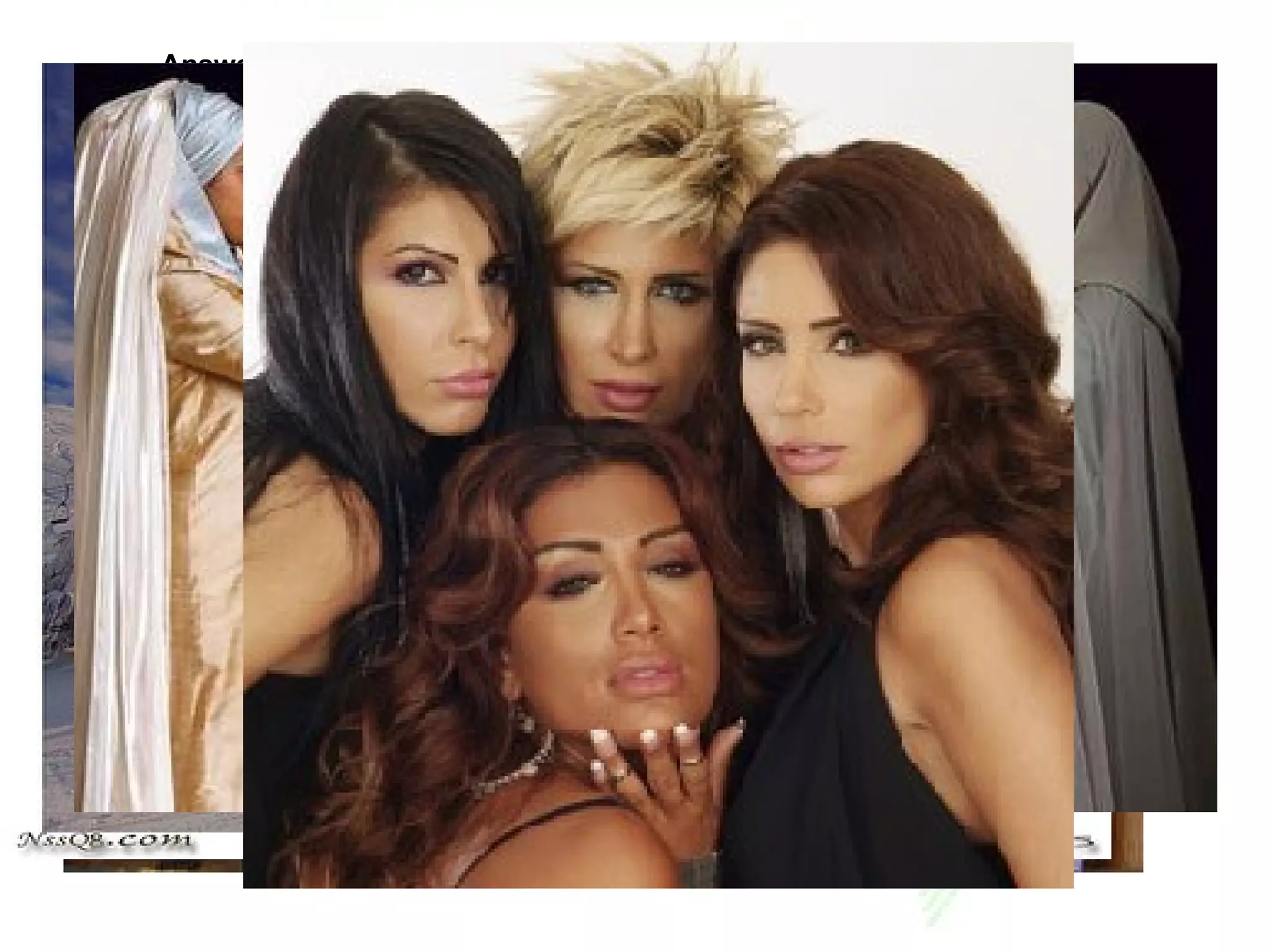
Answer True or False: 1. The Arab countries are mostly very hot deserts.  2. There are multiple faiths in most Arab countries. 3. In some Arab countries, there are Churches, Synagogues and  Mosques. 4. All Muslims are Arabs 5. Muslims believe in the Bible just as much as they do in the Koran. 6. All Arab women cover at least their heads. 7. Other than the oil, the Arab land is very poor in natural ores and produce. 8. Some Arab countries are considered the “bread baskets” of many neighboring countries. 9. Most Muslim Arabs do not drink alcohol. 10. Most Muslim Arabs do not eat pork. 11. Most Christian Arabs do not drink alcohol and do not eat pork. False True True True True True True True False False False
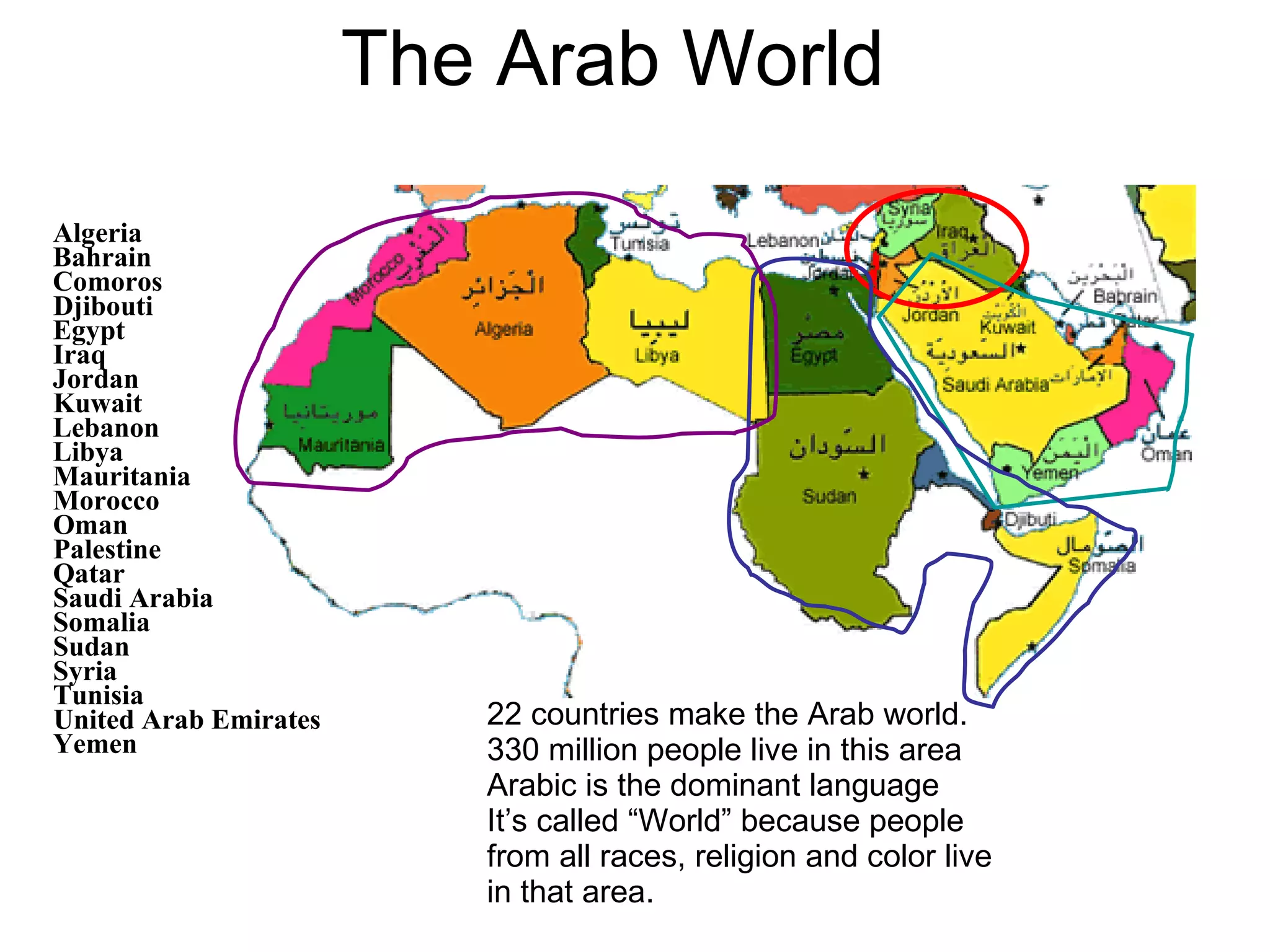
The Arab World 22 countries make the Arab world. 330 million people live in this area  Arabic is the dominant language  It’s called “World” because people from all races, religion and color live in that area. Algeria  Bahrain  Comoros  Djibouti  Egypt  Iraq  Jordan  Kuwait  Lebanon  Libya  Mauritania  Morocco  Oman  Palestine  Qatar  Saudi Arabia  Somalia  Sudan  Syria  Tunisia  United Arab Emirates  Yemen
The Arab World Religion and Ancestry:   All three  monotheistic religions  (Judaism, Christianity and Islam) originated in what is known today as the Arab-World. Arabs trace their ancestry to Sam the son of Noah and they’re therefore Semites. Arabs represent 98% of the current Semites. Arabs are immediate descendant from Ishmael the son of Abraham who lived all his life in Becca (Today’s Mecca). The Ka’ba was built by Ishmael and Abraham about 2000 BCE. Islam originated in Mecca in 610 CE. Most pre-Islam Arab tribes were polytheists but several of them adhered to the Jewish or Christian faiths. Today most Arabs are Muslims but a significant minority about 10% are of Christian or Jewish faith.
History of the Arab World Pre-Islam Arab Kingdoms: There were many Arab Kingdoms before Islam, among them: The Babylonian, the Canaanites and the Phoenicians  It’s also referred to as the “cradle of civilization”
Islamic Arab dynasties :   Rashidun  Empire  (632 - 661)  Umayyad Empire  (661 - 750) - Successor of the Rashidun Caliphate  Umayyad Emirate in  Islamic Spain  (750 - 929)  Umayyad  Caliphate of Córdoba  in Islamic Spain (929 - 1031)  Abbasid Empire  (750 - 1258) - Successors of the Umayyad Caliphate  Fatimid Empire  (910 - 1171)  Ayyubid  dynasty  (1171-1246), Saladdin Bahri  dynasty  (1250-1382) Burji  dynasty  (1382–1517) Ottoman Empire (1517-1914)  Non-Arab Muslims ruled The Arab World  (Collapses after WWI and the Arab World divided into 22 countries) History of the Arab World
The Arab World Culture:   The Alphabet: The Arabic alphabet is about 3000 years old. It has 28 letters. It’s written from right to left.
The Arabic Alphabet Today Iran, Afghanistan, Pakistan, India, and China are the main non-Arab states  using the Arabic alphabet to write one or more official national languages, including Persian, Dari, Pashto, Urdu, Kashmiri, Sindhi, and Uyghur   ->   Countries where the Arabic script is used alongside other  orthographies .  ->   Countries where the Arabic script is the only official orthography
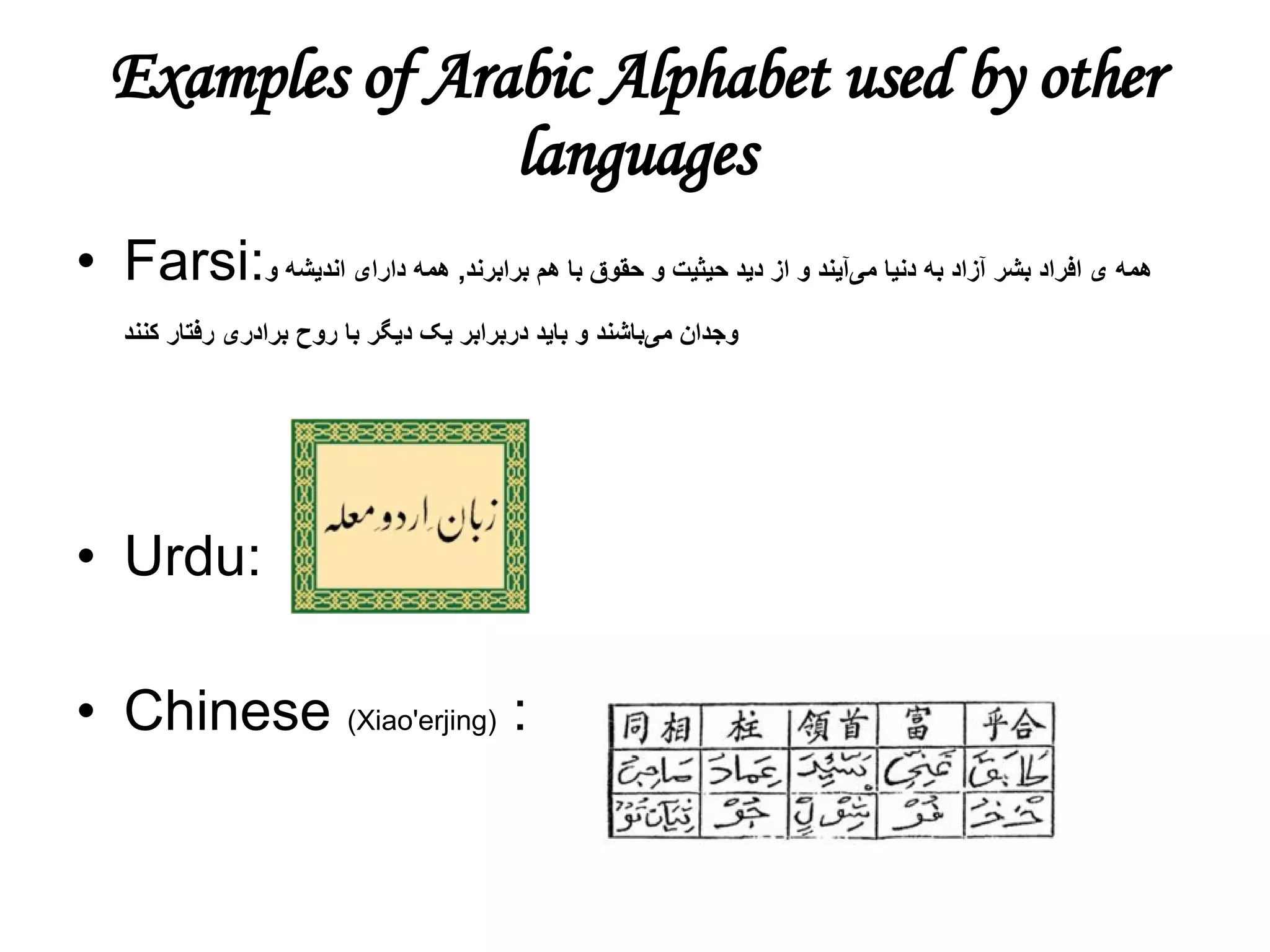
Examples of Arabic Alphabet used by other languages Farsi: همه ی افراد بشر آزاد به دنیا می‌آیند و از دید حیثیت و حقوق با هم برابرند ,  همه دارای اندیشه و وجدان می‌باشند و باید دربرابر یک دیگر با روح برادری رفتار کنند   Urdu: Chinese  (Xiao'erjing)  :
 
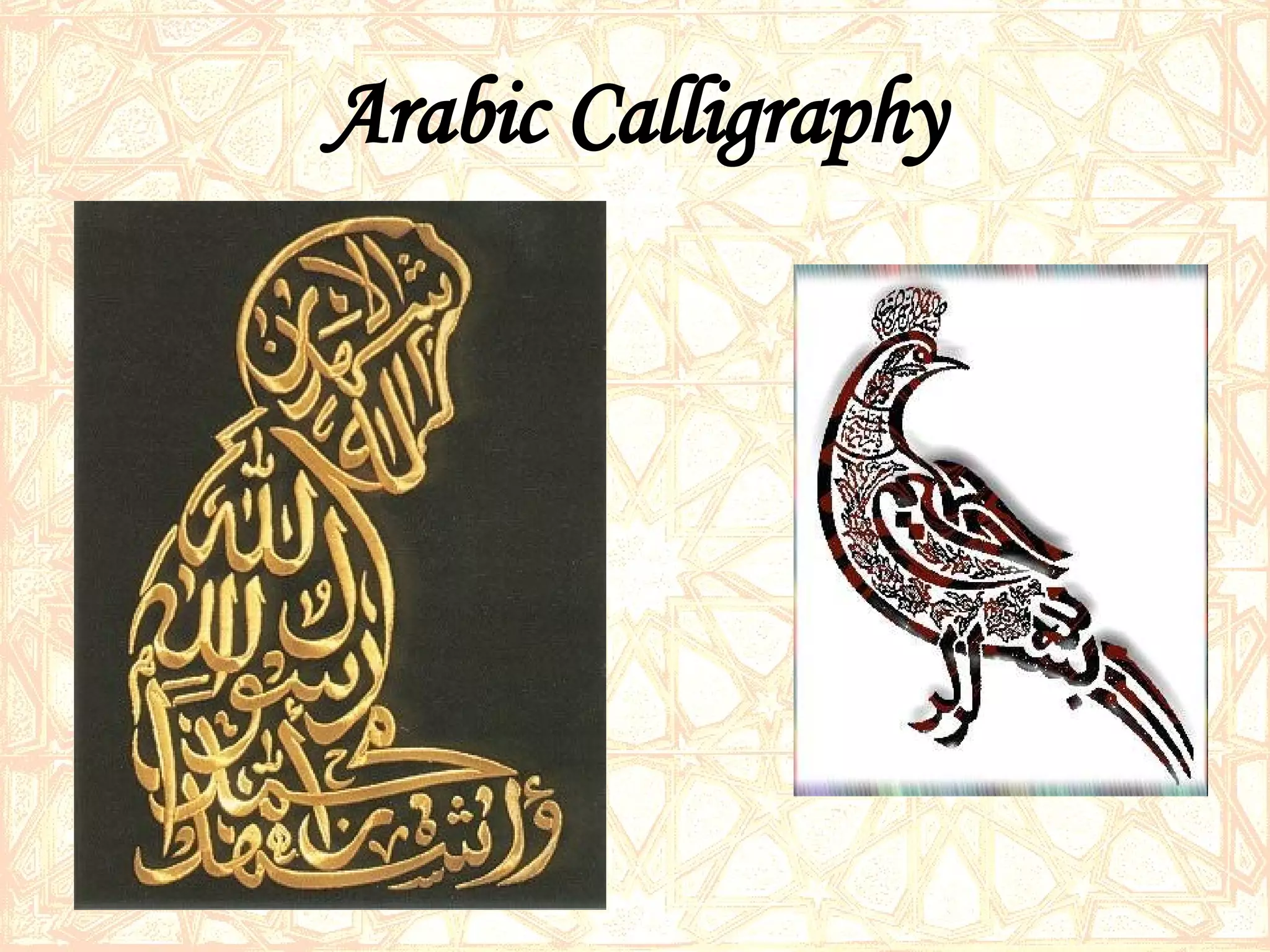
Arabic Calligraphy
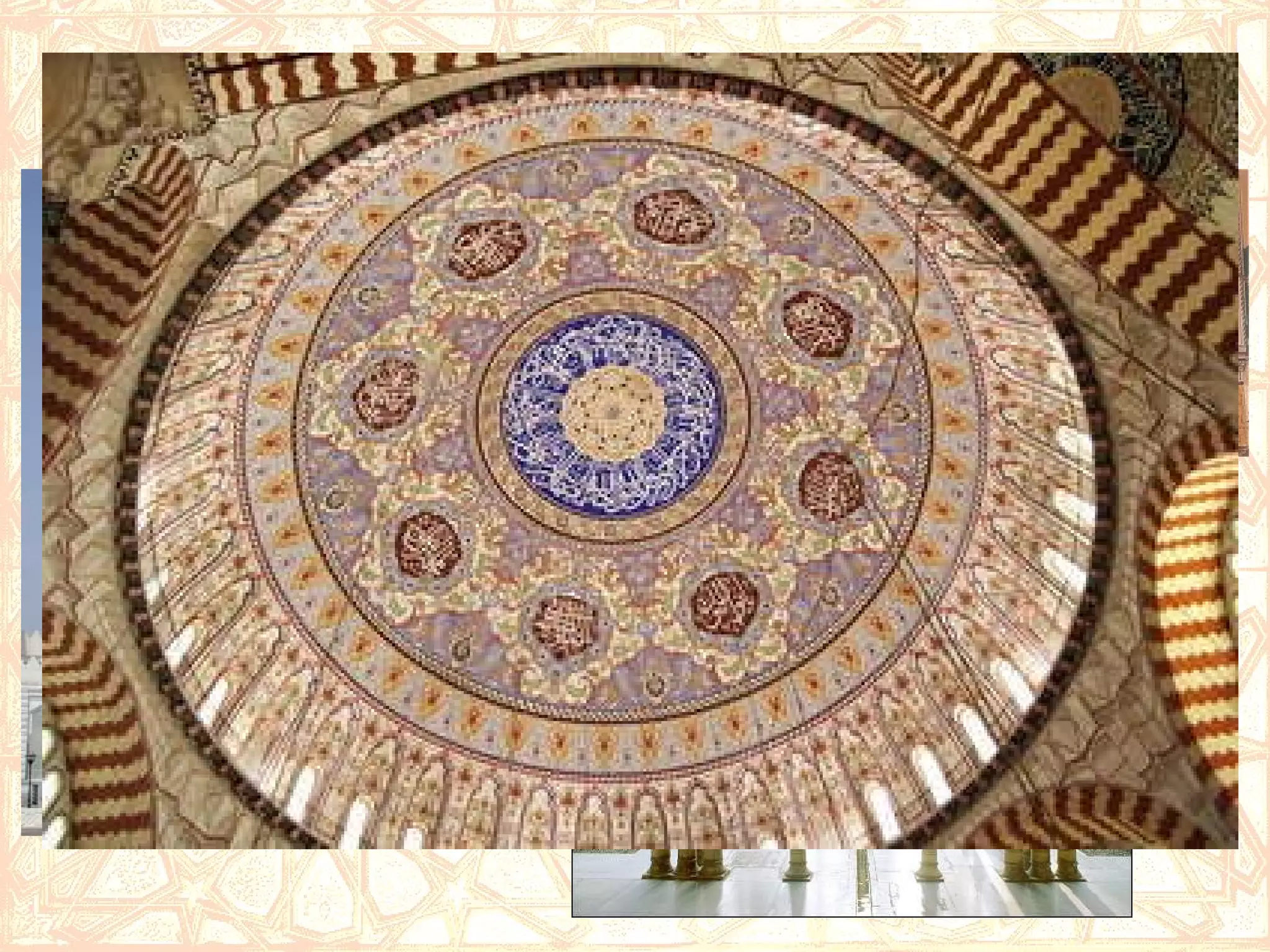
Arabic Architecture and Arts
Arabic Music
Arabic Music
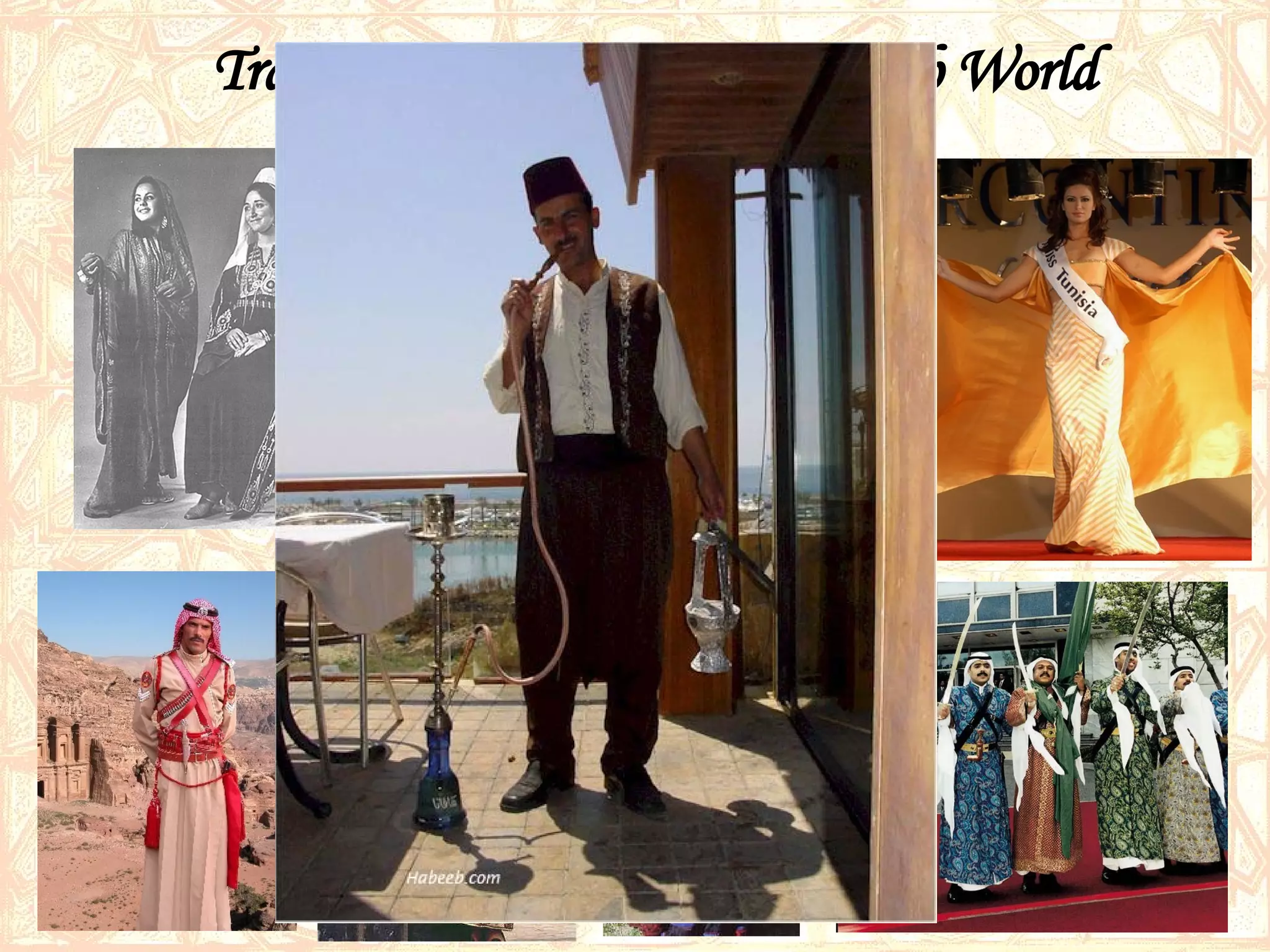
Traditional Costumes of the Arab World
Food The Arabic cuisine is very diverse and rich. Each area in the Arab World has it’s own flavor and specific cuisine.
Cities of the Arab World Amman, Jordan Al-Quds or Jerusalem, Palestine Beirut, Lebanon Dubai, UAE Cairo, Egypt Casablanca, Aldar Albaida, Morocco
Contribution of the Arab/Islamic civilization to Science, Math and Astrology
Medicine and Pharmacy Institutionalized and regulated the practice of Medicine and Pharmacy The modern concept of clinics Board exams and license to practice. Regulatory boards (FDA's!!!) Classification of plants and Algae for their medical use, and outlined possible side effects (PDR’s!!) Hospitals :  Tens, including specialized, in each of Baghdad, Qurtoba, and Damascus.  Mobile hospitals for emergency.  Departments and University Hospitals. Patients records and vital signs, urine tests, family history.  Surgery :  Threads from animals intestine.  Opium and Hashish for Anesthesia.  Alcohol as disinfectant.  Treatment of cataract, and removal of kidney and gallbladder stones Autopsy  !!! Students training (Anatomy) Cause of death
Abu-bakr Elrazzy ; 9th Century  Father of Physicians, great clinician and experimentalist  Many books including “Smallpox and Measles” Ibn-Elhaytham : 10th Century  Multidisciplinary scientist. Ophthalmologist  Mechanism of sight. Function of the eye  Over 100 books in Med. and Math. Ibn-Seena (Avisai) : 10th Century  The “Qannun”, the medical text book in Europe till 19th Cen. Described the medical use of over 2700 plants Light has a finite speed, which is much faster than the speed of sound Ibn-Rushd (Aviros) :  13th Century  Philosopher and Physician. Many books Ibn-Elnafees :  Blood circulation and the role of lungs Abulkassim Alzahrawi (Abulcasis or Albucasis) : 11th Century  One of the greatest surgeons.  A good dentist and GP.  Removal of breast cancer.  Hemophilia and its hereditary transmission (female to male) Known Physicians
Arabic terms and methods of preparation for Alkali, Alcohol, Tartarate  Discovered and prepared 28 elements (Ibn Elhaytham)  The processes of crystallization, fermentation, distillation, sublimation,  Preparation of acids (H 2 SO 4 , HCl, HNO 3 ) and bases (NaOH) Light travels in straight lines. Laws of refraction, reflection and illusion of light.  First attempt to fly by Abbas Ibn Fernas Mechanical clock Astrulab Magnifiers (1 st  Telescopes) Torpedos and Rockets (Used for Military purposes) Eluded to the Magnetic properties of some objects Chemistry and Physics
Arabic numeral and the decimal system of numbers.  Right     Left.  English. But 1000 Arithmetic. Roots and powers Algorithm =  Alkhawarismi The mathematical ZERO Algebra (combining fractions).  The Use of (x, y, z) to solve complex arithmetic/geometric problems Trigonometry (Albairuni and Albuzjani), differential and Integral.    = 3.141596.  Some known Mathematicians: Abu-bakr Alkhawarismi Thabit Ibn Qarra (9th Century).  Calculus.  Ibn-elhaytham Albairuni (10th Century) Albuzjani  Omar Elkhayam (2° & 3° equations) Mathematics
Astrology (myth)    Astronomy (science) Movement, path, and location of planets and stars The Asturlab Earth is spherical and rotates along its axis and around the sun.  Calculated earth circumference (Albairuni) Calculated the time needed for one rotation around the sun (solar year), with an error of 2’ 22” only (Albattani) Calculated the equinoxes  Current names of most constellations, and many stars are from Arabic Map making was enhanced by Arab scientists Arab sailors dominated the seas and were major members of Columbus’s crew that discovered America. Magellan used Arab sailors and maps to navigate around the globe. Vasco de Gama was helped by Arab sailors to travel around the Cape of Good Hope making him the first European to reach India by sea. Some known astronomists: Alkindy (9th Century) Albattani (9th Century) Ibn-elhaytham (11th Century) Thabit Ibn Qarra  Almajreeti Astronomy
Arab Americans Who are they and where do they come from?
Countries of origin of Arab Americans
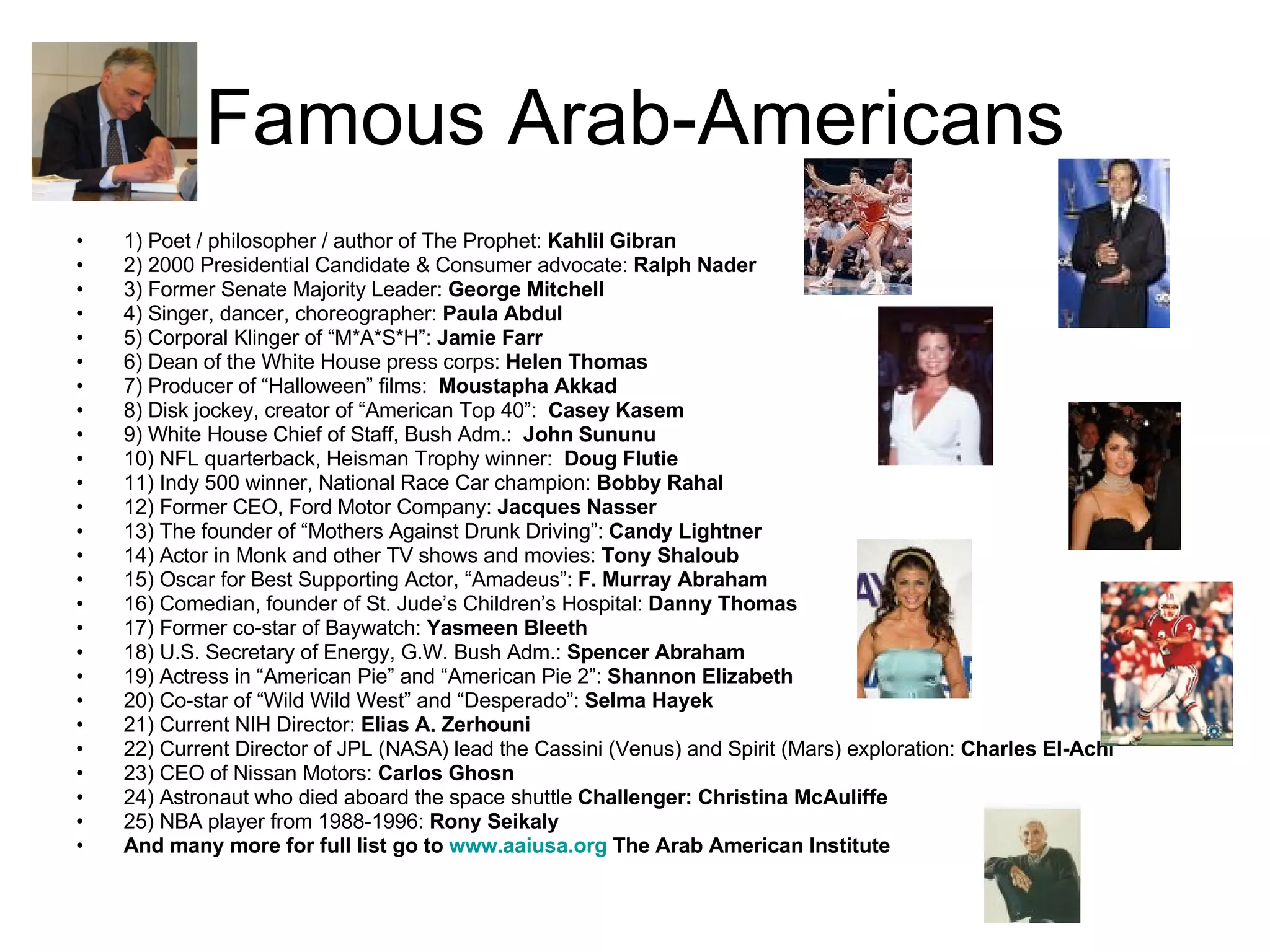
Famous Arab-Americans 1) Poet / philosopher / author of The Prophet:  Kahlil Gibran   2) 2000 Presidential Candidate & Consumer advocate:  Ralph Nader 3) Former Senate Majority Leader:  George Mitchell 4) Singer, dancer, choreographer:  Paula Abdul 5) Corporal Klinger of “M*A*S*H”:  Jamie Farr 6) Dean of the White House press corps:  Helen Thomas   7) Producer of “Halloween” films:  Moustapha Akkad 8) Disk jockey, creator of “American Top 40”:  Casey Kasem 9) White House Chief of Staff, Bush Adm.:  John Sununu 10) NFL quarterback, Heisman Trophy winner:  Doug Flutie 11) Indy 500 winner, National Race Car champion:  Bobby Rahal 12) Former CEO, Ford Motor Company:  Jacques Nasser 13) The founder of “Mothers Against Drunk Driving”:  Candy Lightner 14) Actor in Monk and other TV shows and movies:  Tony Shaloub 15) Oscar for Best Supporting Actor, “Amadeus”:  F. Murray Abraham 16) Comedian, founder of St. Jude’s Children’s Hospital:  Danny Thomas 17) Former co-star of Baywatch:  Yasmeen Bleeth   18) U.S. Secretary of Energy, G.W. Bush Adm.:  Spencer Abraham 19) Actress in “American Pie” and “American Pie 2”:  Shannon Elizabeth 20) Co-star of “Wild Wild West” and “Desperado”:  Selma Hayek 21) Current NIH Director:  Elias A. Zerhouni 22) Current Director of JPL (NASA) lead the Cassini (Venus) and Spirit (Mars) exploration:  Charles El-Achi 23) CEO of Nissan Motors:  Carlos Ghosn   24) Astronaut who died aboard the space shuttle  Challenger: Christina McAuliffe 25) NBA player from 1988-1996:  Rony Seikaly And many more for full list go to  www.aaiusa.org  The Arab American Institute
Guess what?? You speak Arabic without knowing!! A Sample of Arabic words used in English: Admiral = amir al (ruler of; originally "amir al-bahr," ruler of the sea) Alchemy = alkimia (from Greek "chemia," a pouring together) Alcohol = al kohool (First distillation of Alcohol by humans) Algebra = al-jabr (the reunion of broken parts, from "jabara," to reunite, bind together) Almanac = almanakh (calendar) Arsenal = dar as-sina'ah (workshop, literally, house of skill or trade) Azure = lazward (sky blue, from Persian "lazhward") Candy = qandi (made of sugar, from Sanskrit "khanda," sugar in pieces; "khand," to break) Coffee = qahwa (coffee) Cotton = qutun (cotton) Elixir = el iksir (the philosopher's stone) Gazelle = gazal (gazelle) Mattress = matrah (mattress, foundation) Rice = Rozz Saffron = za'faran Sherbet = sherbet (from "sharaba," to drink) Sofa = soffah (cushion on a saddle for a camel) Sugar = sakkar (from Persian "shakar" and Sanskrit "carkara," gravel or candied sugar) Soap= Saboon Syrup = sharab (from "shariba," to drink) Tariff = tar'if (explanation, information, a list of things, especially of fees to be paid; from "`arafa," to inform) Zero = sifr (a cipher) And many more…
 
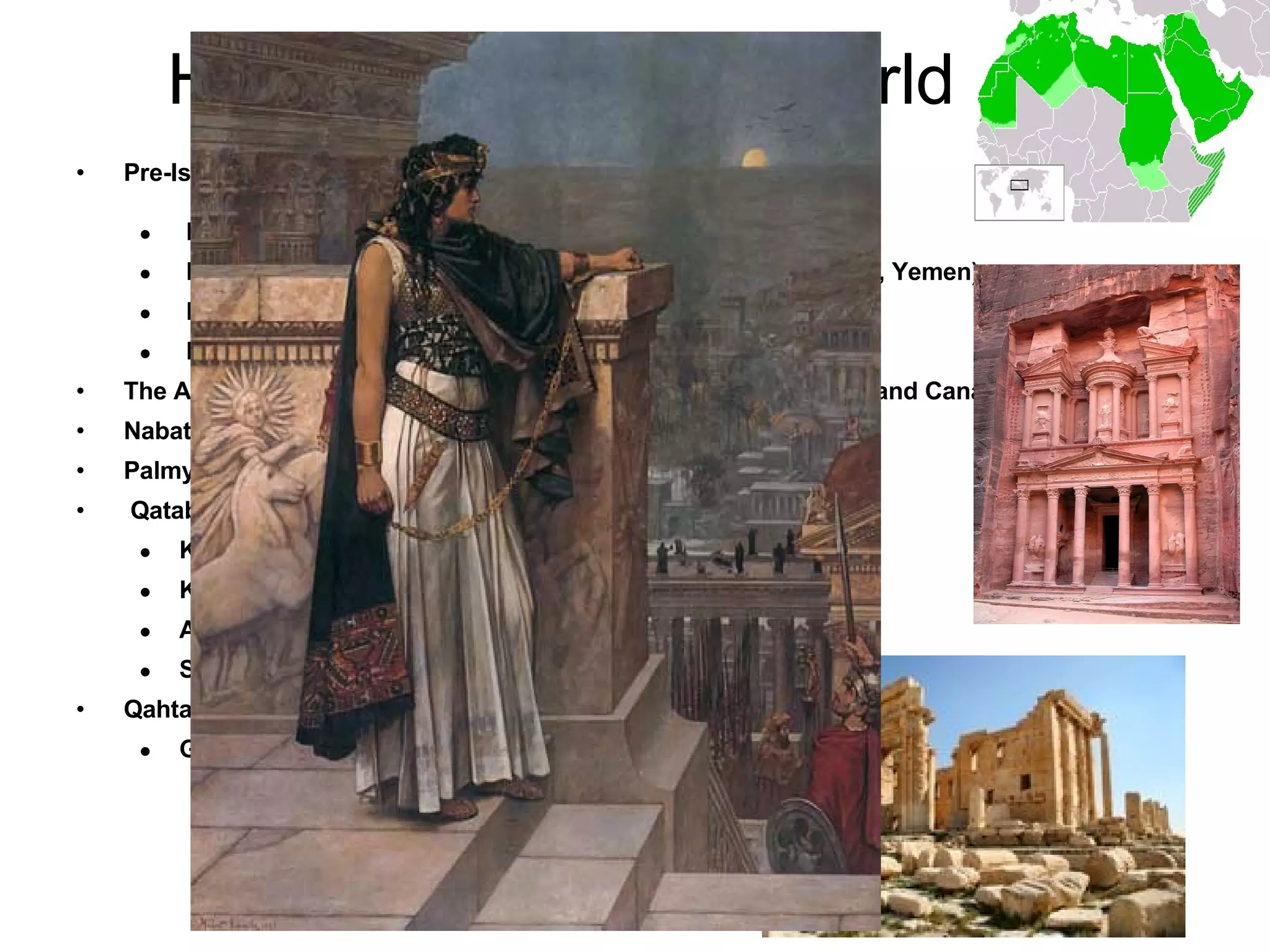
History of the Arab World Pre-Islam Arab Kingdoms: Kingdom of Ma'in (9th century BC - 1st century BC)  Kingdom of Saba (9th century BC - 275AD) (Queen of Sheba, Yemen) Kingdom of Hadhramaut (8th century BC - 3rd century AD)  Kingdom of Awsan (8th century BC - 6th century BC)  The Achaemenids in Northern Arabia: Babylonians, Phoenicians and Canaanites Nabateans (Petra, Jordan) Palmyra (Tadmor, Syria) Qataban & Himyar in South Arabia  Kingdom of Qataban (4th century BC - 3rd century AD)  Kingdom of Himyar (2nd Century BC - 525 AD)  Aksumite occupation of Yemen (525AD - 570AD)  Sassanid period (570AD - 630AD)  Qahtani expansion to the North (Crescent Fertile) Ghassanids, Lakhmids and Kindites
Arabic Calligraphy

Introduction to the Arab world

  • 1.
    Answer True orFalse: 1. The Arab countries are mostly very hot deserts. 2. There are multiple faiths in most Arab countries. 3. In some Arab countries, there are Churches, Synagogues and Mosques. 4. All Muslims are Arabs 5. Muslims believe in the Bible just as much as they do in the Koran. 6. All Arab women cover at least their heads. 7. Other than the oil, the Arab land is very poor in natural ores and produce. 8. Some Arab countries are considered the “bread baskets” of many neighboring countries. 9. Most Muslim Arabs do not drink alcohol. 10. Most Muslim Arabs do not eat pork. 11. Most Christian Arabs do not drink alcohol and do not eat pork. False True True True True True True True False False False
  • 2.
    The Arab World22 countries make the Arab world. 330 million people live in this area Arabic is the dominant language It’s called “World” because people from all races, religion and color live in that area. Algeria Bahrain Comoros Djibouti Egypt Iraq Jordan Kuwait Lebanon Libya Mauritania Morocco Oman Palestine Qatar Saudi Arabia Somalia Sudan Syria Tunisia United Arab Emirates Yemen
  • 3.
    The Arab WorldReligion and Ancestry: All three monotheistic religions (Judaism, Christianity and Islam) originated in what is known today as the Arab-World. Arabs trace their ancestry to Sam the son of Noah and they’re therefore Semites. Arabs represent 98% of the current Semites. Arabs are immediate descendant from Ishmael the son of Abraham who lived all his life in Becca (Today’s Mecca). The Ka’ba was built by Ishmael and Abraham about 2000 BCE. Islam originated in Mecca in 610 CE. Most pre-Islam Arab tribes were polytheists but several of them adhered to the Jewish or Christian faiths. Today most Arabs are Muslims but a significant minority about 10% are of Christian or Jewish faith.
  • 4.
    History of theArab World Pre-Islam Arab Kingdoms: There were many Arab Kingdoms before Islam, among them: The Babylonian, the Canaanites and the Phoenicians It’s also referred to as the “cradle of civilization”
  • 5.
    Islamic Arab dynasties: Rashidun Empire (632 - 661) Umayyad Empire (661 - 750) - Successor of the Rashidun Caliphate Umayyad Emirate in Islamic Spain (750 - 929) Umayyad Caliphate of Córdoba in Islamic Spain (929 - 1031) Abbasid Empire (750 - 1258) - Successors of the Umayyad Caliphate Fatimid Empire (910 - 1171) Ayyubid dynasty (1171-1246), Saladdin Bahri dynasty (1250-1382) Burji dynasty (1382–1517) Ottoman Empire (1517-1914) Non-Arab Muslims ruled The Arab World (Collapses after WWI and the Arab World divided into 22 countries) History of the Arab World
  • 6.
    The Arab WorldCulture: The Alphabet: The Arabic alphabet is about 3000 years old. It has 28 letters. It’s written from right to left.
  • 7.
    The Arabic AlphabetToday Iran, Afghanistan, Pakistan, India, and China are the main non-Arab states using the Arabic alphabet to write one or more official national languages, including Persian, Dari, Pashto, Urdu, Kashmiri, Sindhi, and Uyghur  ->  Countries where the Arabic script is used alongside other orthographies .  ->  Countries where the Arabic script is the only official orthography
  • 8.
    Examples of ArabicAlphabet used by other languages Farsi: همه ی افراد بشر آزاد به دنیا می‌آیند و از دید حیثیت و حقوق با هم برابرند , همه دارای اندیشه و وجدان می‌باشند و باید دربرابر یک دیگر با روح برادری رفتار کنند Urdu: Chinese (Xiao'erjing) :
  • 9.
  • 10.
  • 11.
  • 12.
  • 13.
  • 14.
  • 15.
  • 16.
    Food The Arabiccuisine is very diverse and rich. Each area in the Arab World has it’s own flavor and specific cuisine.
  • 17.
    Cities of theArab World Amman, Jordan Al-Quds or Jerusalem, Palestine Beirut, Lebanon Dubai, UAE Cairo, Egypt Casablanca, Aldar Albaida, Morocco
  • 18.
    Contribution of theArab/Islamic civilization to Science, Math and Astrology
  • 19.
    Medicine and PharmacyInstitutionalized and regulated the practice of Medicine and Pharmacy The modern concept of clinics Board exams and license to practice. Regulatory boards (FDA's!!!) Classification of plants and Algae for their medical use, and outlined possible side effects (PDR’s!!) Hospitals : Tens, including specialized, in each of Baghdad, Qurtoba, and Damascus. Mobile hospitals for emergency. Departments and University Hospitals. Patients records and vital signs, urine tests, family history. Surgery : Threads from animals intestine. Opium and Hashish for Anesthesia. Alcohol as disinfectant. Treatment of cataract, and removal of kidney and gallbladder stones Autopsy !!! Students training (Anatomy) Cause of death
  • 20.
    Abu-bakr Elrazzy ;9th Century Father of Physicians, great clinician and experimentalist Many books including “Smallpox and Measles” Ibn-Elhaytham : 10th Century Multidisciplinary scientist. Ophthalmologist Mechanism of sight. Function of the eye Over 100 books in Med. and Math. Ibn-Seena (Avisai) : 10th Century The “Qannun”, the medical text book in Europe till 19th Cen. Described the medical use of over 2700 plants Light has a finite speed, which is much faster than the speed of sound Ibn-Rushd (Aviros) : 13th Century Philosopher and Physician. Many books Ibn-Elnafees : Blood circulation and the role of lungs Abulkassim Alzahrawi (Abulcasis or Albucasis) : 11th Century One of the greatest surgeons. A good dentist and GP. Removal of breast cancer. Hemophilia and its hereditary transmission (female to male) Known Physicians
  • 21.
    Arabic terms andmethods of preparation for Alkali, Alcohol, Tartarate Discovered and prepared 28 elements (Ibn Elhaytham) The processes of crystallization, fermentation, distillation, sublimation, Preparation of acids (H 2 SO 4 , HCl, HNO 3 ) and bases (NaOH) Light travels in straight lines. Laws of refraction, reflection and illusion of light. First attempt to fly by Abbas Ibn Fernas Mechanical clock Astrulab Magnifiers (1 st Telescopes) Torpedos and Rockets (Used for Military purposes) Eluded to the Magnetic properties of some objects Chemistry and Physics
  • 22.
    Arabic numeral andthe decimal system of numbers. Right  Left. English. But 1000 Arithmetic. Roots and powers Algorithm = Alkhawarismi The mathematical ZERO Algebra (combining fractions). The Use of (x, y, z) to solve complex arithmetic/geometric problems Trigonometry (Albairuni and Albuzjani), differential and Integral.   = 3.141596. Some known Mathematicians: Abu-bakr Alkhawarismi Thabit Ibn Qarra (9th Century). Calculus. Ibn-elhaytham Albairuni (10th Century) Albuzjani Omar Elkhayam (2° & 3° equations) Mathematics
  • 23.
    Astrology (myth)  Astronomy (science) Movement, path, and location of planets and stars The Asturlab Earth is spherical and rotates along its axis and around the sun. Calculated earth circumference (Albairuni) Calculated the time needed for one rotation around the sun (solar year), with an error of 2’ 22” only (Albattani) Calculated the equinoxes Current names of most constellations, and many stars are from Arabic Map making was enhanced by Arab scientists Arab sailors dominated the seas and were major members of Columbus’s crew that discovered America. Magellan used Arab sailors and maps to navigate around the globe. Vasco de Gama was helped by Arab sailors to travel around the Cape of Good Hope making him the first European to reach India by sea. Some known astronomists: Alkindy (9th Century) Albattani (9th Century) Ibn-elhaytham (11th Century) Thabit Ibn Qarra Almajreeti Astronomy
  • 24.
    Arab Americans Whoare they and where do they come from?
  • 25.
    Countries of originof Arab Americans
  • 26.
    Famous Arab-Americans 1)Poet / philosopher / author of The Prophet: Kahlil Gibran 2) 2000 Presidential Candidate & Consumer advocate: Ralph Nader 3) Former Senate Majority Leader: George Mitchell 4) Singer, dancer, choreographer: Paula Abdul 5) Corporal Klinger of “M*A*S*H”: Jamie Farr 6) Dean of the White House press corps: Helen Thomas 7) Producer of “Halloween” films: Moustapha Akkad 8) Disk jockey, creator of “American Top 40”: Casey Kasem 9) White House Chief of Staff, Bush Adm.: John Sununu 10) NFL quarterback, Heisman Trophy winner: Doug Flutie 11) Indy 500 winner, National Race Car champion: Bobby Rahal 12) Former CEO, Ford Motor Company: Jacques Nasser 13) The founder of “Mothers Against Drunk Driving”: Candy Lightner 14) Actor in Monk and other TV shows and movies: Tony Shaloub 15) Oscar for Best Supporting Actor, “Amadeus”: F. Murray Abraham 16) Comedian, founder of St. Jude’s Children’s Hospital: Danny Thomas 17) Former co-star of Baywatch: Yasmeen Bleeth 18) U.S. Secretary of Energy, G.W. Bush Adm.: Spencer Abraham 19) Actress in “American Pie” and “American Pie 2”: Shannon Elizabeth 20) Co-star of “Wild Wild West” and “Desperado”: Selma Hayek 21) Current NIH Director: Elias A. Zerhouni 22) Current Director of JPL (NASA) lead the Cassini (Venus) and Spirit (Mars) exploration: Charles El-Achi 23) CEO of Nissan Motors: Carlos Ghosn 24) Astronaut who died aboard the space shuttle Challenger: Christina McAuliffe 25) NBA player from 1988-1996: Rony Seikaly And many more for full list go to www.aaiusa.org The Arab American Institute
  • 27.
    Guess what?? Youspeak Arabic without knowing!! A Sample of Arabic words used in English: Admiral = amir al (ruler of; originally "amir al-bahr," ruler of the sea) Alchemy = alkimia (from Greek "chemia," a pouring together) Alcohol = al kohool (First distillation of Alcohol by humans) Algebra = al-jabr (the reunion of broken parts, from "jabara," to reunite, bind together) Almanac = almanakh (calendar) Arsenal = dar as-sina'ah (workshop, literally, house of skill or trade) Azure = lazward (sky blue, from Persian "lazhward") Candy = qandi (made of sugar, from Sanskrit "khanda," sugar in pieces; "khand," to break) Coffee = qahwa (coffee) Cotton = qutun (cotton) Elixir = el iksir (the philosopher's stone) Gazelle = gazal (gazelle) Mattress = matrah (mattress, foundation) Rice = Rozz Saffron = za'faran Sherbet = sherbet (from "sharaba," to drink) Sofa = soffah (cushion on a saddle for a camel) Sugar = sakkar (from Persian "shakar" and Sanskrit "carkara," gravel or candied sugar) Soap= Saboon Syrup = sharab (from "shariba," to drink) Tariff = tar'if (explanation, information, a list of things, especially of fees to be paid; from "`arafa," to inform) Zero = sifr (a cipher) And many more…
  • 28.
  • 29.
    History of theArab World Pre-Islam Arab Kingdoms: Kingdom of Ma'in (9th century BC - 1st century BC) Kingdom of Saba (9th century BC - 275AD) (Queen of Sheba, Yemen) Kingdom of Hadhramaut (8th century BC - 3rd century AD) Kingdom of Awsan (8th century BC - 6th century BC) The Achaemenids in Northern Arabia: Babylonians, Phoenicians and Canaanites Nabateans (Petra, Jordan) Palmyra (Tadmor, Syria) Qataban & Himyar in South Arabia Kingdom of Qataban (4th century BC - 3rd century AD) Kingdom of Himyar (2nd Century BC - 525 AD) Aksumite occupation of Yemen (525AD - 570AD) Sassanid period (570AD - 630AD) Qahtani expansion to the North (Crescent Fertile) Ghassanids, Lakhmids and Kindites
  • 30.