JAIPUR NATIONAL
UNIVERSITY
The presentation on the topic of
DUBAI
SUBMITTED TO: SUBMITTED
BY:
Surjit Jha
CONTENT
 Introduction.
 Etymology.
 History.
 Geography.
 Climate.
 Governance and politics.
 Human rights.
 Demographics.
 Economy.
 Cityscape.
 Transportation.
 Education.
 Healthcare.
 Notable people.
INTRODUCTION.
Dubai (/duːˈbaɪ/ doo-BY; Arabic. ‫دبي‬Dubayy, Gulf
pronunciation:
[dʊˈbɑj ] is the most populous city in the
United Arab Emirates (UAE). It is located on the
southeast coast of the Persian Gulf and is one of the
seven emirates that make up the country. Abu Dhabi
and
Dubai are the only two emirates to have veto power
over
critical matters of national importance in the country’s
Legislature The city of Dubai is located on the
emirate’s
northern coastline and heads up the Dubai-Sharjah-
Ajman metropolitan area. Dubai is to host World
Expo
2020.
Dubai flag
Etymology.
Many theories have been proposed as to the origin of the
word Dubai. One theory suggests the word was used to
describe the souq, which was similar to the souq in Ba
Another theory states that the name came from a word
meaning “money”, as people from Dubai were commonly
believed to be rich due to the thriving trading center of the
location. An Arabic proverb says "Daba Dubai" (Arabic:
‫دبي‬ ‫دبا‬), meaning “They came with a lot of money.”
According to Fedel Handhal, a scholar on the UAE’s history
and culture, the word Dubai may have come from the
word daba (Arabic: ‫دبا‬( ) a past tense derivative of yadub
(Arabic: ‫يدب‬), which means “to creep”), referring to the
slow flow of Dubai Creek inland. The poet and scholar
Ahmad Mohammad Obaid traces it to the same word, but
to its alternative meaning of “baby locust" (Arabic: ( ‫جراد‬
due to the abundant nature of locusts in the area before
settlement.
History.
1. Pre-oil Dubai.
Dubai’s geographical proximity to Iran made it an important
trade location. The town of Dubai was an important
port of call for foreign tradesmen, chiefly those from Iran,
many of whom eventually settled in the town. By the beginning
of the 20th century, it was an important port.
Dubai was known for its pearl exports until the 1930s; thepearl trade
was damaged irreparably by the Great Depression
in the 1930s and the innovation of cultured pearls.
With the collapse of the pearling industry, Dubai fell into
a deep depression and many residents starved or migrated
to other parts of the Persian Gulf. In the early days since its inception,
Dubai was constantly
at odds with Abu Dhabi. In 1947, a border dispute between
Dubai and Abu Dhabi on the northern sector of
their mutual border escalated into war . Arbitration by
the British and the creation of a buffer frontier running
south eastwards from the coast at Ras Husian resulted in
a temporary cessation of hostilities.
Con……
Despite a lack of oil, Dubai’s ruler from 1948, Sheikh
Rashid bin Saeed Al Maktoum, used revenue from trading
activities to build infrastructure. Electricity, telephone
services, and an airport were established in Dubai
in the 1950s and, in 1959, the emirate’s first hotel, the
Airlines Hotel, was constructed. This was followed by
the Ambassador and Carlton Hotel in 1968.
2. Oil era.
After years of exploration following large finds in neighboring
Abu Dhabi, oil was eventually discovered in territorial
waters off Dubai in 1966, albeit in far smaller quantities.
The first field was named 'Fateh' or 'good fortune'.
This led the emirate to grant concessions to international
oil companies, thus igniting a massive influx of foreign
workers, mainly Indians and Pakistanis. Between 1968
and 1975 the city’s population grew by over 300%.
Geography.
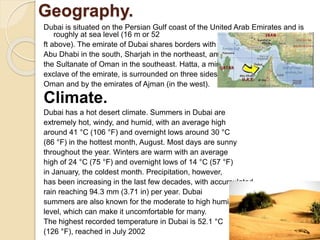
Dubai is situated on the Persian Gulf coast of the United Arab Emirates and is
roughly at sea level (16 m or 52
ft above). The emirate of Dubai shares borders with
Abu Dhabi in the south, Sharjah in the northeast, and
the Sultanate of Oman in the southeast. Hatta, a minor
exclave of the emirate, is surrounded on three sides by
Oman and by the emirates of Ajman (in the west).
Climate.
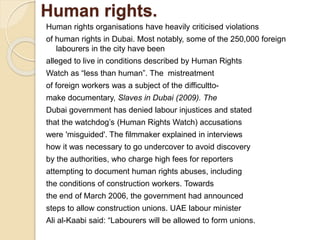
Dubai has a hot desert climate. Summers in Dubai are
extremely hot, windy, and humid, with an average high
around 41 °C (106 °F) and overnight lows around 30 °C
(86 °F) in the hottest month, August. Most days are sunny
throughout the year. Winters are warm with an average
high of 24 °C (75 °F) and overnight lows of 14 °C (57 °F)
in January, the coldest month. Precipitation, however,
has been increasing in the last few decades, with accumulated
rain reaching 94.3 mm (3.71 in) per year. Dubai
summers are also known for the moderate to high humidity
level, which can make it uncomfortable for many.
The highest recorded temperature in Dubai is 52.1 °C
(126 °F), reached in July 2002
Governance and politics.
Al Maktoum, Government of Dubai,
Dubai Municipality and Politics of the United Arab emirates
Dubai has been ruled by the Al Maktoum family since
1833; the emirate is an absolute monarchy with no elections
(other than the few thousand Dubai citizens participating
in the electoral college for the Federal National
Council of the UAE). The ruler, Mohammed bin Rashid
Al Maktoum, is also the Vice President and Prime Minister
of the United Arab Emirates and member of the
Supreme Council of the Union (SCU). Dubai appoints
8 members in two-term periods to the Federal National
Council (FNC) of the UAE, the supreme federal legislative body. The Dubai
Municipality (DM) was established by the
then-ruler of Dubai, Rashid bin Saeed Al Maktoum, in
1954 for purposes of city planning, citizen services and
upkeep of local facilities.DM is chaired by Hamdan
bin Rashid Al Maktoum.
Con…..
1.Sharia laws.
Kissing in public is strictly illegal and can result in
deportation.
Non-Muslims are allowed to consume alcohol in licensed
venues, typically within hotels, or at home with the possession
of an alcohol license. Restaurants outside hotels
in Dubai are typically not permitted to sell alcohol.
2. Dress code.
The Islamic dress code is not compulsory, but prohibitions
on wearing “indecent clothing” or revealing too
much skin are aspects of the UAE to which Dubai’s visitors
are expected to conform, and are encoded in Dubai’s
criminal law. The UAE has enforced anti-indecency
prohibitions in all public places (aside from beaches,
clubs, and bars
Human rights.
Human rights organisations have heavily criticised violations
of human rights in Dubai. Most notably, some of the 250,000 foreign
labourers in the city have been
alleged to live in conditions described by Human Rights
Watch as “less than human”. The mistreatment
of foreign workers was a subject of the difficultto-
make documentary, Slaves in Dubai (2009). The
Dubai government has denied labour injustices and stated
that the watchdog’s )Human Rights Watch) accusations
were 'misguided'. The filmmaker explained in interviews
how it was necessary to go undercover to avoid discovery
by the authorities, who charge high fees for reporters
attempting to document human rights abuses, including
the conditions of construction workers. Towards
the end of March 2006, the government had announced
steps to allow construction unions. UAE labour minister
Ali al-Kaabi said: “Labourers will be allowed to form unions.
Demographics.
1.Religion.
Islam in the United Arab Emirates and Religionin the United Arab
Emirates .
2. Minorities.
Dubai also has large Christian, Hindu, Sikh, Bahá'í,
Buddhist and other religious communities residing in the city. Non-
Muslim groups can own their own houses of worship,
where they can practice their religion freely, by
requesting a land grant and permission to build a compound.
Groups that do not have their own buildings must
use the facilities of other religious organisations or worship
in private homes. Non-Muslim religious groups
are permitted to advertise group functions openly and
distribute various religious literature; however, outright
proselytising is strictly prohibited under penalty of criminal
prosecution, imprisonment and deportation for engaging
in behaviour offensive to Islam. Strict prohibition
extends to small groups such as the Ahmadiyya.
Catholics have no proper jurisdiction in the UAE, but are
served pastorally by the Bahrain-based Apostolic Vicariate
Economy.
Economy of Dubai One of the world’s fastest growing economies, Dubai’s
gross domestic product is projected at USD 107.1 billion,
with a growth rate of 6.1% in 2014.Although a
number of core elements of Dubai’s trading infrastructure
were built on the back of the oil industry, revenues
from oil and natural gas account for less than 5% of
the emirate’s revenues .It is estimated that Dubai produces
50,000 to 70,000 barrels (7,900 to 11,100 m3) of
oil a day and substantial quantities of gas from offshore
fields. The emirate’s share in the UAE’s total gas revenues is about 2%.
Dubai’s oil reserves have diminished
significantly and are expected to be exhausted in 20
years. Real estate and construction (22.6%), trade
(16%), entrepot (15%) and financial services (11%) are
the largest contributors to Dubai’s economy.
Dubai’s non-oil foreign trade stood at $362 billion in
2014. Of the overall trade volumes, imports had the
biggest share with a value of $230 billion while exports
and re-exports to the emirate stood at $31 billion and
$101 billion respectively.
Con..
The Dubai Financial Market (DFM) was established in
March 2000 as a secondary market for trading securities
and bonds, both local and foreign. As of fourth quarter
2006, its trading volume stood at about 400 billion shares,
worth $95 billion in total. The DFM had a market capitalisation
of about $87 billion. The other Dubai-based
stock exchange is NASDAQ Dubai, which is the international
stock exchange in the Middle East. It enables a
range of companies, including UAE and regional small
and medium-sized enterprises, to trade on an exchange
with an international brand name, with access by both regional
and international investors.
Dubai is also known as the City of Gold, because a major
part of the economy is based on gold trades, with
Dubai’s total gold trading volumes in H1 2011 reaching
580 tonnes, with an average price of US$1,455 per troy
Con…
Tourism and retail.
Tourism is an important part of the Dubai government’s
strategy to maintain the flow of foreign cash into the
emirate. Dubai’s lure for tourists is based mainly on
shopping, but also on its possession of other ancient
and modern attractions. As of 2013, Dubai was the
7th most visited city of the world based on air traffic and
the fastest growing, increasing by a 10.7% rate. Dubai
is expected to accommodate over 15 million tourists by
2015.The emirate is also the most populous of the
seven emirates of the United Arab Emirates.
Dubai has been called the “shopping capital of the
Middle
East”. Dubai alone has more than 70 shopping centres,
Cityscape.
1. Burj Al Arab.
The Burj Al Arab is a 7 star luxury hotel. Although the hotel is
Frequently described as “the world’s only seven-Star hotel.
the hotel’s management has said it has never made that
claim for the property. A Jumeirah Group spokesperson
is quoted as saying: “There’s not a lot we can do to stop it.
We're not encouraging the use of the term. We've never
used it in our advertising.”
2. Burj Khalifa.
Burj Khalifa is an 828 meter high skyscraper in
Dubai, and the tallest man-made building in the world.
The tower was inspired by the structure of the desert
flower named as Hymenocallis. It was constructed by
more than 30 contracting companies around the world
with 100 nationalities of workers. It is a building icon
Transportation.
1. Road.
2. Air.
3. Metro rail.
4. Palm Jumeirah Monorail.
5. Tram.
6. High speed rail.
7. Waterways.
Education.
The school system in Dubai follows that of the United Arab Emirates.
As of 2009, there are 79 public schools
run by the Ministry of Education that serve Emiratis and
expatriate Arab people as well as 145 private schools.
The medium of instruction in public schools is Arabic
with emphasis on English as a second language, while
most of the private schools use English as their medium
of instruction. Most private schools cater to one or more
expatriate communities.
Healthcare.
Healthcare in Dubai can be divided into two different
sectors: public and private. Each Emirate is able to
dictate
healthcare standards according to their internal laws,
although the standards and regulations rarely have
extreme
differences. Public hospitals in Dubai were first
built in the late 1950s and continued to grow with
public
health initiatives. There are now 28 hospitals in Dubai,
6
public and 22 private, with 3 more major hospitals
scheduled
By the end of 2012 there were also a total of 1,348
medical
clinics, 97% of which are operated privately. In
2015, Dubai phased in mandatory health insurance for
Notable person.
1.Mohammed bin Rashid Al Maktoum
(born 15 july 1949)
The vice president and prime minister of the UAE
Dubai ppt

Dubai ppt

  • 1.
    JAIPUR NATIONAL UNIVERSITY The presentationon the topic of DUBAI SUBMITTED TO: SUBMITTED BY: Surjit Jha
  • 2.
    CONTENT  Introduction.  Etymology. History.  Geography.  Climate.  Governance and politics.  Human rights.  Demographics.  Economy.  Cityscape.  Transportation.  Education.  Healthcare.  Notable people.
  • 3.
    INTRODUCTION. Dubai (/duːˈbaɪ/ doo-BY;Arabic. ‫دبي‬Dubayy, Gulf pronunciation: [dʊˈbɑj ] is the most populous city in the United Arab Emirates (UAE). It is located on the southeast coast of the Persian Gulf and is one of the seven emirates that make up the country. Abu Dhabi and Dubai are the only two emirates to have veto power over critical matters of national importance in the country’s Legislature The city of Dubai is located on the emirate’s northern coastline and heads up the Dubai-Sharjah- Ajman metropolitan area. Dubai is to host World Expo 2020. Dubai flag
  • 4.
    Etymology. Many theories havebeen proposed as to the origin of the word Dubai. One theory suggests the word was used to describe the souq, which was similar to the souq in Ba Another theory states that the name came from a word meaning “money”, as people from Dubai were commonly believed to be rich due to the thriving trading center of the location. An Arabic proverb says "Daba Dubai" (Arabic: ‫دبي‬ ‫دبا‬), meaning “They came with a lot of money.” According to Fedel Handhal, a scholar on the UAE’s history and culture, the word Dubai may have come from the word daba (Arabic: ‫دبا‬( ) a past tense derivative of yadub (Arabic: ‫يدب‬), which means “to creep”), referring to the slow flow of Dubai Creek inland. The poet and scholar Ahmad Mohammad Obaid traces it to the same word, but to its alternative meaning of “baby locust" (Arabic: ( ‫جراد‬ due to the abundant nature of locusts in the area before settlement.
  • 5.
    History. 1. Pre-oil Dubai. Dubai’sgeographical proximity to Iran made it an important trade location. The town of Dubai was an important port of call for foreign tradesmen, chiefly those from Iran, many of whom eventually settled in the town. By the beginning of the 20th century, it was an important port. Dubai was known for its pearl exports until the 1930s; thepearl trade was damaged irreparably by the Great Depression in the 1930s and the innovation of cultured pearls. With the collapse of the pearling industry, Dubai fell into a deep depression and many residents starved or migrated to other parts of the Persian Gulf. In the early days since its inception, Dubai was constantly at odds with Abu Dhabi. In 1947, a border dispute between Dubai and Abu Dhabi on the northern sector of their mutual border escalated into war . Arbitration by the British and the creation of a buffer frontier running south eastwards from the coast at Ras Husian resulted in a temporary cessation of hostilities.
  • 6.
    Con…… Despite a lackof oil, Dubai’s ruler from 1948, Sheikh Rashid bin Saeed Al Maktoum, used revenue from trading activities to build infrastructure. Electricity, telephone services, and an airport were established in Dubai in the 1950s and, in 1959, the emirate’s first hotel, the Airlines Hotel, was constructed. This was followed by the Ambassador and Carlton Hotel in 1968. 2. Oil era. After years of exploration following large finds in neighboring Abu Dhabi, oil was eventually discovered in territorial waters off Dubai in 1966, albeit in far smaller quantities. The first field was named 'Fateh' or 'good fortune'. This led the emirate to grant concessions to international oil companies, thus igniting a massive influx of foreign workers, mainly Indians and Pakistanis. Between 1968 and 1975 the city’s population grew by over 300%.
  • 7.
    Geography. Dubai is situatedon the Persian Gulf coast of the United Arab Emirates and is roughly at sea level (16 m or 52 ft above). The emirate of Dubai shares borders with Abu Dhabi in the south, Sharjah in the northeast, and the Sultanate of Oman in the southeast. Hatta, a minor exclave of the emirate, is surrounded on three sides by Oman and by the emirates of Ajman (in the west). Climate. Dubai has a hot desert climate. Summers in Dubai are extremely hot, windy, and humid, with an average high around 41 °C (106 °F) and overnight lows around 30 °C (86 °F) in the hottest month, August. Most days are sunny throughout the year. Winters are warm with an average high of 24 °C (75 °F) and overnight lows of 14 °C (57 °F) in January, the coldest month. Precipitation, however, has been increasing in the last few decades, with accumulated rain reaching 94.3 mm (3.71 in) per year. Dubai summers are also known for the moderate to high humidity level, which can make it uncomfortable for many. The highest recorded temperature in Dubai is 52.1 °C (126 °F), reached in July 2002
  • 8.
    Governance and politics. AlMaktoum, Government of Dubai, Dubai Municipality and Politics of the United Arab emirates Dubai has been ruled by the Al Maktoum family since 1833; the emirate is an absolute monarchy with no elections (other than the few thousand Dubai citizens participating in the electoral college for the Federal National Council of the UAE). The ruler, Mohammed bin Rashid Al Maktoum, is also the Vice President and Prime Minister of the United Arab Emirates and member of the Supreme Council of the Union (SCU). Dubai appoints 8 members in two-term periods to the Federal National Council (FNC) of the UAE, the supreme federal legislative body. The Dubai Municipality (DM) was established by the then-ruler of Dubai, Rashid bin Saeed Al Maktoum, in 1954 for purposes of city planning, citizen services and upkeep of local facilities.DM is chaired by Hamdan bin Rashid Al Maktoum.
  • 9.
    Con….. 1.Sharia laws. Kissing inpublic is strictly illegal and can result in deportation. Non-Muslims are allowed to consume alcohol in licensed venues, typically within hotels, or at home with the possession of an alcohol license. Restaurants outside hotels in Dubai are typically not permitted to sell alcohol. 2. Dress code. The Islamic dress code is not compulsory, but prohibitions on wearing “indecent clothing” or revealing too much skin are aspects of the UAE to which Dubai’s visitors are expected to conform, and are encoded in Dubai’s criminal law. The UAE has enforced anti-indecency prohibitions in all public places (aside from beaches, clubs, and bars
  • 10.
    Human rights. Human rightsorganisations have heavily criticised violations of human rights in Dubai. Most notably, some of the 250,000 foreign labourers in the city have been alleged to live in conditions described by Human Rights Watch as “less than human”. The mistreatment of foreign workers was a subject of the difficultto- make documentary, Slaves in Dubai (2009). The Dubai government has denied labour injustices and stated that the watchdog’s )Human Rights Watch) accusations were 'misguided'. The filmmaker explained in interviews how it was necessary to go undercover to avoid discovery by the authorities, who charge high fees for reporters attempting to document human rights abuses, including the conditions of construction workers. Towards the end of March 2006, the government had announced steps to allow construction unions. UAE labour minister Ali al-Kaabi said: “Labourers will be allowed to form unions.
  • 11.
    Demographics. 1.Religion. Islam in theUnited Arab Emirates and Religionin the United Arab Emirates . 2. Minorities. Dubai also has large Christian, Hindu, Sikh, Bahá'í, Buddhist and other religious communities residing in the city. Non- Muslim groups can own their own houses of worship, where they can practice their religion freely, by requesting a land grant and permission to build a compound. Groups that do not have their own buildings must use the facilities of other religious organisations or worship in private homes. Non-Muslim religious groups are permitted to advertise group functions openly and distribute various religious literature; however, outright proselytising is strictly prohibited under penalty of criminal prosecution, imprisonment and deportation for engaging in behaviour offensive to Islam. Strict prohibition extends to small groups such as the Ahmadiyya. Catholics have no proper jurisdiction in the UAE, but are served pastorally by the Bahrain-based Apostolic Vicariate
  • 12.
    Economy. Economy of DubaiOne of the world’s fastest growing economies, Dubai’s gross domestic product is projected at USD 107.1 billion, with a growth rate of 6.1% in 2014.Although a number of core elements of Dubai’s trading infrastructure were built on the back of the oil industry, revenues from oil and natural gas account for less than 5% of the emirate’s revenues .It is estimated that Dubai produces 50,000 to 70,000 barrels (7,900 to 11,100 m3) of oil a day and substantial quantities of gas from offshore fields. The emirate’s share in the UAE’s total gas revenues is about 2%. Dubai’s oil reserves have diminished significantly and are expected to be exhausted in 20 years. Real estate and construction (22.6%), trade (16%), entrepot (15%) and financial services (11%) are the largest contributors to Dubai’s economy. Dubai’s non-oil foreign trade stood at $362 billion in 2014. Of the overall trade volumes, imports had the biggest share with a value of $230 billion while exports and re-exports to the emirate stood at $31 billion and $101 billion respectively.
  • 13.
    Con.. The Dubai FinancialMarket (DFM) was established in March 2000 as a secondary market for trading securities and bonds, both local and foreign. As of fourth quarter 2006, its trading volume stood at about 400 billion shares, worth $95 billion in total. The DFM had a market capitalisation of about $87 billion. The other Dubai-based stock exchange is NASDAQ Dubai, which is the international stock exchange in the Middle East. It enables a range of companies, including UAE and regional small and medium-sized enterprises, to trade on an exchange with an international brand name, with access by both regional and international investors. Dubai is also known as the City of Gold, because a major part of the economy is based on gold trades, with Dubai’s total gold trading volumes in H1 2011 reaching 580 tonnes, with an average price of US$1,455 per troy
  • 14.
    Con… Tourism and retail. Tourismis an important part of the Dubai government’s strategy to maintain the flow of foreign cash into the emirate. Dubai’s lure for tourists is based mainly on shopping, but also on its possession of other ancient and modern attractions. As of 2013, Dubai was the 7th most visited city of the world based on air traffic and the fastest growing, increasing by a 10.7% rate. Dubai is expected to accommodate over 15 million tourists by 2015.The emirate is also the most populous of the seven emirates of the United Arab Emirates. Dubai has been called the “shopping capital of the Middle East”. Dubai alone has more than 70 shopping centres,
  • 15.
    Cityscape. 1. Burj AlArab. The Burj Al Arab is a 7 star luxury hotel. Although the hotel is Frequently described as “the world’s only seven-Star hotel. the hotel’s management has said it has never made that claim for the property. A Jumeirah Group spokesperson is quoted as saying: “There’s not a lot we can do to stop it. We're not encouraging the use of the term. We've never used it in our advertising.” 2. Burj Khalifa. Burj Khalifa is an 828 meter high skyscraper in Dubai, and the tallest man-made building in the world. The tower was inspired by the structure of the desert flower named as Hymenocallis. It was constructed by more than 30 contracting companies around the world with 100 nationalities of workers. It is a building icon
  • 16.
    Transportation. 1. Road. 2. Air. 3.Metro rail. 4. Palm Jumeirah Monorail. 5. Tram. 6. High speed rail. 7. Waterways. Education. The school system in Dubai follows that of the United Arab Emirates. As of 2009, there are 79 public schools run by the Ministry of Education that serve Emiratis and expatriate Arab people as well as 145 private schools. The medium of instruction in public schools is Arabic with emphasis on English as a second language, while most of the private schools use English as their medium of instruction. Most private schools cater to one or more expatriate communities.
  • 17.
    Healthcare. Healthcare in Dubaican be divided into two different sectors: public and private. Each Emirate is able to dictate healthcare standards according to their internal laws, although the standards and regulations rarely have extreme differences. Public hospitals in Dubai were first built in the late 1950s and continued to grow with public health initiatives. There are now 28 hospitals in Dubai, 6 public and 22 private, with 3 more major hospitals scheduled By the end of 2012 there were also a total of 1,348 medical clinics, 97% of which are operated privately. In 2015, Dubai phased in mandatory health insurance for
  • 18.
    Notable person. 1.Mohammed binRashid Al Maktoum (born 15 july 1949) The vice president and prime minister of the UAE