3/21/2013
1
CENG 5503 - Steel and Timber Structures
Chapter 1: Introduction
Objectives
• Introduction
• Types of Steel Structure
• Structural Members
• Structural Design
• Material Properties of Structural Steel
• Structural Steel Shapes
3/21/2013
2
Introduction
• Structures whose major
constituent components
are steel are known as
steel structure while
those with large
proportion of timber
components timber
structures.
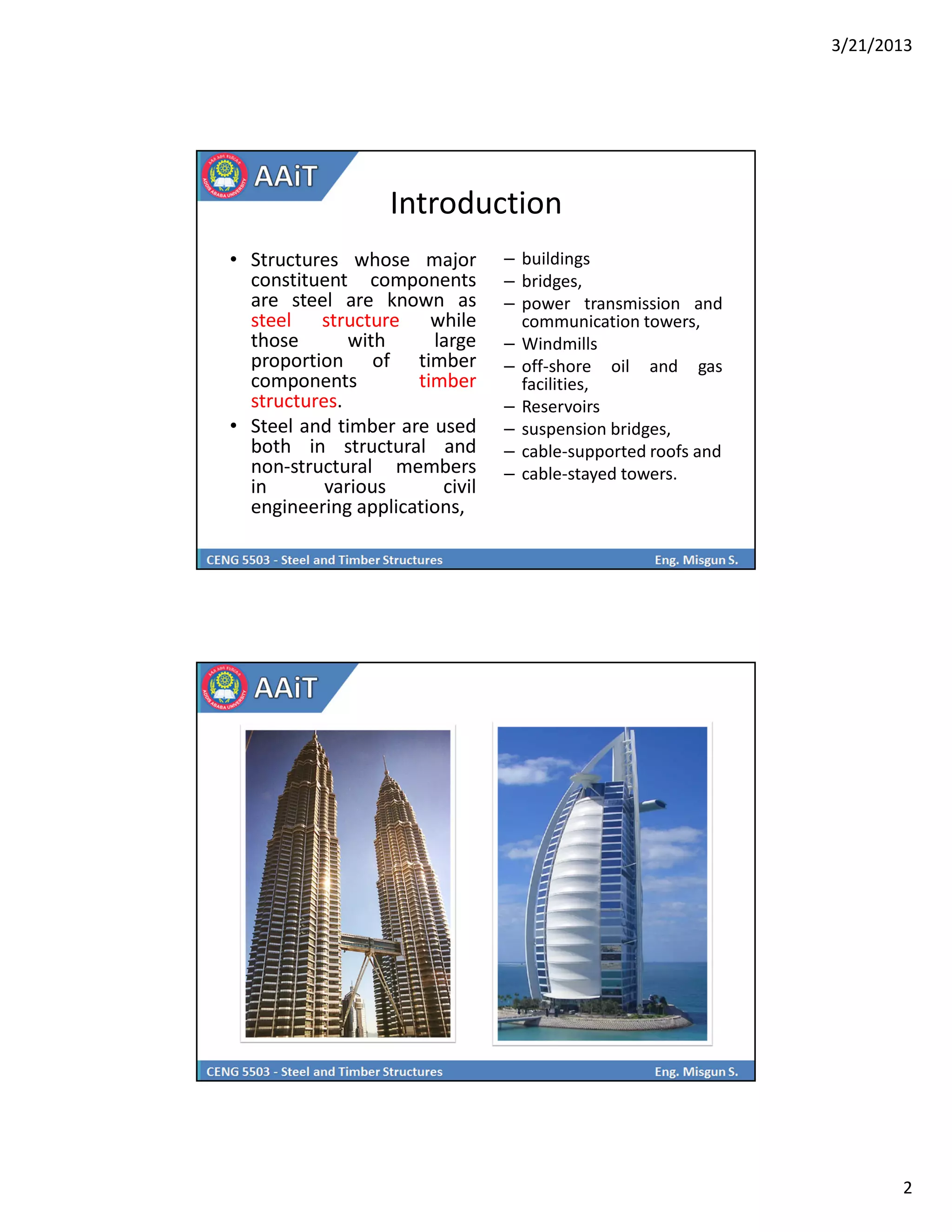
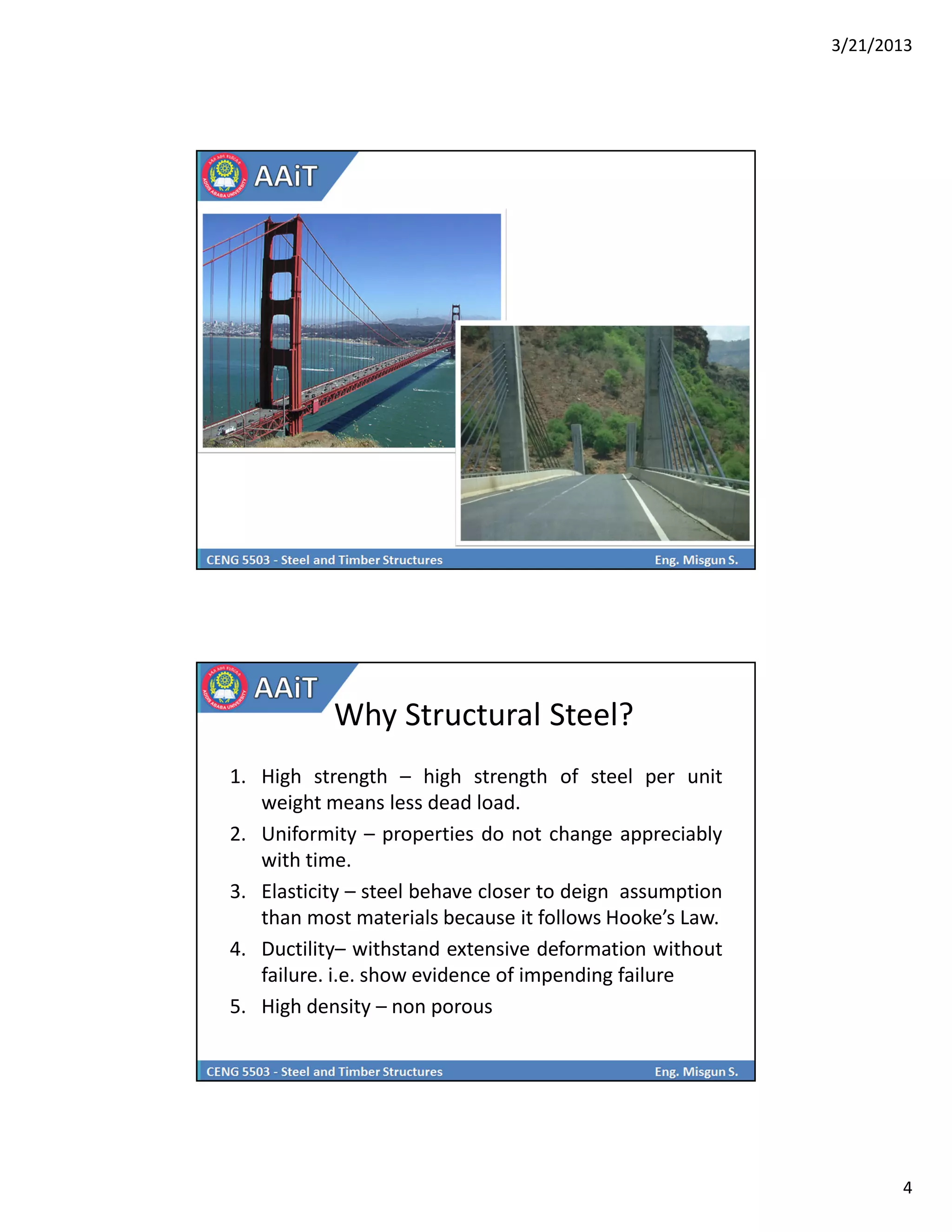
• Steel and timber are used
both in structural and
non-structural members
in various civil
engineering applications,
– buildings
– bridges,
– power transmission and
communication towers,
– Windmills
– off-shore oil and gas
facilities,
– Reservoirs
– suspension bridges,
– cable-supported roofs and
– cable-stayed towers.
3/21/2013
3
3/21/2013
4
Why Structural Steel?
1. High strength – high strength of steel per unit
weight means less dead load.
2. Uniformity – properties do not change appreciably
with time.
3. Elasticity – steel behave closer to deign assumption
than most materials because it follows Hooke’s Law.
4. Ductility– withstand extensive deformation without
failure. i.e. show evidence of impending failure
5. High density – non porous
3/21/2013
5
Cont’d
6. Long Life – very durable material and long service
life.
7. Additions to existing structures – new members can
be added to existing frame building.
8. Time saving – no curing time and scaffolding time.
9. Flexibility in fabrication – geometry, strength and
other properties easily controlled.
10. Re-usable – highly reusable, can be converted to
raw material to produce new sections.
Disadvantage of steel
• It is very susceptible to corrosion if not properly
treated.
• It is low fire resistance, under high temperature the
strength is reduced greatly while deformation
increase dramatically.
3/21/2013
6
Manufacturing Process
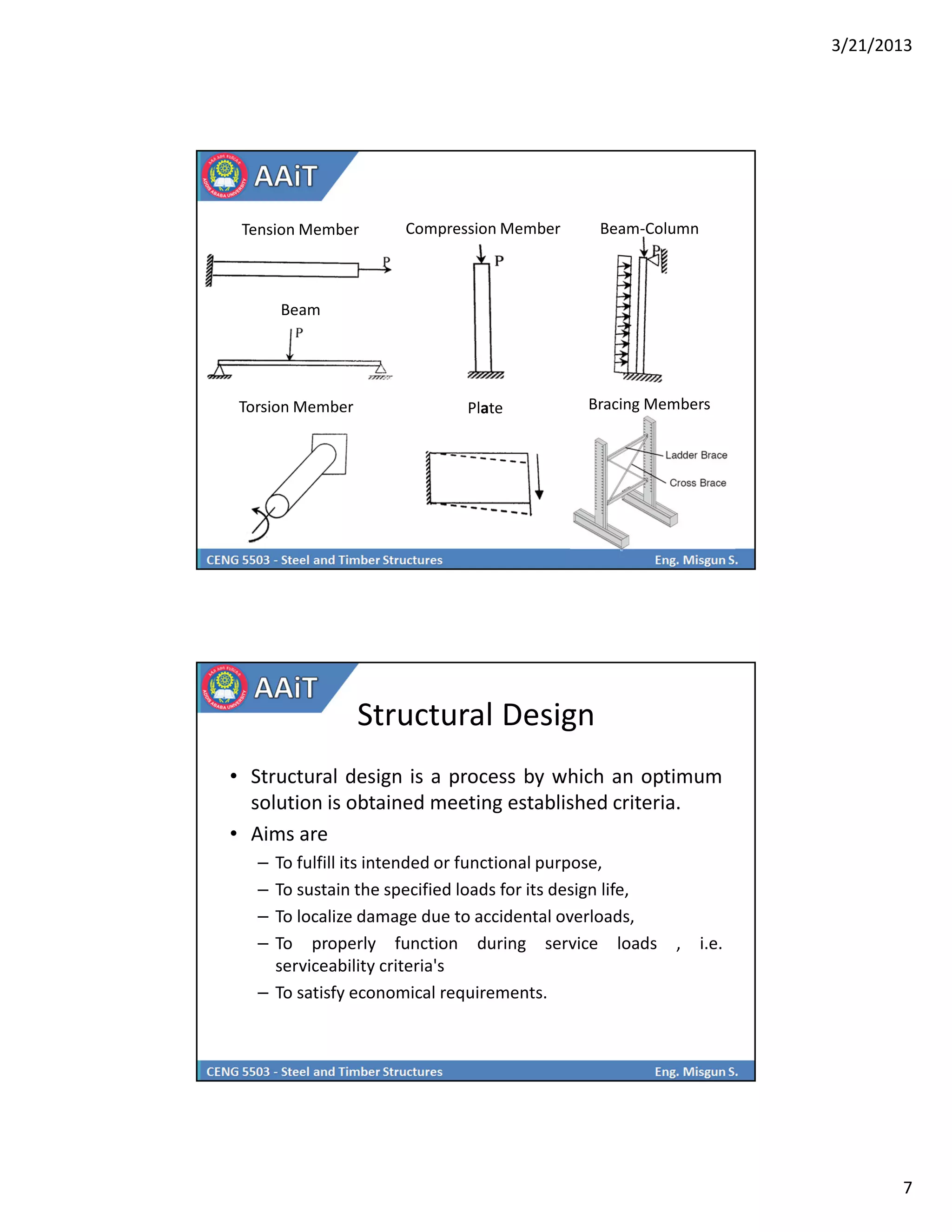
Structural Members
• Depending on the type of load that a member resist
,structural member can be classified as,
– Tension member
– Compression member,
– Beams,
– Beam-Columns
– Torsion members
– Plate
– Bracing members
3/21/2013
7
Tension Member Compression Member Beam-Column
Beam
Torsion Member Plate Bracing Members
Structural Design
• Structural design is a process by which an optimum
solution is obtained meeting established criteria.
• Aims are
– To fulfill its intended or functional purpose,
– To sustain the specified loads for its design life,
– To localize damage due to accidental overloads,
– To properly function during service loads , i.e.
serviceability criteria's
– To satisfy economical requirements.
3/21/2013
8
Cont’d
• The design thus should take into account,
– Facilitate safe fabrication, transport, handling and erection
– Future maintenance, final demolition, recycling and reuse
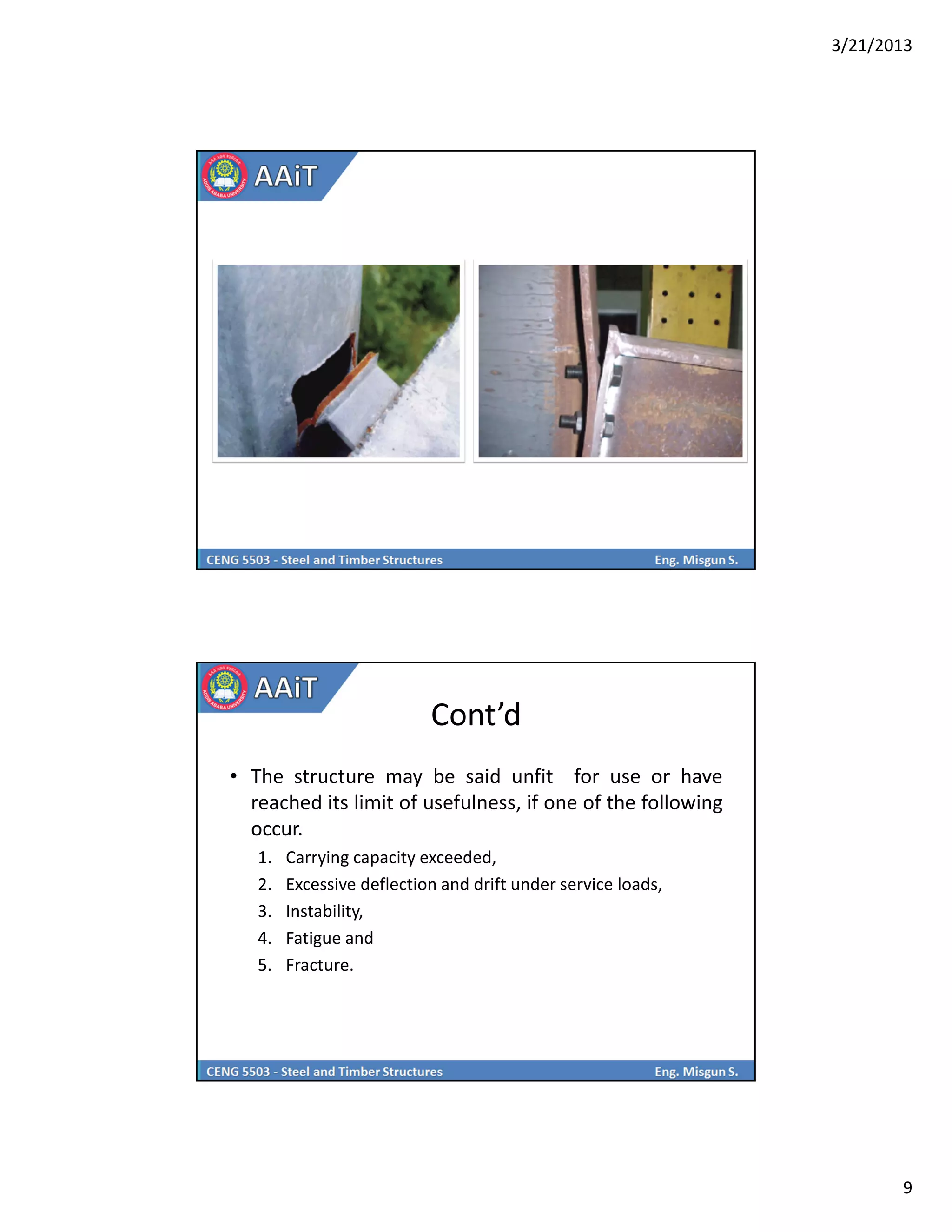
• If proper structural design is not carried out failure
would result. (See Next Slides),
3/21/2013
9
Cont’d
• The structure may be said unfit for use or have
reached its limit of usefulness, if one of the following
occur.
1. Carrying capacity exceeded,
2. Excessive deflection and drift under service loads,
3. Instability,
4. Fatigue and
5. Fracture.
3/21/2013
10
Structural Design Steps
Architectural Plan
Structural System
Trail Sections
Modeling
Analysis Member Design
Acceptable
Detailing
Structural Drawings
No !
Revise !
Yes !
Method of Design
• Three major design methods are employed in steel
structures. They are,
1. Allowable Stress Design (ASD)
2. Plastic Design
3. Limit State Design (LSD)
3/21/2013
11
Allowable Stress Design
• In this philosophy, a member is selected such that
under expected loads, known as service or working
loads, the stress will not exceed one of the previously
described limits of usefulness. (See Previous Slides)
• Analysis is based on elastic theory and section are
sized so that permissible stress are not exceeded.
• These permissible stress are expressed in terms of
yield stress (fy) or tensile stress (fu).
• Factor of safety is applied for nominal resistance of
the member.
Cont’d
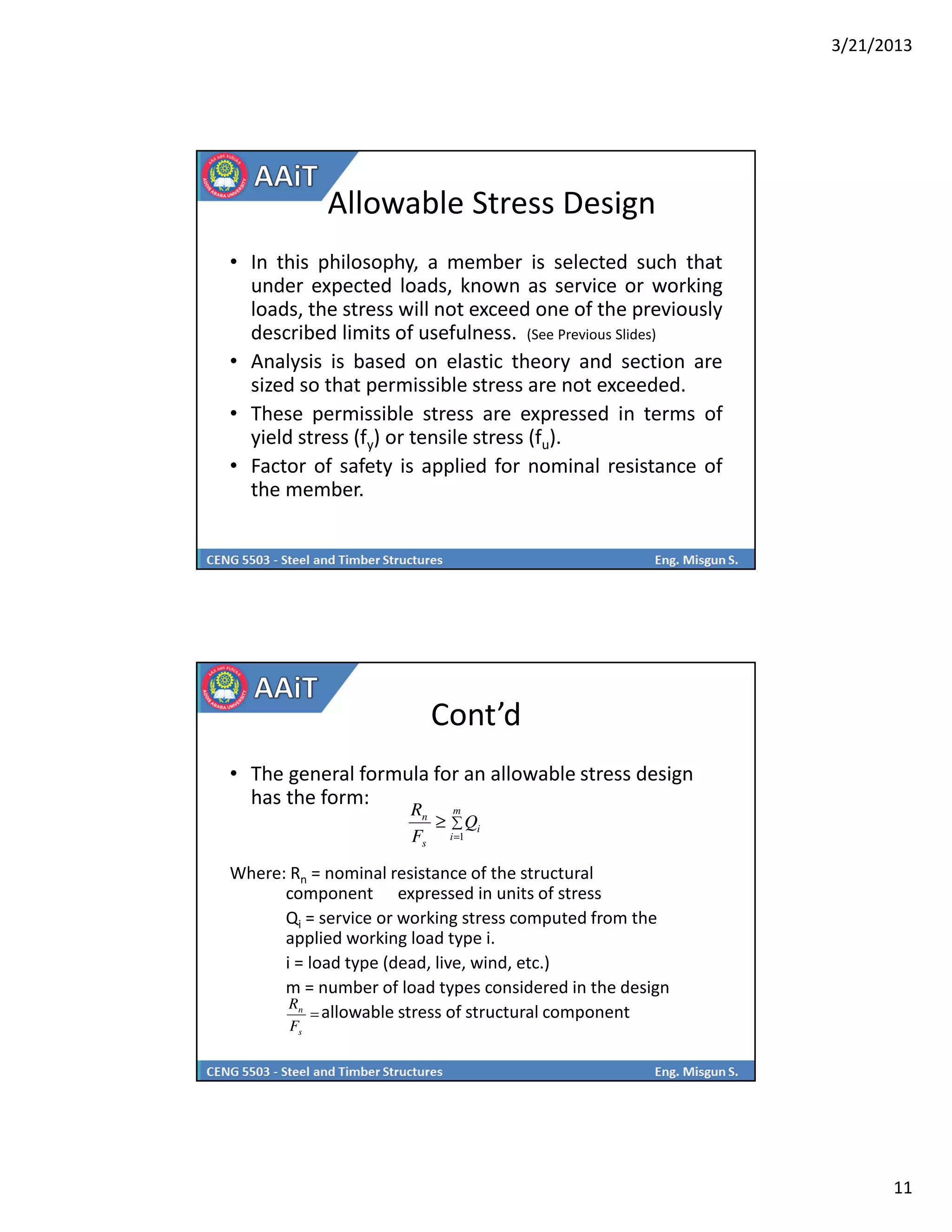
• The general formula for an allowable stress design
has the form:
Where: Rn = nominal resistance of the structural
component expressed in units of stress
Qi = service or working stress computed from the
applied working load type i.
i = load type (dead, live, wind, etc.)
m = number of load types considered in the design
allowable stress of structural component
∑
=
≥
m
i
i
s
n
Q
F
R
1
=
s
n
F
R
3/21/2013
12
Plastic Design
• Plastic design makes use of the fact that steel
sections have reserved strength beyond the first
yield condition.
• This phenomenon of progressive yielding referred to
as plastification, means that the cross section does
not fail at first yield.
• For an indeterminate structure, failure of the
structure will not occur after the formation of a
plastic hinge.
Cont’d
• After complete yielding of a cross section, force (or,
more precisely, moment) redistribution will occur,
• Failure will occur only when enough cross sections
have yielded resulting in the formation of a plastic
collapse mechanism.
• In plastic design the factor of safety is applied to the
applied loads to obtain factored loads.
3/21/2013
13
Cont’d
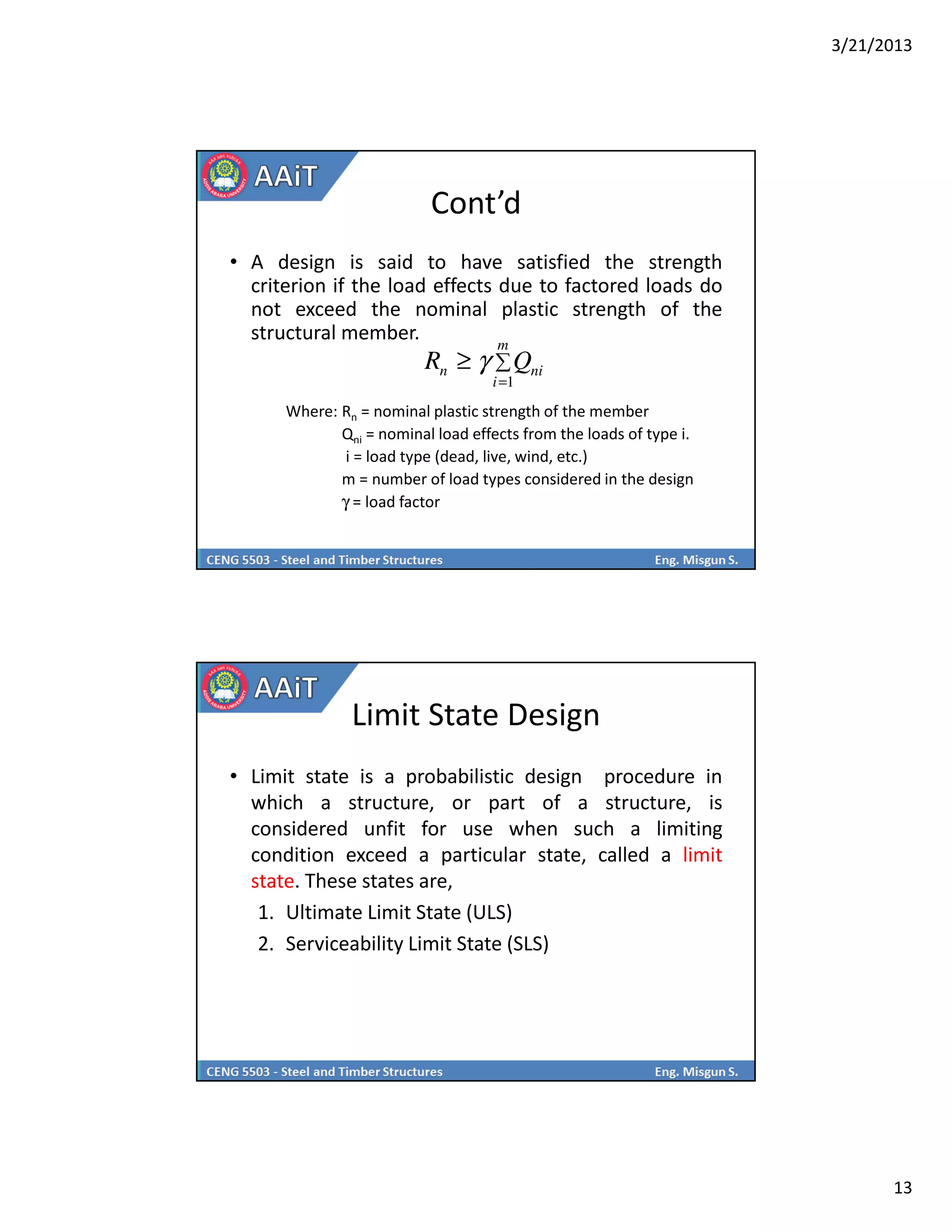
• A design is said to have satisfied the strength
criterion if the load effects due to factored loads do
not exceed the nominal plastic strength of the
structural member.
Where: Rn = nominal plastic strength of the member
Qni = nominal load effects from the loads of type i.
i = load type (dead, live, wind, etc.)
m = number of load types considered in the design
γ = load factor
∑
=
≥
m
i
nin QR
1
γ
Limit State Design
• Limit state is a probabilistic design procedure in
which a structure, or part of a structure, is
considered unfit for use when such a limiting
condition exceed a particular state, called a limit
state. These states are,
1. Ultimate Limit State (ULS)
2. Serviceability Limit State (SLS)
3/21/2013
14
1. Ultimate Limit State
• This is reached when a structure or part of a structure
collapse.
• The collapse may be triggered by,
– Loss of equilibrium or stability
– Failure by rupture of structural members
• Factor of safety γm is applied to the nominal resistance of
the structural component to account for any
uncertainties associated with the determination of its
strength.
• Factor of safety γl is applied to each load type to account
for the uncertainties and difficulties associated with
determining its actual load magnitude.
Cont’d
• Mathematically it can be expressed as:
Where: design strength
the required strength or load effects
for a given load combination
∑
=
≥
m
i
ili
m
n
Q
R
1
γ
γ
=
m
nR
γ
∑
=
=
m
i
iliQ
1
γ
3/21/2013
15
Design Checks
• Design checks are required and depends on the type
of structures
• Frames are checked for
– Static equilibrium
– Frame stability
– Resistance of cross-section
– Resistance of members
– Resistance of joints
• Tension members need only checked for resistance
of cross-sections
2. Serviceability Limit State
• This condition is reached when a structure, while
remaining safe, becomes unfit for everyday use due
to phenomena such as,
– Excessive deformation,
– Cracking and
– Vibration.
• The national building codes, both EBCS 3 1995 for
steel and EBCS 5 1995 far timber structures are
based on the concepts of the limit state design and
will be covered in this course work.
3/21/2013
16
Material Behavior
• Properties of particular importance in structural
usage are
– high strength compare to any other available material,
– and ductility (i.e., its ability to deform substantially in
either tension or compression before failure).
• It both strong in tension and compression.
• The most important structural properties of steel are
– yield strength and ultimate strength,
– modulus of elasticity, shear modulus, Poisson’s ratio,
coefficient of thermal expansion, and
– its density.
Stress-Strain Behavior of Structural Steel
3/21/2013
17
Cont’d
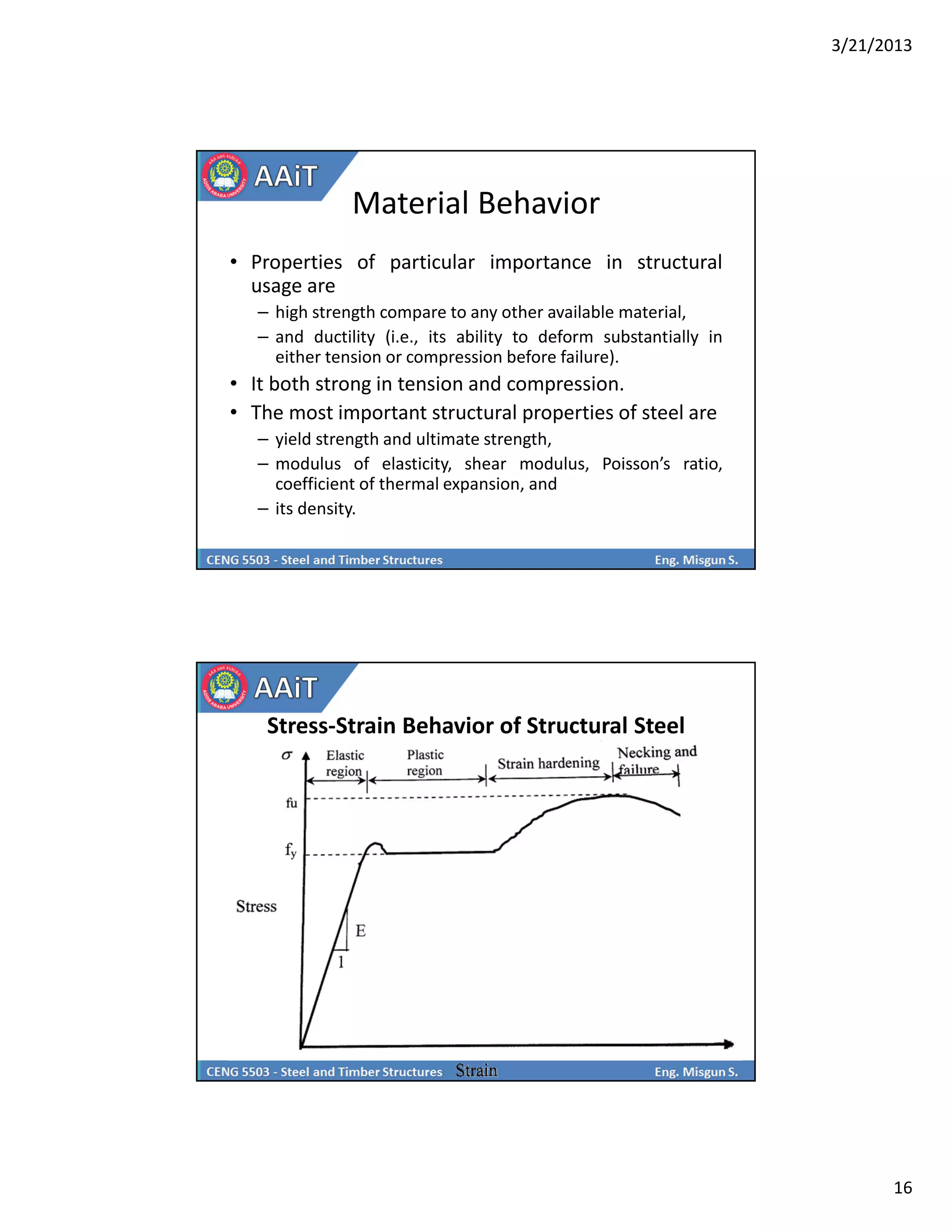
• Four regions can be seen. They are discussd below.
1. Elastic Region:
– In this region the stress is proportional to the strain, and
Hooke's law applies.
– The constant of proportionality is the modulus of
elasticity or Young’s modulus, E. The modulus of elasticity
for steel has values ranging from 190 - 210 GPa.
– The modulus of elasticity does not vary appreciably for
the different grades of steel used in construction, and a
value of 200 GPa is often used for design
Cont’d
2. Inelastic Region:
– In this region the steel section deforms plastically under a
constant stress, fy.
– The extent of this deformation differs for different steel
grades.
– Generally, the ductility decreases with increasing steel
strength.
– The ability of structural steel to deform considerably
before failure by fracture allows the structure to undergo
force redistribution when yielding occurs, and it
enhances the energy absorption characteristic of the
structure.
3/21/2013
18
Cont’d
3. Strain-Harding Region:
– In this region deformation is accompanied by an increase
in stress.
– The peak point of the idealized stress-strain curve is the
ultimate stress, fu. It is the highest stress based on original
cross-section size.
Cont’d
4. Necking and Failure:
– After maximum stress, a localized reduction in area, called
necking begins and elongation continues until specimen
breaks
3/21/2013
19
Material Properties
• Three nominal grades are listed in EBCS 3-1995,
– Fe 360 nominal strength = 235 N/mm2
– Fe 430 nominal strength = 275N/mm2
– Fe 510 nominal strength = 355N/mm2
• Strength depends on thickness of the member and is
given on next slide.
Cont’d
Nominal
Steel
Grade
Thickness t (mm)
t ≤ 40 mm 40 mm ≤ t ≤ 100 mm
fy (MPa) fu (MPa) fy (MPa) fu (MPa)
Fe 360 235 360 215 340
Fe 430 275 430 255 410
Fe 510 355 510 335 490
3/21/2013
20
Cont’d
• Code states following values for elastic properties
a) Modulus of Elasticity: E = 210 GPa
b) Shear Modulus: G = 80 GPa
c) Poisson’s Ratio; ν = 0.3
d) Cof. of Thermal Expansion α = 12 x 10-6 per oC
e) Unit Mass: ρ = 7850 kg/m3
Structural Steel Shapes
• In general, there are three procedures by which steel
shapes can be formed: hot-rolled, cold-formed, built-
up and compound.
• When rolling is done on hot steel, the product is
termed hot-rolled steel.
• When thinner plates are further rolled or bent, after
cooling, the product is called cold-formed steel.
• When special conditions occur (heavy load or longer
span) built up members can be produced by welding
together different plates to form I, H or box member.
3/21/2013
21
Cont’d
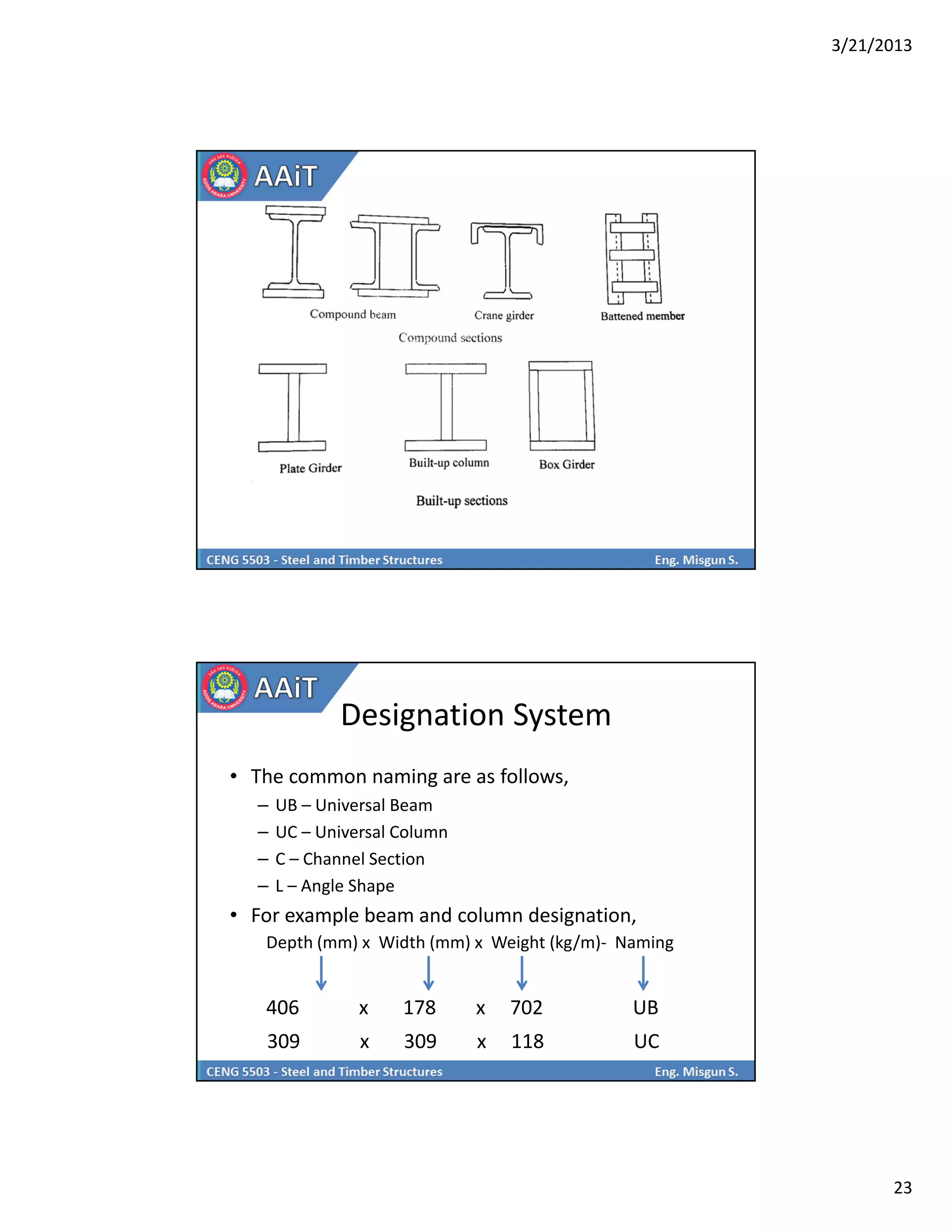
• Compound section are formed by,
– Strengthening a rolled section such as universal beam by
welding on cover plates
– Combining two separate rolled sections, like crane girder
– Connecting two members together to form a strong
combined member
Cont’d
3/21/2013
22
Figure: Standard Hot Rolled Shapes
Figure: Standard Cold Formed Shapes
3/21/2013
23
Designation System
• The common naming are as follows,
– UB – Universal Beam
– UC – Universal Column
– C – Channel Section
– L – Angle Shape
• For example beam and column designation,
406 x 178 x 702 UB
Depth (mm) x Width (mm) x Weight (kg/m)- Naming
309 x 309 x 118 UC
3/21/2013
24
Cont’d
• For C and L sections
L 60 x 60 x 10
Shape – leg 1 width (mm) x leg 2 width (mm) x thickness(mm)
C 60 x 60 x 10
Thank you !

Ceng 5503 chapter i

  • 1.
    3/21/2013 1 CENG 5503 -Steel and Timber Structures Chapter 1: Introduction Objectives • Introduction • Types of Steel Structure • Structural Members • Structural Design • Material Properties of Structural Steel • Structural Steel Shapes
  • 2.
    3/21/2013 2 Introduction • Structures whosemajor constituent components are steel are known as steel structure while those with large proportion of timber components timber structures. • Steel and timber are used both in structural and non-structural members in various civil engineering applications, – buildings – bridges, – power transmission and communication towers, – Windmills – off-shore oil and gas facilities, – Reservoirs – suspension bridges, – cable-supported roofs and – cable-stayed towers.
  • 3.
  • 4.
    3/21/2013 4 Why Structural Steel? 1.High strength – high strength of steel per unit weight means less dead load. 2. Uniformity – properties do not change appreciably with time. 3. Elasticity – steel behave closer to deign assumption than most materials because it follows Hooke’s Law. 4. Ductility– withstand extensive deformation without failure. i.e. show evidence of impending failure 5. High density – non porous
  • 5.
    3/21/2013 5 Cont’d 6. Long Life– very durable material and long service life. 7. Additions to existing structures – new members can be added to existing frame building. 8. Time saving – no curing time and scaffolding time. 9. Flexibility in fabrication – geometry, strength and other properties easily controlled. 10. Re-usable – highly reusable, can be converted to raw material to produce new sections. Disadvantage of steel • It is very susceptible to corrosion if not properly treated. • It is low fire resistance, under high temperature the strength is reduced greatly while deformation increase dramatically.
  • 6.
    3/21/2013 6 Manufacturing Process Structural Members •Depending on the type of load that a member resist ,structural member can be classified as, – Tension member – Compression member, – Beams, – Beam-Columns – Torsion members – Plate – Bracing members
  • 7.
    3/21/2013 7 Tension Member CompressionMember Beam-Column Beam Torsion Member Plate Bracing Members Structural Design • Structural design is a process by which an optimum solution is obtained meeting established criteria. • Aims are – To fulfill its intended or functional purpose, – To sustain the specified loads for its design life, – To localize damage due to accidental overloads, – To properly function during service loads , i.e. serviceability criteria's – To satisfy economical requirements.
  • 8.
    3/21/2013 8 Cont’d • The designthus should take into account, – Facilitate safe fabrication, transport, handling and erection – Future maintenance, final demolition, recycling and reuse • If proper structural design is not carried out failure would result. (See Next Slides),
  • 9.
    3/21/2013 9 Cont’d • The structuremay be said unfit for use or have reached its limit of usefulness, if one of the following occur. 1. Carrying capacity exceeded, 2. Excessive deflection and drift under service loads, 3. Instability, 4. Fatigue and 5. Fracture.
  • 10.
    3/21/2013 10 Structural Design Steps ArchitecturalPlan Structural System Trail Sections Modeling Analysis Member Design Acceptable Detailing Structural Drawings No ! Revise ! Yes ! Method of Design • Three major design methods are employed in steel structures. They are, 1. Allowable Stress Design (ASD) 2. Plastic Design 3. Limit State Design (LSD)
  • 11.
    3/21/2013 11 Allowable Stress Design •In this philosophy, a member is selected such that under expected loads, known as service or working loads, the stress will not exceed one of the previously described limits of usefulness. (See Previous Slides) • Analysis is based on elastic theory and section are sized so that permissible stress are not exceeded. • These permissible stress are expressed in terms of yield stress (fy) or tensile stress (fu). • Factor of safety is applied for nominal resistance of the member. Cont’d • The general formula for an allowable stress design has the form: Where: Rn = nominal resistance of the structural component expressed in units of stress Qi = service or working stress computed from the applied working load type i. i = load type (dead, live, wind, etc.) m = number of load types considered in the design allowable stress of structural component ∑ = ≥ m i i s n Q F R 1 = s n F R
  • 12.
    3/21/2013 12 Plastic Design • Plasticdesign makes use of the fact that steel sections have reserved strength beyond the first yield condition. • This phenomenon of progressive yielding referred to as plastification, means that the cross section does not fail at first yield. • For an indeterminate structure, failure of the structure will not occur after the formation of a plastic hinge. Cont’d • After complete yielding of a cross section, force (or, more precisely, moment) redistribution will occur, • Failure will occur only when enough cross sections have yielded resulting in the formation of a plastic collapse mechanism. • In plastic design the factor of safety is applied to the applied loads to obtain factored loads.
  • 13.
    3/21/2013 13 Cont’d • A designis said to have satisfied the strength criterion if the load effects due to factored loads do not exceed the nominal plastic strength of the structural member. Where: Rn = nominal plastic strength of the member Qni = nominal load effects from the loads of type i. i = load type (dead, live, wind, etc.) m = number of load types considered in the design γ = load factor ∑ = ≥ m i nin QR 1 γ Limit State Design • Limit state is a probabilistic design procedure in which a structure, or part of a structure, is considered unfit for use when such a limiting condition exceed a particular state, called a limit state. These states are, 1. Ultimate Limit State (ULS) 2. Serviceability Limit State (SLS)
  • 14.
    3/21/2013 14 1. Ultimate LimitState • This is reached when a structure or part of a structure collapse. • The collapse may be triggered by, – Loss of equilibrium or stability – Failure by rupture of structural members • Factor of safety γm is applied to the nominal resistance of the structural component to account for any uncertainties associated with the determination of its strength. • Factor of safety γl is applied to each load type to account for the uncertainties and difficulties associated with determining its actual load magnitude. Cont’d • Mathematically it can be expressed as: Where: design strength the required strength or load effects for a given load combination ∑ = ≥ m i ili m n Q R 1 γ γ = m nR γ ∑ = = m i iliQ 1 γ
  • 15.
    3/21/2013 15 Design Checks • Designchecks are required and depends on the type of structures • Frames are checked for – Static equilibrium – Frame stability – Resistance of cross-section – Resistance of members – Resistance of joints • Tension members need only checked for resistance of cross-sections 2. Serviceability Limit State • This condition is reached when a structure, while remaining safe, becomes unfit for everyday use due to phenomena such as, – Excessive deformation, – Cracking and – Vibration. • The national building codes, both EBCS 3 1995 for steel and EBCS 5 1995 far timber structures are based on the concepts of the limit state design and will be covered in this course work.
  • 16.
    3/21/2013 16 Material Behavior • Propertiesof particular importance in structural usage are – high strength compare to any other available material, – and ductility (i.e., its ability to deform substantially in either tension or compression before failure). • It both strong in tension and compression. • The most important structural properties of steel are – yield strength and ultimate strength, – modulus of elasticity, shear modulus, Poisson’s ratio, coefficient of thermal expansion, and – its density. Stress-Strain Behavior of Structural Steel
  • 17.
    3/21/2013 17 Cont’d • Four regionscan be seen. They are discussd below. 1. Elastic Region: – In this region the stress is proportional to the strain, and Hooke's law applies. – The constant of proportionality is the modulus of elasticity or Young’s modulus, E. The modulus of elasticity for steel has values ranging from 190 - 210 GPa. – The modulus of elasticity does not vary appreciably for the different grades of steel used in construction, and a value of 200 GPa is often used for design Cont’d 2. Inelastic Region: – In this region the steel section deforms plastically under a constant stress, fy. – The extent of this deformation differs for different steel grades. – Generally, the ductility decreases with increasing steel strength. – The ability of structural steel to deform considerably before failure by fracture allows the structure to undergo force redistribution when yielding occurs, and it enhances the energy absorption characteristic of the structure.
  • 18.
    3/21/2013 18 Cont’d 3. Strain-Harding Region: –In this region deformation is accompanied by an increase in stress. – The peak point of the idealized stress-strain curve is the ultimate stress, fu. It is the highest stress based on original cross-section size. Cont’d 4. Necking and Failure: – After maximum stress, a localized reduction in area, called necking begins and elongation continues until specimen breaks
  • 19.
    3/21/2013 19 Material Properties • Threenominal grades are listed in EBCS 3-1995, – Fe 360 nominal strength = 235 N/mm2 – Fe 430 nominal strength = 275N/mm2 – Fe 510 nominal strength = 355N/mm2 • Strength depends on thickness of the member and is given on next slide. Cont’d Nominal Steel Grade Thickness t (mm) t ≤ 40 mm 40 mm ≤ t ≤ 100 mm fy (MPa) fu (MPa) fy (MPa) fu (MPa) Fe 360 235 360 215 340 Fe 430 275 430 255 410 Fe 510 355 510 335 490
  • 20.
    3/21/2013 20 Cont’d • Code statesfollowing values for elastic properties a) Modulus of Elasticity: E = 210 GPa b) Shear Modulus: G = 80 GPa c) Poisson’s Ratio; ν = 0.3 d) Cof. of Thermal Expansion α = 12 x 10-6 per oC e) Unit Mass: ρ = 7850 kg/m3 Structural Steel Shapes • In general, there are three procedures by which steel shapes can be formed: hot-rolled, cold-formed, built- up and compound. • When rolling is done on hot steel, the product is termed hot-rolled steel. • When thinner plates are further rolled or bent, after cooling, the product is called cold-formed steel. • When special conditions occur (heavy load or longer span) built up members can be produced by welding together different plates to form I, H or box member.
  • 21.
    3/21/2013 21 Cont’d • Compound sectionare formed by, – Strengthening a rolled section such as universal beam by welding on cover plates – Combining two separate rolled sections, like crane girder – Connecting two members together to form a strong combined member Cont’d
  • 22.
    3/21/2013 22 Figure: Standard HotRolled Shapes Figure: Standard Cold Formed Shapes
  • 23.
    3/21/2013 23 Designation System • Thecommon naming are as follows, – UB – Universal Beam – UC – Universal Column – C – Channel Section – L – Angle Shape • For example beam and column designation, 406 x 178 x 702 UB Depth (mm) x Width (mm) x Weight (kg/m)- Naming 309 x 309 x 118 UC
  • 24.
    3/21/2013 24 Cont’d • For Cand L sections L 60 x 60 x 10 Shape – leg 1 width (mm) x leg 2 width (mm) x thickness(mm) C 60 x 60 x 10 Thank you !