Society and Technology
BCA 1st sem
Chhatra Karki
chhatrakr@gmail.com
Twitter:@chhatrakarki
Basic Concept of Sociology
 Definition of Sociology
 Nature and scope of sociology
 Relationship of sociology with other Social Sciences
Concept of Sociology
 Sociology= the youngest branch of social sciences. Focuses on society and
widely known as ‘science of society.’
 Science= Scientia (latin word)- ‘Knowledge’. It is concerned with
Knowledge/body of knowledge systematically arranged. Study of a thing
with experimentation and verification.
 ‘Knowledge is as vast as an ocean. The more a scientist acquires it, the
more it remains to be acquired.’ -C.N Shankar Rao (Indian Sociologist)
 TWO KINDS OF SCIENCES
 1. Physical Sciences 2. Social Sciences
 1. Physical Sciences : deal with the natural inanimate objects (more
precise and exact) eg. Mathematics, Physics, Chemistry, Geology,
Geography, Astronomy etc.
Concept of Sociology
 The Physical Scientists can conduct experiments to verify the facts.
Theories and laws of universal validity are established more accurately.
 The relationship between cause and effect is relatively more clear.
 2. Social Sciences : Applied to any kind of study that is concerned with
man and society.
 ‘By Social Science, We mean those bodies of knowledge compiled through
the use of scientific method which deal with the forms of contents of
man’s interaction.’ - Young and Mack.
Eg. History, Political Science, Economics, Sociology, Anthropology,
Psychology etc.
Concept of Sociology
 The Physicist, the Chemist, the astronomer, the biologist etc. study the
universe, in which we live and elements of which it is composed. (to
understand our physical environment).
 The Social Scientists studies the environment in which we live in/ to
understand human society and people’s interaction.
 SOCIAL SCIENCES ARE LESS EXACT?
 When Compared with the physical sciences, the social sciences, the social
sciences are less exact and less precise.
 The Social scientists face many difficulties while making their studies.
 Scientific method, with all its extablished procedures, can not be used
strictly used in social investigations.
Concept of Sociology
 Experiments of laboratory conditions are difficult to be arranged in the
social field/ controlled experiments are almost impossible.
 The whole society constitutes the laboratory for the social scientist.
 Social science comparatively less exact ??????????
-Complexity of social data.
-Interdependence of cause and effect.
-Problems of objectivity and prediction etc.
Why we need social sciences?
 First world war (1914-1918 AD) and Second world war (1939-1945 AD) created
anxieties and fears among the people globally.
 Industrial Revolution of the 18th and 19th centuries increased imbalanced in the
culture.
 The scientific advances in physical sciences== the atomic bomb, hydrogen
bomb, germ warefare, the tragedy of Hirosima and Nagasaki..........etc.
 Science is capable of organizing the forces of the atom to cause the destruction
of the entire world by a single explosion.
 The necessity of social science to make destruction impossible.
 The material resources like coal, iron, oil, forest, soil and minerals are better
organized than human resources like human energy, intelligence, inherent
goodness of man etc.
 The government engaged in armament (army) race/ millions for investing
destructive weapons.
Why we need social sciences?
 The imbalance between the physical and social sciences is to be set right.
 Advancement in physical sciences alone can not bring happiness in
man/Social sciences equally important in promoting human welfare.
 ‘The Anthropologist is the Asronomer of the Social Sciences.’ –UNESCO
(1954)
 The UNO, UNESCO, WHO etc attempt to solve the problems with the
help of Sociological knowledge.
 Eg. Medical doctor---prevent disease and save life.
Social Scientists—Prevent friction and violence in human relations/
help community in establishing peaceful and self-respecting relations.
Factors contributing to the Emergence of sociology
 Industrial Revolution and Industrialization.
-Factory system of production
-mechanization and industrialization.
-Industrialization led to urbanization
- Inspiration from the growth of Natural Sciences. (physical
sciences)
-Inspiration provided by the radically diverse societies
-Cultures of the colonial empires.
TO BE CONTINUED...
Sociology as a Social Science
 Socius (Latin)= Companion or associate (Society), Logos=Science or
study. Socius+Logos=Sociology
 A science that is concerned with the study of Society.
 Sociology=Social interactions, Social processes and Social institutions.
 Social interactions =Social relationships/interrelationships.
 Social Processes=modernization, westernization, Assimilation,
Acculturation etc.
 Social Institutions=family, marriage, kinship, educational. Economic,
religious, entertainment, political, technological, cultural etc.
 Social Problems= Poverty, Beggary, over population, Crime,
unemployment etc.
Sociology as a Social Science
 History, Political science and economics have a long story of their own. In the 19th
century, they could get the recognition as ‘Social Science.’
 Herodotus= father of History, Aristotle= father of political science, Kautilya=an
authority on ArthaShatra.
 AUGUSTE COMTE (french Philosopher) developed sociology for the first time in
1838 AD. Comte is known as ‘the founding father of Sociology.’
 Sociological studies are based on scientific Procedures of research. Deals with ethnic,
linguistic, gender, cultural, religious and political diversity of society.
 Sociology has a long past but only a short history.
 It is one of the youngest branch of social science, but it is also one of the oldest
sciences.
 Ancient sources of social thought :
 Plato=‘Republic’ Aristotle=‘politics’, Kautilya=‘Arthashastra’, Manu=‘Smriti’,
Confucius=‘Analects’, Cicero= ‘On Justice’.
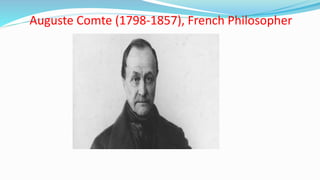
Auguste Comte (1798-1857), French Philosopher
Auguste Comte
 Comte introduced ‘Sociology’ for the first time in his famous work ‘positive
philosophy’ (6 volumes) in 1838 AD.
 Law of three stages of society :
1. the theological 2. the metaphysical 3. the ‘positive’ or ‘Scientific’ or
‘empirical’.
The four founding father of Sociology :
1. Auguste Comte (1798-1857 AD) French Philosopher
2. Herbert Spencer (1820-1903 AD), British scholar.
3. Emile Durkhein (1858-1917 AD), French thinker.
4. Max Weber (1864-1920 AD), Germany scholar and prolific writer.
Definition of Sociology
 Economics : It studies man as wealth-getter, wealth disposer/the relations
of wealth and welfare.
 History : deals with the human past in accordance with the time over.
 Anthropology: deals with human behaviour, culture etc.
 Psychology : study of human mind/ studies man as a behaving individual.
 Political Science : Studying man as a citizen, as a ruler and as being ruled.
Government, poltical parties, political system etc.
 Religion: deals with man as a spiritual being and faith in supernatural
power.
 Sociology : studies social relationships, social interactions, social
processes, social institutions etc.
Definition of Sociology
 Sociology has been defined in a number of ways by different sociologists :
 Auguste Comte : defines sociology as the science of social phenomena ‘subject to
natural and invariable laws, the discovery of which is the object of investigation.’
 Kingsley Davis : ‘Sociology is a general science of society.’
 Emile Durkheim : ‘Sociology is the systematic description and explanation of
society as a whole.’ defines sociology as the ‘Science of social institutions.’
 MacIver and Page : ‘Sociology is about social relationships, network of relationship
we call society.’
 Park: regards sociology as the sciece of collective behaviour.
 Small: defines sociology as the science of social relations.
 Marshal Jones : defines sociology as the study of man-in-relationship –to-men.
 Ogburn and Nimkoff : defines sociology as the scientific study of social life.
Definition of Sociology
 Franklin Henry Giddings : defines Sociology as the science of social
Phenomena.
 Max Weber : defines Sociology as the science which attempts the
interpretative understanding of social action in order thereby to arrive at
causal explanation of its course and effects.
 Alex Inkeless : Sociology is the study of systems of social action and of
their interactions.
 Morris Ginsberg: In the broad sense, Sociology is the study of human
interactions and inter-relations, their conditions and consequences.
 Overall, Sociology deals with social relationships, social groups. Social
interactions, social processes, social life, social activities, social
institutions etc.
Nature of Sociology
 Sociology is an Independent Science.
 Sociology is a social science and not a physical science.
 Sociology is a catagorical and not a normative discipline. (ethically
neutral)
 Sociology is Pure science as well as Applied Science.
 Sociology is relatively an abstract science but methods and methodologies
are concrete.
 Sociology is a generalising and not a particularising or individualising
science.
 Fieldwork is hallmark in sociological research.
 Finally, Sociology is Both a rational and an empirical science.
 How can Sociology help us in our lives?
Scope of Sociology (own areas of study/fields of inquiry)
 ‘Since sociology is so elastic science, it is difficult to determine just where its
boundaries begin and end, where sociology becomes social psychology and
where social psychology becomes sociology, or where economics theory
becomes sociological doctrine or bi0logical theory becomes sociological theory
something, which is impossible to decide.’
-V.F. Calberton
The main schools of thought regarding the scope of sociology.
1. The specialistic or formalistic school.
2. The synthetic school.
1. The specialistic or formalistic school : This school 0f thought is led by the
German sociologist George Simmel. The other main advocates of this school
are vierkandt, Max Weber, Small, Von wiese and Tonnies.
Scope of Sociology
 Simmel and others opine that Sociology is a pure and an independent science.
 Sociology has a limited scope and studies the certain aspects of human
relationship only.
 As a specific social science, sociology describes, classifies and anlyses the forms
of social relationships/ not their content. (eg. Social relationship competition,
sub-ordination, division of labour etc.)
 Vierkandt : The ultimate form of mental or psychic relationship that links men
to one another society. Sociology should not concern itself with the actual
contents of cultural evolution but it should confine itself to only the discovery
of the fundamental forces of charge and persistence.
 Max Weber: The aim of Sociology is to interpret social behaviour. But, Social
behaviour does not cover the whole field of human relations. Sociology should
make an analysis and classification of types of social relationships.
 Small : Sociology has only a limited field. Von wiese and Tonnies expressed
more or less the same opinion.
Scope of Sociology
Criticism of formalistic school.
The views of the formalistic school are widely criticised. Some critical
remarks may be cited here:
1. The formalistic school has unreasonably narrowed the field of sociology.
2. The distinction between the forms of social relations and their contents
is not workable.
3.Sociology is not the only science that studies the forms of social
relationships. (other sciences also do that) eg. While studying
international law----includes social relations like conflict, war, opposition,
agreement, contract etc.
4. The establishment of pure science is impractical. No Sociologist has been
able to develop a pure sociology.
Scope of Socioogy
No science can be studied in complete isolation from other sciences. More
fouces on inter-disciplinary.
 2. The Synthetic School.
 Describes sociology as a system of the social sciences.
 Wants to make sociology a general science/ not pure or special social
science. The main exponents of this school are Durkheim, Hob House,
Ginsberg and Sorokin.
 The main arguement of this school is that all parts of social life are
intimately/ closely interrelated.
 The study of one aspects is not sufficient to understand the entire
phenomenon of the society.
 Sociology should study social life as a whole.
Scope of Sociology
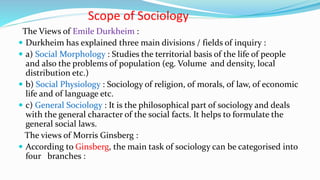
The Views of Emile Durkheim :
 Durkheim has explained three main divisions / fields of inquiry :
 a) Social Morphology : Studies the territorial basis of the life of people
and also the problems of population (eg. Volume and density, local
distribution etc.)
 b) Social Physiology : Sociology of religion, of morals, of law, of economic
life and of language etc.
 c) General Sociology : It is the philosophical part of sociology and deals
with the general character of the social facts. It helps to formulate the
general social laws.
The views of Morris Ginsberg :
 According to Ginsberg, the main task of sociology can be categorised into
four branches :
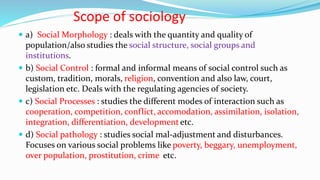
Scope of sociology
 a) Social Morphology : deals with the quantity and quality of
population/also studies the social structure, social groups and
institutions.
 b) Social Control : formal and informal means of social control such as
custom, tradition, morals, religion, convention and also law, court,
legislation etc. Deals with the regulating agencies of society.
 c) Social Processes : studies the different modes of interaction such as
cooperation, competition, conflict, accomodation, assimilation, isolation,
integration, differentiation, development etc.
 d) Social pathology : studies social mal-adjustment and disturbances.
Focuses on various social problems like poverty, beggary, unemployment,
over population, prostitution, crime etc.
Scope of sociology
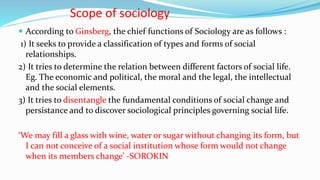
 According to Ginsberg, the chief functions of Sociology are as follows :
1) It seeks to provide a classification of types and forms of social
relationships.
2) It tries to determine the relation between different factors of social life.
Eg. The economic and political, the moral and the legal, the intellectual
and the social elements.
3) It tries to disentangle the fundamental conditions of social change and
persistance and to discover sociological principles governing social life.
‘We may fill a glass with wine, water or sugar without changing its form, but
I can not conceive of a social institution whose form would not change
when its members change’ -SOROKIN
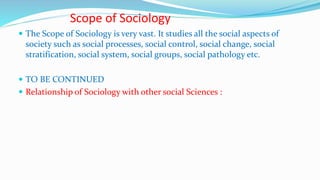
Scope of Sociology
 The Scope of Sociology is very vast. It studies all the social aspects of
society such as social processes, social control, social change, social
stratification, social system, social groups, social pathology etc.
 TO BE CONTINUED
 Relationship of Sociology with other social Sciences :
Relationship of Sociology with other social Sciences
 1. Relationship of Sociology with Anthropology.
 ‘Sociology and Anthropology are twin sisters’ –Kroebar
 Anthropos (human) +Logos (Study or science) both Greek words =Anthropology
 ‘Anthropology is the science of man and his works and behaviour’-Kroebar
 Sociology is the study of society, social relations, collective behaviour, social
interactions, social institutions and social processes.
 Both are the youngest branches of the traditional social science.
 Sociology has been enriched by the Anthropological studies.
 ‘Sociology and Anthropology are in their broadest sense one and the same.’-Hoebal.
 Sociology is benefited by Anthropological studies.
 Sociologists have to depend upon Anthropologists to understand the present social
phenomena with the help of Anthropological knowledge.
Relationship of Sociology with other social Sciences
 Famous Anthropologists Redcliff Brown, B. Malinowski, Lowie, Margaret Mead
etc. made significant contribution on sociological research.
 Sociological topics like origin of family, the beginning of marriage, private
property, the genesis of religion etc. Can be understood broadly with the help of
Anthropological knowledge.
 The knowledge of Anthropology is essential for sociologist. A society can be
explained properly by comparing various cultures, particularly, the modern with
the primitive ones.
 Anthropology/Sociology are organized into one department in some
universities.
 Sociology studies the modern, civilized and complex societies whereas
Anthropology primarily studies uneducated, illiterate, uncivilized, primitive,
indigenous and small cultural identities through physical and cultural
evolutionary perspectives. Anthropology-Past Society, Sociology-Present
Society.
Relationship of Sociology with other social Sciences
 Anthropology provides the past as well as present information to Sociology and
5-6 months or one year field work is mandatory to collect qualitative data.
Anthopologist Dor Bahadur Bista, Book : Fatalism and development
Franz Boas , founder of modern Anthropology
 Anthropology conducts micro research of the issue in small group whereas
Sociology conducts macro research in mass.
 Sociology use of observation, interview, social survey, questionnaire and other
methods and techniques in its investigations whereas Anthropology makes use
of direct observation and interviews. (participant observation method)
 Overall, Sociological finding are equally useful for Anthropological studies.
Relationship of Sociology with other social Sciences
2.Relationship of Sociology with Political Science.
 Political Science deals with political aspects like state, government, constitution,
interdependence of executive, judiciary and legislative system, sovereignty, law,
right to vote, international relations, political power, political processes,
political systems etc.
 Sociology has its roots in politics. ‘Historically, Sociology has its roots in politics
and philosophy of history.’-Ginsberg (Sociologist).
 A political Scientists must also be a sociologist.
 Sociology studies all kinds of societies- organized as well as unorganized
whereas political science studies only the politically organized societies.
 Sociology-general science/ describes man as a social animal. Political Science-
Special Social Science/describes man as a political animal.
 Sociology is quite young, but political science is an older science comparitively.
Relationship of Sociology with other social Sciences
 Sociology describes political institutions both in formal and informal
ways as parts of social system.
 How man exercises the power, builds nexus with power houses within
social structures and systems also are the research areas for sociologists.
 Political science provides political data and information to sociology.
Relationship of Sociology with other social Sciences
3. Relationship of Sociology with Economics
 Both are Social science having close relations.
 Economics is, infact, but one branch of the comprehensive science of sociology.
 Economics studies about economic activities of man.
 ‘Economics as on the one side, the study of wealth and on the other and more
important side a part of the study of man.’ –Dr. Alfred Marshall
 Economics is the wealth of science which deals with production, distribution
and consumption.
 Economics studies the interelations of purely economics factors and forces: the
relations of price and supply, money flows, input-output ratios and function of
economics organizations like banks, factories, markets, business firms,
corporations, transport etc.
Relationship of Sociology with other social Sciences
 Social relationships are also affected by economic activities. Sociology and
Economics are mutually helpful.
 According to the scholars like Sombart, Max weber, pareto and oppenheimer,
economic changes as an aspect of social change.
 Sociology=all types of social relationships/ Economics=Social relationships
having economic in character.
 Without understanding of human society, the study of economics wouldn’t be
complete.
 The society, its strucutres, its organizations, its institutions, its strength and
weakness etc. are bound to affect the economics activities of its people.
 Max weber (German Sociologist) explains how social factors, religious beliefs
and practical ethics influences the economic activities of people. ‘The
Protestant Ethic and the Spirit of Capitalism.’ by Max Weber.
Relationship of Sociology with other social Sciences
 ‘The progressive Protestant ethics provided the stimulus to rapid growth
of capitalism in the west, whereas Hinduism and Buddhism, with their so
called fatalistic approach, failed to stimulate the growth of capitalism in
the East.’ –Max Weber
 ‘Social science can be explained in terms of economics forces’-Karl Marx
(German Philosopher, writer of Communist Manifesto)
 Knowledge of Property system, division of labour, occupations, industrial
organizations etc. is provided by a sociologist to an economist.
 Labour relations, standard of living, employers-employee relations, social
classes, socio-economic planning, socio-economics refers to both
economics and sociology.
 Economics analyzes the social factors influencing economic growth.
Relationship of Sociology with other social Sciences
 Economics working with the sociologists in their study of the problems of
economics development in underdeveloped countries.
 Socio-economic problems like poverty, beggary, unemployment, over
population, unregulated industrialization to be studied by both
economists and sociologists. Combine studies of both subject could be
helpful to meet the challenges.
 Sociology has comprehensive view point towards the economic contents
as it is an important social institution of society whereas economics has
economic view point with limited contents but with specific gaze.
TO BE CONTINUED
Relationship of Sociology with other social Sciences
4. Relationship of Sociology with Psychology.
 Psychology is the study of human behaviour in society. (Intelligence, Learning, hopes, fears, the order
and the disorder of mind). Sociology is the study of society and social groups.
 ‘Psychology is the positive science of human experience and behaviour.’ –Thouless
 Social Psychology deals with the mental processes of man, considering him as a social being.
(Character of his social behaviour)
 Freud, medical doctor, conducted the research on human mind and found that three layers of mind-
Id (unconscious), Ego (Sub-conscious) and Super-ego (Conscious).
 The relationship between Sociology and psychology is close and they are mutual dependent. Sociolgy
analyzes social process whereas Psychology analyzes the mental process of man.
 Sociology is a general science, but Psychology is a specialized science.
 Sociology applies questionnaire, interview, survey etc., but Psychology applies experimental
methods.
 ‘Sociology and Psychology are not separate science.’ –Karl Pearson
 Psychology depends to sociology to know human nature and behaviour for which sociology provides
materials like the structure, organization and culture of society to which individuals belong.
 Psychologists (research on individual’s mind and behaviour) provides the findings to sociologists that
is helpful to study group behaviour.
 Psychological factors are important to understand the changes in social structure.
Relationship of Sociology with other social Sciences
 Sociology and Psychology study certain common topics : individual disorganization, crime,
Social disorganization, leadership, Conflict, Socialization, imitation, fashion etc.
 Social Psychology helps to face social problems like racial conflict, religious prejudices,
communal tensions, crimes, gambling, alcoholism. Knowledge of sociology may be useful to face
these problems.
 Deviant Patterns >> stealing, suicide, divorce , prostitution etc. which are the consequences of
our social institutions. In this case, applied social psychologist can act as an expert.
 How human personality is shaped with social environment. Which factors are responsible for
it?
 Daily 40,000-60,000 thoughts come in human mind. How such thoughts come in human mind?
Needs psychological research.
 Overall, Sociology and Psychology blended together to make knowledge empirical, rational and
holistic.
Relationship of Sociology with other social Sciences
 5.Relationship of Sociology with History.
 Sociology and History both studies social events.
 Sociology describes the contemporary society whereas History deals with
situation of past events.
 Sociology is relatively a young Social Science whereas history is an age-old Social
Science.
 Sociology is an analytical science whereas History is a descriptive science.
 Sociology is abstract in nature, but History is concrete,
 ‘History is the past sociology and sociology is the present history.’ –G.E. Howard.
 History studies human events in accordance with the time order.
 History can supply information to Sociology whereas Sociology helps history
too.
 History>> Knowledge of ancient social, political, economic and cultural matters,
which are also some areas of sociology.
Relationship of Sociology with other social Sciences
 History documents historical events, different civilizations, historical
narratives and past raw materials in a chronological ( record of events
following the order) order which are studied diachronically (dealing with
phenomena as of language and culture as they change over a period of
time) in sociological discipline.
 Overall, History provides the past events with historical dates to sociology
that makes easier to conduct comparative research.
THE END