COURSE
DESCRIPTION
• The courseintroduces students to
basic concepts, approaches, and
methods in the disciplines that
comprise the Social Sciences and
Applied Social Science. It highlights
the intersections between the social
science disciplines and the applied
social sciences while focusing on
social development concerns.
4.
CONTENT STANDARDS
• Thelearners demonstrate an understanding of the historical development, key
concepts, and approaches in the Social Sciences including its major theories,
enabling them to analyze and explain human behavior, social structures, and cultural
dynamics within diverse societal contexts.
PERFORMANCE STANDARDS
• The learner applies Social Science disciplines in explaining a social issue using a
multimedia presentation, infographic, podcast, or other relevant presentation
scheme.
5.
SOCIAL SCIENCES ASTHE
STUDY OF SOCIETY
Exploring the role of social sciences in understanding human societies
Lance Usabal
6.
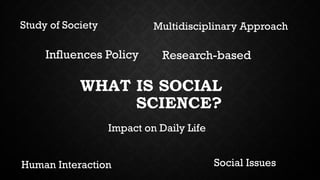
WHAT IS SOCIAL
SCIENCE?
Studyof Society Multidisciplinary Approach
Human Interaction Social Issues
Influences Policy Research-based
Impact on Daily Life
7.
WHAT IS SOCIALSCIENCE?
•Study of Society: Focuses on understanding how societies function, including
relationships, cultures, and institutions.
•Multidisciplinary Approach: Combines various fields such as sociology, psychology,
anthropology, economics, and political science to explore human behavior.
•Human Interaction: Examines how individuals and groups interact within a society
and how these interactions shape societal structures.
•Social Issues: Analyzes problems like inequality, poverty, education, crime, and
politics.
•Influences Policy: Provides insights that help guide government policies, social
programs, and laws.
•Research-based: Uses data collection methods such as surveys, experiments, and
ethnography to draw conclusions.
•Impact on Daily Life: Helps improve understanding of everyday social dynamics,
influencing education, employment, and family structures.
8.
INTRODUCTION
• Social scienceshelp us understand
human behavior, society's structure,
and how people interact.They allow
us to address societal challenges
and bring about improvements.
9.
WHAT ARE SOCIALSCIENCES?
• Social sciences focus on studying
human society and relationships.
These include sociology, psychology,
anthropology, political science,
economics, and history.
10.
KEY DISCIPLINES OFSOCIAL SCIENCES
• 1. Sociology: Study of society and behavior
• 2. Psychology: Study of the mind and human behavior
• 3. Political Science: Study of politics and governance
• 4. Economics: Study of wealth and resources
• 5. Anthropology: Study of human cultures and history
11.
ROLE OF
SOCIAL
SCIENCES IN
SOCIETY
•Social sciences provide
insights into human behavior
and help address issues like
poverty, inequality, and social
change.They also guide
decision-making in
governance and policy.
12.
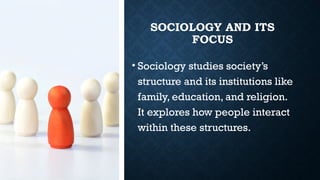
SOCIOLOGY AND ITS
FOCUS
•Sociology studies society’s
structure and its institutions like
family, education, and religion.
It explores how people interact
within these structures.
POLITICAL SCIENCE AND
GOVERNANCE
•Political science helps us
understand power dynamics in
society. It examines
governments, laws, policies,
and international relations.
15.
ECONOMICS AND SOCIALSYSTEMS
•Economics focuses on how
societies manage resources
and wealth. It examines
issues like poverty,
unemployment, and wealth
distribution.
THE RELATIONSHIP BETWEENSOCIAL
SCIENCES AND SOCIETY
•Social sciences impact policies, education,
and welfare.They help shape societal
values and address social problems by
providing data-driven solutions.
18.
SOCIAL SCIENCES AND
SOCIALISSUES
• Social sciences are used to understand and
address societal issues like poverty, inequality, and
crime.They guide policies that tackle these
problems.
• Social sciences help us understand big problems
in society, like poverty, unfair treatment, and
crime.They study why these problems happen and
how they affect people. By doing this, social
scientists provide advice on how to create rules
and programs that can fix or improve these issues.
SOCIAL SCIENCES ANDPUBLIC POLICY
• Social science research informs public policies by analyzing social
problems and recommending solutions. Examples include healthcare
reforms and educational policies.
• Social science research plays a key role in shaping public policies by
studying the issues that affect people and society. Researchers use
data and methods like surveys, interviews, and observations to explore
problems such as poverty, healthcare access, education quality, and
crime.
• Once they gather information, they analyze it to understand the causes
of these problems and how they impact communities. Based on their
findings, social scientists make recommendations for policies or
programs that could address these issues.
21.
•Healthcare Reforms: Ifresearchers find that many people
don’t have access to affordable healthcare, they might suggest
policy changes like expanding health insurance, increasing
government funding for clinics, or introducing health education
programs.These changes aim to improve the health of the
population and ensure everyone has access to care.
•Educational Policies: If studies show that students in certain
areas are struggling in school, social scientists might
recommend changes like increasing school funding, offering
additional teacher training, or implementing after-school
programs to help students succeed.
-Through this process, social science research helps create
policies that are based on evidence, which can lead to better
solutions for societal challenges.
EXAMPLES
22.
SOCIAL
SCIENCES IN
THE GLOBAL
CONTEXT
•Social sciences help us
understand global issues like
climate change, migration, and
international relations.They
address challenges affecting the
global community.
23.
SOCIAL SCIENCE ANDTECHNOLOGY
• Social scientists study how
technology affects social behavior
and communication.This includes
the impact of social media, online
networks, and digital behavior.
24.
CHALLENGES IN SOCIALSCIENCES
• Challenges in social science research include
ethical concerns, biases, and limited funding.
These issues can affect the quality and
reliability of data.
25.
CHALLENGES IN SOCIALSCIENCES
Social science research is essential for understanding and
solving societal problems, but it comes with several challenges
that can affect the accuracy and reliability of findings.These
challenges include:
1.Ethical Concerns: Social science research often involves
studying people’s behaviors, experiences, and personal lives.
Researchers must ensure they respect participants' rights and
privacy. For example, when conducting surveys or interviews,
they must protect participants' confidentiality and obtain their
consent before gathering any information. If these ethical
guidelines aren't followed, the research can be compromised,
and participants may feel uncomfortable or harmed.
26.
CHALLENGES IN SOCIALSCIENCES
2. Biases: Biases can occur when researchers allow their personal
beliefs or preferences to influence the study’s design or
interpretation of data. For instance, a researcher might unintentionally
focus on certain groups or omit others, leading to a skewed view of
the problem. Bias can also arise in the way questions are framed
during interviews or surveys.To ensure reliable results, researchers
need to strive for objectivity and fairness, but it’s challenging to
completely eliminate all biases.
27.
CHALLENGES IN SOCIALSCIENCES
3. Limited Funding: Social science research often requires
funding for tools, data collection, and analysis. However,
securing adequate financial resources can be difficult,
especially for long-term projects.Without enough funding,
researchers might not be able to gather a sufficient sample
size, use advanced technology, or carry out comprehensive
studies.This can limit the scope of their research and the
quality of their findings.
28.
THE FUTURE OFSOCIAL SCIENCES
• Social sciences will continue to grow in importance.
They will help solve global challenges like climate
change, migration, and health crises. Advancements
in research methods will also improve understanding.
29.
CONCLUSION
• Social sciencesare crucial for
understanding human
behavior and societal
structures.They guide
solutions for societal
challenges and help improve
lives.


 Most read
 Most read
 Most read