

An Introduction to
Silverlight
Dave Bost
dave.bost@microsoft.com
http://davebost.com | @davebost
Topics
   The Metro design style
   Silverlight Components
   Creating a Silverlight Application
   Silverlight and XAML
   Introduction to Silverlight Layout
   Components and Events
   Silverlight Project Templates
   ApplicationBar
   Page Navigation

2   Windows Phone
Windows Phone
Windows Phone and Metro

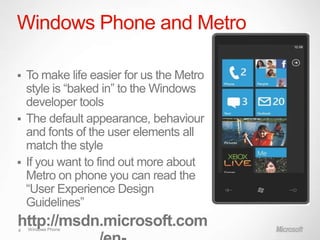
 To make life easier for us the Metro
  style is “baked in” to the Windows
  developer tools
 The default appearance, behaviour
  and fonts of the user elements all
  match the style
 If you want to find out more about
  Metro on phone you can read the
  “User Experience Design
  Guidelines”
http://msdn.microsoft.com
4   Windows Phone
Tools for the job : Graphical
Design separates the
 Great design
  graphical design aspects from
  the programming
       The designer works on the
         look and feel of the
         application
       The programmer
         implements the required
         behaviours
 Silverlight is designed to support
  this
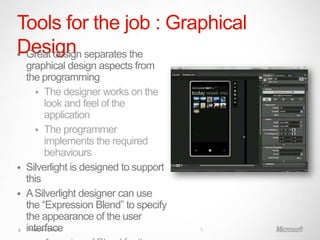
 A Silverlight designer can use
  the “Expression Blend” to specify
  the appearance of the user
5 interface
   Windows Phone                       5
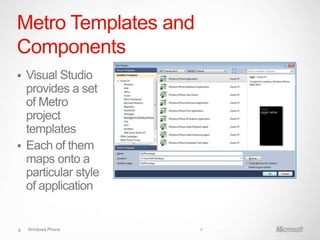
Metro Templates and
Components
 Visual Studio
  provides a set
  of Metro
  project
  templates
 Each of them
  maps onto a
  particular style
  of application


6   Windows Phone     6
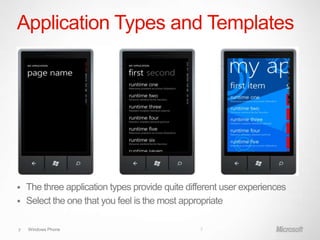
Application Types and Templates


 The three application types provide quite different user experiences
 Select the one that you feel is the most appropriate


7   Windows Phone                              7
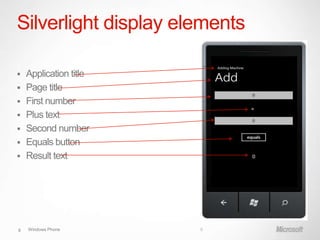
Silverlight display elements

   Application title
   Page title
   First number
   Plus text
   Second number
   Equals button
   Result text


8   Windows Phone       8
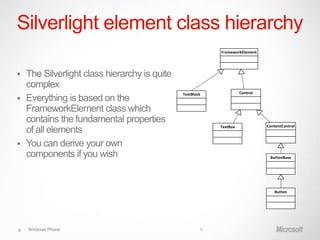
Silverlight element class hierarchy
                                                         FrameworkElement


 The Silverlight class hierarchy is quite
  complex
                                             TextBlock             Control
 Everything is based on the
  FrameworkElement class which
  contains the fundamental properties
                                                         TextBox             ContentControl
  of all elements
 You can derive your own
  components if you wish                                                      ButtonBase


                                                                                Button


9   Windows Phone                                    9
Elements in AddingMachine

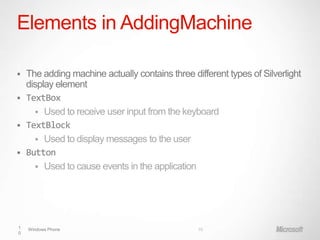
 The adding machine actually contains three different types of Silverlight
  display element
 TextBox
     Used to receive user input from the keyboard
 TextBlock
     Used to display messages to the user
 Button
     Used to cause events in the application


1   Windows Phone                              10
0
Elements and XAML
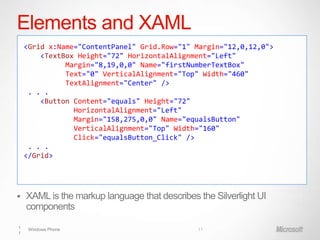
    <Grid x:Name="ContentPanel" Grid.Row="1" Margin="12,0,12,0">
        <TextBox Height="72" HorizontalAlignment="Left"
              Margin="8,19,0,0" Name="firstNumberTextBox"
              Text="0" VerticalAlignment="Top" Width="460"
              TextAlignment="Center" />
     . . .
        <Button Content="equals" Height="72"
                HorizontalAlignment="Left"
                Margin="158,275,0,0" Name="equalsButton"
                VerticalAlignment="Top" Width="160"
                Click="equalsButton_Click" />
     . . .
    </Grid>


   XAML is the markup language that describes the Silverlight UI
    components

1    Windows Phone                             11
1
Grid container element
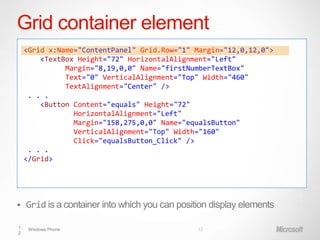
    <Grid x:Name="ContentPanel" Grid.Row="1" Margin="12,0,12,0">
        <TextBox Height="72" HorizontalAlignment="Left"
              Margin="8,19,0,0" Name="firstNumberTextBox"
              Text="0" VerticalAlignment="Top" Width="460"
              TextAlignment="Center" />
     . . .
        <Button Content="equals" Height="72"
                HorizontalAlignment="Left"
                Margin="158,275,0,0" Name="equalsButton"
                VerticalAlignment="Top" Width="160"
                Click="equalsButton_Click" />
     . . .
    </Grid>


   Grid is a container into which you can position display elements

1    Windows Phone                              12
2
TextBox element
    <Grid x:Name="ContentPanel" Grid.Row="1" Margin="12,0,12,0">
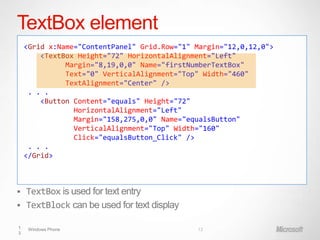
        <TextBox Height="72" HorizontalAlignment="Left"
              Margin="8,19,0,0" Name="firstNumberTextBox"
              Text="0" VerticalAlignment="Top" Width="460"
              TextAlignment="Center" />
     . . .
        <Button Content="equals" Height="72"
                HorizontalAlignment="Left"
                Margin="158,275,0,0" Name="equalsButton"
                VerticalAlignment="Top" Width="160"
                Click="equalsButton_Click" />
     . . .
    </Grid>


 TextBox is used for text entry
 TextBlock can be used for text display

1    Windows Phone                           13
3
Button element
    <Grid x:Name="ContentPanel" Grid.Row="1" Margin="12,0,12,0">
        <TextBox Height="72" HorizontalAlignment="Left"
              Margin="8,19,0,0" Name="firstNumberTextBox"
              Text="0" VerticalAlignment="Top" Width="460"
              TextAlignment="Center" />
     . . .
        <Button Content="equals" Height="72"
                HorizontalAlignment="Left"
                Margin="158,275,0,0" Name="equalsButton"
                VerticalAlignment="Top" Width="160"
                Click="equalsButton_Click" />
     . . .
    </Grid>


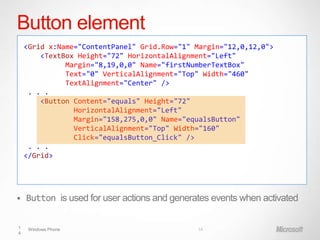
   Button is used for user actions and generates events when activated

1    Windows Phone                            14
4
Button element
    <Grid x:Name="ContentPanel" Grid.Row="1" Margin="12,0,12,0">
        <TextBox Height="72" HorizontalAlignment="Left"
              Margin="8,19,0,0" Name="firstNumberTextBox"
              Text="0" VerticalAlignment="Top" Width="460"
              TextAlignment="Center" />
     . . .
        <Button Content="equals" Height="72"
                HorizontalAlignment="Left"
                Margin="158,275,0,0" Name="equalsButton"
                VerticalAlignment="Top" Width="160"
                Click="equalsButton_Click" />
     . . .
    </Grid>


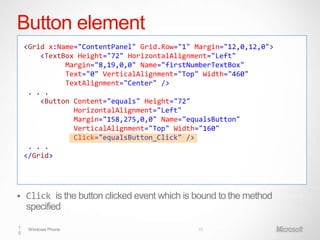
   Click is the button clicked event which is bound to the method
    specified

1    Windows Phone                             15
5
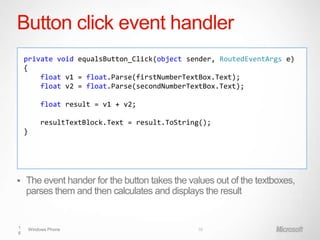
Button click event handler
    private void equalsButton_Click(object sender, RoutedEventArgs e)
    {
        float v1 = float.Parse(firstNumberTextBox.Text);
        float v2 = float.Parse(secondNumberTextBox.Text);

            float result = v1 + v2;

            resultTextBlock.Text = result.ToString();
    }


   The event hander for the button takes the values out of the textboxes,
    parses them and then calculates and displays the result


1       Windows Phone                            16
6
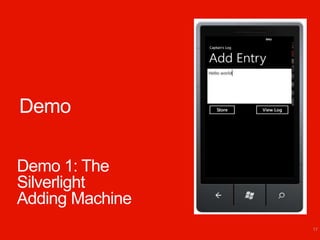
Demo

Demo 1: The
Silverlight
Adding Machine
                 17
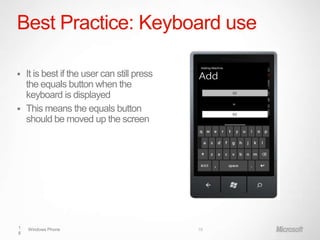
Best Practice: Keyboard use

 It is best if the user can still press
  the equals button when the
  keyboard is displayed
 This means the equals button
  should be moved up the screen


1   Windows Phone                          18
8
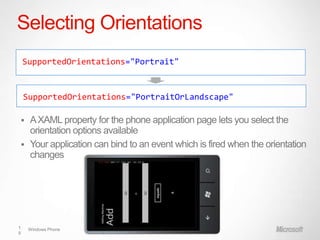
Selecting Orientations
    SupportedOrientations="Portrait"


    SupportedOrientations="PortraitOrLandscape"

     A XAML property for the phone application page lets you select the
      orientation options available
     Your application can bind to an event which is fired when the orientation
      changes


1       Windows Phone                             19
9
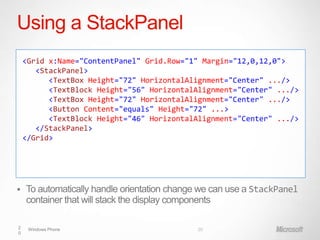
Using a StackPanel
    <Grid x:Name="ContentPanel" Grid.Row="1" Margin="12,0,12,0">
       <StackPanel>
          <TextBox Height="72" HorizontalAlignment="Center" .../>
          <TextBlock Height="56" HorizontalAlignment="Center" .../>
          <TextBox Height="72" HorizontalAlignment="Center" .../>
          <Button Content="equals" Height="72" ...>
          <TextBlock Height="46" HorizontalAlignment="Center" .../>
       </StackPanel>
    </Grid>


   To automatically handle orientation change we can use a StackPanel
    container that will stack the display components

2    Windows Phone                           20
0
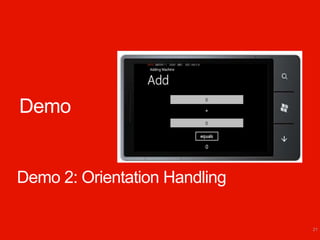
Demo


Demo 2: Orientation Handling

                               21
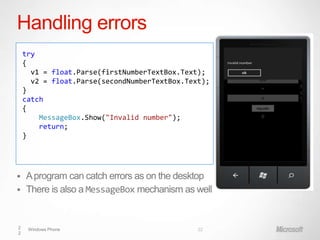
Handling errors
    try
    {
      v1 = float.Parse(firstNumberTextBox.Text);
      v2 = float.Parse(secondNumberTextBox.Text);
    }
    catch
    {
        MessageBox.Show("Invalid number");
        return;
    }


 A program can catch errors as on the desktop
 There is also a MessageBox mechanism as well


2    Windows Phone                            22
2
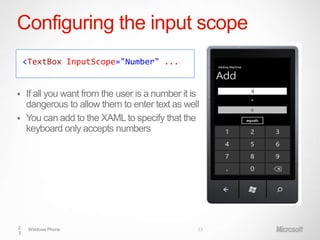
Configuring the input scope
    <TextBox InputScope="Number" ...


 If all you want from the user is a number it is
  dangerous to allow them to enter text as well
 You can add to the XAML to specify that the
  keyboard only accepts numbers


2    Windows Phone                              23
3
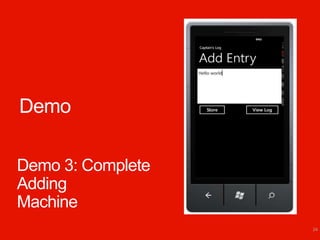
Demo

Demo 3: Complete
Adding
Machine
                   24
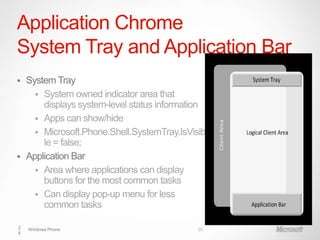
ApplicationBar
Application Chrome
System Tray and Application Bar
 System Tray
     System owned indicator area that
      displays system-level status information
     Apps can show/hide
     Microsoft.Phone.Shell.SystemTray.IsVisib
      le = false;
 Application Bar
     Area where applications can display
      buttons for the most common tasks
     Can display pop-up menu for less
      common tasks

2   Windows Phone                           26
6
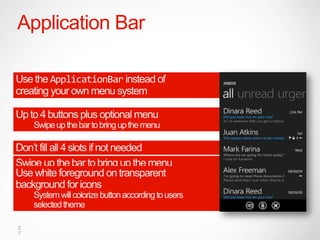
Application Bar


2
7
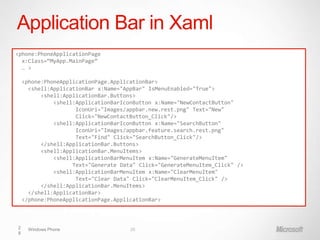
Application Bar in Xaml
<phone:PhoneApplicationPage
  x:Class=“MyApp.MainPage”
  … >

    <phone:PhoneApplicationPage.ApplicationBar>
      <shell:ApplicationBar x:Name="AppBar" IsMenuEnabled="True">
          <shell:ApplicationBar.Buttons>
              <shell:ApplicationBarIconButton x:Name="NewContactButton"
                     IconUri="Images/appbar.new.rest.png" Text="New"
                     Click="NewContactButton_Click"/>
              <shell:ApplicationBarIconButton x:Name="SearchButton"
                     IconUri="Images/appbar.feature.search.rest.png"
                     Text="Find" Click="SearchButton_Click"/>
          </shell:ApplicationBar.Buttons>
          <shell:ApplicationBar.MenuItems>
              <shell:ApplicationBarMenuItem x:Name="GenerateMenuItem"
                    Text="Generate Data" Click="GenerateMenuItem_Click" />
              <shell:ApplicationBarMenuItem x:Name="ClearMenuItem"
                     Text="Clear Data" Click="ClearMenuItem_Click" />
          </shell:ApplicationBar.MenuItems>
      </shell:ApplicationBar>
    </phone:PhoneApplicationPage.ApplicationBar>


2     Windows Phone                   28
8
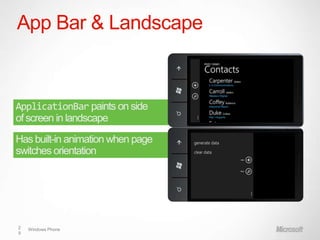
App Bar & Landscape


2   Windows Phone
9
Page Navigation
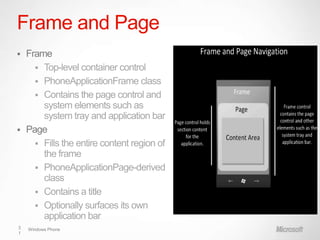
Frame and Page
 Frame
     Top-level container control
     PhoneApplicationFrame class
     Contains the page control and
      system elements such as
      system tray and application bar
 Page
     Fills the entire content region of
      the frame
     PhoneApplicationPage-derived
      class
     Contains a title
     Optionally surfaces its own
      application bar
3   Windows Phone
1
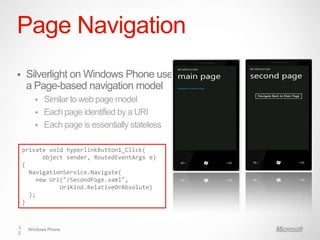
Page Navigation
    Silverlight on Windows Phone uses
     a Page-based navigation model
          Similar to web page model
          Each page identified by a URI
          Each page is essentially stateless

    private void hyperlinkButton1_Click(
           object sender, RoutedEventArgs e)
    {
      NavigationService.Navigate(
         new Uri("/SecondPage.xaml",
                UriKind.RelativeOrAbsolute)
      );
    }


3    Windows Phone
2
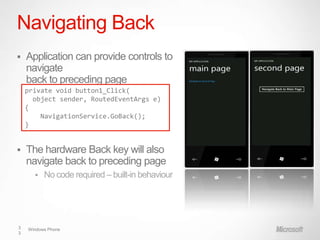
Navigating Back
   Application can provide controls to
    navigate
    back to preceding page
    private void button1_Click(
      object sender, RoutedEventArgs e)
    {
        NavigationService.GoBack();
    }


   The hardware Back key will also
    navigate back to preceding page
         No code required – built-in behaviour


3   Windows Phone
3
Demo


ApplicationBar, Page Navigation and
Pivot Control
                                      34
Review

   Windows Phone applications use Silverlight to express the design of
    their user interface
         The design is expressed in a XAML text file that identifies and
           configures display elements
         Elements can also be manipulated as code objects
   There are a set of Silverlight templates for applications and elements
    based on the Metro design
   You can create multiple Silverlight pages and add them to your project
   Navigation to pages is performed on the basis of uri (Uniform Resource
    Indicator) values
   The back button normally navigates back to the source page, but this
    can be overridden

3
    The uri can contain simple text messages
     Windows Phone                                 35
5
   Pages can share larger objects in the App.xaml page
Bonus
  (and really good to know)
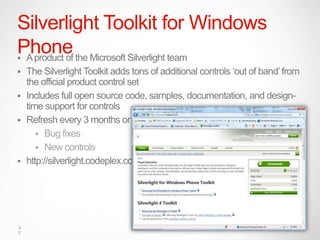
Silverlight Toolkit for Windows
Phone the Microsoft Silverlight team
A product of
 The Silverlight Toolkit adds tons of additional controls „out of band‟ from
  the official product control set
 Includes full open source code, samples, documentation, and design-
  time support for controls
 Refresh every 3 months or so
      Bug fixes
      New controls
 http://silverlight.codeplex.com


3
7
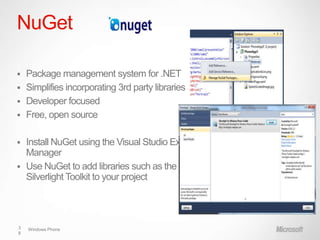
NuGet

 Package management system for .NET
 Simplifies incorporating 3rd party libraries
 Developer focused
 Free, open source


 Install NuGet using the Visual Studio Extension
  Manager
 Use NuGet to add libraries such as the
  Silverlight Toolkit to your project


3   Windows Phone
8
Q&A

Introduction to Silverlight for Windows Phone

  • 1.
    An Introduction to Silverlight DaveBost dave.bost@microsoft.com http://davebost.com | @davebost
  • 2.
    Topics  The Metro design style  Silverlight Components  Creating a Silverlight Application  Silverlight and XAML  Introduction to Silverlight Layout  Components and Events  Silverlight Project Templates  ApplicationBar  Page Navigation 2 Windows Phone
  • 3.
  • 4.
    Windows Phone andMetro  To make life easier for us the Metro style is “baked in” to the Windows developer tools  The default appearance, behaviour and fonts of the user elements all match the style  If you want to find out more about Metro on phone you can read the “User Experience Design Guidelines” http://msdn.microsoft.com 4 Windows Phone
  • 5.
    Tools for thejob : Graphical Design separates the  Great design graphical design aspects from the programming  The designer works on the look and feel of the application  The programmer implements the required behaviours  Silverlight is designed to support this  A Silverlight designer can use the “Expression Blend” to specify the appearance of the user 5 interface Windows Phone 5
  • 6.
    Metro Templates and Components Visual Studio provides a set of Metro project templates  Each of them maps onto a particular style of application 6 Windows Phone 6
  • 7.
    Application Types andTemplates  The three application types provide quite different user experiences  Select the one that you feel is the most appropriate 7 Windows Phone 7
  • 8.
    Silverlight display elements  Application title  Page title  First number  Plus text  Second number  Equals button  Result text 8 Windows Phone 8
  • 9.
    Silverlight element classhierarchy FrameworkElement  The Silverlight class hierarchy is quite complex TextBlock Control  Everything is based on the FrameworkElement class which contains the fundamental properties TextBox ContentControl of all elements  You can derive your own components if you wish ButtonBase Button 9 Windows Phone 9
  • 10.
    Elements in AddingMachine The adding machine actually contains three different types of Silverlight display element  TextBox  Used to receive user input from the keyboard  TextBlock  Used to display messages to the user  Button  Used to cause events in the application 1 Windows Phone 10 0
  • 11.
    Elements and XAML <Grid x:Name="ContentPanel" Grid.Row="1" Margin="12,0,12,0"> <TextBox Height="72" HorizontalAlignment="Left" Margin="8,19,0,0" Name="firstNumberTextBox" Text="0" VerticalAlignment="Top" Width="460" TextAlignment="Center" /> . . . <Button Content="equals" Height="72" HorizontalAlignment="Left" Margin="158,275,0,0" Name="equalsButton" VerticalAlignment="Top" Width="160" Click="equalsButton_Click" /> . . . </Grid>  XAML is the markup language that describes the Silverlight UI components 1 Windows Phone 11 1
  • 12.
    Grid container element <Grid x:Name="ContentPanel" Grid.Row="1" Margin="12,0,12,0"> <TextBox Height="72" HorizontalAlignment="Left" Margin="8,19,0,0" Name="firstNumberTextBox" Text="0" VerticalAlignment="Top" Width="460" TextAlignment="Center" /> . . . <Button Content="equals" Height="72" HorizontalAlignment="Left" Margin="158,275,0,0" Name="equalsButton" VerticalAlignment="Top" Width="160" Click="equalsButton_Click" /> . . . </Grid>  Grid is a container into which you can position display elements 1 Windows Phone 12 2
  • 13.
    TextBox element <Grid x:Name="ContentPanel" Grid.Row="1" Margin="12,0,12,0"> <TextBox Height="72" HorizontalAlignment="Left" Margin="8,19,0,0" Name="firstNumberTextBox" Text="0" VerticalAlignment="Top" Width="460" TextAlignment="Center" /> . . . <Button Content="equals" Height="72" HorizontalAlignment="Left" Margin="158,275,0,0" Name="equalsButton" VerticalAlignment="Top" Width="160" Click="equalsButton_Click" /> . . . </Grid>  TextBox is used for text entry  TextBlock can be used for text display 1 Windows Phone 13 3
  • 14.
    Button element <Grid x:Name="ContentPanel" Grid.Row="1" Margin="12,0,12,0"> <TextBox Height="72" HorizontalAlignment="Left" Margin="8,19,0,0" Name="firstNumberTextBox" Text="0" VerticalAlignment="Top" Width="460" TextAlignment="Center" /> . . . <Button Content="equals" Height="72" HorizontalAlignment="Left" Margin="158,275,0,0" Name="equalsButton" VerticalAlignment="Top" Width="160" Click="equalsButton_Click" /> . . . </Grid>  Button is used for user actions and generates events when activated 1 Windows Phone 14 4
  • 15.
    Button element <Grid x:Name="ContentPanel" Grid.Row="1" Margin="12,0,12,0"> <TextBox Height="72" HorizontalAlignment="Left" Margin="8,19,0,0" Name="firstNumberTextBox" Text="0" VerticalAlignment="Top" Width="460" TextAlignment="Center" /> . . . <Button Content="equals" Height="72" HorizontalAlignment="Left" Margin="158,275,0,0" Name="equalsButton" VerticalAlignment="Top" Width="160" Click="equalsButton_Click" /> . . . </Grid>  Click is the button clicked event which is bound to the method specified 1 Windows Phone 15 5
  • 16.
    Button click eventhandler private void equalsButton_Click(object sender, RoutedEventArgs e) { float v1 = float.Parse(firstNumberTextBox.Text); float v2 = float.Parse(secondNumberTextBox.Text); float result = v1 + v2; resultTextBlock.Text = result.ToString(); }  The event hander for the button takes the values out of the textboxes, parses them and then calculates and displays the result 1 Windows Phone 16 6
  • 17.
  • 18.
    Best Practice: Keyboarduse  It is best if the user can still press the equals button when the keyboard is displayed  This means the equals button should be moved up the screen 1 Windows Phone 18 8
  • 19.
    Selecting Orientations SupportedOrientations="Portrait" SupportedOrientations="PortraitOrLandscape"  A XAML property for the phone application page lets you select the orientation options available  Your application can bind to an event which is fired when the orientation changes 1 Windows Phone 19 9
  • 20.
    Using a StackPanel <Grid x:Name="ContentPanel" Grid.Row="1" Margin="12,0,12,0"> <StackPanel> <TextBox Height="72" HorizontalAlignment="Center" .../> <TextBlock Height="56" HorizontalAlignment="Center" .../> <TextBox Height="72" HorizontalAlignment="Center" .../> <Button Content="equals" Height="72" ...> <TextBlock Height="46" HorizontalAlignment="Center" .../> </StackPanel> </Grid>  To automatically handle orientation change we can use a StackPanel container that will stack the display components 2 Windows Phone 20 0
  • 21.
  • 22.
    Handling errors try { v1 = float.Parse(firstNumberTextBox.Text); v2 = float.Parse(secondNumberTextBox.Text); } catch { MessageBox.Show("Invalid number"); return; }  A program can catch errors as on the desktop  There is also a MessageBox mechanism as well 2 Windows Phone 22 2
  • 23.
    Configuring the inputscope <TextBox InputScope="Number" ...  If all you want from the user is a number it is dangerous to allow them to enter text as well  You can add to the XAML to specify that the keyboard only accepts numbers 2 Windows Phone 23 3
  • 24.
  • 25.
  • 26.
    Application Chrome System Trayand Application Bar  System Tray  System owned indicator area that displays system-level status information  Apps can show/hide  Microsoft.Phone.Shell.SystemTray.IsVisib le = false;  Application Bar  Area where applications can display buttons for the most common tasks  Can display pop-up menu for less common tasks 2 Windows Phone 26 6
  • 27.
  • 28.
    Application Bar inXaml <phone:PhoneApplicationPage x:Class=“MyApp.MainPage” … > <phone:PhoneApplicationPage.ApplicationBar> <shell:ApplicationBar x:Name="AppBar" IsMenuEnabled="True"> <shell:ApplicationBar.Buttons> <shell:ApplicationBarIconButton x:Name="NewContactButton" IconUri="Images/appbar.new.rest.png" Text="New" Click="NewContactButton_Click"/> <shell:ApplicationBarIconButton x:Name="SearchButton" IconUri="Images/appbar.feature.search.rest.png" Text="Find" Click="SearchButton_Click"/> </shell:ApplicationBar.Buttons> <shell:ApplicationBar.MenuItems> <shell:ApplicationBarMenuItem x:Name="GenerateMenuItem" Text="Generate Data" Click="GenerateMenuItem_Click" /> <shell:ApplicationBarMenuItem x:Name="ClearMenuItem" Text="Clear Data" Click="ClearMenuItem_Click" /> </shell:ApplicationBar.MenuItems> </shell:ApplicationBar> </phone:PhoneApplicationPage.ApplicationBar> 2 Windows Phone 28 8
  • 29.
    App Bar &Landscape 2 Windows Phone 9
  • 30.
  • 31.
    Frame and Page Frame  Top-level container control  PhoneApplicationFrame class  Contains the page control and system elements such as system tray and application bar  Page  Fills the entire content region of the frame  PhoneApplicationPage-derived class  Contains a title  Optionally surfaces its own application bar 3 Windows Phone 1
  • 32.
    Page Navigation  Silverlight on Windows Phone uses a Page-based navigation model  Similar to web page model  Each page identified by a URI  Each page is essentially stateless private void hyperlinkButton1_Click( object sender, RoutedEventArgs e) { NavigationService.Navigate( new Uri("/SecondPage.xaml", UriKind.RelativeOrAbsolute) ); } 3 Windows Phone 2
  • 33.
    Navigating Back  Application can provide controls to navigate back to preceding page private void button1_Click( object sender, RoutedEventArgs e) { NavigationService.GoBack(); }  The hardware Back key will also navigate back to preceding page  No code required – built-in behaviour 3 Windows Phone 3
  • 34.
  • 35.
    Review  Windows Phone applications use Silverlight to express the design of their user interface  The design is expressed in a XAML text file that identifies and configures display elements  Elements can also be manipulated as code objects  There are a set of Silverlight templates for applications and elements based on the Metro design  You can create multiple Silverlight pages and add them to your project  Navigation to pages is performed on the basis of uri (Uniform Resource Indicator) values  The back button normally navigates back to the source page, but this can be overridden  3 The uri can contain simple text messages Windows Phone 35 5  Pages can share larger objects in the App.xaml page
  • 36.
    Bonus (andreally good to know)
  • 37.
    Silverlight Toolkit forWindows Phone the Microsoft Silverlight team A product of  The Silverlight Toolkit adds tons of additional controls „out of band‟ from the official product control set  Includes full open source code, samples, documentation, and design- time support for controls  Refresh every 3 months or so  Bug fixes  New controls  http://silverlight.codeplex.com 3 7
  • 38.
    NuGet  Package managementsystem for .NET  Simplifies incorporating 3rd party libraries  Developer focused  Free, open source  Install NuGet using the Visual Studio Extension Manager  Use NuGet to add libraries such as the Silverlight Toolkit to your project 3 Windows Phone 8
  • 39.