Cardiogenic Shock and
Hemodynamics
DR DODIYI-MANUEL ST
Outline
• Overview of shock
• Hemodynamic Parameters
• PA catheter, complications
• Differentiating Types of Shock
• Cardiogenic Shock
• Etiologies
• Pathophysiology
• Clinical Findings
• Treatment
introduction
• Cardiogenic shock is a life threatening emergency
• characterized by systemic hypoperfusion due to severe
• depression of the cardiac index(<2.2L/min/m2 and sustained
• systolic arterial hypotension(<90mmHg) despite an elevated
• filling pressure( pulmonary cappilary wedge pressure PCWP)
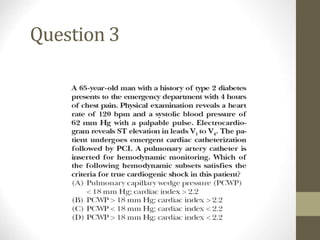
(> 18mmHg)
SHOCK=InadequateTissuePerfusion
• Mechanisms:
• Inadequate oxygen delivery
• Release of inflammatory mediators
• Further microvascular changes, compromised blood flow and
further cellular hypoperfusion
• Clinical Manifestations:
• Multiple organ failure
• Hypotension
Hemodynamic Parameters
• Systemic Vascular Resistance (SVR)
• Cardiac Output (CO)
• Mixed Venous Oxygen Saturation (SvO2)
• Pulmonary Capillary Wedge Pressure (PCWP)
• Central Venous Pressure (CVP)
pathophysiolgy
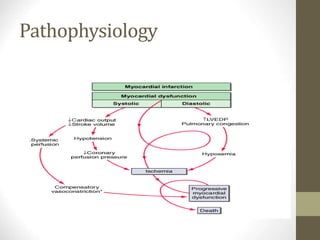
• CS is characterized by a vicious cycle which ↓ myocardial
contractility due to ischemia → ↓CO, & ↓BP →SV& diastolic
LV end diastolic pressure & progressive myocardial dysfxn.
• Inflammatory cytokines, inducible nitric oxide synthase,
perryoxynitrite. Lactic acidosis from poor perfussionand
hypoxemia from pulmonary edema → pump failure,
myocardial ischemia.
• Severe acidosis <7.25 reduces efficacy of endogenous &
exogenously administered catecholamines.
• Refractory ventricular / atrial tachyarrythmias exacerbate CS.
Clinical features
• Chestpain
• Dyspnoea
• Pallor
• diaphoretic
• Altered sensorium
• Somnolence
• Cold extremeties
• Confusion, agitation
• Weak, rapid or absent pulse.
• PR 90-110bpm, severe bradycardia
• Oliguria (UO < 30ml/hr)
Cfxs
• Soft S1 , S3 gallop
• Systolic murmur MR, VSD.
• Crepitation if there is pulm oedema.
• Laboratory Investigations
• Increased WBC ± left shift
• ↑ Urea & creatinine , ↓ HCO3
• ↑ transaminases
• ↑CKMB, troponin I & T
• CXR – fxs of acute pulmonary edema.
• Normal heart size - !st MI, Enlarged – previous MI
• Echo – left → Right shunt (VSD)
AR, Tamponade, MR
Treatment
• Medications
• Aortic counterpulsation
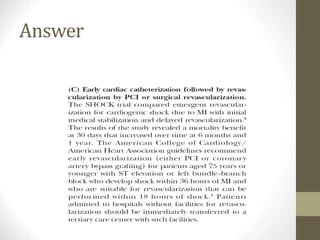
• Reperfussion, revascularization
• RVI- caution IV fluid
• IABD
• Repair of septal rupture.
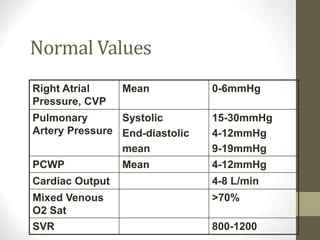
Normal Values
Right Atrial
Pressure, CVP
Mean 0-6mmHg
Pulmonary
Artery Pressure
Systolic
End-diastolic
mean
15-30mmHg
4-12mmHg
9-19mmHg
PCWP Mean 4-12mmHg
Cardiac Output 4-8 L/min
Mixed Venous
O2 Sat
>70%
SVR 800-1200
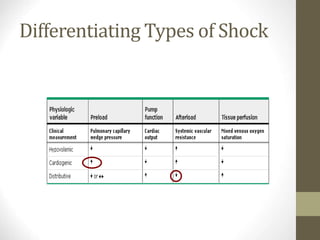
Differentiating Types of Shock
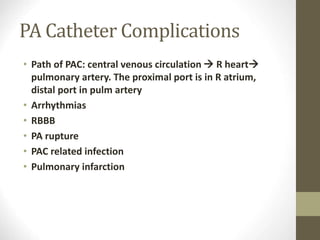
PA Catheter Complications
• Path of PAC: central venous circulation  R heart
pulmonary artery. The proximal port is in R atrium,
distal port in pulm artery
• Arrhythmias
• RBBB
• PA rupture
• PAC related infection
• Pulmonary infarction
Cardiogenic Shock
• Systemic hypoperfusion secondary to severe depression of
cardiac output and sustained systolic arterial hypotension
despite elevated filling pressures.
Cardiogenic Shock
• Etiologies
• Pathophysiology
• Clinical/Hemodynamic Characteristics
• Treatment Options
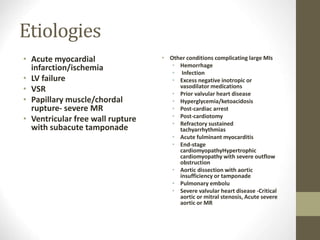
Etiologies
• Acute myocardial
infarction/ischemia
• LV failure
• VSR
• Papillary muscle/chordal
rupture- severe MR
• Ventricular free wall rupture
with subacute tamponade
• Other conditions complicating large MIs
• Hemorrhage
• Infection
• Excess negative inotropic or
vasodilator medications
• Prior valvular heart disease
• Hyperglycemia/ketoacidosis
• Post-cardiac arrest
• Post-cardiotomy
• Refractory sustained
tachyarrhythmias
• Acute fulminant myocarditis
• End-stage
cardiomyopathyHypertrophic
cardiomyopathy with severe outflow
obstruction
• Aortic dissection with aortic
insufficiency or tamponade
• Pulmonary embolu
• Severe valvular heart disease -Critical
aortic or mitral stenosis, Acute severe
aortic or MR
Pathophysiology
Clinical Findings
• Physical Exam: elevated JVP, +S3, rales, oliguria, acute
pulmonary edema
• Hemodynamics: dec CO, inc SVR, dec SvO2
• Initial evaluation: hemodynamics (PA catheter),
echocardiography, angiography
4 Potential Therapies
• Pressors
• Intra-aortic Balloon Pump (IABP)
• Fibrinolytics
• Revascularization: CABG/PCI
• Refractory shock: ventricular assist device, cardiac
transplantation
Pressors do not change
outcome
• Dopamine
• <2 renal vascular dilation
• <2-10 +chronotropic/inotropic (beta effects)
• >10 vasoconstriction (alpha effects)
• Dobutamine – positive inotrope, vasodilates,
arrhythmogenic at higher doses
• Norepinephrine (Levophed): vasoconstriction, inotropic
stimulant. Should only be used for refractory hypotension
with dec SVR.
• Vasopression – vasoconstriction
• VASO and LEVO should only be used as a last resort
IABP is a temporizing measure
• Augments coronary blood flow in diastole
• Balloon collapse in systole creates a vacuum effect 
decreases afterload
• Decrease myocardial oxygen demand
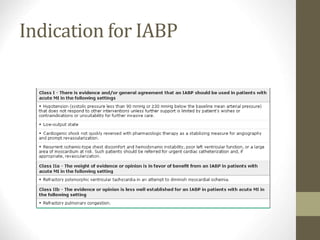
Indication for IABP
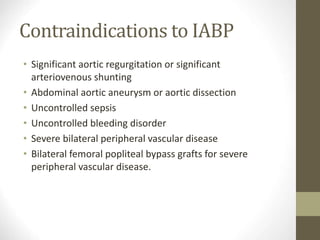
Contraindications to IABP
• Significant aortic regurgitation or significant
arteriovenous shunting
• Abdominal aortic aneurysm or aortic dissection
• Uncontrolled sepsis
• Uncontrolled bleeding disorder
• Severe bilateral peripheral vascular disease
• Bilateral femoral popliteal bypass grafts for severe
peripheral vascular disease.
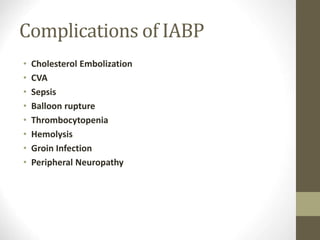
Complications of IABP
• Cholesterol Embolization
• CVA
• Sepsis
• Balloon rupture
• Thrombocytopenia
• Hemolysis
• Groin Infection
• Peripheral Neuropathy
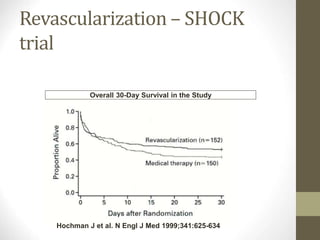
Revascularization – SHOCK
trial
Overall 30-Day Survival in the Study
Hochman J et al. N Engl J Med 1999;341:625-634
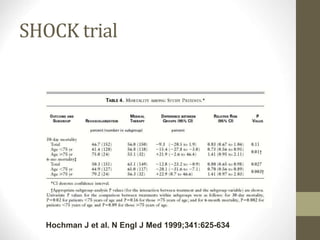
SHOCK trial
Hochman J et al. N Engl J Med 1999;341:625-634
Copyright restrictions may apply.
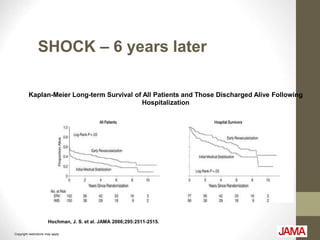
Hochman, J. S. et al. JAMA 2006;295:2511-2515.
Kaplan-Meier Long-term Survival of All Patients and Those Discharged Alive Following
Hospitalization
SHOCK – 6 years later
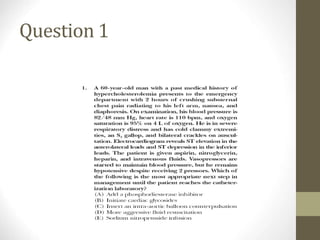
Question 1
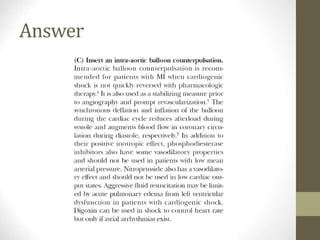
Answer
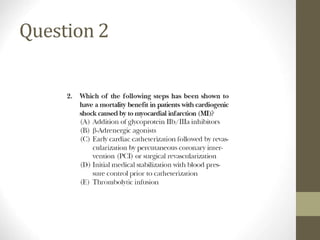
Question 2
Answer
Question 3
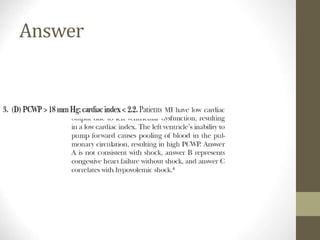
Answer

Cardiogenic_Shock.ppt

  • 1.
  • 2.
    Outline • Overview ofshock • Hemodynamic Parameters • PA catheter, complications • Differentiating Types of Shock • Cardiogenic Shock • Etiologies • Pathophysiology • Clinical Findings • Treatment
  • 3.
    introduction • Cardiogenic shockis a life threatening emergency • characterized by systemic hypoperfusion due to severe • depression of the cardiac index(<2.2L/min/m2 and sustained • systolic arterial hypotension(<90mmHg) despite an elevated • filling pressure( pulmonary cappilary wedge pressure PCWP) (> 18mmHg)
  • 4.
    SHOCK=InadequateTissuePerfusion • Mechanisms: • Inadequateoxygen delivery • Release of inflammatory mediators • Further microvascular changes, compromised blood flow and further cellular hypoperfusion • Clinical Manifestations: • Multiple organ failure • Hypotension
  • 5.
    Hemodynamic Parameters • SystemicVascular Resistance (SVR) • Cardiac Output (CO) • Mixed Venous Oxygen Saturation (SvO2) • Pulmonary Capillary Wedge Pressure (PCWP) • Central Venous Pressure (CVP)
  • 6.
    pathophysiolgy • CS ischaracterized by a vicious cycle which ↓ myocardial contractility due to ischemia → ↓CO, & ↓BP →SV& diastolic LV end diastolic pressure & progressive myocardial dysfxn. • Inflammatory cytokines, inducible nitric oxide synthase, perryoxynitrite. Lactic acidosis from poor perfussionand hypoxemia from pulmonary edema → pump failure, myocardial ischemia. • Severe acidosis <7.25 reduces efficacy of endogenous & exogenously administered catecholamines. • Refractory ventricular / atrial tachyarrythmias exacerbate CS.
  • 7.
    Clinical features • Chestpain •Dyspnoea • Pallor • diaphoretic • Altered sensorium • Somnolence • Cold extremeties • Confusion, agitation • Weak, rapid or absent pulse. • PR 90-110bpm, severe bradycardia • Oliguria (UO < 30ml/hr)
  • 8.
    Cfxs • Soft S1, S3 gallop • Systolic murmur MR, VSD. • Crepitation if there is pulm oedema. • Laboratory Investigations • Increased WBC ± left shift • ↑ Urea & creatinine , ↓ HCO3 • ↑ transaminases • ↑CKMB, troponin I & T • CXR – fxs of acute pulmonary edema. • Normal heart size - !st MI, Enlarged – previous MI • Echo – left → Right shunt (VSD) AR, Tamponade, MR
  • 9.
    Treatment • Medications • Aorticcounterpulsation • Reperfussion, revascularization • RVI- caution IV fluid • IABD • Repair of septal rupture.
  • 10.
    Normal Values Right Atrial Pressure,CVP Mean 0-6mmHg Pulmonary Artery Pressure Systolic End-diastolic mean 15-30mmHg 4-12mmHg 9-19mmHg PCWP Mean 4-12mmHg Cardiac Output 4-8 L/min Mixed Venous O2 Sat >70% SVR 800-1200
  • 11.
  • 12.
    PA Catheter Complications •Path of PAC: central venous circulation  R heart pulmonary artery. The proximal port is in R atrium, distal port in pulm artery • Arrhythmias • RBBB • PA rupture • PAC related infection • Pulmonary infarction
  • 13.
    Cardiogenic Shock • Systemichypoperfusion secondary to severe depression of cardiac output and sustained systolic arterial hypotension despite elevated filling pressures.
  • 14.
    Cardiogenic Shock • Etiologies •Pathophysiology • Clinical/Hemodynamic Characteristics • Treatment Options
  • 15.
    Etiologies • Acute myocardial infarction/ischemia •LV failure • VSR • Papillary muscle/chordal rupture- severe MR • Ventricular free wall rupture with subacute tamponade • Other conditions complicating large MIs • Hemorrhage • Infection • Excess negative inotropic or vasodilator medications • Prior valvular heart disease • Hyperglycemia/ketoacidosis • Post-cardiac arrest • Post-cardiotomy • Refractory sustained tachyarrhythmias • Acute fulminant myocarditis • End-stage cardiomyopathyHypertrophic cardiomyopathy with severe outflow obstruction • Aortic dissection with aortic insufficiency or tamponade • Pulmonary embolu • Severe valvular heart disease -Critical aortic or mitral stenosis, Acute severe aortic or MR
  • 16.
  • 17.
    Clinical Findings • PhysicalExam: elevated JVP, +S3, rales, oliguria, acute pulmonary edema • Hemodynamics: dec CO, inc SVR, dec SvO2 • Initial evaluation: hemodynamics (PA catheter), echocardiography, angiography
  • 18.
    4 Potential Therapies •Pressors • Intra-aortic Balloon Pump (IABP) • Fibrinolytics • Revascularization: CABG/PCI • Refractory shock: ventricular assist device, cardiac transplantation
  • 19.
    Pressors do notchange outcome • Dopamine • <2 renal vascular dilation • <2-10 +chronotropic/inotropic (beta effects) • >10 vasoconstriction (alpha effects) • Dobutamine – positive inotrope, vasodilates, arrhythmogenic at higher doses • Norepinephrine (Levophed): vasoconstriction, inotropic stimulant. Should only be used for refractory hypotension with dec SVR. • Vasopression – vasoconstriction • VASO and LEVO should only be used as a last resort
  • 20.
    IABP is atemporizing measure • Augments coronary blood flow in diastole • Balloon collapse in systole creates a vacuum effect  decreases afterload • Decrease myocardial oxygen demand
  • 21.
  • 22.
    Contraindications to IABP •Significant aortic regurgitation or significant arteriovenous shunting • Abdominal aortic aneurysm or aortic dissection • Uncontrolled sepsis • Uncontrolled bleeding disorder • Severe bilateral peripheral vascular disease • Bilateral femoral popliteal bypass grafts for severe peripheral vascular disease.
  • 23.
    Complications of IABP •Cholesterol Embolization • CVA • Sepsis • Balloon rupture • Thrombocytopenia • Hemolysis • Groin Infection • Peripheral Neuropathy
  • 24.
    Revascularization – SHOCK trial Overall30-Day Survival in the Study Hochman J et al. N Engl J Med 1999;341:625-634
  • 25.
    SHOCK trial Hochman Jet al. N Engl J Med 1999;341:625-634
  • 26.
    Copyright restrictions mayapply. Hochman, J. S. et al. JAMA 2006;295:2511-2515. Kaplan-Meier Long-term Survival of All Patients and Those Discharged Alive Following Hospitalization SHOCK – 6 years later
  • 27.
  • 28.
  • 29.
  • 30.
  • 31.
  • 32.