Lesson 1.1
Introduction to Sets
Learning Competency
At the end of the lesson, the learners should be able
to illustrate well-defined sets, subsets, universal sets,
null set, cardinality of sets, union and intersection of
sets and the difference of two sets.
Objectives
At the end of this lesson, the learners should be able to
do the following:
● Define a set.
● Represent a set using roster and set-builder forms.
● List all the subsets of a set.
● Solve word problems involving sets.
Studying the concept of sets is inevitable to
learning algebra and other mathematical
concepts. In fact, we are always surrounded by
sets and its applications in our daily life.
At home, the most
relevant example of
sets is in the kitchen.
Plates and bowls kept
separate from
glasses, and utensil
sets are stored
separately.
The application of sets in
businesses is also very useful
in planning and operations.
Set is a vital part in
categorizing or grouping
several items as well as
comparing and contrasting
them.
In this lesson, you will learn the basic concept of sets including
the subsets, universal sets, null set, and cardinality of sets.
Essential Questions
● How do you represent a set?
● How do you write the subsets of a given set?
Learn about It!
It is a collection of well-defined and distinct objects.
Set
Learn about It!
•
Set
Learn about It!
In this form, all elements of a set are listed and enclosed in
braces.
Elements are separated by a comma.
Roster Form
Learn about It!
•
Set
Learn about It!
•
Roster Form
Learn about It!
In this form, a common property of all the elements of a set is
written.
Set-builder Form
Learn about It!
•
Set-builder Form
Learn about It!
•
Subset
Learn about It!
•
Subset
Learn about It!
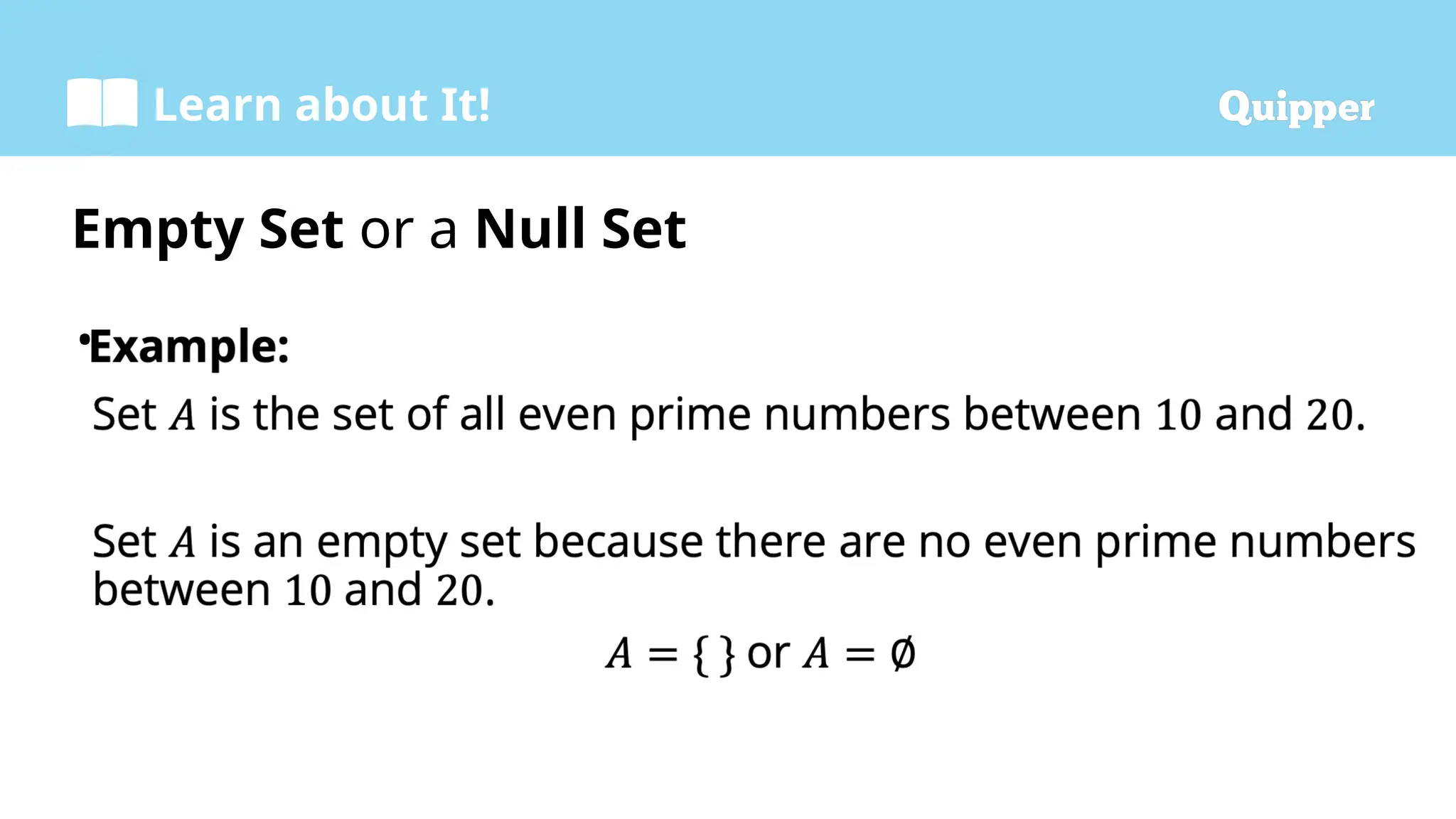
A set with no elements.
Empty Set or a Null Set
Learn about It!
•
Empty Set or a Null Set
Learn about It!
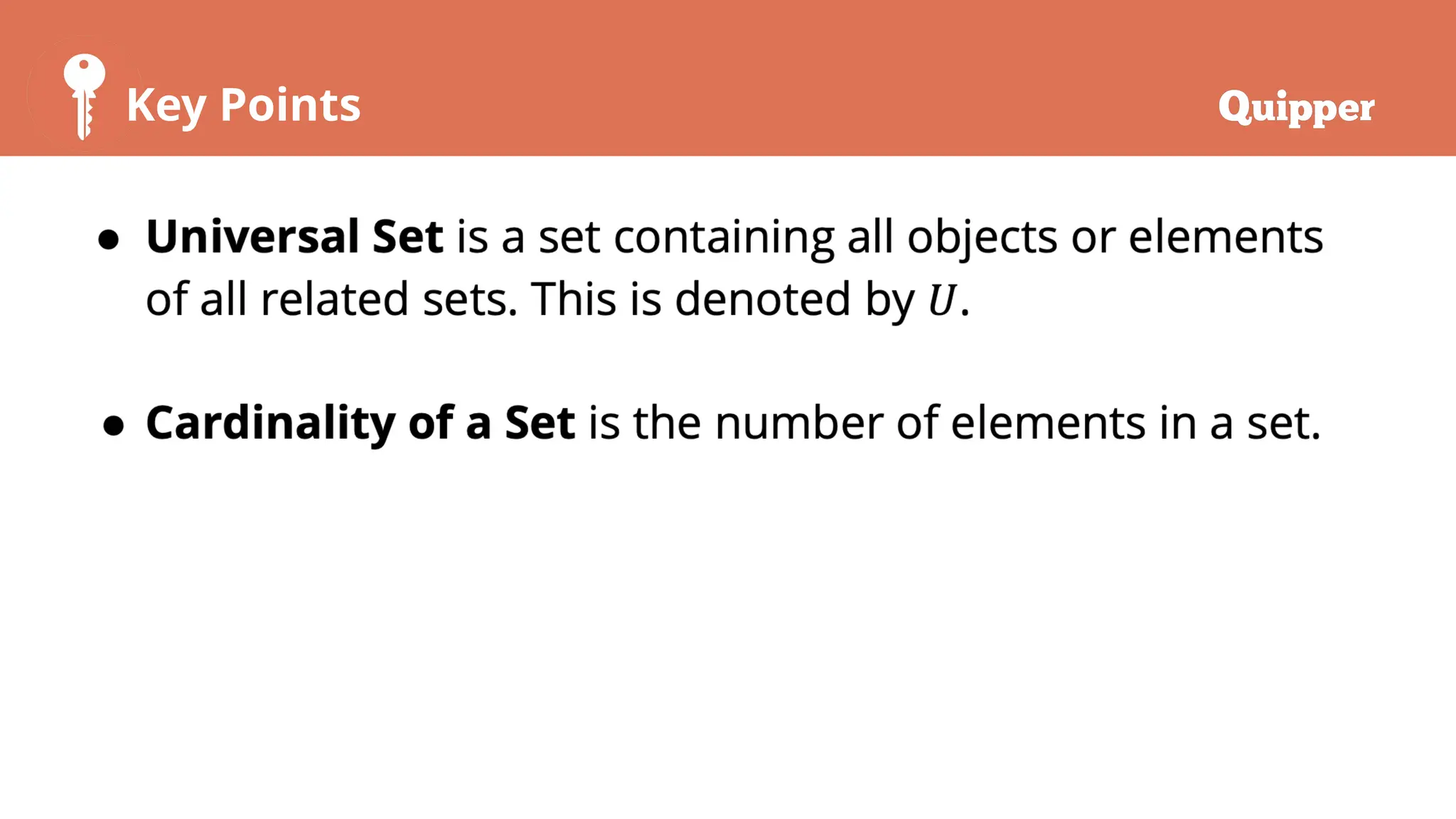
The set containing all objects or elements and of which all other
sets are subsets.
Learn about It!
•
Learn about It!
•
Cardinality of a Set
Learn about It!
•
Cardinality of a Set
Try it!
Let’s Practice
Solution to Let’s Practice
Try it!
Let’s Practice
Solution to Let’s Practice
Example 2: Set consists of all positive multiples of 3 less
𝐴
than 26 and set consists of all positive multiples of 8 less
𝐵
than 89. Find | | and | |.
𝐴 𝐵
Solution to Let’s Practice
Example 2: Set consists of all positive multiples of 3 less
𝐴
than 26 and set consists of all positive multiples of 8 less
𝐵
than 89. Find | | and | |.
𝐴 𝐵
Try It!
Individual Practice:
Try It!
Group Practice: To be done by 2 to 5 groups
Among six students in a class, namely, Jack, Karlo, Lexis,
Mario, Nathan, and Owen, only Jack, Lexis, and Mario love to
play basketball. Karlo, Nathan, and Owen, on the other
hand, love to play football. Define set as the set of
𝐴
students who love to play basketball and set as the set of
𝐵
students who love to play football. If the universal set
contains all students among them who love basketball or
football, determine the universal set.
Key Points
● A set is a collection of well-defined and distinct objects.
●A set is in roster form if all elements of a set are listed
and enclosed in braces. The elements are separated by a
comma.
● A set is in set-builder form when a common property of
all the elements of a set is written.
Key Points
●A set is said to be a subset of another set if all the
elements of it are contained in another set.
● Proper Subset is a subset which does not contain all the
same elements of a set.
●Empty or Null Set is a set with no elements.
Key Points
Bibliography
Garneau, Marc, et al. Math Makes Sense 7.USA: Pearson Education Canada, 2007.
“Representation of a Set.” Math Only Math. Retrieved 13 January 2019 from
https://www.math-only-math.com/representation-of-a-set.html

introduction to sets grade 7 mathematics.pptx

  • 1.
  • 2.
    Learning Competency At theend of the lesson, the learners should be able to illustrate well-defined sets, subsets, universal sets, null set, cardinality of sets, union and intersection of sets and the difference of two sets.
  • 3.
    Objectives At the endof this lesson, the learners should be able to do the following: ● Define a set. ● Represent a set using roster and set-builder forms. ● List all the subsets of a set. ● Solve word problems involving sets.
  • 4.
    Studying the conceptof sets is inevitable to learning algebra and other mathematical concepts. In fact, we are always surrounded by sets and its applications in our daily life.
  • 5.
    At home, themost relevant example of sets is in the kitchen. Plates and bowls kept separate from glasses, and utensil sets are stored separately.
  • 6.
    The application ofsets in businesses is also very useful in planning and operations. Set is a vital part in categorizing or grouping several items as well as comparing and contrasting them.
  • 7.
    In this lesson,you will learn the basic concept of sets including the subsets, universal sets, null set, and cardinality of sets.
  • 8.
    Essential Questions ● Howdo you represent a set? ● How do you write the subsets of a given set?
  • 9.
    Learn about It! Itis a collection of well-defined and distinct objects. Set
  • 10.
  • 11.
    Learn about It! Inthis form, all elements of a set are listed and enclosed in braces. Elements are separated by a comma. Roster Form
  • 12.
  • 13.
  • 14.
    Learn about It! Inthis form, a common property of all the elements of a set is written. Set-builder Form
  • 15.
  • 16.
  • 17.
  • 18.
    Learn about It! Aset with no elements. Empty Set or a Null Set
  • 19.
    Learn about It! • EmptySet or a Null Set
  • 20.
    Learn about It! Theset containing all objects or elements and of which all other sets are subsets.
  • 21.
  • 22.
  • 23.
  • 24.
  • 25.
  • 26.
  • 27.
    Solution to Let’sPractice Example 2: Set consists of all positive multiples of 3 less 𝐴 than 26 and set consists of all positive multiples of 8 less 𝐵 than 89. Find | | and | |. 𝐴 𝐵
  • 28.
    Solution to Let’sPractice Example 2: Set consists of all positive multiples of 3 less 𝐴 than 26 and set consists of all positive multiples of 8 less 𝐵 than 89. Find | | and | |. 𝐴 𝐵
  • 29.
  • 30.
    Try It! Group Practice:To be done by 2 to 5 groups Among six students in a class, namely, Jack, Karlo, Lexis, Mario, Nathan, and Owen, only Jack, Lexis, and Mario love to play basketball. Karlo, Nathan, and Owen, on the other hand, love to play football. Define set as the set of 𝐴 students who love to play basketball and set as the set of 𝐵 students who love to play football. If the universal set contains all students among them who love basketball or football, determine the universal set.
  • 31.
    Key Points ● Aset is a collection of well-defined and distinct objects. ●A set is in roster form if all elements of a set are listed and enclosed in braces. The elements are separated by a comma. ● A set is in set-builder form when a common property of all the elements of a set is written.
  • 32.
    Key Points ●A setis said to be a subset of another set if all the elements of it are contained in another set. ● Proper Subset is a subset which does not contain all the same elements of a set. ●Empty or Null Set is a set with no elements.
  • 33.
  • 34.
    Bibliography Garneau, Marc, etal. Math Makes Sense 7.USA: Pearson Education Canada, 2007. “Representation of a Set.” Math Only Math. Retrieved 13 January 2019 from https://www.math-only-math.com/representation-of-a-set.html