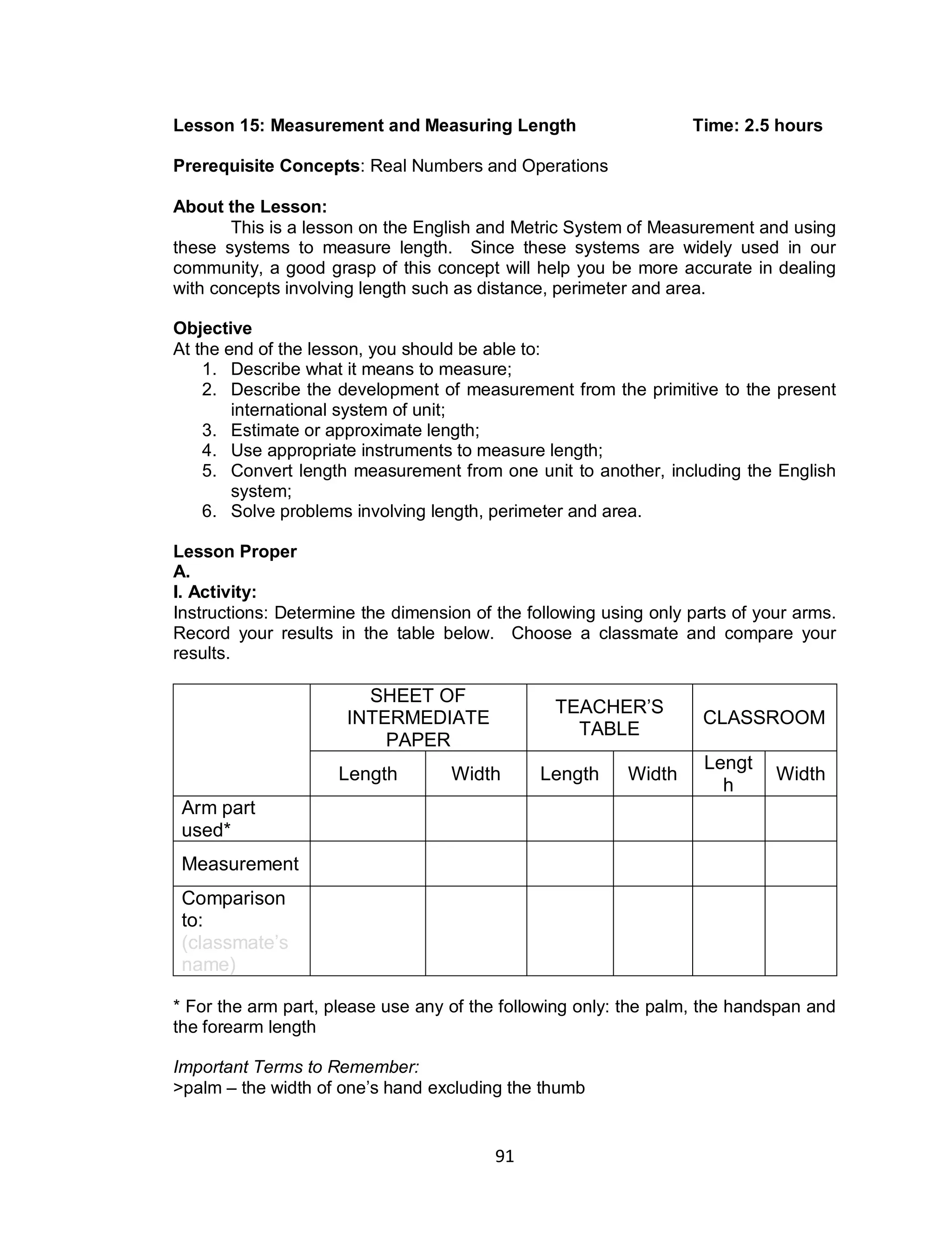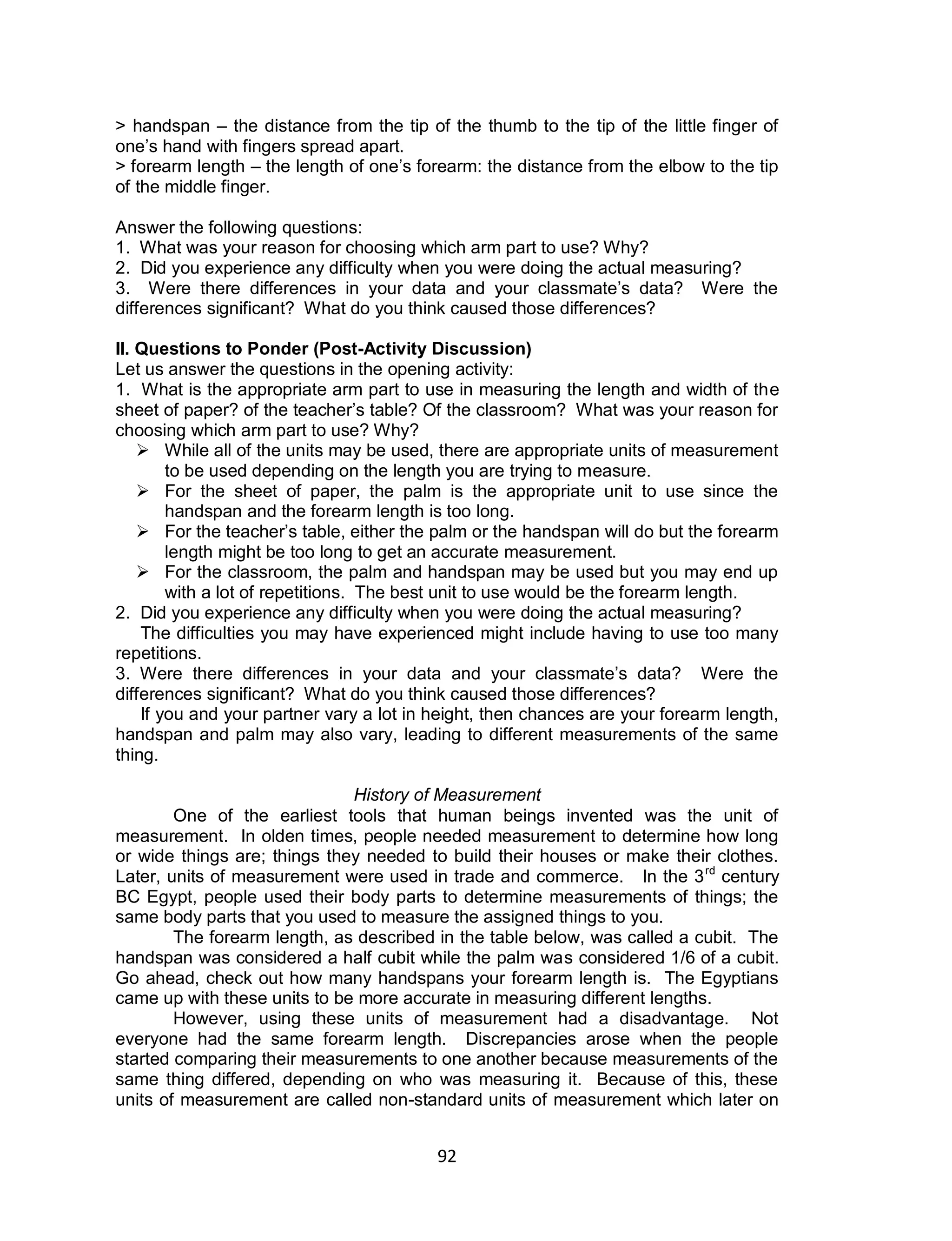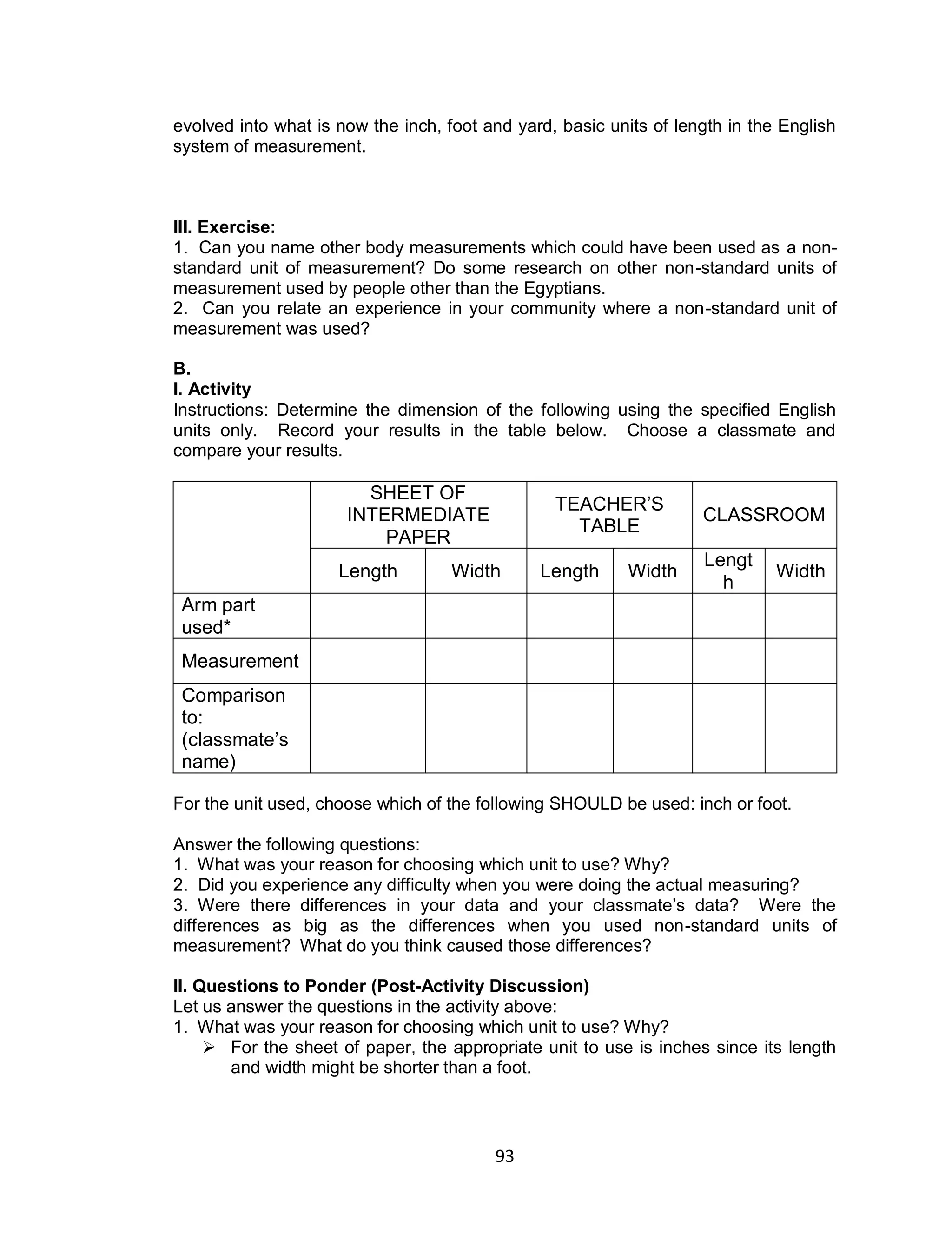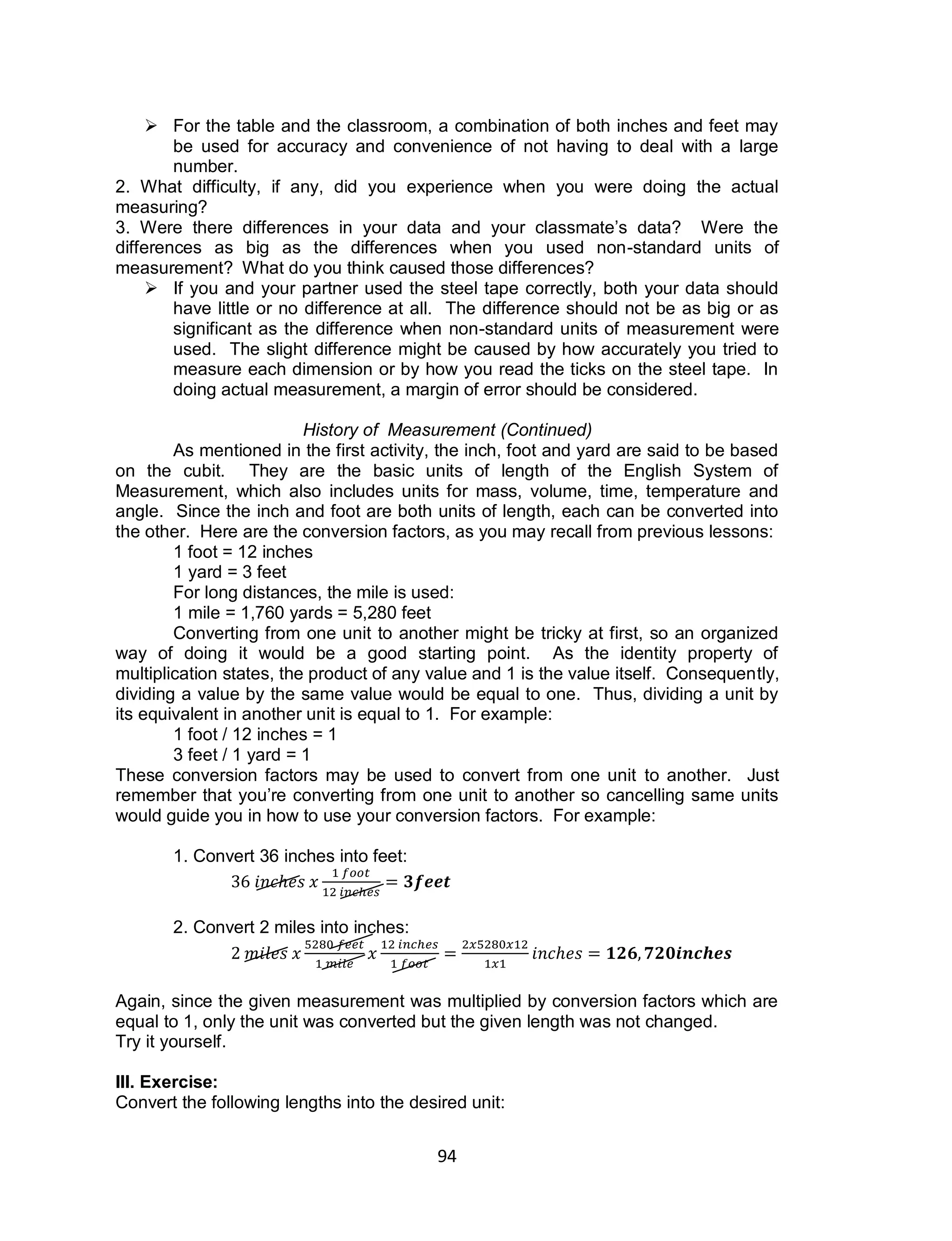
Compilation by Ben: r_borres@yahoo.com        


GRADE 7 
Learning Module 
 
  MATH 
(Qtr 1 to 4)  
 
 
Learner’s Material
Department of Education
Republic of the Philippines
7
This instructional material was collaboratively
developed and reviewed by educators from public and
private schools, colleges, and/or universities. We encourage
teachers and other education stakeholders to email their
feedback, comments, and recommendations to the
Department of Education at action@deped.gov.ph.
We value your feedback and recommendations.
ii
Mathematics – Grade 7
Learner’s Material
First Edition, 2013
ISBN: 978-971-9990-60-4
Republic Act 8293, section 176 states that: No copyright shall subsist in any
work of the Government of the Philippines. However, prior approval of the
government agency or office wherein the work is created shall be necessary for
exploitation of such work for profit. Such agency or office may, among other things,
impose as a condition the payment of royalties.
Borrowed materials (i.e., songs, stories, poems, pictures, photos, brand
names, trademarks, etc.) included in this book are owned by their respective
copyright holders. Every effort has been exerted to locate and seek permission to
use these materials from their respective copyright owners. The publisher and
authors do not represent nor claim ownership over them.
Published by the Department of Education
Secretary: Br. Armin A. Luistro FSC
Undersecretary: Yolanda S. Quijano, Ph.D.
Assistant Secretary: Elena R. Ruiz, Ph.D.
Printed in the Philippines by ____________
Department of Education-Instructional Materials Council Secretariat (DepEd-
IMCS)
Office Address: 2nd
Floor Dorm G, Philsports Complex, Meralco
Avenue,
Pasig City, Philippines 1600
Telefax: (02) 634-1054, 634-1072
E-mail Address: imcsetd@yahoo.com
Development Team of the Learner’s Material
Consultant: Ian June L. Garces, Ph.D.
Authors: Elizabeth R. Aseron, Angelo D. Armas, Allan M. Canonigo, Ms.
Jasmin T. Dullete, Flordeliza F. Francisco,Ph.D., Ian June L. Garces, Ph.D.,
Eugenia V. Guerra, Phoebe V. Guerra, Almira D. Lacsina, Rhett Anthony C.
Latonio, Lambert G. Quesada, Ma. Christy R. Reyes, Rechilda P. Villame,
Debbie Marie B. Verzosa, Ph.D., and Catherine P. Vistro-Yu, Ph.D.
Editor: Catherine P. Vistro-Yu, Ph.D.
Reviewers: Melvin M. Callanta, Sonia Javier, and Corazon Lomibao
iii
Table Of Contents
First Quarter
Lesson 1: SETS: An Introduction 1
Lesson 2.1: Union and Intersection of Sets 5
Lesson 2.2: Complement of a Set 10
Lesson 3: Problems Involving Sets 14
Leson 4.1: Fundamental Operations on Inetegers: Addition
of Integers
19
Lesson 4.2: Fundamental Operation on Integers:
Subraction of Integers
23
Lesson 4.3: Fundamental Operation on Integers:
Multiplication of Integers
28
Lesson 4.4: Fundamental Operation on Integers: Division of
Integers
31
Lesson 5: Properties of the Operations on Integers 34
Lesson 6: Rational Numbers in the Number Line 43
Lesson 7: Forms of Rational Numbers and Addition and
Subtraction of Rational Numbers
47
Lesson 8: Multiplication and Division of Rational Numbers 54
Lesson 9: Properties of the Operations on Rational
Numbers
60
Lesson 10: Principal Roots and Irrational Numbers 65
Lesson 11: The Absolute Value of a Number 71
Second Quarter
Lesson 12: Subsets of Real Numbers 77
Lesson 13: Significant and Digits and the Scientific Notation 84
Lesson 14: More Problems Involving Real Numbers 88
Lesson 15: Measurement and Measuring Length 92
Lesson 16: Measuring Weight/Mass and Volume 100
Lesson 17: Measuring Angles, Time and Temperature 107
Lesson 18:Constant, Variables and Algebraic Expressions 113
Lesson 19: Verbal Phrases and Mathematical Phrases 118
Lesson 20: Polynomials 123
Lesson 21: Laws of Exponents 127
Lesson 22: Addition and Subraction of Polynomials 131
Lesson 23: Multiplying Polynomials 135
Lesson 24: Dividing Polynomials 141
Lesoon 25: Special Products 146
iv
Third Quarter
Lesson 26: Solving Linear Equations and Inequalities in
One Variable Using Guess and Check
153
Lesson 27: Solving Linear Equations and Inequalities
Algebraically
161
Lesson 28: Solving First Degree Inequalities in One
Variable Algebraically
171
Lesson 29: Solving Absolute Value Equations and
Inequalities
178
Fourth Quarter
Lesson 30: Basic Concepts and Terms in Geometry 187
Lesson 31: Angles 200
Lesson 32: Basic Constructions 209
Lesson 33: Polygons 215
Lesson 34: Triangles 222
Lesson 35: Quadrilaterals 227
Lesson 36: Circles 234
Lesson 37: Introduction to Statistics 238
Lesson 38: Organizing and Presenting Data 240
Lesson 39: Organizing and Presenting Data Using
Frequency Table and Histogram
253
Lesson 40: Averages: Mean, Median, and Mode 250
Lesson 41: Analyzing Interpreting, and Drawing
Conclusions from Graphics and Tabular
Presentations
253
1
GRADE 7 MATH LEARNING GUIDE
Lesson 1: SETS: AN INTRODUCTION Time: 1.5 hours
Pre-requisite Concepts: Whole numbers
About the Lesson:
This is an introductory lesson on sets. A clear understanding of the concepts
in this lesson will help you easily grasp number properties and enable you to quickly
identify multiple solutions involving sets of numbers.
Objectives:
In this lesson, you are expected to:
1. Describe and illustrate
a. well-defined sets;
b. subsets;
c. universal set, and;
d. the null set.
2. Use Venn Diagrams to represent sets and subsets.
Lesson Proper:
A.
I. Activity
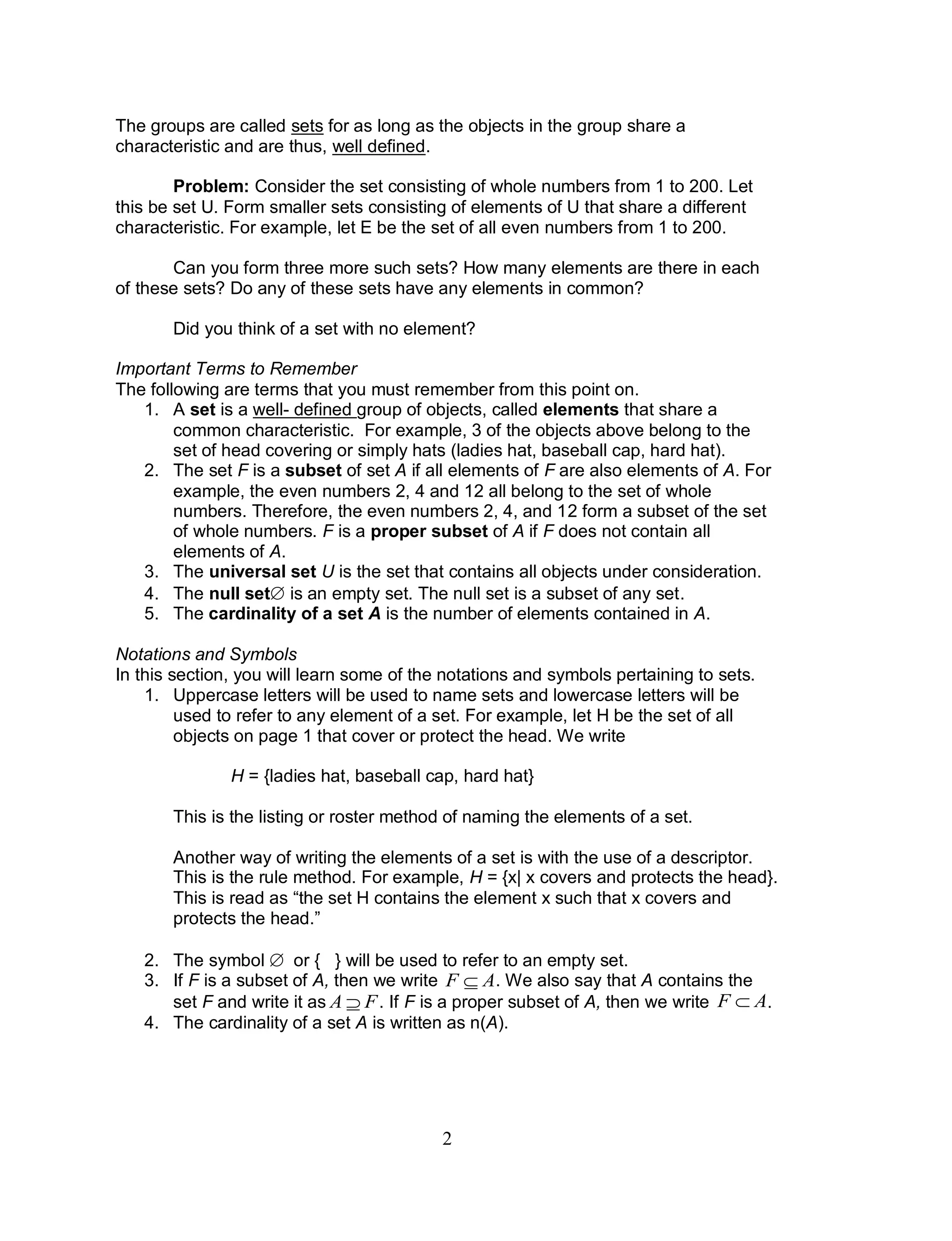
Below are some objects. Group them as you see fit and label each group.
Answer the following questions:
a. How many groups are there?
b. Does each object belong to a group?
c. Is there an object that belongs to more than one group? Which one?
2
The groups are called sets for as long as the objects in the group share a
characteristic and are thus, well defined.
Problem: Consider the set consisting of whole numbers from 1 to 200. Let
this be set U. Form smaller sets consisting of elements of U that share a different
characteristic. For example, let E be the set of all even numbers from 1 to 200.
Can you form three more such sets? How many elements are there in each
of these sets? Do any of these sets have any elements in common?
Did you think of a set with no element?
Important Terms to Remember
The following are terms that you must remember from this point on.
1. A set is a well- defined group of objects, called elements that share a
common characteristic. For example, 3 of the objects above belong to the
set of head covering or simply hats (ladies hat, baseball cap, hard hat).
2. The set F is a subset of set A if all elements of F are also elements of A. For
example, the even numbers 2, 4 and 12 all belong to the set of whole
numbers. Therefore, the even numbers 2, 4, and 12 form a subset of the set
of whole numbers. F is a proper subset of A if F does not contain all
elements of A.
3. The universal set U is the set that contains all objects under consideration.
4. The null set is an empty set. The null set is a subset of any set.
5. The cardinality of a set A is the number of elements contained in A.
Notations and Symbols
In this section, you will learn some of the notations and symbols pertaining to sets.
1. Uppercase letters will be used to name sets and lowercase letters will be
used to refer to any element of a set. For example, let H be the set of all
objects on page 1 that cover or protect the head. We write
H = {ladies hat, baseball cap, hard hat}
This is the listing or roster method of naming the elements of a set.
Another way of writing the elements of a set is with the use of a descriptor.
This is the rule method. For example, H = {x| x covers and protects the head}.
This is read as “the set H contains the element x such that x covers and
protects the head.”
2. The symbol  or { } will be used to refer to an empty set.
3. If F is a subset of A, then we write . We also say that A contains the
set F and write it as . If F is a proper subset of A, then we write .
4. The cardinality of a set A is written as n(A).

F  A

A  F

F  A
3
II. Questions to Ponder (Post-Activity Discussion)
Let us answer the questions posed in the opening activity.
1. How many sets are there?
There is the set of head covers (hats), the set of trees, the set of even
numbers, and the set of polyhedral. But, there is also a set of round objects
and a set of pointy objects. There are 6 well-defined sets.
2. Does each object belong to a set? Yes.
3. Is there an object that belongs to more than one set? Which ones?
All the hats belong to the set of round objects. The pine trees and two of the
polyhedral belong to the set of pointy objects.
III. Exercises
Do the following exercises.
1. Give 3 examples of well-defined sets.
2. Name two subsets of the set of whole numbers using both the listing
method and the rule method.
3. Let B = [1, 3, 5, 7, 9}. List all the possible subsets of B.
4. Answer this question: How many subsets does a set of n elements have?
B. Venn Diagrams
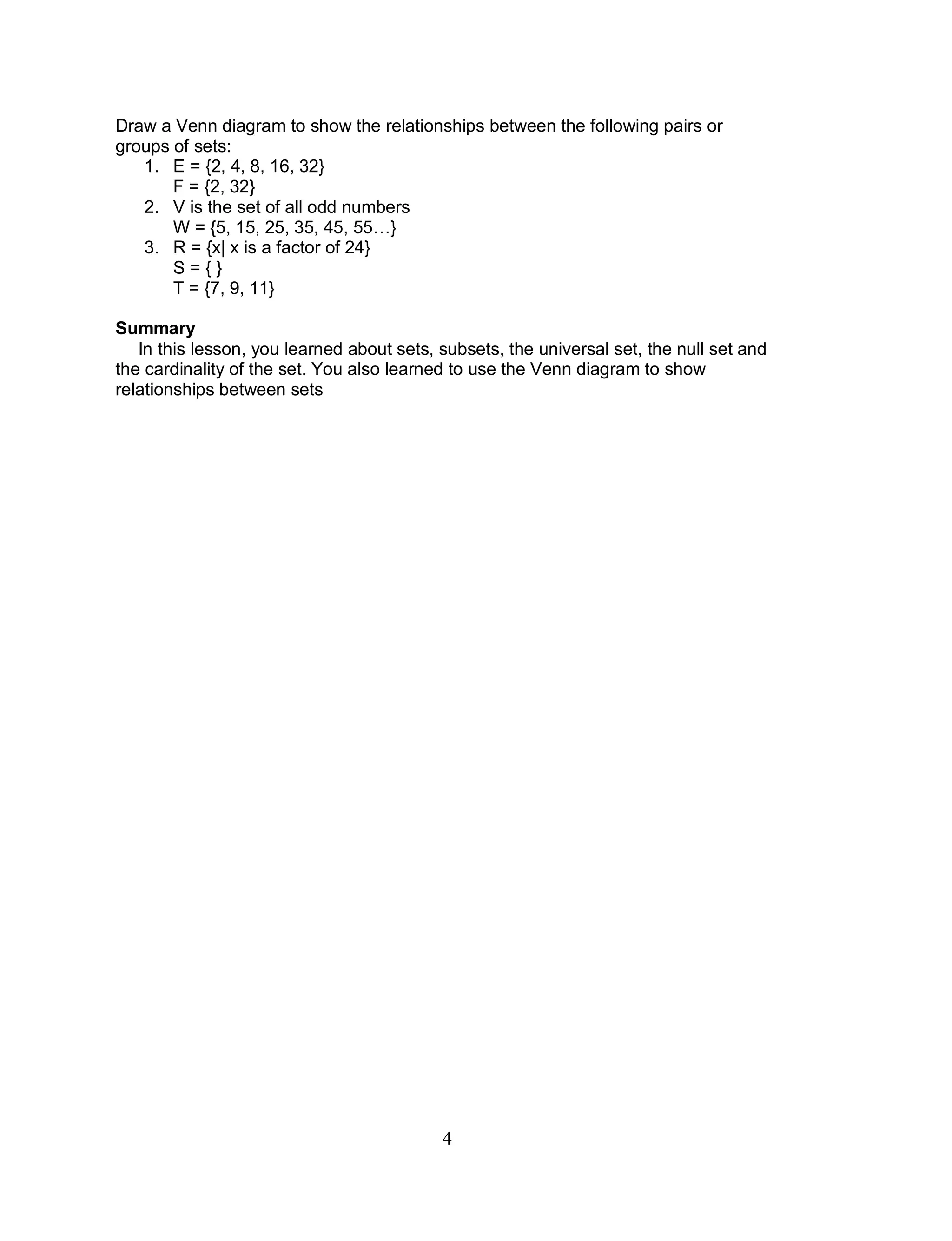
Sets and subsets may be represented using Venn Diagrams. These are diagrams
that make use of geometric shapes to show relationships between sets.
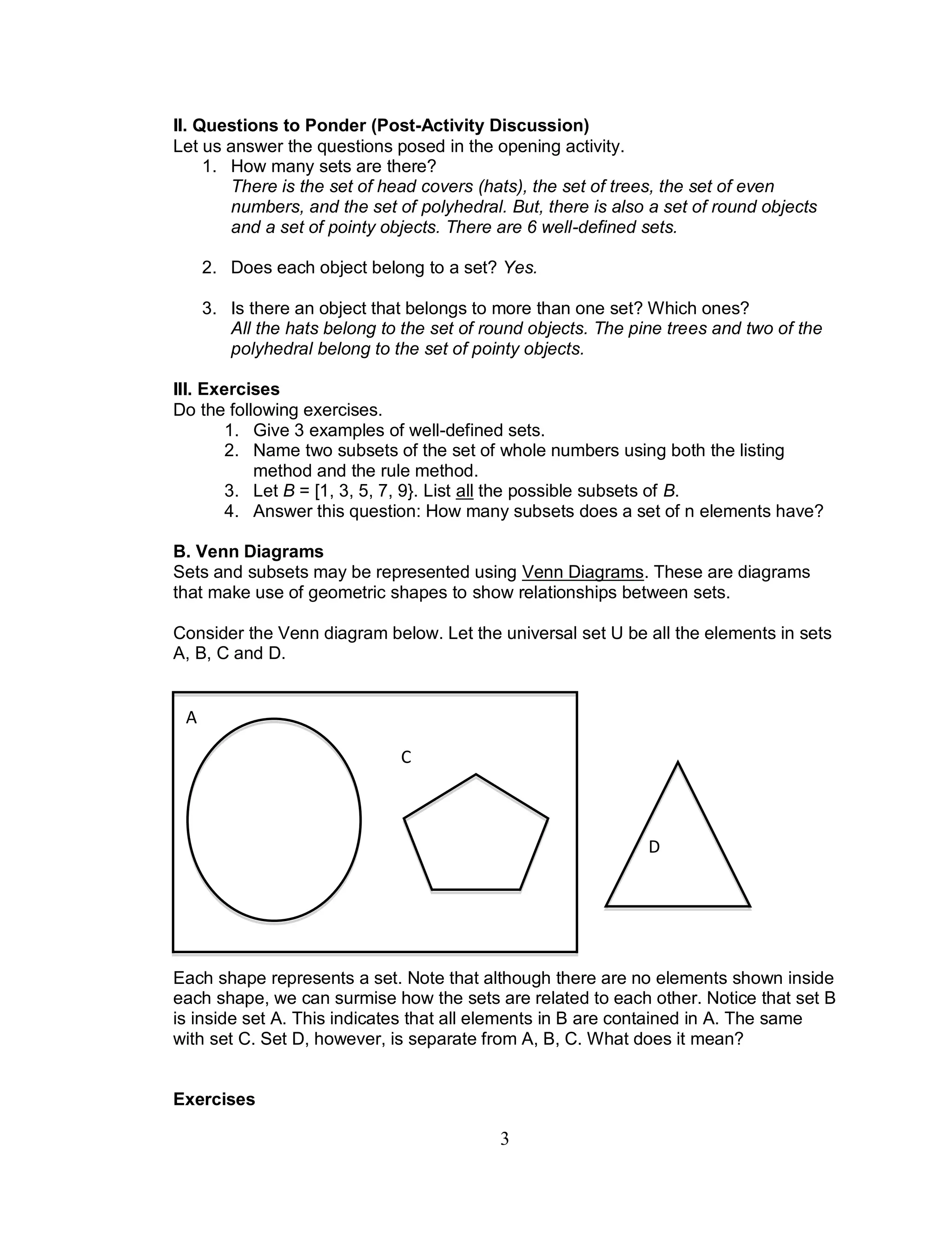
Consider the Venn diagram below. Let the universal set U be all the elements in sets
A, B, C and D.
Each shape represents a set. Note that although there are no elements shown inside
each shape, we can surmise how the sets are related to each other. Notice that set B
is inside set A. This indicates that all elements in B are contained in A. The same
with set C. Set D, however, is separate from A, B, C. What does it mean?
Exercises
D
A
C
4
Draw a Venn diagram to show the relationships between the following pairs or
groups of sets:
1. E = {2, 4, 8, 16, 32}
F = {2, 32}
2. V is the set of all odd numbers
W = {5, 15, 25, 35, 45, 55…}
3. R = {x| x is a factor of 24}
S = { }
T = {7, 9, 11}
Summary
In this lesson, you learned about sets, subsets, the universal set, the null set and
the cardinality of the set. You also learned to use the Venn diagram to show
relationships between sets
5
Lesson 2.1: Union and Intersection of Sets Time: 1.5 hours
Pre-requisite Concepts: Whole Numbers, definition of sets, Venn diagrams
About the Lesson:
After learning some introductory concepts about sets, a lesson on set operations
follows. The student will learn how to combine sets (union) and how to determine the
elements common to 2 or 3 sets (intersection).
Objectives:
In this lesson, you are expected to:
1. Describe and define
a. union of sets;
b. intersection of sets.
2. Perform the set operations
a. union of sets;
b. intersection of sets.
` 3. Use Venn diagrams to represent the union and intersection of sets.
Lesson Proper:
I. Activities
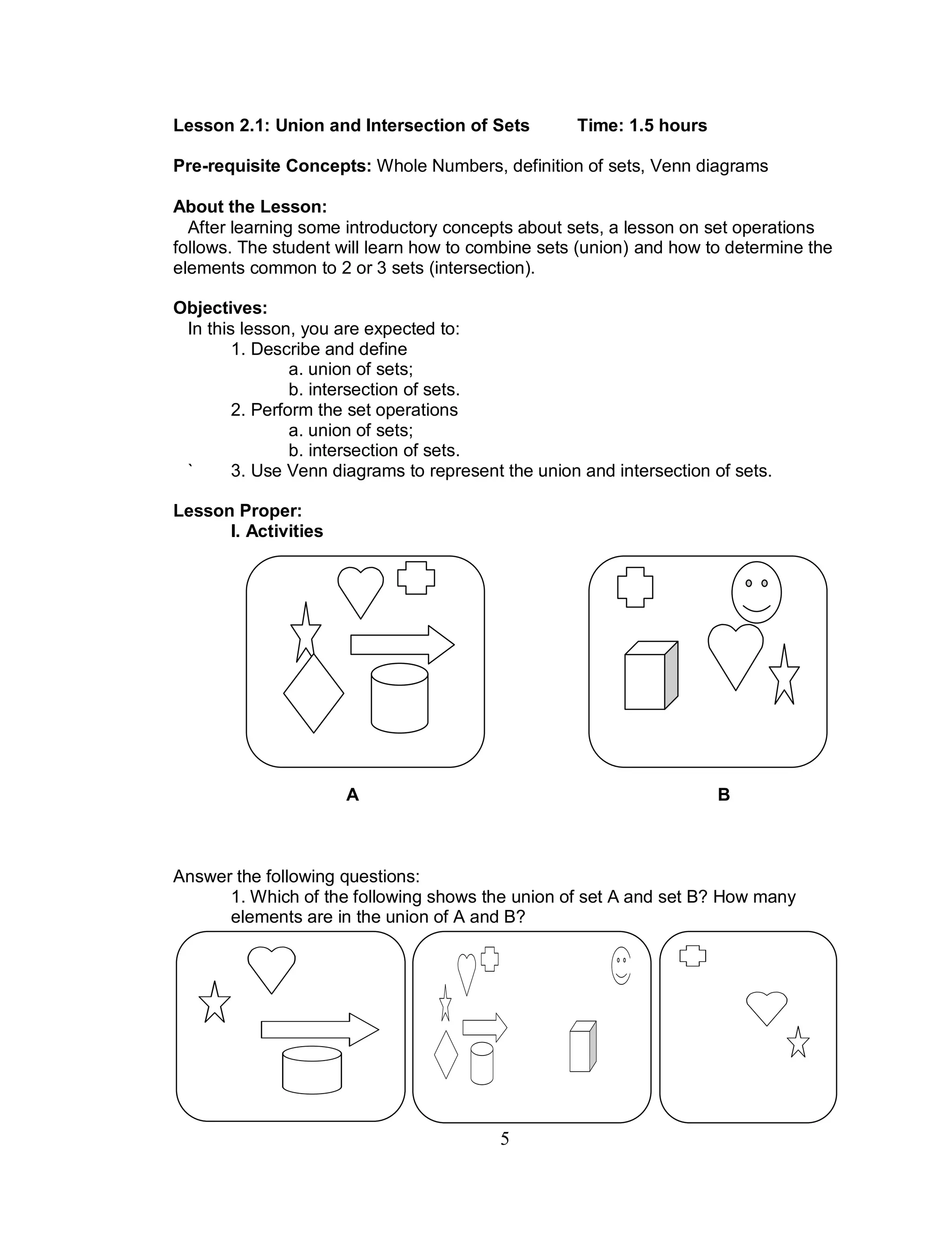
A B
Answer the following questions:
1. Which of the following shows the union of set A and set B? How many
elements are in the union of A and B?
6
1 2 3
2. Which of the following shows the intersection of set A and set B? How
many elements are there in the intersection of A and B?
1 2 3
Here’s another activity:
Let
V = {2x | x  , 1  x  4}
W = {x2
| x  , -2  x  2}
What elements may be found in the intersection of V and W? How many are
there? What elements may be found in the union of V and W? How many are
there?
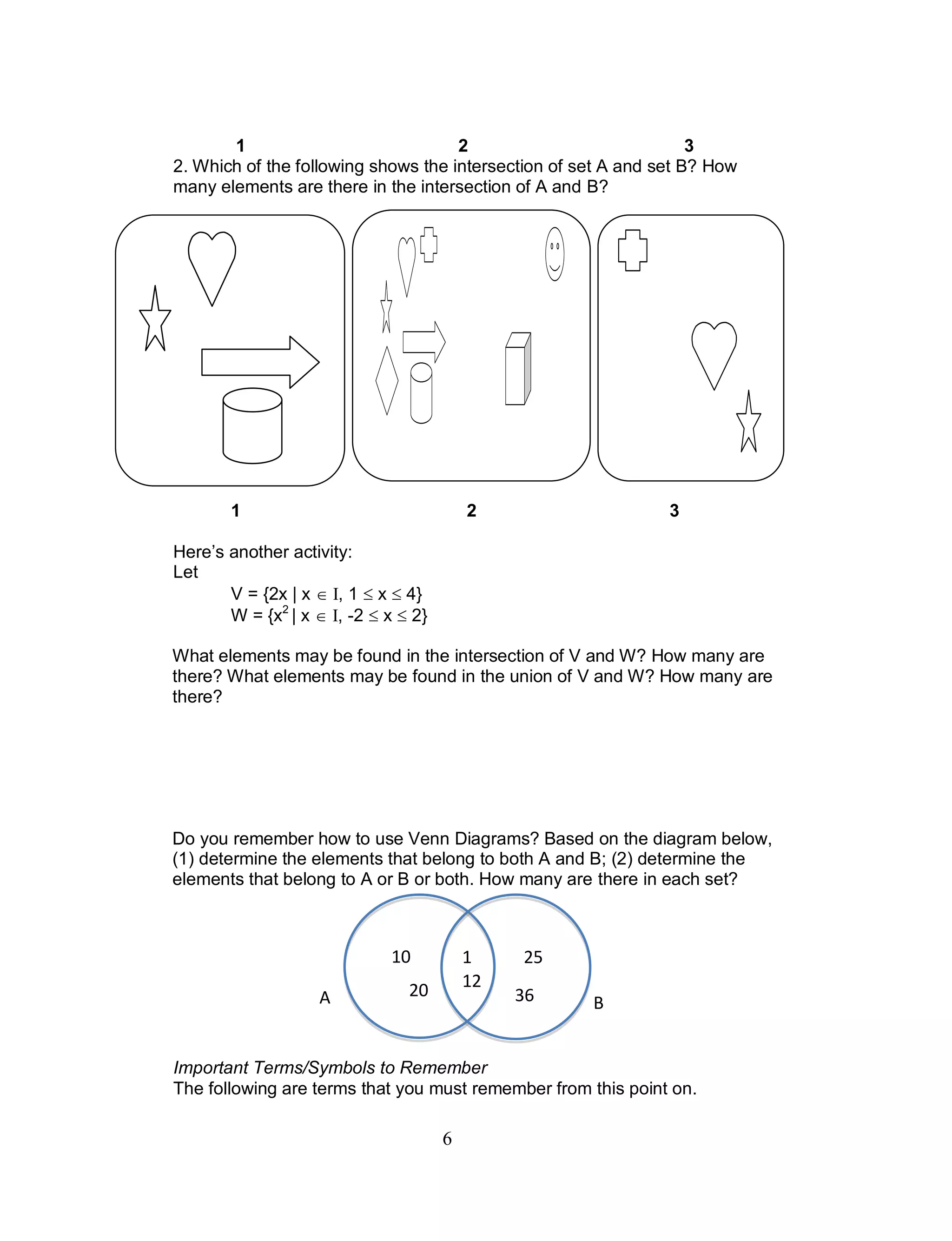
Do you remember how to use Venn Diagrams? Based on the diagram below,
(1) determine the elements that belong to both A and B; (2) determine the
elements that belong to A or B or both. How many are there in each set?
Important Terms/Symbols to Remember
The following are terms that you must remember from this point on.
A B
10
20
1
12
25
36
7
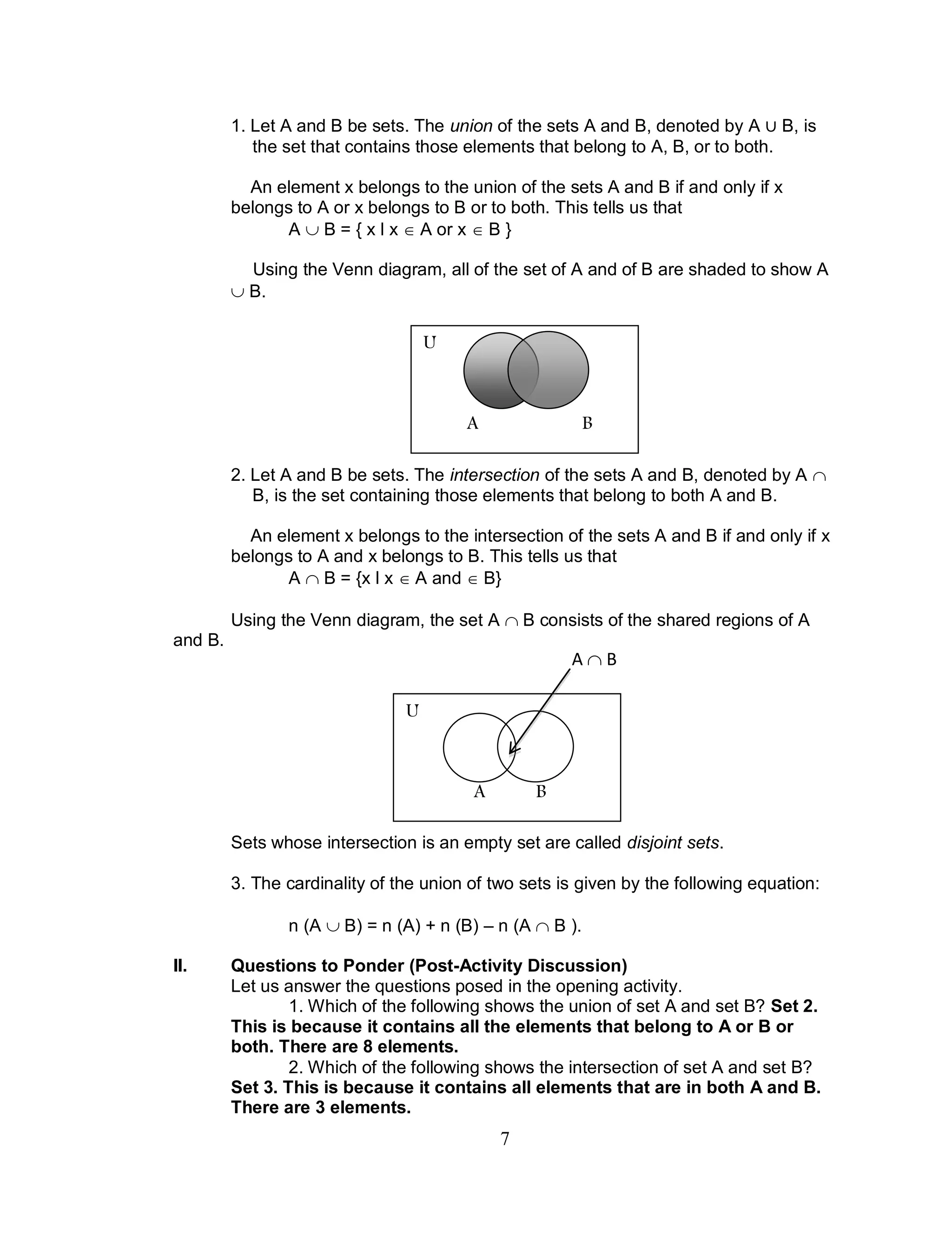
1. Let A and B be sets. The union of the sets A and B, denoted by A B, is
the set that contains those elements that belong to A, B, or to both.
An element x belongs to the union of the sets A and B if and only if x
belongs to A or x belongs to B or to both. This tells us that
A  B = { x l x  A or x  B }
Using the Venn diagram, all of the set of A and of B are shaded to show A
 B.
2. Let A and B be sets. The intersection of the sets A and B, denoted by A 
B, is the set containing those elements that belong to both A and B.
An element x belongs to the intersection of the sets A and B if and only if x
belongs to A and x belongs to B. This tells us that
A  B = {x l x  A and  B}
Using the Venn diagram, the set A  B consists of the shared regions of A
and B.
Sets whose intersection is an empty set are called disjoint sets.
3. The cardinality of the union of two sets is given by the following equation:
n (A  B) = n (A) + n (B) – n (A  B ).
II. Questions to Ponder (Post-Activity Discussion)
Let us answer the questions posed in the opening activity.
1. Which of the following shows the union of set A and set B? Set 2.
This is because it contains all the elements that belong to A or B or
both. There are 8 elements.
2. Which of the following shows the intersection of set A and set B?
Set 3. This is because it contains all elements that are in both A and B.
There are 3 elements.
U
A B
U
A B
A  B
8
In the second activity:
V = { 2, 4, 6, 8 }
W = { 0, 1, 4}
Therefore, V  W = { 4 } has 1 element and V  W = { 0, 1, 2, 4, 6, 8 } has 6
elements. Note that the element { 4 } is counted only once.
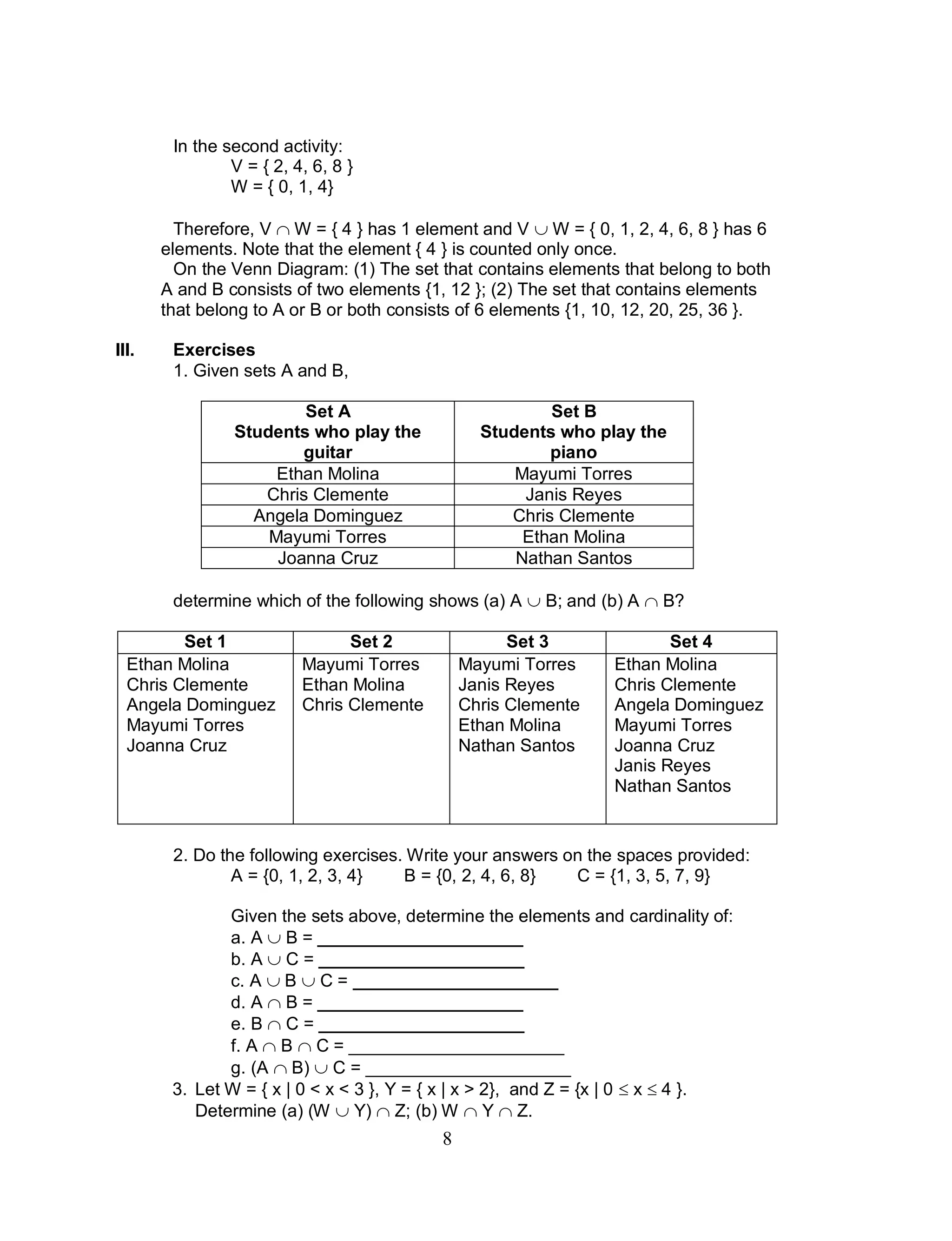
On the Venn Diagram: (1) The set that contains elements that belong to both
A and B consists of two elements {1, 12 }; (2) The set that contains elements
that belong to A or B or both consists of 6 elements {1, 10, 12, 20, 25, 36 }.
III. Exercises
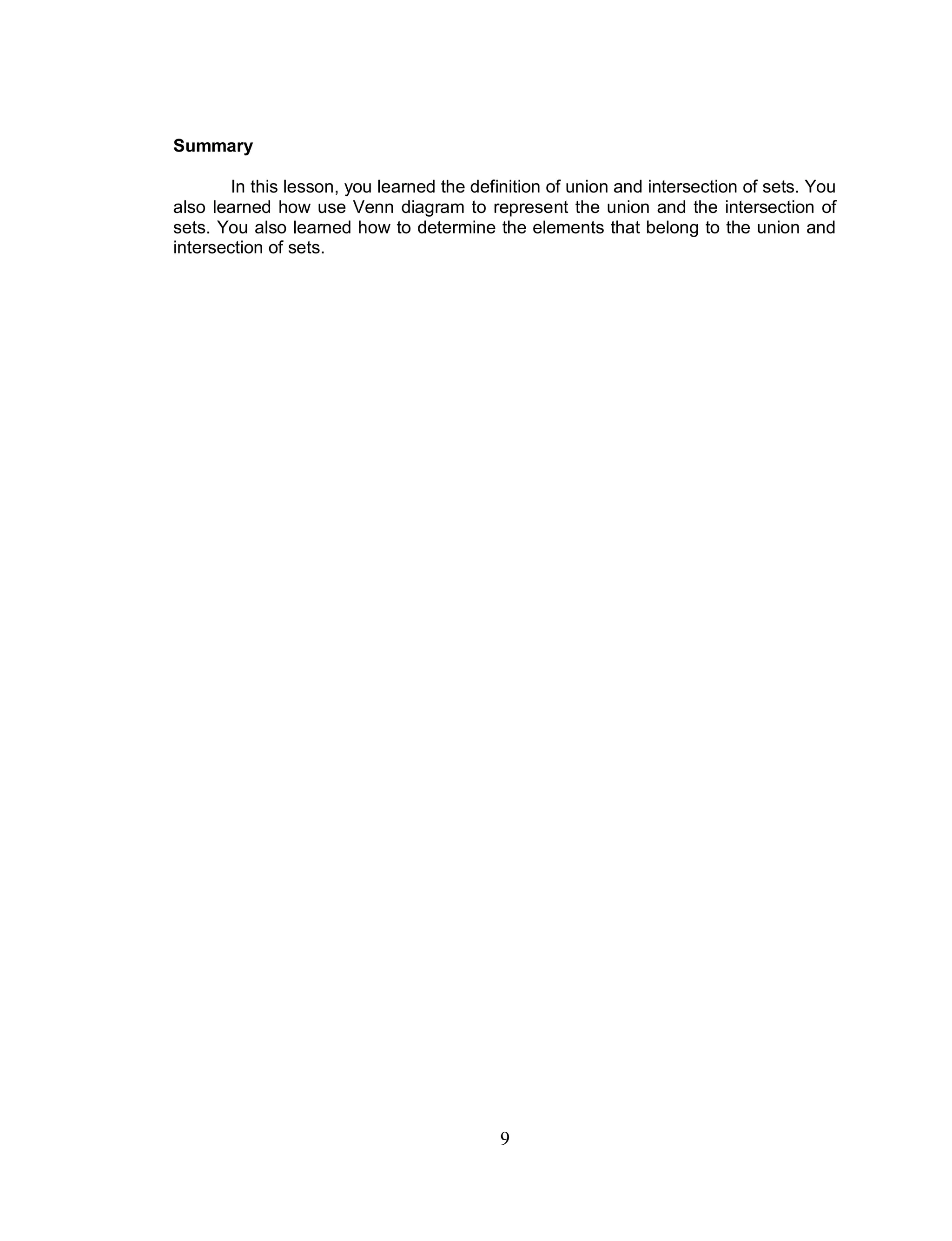
1. Given sets A and B,
Set A
Students who play the
guitar
Set B
Students who play the
piano
Ethan Molina Mayumi Torres
Chris Clemente Janis Reyes
Angela Dominguez Chris Clemente
Mayumi Torres Ethan Molina
Joanna Cruz Nathan Santos
determine which of the following shows (a) A  B; and (b) A  B?
Set 1 Set 2 Set 3 Set 4
Ethan Molina
Chris Clemente
Angela Dominguez
Mayumi Torres
Joanna Cruz
Mayumi Torres
Ethan Molina
Chris Clemente
Mayumi Torres
Janis Reyes
Chris Clemente
Ethan Molina
Nathan Santos
Ethan Molina
Chris Clemente
Angela Dominguez
Mayumi Torres
Joanna Cruz
Janis Reyes
Nathan Santos
2. Do the following exercises. Write your answers on the spaces provided:
A = {0, 1, 2, 3, 4} B = {0, 2, 4, 6, 8} C = {1, 3, 5, 7, 9}
Given the sets above, determine the elements and cardinality of:
a. A  B = _____________________
b. A  C = _____________________
c. A  B  C = _____________________
d. A  B = _____________________
e. B  C = _____________________
f. A  B  C = ______________________
g. (A  B)  C = _____________________
3. Let W = { x | 0 < x < 3 }, Y = { x | x > 2}, and Z = {x | 0  x  4 }.
Determine (a) (W  Y)  Z; (b) W  Y  Z.
9
Summary
In this lesson, you learned the definition of union and intersection of sets. You
also learned how use Venn diagram to represent the union and the intersection of
sets. You also learned how to determine the elements that belong to the union and
intersection of sets.
10
Lesson 2.2: Complement of a Set Time: 1.5 hours
Prerequisite Concepts: sets, universal set, empty set, union and intersection of
sets, cardinality of sets, Venn diagrams
About the Lesson:
The complement of a set is an important concept. There will be times when
one needs to consider the elements not found in a particular set A. You must know
that this is when you need the complement of a set.
Objectives:
In this lesson, you are expected to:
1. Describe and define the complement of a set;
2. Find the complement of a given set;
3. Use Venn diagrams to represent the complement of a set.
Lesson Proper:
I. Problem
In a population of 8000 students, 2100 are Freshmen, 2000 are
Sophomores, 2050 are Juniors and the remaining 1850 are either in their
fourth or fifth year in university. A student is selected from the 8000 students
and it is not a sophomore, how many possible choices are there?
Discussion
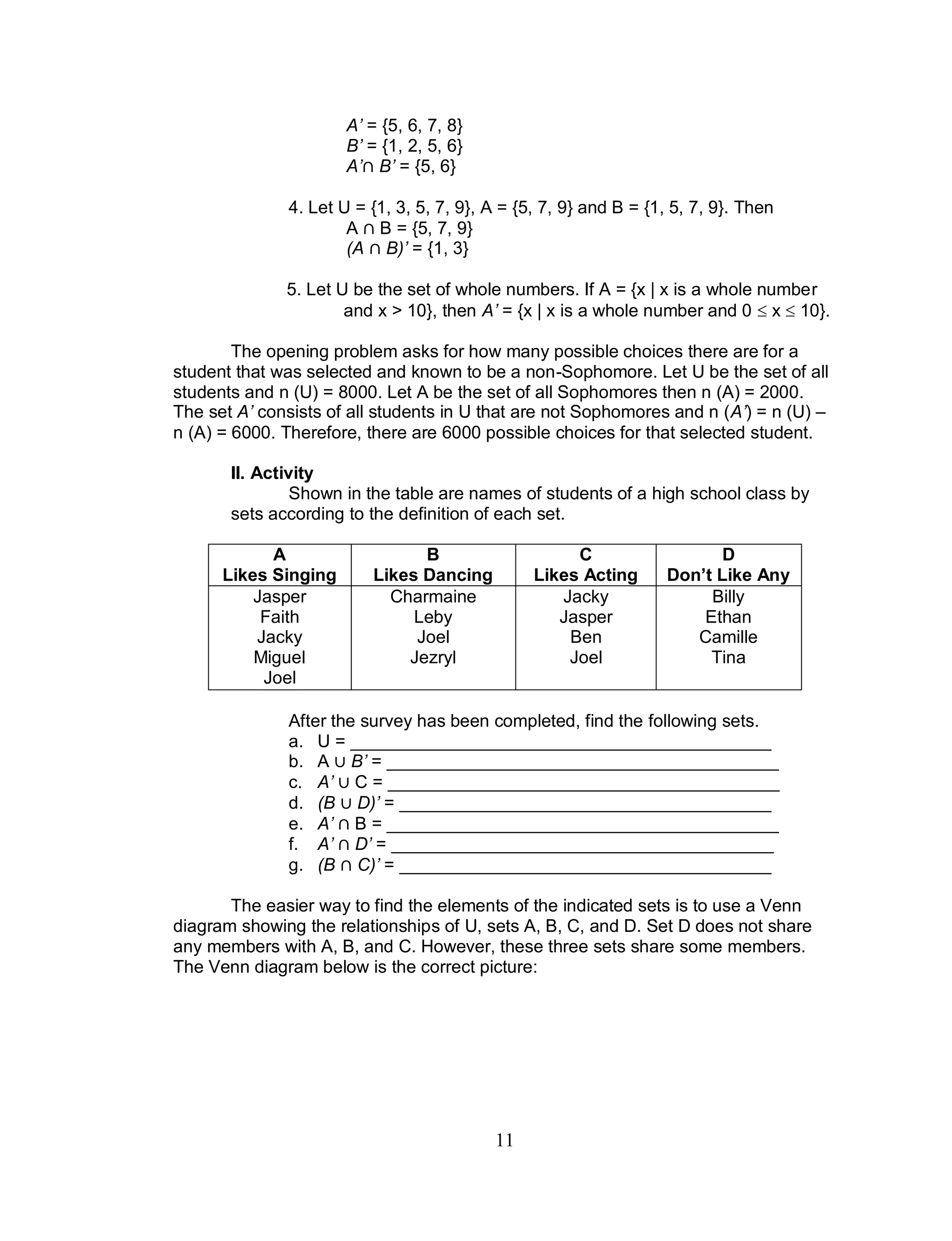
Definition: The complement of a set A, written as A’, is the set of all
elements found in the universal set, U, that are not found in set A. The cardinality n
(A’) is given by
n (A’) = n (U) – n (A) .
Venn diagram:
Examples:
1. Let U = {0, 1, 2, 3, 4, 5, 6, 7, 8, 9}, and A = {0, 2, 4, 6, 8}.
Then the elements of A’ are the elements from U that are not
found in A.
Therefore, A’ = {1, 3, 5, 7, 9} and n (A’ ) = 5
2. Let U = {1, 2, 3, 4, 5}, A = {2, 4} and B = {1, 5}. Then
A’ = {1, 3, 5}
B’ = {2, 3, 4}
A’ B’ = {1, 2, 3, 4, 5} = U
3. Let U = {1, 2, 3, 4, 5, 6, 7, 8}, A = {1, 2, 3, 4} and B = {3, 4, 7, 8}.
Then
U
A’
A
11
A’ = {5, 6, 7, 8}
B’ = {1, 2, 5, 6}
A’ B’ = {5, 6}
4. Let U = {1, 3, 5, 7, 9}, A = {5, 7, 9} and B = {1, 5, 7, 9}. Then
A B = {5, 7, 9}
(A B)’ = {1, 3}
5. Let U be the set of whole numbers. If A = {x | x is a whole number
and x > 10}, then A’ = {x | x is a whole number and 0  x  10}.
The opening problem asks for how many possible choices there are for a
student that was selected and known to be a non-Sophomore. Let U be the set of all
students and n (U) = 8000. Let A be the set of all Sophomores then n (A) = 2000.
The set A’ consists of all students in U that are not Sophomores and n (A’) = n (U) –
n (A) = 6000. Therefore, there are 6000 possible choices for that selected student.
II. Activity
Shown in the table are names of students of a high school class by
sets according to the definition of each set.
A
Likes Singing
B
Likes Dancing
C
Likes Acting
D
Don’t Like Any
Jasper
Faith
Jacky
Miguel
Joel
Charmaine
Leby
Joel
Jezryl
Jacky
Jasper
Ben
Joel
Billy
Ethan
Camille
Tina
After the survey has been completed, find the following sets.
a. U = ___________________________________________
b. A B’ = ________________________________________
c. A’ C = ________________________________________
d. (B D)’ = ______________________________________
e. A’ B = ________________________________________
f. A’ D’ = _______________________________________
g. (B C)’ = ______________________________________
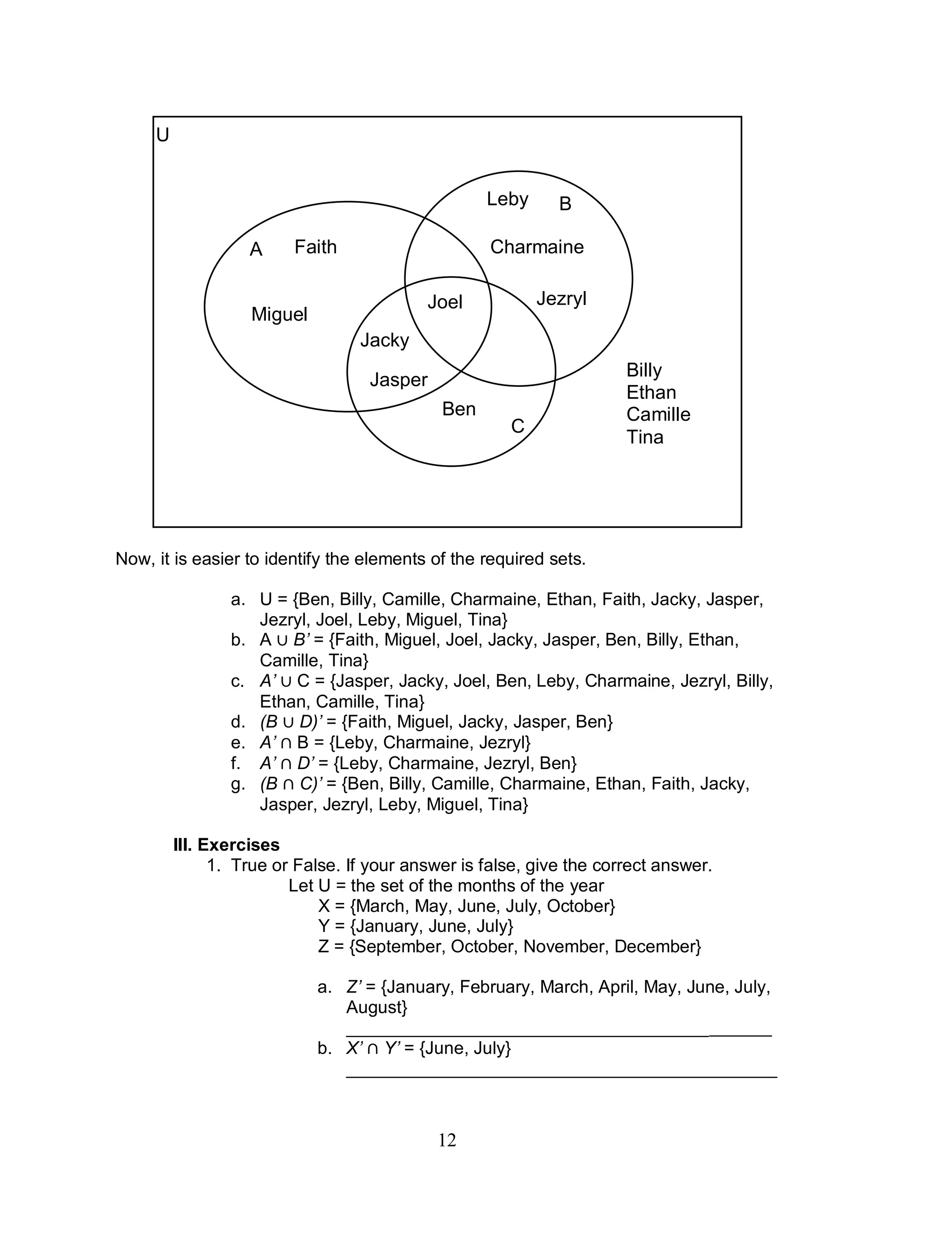
The easier way to find the elements of the indicated sets is to use a Venn
diagram showing the relationships of U, sets A, B, C, and D. Set D does not share
any members with A, B, and C. However, these three sets share some members.
The Venn diagram below is the correct picture:
12
Now, it is easier to identify the elements of the required sets.
a. U = {Ben, Billy, Camille, Charmaine, Ethan, Faith, Jacky, Jasper,
Jezryl, Joel, Leby, Miguel, Tina}
b. A B’ = {Faith, Miguel, Joel, Jacky, Jasper, Ben, Billy, Ethan,
Camille, Tina}
c. A’ C = {Jasper, Jacky, Joel, Ben, Leby, Charmaine, Jezryl, Billy,
Ethan, Camille, Tina}
d. (B D)’ = {Faith, Miguel, Jacky, Jasper, Ben}
e. A’ B = {Leby, Charmaine, Jezryl}
f. A’ D’ = {Leby, Charmaine, Jezryl, Ben}
g. (B C)’ = {Ben, Billy, Camille, Charmaine, Ethan, Faith, Jacky,
Jasper, Jezryl, Leby, Miguel, Tina}
III. Exercises
1. True or False. If your answer is false, give the correct answer.
Let U = the set of the months of the year
X = {March, May, June, July, October}
Y = {January, June, July}
Z = {September, October, November, December}
a. Z’ = {January, February, March, April, May, June, July,
August}
_____________________________________
b. X’ Y’ = {June, July}
____________________________________________
A
B
C
Joel
Jacky
Jasper
Ben
Leby
Charmaine
Jezryl
Faith
Miguel
Billy
Ethan
Camille
Tina
U
13
c. X’ Z’ = {January, February, March, April, May, June,
July, August, September, November, December}
____________________________________________
d. (Y Z)’ = {February, March, April, May}
______________________________________
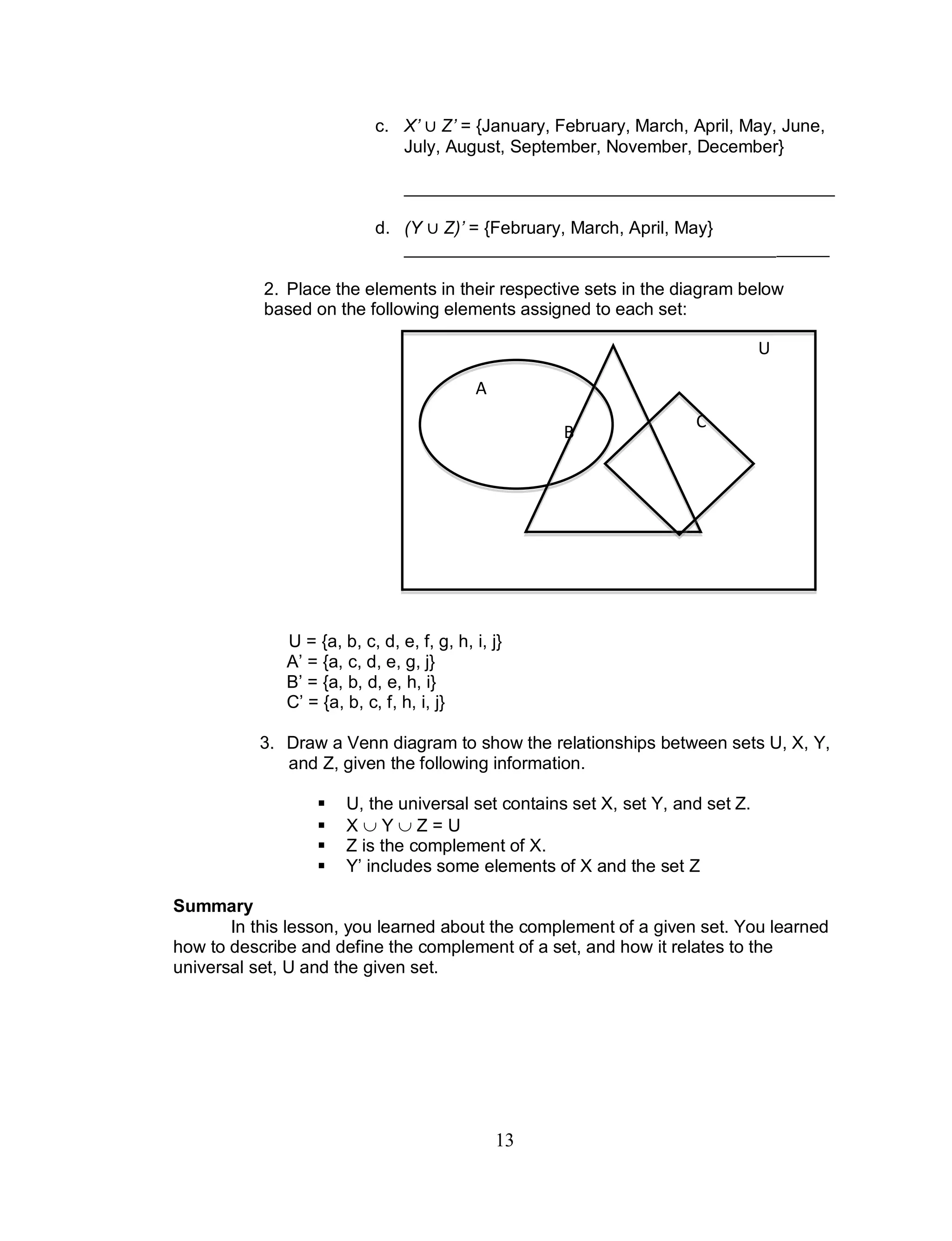
2. Place the elements in their respective sets in the diagram below
based on the following elements assigned to each set:
U = {a, b, c, d, e, f, g, h, i, j}
A’ = {a, c, d, e, g, j}
B’ = {a, b, d, e, h, i}
C’ = {a, b, c, f, h, i, j}
3. Draw a Venn diagram to show the relationships between sets U, X, Y,
and Z, given the following information.
 U, the universal set contains set X, set Y, and set Z.
 X  Y  Z = U
 Z is the complement of X.
 Y’ includes some elements of X and the set Z
Summary
In this lesson, you learned about the complement of a given set. You learned
how to describe and define the complement of a set, and how it relates to the
universal set, U and the given set.
A
B
C
U
14
Lesson 3: Problems Involving Sets Time: 1 hour
Prerequisite Concepts: Operations on Sets and Venn Diagrams
About the Lesson:
This is an application of your past lessons about sets. You will appreciate
more the concepts and the use of Venn diagrams as you work through the different
word problems.
Objectives:
In this lesson, you are expected to:
1. Solve word problems involving sets with the use of Venn diagrams
2. Apply set operations to solve a variety of word problems.
Lesson Proper:
I. Activity
Try solving the following problem:
In a class of 40 students, 17 have ridden an airplane, 28 have ridden a
boat. 10 have ridden a train, 12 have ridden both an airplane and a
boat. 3 have ridden a train only and 4 have ridden an airplane only.
Some students in the class have not ridden any of the three modes of
transportation and an equal number have taken all three.
a. How many students have used all three modes of transportation?
b. How many students have taken only the boat?
II. Questions/Points to Ponder (Post-Activity Discussion)
Venn diagrams can be used to solve word problems involving union and
intersection of sets. Here are some worked out examples:
1. A group of 25 high school students were asked whether they use either
Facebook or Twitter or both. Fifteen of these students use Facebook and
twelve use Twitter.
a. How many use Facebook only?
b. How many use Twitter only?
c. How many use both social networking sites?
Solution:
Let S1 = set of students who use Facebook only
S2 = set of students who use both social networking sites
S3 = set of students who use Twitter only
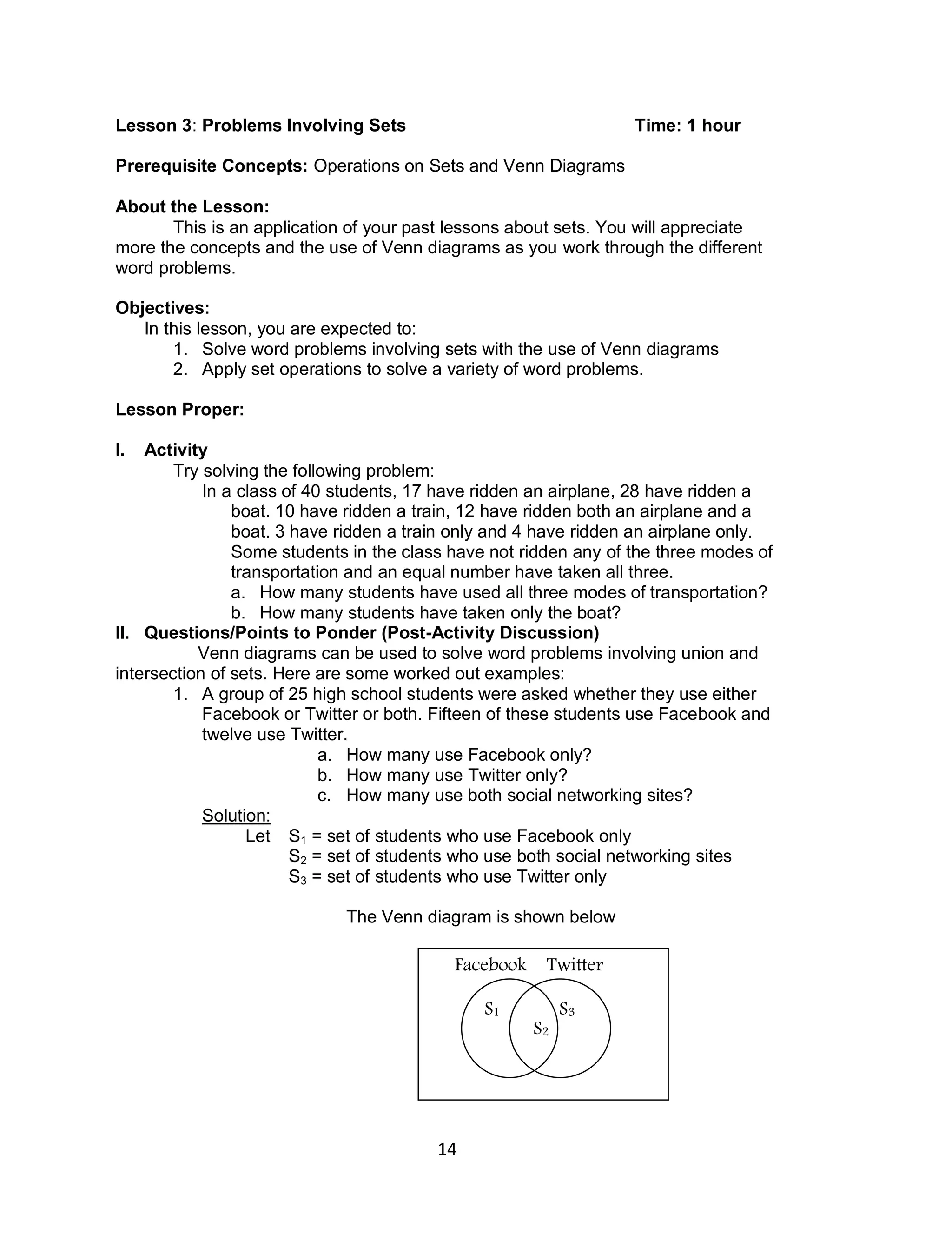
The Venn diagram is shown below
Facebook Twitter
S1 S3
S2
15
Finding the elements in each region:
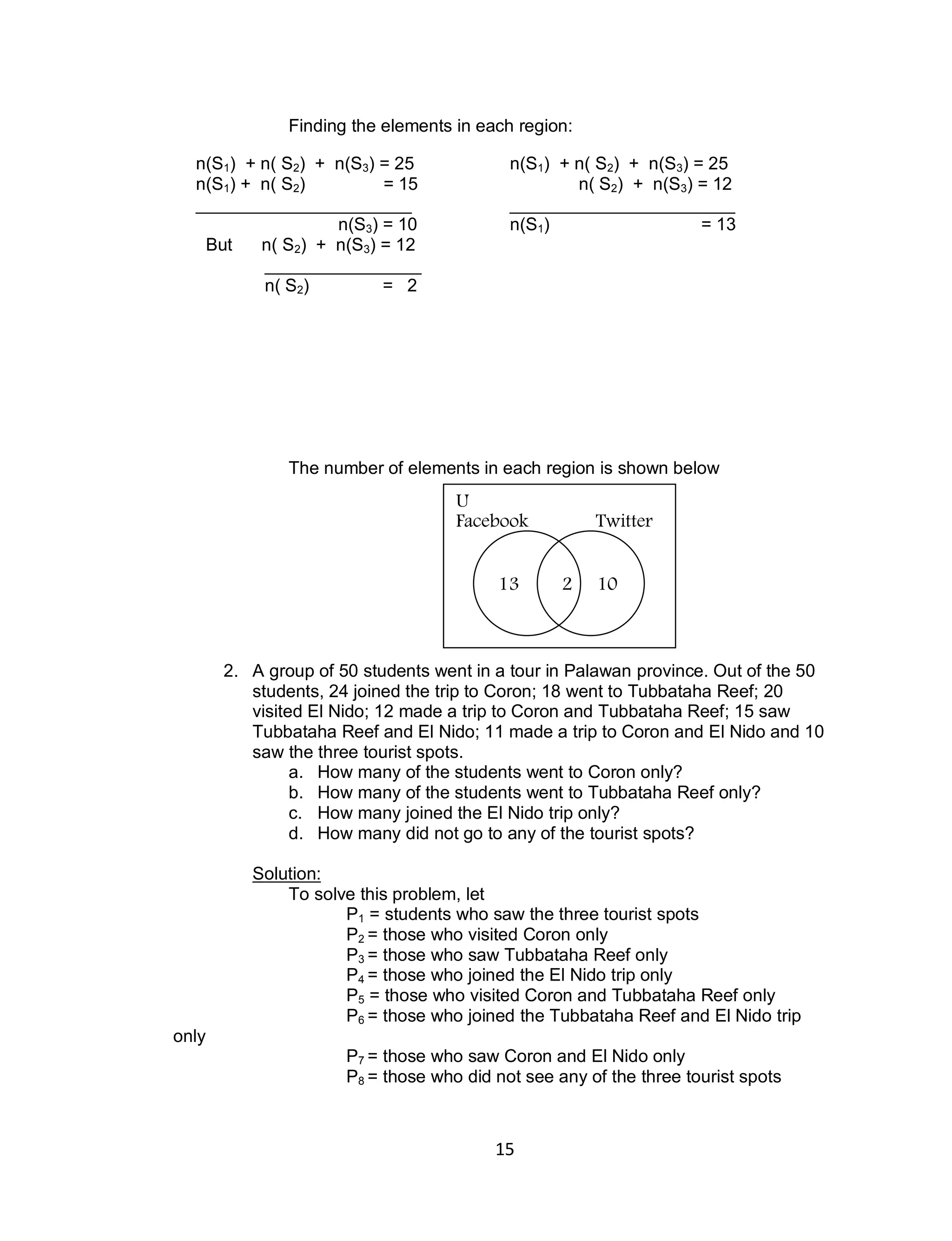
The number of elements in each region is shown below
2. A group of 50 students went in a tour in Palawan province. Out of the 50
students, 24 joined the trip to Coron; 18 went to Tubbataha Reef; 20
visited El Nido; 12 made a trip to Coron and Tubbataha Reef; 15 saw
Tubbataha Reef and El Nido; 11 made a trip to Coron and El Nido and 10
saw the three tourist spots.
a. How many of the students went to Coron only?
b. How many of the students went to Tubbataha Reef only?
c. How many joined the El Nido trip only?
d. How many did not go to any of the tourist spots?
Solution:
To solve this problem, let
P1 = students who saw the three tourist spots
P2 = those who visited Coron only
P3 = those who saw Tubbataha Reef only
P4 = those who joined the El Nido trip only
P5 = those who visited Coron and Tubbataha Reef only
P6 = those who joined the Tubbataha Reef and El Nido trip
only
P7 = those who saw Coron and El Nido only
P8 = those who did not see any of the three tourist spots
n(S1) + n( S2) + n(S3) = 25
n(S1) + n( S2) = 15
______________________
n(S3) = 10
But n( S2) + n(S3) = 12
________________
n( S2) = 2
n(S1) + n( S2) + n(S3) = 25
n( S2) + n(S3) = 12
_______________________
n(S1) = 13
U
Facebook Twitter
13 2 10
16
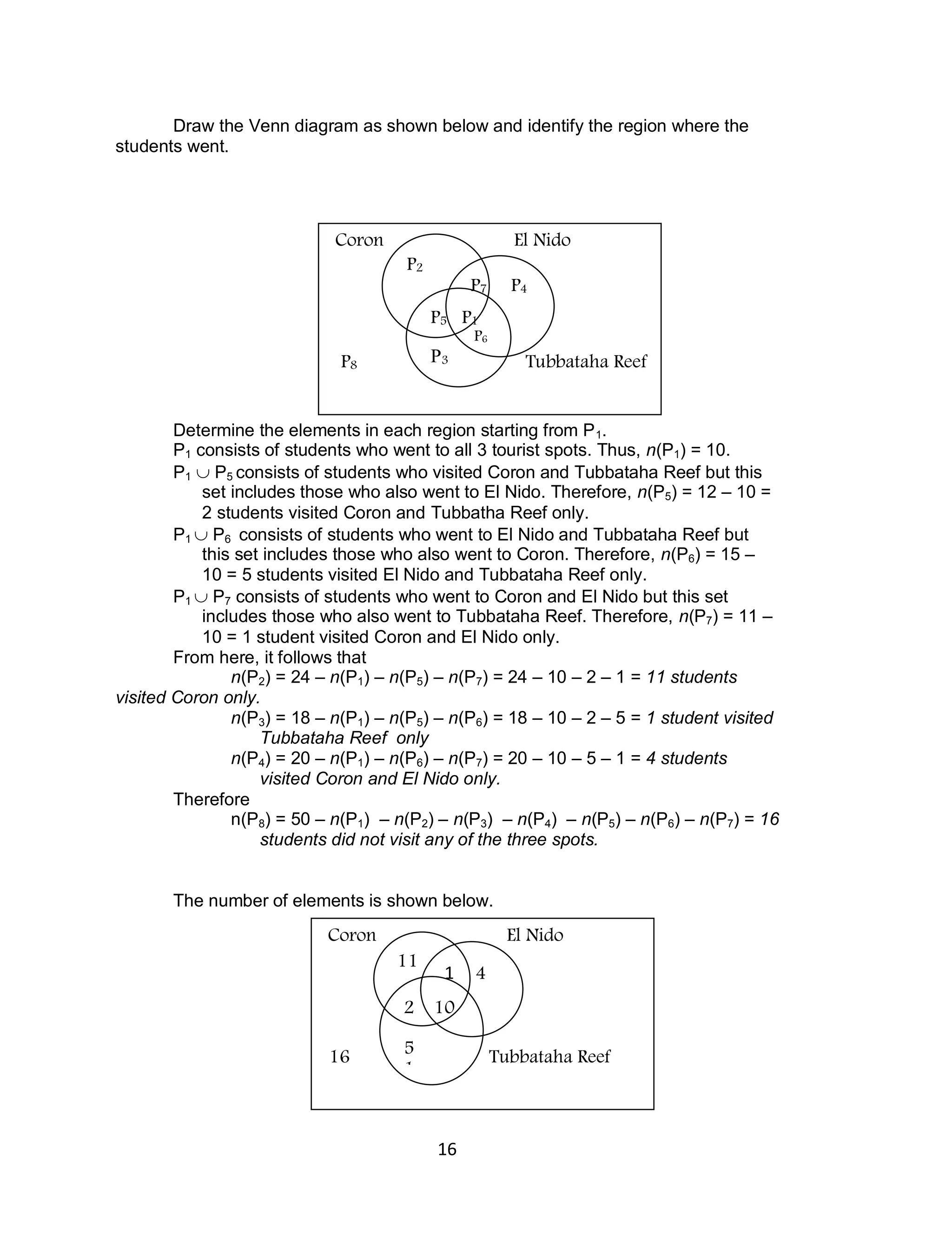
Draw the Venn diagram as shown below and identify the region where the
students went.
Determine the elements in each region starting from P1.
P1 consists of students who went to all 3 tourist spots. Thus, n(P1) = 10.
P1  P5 consists of students who visited Coron and Tubbataha Reef but this
set includes those who also went to El Nido. Therefore, n(P5) = 12 – 10 =
2 students visited Coron and Tubbatha Reef only.
P1  P6 consists of students who went to El Nido and Tubbataha Reef but
this set includes those who also went to Coron. Therefore, n(P6) = 15 –
10 = 5 students visited El Nido and Tubbataha Reef only.
P1  P7 consists of students who went to Coron and El Nido but this set
includes those who also went to Tubbataha Reef. Therefore, n(P7) = 11 –
10 = 1 student visited Coron and El Nido only.
From here, it follows that
n(P2) = 24 – n(P1) – n(P5) – n(P7) = 24 – 10 – 2 – 1 = 11 students
visited Coron only.
n(P3) = 18 – n(P1) – n(P5) – n(P6) = 18 – 10 – 2 – 5 = 1 student visited
Tubbataha Reef only
n(P4) = 20 – n(P1) – n(P6) – n(P7) = 20 – 10 – 5 – 1 = 4 students
visited Coron and El Nido only.
Therefore
n(P8) = 50 – n(P1) – n(P2) – n(P3) – n(P4) – n(P5) – n(P6) – n(P7) = 16
students did not visit any of the three spots.
The number of elements is shown below.
Coron El Nido
P8 Tubbataha Reef
P5 P1
P6
P3
P2
P7 P4
Coron El Nido
16 Tubbataha Reef
11
1 4
2 10
5
1
17
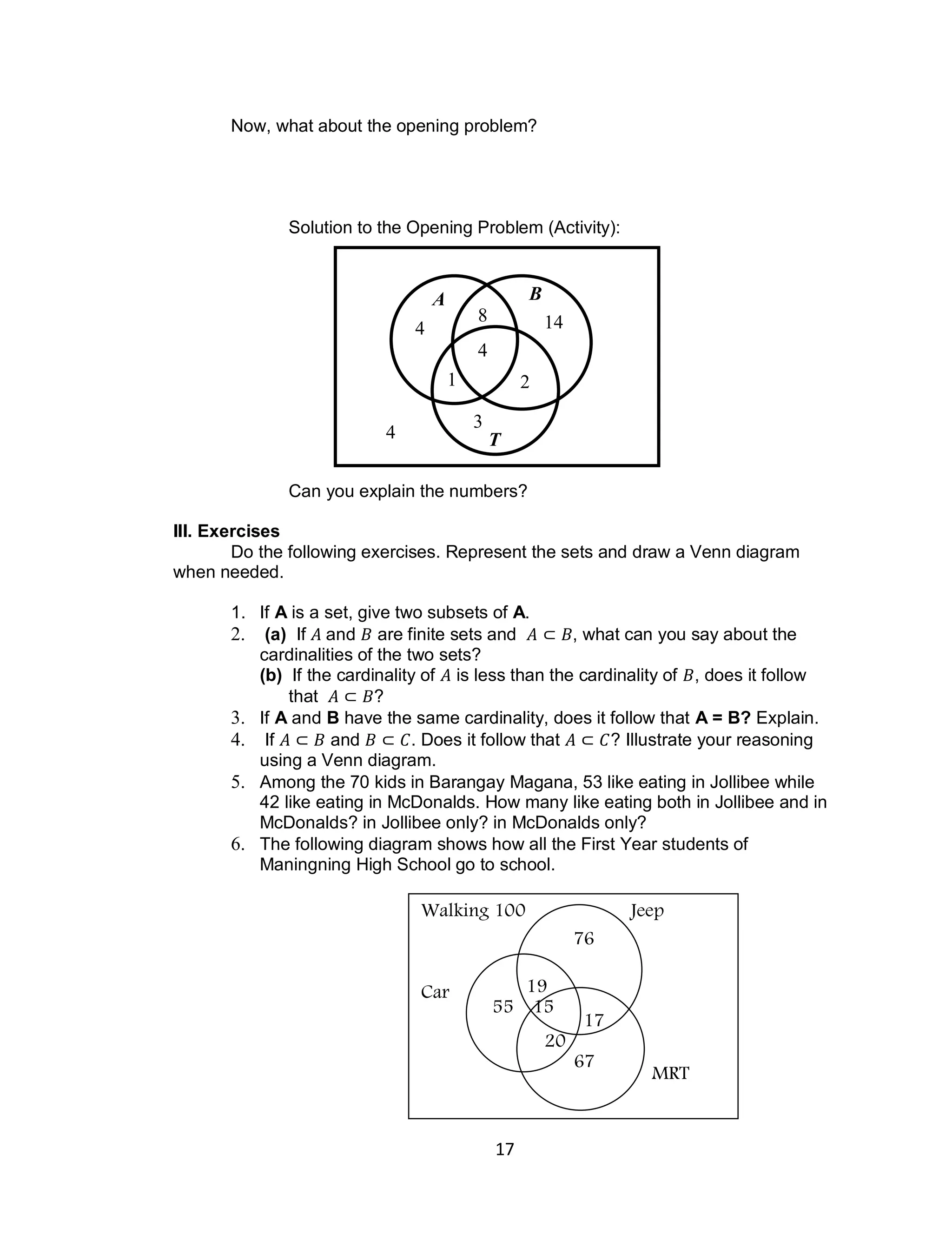
Now, what about the opening problem?
Solution to the Opening Problem (Activity):
Can you explain the numbers?
III. Exercises
Do the following exercises. Represent the sets and draw a Venn diagram
when needed.
1. If A is a set, give two subsets of A.
2. (a) If and are finite sets and , what can you say about the
cardinalities of the two sets?
(b) If the cardinality of is less than the cardinality of , does it follow
that ?
3. If A and B have the same cardinality, does it follow that A = B? Explain.
4. If and . Does it follow that ? Illustrate your reasoning
using a Venn diagram.
5. Among the 70 kids in Barangay Magana, 53 like eating in Jollibee while
42 like eating in McDonalds. How many like eating both in Jollibee and in
McDonalds? in Jollibee only? in McDonalds only?
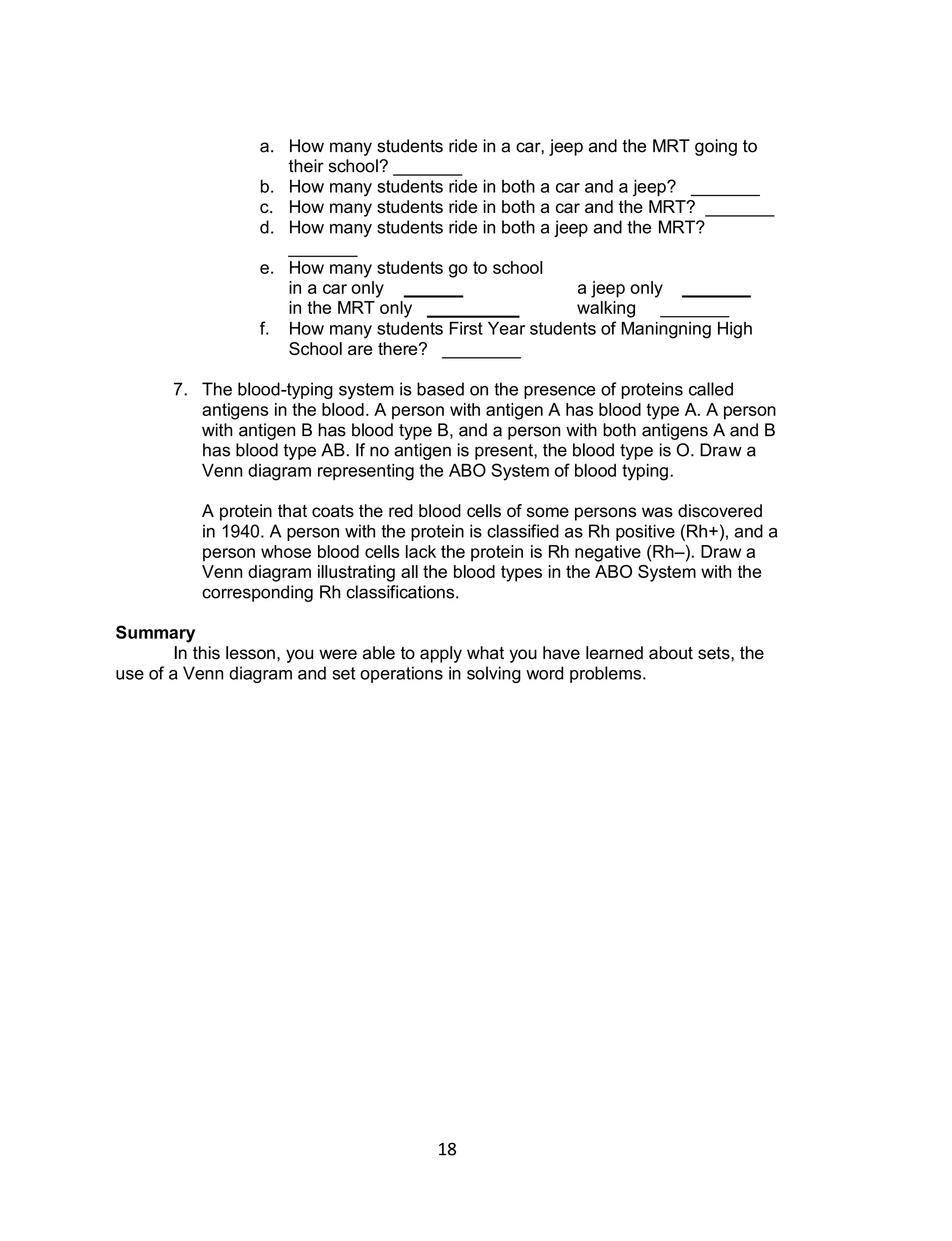
6. The following diagram shows how all the First Year students of
Maningning High School go to school.
Walking 100 Jeep
Car
MRT
148
A B
3
4
21
4
4
T
19
55 15
76
17
20
67
18
a. How many students ride in a car, jeep and the MRT going to
their school? _______
b. How many students ride in both a car and a jeep? _______
c. How many students ride in both a car and the MRT? _______
d. How many students ride in both a jeep and the MRT?
_______
e. How many students go to school
in a car only ______ a jeep only _______
in the MRT only ______ walking _______
f. How many students First Year students of Maningning High
School are there? ________
7. The blood-typing system is based on the presence of proteins called
antigens in the blood. A person with antigen A has blood type A. A person
with antigen B has blood type B, and a person with both antigens A and B
has blood type AB. If no antigen is present, the blood type is O. Draw a
Venn diagram representing the ABO System of blood typing.
A protein that coats the red blood cells of some persons was discovered
in 1940. A person with the protein is classified as Rh positive (Rh+), and a
person whose blood cells lack the protein is Rh negative (Rh–). Draw a
Venn diagram illustrating all the blood types in the ABO System with the
corresponding Rh classifications.
Summary
In this lesson, you were able to apply what you have learned about sets, the
use of a Venn diagram and set operations in solving word problems.
19
1 2 3 4 5
123
Lesson 4.1: Fundamental Operations on Integers: Addition of Integers
Time: 1 hour
Pre-requisite Concepts: Whole numbers, Exponents, Concept of Integers
About the Lesson: This lesson focuses on addition of integers using different
approaches. It is a review of what the students learned in Grade 6.
Objectives:
In this lesson, you are expected to:
1. Add integers using different approaches;
2. Solve word problems involving addition of integers.
Lesson Proper:
I. Activity
Study the following examples:
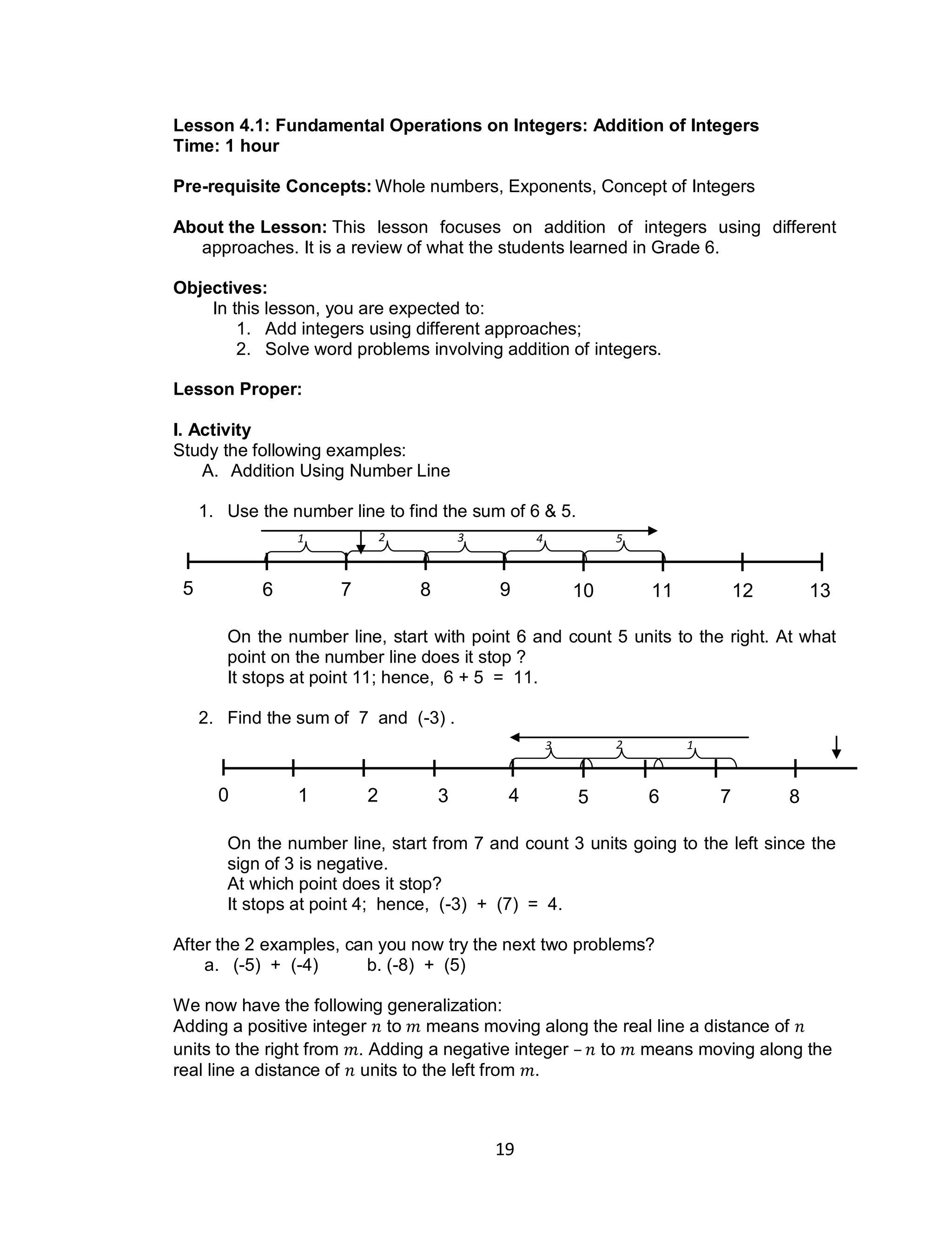
A. Addition Using Number Line
1. Use the number line to find the sum of 6 & 5.
On the number line, start with point 6 and count 5 units to the right. At what
point on the number line does it stop ?
It stops at point 11; hence, 6 + 5 = 11.
2. Find the sum of 7 and (-3) .
On the number line, start from 7 and count 3 units going to the left since the
sign of 3 is negative.
At which point does it stop?
It stops at point 4; hence, (-3) + (7) = 4.
After the 2 examples, can you now try the next two problems?
a. (-5) + (-4) b. (-8) + (5)
We now have the following generalization:
Adding a positive integer to means moving along the real line a distance of
units to the right from . Adding a negative integer – to means moving along the
real line a distance of units to the left from .
6 7 8 9 10 11 12 135
1 2 3 4 5 6 7 80
20
B. Addition Using Signed Tiles
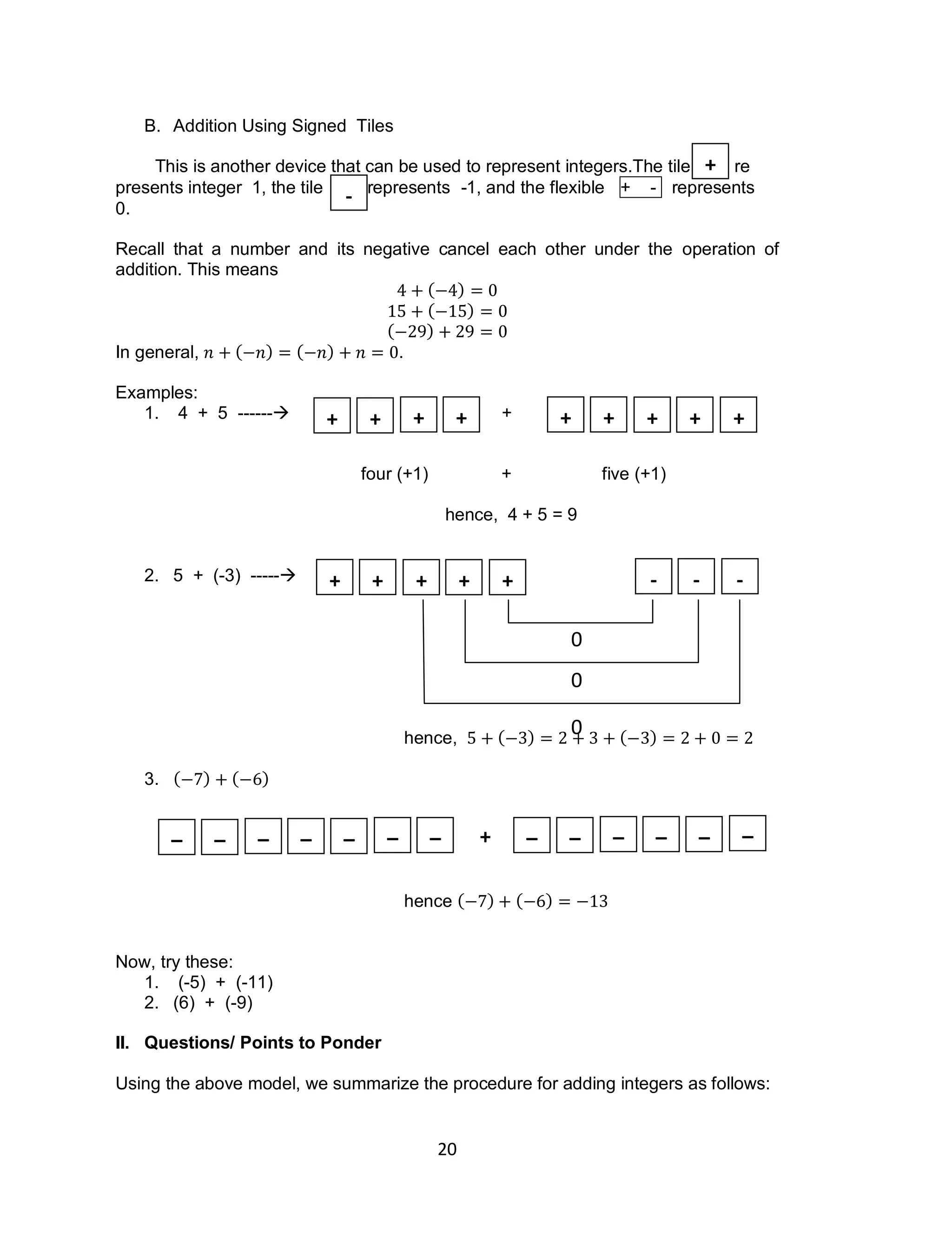
This is another device that can be used to represent integers.The tile re
presents integer 1, the tile represents -1, and the flexible + - represents
0.
Recall that a number and its negative cancel each other under the operation of
addition. This means
( )
( )
( )
In general, ( ) ( ) .
Examples:
1. 4 + 5 ------ + +
four (+1) + five (+1)
hence, 4 + 5 = 9
2. 5 + (-3) -----
hence, ( ) ( )
3. ( ) ( )
hence ( ) ( )
Now, try these:
1. (-5) + (-11)
2. (6) + (-9)
II. Questions/ Points to Ponder
Using the above model, we summarize the procedure for adding integers as follows:
+
-
+ + + + + + + + +
+ + + + + - - -
0
0
0
– – – – – – – – – – – – –+
21
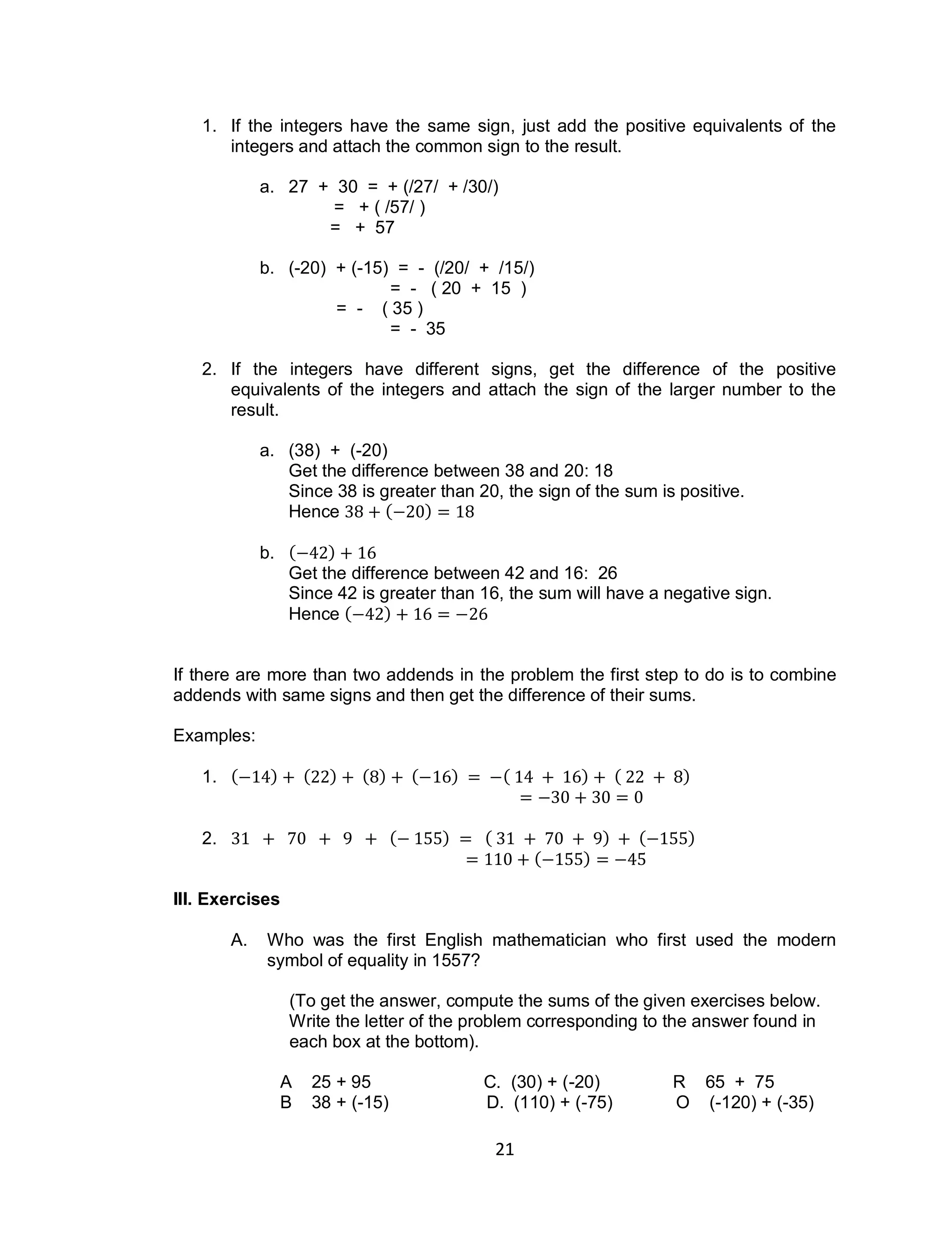
1. If the integers have the same sign, just add the positive equivalents of the
integers and attach the common sign to the result.
a. 27 + 30 = + (/27/ + /30/)
= + ( /57/ )
= + 57
b. (-20) + (-15) = - (/20/ + /15/)
= - ( 20 + 15 )
= - ( 35 )
= - 35
2. If the integers have different signs, get the difference of the positive
equivalents of the integers and attach the sign of the larger number to the
result.
a. (38) + (-20)
Get the difference between 38 and 20: 18
Since 38 is greater than 20, the sign of the sum is positive.
Hence ( )
b. ( )
Get the difference between 42 and 16: 26
Since 42 is greater than 16, the sum will have a negative sign.
Hence ( )
If there are more than two addends in the problem the first step to do is to combine
addends with same signs and then get the difference of their sums.
Examples:
1. ( ) ( ) ( ) ( ) ( ) ( )
2. ( ) ( ) ( )
( )
III. Exercises
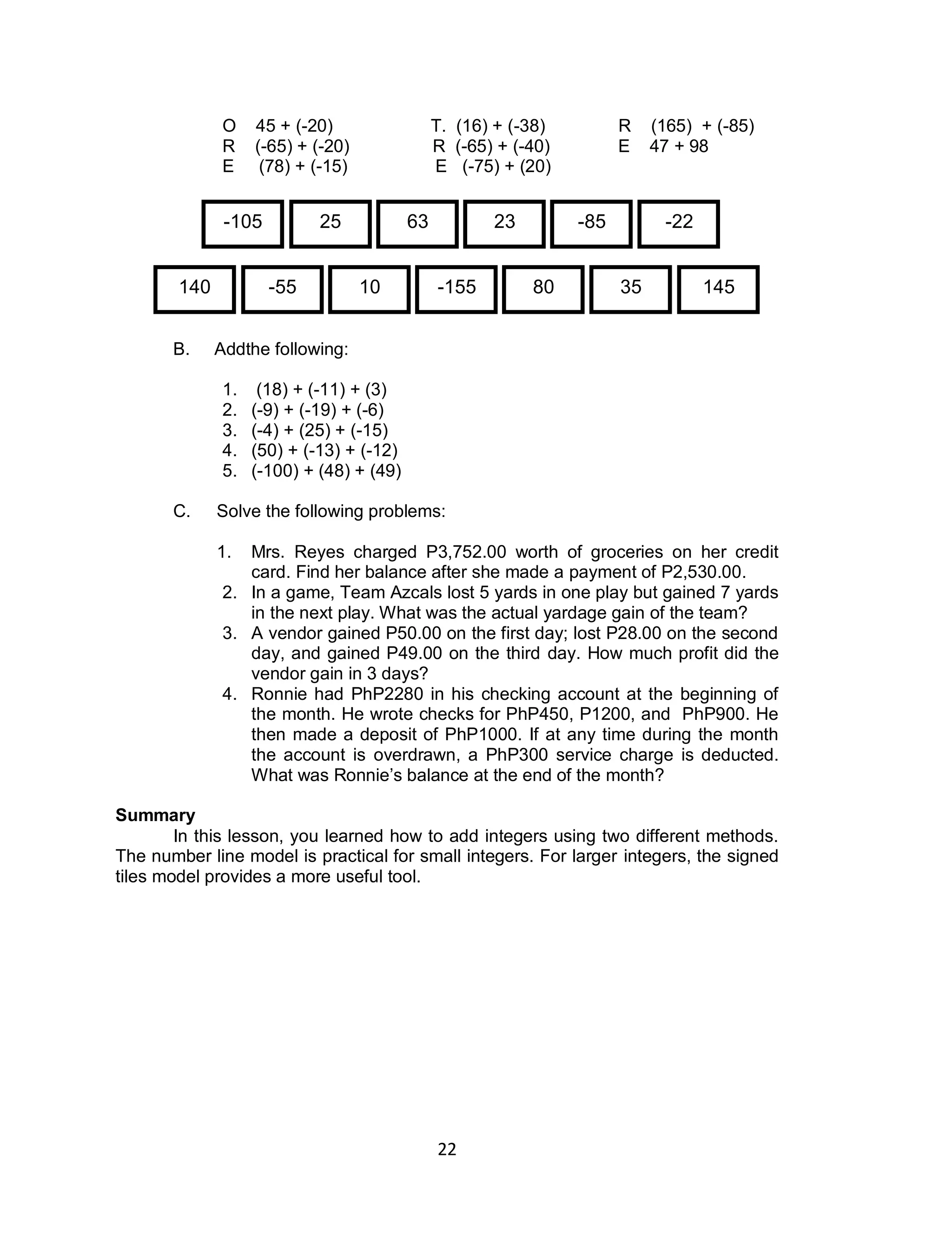
A. Who was the first English mathematician who first used the modern
symbol of equality in 1557?
(To get the answer, compute the sums of the given exercises below.
Write the letter of the problem corresponding to the answer found in
each box at the bottom).
A 25 + 95 C. (30) + (-20) R 65 + 75
B 38 + (-15) D. (110) + (-75) O (-120) + (-35)
22
O 45 + (-20) T. (16) + (-38) R (165) + (-85)
R (-65) + (-20) R (-65) + (-40) E 47 + 98
E (78) + (-15) E (-75) + (20)
B. Addthe following:
1. (18) + (-11) + (3)
2. (-9) + (-19) + (-6)
3. (-4) + (25) + (-15)
4. (50) + (-13) + (-12)
5. (-100) + (48) + (49)
C. Solve the following problems:
1. Mrs. Reyes charged P3,752.00 worth of groceries on her credit
card. Find her balance after she made a payment of P2,530.00.
2. In a game, Team Azcals lost 5 yards in one play but gained 7 yards
in the next play. What was the actual yardage gain of the team?
3. A vendor gained P50.00 on the first day; lost P28.00 on the second
day, and gained P49.00 on the third day. How much profit did the
vendor gain in 3 days?
4. Ronnie had PhP2280 in his checking account at the beginning of
the month. He wrote checks for PhP450, P1200, and PhP900. He
then made a deposit of PhP1000. If at any time during the month
the account is overdrawn, a PhP300 service charge is deducted.
What was Ronnie’s balance at the end of the month?
Summary
In this lesson, you learned how to add integers using two different methods.
The number line model is practical for small integers. For larger integers, the signed
tiles model provides a more useful tool.
-105 25 63 23 -85 -22
140 -55 10 -155 80 35 145
23
Lesson 4.2: Fundamental Operation on Integers:Subtraction of Integers
Time: 1 hour
Prerequisite Concepts: Whole numbers, Exponents, Concept of Integers, Addition
of Integers
About the Lesson: This lesson focuses on the subtraction of integers using
different approaches. It is a review of what the students learned in Grade 6.
Objectives:
In this lesson, you are expected to:
1. Subtract integers using
a. Number line
b. Signed tiles
2. Solve problems involving subtraction of integers.
Lesson Proper:
I. Activity
Study the material below.
1. Subtraction as the reverse operation of addition.
Recall how subtraction is defined. We have previously defined subtraction as
the reverse operation of addition. This means that when we ask “what is 5
minus 2?”, we are also asking “what number do we add to 2 in order to get
5?” Using this definition of subtraction, we can deduce how subtraction is
done using the number line.
a. Suppose you want to compute ( ) . You ask “What number must be
added to 3 to get ?
To get from 3 to , you need to move 7 units to the left. This is
equivalent to adding to 3. Hence in order to get , must be
added to 3. Therefore,
( )
b. Compute ( ) ( )
What number must be added to to get ?
24
To go from to , move 4 units to the right, or equivalently, add 4.
Therefore,
( ) ( )
2. Subtraction as the addition of the negative
Subtraction is also defined as the addition of the negative of the number. For
example, ( ). Keeping in mind that and are negatives of
each other, we can also have ( ) . Hence the examples above
can be solved as follows:
( ) ( ) ( )
( ) ( ) ( )
This definition of subtraction allows the conversion of a subtraction problem
to an addition problem.
Problem:
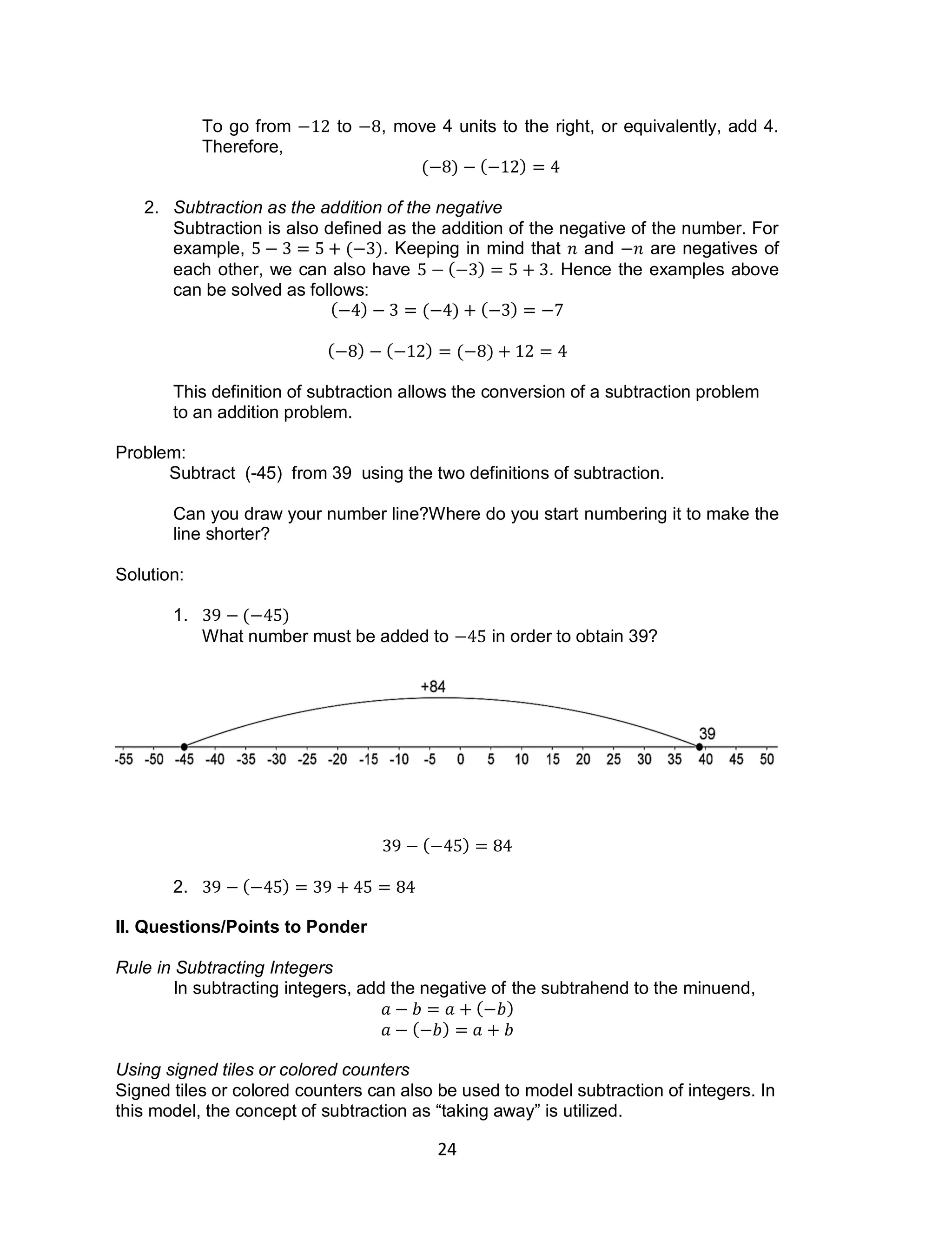
Subtract (-45) from 39 using the two definitions of subtraction.
Can you draw your number line?Where do you start numbering it to make the
line shorter?
Solution:
1. ( )
What number must be added to in order to obtain 39?
( )
2. ( )
II. Questions/Points to Ponder
Rule in Subtracting Integers
In subtracting integers, add the negative of the subtrahend to the minuend,
( )
( )
Using signed tiles or colored counters
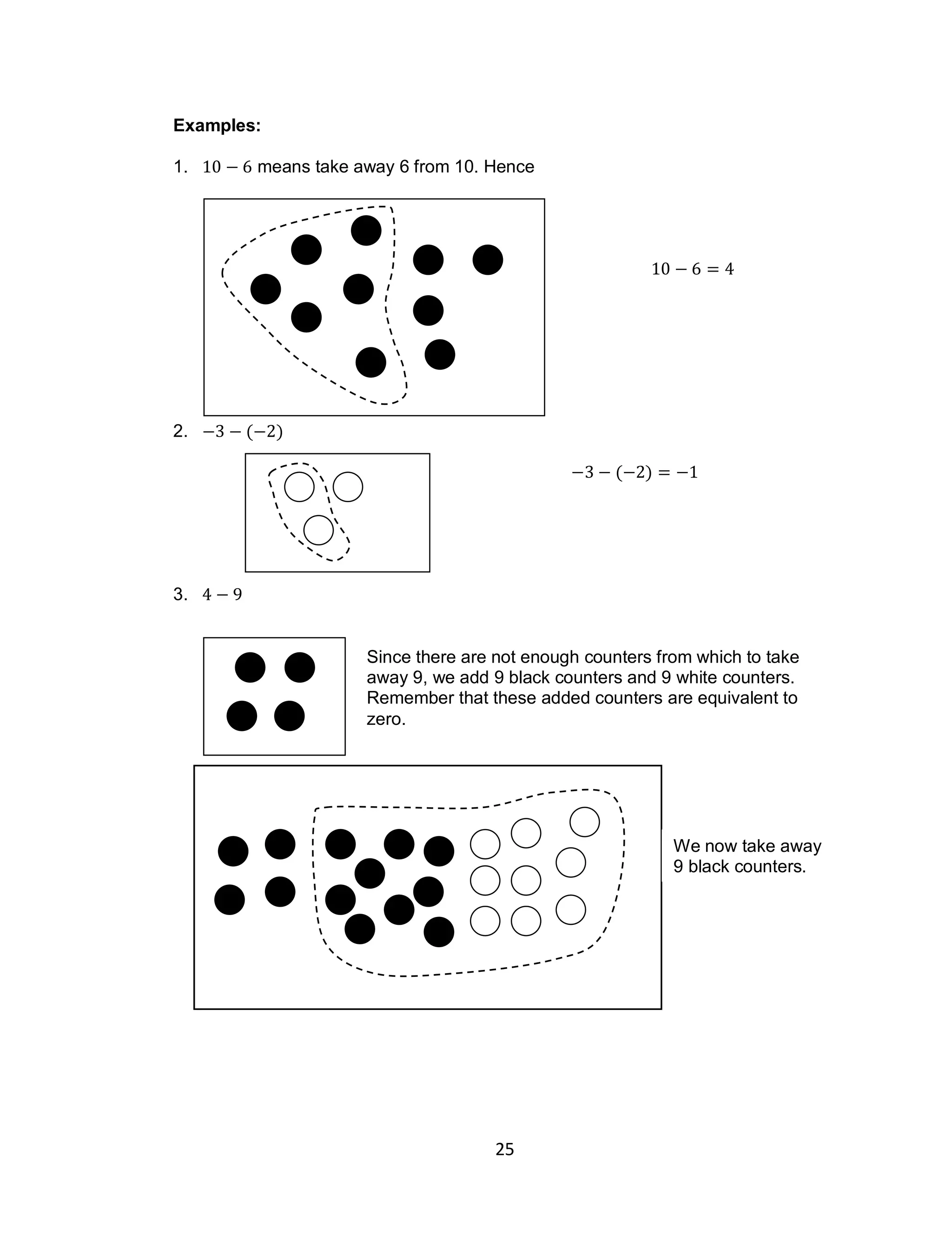
Signed tiles or colored counters can also be used to model subtraction of integers. In
this model, the concept of subtraction as “taking away” is utilized.
25
Examples:
1. means take away 6 from 10. Hence
2. ( )
( )
3.
Since there are not enough counters from which to take
away 9, we add 9 black counters and 9 white counters.
Remember that these added counters are equivalent to
zero.
We now take away
9 black counters.
26
4. ( )
Hence ( )
The last two examples above illustrate the definition of subtraction as the addition of
the negative.
[ ( )] [ ] ( ) ( )
III. Exercices
A. What is the name of the 4th highest mountain in the world?
(Decode the answer by finding the difference of the following subtraction
problems. Write the letter to the answer corresponding to the item in the box
provided below:
O Subtract (-33) from 99
L Subtract (-30) from 49
H 18 less than (-77)
E Subtract (-99) from 0
T How much is 0 decreased by (-11)?
S (-42) – (-34) – (-9) - 18
79 -95 132 11 -17 99
Notice that this configuration is the
same configuration for ( ).
We proceed with the addition and
obtain the answer
27
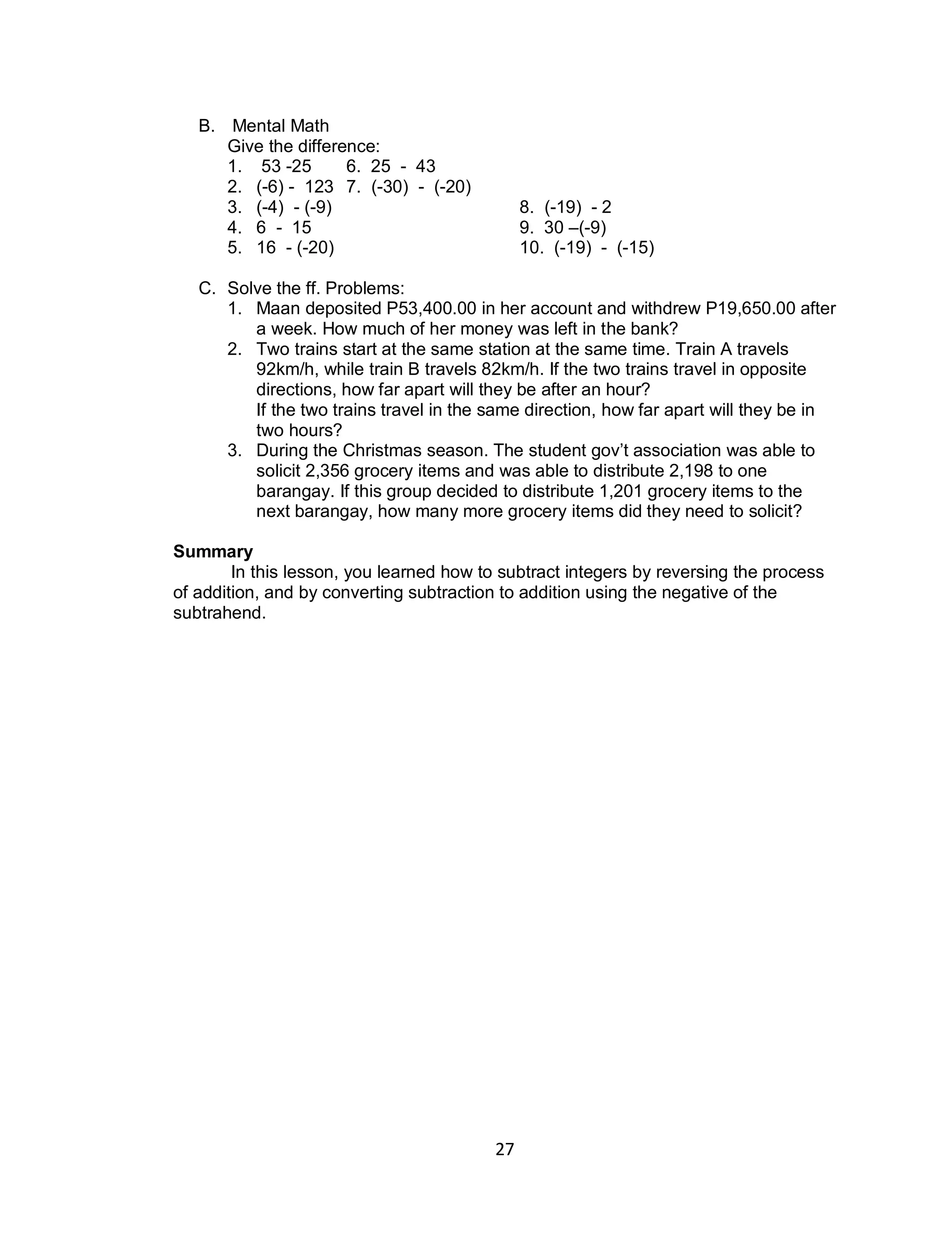
B. Mental Math
Give the difference:
1. 53 -25 6. 25 - 43
2. (-6) - 123 7. (-30) - (-20)
3. (-4) - (-9) 8. (-19) - 2
4. 6 - 15 9. 30 –(-9)
5. 16 - (-20) 10. (-19) - (-15)
C. Solve the ff. Problems:
1. Maan deposited P53,400.00 in her account and withdrew P19,650.00 after
a week. How much of her money was left in the bank?
2. Two trains start at the same station at the same time. Train A travels
92km/h, while train B travels 82km/h. If the two trains travel in opposite
directions, how far apart will they be after an hour?
If the two trains travel in the same direction, how far apart will they be in
two hours?
3. During the Christmas season. The student gov’t association was able to
solicit 2,356 grocery items and was able to distribute 2,198 to one
barangay. If this group decided to distribute 1,201 grocery items to the
next barangay, how many more grocery items did they need to solicit?
Summary
In this lesson, you learned how to subtract integers by reversing the process
of addition, and by converting subtraction to addition using the negative of the
subtrahend.
28
Lesson 4.3: Fundamental Operations on Integers: Multiplication of Integers
Time: 1 hour
Prerequisite Concepts: Operations on whole numbers, addition and subtraction of
integers
About the Lesson: This is the third lesson on operations on integers. The intent of
the lesson is to deepen what students have learned in Grade 6, by expounding on
the meaning of multiplication of integers.
Objective:
In this lesson; you are expected to:
1. Multiply integers.
2. Apply multiplication of integers in solving problems
Lesson Proper:
I. Activity
Answer the following question.
How do we define multiplication?
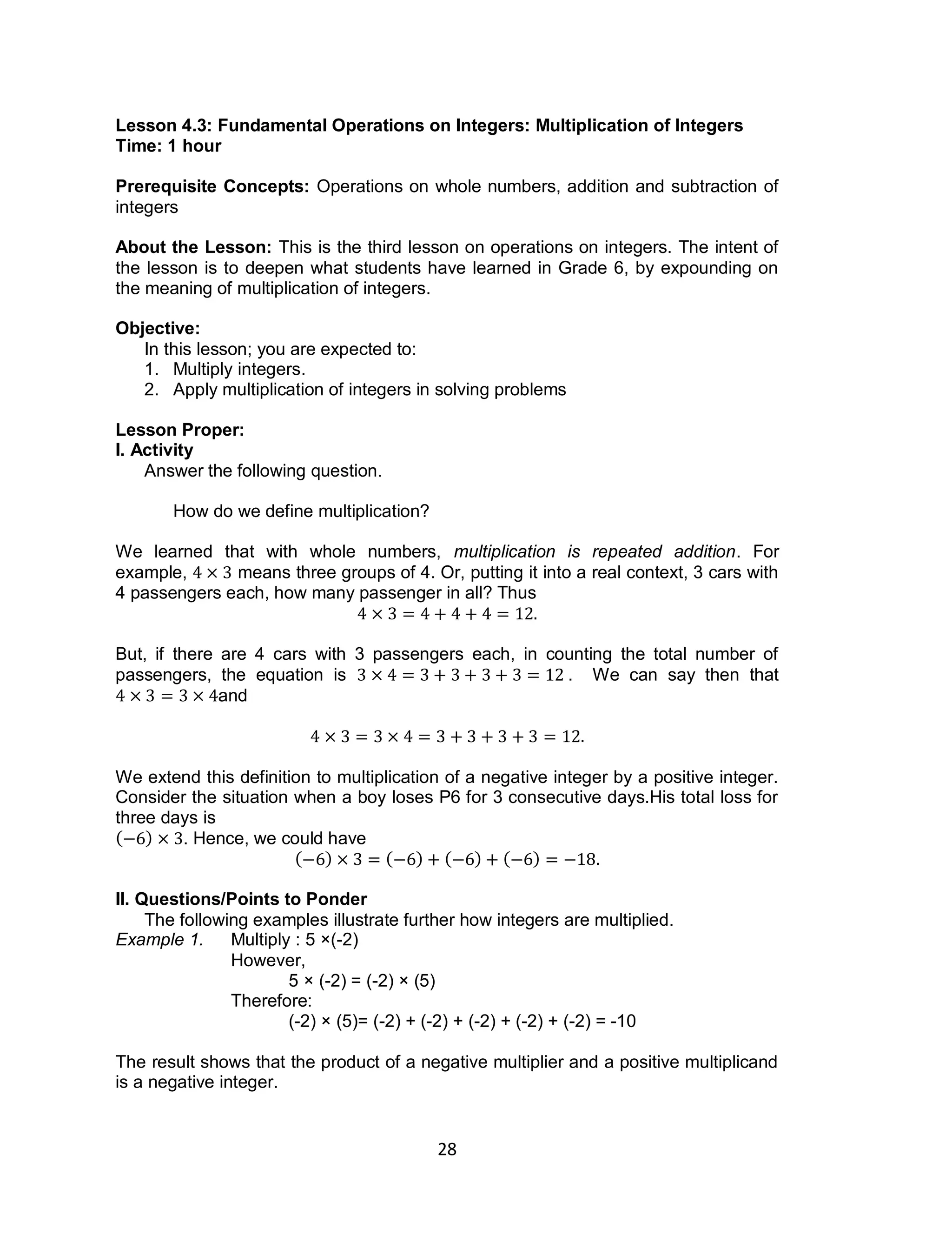
We learned that with whole numbers, multiplication is repeated addition. For
example, means three groups of 4. Or, putting it into a real context, 3 cars with
4 passengers each, how many passenger in all? Thus
But, if there are 4 cars with 3 passengers each, in counting the total number of
passengers, the equation is . We can say then that
and
We extend this definition to multiplication of a negative integer by a positive integer.
Consider the situation when a boy loses P6 for 3 consecutive days.His total loss for
three days is
( ) . Hence, we could have
( ) ( ) ( ) ( )
II. Questions/Points to Ponder
The following examples illustrate further how integers are multiplied.
Example 1. Multiply : 5 ×(-2)
However,
5 × (-2) = (-2) × (5)
Therefore:
(-2) × (5)= (-2) + (-2) + (-2) + (-2) + (-2) = -10
The result shows that the product of a negative multiplier and a positive multiplicand
is a negative integer.
29
Generalization:Multiplying unlike signs
We know that adding negative numbers means adding their positive equivalents and
attaching the negative sign to the result, then
( ) ( ) ( ) ( ) ( )⏟ ( )⏟
for any positive integers and .
We know that any whole number multiplied by 0 gives 0. Is this true for any integer
as well? The answer is YES. In fact, any number multiplied by 0 gives 0. This is
known as the Zero Property.
What do we get when we multiply two negative integers?
Example 2. Multiply: (-8) × (-3)
We know that ( ) .
Therefore,
( ) ( ) ( ) ( ) ( )
( ) [ ( )](Distributive Law)
( ) ( and are additive inverses)
(Zero Property)
The only number which when added to gives 0 is the additive
inverse of . Therefore, ( ) ( ) is the additive inverse of 24,
or ( ) ( )
The result shows that the product of two negative integers is a positive integer.
Generalization:Multiplying Two Negative Integers
If and are positive integers, then ( ) ( ) .
Rules in Multiplying Integers:
In multiplying integers, find the product of their positive equivalents.
1. If the integers have the same signs, their product is positive.
2. If the integers have different signs their product is negative.
III. Exercises
A. Find the product of the following:
1. (5)(12)
2. (-8)(4)
3. (-5)(3)(2)
4. (-7)(4)(-2)
5. (3)(8)(-2)
6. (9)(-8)(-9)
7. (-9)(-4)(-6)
30
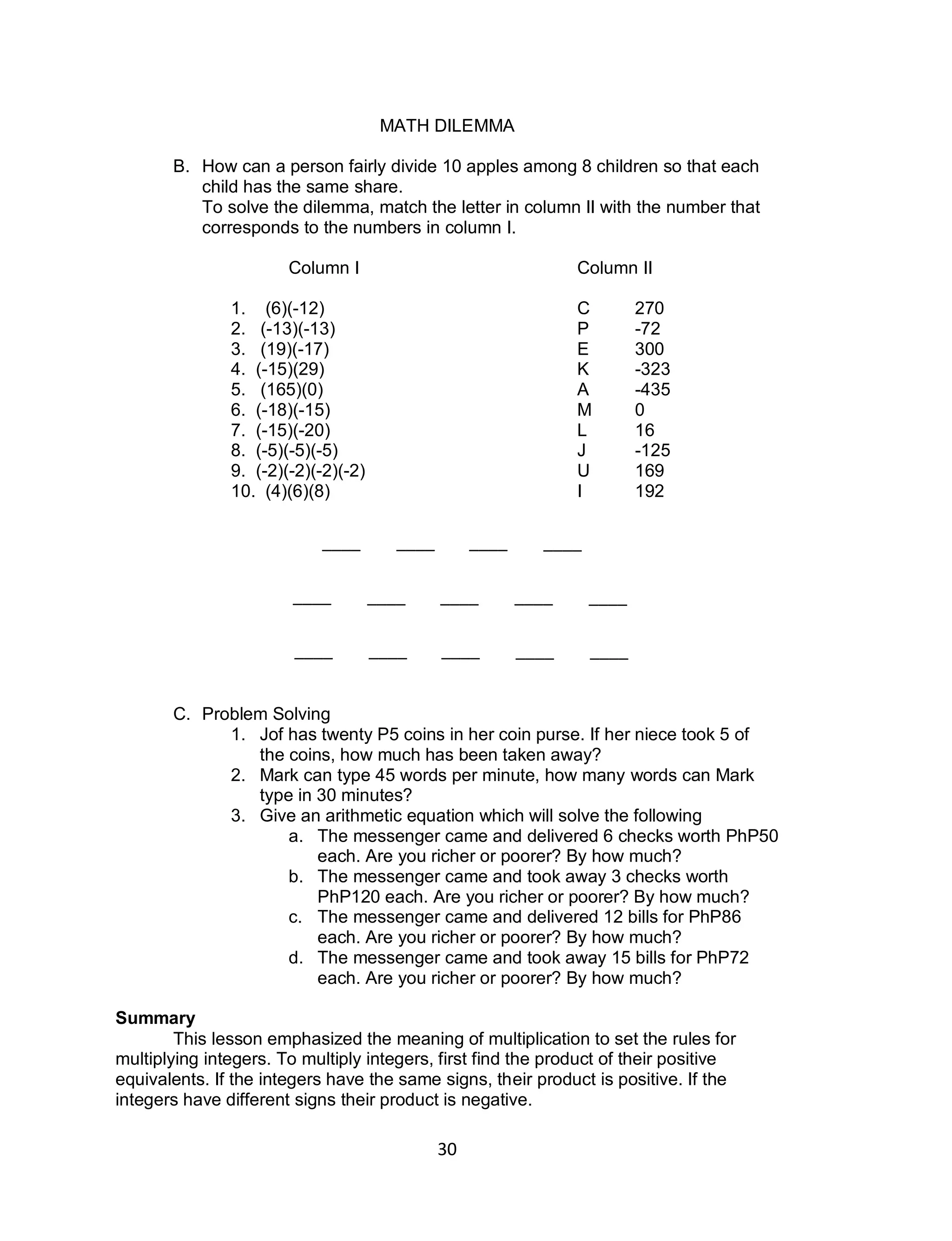
MATH DILEMMA
B. How can a person fairly divide 10 apples among 8 children so that each
child has the same share.
To solve the dilemma, match the letter in column II with the number that
corresponds to the numbers in column I.
Column I Column II
1. (6)(-12) C 270
2. (-13)(-13) P -72
3. (19)(-17) E 300
4. (-15)(29) K -323
5. (165)(0) A -435
6. (-18)(-15) M 0
7. (-15)(-20) L 16
8. (-5)(-5)(-5) J -125
9. (-2)(-2)(-2)(-2) U 169
10. (4)(6)(8) I 192
C. Problem Solving
1. Jof has twenty P5 coins in her coin purse. If her niece took 5 of
the coins, how much has been taken away?
2. Mark can type 45 words per minute, how many words can Mark
type in 30 minutes?
3. Give an arithmetic equation which will solve the following
a. The messenger came and delivered 6 checks worth PhP50
each. Are you richer or poorer? By how much?
b. The messenger came and took away 3 checks worth
PhP120 each. Are you richer or poorer? By how much?
c. The messenger came and delivered 12 bills for PhP86
each. Are you richer or poorer? By how much?
d. The messenger came and took away 15 bills for PhP72
each. Are you richer or poorer? By how much?
Summary
This lesson emphasized the meaning of multiplication to set the rules for
multiplying integers. To multiply integers, first find the product of their positive
equivalents. If the integers have the same signs, their product is positive. If the
integers have different signs their product is negative.
____
_
5
____
_
4
____
_
3
____
_
7____
_
4
____
_
1
____
_
1
____
_
9
____
_
7____
_
8
____
_
2
____
_
10
____
_
6
____
_
7
31
Lesson 4.4: Fundamental Operations on Integers: Division of Integers
Time: 1 hour
Prerequisite Concepts: Addition and subtraction of Integers, Multiplication of
Integers
About the Lesson: Like in the previous lessons, this lesson is meant to deepen
students’ understanding of the division operation on integers. The concept of
division used here relies on its relationship to multiplication.
Objective:
In this lesson you are expected to:
1. Find the quotient of two integers.
2. Solve problems involving division of integers.
Lesson Proper:
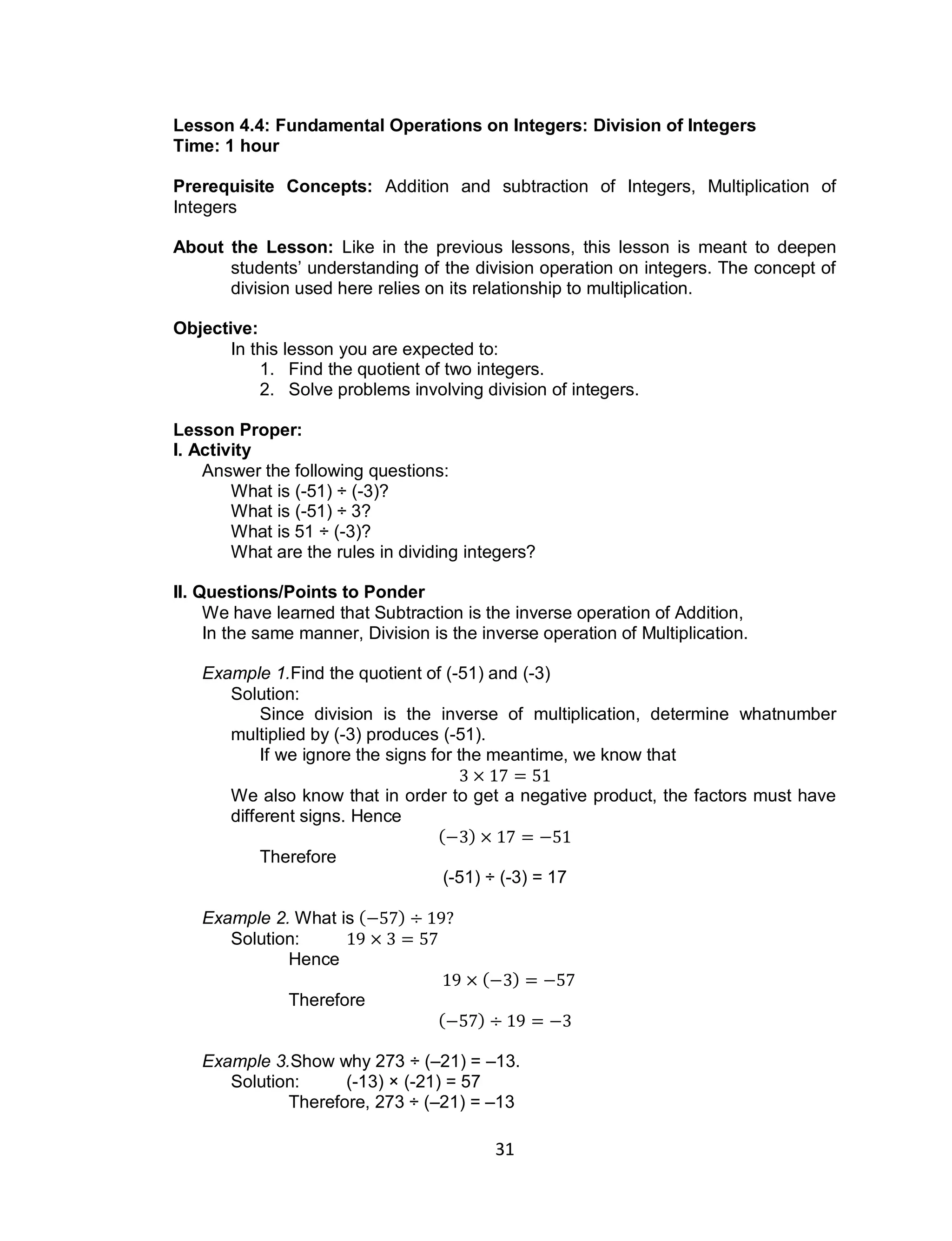
I. Activity
Answer the following questions:
What is (-51) ÷ (-3)?
What is (-51) ÷ 3?
What is 51 ÷ (-3)?
What are the rules in dividing integers?
II. Questions/Points to Ponder
We have learned that Subtraction is the inverse operation of Addition,
In the same manner, Division is the inverse operation of Multiplication.
Example 1.Find the quotient of (-51) and (-3)
Solution:
Since division is the inverse of multiplication, determine whatnumber
multiplied by (-3) produces (-51).
If we ignore the signs for the meantime, we know that
We also know that in order to get a negative product, the factors must have
different signs. Hence
( )
Therefore
(-51) ÷ (-3) = 17
Example 2. What is ( )
Solution:
Hence
( )
Therefore
( )
Example 3.Show why 273 ÷ (–21) = –13.
Solution: (-13) × (-21) = 57
Therefore, 273 ÷ (–21) = –13
32
(-352) ÷ 22
(128) ÷ -16
(168) ÷ 6(144) ÷ -3 (108) ÷ 9
(-315) ÷ (-35)(-147) ÷ 7
(-120) ÷ 8
(-444) ÷ (-12)
Generalization
The quotient of two integers with the same signs is a positive integer and the
quotient of two integers having unlike signs is a negative integer.However,
division by zero is not possible.
When several operations have to be performed, the GEMDAS rule applies.
Example 4. Perform the indicated operations
1. ( )
2. ( )
3. ( ) ( )
Solution:
1. ( ) ( )
2. ( ) ( )
3. ( ) ( ) ( ) ( )
III. Exercises:
A. Compute the following
1. ( ) ( )
2. ( )
3. ( )
4. ( ) [( ) ]
5. ( )
B. What was the original name for the butterfly?
To find the answer find the quotient of each of the following and write the
letter of the problems in the box corresponding to the quotient.
9 37 -15 -8 -8 28 -16 12 -48
R
L
EB
T F
U
T
Y
33
C. Solvethe following problems:
1. Vergara’s store earned P8750 a week, How much is her average
earning in a day?
2. Russ worked in a factory and earned P7875.00 for 15 days. How
much is his earning in a day?
3. There are 336 oranges in 12 baskets. How many oranges are there in
3 baskets?
4. A teacher has to divide 280 pieces of graphing paper equally among
his 35 students. How many pieces of graphing paper will each student
recieve?
5. A father has 976 sq. meters lot, he has to divide it among his 4
children. What is the share of each child?
D. Complete the three-by-three magic square (that is, the sums of the numbers
in each row, in each column and in each of the diagonals are the same) using
the numbers -10, -7, -4, -3, 0, 3, 4, 7, 10. What is the sum for each row,
column and diagonal?
Summary
Division is the reverse operation of multiplication. Using this definition, it is
easy to see that the quotient of two integers with the same signs is a positive integer
and the quotient of two integers having unlike signs is a negative integer.
34
Lesson 5: Properties of the Operations on Integers Time: 1.5 hours
Prerequisite Concepts: Addition, Subtraction, Multiplication and Division of
Integers
About the Lesson:
This lesson will strengthen the skills of students in performing the
fundamental operations of integers. Knowledge of these will serve as an
axiom/guide in performing said operations. In addition, this will help students
solve problems including real life situations in algebra. This section also
discusses how an application of the properties of real numbers in real life
situations can be helpful in sustaining harmonious relationships among people.
Objectives
In this lesson, you are expected to:
1. State and illustrate the different properties of the operations on
integers
a. closure
b. commutative
c. associative
d. distributive
e. identity
f. inverse
2. Rewrite given expressions according to the given property.
Lesson Proper:
I. A. Activity 1: Try to reflect on these . . .
1. Give at least 5 words synonymous to the word “property”.
Activity 2: PICTIONARY GAME: DRAW AND TELL!
Needed Materials:
5 strips of cartolina with adhesive tape
where each of the following words will
be written:
 Closure
 Commutative
 Associative
 Distributive
 Identity
 Inverse
Printed Description:
 Stays the same
 Swapping /Interchange
 Bracket Together/Group Together
 Share Out /Spread Out /Disseminate
 One and the Same/Alike
 Opposite/Contrary
Rules of the Game:
The mission of each player holding a
strip of cartolina is to let the
classmates guess the hidden word
by drawing symbols, figures or
images on the board without any
word.
If the hidden property is discovered,
a volunteer from the class will give
his/her own meaning of the identified
words. Then, from the printed
descriptions, he/she can choose the
appropriate definition of the disclosed
word and verify if his/her initial
description is correct.
The game ends when all the words
are revealed.
35
The following questions will be answered as you go along to the next activity.
 What properties of real numbers were shown in the Pictionary Game?
Give one example and explain.
 How are said properties seen in real life?
Activity 3: SHOW AND TELL!
Determine what kind of property of real numbers is being illustrated in the
following images:
A. Fill in the blanks with the correct numerical values of the motorbike and bicycle
riders.
_______ _______
If a represents the number of motorbike riders and b represents the
number of bicycle riders, show the mathematical statement for the
diagram below.
_______ + _______ = _______ + _______
Guide Questions:
 What operation is used in illustrating the diagram?
 What happened to the terms in both sides of the equation?
 Based on the previous activity, what property is being applied?
 What if the operation is replaced by multiplication, will the same property
be applicable? Give an example to prove your answer.
 Define the property.
 Give a real life situation in which the commutative property can be
applied.
 Test the property on subtraction and division operations by using
simple examples. What did you discover?
+
Equals
+
36
B. Fill in the blanks with the correct numerical values of the set of cellphones,
ipods and laptops.
_______ _______ _______
_______ _______ _______
If a represents the number of cellphones, b represents the ipods and c
represents the laptops, show the mathematical statement for the diagram
below.
(_______ + _______ ) +_______ = _______ + (_______ + _______ )
Guide Questions:
 What operation is used in illustrating the diagram?
 What happened to the groupings of the given sets that correspond to both
sides of the equation?
 Based on the previous activity, what property is being applied?
 What if the operation is replaced by multiplication, will the same property
be applicable? Give an example to prove your answer.
 Define the property.
 Give a real life situation wherein associative property can be applied.
 Test the property on subtraction and division operations by using simple
examples. What did you discover?
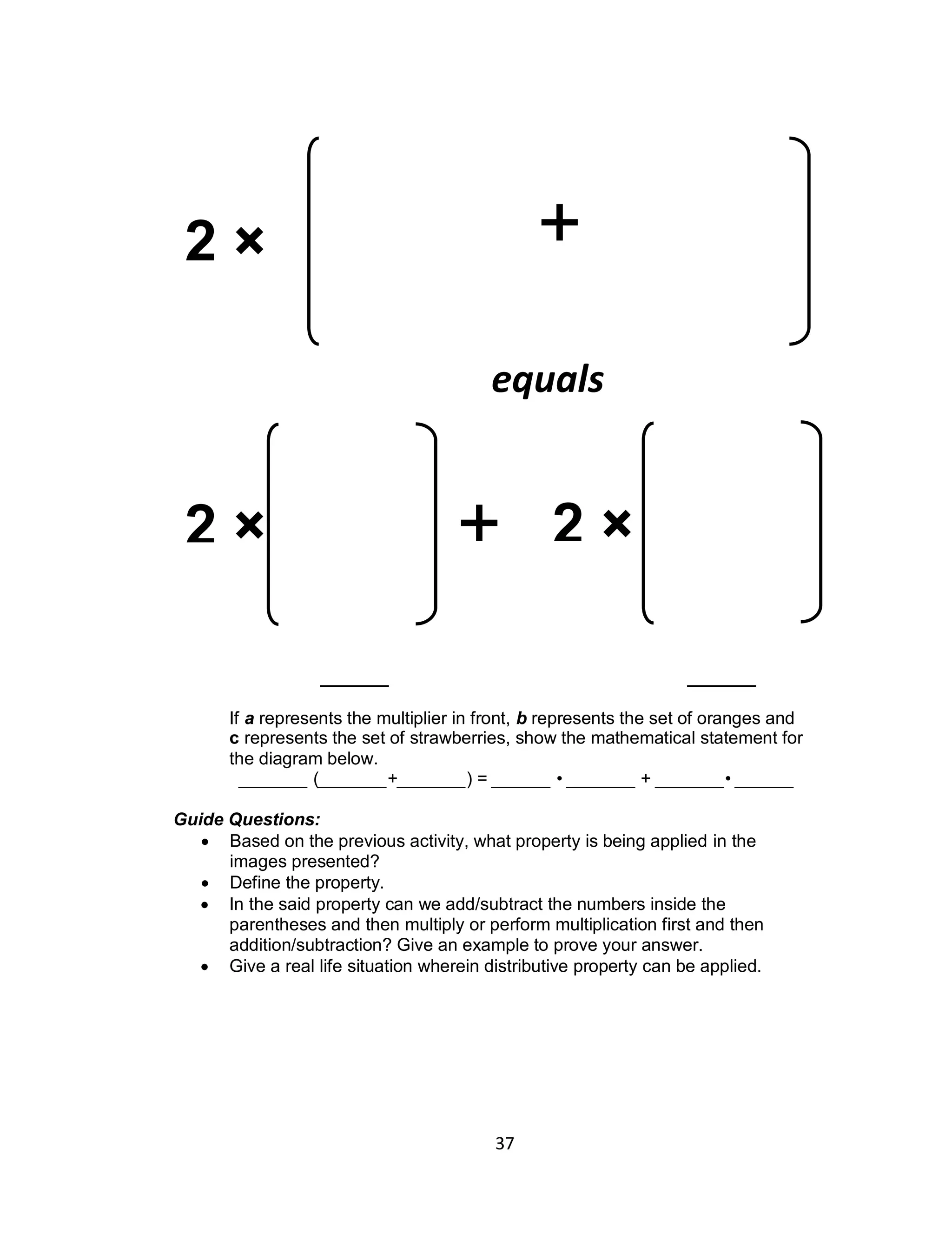
C. Fill in the blanks with the correct numerical values of the set of oranges and
set of strawberries.
_______ _______
+ +
equals
+ +
37
_______ _______
If a represents the multiplier in front, b represents the set of oranges and
c represents the set of strawberries, show the mathematical statement for
the diagram below.
_______ (_______+_______) = ______ • _______ + _______• ______
Guide Questions:
 Based on the previous activity, what property is being applied in the
images presented?
 Define the property.
 In the said property can we add/subtract the numbers inside the
parentheses and then multiply or perform multiplication first and then
addition/subtraction? Give an example to prove your answer.
 Give a real life situation wherein distributive property can be applied.
+2 × 2 ×
equals
+2 ×
38
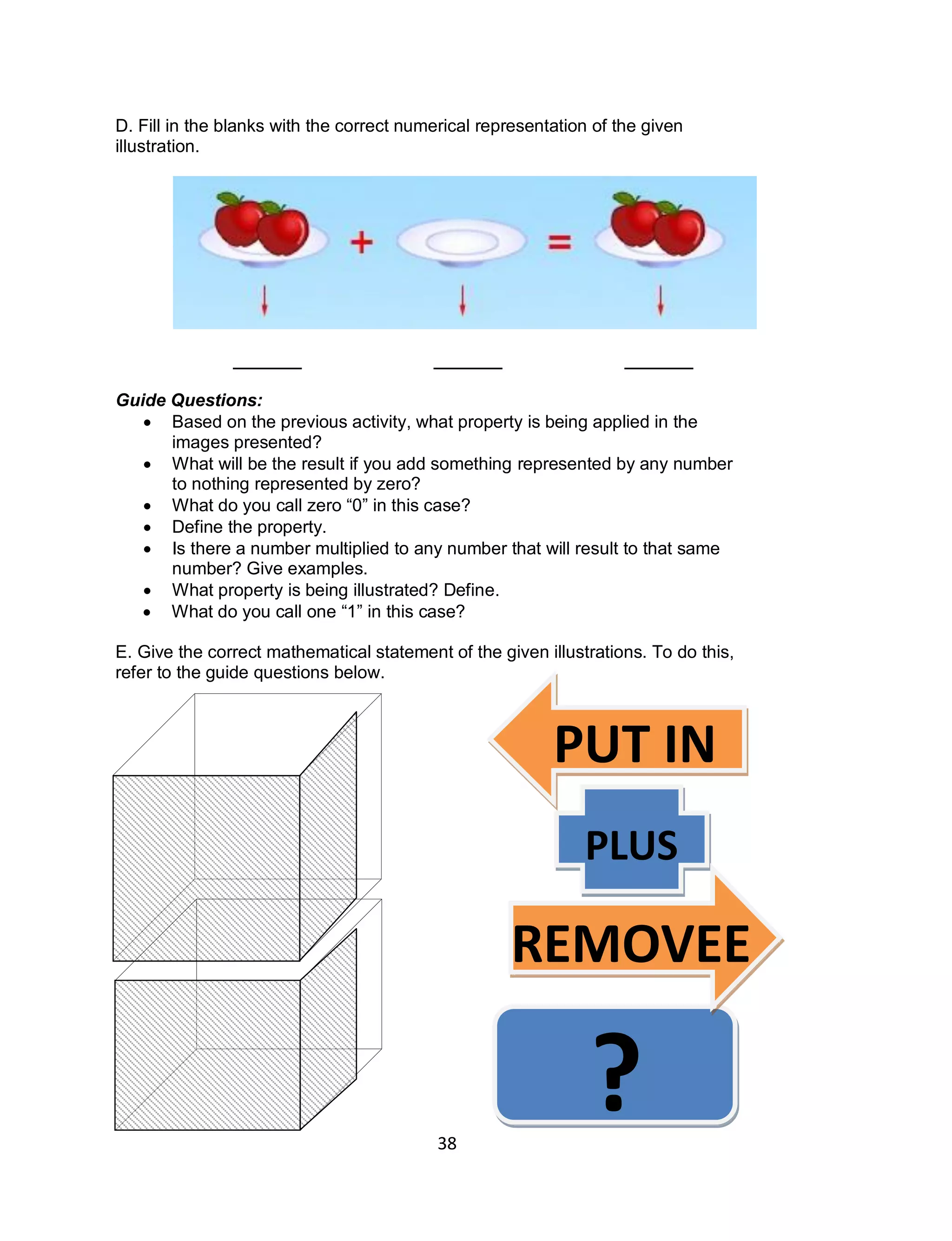
D. Fill in the blanks with the correct numerical representation of the given
illustration.
_______ _______ _______
Guide Questions:
 Based on the previous activity, what property is being applied in the
images presented?
 What will be the result if you add something represented by any number
to nothing represented by zero?
 What do you call zero “0” in this case?
 Define the property.
 Is there a number multiplied to any number that will result to that same
number? Give examples.
 What property is being illustrated? Define.
 What do you call one “1” in this case?
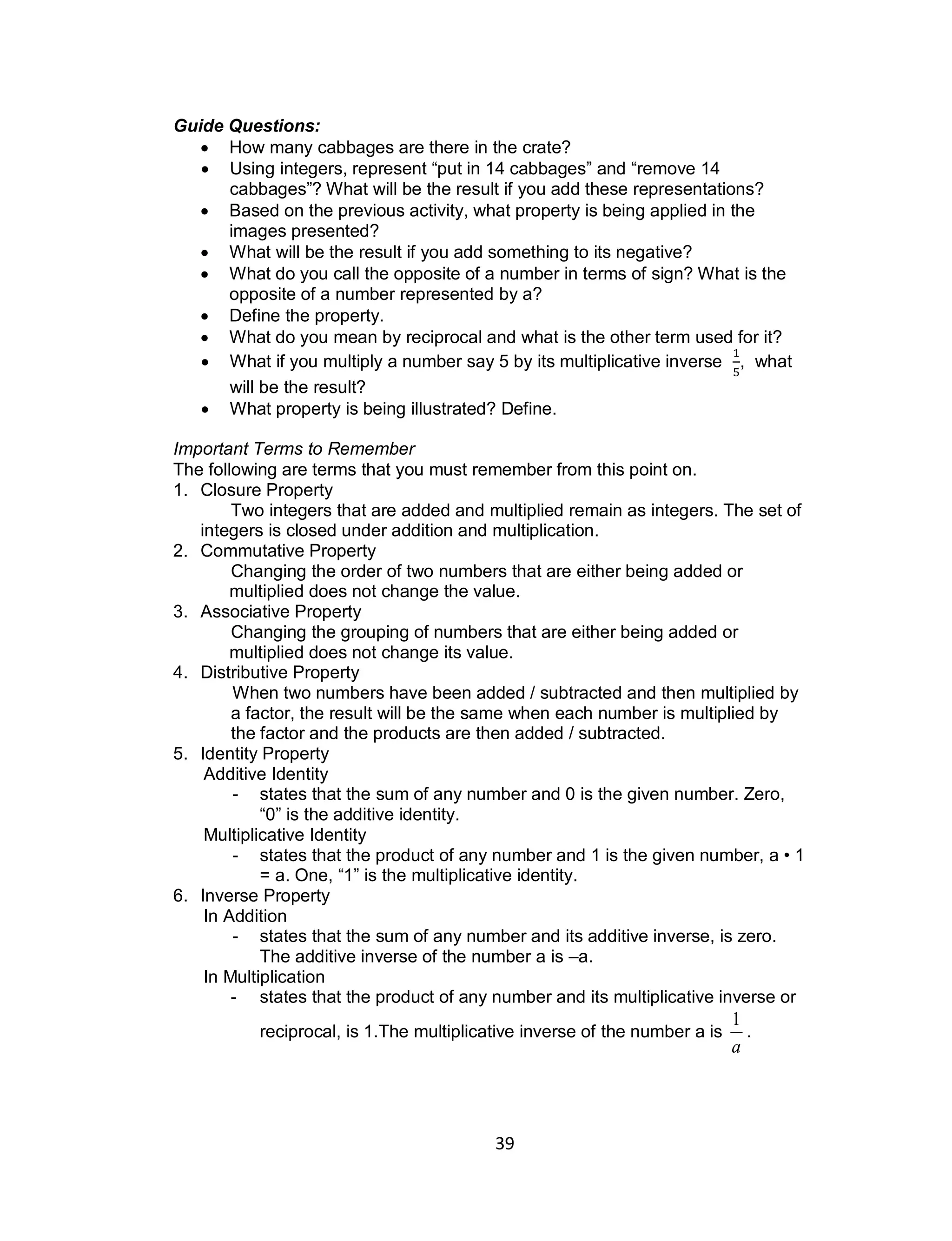
E. Give the correct mathematical statement of the given illustrations. To do this,
refer to the guide questions below.
PUT IN
PLUS
REMOVEE
?
39
Guide Questions:
 How many cabbages are there in the crate?
 Using integers, represent “put in 14 cabbages” and “remove 14
cabbages”? What will be the result if you add these representations?
 Based on the previous activity, what property is being applied in the
images presented?
 What will be the result if you add something to its negative?
 What do you call the opposite of a number in terms of sign? What is the
opposite of a number represented by a?
 Define the property.
 What do you mean by reciprocal and what is the other term used for it?
 What if you multiply a number say 5 by its multiplicative inverse , what
will be the result?
 What property is being illustrated? Define.
Important Terms to Remember
The following are terms that you must remember from this point on.
1. Closure Property
Two integers that are added and multiplied remain as integers. The set of
integers is closed under addition and multiplication.
2. Commutative Property
Changing the order of two numbers that are either being added or
multiplied does not change the value.
3. Associative Property
Changing the grouping of numbers that are either being added or
multiplied does not change its value.
4. Distributive Property
When two numbers have been added / subtracted and then multiplied by
a factor, the result will be the same when each number is multiplied by
the factor and the products are then added / subtracted.
5. Identity Property
Additive Identity
- states that the sum of any number and 0 is the given number. Zero,
“0” is the additive identity.
Multiplicative Identity
- states that the product of any number and 1 is the given number, a • 1
= a. One, “1” is the multiplicative identity.
6. Inverse Property
In Addition
- states that the sum of any number and its additive inverse, is zero.
The additive inverse of the number a is –a.
In Multiplication
- states that the product of any number and its multiplicative inverse or
reciprocal, is 1.The multiplicative inverse of the number a is
a
1
.
40
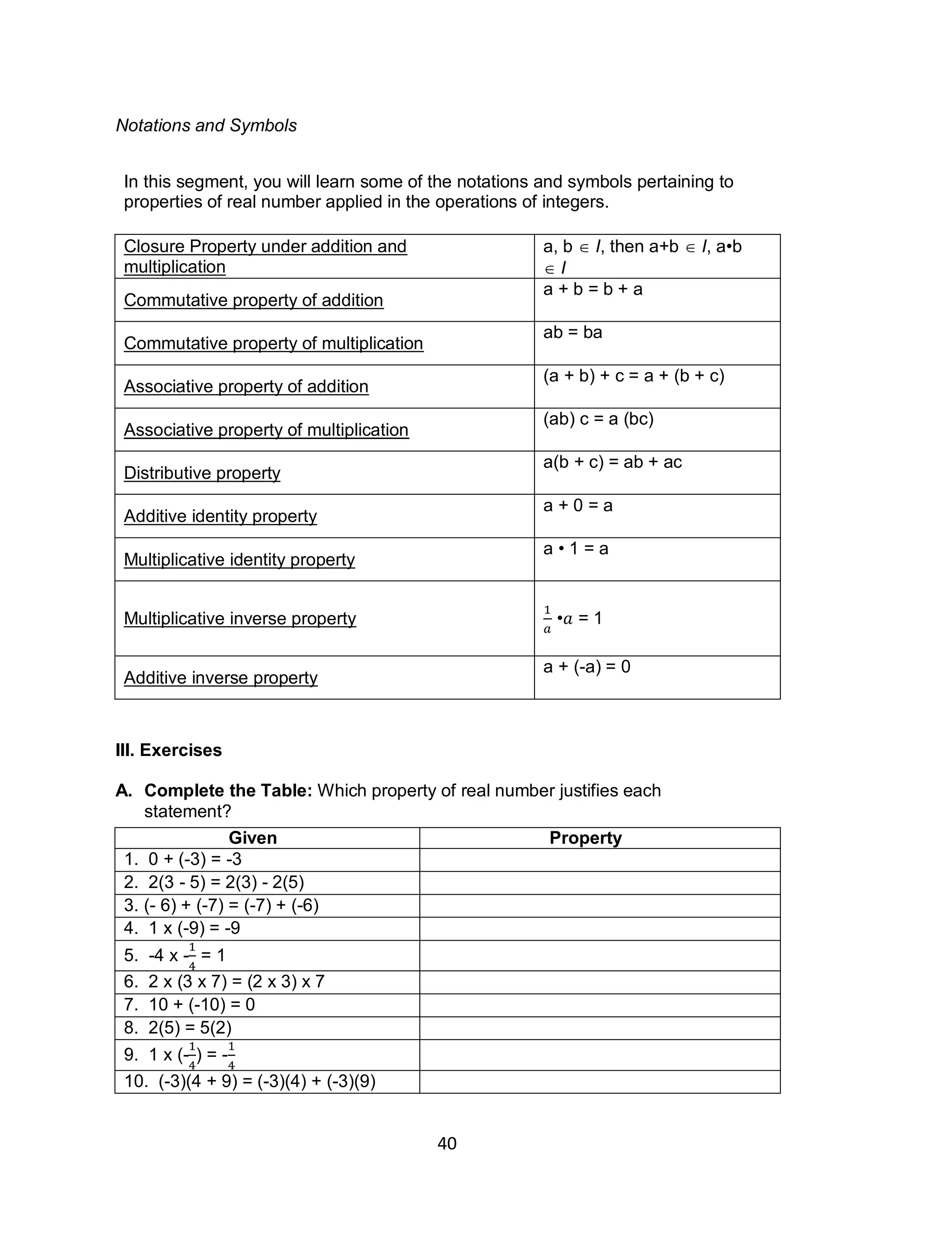
Notations and Symbols
III. Exercises
A. Complete the Table: Which property of real number justifies each
statement?
In this segment, you will learn some of the notations and symbols pertaining to
properties of real number applied in the operations of integers.
Closure Property under addition and
multiplication
a, b  I, then a+b  I, a•b
 I
Commutative property of addition
a + b = b + a
Commutative property of multiplication
ab = ba
Associative property of addition
(a + b) + c = a + (b + c)
Associative property of multiplication
(ab) c = a (bc)
Distributive property
a(b + c) = ab + ac
Additive identity property
a + 0 = a
Multiplicative identity property
a • 1 = a
Multiplicative inverse property • = 1
Additive inverse property
a + (-a) = 0
Given Property
1. 0 + (-3) = -3
2. 2(3 - 5) = 2(3) - 2(5)
3. (- 6) + (-7) = (-7) + (-6)
4. 1 x (-9) = -9
5. -4 x - = 1
6. 2 x (3 x 7) = (2 x 3) x 7
7. 10 + (-10) = 0
8. 2(5) = 5(2)
9. 1 x (- ) = -
10. (-3)(4 + 9) = (-3)(4) + (-3)(9)
41
B. Rewrite the following expressions using the given property.
1. 12a – 5a Distributive Property
2. (7a)b Associative Property
3. 8 + 5 Commutative Property
4. -4(1) Identity Property
5. 25 + (-25) Inverse Property
C. Fill in the blanks and determine what properties were used to solve the
equations.
1. 5 x ( ____ + 2) = 0
2. -4 + 4 = _____
3. -6 + 0 = _____
4. (-14 + 14) + 7 = _____
5. 7 x (_____ + 7) = 49
Summary
The lesson on the properties or real numbers explains how numbers or
values are arranged or related in an equation. It further clarifies that no matter
how these numbers are arranged and what processes are used, the
composition of the equation and the final answer will still be the same. Our
society is much like these equations - composed of different numbers and
operations, different people with varied personalities, perspectives and
experiences. We can choose to look at the differences and forever highlight
one's advantage or superiority over the others. Or we can focus on the
commonality among people and altogether, work for the common good. A
peaceful society and harmonious relationship starts with recognizing,
appreciating and fully maximizing the positive traits that we, as a people, have
in common.
42
Lesson 6: Rational Numbers in the Number Line Time: 1 hour
Prerequisite Concepts: Subsets of Real Numbers, Integers
About the lesson:
This lesson is a more in-depth discussion of the set of Rational Numbers and
focuses on where they are found in the real number line.
Objective:
In this lesson, you, the students, are expected to
1. Define rational numbers;
2. Illustrate rational numbers on the number line;
3. Arrange rational numbers on the number line.
Lesson Proper
I. Activity
Determine whether the following numbers are rational numbers or not.
- 2, ,

1
11
,

43
,

16 , -1.89,
Now, try to locate them on the real number line below by plotting:
II. Questions to Ponder
Consider the following examples and answer the questions that follow:
a. 7 ÷ 2 = 3 1⁄2 ,
b. (-25) ÷ 4 = -6 1⁄4
c. (-6) ÷ (-12) = 1⁄2
1. Are quotients integers?
2. What kind of numbers are they?
3. Can you represent them on a number line?
Recall what rational numbers are...
3 1⁄2, -6 1⁄4, 1⁄2, are rational numbers. The word rational is derived from the word
“ratio” which means quotient. Rational numbers are numbers which can be written as
a quotient of two integers, where b ≠ 0.
The following are more examples of rational numbers:
5 =

5
1 0.06 =

6
100 1.3 =
From the example, we can see that an integer is also a rational number and
therefore, integers are a subset of rational numbers. Why is that?
0-1-2-3 1 2 3 4
43
0 1
0 1
½
Let’s check on your work earlier. Among the numbers given, - 2, ,

1
11
,

43
,

16 , -
1.89, the numbers  and

43
are the only ones that are not rational numbers.
Neither can be expressed as a quotient of two integers. However, we can express
the remaining ones as a quotient of two intergers:

2  2
1 , 16  4  4
1 , 1.89 
189
100
Of course,

1
11
is already a quotient by itself.
We can locate rational numbers on the real number line.
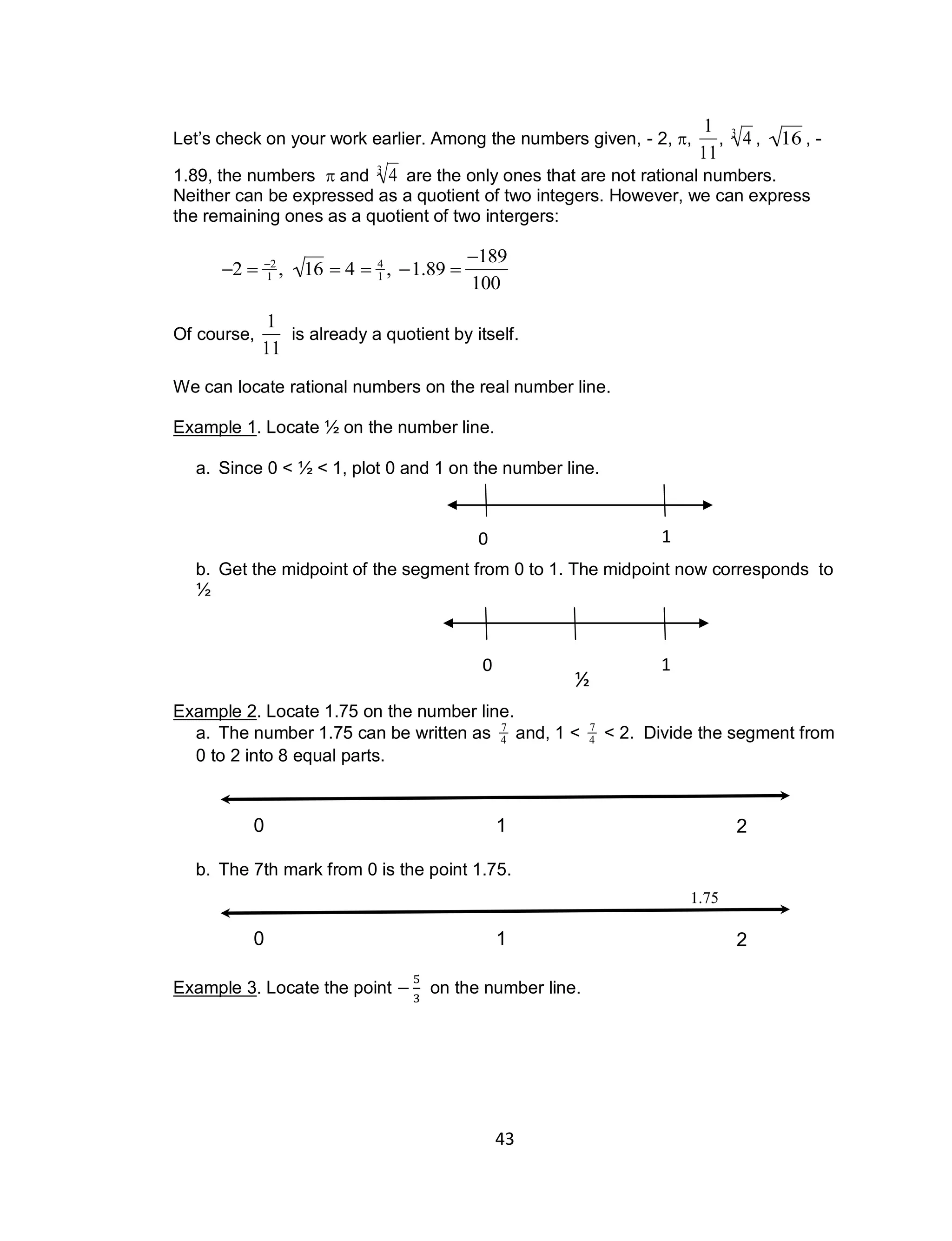
Example 1. Locate 1⁄2 on the number line.
a. Since 0 < 1⁄2 < 1, plot 0 and 1 on the number line.
b. Get the midpoint of the segment from 0 to 1. The midpoint now corresponds to
1⁄2
Example 2. Locate 1.75 on the number line.
a. The number 1.75 can be written as

7
4 and, 1 <

7
4 < 2. Divide the segment from
0 to 2 into 8 equal parts.
b. The 7th mark from 0 is the point 1.75.
Example 3. Locate the point on the number line.
10 2
10 2
1.75
44
Note that -2 < < -1. Dividing the segment from -2 to 0 into 6 equal parts, it is
easy to plot . The number is the 5th mark from 0 to the left.
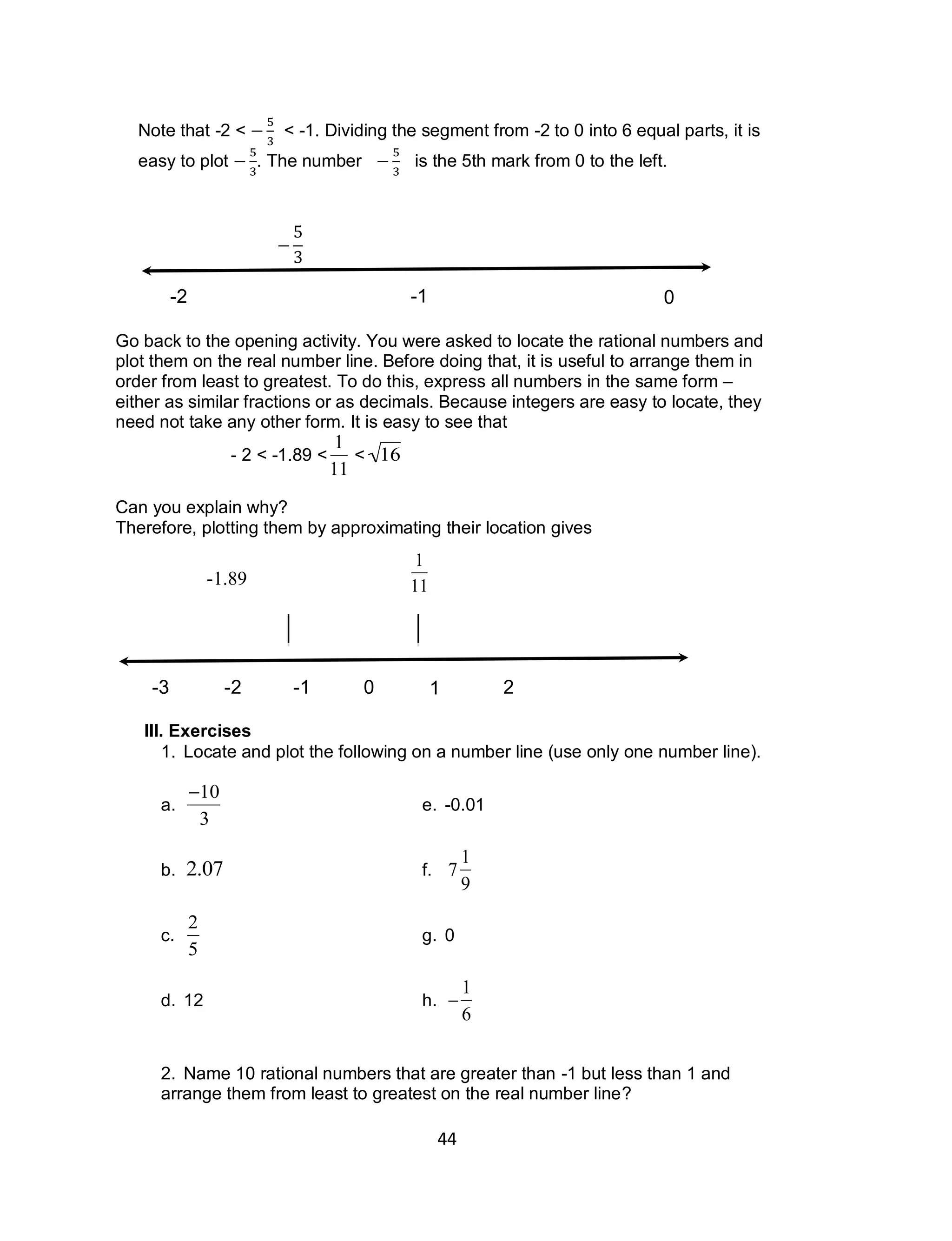
Go back to the opening activity. You were asked to locate the rational numbers and
plot them on the real number line. Before doing that, it is useful to arrange them in
order from least to greatest. To do this, express all numbers in the same form –
either as similar fractions or as decimals. Because integers are easy to locate, they
need not take any other form. It is easy to see that
- 2 < -1.89 <

1
11
<

16
Can you explain why?
Therefore, plotting them by approximating their location gives
III. Exercises
1. Locate and plot the following on a number line (use only one number line).
a.

10
3
e. -0.01
b.

2.07 f.

7
1
9
c.

2
5
g. 0
d. 12 h.


1
6
2. Name 10 rational numbers that are greater than -1 but less than 1 and
arrange them from least to greatest on the real number line?
0-1-2-3 1 2 3 4
-2 -1 0

1
11-1.89
45
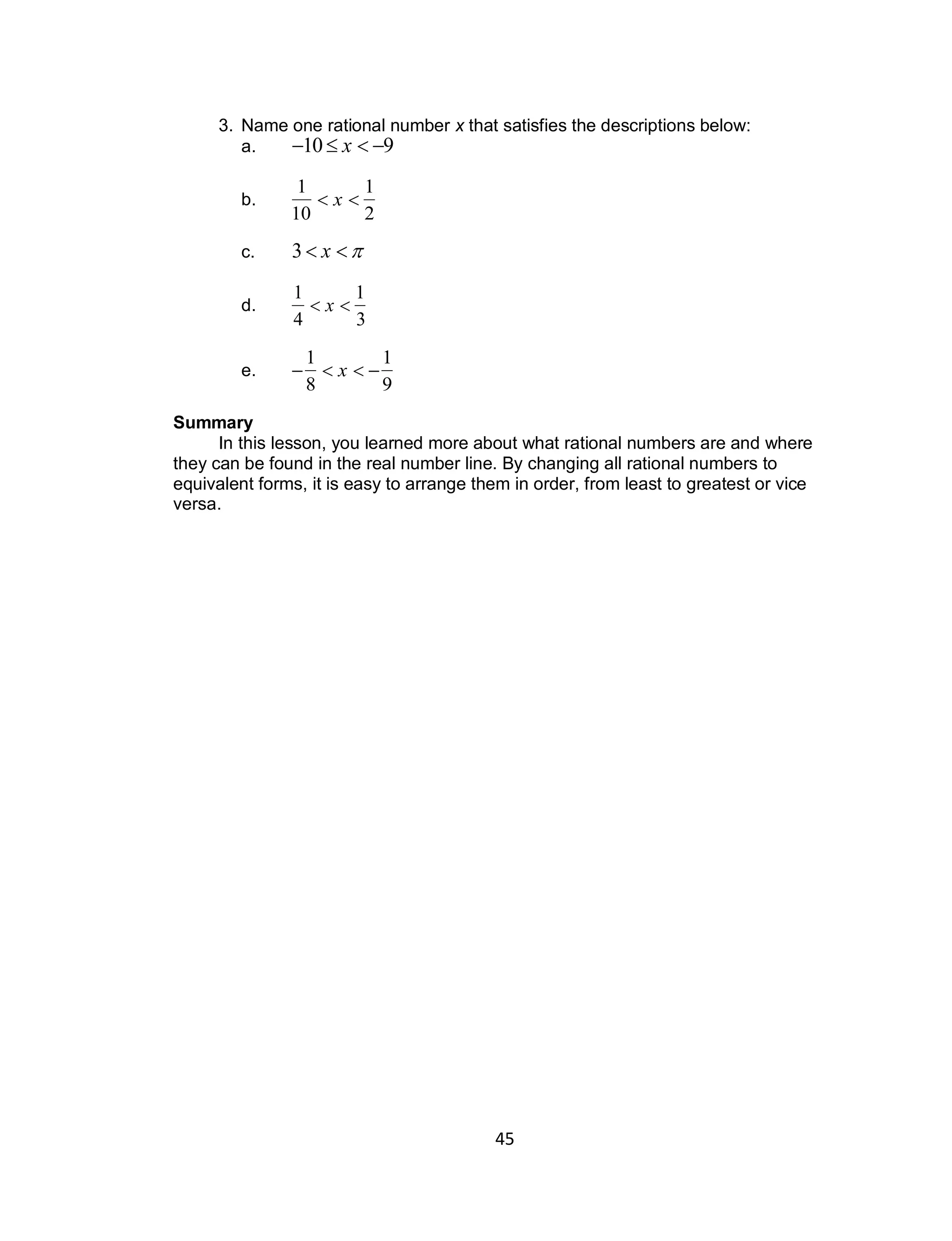
3. Name one rational number x that satisfies the descriptions below:
a.

10  x  9
b.

1
10
 x 
1
2
c.

3  x 
d.

1
4
 x 
1
3
e.


1
8
 x  
1
9
Summary
In this lesson, you learned more about what rational numbers are and where
they can be found in the real number line. By changing all rational numbers to
equivalent forms, it is easy to arrange them in order, from least to greatest or vice
versa.
46
Lesson 7: Forms of Rational Numbers and Addition and Subtraction of
Rational Numbers
Time: 2 hours
Prerequisite Concepts: definition of rational numbers, subsets of real numbers,
fractions, decimals
About the Lesson:
Like with any set of numbers, rational numbers can be added and subtracted.
In this lesson, you will learn techniques in adding and subtracting rational numbers.
Techniques include changing rational numbers into various forms convenient for the
operation as well as estimation and computation techniques.
Objectives:
In this lesson, you are expected to:
1. Express rational numbers from fraction form to decimal form (terminating
and repeating and non-terminating) and vice versa;
2. Add and subtract rational numbers;
3. Solve problems involving addition and subtraction of rational numbers.
Lesson Proper:
A. Forms of Rational Numbers
I. Activity
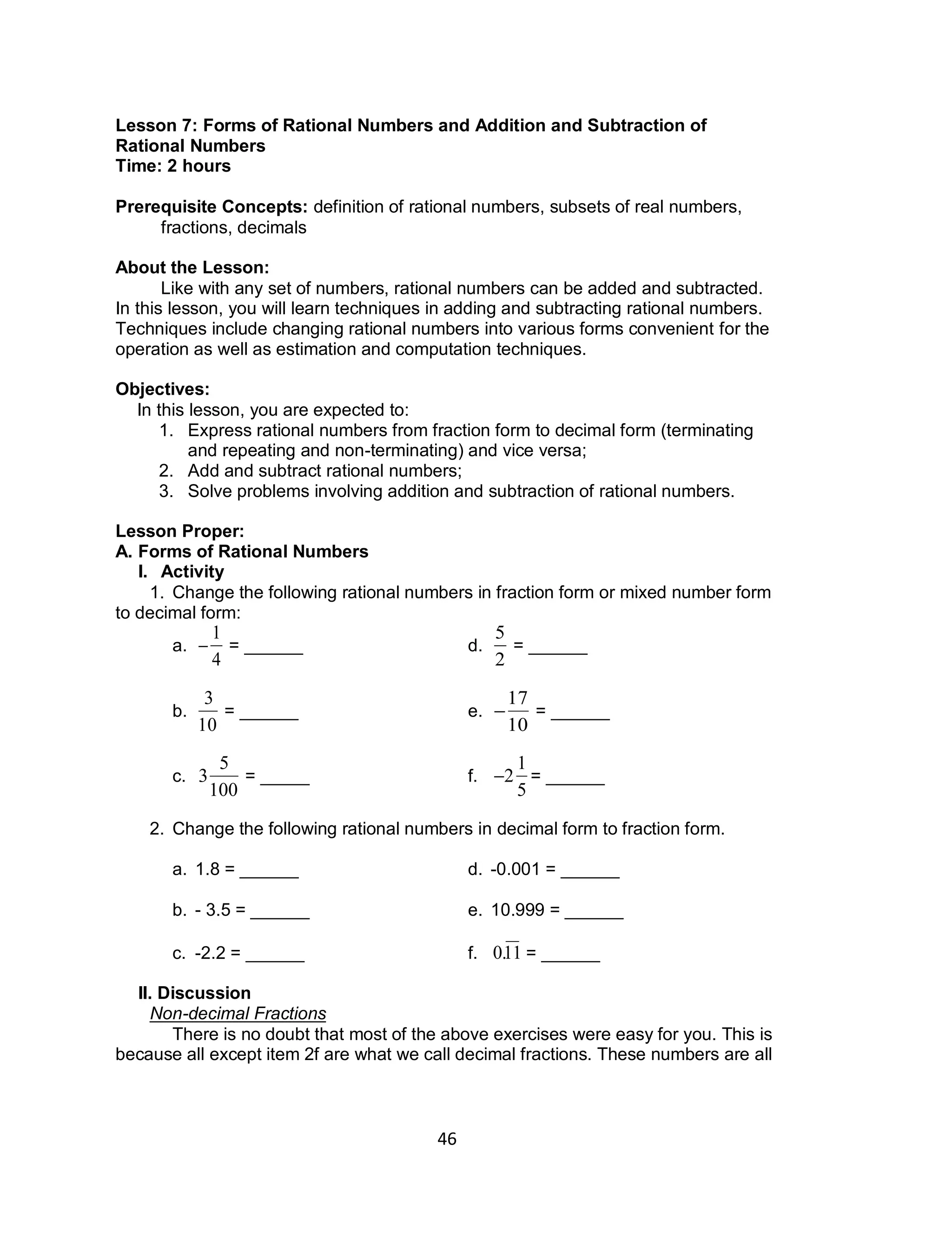
1. Change the following rational numbers in fraction form or mixed number form
to decimal form:
a.


1
4
= ______ d.

5
2
= ______
b.

3
10
= ______ e.


17
10
= ______
c.

3
5
100
= _____ f.

2
1
5
= ______
2. Change the following rational numbers in decimal form to fraction form.
a. 1.8 = ______ d. -0.001 = ______
b. - 3.5 = ______ e. 10.999 = ______
c. -2.2 = ______ f.

0.11 = ______
II. Discussion
Non-decimal Fractions
There is no doubt that most of the above exercises were easy for you. This is
because all except item 2f are what we call decimal fractions. These numbers are all
47
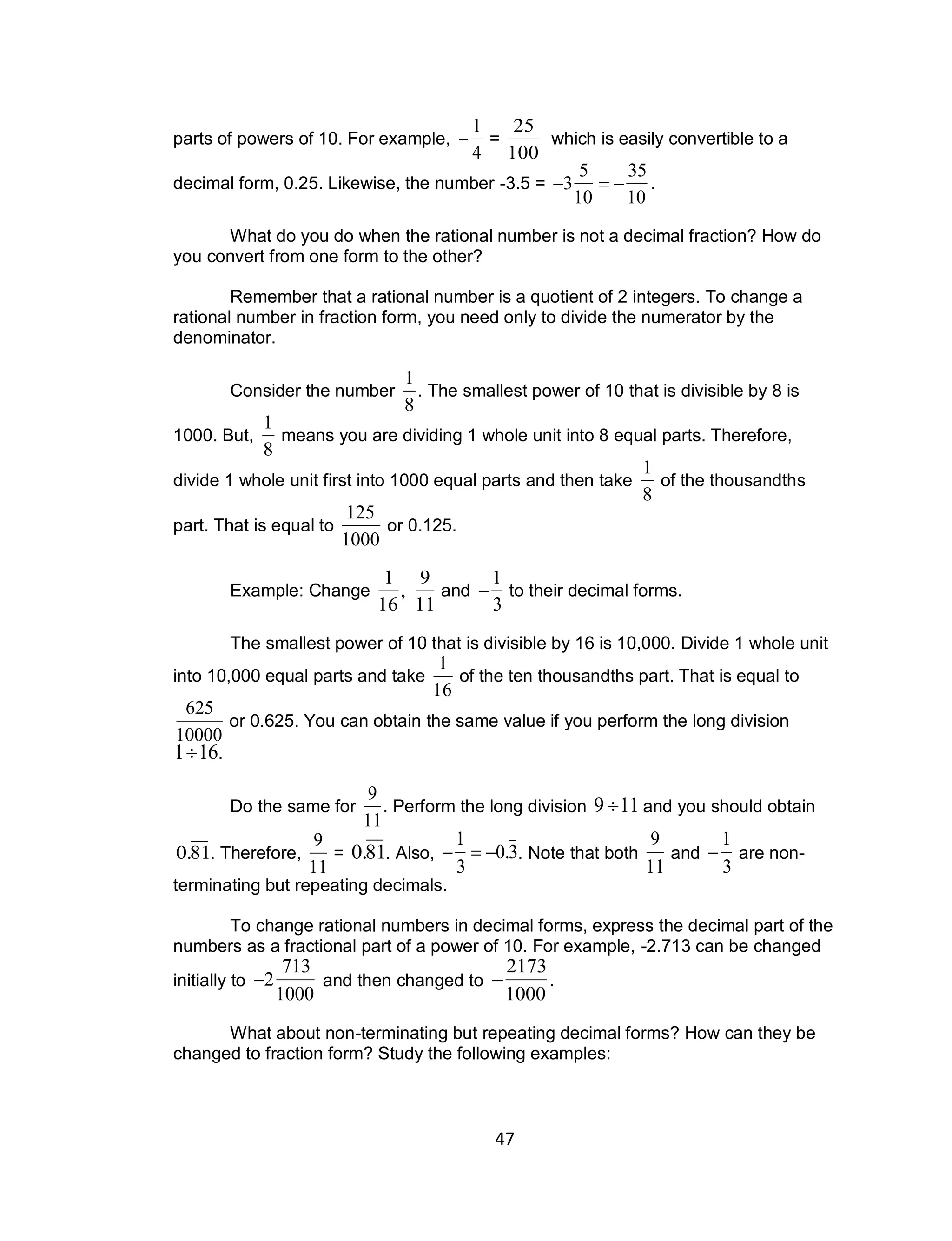
parts of powers of 10. For example,


1
4
=

25
100
which is easily convertible to a
decimal form, 0.25. Likewise, the number -3.5 =

3
5
10
 
35
10
.
What do you do when the rational number is not a decimal fraction? How do
you convert from one form to the other?
Remember that a rational number is a quotient of 2 integers. To change a
rational number in fraction form, you need only to divide the numerator by the
denominator.
Consider the number

1
8
. The smallest power of 10 that is divisible by 8 is
1000. But,

1
8
means you are dividing 1 whole unit into 8 equal parts. Therefore,
divide 1 whole unit first into 1000 equal parts and then take

1
8
of the thousandths
part. That is equal to

125
1000
or 0.125.
Example: Change

1
16
,
9
11
and


1
3
to their decimal forms.
The smallest power of 10 that is divisible by 16 is 10,000. Divide 1 whole unit
into 10,000 equal parts and take

1
16
of the ten thousandths part. That is equal to

625
10000
or 0.625. You can obtain the same value if you perform the long division

116.
Do the same for

9
11
. Perform the long division

9 11 and you should obtain

0.81. Therefore,

9
11
=

0.81. Also,


1
3
 0.3. Note that both

9
11
and


1
3
are non-
terminating but repeating decimals.
To change rational numbers in decimal forms, express the decimal part of the
numbers as a fractional part of a power of 10. For example, -2.713 can be changed
initially to

2
713
1000
and then changed to


2173
1000
.
What about non-terminating but repeating decimal forms? How can they be
changed to fraction form? Study the following examples:
48
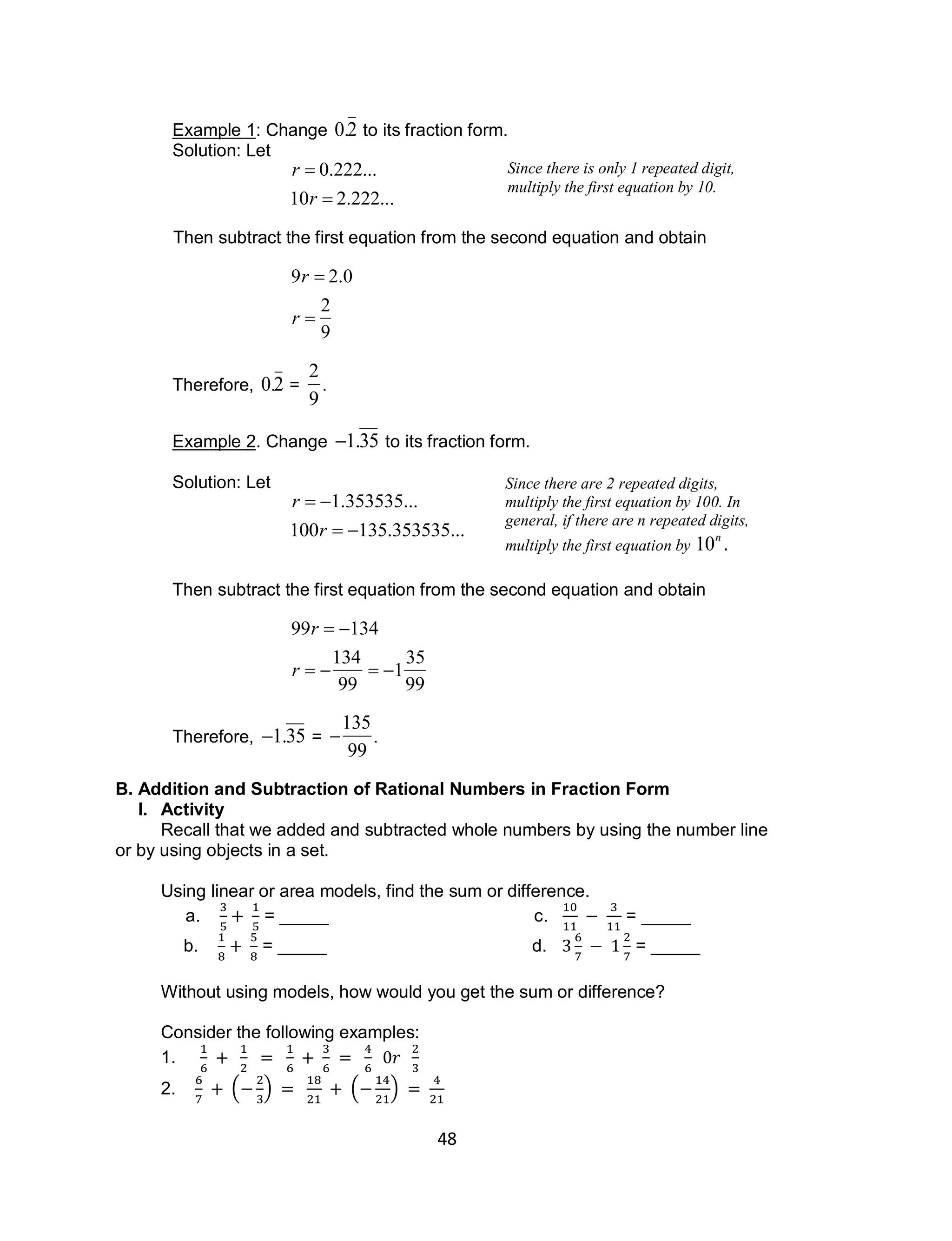
Example 1: Change

0.2 to its fraction form.
Solution: Let

r  0.222...
10r  2.222...
Then subtract the first equation from the second equation and obtain

9r  2.0
r 
2
9
Therefore,

0.2 =

2
9
.
Example 2. Change

1.35 to its fraction form.
Solution: Let

r  1.353535...
100r  135.353535...
Then subtract the first equation from the second equation and obtain

99r  134
r  
134
99
 1
35
99
Therefore,

1.35 =


135
99
.
B. Addition and Subtraction of Rational Numbers in Fraction Form
I. Activity
Recall that we added and subtracted whole numbers by using the number line
or by using objects in a set.
Using linear or area models, find the sum or difference.
a. = _____ c. = _____
b. = _____ d. = _____
Without using models, how would you get the sum or difference?
Consider the following examples:
1.
2. ( ) ( )
Since there is only 1 repeated digit,
multiply the first equation by 10.
Since there are 2 repeated digits,
multiply the first equation by 100. In
general, if there are n repeated digits,
multiply the first equation by

10n
.
49
3. ( ) ( )
4.
5. ( ) ( )
6. ( ) ( )
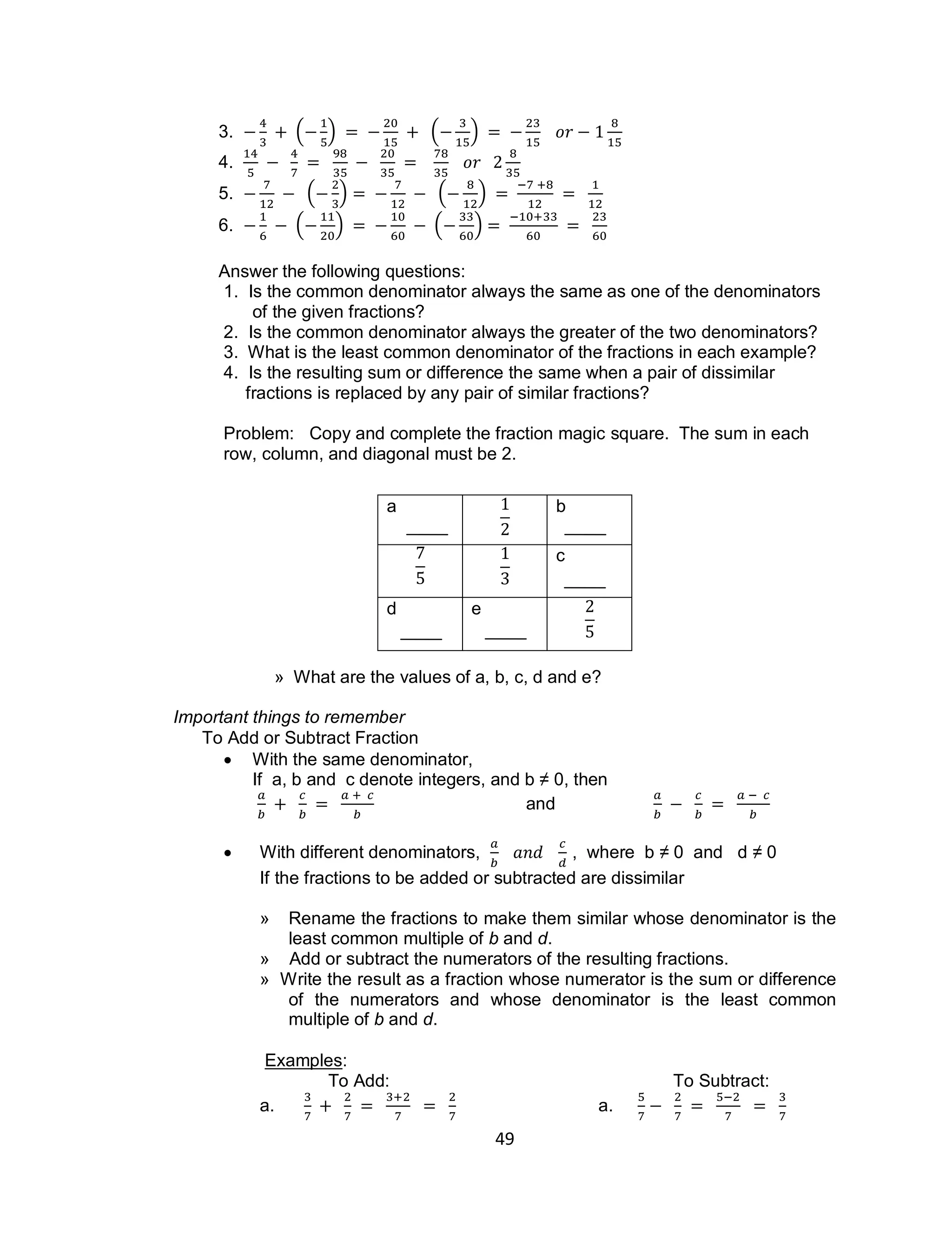
Answer the following questions:
1. Is the common denominator always the same as one of the denominators
of the given fractions?
2. Is the common denominator always the greater of the two denominators?
3. What is the least common denominator of the fractions in each example?
4. Is the resulting sum or difference the same when a pair of dissimilar
fractions is replaced by any pair of similar fractions?
Problem: Copy and complete the fraction magic square. The sum in each
row, column, and diagonal must be 2.
» What are the values of a, b, c, d and e?
Important things to remember
To Add or Subtract Fraction
 With the same denominator,
If a, b and c denote integers, and b ≠ 0, then
and
 With different denominators, , where b ≠ 0 and d ≠ 0
If the fractions to be added or subtracted are dissimilar
» Rename the fractions to make them similar whose denominator is the
least common multiple of b and d.
» Add or subtract the numerators of the resulting fractions.
» Write the result as a fraction whose numerator is the sum or difference
of the numerators and whose denominator is the least common
multiple of b and d.
Examples:
To Add: To Subtract:
a. a.
a b
c
d e
50
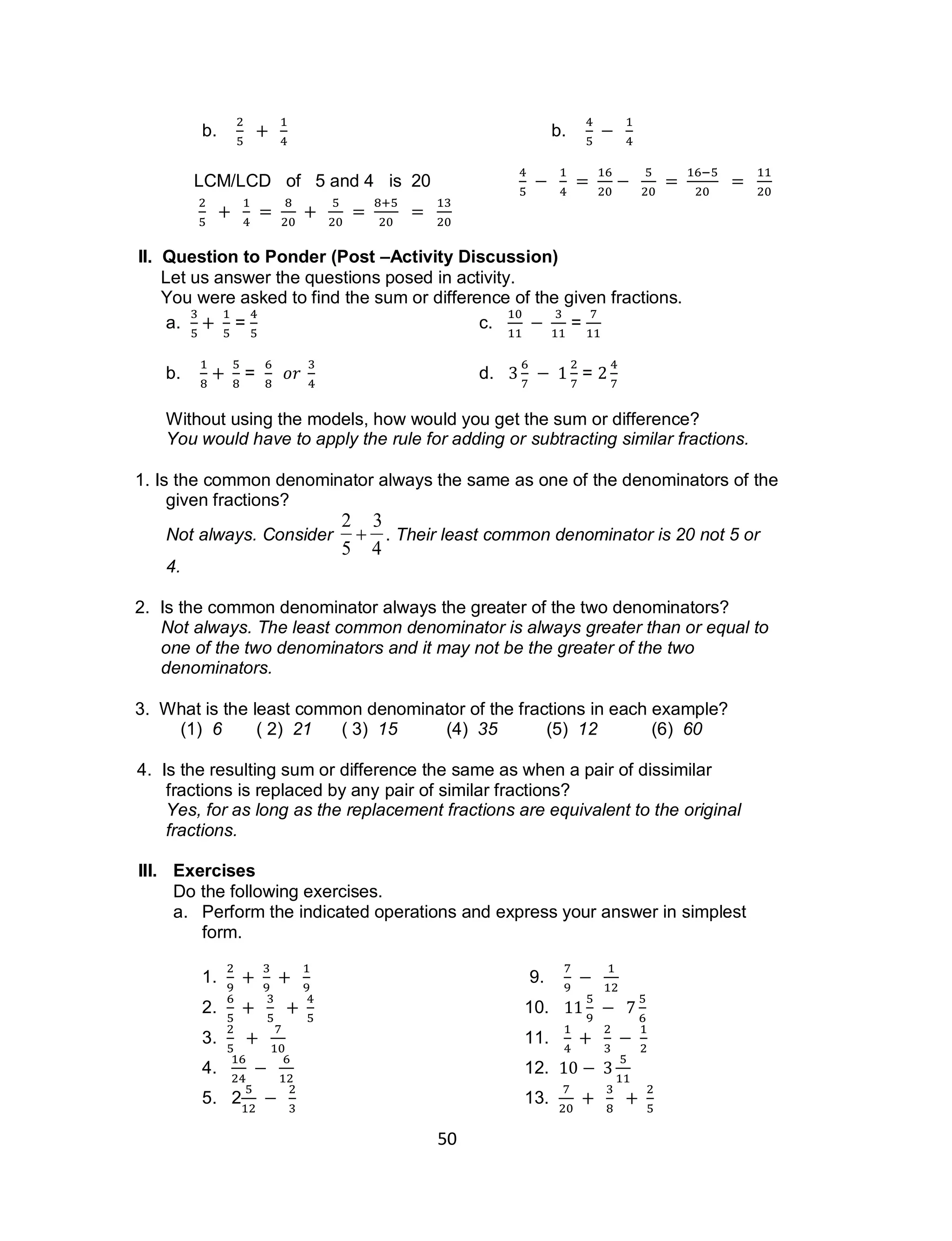
b. b.
LCM/LCD of 5 and 4 is 20
II. Question to Ponder (Post –Activity Discussion)
Let us answer the questions posed in activity.
You were asked to find the sum or difference of the given fractions.
a. = c. =
b. = d. =
Without using the models, how would you get the sum or difference?
You would have to apply the rule for adding or subtracting similar fractions.
1. Is the common denominator always the same as one of the denominators of the
given fractions?
Not always. Consider

2
5

3
4
. Their least common denominator is 20 not 5 or
4.
2. Is the common denominator always the greater of the two denominators?
Not always. The least common denominator is always greater than or equal to
one of the two denominators and it may not be the greater of the two
denominators.
3. What is the least common denominator of the fractions in each example?
(1) 6 ( 2) 21 ( 3) 15 (4) 35 (5) 12 (6) 60
4. Is the resulting sum or difference the same as when a pair of dissimilar
fractions is replaced by any pair of similar fractions?
Yes, for as long as the replacement fractions are equivalent to the original
fractions.
III. Exercises
Do the following exercises.
a. Perform the indicated operations and express your answer in simplest
form.
1. 9.
2. 10.
3. 11.
4. 12.
5. 2 13.
51
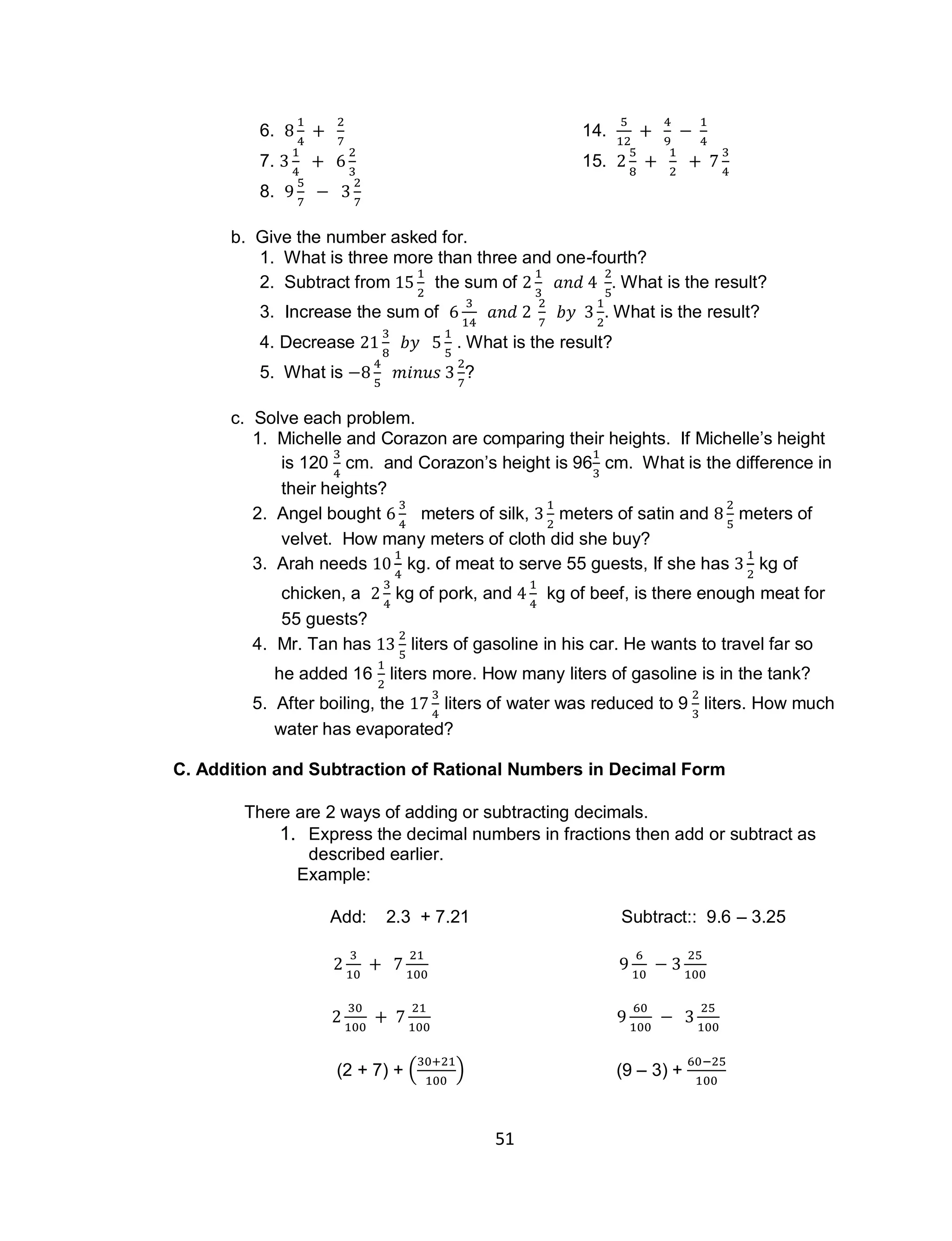
6. 14.
7. 15.
8.
b. Give the number asked for.
1. What is three more than three and one-fourth?
2. Subtract from the sum of . What is the result?
3. Increase the sum of . What is the result?
4. Decrease . What is the result?
5. What is ?
c. Solve each problem.
1. Michelle and Corazon are comparing their heights. If Michelle’s height
is 120 cm. and Corazon’s height is 96 cm. What is the difference in
their heights?
2. Angel bought meters of silk, meters of satin and meters of
velvet. How many meters of cloth did she buy?
3. Arah needs kg. of meat to serve 55 guests, If she has kg of
chicken, a kg of pork, and kg of beef, is there enough meat for
55 guests?
4. Mr. Tan has liters of gasoline in his car. He wants to travel far so
he added 16 liters more. How many liters of gasoline is in the tank?
5. After boiling, the liters of water was reduced to 9 liters. How much
water has evaporated?
C. Addition and Subtraction of Rational Numbers in Decimal Form
There are 2 ways of adding or subtracting decimals.
1. Express the decimal numbers in fractions then add or subtract as
described earlier.
Example:
Add: 2.3 + 7.21 Subtract:: 9.6 – 3.25
(2 + 7) + ( ) (9 – 3) +
52
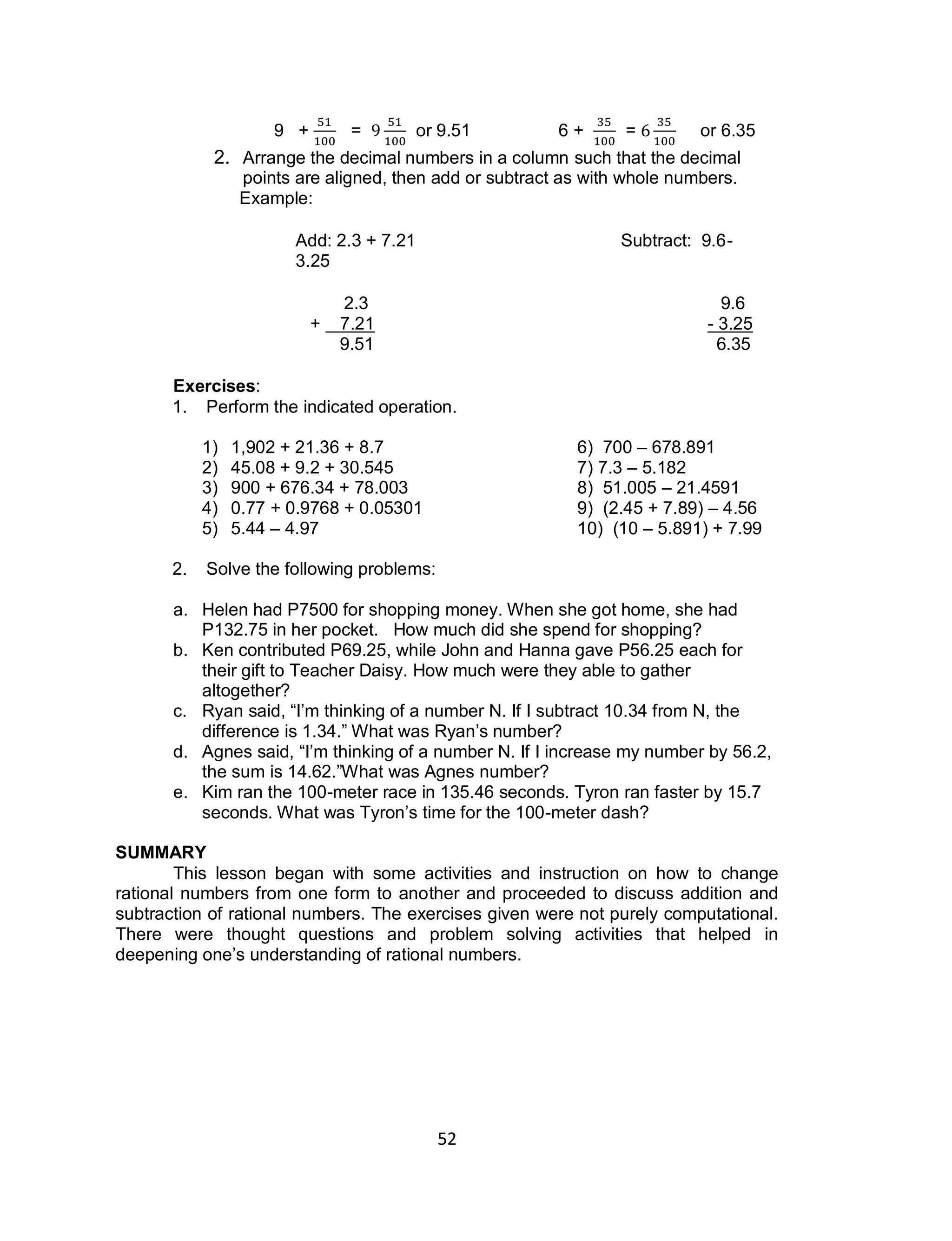
9 + = or 9.51 6 + = or 6.35
2. Arrange the decimal numbers in a column such that the decimal
points are aligned, then add or subtract as with whole numbers.
Example:
Add: 2.3 + 7.21 Subtract: 9.6-
3.25
2.3 9.6
+ 7.21 - 3.25
9.51 6.35
Exercises:
1. Perform the indicated operation.
1) 1,902 + 21.36 + 8.7 6) 700 – 678.891
2) 45.08 + 9.2 + 30.545 7) 7.3 – 5.182
3) 900 + 676.34 + 78.003 8) 51.005 – 21.4591
4) 0.77 + 0.9768 + 0.05301 9) (2.45 + 7.89) – 4.56
5) 5.44 – 4.97 10) (10 – 5.891) + 7.99
2. Solve the following problems:
a. Helen had P7500 for shopping money. When she got home, she had
P132.75 in her pocket. How much did she spend for shopping?
b. Ken contributed P69.25, while John and Hanna gave P56.25 each for
their gift to Teacher Daisy. How much were they able to gather
altogether?
c. Ryan said, “I’m thinking of a number N. If I subtract 10.34 from N, the
difference is 1.34.” What was Ryan’s number?
d. Agnes said, “I’m thinking of a number N. If I increase my number by 56.2,
the sum is 14.62.”What was Agnes number?
e. Kim ran the 100-meter race in 135.46 seconds. Tyron ran faster by 15.7
seconds. What was Tyron’s time for the 100-meter dash?
SUMMARY
This lesson began with some activities and instruction on how to change
rational numbers from one form to another and proceeded to discuss addition and
subtraction of rational numbers. The exercises given were not purely computational.
There were thought questions and problem solving activities that helped in
deepening one’s understanding of rational numbers.
53
Lesson 8: Multiplication and Division of Rational Numbers
Time: 2 hours
Prerequisite Concepts: addition and subtraction of rational numbers, expressing
rational numbers in different forms
About the lesson:
In this lesson, you will learn how to multiply and divide rational numbers.
While there are rules and algorithms to remember, this lesson also shows why those
rules and algorithms work.
Objectives:
In this lesson, you are expected to:
1. Multiply rational numbers;
2. Divide rational numbers;
3. Solve problems involving multiplication and division of rational numbers.
Lesson Proper
A. Models for the Multiplication and Division
I. Activity:
Make a model or a drawing to show the following:
1. A pizza is divided into 10 equal slices. Kim ate of of the pizza. What
part of the whole pizza did Kim eat?
2. Miriam made 8 chicken sandwiches for some street children. She cut up
each sandwich into 4 triangular pieces. If a child can only take a piece, how
many children can she feed?
Can you make a model or a drawing to help you solve these problems?
A model that we can use to illustrate multiplication and division of rational numbers is
the area model.
What is

1
4

1
3
? Suppose we have one bar of chocolate represent 1 unit.
Divide the bar first into 4 equal parts vertically. One part of it is

1
4
54
Then, divide each fourth into 3 equal parts, this time horizontally to make the
divisions easy to see. One part of the horizontal division is

1
3
.
There will be 12 equal-sized pieces and one piece is

1
12
. But, that one piece
is

1
3
of

1
4
, which we know from elementary mathematics to mean

1
3

1
4
.
What about a model for division of rational numbers?
Take the division problem:

4
5

1
2
. One unit is divided into 5 equal parts and 4
of them are shaded.
Each of the 4 parts now will be cut up in halves
Since there are 2 divisions per part (i.e.

1
5 ) and there are 4 of them (i.e.

4
5 ), then
there will be 8 pieces out of 5 original pieces or

4
5

1
2

8
5
.
II. Questions to Ponder (Post-Activity Discussion)
Let us answer the questions posed in the opening activity.
1. A pizza is divided into 10 equal slices. Kim ate of of the pizza. What part
of the whole pizza did Kim eat?
1⁄2
3/5
// // //

1
3

1
4

1
12

3
5

1
2

3
10
Kim ate

3
10
of the whole pizza.
55
2. Miriam made 8 chicken sandwiches for some street children. She cut up
each sandwich into 4 triangular pieces. If a child can only take a piece, how
many children can she feed?
The equation is

8  1
4  32. Since there are 4 fourths in one sandwich, there
will be 4 x 8 = 32 triangular pieces and hence, 32 children will be fed.
How then can you multiply or divide rational numbers without using models or
drawings?
Important Rules to Remember
The following are rules that you must remember. From here on, the symbols to be
used for multiplication are any of the following:

, x,

, or x.
1. To multiply rational numbers in fraction form simply multiply the numerators and
multiply the denominators.
In symbol, where b and d are NOT equal to zero, ( b ≠ 0; d ≠
0 )
2. To divide rational numbers in fraction form, you take the reciprocal of the second
fraction (called the divisor) and multiply it by the first fraction.
In symbol, where b, c, and d are NOT equal to
zero.
Example:
Multiply the following and write your answer in
simplest form
a.
b.
The easiest way to solve for this
number is to change mixed
numbers to an improper fraction
and then multiply it. Or use
prime factors or the greatest
common factor, as part of the
multiplication process.
56
Divide:
=
III. Exercises.
Do the following exercises. Write your answer on the spaces provided:
1. Find the products:
a. f.
b. 7 g.
c. h.
d. i. ( )
e. j. ( )
B. Divide:
1. 20 6.
2. ( ) 7. ( )
3. 8. ( )
4. 9.
5. 10.
C. Solve the following:
1. Julie spent hours doing her assignment. Ken did his assignment for
times as many hours as Julie did. How many hours did Ken spend doing his
assignment?
2. How many thirds are there in six-fifths?
3. Hanna donated of her monthly allowance to the Iligan survivors. If her
monthly allowance is P3500, how much did she donate?
4. The enrolment for this school year is 2340. If are sophomores and are
seniors, how many are freshmen and juniors?
5. At the end of the day, a store had 2/5 of a cake leftover. The four employees
each took home the same amount of leftover cake. How much did each
employee take home?
Take the reciprocal of , which is then multiply it
with the first fraction. Using prime factors, it is easy
to see that 2 can be factored out of the numerator then
cancelled out with the denominator, leaving 4 and 3
as the remaining factors in the numerator and 11 as
the remaining factors in the denominator.
57
B. Multiplication and Division of Rational Numbers in Decimal Form
This unit will draw upon your previous knowledge of multiplication and
division of whole numbers. Recall the strategies that you learned and developed
when working with whole numbers.
Activity:
1. Give students several examples of multiplication sentences with the answers
given. Place the decimal point in an incorrect spot and ask students to
explain why the decimal place does not go there and explain where it
should go and why.
Example:
215.2 x 3.2 = 68.864
2. Five students ordered buko pie and the total cost was P135.75. How much
did each student have to pay if they shared the cost equally?
Questions and Points to Ponder:
1. In multiplying rational numbers in decimal form, note the importance of
knowing where to place the decimal point in a product of two decimal
numbers. Do you notice a pattern?
2. In dividing rational numbers in decimal form, how do you determine where to
place the decimal point in the quotient?
Rules in Multiplying Rational Numbers in Decimal Form
1. Arrange the numbers in a vertical column.
2. Multiply the numbers, as if you are multiplying whole numbers.
3. Starting from the rightmost end of the product, move the decimal point to the left
the same number of places as the sum of the decimal places in the multiplicand and
the multiplier.
Rules in Dividing Rational Numbers in Decimal Form
1. If the divisor is a whole number, divide the dividend by the divisor applying the
rules of a whole number. The position of the decimal point is the same as that in the
dividend.
2. If the divisor is not a whole number, make the divisor a whole number by moving
the decimal point in the divisor to the rightmost end, making the number seem like a
whole number.
3. Move the decimal point in the dividend to the right the same number of places as
the decimal point was moved to make the divisor a whole number.
4. Lastly divide the new dividend by the new divisor.
Exercises:
A. Perform the indicated operation
1. 3.5 ÷ 2 6. 27.3 x 2.5
2. 78 x 0.4 7. 9.7 x 4.1
3. 9.6 x 13 8. 3.415 ÷ 2.5
58
4. 3.24 ÷ 0.5 9. 53.61 x 1.02
5. 1.248 ÷ 0.024 10. 1948.324 ÷ 5.96
B. Finds the numbers that when multiplied give the products shown.
1. . 3. . 5. .
x_______ x______ x___________
1 0 . 6 2 1 . 6 2 1 . 9 8
2. . 4. .
x _______ x _______
1 6 . 8 9 . 5
Summary
In this lesson, you learned to use the area model to illustrate multiplication
and division of rational numbers. You also learned the rules for multiplying and
dividing rational numbers in both the fraction and decimal forms. You solved
problems involving multiplication and division of rational numbers.
59
Lesson 9: Properties of the Operations on Rational Numbers
Time: 1.5 hours
Pre-requisite Concepts: Operations on rational numbers
About the Lesson: The purpose of this lesson is to use properties of operations on
rational numbers when adding, subtracting, multiplying and dividing rational
numbers.
Objectives:
In this lesson, you are expected to
1. Describe and illustrate the different properties of the operations on
rational numbers.
2. Apply the properties in performing operations on rational numbers.
Lesson Proper:
I. Activity
Pick a Pair

2
14

3
5
0 1

13
40

13
12

1
3

3
20
From the box above, pick the correct rational number to be placed in the spaces
provided to make the equation true.
1. ___ = 6. ( )
2. ____ + 7. ( ) =
3. = 0 8.

2
5
 ___ 
3
4






3
20
4. 1 x ____ = 9. ( ) = _____
5. + ____ = 10. ( ) ( )
( ) = ____
Answer the following questions:
1. What is the missing number in item 1?
2. How do you compare the answers in items 1 and 2
3. What about item 3? What is the missing number?
4. In item 4, what number did you multiply with 1 to get ?
60
5. What number should be added to in item 5 to get the same
number?
6. What is the missing number in items 6 and 7?
7. What can you say about the grouping in items 6 and 7?
8. What do you think are the answers in items 8 and 9?
9. What operation did you apply in item 10?
Problem:
Consider the given expressions:
a.
b. =
* Are the two expressions equal? If yes, state the property illustrated.
PROPERTIES OF RATIONAL NUMBERS (ADDITION & MULTIPLICATION)
1. CLOSURE PROPERTY: For any two rational numbers. , their sum
and product is also rational.
For example:
a. = ( )
b.
2. COMMUTATIVE PROPERTY: For any two rational numbers ,
i. =
ii. =
where a, b, c and d are integers and b and d are not equal to zero.
For example:
a.
b.
3. ASSOCIATIVE PROPERTY: For any three rational numbers
i. ( ) ( )
ii. ( ) ( )
61
where a, b, c, d, e and f are integers and b, d and f are not equal to zero.
For example:
a. ( ) ( )
b. ( ) ( )
4. DISTRIBUTIVE PROPERTY of multiplication over addition for rational
numbers.
If are any rational numbers, then ( ) ( )
( )
For example: ( ) ( ) ( )
5. DISTRIBUTIVE PROPERTY of multiplication over subtraction for rational
numbers.
If are any rational numbers, then ( ) ( )
( )
For example: ( ) ( ) ( )
6. IDENTITY PROPERTY
Addition: Adding 0 to a number will not change the identity or value of that
number.
+ 0 =
For example:
Multiplication: Multiplying a number by 1 will not change the identity or value
of that number.
For example:
7. ZERO PROPERTY OF MULTIPLICATION: Any number multiplied by zero
equals 0, i. e.
For example:
62
II. Question to Ponder (Post-Activity Discussion)
Let us answer the questions posed in the opening activity.
1. What is the missing number in item1? »
2. How do you compare the answers in items 1 and 2? » The answer is the
same, the order of the numbers is not important.
3. What about item 3? What is the missing number? » The missing number is
0. When you multiply a number with zero the product is zero.
4. In item 4, what number did you multiply with 1 to get ? » When you
multiply a number by one the answer is the same.
5. What number should be added to in item 5 to get the same number? » 0,
When you add zero to any number, the value of the number does not
change.
6. What do you think is the missing number in items 6 and 7?»
7. What can you say about the grouping in items 6 and 7? » The groupings
are different but they do not affect the sum.
8. What do you think are the answers in items 8 and 9? » The answer is the
same in both items, .
9. What operation did you apply in item 10? » The Distributive Property of
Multiplication over Addition
III. Exercises:
Do the following exercises. Write your answer in the spaces provided.
A. State the property that justifies each of the following statements.
1.
2. 1 =
3. ( ) ( ) ( )
4. ( ) ( )
5.
6. ( )
7.
8. =
9. ( ) ( ) ( )
63
10.
B. Find the value of N in each expression
1. N +
2. ( ) = ( )
3. ( ) = + ( )
4. 0 + N =
6. N ( ) = ( ) ( )
7.
8. = N
Summary
This lesson is about the properties of operations on rational numbers. The
properties are useful because they simplify computations on rational numbers. These
properties are true under the operations addition and multiplication. Note that for the
Distributive Property of Multiplication over Subtraction, subtraction is considered part
of addition. Think of subtraction as the addition of a negative rational number.
64
Lesson 10: Principal Roots and Irrational Numbers Time: 2 hours
Prerequisite Concepts: Set of rational numbers
About the Lesson:
This is an introductory lesson on irrational numbers, which may be daunting
to students at this level. The key is to introduce them by citing useful examples.
Objectives:
In this lesson, you are expected to:
1. describe and define irrational numbers;
2. describe principal roots and tell whether they are rational or irrational;
3. determine between what two integers the square root of a number is;
4. estimate the square root of a number to the nearest tenth;
5. illustrate and graph irrational numbers (square roots) on a number line with
and without appropriate technology.
Lesson Proper:
I. Activities
A. Take a look at the unusual wristwatch and answer the questions below.
1. Can you tell the time?
2. What time is shown in the wristwatch?
3. What do you get when you take the √ ? √ ? √ ? √ ?
4. How will you describe the result?
5. Can you take the exact value of √ ?
6. What value could you get?
Taking the square root of a number is like doing the reverse operation of squaring a
number. For example, both 7 and -7 are square roots of 49 since

72
 49 and

7 2
 49. Integers such as 1, 4, 9, 16, 25 and 36 are called perfect squares.
Rational numbers such as 0.16,

4
100
and 4.84 are also, perfect squares. Perfect
squares are numbers that have rational numbers as square roots. The square roots
of perfect squares are rational numbers while the square roots of numbers that are
not perfect squares are irrational numbers.
Any number that cannot be expressed as a quotient of two integers is an
irrational number. The numbers

2 , , and the special number e are all irrational
numbers. Decimal numbers that are non-repeating and non-terminating are irrational
numbers.
65
B. Activity
Use the

n button of a scientific calculator to find the following values:
1.

646
2.

164
3.

903
4.

31255
5.

24
II. Questions to Ponder ( Post-Activity Discussions )
Let us answer the questions in the opening activity.
1. Can you tell the time? Yes
2. What time is it in the wristwatch? 10:07
3. What do you get when you take the √ ? √ ? √ ? √ ? 1, 2, 3, 4
4. How will you describe the result? They are all positive integers.
5. Can you take the exact value of √ ? No.
6. What value could you get? Since the number is not a perfect square you could
estimate the value to be between

121 and

144 , which is about 11.4.
Let us give the values asked for in Activity B. Using a scientific calculator, you
probably obtained the following:
1.

646
= 2
2.

164
Math Error, which means not defined
3.

903
= 4.481404747, which could mean non-terminating and non-repeating since
the calculator screen has a limited size
4.

31255
= -5
5.

24 = 4.898979486, which could mean non-terminating and non-repeating since
the calculator screen has a limited size
On Principal nth
Roots
Any number, say a, whose nth
power (n, a positive integer), is b is called the nth
root
of b. Consider the following:

7 2
 49,

24
16 and

10 3
 1000. This means
that -7 is a 2nd
or square root of 49, 2 is a 4th
root of 16 and -10 is a 3rd
or cube root
of -1000.
However, we are not simply interested in any nth
root of a number; we are more
concerned about the principal nth
root of a number. The principal nth
root of a
positive number is the positive nth
root. The principal nth
root of a negative
number is the negative nth
root if n is odd. If n is even and the number is
negative, the principal nth
root is not defined. The notation for the principal nth
root of a number b is

bn
. In this expression, n is the index and b is the
radicand. The nth
roots are also called radicals.
66
Classifying Principal nth
Roots as Rational or Irrational Numbers
To determine whether a principal root is a rational or irrational number, determine if
the radicand is a perfect nth
power or not. If it is, then the root is rational. Otherwise, it
is irrational.
Problem 1. Tell whether the principal root of each number is rational or irrational.
(a)

2253
(b)

0.04 (c)

1115
(d) √ (e)

6254
Answers:
a)

2253
is irrational
(b)

0.04 = 0.2 is rational
(c)

1115
is irrational
(d) √ = 100 is rational
(e)

6254
= 5 is rational
If a principal root is irrational, the best you can do for now is to give an estimate of its
value. Estimating is very important for all principal roots that are not roots of perfect
nth
powers.
Problem 2. The principal roots below are between two integers. Find the two closest
such integers.
(a) √ (b)

1013
(c) √
Solution:
(a) √
16 is a perfect integer square and 4 is its principal square root. 25 is the next
perfect integer square and 5 is its principal square root. Therefore, √ is between 4
and 5.
(b)

1013
64 is a perfect integer cube and 4 is its principal cube root. 125 is the next
perfect integer cube and 5 is its principal cube root. Therefore,

1013
is between 4
and 5.
(c) √
289 is a perfect integer square and 17 is its principal square root. 324 is the
next perfect integer square and 18 is its principal square root. Therefore, √ is
between 17 and 18.
Problem 3. Estimate each square root to the nearest tenth.
(a) √ (b) √ (c) √
Solution:
(a) √
67
The principal root √ is between 6 and 7, principal roots of the two perfect
squares 36 and 49, respectively. Now, take the square of 6.5, midway between 6
and 7. Computing,

6.5 2
 42.25. Since 42.25 > 40 then √ is closer to 6 than to
7. Now, compute for the squares of numbers between 6 and 6.5:

6.1 2
 37.21,

6.2 2
 38.44,

6.3 2
 39.69, and

6.4 2
 40.96. Since 40 is close to 39.69 than to
40.96, √ is approximately 6.3.
(b) √
The principal root √ is between 3 and 4, principal roots of the two perfect
squares 9 and 16, respectively. Now take the square of 3.5, midway between 3 and
4. Computing

3.5 2
12.25. Since 12.25 > 12 then √ is closer to 3 than to 4.
Compute for the squares of numbers between 3 and 3.5:

3.1 2
 9.61,

3.2 2
10.24,

3.3 2
10.89, and

3.4 2
11.56. Since 12 is closer to 12.25 than to
11.56, √ is approximately 3.5.
(c) √
The principal root √ is between 13 and 14, principal roots of the two
perfect squares 169 and 196. The square of 13.5 is 182.25, which is greater than
175. Therefore, √ is closer to 13 than to 14. Now:

13.1 2
171.61,

13.2 2
174.24,

13.3 2
176.89. Since 175 is closer to 174.24 than to 176.89
then, √ is approximately 13.2.
Problem 4. Locate and plot each square root on a number line.
(a) √ (b) √ (c) √
Solution: You may use a program like Geogebra to plot the square roots on a
number line.
(a) √
This number is between 1 and 2, principal roots of 1 and 4. Since 3 is closer
to 4 than to 1, √ is closer to 2. Plot √ closer to 2.
(b) √
This number is between 4 and 5, principal roots of 16 and 25. Since 21 is
closer to 25 than to 16, √ is closer to 5 than to 4. Plot √ closer to 5.
68
(c) √
This number is between 9 and 10, principal roots of 81 and 100. Since 87 is
closer to 81, then √ is closer to 9 than to 10. Plot √ closer to 9.
III. Exercises
A. Tell whether the principal roots of each number is rational or irrational.
1. √ 6. √
2. √ 7. √
3. √ 8. √
4. √ 9. √
5. √ 10. √
B. Between which two consecutive integers does the square root lie?
1. √ 6. √
2. √ 7. √
3. √ 8. √
4. √ 9. √
5. √ 10. √
C. Estimate each square root to the nearest tenth and plot on a number line.
1. √ 6. √
2. √ 7. √
3. √ 8. √
4. √ 9. √
5. √ 10. √
D. Which point on the number line below corresponds to which square root?
A B C D E
0 1 2 3 4 5 6 7 8 9 10
69
1. √ ______
2. √ ______
3. √ ______
4. √ ______
5. √ ______
Summary
In this lesson, you learned about irrational numbers and principal nth
roots,
particularly square roots of numbers. You learned to find two consecutive integers
between which an irrational square root lies. You also learned how to estimate the
square roots of numbers to the nearest tenth and how to plot the estimated square
roots on a number line.
70
Lesson 11: The Absolute Value of a Number Time: 1.5 hours
Prerequisite Concepts: Set of real numbers
About the Lesson:
This lesson explains why a distance between two points, even if represented
on a number line cannot be expressed as a negative number. Intuitively, the absolute
value of a number may be thought of as the non-negative value of a number. The
concept of absolute value is important to designate the magnitude of a measure such
as the temperature dropped by 23 (the absolute value) degrees. A similar concept is
applied to profit vs loss, income against expense, and so on.
Objectives:
In this lesson, you are expected to describe and illustrate
a. the absolute value of a number on a number line.
b. the distance of the number from 0.
Lesson Proper:
I. Activity 1: THE METRO MANILA RAIL TRANSIT (MRT) TOUR
Suppose the MRT stations from Pasay City to Quezon City were on a straight
line and were 500 meters apart from each other.
71
1. How far would the North Avenue station be from Taft Avenue?
2. What if Elaine took the MRT from North Avenue and got off at the last
station? How far would she have travelled?
3. Suppose both Archie and Angelica rode the MRT at Shaw Boulevard and the
former got off in Ayala while the latter in Kamuning. How far would each have
travelled from the starting point to their destinations?
4. What can you say about the directions and the distances travelled by Archie
and Angelica?
Activity 2: THE BICYCLE JOY RIDE OF ARCHIEL AND ANGELICA
Problem: Archie and Angelica were at Aloys’ house. Angelica rode her bicycle 3
miles west of Aloys’ house, and Archie rode his bicycle 3 miles east of
Aloys’ house. Who travelled a greater distance from Aloys’ house –
Archie or Angelica?
Questions To Ponder:
1. What subsets of real numbers are used in the problem? Represent the trip of
Archie and Angelica to the house of Aloys using a number line.
2. What are opposite numbers on the number line? Give examples and show on
the number line.
TaftAvenue
Magallanes
Ayala
Buendia
Guadalupe
Boni
ShawBoulevard
Ortigas
Santolan
AranetaCenter-Cubao
Kamuning
QuezonAvenue
NorthAvenue
72
3. What does it mean for the same distance travelled but in opposite directions?
How would you interpret using the numbers -3 and +3?
4. What can you say about the absolute value of opposite numbers say -5 and
+5?
5. How can we represent the absolute value of a number? What notation can
we use?
Important Terms to Remember
The following are terms that you must remember from this point on.
1. Absolute Value – of a number is the distance between that number
and zero on the number line.
2. Number Line –is best described as a straight line which is extended
in both directions as illustrated by arrowheads. A number line consists
of three elements:
a. set of positive numbers, and is located to the right of zero.
b. set of negative numbers, and is located to the left of zero; and
c. Zero.
Notations and Symbols
The absolute value of a number is denoted by two bars ││.
Let's look at the number line:
The absolute value of a number, denoted "| |" is the distance of the number
from zero. This is why the absolute value of a number is never negative. In thinking
about the absolute value of a number, one only asks "how far?" not "in which
direction?" Therefore, the absolute value of 3 and of -3 is the same, which is 3
because both numbers have the same distance from zero.
Warning: The absolute-value notation is bars, not parentheses or brackets. Use the
proper notation; the other notations do not mean the same thing.
It is important to note that the absolute value bars do NOT work in the same way as
do parentheses. Whereas – (–3) = +3, this is NOT how it works for absolute value:
Problem: Simplify – | –3 |.
Solution: Given – | – 3 |, first find the absolute value of – 3.
– | –3 | = – (3)
Now take the negative of 3. Thus, :
– | –3 | = – (3) = –3
This illustrates that if you take the negative of the absolute value of a number, you
will get a negative number for your answer.
II. Questons to Ponder(Post-Activity Discussion)
Let us answer the questions posed in Activity 2.
1. What subsets of real numbers are used in the problem? Represent the
trip of Archie and Angelica to the house of Aloys using a number line.
73
The problem uses integers. Travelling 3 miles west can be represented by -3
(pronounced negative 3). Travelling 3 miles east can be represented by
+3 (pronounced positive 3). Aloys’ house can be represented by the
integer 0.
2. What are opposite numbers on the number line? Give examples and
show on the number line.
Two integers that are the same distance from zero in opposite directions are called
opposites. The integers +
3 and -
3 are opposites since they are each 3 units from
zero.
3. What does it mean for the same distance travelled but in opposite
directions? How would you interpret using the numbers -3 and +3?
The absolute value of a number is its distance from zero on the number
line. The absolute value of +3 is 3, and the absolute value of -3 is 3.
4. What can you say about the absolute value of opposite numbers say -5
and +5?
Opposite numbers have the same absolute values.
5. How can we represent the absolute value of a number? What notation
can we use?
The symbol ││is used for the absolute value of a number.
III. Exercises
Carry out the following tasks. Write your answers on the spaces provided for
each number.
1. Find the absolute value of +
3, -
3, +
7, -
5, +
9, -
8, +
4, -
4. You may
refer to the number line below. What should you remember when we
talk about the absolute value of a number?
Solution: |+
3| = 3 |+
9| = 9
|-
3| = 3 |-
8| = 8
74
|+
7| = 7 |+
4| = 4
|-
5| = 5 |-
4| = 4
2. Find the absolute value of: +
11, -
9, +
14, -
10, +
17, -
19, +
20, -
20.
You may extend the number line below to help you solve this
problem.
Solution: |+
11| = 11 |+
17| = 17
|-
9| = 9 |-
19| = 19
|+
14| = 14 |+
20| = 20
|-
10| = 10 |-
20| = 20
3. Use the number line below to find the value of N: |N| = 5.1
Solution: This problem asks us to find all numbers that are a distance of 5.1 units
from zero on the number line. We let N represent all integers that satisfy
this condition.
The number +
5.1 is 5.1 units from zero on the number line, and the number
-
5.1 is also 5.1 units from zero on the number line. Thus both +
5.1 and -
5.1
satisfy the given condition.
Solution:
4. When is the absolute value of a number equal to itself?
When the value of the number is positive or zero.
5. Explain why the absolute value of a number is never negative. Give
an example that will support your answer.
Remember that when we find the absolute value of a number, we are finding its
distance from 0 on the number line. Opposite numbers have the same absolute
value since they both have the same distance from 0. Also, you will notice that
taking the absolute value of a number automatically means taking the positive value
of that number.
75
Solution: Let │N │= -4. Think of a number that when you get the absolute value will
give you a negative answer. There will be no solution since the distance of
any number from 0 cannot be a negative quantity.
Enrichment Exercises:
A. Simplify the following.
1. │7.04 │
2. │0 │
3. │-

2
9 │
4. -│15 + 6 │
5. │-

2 2 │ - │-

3 2 │
B. List at least two integers that can replace N such that.
1. │N │= 4
2. │N │< 3
3. │N │> 5
4. │N │≤ 9
5. 0<│N │< 3
C. Answer the following.
1. Insert the correct relation symbol(>, =, <): │-7 │____ │-4 │.
2. If │x - 7│= 5, what are the possible values of x?
3. If │x │= , what are the possible values of x?
4. Evaluate the expression, │x + y │ - │y - x │, if x = 4 and y = 7.
5. A submarine navigates at a depth of 50 meters below sea level while
exactly above it; an aircraft flies at an altitude of 185 meters. What is
the distance between the two carriers?
Summary:
In this lesson you learned about the absolute value of a number, that
it is a distance from zero on the number line denoted by the notation
|N|. This notation is used for the absolute value of an unknown
number that satisfies a given condition. You also learned that a
distance can never be a negative quantity and absolute value
pertains to the magnitude rather than the direction of a number.
76
LESSON 12: SUBSETS OF REAL NUMBERS Time: 1.5 hours
Prerequisite Concepts: whole numbers and operations, set of integers, rational
numbers, irrational numbers, sets and set operations, Venn diagrams
About the Lesson:
This lesson will intensify the study of mathematics since this requires a
good understanding of the sets of numbers for easier communication. Classifying
numbers is very helpful as it allows us to categorize what kind of numbers we are
dealing with every day.
Objectives:
In this lesson, you are expected to :
2. Describe and illustrate the real number system.
3. Apply various procedures and manipulations on the different subsets of
the set of real numbers.
a. Describe, represent and compare the different subsets of real
number.
b. Find the union, intersection and complement of the set of real
numbers and its subsets
Lesson Proper:
A. The Real Number System
I. Activity 1: Try to reflect on these . . .
It is difficult for us to realize that once upon a time there were no symbols or
names for numbers. In the early days, primitive man showed how many animals he
owned by placing an equal number of stones in a pile, or sticks in a row. Truly our
number system evolved over hundreds of years.
Sharing Ideas! What do you think?
1. In what ways do you think did primitive man need to use numbers?
2. Why do you think he needed names or words to tell “how many”?
3. How did number symbols come about?
4. What led man to invent numbers, words and symbols?
77
Activity 2: LOOK AROUND!
Fifteen different words/partitions of numbers are hidden in this puzzle. How many
can you find? Look up, down, across, backward, and diagonally. Figures are
scattered around that will serve as clues to help you locate the mystery words.
N A F R A C T I O N S I
S P B A C C D Z W N E L
T E O F T O G E H E R A
O R H S I U J R O G A M
I C R K I N R O L A T I
L E E L M T N A E T I C
A N A O P I I Q L I O E
R T L R S N T V U V N D
U I N T E G E R E E A A
T I R R A T I O N A L I
A N O N I N T E G E R S
N N U M N U M B E R S S
Answer the following questions:
1. How many words in the puzzle were familiar to
you?
2. What word/s have you encountered in your early
years? Define and give examples.
3. What word/s is/are still strange to you?
...,-3, -2, -1,
0, 1, 2, 3, ...
π, e, √
,
-4, -5, -6, ...
1, 2, 3, ...
0, 1, 2, 3, ...
0
-1, 0, 1, - , , 0.25,
0.1313...
100%, 15%,
25%
0.25,
0.33...
78
-1, 0, 1, - , ,
0.25, 0.33...,
π, e, √ , 10%,
15%, 25%
Activity 3: Determine what set of numbers will represent the following
situations:
1. Finding out how many cows there are in a barn
2. Corresponds to no more apples inside the basket
3. Describing the temperature in the North Pole
4. Representing the amount of money each member gets when P200 prize is
divided among 3 members
5. Finding the ratio of the circumference to the diameter of a circle, denoted π (read
“pi”)
The set of numbers called the real number system consists of different partitions/
subsets that can be represented graphically on a number line.
II. Questions to Ponder
Consider the activities done earlier and recall the different terms you encountered
including the set of real numbers and together let us determine the various subsets.
Let us go back to the first time we encountered the numbers...
Let's talk about the various subsets of real numbers.
Early Years...
1. What subset of real numbers do children learn at an early stage when they
were just starting to talk? Give examples.
One subset is the counting (or natural) numbers. This subset includes all the
numbers we use to count starting with "1" and so on. The
subset would look like this: {1, 2, 3, 4, 5...}
In School at an Early Phase...
2. What do you call the subset of real numbers that
includes zero (the number that represents nothing) and is
combined with the subset of real numbers learned in the
early years? Give examples.
Another subset is the whole numbers. This subset is exactly like the subset
of counting numbers, with the addition of one extra number. This extra
number is "0". The subset would look like this:{0, 1, 2, 3, 4...}
In School at Middle Phase...
3. What do you call the subset of real numbers that includes negative numbers
(that came from the concept of “opposites” and specifically used in describing
debt or below zero temperature) and is united with the whole numbers? Give
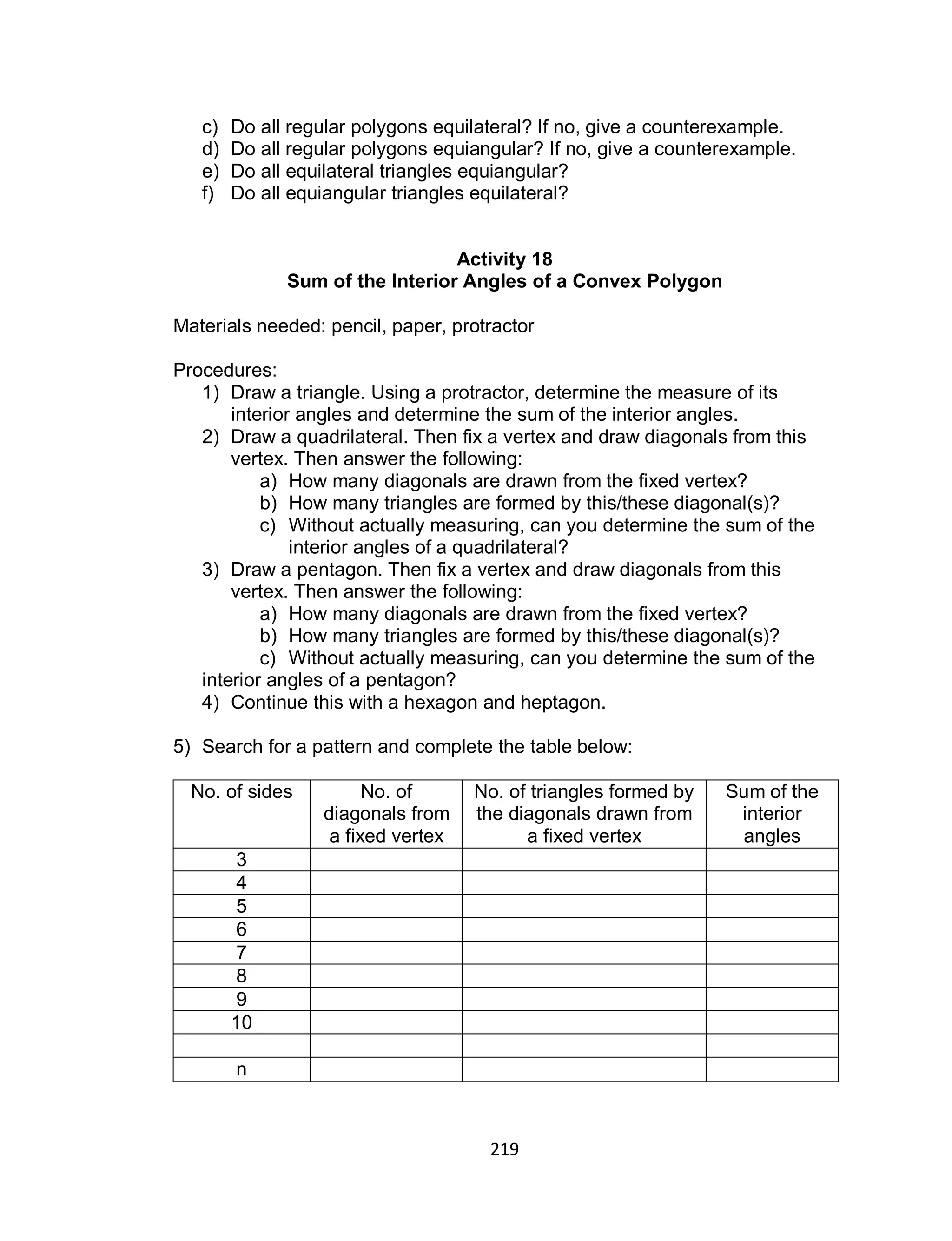
examples.
79
A third subset is the integers. This subset includes all the whole numbers
and their “opposites”. The subset would look like this: {... -4, -3, -2, -1, 0, 1, 2,
3, 4...}
Still in School at Middle Period...
4. What do you call the subset of real numbers that includes integers and non-
integers and are useful in representing concepts like “half a gallon of milk”?
Give examples.
The next subset is the rational numbers. This subset includes all numbers
that "come to an end" or numbers that repeat and have a pattern. Examples
of rational numbers are: 5.34, 0.131313..., , , 9
5. What do you call the subset of real numbers that is not a rational number but
are physically represented like “the diagonal of a square”?
Lastly we have the set of irrational numbers. This subset includes numbers
that cannot be exactly written as a decimal or fraction. Irrational numbers
cannot be expressed as a ratio of two integers. Examples of irrational
numbers are:

2 ,

1013
, and π
Important Terms to Remember
The following are terms that you must remember from this point on.
1. Natural/Counting Numbers – are the numbers we use in counting
things, that is {1, 2, 3, 4, . . . }. The three dots, called ellipses, indicate
that the pattern continues indefinitely.
2. Whole Numbers – are numbers consisting of the set of natural or
counting numbers and zero.
3. Integers – are the result of the union of the set of whole numbers and
the negative of counting numbers.
4. Rational Numbers – are numbers that can be expressed as a
quotient of two integers. The integer a is the numerator while the
integer b, which cannot be 0 is the denominator. This set includes
fractions and some decimal numbers.
5. Irrational Numbers – are numbers that cannot be expressed as a
quotient of two integers. Every irrational number may be
represented by a decimal that neither repeats nor terminates.
6. Real Numbers – are any of the numbers from the preceding subsets.
They can be found on the real number line. The union of rational
numbers and irrational numbers is the set of real numbers.
80
7. Number Line – a straight line extended on both directions as
illustrated by arrowheads and is used to represent the set of real
numbers. On the real number line, there is a point for every real
number and there is a real number for every point.
III. Exercises
a. Locate the following numbers on the number line by naming the correct point.
b. Determine the subset of real numbers to which each number belongs. Use a tick
mark
(√) to answer.
Number Whole
Number
Integer Rational Irrational
1. -86
2. 34.74
3.
4. √
5. √
6. -0.125
7. -√
8. e
9. -45.37
10.-1.252525...
B. Points to Contemplate
It is interesting to note that the set of rational numbers and the set of irrational
numbers are disjoint sets; that is their intersection is empty. In fact, they are
complements of each other. The union of these two sets is the set of real numbers.
Exercises:
1. Based on the stated information, show the relationships among natural/counting
numbers, whole numbers, integers, rational numbers, irrational numbers and
-2.66... , , -0.25 , , √ , √
1 2 3 40-1-2-3-4
81
real numbers using the Venn diagram. Fill each broken line with its corresponding
answer.
2. Answer the following questions on the space provided for each number.
a) Are all real numbers rational numbers? Prove your answer.
b) Are all rational numbers whole numbers? Prove your answer.
c) Are and negative integers? Prove your answer.
82
d) How is a rational number different from an irrational number?
e) How do natural numbers differ from whole numbers?
3. Complete the details in the Hierarchy Chart of the Set of Real Numbers.
THE REAL NUMBER SYSTEM
Summary
In this lesson, you learned different subsets of real numbers that enable you to
name numbers in different ways. You also learned to determine the hierarchy and
relationship of one subset to another that leads to the composition of the real
number system using the Venn Diagram and Hierarchy Chart. You also learned
that it was because of necessity that led man to invent number, words and
symbols.
83
Lesson 13: Significant Digits and the Scientific Notation OPTIONAL
Prerequisite Concepts: Rational numbers and powers of 10
About the Lesson:
This is a lesson on significant digits and the scientific notation combined. The
use of significant digits and the scientific notation is often in the area of measures
and in the natural sciences. The scientific notation simplifies the way we write very
large and very small numbers. On the other hand, numerical data become more
accurate when significant digits are taken into account.
Objectives:
In this lesson, you are expected to :
1. determine the significant digits in a given situation.
2. write very large and very small numbers in scientific notation
Lesson Proper:
I. A. Activity
The following is a list of numbers. The number of significant digits in each number
is written in the parenthesis after the number.
234 (3) 0.0122 (3)
745.1 (4) 0.00430 (3)
6007 (4) 0.0003668 (4)
1.3 X 10²
(2) 10000 (1)
7.50 X 10⁻⁷
(3) 1000. (4)
0.012300 (5) 2.222 X 10⁻³
(4)
100.0 (4) 8.004 X 10⁵
(4)
100 (1) 6120. (4)
7890 (3) 120.0 (4)
4970.00 (6) 530 (2)
Describe what digits are not significant. ________________________________
Important Terms to Remember
Significant digits are the digits in a number that express the precision of a
measurement rather than its magnitude. The number of significant digits in a given
measurement depends on the number of significant digits in the given data. In
calculations involving multiplication, division, trigonometric functions, for example,
the number of significant digits in the final answer is equal to the least number of
significant digits in any of the factors or data involved.
Rules for Determining Significant Digits
A. All digits that are not zeros are significant.
For example: 2781 has 4 significant digits
82.973 has 5 significant digits
B. Zeros may or may not be significant. Furthermore,
1. Zeros appearing between nonzero digits are significant.
For example: 20.1 has 3 significant digits
84
79002 has 5 significant digits
2. Zeros appearing in front of nonzero digits are not significant.
For example: 0.012 has 2 significant digits
0.0000009 has 1 significant digit
3. Zeros at the end of a number and to the right of a decimal are significant
digits. Zeros between nonzero digits and significant zeros are also
significant.
For example: 15.0 has 3 significant digits
25000.00 has 7 significant digits
4. Zeros at the end of a number but to the left of a decimal may or may not be
significant. If such a zero has been measured or is the first estimated digit,
it is significant. On the other hand, if the zero has not been measured or
estimated but is just a place holder it is not significant. A decimal placed
after the zeros indicates that they are significant
For example: 560000 has 2 significant digits
560000. has 6 significant digits
Significant Figures in Calculations
1. When multiplying or dividing measured quantities, round the answer to as
many significant figures in the answer as there are in the measurement with
the least number of significant figures.
2. When adding or subtracting measured quantities, round the answer to the
same number of decimal places as there are in the measurement with the
least number of decimal places.
For example:
a. 3.0 x 20.536 = 61.608
Answer: 61 since the least number of significant digits is 2, coming
from 3.0
b. 3.0 + 20.536 = 23.536
Answer: 23.5 since the addend with the least number of decimal
places is 3.0
II. Questions to Ponder ( Post-Activity Discussion )
Describe what digits are not significant. The digits that are not significant are the
zeros before a non-zero digit and zeros at the end of numbers without the decimal
point.
Problem 1. Four students weigh an item using different scales. These are the values
they report:
a. 30.04 g
b. 30.0 g
c. 0.3004 kg
d. 30 g
How many significant digits are in each measurement?
Answer: 30.04 has 4 significant; 30.0 has 3 significant digits; 0.3004 has 4 significant
digits; 30 has 1 significant digit
85
Problem 2. Three students measure volumes of water with three different devices.
They report the following results:
Device Volume
Large graduated cylinder 175 mL
Small graduated cylinder 39.7 mL
Calibrated buret 18.16 mL
If the students pour all of the water into a single container, what is the total volume of
water in the container? How many digits should you keep in this answer?
Answer: The total volume is 232.86 mL. Based on the measures, the final answer
should be 232.9 mL.
On the Scientific Notation
The speed of light is 300 000 000 m/sec, quite a large number. It is cumbersome to
write this number in full. Another way to write it is 3.0 x 10⁸
. How about a very small
number like 0.000 000 089? Like with a very large number, a very small number may
be written more efficiently. 0.000 000 089 may be written as 8.9 x 10⁻⁸
.
Writing a Number in Scientific Notation
1. Move the decimal point to the right or left until after the first significant digit
and copy the significant digits to the right of the first digit. If the number is a
whole number and has no decimal point, place a decimal point after the first
significant digit and copy the significant digits to its right.
For example, 300 000 000 has 1 significant digit, which is 3. Place a
decimal point after 3.0
The first significant digit in 0.000 000 089 is 8 and so place a decimal
point after 8, (8.9).
2. Multiply the adjusted number in step 1 by a power of 10, the exponent of
which is the number of digits that the decimal point moved, positive if moved
to the left and negative if moved to the right.
For example, 300 000 000 is written as 3.0 x 10⁸
because the decimal
point was moved past 8 places.
0.0 000 089 is written as 8.9 x 10⁻⁸
because the decimal point was moved
8 places to the right past the first significant digit 8.
III. Exercises
A. Determine the number of significant digits in the following measurements.
Rewrite the numbers with at least 5 digits in scientific notation.
1. 0.0000056 L 6. 8207 mm
2. 4.003 kg 7. 0.83500 kg
3. 350 m 8. 50.800 km
4. 4113.000 cm 9. 0.0010003 m3
5. 700.0 mL 10. 8 000 L
B. a. Round off the following quantities to the specified number of significant
figures.
86
1. 5 487 129 m to three significant figures
2. 0.013 479 265 mL to six significant figures
3. 31 947.972 cm2
to four significant figures
4. 192.6739 m2
to five significant figures
5. 786.9164 cm to two significant figures
b. Rewrite the answers in (a) using the scientific notation
C. Write the answers to the correct number of significant figures
1. 4.5 X 6.3 ÷ 7.22 __________________________
2. 5.567 X 3.0001 ÷ 3.45 __________________________
3. ( 37 X 43) ÷ ( 4.2 X 6.0 ) __________________________
4. ( 112 X 20 ) ÷ ( 30 X 63 ) __________________________
5. 47.0 ÷ 2.2 __________________________
D. Write the answers in the correct number of significant figures
1. 5.6713 + 0.31 + 8.123 __________________________
2. 3.111 + 3.11 + 3.1 __________________________
3. 1237.6 + 23 + 0.12 __________________________
4. 43.65 – 23.7 __________________________
5. 0.009 – 0.005 + 0.013 __________________________
E. Answer the following.
1. A runner runs the last 45m of a race in 6s. How many significant
figures will the runner's speed have?
2. A year is 356.25 days, and a decade has exactly 10 years in it. How
many significant figures should you use to express the number of
days in two decades?
3. Which of the following measurements was recorded to 3 significant
digits : 50 mL , 56 mL , 56.0 mL or 56.00 mL?
4. A rectangle measures 87.59 cm by 35.1 mm. Express its area with
the proper number of significant figures in the specified unit: a. in cm2
b. in mm2
5. A 125 mL sample of liquid has a mass of 0.16 kg. What is the density
of the liquid in g/mL?
Summary
In this lesson, you learned about significant digits and the scientific notation.
You learned the rules in determining the number of significant digits. You also
learned how to write very large and very small numbers using the scientific notation.
87
Lesson 14: More Problems Involving Real Numbers Time: 1.5 hours
Pre-requisite Concepts: Whole numbers, Integers, Rational Numbers, Real
Numbers, Sets
About the Lesson: This is the culminating lesson on real numbers. It combines all
the concepts and skills learned in the past lessons on real numbers.
Objectives:
In this lesson, you are expected to:
1. Apply the set operations and relations to sets of real numbers
2. Describe and represent real-life situations which involve integers, rational
numbers, square roots of rational numbers, and irrational numbers
3. Apply ordering and operations of real numbers in modeling and solving real-
life problems
Lesson Proper:
Recall how the set of real numbers was formed and how the operations are
performed. Numbers came about because people needed and learned to count. The
set of counting numbers was formed. To make the task of counting easier, addition
came about. Repeated addition then got simplified to multiplication. The set of
counting numbers is closed under both the operations of addition and multiplication.
When the need to represent zero arose, the set W of whole numbers was formed.
When the operation of subtraction began to be performed, the W was extended to
the set or integers. is closed under the operations of addition, multiplication and
subtraction. The introduction of division needed the expansion of to the set of
rational numbers. is closed under all the four arithmetic operations of addition,
multiplication, subtraction and division. When numbers are used to represent
measures of length, the set or rational numbers no longer sufficed. Hence, the set
of real numbers came to be the field where properties work.
The above is a short description of the way the set of real numbers was built
up to accommodate applications to counting and measurement and performance of
the four arithmetic operations. We can also explore the set of real numbers by
dissection – beginning from the big set, going into smaller subsets. We can say that
is the set of all decimals (positive, negative and zero). The set includes all the
decimals which are repeating (we can think of terminating decimals as decimals in
which all the digits after a finite number of them are zero). The set comprises all
the decimals in which the digits to the right of the decimal point are all zero. This
view gives us a clearer picture of the relationship among the different subsets of in
terms of inclusion.
88
We know that the nth root of any number which is not the nth power of a rational
number is irrational. For instance,√ , √ , and √ are irrational.
Example 1. Explain why √ is irrational.
We use an argument called an indirect proof. This means that we will show
why √ becoming rational will lead to an absurd conclusion. What happens
if √ is rational? Because is closed under multiplication and is rational,
then √ is rational. However, √ √ , which we know to be
irrational. This is an absurdity. Hence we have to conclude that √ must be
irrational.
Example 2. A deep-freeze compartment is maintained at a temperature of 12°C
below zero. If the room temperature is 31°C, how much warmer is the room
temperature than the temperature in the deep-freeze compartment.
Get the difference between room temperature and the temperature inside the
deep-freeze compartment
( ) . Hence, room temperature is 43°C warmer than the
compartment.
Example 3. Hamming Code
A mathematician, Richard Hamming
developed an error detection code to
determine if the information sent
electronically is transmitted correctly.
Computers store information using bits
(binary digits, that is, a 0 or a 1). For
example, 1011 is a four-bit code.
W
a
b
c
d
E
F
G
89
Hamming uses a Venn diagram with three “sets” as follows:
1. The digits of the four-bit code are placed in regions a, b, c, and d, in
this order.
2. Three additional digits of 0’s and 1’s are put in the regions E, F, and G
so that each “set” has an even number of 1’s.
3. The code is then extended to a 7-bit code using (in order) the digits in
the regions a, b, c, d, E, F, G.
For example, the code 1011 is encoded as follows:
Example 4. Two students are vying to represent their school in the regional chess
competition. Felix won 12 of the 17 games he played this year, while Rommel
won 11 of the 14 games he played this year. If you were the principal of the
school, which student would you choose? Explain.
The Prinicpal will likely use fractions to get the winning ratio or percentage of
each player. Felix has a winning ratio, while Rommel has a winning ratio.
Since , Rommel will be a logical choice.
Example 5. A class is having an election to decide whether they will go on a
fieldtrip. They will have a fieldtrip if more than 50% of the class will vote Yes.
Assume that every member of the class will vote. If 34% of the girls and 28%
of the boys will vote Yes, will the class go on a fieldtrip? Explain.
Although , less than half of the girls and less than half of
the boys voted Yes. This means that less than half all students voted Yes.
Example 6. A sale item was marked down by the same percentage for three years
in a row. After two years the item was 51% off the original price. By how
much was the price off the original price in the first year?
Since the price after 2 years is 51% off the original price, this means that the
price is then 49% of the original. Since the percentage ratio must be
multiplied to the original price twice (one per year), and , then
the price per year is 70% of the price in the preceding year. Hence the
discount is 30% off the original.
1
0
1
1
0
1
0
1
1
0 1
1011 1011001
90
Exercises:
1. The following table shows the mean temperature in Moscow by month from 2001
to 2011
January May September
February June October
March July November
April August December
Plot each temperature point on the number line and list from lowest to highest.
2. Below are the ingredients for chocolate oatmeal raisin cookies. The recipe yields
32 cookies. Make a list of ingredients for a batch of 2 dozen cookies.
3. In high-rise buildings, floors are numbered in increasing sequence from the
ground-level floor to second, third, etc, going up. The basement immediately
below the ground floor is usually labeled B1, the floor below it is B2, and so on.
How many floors does an elevator travel from the 39th
floor of a hotel to the
basement parking at level B6?
4. A piece of ribbon 25 m long is cut into pieces of equal length. Is it possible to get
a piece with irrational length? Explain.
5. Explain why √ is irrational. (See Example 1.)
1 ½ cups all-purpose flour
1 tsp baking soda
1 tsp salt
1 cup unsalted butter
¾ cup light-brown sugar
¾ cup granulated sugar
2 large eggs
1 tsp vanilla extract
2 ½ cups rolled oats
1 ½ cups raisins
12 ounces semi-sweet chocolate
chips
91
Lesson 15: Measurement and Measuring Length Time: 2.5 hours
Prerequisite Concepts: Real Numbers and Operations
About the Lesson:
This is a lesson on the English and Metric System of Measurement and using
these systems to measure length. Since these systems are widely used in our
community, a good grasp of this concept will help you be more accurate in dealing
with concepts involving length such as distance, perimeter and area.
Objective
At the end of the lesson, you should be able to:
1. Describe what it means to measure;
2. Describe the development of measurement from the primitive to the present
international system of unit;
3. Estimate or approximate length;
4. Use appropriate instruments to measure length;
5. Convert length measurement from one unit to another, including the English
system;
6. Solve problems involving length, perimeter and area.
Lesson Proper
A.
I. Activity:
Instructions: Determine the dimension of the following using only parts of your arms.
Record your results in the table below. Choose a classmate and compare your
results.
SHEET OF
INTERMEDIATE
PAPER
TEACHER’S
TABLE
CLASSROOM
Length Width Length Width
Lengt
h
Width
Arm part
used*
Measurement
Comparison
to:
(classmate’s
name)
* For the arm part, please use any of the following only: the palm, the handspan and
the forearm length
Important Terms to Remember:
>palm – the width of one’s hand excluding the thumb
92
> handspan – the distance from the tip of the thumb to the tip of the little finger of
one’s hand with fingers spread apart.
> forearm length – the length of one’s forearm: the distance from the elbow to the tip
of the middle finger.
Answer the following questions:
1. What was your reason for choosing which arm part to use? Why?
2. Did you experience any difficulty when you were doing the actual measuring?
3. Were there differences in your data and your classmate’s data? Were the
differences significant? What do you think caused those differences?
II. Questions to Ponder (Post-Activity Discussion)
Let us answer the questions in the opening activity:
1. What is the appropriate arm part to use in measuring the length and width of the
sheet of paper? of the teacher’s table? Of the classroom? What was your reason for
choosing which arm part to use? Why?
 While all of the units may be used, there are appropriate units of measurement
to be used depending on the length you are trying to measure.
 For the sheet of paper, the palm is the appropriate unit to use since the
handspan and the forearm length is too long.
 For the teacher’s table, either the palm or the handspan will do but the forearm
length might be too long to get an accurate measurement.
 For the classroom, the palm and handspan may be used but you may end up
with a lot of repetitions. The best unit to use would be the forearm length.
2. Did you experience any difficulty when you were doing the actual measuring?
The difficulties you may have experienced might include having to use too many
repetitions.
3. Were there differences in your data and your classmate’s data? Were the
differences significant? What do you think caused those differences?
If you and your partner vary a lot in height, then chances are your forearm length,
handspan and palm may also vary, leading to different measurements of the same
thing.
History of Measurement
One of the earliest tools that human beings invented was the unit of
measurement. In olden times, people needed measurement to determine how long
or wide things are; things they needed to build their houses or make their clothes.
Later, units of measurement were used in trade and commerce. In the 3rd
century
BC Egypt, people used their body parts to determine measurements of things; the
same body parts that you used to measure the assigned things to you.
The forearm length, as described in the table below, was called a cubit. The
handspan was considered a half cubit while the palm was considered 1/6 of a cubit.
Go ahead, check out how many handspans your forearm length is. The Egyptians
came up with these units to be more accurate in measuring different lengths.
However, using these units of measurement had a disadvantage. Not
everyone had the same forearm length. Discrepancies arose when the people
started comparing their measurements to one another because measurements of the
same thing differed, depending on who was measuring it. Because of this, these
units of measurement are called non-standard units of measurement which later on
93
evolved into what is now the inch, foot and yard, basic units of length in the English
system of measurement.
III. Exercise:
1. Can you name other body measurements which could have been used as a non-
standard unit of measurement? Do some research on other non-standard units of
measurement used by people other than the Egyptians.
2. Can you relate an experience in your community where a non-standard unit of
measurement was used?
B.
I. Activity
Instructions: Determine the dimension of the following using the specified English
units only. Record your results in the table below. Choose a classmate and
compare your results.
SHEET OF
INTERMEDIATE
PAPER
TEACHER’S
TABLE
CLASSROOM
Length Width Length Width
Lengt
h
Width
Arm part
used*
Measurement
Comparison
to:
(classmate’s
name)
For the unit used, choose which of the following SHOULD be used: inch or foot.
Answer the following questions:
1. What was your reason for choosing which unit to use? Why?
2. Did you experience any difficulty when you were doing the actual measuring?
3. Were there differences in your data and your classmate’s data? Were the
differences as big as the differences when you used non-standard units of
measurement? What do you think caused those differences?
II. Questions to Ponder (Post-Activity Discussion)
Let us answer the questions in the activity above:
1. What was your reason for choosing which unit to use? Why?
 For the sheet of paper, the appropriate unit to use is inches since its length
and width might be shorter than a foot.
94
 For the table and the classroom, a combination of both inches and feet may
be used for accuracy and convenience of not having to deal with a large
number.
2. What difficulty, if any, did you experience when you were doing the actual
measuring?
3. Were there differences in your data and your classmate’s data? Were the
differences as big as the differences when you used non-standard units of
measurement? What do you think caused those differences?
 If you and your partner used the steel tape correctly, both your data should
have little or no difference at all. The difference should not be as big or as
significant as the difference when non-standard units of measurement were
used. The slight difference might be caused by how accurately you tried to
measure each dimension or by how you read the ticks on the steel tape. In
doing actual measurement, a margin of error should be considered.
History of Measurement (Continued)
As mentioned in the first activity, the inch, foot and yard are said to be based
on the cubit. They are the basic units of length of the English System of
Measurement, which also includes units for mass, volume, time, temperature and
angle. Since the inch and foot are both units of length, each can be converted into
the other. Here are the conversion factors, as you may recall from previous lessons:
1 foot = 12 inches
1 yard = 3 feet
For long distances, the mile is used:
1 mile = 1,760 yards = 5,280 feet
Converting from one unit to another might be tricky at first, so an organized
way of doing it would be a good starting point. As the identity property of
multiplication states, the product of any value and 1 is the value itself. Consequently,
dividing a value by the same value would be equal to one. Thus, dividing a unit by
its equivalent in another unit is equal to 1. For example:
1 foot / 12 inches = 1
3 feet / 1 yard = 1
These conversion factors may be used to convert from one unit to another. Just
remember that you’re converting from one unit to another so cancelling same units
would guide you in how to use your conversion factors. For example:
1. Convert 36 inches into feet:
2. Convert 2 miles into inches:
Again, since the given measurement was multiplied by conversion factors which are
equal to 1, only the unit was converted but the given length was not changed.
Try it yourself.
III. Exercise:
Convert the following lengths into the desired unit:
95
1. Convert 30 inches to feet
2. Convert 130 yards to inches
3. Sarah is running in a 42-mile marathon. How many more feet does Sarah need to
run if she has already covered64,240 yards?
C.
I. Activity:
Answer the following questions:
1. When a Filipina girl is described as 1.7 meters tall, would she be considered tall
or short? How about if the Filipina girl is described as 5 ft, 7 inches tall, would she
be considered tall or short?
2. Which particular unit of height were you more familiar with? Why?
II. Questions to Ponder (Post-Activity Discussion)
Let us answer the questions in the activity above:
1. When a Filipina girl is described as 1.7 meters tall, would she be considered tall
or short? How about if the Filipina girl is described as 5 ft, 7 inches tall, would she
be considered tall or short?
 Chances are, you would find it difficult to answer the first question. As for the
second question, a Filipina girl with a height of 5 feet, 7 inches would be
considered tall by Filipino standards.
2. Which particular unit of height were you more familiar with? Why?
 Again, chances are you would be more familiar with feet and inches since
feet and inches are still being widely used in measuring and describing height
here in the Philippines.
History of Measurement (Continued)
The English System of Measurement was widely used until the 1800s and the
1900s when the Metric System of Measurement started to gain ground and became
the most used system of measurement worldwide. First described by Belgian
Mathematician Simon Stevin in his booklet, De Thiende (The Art of Tenths) and
proposed by English philosopher, John Wilkins, the Metric System of Measurement
was first adopted by France in 1799. In 1875, the General Conference on Weights
and Measures (Conférence générale des poids et mesures or CGPM) was tasked to
define the different measurements. By 1960, CGPM released the International
System of Units (SI) which is now being used by majority of the countries with the
biggest exception being the United States of America. Since our country used to be
a colony of the United States, the Filipino people were schooled in the use of the
English instead of the Metric System of Measurement. Thus, the older generation of
Filipinos is more comfortable with English System rather than the Metric System
although the Philippines have already adopted the Metric System as its official
system of measurement.
The Metric System of Measurement is easier to use than the English System
of Measurement since its conversion factors would consistently be in the decimal
system, unlike the English System of Measurement where units of lengths have
different conversion factors. Check out the units used in your steep tape measure,
most likely they are inches and centimeters. The base unit for length is the meter
and units longer or shorter than the meter would be achieved by adding prefixes to
96
the base unit. These prefixes may also be used for the base units for mass, volume,
time and other measurements. Here are the common prefixes used in the Metric
System:
For example:
1 kilometer = 1,000 meters
1 millimeter = 1/1,000 meter or 1,000 millimeters = 1 meter
These conversion factors may be used to convert from big to small units or vice
versa. For example:
1. Convert 3 km to m:
2. Convert 10 mm to m:
As you can see in the examples above, any length or distance may be measured
using the appropriate English or Metric units. In the question about the Filipina girl
whose height was expressed in meters, her height can be converted to the more
familiar feet and inches. So, in the Philippines where the official system of
measurements is the Metric System yet the English System continues to be used, or
as long as we have relatives and friends residing in the United States, knowing how
to convert from the English System to the Metric System (or vice versa) would be
useful. The following are common conversion factors for length:
1 inch = 2.54 cm
3.3 feet ≈ 1 meter
For example:
Convert 20 inches to cm:
III. Exercise:
1. Using the tape measure, determine the length of each of the following in cm.
Convert these lengths to meters.
PREFIX SYMBOL FACTOR
tera T x 1,000,000,000,000
giga G x 1,000,000,000
mega M x 1,000,000
kilo k x 1,000
hecto h x 100
deka da x 10
deci d x 1/10
centi c x 1/100
milli m x 1/1,000
micro µ x 1/1,000,000
nano n x 1/1,000,000,000
97
PALM HANDSPAN FOREARM
LENGTH
Centimeters
Meters
2. Using the data in the table above, estimate the lengths of the following without
using the steel tape measure or ruler:
BALLPE
N
LENGTH
OF
WINDO
W PANE
LENGT
H OF
YOUR
FOOT
FROM
THE TIP
OF
YOUR
HEEL
TO THE
TIP OF
YOUR
TOES
HEIGHT
OF THE
CHALK
BOARD
LENGTH OF
THE CHALK
BOARD
NON-
STANDAR
D UNIT
METRIC
UNIT
3. Using the data from table 1, convert the dimensions of the sheet of paper,
teacher’s table and the classroom into Metric units. Recall past lessons on perimeter
and area and fill in the appropriate columns:
SHEET OF
INTERMEDIATE PAPER
TEACHER’S TABLE CLASSROOM
Length Width
Peri-
meter
Area Length Width
Peri-
meter
Area Length Width
Peri-
meter
Area
English
units
Metric
Units
4. Two friends, Zale and En zo, run in marathons. Zale finished a 21-km marathon in
Cebu while Enzo finished a 15-mile marathon in Los Angeles. Who between the two
ran a longer distance? By how many meters?
98
5. Georgia wants to fence her square garden, which has a side of 20 feet, with two
rows of barb wire. The store sold barb wire by the meter at P12/meter. How much
money will Georgia need to buy the barb wire she needs?
5. A rectangular room has a floor area of 32 square meters. How many tiles, each
measuring 50 cm x 50 cm, are needed to cover the entire floor?
Summary
In this lesson, you learned: 1) that ancient Egyptians used units of measurement
based on body parts such as the cubit and the half cubit. The cubit is the length of
the forearm from the elbow to the tip of the middle finger; 2) that the inch and foot,
the units for length of the English System of Measurement, are believed to be based
on the cubit; 3) that the Metric System of Measurement became the dominant
system in the 1900s and is now used by most of the countries with a few exceptions,
the biggest exception being the United States of America; 4) that it is appropriate to
use short base units of length for measuring short lengths and long units of lengths
to measure long lengths or distances; 5) how to convert common English units of
length into other English units of length using conversion factors; 6) that the Metric
System of Measurement is based on the decimal system and is therefore easier to
use; 7) that the Metric System of Measurement has a base unit for length (meter)
and prefixes to signify long or short lengths or distances; 8) how to estimate lengths
and distances using your arm parts and their equivalent Metric lengths; 9) how to
convert common Metric units of length into other Metric units of length using the
conversion factors based on prefixes; 10) how to convert common English units of
length into Metric units of length (and vice versa) using conversion factors; 11) how
to solve length, perimeter and area problems using English and Metric units.
99
Lesson 16: Measuring Weight/Mass and Volume Time: 2.5 hours
Prerequisite Concepts: Basic concepts of measurement, measurement of length
About the Lesson:
This is a lesson on measuring volume & mass/weight and converting its units
from one to another. A good grasp of this concept is essential since volume &
weight are commonplace and have practical applications.
Objectives:
At the end of the lesson, you should be able to:
7. estimate or approximate measures of weight/mass and volume;
8. use appropriate instruments to measure weight/mass and volume;
9. convert weight/mass and volume measurements from one unit to another,
including the English system;
10. Solve problems involving weight/mass and volume/capacity.
Lesson Proper
A.
I. Activity:
Read the following narrative to help you review the concept of volume.
Volume
Volume is the amount of space an object contains or occupies. The volume
of a container is considered to be the capacity of the container. This is measured by
the number of cubic units or the amount of fluid it can contain and not the amount of
space the container occupies. The base SI unit for volume is the cubic meter (m3
).
Aside from cubic meter, another commonly used metric unit for volume of solids is
the cubic centimeter (cm3
or cc) while the commonly used metric units for volume of
fluids are the liter (L) and the milliliter (mL).
Hereunder are the volume formulae of some regularly-shaped objects:
Cube: Volume = edge x edge x edge (V = e3
)
Rectangular prism: Volume = length x width x height (V = lwh)
Triangular prism: Volume = 1⁄2 x base of the triangular base x height of the
triangular base x Height of the prism
( ( ) )
Cylinder: Volume = π x (radius)2
x height of the cylinder (V = πr2
h)
Other common regularly-shaped objects are the different pyramids, the cone
and the sphere. The volumes of different pyramids depend on the shape of its base.
Here are their formulae:
Square-based pyramids: Volume = 1/3 x (side of base)2
x height of
pyramid(V = 1/3 s2
h)
Rectangle-based pyramid: Volume=1/3 x length of the base x width of
the base x height of pyramid (V=1/3 lwh)
Triangle-based pyramid: Volume = 1/3 x 1⁄2 x base of the triangle x
height of the triangle x Height of the pyramid
100
( ( ) )
Cone: Volume = 1/3 x π x (radius)2
x height
Sphere: Volume = 4/3 x πx (radius)3
(V = 4/3 πr3
)
Here are some examples:
1. V = lwh = 3 m x 4 m x 5 m
= (3 x 4 x 5) x (m x m x m) = 60 m3
2. V = 1/3 lwh = 1/3 x 3 m x 4 m x 5 m
= (1/3 x 3 x 4 x 5) x (m x m x m) = 20 m3
Answer the following questions:
1. Cite a practical application of volume.
2. What do you notice about the parts of the formulas that have been underlined?
Come up with a general formula for the volume of all the given prisms and for the
cylinder.
3. What do you notice about the parts of the formulas that have been shaded?
Come up with a general formula for the volume of all the given pyramids and for
the cone.
II. Questions to Ponder (Post-Activity Discussion)
Let us answer the questions in the opening activity:
1. Cite a practical application of volume.
Volume is widely used from baking to construction. Baking requires a degree of
precision in the measurement of the ingredients to be used thus measuring
spoons and cups are used. In construction, volume is used to measure the size
of a room, the amount of concrete needed to create a specific column or beam or
the amount of water a water tank could hold.
2. What do you notice about the parts of the formulas that have been underlined?
Come up with a general formula for the volume of all the given prisms and for the
cylinder.
The formulas that have been underlined are formulas for area. The general
formula for the volume of the given prisms and cylinder is just the area of the
base of the prisms or cylinder times the height of the prism or cylinder (V =
Abaseh).
3 m
4 m
5 m
4 m
3m
5 m
101
3. What do you notice about the parts of the formulas that have been shaded?
Come up with a general formula for the volume of all the given pyramids and for
the cone.
The formulas that have been shaded are formulas for the volume of prisms or
cylinders. The volume of the given pyramids is just 1/3 of the volume of a prism
whose base and height are equal to that of the pyramid while the formula for the
cone is just 1/3 of the volume of a cylinder with the same base and height as the
cone (V = 1/3 Vprism or cylinder).
III. Exercise:
Instructions: Answer the following items. Show your solution.
1. How big is a Toblerone box (triangular prism) if its triangular side has a base of 3
cm and a height of 4.5 cm and the box’s height is 25 cm?
2. How much water is in a cylindrical tin can with a radius of 7 cm and a height of 20
cm if it is only a quarter full?
3. Which of the following occupies more space, a ball with a radius of 4 cm or a
cube with an edge of 60 mm?
B.
I. Activity
Materials Needed:
Ruler / Steel tape measure
Different regularly-shaped objects (brick, cylindrical drinking glass, balikbayan
box)
Instructions: Determine the dimension of the following using the specified metric
units only. Record your results in the table below and compute for each object’s
volume using the unit used to measure the object’s dimensions. Complete the table
by expressing/converting the volume using the specified units.
BRICK
DRINKING
GLASS
BALIKBAYAN BOX CLASSROOM
Length Width Height Radius Height Length Width Height Length Width Height
Unit used*
Measurement
Volume
cm
3
m
3
in3
ft3
For the unit used, choose ONLY one: centimeter or meter.
Answer the following questions:
1. What was your reason for choosing which unit to use? Why?
2. How did you convert the volume from cc to m3
or vice versa?
3. How did you convert the volume from cc to the English units for volume?
102
Volume (continued)
The English System of Measurement also has its own units for measuring
volume or capacity. The commonly used English units for volume are cubic feet (ft3
)
or cubic inches (in3
) while the commonly used English units for fluid volume are the
pint, quart or gallon. Recall from the lesson on length and area that while the
Philippine government has mandated the use of the Metric system, English units are
still very much in use in our society so it is an advantage if we know how to convert
from the English to the Metric system and vice versa. Recall as well from the
previous lesson on measuring length that a unit can be converted into another unit
using conversion factors. Hereunder are some of the conversion factors which
would help you convert given volume units into the desired volume units:
1 m3
= 1 million cm3
1 gal = 3.79 L
1 ft3
= 1,728 in3
1 gal = 4 quarts
1 in3
= 16.4 cm3
1 quart = 2 pints
1 m3
= 35.3 ft3
1 pint = 2 cups
1 cup = 16 tablespoons
1 tablespoon = 3 teaspoons
Since the formula for volume only requires length measurements, another
alternative to converting volume from one unit to another is to convert the object’s
dimensions into the desired unit before solving for the volume.
For example:
1. How much water, in cubic centimeters, can a cubical water tank hold if it
has an edge of 3 meters?
Solution 1 (using a conversion factor):
i. Volume = e3
= (3 m)3
= 27 m3
ii. 27 m3
x 1 million cm3
/1 m3 = 27 million cm3
Solution 2 (converting dimensions first):
i. 3 m x 100 cm
/ 1 m = 300 cm
ii. Volume = e3
= (300 cm)3
= 27 million cm3
II. Questions to Ponder (Post-Activity Discussion)
Let us answer the questions in the activity above:
1. What was your reason for choosing which unit to use?
Any unit on the measuring instrument may be used but the decision on what
unit to use would depend on how big the object is. In measuring the brick,
the glass and the balikbayan box, the appropriate unit to use would be
centimeter. In measuring the dimensions of the classroom, the appropriate
unit to use would be meter.
2. How did you convert the volume from cc to m3
or vice versa?
Possible answer would be converting the dimensions to the desired units first
before solving for the volume.
3. How did you convert the volume from cc or m3
to the English units for volume?
Possible answer would be by converting the dimensions into English units
first before solving for the volume.
103
III. Exercises:
Answer the following items. Show your solutions.
1. Convert 10 m3
to ft3
2. Convert 12 cups to mL
3. A cylindrical water tank has a diameter of 4 feet and a height of 7 feet while a
water tank shaped like a rectangular prism has a length of 1 m, a width of 2 meters
and a height of 2 meters. Which of the two tanks can hold more water? By how
many cubic meters?
C.
I. Activity:
Problem: The rectangular water tank of a fire truckmeasures 3 m by 4 m by 5 m.
How many liters of water can the fire truck hold?
Volume (Continued)
While capacities of containers are obtained by measuring its dimensions, fluid
volume may also be expressed using Metric or English units for fluid volume such as
liters or gallons. It is then essential to know how to convert commonly used units for
volume into commonly used units for measuring fluid volume.
While the cubic meter is the SI unit for volume, the liter is also widely
accepted as a SI-derived unit for capacity. In 1964, after several revisions of its
definition, the General Conference on Weights and Measures (CGPM) finally defined
a liter as equal to one cubic decimeter. Later, the letter L was also accepted as the
symbol for liter.
This conversion factor may also be interpreted in other ways. Check out the
conversion factors below:
1 L = 1 dm3
1 mL = 1 cc
1,000 L = 1 m3
II. Questions to Ponder (Post-Activity Discussion)
Let us answer the problem above:
Step 1: V = lwh Step 2: 60 m3
x 1,000 L
/ 1 m3 = 60,000 L
= 3m x 4m x 5m
= 60 m3
III. Exercise:
Instructions: Answer the following items. Show your solution.
1. A spherical fish bowl has a radius of 21 cm. How many mL of water is needed to
fill half the bowl?
2. A rectangular container van needs to be filled with identical cubical balikbayan
boxes. If the container van’s length, width and height are 16 ft, 4 ft and 6ft,
respectively, while each balikbayan box has an edge of 2 ft, what is the maximum
number of balikbayan boxes that can be placed inside the van?
3. A drinking glass has a height of 4 in, a length of 2 in and a width of 2 in while a
baking pan has a width of 4 in, a length of 8 in and a depth of 2 in. If the baking pan
is to be filled with water up to half its depth using the drinking glass, how many
glasses full of water would be needed?
104
D.
Activity:
Instructions: Fill the table below according to the column headings. Choose which of
the available instruments is the most appropriate in measuring the given object’s
weight. For the weight, choose only one of the given units.
INSTRUMENT* WEIGHT
Gram Kilogram Pound
¢25-coin
₱5-coin
Small toy
marble
Piece of brick
Yourself
*Available instruments: triple-beam balance, nutrition (kitchen) scale, bathroom scale
Answer the following questions:
1. What was your reason for choosing which instrument to use?
2. What was your reason for choosing which unit to use?
3. What other kinds of instruments for measuring weight do you know?
4. What other units of weight do you know?
Mass/ Weight
In common language, mass and weight are used interchangeably although
weight is the more popular term. Oftentimes in daily life, it is the mass of the given
object which is called its weight. However, in the scientific community, mass and
weight are two different measurements. Mass refers to the amount of matter an
object has while weight is the gravitational force acting on an object.
Weight is often used in daily life, from commerce to food production. The
base SI unit for weight is the kilogram (kg) which is almost exactly equal to the mass
of one liter of water. For the English System of Measurement, the base unit for
weight is the pound (lb). Since both these units are used in Philippine society,
knowing how to convert from pound to kilogram or vice versa is important. Some of
the more common Metric units are the gram (g) and the milligram (mg) while another
commonly used English unit for weight is ounces (oz). Here are some of the
conversion factors for these units:
1 kg = 2.2 lb 1 g = 1000 mg 1 metric ton = 1000 kg
1 kg = 1000 g 1 lb = 16 oz
Use these conversion factors to convert common weight units to the desired unit.
For example:
Convert 190 lb to kg:
II. Questions to Ponder (Post-Activity Discussion)
1. What was your reason for choosing which instrument to use?
Possible reasons would include how heavy the object to be weighed to the
capacity of the weighing instrument.
2. What was your reason for choosing which unit to use?
105
The decision on which unit to use would depend on the unit used by the
weighing instrument. This decision will also be influenced by how heavy the
object is.
3. What other kinds of instruments for measuring weight do you know?
Other weighing instruments include the two-pan balance, the spring scale,
the digital scales.
4. What other common units of weight do you know?
Possible answers include ounce, carat and ton.
III. Exercise:
Answer the following items. Show your solution.
1. Complete the table above by converting the measured weight into the specified
units.
2. When Sebastian weighed his balikbayan box, its weight was 34 kg. When he got
to the airport, he found out that the airline charged $5 for each lb in excess of the
free baggage allowance of 50 lb. How much will Sebastian pay for the excess
weight?
3. A forwarding company charges P1,100 for the first 20 kg and P60 for each
succeeding 2 kg for freight sent to Europe. How much do you need to pay for a
box weighing 88 lb?
Summary
In this lesson, you learned: 1) how to determine the volume of selected
regularly-shaped solids; 2) that the base SI unit for volume is the cubic meter; 3) how
to convert Metric and English units of volume from one to another; 4) how to solve
problems involving volume or capacity; 5) that mass and weight are two different
measurements and that what is commonly referred to as weight in daily life is
actually the mass; 6) how to use weighing intruments to measure the mass/weight of
objects and people; 7) how to convert common Metric and English units of weight
from one to another; 8) how to solve problems involving mass / weight.
106
Lesson 17: Measuring Angles, Time and Temperature
Prerequisite Concepts: Basic concepts of measurement, ratios
About the Lesson:
This lesson should reinforce your prior knowledge and skills on measuring
angle, time and temperature as well as meter reading. A good understanding of this
concept would not only be useful in your daily lives but would also help you in
geometry and physical sciences.
Objectives:
At the end of the lesson, you should be able to:
11. estimate or approximate measures of angle, time and temperature;
12. use appropriate instruments to measure angles, time and temperature;
13. solve problems involving time, speed, temperature and utilities usage (meter
reading).
Lesson Proper
A.
I. Activity:
Material needed:
Protractor
Instruction: Use your protractor to measure the angles given below. Write your
answer on the line provided.
1.__________ 2._____________ 3.____________ 4.____________
Angles
Derived from the Latin word angulus, which means corner, an angle is
defined as a figure formed when two rays share a common endpoint called the
vertex. Angles are measured either in degree or radian measures. A protractor is
used to determine the measure of an angle in degrees. In using the protractor, make
sure that the cross bar in the middle of the protractor is aligned with the vertex and
one of the legs of the angle is aligned with one side of the line passing through the
cross bar. The measurement of the angle is determined by its other leg.
Answer the following items:
1. Estimate the measurement of the angle below. Use your protractor to check your
estimate.
Estimate_______________
Measurement using the protractor_______
2. What difficulties did you meet in using your protractor to measure the angles?
107
3. What can be done to improve your skill in estimating angle measurements?
II. Questions to Ponder (Post-activity discussion):
1. Estimate the measurement of the angles below. Use your protractor to check
your estimates.
Measurement = 50
2. What difficulties did you meet in using your protractor to measure the angles?
One of the difficulties you may encounter would be on the use of the protractor
and the angle orientation. Aligning the cross bar and base line of the protractor
with the vertex and an angle leg, respectively, might prove to be confusing at
first, especially if the angle opens in the clockwise orientation. Another difficulty
arises if the length of the leg is too short such that it won’t reach the tick marks
on the protractor. This can be remedied by extending the leg.
3. What can be done to improve your skill in estimating angle measurements?
You may familiarize yourself with the measurements of the common angles like
the angles in the first activity and use these angles in estimating the
measurement of other angles.
III. Exercise:
Instructions: Estimate the measurement of the given angles, then check your
estimates by measuring the same angles using your protractor.
ANGLE
A B C
ESTIMAT
E
MEASUR
EMENT
B.
I. Activity
Problem: An airplane bound for Beijing took off from the Ninoy Aquino International
Airport at 11:15 a.m. Its estimated time of arrival in Beijing is at1550 hrs. The
distance from Manila to Beijing is 2839 km.
1. What time (in standard time) is the plane supposed to arrive in Beijing?
2. How long is the flight?
3. What is the plane’s average speed?
Time and Speed
The concept of time is very basic and is integral in the discussion of other
concepts such as speed. Currently, there are two types of notation in stating time,
the 12-hr notation (standard time) or the 24-hr notation (military or astronomical
108
time). Standard time makes use of a.m. and p.m. to distinguish between the time
from 12midnight to 12 noon (a.m. or ante meridiem) and from 12 noon to 12 midnight
(p.m. or post meridiem). This sometimes leads to ambiguity when the suffix of a.m.
and p.m. are left out. Military time prevents this ambiguity by using the 24-hour
notation where the counting of the time continues all the way to 24. In this notation,
1:00 p.m. is expressed as 1300 hours or 5:30 p.m. is expressed as 1730 hours.
Speed is the rate of an object’s change in position along a line. Average
speed is determined by dividing the distance travelled by the time spent to cover the
distance (Speed = distance
/time or S = d
/t, read as “distance per time”). The base SI unit
for speed is meters per second (m
/s). The commonly used unit for speed is
Kilometers
/hour (kph or km
/h) for the Metric system and miles/hour (mph or mi
/hr) for the
English system.
II. Questions to Ponder (Post-Activity Discussion)
Let us answer the questions in the activity above:
1. What time (in standard time) is the plane supposed to arrive in Beijing?
3:50 p.m.
2. How long is the flight?
1555 hrs – 1115 hrs = 4 hrs, 40 minutes or 4.67 hours
3. What is the plane’s average speed?
S = d/t
= 2839 km / 4.67 hrs
= 607.92 kph
III. Exercise:
Answer the following items. Show your solutions.
1. A car left the house and travelled at an average speed of 60 kph. How many
minutes will it take for the car to reach the school which is 8 km away from the
house?
2. Sebastian stood at the edge of the cliff and shouted facing down. He heard the
echo of his voice 4 seconds after he shouted. Given that the speed of sound in air is
340 m / s, how deep is the cliff?
3. Maria ran in a 42-km marathon. She covered the first half of the marathon from
0600 hrs to 0715 hours and stopped to rest. She resumed running and was able to
cover the remaining distance from 0720 hrs to 0935 hrs. What was Maria’s average
speed for the entire marathon?
C.
I. Activity:
Problem: Zale, a Cebu resident, was packing his suitcase for his trip to New York
City the next day for a 2-week vacation. He googled New York weather and found
out the average temperature there is 59F. Should he bring a sweater? What data
should Zale consider before making a decision?
Temperature
Temperature is the measurement of the degree of hotness or coldness of an
object or substance. While the commonly used units are Celsius (C) for the Metric
system and Fahrenheit (F) for the English system, the base SI unit for temperature
is the Kelvin (K). Unlike the Celsius and Fahrenheit which are considered degrees,
109
the Kelvin is considered as an absolute unit of measure and therefore can be worked
on algebraically.
Hereunder are some conversion factors:
C = (5
/9)(F – 32)
F = (9
/5)(C) + 32
K = C + 273.15
For example:
Convert 100C to F: F = (9
/5)(100 C) + 32
= 180 + 32
= 212 F
II. Questions to Ponder (Post-Activity Discussion)
Let us answer the problem above:
1. What data should Zale consider before making a decision?
In order to determine whether he should bring a sweater or not, Zale needs to
compare the average temperature in NYC to the temperature he is used to which
is the average temperature in Cebu. He should also express both the average
temperature in NYC and in Cebu in the same units for comparison.
2. Should Zale bring a sweater?
The average temperature in Cebu is between 24 – 32 C. Since the average
temperature in NYC is 59F which is equivalent to 15C, Zale should probably
bring a sweater since the NYC temperature is way below the temperature he is
used to. Better yet, he should bring a jacket just to be safe.
III. Exercise:
Instructions: Answer the following items. Show your solution.
1. Convert 14F to K.
2. Maria was preparing the oven to bake brownies. The recipe’s direction was to
pre-heat the oven to 350F but her oven thermometer was in C. What should be
the thermometer reading before Maria puts the baking pan full of the brownie mix in
the oven?
D.
Activity:
Instructions: Use the pictures below to answer the questions that follow.
1. What was the initial meter reading? Final meter reading?
2. How much electricity was consumed during the given period?
Initial electric meter reading at 0812 hrs
on 14 Feb 2012
Final electric meter reading at 0812 hrs
on 15 Feb 2012
110
3. How much will the electric bill be for the given time period if the electricity charge
is P9.50 / kiloWatthour?
Reading Your Electric Meter
Nowadays, reading the electric meter would be easier considering that the
newly-installed meters are digital but most of the installed meters are still dial-based.
Here are the steps in reading the electric meter:
a. To read your dial-based electric meter, read the dials from left to right.
b. If the dial hand is between numbers,the smaller of the two numbers should be
used. If the dial hand is on the number, check out the dial to the right. If the dial
hand has passed zero, use the number at which the dial hand is pointing. If the
dial hand has not passed zero, use the smaller number than the number at
which the dial hand is pointing.
c. To determine the electric consumption for a given period, subtract the initial
reading from the final reading.
II. Questions to Ponder (Post-Activity Discussion)
Let us answer the questions above:
1. What was the initial meter reading? final meter reading?
The initial reading is 40493 kWh. For the first dial from the left, the dial hand is
on the number 4 so you look at the dial immediately to the right which is the
second dial. Since the dial hand of the second dial is past zero already, then the
reading for the first dial is 4. For the second dial, since the dial hand is between
0 and 1 then the reading for the second dial is 0. For the third dial from the left,
the dial hand is on the number 5 so you look at the dial immediately to the right
which is the fourth dial. Since the dial hand of the fourth dial has not yet passed
zero, then the reading for the third dial is 4. The final reading is 40515 kWh.
2. How much electricity was consumed during the given period?
Final reading – initial reading = 40515 kWh – 40493 kWh = 22 kWh
3. How much will the electric bill be for the given time period if the electricity charge
is ₱9.50 / kiloWatthour?
Electric bill = total consumption x electricity charge
= 22 kWh x P9.50 / kWh
= P209
III. Exercise:
Answer the following items. Show your solution.
1. The pictures below show the water meter reading of Sebastian’s house.
Initial meter reading at 0726 hrs
on 20 February 2012
Final meter reading at 0725 hrs
on 21 February 2012
111
If the water company charges P14 / cubic meter of water used, how much must
Sebastian pay the water company for the given period?
2. The pictures below show the electric meter reading of Maria’s canteen.
If the electric charge is P9.50 / kWh, how much will Maria pay the electric company
for the given period?
3. The pictures below show the electric meter reading of a school.
Assuming that the school’s average consumption remains the same until 1700 hrs of
15 August 2012 and the electricity charge is P9.50 / kWh, how much will the school
be paying the electric company?
Summary
In this lesson, you learned:
1. how to measure angles using a protractor;
2. how to estimate angle measurement;
3. express time in 12-hr or 24-hr notation;
4. how to measure the average speed as the quotient of distance over time;
5. convert units of temperature from one to the other;
6. solve problems involving time, speed and temperature;
7. read utilities usage.
Initial meter reading at 1600 hrs on 20 Feb 2012 Final meter reading @ 1100 hrs on 22 Feb 2012
Initial meter reading @1700 hrs on 15 July 2012 Final meter reading @ 1200 hrs on 16
July 2012
112
Lesson 18: Constants, Variables and Algebraic Expressions
Prerequisite Concepts: Real Number Properties and Operations
About the Lesson:
This lesson is an introduction to the concept of constants, unknowns and
variables and algebraic expressions. Familiarity with this concept is necessary in
laying a good foundation for Algebra and in understanding and translating
mathematical phrases and sentences, solving equations and algebraic word
problems as well as in grasping the concept of functions.
Objectives:
At the end of the lesson, you should be able to:
1. Differentiate between constants and variables in a given algebraic expression
2. Evaluate algebraic expressions for given values of the variables
Lesson Proper
I. Activity
A. Instructions: Complete the table below according to the pattern you see.
TABLE A
ROW 1ST
TERM 2ND
TERM
a. 1 5
b. 2 6
c. 3 7
d. 4
e. 5
f. 6
g. 59
h. Any
number n
B. Using Table A as your basis, answer the following questions:
1. What did you do to determine the 2nd
term for rows d to f?
2. What did you do to determine the 2nd
term for row g?
3. How did you come up with your answer in row h?
4. What is the relation between the 1st
and 2nd
terms?
5. Express the relation of the 1st
and 2nd
terms in a mathematical sentence.
II. Questions to Ponder (Post-Activity Discussion)
A. The 2nd
terms for rows d to f are 8, 9 and 10, respectively. The 2nd
term in row g is
63. The 2nd
term in row h is the sum of a given number n and 4.
B.
1. One way of determining the 2nd
terms for rows d to f is to add 1 to the 2nd
term of the preceding row (e.g 7 + 1 = 8). Another way to determine the 2nd
term would be to add 4 to its corresponding 1st
term (e.g. 4 + 4 = 8).
113
2. Since from row f, the first term is 6, and from 6 you add 53 to get 59, to get
the 2nd
term of row g, 10 + 53 = 63. Of course, you could have simply added
4 to 59.
3. The answer in row h is determined by adding 4 to n, which represents any
number.
4. The 2nd
term is the sum of the 1st
term and 4.
5. To answer this item better, we need to be introduced to Algebra first.
Algebra
We need to learn a new language to answer item 5. The name of this
language is Algebra. You must have heard about it. However, Algebra is not entirely
a new language to you. In fact, you have been using its applications and some of
the terms used for a long time already. You just need to see it from a different
perspective.
Algebra comes from the Arabic word, al-jabr (which means restoration),
which in turn was part of the title of a mathematical book written around the 820 AD
by Arab mathematician, Muhammad ibn Musa al-Khwarizmi. While this book is
widely considered to have laid the foundation of modern Algebra, history shows that
ancient Babylonian, Greek, Chinese and Indian mathematicians were discussing and
using algebra a long time before this book was published.
Once you’ve learned this new language, you’ll begin to appreciate how
powerful it is and how its applications have drastically improved our way of life.
III. Activity
Instructions: How do you understand the following symbols and expressions?
SYMBOLS /
EXPRESSIONS
MEANING
1. x
2. 2 + 3
3. =
IV. Questions to Ponder (Post-Activity Discussion)
Let us answer the questions in the previous activity:
1. You might have thought of x as the multiplication sign. From here on, x will be
considered a symbol that stands for any value or number.
2. You probably thought of 2 + 3 as equal to 5 and must have written the number 5.
Another way to think of 2 + 3 is to read it as the sum of 2 and 3.
3. You must have thought, “Alright, what am I supposed to compute?” The sign “=”
may be called the equal sign by most people but may be interpreted as a command
to carry out an operation or operations. However, the equal sign is also a symbol for
the relation between the expressions on its left and right sides, much like the less
than “<” and greater than “>” signs.
The Language Of Algebra
The following are important terms to remember.
a. constant – a constant is a number on its own. For example, 1 or 127;
b. variable – a variable is a symbol, usually letters, which represent a value or a
number. For example, a or x. In truth, you have been dealing with variables
114
since pre-school in the form of squares ( ), blank lines (___) or other
symbols used to represent the unknowns in some mathematical sentences or
phrases;
c. term – a term is a constant or a variable or constants and variables multiplied
together. For example, 4, xy or 8yz. The term’s number part is called the
numerical coefficient while the variable or variables is/are called the literal
coefficient/s. For the term 8yz, the numerical coefficient is 8 and the
literal coefficients are yz;
d. expression – an Algebraic expression is a group of terms separated by
the plus or minus sign. For example, x – 2 or 4x + 1⁄2y – 45
Problem: Which of the following is/are equal to 5?
a. 2 + 3 b. 6 – 1 c. 10
/2 d. 1+4 e. all of these
Discussion: The answer is e since 2 + 3, 6 – 1, 10
/2 and 1 + 4 are all equal to 5.
Notation
Since the letter x is now used as a variable in Algebra, it would not only be funny
but confusing as well to still use x as a multiplication symbol. Imagine writing the
product of 4 and a value x as 4xx! Thus, Algebra simplifies multiplication of
constants and variables by just writing them down beside each other or by
separating them using only parentheses or the symbol “ ” . For example, the
product of 4 and the value x (often read as four x) may be expressed as 4x, 4(x) or
4x. Furthermore, division is more often expressed in fraction form. The division sign
÷ is now seldom used.
Problem: Which of the following equations is true?
a. 12 + 5 = 17
b. 8 + 9 = 12 + 5
c. 6 + 11 = 3(4 + 1) + 2
Discussion: All of the equations are true. In each of the equations, both sides of the
equal sign give the same number though expressed in different forms. In a) 17 is the
same as the sum of 12 and 5. In b) the sum of 8 and 9 is 17 thus it is equal to the
sum of 12 and 5. In c) the sum of 6 and 11 is equal to the sum of 2 and the product
of 3 and the sum of 4 and 1.
On Letters and Variables
Problem: Let x be any real number. Find the value of the expression 3x (the product
of 3 and x, remember?) if
a) x = 5 b) x = 1
/2 c) x = -0.25
Discussion: The expression 3x means multiply 3 by any real number x. Therefore,
a) If x = 5, then 3x = 3(5) = 15.
b) If x = 1
/2 , then 3x = 3(1
/2) = 3
/2
c) If x = -0.25, then 3x = 3(-0.25) = -0.75
The letters such as x, y, n, etc. do not always have specific values assigned to them.
When that is the case, simply think of each of them as any number. Thus, they can
115
be added (x + y), subtracted (x – y), multiplied (xy), and divided (x
/y) like any real
number.
Problem: Recall the formula for finding the perimeter of a rectangle, P = 2L + 2W.
This means you take the sum of twice the length and twice the width of the rectangle
to get the perimeter. Suppose the length of a rectangle is 6.2 cm and the width is 1
/8
cm. What is the perimeter?
Discussion: Let L = 6.2 cm and W = 1
/8 cm. Then,
P = 2(6.2) + 2(1
/8) = 12.4 + 1⁄4 = 12.65 cm
V. Exercises:
1. Which of the following is considered a constant?
a. f b. c. 500 d. 42x
2. Which of the following is a term?
a. 23m + 5 b. (2)(6x) c. x – y + 2 d. 1⁄2 x – y
3. Which of the following is equal to the product of 27 and 2?
a. 29 b. 49 + 6 c. 60 – 6 d. 11(5)
4. Which of the following makes the sentence 69 – 3 = ___ + 2 true?
a. 33 b. 64 c. 66 d. 68
5. Let y = 2x + 9. What is y when x = 5?
a. 118 b. 34 c. 28 d. 19
Let us now answer item B.5. of the initial problem using Algebra:
1. The relation of the 1st
and 2nd
terms of Table A is “the 2nd
term is the sum of
the 1st
term and 4”. To express this using an algebraic expression, we use
the letters n and y as the variables to represent the 1st
and 2nd
terms,
respectively. Thus, if n represents the 1st
term and y represents the 2nd
term,
then
y = n + 4.
FINAL PROBLEM:
A. Fill the table below:
TABLE B
ROW 1ST
TERM 2ND
TERM
a. 10 23
b. 11 25
c. 12 27
d. 13
116
e. 15
f. 18
g. 37
h. n
B. Using Table B as your basis, answer the following questions:
1. What did you do to determine the 2nd
term for rows d to f?
2. What did you do to determine the 2nd
term for row g?
3. How did you come up with your answer in row h?
4. What is the relation between the 1st
and 2nd
terms?
5. Express the relation of the 1st
and 2nd
terms using an algebraic
expression.
Summary
In this lesson, you learned about constants, letters and variables, and algebraic
expressions. You learned that the equal sign means more than getting an answer to
an operation; it just means that expressions on either side have equal values. You
also learned how to evaluate algebraic expressions when values are assigned to
letters.
117
Lesson 19: Verbal Phrases and Mathematical Phrases
Time: 2 hours
Prerequisite Concepts: Real Numbers and Operations on Real Numbers
About the Lesson:
This lesson is about verbal phrases and sentences and their equivalent
expressions in mathematics. This lesson will show that mathematical or algebraic
expressions are also meaningful.
Objectives
In this lesson, you will be able to translate verbal phrases to mathematical phrases
and vice versa.
Lesson Proper
I. Activity 1
Directions: Match each verbal phrase under Column A to its mathematical phrase
under Column B. Each number corresponds to a letter which will reveal a quotation if
answered correctly. A letter may be used more than once.
_____ 1. The sum of a number and three
_____ 2. Four times a certain number decreased by
one
_____ 3. One subtracted from four times a number
_____ 4. A certain number decreased by two
_____ 5. Four increased by a certain number
_____ 6. A certain number decreased by three
_____ 7. Three more than a number
_____ 8. Twice a number decreased by three
_____ 9. A number added to four
_____ 10. The sum of four and a number
_____ 11. The difference of two and a number
_____ 12. The sum of four times a number and three
_____ 13. A number increased by three
_____ 14. The difference of four times a number and
one
II. Question to Ponder (Post-Activity Discussion)
Which phrase was easy to translate? _________________________________
Translate the mathematical expression 2(x-3) in at least two ways.
___________________________________________________________________
___________________________________________________________________
Column A
A. x + 3
B. 3 + 4x
E. 4 + x
I. x + 4
L. 4x – 1
M. x – 2
N. x – 3
P. 3 – x
Q. 2 – x
R. 2x – 3
U. 4x + 3
Column B
118
Did you get the quote, “ALL MEN ARE EQUAL”? If not, what was your mistake?
___________________________________________________________________
III. Activity 2
Directions: Choose the words or expressions inside the boxes and write it under its
respective symbol.
+ – x ÷ < > < > ≠
increased
by
decreased
by
multiplied
by
ratio of is
less
than
is
greater
than
is less
than
or
equal
to
is
greater
than or
equal to
is not
equal
to
added to subtracted
from
of the
quotient
of
is at
most
is at
least
the sum
of
the
difference
of
the
product of
more
than
less than
diminished
by
IV. Question to Ponder (Post-Activity Discussion)
1. Addition would indicate an increase, a putting together, or combining. Thus,
phrases like increased by and added to are addition phrases.
2. Subtraction would indicate a lessening, diminishing action. Thus, phrases like
decreased by, less, diminished by are subtraction phrases.
3. Multiplication would indicate a multiplying action. Phrases like multiplied by or
n times are multiplication phrases.
4. Division would indicate partitioning, a quotient, and a ratio. Phrases such as
divided by, ratio of, and quotient of are common for division.
5. The inequalities are indicated by phrases such as less than, greater than, at
least, and at most.
6. Equalities are indicated by phrases like the same as and equal to.
plus more than times divided by is less than
increased by subtracted from multiplied by ratio of is greater than
or equal to
is greater than the quotient of of is at most is less than or
equal to
the sum of the difference of diminished by less than added to
is at least the product of decreased by is not equal to minus
119
V. THE TRANSLATION OF THE “=” SIGN
Directions: The table below shows two columns, A and B. Column A contains
mathematical sentences while Column B contains their verbal translations. Observe
the items under each column and compare. Answer the proceeding questions.
Column A
Mathematical
Sentence
Column B
Verbal Sentence
x + 5 = 4 The sum of a number and 5 is 4.
2x – 1 = 1 Twice a number decreased by 1 is equal to 1.
7 + x = 2x + 3
Seven added by a number x is equal to twice the
same number increased by 3.
3x = 15 Thrice a number x yields 15.
x – 2 = 3 Two less than a number x results to 3.
VI. Question to Ponder (Post-Activity Discussion)
1) Based on the table, what do you observe are the common verbal translations
of the “=” sign? “is”, “is equal to”
2) Can you think of other verbal translations for the “=” sign? “results in”,
“becomes”
3) Use the phrase “is equal to” on your own sentence.
4) Write your own pair mathematical sentence and its verbal translation on the
last row of the table.
VII. Exercises:
A. Directions: Write your responses on the space provided.
1. Write the verbal translation of the formula for converting temperature from
Celsius (C) to Fahrenheit (F) which is .
___________________________________________________________________
2. Write the verbal translation of the formula for converting temperature from
Fahrenheit (F) to Celsius (C) which is .
___________________________________________________________________
3. Write the verbal translation of the formula for simple interest: I = PRT, where I is
simple interest, P is Principal Amount, R is Rate and T is time in years.
___________________________________________________________________
4. The perimeter (P) of a rectangle is twice the sum of the length (L) and width (W).
Express the formula of the perimeter of a rectangle in algebraic expressions
using the indicated variables.
3 2
5
9
 CF
 32
9
5
 FC
120
___________________________________________________________________
5. The area (A) of a rectangle is the product of length (L) and width (W).
___________________________________________________________________
6. The perimeter (P) of a square is four times its side (S).
___________________________________________________________________
7. Write the verbal translation of the formula for Area of a Square (A): A = s2
, where
s is the length of a side of a square.
___________________________________________________________________
8. The circumference (C) of a circle is twice the product of π and radius (r).
___________________________________________________________________
9. Write the verbal translation of the formula for Area of a Circle (A): A = πr2
, where
r is the radius.
___________________________________________________________________
10. The midline (k) of a trapezoid is half the sum of the bases (a and b) or the sum of
the bases (a and b) divided by 2.
___________________________________________________________________
11. The area (A) of a trapezoid is half the product of the sum of the bases (a and b)
and height (h).
___________________________________________________________________
12. The area (A) of a triangle is half the product of the base (b) and height (h).
___________________________________________________________________
13. The sum of the angles of a triangle (A, B and C) is 1800
.
___________________________________________________________________
14. Write the verbal translation of the formula for Area of a Rhombus (A): A =
, where d1 and d2 are the lengths of diagonals.
___________________________________________________________________
15. Write the verbal translation of the formula for the Volume of a rectangular
parallelepiped (V): A = lwh, where l is the length, w is the width and h is the
height.
___________________________________________________________________
21
2
1
dd
121
16. Write the verbal translation of the formula for the Volume of a sphere (V): V =
, where r is the radius.
___________________________________________________________________
17. Write the verbal translation of the formula for the Volume of a cylinder (V): V =
πr2
h, where r is the radius and h is the height.
___________________________________________________________________
18. The volume of the cube (V) is the cube of the length of its edge (a). Or the
volume of the cube (V) is the length of its edge (a) raised to 3. Write its formula.
___________________________________________________________________
B. Directions: Write as many verbal translations as you can for this mathematical
sentence.
3x – 2 = – 4
_____________________________________
_____________________________________
_____________________________________
_____________________________________
_____________________________________
_____________________________________
_____________________________________
_____________________________________
C. REBUS PUZZLE
Try to answer this puzzle!
What number must replace the letter x?
x + ( “ “ – “b”) = “ – “kit”
SUMMARY
In this lesson, you learned that verbal phrases can be written in both words
and in mathematical expressions. You learned common phrases associated with
addition, subtraction, multiplication, division, the inequalities and the equality. With
this lesson, you must realize by now that mathematical expressions are also
meaningful.
3
3
4
r
122
GRADE 7 MATH LEARNING GUIDE
Lesson 20: Polynomials Time: 1.5 hours
Pre-requisite Concepts: Constants, Variables, Algebraic expressions
About the Lesson: This lesson introduces to students the terms associated with
polynomials. It discusses what polynomials are.
Objectives:
In this lesson, the students must be able to:
1) Give examples of polynomials, monomials, binomials, and
trinomials;
2) Identify the base, coefficient, terms and exponent sin a given
polynomial.
Lesson Proper:
I. A. Activity 1: Word Hunt
Find the following words inside the box.
BASE
COEFFICIENT
DEGREE
EXPONENT
TERM
CONSTANT
BINOMIAL
MONOMIAL
POLYNOMIAL
TRINOMIAL
CUBIC
LINEAR
QUADRATIC
QUINTIC
QUARTIC
Definition of Terms
In the algebraic expression 3x2
– x + 5, 3x2
, -x and 5 are called the terms.
Term is a constant, a variable or a product of constant and variable.
In the term 3x2
, 3 is called the numerical coefficient and x2
is called the literal
coefficient.
In the term –x has a numerical coefficient which is -1 and a literal coefficient which
is x.
P C I T N I U Q Y N E T
P M E X P O N E N T S C
C O E F F I C I E N T O
Q N L I N E A R B D R N
U O C Y A P M R A E I S
A M R I N L M T S G N T
D I U N B O Q U N R O A
R A E Q P U M V T E M N
A L S O B D C I R E I T
T A A C U B I N A S A A
I U B I N O M I A L L C
C I T R A U Q R T I C B
123
The term 5 is called the constant, which is usually referred to as the term without a
variable.
Numerical coefficient is the constant/number.
Literal coefficient is the variable including its exponent.
The word Coefficient alone is referred to as the numerical coefficient.
In the literal coefficient x2
, x is called the base and 2 is called the exponent.
Degree is the highest exponent or the highest sum of exponents of the
variables in a term.
In 3x2
– x + 5, the degree is 2.
In 3x2
y3
– x4
y3
the degree is 7.
Similar Terms are terms having the same literal coefficients.
3x2
and -5x2
are similar because their literal coefficients are the same.
5x and 5x2
are NOT similar because their literal coefficients are NOT
the same.
2x3
y2
and –4x2
y3
are NOT similar because their literal coefficients are
NOT the same.
A polynomial is a kind of algebraic expression where each term is a constant, a
variable or a product of a constant and variable in which the variable has a whole
number (non-negative number) exponent. A polynomial can be a monomial,
binomial, trinomial or a multinomial.
An algebraic expression is NOT a polynomial if
1) the exponent of the variable is NOT a whole number {0, 1, 2, 3..}.
2) the variable is inside the radical sign.
3) the variable is in the denominator.
Kinds of Polynomial according to the number of terms
1) Monomial – is a polynomial with only one term
2) Binomial – is polynomial with two terms
3) Trinomial – is a polynomial with three terms
4) Polynomial – is a polynomial with four or more terms
B. Activity 2
Tell whether the given expression is a polynomial or not. If it is a polynomial,
determine its degree and tell its kind according to the number of terms. If it is NOT,
explain why.
1) 3x2
6) x 1⁄2
- 3x + 4
2) x2
– 5xy 7) 2 x4
– x7
+ 3
3) 10 8) 123 2
xx
4) 3x2
– 5xy + x3
+ 5 9) 6
4
3
3
1 3

x
x
124
5) x3
– 5x-2
+ 3 10) 1
3 2
2
 x
x
Kinds of Polynomial according to its degree
1) Constant – a polynomial of degree zero
2) Linear – a polynomial of degree one
3) Quadratic – a polynomial of degree two
4) Cubic – a polynomial of degree three
5) Quartic – a polynomial of degree four
6) Quintic – a polynomial of degree five
* The next degrees have no universal name yet so they are just called “polynomial of
degree ____.”
A polynomial is in Standard Form if its terms are arranged from the term with the
highest degree, up to the term with the lowest degree.
If the polynomial is in standard form the first term is called the Leading Term, the
numerical coefficient of the leading term is called the Leading Coefficient and the
exponent or the sum of the exponents of the variable in the leading term the Degree
of the polynomial.
The standard form of 2x2
– 5x5
– 2x3
+ 3x – 10 is -5x5
– 2x3
+ 2x2
+ 3x – 10.
The terms -5x5
is the leading term, -5 is its leading coefficient and 5 is its degree.
It is a quintic polynomial because its degree is 5.
125
C. Activity 3
Complete the table.
Given
Leading
Term
Leading
Coefficient
Degree
Kind of
Polynomial
according
to the no.
of terms
Kind of
Polynomial
According
to the
degree
Standard
Form
1) 2x + 7
2) 3 – 4x +
7x2
3) 10
4) x4
– 5x3
+ 2x – x2
–
1
5) 5x5
+ 3x3
– x
6) 3 – 8x
7) x2
– 9
8) 13 – 2x
+ x5
9) 100x3
10) 2x3
–
4x2
+ x4
– 6
Summary
In this lesson, you learned about the terminologies in polynomials: term,
coefficient, degree, similar terms, polynomial, standard form, leading term, leading
coefficient.
126
Lesson 21: Laws of Exponents Time: 1.5 hours
Pre-requisite Concepts: Multiplication of real numbers
About the Lesson: This lesson is all about the laws of exponents.
Objectives:
In this lesson, the students must be able to:
1) define and interpret the meaning of an
where n is a positive integer;
2) derive inductively the Laws of Exponents (restricted to positive integers)
3) illustrate the Laws of Exponents.
Lesson Proper
I. Activity 1
Give the product of each of the following as fast as you can.
1) 3 x 3 = ________
2) 4 x 4 x 4 = ________
3) 5 x 5 x 5 = ________
4) 2 x 2 x 2 = ________
5) 2 x 2 x 2 x 2 = ________
6) 2 x 2 x 2 x 2 x 2 = ________
II. Development of the Lesson
Discovering the Laws of Exponents
A) an
= a x a x a x a ….. (n times)
In an
, a is called the base and n is called the exponent
Exercises
1) Which of the following is/are correct?
a) 42
= 4 x 4 = 16
b) 24
= 2 x 2 x 2 x 2 = 8
c) 25
= 2 x 5 = 10
d) 33
= 3 x 3 x 3 = 27
2) Give the value of each of the following as fast as you can.
a) 23
b) 25
c) 34
d) 106
Activity 2
Evaluate the following. Investigate the result. Make a simple conjecture on it. The
first two are done for you.
1) (23
)2
= 23
• 23
= 2 • 2 • 2 • 2 • 2 • 2 = 64
2) (x4
)3
= x4
• x4
• x4
= x • x • x • x • x • x • x • x • x • x • x • x = x12
3) (32
)2
=
4) (22
)3
=
127
5) (a2
)5
=
Did you notice something?
What can you conclude about (an
)m
? What will you do with a, n and m?
What about these?
1) (x100
)3
2) (y12
)5
Activity 3
Evaluate the following. Notice that the bases are the same. The first example is
done for you.
1) (23
)(22
) = 2 • 2 • 2 • 2 • 2 = 25
= 32
2) (x5
)(x4
) =
3) (32
)(34
) =
4) (24
)(25
) =
5) (x3
)(x4
) =
Did you notice something?
What can you conclude about an
• am
? What will you do with a, n and m?
What about these?
1) (x32
)(x25
)
2) (y59
)(y51
)
Activity 4
Evaluate each of the following. Notice that the bases are the same. The first example
is done for you.
1) 3
7
2
2
=
8
128
= 16 --- remember that 16 is the same as 24
2) 3
5
3
3
=
3) 2
3
4
4
=
4) 6
8
2
2
=
Did you notice something?
What can you conclude about m
n
a
a
? What will you do with a, n and m?
What about these?
1) 13
20
x
x
2) 87
105
y
y
128
Summary:
Laws of exponent
1) an
= a • a • a • a • a….. (n times)
2) (an
)m
= anm
power of powers
3) an
• am
= am+n
product of a power
4) m
n
a
a
=an – m
quotient of a power
5) a0
= 1 where a ≠ 0 law for zero exponent
What about these?
a) (7,654,321)0
b) 30
+ x0
+ (3y)0
Exercise:
Choose a Law of Exponent to apply. Complete the table and observe. Make a
conjecture.
No. Result Applying a
law of
Exponent
GIVEN
(Start
here)
ANSWER REASON
1) 5
5
2)
100
100
3)
x
x
4) 5
5
a
a
6) a-n
and n
a
1
law for negative exponent
Can you rewrite the fractions below using exponents and simplify them?
a)
4
2
b)
32
4
c)
81
27
129
What did you notice?
What about these?
d) x-2
e) 3-3
f) (5-3)-2
III. Exercises
A. Evaluate each of the following.
1) 28
6) (23
)3
2) 82
7) (24
)(23
)
3) 5-1
8) (32
)(23
)
4) 3-2
9) x0
+ 3-1
– 22
5) 180
10 [22
– 33
+ 44
]0
B. Simplify each of the following.
1) (x10
)(x12
) 7) 12
8
b
b
2) (y-3
)(y8
) 8) 2
3

c
c
3) (m15
)3
9) 53
107
yx
yx
4) (d-3
)2
10) 55
028
ba
cba
5) (a-4
)-4
11) 51
238


ba
baa
6) 15
23
z
z
Summary
In these lessons, you learned some laws of exponents.
130
Lesson 22: Addition and Subtraction of Polynomials Time: 2 hours
Pre-requisite Concepts: Similar Terms, Addition and Subtraction of Integers
About the Lesson: This lesson will teach students how to add and subtract
polynomials using tiles at first and then by paper and pencil after.
Objectives:
In this lesson, the students are expected to:
1) add and subtract polynomials;
2) solve problems involving polynomials.
Lesson Proper:
I. Activity 1
Familiarize yourself with the Tiles below:
Can you represent the following quantities using the above tiles?
1. x – 2
2. 4x +1
Activity 2.
Use the tiles to find the sum of the following polynomials;
1. 5x + 3x
2. (3x - 4) - 6x
3. (2x2
– 5x + 2) + (3x2
+ 2x)
Can you come up with the rules for adding polynomials?
II. Questions/Points to Ponder (Post-Activity Discussion)
The tiles can make operations on polynomials easy to understand and do.
Stands for (-1)
Stands for (+1) Stands for (+x)
Stands for (-x)
Stands for (+x2
) Stands for (-x2
)
131
Let us discuss the first activity.
1. To represent x – 2, we get one (+x) tile and two (-1) tiles.
2. To represent 4x +1, we get four (+x) tiles and one (+1) tile.
What about the second activity? Did you pick out the correct tiles?
1. 5x + 3x
Get five (+x tiles) and three more (+x) tiles. How many do you have in all?
There are eight (+x) altogether. Therefore, 5x + 3x = 8x .
2. (3x - 4) - 6x
Get three (+x) tiles and four (-1) tiles to represent (3x - 4). Add six (-x)
tiles.
[Recall that subtraction also means adding the negative of the quantity.]
132
Now, recall further that a pair of one (+x) and one (-x) is zero. What tiles do you have
left?
That’s right, if you have with you three (-x) and four (-1), then you are correct. That
means the sum is (-3x -4).
3. (2x2
– 5x + 2) + (3x2
+ 2x)
What tiles would you put together? You should have two (+x2
), five (-x)
and two (+1) tiles then add three (+x2
) and two (+x) tiles. Matching the pairs
that make zero, you have in the end five (+x2
), three (-x), and two (+1) tiles.
The sum is 5x2
– 3x + 2.
Or, using your pen and paper,
(2x2
– 5x + 2) + (3x2
+ 2x) = (2x2
+3x2
) + (– 5x + 2x) + 2 = 5x2
– 3x + 2
Rules for Adding Polynomials
To add polynomials, simply combine similar terms. To combine similar terms,
get the sum of the numerical coefficients and annex the same literal coefficients. If
there is more than one term, for convenience, write similar terms in the same
column.
Do you think you can add polynomials now without the tiles?
Perform the operation.
1) Add 4a – 3b + 2c, 5a + 8b – 10c and -12a + c.
4a – 3b + 2c
5a + 8b – 10c
+ -12a + c
2) Add 13x4
– 20x3
+ 5x – 10 and -10x2
– 8x4
– 15x + 10.
13x4
– 20x3
+ 5x – 10
+ -8x4
– 10x2
– 15x + 10
Rules for Subtracting Polynomials
To subtract polynomials, change the sign of the subtrahend then proceed to the
addition rule. Also, remember what subtraction means. It is adding the negative of
the quantity.
Perform the operation.
1) 5x – 13x = 5x + (-5x) + (-8x) = -8x
2) 2x2
– 15x + 25 2x2
– 15x + 25
- 3x2
+ 12x – 18 + -3x2
– 12x + 18
3) (30x3
– 50x2
+ 20x – 80) – (17x3
+ 26x + 19)
30x3
– 50x2
+ 20x – 80
+ -17x3
- 26x – 19
133
III. Exercises
A. Perform the indicated operation, first using the tiles when applicable, then
using paper and pen.
1) 3x + 10x 6) 10xy – 8xy
2) 12y – 18y 7) 20x2
y2
+ 30x2
y2
3) 14x3
+ (-16x3
) 8) -9x2
y + 9x2
y
4) -5x3
-4x3
9) 10x2
y3
– 10x3
y2
5) 2x – 3y 10) 5x – 3x – 8x + 6x
B. Answer the following questions. Show your solution.
1) What is the sum of 3x2
– 11x + 12 and 18x2
+ 20x – 100?
2) What is 12x3
– 5x2
+ 3x + 4 less than 15x3
+ 10x + 4x2
– 10?
3) What is the perimeter of the triangle shown at the right?
4) If you have (100x3
– 5x + 3) pesos in your wallet and you spent
(80x3
– 2x2
+ 9) pesos in buying foods, how much money is left in your
pocket?
5) What must be added to 3x + 10 to get a result of 5x – 3?
Summary
In this lesson, you learned about tiles and how to use them to represent
algebraic expressions. You learned how to add and subtract terms and polynomials
using these tiles. You were also able to come up with the rules in adding and
subtracting polynomials. To add polynomials, simply combine similar terms. To
combine similar terms, get the sum of the numerical coefficients and annex the same
literal coefficients. If there is more than one term, for convenience, write similar terms
in the same column. To subtract polynomials, change the sign of the subtrahend
then proceed to the addition rule.
(3x2
– 2x)
cm
(x2
+ 12x – 5 ) cm
(2x2
+7) cm
134
Lesson 23: Multiplying Polynomials Time: 3 hours
Pre-requisite Concepts: Laws of exponents, Adding and Subtracting Polynomials,
Distributive Property of Real Numbers
About the Lesson: In this lesson, we use the context of area to show how to
multiply polynomials. Tiles will be used to illustrate the action of multiplying
terms of a polynomial. Other ways of multiplying polynomials will also be
taught.
Objectives:
In this lesson, you should be able to:
1) multiply polynomials such as;
a) monomial by monomial,
b) monomial by polynomial with more than one term,
c) binomial by binomial,
d) polynomial with more than one term to polynomial with three or
more terms.
2) solve problems involving multiplying polynomials.
Lesson Proper
I. Activity
Familiarize yourself with the following tiles:
Now, find the following products and use the tiles whenever applicable:
1) (3x) (x) 2) (-x)(1+ x) 3) (3 - x)(x + 2)
Can you tell what the algorithms are in multiplying polynomials?
135
II. Questions/Points to Ponder (Post-Activity Discussion)
Recall the Laws of Exponents. The answer to item (1) should not be a surprise. By
the Laws of Exponents, (3x) (x) = 3x2
. Can you use the tiles to show this product?
So, 3x2
is represented by three of the big shaded squares.
What about item (2)? The product (-x)(1+ x) can be represented by the
following.
136
The picture shows that the product is

x2
  x . Can you explain what
happened? Recall the sign rules for multiplying.
The third item is (3 - x)(x + 2). How can you use the Tiles to show the product?
Rules in Multiplying Polynomials
A. To multiply a monomial by another monomial, simply multiply the numerical
coefficients then multiply the literal coefficients by applying the basic laws of
exponent.
137
Examples:
1) (x3
)(x5
) = x8
2) (3x2
)(-5x10
) = -15x12
3) (-8x2
y3
)(-9xy8
) = 72x3
y11
B. To multiply monomial by a polynomial, simply apply the distributive property and
follow the rule in multiplying monomial by a monomial.
Examples:
1) 3x (x2
– 5x + 7) = 3x3
– 15x2
+ 21x
2) -5x2
y3
(2x2
y – 3x + 4y5
) = -10x4
y4
+ 15x3
y3
– 20x2
y8
C. To multiply binomial by another binomial, simply distribute the first term of the first
binomial to each term of the other binomial then distribute the second term to each
term of the other binomial and simplify the results by combining similar terms. This
procedure is also known as the F-O-I-L method or Smile method. Another way is the
vertical way of multiplying which is the conventional one.
Examples
1) (x + 3)(x + 5) = x2
+ 8x + 15
(x + 3) (x + 5)
2) (x - 5)(x + 5) = x2
+ 5x – 5x – 25 = x2
– 25
3) (x + 6)2
= (x + 6)(x + 6) = x2
+ 6x + 6x + 36 = x2
+ 12x + 36
4) (2x + 3y)(3x – 2y) = 6x2
– 4xy + 9xy – 6y2
= 6x2
+ 5xy – 6y2
5) (3a – 5b)(4a + 7) = 12a2
+ 21a – 20ab – 35b
There are no similar terms so it is already in simplest form.
Guide questions to check whether the students understand the process or not
If you multiply (2x + 3) and (x – 7) by F-O-I-L method,
a) the product of the first terms is __________.
b) the product of the outer terms is __________.
c) the product of the inner terms is __________.
d) the product of the last terms is __________.
e) Do you see any similar terms? What are they?
f) What is the result when you combine those similar terms?
g) The final answer is ____________________.
F –> (x)(x) = x2
O –> (x)(5) = 5x
I –> (3)(x) = 3x
L –> (3)(5)= 15
Since 5x and 3x are similar terms
we can combine them. 5x + 3x =
8x. The final answer is
x2
+ 8x + 15
First terms Last terms
Inner terms
Outer terms
138
Another Way of Multiplying Polynomials
1) Consider this example. 2) Now, consider this.
7 8 2x + 3
X 5 9 x – 7
7 0 2 14x + 21
3 9 0 2x2
+ 3x
4 6 0 2 2x2
+ 17x + 21
Consider the example below.
3a – 5b
4a + 7
21a – 35b
12a2
– 20ab
12a2
– 20ab + 21a – 35b
D. To multiply a polynomial with more than one term by a polynomial with three or
more terms, simply distribute the first term of the first polynomial to each term of the
other polynomial. Repeat the procedure up to the last term and simplify the results by
combining similar terms.
Examples:
1) (x + 3)(x2
– 2x + 3) = x(x2
– 2x + 3) – 3(x2
– 2x + 3)
= x3
– 2x2
+ 3x – 3x2
+ 6x – 9
= x3
– 5x2
+ 9x – 9
2) (x2
+ 3x – 4)(4x3
+ 5x – 1) = x2
(4x3
+ 5x – 1) + 3x(4x3
+ 5x – 1) - 4(4x3
+ 5x
– 1)
= 4x5
+ 5x3
– x2
+ 12x4
+ 15x2
– 3x – 16x3
– 20x
+ 4
= 4x5
+ 12x4
– 11x3
+ 14x2
– 23x + 4
3) (2x – 3)(3x + 2)(x2
– 2x – 1) = (6x2
– 5x – 6)(x2
– 2x – 1)
= 6x4
– 17x3
– 22x2
+ 17x + 6
*Do the distribution one by one.
III. Exercises
A. Simplify each of the following by combining like terms.
1) 6x + 7x
2) 3x – 8x
3) 3x – 4x – 6x + 2x
4) x2
+ 3x – 8x + 3x2
5) x2
– 5x + 3x – 15
This procedure also
applies the distributive
property.
This one looks
the same as the
first one.
In this case, although 21a and -20ab
are aligned, you cannot combine
them because they are not similar.
139
B. Call a student or ask for volunteers to recite the basic laws of exponent but focus
more on the “product of a power” or ”multiplying with the same base”. Give follow up
exercises through flashcards.
1) x12
÷ x5
2) a-10
• a12
3) x2
• x3
4) 22
• 23
5) x100
• x
C. Answer the following.
1) Give the product of each of the following.
a) (12x2
y3
z)(-13ax3
z4
)
b) 2x2
(3x2
– 5x – 6)
c) (x – 2)(x2
– x + 5)
2) What is the area of the square whose side measures (2x – 5) cm? (Hint:
Area of the square = s2
)
3) Find the volume of the rectangular prism whose length, width and height
are (x + 3) meter, (x – 3) meter and (2x + 5) meter. (Hint: Volume of
rectangular prism = l x w x h)
4) If I bought (3x + 5) pencils which cost (5x – 1) pesos each, how much will I
pay for it?
Summary
In this lesson, you learned about multiplying polynomials using different
approaches: using the Tiles, using the FOIL, and using the vertical way of multiplying
numbers.
140
Lesson 24: Dividing Polynomials Time: 3 hours
Pre-requisite Concepts: Addition, Subtraction, and Multiplication of Polynomials
About the Lesson: In this lesson, students will continue to work with Tiles to help
reinforce the association of terms of a polynomial with some concrete objects,
hence helping them remember the rules for dividing polynomials.
Objectives:
In this lesson, the students must be able to:
1) divide polynomials such as:
a) polynomial by a monomial and
b) polynomial by a polynomial with more than one term.
2) solve problems involving division of polynomials.
Lesson Proper
I. Activity 1:
Decoding
“ I am the father of Archimedes.” Do you know my name?
Find it out by decoding the hidden message below.
Match Column A with its answer in Column B to know the name of
Archimedes’ father. Put the letter of the correct answer in the space provided
below.
Column A (Perform the indicated operation) Column B
1) (3x2
– 6x – 12) + (x2
+ x + 3) S 4x2
+ 12x + 9
2) (2x – 3)(2x + 3) H 4x2
– 9
3) (3x2
+ 2x – 5) – (2x2
– x + 5) I x2
+ 3x - 10
4) (3x2
+ 4) + (2x – 9) P 4x2
– 5x - 9
5) (x + 5)(x – 2) A 2x2
– 3x + 6
6) 3x2
– 5x + 2x – x2
+ 6 E 4x2
– 6x – 9
7) (2x + 3)(2x + 3) D 3x2
+ 2x – 5
V 5x3
– 5
____ ____ ____ ____ ____ ____ ____
1 2 3 4 5 6 7
141
Activity 2.
Recall the Tiles. We can use these tiles to divide polynomials of a certain
type. Recall also that division is the reverse operation of multiplication. Let’s see if
you can work out this problem using Tiles:

x2
 7x 6  x 1 
II. Questions/Points to Ponder (Post-Activity Discussion)
The answer to Activity 1 is PHIDIAS. Di you get it? If not, what went wrong?
In Activity 2, note that the dividend is under the horizontal bar similar to the
long division process on whole numbers.
Rules in Dividing Polynomials
To divide polynomial by a monomial, simply divide each term of the
polynomial by the given divisor.
Examples:
1) Divide 12x4
– 16x3
+ 8x2
by 4x2
a) 2
234
4
81612
x
xxx 
b.
243
12
816124
2
4
2342


xx
x
xxxx
___
-16x3
-16x3
______
8x2
8x2
0
= 2
2
2
3
2
4
4
8
4
16
4
12
x
x
x
x
x
x

= 3x2
– 4x + 2
142
2) Divide 15x4
y3
+ 25x3
y3
– 20x2
y4
by -5x2
y3
= -3x2
– 5x + 4y
To divide polynomial by a polynomial with more than one term (by long division),
simply follow the procedure in dividing numbers by long division.
These are some suggested steps to follow:
1) Check the dividend and the divisor if it is in standard form.
2) Set-up the long division by writing the division symbol where the divisor is
outside the division symbol and the dividend inside it.
3) You may now start the Division, Multiplication, Subtraction and Bring Down
cycle.
4) You can stop the cycle when:
a) the quotient (answer) has reached the constant term.
b) the exponent of the divisor is greater than the exponent of the
dividend
Examples:
1) Divide 2485 by 12.
207
24
248512 or
12
1
207
2) Divide x2
– 3x – 10 by x + 2
5
2
1032
2
2



x
xx
xxx
r. 1
___0
8
___84
85
1
0
– 5x - 10
– 5x - 10
1) divide x2
by x and put the result on top
2) multiply that result to x + 2
3) subtract the product to the dividend
4) bring down the remaining term/s
5) repeat the procedure from 1.
= 32
42
32
33
32
34
5
2 0
5
2 5
5
1 5
yx
yx
yx
yx
yx
yx





143
3) Divide x3
+ 6x2
+ 11x + 6 by x - 3
23
3
61163
2
23
23



xx
xx
xxxx
4) Divide 2x3
– 3x2
– 10x – 4 by 2x – 1
12
2
42
2
6103212
2
23
23




x
xx
xx
xxxx
5) Divide x4
– 3x2
+ 2 by x2
– 2x + 3
32
1810
22
32
1203032
2
2
234
2342





xx
x
xx
xxx
xxxxxx
III. Exercises
Answer the following.
1) Give the quotient of each of the following.
a) 30x3
y5
divided by -5x2
y5
b) 3
753
13
392613
x
xxx 
0
2x – 6
2x – 6
– 3x + 9x
– 3x + 11x
- 2
- 8x - 4
- 8x - 6
– 4x2
- 2x
– 4x2
- 10x
2x3
- 6x2
+ 0x
2x3
- 4x2
+ 6x
-2x2
- 6x + 12
-2x2
+4x – 6
– 10x+18
144
c) Divide 7x + x3
– 6 by x – 2
2) If I spent (x3
+ 5x2
– 2x – 24) pesos for (x2
+ x – 6) pencils, how much does
each pencil cost?
3) If 5 is the number needed to be multiplied by 9 to get 45, what polynomial
is needed to be multiplied to x + 3 to get 2x2
+ 3x – 9?
4) The length of the rectangle is x cm and its area is (x3
– x) cm2
. What is the
measure of its width?
Summary:
In this lesson, you have learned about dividing polynomials first using the
Tiles then using the long way of dividing.
145
Lesson 25: Special Products Time: 3.5 hours
Prerequisite Concepts: Multiplication and Division of Polynomials
About the Lesson: This is a very important lesson. The applications come much
later but the skills will always be useful from here on.
Objectives:
In this lesson, you are expected to:
find (a) inductively, using models and (b) algebraically the
1. product of two binomials
2. product of a sum and difference of two terms
3. square of a binomial
4. cube of a binomial
5. product of a binomial and a trinomial
Lesson Proper:
A. Product of two binomials
I. Activity
Prepare three sets of algebra tiles by cutting them out from a page of
newspaper or art paper. If you are using newspaper, color the tiles from the first set
black, the second set red and the third set yellow.
146
Problem:
1. What is the area of a square whose sides are 2cm?
2. What is the area of a rectangle with a length of 3cm and a width of 2cm?
3. Demonstrate the area of the figures using algebra tiles.
Problem:
1. What are the areas of the different kinds of algebra tiles?
2. Form a rectangle with a length of x + 2 and a width of x + 1 using the algebra
tiles. What is the area of the rectangle?
Solution:
1. x2
, x and 1 square units.
2.
The area is the sum of all the areas of the algebra tiles.
Area = x2
+ x + x + x + 1 + 1 = x2
+ 3x + 2
Problem:
1. Use algebra tiles to find the product of the following:
a.   32  xx
b.   412  xx
c.   3212  xx
2. How can you represent the difference x – 1 using algebra tiles?
Problem:
1. Use algebra tiles to find the product of the following:
a.   21  xx
b.   112  xx
c.   32  xx
d.   412  xx
II. Questions to Ponder
1. Using the concept learned in algebra tiles what is the area of the rectangle
shown below?
147
2. Derive a general formula for the product of two binomials   dcba  .
The area of the rectangle is equivalent to the product of   dcba  which is
cdbcadac  . This is the general formula for the product of two binomials
  dcba  . This general form is sometimes called the FOIL method where the
letters of FOIL stand for first, outside, inside, and last.
Example: Find the product of (x + 3) (x + 5)
First: x . x = x2
Outside: x . 5 = 5x
Inside: 3 . x = 3x
Last: 3 . 5 = 15
(x + 3) (x + 5) = x2
+ 5x + 3x + 15 = x2
+ 8x + 15
III. Exercises
Find the product using the FOIL method. Write your answers on the spaces
provided:
1. (x + 2) (x + 7)
2. (x + 4) (x + 8)
3. (x – 2) (x – 4)
4. (x – 5) (x + 1)
5. (2x + 3) (x + 5)
6. (3x – 2) (4x + 1)
7. (x2
+ 4) (2x – 1)
8. (5x3
+ 2x) (x2
– 5)
9. (4x + 3y) (2x + y)
10. (7x – 8y) (3x + 5y)
148
B. Product of a sum and difference of two terms
I. Activity
1. Use algebra tiles to find the product of the following:
a. (x + 1) (x – 1)
b. (x + 3) (x – 3)
c. (2x – 1) (2x + 1)
d. (2x – 3) (2x + 3)
2. Use the FOIL method to find the products of the above numbers.
II. Questions to Ponder
1. What are the products?
2. What is the common characteristic of the factors in the activity?
3. Is there a pattern for the products for these kinds of factors? Give the rule.
Concepts to Remember
The factors in the activity are called the sum and difference of two terms.
Each binomial factor is made up of two terms. One factor is the sum of the terms
and the other factor being their difference. The general form is (a + b) (a – b).
The product of the sum and difference of two terms is given by the general
formula
(a + b) (a – b) = a2
– b2
.
III. Exercises
Find the product of each of the following:
1. (x – 5) (x + 5)
2. (x + 2) (x – 2)
3. (3x – 1) (3x + 1)
4. (2x + 3) (2x – 3)
5. (x + y2
) (x – y2
)
6. (x2
– 10)(x2
+ 10)
7. (4xy + 3z3
) (4xy – 3z3
)
8. (3x3
– 4)(3x3
+ 4)
9. [(x + y) - 1] [(x + y) + 1]
10. (2x + y – z) (2x + y + z)
C. Square of a binomial
I. Activity
1. Using algebra tiles, find the product of the following:
a. (x + 3) (x + 3)
b. (x – 2) (x – 2)
c. (2x + 1) (2x + 1)
d. (2x – 1) (2x – 1)
149
2. Use the FOIL method to find their products.
II. Questions to Ponder
1. Find another method of expressing the product of the given binomials.
2. What is the general formula for the square of a binomial?
3. How many terms are there? Will this be the case for all squares of binomials?
Why?
4. What is the difference between the square of the sum of two terms from the
square of the difference of the same two terms?
Concepts to Remember
The square of a binomial  2
ba  is the product of a binomial when multiplied
to itself. The square of a binomial has a general formula,   222
2 ba baba  .
III. Exercises
Find the squares of the following binomials.
1. (x + 5)2
2. (x - 5)2
3. (x + 4)2
4. (x – 4)2
5. (2x + 3)2
6. (3x - 2)2
7. (4 – 5x)2
8. (1 + 9x)2
9. (x2
+ 3y)2
10. (3x3
– 4y2
)2
D. Cube of a binomial
I. Activity
A. The cube of the binomial (x + 1) can be expressed as (x + 1)3
. This is equivalent
to (x + 1)(x + 1)(x + 1).
1. Show that (x + 1)2
= x2
+ 2x + 1.
2. How are you going to use the above expression to find (x + 1)3
?
3. What is the expanded form of (x + 1)3
?
B. Use the techniques outlined above, to find the following:
1. (x + 2)2
2. (x – 1)2
3. (x – 2)2
II. Questions to Ponder
1. How many terms are there in each of the cubes of binomials?
2. Compare your answers in numbers 1 and 2?
a. What are similar with the first term? How are they different?
150
b. What are similar with the second terms? How are they different?
c. What are similar with the third terms? How are they different?
d. What are similar with the fourth terms? How are they different?
3. Craft a rule for finding the cube of the binomial in the form (x + a)3
. Use this
rule to find (x + 3)3
. Check by using the method outlined in the activity.
4. Compare numbers 1 and 3 and numbers 2 and 4.
a. What are the similarities for each of these pairs?
b. What are their differences?
5. Craft a rule for finding the cube of a binomial in the form (x –a )3
. Use this rule
to find (x – 4)3
.
6. Use the method outlined in the activity to find (2x + 5)3
. Can you apply the
rule you made in number 3 for getting the cube of this binomial? If not, modify
your rule and use it to find
(4x + 1)3
.
Concepts to Remember
The cube of a binomial has the general form,   32233
33 babbaaba  .
III. Exercises
Expand.
1.  3
5x
2.  3
5x
3.  3
7x
4.  3
6x
5.  3
12 x
6.  3
23 x
7.  32
1x
8.  3
3yx
9.  3
34 xy
10.  32
32 qp 
E. Product of a binomial and a trinomial
I. Activity
In the previous activity, we have tried multiplying a trinomial with a binomial.
The resulting product then had four terms. But, the product of a trinomial and a
binomial does not always give a product of four terms.
1. Find the product of 12
 xx and 1x .
2. How many terms are in the product?
3. What trinomial should be multiplied to 1x to get 13
x ?
151
4. Is there a trinomial that can be multiplied to x – 1 to get x3
+ 1?
5. Using the methods outlined in the previous problems, what should be
multiplied to x + 2 to get
x3
+ 8? Multiplied to x – 3 to get x3
– 27?
II. Questions to Ponder
1. What factors should be multiplied to get the product x3
+ a3
? x3
– a3
?
2. What factors should be multiplied to get 27x3
+ 8?
Concepts to Remember
The product of a trinomial and a binomial can be expressed as the sum or
difference of two cubes if they are in the following form.
   3322
babababa 
   3322
babababa 
III. Exercises
A. Find the product.
1.   3932
 xxx
2.   41642
 xxx
3.   63662
 xxx
4.   10100102
 xxx
5.   5225104 2
 xxx
6.   4316129 2
 xxx
B. What should be multiplied to the following to get a sum/difference of two cubes?
Give the product.
1.  7x
2.  8x
3.  14 x
4.  35 x
5.  422
 xx
6.  121112
 xx
7.  930100 2
 xx
8.  49219 2
 xx
Summary: You learned plenty of special products and techniques in solving
problems that require special products.
152
GRADE 7 MATH LEARNING GUIDE
Lesson 26: Solving Linear Equations and Inequalities in One Variable
Using Guess and Check Time:
1 hour
Prerequisite Concepts: Evaluation of algebraic expressions given values of
the variables
About the Lesson: This lesson will deal with finding the unknown value of a
variable that will make an equation true (or false). You will try to prove if the
value/s from a replacement set is/are solution/s to an equation or inequality.
In addition, this lesson will help you think logically via guess and check even if
rules for solving equations are not yet introduced.
Objective:
In this lesson, you are expected to:
1. Differentiate between mathematical expressions and mathematical
equations.
2. Differentiate between equations and inequalities.
3. Find the solution of an equation and inequality involving one variable
from a given replacement set by guess and check.
Lesson Proper:
I. Activity
A mathematical expression may contain variables that can take on many
values. However, when a variable is known to have a specific value, we can
substitute this value in the expression. This process is called evaluating a
mathematical expression. Instructions: Evaluate each expression under
Column A if x = 2. Match it to its value under Column B and write the
corresponding letter on the space before each item. A passage will be
revealed if answered correctly.
153
II. Activity
Mental Arithmetic: How many can you do orally?
1) 2(5) + 2 6) 5(4)
2) 3(2 – 5) 7) 2(5 + 1)
3) 6(4 + 1) 8) – 9 + 1
4) –(2 – 3) 9) 3 + (–1)
5) 3 + 2(1 + 1) 10) 2 – (–4)
III. Activity
Directions: The table below shows two columns, A and B. Column A contains
mathematical expressions while Column B contains mathematical equations.
Observe the items under each column and compare. Answer the questions
that follow.
1) How are items in Column B different from Column A?
2) What symbol is common in all items of Column B?
PASSAGE: “_________________________________________”
Column A
Mathematical Expressions
Column B
Mathematical Equations
x + 2 x + 2 = 5
2x – 5 4 = 2x – 5
x x = 2
7 7 = 3 – x
___________ ___________
___________ ___________
COLUMN B
A. –3
C. –1
E. –5
F. 1
H. –2
I. 4
L. 5
O. 6
S. 10
COLUMN A
_____ 1. 3 + x
_____ 2. 3x – 2
_____ 3. x – 1
_____ 4. 2x – 9
_____ 5. 3
2
1
x
_____ 6. 5x
_____ 7. x – 5
_____ 8. 1 – x
_____ 9. – 4 + x
_____ 10. 3x
_____ 11. 14 – 5x
_____ 12. –x + 1
_____ 13. 1 – 3x
154
3) Write your own examples (at least 2) on the blanks provided below
each column.
Directions: In the table below, the first column contains a mathematical
expression, and a corresponding mathematical equation is provided in the
third column. Answer the questions that follow.
Mathematical
Expression
Verbal
Translation
Mathematical
Equation
Verbal Translation
2x five added to a
number
2x = x + 5 Doubling a number
gives the same value
as adding five to the
number.
2x – 1 twice a number
decreased by 1
1 = 2x – 1 1 is obtained when
twice a number is
decreased by 1.
7 + x seven increased
by a number
7 + x = 2x + 3 Seven increased by a
number is equal to
twice the same number
increased by 3.
3x thrice a number 3x = 15 Thrice a number x
gives 15.
x – 2 two less than a
number
x – 2 = 3 Two less than a
number x results to 3.
5) What is the difference between the verbal translation of a mathematical
expression from that of a mathematical equation?
6) What verbal translations for the “=” sign do you see in the table? What
other words can you use?
7) Can we evaluate the first mathematical expression (x + 5) in the table
when x = 3? What happens if we substitute x = 3 in the corresponding
mathematical equation (x + 5 = 2x)?
8) Can a mathematical equation be true or false? What about a
mathematical expression?
9) Write your own example of a mathematical expression and equation
(with verbal translations) in the last row of the table.
IV. Activity
From the previous activities, we know that a mathematical equation with one
variable is similar to a complete sentence. For example, the equation x – 3 =
155
11 can be expressed as, “Three less than a number is eleven.” This equation
or statement may or may not be true, depending on the value of x. In our
example, the statement x – 3 = 11 is true if x = 14, but not if x = 7. We call x =
14 a solution to the mathematical equation x – 3 = 11.
In this activity, we will work with mathematical inequalities which, like a
mathematical equation, may either be true or false. For example, x – 3 < 11 is
true when x = 5 or when x = 0 but not when x = 20 or when x = 28. We call all
possible x values (such as 5 and 0) that make the inequality true solutions to
the inequality.
Complete the following table by placing a check mark on the cells that
correspond to x values that make the given equation or inequality true.
x = –4 x = –1 x = 0 x = 2 x = 3 x = 8
0 = 2x +
2
3x + 1 <
0
–1  2 –
x
(x – 1)
= –1
1) In the table, are there any examples of linear equations that have more
than one solution?
2) Do you think that there can be more than one solution to a linear
inequality in one variable? Why or why not?
V. Questions/Points to Ponder
In the previous activity, we saw that linear equations in one variable may have
a unique solution, but linear inequalities in one variable may have many
solutions. The following examples further illustrate this idea.
Example 1. Given, x + 5 = 13, prove that only one of the elements of the
replacement set
{–8, –3, 5, 8, 11} satisfies the equation.
x + 5 = 13
For x = –8:
–8 + 5 = –3
–3  13
Therefore –
For x = –3:
–3 + 5 = 2
2  13
Therefore –3
For x = 5:
5 + 5 = 10
10  13
Therefore 5 is
For x = 8:
8 + 5 = 13
13 = 13
Therefore 8 is
For x = 11:
11 + 5 = 16
16  13
Therefore 11
156
8 is not a
solution.
is not a
solution.
not a
solution.
a solution. is not a
solution.
Based on the evaluation, only x = 8 satisfied the equation while the rest
did not. Therefore, we proved that only one element in the replacement set
satisfies the equation.
We can also use a similar procedure to find solutions to a mathematical
inequality, as the following example shows.
Example 2. Given, x – 3 < 5, determine the element/s of the replacement set
{–8,–3, 5, 8, 11} that satisfy the inequality.
x – 3 < 5
For x = –8:
–8 – 3 = –
11
–11 < 5
Therefore –
8 is a
solution.
For x = –3:
–3 – 3 = –6
–6 < 5
Therefore –3
is a solution.
For x = 5:
5 – 3 = 2
2 < 5
Therefore 5 is
a solution.
For x = 8:
8 – 3 = 5
5 < 5
Therefore 8 is
a solution.
For x = 11:
11 – 3 = 8
8 < 13
Therefore 11
is not a
solution.
Based on the evaluation, the inequality was satisfied if x = –8,–3, 5, or
8. The inequality was not satisfied when x = 11. Therefore, there are 4
elements in the replacement set that are solutions to the inequality.
VI. Exercises
Given the replacement set {–3, –2, –1, 0, 1, 2, 3}, determine the solution/s for
the following equations and inequalities. Show your step-by-step
computations to prove your conclusion.
1) x + 8 < 10
2) 2x + 4 = 3
3) x – 5 > – 3
4) x > – 4 and x < 2
5) x < 0 and x > 2.5
157
Solve for the value of x to make the mathematical sentence true. You may try
several values for x until you reach a correct solution.
1) x + 6 = 10
2) x – 4 = 11
3) 2x = 8
4) 3
5
1
x
5) 5 – x = 3
6) 4 + x = 9
7) –4x = –16
8) 6
3
2
 x
9) 2x + 3 = 13
10)3x – 1 = 14
VII. Activity
Match the solutions under Column B to each equation or inequality in one
variable under Column A. Remember that in inequalities there can be more
than one solution.
COLUMN B
A. –9
B. –1
C. –5
D. 1
E. –2
F. 4
G. –4
H. 6
I. 10
J. 2
K. 18
L. 11
M. –10
N. 3
O. –12
COLUMN A
_____ 1. 3 + x = 4
_____ 2. 3x – 2 = 4
_____ 3. x – 1 < 10
_____ 4. 2x – 9  –7
_____ 5. 33
2
1
x
_____ 6. 2x > –10
_____ 7. x – 5 = 13
_____ 8. 1 – x = 11
_____ 9. –3 + x > 1
_____ 10. –3x = 15
_____ 11. 14 – 5x  –1
_____ 12. –x + 1 = 10
_____ 13. 1 – 3x = 13
158
VIII. Activity
Scavenger Hunt. You will be given only 5-10 minutes to complete this activity.
Go around the room and ask your classmates to solve one task. They should
write the correct answer and place their signature in a box. Each of your
classmates can sign in at most two boxes. You cannot sign on own paper.
Also, when signing on your classmates’ papers, you cannot always sign in the
same box.
159
Find someone who
Can give the
value of x so
that x + 3 = 5
is a true
equation.
Can determine
the smallest
integer value for
x that can hold x
> 1.5 true.
Can solve by
guess and check
for the solution
of 9x–1=8.
Can give the
value of 3x–1 if
x = 3.
Can give the
numerical
value of 3(22
–
32
).
Knows which is
greater between
x3
and 3x
when x
= 2.
Can translate
the phrase ‘a
number x
increased by 3 is
2’ to algebraic
expression.
Can determine
which of these
{0,1, 2,…, 8, 9}
is/are solution/s
of 3x < 9.
Can write an
inequality for
which all
positive
numbers are
NOT
solutions.
Knows the
largest integer
value of x that
can satisfy the
inequality 2x – 1
< 3?
Knows what
Arabic word is
known to be the
origin of the
word Algebra.
Can write an
equation that is
true when x = 4.
Can write a
simple
inequality that
will is satisfied
by the
elements in
the set
{–1, 0, 1.1, 2 ,
3, 4, …}.
Can name the
set of numbers
satisfying the
inequality x < 0.
Can explain
what an open
sentence is.
Can give the
positive integer
values of x that
can satisfy
x + 3 < 6.
Summary
In this lesson, you learned how to evaluate linear equations at a
specific value of x. You also learned to determine whether particular values of
x are solutions to linear equations and inequalities in one variable.
160
Lesson 27: Solving Linear Equations and Inequalities Algebraically
Time: 2 hours
Prerequisite Concepts: Operations on polynomials, verifying a solution to an
equation
About the Lesson: This lesson will introduce the properties of equality as a
means for solving equations. Furthermore, simple word problems on numbers
and age will be discussed as applications to solving equations in one variable.
Objectives:
In this lesson, you are expected to:
1. Identify and apply the properties of equality
2. Find the solution of an equation involving one variable by algebraic
procedure using the properties of equality
3. Solve word problems involving equations in one variable
Lesson Proper:
I. Activity1
The following exercises serve as a review of translating between verbal and
mathematical phrases, and evaluating expressions.
Instructions: Answer each part neatly and promptly.
A. Translate the following verbal sentences to mathematical equation.
1. The difference between five and two is three.
2. The product of twelve and a number y is equal to twenty-four.
3. The quotient of a number x and twenty-five is one hundred.
4. The sum of five and twice y is fifteen.
5. Six more than a number x is 3.
B. Translate the following equations to verbal sentences using the
indicated expressions.
1. a + 3 = 2, “the sum of”
2. x – 5 = 2, “subtracted from”
3. x
3
2
= 5, “of”
4. 3x + 2 = 8, “the sum of”
5. 6b = 36, “the product of”
C. Evaluate 2x + 5 if:
1. x = 5
2. x = –4
3. x = –7
4. x = 0
5. x = 13
161
II. Activity
The Properties of Equality. To solve equations algebraically, we need to use
the various properties of equality. Create your own examples for each
property.
A. Reflexive Property of Equality
For each real number a, a = a.
Examples: 3 = 3 –b = –b x + 2 = x + 2
B. Symmetric Property of Equality
For any real numbers a and b, if a = b then b = a.
Examples: If 2 + 3 = 5, then 5 = 2 + 3.
If x – 5 = 2, then 2 = x – 5.
C. Transitive Property of Equality
For any real numbers a, b, and c,
If a = b and b = c, then a = c
Examples: If 2 + 3 = 5 and 5 = 1 + 4, then 2 + 3 = 1 + 4.
If x – 1 = y and y = 3, then x – 1 = 3.
D. Substitution Property of Equality
For any real numbers a and b: If a = b, then a may be replaced by b, or
b may be replaced by a, in any mathematical sentence without
changing its meaning.
Examples: If x + y = 5 and x = 3, then 3 + y = 5.
If 6 – b = 2 and b = 4, then 6 – 4 = 2.
E. Addition Property of Equality (APE)
For all real numbers a, b, and c,
a = b if and only if a + c = b + c.
If we add the same number to both sides of the equal sign, then the
two sides remain equal.
Example: 10 + 3 = 13 is true if and only if 10 + 3 + 248 = 13+ 248 is
also true (because the same number, 248, was added to
both sides of the equation).
F. Multiplication Property of Equality (MPE)
For all real numbers a, b, and c, where c ≠ 0,
a = b if and only if ac = bc.
If we multiply the same number to both sides of the equal sign, then
the two sides remain equal.
Example: 3 · 5 = 15 is true if and only if (3 · 5) · 2 = 15 · 2 is also
true
(because the same number, 2, was multiplied to both
sides of the equation).
162
Why is there no Subtraction or Division Property of Equality? Even
though subtracting or dividing the same number from both sides of an
equation preserves equality, these cases are already covered by APE and
MPE. Subtracting the same number from both sides of an equality is the
same as adding a negative number to both sides of an equation. Also,
dividing the same number from both sides of an equality is the same as
multiplying the reciprocal of the number to both sides of an equation.
III. Exercises
Directions: Answer the following exercises neatly and promptly.
A. Identify the property shown in each sentence.
1. If 3 · 4 = 12 and 12 = 2 · 6. then 3 · 4 = 2 · 6
2. 12 = 12
3. If a + 2 = 8, then a + 2 + (–2) = 8 + (–2).
4. If 1 + 5 = 6, then 6 = 1 + 5.
5. If 3x = 10, then )10(
3
1
)3(
3
1
x
B. Fill-in the blanks with correct expressions indicated by the property of
equality to be used.
1. If 2 + 5 = 7, then 7 = ____ (Symmetric Property)
2. (80 + 4) · 2 = 84 · ____ (Multiplication Property)
3. 11 + 8 = 19 and 19 = 10 + 9, then 11 + 8 = _____ (Transitive
Property)
4. 3 + 10 + (–9) = 13 + ____ (Addition Property)
5. 3 = ____ (Reflexive Property)
IV. Questions/Points to Ponder
Finding solutions to equations in one variable using the properties of equality.
Solving an equation means finding the values of the unknown (such as x) so
that the equation becomes true. Although you may solve equations using
Guess and Check, a more systematic way is to use the properties of equality
as the following examples show.
Example 1. Solve x – 4 = 8.
Solution x – 4 = 8 Given
x – 4 + 4 = 8 + 4 APE (Added 4 to both sides)
x = 12
Checking the solution is a good routine after solving equations. The
Substitution Property of Equality can help. This is a good practice for you to
check mentally.
x = 12 x – 4 = 8
12 – 4 = 8
8 = 8
163
Since 8 = 8 is true, then the x = 12 is a correct solution to the equation.
Example 2. Solve x + 3 = 5.
Solution x + 3 = 5 Given
x + 3 + (–3) = 5 + (–3) APE (Added –3 to both sides)
x = 2
Example 3. Solve 3x = 75.
Solution 3x = 75 Given
( ) ( ) MPE (Multiplied to both sides)
x = 25
Note also that multiplying to both sides of the equation is the same as
dividing by 3, so the following solution may also be used:
3x = 75 Given
MPE (Divided both sides of the equation by
3)
x = 25
In Examples 1-3, we saw how the properties of equality may be used to solve
an equation and to check the answer. Specifically, the properties were used
to “isolate” x, or make one side of the equation contain only x.
In the next examples, there is an x on both sides of the equation. To solve
these types of equations, we will use the properties of equality so that all the
x’s will be on one side of the equation only, while the constant terms are on
the other side.
Example 4. Solve 4x + 7 = x – 8.
Solution 4x + 7 x – 8 Given
4x + 7 + (–7) x – 8 + (–7) APE
4x x – 15
4x + (–x) x – 15 + (–x) APE
3x –15
MPE (Multiplied by )
x –5
Example 5. Solve
Solution Given
( ) MPE (Multiplied by the LCD: 6)
2x + (x – 2) 24
2x + x – 2 24
164
3x – 2 + 2 24 + 2 APE
3x 26
MPE (Multiplied by )
x
3
26
POINT TO REMEMBER:
In solving linear equations, it is usually helpful to use the properties of equality
to combine all terms involving x on one side of the equation, and all constant
terms on the other side.
V. Exercises:
Solve the following equations, and include all your solutions on your paper.
1. –6y – 4 = 16
2. 3x + 4 = 5x – 2
3. x – 4 – 4x = 6x + 9 – 8x
4. 5x – 4(x – 6) = –11
5. 4(2a + 2.5) – 3(4a – 1) = 5(4a – 7)
VI. Questions/Points to Ponder
To solve the equation –14 = 3a – 2, a student gave the solution below. Read
the solution and answer the following questions.
–14 = 3a – 2
–14 + 2 = 3a – 2 + 2
–12 = 3a
–12 + (–3a) = 3a + (–3a)
–12 – 3a = 0
–12 – 3a + 12 = 0 + 12
– 3a = 12
–3 –3
a = –4
1) Is this a correct solution?
2) What suggestions would you have in terms of shortening the method
used to solve the equation?
Do equations always have exactly one solution? Solve the following
equations and answer the questions.
A) 3x + 5 = 3(x – 2)
Guide Questions
1) Did you find the value of the unknown?
2) By guess and check, can you think of the solution?
3) This is an equation that has no solution or a null set, can you
explain why?
4) Give another equation that has no solution and prove it.
165
B) 2(x – 5) = 3(x + 2) – x – 16
Guide Questions
1) Did you find the value of the unknown?
2) Think of 2 or more numbers to replace the variable x and
evaluate, what do you notice?
3) This is an equation that has many or infinite solutions, can you
explain why?
4) Give another equation that has many or infinite solution and
prove it.
C) Are the equations 7 = 9x – 4 and 9x – 4 = 7 equivalent equations;
that is, do they have the same solution? Defend your answer.
VII. Questions/Points to Ponder
Solving word problems involving equations in one variable. The following is a
list of suggestions when solving word problems.
1. Read the problem cautiously. Make sure that you understand the
meanings of the words used. Be alert for any technical terms used in
the statement of the problem.
2. Read the problem twice or thrice to get an overview of the situation
being described.
3. Draw a figure, a diagram, a chart or a table that may help in analyzing
the problem.
4. Select a meaningful variable to represent an unknown quantity in the
problem (perhaps t, if time is an unknown quantity) and represent any
other unknowns in terms of that variable (since the problems are
represented by equations in one variable).
5. Look for a guideline that you can use to set up an equation. A guideline
might be a formula, such as distance equals rate times time, or a
statement of a relationship, such as “The sum of the two numbers is
28.”
6. Form an equation that contains the variable and that translates the
conditions of the guideline from verbal sentences to equations.
7. Solve the equation, and use the solution to determine other facts
required to be solved.
8. Check answers to the original statement of the problem and not on
the equation formulated.
Example 1. NUMBER PROBLEM
166
Find five consecutive odd integers whose sum is 55.
Solution Let x
=
1st
odd integer
x + 2 = 2nd
odd integer
x + 4 = 3rd
odd integer
x + 6 = 4th
odd integer
x + 8 = 5th
odd integer
x + (x + 2) + (x + 4) + (x + 6) + (x + 8)
=
55
5x + 20 = 55
5x + 20 + (– 20) = 55 + (–20)
5x = 35
5
5
x = 7 The 1st
odd integer
x + 2 = 7 + 2 = 9 2nd
odd integer
x + 4 = 7 + 4 = 11 3rd
odd integer
x + 6 = 7 + 6 = 13 4th
odd integer
x + 8 = 7 + 8 = 15 5th
odd integer
The five consecutive odd integers are 7, 9, 11, 13, and 15. We can check that
the answers are correct if we observe that the sum of these integers is 55, as
required by the problem.
Example 2. AGE PROBLEM
Margie is 3 times older than Lilet. In 15 years, the sum of their ages is 38
years. Find their present ages.
Representation:
In 15 years, the sum of their ages is 38 years.
Equation: (x + 15) + (3x + 15) = 38
Solution: 4x + 30 = 38
4x = 38 – 30
4x = 8
x = 2
Answer: Lilet’s age now is 2 while, Margie’s age now is 3(2) or 6.
Age now In 15 years
Lilet x x + 15
Margie 3x 3x + 15
167
Checking: Margie is 6 which is 3 times older than Lilet who’s only 2 years
old. In 15 years, their ages will be 21 and 17. The sum of these ages is 21 +
17 = 38.
VIII. Exercises:
1. The sum of five consecutive integers is 0. Find the integers.
2. The sum of four consecutive even integers is 2 more than five times
the first integer. Find the smallest integer.
3. Find the largest of three consecutive even integers when six times the
first integer is equal to five times the middle integer.
4. Find three consecutive even integers such that three times the first
equals the sum of the other two.
5. Five times an odd integer plus three times the next odd integer equals
62. Find the first odd integer.
6. Al's father is 45. He is 15 years older than twice Al's age. How old is
Al?
7. Karen is twice as old as Lori. Three years from now, the sum of their
ages will be 42. How old is Karen?
8. John is 6 years older than his brother. He will be twice as old as his
brother in 4 years. How old is John now?
9. Carol is five times as old as her brother. She will be three times as old
as her brother in two years. How old is Carol now?
10.Jeff is 10 years old and his brother is 2 years old. In how many years
will Jeff be twice as old as his brother?
168
IX. Activity
Solution Papers (Individual Transfer Activity)
Directions: Your teacher will provide two word problems. For each problem,
write your solution using the format below. The system that will be used to
check your solution paper is provided on the next page.
Name:
Year and Section:
Date Submitted:
Score:
Problem: _____________________________________________________
_________________________________________________________________
________________________________________________________
Representation:
YOUR OWN TITLE FOR THE PROBLEM:
Solution:
Conclusion:
Checking:
169
System for Checking Your Solution
Title
Correctness/
Completeness
Neatness
3
(Exemplary)
The display
contains a title that
clearly and
specifically tells
what the data
shows.
All data is
accurately
represented on the
graph. All parts are
complete.
The solution
paper is very
neat and easy
to read.
2
(Proficient)
The display
contains a title that
generally tells
what the data
shows.
All parts are
complete. Data
representation
contains minor
errors.
The solution
paper is
generally neat
and readable.
1
(Revision
Needed)
The title does not
reflect what the
data shows.
All parts are
complete. However,
the data is not
accurately
represented,
contains major
errors.
Or
Some parts are
missing and there
are minor errors.
The solution
paper is sloppy
and difficult to
read.
0
(No Credit)
The title is
missing.
Some parts and
data are missing.
The display is a
total mess.
Summary
This lesson presented the procedure for solving linear equations in one
variable by using the properties of equality. To solve linear equations, use the
properties of equality to isolate the variable (or x) to one side of the equation.
In this lesson, you also learned to solve word problems involving linear
equations in one variable. To solve word problems, define the variable as the
unknown in the problem and translate the word problem to a mathematical
equation. Solve the resulting equation.
170
Lesson 28: Solving Linear Inequalities Algebraically
Time:
2 hours
Pre-requisite Concepts: Definition of Inequalities, Operation on Integers,
Order of Real Numbers
About the Lesson: This lesson discusses the properties of inequality and
how these may be used to solve linear inequalities.
Objectives:
In this lesson, you are expected to:
1. State and apply the different properties of inequality;
2. Solve linear inequalities in one variable algebraically; and
3. Solve problems that use first-degree inequality in one variable.
Lesson Proper:
I. Activity
A. Classify each statement as true or false and explain your answer. (You
may give examples to justify your answer.)
1. Given any two real numbers x and y, exactly one of the following
statements is true: x > y or x < y.
2. Given any three real numbers a, b, and c. If a < b and b < c, then a < c.
3. From the statement “10 > 3”, if a positive number is added to both
sides of the inequality, the resulting inequality is correct.
4. From the statement “–12 < –2”, if a negative number is added to both
sides of the inequality, the resulting inequality is correct.
B. Answer the following questions. Think carefully and multiply several
values before giving your answer.
1. If both sides of the inequality 2 < 5 are multiplied by a non-zero
number, will the resulting inequality be true or false?
2. If both sides of the inequality –3 < 7 are multiplied by a non-zero
number, will the resulting inequality be true or false?
II. Questions/Points to Ponder
Properties of Inequalities
The following are the properties of inequality. These will be helpful in finding
the solution set of linear inequalities in one variable.
1. Trichotomy Property
For any number a and b, one and only one of the following is true: a <
b, a = b, or a > b.
This property may be obvious, but it draws our attention to this fact so
that we can recall it easily next time.
171
2. Transitive Property of Inequality
For any numbers a, b and c, (a) if a < b and b < c, then a < c, and
(b) if a > b and b > c, then a > c.
The transitive property can be visualized using the number line:
If a is to the left of b, and b is to the left of c, then a is to the left of c.
3. Addition Property of Inequality (API)
For all real numbers a, b and c: (a) if a < b, then a + c < b + c, and
(b) if a > b, then a + c > b + c.
Observe that adding the same number to both a and b will not change
the inequality. Note that this is true whether we add a positive or
negative number to both sides of the inequality. This property can also
be visualized using the number line:
4. Multiplication Property of Inequality (MPI)
For all real numbers a, b and c, then all the following are true:
(a) if c > 0 and a < b, then ac < bc;
(b) if c > 0 and a > b, then ac > bc.
(c) if c < 0 and a < b, then ac > bc;
(d) if c < 0 and a > b, then ac < bc.
Observe that multiplying a positive number to both sides of an inequality
does not change the inequality. However, multiplying a negative number
to both sides of an inequality reverses the inequality. Some applications of
this property can be visualized using a number line:
In the number line, it can be seen that if 2 < 3, then 2(4) < 3(4), but 2(–
2) > 3(–2).
a b c< <
a b a + 4 b + 4
+ 4
< <
a - 2 b - 2 a b
- 2
< <
0 2 3 8 12
 (-2)
-4-6
 4
172
POINTS TO REMEMBER:
 Subtracting numbers. The API also covers subtraction because
subtracting a number is the same as adding its negative.
 Dividing numbers. The MPI also covers division because dividing by
a number is the same as multiplying by its reciprocal.
 Do not multiply (or divide) by a variable. The MPI shows that the
direction of the inequality depends on whether the number multiplied is
positive or negative. However, a variable may take on positive or
negative values. Thus, it would not be possible to determine whether
the direction of the inequality will be retained not.
III. Exercises
A. Multiple-Choice. Choose the letter of the best answer.
1. What property of inequality is used in the statement “If m > 7 and 7
> n, then m > n”?
A. Trichotomy Property C. Transitive Property of
Inequality
B. Addition Property of Inequality D. Multiplication Property of
Inequality
2. If c > d and p < 0, then cp ? dp.
A. < B. > C. = D. Cannot be determined
3. If r and t are real numbers and r < t, which one of the following
must be true?
A. –r < –t B. –r > –t C. r < –t D. –r > t
4. If w < 0 and a + w > c + w, then what is the relationship between a and c?
A. a > c B. a = c
C. a < c D. The relationship cannot be determined.
5. If f < 0 and g > 0, then which of the following is true?
A. f + g < 0 C. f + g > 0
B. f + g = 0 D. The relationship cannot be determined.
B. Fill in the blanks by identifying the property of inequality used in each of
the following:
1. x + 11 ≥ 23 Given
x + 11 + (–11) ≥ 23 + (–11)____________
x ≥ 12
2. 5x < –15 Given
(5x) < (–15) ____________
x < –3
3. 3x – 7 > 14 Given
3x – 7 + 7 > 14 + 7 ____________
(3x) > (21) ____________
x > 7
173
IV. Activity
Answer each exercise below. After completing all the exercises, compare
your work with a partner and discuss.
From the given replacement set, find the solution set of the following
inequalities.
1. 2x + 5 > 7 ; {–6, –3, 4, 8, 10}
2. 5x + 4 < –11 ; {–7, –5, –2, 0 }
3. 3x – 7 ≥ 2; { –2, 0, 3, 6 }
4. 2x ≤ 3x –1 ; { –5, –3, –1, 1, 3 }
5. 11x + 1 < 9x + 3 ; { –7, –3, 0, 3, 5 }
Answer the following exercises in groups of five.
What number/expression must be placed in the box to make each statement
correct?
1. x – 20 < –12 Given
x – 20 + < –12 + API
x < 8
2. –7x ≥ 49 Given
( –7x) ( ) ≥ (49)( ) MPI
x ≤ –7
3. – 8 > 3 Given
– 8 + > 3 + API
> 11
( ) > (3) MPI
x > 12
4. 13x + 4 < –5 + 10x Given
13x + 4 + < –5 + 10x + API
3x + 4 < –5
3x + 4 + < –5 + API
3x < –9
( )3x < (–9)( ) MPI
x < –3
174
POINTS TO REMEMBER:
 The last statement in each item in the preceding set of exercises is the
solution set of the given inequality. For example, in #4, the solution to
13x+ 4 < –5 + 10x consists of all numbers less than –3 (or x < –3). This
solution represents all numbers that make the inequality true.
 The solution can be written using set notation as {x | x < –3}. This is
read as the “set of all numbers x such that x is less than –3”.
 To solve linear inequalities in one variable, isolate the variable that you
are solving for on one side of the inequality by applying the properties
of inequality.
V. Questions/Points to Ponder
Observe how the properties of inequality may be used to find the solution set
of linear inequalities:
1. b + 14 > 17
b + 14 – 14 > 17 – 14
b > 3 Solution Set: {b | b > 3}
2. 4t – 17 < 51 3. 2r – 32 > 4r + 12
4t – 17 + 17 < 51 + 17 2r – 32 – 4r > 4r + 12 – 4r
4t < 68 –2r – 32 > 12
–2r – 32 + 32 > 12 + 32
t < 17 –2r > 44
Solution Set: {t | t < 17}
r ≤ –22
Solution Set: {r | r < –22}
VI. Exercises
Find the solution set of the following inequalities.
1. b – 19 ≤ 15 6. 3w + 10 > 5w + 24
2. 9k ≤ –27 7. 12x – 40 ≥ 11x – 50
3. –2p > 32 8. 7y + 8 < 17 + 4y
4. 3r – 5 > 4 9. h – 9 < 2(h – 5)
5. 2(1 + 5x) < 22 10. 10u + 3 – 5u > –18 – 2u
VII. Questions/Points to Ponder
Match the verbal sentences in column A with the corresponding mathematical
statements in column B.
COLUMN A COLUMN B
1) x is less than or equal to 28. a) 2x < 28
2) Two more than x is greater than 28. b) x + 2 > 28
3) The sum of a number x and 2 is at least 28. c) x +
2 > 28
4) Twice a number x is less than 28. d) x < 28
175
5) Two less than a number x is at most 28. e) x –
2 < 28
Being familiar with translating between mathematical and English phrases will
help us to solve word problems, as the following discussion will show.
SOLVING PROBLEMS INVOLVING FIRST-DEGREE INEQUALITY
There are problems in real life that require several answers. Those
problems use the concept of inequality. Here are some points to remember
when solving word problems that use inequality.
POINTS TO REMEMBER:
 Read and understand the problem carefully.
 Represent the unknowns using variables.
 Formulate an inequality.
 Solve the inequality formulated.
 Check or justify your answer.
Example 1. Keith has P5,000.00 in a savings account at the beginning of the
summer. He wants to have at least P2,000.00 in the account by the end of the
summer. He withdraws P250.00 each week for food and transportation. How
many weeks can Keith withdraw money from his account?
Solution:
Step 1: Let w be the number of weeks Keith can withdraw money.
Step 2: 50000 – 250w >
2000
amount at the beginning withdraw 250 each at least amount
at the end
of the summer week of the
summer
Step 3: 50000 – 250w > 2000
–250w > 2000 - 5000
–250 w > -3000
w < 12
Therefore, Keith can withdraw money from his account not more than 12
weeks. We can check our answer as follows. If Keith withdraws P250 per
month for 12 months, then the total money withdrawn is P3000. Since he
started with P5000, then he will still have P2000 at the end of 12 months.
VIII. Exercises
Solve the following problems on linear inequalities.
176
1. Kevin wants to buy some pencils at a price of P4.50 each. He does not
want to spend more than P55.00. What is the greatest number of
pencils can Kevin buy?
2. In a pair of consecutive even integers, five times the smaller is less
than four times the greater. Find the largest pair of integers satisfying
the given condition.
Summary
In this lesson, you learned about the different properties of linear inequality
and the process of solving linear inequalities.
 Many simple inequalities can be solved by adding, subtracting,
multiplying or dividing both sides until you are left with the variable on
its own.
 The direction of the inequality can change when:
o Multiplying or dividing both sides by a negative number
o Swapping left and right hand sides
 Do not multiply or divide by a variable (unless you know it is always
positive or always negative).
 While the procedure for solving linear inequalities is similar to that for
solving linear equations, the solution to a linear inequality in one
variable usually consists of a range of values rather than a single
value.
177
Lesson 29: Solving Absolute Value Equations and Inequalities
Time: 2.5 hours
Pre-requisite Concepts: Properties of Equations and Inequalities, Solving
Linear Equations, Solving Linear Inequalities
About the Lesson: This lesson discusses solutions to linear equations and
inequalities that involve absolute value.
Objectives:
In this lesson, the students are expected to:
1. solve absolute value equations;
2. solve absolute value inequalities; and
3. solve problems involving absolute value.
Lesson Proper
I. Activity
Previously, we learned that the absolute value of a number x (denoted by
|x|) is the distance of the number from zero on the number line. The absolute
value of zero is zero. The absolute value of a positive number is itself. The
absolute value of a negative number is its opposite or positive counterpart.
Examples are:
|0| = 0 |4| = 4 |–12| = 12 |7 – 2| = 5
|2 – 7| = 5
Is it true that the absolute value of any number can never be negative? Why
or why not?
II. Questions/Points to Ponder
By guess-and-check, identify the value/s of the variable that will make each
equation TRUE.
1) |a| = 11 6) |b| + 2 = 3
2) |m| = 28 7) |w – 10| = 1
3) |r| = 8)
4) |y| + 1 = 3 9) 2|x| = 22
5) |p| - 1 = 7 10) 3|c + 1| = 6
Many absolute value equations are not easy to solve by the guess-and-check
method. An easier way may be to use the following procedure.
Step 1: Let the expression on one side of the equation consist only of a
single absolute value expression.
Step 2: Is the number on the other side of the equation negative? If it is,
then the equation has no solution. (Think, why?) If it is not, then
proceed to step 3.
178
Step 3: If the absolute value of an expression is equal to a positive
number, say a, then the expression inside the absolute value can
either be a or –a (Again, think, why?). Equate the expression inside
the absolute value sign to a and to –a, and solve both equations.
Example 1: Solve |3a – 4| – 9 = 15.
Step 1: Let the expression on one
side of the equation consist only of a
single absolute value expression.
|3a – 4| – 11 = 15
|3a – 4| = 26
Step 2: Is the number on the other
side of the equation negative?
No, it’s a positive number, 26, so
proceed to step 3
Step 3: To satisfy the equation, the
expression inside the absolute value
can either be +26 or –26. These
correspond to two equations.
3a – 4 = 26 3a – 4 = –26
Step 4: Solve both equations. 3a – 4 = 26
3a = 30
a = 10
3a – 4 = –26
3a = –22
a =
We can check that these two solutions make the original equation true. If a
= 10, then |3a – 4| – 9 = |3(10) – 4| – 9 = 26 – 9 = 15. Also, if a = –22/3,
then |3a – 4| – 9 = |3(–22/3) – 4| – 9 = |–26| – 9 = 15.
Example 2: Solve |5x + 4| + 12 = 4.
Step 1: Let the expression on one
side of the equation consist only of
a single absolute value expression.
|5x + 4| + 12 = 4
|5x + 4| = –8
Step 2: Is the number on the other
side of the equation negative?
Yes, it’s a negative number, –8.
There is no solution because |5x +
4| can never be negative, no matter
what we substitute for x.
179
Example 3: Solve |c – 7| = |2c – 2|.
Step 1: Let the expression on one
side of the equation consist only of
a single absolute value expression.
Done, because the expression on
the left already consists only of a
single absolute value expression.
Step 2: Is the number on the other
side of the equation negative?
No, because |2c – 2| is surely not
negative (the absolute value of a
number can never be negative).
Proceed to Step 3.
Step 3: To satisfy the equation,
the expression inside the first
absolute value, c – 7, can either be
+(2c – 2) or –(2c – 2). These
correspond to two equations.
[Notice the similarity to Step 3 of
Example 1.]
c – 7 = +(2c – 2) c – 7 = –(2c – 2)
Step 4: Solve both equations. c – 7 =
+(2c – 2)
c – 7 = 2c
– 2
–c – 7 = –2
–c = 5
c = –5
c – 7 = –(2c
– 2)
c – 7 = –2c +
2
3c – 7= 2
3c = 9
c = 3
Again, we can check that these two values for c satisfy the original equation.
Example 4: Solve |b + 2| = |b – 3|
Step 1: Let the expression on one
side of the equation consist only
of a single absolute value
expression.
Done, because the expression on
the left already consists only of a
single absolute value expression.
Step 2: Is the number on the
other side of the equation
negative?
No, because |b – 3| is surely not
negative (the absolute value of a
number can never be negative).
Proceed to Step 3.
Step 3: To satisfy the equation,
the expression inside the first
absolute value, b + 2, can either
be equal to +(b – 3) or –(b – 3).
These correspond to two
b + 2 = +(b – 3) b + 2 = –(b – 3)
180
equations. [Notice the similarity to
Step 3 of Example 1.]
Step 4: Solve both equations. b + 2 = +(b – 3)
b + 2 = b - 3
2 = –3
This is false.
There is no
solution from this
equation
b + 2 = –(b
– 3)
b + 2 = –b
+ 3
2b + 2 = 3
2b = 1
b =
Since the original equation is satisfied even if only of the two equations in
Step 3 were satisfied, then
this problem has a solution: b = . This value of b will make the original
equation true.
Example 5: Solve |x – 4| = |4 – x|.
Step 1: Let the expression on one
side of the equation consist only of
a single absolute value expression.
Done, because the expression on
the left already consists only of a
single absolute value expression.
Step 2: Is the number on the other
side of the equation negative?
No, because |4 – x| is surely not
negative (the absolute value of a
number can never be negative).
Proceed to Step 3.
Step 3: To satisfy the equation,
the expression inside the first
absolute value, x – 4, can either be
equal to +(4 – x) or –(4 – x). These
correspond to two equations.
[Notice the similarity to Step 3 of
Example 1.]
x – 4 = +(4 – x) x – 4 = –(4 – x)
Step 4: Solve both equations. x – 4 = +4
– x
2x – 4 = 4
2x = 8
x = 4
x – 4 = –(4 – x)
x – 4 = –4 + x
–3 = –3
This is true no
matter what
value x is.
181
All real numbers
are solutions to
this equation
Since the original equation is satisfied even if only of the two equations in
Step 3 were satisfied, then the solution to the absolute value equation is the
set of all real numbers.
III. Exercises
Solve the following absolute value equations.
1. |m| – 3 = 37 6. |2n – 9| = |n + 6 |
2. |2v| – 4 = 28 7. |5y + 1 | = |3y – 7|
3. |5z + 1| = 21 8. |2t + 3| = |2t – 4|
4. |4x + 2| – 3 = –7 9. |6w – 2| = |6w + 18|
5. |3a – 8| + 4 = 11 10. |10 – u| = |u – 10|
IV. Activity
Absolute Value Inequalities.
You may recall that when solving an absolute value equation, you
came up with one, two or more solutions. You may also recall that when
solving linear inequalities, it was possible to come up with an interval rather
than a single value for the answer.
Now, when solving absolute value inequalities, you are going to
combine techniques used for solving absolute value equations as well as first-
degree inequalities.
Directions: From the given options, identify which is included in the solution
set of the given absolute value inequality. You may have one or more
answers in each item.
1. |x – 2| < 3 a) 5 b) –1 c) 4 d) 0
e) –2
2. |x + 4| > 41 a) –50 b) –20 c)
10 d) 40 e) 50
3. | | > 9 a) –22 b) –34 c)
4 d) 18 e) 16
4. |2a – 1| < 19 a) 14 b) 10 c) –12
d) –11 e) –4
182
5. 2|u – 3| < 16 a) –3 b) –13 c) 7 d) 10
e) 23
6. |m + 12| – 4 > 32 a) –42 b) –22 c)
–2 d) 32 e) 42
7. |2z + 1| + 3 < 6 a) –4 b) –1 c) 3 d) 0
e) 5
8. |2r – 3| – 4 > 11 a) –7 b) –11 c)
7 d) 11 e) 1
9. |11 – x| – 2 > 4 a) 15 b) 11 c) 2 d)
4 e) 8
10.| | a) –42 b) –36 c)
–30 d) –9 e) 21
V. Questions/Points to Ponder
Think about the inequality |x| < 7. This means that the expression in the
absolute value symbols needs to be less than 7, but it also has to be greater
than –7. So answers like 6, 4, 0, –1, as well as many other possibilities will
work. With |x| < 7, any real number between –7 and 7 will make the inequality
true. The solution consists of all numbers satisfying the double inequality –7 <
x < 7.
Suppose our inequality had been |x| > 7. In this case, we want the
absolute value of x to be larger than 7, so obviously any number larger than 7
will work (8, 9, 10, etc.). But numbers such as –8, –9, –10 and so on will also
work since the absolute value of all those numbers are positive and larger
than 7. Thus, the solution or this problem is the set of all x such that x < –7 or
x > 7.
With so many possibilities, is there a systematic way of finding all
solutions? The following discussion provides an outline of such a procedure.
In general, an absolute value inequality may be a “less than” or a “greater
than” type of inequality (either |x| < k or |x| > k). They result in two different
solutions, as discussed below.
1. Let k be a positive number. Given |x| < k, then –k < x < k.
The solution may be represented on the number line. Observe that the
solution consists of all numbers whose distance from 0 is less than k.
 If the inequality involves  instead of <, then k will now be part
of the solution, which gives –k  x  k. This solution is
represented graphically below.
0-k k
183
2. Let k be a positive number. Given |x| > k, then x < –k or x > k.
The solution may be represented on a number line. Observe that the
solution consists of all numbers whose distance from 0 is greater than
k.
 If the inequality involves  instead of >, then k will now be part
of the solution, which gives x  –k or x  k. This solution
represented graphically below.
Example 1: Solve |x – 4| < 18.
Step 1: This is a “less than”
absolute value inequality. Set up a
double inequality.
–18 < x – 4 < 18
Step 2: Solve the double
inequality.
–18 + 4 < x < 18 +
4
–14 < x < 22
Therefore, the solution of the inequality is {x | –14 < x < 22}. We can
check that choosing a number in this set will make the original inequality true.
Also, numbers outside this set will not satisfy the original inequality.
Example 2: Solve |2x + 3| > 13.
Step 1: This is a “greater than”
absolute value inequality. Set up
two separate inequalities
2x + 3 < –13 2x + 3 > 13
Step 2: Solve the two inequalities. 2x + 3 – 3 < –13
– 3
2x < –16
x < –8
2x + 3 – 3 >
13 – 3
2x > 10
x > 5
Therefore, the solution of the inequality is {x | x < –8 or x > 5}. This
means that all x values less than –8 or greater than 5 will satisfy the
inequality. By contrast, any number between –8 and 5 (including –8 and 5)
0-k k
0-k k
0-k k
184
will not satisfy the inequality. How do you think will the solution change if the
original inequality was  instead of > ?
Example 3: Solve |3x – 7| – 4 > 10
Step 1: Isolate the absolute value
expression on one side.
|3x – 7| > 14
Step 2: This is a “greater than”
absolute value inequality. Set up a
two separate inequalities.
3x – 7 < –14 3x – 7 > 14
Step 3: Solve the two inequalities 3x – 7 < –14
3x + 7 < –14
+ 7
3x < –7
x <
3x – 7 > 14
3x – 7 + 7 >
14 + 7
3x > 21
x > 7
Therefore, the solution of the inequality is {x | x < or x > 7}.
VI. Exercises
Directions: Solve the following absolute value inequalities and choose the
letter of the correct answer from the given choices.
1. What values of a satisfy the inequality |4a + 1| > 5?
A. {a | a < or a > 1} B. {a | a > or a > 1}
C. {a | a > or a < 1} D. {a | a < or a < 1}
2. Solve for the values of y in the inequality |y – 20| < 4.
A. {y | 16 > y < 24} B. {y | 16 > y > 24}
C. {y | 16 < y < 24} D. {y | 16 < y > 24}
3. Find the solution set of |b – 7| < 6.
A. {b | –13 < b < 13} B. {b | 1 < b < 13}
C. {b | 1 > b > 13} D. {b | –13 > b > 13}
4. Solve for c: |c + 12| + 3 > 17
A. {c | c > –2 or c < 2} B. {c | c > –26 or c < 2}
C. {c | c < –2 or c > 2 } D. {c | c < –26 or c > 2}
5. Solve the absolute value inequality: |1 – 2w| < 5
A. {c | 3 < c < –2} B. {c | –3 < c < 2}
C. {c | 3 > c > –2} D. {c | –3 > c > 2}
VII. Questions/Points to Ponder
Solve the following problems involving absolute value.
1. You need to cut a board to a length of 13 inches. If you can tolerate no
more than a 2% relative error, what would be the boundaries of
185
acceptable lengths when you measure the cut board? (Hint: Let x =
actual length, and set up an inequality involving absolute value.)
2. A manufacturer has a 0.6 oz tolerance for a bottle of salad dressing
advertised as 16 oz. Write and solve an absolute value inequality that
describes the acceptable volumes for “16 oz” bottles. (Hint: Let x =
actual amount in a bottle, and set up an inequality involving absolute
value.)
Summary
In this lesson you learned how to solve absolute value equations and
absolute value inequalities. If a is a positive number, then the solution to the
absolute value equation |x| = a is x = a or x = –a.
There are two types of absolute value inequalities, each corresponding
to a different procedure. If |x| < k, then –k< x < k. If |x| > k, then x < –k or x >
k. These principles work for any positive number k.
186
Lesson 30: Basic Concepts and Terms in Geometry
About the Lesson:
This lesson focuses on plane figures. Included in the discussion are
the basic terms used in geometry such as points, lines and planes. The focus
of this section is the different ways of describing and representing the basic
objects used in the study of geometry.
Objectives:
In this lesson, the participants are expected to:
1. describe the undefined terms;
2. give examples of objects that maybe used to represent the undefined
terms;
3. name the identified point(s), line(s) and plane(s) in a given figure;
4. formulate the definition of parallel lines, intersecting lines, concurrent
lines, skew lines, segment, ray, and congruent segments;
5. Perform the set operations on segments and rays.
Lesson Proper
A. Introduction to the Undefined Terms:
In any mathematical system, definitions are important. Elements and
objects must be defined precisely. However, there are some terms or objects
that are the primitive building blocks of the system and hence cannot be
defined independently of other objects. In geometry, these are point, line,
plane, and space. There are also relationships like between that are not
formally defined but are merely described or illustrated.
In Euclidean Geometry, the geometric terms point, line, and plane are
all undefined terms and are purely mental concepts or ideas. However, we
can use concrete objects around us to represent these ideas. Thus, these
undefined terms can only be described.
187
Term Figure Description Notation
Point
A point suggests an exact location in
space.
It has no dimension.
We use a capital letter to name a point.
point A
Line
A line is a set of points arranged in a row.
It is extended endlessly in both
directions.
It is a one-dimensional figure.
Two points determine a line. That is, two
distinct points are contained by exactly
one line.
We use a lower case letter or any two
points on the line to name the line.
line m or
RV
Plane
A plane is a set of points in an endless
flat surface.
The following determine a plane: (a)
three non-collinear points; (b) two
intersecting lines;
(c) two parallel lines; or (d) a line and a
point not on the line.
We use a lower case letter or three
points on the plane to name the plane.
plane PQR
or
PQR
A
P
Q R
R V
m
188
I. Activity 1
Objects Representing the Undefined Terms
1. These are some of the objects around us that could represent a point or
line or plane. Place each object in its corresponding column in the table
below.
Blackboard Corner of a
table
intersection of a side
wall and ceiling
tip of a needle
Laser Electric wire
Intersection of the front
wall, a side wall and
ceiling
surface of a table
Tip of a ballpen Wall Edge of a table Paper
Objects that could
represent a point
Objects that could
represent a line
Objects that could
represent a plane
II. Questions to Ponder:
1. Consider the stars in the night sky. Do they represent points?
2. Consider the moon in its fullest form. Would you consider a full moon
as a representation of a point?
3. A dot represents a point. How big area dot that represents a point and
a dot that represents a circular region?
4. A point has no dimension. A line has a dimension. How come that a
line composed of dimensionless points has a dimension?
5. A pencil is an object that represents a line. Does a pencil extend
infinitely in both directions? Is a pencil a line?
189
III. Exercises
1. List down 5 other objects that could represent
a. a point.
b. a line.
c. a plane.
2. Use the figure below, identify what is being asked.
a) Name the point(s) in the interior region of the circle.
b) Name the point(s) in the interior region of the triangle.
c) Name the line(s) in the interior region of the triangle.
d) Give other name(s) for line p.
e) Name the plane that can be formed by the three points in the interior of
the circle.
f) Name the plane formed by line p and point I.
g) Name the points outside the circular region.
h) Name the points outside the region bounded by the triangle.
i) Name the points of plane M.
j) Give other names for plane M.
C. Recall:
(a) Two points determine a line.
(b) Three points not on the same line determine a plane.
A B C
D
E
F G
H
I
J
k
M
p
190
(c) Two intersecting lines determine a plane.
(d) Two parallel lines determine a plane.
(e) A line and a point not on the line determine a plane.
Given: The points A, B, C, D, E, F, G, H are corners of a box shown below:
Answer the following:
1. How many lines are possible which can be formed by these points? (Hint:
There are more than 20.) Refer to statement (a) above. __________
2. What are the lines that contain the point A? (Hint: There are more than 3
lines.) ___________________________
3. Identify the different planes which can be formed by these points. (Hint:
There are more than six. Refer to statement (d) above. _______________
4. What are the planes that contain line DC? __________
5. What are the planes that intersect at line BF? ________
B. Other basic geometric terms on points and lines
The three undefined terms in Plane Geometry are point, line and plane.
Relationships between the above objects are defined and described in
the activities that follow.
Geometric Terms
Illustration
Collinear points are points on the
same line.
A B
CD
H
G
FE
191
Coplanar points/lines are points/lines
on the same plane.
The following activity sheet will help us develop the definitions of the
other relationships.
I. Activity 2
Other Geometric Terms on Lines
Refer to the figure below:
Given: The points A, B, C, D, E, F, G, H are corners of a box as shown:
A B
D C
E F
H G
Intersecting Lines
Lines DH and DC intersectat point D. They are intersecting lines.
Lines CG and GF intersect at point G. They are also intersecting lines.
1. What other lines intersect with line DH? ___________
2. What other lines intersect with line CG? ___________
3. What lines intersect with EF? ________________
Parallel Lines
Lines AB and DC are parallel.
Lines DH and CG are parallel.
4. What other lines are parallel to line AB? __________
5. What other lines are parallel to line CG? __________
6. What lines are parallel to line AD? _____________
How would you describe parallel lines?
Concurrent Lines
Lines AD, AB, and AE are concurrent at point A.
192
Lines GH, GF, and GC are concurrent at point G.
7. Name if possible, other lines that are concurrent at point A.
___________
8. Name if possible, other lines that are concurrent at point G.
___________
9. What lines are concurrent at point F? __________
What do you think are concurrent lines? How would you distinguish
concurrent lines from intersecting lines?
Skew Lines
Lines DH and EF are two lines which are neither intersecting nor
parallel. These two lines do not lie on a plane and are called skew lines.
Lines AE and GF are also skew lines. The lines DH, CG, HE and GF are
skew to AB.
10.What other lines are skew to DH? _____________
11.What other lines are skew to EF? ______________
12.What lines are skew to BF? __________________
C. Subsets of Lines
The line segment and the ray are some of the subsets of a line. A
segment has two endpoints while a ray has only one endpoint and is
extended endlessly in one direction. The worksheets below will help you
formulate the definitions of segments and rays.
Remember:
- Two lines are intersecting if they have a common point.
- Three or more lines are concurrent if they all intersect at only one point.
- Parallel lines are coplanar lines that do not meet.
- Skew lines are lines that do not lie on the same plane.
193
Activity 3
Definition of a Line Segment
ABCD
ADis a line segment. The points A, B, C, and Dare on line segment AD. In
notation, we write ̅̅̅̅ or simply AD. We can also name it as ̅̅̅̅ or DA.
E F G H I J
FH is a segment. The points F, G, and H are on line segment FH. The points
E, I, and J are not on line segmentFH. In notation, we write ̅̅̅̅. We can also
name it as ̅̅̅̅ or HF.
A B C D E F G H I J K L M N O P Q R S T U
V
The points E,F,G, and J are on line segment EQ or segment QE.
The points C,D,T, and U are not on line segment EQ.
Answer the following:
1. Name other points which are on line segment EQ. ________________
2. Name other points which are not on line segment EQ.
________________
Complete the following statements:
3. A line segment is part of a line that has __________.
4. Line segmentEQconsists of the points ____________________.
Activity 4
Congruent Segments
The line segment. A line segment is part of a line that has two endpoints. We
define a line segment ̅̅̅̅ as a subset of line ⃡ consisting of the points A and B
and all the points between them. If the line to which a line segment belongs is
given a scale so that it turns into the real line, then the length of the segment can
be determined by getting the distance between its endpoints.
194
Given the points on the number line:
A B C D E F G
1 2 3 4 5 6 7 8 9 10 11
1. Determine the length of the following:
a) AB = _______ e) AC= _________
b) DE = _______ f) DG = _________
c) BD= _______ g) BE = _________
d) DF = _______ h) CG = _________
2. The following segments are congruent: ABandDE; BD andDF; ACand
DG, BEand CG.
3. The following pairs of segments are not congruent: AB and CF; BD
and AE; AC and BF; BG and AD.
4. Using the figure below, which segments are congruent?
J K L M N O P Q R
-7 -6 -5 -4 -3 -2 -1 0 1 2 3 4 5 6 7 8 9
10
Define congruent segments: Congruent segments are segments
__________________.
Activity 5
Definition of a Ray
A B C
Remember:
Segments are congruent if they have the same length.
195
This is ray AB. We can also name it as ray AC.
In symbol, we write .
The points A, B, C are on ray AC.
X Y Z
This is ray ZY. We can also name it as ray ZX.
In symbol, we write . We do NOT write it as⃡ .
The points X, Y, Z are on ray ZY.
D E F G
This is ray DE. We can also name it as ray DF or ray DG.
The points D, E, F, G are on ray DE.
Q R S T
This is rayTS. We can also name it as ray TR or ray TQ.
The points Q, R, S, T are on ray TS.
H I J K L M
This is ray ML.
1. How else can you name this ray? _________
2. What are the points on ray ML? ________________
N O P Q R S T U
The points Q, R, S, T, U are on ray QR.
The points N, O, P are not on ray QR.
196
3. How else can you name ray QR? _______________.
A B C D E F G H I
J
4. What are the points on ray DE? _______________
5. What are the points not on ray DE? ____________
5. How else can you name ray DE? _________________
M N O P Q R S T U V W X Y
7. What are the points on ray QT?
8. What are the points on ray PQ?
9. What are the points on ray XU?
10. What are the points on ray SP?
In general, how do you describe the points on any ray AC?
_________________________________________
The points A, B, C are on ray AC.
However, referring to another ray BC , the point A is not on ray BC .
The ray.A ray is also a part of a line but has only one endpoint, and extends
endlessly in one direction. We name a ray by its endpoint and one of its points.
We always start on the endpoint. The figure is ray AB or we can also name it as
ray AC. It is not correct to name it as ray BA or ray CA. In notation, we write AB
or AC .
A CB
Remember:
Ray is a subset of the line AB. The points of are the points on
segment AB and all the points X such that B is between A and X.
197
We say:
D. Set operations involving line and its subsets
Since the lines, segments and rays are all sets of points, we can
perform set operations on these sets.
Activity 6
The Union/Intersection of Segments and Rays
Use the figure below to determine the part of the line being described
by the union or intersection of two segments, rays or segment and ray:
A B C D E F
Example: is the set of all points on the ray DE and segment CF.
Thus, all these points determine ray .
is the set of all points common to ray and ray . The
common points are the points on the segment BE.
Answer the following:
1) ̅̅̅̅ ̅̅̅̅
2) ̅̅̅̅
3) ̅̅̅̅
4) ̅̅̅̅
5)
6) ̅̅̅̅ ̅̅̅̅
AB is parallel to CD
is parallel to CD
is parallel to ⃡
⃡ is parallel to CD
if the lines ⃡ and ⃡ are parallel.
198
7) ̅̅̅̅
8)
9)
10)̅̅̅̅
Summary
In this lesson, you learned about the basic terms in geometry which
are point, line, plane, segment, and ray. You also learned how to perform set
operations on segments and rays.
199
Lesson 31: Angles
Prerequisite Concepts: Basic terms and set operation on rays
About the Lesson:
This lesson is about angles and angle pairs, and the angles formed
when two lines are cut by a transversal.
Objectives:
In this lesson, you are expected to:
6. Define angle,angle pair, and the different types of angles
7. Classify anglesaccording to their measures
8. Solve problems involving angles.
Lesson Proper
We focus the discussion on performing set operations on
rays. The worksheet below will help us formulate a definition of an
angle.
A. Definition of Angle
I. Activity
Activity 7
Definition of an Angle
The following are angles:
The following are not angles:
Which of these are angles?
200
How would you define an angle?
An angle is ___________________________________.
II. Questions to ponder:
If no confusion will arise, an angle can be designated by its vertex. If
more precision is required three letters are used to identify an angle. The
middle letter is the vertex, while the other two letters are points one from each
side (other than the vertex) of the angle. For example:
An angle divides the plane containing it into two regions: the interior and the
exterior of the angle.
B. Measuring and constructing angles
I. Activity
A protractor is an instrument used to measure angles. The unit of measure
we use is the degree, denoted by °. Angle measures are between 0o
and
180o
. The measure of is denoted by m , or simply .
An angle is a union of two non-collinear rays with common endpoint. The
two non-collinear rays are the sides of the angle while the common endpoint is
the vertex.
1. Is this an angle?
2. Why is this figure, taken as a whole, not an angle?
A
B
C
The angle on the left can be named angle A or angle BAC, or
angle CAB. The mathematical notation is , or , or .
Interior of
Exterior of
A
201
Activity 8
Measuring an Angle
a) Construct angles with the following measures: 90o
, 60o
, 30o
, 120o
b) From the figure, determine the measure of each angle.
1) EHC = __________ 6) CHB = __________ 11) BHE =
__________
2) CHF = __________ 7) DHG = __________ 12) CHI =
__________
3) IHA = __________ 8) FHI = __________ 13) BHG =
__________
4) BHD = __________ 9) EHF = __________ 14) CHD =
__________
5) AHG = __________ 10) DHI = __________ 15) BHI =
__________
Exercise 9.Estimating Angle Measures
A. In the drawings below, some of the indicated measures of angles are
correct and some are obviously wrong. Using estimation, state which
202
measures are correct and which are wrong. The measures are given in
degrees. You are not expected to measure the angles.
Discussion:
The three different types of angles are acute, right and obtuse angles. An
acute angle measures more than 0o
but less than 90o
; a right angle
measures exactly 90o
while an obtuse angle measures more than 90o
but
less than 180o
. If two lines or segments intersect so that they form a right
angle, then they are perpendicular. In fact, two perpendicular lines meet to
form four right angles.
Note that we define angle as a union of two non-collinear rays with a
common endpoint. In trigonometry, an angle is sometimes defined as the
rotation of a ray about its endpoint. Here, there is a distinction between the
initial position of the ray and its terminal position. This leads to the
designation of the initial side and the terminal side. The measure of an angle
is the amount of rotation. If the direction of the rotation is considered, negative
angles might arise. This also generates additional types of angles: the zero,
straight, reflex and perigon angles. A zero angle measures exactly 0o
; a
straight angle measures exactly 180o
; a reflex angle measures more than
180o
but less than 360o
and aperigon angle measures exactly 360o
.
II. Question to ponder:
A. On Angle Pairs:
(3n -60)o
If is an acute angle, what are the possible
values of n?
203
I. Definitions
Two angles are adjacent if they are coplanar, have common vertex
and a common
side but have no common interior points.
Two angles are complementary if the sum of their measures is 900
.
Two angles are supplementary if the sum of their measures is 1800
.
Two angles form a linear pair if they are both adjacent and
supplementary.
Vertical angles are the opposite angles formed when two lines
intersect. Vertical
angles are congruent.
II. Activity
Exercise 10: Parts of an Angle
Use the given figure to identify the following:
1) The sides of YVW ____________
2) The sides of XVY ____________
3) The angle(s) adjacent to ZVW ____________
4) The angle(s) adjacent to  XVZ ____________
5) The angle(s) adjacent to YVZ ____________
6) The side common to  XVY and YVZ ____________
7) The side common to XVZ andZVW ____________
8) The side common to XVZ andZVY ____________
9) The side common to XVY and YVW ____________
10) The common vertex. ____________
X
Y
Z
W
V
In the figure, and are vertical angles.
204
III. Question to Ponder:
Why are the angles  XVZand YVZ not considered to be adjacent
angles?
Exercise 11:
A. Determine the measures of the angles marked with letters. (Note:
Figures are not drawn to scale.)
1. 2. 3.
4. 5. 6.
B. Determine whether the statement is true or false. If false, explain why.
7. 20o
, 30o,
40o
are complementary angles.
8. 100o
, 50o
, 30o
are supplementary angles.
Note that only pairs of angles are complementary or supplementary to
each other. Hence, the angles measuring 20°, 30° and 40° are not
complementary. Similarly, the angles measuring 100°, 50° and 30° are not
supplementary.
B. Angles formed when two lines are cut by a transversal.
I. Discussion
Given the lines x and y in the figure below. The line z is a transversal
of the two lines. A transversal is a line that intersects two or more lines. The
following angles are formed when a transversal intersects the two lines:
The interior angles are the four angles formed between the lines x
and y. In the figure, these are , , , and .
205
The exterior angles are the four angles formed that lie outside the
lines x and y. These are , , , and .
The alternate interior angles are two interior angles that lie on
opposite sides of a transversal. The angle pairs and are alternate
interior angles. So are and .
The alternate exterior angles are two exterior angles that lie on
opposite sides of the transversal. In the figure, and are alternate
exterior angles, as well as and .
The corresponding angles are two angles, one interior and the other
exterior, on the same side of the transversal. The pairs of corresponding
angles are and , and , and , and and .
II. Activity12
Angles Formed when Two Parallel Lines are Cut by a Transversal
Draw parallel lines g and h. Draw a transversal j so that it forms an 80o
angle
line with g as shown. Also, draw a transversal k so that it forms a 50o
angle
with line h as shown.
Use your protractor to find the measures of the angles marked with letters.
A B C
D E F G
H I J
K L M N
80O
50O
j k
g
h
x
y
z
A
E
B
C
F
G H
D
206
Compare the measures of all the:
a) corresponding angles
b) alternate interior angles
c) alternate exterior angles.
What do you observe? ________________________
Complete the statements below:
When two parallel lines are cut by a transversal, then
a) The corresponding angles are __________________.
b) The alternate interior angles are _______________.
c) The alternate exterior angles are _____________.
III. Questions to ponder:
Use the figure below to answer the following questions:
1. If lines x and yare parallel and z is a transversal, what can you say
about
a) any pair of angles that are boxed?
b) oneboxed and one unboxed angle?
2. If ( ) and ( ) , what is the value of m?
Remember:
When two parallel lines are cut by a transversal as shown, the boxed angles
are congruent. Also, corresponding angles are congruent, alternate interior
angles are congruent and alternate exterior angles are congruent. Moreover,
linear pairs are supplementary, interior angles on the same side of the
transversal are supplementary, and exterior angles on the same side of the
transversal are supplementary.
x
y
z
207
Exercise 13.Determine the measures of the angles marked with letters. Lines
with arrowheads are parallel. (Note: Figures are not drawn to scale.)
1. 2. 3.
4. 5. 6.
7. 8.
9. 10.
Summary: In this lesson, you learned about angles, constructing angles with
a given measure, measuring a given angle; types of angles and angle pairs.
j
105
o
n
75o
p
q
112
o
125
o
r
83o
s
70o
t
47o
u
v
65o
x
w
109
ow
w
92o
33
ox
yz
130
o
a
b
c
208
Lesson 32: Basic Constructions
About the Lesson:
This lesson is about geometric constructions using only a compass
and straightedge.
Objectives:
In this lesson, you are expected to:
9. Perform basic constructions in geometry involving segments,
midpoints, angles and angle bisectors
10.Sketch an equilateral triangle accurately.
Lesson Proper
Using only the compass and straightedge, we can perform the basic
constructions in geometry. We use a straightedge to construct a line, ray, or
segment when two points are given. The marks indicated in the ruler may not
be used for measurement. We use a compass to construct an arc (part of a
circle) or a circle, given a center point and a radius length.
Construction 1.To construct a segment congruent to a given segment
Given: Line segment AB:
Construct: Line segment XY congruent to AB.
Construction 2.To construct an angle congruent to a given angle.
Given:
Use the straight edge
to draw a line and
indicate a point X on
the line.
Fix compass
opening to match
the length of AB.
Mark on the line the point Y
with distance AB from X.
209
Construct: congruent to .
Construction 3.To construct the bisector of a given angle.
The bisectorof an angle is the ray through the vertex and interior of
the angle which divides the angle into two angles of equal measures.
Given:
Draw a ray with
endpoint W.
Draw a circular arc (part of a
circle) with center at A and
cutting the sides of at
points B and C, respectively.
Set the compass opening to length BC.
Draw a similar arc using
centerW and radius AB,
intersecting the ray at X.
Using X as center and BC as
radius, draw an arc
intersecting the first arc at
point Y.
Draw ray to complete
congruent to .
210
Locate points B and C one on each side of so that .
This can be done by drawing an arc of a circle with center at A.
Construct: Ray such that X is in the interior of and
The midpointof a line segment is the point on the line segment that divides it
into two equal parts. This means that the midpoint of the segment AB is the
point C on AB such that . The perpendicular bisector of a line
segment is the line perpendicular to the line segment at its midpoint.
Using C as center and any
radiusr which is more
than half of BC, draw an
arc of a circle in the
interior of .
Then using B as center,
construct an arc of the
circle with the same
radius r and
intersecting the arc in
the preceding step at
point X.
Ray is the
bisector of .
In the figure, C is the midpoint of AB. Thus,
.
The line is the perpendicular bisector of AB.
211
You will learn and prove in your later geometry lessons that the perpendicular
bisector of a segment is exactly the set of all points equidistant (with the
same distance) from the two endpoints of the segment. This property is the
principle behind the construction we are about to do.
Construction 5.To construct the midpoint and perpendicular bisector of a
segment.
Given: Segment AB
Construct: The midpoint C of ABand the perpendicular bisector of AB.
As stated above, the idea in the construction of the perpendicular
bisector is to locate two points which are equidistant from A and B.
Since there is only one line passing through any two given points, the
perpendicular bisector can be drawn from these two equidistant points.
Construction 6.To constructs the perpendicular to a given line through a
given point on the line.
Given: Line and point P on
Using centerA and
radius r which is
more than half of
AB, draw two arcs
on both sides of AB.
Using centerB and radius
r, draw arcs crossing the
two previously drawn
arcs at points P and Q.
Line PQ is the
perpendicular bisector of
AB and the intersection
of PQ with AB is the
midpoint of AB.
212
Construct: Line through P perpendicular to
Construction 7. To construct the perpendicular to a given line through a
given point not on the line
Given: Line and point P which is not on .
Construct: Line through P perpendicular to .
The technique used in Construction 6 will be utilized.
Construction 8. To construct a line parallel to a given line and though a
point not on the given line
Given: Line and point P not on .
Construct: Line through P parallel to .
Using centerP and any
radius, locate two points,
X and Y, on the circle
which are on .
The perpendicular
bisector of XY is the
perpendicular to that
passes through P.
Can you see why?
Using Pas center draw arcs of circle
with big enough radius to cross the
line . Mark on the two points (X
and Y)crossed by the circle.
The perpendicular bisector of XY
passes through P and is the line we
want.
From P, draw the perpendicularmto
.
Through P, draw the perpendicular
to m (Construction 6).
213
Why is n parallel to ?
II. Exercises
Draw ∆ABC such that AB = 6 cm, BC = 8 cm and AC = 7 cm long. Use
a ruler for this.
Do the following constructions using .
1. Bisect the side BC.
2. Bisect the interior B.
3. Construct the altitude from vertex C. (The perpendicular from Cto ⃡ .)
4. Construct a line through B which is parallel to side AC.
5. Construct an equilateral triangle PQR so that PR and the altitude from
vertex C have equal lengths.
6. Congruent angle construction can be used to do the parallel line
construction (Construction 8) instead of perpendicular construction.
How can this be done? What result are we applying in the parallel line
construction?
V. Summary
In this lesson, basic geometric constructions were discussed.
214
Lesson 33: Polygons Time: 2 hours
Prerequisite Concepts: Basic geometric terms
About the Lesson: This lesson is about polygons. Included in the
discussion are its parts, classifications, and properties involving the
sum of the measures of the interior and exterior angles of a given
polygon.
Objective:
In this lesson; you are expected to:
11.Define a polygon.
12.Illustrate the different parts of a polygon.
13.State the different classifications of a polygon.
14.Determine the sum of the measures of the interior and exterior angles
of a convex polygon.
I. Lesson Proper
We first define the term polygon. The worksheet below will help us
formulate a definition of a polygon.
Activity 15
Definition of a Polygon
The following are polygons:
The following are not polygons:
Which of these are polygons?
215
What is then a polygon?
A. Definition, Parts and Classification of a Polygon
Use the internet to learn where the word “polygon” comes from.
The word “polygon” comes from the Greek words “poly”, which means
“many,” and “gon,” which means “angles.”
A polygon is a union of non-collinear segments, the sides, on a plane
that meet at their endpoints, the vertices, so that each endpoint (vertex) is
contained by exactly two segments (sides).
Go back to Activity 15 to verify the definition of a polygon.
A polygon separates a plane into three sets
of points: the polygon itself, points in the interior
(inside) of the polygon, and points in the exterior (outside) of the polygon.
Consider the following sets of polygons:
Set A
Set B
Can you state a difference between the polygons in Set A and in Set B?
Polygons are named by writing their consecutive
vertices in order, such as ABCDE or AEDCB or CDEAB
or CBAED for the figure on the right.
216
Polygons in Set A are called convex, while the polygons in Set B are
non-convex. A polygon is said to be convex if the lines containing the sides
of the polygon do not cross the interior of the polygon.
There are two types of angles associated with a convex polygon:
exterior angle and interior angle. An exterior angle of a convex polygon is an
angle that is both supplement and adjacent to one of its interior angles.
Consecutive vertices are vertices on the same side of the polygon.
Consecutive sides are sides that have a common vertex. A diagonal is a
segment joining non-consecutive vertices.
The different types of polygons in terms of congruency of parts are
equilateral, equiangular and regular. A polygon is equilateral if all its sides
are equal; equiangular if all its angles are equal; and regular if it is both
equilateral and equiangular.
Polygons are named according to the number of sides.
Name of Polygon Number of
Sides
Name of
Polygon
Number of
sides
In the convex polygon ABCDE, A, B, BCD, D, and
E are the interior angles, while MCD is an exterior
angle.
In the polygon ABCDE, some consecutive vertices are
A and B, B and C.
Some consecutive sides are AE and ED ; AB and BC
Some diagonals are AC and AD .
217
Triangle 3 Octagon 8
Quadrilateral 4 Nonagon 9
Pentagon 5 Decagon 10
Hexagon 6 Undecagon 11
Heptagon 7 Dodecagon 12
B. Questions to ponder:
1. Can two segments form a polygon? If yes, draw the figure. If no, explain
why.
2. What is the minimum number of non-collinear segments needed to satisfy
the definition of polygon above?
3. Why are the following figures not considered as polygons?
C. Properties of a Polygon
Activity 16
Number of Vertices and Interior Angles of a Polygon
Materials needed: match sticks, paste or glue, paper
Consider each piece of matchstick as the side of a polygon.
(Recall: A polygon is ___________________________.)
Procedure:
1) Using three pieces of matchsticks form a polygon. Paste it on a piece of
paper.
a) How many sides does it have? _________
b) How many vertices does it have? _______
c) How many interior angles does it have? _______
2) Using four pieces of match sticks form a polygon. Paste it on a piece of
paper.
a) How many sides does it have? _________
218
b) How many vertices does it have? _______
c) How many interior angles does it have? _______
3) Using five pieces of matchsticks form a polygon. Paste it on a piece of
paper.
a) How many sides does it have? _________
b) How many vertices does it have? _______
c) How many interior angles does it have? _______
4) Using six pieces of matchsticks form a polygon. Paste it on a piece of
paper.
a) How many sides does it have? _________
b) How many vertices does it have? _______
c) How many interior angles does it have? _______
Were you able to observe a pattern? ____________
Complete the sentence below:
A polygon with n sides has ___ number of vertices and ______ number
of interior angles.
Activity 17
Types of Polygon
Recall:
A polygon is ________________________________________.
A polygon is equilateral is _____________________________.
A polygon is equiangular if ____________________________.
A polygon is regular if ________________________________.
1. Determine if a figure can be constructed using the given condition. If yes,
sketch a figure. If no, explain why it cannot be constructed.
a) A triangle which is equilateral but not equiangular.
b) A triangle which is equiangular but not equilateral
c) A triangle which is regular
d) A quadrilateral which is equilateral but not equiangular.
e) A quadrilateral which is equiangular but not equilateral
f) A quadrilateral which is regular.
2. In general,
a) Do all equilateral polygons equiangular? If no, give a counterexample.
b) Do all equiangular polygons equilateral? If no, give a counterexample.
219
c) Do all regular polygons equilateral? If no, give a counterexample.
d) Do all regular polygons equiangular? If no, give a counterexample.
e) Do all equilateral triangles equiangular?
f) Do all equiangular triangles equilateral?
Activity 18
Sum of the Interior Angles of a Convex Polygon
Materials needed: pencil, paper, protractor
Procedures:
1) Draw a triangle. Using a protractor, determine the measure of its
interior angles and determine the sum of the interior angles.
2) Draw a quadrilateral. Then fix a vertex and draw diagonals from this
vertex. Then answer the following:
a) How many diagonals are drawn from the fixed vertex?
b) How many triangles are formed by this/these diagonal(s)?
c) Without actually measuring, can you determine the sum of the
interior angles of a quadrilateral?
3) Draw a pentagon. Then fix a vertex and draw diagonals from this
vertex. Then answer the following:
a) How many diagonals are drawn from the fixed vertex?
b) How many triangles are formed by this/these diagonal(s)?
c) Without actually measuring, can you determine the sum of the
interior angles of a pentagon?
4) Continue this with a hexagon and heptagon.
5) Search for a pattern and complete the table below:
No. of sides No. of
diagonals from
a fixed vertex
No. of triangles formed by
the diagonals drawn from
a fixed vertex
Sum of the
interior
angles
3
4
5
6
7
8
9
10
n
220
6. Complete this: The sum of the interior angles of a polygon with n sides
is ______.
Activity 19
The Sum of the Exterior Angles of a Convex Polygon
1. Given ABC with the exterior angle on each vertex as shown:
Let the interior angles at A, B, C measure a, b, c
respectively while the exterior angles measure d, e, f.
Determine the following sum of angles:
a + d = _________
b + e = _________
c + f = _________
(a + d) + (b + e) + (c + f) = _________
(a + b+ c) + ( d + e + f) = _________
a + b + c = _________
d + e + f = _________
2. Given the  ABCD and the exterior angle at each vertex as shown:
Determine the following sum:
a + e = _________
b + f = _________
c + g = _________
d + h
(a + e) + (b + f) + (c + g) + (d + h) = _________
(a + b+ c + d) + ( e + f + g + h) = _________
a + b + c + d = _________
e + f + g + h = _________
The sum of the exterior angles of a convex quadrilateral is
______________.
3. Do the same thing with convex pentagon, hexagon and heptagon. Then
complete the following:
The sum of the exterior angles of a convex pentagon is ___________.
The sum of the exterior angles of a convex hexagon is ___________.
The sum of the exterior angles of a convex heptagon is ___________.
4. What conclusion can you formulate about the sum of the exterior angles of
a convex polygon?
I. Exercise 20
1. For each regular polygon, determine the measure of an exterior angle.
a. quadrilateral b. hexagon c. nonagon
221
2. Determine the sum of the interior angles of the following convex
polygons:
a. pentagon b. heptagon c. octagon
3. Each exterior angle of a regular polygon measures 20o
. Determine the
sum of its interior angles.
Summary: In this lesson we learned about polygon, its parts and the
different classifications of a polygon. We also performed some
activities that helped us determine the sum of the interior and exterior
angles of a convex polygon.
Lesson 34: Triangles
Time: 2 hours
Prerequisite Concepts: Polygons
About the Lesson: This lesson is about triangles, its classifications and
properties.
Objective:
In this lesson, you are expected to:
15.Define and illustrate the different terms associated with a triangle.
16.Classify triangles according to their angles and according to their
sides. .
17.Derive relationships among sides and angles of a triangle.
II. Lesson Proper
A. Terms associated with a Triangle
Given ∆ABC, its parts are the three vertices A, B, C; the three sides
AB , AC and BC and the three interior angles A, B and C.
We discuss other terms associated with ∆ABC.
Exterior angle – an angle that is adjacent and supplement to one of the
interior angles of a triangle.
222
Remote interior angles of an exterior angle – Given an exterior angle of a
triangle, the two remote interior angles of this exterior angle are the interior
angles of the triangle that are not adjacent to the given exterior angle.
Angle bisector – This is a segment, a ray or a line that bisects an interior
angle.
Altitude – This is a segment from a vertex that is perpendicular to the line
containing the opposite side.
Median – This is a segment joining a vertex and the midpoint of the opposite
side.
Perpendicular bisector of a side – Given a side of a triangle, a
perpendicular bisector is a segment or a line that is perpendicular to the given
side and passes through the midpoint of the given side.
Exercise 21
Parts of a Triangle
Given ABE with AC BE and BD = DE, identify the following parts of the
triangle.
B. The lengths of the sides of a triangle
Activity 22
Lengths of Sides of a Triangle
1) vertices ______________
2) sides ______________
3) interior angles ______________
4) exterior angles
______________
5) the remote interior angles of  AEI ______________
6) the remote interior angles of EBG ______________
7) altitude
______________
8) median
______________
223
Materials Needed: coconut midribs or barbecue sticks, scissors, ruler
Procedure:
1. Cut pieces of midribs with the indicated measures. There are three pieces
in each set.
2. With each set of midribs, try to form a triangle. Complete the table below:
Lengths of midribs (in cm) Do they form a triangle or not?
3, 3, 7
3, 3, 5
4, 6, 10
4, 6, 9
5, 5, 10
5, 5, 8
6, 7, 11
6, 7, 9
4, 7, 12
4, 7, 10
3. For each set of lengths, add the two shortest lengths. Then compare the
sum with the longest length.
What pattern did you observe?
________________________________________
C. Classification of Triangles
Triangles can be classified according to their interior angles or
according to the number of congruent sides.
According to the interior angles:
Acute triangle is a triangle with three acute interior angles.
Right triangle is a triangle with one right angle.
Obtuse triangle is a triangle with one obtuse angle.
According to the number of congruent sides:
Scalene triangle is a triangle with no two sides congruent.
Isosceles triangle is a triangle with two congruent sides.
Equilateral triangle is a triangle with three congruent sides.
224
In an isosceles triangle, the angles opposite the congruent sides are
also congruent. Meanwhile, in an equilateral triangle, all angles are
congruent.
D. Some Properties of a Triangle
Activity 23
Pythagorean Triples
1. In a graphing paper, sketch the right triangles with the specified
lengths (in cm) of legs. Then measure the hypotenuse. Let x and y be
the legs and let z be the hypotenuse of the triangle.
2. Complete the first table.
Leg (x) Leg (y) Hypotenuse
(z)
Leg (x) Leg (y) Hypotenuse
(z)
3 4 10 24
6 8 8 15
9 12 20 21
5 12 15 20
3. Compute for x2
, y2
, and z2
, and x2
+ y2
and complete the second
table.
x2
y2
z2
x2
+ y2
x2
y2
z2
x2
+ y2
4. Compare the values of x2
+ y2
with z2
. What did you observe?
_____________________________________________________.
5. Formulate your conjecture about the lengths of the sides of a right
triangle.
__________________________________________________
II. Exercise 24
A. True or False
1. A triangle can have exactly one acute angle.
2. A triangle can have two right angles.
3. A triangle can have two obtuse interior angles.
4. A right triangle can be an isosceles triangle.
225
5. An isosceles triangle can have an obtuse interior angle.
6. An acute triangle can be an isosceles triangle.
7. An obtuse triangle can be an scalene triangle.
8. An acute triangle can be an scalene triangle.
9. A right triangle can be an equilateral triangle.
10.An obtuse triangle can be an isosceles triangle.
B. Determine the measure of the angles marked with letters. Lines with
arrowheads are parallel.
1) 2) 3)
4) 5)
C. Construct the following:
7. Construct a triangle whose sides are 5 cm, 8 cm, and 10 cm long.
8. Construct ∆PQR such that PQ = 5 cm, QR = 8 cm, and mQ = 60o
.
9. Construct ∆WXY such that WX = 8 cm, mW = 15o
, and mX =
60o
.
D. Construct 4 different scalene triangles.
1. In the first triangle, construct all the perpendicular bisectors of the
sides.
2. In the second triangle, construct all the angle bisectors.
3. In the third triangle, construct all the altitudes.
4. In the fourth triangle, construct a line passing through a vertex and
parallel to the opposite side of the chosen vertex.
226
III. Question to ponder:
Try to construct a triangle whose sides are 4 cm, 6 cm and 11 cm.
What did you observe? Could you explain why?
IV. Discuss the following properties of a triangle:
1. The perpendicular bisectors of the sides of a triangle are concurrent at
a point. This point is called the circumcenter of the given triangle.
2. The medians of a triangle are concurrent at a point. This point is called
the centroid of the given triangle.
3. The interior angle bisectors of a triangle are concurrent at a point. This
point is called the incenter of the given triangle.
4. The altitudes of a triangle are concurrent at a point. This point is called
the orthocenter of the given triangle.
V. Summary
In this lesson, we learned about triangles, its parts and its properties.
The construction is used to illustrate some properties of a triangle involving
the perpendicular bisectors of its sides, medians, bisectors of its interior
angles and its altitudes.
GRADE 7 MATH LEARNING GUIDE
Lesson 35: Quadrilaterals
Time: 2 hours
Prerequisite Concepts: Polygons
About the Lesson: This lesson is about the quadrilateral, its classifications
and properties.
Objective:
In this lesson, you are expected to:
18.Classify quadrilaterals
19.State the different properties of parallelogram.
I. Lesson Proper
A. Learning about quadrilaterals
A quadrilateral is a polygon with four sides.
1. Some special quadrilaterals:
Trapezoid is a quadrilateral with exactly one pair of opposite sides parallel to
each other. The parallel sides are called the bases, while the non-parallel
sides are called the legs.
If the legs of a trapezoid are congruent (that is, equal in length), then the
trapezoid is an isosceles trapezoid. Consequently, the base angles are
congruent, and the remaining two angles are also congruent.
Parallelogram is a quadrilateral with two pairs of opposite sides parallel to
each other.
227
Exercise 25. Angles in Quadrilateral
Find the angles marked with letters. (Note: Figures are not drawn to scales.)
1) 6)
2) 7)
3) 8)
4) 9)
5) 10)
On Parallelograms
228
Activity 26
Vertices of a Parallelogram
Using a graphing paper, plot the three given points. Then find the three
possible points for the fourth vertex so that the figure formed is a
parallelogram. Sketch the figure.
Given vertices Possible fourth vertex
A (2, 3), B (2, -3), C (4, 2)
E (-8, 3), F(-2, 5), G(-4, 1)
H(-3, 7), I(-6, 5), J(-1, 4)
K(6, 3), L(7, 5), M(2, 6)
N(6, -3), O(2, -4), P(5, -7)
Activity 27
Materials: Pair of scissors, ruler, cardboards or papers
Procedures:
A. Prepare five models of parallelograms. (Or use the attached sketch of
parallelograms.)
Name the parallelogram as ABCD.
1. For the first parallelogram: cut the parallelogram into two so that
you can compare A and C; B and D. What do you observe?
Opposite angles of a parallelogram are _______________________.
2. For the second parallelogram: cut the angles and arrange any two
consecutive angles about a point. What do you observe about the
sum of any two consecutive angles of a parallelogram?
Consecutive angles of a parallelogram are ____________________.
3. For the third parallelogram: cut the figure along the diagonal AC.
Compare the two triangles formed. Can they be coincided with
each other?
For the fourth parallelogram: cut the figure along the diagonal BD.
Compare the two triangles formed. Can they be coincided with
each other?
In both parallelograms, what do you observe about the triangles
formed by the diagonals?
229
Diagonals of a parallelogram divide the parallelogram into ___________.
4. For the fifth parallelogram: cut the figure along the two diagonals.
Then compare the partitioned diagonals. How did one diagonal
divide the other diagonal?
Diagonals of a parallelogram _________________________.
Models for Activity 27
D
CB
A
D
CB
A D
CB
A
D
CB
A
D
CB
A
D
CB
A D
CB
A
D
CB
A
230
Activity 28
Special Properties of Rectangle, Square, Rhombus
Materials: two sets of models of rectangles, squares, rhombus. Name each as
ABCD.
(see attached sheet for the models)
Procedure:
1.) Cut the rectangle along the diagonal AC. What type/s of triangle(s)
is/are formed?
2.) Cut the rhombus along the diagonal AC. What type/s of triangle(s)
is/are formed?
3.) Cut the square along the diagonal AC. What type/s of triangle(s) is/are
formed?
In which parallelogram does the diagonal divide the parallelogram into
two congruent right triangles? ____________________________
4.) In each figure, draw diagonals AC and BD and let the intersection be
point O. In each figure, measure the lengths of the diagonals.
In which parallelogram are the diagonals congruent? ______________
5.) In each figure, draw diagonals AC and BD and let the intersection be
point O. Then measure AOD, DOC, COB, BOA. What do you
observe?
In which parallelogram are the diagonals perpendicular?
_________________
6.) From the results of # 4-5, complete the statements below:
Diagonals of a rhombus are _____________________.
231
Diagonals of a rectangle are _____________________.
Diagonals of a square are _______________________.
Models for Activity 28
Discussion:
Properties of a parallelogram:
D C
BA
D C
BA
A B
D C
A B
D C
A B
D C
A B
D C
A B
D C
A B
D C
A B
D C
A B
D C
D C
BA
D C
BA
232
Opposite angles of a parallelogram are congruent.
Consecutive angles of a parallelogram are supplementary.
Diagonals of a parallelogram divide the parallelogram into two congruent
triangles.
Diagonals of a parallelogram bisect each other.
A diagonal of a rectangle divides the rectangle into two congruent right
triangles.
A diagonal of a square divides the square into two congruent isosceles right
triangles.
Diagonals of a rectangle are congruent.
Diagonals of a rhombus are perpendicular.
Diagonals of a square are both congruent and perpendicular.
Summary
In this lesson, we learned about quadrilaterals and the different types of
quadrilaterals.. We also learned about parallelogram and its properties.
233
Lesson 36: Circles Time: 1 hour
Prerequisite Concepts: Distance, angle measures
About the Lesson: Students have been introduced to circles as early as
Grade 1, and they may easily recognize circles from a drawing, even
without knowing how points on the circle are defined. This lesson
extends students’ visual understanding of circles by introducing them
to its mathematical definition. Definitions of terms related to the circle
also developed.
Objective:
In this lesson; you are expected to:
3. Define a circle and its parts.
4. Apply the definition to solve problems.
Lesson Proper:
A. Circles
I. Activity
Draw a point somewhere in the middle of a sheet of paper. Now, using a
ruler, mark 20 other points that are 5 cm from the first point. Compare your
work with that of your seatmates. What shape do you recognize?
You can probably recognize circles even when you were young. When you
hear the word circle, round shapes may come to your mind. Now, we will
learn how circles are shaped this way. In the activity above, you saw that
points that points that are the same distance from a fixed point yields a round
shape.
Definitions: A circle is the set of all points that
are the same distance from a fixed point. This
fixed point is called the center of the circle. A
segment drawn from any point on the circle to
the center is called a radius.
Note: A circle is named by its center. The circle
at the right is called Circle O.
II. Questions to Ponder
1. Why do all radii (plural of radius) of a circle have the same length?
234
2. Which the following figures are circles?
3. Your grandfather told you that when he was young, he and his playmates
buried some old coins under the ground, thinking that these coins will be
valuable after several years. He also remembered that these coins were
buried exactly 4 kilometers from Tree A (see map) and 5 kilometers from
Tree B. Where could the coins possibly be located?
B. Terms Related to Circles
I. Activity
235
On Circle O, segments AD, BF,
CG, and HE were constructed so
that their endpoints are points on
the circle. Measure each
segment, and determine which of
these segments is the longest.
Find
the
measu
re of
APB
below.
The activity above introduced you to other parts of a circle.
A chord is a segment that connects any two points of a circle. AD, BF, CG,
and HE are chords of Circle O.
A diameter is a chord that passes through the center of a circle. BF is a
diameter of Circle O. It is the longest chord of a circle and it is twice the
length of a circle’s radius.
A central angle is an angle whose vertex is on the circle’s center, and
whose sides intersect the circle at two points. APB is a central angle of
Circle P.
An arc is a portion of a circle determined by a central angle. Arc AB is an arc
of Circle P.
II. Points to Ponder
1. Determine whether each statement is true or false.
a. Two radii always have the same length.
b. Two chords always have the same length.
236
c. All chords are diameters.
d. All diameters are chords.
e. All chords intersect at one point.
f. A radius is not a chord.
g. All diameters intersect at one point.
2. On Circle O,
a. name each radius.
b. name each diameter.
c. name each chord.
d. name each central angle.
e. name the arcs subtended by the central angles in (d).
3. Using a compass, draw a circle whose radius is 5 cm. Then draw the
following objects. Write “impossible” if the object cannot be drawn.
a. One chord measuring 2 cm.
b. One chord measuring 10 cm.
c. One chord measuring 12 cm.
d. Three radii measuring 5 cm.
e. One central angle measuring 90.
f. One central angle measuring 135.
g. One arc subtended by an angle that measures 35.
h. Three adjacent central angles, each measuring 100
237
Lesson 37: Introduction to Statistics
Time: 1 hour
Prerequisite Concepts: Measurement concepts, length measurements,
measurement units
About the Lesson: This is an introductory lesson to basic concepts, uses,
and importance of Statistics. The first lesson allows you to experience
systematic gathering and organizing data. This makes use of your knowledge
of arranging numbers according to some considerations, like arranging
numbers in descending or ascending order.
Objective:
In this lesson, you are expected to:
4. Collect or gather statistical data and organize the data in a frequency
table according to some systematic consideration;
5. Explain the basic concepts, uses and importance of Statistics; and
6. Pose questions and problems that may be answered using Statistics.
Lesson Proper:
I. Activity
http://www.gnbco.com/bow_length.php
Do you think students in this class have different arm spans? How many in
this class have the same arm spans? What is the most common measure of
arm spans? To answer these questions, you will to do the following:
Instructions:
1. Using a tape measure or a meter stick, measure your individual arm
span. Use the centimeter (cm) unit of length. Round off measures to
the nearest cm.
2. On the board, write your measures individually.
Questions:
1. What do these numbers represent?
2. Can we get clear and precise information immediately as we look at
these numbers?
3. How can we make these numbers meaningful for anyone who does not
know about the description of these numbers?
Measuring the arm span: Stretch out both arms
and measure the length from the tip of a
middle finger to the tip of the other middle
finger.
238
II. Activity
Directions: Based on the previous activity, after listing all your measures on
the board, group yourselves in to groups of 5 to 8 members. Sort out the raw
data and present it in a way you think would be a good presentation. After 10
to 15 minutes, present your output.
III. Questions/Points to Ponder
1. In our daily activities, we encounter a lot of sorting and organizing
objects, data, or things like what you just did. These are just few of the
activities of doing Statistics.
a. What are some of the few activities that you did in the previous
activity?
b. What is Statistics?
2. Give some examples of activities which you think Statistics is involved.
3. List down some problems or questions that can be answered using
Statistics.
IV. Exercises
Make a survey in your community or in school to find out how far
students travel to come to school. Make the best estimate using kilometers.
Ask at least 40 students and present your data using different methods.
V. Summary
In this lesson, you discussed different ways of presenting data in an
organized manner. You were also introduced to a new area of mathematics
called Statistics. You discussed the different activities involved in learning
Statistics.
239
Lesson 38: Organizing and Presenting Data
Time: 1 hour
Prerequisite Concepts: Ratio and proportion, measurement concepts
About the Lesson: This lesson allows you to explore different ways of
organizing and presenting data such as using tables, graphs or charts.
Presenting data using graphs or charts such as frequency histogram, bar
graphs, line graphs and pie charts or circle graphs will be studied. This will
help you realize when to use such kind of graph and what information each of
these types can provide.
Objective:
In this lesson, you are expected to:
1. Organize data in a frequency table
2. Use appropriate graphs to represent data.
Lesson Proper:
I. Activity
Consider the following charts and graphs and answer the questions that
follow:
Grade 7, 45%
Grade 8, 20%
Grade 9, 10%
Grade 10, 25%
Population of Studentsin 2011
0
100
200
300
400
500
600
700
800
Grade
7
Grade
8
Grade
9
Grade
10
2010
2011
2012
Enrolment of Students per grade
level for three consecutive years
240
1. What information can we get from each of the above charts or graphs?
Discuss each chart or graph.
2. Do they present the same information?
2. Describe each of the charts/graphs. What do you think are some uses
of each of the charts or graphs?
II. Discussion
A histogram is a graphical representation showing a visual impression
of the distribution of data. A histogram consists of tabular frequencies,
shown as adjacent rectangles, erected over intervals. The height of a
rectangle is also equal to the frequency.
http://www.mathsisfun.com/data/histograms.html
0
10
20
30
40
50
60
70
80
90
First Quarter Second
Quarter
Third Quarter Fourth
Quarter
English
Mathematics
Scores of Students in the Period Examinations for
Mathematics and English
241
A pie chart is a circle divided into sectors proportional to the
frequencies. It shows how a part of something relates to the whole. It is
important to define what the whole represents.
http://hwachongilp.wikispaces.com/6.+How+to+interpret+pie+charts+
A bar graph is like a histogram except that its bars are separated. This
uses parallel bars, either horizontal or vertical, to represent counts for
several categories. One bar is used for each category with the length of
the bar representing the count for that one category.
242
http://www.k12.hi.us/~gkolbeck/website/grade2.html
A line graph shows trends in data clearly. This displays data which
are collected over a period of time to show how the data change at regular
intervals.
http://hwachongilp.wikispaces.com/7.+How+to+interpret+line+graphs
III. Activity
Directions:
1. Organize the following data and present using appropriate graph or
chart. Explain why you are using such graph/chart in presenting
your data.
a. The data below shows the population [in thousands] of a certain
city.
Year 197
5
198
0
198
5
199
0
199
5
200
0
200
5
201
0
Populatio
n in
thousand
65 78 80 81 82 86 90 120
b. The following data indicates the scores of 30 students who took
the qualifying examination for mathematics challenge.
243
35, 60, 45, 56, 54, 20, 65, 80, 70, 34, 32
90, 95, 70, 24, 11, 70, 65, 70, 45, 32, 70
45, 55, 76, 77, 16, 92, 88, 86, 78, 54, 19
2. What is your story?
Work individually. After 10 minutes, share your answer to the
person next to you.
The bar chart below does not have a title and other important
information is missing:
Use your imagination and knowledge of charts to help make
sense of the above chart. Think of a suitable title that explains what the
bar chart is all about. Provide all the needed information and labels to
complete the graph.
IV. Questions to Ponder
1. What are some of the different ways of presenting data?
2. Describe the information that can be obtained from a data presented
using
Bar Graph, Pie Chart, Line Graph, and Histogram
V. Exercises
1. Organize and present the following data using an appropriate chart or
graph:
a. An informal survey of 130 youth voters shows their top pick for
senator:
Loren Legarda – 68
Chiz Escudero – 31
Bam Aquino – 13
244
Risa Baraquel – 10
Sonny Angara – 8
b. Mr. Palanca recorded his weight every end of the month in the year
2012.
January 31 – 175 lbs July 31 – 163 lbs
February 29 – 176 lbs August 31 – 165 lbs
March 31 – 169 lbs September 30 – 161 lbs
April 30 – 169 lbs October 31 – 158 lbs
May 31 – 170 lbs November 30 – 155 lbs
June 30 – 165 lbs December 31 – 153 lbs
c. Mrs. Bernardo tallied the Second Quarter Math grades of all 200
Grade 7 students in Lara’s school as follows:
96 – 100 23 students
90 – 95 45 students
86 – 89 55 students
81 – 85 30 students
78 – 80 26 students
75 – 77 10 students
70 – 75 11 students
2. Go to your school EMIS (Educational Management Information
System) office and ask permission from the personnel at the principal’s
office to guide you where the graphs/charts of the Performance
Indicators of the school for the past 2 school years.
a. What are the performance indicators that you see?
b. What information can be obtained from the charts or graphs?
c. What is the significance of those charts or graphs?
d. Why is it important to put the data in graphs or in charts?
VI. Summary
In this lesson, you learned about the different ways of organizing and
presenting data. These are histograms, pie charts, bar graphs and line
graphs. You also learned which type of chart or graph suits a particular
type of data to present.
245
Lesson 39: Organizing and Presenting Data Using Frequency Table and
Histogram
Time: 1 hour
Prerequisite Concepts: Sorting and Presenting Data
About the Lesson: This lesson focuses on the use of frequency tables and
histograms as a way of organizing and presenting data.
Objective:
In this lesson, you are expected to:
1. Sort and organize data using frequency table
2. Present data using a histogram.
Lesson Proper:
I. Activity
The following is a list of shoe sizes of 35 boys.
7 5 4 4 6 5 4
8 5 5 4 3 5 6
5 3 6 3 2 8 5
6 6 7 4 7 4 5
4 4 2 5 5 6 4
a. What information can you get from the above list?
b. What does the list tell us?
c. The list above does not tell us anything. So what do we do with the
list?
II. Discussion
1. The Frequency Table
We construct a table with three columns as shown. The shoe sizes may
be grouped as follows: 1-3, 3-5, 5-7, and 7-9.. Then we refer to our list and
go down each column and make a mark for each figure or number in the
tally table. For boundary sizes, we can use the rule that we include the
lower bound in the interval but not the upper bound. The first count is 2
(for sizes 1 and 2), so we put two strokes. The next count is 12 (for sizes 3
and 4), so we put 12 strokes, and so on.
Shoe
Size
Tally Frequency
1-3
3-5
5-7
7-9
||
|||| |||| ||
|||| |||| ||||
|
||||
2
12
16
5
246
Total: 35
After tallying, we count the tally marks in each row and put the number in
the last column. This is now called the frequency table.
2. The Frequency Histogram
From the frequency table, we are going to construct a histogram.
A histogram is "a representation of a frequency distribution by means of
rectangles whose widths represent class intervals and whose areas are
proportional to the corresponding frequencies."
a. What does the height of each of the rectangles tell us?
The height of each rectangle corresponds to the frequency of
the shoe sizes within an interval.
b. What is the total area of all the rectangles?
The total area of the rectangles is equal to 35
c. What does the total area tell us?
The total area of the rectangles is the total frequency.
III. Activity
Given the set of data, construct a frequency table and a frequency
histogram using intervals of width 5.
34 45 37 29 20
36 20 20 34 45
40 40 34 45 40
30 30 20 29 36
0
5
10
15
20
1-3 3-5 5-7 7-9
FrequencyCount
Shoe Sizes
Histogram of Boys' Shoe Sizes
247
The lowest data value is 20 so we can use 6 intervals of width 5: 20 – 25,
25 – 30, 30 – 35, 35 – 40, 40 – 45, and 45 – 50.
Interval Frequency
20 – 25 4
25 – 30 2
30 – 35 5
35 – 40 3
40 – 45 3
45 – 50 3
Total 20
And here is the corresponding frequency histogram made by Excel:
Can you come up with a different set of intervals and frequency count?
Suppose you used 4 or 5 intervals only? How will the histogram differ?
IV. Questions/Points to Ponder
The frequency of a particular data value is the number of times the data
value occurs.
What is a frequency table?
A frequency table is a table that lists numerical data that have been grouped
in intervals and the frequency of occurrence of the data.
How do you construct a frequency table?
A frequency table is constructed by arranging collected data values in
ascending order of magnitude with their corresponding frequencies. The data
0
1
2
3
4
5
6
20 - 25 25 – 30 30 – 35 35 – 40 40 – 45 45 - 50
Frequency
Intervals
248
values are then grouped in intervals (e.g. 0-5,5-10). Following a rule for
boundary values, frequency counts are noted for each interval.
We use the following steps to construct a frequency table:
Step 1: Construct a table with three columns. In the first column, write down
all of the data values grouped in intervals.
Step 2: To complete the second column, go through the list of data values
and place one tally mark at the appropriate place in the second column for
every data value in the interval following a specified rule for counting
boundary values. When the fifth tally is reached for a mark, draw a horizontal
line through the first four tally marks as shown for 6 in the above frequency
table. We continue this process until all data values in the list are tallied.
Step 3: Count the number of tally marks for each interval and write the count
in the third column.
What is a frequency histogram?
A histogram is a vertical bar graph of a frequency distribution of data values
grouped into intervals.
How do you construct a frequency histogram?
Step 1: Place the data intervals along the horizontal axis.
Step 2: Mark the frequency numbers on the vertical axis.
Step 3: Draw rectangles for each interval. The height of the rectangle is the
frequency count for that interval.
V. Exercises
The following are test scores of Section 1. Construct a suitable
frequency table and a frequency histogram. Use intervals of width 6.
14 15 30 19 10 18
26 30 10 15 15 28
10 30 34 40 20 43
20 30 10 22 36 36
VI. Summary
You learned how to construct frequency tables and a frequency
histogram. A frequency table is a table that lists items and uses tally marks
to record and show the number of times data values occur. A histogram is a
vertical bar graph of a frequency distribution of data values grouped into
intervals.
249
Lesson 40: Averages: Mean, Median, and Mode
Time: 1 hour
Prerequisite Concepts: Sorting and Presenting Data
About the Lesson: This is a lesson on computing for the values of Mean,
Median, and Mode given a set of data. You will also describe data using the
mean, median, and mode. Problem solving involving Mean, Median, and
Mode is also included in this lesson.
Objective:
In this lesson, you are expected to:
1. Find the mean, median, and mode of a statistical data.
2. Solve problems involving mean, median, and mode.
3. Describe the data using information from the mean, median, and
mode.
Lesson Proper:
I. Activity
The set of data shows a score of 35 students in their periodical test.
1. What score is typical to the group of students? Why?
2. What score frequently appears?
3. What score appears to be in the middle? How many students
fall below this score?
II. Discussion
1. The mean is commonly referred to as the average of all values. To
compute for the mean, add all the scores and divide the sum by the
number of scores. It is the easiest “average” to compute.
2. The most frequent score/s in the given set of data is called the mode. It
is also an “average” score. A data set may have two modes (and
hence the data set is called bimodal).
3. The median is also an “average” score. It is the middle score in the list
after the scores are arranged in decreasing or increasing order. How
do you get the median for an even number of scores in a set of data?
What about for an odd number of scores?
III. Activity
34 35 40 40 48 21 9
21 20 19 34 45 21 20
19 17 18 15 16 20 28
21 20 18 17 10 45 48
19 17 29 45 50 48 25
250
1. The following sets of data show the height [in centimeters] of two
groups of boys playing basketball.
Group A: 135, 136, 140, 150, 134, 129, 126, 130
Group B: 167, 136, 119, 136, 160, 178, 126, 140
a. Compute for the mean.
b. What information can you get from these two values?
2. The following sets of data show the weekly income [in peso] of ten
selected households living in two different barangays in the town of
Kananga.
Brgy. Kawayan: 150, 1500, 1700, 1800, 3000, 2100, 1700, 1500,
1750, 1200
Brgy. Montealegre: 1000, 1200, 1200, 1150, 1800, 1800, 1800, 2000,
1470, 8000
a. Compute for the mean and the median for each Barangay.
b. What information can we get from these values?
c. Why do you think the median is more appropriate than the
mean?
IV. Questions/Points to Ponder
The mean is the score obtained if all the scores are “evened out”. For
example, 5 boys have the following ages: 14, 12, 12, 15, and 12. If the
ages are “evened out” (2 from 15 distributed to each of the 12 and 1
from 14 added to the other 12) then all 5 ages become 13. Thus, the
mean age is 13. The mean is affected by extreme values.
The median is the middle score in the ordered list of the values. For
example, in the case of the ages of the five boys, the ages may be
arranged as: 15, 14, 12, 12, and 12. Hence, the median is 12, lower
than the mean. The median is not affected by extreme values because
its position in an ordered list stays the same.
The mode is the most common value. In the example, the mode is the
age with the highest frequency count among the 5 boys and that is 12.
The mode is useful if the interest is to know the most common value.
For example, a company has give-away items for teens. To determine
if the items are age-appropriate, the company might simply ask for the
most common age in the group.
251
V. Exercises
1. Below are the mathematics grades of 30 Grade 7 students in the last
quarter:
78 98 76 89 89 83
87 75 72 91 90 79
84 84 85 88 87 95
96 95 96 96 76 80
83 82 85 92 91 90
Compute for the mean, median and mode.
2. Mario took four examinations in a science class. His scores are 48, 65,
78, and 79. Which measure is more appropriate to use in order to
determine how well Mario is performing in science?
3. The National Housing Authority publishes data on resale prices of
houses in Metro Manila. Which of mean, median and mode is more
appropriate to use? Explain your answer.
4. Solve the following problems:
a. The median for 10, 9, y, 12, and 6 is y. Find possible values of
y, given that the values are whole numbers.
b. The mean of fifteen numbers is 30 and the mean of ten
numbers is 25. What is the mean of all the twenty-five numbers?
c. Given the set of numbers N = {7, 9, 10, 14, 8, 16, 13}. When a
number x is added to the set, the new mean is 12. Calculate the
value of x.
VI. Summary
In this lesson, you learned about the three different “averages” of a set
of numerical data: Mean, Median and Mode. The mean is the most commonly
known average and is obtained by adding all the values and dividing the sum
by the number of values. The median is the middle value in the ordered list of
all values. The median is not affected by extreme values, unlike the mean. If
there is an odd number of data values, the median is the middle value in the
ordered list. If there is an even number of data values, the median is the
mean of the two middle values in the ordered list. The mode is the value with
the highest frequency count. It is useful in certain situations that simply ask
for the most common value.
252
Lesson 41: Analyzing, Interpreting, and Drawing Conclusions from
Graphics and Tabular Presentations
Time: 1 hour
Prerequisite Concepts: Organizing data using charts, tables and graphs;
Mean, Median and Mode
About the Lesson: This lesson serves as a consolidation and practice of
what you learned in the previous lessons. The problems will give you the
opportunity to work in groups and discuss different solutions. You will also
learn to justify your answers using data.
Objective:
In this lesson, you are expected to analyze, interpret accurately and draw
conclusions from graphics and tabular presentations of statistical data.
Lesson Proper:
I. Activity
Directions: Solve the following problems in groups or in pairs.
1. Daria bought 3 colors of T-shirts from a department store. She paid an
average of PhP 74.00 per shirt. The receipt is shown below where part
of it was torn.
a. How much did she pay for each white shirt?
b. How much did she pay in all? How did you determine this?
253
2. Samuel brought ten sachets of chocolate candies. He checked the
sachets and found that they contain 12, 15, 16, 10, 15, 14, 12, 16, 15,
and 12 candies.
a. According to the data, what is the mean number of candies per
sachet?
b. The above information is written on each pack of candies. Why
do you think this number is different from the answer to (a)?
3. The Municipal Agriculturist of Kananga made a survey of fruit trees
available in the orchard. He made a chart that shows the distribution of
types of fruit trees planted.
a. How do the number of Durian and Rambutan trees compare?
b. What is the most common fruit tree?
c. What fraction of the fruit trees is Santol?
d. If there are 150 fruit trees altogether, how many are
Mangosteen trees?
II. Activity
Rambutan
40%
Mangosteen
20%
Durian
20%
Jackfruit
10%
Santol
10%
No. of Fruit Trees
AVERAGE CONTENT: 14
254
1. Mrs. Amodia, the School Librarian prepared a bar chart that shows the
number of students who borrowed magazines in the library last week.
a. How many magazines were borrowed on Friday? How many
students borrowed magazines on this day?
b. What is the mean number of magazines borrowed per day last
week? How many students borrowed magazines in all of the five
days?
c. On what day had the most number of students borrow
magazines?
d. How many students borrowed magazines on Tuesday?
2. The pie chart below shows the memberships of the different clubs in
Ormoc City National High School.
0
5
10
15
20
25
30
Monday Tuesday Wednesday Thursday Friday
No. of Magazines Borrowed
255
a. What is the ratio of the number of students who are members of
the Computer Club to that of the members of the Glee Club?
b. What percentage of the students are members of the Drama
Club?
c. If there are a total 240 students, how many are members of the
Mathematics Club?
III. Questions/Points to Ponder
By analyzing data from graphs, charts and tables carefully, you could
derive important information that lead to well-justified answers or conclusions.
Hence it is important for students what each type of data presentation
emphasizes. Combine with that the understanding of the measures mean,
median and mode and the information gets richer. This is the most important
part of this lesson.
IV. Exercise
1. From the local newspaper, cut out at least two different charts or
graphs and write questions that will help your classmates interpret the
graph or chart. Write down some implications that are important to you
or to the community.
2. Study the pie chart below that shows the kinds of books owned by a
local library:
400
800
1200
600
600
Club Membership
Science
Club
Math Club
Computer
Club
Glee
Club
Drama Club
256
a. What type of book does the library have the most number of
compared to any other type in its collection?
b. If there are 850 books in the collection, how many books are there
of each type? What is the “average” number of books per type?
c. How many more Science Fiction books should be added to the
collection in order to match the Comedy Book collection? What
percentage of the collection is each type when this happens?
3.USD to PHP Exchange Rates: (US Dollar to Philippine Peso) Charts
and historical data
Last 10 working days
a. On what day was the peso strongest against the US dollar?
b. On what days did the peso appreciate against the US dollar?
c. Can you explain the scale on the vertical axis?
d. What is the “average” peso-dollar exchange rate from Dec 24 to
Jan 9?
V. Summary
In this lesson, you learned to interpret information gathered from
tables, charts and graphs. You also learned to analyze data by obtaining the
measures mean, median and mode.

Grade 7 Learning Module in Math (Quarter 1 to 4)

  • 1.
    Compilation by Ben: r_borres@yahoo.com                  GRADE 7  Learning Module      MATH  (Qtr 1 to 4)      
  • 2.
    Learner’s Material Department ofEducation Republic of the Philippines 7 This instructional material was collaboratively developed and reviewed by educators from public and private schools, colleges, and/or universities. We encourage teachers and other education stakeholders to email their feedback, comments, and recommendations to the Department of Education at action@deped.gov.ph. We value your feedback and recommendations.
  • 3.
    ii Mathematics – Grade7 Learner’s Material First Edition, 2013 ISBN: 978-971-9990-60-4 Republic Act 8293, section 176 states that: No copyright shall subsist in any work of the Government of the Philippines. However, prior approval of the government agency or office wherein the work is created shall be necessary for exploitation of such work for profit. Such agency or office may, among other things, impose as a condition the payment of royalties. Borrowed materials (i.e., songs, stories, poems, pictures, photos, brand names, trademarks, etc.) included in this book are owned by their respective copyright holders. Every effort has been exerted to locate and seek permission to use these materials from their respective copyright owners. The publisher and authors do not represent nor claim ownership over them. Published by the Department of Education Secretary: Br. Armin A. Luistro FSC Undersecretary: Yolanda S. Quijano, Ph.D. Assistant Secretary: Elena R. Ruiz, Ph.D. Printed in the Philippines by ____________ Department of Education-Instructional Materials Council Secretariat (DepEd- IMCS) Office Address: 2nd Floor Dorm G, Philsports Complex, Meralco Avenue, Pasig City, Philippines 1600 Telefax: (02) 634-1054, 634-1072 E-mail Address: imcsetd@yahoo.com Development Team of the Learner’s Material Consultant: Ian June L. Garces, Ph.D. Authors: Elizabeth R. Aseron, Angelo D. Armas, Allan M. Canonigo, Ms. Jasmin T. Dullete, Flordeliza F. Francisco,Ph.D., Ian June L. Garces, Ph.D., Eugenia V. Guerra, Phoebe V. Guerra, Almira D. Lacsina, Rhett Anthony C. Latonio, Lambert G. Quesada, Ma. Christy R. Reyes, Rechilda P. Villame, Debbie Marie B. Verzosa, Ph.D., and Catherine P. Vistro-Yu, Ph.D. Editor: Catherine P. Vistro-Yu, Ph.D. Reviewers: Melvin M. Callanta, Sonia Javier, and Corazon Lomibao
  • 4.
    iii Table Of Contents FirstQuarter Lesson 1: SETS: An Introduction 1 Lesson 2.1: Union and Intersection of Sets 5 Lesson 2.2: Complement of a Set 10 Lesson 3: Problems Involving Sets 14 Leson 4.1: Fundamental Operations on Inetegers: Addition of Integers 19 Lesson 4.2: Fundamental Operation on Integers: Subraction of Integers 23 Lesson 4.3: Fundamental Operation on Integers: Multiplication of Integers 28 Lesson 4.4: Fundamental Operation on Integers: Division of Integers 31 Lesson 5: Properties of the Operations on Integers 34 Lesson 6: Rational Numbers in the Number Line 43 Lesson 7: Forms of Rational Numbers and Addition and Subtraction of Rational Numbers 47 Lesson 8: Multiplication and Division of Rational Numbers 54 Lesson 9: Properties of the Operations on Rational Numbers 60 Lesson 10: Principal Roots and Irrational Numbers 65 Lesson 11: The Absolute Value of a Number 71 Second Quarter Lesson 12: Subsets of Real Numbers 77 Lesson 13: Significant and Digits and the Scientific Notation 84 Lesson 14: More Problems Involving Real Numbers 88 Lesson 15: Measurement and Measuring Length 92 Lesson 16: Measuring Weight/Mass and Volume 100 Lesson 17: Measuring Angles, Time and Temperature 107 Lesson 18:Constant, Variables and Algebraic Expressions 113 Lesson 19: Verbal Phrases and Mathematical Phrases 118 Lesson 20: Polynomials 123 Lesson 21: Laws of Exponents 127 Lesson 22: Addition and Subraction of Polynomials 131 Lesson 23: Multiplying Polynomials 135 Lesson 24: Dividing Polynomials 141 Lesoon 25: Special Products 146
  • 5.
    iv Third Quarter Lesson 26:Solving Linear Equations and Inequalities in One Variable Using Guess and Check 153 Lesson 27: Solving Linear Equations and Inequalities Algebraically 161 Lesson 28: Solving First Degree Inequalities in One Variable Algebraically 171 Lesson 29: Solving Absolute Value Equations and Inequalities 178 Fourth Quarter Lesson 30: Basic Concepts and Terms in Geometry 187 Lesson 31: Angles 200 Lesson 32: Basic Constructions 209 Lesson 33: Polygons 215 Lesson 34: Triangles 222 Lesson 35: Quadrilaterals 227 Lesson 36: Circles 234 Lesson 37: Introduction to Statistics 238 Lesson 38: Organizing and Presenting Data 240 Lesson 39: Organizing and Presenting Data Using Frequency Table and Histogram 253 Lesson 40: Averages: Mean, Median, and Mode 250 Lesson 41: Analyzing Interpreting, and Drawing Conclusions from Graphics and Tabular Presentations 253
  • 6.
    1 GRADE 7 MATHLEARNING GUIDE Lesson 1: SETS: AN INTRODUCTION Time: 1.5 hours Pre-requisite Concepts: Whole numbers About the Lesson: This is an introductory lesson on sets. A clear understanding of the concepts in this lesson will help you easily grasp number properties and enable you to quickly identify multiple solutions involving sets of numbers. Objectives: In this lesson, you are expected to: 1. Describe and illustrate a. well-defined sets; b. subsets; c. universal set, and; d. the null set. 2. Use Venn Diagrams to represent sets and subsets. Lesson Proper: A. I. Activity Below are some objects. Group them as you see fit and label each group. Answer the following questions: a. How many groups are there? b. Does each object belong to a group? c. Is there an object that belongs to more than one group? Which one?
  • 7.
    2 The groups arecalled sets for as long as the objects in the group share a characteristic and are thus, well defined. Problem: Consider the set consisting of whole numbers from 1 to 200. Let this be set U. Form smaller sets consisting of elements of U that share a different characteristic. For example, let E be the set of all even numbers from 1 to 200. Can you form three more such sets? How many elements are there in each of these sets? Do any of these sets have any elements in common? Did you think of a set with no element? Important Terms to Remember The following are terms that you must remember from this point on. 1. A set is a well- defined group of objects, called elements that share a common characteristic. For example, 3 of the objects above belong to the set of head covering or simply hats (ladies hat, baseball cap, hard hat). 2. The set F is a subset of set A if all elements of F are also elements of A. For example, the even numbers 2, 4 and 12 all belong to the set of whole numbers. Therefore, the even numbers 2, 4, and 12 form a subset of the set of whole numbers. F is a proper subset of A if F does not contain all elements of A. 3. The universal set U is the set that contains all objects under consideration. 4. The null set is an empty set. The null set is a subset of any set. 5. The cardinality of a set A is the number of elements contained in A. Notations and Symbols In this section, you will learn some of the notations and symbols pertaining to sets. 1. Uppercase letters will be used to name sets and lowercase letters will be used to refer to any element of a set. For example, let H be the set of all objects on page 1 that cover or protect the head. We write H = {ladies hat, baseball cap, hard hat} This is the listing or roster method of naming the elements of a set. Another way of writing the elements of a set is with the use of a descriptor. This is the rule method. For example, H = {x| x covers and protects the head}. This is read as “the set H contains the element x such that x covers and protects the head.” 2. The symbol  or { } will be used to refer to an empty set. 3. If F is a subset of A, then we write . We also say that A contains the set F and write it as . If F is a proper subset of A, then we write . 4. The cardinality of a set A is written as n(A).  F  A  A  F  F  A
  • 8.
    3 II. Questions toPonder (Post-Activity Discussion) Let us answer the questions posed in the opening activity. 1. How many sets are there? There is the set of head covers (hats), the set of trees, the set of even numbers, and the set of polyhedral. But, there is also a set of round objects and a set of pointy objects. There are 6 well-defined sets. 2. Does each object belong to a set? Yes. 3. Is there an object that belongs to more than one set? Which ones? All the hats belong to the set of round objects. The pine trees and two of the polyhedral belong to the set of pointy objects. III. Exercises Do the following exercises. 1. Give 3 examples of well-defined sets. 2. Name two subsets of the set of whole numbers using both the listing method and the rule method. 3. Let B = [1, 3, 5, 7, 9}. List all the possible subsets of B. 4. Answer this question: How many subsets does a set of n elements have? B. Venn Diagrams Sets and subsets may be represented using Venn Diagrams. These are diagrams that make use of geometric shapes to show relationships between sets. Consider the Venn diagram below. Let the universal set U be all the elements in sets A, B, C and D. Each shape represents a set. Note that although there are no elements shown inside each shape, we can surmise how the sets are related to each other. Notice that set B is inside set A. This indicates that all elements in B are contained in A. The same with set C. Set D, however, is separate from A, B, C. What does it mean? Exercises D A C
  • 9.
    4 Draw a Venndiagram to show the relationships between the following pairs or groups of sets: 1. E = {2, 4, 8, 16, 32} F = {2, 32} 2. V is the set of all odd numbers W = {5, 15, 25, 35, 45, 55…} 3. R = {x| x is a factor of 24} S = { } T = {7, 9, 11} Summary In this lesson, you learned about sets, subsets, the universal set, the null set and the cardinality of the set. You also learned to use the Venn diagram to show relationships between sets
  • 10.
    5 Lesson 2.1: Unionand Intersection of Sets Time: 1.5 hours Pre-requisite Concepts: Whole Numbers, definition of sets, Venn diagrams About the Lesson: After learning some introductory concepts about sets, a lesson on set operations follows. The student will learn how to combine sets (union) and how to determine the elements common to 2 or 3 sets (intersection). Objectives: In this lesson, you are expected to: 1. Describe and define a. union of sets; b. intersection of sets. 2. Perform the set operations a. union of sets; b. intersection of sets. ` 3. Use Venn diagrams to represent the union and intersection of sets. Lesson Proper: I. Activities A B Answer the following questions: 1. Which of the following shows the union of set A and set B? How many elements are in the union of A and B?
  • 11.
    6 1 2 3 2.Which of the following shows the intersection of set A and set B? How many elements are there in the intersection of A and B? 1 2 3 Here’s another activity: Let V = {2x | x  , 1  x  4} W = {x2 | x  , -2  x  2} What elements may be found in the intersection of V and W? How many are there? What elements may be found in the union of V and W? How many are there? Do you remember how to use Venn Diagrams? Based on the diagram below, (1) determine the elements that belong to both A and B; (2) determine the elements that belong to A or B or both. How many are there in each set? Important Terms/Symbols to Remember The following are terms that you must remember from this point on. A B 10 20 1 12 25 36
  • 12.
    7 1. Let Aand B be sets. The union of the sets A and B, denoted by A B, is the set that contains those elements that belong to A, B, or to both. An element x belongs to the union of the sets A and B if and only if x belongs to A or x belongs to B or to both. This tells us that A  B = { x l x  A or x  B } Using the Venn diagram, all of the set of A and of B are shaded to show A  B. 2. Let A and B be sets. The intersection of the sets A and B, denoted by A  B, is the set containing those elements that belong to both A and B. An element x belongs to the intersection of the sets A and B if and only if x belongs to A and x belongs to B. This tells us that A  B = {x l x  A and  B} Using the Venn diagram, the set A  B consists of the shared regions of A and B. Sets whose intersection is an empty set are called disjoint sets. 3. The cardinality of the union of two sets is given by the following equation: n (A  B) = n (A) + n (B) – n (A  B ). II. Questions to Ponder (Post-Activity Discussion) Let us answer the questions posed in the opening activity. 1. Which of the following shows the union of set A and set B? Set 2. This is because it contains all the elements that belong to A or B or both. There are 8 elements. 2. Which of the following shows the intersection of set A and set B? Set 3. This is because it contains all elements that are in both A and B. There are 3 elements. U A B U A B A  B
  • 13.
    8 In the secondactivity: V = { 2, 4, 6, 8 } W = { 0, 1, 4} Therefore, V  W = { 4 } has 1 element and V  W = { 0, 1, 2, 4, 6, 8 } has 6 elements. Note that the element { 4 } is counted only once. On the Venn Diagram: (1) The set that contains elements that belong to both A and B consists of two elements {1, 12 }; (2) The set that contains elements that belong to A or B or both consists of 6 elements {1, 10, 12, 20, 25, 36 }. III. Exercises 1. Given sets A and B, Set A Students who play the guitar Set B Students who play the piano Ethan Molina Mayumi Torres Chris Clemente Janis Reyes Angela Dominguez Chris Clemente Mayumi Torres Ethan Molina Joanna Cruz Nathan Santos determine which of the following shows (a) A  B; and (b) A  B? Set 1 Set 2 Set 3 Set 4 Ethan Molina Chris Clemente Angela Dominguez Mayumi Torres Joanna Cruz Mayumi Torres Ethan Molina Chris Clemente Mayumi Torres Janis Reyes Chris Clemente Ethan Molina Nathan Santos Ethan Molina Chris Clemente Angela Dominguez Mayumi Torres Joanna Cruz Janis Reyes Nathan Santos 2. Do the following exercises. Write your answers on the spaces provided: A = {0, 1, 2, 3, 4} B = {0, 2, 4, 6, 8} C = {1, 3, 5, 7, 9} Given the sets above, determine the elements and cardinality of: a. A  B = _____________________ b. A  C = _____________________ c. A  B  C = _____________________ d. A  B = _____________________ e. B  C = _____________________ f. A  B  C = ______________________ g. (A  B)  C = _____________________ 3. Let W = { x | 0 < x < 3 }, Y = { x | x > 2}, and Z = {x | 0  x  4 }. Determine (a) (W  Y)  Z; (b) W  Y  Z.
  • 14.
    9 Summary In this lesson,you learned the definition of union and intersection of sets. You also learned how use Venn diagram to represent the union and the intersection of sets. You also learned how to determine the elements that belong to the union and intersection of sets.
  • 15.
    10 Lesson 2.2: Complementof a Set Time: 1.5 hours Prerequisite Concepts: sets, universal set, empty set, union and intersection of sets, cardinality of sets, Venn diagrams About the Lesson: The complement of a set is an important concept. There will be times when one needs to consider the elements not found in a particular set A. You must know that this is when you need the complement of a set. Objectives: In this lesson, you are expected to: 1. Describe and define the complement of a set; 2. Find the complement of a given set; 3. Use Venn diagrams to represent the complement of a set. Lesson Proper: I. Problem In a population of 8000 students, 2100 are Freshmen, 2000 are Sophomores, 2050 are Juniors and the remaining 1850 are either in their fourth or fifth year in university. A student is selected from the 8000 students and it is not a sophomore, how many possible choices are there? Discussion Definition: The complement of a set A, written as A’, is the set of all elements found in the universal set, U, that are not found in set A. The cardinality n (A’) is given by n (A’) = n (U) – n (A) . Venn diagram: Examples: 1. Let U = {0, 1, 2, 3, 4, 5, 6, 7, 8, 9}, and A = {0, 2, 4, 6, 8}. Then the elements of A’ are the elements from U that are not found in A. Therefore, A’ = {1, 3, 5, 7, 9} and n (A’ ) = 5 2. Let U = {1, 2, 3, 4, 5}, A = {2, 4} and B = {1, 5}. Then A’ = {1, 3, 5} B’ = {2, 3, 4} A’ B’ = {1, 2, 3, 4, 5} = U 3. Let U = {1, 2, 3, 4, 5, 6, 7, 8}, A = {1, 2, 3, 4} and B = {3, 4, 7, 8}. Then U A’ A
  • 16.
    11 A’ = {5,6, 7, 8} B’ = {1, 2, 5, 6} A’ B’ = {5, 6} 4. Let U = {1, 3, 5, 7, 9}, A = {5, 7, 9} and B = {1, 5, 7, 9}. Then A B = {5, 7, 9} (A B)’ = {1, 3} 5. Let U be the set of whole numbers. If A = {x | x is a whole number and x > 10}, then A’ = {x | x is a whole number and 0  x  10}. The opening problem asks for how many possible choices there are for a student that was selected and known to be a non-Sophomore. Let U be the set of all students and n (U) = 8000. Let A be the set of all Sophomores then n (A) = 2000. The set A’ consists of all students in U that are not Sophomores and n (A’) = n (U) – n (A) = 6000. Therefore, there are 6000 possible choices for that selected student. II. Activity Shown in the table are names of students of a high school class by sets according to the definition of each set. A Likes Singing B Likes Dancing C Likes Acting D Don’t Like Any Jasper Faith Jacky Miguel Joel Charmaine Leby Joel Jezryl Jacky Jasper Ben Joel Billy Ethan Camille Tina After the survey has been completed, find the following sets. a. U = ___________________________________________ b. A B’ = ________________________________________ c. A’ C = ________________________________________ d. (B D)’ = ______________________________________ e. A’ B = ________________________________________ f. A’ D’ = _______________________________________ g. (B C)’ = ______________________________________ The easier way to find the elements of the indicated sets is to use a Venn diagram showing the relationships of U, sets A, B, C, and D. Set D does not share any members with A, B, and C. However, these three sets share some members. The Venn diagram below is the correct picture:
  • 17.
    12 Now, it iseasier to identify the elements of the required sets. a. U = {Ben, Billy, Camille, Charmaine, Ethan, Faith, Jacky, Jasper, Jezryl, Joel, Leby, Miguel, Tina} b. A B’ = {Faith, Miguel, Joel, Jacky, Jasper, Ben, Billy, Ethan, Camille, Tina} c. A’ C = {Jasper, Jacky, Joel, Ben, Leby, Charmaine, Jezryl, Billy, Ethan, Camille, Tina} d. (B D)’ = {Faith, Miguel, Jacky, Jasper, Ben} e. A’ B = {Leby, Charmaine, Jezryl} f. A’ D’ = {Leby, Charmaine, Jezryl, Ben} g. (B C)’ = {Ben, Billy, Camille, Charmaine, Ethan, Faith, Jacky, Jasper, Jezryl, Leby, Miguel, Tina} III. Exercises 1. True or False. If your answer is false, give the correct answer. Let U = the set of the months of the year X = {March, May, June, July, October} Y = {January, June, July} Z = {September, October, November, December} a. Z’ = {January, February, March, April, May, June, July, August} _____________________________________ b. X’ Y’ = {June, July} ____________________________________________ A B C Joel Jacky Jasper Ben Leby Charmaine Jezryl Faith Miguel Billy Ethan Camille Tina U
  • 18.
    13 c. X’ Z’= {January, February, March, April, May, June, July, August, September, November, December} ____________________________________________ d. (Y Z)’ = {February, March, April, May} ______________________________________ 2. Place the elements in their respective sets in the diagram below based on the following elements assigned to each set: U = {a, b, c, d, e, f, g, h, i, j} A’ = {a, c, d, e, g, j} B’ = {a, b, d, e, h, i} C’ = {a, b, c, f, h, i, j} 3. Draw a Venn diagram to show the relationships between sets U, X, Y, and Z, given the following information.  U, the universal set contains set X, set Y, and set Z.  X  Y  Z = U  Z is the complement of X.  Y’ includes some elements of X and the set Z Summary In this lesson, you learned about the complement of a given set. You learned how to describe and define the complement of a set, and how it relates to the universal set, U and the given set. A B C U
  • 19.
    14 Lesson 3: ProblemsInvolving Sets Time: 1 hour Prerequisite Concepts: Operations on Sets and Venn Diagrams About the Lesson: This is an application of your past lessons about sets. You will appreciate more the concepts and the use of Venn diagrams as you work through the different word problems. Objectives: In this lesson, you are expected to: 1. Solve word problems involving sets with the use of Venn diagrams 2. Apply set operations to solve a variety of word problems. Lesson Proper: I. Activity Try solving the following problem: In a class of 40 students, 17 have ridden an airplane, 28 have ridden a boat. 10 have ridden a train, 12 have ridden both an airplane and a boat. 3 have ridden a train only and 4 have ridden an airplane only. Some students in the class have not ridden any of the three modes of transportation and an equal number have taken all three. a. How many students have used all three modes of transportation? b. How many students have taken only the boat? II. Questions/Points to Ponder (Post-Activity Discussion) Venn diagrams can be used to solve word problems involving union and intersection of sets. Here are some worked out examples: 1. A group of 25 high school students were asked whether they use either Facebook or Twitter or both. Fifteen of these students use Facebook and twelve use Twitter. a. How many use Facebook only? b. How many use Twitter only? c. How many use both social networking sites? Solution: Let S1 = set of students who use Facebook only S2 = set of students who use both social networking sites S3 = set of students who use Twitter only The Venn diagram is shown below Facebook Twitter S1 S3 S2
  • 20.
    15 Finding the elementsin each region: The number of elements in each region is shown below 2. A group of 50 students went in a tour in Palawan province. Out of the 50 students, 24 joined the trip to Coron; 18 went to Tubbataha Reef; 20 visited El Nido; 12 made a trip to Coron and Tubbataha Reef; 15 saw Tubbataha Reef and El Nido; 11 made a trip to Coron and El Nido and 10 saw the three tourist spots. a. How many of the students went to Coron only? b. How many of the students went to Tubbataha Reef only? c. How many joined the El Nido trip only? d. How many did not go to any of the tourist spots? Solution: To solve this problem, let P1 = students who saw the three tourist spots P2 = those who visited Coron only P3 = those who saw Tubbataha Reef only P4 = those who joined the El Nido trip only P5 = those who visited Coron and Tubbataha Reef only P6 = those who joined the Tubbataha Reef and El Nido trip only P7 = those who saw Coron and El Nido only P8 = those who did not see any of the three tourist spots n(S1) + n( S2) + n(S3) = 25 n(S1) + n( S2) = 15 ______________________ n(S3) = 10 But n( S2) + n(S3) = 12 ________________ n( S2) = 2 n(S1) + n( S2) + n(S3) = 25 n( S2) + n(S3) = 12 _______________________ n(S1) = 13 U Facebook Twitter 13 2 10
  • 21.
    16 Draw the Venndiagram as shown below and identify the region where the students went. Determine the elements in each region starting from P1. P1 consists of students who went to all 3 tourist spots. Thus, n(P1) = 10. P1  P5 consists of students who visited Coron and Tubbataha Reef but this set includes those who also went to El Nido. Therefore, n(P5) = 12 – 10 = 2 students visited Coron and Tubbatha Reef only. P1  P6 consists of students who went to El Nido and Tubbataha Reef but this set includes those who also went to Coron. Therefore, n(P6) = 15 – 10 = 5 students visited El Nido and Tubbataha Reef only. P1  P7 consists of students who went to Coron and El Nido but this set includes those who also went to Tubbataha Reef. Therefore, n(P7) = 11 – 10 = 1 student visited Coron and El Nido only. From here, it follows that n(P2) = 24 – n(P1) – n(P5) – n(P7) = 24 – 10 – 2 – 1 = 11 students visited Coron only. n(P3) = 18 – n(P1) – n(P5) – n(P6) = 18 – 10 – 2 – 5 = 1 student visited Tubbataha Reef only n(P4) = 20 – n(P1) – n(P6) – n(P7) = 20 – 10 – 5 – 1 = 4 students visited Coron and El Nido only. Therefore n(P8) = 50 – n(P1) – n(P2) – n(P3) – n(P4) – n(P5) – n(P6) – n(P7) = 16 students did not visit any of the three spots. The number of elements is shown below. Coron El Nido P8 Tubbataha Reef P5 P1 P6 P3 P2 P7 P4 Coron El Nido 16 Tubbataha Reef 11 1 4 2 10 5 1
  • 22.
    17 Now, what aboutthe opening problem? Solution to the Opening Problem (Activity): Can you explain the numbers? III. Exercises Do the following exercises. Represent the sets and draw a Venn diagram when needed. 1. If A is a set, give two subsets of A. 2. (a) If and are finite sets and , what can you say about the cardinalities of the two sets? (b) If the cardinality of is less than the cardinality of , does it follow that ? 3. If A and B have the same cardinality, does it follow that A = B? Explain. 4. If and . Does it follow that ? Illustrate your reasoning using a Venn diagram. 5. Among the 70 kids in Barangay Magana, 53 like eating in Jollibee while 42 like eating in McDonalds. How many like eating both in Jollibee and in McDonalds? in Jollibee only? in McDonalds only? 6. The following diagram shows how all the First Year students of Maningning High School go to school. Walking 100 Jeep Car MRT 148 A B 3 4 21 4 4 T 19 55 15 76 17 20 67
  • 23.
    18 a. How manystudents ride in a car, jeep and the MRT going to their school? _______ b. How many students ride in both a car and a jeep? _______ c. How many students ride in both a car and the MRT? _______ d. How many students ride in both a jeep and the MRT? _______ e. How many students go to school in a car only ______ a jeep only _______ in the MRT only ______ walking _______ f. How many students First Year students of Maningning High School are there? ________ 7. The blood-typing system is based on the presence of proteins called antigens in the blood. A person with antigen A has blood type A. A person with antigen B has blood type B, and a person with both antigens A and B has blood type AB. If no antigen is present, the blood type is O. Draw a Venn diagram representing the ABO System of blood typing. A protein that coats the red blood cells of some persons was discovered in 1940. A person with the protein is classified as Rh positive (Rh+), and a person whose blood cells lack the protein is Rh negative (Rh–). Draw a Venn diagram illustrating all the blood types in the ABO System with the corresponding Rh classifications. Summary In this lesson, you were able to apply what you have learned about sets, the use of a Venn diagram and set operations in solving word problems.
  • 24.
    19 1 2 34 5 123 Lesson 4.1: Fundamental Operations on Integers: Addition of Integers Time: 1 hour Pre-requisite Concepts: Whole numbers, Exponents, Concept of Integers About the Lesson: This lesson focuses on addition of integers using different approaches. It is a review of what the students learned in Grade 6. Objectives: In this lesson, you are expected to: 1. Add integers using different approaches; 2. Solve word problems involving addition of integers. Lesson Proper: I. Activity Study the following examples: A. Addition Using Number Line 1. Use the number line to find the sum of 6 & 5. On the number line, start with point 6 and count 5 units to the right. At what point on the number line does it stop ? It stops at point 11; hence, 6 + 5 = 11. 2. Find the sum of 7 and (-3) . On the number line, start from 7 and count 3 units going to the left since the sign of 3 is negative. At which point does it stop? It stops at point 4; hence, (-3) + (7) = 4. After the 2 examples, can you now try the next two problems? a. (-5) + (-4) b. (-8) + (5) We now have the following generalization: Adding a positive integer to means moving along the real line a distance of units to the right from . Adding a negative integer – to means moving along the real line a distance of units to the left from . 6 7 8 9 10 11 12 135 1 2 3 4 5 6 7 80
  • 25.
    20 B. Addition UsingSigned Tiles This is another device that can be used to represent integers.The tile re presents integer 1, the tile represents -1, and the flexible + - represents 0. Recall that a number and its negative cancel each other under the operation of addition. This means ( ) ( ) ( ) In general, ( ) ( ) . Examples: 1. 4 + 5 ------ + + four (+1) + five (+1) hence, 4 + 5 = 9 2. 5 + (-3) ----- hence, ( ) ( ) 3. ( ) ( ) hence ( ) ( ) Now, try these: 1. (-5) + (-11) 2. (6) + (-9) II. Questions/ Points to Ponder Using the above model, we summarize the procedure for adding integers as follows: + - + + + + + + + + + + + + + + - - - 0 0 0 – – – – – – – – – – – – –+
  • 26.
    21 1. If theintegers have the same sign, just add the positive equivalents of the integers and attach the common sign to the result. a. 27 + 30 = + (/27/ + /30/) = + ( /57/ ) = + 57 b. (-20) + (-15) = - (/20/ + /15/) = - ( 20 + 15 ) = - ( 35 ) = - 35 2. If the integers have different signs, get the difference of the positive equivalents of the integers and attach the sign of the larger number to the result. a. (38) + (-20) Get the difference between 38 and 20: 18 Since 38 is greater than 20, the sign of the sum is positive. Hence ( ) b. ( ) Get the difference between 42 and 16: 26 Since 42 is greater than 16, the sum will have a negative sign. Hence ( ) If there are more than two addends in the problem the first step to do is to combine addends with same signs and then get the difference of their sums. Examples: 1. ( ) ( ) ( ) ( ) ( ) ( ) 2. ( ) ( ) ( ) ( ) III. Exercises A. Who was the first English mathematician who first used the modern symbol of equality in 1557? (To get the answer, compute the sums of the given exercises below. Write the letter of the problem corresponding to the answer found in each box at the bottom). A 25 + 95 C. (30) + (-20) R 65 + 75 B 38 + (-15) D. (110) + (-75) O (-120) + (-35)
  • 27.
    22 O 45 +(-20) T. (16) + (-38) R (165) + (-85) R (-65) + (-20) R (-65) + (-40) E 47 + 98 E (78) + (-15) E (-75) + (20) B. Addthe following: 1. (18) + (-11) + (3) 2. (-9) + (-19) + (-6) 3. (-4) + (25) + (-15) 4. (50) + (-13) + (-12) 5. (-100) + (48) + (49) C. Solve the following problems: 1. Mrs. Reyes charged P3,752.00 worth of groceries on her credit card. Find her balance after she made a payment of P2,530.00. 2. In a game, Team Azcals lost 5 yards in one play but gained 7 yards in the next play. What was the actual yardage gain of the team? 3. A vendor gained P50.00 on the first day; lost P28.00 on the second day, and gained P49.00 on the third day. How much profit did the vendor gain in 3 days? 4. Ronnie had PhP2280 in his checking account at the beginning of the month. He wrote checks for PhP450, P1200, and PhP900. He then made a deposit of PhP1000. If at any time during the month the account is overdrawn, a PhP300 service charge is deducted. What was Ronnie’s balance at the end of the month? Summary In this lesson, you learned how to add integers using two different methods. The number line model is practical for small integers. For larger integers, the signed tiles model provides a more useful tool. -105 25 63 23 -85 -22 140 -55 10 -155 80 35 145
  • 28.
    23 Lesson 4.2: FundamentalOperation on Integers:Subtraction of Integers Time: 1 hour Prerequisite Concepts: Whole numbers, Exponents, Concept of Integers, Addition of Integers About the Lesson: This lesson focuses on the subtraction of integers using different approaches. It is a review of what the students learned in Grade 6. Objectives: In this lesson, you are expected to: 1. Subtract integers using a. Number line b. Signed tiles 2. Solve problems involving subtraction of integers. Lesson Proper: I. Activity Study the material below. 1. Subtraction as the reverse operation of addition. Recall how subtraction is defined. We have previously defined subtraction as the reverse operation of addition. This means that when we ask “what is 5 minus 2?”, we are also asking “what number do we add to 2 in order to get 5?” Using this definition of subtraction, we can deduce how subtraction is done using the number line. a. Suppose you want to compute ( ) . You ask “What number must be added to 3 to get ? To get from 3 to , you need to move 7 units to the left. This is equivalent to adding to 3. Hence in order to get , must be added to 3. Therefore, ( ) b. Compute ( ) ( ) What number must be added to to get ?
  • 29.
    24 To go fromto , move 4 units to the right, or equivalently, add 4. Therefore, ( ) ( ) 2. Subtraction as the addition of the negative Subtraction is also defined as the addition of the negative of the number. For example, ( ). Keeping in mind that and are negatives of each other, we can also have ( ) . Hence the examples above can be solved as follows: ( ) ( ) ( ) ( ) ( ) ( ) This definition of subtraction allows the conversion of a subtraction problem to an addition problem. Problem: Subtract (-45) from 39 using the two definitions of subtraction. Can you draw your number line?Where do you start numbering it to make the line shorter? Solution: 1. ( ) What number must be added to in order to obtain 39? ( ) 2. ( ) II. Questions/Points to Ponder Rule in Subtracting Integers In subtracting integers, add the negative of the subtrahend to the minuend, ( ) ( ) Using signed tiles or colored counters Signed tiles or colored counters can also be used to model subtraction of integers. In this model, the concept of subtraction as “taking away” is utilized.
  • 30.
    25 Examples: 1. means takeaway 6 from 10. Hence 2. ( ) ( ) 3. Since there are not enough counters from which to take away 9, we add 9 black counters and 9 white counters. Remember that these added counters are equivalent to zero. We now take away 9 black counters.
  • 31.
    26 4. ( ) Hence( ) The last two examples above illustrate the definition of subtraction as the addition of the negative. [ ( )] [ ] ( ) ( ) III. Exercices A. What is the name of the 4th highest mountain in the world? (Decode the answer by finding the difference of the following subtraction problems. Write the letter to the answer corresponding to the item in the box provided below: O Subtract (-33) from 99 L Subtract (-30) from 49 H 18 less than (-77) E Subtract (-99) from 0 T How much is 0 decreased by (-11)? S (-42) – (-34) – (-9) - 18 79 -95 132 11 -17 99 Notice that this configuration is the same configuration for ( ). We proceed with the addition and obtain the answer
  • 32.
    27 B. Mental Math Givethe difference: 1. 53 -25 6. 25 - 43 2. (-6) - 123 7. (-30) - (-20) 3. (-4) - (-9) 8. (-19) - 2 4. 6 - 15 9. 30 –(-9) 5. 16 - (-20) 10. (-19) - (-15) C. Solve the ff. Problems: 1. Maan deposited P53,400.00 in her account and withdrew P19,650.00 after a week. How much of her money was left in the bank? 2. Two trains start at the same station at the same time. Train A travels 92km/h, while train B travels 82km/h. If the two trains travel in opposite directions, how far apart will they be after an hour? If the two trains travel in the same direction, how far apart will they be in two hours? 3. During the Christmas season. The student gov’t association was able to solicit 2,356 grocery items and was able to distribute 2,198 to one barangay. If this group decided to distribute 1,201 grocery items to the next barangay, how many more grocery items did they need to solicit? Summary In this lesson, you learned how to subtract integers by reversing the process of addition, and by converting subtraction to addition using the negative of the subtrahend.
  • 33.
    28 Lesson 4.3: FundamentalOperations on Integers: Multiplication of Integers Time: 1 hour Prerequisite Concepts: Operations on whole numbers, addition and subtraction of integers About the Lesson: This is the third lesson on operations on integers. The intent of the lesson is to deepen what students have learned in Grade 6, by expounding on the meaning of multiplication of integers. Objective: In this lesson; you are expected to: 1. Multiply integers. 2. Apply multiplication of integers in solving problems Lesson Proper: I. Activity Answer the following question. How do we define multiplication? We learned that with whole numbers, multiplication is repeated addition. For example, means three groups of 4. Or, putting it into a real context, 3 cars with 4 passengers each, how many passenger in all? Thus But, if there are 4 cars with 3 passengers each, in counting the total number of passengers, the equation is . We can say then that and We extend this definition to multiplication of a negative integer by a positive integer. Consider the situation when a boy loses P6 for 3 consecutive days.His total loss for three days is ( ) . Hence, we could have ( ) ( ) ( ) ( ) II. Questions/Points to Ponder The following examples illustrate further how integers are multiplied. Example 1. Multiply : 5 ×(-2) However, 5 × (-2) = (-2) × (5) Therefore: (-2) × (5)= (-2) + (-2) + (-2) + (-2) + (-2) = -10 The result shows that the product of a negative multiplier and a positive multiplicand is a negative integer.
  • 34.
    29 Generalization:Multiplying unlike signs Weknow that adding negative numbers means adding their positive equivalents and attaching the negative sign to the result, then ( ) ( ) ( ) ( ) ( )⏟ ( )⏟ for any positive integers and . We know that any whole number multiplied by 0 gives 0. Is this true for any integer as well? The answer is YES. In fact, any number multiplied by 0 gives 0. This is known as the Zero Property. What do we get when we multiply two negative integers? Example 2. Multiply: (-8) × (-3) We know that ( ) . Therefore, ( ) ( ) ( ) ( ) ( ) ( ) [ ( )](Distributive Law) ( ) ( and are additive inverses) (Zero Property) The only number which when added to gives 0 is the additive inverse of . Therefore, ( ) ( ) is the additive inverse of 24, or ( ) ( ) The result shows that the product of two negative integers is a positive integer. Generalization:Multiplying Two Negative Integers If and are positive integers, then ( ) ( ) . Rules in Multiplying Integers: In multiplying integers, find the product of their positive equivalents. 1. If the integers have the same signs, their product is positive. 2. If the integers have different signs their product is negative. III. Exercises A. Find the product of the following: 1. (5)(12) 2. (-8)(4) 3. (-5)(3)(2) 4. (-7)(4)(-2) 5. (3)(8)(-2) 6. (9)(-8)(-9) 7. (-9)(-4)(-6)
  • 35.
    30 MATH DILEMMA B. Howcan a person fairly divide 10 apples among 8 children so that each child has the same share. To solve the dilemma, match the letter in column II with the number that corresponds to the numbers in column I. Column I Column II 1. (6)(-12) C 270 2. (-13)(-13) P -72 3. (19)(-17) E 300 4. (-15)(29) K -323 5. (165)(0) A -435 6. (-18)(-15) M 0 7. (-15)(-20) L 16 8. (-5)(-5)(-5) J -125 9. (-2)(-2)(-2)(-2) U 169 10. (4)(6)(8) I 192 C. Problem Solving 1. Jof has twenty P5 coins in her coin purse. If her niece took 5 of the coins, how much has been taken away? 2. Mark can type 45 words per minute, how many words can Mark type in 30 minutes? 3. Give an arithmetic equation which will solve the following a. The messenger came and delivered 6 checks worth PhP50 each. Are you richer or poorer? By how much? b. The messenger came and took away 3 checks worth PhP120 each. Are you richer or poorer? By how much? c. The messenger came and delivered 12 bills for PhP86 each. Are you richer or poorer? By how much? d. The messenger came and took away 15 bills for PhP72 each. Are you richer or poorer? By how much? Summary This lesson emphasized the meaning of multiplication to set the rules for multiplying integers. To multiply integers, first find the product of their positive equivalents. If the integers have the same signs, their product is positive. If the integers have different signs their product is negative. ____ _ 5 ____ _ 4 ____ _ 3 ____ _ 7____ _ 4 ____ _ 1 ____ _ 1 ____ _ 9 ____ _ 7____ _ 8 ____ _ 2 ____ _ 10 ____ _ 6 ____ _ 7
  • 36.
    31 Lesson 4.4: FundamentalOperations on Integers: Division of Integers Time: 1 hour Prerequisite Concepts: Addition and subtraction of Integers, Multiplication of Integers About the Lesson: Like in the previous lessons, this lesson is meant to deepen students’ understanding of the division operation on integers. The concept of division used here relies on its relationship to multiplication. Objective: In this lesson you are expected to: 1. Find the quotient of two integers. 2. Solve problems involving division of integers. Lesson Proper: I. Activity Answer the following questions: What is (-51) ÷ (-3)? What is (-51) ÷ 3? What is 51 ÷ (-3)? What are the rules in dividing integers? II. Questions/Points to Ponder We have learned that Subtraction is the inverse operation of Addition, In the same manner, Division is the inverse operation of Multiplication. Example 1.Find the quotient of (-51) and (-3) Solution: Since division is the inverse of multiplication, determine whatnumber multiplied by (-3) produces (-51). If we ignore the signs for the meantime, we know that We also know that in order to get a negative product, the factors must have different signs. Hence ( ) Therefore (-51) ÷ (-3) = 17 Example 2. What is ( ) Solution: Hence ( ) Therefore ( ) Example 3.Show why 273 ÷ (–21) = –13. Solution: (-13) × (-21) = 57 Therefore, 273 ÷ (–21) = –13
  • 37.
    32 (-352) ÷ 22 (128)÷ -16 (168) ÷ 6(144) ÷ -3 (108) ÷ 9 (-315) ÷ (-35)(-147) ÷ 7 (-120) ÷ 8 (-444) ÷ (-12) Generalization The quotient of two integers with the same signs is a positive integer and the quotient of two integers having unlike signs is a negative integer.However, division by zero is not possible. When several operations have to be performed, the GEMDAS rule applies. Example 4. Perform the indicated operations 1. ( ) 2. ( ) 3. ( ) ( ) Solution: 1. ( ) ( ) 2. ( ) ( ) 3. ( ) ( ) ( ) ( ) III. Exercises: A. Compute the following 1. ( ) ( ) 2. ( ) 3. ( ) 4. ( ) [( ) ] 5. ( ) B. What was the original name for the butterfly? To find the answer find the quotient of each of the following and write the letter of the problems in the box corresponding to the quotient. 9 37 -15 -8 -8 28 -16 12 -48 R L EB T F U T Y
  • 38.
    33 C. Solvethe followingproblems: 1. Vergara’s store earned P8750 a week, How much is her average earning in a day? 2. Russ worked in a factory and earned P7875.00 for 15 days. How much is his earning in a day? 3. There are 336 oranges in 12 baskets. How many oranges are there in 3 baskets? 4. A teacher has to divide 280 pieces of graphing paper equally among his 35 students. How many pieces of graphing paper will each student recieve? 5. A father has 976 sq. meters lot, he has to divide it among his 4 children. What is the share of each child? D. Complete the three-by-three magic square (that is, the sums of the numbers in each row, in each column and in each of the diagonals are the same) using the numbers -10, -7, -4, -3, 0, 3, 4, 7, 10. What is the sum for each row, column and diagonal? Summary Division is the reverse operation of multiplication. Using this definition, it is easy to see that the quotient of two integers with the same signs is a positive integer and the quotient of two integers having unlike signs is a negative integer.
  • 39.
    34 Lesson 5: Propertiesof the Operations on Integers Time: 1.5 hours Prerequisite Concepts: Addition, Subtraction, Multiplication and Division of Integers About the Lesson: This lesson will strengthen the skills of students in performing the fundamental operations of integers. Knowledge of these will serve as an axiom/guide in performing said operations. In addition, this will help students solve problems including real life situations in algebra. This section also discusses how an application of the properties of real numbers in real life situations can be helpful in sustaining harmonious relationships among people. Objectives In this lesson, you are expected to: 1. State and illustrate the different properties of the operations on integers a. closure b. commutative c. associative d. distributive e. identity f. inverse 2. Rewrite given expressions according to the given property. Lesson Proper: I. A. Activity 1: Try to reflect on these . . . 1. Give at least 5 words synonymous to the word “property”. Activity 2: PICTIONARY GAME: DRAW AND TELL! Needed Materials: 5 strips of cartolina with adhesive tape where each of the following words will be written:  Closure  Commutative  Associative  Distributive  Identity  Inverse Printed Description:  Stays the same  Swapping /Interchange  Bracket Together/Group Together  Share Out /Spread Out /Disseminate  One and the Same/Alike  Opposite/Contrary Rules of the Game: The mission of each player holding a strip of cartolina is to let the classmates guess the hidden word by drawing symbols, figures or images on the board without any word. If the hidden property is discovered, a volunteer from the class will give his/her own meaning of the identified words. Then, from the printed descriptions, he/she can choose the appropriate definition of the disclosed word and verify if his/her initial description is correct. The game ends when all the words are revealed.
  • 40.
    35 The following questionswill be answered as you go along to the next activity.  What properties of real numbers were shown in the Pictionary Game? Give one example and explain.  How are said properties seen in real life? Activity 3: SHOW AND TELL! Determine what kind of property of real numbers is being illustrated in the following images: A. Fill in the blanks with the correct numerical values of the motorbike and bicycle riders. _______ _______ If a represents the number of motorbike riders and b represents the number of bicycle riders, show the mathematical statement for the diagram below. _______ + _______ = _______ + _______ Guide Questions:  What operation is used in illustrating the diagram?  What happened to the terms in both sides of the equation?  Based on the previous activity, what property is being applied?  What if the operation is replaced by multiplication, will the same property be applicable? Give an example to prove your answer.  Define the property.  Give a real life situation in which the commutative property can be applied.  Test the property on subtraction and division operations by using simple examples. What did you discover? + Equals +
  • 41.
    36 B. Fill inthe blanks with the correct numerical values of the set of cellphones, ipods and laptops. _______ _______ _______ _______ _______ _______ If a represents the number of cellphones, b represents the ipods and c represents the laptops, show the mathematical statement for the diagram below. (_______ + _______ ) +_______ = _______ + (_______ + _______ ) Guide Questions:  What operation is used in illustrating the diagram?  What happened to the groupings of the given sets that correspond to both sides of the equation?  Based on the previous activity, what property is being applied?  What if the operation is replaced by multiplication, will the same property be applicable? Give an example to prove your answer.  Define the property.  Give a real life situation wherein associative property can be applied.  Test the property on subtraction and division operations by using simple examples. What did you discover? C. Fill in the blanks with the correct numerical values of the set of oranges and set of strawberries. _______ _______ + + equals + +
  • 42.
    37 _______ _______ If arepresents the multiplier in front, b represents the set of oranges and c represents the set of strawberries, show the mathematical statement for the diagram below. _______ (_______+_______) = ______ • _______ + _______• ______ Guide Questions:  Based on the previous activity, what property is being applied in the images presented?  Define the property.  In the said property can we add/subtract the numbers inside the parentheses and then multiply or perform multiplication first and then addition/subtraction? Give an example to prove your answer.  Give a real life situation wherein distributive property can be applied. +2 × 2 × equals +2 ×
  • 43.
    38 D. Fill inthe blanks with the correct numerical representation of the given illustration. _______ _______ _______ Guide Questions:  Based on the previous activity, what property is being applied in the images presented?  What will be the result if you add something represented by any number to nothing represented by zero?  What do you call zero “0” in this case?  Define the property.  Is there a number multiplied to any number that will result to that same number? Give examples.  What property is being illustrated? Define.  What do you call one “1” in this case? E. Give the correct mathematical statement of the given illustrations. To do this, refer to the guide questions below. PUT IN PLUS REMOVEE ?
  • 44.
    39 Guide Questions:  Howmany cabbages are there in the crate?  Using integers, represent “put in 14 cabbages” and “remove 14 cabbages”? What will be the result if you add these representations?  Based on the previous activity, what property is being applied in the images presented?  What will be the result if you add something to its negative?  What do you call the opposite of a number in terms of sign? What is the opposite of a number represented by a?  Define the property.  What do you mean by reciprocal and what is the other term used for it?  What if you multiply a number say 5 by its multiplicative inverse , what will be the result?  What property is being illustrated? Define. Important Terms to Remember The following are terms that you must remember from this point on. 1. Closure Property Two integers that are added and multiplied remain as integers. The set of integers is closed under addition and multiplication. 2. Commutative Property Changing the order of two numbers that are either being added or multiplied does not change the value. 3. Associative Property Changing the grouping of numbers that are either being added or multiplied does not change its value. 4. Distributive Property When two numbers have been added / subtracted and then multiplied by a factor, the result will be the same when each number is multiplied by the factor and the products are then added / subtracted. 5. Identity Property Additive Identity - states that the sum of any number and 0 is the given number. Zero, “0” is the additive identity. Multiplicative Identity - states that the product of any number and 1 is the given number, a • 1 = a. One, “1” is the multiplicative identity. 6. Inverse Property In Addition - states that the sum of any number and its additive inverse, is zero. The additive inverse of the number a is –a. In Multiplication - states that the product of any number and its multiplicative inverse or reciprocal, is 1.The multiplicative inverse of the number a is a 1 .
  • 45.
    40 Notations and Symbols III.Exercises A. Complete the Table: Which property of real number justifies each statement? In this segment, you will learn some of the notations and symbols pertaining to properties of real number applied in the operations of integers. Closure Property under addition and multiplication a, b  I, then a+b  I, a•b  I Commutative property of addition a + b = b + a Commutative property of multiplication ab = ba Associative property of addition (a + b) + c = a + (b + c) Associative property of multiplication (ab) c = a (bc) Distributive property a(b + c) = ab + ac Additive identity property a + 0 = a Multiplicative identity property a • 1 = a Multiplicative inverse property • = 1 Additive inverse property a + (-a) = 0 Given Property 1. 0 + (-3) = -3 2. 2(3 - 5) = 2(3) - 2(5) 3. (- 6) + (-7) = (-7) + (-6) 4. 1 x (-9) = -9 5. -4 x - = 1 6. 2 x (3 x 7) = (2 x 3) x 7 7. 10 + (-10) = 0 8. 2(5) = 5(2) 9. 1 x (- ) = - 10. (-3)(4 + 9) = (-3)(4) + (-3)(9)
  • 46.
    41 B. Rewrite thefollowing expressions using the given property. 1. 12a – 5a Distributive Property 2. (7a)b Associative Property 3. 8 + 5 Commutative Property 4. -4(1) Identity Property 5. 25 + (-25) Inverse Property C. Fill in the blanks and determine what properties were used to solve the equations. 1. 5 x ( ____ + 2) = 0 2. -4 + 4 = _____ 3. -6 + 0 = _____ 4. (-14 + 14) + 7 = _____ 5. 7 x (_____ + 7) = 49 Summary The lesson on the properties or real numbers explains how numbers or values are arranged or related in an equation. It further clarifies that no matter how these numbers are arranged and what processes are used, the composition of the equation and the final answer will still be the same. Our society is much like these equations - composed of different numbers and operations, different people with varied personalities, perspectives and experiences. We can choose to look at the differences and forever highlight one's advantage or superiority over the others. Or we can focus on the commonality among people and altogether, work for the common good. A peaceful society and harmonious relationship starts with recognizing, appreciating and fully maximizing the positive traits that we, as a people, have in common.
  • 47.
    42 Lesson 6: RationalNumbers in the Number Line Time: 1 hour Prerequisite Concepts: Subsets of Real Numbers, Integers About the lesson: This lesson is a more in-depth discussion of the set of Rational Numbers and focuses on where they are found in the real number line. Objective: In this lesson, you, the students, are expected to 1. Define rational numbers; 2. Illustrate rational numbers on the number line; 3. Arrange rational numbers on the number line. Lesson Proper I. Activity Determine whether the following numbers are rational numbers or not. - 2, ,  1 11 ,  43 ,  16 , -1.89, Now, try to locate them on the real number line below by plotting: II. Questions to Ponder Consider the following examples and answer the questions that follow: a. 7 ÷ 2 = 3 1⁄2 , b. (-25) ÷ 4 = -6 1⁄4 c. (-6) ÷ (-12) = 1⁄2 1. Are quotients integers? 2. What kind of numbers are they? 3. Can you represent them on a number line? Recall what rational numbers are... 3 1⁄2, -6 1⁄4, 1⁄2, are rational numbers. The word rational is derived from the word “ratio” which means quotient. Rational numbers are numbers which can be written as a quotient of two integers, where b ≠ 0. The following are more examples of rational numbers: 5 =  5 1 0.06 =  6 100 1.3 = From the example, we can see that an integer is also a rational number and therefore, integers are a subset of rational numbers. Why is that? 0-1-2-3 1 2 3 4
  • 48.
    43 0 1 0 1 ½ Let’scheck on your work earlier. Among the numbers given, - 2, ,  1 11 ,  43 ,  16 , - 1.89, the numbers  and  43 are the only ones that are not rational numbers. Neither can be expressed as a quotient of two integers. However, we can express the remaining ones as a quotient of two intergers:  2  2 1 , 16  4  4 1 , 1.89  189 100 Of course,  1 11 is already a quotient by itself. We can locate rational numbers on the real number line. Example 1. Locate 1⁄2 on the number line. a. Since 0 < 1⁄2 < 1, plot 0 and 1 on the number line. b. Get the midpoint of the segment from 0 to 1. The midpoint now corresponds to 1⁄2 Example 2. Locate 1.75 on the number line. a. The number 1.75 can be written as  7 4 and, 1 <  7 4 < 2. Divide the segment from 0 to 2 into 8 equal parts. b. The 7th mark from 0 is the point 1.75. Example 3. Locate the point on the number line. 10 2 10 2 1.75
  • 49.
    44 Note that -2< < -1. Dividing the segment from -2 to 0 into 6 equal parts, it is easy to plot . The number is the 5th mark from 0 to the left. Go back to the opening activity. You were asked to locate the rational numbers and plot them on the real number line. Before doing that, it is useful to arrange them in order from least to greatest. To do this, express all numbers in the same form – either as similar fractions or as decimals. Because integers are easy to locate, they need not take any other form. It is easy to see that - 2 < -1.89 <  1 11 <  16 Can you explain why? Therefore, plotting them by approximating their location gives III. Exercises 1. Locate and plot the following on a number line (use only one number line). a.  10 3 e. -0.01 b.  2.07 f.  7 1 9 c.  2 5 g. 0 d. 12 h.   1 6 2. Name 10 rational numbers that are greater than -1 but less than 1 and arrange them from least to greatest on the real number line? 0-1-2-3 1 2 3 4 -2 -1 0  1 11-1.89
  • 50.
    45 3. Name onerational number x that satisfies the descriptions below: a.  10  x  9 b.  1 10  x  1 2 c.  3  x  d.  1 4  x  1 3 e.   1 8  x   1 9 Summary In this lesson, you learned more about what rational numbers are and where they can be found in the real number line. By changing all rational numbers to equivalent forms, it is easy to arrange them in order, from least to greatest or vice versa.
  • 51.
    46 Lesson 7: Formsof Rational Numbers and Addition and Subtraction of Rational Numbers Time: 2 hours Prerequisite Concepts: definition of rational numbers, subsets of real numbers, fractions, decimals About the Lesson: Like with any set of numbers, rational numbers can be added and subtracted. In this lesson, you will learn techniques in adding and subtracting rational numbers. Techniques include changing rational numbers into various forms convenient for the operation as well as estimation and computation techniques. Objectives: In this lesson, you are expected to: 1. Express rational numbers from fraction form to decimal form (terminating and repeating and non-terminating) and vice versa; 2. Add and subtract rational numbers; 3. Solve problems involving addition and subtraction of rational numbers. Lesson Proper: A. Forms of Rational Numbers I. Activity 1. Change the following rational numbers in fraction form or mixed number form to decimal form: a.   1 4 = ______ d.  5 2 = ______ b.  3 10 = ______ e.   17 10 = ______ c.  3 5 100 = _____ f.  2 1 5 = ______ 2. Change the following rational numbers in decimal form to fraction form. a. 1.8 = ______ d. -0.001 = ______ b. - 3.5 = ______ e. 10.999 = ______ c. -2.2 = ______ f.  0.11 = ______ II. Discussion Non-decimal Fractions There is no doubt that most of the above exercises were easy for you. This is because all except item 2f are what we call decimal fractions. These numbers are all
  • 52.
    47 parts of powersof 10. For example,   1 4 =  25 100 which is easily convertible to a decimal form, 0.25. Likewise, the number -3.5 =  3 5 10   35 10 . What do you do when the rational number is not a decimal fraction? How do you convert from one form to the other? Remember that a rational number is a quotient of 2 integers. To change a rational number in fraction form, you need only to divide the numerator by the denominator. Consider the number  1 8 . The smallest power of 10 that is divisible by 8 is 1000. But,  1 8 means you are dividing 1 whole unit into 8 equal parts. Therefore, divide 1 whole unit first into 1000 equal parts and then take  1 8 of the thousandths part. That is equal to  125 1000 or 0.125. Example: Change  1 16 , 9 11 and   1 3 to their decimal forms. The smallest power of 10 that is divisible by 16 is 10,000. Divide 1 whole unit into 10,000 equal parts and take  1 16 of the ten thousandths part. That is equal to  625 10000 or 0.625. You can obtain the same value if you perform the long division  116. Do the same for  9 11 . Perform the long division  9 11 and you should obtain  0.81. Therefore,  9 11 =  0.81. Also,   1 3  0.3. Note that both  9 11 and   1 3 are non- terminating but repeating decimals. To change rational numbers in decimal forms, express the decimal part of the numbers as a fractional part of a power of 10. For example, -2.713 can be changed initially to  2 713 1000 and then changed to   2173 1000 . What about non-terminating but repeating decimal forms? How can they be changed to fraction form? Study the following examples:
  • 53.
    48 Example 1: Change  0.2to its fraction form. Solution: Let  r  0.222... 10r  2.222... Then subtract the first equation from the second equation and obtain  9r  2.0 r  2 9 Therefore,  0.2 =  2 9 . Example 2. Change  1.35 to its fraction form. Solution: Let  r  1.353535... 100r  135.353535... Then subtract the first equation from the second equation and obtain  99r  134 r   134 99  1 35 99 Therefore,  1.35 =   135 99 . B. Addition and Subtraction of Rational Numbers in Fraction Form I. Activity Recall that we added and subtracted whole numbers by using the number line or by using objects in a set. Using linear or area models, find the sum or difference. a. = _____ c. = _____ b. = _____ d. = _____ Without using models, how would you get the sum or difference? Consider the following examples: 1. 2. ( ) ( ) Since there is only 1 repeated digit, multiply the first equation by 10. Since there are 2 repeated digits, multiply the first equation by 100. In general, if there are n repeated digits, multiply the first equation by  10n .
  • 54.
    49 3. ( )( ) 4. 5. ( ) ( ) 6. ( ) ( ) Answer the following questions: 1. Is the common denominator always the same as one of the denominators of the given fractions? 2. Is the common denominator always the greater of the two denominators? 3. What is the least common denominator of the fractions in each example? 4. Is the resulting sum or difference the same when a pair of dissimilar fractions is replaced by any pair of similar fractions? Problem: Copy and complete the fraction magic square. The sum in each row, column, and diagonal must be 2. » What are the values of a, b, c, d and e? Important things to remember To Add or Subtract Fraction  With the same denominator, If a, b and c denote integers, and b ≠ 0, then and  With different denominators, , where b ≠ 0 and d ≠ 0 If the fractions to be added or subtracted are dissimilar » Rename the fractions to make them similar whose denominator is the least common multiple of b and d. » Add or subtract the numerators of the resulting fractions. » Write the result as a fraction whose numerator is the sum or difference of the numerators and whose denominator is the least common multiple of b and d. Examples: To Add: To Subtract: a. a. a b c d e
  • 55.
    50 b. b. LCM/LCD of5 and 4 is 20 II. Question to Ponder (Post –Activity Discussion) Let us answer the questions posed in activity. You were asked to find the sum or difference of the given fractions. a. = c. = b. = d. = Without using the models, how would you get the sum or difference? You would have to apply the rule for adding or subtracting similar fractions. 1. Is the common denominator always the same as one of the denominators of the given fractions? Not always. Consider  2 5  3 4 . Their least common denominator is 20 not 5 or 4. 2. Is the common denominator always the greater of the two denominators? Not always. The least common denominator is always greater than or equal to one of the two denominators and it may not be the greater of the two denominators. 3. What is the least common denominator of the fractions in each example? (1) 6 ( 2) 21 ( 3) 15 (4) 35 (5) 12 (6) 60 4. Is the resulting sum or difference the same as when a pair of dissimilar fractions is replaced by any pair of similar fractions? Yes, for as long as the replacement fractions are equivalent to the original fractions. III. Exercises Do the following exercises. a. Perform the indicated operations and express your answer in simplest form. 1. 9. 2. 10. 3. 11. 4. 12. 5. 2 13.
  • 56.
    51 6. 14. 7. 15. 8. b.Give the number asked for. 1. What is three more than three and one-fourth? 2. Subtract from the sum of . What is the result? 3. Increase the sum of . What is the result? 4. Decrease . What is the result? 5. What is ? c. Solve each problem. 1. Michelle and Corazon are comparing their heights. If Michelle’s height is 120 cm. and Corazon’s height is 96 cm. What is the difference in their heights? 2. Angel bought meters of silk, meters of satin and meters of velvet. How many meters of cloth did she buy? 3. Arah needs kg. of meat to serve 55 guests, If she has kg of chicken, a kg of pork, and kg of beef, is there enough meat for 55 guests? 4. Mr. Tan has liters of gasoline in his car. He wants to travel far so he added 16 liters more. How many liters of gasoline is in the tank? 5. After boiling, the liters of water was reduced to 9 liters. How much water has evaporated? C. Addition and Subtraction of Rational Numbers in Decimal Form There are 2 ways of adding or subtracting decimals. 1. Express the decimal numbers in fractions then add or subtract as described earlier. Example: Add: 2.3 + 7.21 Subtract:: 9.6 – 3.25 (2 + 7) + ( ) (9 – 3) +
  • 57.
    52 9 + =or 9.51 6 + = or 6.35 2. Arrange the decimal numbers in a column such that the decimal points are aligned, then add or subtract as with whole numbers. Example: Add: 2.3 + 7.21 Subtract: 9.6- 3.25 2.3 9.6 + 7.21 - 3.25 9.51 6.35 Exercises: 1. Perform the indicated operation. 1) 1,902 + 21.36 + 8.7 6) 700 – 678.891 2) 45.08 + 9.2 + 30.545 7) 7.3 – 5.182 3) 900 + 676.34 + 78.003 8) 51.005 – 21.4591 4) 0.77 + 0.9768 + 0.05301 9) (2.45 + 7.89) – 4.56 5) 5.44 – 4.97 10) (10 – 5.891) + 7.99 2. Solve the following problems: a. Helen had P7500 for shopping money. When she got home, she had P132.75 in her pocket. How much did she spend for shopping? b. Ken contributed P69.25, while John and Hanna gave P56.25 each for their gift to Teacher Daisy. How much were they able to gather altogether? c. Ryan said, “I’m thinking of a number N. If I subtract 10.34 from N, the difference is 1.34.” What was Ryan’s number? d. Agnes said, “I’m thinking of a number N. If I increase my number by 56.2, the sum is 14.62.”What was Agnes number? e. Kim ran the 100-meter race in 135.46 seconds. Tyron ran faster by 15.7 seconds. What was Tyron’s time for the 100-meter dash? SUMMARY This lesson began with some activities and instruction on how to change rational numbers from one form to another and proceeded to discuss addition and subtraction of rational numbers. The exercises given were not purely computational. There were thought questions and problem solving activities that helped in deepening one’s understanding of rational numbers.
  • 58.
    53 Lesson 8: Multiplicationand Division of Rational Numbers Time: 2 hours Prerequisite Concepts: addition and subtraction of rational numbers, expressing rational numbers in different forms About the lesson: In this lesson, you will learn how to multiply and divide rational numbers. While there are rules and algorithms to remember, this lesson also shows why those rules and algorithms work. Objectives: In this lesson, you are expected to: 1. Multiply rational numbers; 2. Divide rational numbers; 3. Solve problems involving multiplication and division of rational numbers. Lesson Proper A. Models for the Multiplication and Division I. Activity: Make a model or a drawing to show the following: 1. A pizza is divided into 10 equal slices. Kim ate of of the pizza. What part of the whole pizza did Kim eat? 2. Miriam made 8 chicken sandwiches for some street children. She cut up each sandwich into 4 triangular pieces. If a child can only take a piece, how many children can she feed? Can you make a model or a drawing to help you solve these problems? A model that we can use to illustrate multiplication and division of rational numbers is the area model. What is  1 4  1 3 ? Suppose we have one bar of chocolate represent 1 unit. Divide the bar first into 4 equal parts vertically. One part of it is  1 4
  • 59.
    54 Then, divide eachfourth into 3 equal parts, this time horizontally to make the divisions easy to see. One part of the horizontal division is  1 3 . There will be 12 equal-sized pieces and one piece is  1 12 . But, that one piece is  1 3 of  1 4 , which we know from elementary mathematics to mean  1 3  1 4 . What about a model for division of rational numbers? Take the division problem:  4 5  1 2 . One unit is divided into 5 equal parts and 4 of them are shaded. Each of the 4 parts now will be cut up in halves Since there are 2 divisions per part (i.e.  1 5 ) and there are 4 of them (i.e.  4 5 ), then there will be 8 pieces out of 5 original pieces or  4 5  1 2  8 5 . II. Questions to Ponder (Post-Activity Discussion) Let us answer the questions posed in the opening activity. 1. A pizza is divided into 10 equal slices. Kim ate of of the pizza. What part of the whole pizza did Kim eat? 1⁄2 3/5 // // //  1 3  1 4  1 12  3 5  1 2  3 10 Kim ate  3 10 of the whole pizza.
  • 60.
    55 2. Miriam made8 chicken sandwiches for some street children. She cut up each sandwich into 4 triangular pieces. If a child can only take a piece, how many children can she feed? The equation is  8  1 4  32. Since there are 4 fourths in one sandwich, there will be 4 x 8 = 32 triangular pieces and hence, 32 children will be fed. How then can you multiply or divide rational numbers without using models or drawings? Important Rules to Remember The following are rules that you must remember. From here on, the symbols to be used for multiplication are any of the following:  , x,  , or x. 1. To multiply rational numbers in fraction form simply multiply the numerators and multiply the denominators. In symbol, where b and d are NOT equal to zero, ( b ≠ 0; d ≠ 0 ) 2. To divide rational numbers in fraction form, you take the reciprocal of the second fraction (called the divisor) and multiply it by the first fraction. In symbol, where b, c, and d are NOT equal to zero. Example: Multiply the following and write your answer in simplest form a. b. The easiest way to solve for this number is to change mixed numbers to an improper fraction and then multiply it. Or use prime factors or the greatest common factor, as part of the multiplication process.
  • 61.
    56 Divide: = III. Exercises. Do thefollowing exercises. Write your answer on the spaces provided: 1. Find the products: a. f. b. 7 g. c. h. d. i. ( ) e. j. ( ) B. Divide: 1. 20 6. 2. ( ) 7. ( ) 3. 8. ( ) 4. 9. 5. 10. C. Solve the following: 1. Julie spent hours doing her assignment. Ken did his assignment for times as many hours as Julie did. How many hours did Ken spend doing his assignment? 2. How many thirds are there in six-fifths? 3. Hanna donated of her monthly allowance to the Iligan survivors. If her monthly allowance is P3500, how much did she donate? 4. The enrolment for this school year is 2340. If are sophomores and are seniors, how many are freshmen and juniors? 5. At the end of the day, a store had 2/5 of a cake leftover. The four employees each took home the same amount of leftover cake. How much did each employee take home? Take the reciprocal of , which is then multiply it with the first fraction. Using prime factors, it is easy to see that 2 can be factored out of the numerator then cancelled out with the denominator, leaving 4 and 3 as the remaining factors in the numerator and 11 as the remaining factors in the denominator.
  • 62.
    57 B. Multiplication andDivision of Rational Numbers in Decimal Form This unit will draw upon your previous knowledge of multiplication and division of whole numbers. Recall the strategies that you learned and developed when working with whole numbers. Activity: 1. Give students several examples of multiplication sentences with the answers given. Place the decimal point in an incorrect spot and ask students to explain why the decimal place does not go there and explain where it should go and why. Example: 215.2 x 3.2 = 68.864 2. Five students ordered buko pie and the total cost was P135.75. How much did each student have to pay if they shared the cost equally? Questions and Points to Ponder: 1. In multiplying rational numbers in decimal form, note the importance of knowing where to place the decimal point in a product of two decimal numbers. Do you notice a pattern? 2. In dividing rational numbers in decimal form, how do you determine where to place the decimal point in the quotient? Rules in Multiplying Rational Numbers in Decimal Form 1. Arrange the numbers in a vertical column. 2. Multiply the numbers, as if you are multiplying whole numbers. 3. Starting from the rightmost end of the product, move the decimal point to the left the same number of places as the sum of the decimal places in the multiplicand and the multiplier. Rules in Dividing Rational Numbers in Decimal Form 1. If the divisor is a whole number, divide the dividend by the divisor applying the rules of a whole number. The position of the decimal point is the same as that in the dividend. 2. If the divisor is not a whole number, make the divisor a whole number by moving the decimal point in the divisor to the rightmost end, making the number seem like a whole number. 3. Move the decimal point in the dividend to the right the same number of places as the decimal point was moved to make the divisor a whole number. 4. Lastly divide the new dividend by the new divisor. Exercises: A. Perform the indicated operation 1. 3.5 ÷ 2 6. 27.3 x 2.5 2. 78 x 0.4 7. 9.7 x 4.1 3. 9.6 x 13 8. 3.415 ÷ 2.5
  • 63.
    58 4. 3.24 ÷0.5 9. 53.61 x 1.02 5. 1.248 ÷ 0.024 10. 1948.324 ÷ 5.96 B. Finds the numbers that when multiplied give the products shown. 1. . 3. . 5. . x_______ x______ x___________ 1 0 . 6 2 1 . 6 2 1 . 9 8 2. . 4. . x _______ x _______ 1 6 . 8 9 . 5 Summary In this lesson, you learned to use the area model to illustrate multiplication and division of rational numbers. You also learned the rules for multiplying and dividing rational numbers in both the fraction and decimal forms. You solved problems involving multiplication and division of rational numbers.
  • 64.
    59 Lesson 9: Propertiesof the Operations on Rational Numbers Time: 1.5 hours Pre-requisite Concepts: Operations on rational numbers About the Lesson: The purpose of this lesson is to use properties of operations on rational numbers when adding, subtracting, multiplying and dividing rational numbers. Objectives: In this lesson, you are expected to 1. Describe and illustrate the different properties of the operations on rational numbers. 2. Apply the properties in performing operations on rational numbers. Lesson Proper: I. Activity Pick a Pair  2 14  3 5 0 1  13 40  13 12  1 3  3 20 From the box above, pick the correct rational number to be placed in the spaces provided to make the equation true. 1. ___ = 6. ( ) 2. ____ + 7. ( ) = 3. = 0 8.  2 5  ___  3 4       3 20 4. 1 x ____ = 9. ( ) = _____ 5. + ____ = 10. ( ) ( ) ( ) = ____ Answer the following questions: 1. What is the missing number in item 1? 2. How do you compare the answers in items 1 and 2 3. What about item 3? What is the missing number? 4. In item 4, what number did you multiply with 1 to get ?
  • 65.
    60 5. What numbershould be added to in item 5 to get the same number? 6. What is the missing number in items 6 and 7? 7. What can you say about the grouping in items 6 and 7? 8. What do you think are the answers in items 8 and 9? 9. What operation did you apply in item 10? Problem: Consider the given expressions: a. b. = * Are the two expressions equal? If yes, state the property illustrated. PROPERTIES OF RATIONAL NUMBERS (ADDITION & MULTIPLICATION) 1. CLOSURE PROPERTY: For any two rational numbers. , their sum and product is also rational. For example: a. = ( ) b. 2. COMMUTATIVE PROPERTY: For any two rational numbers , i. = ii. = where a, b, c and d are integers and b and d are not equal to zero. For example: a. b. 3. ASSOCIATIVE PROPERTY: For any three rational numbers i. ( ) ( ) ii. ( ) ( )
  • 66.
    61 where a, b,c, d, e and f are integers and b, d and f are not equal to zero. For example: a. ( ) ( ) b. ( ) ( ) 4. DISTRIBUTIVE PROPERTY of multiplication over addition for rational numbers. If are any rational numbers, then ( ) ( ) ( ) For example: ( ) ( ) ( ) 5. DISTRIBUTIVE PROPERTY of multiplication over subtraction for rational numbers. If are any rational numbers, then ( ) ( ) ( ) For example: ( ) ( ) ( ) 6. IDENTITY PROPERTY Addition: Adding 0 to a number will not change the identity or value of that number. + 0 = For example: Multiplication: Multiplying a number by 1 will not change the identity or value of that number. For example: 7. ZERO PROPERTY OF MULTIPLICATION: Any number multiplied by zero equals 0, i. e. For example:
  • 67.
    62 II. Question toPonder (Post-Activity Discussion) Let us answer the questions posed in the opening activity. 1. What is the missing number in item1? » 2. How do you compare the answers in items 1 and 2? » The answer is the same, the order of the numbers is not important. 3. What about item 3? What is the missing number? » The missing number is 0. When you multiply a number with zero the product is zero. 4. In item 4, what number did you multiply with 1 to get ? » When you multiply a number by one the answer is the same. 5. What number should be added to in item 5 to get the same number? » 0, When you add zero to any number, the value of the number does not change. 6. What do you think is the missing number in items 6 and 7?» 7. What can you say about the grouping in items 6 and 7? » The groupings are different but they do not affect the sum. 8. What do you think are the answers in items 8 and 9? » The answer is the same in both items, . 9. What operation did you apply in item 10? » The Distributive Property of Multiplication over Addition III. Exercises: Do the following exercises. Write your answer in the spaces provided. A. State the property that justifies each of the following statements. 1. 2. 1 = 3. ( ) ( ) ( ) 4. ( ) ( ) 5. 6. ( ) 7. 8. = 9. ( ) ( ) ( )
  • 68.
    63 10. B. Find thevalue of N in each expression 1. N + 2. ( ) = ( ) 3. ( ) = + ( ) 4. 0 + N = 6. N ( ) = ( ) ( ) 7. 8. = N Summary This lesson is about the properties of operations on rational numbers. The properties are useful because they simplify computations on rational numbers. These properties are true under the operations addition and multiplication. Note that for the Distributive Property of Multiplication over Subtraction, subtraction is considered part of addition. Think of subtraction as the addition of a negative rational number.
  • 69.
    64 Lesson 10: PrincipalRoots and Irrational Numbers Time: 2 hours Prerequisite Concepts: Set of rational numbers About the Lesson: This is an introductory lesson on irrational numbers, which may be daunting to students at this level. The key is to introduce them by citing useful examples. Objectives: In this lesson, you are expected to: 1. describe and define irrational numbers; 2. describe principal roots and tell whether they are rational or irrational; 3. determine between what two integers the square root of a number is; 4. estimate the square root of a number to the nearest tenth; 5. illustrate and graph irrational numbers (square roots) on a number line with and without appropriate technology. Lesson Proper: I. Activities A. Take a look at the unusual wristwatch and answer the questions below. 1. Can you tell the time? 2. What time is shown in the wristwatch? 3. What do you get when you take the √ ? √ ? √ ? √ ? 4. How will you describe the result? 5. Can you take the exact value of √ ? 6. What value could you get? Taking the square root of a number is like doing the reverse operation of squaring a number. For example, both 7 and -7 are square roots of 49 since  72  49 and  7 2  49. Integers such as 1, 4, 9, 16, 25 and 36 are called perfect squares. Rational numbers such as 0.16,  4 100 and 4.84 are also, perfect squares. Perfect squares are numbers that have rational numbers as square roots. The square roots of perfect squares are rational numbers while the square roots of numbers that are not perfect squares are irrational numbers. Any number that cannot be expressed as a quotient of two integers is an irrational number. The numbers  2 , , and the special number e are all irrational numbers. Decimal numbers that are non-repeating and non-terminating are irrational numbers.
  • 70.
    65 B. Activity Use the  nbutton of a scientific calculator to find the following values: 1.  646 2.  164 3.  903 4.  31255 5.  24 II. Questions to Ponder ( Post-Activity Discussions ) Let us answer the questions in the opening activity. 1. Can you tell the time? Yes 2. What time is it in the wristwatch? 10:07 3. What do you get when you take the √ ? √ ? √ ? √ ? 1, 2, 3, 4 4. How will you describe the result? They are all positive integers. 5. Can you take the exact value of √ ? No. 6. What value could you get? Since the number is not a perfect square you could estimate the value to be between  121 and  144 , which is about 11.4. Let us give the values asked for in Activity B. Using a scientific calculator, you probably obtained the following: 1.  646 = 2 2.  164 Math Error, which means not defined 3.  903 = 4.481404747, which could mean non-terminating and non-repeating since the calculator screen has a limited size 4.  31255 = -5 5.  24 = 4.898979486, which could mean non-terminating and non-repeating since the calculator screen has a limited size On Principal nth Roots Any number, say a, whose nth power (n, a positive integer), is b is called the nth root of b. Consider the following:  7 2  49,  24 16 and  10 3  1000. This means that -7 is a 2nd or square root of 49, 2 is a 4th root of 16 and -10 is a 3rd or cube root of -1000. However, we are not simply interested in any nth root of a number; we are more concerned about the principal nth root of a number. The principal nth root of a positive number is the positive nth root. The principal nth root of a negative number is the negative nth root if n is odd. If n is even and the number is negative, the principal nth root is not defined. The notation for the principal nth root of a number b is  bn . In this expression, n is the index and b is the radicand. The nth roots are also called radicals.
  • 71.
    66 Classifying Principal nth Rootsas Rational or Irrational Numbers To determine whether a principal root is a rational or irrational number, determine if the radicand is a perfect nth power or not. If it is, then the root is rational. Otherwise, it is irrational. Problem 1. Tell whether the principal root of each number is rational or irrational. (a)  2253 (b)  0.04 (c)  1115 (d) √ (e)  6254 Answers: a)  2253 is irrational (b)  0.04 = 0.2 is rational (c)  1115 is irrational (d) √ = 100 is rational (e)  6254 = 5 is rational If a principal root is irrational, the best you can do for now is to give an estimate of its value. Estimating is very important for all principal roots that are not roots of perfect nth powers. Problem 2. The principal roots below are between two integers. Find the two closest such integers. (a) √ (b)  1013 (c) √ Solution: (a) √ 16 is a perfect integer square and 4 is its principal square root. 25 is the next perfect integer square and 5 is its principal square root. Therefore, √ is between 4 and 5. (b)  1013 64 is a perfect integer cube and 4 is its principal cube root. 125 is the next perfect integer cube and 5 is its principal cube root. Therefore,  1013 is between 4 and 5. (c) √ 289 is a perfect integer square and 17 is its principal square root. 324 is the next perfect integer square and 18 is its principal square root. Therefore, √ is between 17 and 18. Problem 3. Estimate each square root to the nearest tenth. (a) √ (b) √ (c) √ Solution: (a) √
  • 72.
    67 The principal root√ is between 6 and 7, principal roots of the two perfect squares 36 and 49, respectively. Now, take the square of 6.5, midway between 6 and 7. Computing,  6.5 2  42.25. Since 42.25 > 40 then √ is closer to 6 than to 7. Now, compute for the squares of numbers between 6 and 6.5:  6.1 2  37.21,  6.2 2  38.44,  6.3 2  39.69, and  6.4 2  40.96. Since 40 is close to 39.69 than to 40.96, √ is approximately 6.3. (b) √ The principal root √ is between 3 and 4, principal roots of the two perfect squares 9 and 16, respectively. Now take the square of 3.5, midway between 3 and 4. Computing  3.5 2 12.25. Since 12.25 > 12 then √ is closer to 3 than to 4. Compute for the squares of numbers between 3 and 3.5:  3.1 2  9.61,  3.2 2 10.24,  3.3 2 10.89, and  3.4 2 11.56. Since 12 is closer to 12.25 than to 11.56, √ is approximately 3.5. (c) √ The principal root √ is between 13 and 14, principal roots of the two perfect squares 169 and 196. The square of 13.5 is 182.25, which is greater than 175. Therefore, √ is closer to 13 than to 14. Now:  13.1 2 171.61,  13.2 2 174.24,  13.3 2 176.89. Since 175 is closer to 174.24 than to 176.89 then, √ is approximately 13.2. Problem 4. Locate and plot each square root on a number line. (a) √ (b) √ (c) √ Solution: You may use a program like Geogebra to plot the square roots on a number line. (a) √ This number is between 1 and 2, principal roots of 1 and 4. Since 3 is closer to 4 than to 1, √ is closer to 2. Plot √ closer to 2. (b) √ This number is between 4 and 5, principal roots of 16 and 25. Since 21 is closer to 25 than to 16, √ is closer to 5 than to 4. Plot √ closer to 5.
  • 73.
    68 (c) √ This numberis between 9 and 10, principal roots of 81 and 100. Since 87 is closer to 81, then √ is closer to 9 than to 10. Plot √ closer to 9. III. Exercises A. Tell whether the principal roots of each number is rational or irrational. 1. √ 6. √ 2. √ 7. √ 3. √ 8. √ 4. √ 9. √ 5. √ 10. √ B. Between which two consecutive integers does the square root lie? 1. √ 6. √ 2. √ 7. √ 3. √ 8. √ 4. √ 9. √ 5. √ 10. √ C. Estimate each square root to the nearest tenth and plot on a number line. 1. √ 6. √ 2. √ 7. √ 3. √ 8. √ 4. √ 9. √ 5. √ 10. √ D. Which point on the number line below corresponds to which square root? A B C D E 0 1 2 3 4 5 6 7 8 9 10
  • 74.
    69 1. √ ______ 2.√ ______ 3. √ ______ 4. √ ______ 5. √ ______ Summary In this lesson, you learned about irrational numbers and principal nth roots, particularly square roots of numbers. You learned to find two consecutive integers between which an irrational square root lies. You also learned how to estimate the square roots of numbers to the nearest tenth and how to plot the estimated square roots on a number line.
  • 75.
    70 Lesson 11: TheAbsolute Value of a Number Time: 1.5 hours Prerequisite Concepts: Set of real numbers About the Lesson: This lesson explains why a distance between two points, even if represented on a number line cannot be expressed as a negative number. Intuitively, the absolute value of a number may be thought of as the non-negative value of a number. The concept of absolute value is important to designate the magnitude of a measure such as the temperature dropped by 23 (the absolute value) degrees. A similar concept is applied to profit vs loss, income against expense, and so on. Objectives: In this lesson, you are expected to describe and illustrate a. the absolute value of a number on a number line. b. the distance of the number from 0. Lesson Proper: I. Activity 1: THE METRO MANILA RAIL TRANSIT (MRT) TOUR Suppose the MRT stations from Pasay City to Quezon City were on a straight line and were 500 meters apart from each other.
  • 76.
    71 1. How farwould the North Avenue station be from Taft Avenue? 2. What if Elaine took the MRT from North Avenue and got off at the last station? How far would she have travelled? 3. Suppose both Archie and Angelica rode the MRT at Shaw Boulevard and the former got off in Ayala while the latter in Kamuning. How far would each have travelled from the starting point to their destinations? 4. What can you say about the directions and the distances travelled by Archie and Angelica? Activity 2: THE BICYCLE JOY RIDE OF ARCHIEL AND ANGELICA Problem: Archie and Angelica were at Aloys’ house. Angelica rode her bicycle 3 miles west of Aloys’ house, and Archie rode his bicycle 3 miles east of Aloys’ house. Who travelled a greater distance from Aloys’ house – Archie or Angelica? Questions To Ponder: 1. What subsets of real numbers are used in the problem? Represent the trip of Archie and Angelica to the house of Aloys using a number line. 2. What are opposite numbers on the number line? Give examples and show on the number line. TaftAvenue Magallanes Ayala Buendia Guadalupe Boni ShawBoulevard Ortigas Santolan AranetaCenter-Cubao Kamuning QuezonAvenue NorthAvenue
  • 77.
    72 3. What doesit mean for the same distance travelled but in opposite directions? How would you interpret using the numbers -3 and +3? 4. What can you say about the absolute value of opposite numbers say -5 and +5? 5. How can we represent the absolute value of a number? What notation can we use? Important Terms to Remember The following are terms that you must remember from this point on. 1. Absolute Value – of a number is the distance between that number and zero on the number line. 2. Number Line –is best described as a straight line which is extended in both directions as illustrated by arrowheads. A number line consists of three elements: a. set of positive numbers, and is located to the right of zero. b. set of negative numbers, and is located to the left of zero; and c. Zero. Notations and Symbols The absolute value of a number is denoted by two bars ││. Let's look at the number line: The absolute value of a number, denoted "| |" is the distance of the number from zero. This is why the absolute value of a number is never negative. In thinking about the absolute value of a number, one only asks "how far?" not "in which direction?" Therefore, the absolute value of 3 and of -3 is the same, which is 3 because both numbers have the same distance from zero. Warning: The absolute-value notation is bars, not parentheses or brackets. Use the proper notation; the other notations do not mean the same thing. It is important to note that the absolute value bars do NOT work in the same way as do parentheses. Whereas – (–3) = +3, this is NOT how it works for absolute value: Problem: Simplify – | –3 |. Solution: Given – | – 3 |, first find the absolute value of – 3. – | –3 | = – (3) Now take the negative of 3. Thus, : – | –3 | = – (3) = –3 This illustrates that if you take the negative of the absolute value of a number, you will get a negative number for your answer. II. Questons to Ponder(Post-Activity Discussion) Let us answer the questions posed in Activity 2. 1. What subsets of real numbers are used in the problem? Represent the trip of Archie and Angelica to the house of Aloys using a number line.
  • 78.
    73 The problem usesintegers. Travelling 3 miles west can be represented by -3 (pronounced negative 3). Travelling 3 miles east can be represented by +3 (pronounced positive 3). Aloys’ house can be represented by the integer 0. 2. What are opposite numbers on the number line? Give examples and show on the number line. Two integers that are the same distance from zero in opposite directions are called opposites. The integers + 3 and - 3 are opposites since they are each 3 units from zero. 3. What does it mean for the same distance travelled but in opposite directions? How would you interpret using the numbers -3 and +3? The absolute value of a number is its distance from zero on the number line. The absolute value of +3 is 3, and the absolute value of -3 is 3. 4. What can you say about the absolute value of opposite numbers say -5 and +5? Opposite numbers have the same absolute values. 5. How can we represent the absolute value of a number? What notation can we use? The symbol ││is used for the absolute value of a number. III. Exercises Carry out the following tasks. Write your answers on the spaces provided for each number. 1. Find the absolute value of + 3, - 3, + 7, - 5, + 9, - 8, + 4, - 4. You may refer to the number line below. What should you remember when we talk about the absolute value of a number? Solution: |+ 3| = 3 |+ 9| = 9 |- 3| = 3 |- 8| = 8
  • 79.
    74 |+ 7| = 7|+ 4| = 4 |- 5| = 5 |- 4| = 4 2. Find the absolute value of: + 11, - 9, + 14, - 10, + 17, - 19, + 20, - 20. You may extend the number line below to help you solve this problem. Solution: |+ 11| = 11 |+ 17| = 17 |- 9| = 9 |- 19| = 19 |+ 14| = 14 |+ 20| = 20 |- 10| = 10 |- 20| = 20 3. Use the number line below to find the value of N: |N| = 5.1 Solution: This problem asks us to find all numbers that are a distance of 5.1 units from zero on the number line. We let N represent all integers that satisfy this condition. The number + 5.1 is 5.1 units from zero on the number line, and the number - 5.1 is also 5.1 units from zero on the number line. Thus both + 5.1 and - 5.1 satisfy the given condition. Solution: 4. When is the absolute value of a number equal to itself? When the value of the number is positive or zero. 5. Explain why the absolute value of a number is never negative. Give an example that will support your answer. Remember that when we find the absolute value of a number, we are finding its distance from 0 on the number line. Opposite numbers have the same absolute value since they both have the same distance from 0. Also, you will notice that taking the absolute value of a number automatically means taking the positive value of that number.
  • 80.
    75 Solution: Let │N│= -4. Think of a number that when you get the absolute value will give you a negative answer. There will be no solution since the distance of any number from 0 cannot be a negative quantity. Enrichment Exercises: A. Simplify the following. 1. │7.04 │ 2. │0 │ 3. │-  2 9 │ 4. -│15 + 6 │ 5. │-  2 2 │ - │-  3 2 │ B. List at least two integers that can replace N such that. 1. │N │= 4 2. │N │< 3 3. │N │> 5 4. │N │≤ 9 5. 0<│N │< 3 C. Answer the following. 1. Insert the correct relation symbol(>, =, <): │-7 │____ │-4 │. 2. If │x - 7│= 5, what are the possible values of x? 3. If │x │= , what are the possible values of x? 4. Evaluate the expression, │x + y │ - │y - x │, if x = 4 and y = 7. 5. A submarine navigates at a depth of 50 meters below sea level while exactly above it; an aircraft flies at an altitude of 185 meters. What is the distance between the two carriers? Summary: In this lesson you learned about the absolute value of a number, that it is a distance from zero on the number line denoted by the notation |N|. This notation is used for the absolute value of an unknown number that satisfies a given condition. You also learned that a distance can never be a negative quantity and absolute value pertains to the magnitude rather than the direction of a number.
  • 81.
    76 LESSON 12: SUBSETSOF REAL NUMBERS Time: 1.5 hours Prerequisite Concepts: whole numbers and operations, set of integers, rational numbers, irrational numbers, sets and set operations, Venn diagrams About the Lesson: This lesson will intensify the study of mathematics since this requires a good understanding of the sets of numbers for easier communication. Classifying numbers is very helpful as it allows us to categorize what kind of numbers we are dealing with every day. Objectives: In this lesson, you are expected to : 2. Describe and illustrate the real number system. 3. Apply various procedures and manipulations on the different subsets of the set of real numbers. a. Describe, represent and compare the different subsets of real number. b. Find the union, intersection and complement of the set of real numbers and its subsets Lesson Proper: A. The Real Number System I. Activity 1: Try to reflect on these . . . It is difficult for us to realize that once upon a time there were no symbols or names for numbers. In the early days, primitive man showed how many animals he owned by placing an equal number of stones in a pile, or sticks in a row. Truly our number system evolved over hundreds of years. Sharing Ideas! What do you think? 1. In what ways do you think did primitive man need to use numbers? 2. Why do you think he needed names or words to tell “how many”? 3. How did number symbols come about? 4. What led man to invent numbers, words and symbols?
  • 82.
    77 Activity 2: LOOKAROUND! Fifteen different words/partitions of numbers are hidden in this puzzle. How many can you find? Look up, down, across, backward, and diagonally. Figures are scattered around that will serve as clues to help you locate the mystery words. N A F R A C T I O N S I S P B A C C D Z W N E L T E O F T O G E H E R A O R H S I U J R O G A M I C R K I N R O L A T I L E E L M T N A E T I C A N A O P I I Q L I O E R T L R S N T V U V N D U I N T E G E R E E A A T I R R A T I O N A L I A N O N I N T E G E R S N N U M N U M B E R S S Answer the following questions: 1. How many words in the puzzle were familiar to you? 2. What word/s have you encountered in your early years? Define and give examples. 3. What word/s is/are still strange to you? ...,-3, -2, -1, 0, 1, 2, 3, ... π, e, √ , -4, -5, -6, ... 1, 2, 3, ... 0, 1, 2, 3, ... 0 -1, 0, 1, - , , 0.25, 0.1313... 100%, 15%, 25% 0.25, 0.33...
  • 83.
    78 -1, 0, 1,- , , 0.25, 0.33..., π, e, √ , 10%, 15%, 25% Activity 3: Determine what set of numbers will represent the following situations: 1. Finding out how many cows there are in a barn 2. Corresponds to no more apples inside the basket 3. Describing the temperature in the North Pole 4. Representing the amount of money each member gets when P200 prize is divided among 3 members 5. Finding the ratio of the circumference to the diameter of a circle, denoted π (read “pi”) The set of numbers called the real number system consists of different partitions/ subsets that can be represented graphically on a number line. II. Questions to Ponder Consider the activities done earlier and recall the different terms you encountered including the set of real numbers and together let us determine the various subsets. Let us go back to the first time we encountered the numbers... Let's talk about the various subsets of real numbers. Early Years... 1. What subset of real numbers do children learn at an early stage when they were just starting to talk? Give examples. One subset is the counting (or natural) numbers. This subset includes all the numbers we use to count starting with "1" and so on. The subset would look like this: {1, 2, 3, 4, 5...} In School at an Early Phase... 2. What do you call the subset of real numbers that includes zero (the number that represents nothing) and is combined with the subset of real numbers learned in the early years? Give examples. Another subset is the whole numbers. This subset is exactly like the subset of counting numbers, with the addition of one extra number. This extra number is "0". The subset would look like this:{0, 1, 2, 3, 4...} In School at Middle Phase... 3. What do you call the subset of real numbers that includes negative numbers (that came from the concept of “opposites” and specifically used in describing debt or below zero temperature) and is united with the whole numbers? Give examples.
  • 84.
    79 A third subsetis the integers. This subset includes all the whole numbers and their “opposites”. The subset would look like this: {... -4, -3, -2, -1, 0, 1, 2, 3, 4...} Still in School at Middle Period... 4. What do you call the subset of real numbers that includes integers and non- integers and are useful in representing concepts like “half a gallon of milk”? Give examples. The next subset is the rational numbers. This subset includes all numbers that "come to an end" or numbers that repeat and have a pattern. Examples of rational numbers are: 5.34, 0.131313..., , , 9 5. What do you call the subset of real numbers that is not a rational number but are physically represented like “the diagonal of a square”? Lastly we have the set of irrational numbers. This subset includes numbers that cannot be exactly written as a decimal or fraction. Irrational numbers cannot be expressed as a ratio of two integers. Examples of irrational numbers are:  2 ,  1013 , and π Important Terms to Remember The following are terms that you must remember from this point on. 1. Natural/Counting Numbers – are the numbers we use in counting things, that is {1, 2, 3, 4, . . . }. The three dots, called ellipses, indicate that the pattern continues indefinitely. 2. Whole Numbers – are numbers consisting of the set of natural or counting numbers and zero. 3. Integers – are the result of the union of the set of whole numbers and the negative of counting numbers. 4. Rational Numbers – are numbers that can be expressed as a quotient of two integers. The integer a is the numerator while the integer b, which cannot be 0 is the denominator. This set includes fractions and some decimal numbers. 5. Irrational Numbers – are numbers that cannot be expressed as a quotient of two integers. Every irrational number may be represented by a decimal that neither repeats nor terminates. 6. Real Numbers – are any of the numbers from the preceding subsets. They can be found on the real number line. The union of rational numbers and irrational numbers is the set of real numbers.
  • 85.
    80 7. Number Line– a straight line extended on both directions as illustrated by arrowheads and is used to represent the set of real numbers. On the real number line, there is a point for every real number and there is a real number for every point. III. Exercises a. Locate the following numbers on the number line by naming the correct point. b. Determine the subset of real numbers to which each number belongs. Use a tick mark (√) to answer. Number Whole Number Integer Rational Irrational 1. -86 2. 34.74 3. 4. √ 5. √ 6. -0.125 7. -√ 8. e 9. -45.37 10.-1.252525... B. Points to Contemplate It is interesting to note that the set of rational numbers and the set of irrational numbers are disjoint sets; that is their intersection is empty. In fact, they are complements of each other. The union of these two sets is the set of real numbers. Exercises: 1. Based on the stated information, show the relationships among natural/counting numbers, whole numbers, integers, rational numbers, irrational numbers and -2.66... , , -0.25 , , √ , √ 1 2 3 40-1-2-3-4
  • 86.
    81 real numbers usingthe Venn diagram. Fill each broken line with its corresponding answer. 2. Answer the following questions on the space provided for each number. a) Are all real numbers rational numbers? Prove your answer. b) Are all rational numbers whole numbers? Prove your answer. c) Are and negative integers? Prove your answer.
  • 87.
    82 d) How isa rational number different from an irrational number? e) How do natural numbers differ from whole numbers? 3. Complete the details in the Hierarchy Chart of the Set of Real Numbers. THE REAL NUMBER SYSTEM Summary In this lesson, you learned different subsets of real numbers that enable you to name numbers in different ways. You also learned to determine the hierarchy and relationship of one subset to another that leads to the composition of the real number system using the Venn Diagram and Hierarchy Chart. You also learned that it was because of necessity that led man to invent number, words and symbols.
  • 88.
    83 Lesson 13: SignificantDigits and the Scientific Notation OPTIONAL Prerequisite Concepts: Rational numbers and powers of 10 About the Lesson: This is a lesson on significant digits and the scientific notation combined. The use of significant digits and the scientific notation is often in the area of measures and in the natural sciences. The scientific notation simplifies the way we write very large and very small numbers. On the other hand, numerical data become more accurate when significant digits are taken into account. Objectives: In this lesson, you are expected to : 1. determine the significant digits in a given situation. 2. write very large and very small numbers in scientific notation Lesson Proper: I. A. Activity The following is a list of numbers. The number of significant digits in each number is written in the parenthesis after the number. 234 (3) 0.0122 (3) 745.1 (4) 0.00430 (3) 6007 (4) 0.0003668 (4) 1.3 X 10² (2) 10000 (1) 7.50 X 10⁻⁷ (3) 1000. (4) 0.012300 (5) 2.222 X 10⁻³ (4) 100.0 (4) 8.004 X 10⁵ (4) 100 (1) 6120. (4) 7890 (3) 120.0 (4) 4970.00 (6) 530 (2) Describe what digits are not significant. ________________________________ Important Terms to Remember Significant digits are the digits in a number that express the precision of a measurement rather than its magnitude. The number of significant digits in a given measurement depends on the number of significant digits in the given data. In calculations involving multiplication, division, trigonometric functions, for example, the number of significant digits in the final answer is equal to the least number of significant digits in any of the factors or data involved. Rules for Determining Significant Digits A. All digits that are not zeros are significant. For example: 2781 has 4 significant digits 82.973 has 5 significant digits B. Zeros may or may not be significant. Furthermore, 1. Zeros appearing between nonzero digits are significant. For example: 20.1 has 3 significant digits
  • 89.
    84 79002 has 5significant digits 2. Zeros appearing in front of nonzero digits are not significant. For example: 0.012 has 2 significant digits 0.0000009 has 1 significant digit 3. Zeros at the end of a number and to the right of a decimal are significant digits. Zeros between nonzero digits and significant zeros are also significant. For example: 15.0 has 3 significant digits 25000.00 has 7 significant digits 4. Zeros at the end of a number but to the left of a decimal may or may not be significant. If such a zero has been measured or is the first estimated digit, it is significant. On the other hand, if the zero has not been measured or estimated but is just a place holder it is not significant. A decimal placed after the zeros indicates that they are significant For example: 560000 has 2 significant digits 560000. has 6 significant digits Significant Figures in Calculations 1. When multiplying or dividing measured quantities, round the answer to as many significant figures in the answer as there are in the measurement with the least number of significant figures. 2. When adding or subtracting measured quantities, round the answer to the same number of decimal places as there are in the measurement with the least number of decimal places. For example: a. 3.0 x 20.536 = 61.608 Answer: 61 since the least number of significant digits is 2, coming from 3.0 b. 3.0 + 20.536 = 23.536 Answer: 23.5 since the addend with the least number of decimal places is 3.0 II. Questions to Ponder ( Post-Activity Discussion ) Describe what digits are not significant. The digits that are not significant are the zeros before a non-zero digit and zeros at the end of numbers without the decimal point. Problem 1. Four students weigh an item using different scales. These are the values they report: a. 30.04 g b. 30.0 g c. 0.3004 kg d. 30 g How many significant digits are in each measurement? Answer: 30.04 has 4 significant; 30.0 has 3 significant digits; 0.3004 has 4 significant digits; 30 has 1 significant digit
  • 90.
    85 Problem 2. Threestudents measure volumes of water with three different devices. They report the following results: Device Volume Large graduated cylinder 175 mL Small graduated cylinder 39.7 mL Calibrated buret 18.16 mL If the students pour all of the water into a single container, what is the total volume of water in the container? How many digits should you keep in this answer? Answer: The total volume is 232.86 mL. Based on the measures, the final answer should be 232.9 mL. On the Scientific Notation The speed of light is 300 000 000 m/sec, quite a large number. It is cumbersome to write this number in full. Another way to write it is 3.0 x 10⁸ . How about a very small number like 0.000 000 089? Like with a very large number, a very small number may be written more efficiently. 0.000 000 089 may be written as 8.9 x 10⁻⁸ . Writing a Number in Scientific Notation 1. Move the decimal point to the right or left until after the first significant digit and copy the significant digits to the right of the first digit. If the number is a whole number and has no decimal point, place a decimal point after the first significant digit and copy the significant digits to its right. For example, 300 000 000 has 1 significant digit, which is 3. Place a decimal point after 3.0 The first significant digit in 0.000 000 089 is 8 and so place a decimal point after 8, (8.9). 2. Multiply the adjusted number in step 1 by a power of 10, the exponent of which is the number of digits that the decimal point moved, positive if moved to the left and negative if moved to the right. For example, 300 000 000 is written as 3.0 x 10⁸ because the decimal point was moved past 8 places. 0.0 000 089 is written as 8.9 x 10⁻⁸ because the decimal point was moved 8 places to the right past the first significant digit 8. III. Exercises A. Determine the number of significant digits in the following measurements. Rewrite the numbers with at least 5 digits in scientific notation. 1. 0.0000056 L 6. 8207 mm 2. 4.003 kg 7. 0.83500 kg 3. 350 m 8. 50.800 km 4. 4113.000 cm 9. 0.0010003 m3 5. 700.0 mL 10. 8 000 L B. a. Round off the following quantities to the specified number of significant figures.
  • 91.
    86 1. 5 487129 m to three significant figures 2. 0.013 479 265 mL to six significant figures 3. 31 947.972 cm2 to four significant figures 4. 192.6739 m2 to five significant figures 5. 786.9164 cm to two significant figures b. Rewrite the answers in (a) using the scientific notation C. Write the answers to the correct number of significant figures 1. 4.5 X 6.3 ÷ 7.22 __________________________ 2. 5.567 X 3.0001 ÷ 3.45 __________________________ 3. ( 37 X 43) ÷ ( 4.2 X 6.0 ) __________________________ 4. ( 112 X 20 ) ÷ ( 30 X 63 ) __________________________ 5. 47.0 ÷ 2.2 __________________________ D. Write the answers in the correct number of significant figures 1. 5.6713 + 0.31 + 8.123 __________________________ 2. 3.111 + 3.11 + 3.1 __________________________ 3. 1237.6 + 23 + 0.12 __________________________ 4. 43.65 – 23.7 __________________________ 5. 0.009 – 0.005 + 0.013 __________________________ E. Answer the following. 1. A runner runs the last 45m of a race in 6s. How many significant figures will the runner's speed have? 2. A year is 356.25 days, and a decade has exactly 10 years in it. How many significant figures should you use to express the number of days in two decades? 3. Which of the following measurements was recorded to 3 significant digits : 50 mL , 56 mL , 56.0 mL or 56.00 mL? 4. A rectangle measures 87.59 cm by 35.1 mm. Express its area with the proper number of significant figures in the specified unit: a. in cm2 b. in mm2 5. A 125 mL sample of liquid has a mass of 0.16 kg. What is the density of the liquid in g/mL? Summary In this lesson, you learned about significant digits and the scientific notation. You learned the rules in determining the number of significant digits. You also learned how to write very large and very small numbers using the scientific notation.
  • 92.
    87 Lesson 14: MoreProblems Involving Real Numbers Time: 1.5 hours Pre-requisite Concepts: Whole numbers, Integers, Rational Numbers, Real Numbers, Sets About the Lesson: This is the culminating lesson on real numbers. It combines all the concepts and skills learned in the past lessons on real numbers. Objectives: In this lesson, you are expected to: 1. Apply the set operations and relations to sets of real numbers 2. Describe and represent real-life situations which involve integers, rational numbers, square roots of rational numbers, and irrational numbers 3. Apply ordering and operations of real numbers in modeling and solving real- life problems Lesson Proper: Recall how the set of real numbers was formed and how the operations are performed. Numbers came about because people needed and learned to count. The set of counting numbers was formed. To make the task of counting easier, addition came about. Repeated addition then got simplified to multiplication. The set of counting numbers is closed under both the operations of addition and multiplication. When the need to represent zero arose, the set W of whole numbers was formed. When the operation of subtraction began to be performed, the W was extended to the set or integers. is closed under the operations of addition, multiplication and subtraction. The introduction of division needed the expansion of to the set of rational numbers. is closed under all the four arithmetic operations of addition, multiplication, subtraction and division. When numbers are used to represent measures of length, the set or rational numbers no longer sufficed. Hence, the set of real numbers came to be the field where properties work. The above is a short description of the way the set of real numbers was built up to accommodate applications to counting and measurement and performance of the four arithmetic operations. We can also explore the set of real numbers by dissection – beginning from the big set, going into smaller subsets. We can say that is the set of all decimals (positive, negative and zero). The set includes all the decimals which are repeating (we can think of terminating decimals as decimals in which all the digits after a finite number of them are zero). The set comprises all the decimals in which the digits to the right of the decimal point are all zero. This view gives us a clearer picture of the relationship among the different subsets of in terms of inclusion.
  • 93.
    88 We know thatthe nth root of any number which is not the nth power of a rational number is irrational. For instance,√ , √ , and √ are irrational. Example 1. Explain why √ is irrational. We use an argument called an indirect proof. This means that we will show why √ becoming rational will lead to an absurd conclusion. What happens if √ is rational? Because is closed under multiplication and is rational, then √ is rational. However, √ √ , which we know to be irrational. This is an absurdity. Hence we have to conclude that √ must be irrational. Example 2. A deep-freeze compartment is maintained at a temperature of 12°C below zero. If the room temperature is 31°C, how much warmer is the room temperature than the temperature in the deep-freeze compartment. Get the difference between room temperature and the temperature inside the deep-freeze compartment ( ) . Hence, room temperature is 43°C warmer than the compartment. Example 3. Hamming Code A mathematician, Richard Hamming developed an error detection code to determine if the information sent electronically is transmitted correctly. Computers store information using bits (binary digits, that is, a 0 or a 1). For example, 1011 is a four-bit code. W a b c d E F G
  • 94.
    89 Hamming uses aVenn diagram with three “sets” as follows: 1. The digits of the four-bit code are placed in regions a, b, c, and d, in this order. 2. Three additional digits of 0’s and 1’s are put in the regions E, F, and G so that each “set” has an even number of 1’s. 3. The code is then extended to a 7-bit code using (in order) the digits in the regions a, b, c, d, E, F, G. For example, the code 1011 is encoded as follows: Example 4. Two students are vying to represent their school in the regional chess competition. Felix won 12 of the 17 games he played this year, while Rommel won 11 of the 14 games he played this year. If you were the principal of the school, which student would you choose? Explain. The Prinicpal will likely use fractions to get the winning ratio or percentage of each player. Felix has a winning ratio, while Rommel has a winning ratio. Since , Rommel will be a logical choice. Example 5. A class is having an election to decide whether they will go on a fieldtrip. They will have a fieldtrip if more than 50% of the class will vote Yes. Assume that every member of the class will vote. If 34% of the girls and 28% of the boys will vote Yes, will the class go on a fieldtrip? Explain. Although , less than half of the girls and less than half of the boys voted Yes. This means that less than half all students voted Yes. Example 6. A sale item was marked down by the same percentage for three years in a row. After two years the item was 51% off the original price. By how much was the price off the original price in the first year? Since the price after 2 years is 51% off the original price, this means that the price is then 49% of the original. Since the percentage ratio must be multiplied to the original price twice (one per year), and , then the price per year is 70% of the price in the preceding year. Hence the discount is 30% off the original. 1 0 1 1 0 1 0 1 1 0 1 1011 1011001
  • 95.
    90 Exercises: 1. The followingtable shows the mean temperature in Moscow by month from 2001 to 2011 January May September February June October March July November April August December Plot each temperature point on the number line and list from lowest to highest. 2. Below are the ingredients for chocolate oatmeal raisin cookies. The recipe yields 32 cookies. Make a list of ingredients for a batch of 2 dozen cookies. 3. In high-rise buildings, floors are numbered in increasing sequence from the ground-level floor to second, third, etc, going up. The basement immediately below the ground floor is usually labeled B1, the floor below it is B2, and so on. How many floors does an elevator travel from the 39th floor of a hotel to the basement parking at level B6? 4. A piece of ribbon 25 m long is cut into pieces of equal length. Is it possible to get a piece with irrational length? Explain. 5. Explain why √ is irrational. (See Example 1.) 1 ½ cups all-purpose flour 1 tsp baking soda 1 tsp salt 1 cup unsalted butter ¾ cup light-brown sugar ¾ cup granulated sugar 2 large eggs 1 tsp vanilla extract 2 ½ cups rolled oats 1 ½ cups raisins 12 ounces semi-sweet chocolate chips
  • 96.
    91 Lesson 15: Measurementand Measuring Length Time: 2.5 hours Prerequisite Concepts: Real Numbers and Operations About the Lesson: This is a lesson on the English and Metric System of Measurement and using these systems to measure length. Since these systems are widely used in our community, a good grasp of this concept will help you be more accurate in dealing with concepts involving length such as distance, perimeter and area. Objective At the end of the lesson, you should be able to: 1. Describe what it means to measure; 2. Describe the development of measurement from the primitive to the present international system of unit; 3. Estimate or approximate length; 4. Use appropriate instruments to measure length; 5. Convert length measurement from one unit to another, including the English system; 6. Solve problems involving length, perimeter and area. Lesson Proper A. I. Activity: Instructions: Determine the dimension of the following using only parts of your arms. Record your results in the table below. Choose a classmate and compare your results. SHEET OF INTERMEDIATE PAPER TEACHER’S TABLE CLASSROOM Length Width Length Width Lengt h Width Arm part used* Measurement Comparison to: (classmate’s name) * For the arm part, please use any of the following only: the palm, the handspan and the forearm length Important Terms to Remember: >palm – the width of one’s hand excluding the thumb
  • 97.
    92 > handspan –the distance from the tip of the thumb to the tip of the little finger of one’s hand with fingers spread apart. > forearm length – the length of one’s forearm: the distance from the elbow to the tip of the middle finger. Answer the following questions: 1. What was your reason for choosing which arm part to use? Why? 2. Did you experience any difficulty when you were doing the actual measuring? 3. Were there differences in your data and your classmate’s data? Were the differences significant? What do you think caused those differences? II. Questions to Ponder (Post-Activity Discussion) Let us answer the questions in the opening activity: 1. What is the appropriate arm part to use in measuring the length and width of the sheet of paper? of the teacher’s table? Of the classroom? What was your reason for choosing which arm part to use? Why?  While all of the units may be used, there are appropriate units of measurement to be used depending on the length you are trying to measure.  For the sheet of paper, the palm is the appropriate unit to use since the handspan and the forearm length is too long.  For the teacher’s table, either the palm or the handspan will do but the forearm length might be too long to get an accurate measurement.  For the classroom, the palm and handspan may be used but you may end up with a lot of repetitions. The best unit to use would be the forearm length. 2. Did you experience any difficulty when you were doing the actual measuring? The difficulties you may have experienced might include having to use too many repetitions. 3. Were there differences in your data and your classmate’s data? Were the differences significant? What do you think caused those differences? If you and your partner vary a lot in height, then chances are your forearm length, handspan and palm may also vary, leading to different measurements of the same thing. History of Measurement One of the earliest tools that human beings invented was the unit of measurement. In olden times, people needed measurement to determine how long or wide things are; things they needed to build their houses or make their clothes. Later, units of measurement were used in trade and commerce. In the 3rd century BC Egypt, people used their body parts to determine measurements of things; the same body parts that you used to measure the assigned things to you. The forearm length, as described in the table below, was called a cubit. The handspan was considered a half cubit while the palm was considered 1/6 of a cubit. Go ahead, check out how many handspans your forearm length is. The Egyptians came up with these units to be more accurate in measuring different lengths. However, using these units of measurement had a disadvantage. Not everyone had the same forearm length. Discrepancies arose when the people started comparing their measurements to one another because measurements of the same thing differed, depending on who was measuring it. Because of this, these units of measurement are called non-standard units of measurement which later on
  • 98.
    93 evolved into whatis now the inch, foot and yard, basic units of length in the English system of measurement. III. Exercise: 1. Can you name other body measurements which could have been used as a non- standard unit of measurement? Do some research on other non-standard units of measurement used by people other than the Egyptians. 2. Can you relate an experience in your community where a non-standard unit of measurement was used? B. I. Activity Instructions: Determine the dimension of the following using the specified English units only. Record your results in the table below. Choose a classmate and compare your results. SHEET OF INTERMEDIATE PAPER TEACHER’S TABLE CLASSROOM Length Width Length Width Lengt h Width Arm part used* Measurement Comparison to: (classmate’s name) For the unit used, choose which of the following SHOULD be used: inch or foot. Answer the following questions: 1. What was your reason for choosing which unit to use? Why? 2. Did you experience any difficulty when you were doing the actual measuring? 3. Were there differences in your data and your classmate’s data? Were the differences as big as the differences when you used non-standard units of measurement? What do you think caused those differences? II. Questions to Ponder (Post-Activity Discussion) Let us answer the questions in the activity above: 1. What was your reason for choosing which unit to use? Why?  For the sheet of paper, the appropriate unit to use is inches since its length and width might be shorter than a foot.
  • 99.
    94  For thetable and the classroom, a combination of both inches and feet may be used for accuracy and convenience of not having to deal with a large number. 2. What difficulty, if any, did you experience when you were doing the actual measuring? 3. Were there differences in your data and your classmate’s data? Were the differences as big as the differences when you used non-standard units of measurement? What do you think caused those differences?  If you and your partner used the steel tape correctly, both your data should have little or no difference at all. The difference should not be as big or as significant as the difference when non-standard units of measurement were used. The slight difference might be caused by how accurately you tried to measure each dimension or by how you read the ticks on the steel tape. In doing actual measurement, a margin of error should be considered. History of Measurement (Continued) As mentioned in the first activity, the inch, foot and yard are said to be based on the cubit. They are the basic units of length of the English System of Measurement, which also includes units for mass, volume, time, temperature and angle. Since the inch and foot are both units of length, each can be converted into the other. Here are the conversion factors, as you may recall from previous lessons: 1 foot = 12 inches 1 yard = 3 feet For long distances, the mile is used: 1 mile = 1,760 yards = 5,280 feet Converting from one unit to another might be tricky at first, so an organized way of doing it would be a good starting point. As the identity property of multiplication states, the product of any value and 1 is the value itself. Consequently, dividing a value by the same value would be equal to one. Thus, dividing a unit by its equivalent in another unit is equal to 1. For example: 1 foot / 12 inches = 1 3 feet / 1 yard = 1 These conversion factors may be used to convert from one unit to another. Just remember that you’re converting from one unit to another so cancelling same units would guide you in how to use your conversion factors. For example: 1. Convert 36 inches into feet: 2. Convert 2 miles into inches: Again, since the given measurement was multiplied by conversion factors which are equal to 1, only the unit was converted but the given length was not changed. Try it yourself. III. Exercise: Convert the following lengths into the desired unit:
  • 100.
    95 1. Convert 30inches to feet 2. Convert 130 yards to inches 3. Sarah is running in a 42-mile marathon. How many more feet does Sarah need to run if she has already covered64,240 yards? C. I. Activity: Answer the following questions: 1. When a Filipina girl is described as 1.7 meters tall, would she be considered tall or short? How about if the Filipina girl is described as 5 ft, 7 inches tall, would she be considered tall or short? 2. Which particular unit of height were you more familiar with? Why? II. Questions to Ponder (Post-Activity Discussion) Let us answer the questions in the activity above: 1. When a Filipina girl is described as 1.7 meters tall, would she be considered tall or short? How about if the Filipina girl is described as 5 ft, 7 inches tall, would she be considered tall or short?  Chances are, you would find it difficult to answer the first question. As for the second question, a Filipina girl with a height of 5 feet, 7 inches would be considered tall by Filipino standards. 2. Which particular unit of height were you more familiar with? Why?  Again, chances are you would be more familiar with feet and inches since feet and inches are still being widely used in measuring and describing height here in the Philippines. History of Measurement (Continued) The English System of Measurement was widely used until the 1800s and the 1900s when the Metric System of Measurement started to gain ground and became the most used system of measurement worldwide. First described by Belgian Mathematician Simon Stevin in his booklet, De Thiende (The Art of Tenths) and proposed by English philosopher, John Wilkins, the Metric System of Measurement was first adopted by France in 1799. In 1875, the General Conference on Weights and Measures (Conférence générale des poids et mesures or CGPM) was tasked to define the different measurements. By 1960, CGPM released the International System of Units (SI) which is now being used by majority of the countries with the biggest exception being the United States of America. Since our country used to be a colony of the United States, the Filipino people were schooled in the use of the English instead of the Metric System of Measurement. Thus, the older generation of Filipinos is more comfortable with English System rather than the Metric System although the Philippines have already adopted the Metric System as its official system of measurement. The Metric System of Measurement is easier to use than the English System of Measurement since its conversion factors would consistently be in the decimal system, unlike the English System of Measurement where units of lengths have different conversion factors. Check out the units used in your steep tape measure, most likely they are inches and centimeters. The base unit for length is the meter and units longer or shorter than the meter would be achieved by adding prefixes to
  • 101.
    96 the base unit.These prefixes may also be used for the base units for mass, volume, time and other measurements. Here are the common prefixes used in the Metric System: For example: 1 kilometer = 1,000 meters 1 millimeter = 1/1,000 meter or 1,000 millimeters = 1 meter These conversion factors may be used to convert from big to small units or vice versa. For example: 1. Convert 3 km to m: 2. Convert 10 mm to m: As you can see in the examples above, any length or distance may be measured using the appropriate English or Metric units. In the question about the Filipina girl whose height was expressed in meters, her height can be converted to the more familiar feet and inches. So, in the Philippines where the official system of measurements is the Metric System yet the English System continues to be used, or as long as we have relatives and friends residing in the United States, knowing how to convert from the English System to the Metric System (or vice versa) would be useful. The following are common conversion factors for length: 1 inch = 2.54 cm 3.3 feet ≈ 1 meter For example: Convert 20 inches to cm: III. Exercise: 1. Using the tape measure, determine the length of each of the following in cm. Convert these lengths to meters. PREFIX SYMBOL FACTOR tera T x 1,000,000,000,000 giga G x 1,000,000,000 mega M x 1,000,000 kilo k x 1,000 hecto h x 100 deka da x 10 deci d x 1/10 centi c x 1/100 milli m x 1/1,000 micro µ x 1/1,000,000 nano n x 1/1,000,000,000
  • 102.
    97 PALM HANDSPAN FOREARM LENGTH Centimeters Meters 2.Using the data in the table above, estimate the lengths of the following without using the steel tape measure or ruler: BALLPE N LENGTH OF WINDO W PANE LENGT H OF YOUR FOOT FROM THE TIP OF YOUR HEEL TO THE TIP OF YOUR TOES HEIGHT OF THE CHALK BOARD LENGTH OF THE CHALK BOARD NON- STANDAR D UNIT METRIC UNIT 3. Using the data from table 1, convert the dimensions of the sheet of paper, teacher’s table and the classroom into Metric units. Recall past lessons on perimeter and area and fill in the appropriate columns: SHEET OF INTERMEDIATE PAPER TEACHER’S TABLE CLASSROOM Length Width Peri- meter Area Length Width Peri- meter Area Length Width Peri- meter Area English units Metric Units 4. Two friends, Zale and En zo, run in marathons. Zale finished a 21-km marathon in Cebu while Enzo finished a 15-mile marathon in Los Angeles. Who between the two ran a longer distance? By how many meters?
  • 103.
    98 5. Georgia wantsto fence her square garden, which has a side of 20 feet, with two rows of barb wire. The store sold barb wire by the meter at P12/meter. How much money will Georgia need to buy the barb wire she needs? 5. A rectangular room has a floor area of 32 square meters. How many tiles, each measuring 50 cm x 50 cm, are needed to cover the entire floor? Summary In this lesson, you learned: 1) that ancient Egyptians used units of measurement based on body parts such as the cubit and the half cubit. The cubit is the length of the forearm from the elbow to the tip of the middle finger; 2) that the inch and foot, the units for length of the English System of Measurement, are believed to be based on the cubit; 3) that the Metric System of Measurement became the dominant system in the 1900s and is now used by most of the countries with a few exceptions, the biggest exception being the United States of America; 4) that it is appropriate to use short base units of length for measuring short lengths and long units of lengths to measure long lengths or distances; 5) how to convert common English units of length into other English units of length using conversion factors; 6) that the Metric System of Measurement is based on the decimal system and is therefore easier to use; 7) that the Metric System of Measurement has a base unit for length (meter) and prefixes to signify long or short lengths or distances; 8) how to estimate lengths and distances using your arm parts and their equivalent Metric lengths; 9) how to convert common Metric units of length into other Metric units of length using the conversion factors based on prefixes; 10) how to convert common English units of length into Metric units of length (and vice versa) using conversion factors; 11) how to solve length, perimeter and area problems using English and Metric units.
  • 104.
    99 Lesson 16: MeasuringWeight/Mass and Volume Time: 2.5 hours Prerequisite Concepts: Basic concepts of measurement, measurement of length About the Lesson: This is a lesson on measuring volume & mass/weight and converting its units from one to another. A good grasp of this concept is essential since volume & weight are commonplace and have practical applications. Objectives: At the end of the lesson, you should be able to: 7. estimate or approximate measures of weight/mass and volume; 8. use appropriate instruments to measure weight/mass and volume; 9. convert weight/mass and volume measurements from one unit to another, including the English system; 10. Solve problems involving weight/mass and volume/capacity. Lesson Proper A. I. Activity: Read the following narrative to help you review the concept of volume. Volume Volume is the amount of space an object contains or occupies. The volume of a container is considered to be the capacity of the container. This is measured by the number of cubic units or the amount of fluid it can contain and not the amount of space the container occupies. The base SI unit for volume is the cubic meter (m3 ). Aside from cubic meter, another commonly used metric unit for volume of solids is the cubic centimeter (cm3 or cc) while the commonly used metric units for volume of fluids are the liter (L) and the milliliter (mL). Hereunder are the volume formulae of some regularly-shaped objects: Cube: Volume = edge x edge x edge (V = e3 ) Rectangular prism: Volume = length x width x height (V = lwh) Triangular prism: Volume = 1⁄2 x base of the triangular base x height of the triangular base x Height of the prism ( ( ) ) Cylinder: Volume = π x (radius)2 x height of the cylinder (V = πr2 h) Other common regularly-shaped objects are the different pyramids, the cone and the sphere. The volumes of different pyramids depend on the shape of its base. Here are their formulae: Square-based pyramids: Volume = 1/3 x (side of base)2 x height of pyramid(V = 1/3 s2 h) Rectangle-based pyramid: Volume=1/3 x length of the base x width of the base x height of pyramid (V=1/3 lwh) Triangle-based pyramid: Volume = 1/3 x 1⁄2 x base of the triangle x height of the triangle x Height of the pyramid
  • 105.
    100 ( ( )) Cone: Volume = 1/3 x π x (radius)2 x height Sphere: Volume = 4/3 x πx (radius)3 (V = 4/3 πr3 ) Here are some examples: 1. V = lwh = 3 m x 4 m x 5 m = (3 x 4 x 5) x (m x m x m) = 60 m3 2. V = 1/3 lwh = 1/3 x 3 m x 4 m x 5 m = (1/3 x 3 x 4 x 5) x (m x m x m) = 20 m3 Answer the following questions: 1. Cite a practical application of volume. 2. What do you notice about the parts of the formulas that have been underlined? Come up with a general formula for the volume of all the given prisms and for the cylinder. 3. What do you notice about the parts of the formulas that have been shaded? Come up with a general formula for the volume of all the given pyramids and for the cone. II. Questions to Ponder (Post-Activity Discussion) Let us answer the questions in the opening activity: 1. Cite a practical application of volume. Volume is widely used from baking to construction. Baking requires a degree of precision in the measurement of the ingredients to be used thus measuring spoons and cups are used. In construction, volume is used to measure the size of a room, the amount of concrete needed to create a specific column or beam or the amount of water a water tank could hold. 2. What do you notice about the parts of the formulas that have been underlined? Come up with a general formula for the volume of all the given prisms and for the cylinder. The formulas that have been underlined are formulas for area. The general formula for the volume of the given prisms and cylinder is just the area of the base of the prisms or cylinder times the height of the prism or cylinder (V = Abaseh). 3 m 4 m 5 m 4 m 3m 5 m
  • 106.
    101 3. What doyou notice about the parts of the formulas that have been shaded? Come up with a general formula for the volume of all the given pyramids and for the cone. The formulas that have been shaded are formulas for the volume of prisms or cylinders. The volume of the given pyramids is just 1/3 of the volume of a prism whose base and height are equal to that of the pyramid while the formula for the cone is just 1/3 of the volume of a cylinder with the same base and height as the cone (V = 1/3 Vprism or cylinder). III. Exercise: Instructions: Answer the following items. Show your solution. 1. How big is a Toblerone box (triangular prism) if its triangular side has a base of 3 cm and a height of 4.5 cm and the box’s height is 25 cm? 2. How much water is in a cylindrical tin can with a radius of 7 cm and a height of 20 cm if it is only a quarter full? 3. Which of the following occupies more space, a ball with a radius of 4 cm or a cube with an edge of 60 mm? B. I. Activity Materials Needed: Ruler / Steel tape measure Different regularly-shaped objects (brick, cylindrical drinking glass, balikbayan box) Instructions: Determine the dimension of the following using the specified metric units only. Record your results in the table below and compute for each object’s volume using the unit used to measure the object’s dimensions. Complete the table by expressing/converting the volume using the specified units. BRICK DRINKING GLASS BALIKBAYAN BOX CLASSROOM Length Width Height Radius Height Length Width Height Length Width Height Unit used* Measurement Volume cm 3 m 3 in3 ft3 For the unit used, choose ONLY one: centimeter or meter. Answer the following questions: 1. What was your reason for choosing which unit to use? Why? 2. How did you convert the volume from cc to m3 or vice versa? 3. How did you convert the volume from cc to the English units for volume?
  • 107.
    102 Volume (continued) The EnglishSystem of Measurement also has its own units for measuring volume or capacity. The commonly used English units for volume are cubic feet (ft3 ) or cubic inches (in3 ) while the commonly used English units for fluid volume are the pint, quart or gallon. Recall from the lesson on length and area that while the Philippine government has mandated the use of the Metric system, English units are still very much in use in our society so it is an advantage if we know how to convert from the English to the Metric system and vice versa. Recall as well from the previous lesson on measuring length that a unit can be converted into another unit using conversion factors. Hereunder are some of the conversion factors which would help you convert given volume units into the desired volume units: 1 m3 = 1 million cm3 1 gal = 3.79 L 1 ft3 = 1,728 in3 1 gal = 4 quarts 1 in3 = 16.4 cm3 1 quart = 2 pints 1 m3 = 35.3 ft3 1 pint = 2 cups 1 cup = 16 tablespoons 1 tablespoon = 3 teaspoons Since the formula for volume only requires length measurements, another alternative to converting volume from one unit to another is to convert the object’s dimensions into the desired unit before solving for the volume. For example: 1. How much water, in cubic centimeters, can a cubical water tank hold if it has an edge of 3 meters? Solution 1 (using a conversion factor): i. Volume = e3 = (3 m)3 = 27 m3 ii. 27 m3 x 1 million cm3 /1 m3 = 27 million cm3 Solution 2 (converting dimensions first): i. 3 m x 100 cm / 1 m = 300 cm ii. Volume = e3 = (300 cm)3 = 27 million cm3 II. Questions to Ponder (Post-Activity Discussion) Let us answer the questions in the activity above: 1. What was your reason for choosing which unit to use? Any unit on the measuring instrument may be used but the decision on what unit to use would depend on how big the object is. In measuring the brick, the glass and the balikbayan box, the appropriate unit to use would be centimeter. In measuring the dimensions of the classroom, the appropriate unit to use would be meter. 2. How did you convert the volume from cc to m3 or vice versa? Possible answer would be converting the dimensions to the desired units first before solving for the volume. 3. How did you convert the volume from cc or m3 to the English units for volume? Possible answer would be by converting the dimensions into English units first before solving for the volume.
  • 108.
    103 III. Exercises: Answer thefollowing items. Show your solutions. 1. Convert 10 m3 to ft3 2. Convert 12 cups to mL 3. A cylindrical water tank has a diameter of 4 feet and a height of 7 feet while a water tank shaped like a rectangular prism has a length of 1 m, a width of 2 meters and a height of 2 meters. Which of the two tanks can hold more water? By how many cubic meters? C. I. Activity: Problem: The rectangular water tank of a fire truckmeasures 3 m by 4 m by 5 m. How many liters of water can the fire truck hold? Volume (Continued) While capacities of containers are obtained by measuring its dimensions, fluid volume may also be expressed using Metric or English units for fluid volume such as liters or gallons. It is then essential to know how to convert commonly used units for volume into commonly used units for measuring fluid volume. While the cubic meter is the SI unit for volume, the liter is also widely accepted as a SI-derived unit for capacity. In 1964, after several revisions of its definition, the General Conference on Weights and Measures (CGPM) finally defined a liter as equal to one cubic decimeter. Later, the letter L was also accepted as the symbol for liter. This conversion factor may also be interpreted in other ways. Check out the conversion factors below: 1 L = 1 dm3 1 mL = 1 cc 1,000 L = 1 m3 II. Questions to Ponder (Post-Activity Discussion) Let us answer the problem above: Step 1: V = lwh Step 2: 60 m3 x 1,000 L / 1 m3 = 60,000 L = 3m x 4m x 5m = 60 m3 III. Exercise: Instructions: Answer the following items. Show your solution. 1. A spherical fish bowl has a radius of 21 cm. How many mL of water is needed to fill half the bowl? 2. A rectangular container van needs to be filled with identical cubical balikbayan boxes. If the container van’s length, width and height are 16 ft, 4 ft and 6ft, respectively, while each balikbayan box has an edge of 2 ft, what is the maximum number of balikbayan boxes that can be placed inside the van? 3. A drinking glass has a height of 4 in, a length of 2 in and a width of 2 in while a baking pan has a width of 4 in, a length of 8 in and a depth of 2 in. If the baking pan is to be filled with water up to half its depth using the drinking glass, how many glasses full of water would be needed?
  • 109.
    104 D. Activity: Instructions: Fill thetable below according to the column headings. Choose which of the available instruments is the most appropriate in measuring the given object’s weight. For the weight, choose only one of the given units. INSTRUMENT* WEIGHT Gram Kilogram Pound ¢25-coin ₱5-coin Small toy marble Piece of brick Yourself *Available instruments: triple-beam balance, nutrition (kitchen) scale, bathroom scale Answer the following questions: 1. What was your reason for choosing which instrument to use? 2. What was your reason for choosing which unit to use? 3. What other kinds of instruments for measuring weight do you know? 4. What other units of weight do you know? Mass/ Weight In common language, mass and weight are used interchangeably although weight is the more popular term. Oftentimes in daily life, it is the mass of the given object which is called its weight. However, in the scientific community, mass and weight are two different measurements. Mass refers to the amount of matter an object has while weight is the gravitational force acting on an object. Weight is often used in daily life, from commerce to food production. The base SI unit for weight is the kilogram (kg) which is almost exactly equal to the mass of one liter of water. For the English System of Measurement, the base unit for weight is the pound (lb). Since both these units are used in Philippine society, knowing how to convert from pound to kilogram or vice versa is important. Some of the more common Metric units are the gram (g) and the milligram (mg) while another commonly used English unit for weight is ounces (oz). Here are some of the conversion factors for these units: 1 kg = 2.2 lb 1 g = 1000 mg 1 metric ton = 1000 kg 1 kg = 1000 g 1 lb = 16 oz Use these conversion factors to convert common weight units to the desired unit. For example: Convert 190 lb to kg: II. Questions to Ponder (Post-Activity Discussion) 1. What was your reason for choosing which instrument to use? Possible reasons would include how heavy the object to be weighed to the capacity of the weighing instrument. 2. What was your reason for choosing which unit to use?
  • 110.
    105 The decision onwhich unit to use would depend on the unit used by the weighing instrument. This decision will also be influenced by how heavy the object is. 3. What other kinds of instruments for measuring weight do you know? Other weighing instruments include the two-pan balance, the spring scale, the digital scales. 4. What other common units of weight do you know? Possible answers include ounce, carat and ton. III. Exercise: Answer the following items. Show your solution. 1. Complete the table above by converting the measured weight into the specified units. 2. When Sebastian weighed his balikbayan box, its weight was 34 kg. When he got to the airport, he found out that the airline charged $5 for each lb in excess of the free baggage allowance of 50 lb. How much will Sebastian pay for the excess weight? 3. A forwarding company charges P1,100 for the first 20 kg and P60 for each succeeding 2 kg for freight sent to Europe. How much do you need to pay for a box weighing 88 lb? Summary In this lesson, you learned: 1) how to determine the volume of selected regularly-shaped solids; 2) that the base SI unit for volume is the cubic meter; 3) how to convert Metric and English units of volume from one to another; 4) how to solve problems involving volume or capacity; 5) that mass and weight are two different measurements and that what is commonly referred to as weight in daily life is actually the mass; 6) how to use weighing intruments to measure the mass/weight of objects and people; 7) how to convert common Metric and English units of weight from one to another; 8) how to solve problems involving mass / weight.
  • 111.
    106 Lesson 17: MeasuringAngles, Time and Temperature Prerequisite Concepts: Basic concepts of measurement, ratios About the Lesson: This lesson should reinforce your prior knowledge and skills on measuring angle, time and temperature as well as meter reading. A good understanding of this concept would not only be useful in your daily lives but would also help you in geometry and physical sciences. Objectives: At the end of the lesson, you should be able to: 11. estimate or approximate measures of angle, time and temperature; 12. use appropriate instruments to measure angles, time and temperature; 13. solve problems involving time, speed, temperature and utilities usage (meter reading). Lesson Proper A. I. Activity: Material needed: Protractor Instruction: Use your protractor to measure the angles given below. Write your answer on the line provided. 1.__________ 2._____________ 3.____________ 4.____________ Angles Derived from the Latin word angulus, which means corner, an angle is defined as a figure formed when two rays share a common endpoint called the vertex. Angles are measured either in degree or radian measures. A protractor is used to determine the measure of an angle in degrees. In using the protractor, make sure that the cross bar in the middle of the protractor is aligned with the vertex and one of the legs of the angle is aligned with one side of the line passing through the cross bar. The measurement of the angle is determined by its other leg. Answer the following items: 1. Estimate the measurement of the angle below. Use your protractor to check your estimate. Estimate_______________ Measurement using the protractor_______ 2. What difficulties did you meet in using your protractor to measure the angles?
  • 112.
    107 3. What canbe done to improve your skill in estimating angle measurements? II. Questions to Ponder (Post-activity discussion): 1. Estimate the measurement of the angles below. Use your protractor to check your estimates. Measurement = 50 2. What difficulties did you meet in using your protractor to measure the angles? One of the difficulties you may encounter would be on the use of the protractor and the angle orientation. Aligning the cross bar and base line of the protractor with the vertex and an angle leg, respectively, might prove to be confusing at first, especially if the angle opens in the clockwise orientation. Another difficulty arises if the length of the leg is too short such that it won’t reach the tick marks on the protractor. This can be remedied by extending the leg. 3. What can be done to improve your skill in estimating angle measurements? You may familiarize yourself with the measurements of the common angles like the angles in the first activity and use these angles in estimating the measurement of other angles. III. Exercise: Instructions: Estimate the measurement of the given angles, then check your estimates by measuring the same angles using your protractor. ANGLE A B C ESTIMAT E MEASUR EMENT B. I. Activity Problem: An airplane bound for Beijing took off from the Ninoy Aquino International Airport at 11:15 a.m. Its estimated time of arrival in Beijing is at1550 hrs. The distance from Manila to Beijing is 2839 km. 1. What time (in standard time) is the plane supposed to arrive in Beijing? 2. How long is the flight? 3. What is the plane’s average speed? Time and Speed The concept of time is very basic and is integral in the discussion of other concepts such as speed. Currently, there are two types of notation in stating time, the 12-hr notation (standard time) or the 24-hr notation (military or astronomical
  • 113.
    108 time). Standard timemakes use of a.m. and p.m. to distinguish between the time from 12midnight to 12 noon (a.m. or ante meridiem) and from 12 noon to 12 midnight (p.m. or post meridiem). This sometimes leads to ambiguity when the suffix of a.m. and p.m. are left out. Military time prevents this ambiguity by using the 24-hour notation where the counting of the time continues all the way to 24. In this notation, 1:00 p.m. is expressed as 1300 hours or 5:30 p.m. is expressed as 1730 hours. Speed is the rate of an object’s change in position along a line. Average speed is determined by dividing the distance travelled by the time spent to cover the distance (Speed = distance /time or S = d /t, read as “distance per time”). The base SI unit for speed is meters per second (m /s). The commonly used unit for speed is Kilometers /hour (kph or km /h) for the Metric system and miles/hour (mph or mi /hr) for the English system. II. Questions to Ponder (Post-Activity Discussion) Let us answer the questions in the activity above: 1. What time (in standard time) is the plane supposed to arrive in Beijing? 3:50 p.m. 2. How long is the flight? 1555 hrs – 1115 hrs = 4 hrs, 40 minutes or 4.67 hours 3. What is the plane’s average speed? S = d/t = 2839 km / 4.67 hrs = 607.92 kph III. Exercise: Answer the following items. Show your solutions. 1. A car left the house and travelled at an average speed of 60 kph. How many minutes will it take for the car to reach the school which is 8 km away from the house? 2. Sebastian stood at the edge of the cliff and shouted facing down. He heard the echo of his voice 4 seconds after he shouted. Given that the speed of sound in air is 340 m / s, how deep is the cliff? 3. Maria ran in a 42-km marathon. She covered the first half of the marathon from 0600 hrs to 0715 hours and stopped to rest. She resumed running and was able to cover the remaining distance from 0720 hrs to 0935 hrs. What was Maria’s average speed for the entire marathon? C. I. Activity: Problem: Zale, a Cebu resident, was packing his suitcase for his trip to New York City the next day for a 2-week vacation. He googled New York weather and found out the average temperature there is 59F. Should he bring a sweater? What data should Zale consider before making a decision? Temperature Temperature is the measurement of the degree of hotness or coldness of an object or substance. While the commonly used units are Celsius (C) for the Metric system and Fahrenheit (F) for the English system, the base SI unit for temperature is the Kelvin (K). Unlike the Celsius and Fahrenheit which are considered degrees,
  • 114.
    109 the Kelvin isconsidered as an absolute unit of measure and therefore can be worked on algebraically. Hereunder are some conversion factors: C = (5 /9)(F – 32) F = (9 /5)(C) + 32 K = C + 273.15 For example: Convert 100C to F: F = (9 /5)(100 C) + 32 = 180 + 32 = 212 F II. Questions to Ponder (Post-Activity Discussion) Let us answer the problem above: 1. What data should Zale consider before making a decision? In order to determine whether he should bring a sweater or not, Zale needs to compare the average temperature in NYC to the temperature he is used to which is the average temperature in Cebu. He should also express both the average temperature in NYC and in Cebu in the same units for comparison. 2. Should Zale bring a sweater? The average temperature in Cebu is between 24 – 32 C. Since the average temperature in NYC is 59F which is equivalent to 15C, Zale should probably bring a sweater since the NYC temperature is way below the temperature he is used to. Better yet, he should bring a jacket just to be safe. III. Exercise: Instructions: Answer the following items. Show your solution. 1. Convert 14F to K. 2. Maria was preparing the oven to bake brownies. The recipe’s direction was to pre-heat the oven to 350F but her oven thermometer was in C. What should be the thermometer reading before Maria puts the baking pan full of the brownie mix in the oven? D. Activity: Instructions: Use the pictures below to answer the questions that follow. 1. What was the initial meter reading? Final meter reading? 2. How much electricity was consumed during the given period? Initial electric meter reading at 0812 hrs on 14 Feb 2012 Final electric meter reading at 0812 hrs on 15 Feb 2012
  • 115.
    110 3. How muchwill the electric bill be for the given time period if the electricity charge is P9.50 / kiloWatthour? Reading Your Electric Meter Nowadays, reading the electric meter would be easier considering that the newly-installed meters are digital but most of the installed meters are still dial-based. Here are the steps in reading the electric meter: a. To read your dial-based electric meter, read the dials from left to right. b. If the dial hand is between numbers,the smaller of the two numbers should be used. If the dial hand is on the number, check out the dial to the right. If the dial hand has passed zero, use the number at which the dial hand is pointing. If the dial hand has not passed zero, use the smaller number than the number at which the dial hand is pointing. c. To determine the electric consumption for a given period, subtract the initial reading from the final reading. II. Questions to Ponder (Post-Activity Discussion) Let us answer the questions above: 1. What was the initial meter reading? final meter reading? The initial reading is 40493 kWh. For the first dial from the left, the dial hand is on the number 4 so you look at the dial immediately to the right which is the second dial. Since the dial hand of the second dial is past zero already, then the reading for the first dial is 4. For the second dial, since the dial hand is between 0 and 1 then the reading for the second dial is 0. For the third dial from the left, the dial hand is on the number 5 so you look at the dial immediately to the right which is the fourth dial. Since the dial hand of the fourth dial has not yet passed zero, then the reading for the third dial is 4. The final reading is 40515 kWh. 2. How much electricity was consumed during the given period? Final reading – initial reading = 40515 kWh – 40493 kWh = 22 kWh 3. How much will the electric bill be for the given time period if the electricity charge is ₱9.50 / kiloWatthour? Electric bill = total consumption x electricity charge = 22 kWh x P9.50 / kWh = P209 III. Exercise: Answer the following items. Show your solution. 1. The pictures below show the water meter reading of Sebastian’s house. Initial meter reading at 0726 hrs on 20 February 2012 Final meter reading at 0725 hrs on 21 February 2012
  • 116.
    111 If the watercompany charges P14 / cubic meter of water used, how much must Sebastian pay the water company for the given period? 2. The pictures below show the electric meter reading of Maria’s canteen. If the electric charge is P9.50 / kWh, how much will Maria pay the electric company for the given period? 3. The pictures below show the electric meter reading of a school. Assuming that the school’s average consumption remains the same until 1700 hrs of 15 August 2012 and the electricity charge is P9.50 / kWh, how much will the school be paying the electric company? Summary In this lesson, you learned: 1. how to measure angles using a protractor; 2. how to estimate angle measurement; 3. express time in 12-hr or 24-hr notation; 4. how to measure the average speed as the quotient of distance over time; 5. convert units of temperature from one to the other; 6. solve problems involving time, speed and temperature; 7. read utilities usage. Initial meter reading at 1600 hrs on 20 Feb 2012 Final meter reading @ 1100 hrs on 22 Feb 2012 Initial meter reading @1700 hrs on 15 July 2012 Final meter reading @ 1200 hrs on 16 July 2012
  • 117.
    112 Lesson 18: Constants,Variables and Algebraic Expressions Prerequisite Concepts: Real Number Properties and Operations About the Lesson: This lesson is an introduction to the concept of constants, unknowns and variables and algebraic expressions. Familiarity with this concept is necessary in laying a good foundation for Algebra and in understanding and translating mathematical phrases and sentences, solving equations and algebraic word problems as well as in grasping the concept of functions. Objectives: At the end of the lesson, you should be able to: 1. Differentiate between constants and variables in a given algebraic expression 2. Evaluate algebraic expressions for given values of the variables Lesson Proper I. Activity A. Instructions: Complete the table below according to the pattern you see. TABLE A ROW 1ST TERM 2ND TERM a. 1 5 b. 2 6 c. 3 7 d. 4 e. 5 f. 6 g. 59 h. Any number n B. Using Table A as your basis, answer the following questions: 1. What did you do to determine the 2nd term for rows d to f? 2. What did you do to determine the 2nd term for row g? 3. How did you come up with your answer in row h? 4. What is the relation between the 1st and 2nd terms? 5. Express the relation of the 1st and 2nd terms in a mathematical sentence. II. Questions to Ponder (Post-Activity Discussion) A. The 2nd terms for rows d to f are 8, 9 and 10, respectively. The 2nd term in row g is 63. The 2nd term in row h is the sum of a given number n and 4. B. 1. One way of determining the 2nd terms for rows d to f is to add 1 to the 2nd term of the preceding row (e.g 7 + 1 = 8). Another way to determine the 2nd term would be to add 4 to its corresponding 1st term (e.g. 4 + 4 = 8).
  • 118.
    113 2. Since fromrow f, the first term is 6, and from 6 you add 53 to get 59, to get the 2nd term of row g, 10 + 53 = 63. Of course, you could have simply added 4 to 59. 3. The answer in row h is determined by adding 4 to n, which represents any number. 4. The 2nd term is the sum of the 1st term and 4. 5. To answer this item better, we need to be introduced to Algebra first. Algebra We need to learn a new language to answer item 5. The name of this language is Algebra. You must have heard about it. However, Algebra is not entirely a new language to you. In fact, you have been using its applications and some of the terms used for a long time already. You just need to see it from a different perspective. Algebra comes from the Arabic word, al-jabr (which means restoration), which in turn was part of the title of a mathematical book written around the 820 AD by Arab mathematician, Muhammad ibn Musa al-Khwarizmi. While this book is widely considered to have laid the foundation of modern Algebra, history shows that ancient Babylonian, Greek, Chinese and Indian mathematicians were discussing and using algebra a long time before this book was published. Once you’ve learned this new language, you’ll begin to appreciate how powerful it is and how its applications have drastically improved our way of life. III. Activity Instructions: How do you understand the following symbols and expressions? SYMBOLS / EXPRESSIONS MEANING 1. x 2. 2 + 3 3. = IV. Questions to Ponder (Post-Activity Discussion) Let us answer the questions in the previous activity: 1. You might have thought of x as the multiplication sign. From here on, x will be considered a symbol that stands for any value or number. 2. You probably thought of 2 + 3 as equal to 5 and must have written the number 5. Another way to think of 2 + 3 is to read it as the sum of 2 and 3. 3. You must have thought, “Alright, what am I supposed to compute?” The sign “=” may be called the equal sign by most people but may be interpreted as a command to carry out an operation or operations. However, the equal sign is also a symbol for the relation between the expressions on its left and right sides, much like the less than “<” and greater than “>” signs. The Language Of Algebra The following are important terms to remember. a. constant – a constant is a number on its own. For example, 1 or 127; b. variable – a variable is a symbol, usually letters, which represent a value or a number. For example, a or x. In truth, you have been dealing with variables
  • 119.
    114 since pre-school inthe form of squares ( ), blank lines (___) or other symbols used to represent the unknowns in some mathematical sentences or phrases; c. term – a term is a constant or a variable or constants and variables multiplied together. For example, 4, xy or 8yz. The term’s number part is called the numerical coefficient while the variable or variables is/are called the literal coefficient/s. For the term 8yz, the numerical coefficient is 8 and the literal coefficients are yz; d. expression – an Algebraic expression is a group of terms separated by the plus or minus sign. For example, x – 2 or 4x + 1⁄2y – 45 Problem: Which of the following is/are equal to 5? a. 2 + 3 b. 6 – 1 c. 10 /2 d. 1+4 e. all of these Discussion: The answer is e since 2 + 3, 6 – 1, 10 /2 and 1 + 4 are all equal to 5. Notation Since the letter x is now used as a variable in Algebra, it would not only be funny but confusing as well to still use x as a multiplication symbol. Imagine writing the product of 4 and a value x as 4xx! Thus, Algebra simplifies multiplication of constants and variables by just writing them down beside each other or by separating them using only parentheses or the symbol “ ” . For example, the product of 4 and the value x (often read as four x) may be expressed as 4x, 4(x) or 4x. Furthermore, division is more often expressed in fraction form. The division sign ÷ is now seldom used. Problem: Which of the following equations is true? a. 12 + 5 = 17 b. 8 + 9 = 12 + 5 c. 6 + 11 = 3(4 + 1) + 2 Discussion: All of the equations are true. In each of the equations, both sides of the equal sign give the same number though expressed in different forms. In a) 17 is the same as the sum of 12 and 5. In b) the sum of 8 and 9 is 17 thus it is equal to the sum of 12 and 5. In c) the sum of 6 and 11 is equal to the sum of 2 and the product of 3 and the sum of 4 and 1. On Letters and Variables Problem: Let x be any real number. Find the value of the expression 3x (the product of 3 and x, remember?) if a) x = 5 b) x = 1 /2 c) x = -0.25 Discussion: The expression 3x means multiply 3 by any real number x. Therefore, a) If x = 5, then 3x = 3(5) = 15. b) If x = 1 /2 , then 3x = 3(1 /2) = 3 /2 c) If x = -0.25, then 3x = 3(-0.25) = -0.75 The letters such as x, y, n, etc. do not always have specific values assigned to them. When that is the case, simply think of each of them as any number. Thus, they can
  • 120.
    115 be added (x+ y), subtracted (x – y), multiplied (xy), and divided (x /y) like any real number. Problem: Recall the formula for finding the perimeter of a rectangle, P = 2L + 2W. This means you take the sum of twice the length and twice the width of the rectangle to get the perimeter. Suppose the length of a rectangle is 6.2 cm and the width is 1 /8 cm. What is the perimeter? Discussion: Let L = 6.2 cm and W = 1 /8 cm. Then, P = 2(6.2) + 2(1 /8) = 12.4 + 1⁄4 = 12.65 cm V. Exercises: 1. Which of the following is considered a constant? a. f b. c. 500 d. 42x 2. Which of the following is a term? a. 23m + 5 b. (2)(6x) c. x – y + 2 d. 1⁄2 x – y 3. Which of the following is equal to the product of 27 and 2? a. 29 b. 49 + 6 c. 60 – 6 d. 11(5) 4. Which of the following makes the sentence 69 – 3 = ___ + 2 true? a. 33 b. 64 c. 66 d. 68 5. Let y = 2x + 9. What is y when x = 5? a. 118 b. 34 c. 28 d. 19 Let us now answer item B.5. of the initial problem using Algebra: 1. The relation of the 1st and 2nd terms of Table A is “the 2nd term is the sum of the 1st term and 4”. To express this using an algebraic expression, we use the letters n and y as the variables to represent the 1st and 2nd terms, respectively. Thus, if n represents the 1st term and y represents the 2nd term, then y = n + 4. FINAL PROBLEM: A. Fill the table below: TABLE B ROW 1ST TERM 2ND TERM a. 10 23 b. 11 25 c. 12 27 d. 13
  • 121.
    116 e. 15 f. 18 g.37 h. n B. Using Table B as your basis, answer the following questions: 1. What did you do to determine the 2nd term for rows d to f? 2. What did you do to determine the 2nd term for row g? 3. How did you come up with your answer in row h? 4. What is the relation between the 1st and 2nd terms? 5. Express the relation of the 1st and 2nd terms using an algebraic expression. Summary In this lesson, you learned about constants, letters and variables, and algebraic expressions. You learned that the equal sign means more than getting an answer to an operation; it just means that expressions on either side have equal values. You also learned how to evaluate algebraic expressions when values are assigned to letters.
  • 122.
    117 Lesson 19: VerbalPhrases and Mathematical Phrases Time: 2 hours Prerequisite Concepts: Real Numbers and Operations on Real Numbers About the Lesson: This lesson is about verbal phrases and sentences and their equivalent expressions in mathematics. This lesson will show that mathematical or algebraic expressions are also meaningful. Objectives In this lesson, you will be able to translate verbal phrases to mathematical phrases and vice versa. Lesson Proper I. Activity 1 Directions: Match each verbal phrase under Column A to its mathematical phrase under Column B. Each number corresponds to a letter which will reveal a quotation if answered correctly. A letter may be used more than once. _____ 1. The sum of a number and three _____ 2. Four times a certain number decreased by one _____ 3. One subtracted from four times a number _____ 4. A certain number decreased by two _____ 5. Four increased by a certain number _____ 6. A certain number decreased by three _____ 7. Three more than a number _____ 8. Twice a number decreased by three _____ 9. A number added to four _____ 10. The sum of four and a number _____ 11. The difference of two and a number _____ 12. The sum of four times a number and three _____ 13. A number increased by three _____ 14. The difference of four times a number and one II. Question to Ponder (Post-Activity Discussion) Which phrase was easy to translate? _________________________________ Translate the mathematical expression 2(x-3) in at least two ways. ___________________________________________________________________ ___________________________________________________________________ Column A A. x + 3 B. 3 + 4x E. 4 + x I. x + 4 L. 4x – 1 M. x – 2 N. x – 3 P. 3 – x Q. 2 – x R. 2x – 3 U. 4x + 3 Column B
  • 123.
    118 Did you getthe quote, “ALL MEN ARE EQUAL”? If not, what was your mistake? ___________________________________________________________________ III. Activity 2 Directions: Choose the words or expressions inside the boxes and write it under its respective symbol. + – x ÷ < > < > ≠ increased by decreased by multiplied by ratio of is less than is greater than is less than or equal to is greater than or equal to is not equal to added to subtracted from of the quotient of is at most is at least the sum of the difference of the product of more than less than diminished by IV. Question to Ponder (Post-Activity Discussion) 1. Addition would indicate an increase, a putting together, or combining. Thus, phrases like increased by and added to are addition phrases. 2. Subtraction would indicate a lessening, diminishing action. Thus, phrases like decreased by, less, diminished by are subtraction phrases. 3. Multiplication would indicate a multiplying action. Phrases like multiplied by or n times are multiplication phrases. 4. Division would indicate partitioning, a quotient, and a ratio. Phrases such as divided by, ratio of, and quotient of are common for division. 5. The inequalities are indicated by phrases such as less than, greater than, at least, and at most. 6. Equalities are indicated by phrases like the same as and equal to. plus more than times divided by is less than increased by subtracted from multiplied by ratio of is greater than or equal to is greater than the quotient of of is at most is less than or equal to the sum of the difference of diminished by less than added to is at least the product of decreased by is not equal to minus
  • 124.
    119 V. THE TRANSLATIONOF THE “=” SIGN Directions: The table below shows two columns, A and B. Column A contains mathematical sentences while Column B contains their verbal translations. Observe the items under each column and compare. Answer the proceeding questions. Column A Mathematical Sentence Column B Verbal Sentence x + 5 = 4 The sum of a number and 5 is 4. 2x – 1 = 1 Twice a number decreased by 1 is equal to 1. 7 + x = 2x + 3 Seven added by a number x is equal to twice the same number increased by 3. 3x = 15 Thrice a number x yields 15. x – 2 = 3 Two less than a number x results to 3. VI. Question to Ponder (Post-Activity Discussion) 1) Based on the table, what do you observe are the common verbal translations of the “=” sign? “is”, “is equal to” 2) Can you think of other verbal translations for the “=” sign? “results in”, “becomes” 3) Use the phrase “is equal to” on your own sentence. 4) Write your own pair mathematical sentence and its verbal translation on the last row of the table. VII. Exercises: A. Directions: Write your responses on the space provided. 1. Write the verbal translation of the formula for converting temperature from Celsius (C) to Fahrenheit (F) which is . ___________________________________________________________________ 2. Write the verbal translation of the formula for converting temperature from Fahrenheit (F) to Celsius (C) which is . ___________________________________________________________________ 3. Write the verbal translation of the formula for simple interest: I = PRT, where I is simple interest, P is Principal Amount, R is Rate and T is time in years. ___________________________________________________________________ 4. The perimeter (P) of a rectangle is twice the sum of the length (L) and width (W). Express the formula of the perimeter of a rectangle in algebraic expressions using the indicated variables. 3 2 5 9  CF  32 9 5  FC
  • 125.
    120 ___________________________________________________________________ 5. The area(A) of a rectangle is the product of length (L) and width (W). ___________________________________________________________________ 6. The perimeter (P) of a square is four times its side (S). ___________________________________________________________________ 7. Write the verbal translation of the formula for Area of a Square (A): A = s2 , where s is the length of a side of a square. ___________________________________________________________________ 8. The circumference (C) of a circle is twice the product of π and radius (r). ___________________________________________________________________ 9. Write the verbal translation of the formula for Area of a Circle (A): A = πr2 , where r is the radius. ___________________________________________________________________ 10. The midline (k) of a trapezoid is half the sum of the bases (a and b) or the sum of the bases (a and b) divided by 2. ___________________________________________________________________ 11. The area (A) of a trapezoid is half the product of the sum of the bases (a and b) and height (h). ___________________________________________________________________ 12. The area (A) of a triangle is half the product of the base (b) and height (h). ___________________________________________________________________ 13. The sum of the angles of a triangle (A, B and C) is 1800 . ___________________________________________________________________ 14. Write the verbal translation of the formula for Area of a Rhombus (A): A = , where d1 and d2 are the lengths of diagonals. ___________________________________________________________________ 15. Write the verbal translation of the formula for the Volume of a rectangular parallelepiped (V): A = lwh, where l is the length, w is the width and h is the height. ___________________________________________________________________ 21 2 1 dd
  • 126.
    121 16. Write theverbal translation of the formula for the Volume of a sphere (V): V = , where r is the radius. ___________________________________________________________________ 17. Write the verbal translation of the formula for the Volume of a cylinder (V): V = πr2 h, where r is the radius and h is the height. ___________________________________________________________________ 18. The volume of the cube (V) is the cube of the length of its edge (a). Or the volume of the cube (V) is the length of its edge (a) raised to 3. Write its formula. ___________________________________________________________________ B. Directions: Write as many verbal translations as you can for this mathematical sentence. 3x – 2 = – 4 _____________________________________ _____________________________________ _____________________________________ _____________________________________ _____________________________________ _____________________________________ _____________________________________ _____________________________________ C. REBUS PUZZLE Try to answer this puzzle! What number must replace the letter x? x + ( “ “ – “b”) = “ – “kit” SUMMARY In this lesson, you learned that verbal phrases can be written in both words and in mathematical expressions. You learned common phrases associated with addition, subtraction, multiplication, division, the inequalities and the equality. With this lesson, you must realize by now that mathematical expressions are also meaningful. 3 3 4 r
  • 127.
    122 GRADE 7 MATHLEARNING GUIDE Lesson 20: Polynomials Time: 1.5 hours Pre-requisite Concepts: Constants, Variables, Algebraic expressions About the Lesson: This lesson introduces to students the terms associated with polynomials. It discusses what polynomials are. Objectives: In this lesson, the students must be able to: 1) Give examples of polynomials, monomials, binomials, and trinomials; 2) Identify the base, coefficient, terms and exponent sin a given polynomial. Lesson Proper: I. A. Activity 1: Word Hunt Find the following words inside the box. BASE COEFFICIENT DEGREE EXPONENT TERM CONSTANT BINOMIAL MONOMIAL POLYNOMIAL TRINOMIAL CUBIC LINEAR QUADRATIC QUINTIC QUARTIC Definition of Terms In the algebraic expression 3x2 – x + 5, 3x2 , -x and 5 are called the terms. Term is a constant, a variable or a product of constant and variable. In the term 3x2 , 3 is called the numerical coefficient and x2 is called the literal coefficient. In the term –x has a numerical coefficient which is -1 and a literal coefficient which is x. P C I T N I U Q Y N E T P M E X P O N E N T S C C O E F F I C I E N T O Q N L I N E A R B D R N U O C Y A P M R A E I S A M R I N L M T S G N T D I U N B O Q U N R O A R A E Q P U M V T E M N A L S O B D C I R E I T T A A C U B I N A S A A I U B I N O M I A L L C C I T R A U Q R T I C B
  • 128.
    123 The term 5is called the constant, which is usually referred to as the term without a variable. Numerical coefficient is the constant/number. Literal coefficient is the variable including its exponent. The word Coefficient alone is referred to as the numerical coefficient. In the literal coefficient x2 , x is called the base and 2 is called the exponent. Degree is the highest exponent or the highest sum of exponents of the variables in a term. In 3x2 – x + 5, the degree is 2. In 3x2 y3 – x4 y3 the degree is 7. Similar Terms are terms having the same literal coefficients. 3x2 and -5x2 are similar because their literal coefficients are the same. 5x and 5x2 are NOT similar because their literal coefficients are NOT the same. 2x3 y2 and –4x2 y3 are NOT similar because their literal coefficients are NOT the same. A polynomial is a kind of algebraic expression where each term is a constant, a variable or a product of a constant and variable in which the variable has a whole number (non-negative number) exponent. A polynomial can be a monomial, binomial, trinomial or a multinomial. An algebraic expression is NOT a polynomial if 1) the exponent of the variable is NOT a whole number {0, 1, 2, 3..}. 2) the variable is inside the radical sign. 3) the variable is in the denominator. Kinds of Polynomial according to the number of terms 1) Monomial – is a polynomial with only one term 2) Binomial – is polynomial with two terms 3) Trinomial – is a polynomial with three terms 4) Polynomial – is a polynomial with four or more terms B. Activity 2 Tell whether the given expression is a polynomial or not. If it is a polynomial, determine its degree and tell its kind according to the number of terms. If it is NOT, explain why. 1) 3x2 6) x 1⁄2 - 3x + 4 2) x2 – 5xy 7) 2 x4 – x7 + 3 3) 10 8) 123 2 xx 4) 3x2 – 5xy + x3 + 5 9) 6 4 3 3 1 3  x x
  • 129.
    124 5) x3 – 5x-2 +3 10) 1 3 2 2  x x Kinds of Polynomial according to its degree 1) Constant – a polynomial of degree zero 2) Linear – a polynomial of degree one 3) Quadratic – a polynomial of degree two 4) Cubic – a polynomial of degree three 5) Quartic – a polynomial of degree four 6) Quintic – a polynomial of degree five * The next degrees have no universal name yet so they are just called “polynomial of degree ____.” A polynomial is in Standard Form if its terms are arranged from the term with the highest degree, up to the term with the lowest degree. If the polynomial is in standard form the first term is called the Leading Term, the numerical coefficient of the leading term is called the Leading Coefficient and the exponent or the sum of the exponents of the variable in the leading term the Degree of the polynomial. The standard form of 2x2 – 5x5 – 2x3 + 3x – 10 is -5x5 – 2x3 + 2x2 + 3x – 10. The terms -5x5 is the leading term, -5 is its leading coefficient and 5 is its degree. It is a quintic polynomial because its degree is 5.
  • 130.
    125 C. Activity 3 Completethe table. Given Leading Term Leading Coefficient Degree Kind of Polynomial according to the no. of terms Kind of Polynomial According to the degree Standard Form 1) 2x + 7 2) 3 – 4x + 7x2 3) 10 4) x4 – 5x3 + 2x – x2 – 1 5) 5x5 + 3x3 – x 6) 3 – 8x 7) x2 – 9 8) 13 – 2x + x5 9) 100x3 10) 2x3 – 4x2 + x4 – 6 Summary In this lesson, you learned about the terminologies in polynomials: term, coefficient, degree, similar terms, polynomial, standard form, leading term, leading coefficient.
  • 131.
    126 Lesson 21: Lawsof Exponents Time: 1.5 hours Pre-requisite Concepts: Multiplication of real numbers About the Lesson: This lesson is all about the laws of exponents. Objectives: In this lesson, the students must be able to: 1) define and interpret the meaning of an where n is a positive integer; 2) derive inductively the Laws of Exponents (restricted to positive integers) 3) illustrate the Laws of Exponents. Lesson Proper I. Activity 1 Give the product of each of the following as fast as you can. 1) 3 x 3 = ________ 2) 4 x 4 x 4 = ________ 3) 5 x 5 x 5 = ________ 4) 2 x 2 x 2 = ________ 5) 2 x 2 x 2 x 2 = ________ 6) 2 x 2 x 2 x 2 x 2 = ________ II. Development of the Lesson Discovering the Laws of Exponents A) an = a x a x a x a ….. (n times) In an , a is called the base and n is called the exponent Exercises 1) Which of the following is/are correct? a) 42 = 4 x 4 = 16 b) 24 = 2 x 2 x 2 x 2 = 8 c) 25 = 2 x 5 = 10 d) 33 = 3 x 3 x 3 = 27 2) Give the value of each of the following as fast as you can. a) 23 b) 25 c) 34 d) 106 Activity 2 Evaluate the following. Investigate the result. Make a simple conjecture on it. The first two are done for you. 1) (23 )2 = 23 • 23 = 2 • 2 • 2 • 2 • 2 • 2 = 64 2) (x4 )3 = x4 • x4 • x4 = x • x • x • x • x • x • x • x • x • x • x • x = x12 3) (32 )2 = 4) (22 )3 =
  • 132.
    127 5) (a2 )5 = Did younotice something? What can you conclude about (an )m ? What will you do with a, n and m? What about these? 1) (x100 )3 2) (y12 )5 Activity 3 Evaluate the following. Notice that the bases are the same. The first example is done for you. 1) (23 )(22 ) = 2 • 2 • 2 • 2 • 2 = 25 = 32 2) (x5 )(x4 ) = 3) (32 )(34 ) = 4) (24 )(25 ) = 5) (x3 )(x4 ) = Did you notice something? What can you conclude about an • am ? What will you do with a, n and m? What about these? 1) (x32 )(x25 ) 2) (y59 )(y51 ) Activity 4 Evaluate each of the following. Notice that the bases are the same. The first example is done for you. 1) 3 7 2 2 = 8 128 = 16 --- remember that 16 is the same as 24 2) 3 5 3 3 = 3) 2 3 4 4 = 4) 6 8 2 2 = Did you notice something? What can you conclude about m n a a ? What will you do with a, n and m? What about these? 1) 13 20 x x 2) 87 105 y y
  • 133.
    128 Summary: Laws of exponent 1)an = a • a • a • a • a….. (n times) 2) (an )m = anm power of powers 3) an • am = am+n product of a power 4) m n a a =an – m quotient of a power 5) a0 = 1 where a ≠ 0 law for zero exponent What about these? a) (7,654,321)0 b) 30 + x0 + (3y)0 Exercise: Choose a Law of Exponent to apply. Complete the table and observe. Make a conjecture. No. Result Applying a law of Exponent GIVEN (Start here) ANSWER REASON 1) 5 5 2) 100 100 3) x x 4) 5 5 a a 6) a-n and n a 1 law for negative exponent Can you rewrite the fractions below using exponents and simplify them? a) 4 2 b) 32 4 c) 81 27
  • 134.
    129 What did younotice? What about these? d) x-2 e) 3-3 f) (5-3)-2 III. Exercises A. Evaluate each of the following. 1) 28 6) (23 )3 2) 82 7) (24 )(23 ) 3) 5-1 8) (32 )(23 ) 4) 3-2 9) x0 + 3-1 – 22 5) 180 10 [22 – 33 + 44 ]0 B. Simplify each of the following. 1) (x10 )(x12 ) 7) 12 8 b b 2) (y-3 )(y8 ) 8) 2 3  c c 3) (m15 )3 9) 53 107 yx yx 4) (d-3 )2 10) 55 028 ba cba 5) (a-4 )-4 11) 51 238   ba baa 6) 15 23 z z Summary In these lessons, you learned some laws of exponents.
  • 135.
    130 Lesson 22: Additionand Subtraction of Polynomials Time: 2 hours Pre-requisite Concepts: Similar Terms, Addition and Subtraction of Integers About the Lesson: This lesson will teach students how to add and subtract polynomials using tiles at first and then by paper and pencil after. Objectives: In this lesson, the students are expected to: 1) add and subtract polynomials; 2) solve problems involving polynomials. Lesson Proper: I. Activity 1 Familiarize yourself with the Tiles below: Can you represent the following quantities using the above tiles? 1. x – 2 2. 4x +1 Activity 2. Use the tiles to find the sum of the following polynomials; 1. 5x + 3x 2. (3x - 4) - 6x 3. (2x2 – 5x + 2) + (3x2 + 2x) Can you come up with the rules for adding polynomials? II. Questions/Points to Ponder (Post-Activity Discussion) The tiles can make operations on polynomials easy to understand and do. Stands for (-1) Stands for (+1) Stands for (+x) Stands for (-x) Stands for (+x2 ) Stands for (-x2 )
  • 136.
    131 Let us discussthe first activity. 1. To represent x – 2, we get one (+x) tile and two (-1) tiles. 2. To represent 4x +1, we get four (+x) tiles and one (+1) tile. What about the second activity? Did you pick out the correct tiles? 1. 5x + 3x Get five (+x tiles) and three more (+x) tiles. How many do you have in all? There are eight (+x) altogether. Therefore, 5x + 3x = 8x . 2. (3x - 4) - 6x Get three (+x) tiles and four (-1) tiles to represent (3x - 4). Add six (-x) tiles. [Recall that subtraction also means adding the negative of the quantity.]
  • 137.
    132 Now, recall furtherthat a pair of one (+x) and one (-x) is zero. What tiles do you have left? That’s right, if you have with you three (-x) and four (-1), then you are correct. That means the sum is (-3x -4). 3. (2x2 – 5x + 2) + (3x2 + 2x) What tiles would you put together? You should have two (+x2 ), five (-x) and two (+1) tiles then add three (+x2 ) and two (+x) tiles. Matching the pairs that make zero, you have in the end five (+x2 ), three (-x), and two (+1) tiles. The sum is 5x2 – 3x + 2. Or, using your pen and paper, (2x2 – 5x + 2) + (3x2 + 2x) = (2x2 +3x2 ) + (– 5x + 2x) + 2 = 5x2 – 3x + 2 Rules for Adding Polynomials To add polynomials, simply combine similar terms. To combine similar terms, get the sum of the numerical coefficients and annex the same literal coefficients. If there is more than one term, for convenience, write similar terms in the same column. Do you think you can add polynomials now without the tiles? Perform the operation. 1) Add 4a – 3b + 2c, 5a + 8b – 10c and -12a + c. 4a – 3b + 2c 5a + 8b – 10c + -12a + c 2) Add 13x4 – 20x3 + 5x – 10 and -10x2 – 8x4 – 15x + 10. 13x4 – 20x3 + 5x – 10 + -8x4 – 10x2 – 15x + 10 Rules for Subtracting Polynomials To subtract polynomials, change the sign of the subtrahend then proceed to the addition rule. Also, remember what subtraction means. It is adding the negative of the quantity. Perform the operation. 1) 5x – 13x = 5x + (-5x) + (-8x) = -8x 2) 2x2 – 15x + 25 2x2 – 15x + 25 - 3x2 + 12x – 18 + -3x2 – 12x + 18 3) (30x3 – 50x2 + 20x – 80) – (17x3 + 26x + 19) 30x3 – 50x2 + 20x – 80 + -17x3 - 26x – 19
  • 138.
    133 III. Exercises A. Performthe indicated operation, first using the tiles when applicable, then using paper and pen. 1) 3x + 10x 6) 10xy – 8xy 2) 12y – 18y 7) 20x2 y2 + 30x2 y2 3) 14x3 + (-16x3 ) 8) -9x2 y + 9x2 y 4) -5x3 -4x3 9) 10x2 y3 – 10x3 y2 5) 2x – 3y 10) 5x – 3x – 8x + 6x B. Answer the following questions. Show your solution. 1) What is the sum of 3x2 – 11x + 12 and 18x2 + 20x – 100? 2) What is 12x3 – 5x2 + 3x + 4 less than 15x3 + 10x + 4x2 – 10? 3) What is the perimeter of the triangle shown at the right? 4) If you have (100x3 – 5x + 3) pesos in your wallet and you spent (80x3 – 2x2 + 9) pesos in buying foods, how much money is left in your pocket? 5) What must be added to 3x + 10 to get a result of 5x – 3? Summary In this lesson, you learned about tiles and how to use them to represent algebraic expressions. You learned how to add and subtract terms and polynomials using these tiles. You were also able to come up with the rules in adding and subtracting polynomials. To add polynomials, simply combine similar terms. To combine similar terms, get the sum of the numerical coefficients and annex the same literal coefficients. If there is more than one term, for convenience, write similar terms in the same column. To subtract polynomials, change the sign of the subtrahend then proceed to the addition rule. (3x2 – 2x) cm (x2 + 12x – 5 ) cm (2x2 +7) cm
  • 139.
    134 Lesson 23: MultiplyingPolynomials Time: 3 hours Pre-requisite Concepts: Laws of exponents, Adding and Subtracting Polynomials, Distributive Property of Real Numbers About the Lesson: In this lesson, we use the context of area to show how to multiply polynomials. Tiles will be used to illustrate the action of multiplying terms of a polynomial. Other ways of multiplying polynomials will also be taught. Objectives: In this lesson, you should be able to: 1) multiply polynomials such as; a) monomial by monomial, b) monomial by polynomial with more than one term, c) binomial by binomial, d) polynomial with more than one term to polynomial with three or more terms. 2) solve problems involving multiplying polynomials. Lesson Proper I. Activity Familiarize yourself with the following tiles: Now, find the following products and use the tiles whenever applicable: 1) (3x) (x) 2) (-x)(1+ x) 3) (3 - x)(x + 2) Can you tell what the algorithms are in multiplying polynomials?
  • 140.
    135 II. Questions/Points toPonder (Post-Activity Discussion) Recall the Laws of Exponents. The answer to item (1) should not be a surprise. By the Laws of Exponents, (3x) (x) = 3x2 . Can you use the tiles to show this product? So, 3x2 is represented by three of the big shaded squares. What about item (2)? The product (-x)(1+ x) can be represented by the following.
  • 141.
    136 The picture showsthat the product is  x2   x . Can you explain what happened? Recall the sign rules for multiplying. The third item is (3 - x)(x + 2). How can you use the Tiles to show the product? Rules in Multiplying Polynomials A. To multiply a monomial by another monomial, simply multiply the numerical coefficients then multiply the literal coefficients by applying the basic laws of exponent.
  • 142.
    137 Examples: 1) (x3 )(x5 ) =x8 2) (3x2 )(-5x10 ) = -15x12 3) (-8x2 y3 )(-9xy8 ) = 72x3 y11 B. To multiply monomial by a polynomial, simply apply the distributive property and follow the rule in multiplying monomial by a monomial. Examples: 1) 3x (x2 – 5x + 7) = 3x3 – 15x2 + 21x 2) -5x2 y3 (2x2 y – 3x + 4y5 ) = -10x4 y4 + 15x3 y3 – 20x2 y8 C. To multiply binomial by another binomial, simply distribute the first term of the first binomial to each term of the other binomial then distribute the second term to each term of the other binomial and simplify the results by combining similar terms. This procedure is also known as the F-O-I-L method or Smile method. Another way is the vertical way of multiplying which is the conventional one. Examples 1) (x + 3)(x + 5) = x2 + 8x + 15 (x + 3) (x + 5) 2) (x - 5)(x + 5) = x2 + 5x – 5x – 25 = x2 – 25 3) (x + 6)2 = (x + 6)(x + 6) = x2 + 6x + 6x + 36 = x2 + 12x + 36 4) (2x + 3y)(3x – 2y) = 6x2 – 4xy + 9xy – 6y2 = 6x2 + 5xy – 6y2 5) (3a – 5b)(4a + 7) = 12a2 + 21a – 20ab – 35b There are no similar terms so it is already in simplest form. Guide questions to check whether the students understand the process or not If you multiply (2x + 3) and (x – 7) by F-O-I-L method, a) the product of the first terms is __________. b) the product of the outer terms is __________. c) the product of the inner terms is __________. d) the product of the last terms is __________. e) Do you see any similar terms? What are they? f) What is the result when you combine those similar terms? g) The final answer is ____________________. F –> (x)(x) = x2 O –> (x)(5) = 5x I –> (3)(x) = 3x L –> (3)(5)= 15 Since 5x and 3x are similar terms we can combine them. 5x + 3x = 8x. The final answer is x2 + 8x + 15 First terms Last terms Inner terms Outer terms
  • 143.
    138 Another Way ofMultiplying Polynomials 1) Consider this example. 2) Now, consider this. 7 8 2x + 3 X 5 9 x – 7 7 0 2 14x + 21 3 9 0 2x2 + 3x 4 6 0 2 2x2 + 17x + 21 Consider the example below. 3a – 5b 4a + 7 21a – 35b 12a2 – 20ab 12a2 – 20ab + 21a – 35b D. To multiply a polynomial with more than one term by a polynomial with three or more terms, simply distribute the first term of the first polynomial to each term of the other polynomial. Repeat the procedure up to the last term and simplify the results by combining similar terms. Examples: 1) (x + 3)(x2 – 2x + 3) = x(x2 – 2x + 3) – 3(x2 – 2x + 3) = x3 – 2x2 + 3x – 3x2 + 6x – 9 = x3 – 5x2 + 9x – 9 2) (x2 + 3x – 4)(4x3 + 5x – 1) = x2 (4x3 + 5x – 1) + 3x(4x3 + 5x – 1) - 4(4x3 + 5x – 1) = 4x5 + 5x3 – x2 + 12x4 + 15x2 – 3x – 16x3 – 20x + 4 = 4x5 + 12x4 – 11x3 + 14x2 – 23x + 4 3) (2x – 3)(3x + 2)(x2 – 2x – 1) = (6x2 – 5x – 6)(x2 – 2x – 1) = 6x4 – 17x3 – 22x2 + 17x + 6 *Do the distribution one by one. III. Exercises A. Simplify each of the following by combining like terms. 1) 6x + 7x 2) 3x – 8x 3) 3x – 4x – 6x + 2x 4) x2 + 3x – 8x + 3x2 5) x2 – 5x + 3x – 15 This procedure also applies the distributive property. This one looks the same as the first one. In this case, although 21a and -20ab are aligned, you cannot combine them because they are not similar.
  • 144.
    139 B. Call astudent or ask for volunteers to recite the basic laws of exponent but focus more on the “product of a power” or ”multiplying with the same base”. Give follow up exercises through flashcards. 1) x12 ÷ x5 2) a-10 • a12 3) x2 • x3 4) 22 • 23 5) x100 • x C. Answer the following. 1) Give the product of each of the following. a) (12x2 y3 z)(-13ax3 z4 ) b) 2x2 (3x2 – 5x – 6) c) (x – 2)(x2 – x + 5) 2) What is the area of the square whose side measures (2x – 5) cm? (Hint: Area of the square = s2 ) 3) Find the volume of the rectangular prism whose length, width and height are (x + 3) meter, (x – 3) meter and (2x + 5) meter. (Hint: Volume of rectangular prism = l x w x h) 4) If I bought (3x + 5) pencils which cost (5x – 1) pesos each, how much will I pay for it? Summary In this lesson, you learned about multiplying polynomials using different approaches: using the Tiles, using the FOIL, and using the vertical way of multiplying numbers.
  • 145.
    140 Lesson 24: DividingPolynomials Time: 3 hours Pre-requisite Concepts: Addition, Subtraction, and Multiplication of Polynomials About the Lesson: In this lesson, students will continue to work with Tiles to help reinforce the association of terms of a polynomial with some concrete objects, hence helping them remember the rules for dividing polynomials. Objectives: In this lesson, the students must be able to: 1) divide polynomials such as: a) polynomial by a monomial and b) polynomial by a polynomial with more than one term. 2) solve problems involving division of polynomials. Lesson Proper I. Activity 1: Decoding “ I am the father of Archimedes.” Do you know my name? Find it out by decoding the hidden message below. Match Column A with its answer in Column B to know the name of Archimedes’ father. Put the letter of the correct answer in the space provided below. Column A (Perform the indicated operation) Column B 1) (3x2 – 6x – 12) + (x2 + x + 3) S 4x2 + 12x + 9 2) (2x – 3)(2x + 3) H 4x2 – 9 3) (3x2 + 2x – 5) – (2x2 – x + 5) I x2 + 3x - 10 4) (3x2 + 4) + (2x – 9) P 4x2 – 5x - 9 5) (x + 5)(x – 2) A 2x2 – 3x + 6 6) 3x2 – 5x + 2x – x2 + 6 E 4x2 – 6x – 9 7) (2x + 3)(2x + 3) D 3x2 + 2x – 5 V 5x3 – 5 ____ ____ ____ ____ ____ ____ ____ 1 2 3 4 5 6 7
  • 146.
    141 Activity 2. Recall theTiles. We can use these tiles to divide polynomials of a certain type. Recall also that division is the reverse operation of multiplication. Let’s see if you can work out this problem using Tiles:  x2  7x 6  x 1  II. Questions/Points to Ponder (Post-Activity Discussion) The answer to Activity 1 is PHIDIAS. Di you get it? If not, what went wrong? In Activity 2, note that the dividend is under the horizontal bar similar to the long division process on whole numbers. Rules in Dividing Polynomials To divide polynomial by a monomial, simply divide each term of the polynomial by the given divisor. Examples: 1) Divide 12x4 – 16x3 + 8x2 by 4x2 a) 2 234 4 81612 x xxx  b. 243 12 816124 2 4 2342   xx x xxxx ___ -16x3 -16x3 ______ 8x2 8x2 0 = 2 2 2 3 2 4 4 8 4 16 4 12 x x x x x x  = 3x2 – 4x + 2
  • 147.
    142 2) Divide 15x4 y3 +25x3 y3 – 20x2 y4 by -5x2 y3 = -3x2 – 5x + 4y To divide polynomial by a polynomial with more than one term (by long division), simply follow the procedure in dividing numbers by long division. These are some suggested steps to follow: 1) Check the dividend and the divisor if it is in standard form. 2) Set-up the long division by writing the division symbol where the divisor is outside the division symbol and the dividend inside it. 3) You may now start the Division, Multiplication, Subtraction and Bring Down cycle. 4) You can stop the cycle when: a) the quotient (answer) has reached the constant term. b) the exponent of the divisor is greater than the exponent of the dividend Examples: 1) Divide 2485 by 12. 207 24 248512 or 12 1 207 2) Divide x2 – 3x – 10 by x + 2 5 2 1032 2 2    x xx xxx r. 1 ___0 8 ___84 85 1 0 – 5x - 10 – 5x - 10 1) divide x2 by x and put the result on top 2) multiply that result to x + 2 3) subtract the product to the dividend 4) bring down the remaining term/s 5) repeat the procedure from 1. = 32 42 32 33 32 34 5 2 0 5 2 5 5 1 5 yx yx yx yx yx yx     
  • 148.
    143 3) Divide x3 +6x2 + 11x + 6 by x - 3 23 3 61163 2 23 23    xx xx xxxx 4) Divide 2x3 – 3x2 – 10x – 4 by 2x – 1 12 2 42 2 6103212 2 23 23     x xx xx xxxx 5) Divide x4 – 3x2 + 2 by x2 – 2x + 3 32 1810 22 32 1203032 2 2 234 2342      xx x xx xxx xxxxxx III. Exercises Answer the following. 1) Give the quotient of each of the following. a) 30x3 y5 divided by -5x2 y5 b) 3 753 13 392613 x xxx  0 2x – 6 2x – 6 – 3x + 9x – 3x + 11x - 2 - 8x - 4 - 8x - 6 – 4x2 - 2x – 4x2 - 10x 2x3 - 6x2 + 0x 2x3 - 4x2 + 6x -2x2 - 6x + 12 -2x2 +4x – 6 – 10x+18
  • 149.
    144 c) Divide 7x+ x3 – 6 by x – 2 2) If I spent (x3 + 5x2 – 2x – 24) pesos for (x2 + x – 6) pencils, how much does each pencil cost? 3) If 5 is the number needed to be multiplied by 9 to get 45, what polynomial is needed to be multiplied to x + 3 to get 2x2 + 3x – 9? 4) The length of the rectangle is x cm and its area is (x3 – x) cm2 . What is the measure of its width? Summary: In this lesson, you have learned about dividing polynomials first using the Tiles then using the long way of dividing.
  • 150.
    145 Lesson 25: SpecialProducts Time: 3.5 hours Prerequisite Concepts: Multiplication and Division of Polynomials About the Lesson: This is a very important lesson. The applications come much later but the skills will always be useful from here on. Objectives: In this lesson, you are expected to: find (a) inductively, using models and (b) algebraically the 1. product of two binomials 2. product of a sum and difference of two terms 3. square of a binomial 4. cube of a binomial 5. product of a binomial and a trinomial Lesson Proper: A. Product of two binomials I. Activity Prepare three sets of algebra tiles by cutting them out from a page of newspaper or art paper. If you are using newspaper, color the tiles from the first set black, the second set red and the third set yellow.
  • 151.
    146 Problem: 1. What isthe area of a square whose sides are 2cm? 2. What is the area of a rectangle with a length of 3cm and a width of 2cm? 3. Demonstrate the area of the figures using algebra tiles. Problem: 1. What are the areas of the different kinds of algebra tiles? 2. Form a rectangle with a length of x + 2 and a width of x + 1 using the algebra tiles. What is the area of the rectangle? Solution: 1. x2 , x and 1 square units. 2. The area is the sum of all the areas of the algebra tiles. Area = x2 + x + x + x + 1 + 1 = x2 + 3x + 2 Problem: 1. Use algebra tiles to find the product of the following: a.   32  xx b.   412  xx c.   3212  xx 2. How can you represent the difference x – 1 using algebra tiles? Problem: 1. Use algebra tiles to find the product of the following: a.   21  xx b.   112  xx c.   32  xx d.   412  xx II. Questions to Ponder 1. Using the concept learned in algebra tiles what is the area of the rectangle shown below?
  • 152.
    147 2. Derive ageneral formula for the product of two binomials   dcba  . The area of the rectangle is equivalent to the product of   dcba  which is cdbcadac  . This is the general formula for the product of two binomials   dcba  . This general form is sometimes called the FOIL method where the letters of FOIL stand for first, outside, inside, and last. Example: Find the product of (x + 3) (x + 5) First: x . x = x2 Outside: x . 5 = 5x Inside: 3 . x = 3x Last: 3 . 5 = 15 (x + 3) (x + 5) = x2 + 5x + 3x + 15 = x2 + 8x + 15 III. Exercises Find the product using the FOIL method. Write your answers on the spaces provided: 1. (x + 2) (x + 7) 2. (x + 4) (x + 8) 3. (x – 2) (x – 4) 4. (x – 5) (x + 1) 5. (2x + 3) (x + 5) 6. (3x – 2) (4x + 1) 7. (x2 + 4) (2x – 1) 8. (5x3 + 2x) (x2 – 5) 9. (4x + 3y) (2x + y) 10. (7x – 8y) (3x + 5y)
  • 153.
    148 B. Product ofa sum and difference of two terms I. Activity 1. Use algebra tiles to find the product of the following: a. (x + 1) (x – 1) b. (x + 3) (x – 3) c. (2x – 1) (2x + 1) d. (2x – 3) (2x + 3) 2. Use the FOIL method to find the products of the above numbers. II. Questions to Ponder 1. What are the products? 2. What is the common characteristic of the factors in the activity? 3. Is there a pattern for the products for these kinds of factors? Give the rule. Concepts to Remember The factors in the activity are called the sum and difference of two terms. Each binomial factor is made up of two terms. One factor is the sum of the terms and the other factor being their difference. The general form is (a + b) (a – b). The product of the sum and difference of two terms is given by the general formula (a + b) (a – b) = a2 – b2 . III. Exercises Find the product of each of the following: 1. (x – 5) (x + 5) 2. (x + 2) (x – 2) 3. (3x – 1) (3x + 1) 4. (2x + 3) (2x – 3) 5. (x + y2 ) (x – y2 ) 6. (x2 – 10)(x2 + 10) 7. (4xy + 3z3 ) (4xy – 3z3 ) 8. (3x3 – 4)(3x3 + 4) 9. [(x + y) - 1] [(x + y) + 1] 10. (2x + y – z) (2x + y + z) C. Square of a binomial I. Activity 1. Using algebra tiles, find the product of the following: a. (x + 3) (x + 3) b. (x – 2) (x – 2) c. (2x + 1) (2x + 1) d. (2x – 1) (2x – 1)
  • 154.
    149 2. Use theFOIL method to find their products. II. Questions to Ponder 1. Find another method of expressing the product of the given binomials. 2. What is the general formula for the square of a binomial? 3. How many terms are there? Will this be the case for all squares of binomials? Why? 4. What is the difference between the square of the sum of two terms from the square of the difference of the same two terms? Concepts to Remember The square of a binomial  2 ba  is the product of a binomial when multiplied to itself. The square of a binomial has a general formula,   222 2 ba baba  . III. Exercises Find the squares of the following binomials. 1. (x + 5)2 2. (x - 5)2 3. (x + 4)2 4. (x – 4)2 5. (2x + 3)2 6. (3x - 2)2 7. (4 – 5x)2 8. (1 + 9x)2 9. (x2 + 3y)2 10. (3x3 – 4y2 )2 D. Cube of a binomial I. Activity A. The cube of the binomial (x + 1) can be expressed as (x + 1)3 . This is equivalent to (x + 1)(x + 1)(x + 1). 1. Show that (x + 1)2 = x2 + 2x + 1. 2. How are you going to use the above expression to find (x + 1)3 ? 3. What is the expanded form of (x + 1)3 ? B. Use the techniques outlined above, to find the following: 1. (x + 2)2 2. (x – 1)2 3. (x – 2)2 II. Questions to Ponder 1. How many terms are there in each of the cubes of binomials? 2. Compare your answers in numbers 1 and 2? a. What are similar with the first term? How are they different?
  • 155.
    150 b. What aresimilar with the second terms? How are they different? c. What are similar with the third terms? How are they different? d. What are similar with the fourth terms? How are they different? 3. Craft a rule for finding the cube of the binomial in the form (x + a)3 . Use this rule to find (x + 3)3 . Check by using the method outlined in the activity. 4. Compare numbers 1 and 3 and numbers 2 and 4. a. What are the similarities for each of these pairs? b. What are their differences? 5. Craft a rule for finding the cube of a binomial in the form (x –a )3 . Use this rule to find (x – 4)3 . 6. Use the method outlined in the activity to find (2x + 5)3 . Can you apply the rule you made in number 3 for getting the cube of this binomial? If not, modify your rule and use it to find (4x + 1)3 . Concepts to Remember The cube of a binomial has the general form,   32233 33 babbaaba  . III. Exercises Expand. 1.  3 5x 2.  3 5x 3.  3 7x 4.  3 6x 5.  3 12 x 6.  3 23 x 7.  32 1x 8.  3 3yx 9.  3 34 xy 10.  32 32 qp  E. Product of a binomial and a trinomial I. Activity In the previous activity, we have tried multiplying a trinomial with a binomial. The resulting product then had four terms. But, the product of a trinomial and a binomial does not always give a product of four terms. 1. Find the product of 12  xx and 1x . 2. How many terms are in the product? 3. What trinomial should be multiplied to 1x to get 13 x ?
  • 156.
    151 4. Is therea trinomial that can be multiplied to x – 1 to get x3 + 1? 5. Using the methods outlined in the previous problems, what should be multiplied to x + 2 to get x3 + 8? Multiplied to x – 3 to get x3 – 27? II. Questions to Ponder 1. What factors should be multiplied to get the product x3 + a3 ? x3 – a3 ? 2. What factors should be multiplied to get 27x3 + 8? Concepts to Remember The product of a trinomial and a binomial can be expressed as the sum or difference of two cubes if they are in the following form.    3322 babababa     3322 babababa  III. Exercises A. Find the product. 1.   3932  xxx 2.   41642  xxx 3.   63662  xxx 4.   10100102  xxx 5.   5225104 2  xxx 6.   4316129 2  xxx B. What should be multiplied to the following to get a sum/difference of two cubes? Give the product. 1.  7x 2.  8x 3.  14 x 4.  35 x 5.  422  xx 6.  121112  xx 7.  930100 2  xx 8.  49219 2  xx Summary: You learned plenty of special products and techniques in solving problems that require special products.
  • 157.
    152 GRADE 7 MATHLEARNING GUIDE Lesson 26: Solving Linear Equations and Inequalities in One Variable Using Guess and Check Time: 1 hour Prerequisite Concepts: Evaluation of algebraic expressions given values of the variables About the Lesson: This lesson will deal with finding the unknown value of a variable that will make an equation true (or false). You will try to prove if the value/s from a replacement set is/are solution/s to an equation or inequality. In addition, this lesson will help you think logically via guess and check even if rules for solving equations are not yet introduced. Objective: In this lesson, you are expected to: 1. Differentiate between mathematical expressions and mathematical equations. 2. Differentiate between equations and inequalities. 3. Find the solution of an equation and inequality involving one variable from a given replacement set by guess and check. Lesson Proper: I. Activity A mathematical expression may contain variables that can take on many values. However, when a variable is known to have a specific value, we can substitute this value in the expression. This process is called evaluating a mathematical expression. Instructions: Evaluate each expression under Column A if x = 2. Match it to its value under Column B and write the corresponding letter on the space before each item. A passage will be revealed if answered correctly.
  • 158.
    153 II. Activity Mental Arithmetic:How many can you do orally? 1) 2(5) + 2 6) 5(4) 2) 3(2 – 5) 7) 2(5 + 1) 3) 6(4 + 1) 8) – 9 + 1 4) –(2 – 3) 9) 3 + (–1) 5) 3 + 2(1 + 1) 10) 2 – (–4) III. Activity Directions: The table below shows two columns, A and B. Column A contains mathematical expressions while Column B contains mathematical equations. Observe the items under each column and compare. Answer the questions that follow. 1) How are items in Column B different from Column A? 2) What symbol is common in all items of Column B? PASSAGE: “_________________________________________” Column A Mathematical Expressions Column B Mathematical Equations x + 2 x + 2 = 5 2x – 5 4 = 2x – 5 x x = 2 7 7 = 3 – x ___________ ___________ ___________ ___________ COLUMN B A. –3 C. –1 E. –5 F. 1 H. –2 I. 4 L. 5 O. 6 S. 10 COLUMN A _____ 1. 3 + x _____ 2. 3x – 2 _____ 3. x – 1 _____ 4. 2x – 9 _____ 5. 3 2 1 x _____ 6. 5x _____ 7. x – 5 _____ 8. 1 – x _____ 9. – 4 + x _____ 10. 3x _____ 11. 14 – 5x _____ 12. –x + 1 _____ 13. 1 – 3x
  • 159.
    154 3) Write yourown examples (at least 2) on the blanks provided below each column. Directions: In the table below, the first column contains a mathematical expression, and a corresponding mathematical equation is provided in the third column. Answer the questions that follow. Mathematical Expression Verbal Translation Mathematical Equation Verbal Translation 2x five added to a number 2x = x + 5 Doubling a number gives the same value as adding five to the number. 2x – 1 twice a number decreased by 1 1 = 2x – 1 1 is obtained when twice a number is decreased by 1. 7 + x seven increased by a number 7 + x = 2x + 3 Seven increased by a number is equal to twice the same number increased by 3. 3x thrice a number 3x = 15 Thrice a number x gives 15. x – 2 two less than a number x – 2 = 3 Two less than a number x results to 3. 5) What is the difference between the verbal translation of a mathematical expression from that of a mathematical equation? 6) What verbal translations for the “=” sign do you see in the table? What other words can you use? 7) Can we evaluate the first mathematical expression (x + 5) in the table when x = 3? What happens if we substitute x = 3 in the corresponding mathematical equation (x + 5 = 2x)? 8) Can a mathematical equation be true or false? What about a mathematical expression? 9) Write your own example of a mathematical expression and equation (with verbal translations) in the last row of the table. IV. Activity From the previous activities, we know that a mathematical equation with one variable is similar to a complete sentence. For example, the equation x – 3 =
  • 160.
    155 11 can beexpressed as, “Three less than a number is eleven.” This equation or statement may or may not be true, depending on the value of x. In our example, the statement x – 3 = 11 is true if x = 14, but not if x = 7. We call x = 14 a solution to the mathematical equation x – 3 = 11. In this activity, we will work with mathematical inequalities which, like a mathematical equation, may either be true or false. For example, x – 3 < 11 is true when x = 5 or when x = 0 but not when x = 20 or when x = 28. We call all possible x values (such as 5 and 0) that make the inequality true solutions to the inequality. Complete the following table by placing a check mark on the cells that correspond to x values that make the given equation or inequality true. x = –4 x = –1 x = 0 x = 2 x = 3 x = 8 0 = 2x + 2 3x + 1 < 0 –1  2 – x (x – 1) = –1 1) In the table, are there any examples of linear equations that have more than one solution? 2) Do you think that there can be more than one solution to a linear inequality in one variable? Why or why not? V. Questions/Points to Ponder In the previous activity, we saw that linear equations in one variable may have a unique solution, but linear inequalities in one variable may have many solutions. The following examples further illustrate this idea. Example 1. Given, x + 5 = 13, prove that only one of the elements of the replacement set {–8, –3, 5, 8, 11} satisfies the equation. x + 5 = 13 For x = –8: –8 + 5 = –3 –3  13 Therefore – For x = –3: –3 + 5 = 2 2  13 Therefore –3 For x = 5: 5 + 5 = 10 10  13 Therefore 5 is For x = 8: 8 + 5 = 13 13 = 13 Therefore 8 is For x = 11: 11 + 5 = 16 16  13 Therefore 11
  • 161.
    156 8 is nota solution. is not a solution. not a solution. a solution. is not a solution. Based on the evaluation, only x = 8 satisfied the equation while the rest did not. Therefore, we proved that only one element in the replacement set satisfies the equation. We can also use a similar procedure to find solutions to a mathematical inequality, as the following example shows. Example 2. Given, x – 3 < 5, determine the element/s of the replacement set {–8,–3, 5, 8, 11} that satisfy the inequality. x – 3 < 5 For x = –8: –8 – 3 = – 11 –11 < 5 Therefore – 8 is a solution. For x = –3: –3 – 3 = –6 –6 < 5 Therefore –3 is a solution. For x = 5: 5 – 3 = 2 2 < 5 Therefore 5 is a solution. For x = 8: 8 – 3 = 5 5 < 5 Therefore 8 is a solution. For x = 11: 11 – 3 = 8 8 < 13 Therefore 11 is not a solution. Based on the evaluation, the inequality was satisfied if x = –8,–3, 5, or 8. The inequality was not satisfied when x = 11. Therefore, there are 4 elements in the replacement set that are solutions to the inequality. VI. Exercises Given the replacement set {–3, –2, –1, 0, 1, 2, 3}, determine the solution/s for the following equations and inequalities. Show your step-by-step computations to prove your conclusion. 1) x + 8 < 10 2) 2x + 4 = 3 3) x – 5 > – 3 4) x > – 4 and x < 2 5) x < 0 and x > 2.5
  • 162.
    157 Solve for thevalue of x to make the mathematical sentence true. You may try several values for x until you reach a correct solution. 1) x + 6 = 10 2) x – 4 = 11 3) 2x = 8 4) 3 5 1 x 5) 5 – x = 3 6) 4 + x = 9 7) –4x = –16 8) 6 3 2  x 9) 2x + 3 = 13 10)3x – 1 = 14 VII. Activity Match the solutions under Column B to each equation or inequality in one variable under Column A. Remember that in inequalities there can be more than one solution. COLUMN B A. –9 B. –1 C. –5 D. 1 E. –2 F. 4 G. –4 H. 6 I. 10 J. 2 K. 18 L. 11 M. –10 N. 3 O. –12 COLUMN A _____ 1. 3 + x = 4 _____ 2. 3x – 2 = 4 _____ 3. x – 1 < 10 _____ 4. 2x – 9  –7 _____ 5. 33 2 1 x _____ 6. 2x > –10 _____ 7. x – 5 = 13 _____ 8. 1 – x = 11 _____ 9. –3 + x > 1 _____ 10. –3x = 15 _____ 11. 14 – 5x  –1 _____ 12. –x + 1 = 10 _____ 13. 1 – 3x = 13
  • 163.
    158 VIII. Activity Scavenger Hunt.You will be given only 5-10 minutes to complete this activity. Go around the room and ask your classmates to solve one task. They should write the correct answer and place their signature in a box. Each of your classmates can sign in at most two boxes. You cannot sign on own paper. Also, when signing on your classmates’ papers, you cannot always sign in the same box.
  • 164.
    159 Find someone who Cangive the value of x so that x + 3 = 5 is a true equation. Can determine the smallest integer value for x that can hold x > 1.5 true. Can solve by guess and check for the solution of 9x–1=8. Can give the value of 3x–1 if x = 3. Can give the numerical value of 3(22 – 32 ). Knows which is greater between x3 and 3x when x = 2. Can translate the phrase ‘a number x increased by 3 is 2’ to algebraic expression. Can determine which of these {0,1, 2,…, 8, 9} is/are solution/s of 3x < 9. Can write an inequality for which all positive numbers are NOT solutions. Knows the largest integer value of x that can satisfy the inequality 2x – 1 < 3? Knows what Arabic word is known to be the origin of the word Algebra. Can write an equation that is true when x = 4. Can write a simple inequality that will is satisfied by the elements in the set {–1, 0, 1.1, 2 , 3, 4, …}. Can name the set of numbers satisfying the inequality x < 0. Can explain what an open sentence is. Can give the positive integer values of x that can satisfy x + 3 < 6. Summary In this lesson, you learned how to evaluate linear equations at a specific value of x. You also learned to determine whether particular values of x are solutions to linear equations and inequalities in one variable.
  • 165.
    160 Lesson 27: SolvingLinear Equations and Inequalities Algebraically Time: 2 hours Prerequisite Concepts: Operations on polynomials, verifying a solution to an equation About the Lesson: This lesson will introduce the properties of equality as a means for solving equations. Furthermore, simple word problems on numbers and age will be discussed as applications to solving equations in one variable. Objectives: In this lesson, you are expected to: 1. Identify and apply the properties of equality 2. Find the solution of an equation involving one variable by algebraic procedure using the properties of equality 3. Solve word problems involving equations in one variable Lesson Proper: I. Activity1 The following exercises serve as a review of translating between verbal and mathematical phrases, and evaluating expressions. Instructions: Answer each part neatly and promptly. A. Translate the following verbal sentences to mathematical equation. 1. The difference between five and two is three. 2. The product of twelve and a number y is equal to twenty-four. 3. The quotient of a number x and twenty-five is one hundred. 4. The sum of five and twice y is fifteen. 5. Six more than a number x is 3. B. Translate the following equations to verbal sentences using the indicated expressions. 1. a + 3 = 2, “the sum of” 2. x – 5 = 2, “subtracted from” 3. x 3 2 = 5, “of” 4. 3x + 2 = 8, “the sum of” 5. 6b = 36, “the product of” C. Evaluate 2x + 5 if: 1. x = 5 2. x = –4 3. x = –7 4. x = 0 5. x = 13
  • 166.
    161 II. Activity The Propertiesof Equality. To solve equations algebraically, we need to use the various properties of equality. Create your own examples for each property. A. Reflexive Property of Equality For each real number a, a = a. Examples: 3 = 3 –b = –b x + 2 = x + 2 B. Symmetric Property of Equality For any real numbers a and b, if a = b then b = a. Examples: If 2 + 3 = 5, then 5 = 2 + 3. If x – 5 = 2, then 2 = x – 5. C. Transitive Property of Equality For any real numbers a, b, and c, If a = b and b = c, then a = c Examples: If 2 + 3 = 5 and 5 = 1 + 4, then 2 + 3 = 1 + 4. If x – 1 = y and y = 3, then x – 1 = 3. D. Substitution Property of Equality For any real numbers a and b: If a = b, then a may be replaced by b, or b may be replaced by a, in any mathematical sentence without changing its meaning. Examples: If x + y = 5 and x = 3, then 3 + y = 5. If 6 – b = 2 and b = 4, then 6 – 4 = 2. E. Addition Property of Equality (APE) For all real numbers a, b, and c, a = b if and only if a + c = b + c. If we add the same number to both sides of the equal sign, then the two sides remain equal. Example: 10 + 3 = 13 is true if and only if 10 + 3 + 248 = 13+ 248 is also true (because the same number, 248, was added to both sides of the equation). F. Multiplication Property of Equality (MPE) For all real numbers a, b, and c, where c ≠ 0, a = b if and only if ac = bc. If we multiply the same number to both sides of the equal sign, then the two sides remain equal. Example: 3 · 5 = 15 is true if and only if (3 · 5) · 2 = 15 · 2 is also true (because the same number, 2, was multiplied to both sides of the equation).
  • 167.
    162 Why is thereno Subtraction or Division Property of Equality? Even though subtracting or dividing the same number from both sides of an equation preserves equality, these cases are already covered by APE and MPE. Subtracting the same number from both sides of an equality is the same as adding a negative number to both sides of an equation. Also, dividing the same number from both sides of an equality is the same as multiplying the reciprocal of the number to both sides of an equation. III. Exercises Directions: Answer the following exercises neatly and promptly. A. Identify the property shown in each sentence. 1. If 3 · 4 = 12 and 12 = 2 · 6. then 3 · 4 = 2 · 6 2. 12 = 12 3. If a + 2 = 8, then a + 2 + (–2) = 8 + (–2). 4. If 1 + 5 = 6, then 6 = 1 + 5. 5. If 3x = 10, then )10( 3 1 )3( 3 1 x B. Fill-in the blanks with correct expressions indicated by the property of equality to be used. 1. If 2 + 5 = 7, then 7 = ____ (Symmetric Property) 2. (80 + 4) · 2 = 84 · ____ (Multiplication Property) 3. 11 + 8 = 19 and 19 = 10 + 9, then 11 + 8 = _____ (Transitive Property) 4. 3 + 10 + (–9) = 13 + ____ (Addition Property) 5. 3 = ____ (Reflexive Property) IV. Questions/Points to Ponder Finding solutions to equations in one variable using the properties of equality. Solving an equation means finding the values of the unknown (such as x) so that the equation becomes true. Although you may solve equations using Guess and Check, a more systematic way is to use the properties of equality as the following examples show. Example 1. Solve x – 4 = 8. Solution x – 4 = 8 Given x – 4 + 4 = 8 + 4 APE (Added 4 to both sides) x = 12 Checking the solution is a good routine after solving equations. The Substitution Property of Equality can help. This is a good practice for you to check mentally. x = 12 x – 4 = 8 12 – 4 = 8 8 = 8
  • 168.
    163 Since 8 =8 is true, then the x = 12 is a correct solution to the equation. Example 2. Solve x + 3 = 5. Solution x + 3 = 5 Given x + 3 + (–3) = 5 + (–3) APE (Added –3 to both sides) x = 2 Example 3. Solve 3x = 75. Solution 3x = 75 Given ( ) ( ) MPE (Multiplied to both sides) x = 25 Note also that multiplying to both sides of the equation is the same as dividing by 3, so the following solution may also be used: 3x = 75 Given MPE (Divided both sides of the equation by 3) x = 25 In Examples 1-3, we saw how the properties of equality may be used to solve an equation and to check the answer. Specifically, the properties were used to “isolate” x, or make one side of the equation contain only x. In the next examples, there is an x on both sides of the equation. To solve these types of equations, we will use the properties of equality so that all the x’s will be on one side of the equation only, while the constant terms are on the other side. Example 4. Solve 4x + 7 = x – 8. Solution 4x + 7 x – 8 Given 4x + 7 + (–7) x – 8 + (–7) APE 4x x – 15 4x + (–x) x – 15 + (–x) APE 3x –15 MPE (Multiplied by ) x –5 Example 5. Solve Solution Given ( ) MPE (Multiplied by the LCD: 6) 2x + (x – 2) 24 2x + x – 2 24
  • 169.
    164 3x – 2+ 2 24 + 2 APE 3x 26 MPE (Multiplied by ) x 3 26 POINT TO REMEMBER: In solving linear equations, it is usually helpful to use the properties of equality to combine all terms involving x on one side of the equation, and all constant terms on the other side. V. Exercises: Solve the following equations, and include all your solutions on your paper. 1. –6y – 4 = 16 2. 3x + 4 = 5x – 2 3. x – 4 – 4x = 6x + 9 – 8x 4. 5x – 4(x – 6) = –11 5. 4(2a + 2.5) – 3(4a – 1) = 5(4a – 7) VI. Questions/Points to Ponder To solve the equation –14 = 3a – 2, a student gave the solution below. Read the solution and answer the following questions. –14 = 3a – 2 –14 + 2 = 3a – 2 + 2 –12 = 3a –12 + (–3a) = 3a + (–3a) –12 – 3a = 0 –12 – 3a + 12 = 0 + 12 – 3a = 12 –3 –3 a = –4 1) Is this a correct solution? 2) What suggestions would you have in terms of shortening the method used to solve the equation? Do equations always have exactly one solution? Solve the following equations and answer the questions. A) 3x + 5 = 3(x – 2) Guide Questions 1) Did you find the value of the unknown? 2) By guess and check, can you think of the solution? 3) This is an equation that has no solution or a null set, can you explain why? 4) Give another equation that has no solution and prove it.
  • 170.
    165 B) 2(x –5) = 3(x + 2) – x – 16 Guide Questions 1) Did you find the value of the unknown? 2) Think of 2 or more numbers to replace the variable x and evaluate, what do you notice? 3) This is an equation that has many or infinite solutions, can you explain why? 4) Give another equation that has many or infinite solution and prove it. C) Are the equations 7 = 9x – 4 and 9x – 4 = 7 equivalent equations; that is, do they have the same solution? Defend your answer. VII. Questions/Points to Ponder Solving word problems involving equations in one variable. The following is a list of suggestions when solving word problems. 1. Read the problem cautiously. Make sure that you understand the meanings of the words used. Be alert for any technical terms used in the statement of the problem. 2. Read the problem twice or thrice to get an overview of the situation being described. 3. Draw a figure, a diagram, a chart or a table that may help in analyzing the problem. 4. Select a meaningful variable to represent an unknown quantity in the problem (perhaps t, if time is an unknown quantity) and represent any other unknowns in terms of that variable (since the problems are represented by equations in one variable). 5. Look for a guideline that you can use to set up an equation. A guideline might be a formula, such as distance equals rate times time, or a statement of a relationship, such as “The sum of the two numbers is 28.” 6. Form an equation that contains the variable and that translates the conditions of the guideline from verbal sentences to equations. 7. Solve the equation, and use the solution to determine other facts required to be solved. 8. Check answers to the original statement of the problem and not on the equation formulated. Example 1. NUMBER PROBLEM
  • 171.
    166 Find five consecutiveodd integers whose sum is 55. Solution Let x = 1st odd integer x + 2 = 2nd odd integer x + 4 = 3rd odd integer x + 6 = 4th odd integer x + 8 = 5th odd integer x + (x + 2) + (x + 4) + (x + 6) + (x + 8) = 55 5x + 20 = 55 5x + 20 + (– 20) = 55 + (–20) 5x = 35 5 5 x = 7 The 1st odd integer x + 2 = 7 + 2 = 9 2nd odd integer x + 4 = 7 + 4 = 11 3rd odd integer x + 6 = 7 + 6 = 13 4th odd integer x + 8 = 7 + 8 = 15 5th odd integer The five consecutive odd integers are 7, 9, 11, 13, and 15. We can check that the answers are correct if we observe that the sum of these integers is 55, as required by the problem. Example 2. AGE PROBLEM Margie is 3 times older than Lilet. In 15 years, the sum of their ages is 38 years. Find their present ages. Representation: In 15 years, the sum of their ages is 38 years. Equation: (x + 15) + (3x + 15) = 38 Solution: 4x + 30 = 38 4x = 38 – 30 4x = 8 x = 2 Answer: Lilet’s age now is 2 while, Margie’s age now is 3(2) or 6. Age now In 15 years Lilet x x + 15 Margie 3x 3x + 15
  • 172.
    167 Checking: Margie is6 which is 3 times older than Lilet who’s only 2 years old. In 15 years, their ages will be 21 and 17. The sum of these ages is 21 + 17 = 38. VIII. Exercises: 1. The sum of five consecutive integers is 0. Find the integers. 2. The sum of four consecutive even integers is 2 more than five times the first integer. Find the smallest integer. 3. Find the largest of three consecutive even integers when six times the first integer is equal to five times the middle integer. 4. Find three consecutive even integers such that three times the first equals the sum of the other two. 5. Five times an odd integer plus three times the next odd integer equals 62. Find the first odd integer. 6. Al's father is 45. He is 15 years older than twice Al's age. How old is Al? 7. Karen is twice as old as Lori. Three years from now, the sum of their ages will be 42. How old is Karen? 8. John is 6 years older than his brother. He will be twice as old as his brother in 4 years. How old is John now? 9. Carol is five times as old as her brother. She will be three times as old as her brother in two years. How old is Carol now? 10.Jeff is 10 years old and his brother is 2 years old. In how many years will Jeff be twice as old as his brother?
  • 173.
    168 IX. Activity Solution Papers(Individual Transfer Activity) Directions: Your teacher will provide two word problems. For each problem, write your solution using the format below. The system that will be used to check your solution paper is provided on the next page. Name: Year and Section: Date Submitted: Score: Problem: _____________________________________________________ _________________________________________________________________ ________________________________________________________ Representation: YOUR OWN TITLE FOR THE PROBLEM: Solution: Conclusion: Checking:
  • 174.
    169 System for CheckingYour Solution Title Correctness/ Completeness Neatness 3 (Exemplary) The display contains a title that clearly and specifically tells what the data shows. All data is accurately represented on the graph. All parts are complete. The solution paper is very neat and easy to read. 2 (Proficient) The display contains a title that generally tells what the data shows. All parts are complete. Data representation contains minor errors. The solution paper is generally neat and readable. 1 (Revision Needed) The title does not reflect what the data shows. All parts are complete. However, the data is not accurately represented, contains major errors. Or Some parts are missing and there are minor errors. The solution paper is sloppy and difficult to read. 0 (No Credit) The title is missing. Some parts and data are missing. The display is a total mess. Summary This lesson presented the procedure for solving linear equations in one variable by using the properties of equality. To solve linear equations, use the properties of equality to isolate the variable (or x) to one side of the equation. In this lesson, you also learned to solve word problems involving linear equations in one variable. To solve word problems, define the variable as the unknown in the problem and translate the word problem to a mathematical equation. Solve the resulting equation.
  • 175.
    170 Lesson 28: SolvingLinear Inequalities Algebraically Time: 2 hours Pre-requisite Concepts: Definition of Inequalities, Operation on Integers, Order of Real Numbers About the Lesson: This lesson discusses the properties of inequality and how these may be used to solve linear inequalities. Objectives: In this lesson, you are expected to: 1. State and apply the different properties of inequality; 2. Solve linear inequalities in one variable algebraically; and 3. Solve problems that use first-degree inequality in one variable. Lesson Proper: I. Activity A. Classify each statement as true or false and explain your answer. (You may give examples to justify your answer.) 1. Given any two real numbers x and y, exactly one of the following statements is true: x > y or x < y. 2. Given any three real numbers a, b, and c. If a < b and b < c, then a < c. 3. From the statement “10 > 3”, if a positive number is added to both sides of the inequality, the resulting inequality is correct. 4. From the statement “–12 < –2”, if a negative number is added to both sides of the inequality, the resulting inequality is correct. B. Answer the following questions. Think carefully and multiply several values before giving your answer. 1. If both sides of the inequality 2 < 5 are multiplied by a non-zero number, will the resulting inequality be true or false? 2. If both sides of the inequality –3 < 7 are multiplied by a non-zero number, will the resulting inequality be true or false? II. Questions/Points to Ponder Properties of Inequalities The following are the properties of inequality. These will be helpful in finding the solution set of linear inequalities in one variable. 1. Trichotomy Property For any number a and b, one and only one of the following is true: a < b, a = b, or a > b. This property may be obvious, but it draws our attention to this fact so that we can recall it easily next time.
  • 176.
    171 2. Transitive Propertyof Inequality For any numbers a, b and c, (a) if a < b and b < c, then a < c, and (b) if a > b and b > c, then a > c. The transitive property can be visualized using the number line: If a is to the left of b, and b is to the left of c, then a is to the left of c. 3. Addition Property of Inequality (API) For all real numbers a, b and c: (a) if a < b, then a + c < b + c, and (b) if a > b, then a + c > b + c. Observe that adding the same number to both a and b will not change the inequality. Note that this is true whether we add a positive or negative number to both sides of the inequality. This property can also be visualized using the number line: 4. Multiplication Property of Inequality (MPI) For all real numbers a, b and c, then all the following are true: (a) if c > 0 and a < b, then ac < bc; (b) if c > 0 and a > b, then ac > bc. (c) if c < 0 and a < b, then ac > bc; (d) if c < 0 and a > b, then ac < bc. Observe that multiplying a positive number to both sides of an inequality does not change the inequality. However, multiplying a negative number to both sides of an inequality reverses the inequality. Some applications of this property can be visualized using a number line: In the number line, it can be seen that if 2 < 3, then 2(4) < 3(4), but 2(– 2) > 3(–2). a b c< < a b a + 4 b + 4 + 4 < < a - 2 b - 2 a b - 2 < < 0 2 3 8 12  (-2) -4-6  4
  • 177.
    172 POINTS TO REMEMBER: Subtracting numbers. The API also covers subtraction because subtracting a number is the same as adding its negative.  Dividing numbers. The MPI also covers division because dividing by a number is the same as multiplying by its reciprocal.  Do not multiply (or divide) by a variable. The MPI shows that the direction of the inequality depends on whether the number multiplied is positive or negative. However, a variable may take on positive or negative values. Thus, it would not be possible to determine whether the direction of the inequality will be retained not. III. Exercises A. Multiple-Choice. Choose the letter of the best answer. 1. What property of inequality is used in the statement “If m > 7 and 7 > n, then m > n”? A. Trichotomy Property C. Transitive Property of Inequality B. Addition Property of Inequality D. Multiplication Property of Inequality 2. If c > d and p < 0, then cp ? dp. A. < B. > C. = D. Cannot be determined 3. If r and t are real numbers and r < t, which one of the following must be true? A. –r < –t B. –r > –t C. r < –t D. –r > t 4. If w < 0 and a + w > c + w, then what is the relationship between a and c? A. a > c B. a = c C. a < c D. The relationship cannot be determined. 5. If f < 0 and g > 0, then which of the following is true? A. f + g < 0 C. f + g > 0 B. f + g = 0 D. The relationship cannot be determined. B. Fill in the blanks by identifying the property of inequality used in each of the following: 1. x + 11 ≥ 23 Given x + 11 + (–11) ≥ 23 + (–11)____________ x ≥ 12 2. 5x < –15 Given (5x) < (–15) ____________ x < –3 3. 3x – 7 > 14 Given 3x – 7 + 7 > 14 + 7 ____________ (3x) > (21) ____________ x > 7
  • 178.
    173 IV. Activity Answer eachexercise below. After completing all the exercises, compare your work with a partner and discuss. From the given replacement set, find the solution set of the following inequalities. 1. 2x + 5 > 7 ; {–6, –3, 4, 8, 10} 2. 5x + 4 < –11 ; {–7, –5, –2, 0 } 3. 3x – 7 ≥ 2; { –2, 0, 3, 6 } 4. 2x ≤ 3x –1 ; { –5, –3, –1, 1, 3 } 5. 11x + 1 < 9x + 3 ; { –7, –3, 0, 3, 5 } Answer the following exercises in groups of five. What number/expression must be placed in the box to make each statement correct? 1. x – 20 < –12 Given x – 20 + < –12 + API x < 8 2. –7x ≥ 49 Given ( –7x) ( ) ≥ (49)( ) MPI x ≤ –7 3. – 8 > 3 Given – 8 + > 3 + API > 11 ( ) > (3) MPI x > 12 4. 13x + 4 < –5 + 10x Given 13x + 4 + < –5 + 10x + API 3x + 4 < –5 3x + 4 + < –5 + API 3x < –9 ( )3x < (–9)( ) MPI x < –3
  • 179.
    174 POINTS TO REMEMBER: The last statement in each item in the preceding set of exercises is the solution set of the given inequality. For example, in #4, the solution to 13x+ 4 < –5 + 10x consists of all numbers less than –3 (or x < –3). This solution represents all numbers that make the inequality true.  The solution can be written using set notation as {x | x < –3}. This is read as the “set of all numbers x such that x is less than –3”.  To solve linear inequalities in one variable, isolate the variable that you are solving for on one side of the inequality by applying the properties of inequality. V. Questions/Points to Ponder Observe how the properties of inequality may be used to find the solution set of linear inequalities: 1. b + 14 > 17 b + 14 – 14 > 17 – 14 b > 3 Solution Set: {b | b > 3} 2. 4t – 17 < 51 3. 2r – 32 > 4r + 12 4t – 17 + 17 < 51 + 17 2r – 32 – 4r > 4r + 12 – 4r 4t < 68 –2r – 32 > 12 –2r – 32 + 32 > 12 + 32 t < 17 –2r > 44 Solution Set: {t | t < 17} r ≤ –22 Solution Set: {r | r < –22} VI. Exercises Find the solution set of the following inequalities. 1. b – 19 ≤ 15 6. 3w + 10 > 5w + 24 2. 9k ≤ –27 7. 12x – 40 ≥ 11x – 50 3. –2p > 32 8. 7y + 8 < 17 + 4y 4. 3r – 5 > 4 9. h – 9 < 2(h – 5) 5. 2(1 + 5x) < 22 10. 10u + 3 – 5u > –18 – 2u VII. Questions/Points to Ponder Match the verbal sentences in column A with the corresponding mathematical statements in column B. COLUMN A COLUMN B 1) x is less than or equal to 28. a) 2x < 28 2) Two more than x is greater than 28. b) x + 2 > 28 3) The sum of a number x and 2 is at least 28. c) x + 2 > 28 4) Twice a number x is less than 28. d) x < 28
  • 180.
    175 5) Two lessthan a number x is at most 28. e) x – 2 < 28 Being familiar with translating between mathematical and English phrases will help us to solve word problems, as the following discussion will show. SOLVING PROBLEMS INVOLVING FIRST-DEGREE INEQUALITY There are problems in real life that require several answers. Those problems use the concept of inequality. Here are some points to remember when solving word problems that use inequality. POINTS TO REMEMBER:  Read and understand the problem carefully.  Represent the unknowns using variables.  Formulate an inequality.  Solve the inequality formulated.  Check or justify your answer. Example 1. Keith has P5,000.00 in a savings account at the beginning of the summer. He wants to have at least P2,000.00 in the account by the end of the summer. He withdraws P250.00 each week for food and transportation. How many weeks can Keith withdraw money from his account? Solution: Step 1: Let w be the number of weeks Keith can withdraw money. Step 2: 50000 – 250w > 2000 amount at the beginning withdraw 250 each at least amount at the end of the summer week of the summer Step 3: 50000 – 250w > 2000 –250w > 2000 - 5000 –250 w > -3000 w < 12 Therefore, Keith can withdraw money from his account not more than 12 weeks. We can check our answer as follows. If Keith withdraws P250 per month for 12 months, then the total money withdrawn is P3000. Since he started with P5000, then he will still have P2000 at the end of 12 months. VIII. Exercises Solve the following problems on linear inequalities.
  • 181.
    176 1. Kevin wantsto buy some pencils at a price of P4.50 each. He does not want to spend more than P55.00. What is the greatest number of pencils can Kevin buy? 2. In a pair of consecutive even integers, five times the smaller is less than four times the greater. Find the largest pair of integers satisfying the given condition. Summary In this lesson, you learned about the different properties of linear inequality and the process of solving linear inequalities.  Many simple inequalities can be solved by adding, subtracting, multiplying or dividing both sides until you are left with the variable on its own.  The direction of the inequality can change when: o Multiplying or dividing both sides by a negative number o Swapping left and right hand sides  Do not multiply or divide by a variable (unless you know it is always positive or always negative).  While the procedure for solving linear inequalities is similar to that for solving linear equations, the solution to a linear inequality in one variable usually consists of a range of values rather than a single value.
  • 182.
    177 Lesson 29: SolvingAbsolute Value Equations and Inequalities Time: 2.5 hours Pre-requisite Concepts: Properties of Equations and Inequalities, Solving Linear Equations, Solving Linear Inequalities About the Lesson: This lesson discusses solutions to linear equations and inequalities that involve absolute value. Objectives: In this lesson, the students are expected to: 1. solve absolute value equations; 2. solve absolute value inequalities; and 3. solve problems involving absolute value. Lesson Proper I. Activity Previously, we learned that the absolute value of a number x (denoted by |x|) is the distance of the number from zero on the number line. The absolute value of zero is zero. The absolute value of a positive number is itself. The absolute value of a negative number is its opposite or positive counterpart. Examples are: |0| = 0 |4| = 4 |–12| = 12 |7 – 2| = 5 |2 – 7| = 5 Is it true that the absolute value of any number can never be negative? Why or why not? II. Questions/Points to Ponder By guess-and-check, identify the value/s of the variable that will make each equation TRUE. 1) |a| = 11 6) |b| + 2 = 3 2) |m| = 28 7) |w – 10| = 1 3) |r| = 8) 4) |y| + 1 = 3 9) 2|x| = 22 5) |p| - 1 = 7 10) 3|c + 1| = 6 Many absolute value equations are not easy to solve by the guess-and-check method. An easier way may be to use the following procedure. Step 1: Let the expression on one side of the equation consist only of a single absolute value expression. Step 2: Is the number on the other side of the equation negative? If it is, then the equation has no solution. (Think, why?) If it is not, then proceed to step 3.
  • 183.
    178 Step 3: Ifthe absolute value of an expression is equal to a positive number, say a, then the expression inside the absolute value can either be a or –a (Again, think, why?). Equate the expression inside the absolute value sign to a and to –a, and solve both equations. Example 1: Solve |3a – 4| – 9 = 15. Step 1: Let the expression on one side of the equation consist only of a single absolute value expression. |3a – 4| – 11 = 15 |3a – 4| = 26 Step 2: Is the number on the other side of the equation negative? No, it’s a positive number, 26, so proceed to step 3 Step 3: To satisfy the equation, the expression inside the absolute value can either be +26 or –26. These correspond to two equations. 3a – 4 = 26 3a – 4 = –26 Step 4: Solve both equations. 3a – 4 = 26 3a = 30 a = 10 3a – 4 = –26 3a = –22 a = We can check that these two solutions make the original equation true. If a = 10, then |3a – 4| – 9 = |3(10) – 4| – 9 = 26 – 9 = 15. Also, if a = –22/3, then |3a – 4| – 9 = |3(–22/3) – 4| – 9 = |–26| – 9 = 15. Example 2: Solve |5x + 4| + 12 = 4. Step 1: Let the expression on one side of the equation consist only of a single absolute value expression. |5x + 4| + 12 = 4 |5x + 4| = –8 Step 2: Is the number on the other side of the equation negative? Yes, it’s a negative number, –8. There is no solution because |5x + 4| can never be negative, no matter what we substitute for x.
  • 184.
    179 Example 3: Solve|c – 7| = |2c – 2|. Step 1: Let the expression on one side of the equation consist only of a single absolute value expression. Done, because the expression on the left already consists only of a single absolute value expression. Step 2: Is the number on the other side of the equation negative? No, because |2c – 2| is surely not negative (the absolute value of a number can never be negative). Proceed to Step 3. Step 3: To satisfy the equation, the expression inside the first absolute value, c – 7, can either be +(2c – 2) or –(2c – 2). These correspond to two equations. [Notice the similarity to Step 3 of Example 1.] c – 7 = +(2c – 2) c – 7 = –(2c – 2) Step 4: Solve both equations. c – 7 = +(2c – 2) c – 7 = 2c – 2 –c – 7 = –2 –c = 5 c = –5 c – 7 = –(2c – 2) c – 7 = –2c + 2 3c – 7= 2 3c = 9 c = 3 Again, we can check that these two values for c satisfy the original equation. Example 4: Solve |b + 2| = |b – 3| Step 1: Let the expression on one side of the equation consist only of a single absolute value expression. Done, because the expression on the left already consists only of a single absolute value expression. Step 2: Is the number on the other side of the equation negative? No, because |b – 3| is surely not negative (the absolute value of a number can never be negative). Proceed to Step 3. Step 3: To satisfy the equation, the expression inside the first absolute value, b + 2, can either be equal to +(b – 3) or –(b – 3). These correspond to two b + 2 = +(b – 3) b + 2 = –(b – 3)
  • 185.
    180 equations. [Notice thesimilarity to Step 3 of Example 1.] Step 4: Solve both equations. b + 2 = +(b – 3) b + 2 = b - 3 2 = –3 This is false. There is no solution from this equation b + 2 = –(b – 3) b + 2 = –b + 3 2b + 2 = 3 2b = 1 b = Since the original equation is satisfied even if only of the two equations in Step 3 were satisfied, then this problem has a solution: b = . This value of b will make the original equation true. Example 5: Solve |x – 4| = |4 – x|. Step 1: Let the expression on one side of the equation consist only of a single absolute value expression. Done, because the expression on the left already consists only of a single absolute value expression. Step 2: Is the number on the other side of the equation negative? No, because |4 – x| is surely not negative (the absolute value of a number can never be negative). Proceed to Step 3. Step 3: To satisfy the equation, the expression inside the first absolute value, x – 4, can either be equal to +(4 – x) or –(4 – x). These correspond to two equations. [Notice the similarity to Step 3 of Example 1.] x – 4 = +(4 – x) x – 4 = –(4 – x) Step 4: Solve both equations. x – 4 = +4 – x 2x – 4 = 4 2x = 8 x = 4 x – 4 = –(4 – x) x – 4 = –4 + x –3 = –3 This is true no matter what value x is.
  • 186.
    181 All real numbers aresolutions to this equation Since the original equation is satisfied even if only of the two equations in Step 3 were satisfied, then the solution to the absolute value equation is the set of all real numbers. III. Exercises Solve the following absolute value equations. 1. |m| – 3 = 37 6. |2n – 9| = |n + 6 | 2. |2v| – 4 = 28 7. |5y + 1 | = |3y – 7| 3. |5z + 1| = 21 8. |2t + 3| = |2t – 4| 4. |4x + 2| – 3 = –7 9. |6w – 2| = |6w + 18| 5. |3a – 8| + 4 = 11 10. |10 – u| = |u – 10| IV. Activity Absolute Value Inequalities. You may recall that when solving an absolute value equation, you came up with one, two or more solutions. You may also recall that when solving linear inequalities, it was possible to come up with an interval rather than a single value for the answer. Now, when solving absolute value inequalities, you are going to combine techniques used for solving absolute value equations as well as first- degree inequalities. Directions: From the given options, identify which is included in the solution set of the given absolute value inequality. You may have one or more answers in each item. 1. |x – 2| < 3 a) 5 b) –1 c) 4 d) 0 e) –2 2. |x + 4| > 41 a) –50 b) –20 c) 10 d) 40 e) 50 3. | | > 9 a) –22 b) –34 c) 4 d) 18 e) 16 4. |2a – 1| < 19 a) 14 b) 10 c) –12 d) –11 e) –4
  • 187.
    182 5. 2|u –3| < 16 a) –3 b) –13 c) 7 d) 10 e) 23 6. |m + 12| – 4 > 32 a) –42 b) –22 c) –2 d) 32 e) 42 7. |2z + 1| + 3 < 6 a) –4 b) –1 c) 3 d) 0 e) 5 8. |2r – 3| – 4 > 11 a) –7 b) –11 c) 7 d) 11 e) 1 9. |11 – x| – 2 > 4 a) 15 b) 11 c) 2 d) 4 e) 8 10.| | a) –42 b) –36 c) –30 d) –9 e) 21 V. Questions/Points to Ponder Think about the inequality |x| < 7. This means that the expression in the absolute value symbols needs to be less than 7, but it also has to be greater than –7. So answers like 6, 4, 0, –1, as well as many other possibilities will work. With |x| < 7, any real number between –7 and 7 will make the inequality true. The solution consists of all numbers satisfying the double inequality –7 < x < 7. Suppose our inequality had been |x| > 7. In this case, we want the absolute value of x to be larger than 7, so obviously any number larger than 7 will work (8, 9, 10, etc.). But numbers such as –8, –9, –10 and so on will also work since the absolute value of all those numbers are positive and larger than 7. Thus, the solution or this problem is the set of all x such that x < –7 or x > 7. With so many possibilities, is there a systematic way of finding all solutions? The following discussion provides an outline of such a procedure. In general, an absolute value inequality may be a “less than” or a “greater than” type of inequality (either |x| < k or |x| > k). They result in two different solutions, as discussed below. 1. Let k be a positive number. Given |x| < k, then –k < x < k. The solution may be represented on the number line. Observe that the solution consists of all numbers whose distance from 0 is less than k.  If the inequality involves  instead of <, then k will now be part of the solution, which gives –k  x  k. This solution is represented graphically below. 0-k k
  • 188.
    183 2. Let kbe a positive number. Given |x| > k, then x < –k or x > k. The solution may be represented on a number line. Observe that the solution consists of all numbers whose distance from 0 is greater than k.  If the inequality involves  instead of >, then k will now be part of the solution, which gives x  –k or x  k. This solution represented graphically below. Example 1: Solve |x – 4| < 18. Step 1: This is a “less than” absolute value inequality. Set up a double inequality. –18 < x – 4 < 18 Step 2: Solve the double inequality. –18 + 4 < x < 18 + 4 –14 < x < 22 Therefore, the solution of the inequality is {x | –14 < x < 22}. We can check that choosing a number in this set will make the original inequality true. Also, numbers outside this set will not satisfy the original inequality. Example 2: Solve |2x + 3| > 13. Step 1: This is a “greater than” absolute value inequality. Set up two separate inequalities 2x + 3 < –13 2x + 3 > 13 Step 2: Solve the two inequalities. 2x + 3 – 3 < –13 – 3 2x < –16 x < –8 2x + 3 – 3 > 13 – 3 2x > 10 x > 5 Therefore, the solution of the inequality is {x | x < –8 or x > 5}. This means that all x values less than –8 or greater than 5 will satisfy the inequality. By contrast, any number between –8 and 5 (including –8 and 5) 0-k k 0-k k 0-k k
  • 189.
    184 will not satisfythe inequality. How do you think will the solution change if the original inequality was  instead of > ? Example 3: Solve |3x – 7| – 4 > 10 Step 1: Isolate the absolute value expression on one side. |3x – 7| > 14 Step 2: This is a “greater than” absolute value inequality. Set up a two separate inequalities. 3x – 7 < –14 3x – 7 > 14 Step 3: Solve the two inequalities 3x – 7 < –14 3x + 7 < –14 + 7 3x < –7 x < 3x – 7 > 14 3x – 7 + 7 > 14 + 7 3x > 21 x > 7 Therefore, the solution of the inequality is {x | x < or x > 7}. VI. Exercises Directions: Solve the following absolute value inequalities and choose the letter of the correct answer from the given choices. 1. What values of a satisfy the inequality |4a + 1| > 5? A. {a | a < or a > 1} B. {a | a > or a > 1} C. {a | a > or a < 1} D. {a | a < or a < 1} 2. Solve for the values of y in the inequality |y – 20| < 4. A. {y | 16 > y < 24} B. {y | 16 > y > 24} C. {y | 16 < y < 24} D. {y | 16 < y > 24} 3. Find the solution set of |b – 7| < 6. A. {b | –13 < b < 13} B. {b | 1 < b < 13} C. {b | 1 > b > 13} D. {b | –13 > b > 13} 4. Solve for c: |c + 12| + 3 > 17 A. {c | c > –2 or c < 2} B. {c | c > –26 or c < 2} C. {c | c < –2 or c > 2 } D. {c | c < –26 or c > 2} 5. Solve the absolute value inequality: |1 – 2w| < 5 A. {c | 3 < c < –2} B. {c | –3 < c < 2} C. {c | 3 > c > –2} D. {c | –3 > c > 2} VII. Questions/Points to Ponder Solve the following problems involving absolute value. 1. You need to cut a board to a length of 13 inches. If you can tolerate no more than a 2% relative error, what would be the boundaries of
  • 190.
    185 acceptable lengths whenyou measure the cut board? (Hint: Let x = actual length, and set up an inequality involving absolute value.) 2. A manufacturer has a 0.6 oz tolerance for a bottle of salad dressing advertised as 16 oz. Write and solve an absolute value inequality that describes the acceptable volumes for “16 oz” bottles. (Hint: Let x = actual amount in a bottle, and set up an inequality involving absolute value.) Summary In this lesson you learned how to solve absolute value equations and absolute value inequalities. If a is a positive number, then the solution to the absolute value equation |x| = a is x = a or x = –a. There are two types of absolute value inequalities, each corresponding to a different procedure. If |x| < k, then –k< x < k. If |x| > k, then x < –k or x > k. These principles work for any positive number k.
  • 191.
    186 Lesson 30: BasicConcepts and Terms in Geometry About the Lesson: This lesson focuses on plane figures. Included in the discussion are the basic terms used in geometry such as points, lines and planes. The focus of this section is the different ways of describing and representing the basic objects used in the study of geometry. Objectives: In this lesson, the participants are expected to: 1. describe the undefined terms; 2. give examples of objects that maybe used to represent the undefined terms; 3. name the identified point(s), line(s) and plane(s) in a given figure; 4. formulate the definition of parallel lines, intersecting lines, concurrent lines, skew lines, segment, ray, and congruent segments; 5. Perform the set operations on segments and rays. Lesson Proper A. Introduction to the Undefined Terms: In any mathematical system, definitions are important. Elements and objects must be defined precisely. However, there are some terms or objects that are the primitive building blocks of the system and hence cannot be defined independently of other objects. In geometry, these are point, line, plane, and space. There are also relationships like between that are not formally defined but are merely described or illustrated. In Euclidean Geometry, the geometric terms point, line, and plane are all undefined terms and are purely mental concepts or ideas. However, we can use concrete objects around us to represent these ideas. Thus, these undefined terms can only be described.
  • 192.
    187 Term Figure DescriptionNotation Point A point suggests an exact location in space. It has no dimension. We use a capital letter to name a point. point A Line A line is a set of points arranged in a row. It is extended endlessly in both directions. It is a one-dimensional figure. Two points determine a line. That is, two distinct points are contained by exactly one line. We use a lower case letter or any two points on the line to name the line. line m or RV Plane A plane is a set of points in an endless flat surface. The following determine a plane: (a) three non-collinear points; (b) two intersecting lines; (c) two parallel lines; or (d) a line and a point not on the line. We use a lower case letter or three points on the plane to name the plane. plane PQR or PQR A P Q R R V m
  • 193.
    188 I. Activity 1 ObjectsRepresenting the Undefined Terms 1. These are some of the objects around us that could represent a point or line or plane. Place each object in its corresponding column in the table below. Blackboard Corner of a table intersection of a side wall and ceiling tip of a needle Laser Electric wire Intersection of the front wall, a side wall and ceiling surface of a table Tip of a ballpen Wall Edge of a table Paper Objects that could represent a point Objects that could represent a line Objects that could represent a plane II. Questions to Ponder: 1. Consider the stars in the night sky. Do they represent points? 2. Consider the moon in its fullest form. Would you consider a full moon as a representation of a point? 3. A dot represents a point. How big area dot that represents a point and a dot that represents a circular region? 4. A point has no dimension. A line has a dimension. How come that a line composed of dimensionless points has a dimension? 5. A pencil is an object that represents a line. Does a pencil extend infinitely in both directions? Is a pencil a line?
  • 194.
    189 III. Exercises 1. Listdown 5 other objects that could represent a. a point. b. a line. c. a plane. 2. Use the figure below, identify what is being asked. a) Name the point(s) in the interior region of the circle. b) Name the point(s) in the interior region of the triangle. c) Name the line(s) in the interior region of the triangle. d) Give other name(s) for line p. e) Name the plane that can be formed by the three points in the interior of the circle. f) Name the plane formed by line p and point I. g) Name the points outside the circular region. h) Name the points outside the region bounded by the triangle. i) Name the points of plane M. j) Give other names for plane M. C. Recall: (a) Two points determine a line. (b) Three points not on the same line determine a plane. A B C D E F G H I J k M p
  • 195.
    190 (c) Two intersectinglines determine a plane. (d) Two parallel lines determine a plane. (e) A line and a point not on the line determine a plane. Given: The points A, B, C, D, E, F, G, H are corners of a box shown below: Answer the following: 1. How many lines are possible which can be formed by these points? (Hint: There are more than 20.) Refer to statement (a) above. __________ 2. What are the lines that contain the point A? (Hint: There are more than 3 lines.) ___________________________ 3. Identify the different planes which can be formed by these points. (Hint: There are more than six. Refer to statement (d) above. _______________ 4. What are the planes that contain line DC? __________ 5. What are the planes that intersect at line BF? ________ B. Other basic geometric terms on points and lines The three undefined terms in Plane Geometry are point, line and plane. Relationships between the above objects are defined and described in the activities that follow. Geometric Terms Illustration Collinear points are points on the same line. A B CD H G FE
  • 196.
    191 Coplanar points/lines arepoints/lines on the same plane. The following activity sheet will help us develop the definitions of the other relationships. I. Activity 2 Other Geometric Terms on Lines Refer to the figure below: Given: The points A, B, C, D, E, F, G, H are corners of a box as shown: A B D C E F H G Intersecting Lines Lines DH and DC intersectat point D. They are intersecting lines. Lines CG and GF intersect at point G. They are also intersecting lines. 1. What other lines intersect with line DH? ___________ 2. What other lines intersect with line CG? ___________ 3. What lines intersect with EF? ________________ Parallel Lines Lines AB and DC are parallel. Lines DH and CG are parallel. 4. What other lines are parallel to line AB? __________ 5. What other lines are parallel to line CG? __________ 6. What lines are parallel to line AD? _____________ How would you describe parallel lines? Concurrent Lines Lines AD, AB, and AE are concurrent at point A.
  • 197.
    192 Lines GH, GF,and GC are concurrent at point G. 7. Name if possible, other lines that are concurrent at point A. ___________ 8. Name if possible, other lines that are concurrent at point G. ___________ 9. What lines are concurrent at point F? __________ What do you think are concurrent lines? How would you distinguish concurrent lines from intersecting lines? Skew Lines Lines DH and EF are two lines which are neither intersecting nor parallel. These two lines do not lie on a plane and are called skew lines. Lines AE and GF are also skew lines. The lines DH, CG, HE and GF are skew to AB. 10.What other lines are skew to DH? _____________ 11.What other lines are skew to EF? ______________ 12.What lines are skew to BF? __________________ C. Subsets of Lines The line segment and the ray are some of the subsets of a line. A segment has two endpoints while a ray has only one endpoint and is extended endlessly in one direction. The worksheets below will help you formulate the definitions of segments and rays. Remember: - Two lines are intersecting if they have a common point. - Three or more lines are concurrent if they all intersect at only one point. - Parallel lines are coplanar lines that do not meet. - Skew lines are lines that do not lie on the same plane.
  • 198.
    193 Activity 3 Definition ofa Line Segment ABCD ADis a line segment. The points A, B, C, and Dare on line segment AD. In notation, we write ̅̅̅̅ or simply AD. We can also name it as ̅̅̅̅ or DA. E F G H I J FH is a segment. The points F, G, and H are on line segment FH. The points E, I, and J are not on line segmentFH. In notation, we write ̅̅̅̅. We can also name it as ̅̅̅̅ or HF. A B C D E F G H I J K L M N O P Q R S T U V The points E,F,G, and J are on line segment EQ or segment QE. The points C,D,T, and U are not on line segment EQ. Answer the following: 1. Name other points which are on line segment EQ. ________________ 2. Name other points which are not on line segment EQ. ________________ Complete the following statements: 3. A line segment is part of a line that has __________. 4. Line segmentEQconsists of the points ____________________. Activity 4 Congruent Segments The line segment. A line segment is part of a line that has two endpoints. We define a line segment ̅̅̅̅ as a subset of line ⃡ consisting of the points A and B and all the points between them. If the line to which a line segment belongs is given a scale so that it turns into the real line, then the length of the segment can be determined by getting the distance between its endpoints.
  • 199.
    194 Given the pointson the number line: A B C D E F G 1 2 3 4 5 6 7 8 9 10 11 1. Determine the length of the following: a) AB = _______ e) AC= _________ b) DE = _______ f) DG = _________ c) BD= _______ g) BE = _________ d) DF = _______ h) CG = _________ 2. The following segments are congruent: ABandDE; BD andDF; ACand DG, BEand CG. 3. The following pairs of segments are not congruent: AB and CF; BD and AE; AC and BF; BG and AD. 4. Using the figure below, which segments are congruent? J K L M N O P Q R -7 -6 -5 -4 -3 -2 -1 0 1 2 3 4 5 6 7 8 9 10 Define congruent segments: Congruent segments are segments __________________. Activity 5 Definition of a Ray A B C Remember: Segments are congruent if they have the same length.
  • 200.
    195 This is rayAB. We can also name it as ray AC. In symbol, we write . The points A, B, C are on ray AC. X Y Z This is ray ZY. We can also name it as ray ZX. In symbol, we write . We do NOT write it as⃡ . The points X, Y, Z are on ray ZY. D E F G This is ray DE. We can also name it as ray DF or ray DG. The points D, E, F, G are on ray DE. Q R S T This is rayTS. We can also name it as ray TR or ray TQ. The points Q, R, S, T are on ray TS. H I J K L M This is ray ML. 1. How else can you name this ray? _________ 2. What are the points on ray ML? ________________ N O P Q R S T U The points Q, R, S, T, U are on ray QR. The points N, O, P are not on ray QR.
  • 201.
    196 3. How elsecan you name ray QR? _______________. A B C D E F G H I J 4. What are the points on ray DE? _______________ 5. What are the points not on ray DE? ____________ 5. How else can you name ray DE? _________________ M N O P Q R S T U V W X Y 7. What are the points on ray QT? 8. What are the points on ray PQ? 9. What are the points on ray XU? 10. What are the points on ray SP? In general, how do you describe the points on any ray AC? _________________________________________ The points A, B, C are on ray AC. However, referring to another ray BC , the point A is not on ray BC . The ray.A ray is also a part of a line but has only one endpoint, and extends endlessly in one direction. We name a ray by its endpoint and one of its points. We always start on the endpoint. The figure is ray AB or we can also name it as ray AC. It is not correct to name it as ray BA or ray CA. In notation, we write AB or AC . A CB Remember: Ray is a subset of the line AB. The points of are the points on segment AB and all the points X such that B is between A and X.
  • 202.
    197 We say: D. Setoperations involving line and its subsets Since the lines, segments and rays are all sets of points, we can perform set operations on these sets. Activity 6 The Union/Intersection of Segments and Rays Use the figure below to determine the part of the line being described by the union or intersection of two segments, rays or segment and ray: A B C D E F Example: is the set of all points on the ray DE and segment CF. Thus, all these points determine ray . is the set of all points common to ray and ray . The common points are the points on the segment BE. Answer the following: 1) ̅̅̅̅ ̅̅̅̅ 2) ̅̅̅̅ 3) ̅̅̅̅ 4) ̅̅̅̅ 5) 6) ̅̅̅̅ ̅̅̅̅ AB is parallel to CD is parallel to CD is parallel to ⃡ ⃡ is parallel to CD if the lines ⃡ and ⃡ are parallel.
  • 203.
    198 7) ̅̅̅̅ 8) 9) 10)̅̅̅̅ Summary In thislesson, you learned about the basic terms in geometry which are point, line, plane, segment, and ray. You also learned how to perform set operations on segments and rays.
  • 204.
    199 Lesson 31: Angles PrerequisiteConcepts: Basic terms and set operation on rays About the Lesson: This lesson is about angles and angle pairs, and the angles formed when two lines are cut by a transversal. Objectives: In this lesson, you are expected to: 6. Define angle,angle pair, and the different types of angles 7. Classify anglesaccording to their measures 8. Solve problems involving angles. Lesson Proper We focus the discussion on performing set operations on rays. The worksheet below will help us formulate a definition of an angle. A. Definition of Angle I. Activity Activity 7 Definition of an Angle The following are angles: The following are not angles: Which of these are angles?
  • 205.
    200 How would youdefine an angle? An angle is ___________________________________. II. Questions to ponder: If no confusion will arise, an angle can be designated by its vertex. If more precision is required three letters are used to identify an angle. The middle letter is the vertex, while the other two letters are points one from each side (other than the vertex) of the angle. For example: An angle divides the plane containing it into two regions: the interior and the exterior of the angle. B. Measuring and constructing angles I. Activity A protractor is an instrument used to measure angles. The unit of measure we use is the degree, denoted by °. Angle measures are between 0o and 180o . The measure of is denoted by m , or simply . An angle is a union of two non-collinear rays with common endpoint. The two non-collinear rays are the sides of the angle while the common endpoint is the vertex. 1. Is this an angle? 2. Why is this figure, taken as a whole, not an angle? A B C The angle on the left can be named angle A or angle BAC, or angle CAB. The mathematical notation is , or , or . Interior of Exterior of A
  • 206.
    201 Activity 8 Measuring anAngle a) Construct angles with the following measures: 90o , 60o , 30o , 120o b) From the figure, determine the measure of each angle. 1) EHC = __________ 6) CHB = __________ 11) BHE = __________ 2) CHF = __________ 7) DHG = __________ 12) CHI = __________ 3) IHA = __________ 8) FHI = __________ 13) BHG = __________ 4) BHD = __________ 9) EHF = __________ 14) CHD = __________ 5) AHG = __________ 10) DHI = __________ 15) BHI = __________ Exercise 9.Estimating Angle Measures A. In the drawings below, some of the indicated measures of angles are correct and some are obviously wrong. Using estimation, state which
  • 207.
    202 measures are correctand which are wrong. The measures are given in degrees. You are not expected to measure the angles. Discussion: The three different types of angles are acute, right and obtuse angles. An acute angle measures more than 0o but less than 90o ; a right angle measures exactly 90o while an obtuse angle measures more than 90o but less than 180o . If two lines or segments intersect so that they form a right angle, then they are perpendicular. In fact, two perpendicular lines meet to form four right angles. Note that we define angle as a union of two non-collinear rays with a common endpoint. In trigonometry, an angle is sometimes defined as the rotation of a ray about its endpoint. Here, there is a distinction between the initial position of the ray and its terminal position. This leads to the designation of the initial side and the terminal side. The measure of an angle is the amount of rotation. If the direction of the rotation is considered, negative angles might arise. This also generates additional types of angles: the zero, straight, reflex and perigon angles. A zero angle measures exactly 0o ; a straight angle measures exactly 180o ; a reflex angle measures more than 180o but less than 360o and aperigon angle measures exactly 360o . II. Question to ponder: A. On Angle Pairs: (3n -60)o If is an acute angle, what are the possible values of n?
  • 208.
    203 I. Definitions Two anglesare adjacent if they are coplanar, have common vertex and a common side but have no common interior points. Two angles are complementary if the sum of their measures is 900 . Two angles are supplementary if the sum of their measures is 1800 . Two angles form a linear pair if they are both adjacent and supplementary. Vertical angles are the opposite angles formed when two lines intersect. Vertical angles are congruent. II. Activity Exercise 10: Parts of an Angle Use the given figure to identify the following: 1) The sides of YVW ____________ 2) The sides of XVY ____________ 3) The angle(s) adjacent to ZVW ____________ 4) The angle(s) adjacent to  XVZ ____________ 5) The angle(s) adjacent to YVZ ____________ 6) The side common to  XVY and YVZ ____________ 7) The side common to XVZ andZVW ____________ 8) The side common to XVZ andZVY ____________ 9) The side common to XVY and YVW ____________ 10) The common vertex. ____________ X Y Z W V In the figure, and are vertical angles.
  • 209.
    204 III. Question toPonder: Why are the angles  XVZand YVZ not considered to be adjacent angles? Exercise 11: A. Determine the measures of the angles marked with letters. (Note: Figures are not drawn to scale.) 1. 2. 3. 4. 5. 6. B. Determine whether the statement is true or false. If false, explain why. 7. 20o , 30o, 40o are complementary angles. 8. 100o , 50o , 30o are supplementary angles. Note that only pairs of angles are complementary or supplementary to each other. Hence, the angles measuring 20°, 30° and 40° are not complementary. Similarly, the angles measuring 100°, 50° and 30° are not supplementary. B. Angles formed when two lines are cut by a transversal. I. Discussion Given the lines x and y in the figure below. The line z is a transversal of the two lines. A transversal is a line that intersects two or more lines. The following angles are formed when a transversal intersects the two lines: The interior angles are the four angles formed between the lines x and y. In the figure, these are , , , and .
  • 210.
    205 The exterior anglesare the four angles formed that lie outside the lines x and y. These are , , , and . The alternate interior angles are two interior angles that lie on opposite sides of a transversal. The angle pairs and are alternate interior angles. So are and . The alternate exterior angles are two exterior angles that lie on opposite sides of the transversal. In the figure, and are alternate exterior angles, as well as and . The corresponding angles are two angles, one interior and the other exterior, on the same side of the transversal. The pairs of corresponding angles are and , and , and , and and . II. Activity12 Angles Formed when Two Parallel Lines are Cut by a Transversal Draw parallel lines g and h. Draw a transversal j so that it forms an 80o angle line with g as shown. Also, draw a transversal k so that it forms a 50o angle with line h as shown. Use your protractor to find the measures of the angles marked with letters. A B C D E F G H I J K L M N 80O 50O j k g h x y z A E B C F G H D
  • 211.
    206 Compare the measuresof all the: a) corresponding angles b) alternate interior angles c) alternate exterior angles. What do you observe? ________________________ Complete the statements below: When two parallel lines are cut by a transversal, then a) The corresponding angles are __________________. b) The alternate interior angles are _______________. c) The alternate exterior angles are _____________. III. Questions to ponder: Use the figure below to answer the following questions: 1. If lines x and yare parallel and z is a transversal, what can you say about a) any pair of angles that are boxed? b) oneboxed and one unboxed angle? 2. If ( ) and ( ) , what is the value of m? Remember: When two parallel lines are cut by a transversal as shown, the boxed angles are congruent. Also, corresponding angles are congruent, alternate interior angles are congruent and alternate exterior angles are congruent. Moreover, linear pairs are supplementary, interior angles on the same side of the transversal are supplementary, and exterior angles on the same side of the transversal are supplementary. x y z
  • 212.
    207 Exercise 13.Determine themeasures of the angles marked with letters. Lines with arrowheads are parallel. (Note: Figures are not drawn to scale.) 1. 2. 3. 4. 5. 6. 7. 8. 9. 10. Summary: In this lesson, you learned about angles, constructing angles with a given measure, measuring a given angle; types of angles and angle pairs. j 105 o n 75o p q 112 o 125 o r 83o s 70o t 47o u v 65o x w 109 ow w 92o 33 ox yz 130 o a b c
  • 213.
    208 Lesson 32: BasicConstructions About the Lesson: This lesson is about geometric constructions using only a compass and straightedge. Objectives: In this lesson, you are expected to: 9. Perform basic constructions in geometry involving segments, midpoints, angles and angle bisectors 10.Sketch an equilateral triangle accurately. Lesson Proper Using only the compass and straightedge, we can perform the basic constructions in geometry. We use a straightedge to construct a line, ray, or segment when two points are given. The marks indicated in the ruler may not be used for measurement. We use a compass to construct an arc (part of a circle) or a circle, given a center point and a radius length. Construction 1.To construct a segment congruent to a given segment Given: Line segment AB: Construct: Line segment XY congruent to AB. Construction 2.To construct an angle congruent to a given angle. Given: Use the straight edge to draw a line and indicate a point X on the line. Fix compass opening to match the length of AB. Mark on the line the point Y with distance AB from X.
  • 214.
    209 Construct: congruent to. Construction 3.To construct the bisector of a given angle. The bisectorof an angle is the ray through the vertex and interior of the angle which divides the angle into two angles of equal measures. Given: Draw a ray with endpoint W. Draw a circular arc (part of a circle) with center at A and cutting the sides of at points B and C, respectively. Set the compass opening to length BC. Draw a similar arc using centerW and radius AB, intersecting the ray at X. Using X as center and BC as radius, draw an arc intersecting the first arc at point Y. Draw ray to complete congruent to .
  • 215.
    210 Locate points Band C one on each side of so that . This can be done by drawing an arc of a circle with center at A. Construct: Ray such that X is in the interior of and The midpointof a line segment is the point on the line segment that divides it into two equal parts. This means that the midpoint of the segment AB is the point C on AB such that . The perpendicular bisector of a line segment is the line perpendicular to the line segment at its midpoint. Using C as center and any radiusr which is more than half of BC, draw an arc of a circle in the interior of . Then using B as center, construct an arc of the circle with the same radius r and intersecting the arc in the preceding step at point X. Ray is the bisector of . In the figure, C is the midpoint of AB. Thus, . The line is the perpendicular bisector of AB.
  • 216.
    211 You will learnand prove in your later geometry lessons that the perpendicular bisector of a segment is exactly the set of all points equidistant (with the same distance) from the two endpoints of the segment. This property is the principle behind the construction we are about to do. Construction 5.To construct the midpoint and perpendicular bisector of a segment. Given: Segment AB Construct: The midpoint C of ABand the perpendicular bisector of AB. As stated above, the idea in the construction of the perpendicular bisector is to locate two points which are equidistant from A and B. Since there is only one line passing through any two given points, the perpendicular bisector can be drawn from these two equidistant points. Construction 6.To constructs the perpendicular to a given line through a given point on the line. Given: Line and point P on Using centerA and radius r which is more than half of AB, draw two arcs on both sides of AB. Using centerB and radius r, draw arcs crossing the two previously drawn arcs at points P and Q. Line PQ is the perpendicular bisector of AB and the intersection of PQ with AB is the midpoint of AB.
  • 217.
    212 Construct: Line throughP perpendicular to Construction 7. To construct the perpendicular to a given line through a given point not on the line Given: Line and point P which is not on . Construct: Line through P perpendicular to . The technique used in Construction 6 will be utilized. Construction 8. To construct a line parallel to a given line and though a point not on the given line Given: Line and point P not on . Construct: Line through P parallel to . Using centerP and any radius, locate two points, X and Y, on the circle which are on . The perpendicular bisector of XY is the perpendicular to that passes through P. Can you see why? Using Pas center draw arcs of circle with big enough radius to cross the line . Mark on the two points (X and Y)crossed by the circle. The perpendicular bisector of XY passes through P and is the line we want. From P, draw the perpendicularmto . Through P, draw the perpendicular to m (Construction 6).
  • 218.
    213 Why is nparallel to ? II. Exercises Draw ∆ABC such that AB = 6 cm, BC = 8 cm and AC = 7 cm long. Use a ruler for this. Do the following constructions using . 1. Bisect the side BC. 2. Bisect the interior B. 3. Construct the altitude from vertex C. (The perpendicular from Cto ⃡ .) 4. Construct a line through B which is parallel to side AC. 5. Construct an equilateral triangle PQR so that PR and the altitude from vertex C have equal lengths. 6. Congruent angle construction can be used to do the parallel line construction (Construction 8) instead of perpendicular construction. How can this be done? What result are we applying in the parallel line construction? V. Summary In this lesson, basic geometric constructions were discussed.
  • 219.
    214 Lesson 33: PolygonsTime: 2 hours Prerequisite Concepts: Basic geometric terms About the Lesson: This lesson is about polygons. Included in the discussion are its parts, classifications, and properties involving the sum of the measures of the interior and exterior angles of a given polygon. Objective: In this lesson; you are expected to: 11.Define a polygon. 12.Illustrate the different parts of a polygon. 13.State the different classifications of a polygon. 14.Determine the sum of the measures of the interior and exterior angles of a convex polygon. I. Lesson Proper We first define the term polygon. The worksheet below will help us formulate a definition of a polygon. Activity 15 Definition of a Polygon The following are polygons: The following are not polygons: Which of these are polygons?
  • 220.
    215 What is thena polygon? A. Definition, Parts and Classification of a Polygon Use the internet to learn where the word “polygon” comes from. The word “polygon” comes from the Greek words “poly”, which means “many,” and “gon,” which means “angles.” A polygon is a union of non-collinear segments, the sides, on a plane that meet at their endpoints, the vertices, so that each endpoint (vertex) is contained by exactly two segments (sides). Go back to Activity 15 to verify the definition of a polygon. A polygon separates a plane into three sets of points: the polygon itself, points in the interior (inside) of the polygon, and points in the exterior (outside) of the polygon. Consider the following sets of polygons: Set A Set B Can you state a difference between the polygons in Set A and in Set B? Polygons are named by writing their consecutive vertices in order, such as ABCDE or AEDCB or CDEAB or CBAED for the figure on the right.
  • 221.
    216 Polygons in SetA are called convex, while the polygons in Set B are non-convex. A polygon is said to be convex if the lines containing the sides of the polygon do not cross the interior of the polygon. There are two types of angles associated with a convex polygon: exterior angle and interior angle. An exterior angle of a convex polygon is an angle that is both supplement and adjacent to one of its interior angles. Consecutive vertices are vertices on the same side of the polygon. Consecutive sides are sides that have a common vertex. A diagonal is a segment joining non-consecutive vertices. The different types of polygons in terms of congruency of parts are equilateral, equiangular and regular. A polygon is equilateral if all its sides are equal; equiangular if all its angles are equal; and regular if it is both equilateral and equiangular. Polygons are named according to the number of sides. Name of Polygon Number of Sides Name of Polygon Number of sides In the convex polygon ABCDE, A, B, BCD, D, and E are the interior angles, while MCD is an exterior angle. In the polygon ABCDE, some consecutive vertices are A and B, B and C. Some consecutive sides are AE and ED ; AB and BC Some diagonals are AC and AD .
  • 222.
    217 Triangle 3 Octagon8 Quadrilateral 4 Nonagon 9 Pentagon 5 Decagon 10 Hexagon 6 Undecagon 11 Heptagon 7 Dodecagon 12 B. Questions to ponder: 1. Can two segments form a polygon? If yes, draw the figure. If no, explain why. 2. What is the minimum number of non-collinear segments needed to satisfy the definition of polygon above? 3. Why are the following figures not considered as polygons? C. Properties of a Polygon Activity 16 Number of Vertices and Interior Angles of a Polygon Materials needed: match sticks, paste or glue, paper Consider each piece of matchstick as the side of a polygon. (Recall: A polygon is ___________________________.) Procedure: 1) Using three pieces of matchsticks form a polygon. Paste it on a piece of paper. a) How many sides does it have? _________ b) How many vertices does it have? _______ c) How many interior angles does it have? _______ 2) Using four pieces of match sticks form a polygon. Paste it on a piece of paper. a) How many sides does it have? _________
  • 223.
    218 b) How manyvertices does it have? _______ c) How many interior angles does it have? _______ 3) Using five pieces of matchsticks form a polygon. Paste it on a piece of paper. a) How many sides does it have? _________ b) How many vertices does it have? _______ c) How many interior angles does it have? _______ 4) Using six pieces of matchsticks form a polygon. Paste it on a piece of paper. a) How many sides does it have? _________ b) How many vertices does it have? _______ c) How many interior angles does it have? _______ Were you able to observe a pattern? ____________ Complete the sentence below: A polygon with n sides has ___ number of vertices and ______ number of interior angles. Activity 17 Types of Polygon Recall: A polygon is ________________________________________. A polygon is equilateral is _____________________________. A polygon is equiangular if ____________________________. A polygon is regular if ________________________________. 1. Determine if a figure can be constructed using the given condition. If yes, sketch a figure. If no, explain why it cannot be constructed. a) A triangle which is equilateral but not equiangular. b) A triangle which is equiangular but not equilateral c) A triangle which is regular d) A quadrilateral which is equilateral but not equiangular. e) A quadrilateral which is equiangular but not equilateral f) A quadrilateral which is regular. 2. In general, a) Do all equilateral polygons equiangular? If no, give a counterexample. b) Do all equiangular polygons equilateral? If no, give a counterexample.
  • 224.
    219 c) Do allregular polygons equilateral? If no, give a counterexample. d) Do all regular polygons equiangular? If no, give a counterexample. e) Do all equilateral triangles equiangular? f) Do all equiangular triangles equilateral? Activity 18 Sum of the Interior Angles of a Convex Polygon Materials needed: pencil, paper, protractor Procedures: 1) Draw a triangle. Using a protractor, determine the measure of its interior angles and determine the sum of the interior angles. 2) Draw a quadrilateral. Then fix a vertex and draw diagonals from this vertex. Then answer the following: a) How many diagonals are drawn from the fixed vertex? b) How many triangles are formed by this/these diagonal(s)? c) Without actually measuring, can you determine the sum of the interior angles of a quadrilateral? 3) Draw a pentagon. Then fix a vertex and draw diagonals from this vertex. Then answer the following: a) How many diagonals are drawn from the fixed vertex? b) How many triangles are formed by this/these diagonal(s)? c) Without actually measuring, can you determine the sum of the interior angles of a pentagon? 4) Continue this with a hexagon and heptagon. 5) Search for a pattern and complete the table below: No. of sides No. of diagonals from a fixed vertex No. of triangles formed by the diagonals drawn from a fixed vertex Sum of the interior angles 3 4 5 6 7 8 9 10 n
  • 225.
    220 6. Complete this:The sum of the interior angles of a polygon with n sides is ______. Activity 19 The Sum of the Exterior Angles of a Convex Polygon 1. Given ABC with the exterior angle on each vertex as shown: Let the interior angles at A, B, C measure a, b, c respectively while the exterior angles measure d, e, f. Determine the following sum of angles: a + d = _________ b + e = _________ c + f = _________ (a + d) + (b + e) + (c + f) = _________ (a + b+ c) + ( d + e + f) = _________ a + b + c = _________ d + e + f = _________ 2. Given the  ABCD and the exterior angle at each vertex as shown: Determine the following sum: a + e = _________ b + f = _________ c + g = _________ d + h (a + e) + (b + f) + (c + g) + (d + h) = _________ (a + b+ c + d) + ( e + f + g + h) = _________ a + b + c + d = _________ e + f + g + h = _________ The sum of the exterior angles of a convex quadrilateral is ______________. 3. Do the same thing with convex pentagon, hexagon and heptagon. Then complete the following: The sum of the exterior angles of a convex pentagon is ___________. The sum of the exterior angles of a convex hexagon is ___________. The sum of the exterior angles of a convex heptagon is ___________. 4. What conclusion can you formulate about the sum of the exterior angles of a convex polygon? I. Exercise 20 1. For each regular polygon, determine the measure of an exterior angle. a. quadrilateral b. hexagon c. nonagon
  • 226.
    221 2. Determine thesum of the interior angles of the following convex polygons: a. pentagon b. heptagon c. octagon 3. Each exterior angle of a regular polygon measures 20o . Determine the sum of its interior angles. Summary: In this lesson we learned about polygon, its parts and the different classifications of a polygon. We also performed some activities that helped us determine the sum of the interior and exterior angles of a convex polygon. Lesson 34: Triangles Time: 2 hours Prerequisite Concepts: Polygons About the Lesson: This lesson is about triangles, its classifications and properties. Objective: In this lesson, you are expected to: 15.Define and illustrate the different terms associated with a triangle. 16.Classify triangles according to their angles and according to their sides. . 17.Derive relationships among sides and angles of a triangle. II. Lesson Proper A. Terms associated with a Triangle Given ∆ABC, its parts are the three vertices A, B, C; the three sides AB , AC and BC and the three interior angles A, B and C. We discuss other terms associated with ∆ABC. Exterior angle – an angle that is adjacent and supplement to one of the interior angles of a triangle.
  • 227.
    222 Remote interior anglesof an exterior angle – Given an exterior angle of a triangle, the two remote interior angles of this exterior angle are the interior angles of the triangle that are not adjacent to the given exterior angle. Angle bisector – This is a segment, a ray or a line that bisects an interior angle. Altitude – This is a segment from a vertex that is perpendicular to the line containing the opposite side. Median – This is a segment joining a vertex and the midpoint of the opposite side. Perpendicular bisector of a side – Given a side of a triangle, a perpendicular bisector is a segment or a line that is perpendicular to the given side and passes through the midpoint of the given side. Exercise 21 Parts of a Triangle Given ABE with AC BE and BD = DE, identify the following parts of the triangle. B. The lengths of the sides of a triangle Activity 22 Lengths of Sides of a Triangle 1) vertices ______________ 2) sides ______________ 3) interior angles ______________ 4) exterior angles ______________ 5) the remote interior angles of  AEI ______________ 6) the remote interior angles of EBG ______________ 7) altitude ______________ 8) median ______________
  • 228.
    223 Materials Needed: coconutmidribs or barbecue sticks, scissors, ruler Procedure: 1. Cut pieces of midribs with the indicated measures. There are three pieces in each set. 2. With each set of midribs, try to form a triangle. Complete the table below: Lengths of midribs (in cm) Do they form a triangle or not? 3, 3, 7 3, 3, 5 4, 6, 10 4, 6, 9 5, 5, 10 5, 5, 8 6, 7, 11 6, 7, 9 4, 7, 12 4, 7, 10 3. For each set of lengths, add the two shortest lengths. Then compare the sum with the longest length. What pattern did you observe? ________________________________________ C. Classification of Triangles Triangles can be classified according to their interior angles or according to the number of congruent sides. According to the interior angles: Acute triangle is a triangle with three acute interior angles. Right triangle is a triangle with one right angle. Obtuse triangle is a triangle with one obtuse angle. According to the number of congruent sides: Scalene triangle is a triangle with no two sides congruent. Isosceles triangle is a triangle with two congruent sides. Equilateral triangle is a triangle with three congruent sides.
  • 229.
    224 In an isoscelestriangle, the angles opposite the congruent sides are also congruent. Meanwhile, in an equilateral triangle, all angles are congruent. D. Some Properties of a Triangle Activity 23 Pythagorean Triples 1. In a graphing paper, sketch the right triangles with the specified lengths (in cm) of legs. Then measure the hypotenuse. Let x and y be the legs and let z be the hypotenuse of the triangle. 2. Complete the first table. Leg (x) Leg (y) Hypotenuse (z) Leg (x) Leg (y) Hypotenuse (z) 3 4 10 24 6 8 8 15 9 12 20 21 5 12 15 20 3. Compute for x2 , y2 , and z2 , and x2 + y2 and complete the second table. x2 y2 z2 x2 + y2 x2 y2 z2 x2 + y2 4. Compare the values of x2 + y2 with z2 . What did you observe? _____________________________________________________. 5. Formulate your conjecture about the lengths of the sides of a right triangle. __________________________________________________ II. Exercise 24 A. True or False 1. A triangle can have exactly one acute angle. 2. A triangle can have two right angles. 3. A triangle can have two obtuse interior angles. 4. A right triangle can be an isosceles triangle.
  • 230.
    225 5. An isoscelestriangle can have an obtuse interior angle. 6. An acute triangle can be an isosceles triangle. 7. An obtuse triangle can be an scalene triangle. 8. An acute triangle can be an scalene triangle. 9. A right triangle can be an equilateral triangle. 10.An obtuse triangle can be an isosceles triangle. B. Determine the measure of the angles marked with letters. Lines with arrowheads are parallel. 1) 2) 3) 4) 5) C. Construct the following: 7. Construct a triangle whose sides are 5 cm, 8 cm, and 10 cm long. 8. Construct ∆PQR such that PQ = 5 cm, QR = 8 cm, and mQ = 60o . 9. Construct ∆WXY such that WX = 8 cm, mW = 15o , and mX = 60o . D. Construct 4 different scalene triangles. 1. In the first triangle, construct all the perpendicular bisectors of the sides. 2. In the second triangle, construct all the angle bisectors. 3. In the third triangle, construct all the altitudes. 4. In the fourth triangle, construct a line passing through a vertex and parallel to the opposite side of the chosen vertex.
  • 231.
    226 III. Question toponder: Try to construct a triangle whose sides are 4 cm, 6 cm and 11 cm. What did you observe? Could you explain why? IV. Discuss the following properties of a triangle: 1. The perpendicular bisectors of the sides of a triangle are concurrent at a point. This point is called the circumcenter of the given triangle. 2. The medians of a triangle are concurrent at a point. This point is called the centroid of the given triangle. 3. The interior angle bisectors of a triangle are concurrent at a point. This point is called the incenter of the given triangle. 4. The altitudes of a triangle are concurrent at a point. This point is called the orthocenter of the given triangle. V. Summary In this lesson, we learned about triangles, its parts and its properties. The construction is used to illustrate some properties of a triangle involving the perpendicular bisectors of its sides, medians, bisectors of its interior angles and its altitudes. GRADE 7 MATH LEARNING GUIDE Lesson 35: Quadrilaterals Time: 2 hours Prerequisite Concepts: Polygons About the Lesson: This lesson is about the quadrilateral, its classifications and properties. Objective: In this lesson, you are expected to: 18.Classify quadrilaterals 19.State the different properties of parallelogram. I. Lesson Proper A. Learning about quadrilaterals A quadrilateral is a polygon with four sides. 1. Some special quadrilaterals: Trapezoid is a quadrilateral with exactly one pair of opposite sides parallel to each other. The parallel sides are called the bases, while the non-parallel sides are called the legs. If the legs of a trapezoid are congruent (that is, equal in length), then the trapezoid is an isosceles trapezoid. Consequently, the base angles are congruent, and the remaining two angles are also congruent. Parallelogram is a quadrilateral with two pairs of opposite sides parallel to each other.
  • 232.
    227 Exercise 25. Anglesin Quadrilateral Find the angles marked with letters. (Note: Figures are not drawn to scales.) 1) 6) 2) 7) 3) 8) 4) 9) 5) 10) On Parallelograms
  • 233.
    228 Activity 26 Vertices ofa Parallelogram Using a graphing paper, plot the three given points. Then find the three possible points for the fourth vertex so that the figure formed is a parallelogram. Sketch the figure. Given vertices Possible fourth vertex A (2, 3), B (2, -3), C (4, 2) E (-8, 3), F(-2, 5), G(-4, 1) H(-3, 7), I(-6, 5), J(-1, 4) K(6, 3), L(7, 5), M(2, 6) N(6, -3), O(2, -4), P(5, -7) Activity 27 Materials: Pair of scissors, ruler, cardboards or papers Procedures: A. Prepare five models of parallelograms. (Or use the attached sketch of parallelograms.) Name the parallelogram as ABCD. 1. For the first parallelogram: cut the parallelogram into two so that you can compare A and C; B and D. What do you observe? Opposite angles of a parallelogram are _______________________. 2. For the second parallelogram: cut the angles and arrange any two consecutive angles about a point. What do you observe about the sum of any two consecutive angles of a parallelogram? Consecutive angles of a parallelogram are ____________________. 3. For the third parallelogram: cut the figure along the diagonal AC. Compare the two triangles formed. Can they be coincided with each other? For the fourth parallelogram: cut the figure along the diagonal BD. Compare the two triangles formed. Can they be coincided with each other? In both parallelograms, what do you observe about the triangles formed by the diagonals?
  • 234.
    229 Diagonals of aparallelogram divide the parallelogram into ___________. 4. For the fifth parallelogram: cut the figure along the two diagonals. Then compare the partitioned diagonals. How did one diagonal divide the other diagonal? Diagonals of a parallelogram _________________________. Models for Activity 27 D CB A D CB A D CB A D CB A D CB A D CB A D CB A D CB A
  • 235.
    230 Activity 28 Special Propertiesof Rectangle, Square, Rhombus Materials: two sets of models of rectangles, squares, rhombus. Name each as ABCD. (see attached sheet for the models) Procedure: 1.) Cut the rectangle along the diagonal AC. What type/s of triangle(s) is/are formed? 2.) Cut the rhombus along the diagonal AC. What type/s of triangle(s) is/are formed? 3.) Cut the square along the diagonal AC. What type/s of triangle(s) is/are formed? In which parallelogram does the diagonal divide the parallelogram into two congruent right triangles? ____________________________ 4.) In each figure, draw diagonals AC and BD and let the intersection be point O. In each figure, measure the lengths of the diagonals. In which parallelogram are the diagonals congruent? ______________ 5.) In each figure, draw diagonals AC and BD and let the intersection be point O. Then measure AOD, DOC, COB, BOA. What do you observe? In which parallelogram are the diagonals perpendicular? _________________ 6.) From the results of # 4-5, complete the statements below: Diagonals of a rhombus are _____________________.
  • 236.
    231 Diagonals of arectangle are _____________________. Diagonals of a square are _______________________. Models for Activity 28 Discussion: Properties of a parallelogram: D C BA D C BA A B D C A B D C A B D C A B D C A B D C A B D C A B D C A B D C D C BA D C BA
  • 237.
    232 Opposite angles ofa parallelogram are congruent. Consecutive angles of a parallelogram are supplementary. Diagonals of a parallelogram divide the parallelogram into two congruent triangles. Diagonals of a parallelogram bisect each other. A diagonal of a rectangle divides the rectangle into two congruent right triangles. A diagonal of a square divides the square into two congruent isosceles right triangles. Diagonals of a rectangle are congruent. Diagonals of a rhombus are perpendicular. Diagonals of a square are both congruent and perpendicular. Summary In this lesson, we learned about quadrilaterals and the different types of quadrilaterals.. We also learned about parallelogram and its properties.
  • 238.
    233 Lesson 36: CirclesTime: 1 hour Prerequisite Concepts: Distance, angle measures About the Lesson: Students have been introduced to circles as early as Grade 1, and they may easily recognize circles from a drawing, even without knowing how points on the circle are defined. This lesson extends students’ visual understanding of circles by introducing them to its mathematical definition. Definitions of terms related to the circle also developed. Objective: In this lesson; you are expected to: 3. Define a circle and its parts. 4. Apply the definition to solve problems. Lesson Proper: A. Circles I. Activity Draw a point somewhere in the middle of a sheet of paper. Now, using a ruler, mark 20 other points that are 5 cm from the first point. Compare your work with that of your seatmates. What shape do you recognize? You can probably recognize circles even when you were young. When you hear the word circle, round shapes may come to your mind. Now, we will learn how circles are shaped this way. In the activity above, you saw that points that points that are the same distance from a fixed point yields a round shape. Definitions: A circle is the set of all points that are the same distance from a fixed point. This fixed point is called the center of the circle. A segment drawn from any point on the circle to the center is called a radius. Note: A circle is named by its center. The circle at the right is called Circle O. II. Questions to Ponder 1. Why do all radii (plural of radius) of a circle have the same length?
  • 239.
    234 2. Which thefollowing figures are circles? 3. Your grandfather told you that when he was young, he and his playmates buried some old coins under the ground, thinking that these coins will be valuable after several years. He also remembered that these coins were buried exactly 4 kilometers from Tree A (see map) and 5 kilometers from Tree B. Where could the coins possibly be located? B. Terms Related to Circles I. Activity
  • 240.
    235 On Circle O,segments AD, BF, CG, and HE were constructed so that their endpoints are points on the circle. Measure each segment, and determine which of these segments is the longest. Find the measu re of APB below. The activity above introduced you to other parts of a circle. A chord is a segment that connects any two points of a circle. AD, BF, CG, and HE are chords of Circle O. A diameter is a chord that passes through the center of a circle. BF is a diameter of Circle O. It is the longest chord of a circle and it is twice the length of a circle’s radius. A central angle is an angle whose vertex is on the circle’s center, and whose sides intersect the circle at two points. APB is a central angle of Circle P. An arc is a portion of a circle determined by a central angle. Arc AB is an arc of Circle P. II. Points to Ponder 1. Determine whether each statement is true or false. a. Two radii always have the same length. b. Two chords always have the same length.
  • 241.
    236 c. All chordsare diameters. d. All diameters are chords. e. All chords intersect at one point. f. A radius is not a chord. g. All diameters intersect at one point. 2. On Circle O, a. name each radius. b. name each diameter. c. name each chord. d. name each central angle. e. name the arcs subtended by the central angles in (d). 3. Using a compass, draw a circle whose radius is 5 cm. Then draw the following objects. Write “impossible” if the object cannot be drawn. a. One chord measuring 2 cm. b. One chord measuring 10 cm. c. One chord measuring 12 cm. d. Three radii measuring 5 cm. e. One central angle measuring 90. f. One central angle measuring 135. g. One arc subtended by an angle that measures 35. h. Three adjacent central angles, each measuring 100
  • 242.
    237 Lesson 37: Introductionto Statistics Time: 1 hour Prerequisite Concepts: Measurement concepts, length measurements, measurement units About the Lesson: This is an introductory lesson to basic concepts, uses, and importance of Statistics. The first lesson allows you to experience systematic gathering and organizing data. This makes use of your knowledge of arranging numbers according to some considerations, like arranging numbers in descending or ascending order. Objective: In this lesson, you are expected to: 4. Collect or gather statistical data and organize the data in a frequency table according to some systematic consideration; 5. Explain the basic concepts, uses and importance of Statistics; and 6. Pose questions and problems that may be answered using Statistics. Lesson Proper: I. Activity http://www.gnbco.com/bow_length.php Do you think students in this class have different arm spans? How many in this class have the same arm spans? What is the most common measure of arm spans? To answer these questions, you will to do the following: Instructions: 1. Using a tape measure or a meter stick, measure your individual arm span. Use the centimeter (cm) unit of length. Round off measures to the nearest cm. 2. On the board, write your measures individually. Questions: 1. What do these numbers represent? 2. Can we get clear and precise information immediately as we look at these numbers? 3. How can we make these numbers meaningful for anyone who does not know about the description of these numbers? Measuring the arm span: Stretch out both arms and measure the length from the tip of a middle finger to the tip of the other middle finger.
  • 243.
    238 II. Activity Directions: Basedon the previous activity, after listing all your measures on the board, group yourselves in to groups of 5 to 8 members. Sort out the raw data and present it in a way you think would be a good presentation. After 10 to 15 minutes, present your output. III. Questions/Points to Ponder 1. In our daily activities, we encounter a lot of sorting and organizing objects, data, or things like what you just did. These are just few of the activities of doing Statistics. a. What are some of the few activities that you did in the previous activity? b. What is Statistics? 2. Give some examples of activities which you think Statistics is involved. 3. List down some problems or questions that can be answered using Statistics. IV. Exercises Make a survey in your community or in school to find out how far students travel to come to school. Make the best estimate using kilometers. Ask at least 40 students and present your data using different methods. V. Summary In this lesson, you discussed different ways of presenting data in an organized manner. You were also introduced to a new area of mathematics called Statistics. You discussed the different activities involved in learning Statistics.
  • 244.
    239 Lesson 38: Organizingand Presenting Data Time: 1 hour Prerequisite Concepts: Ratio and proportion, measurement concepts About the Lesson: This lesson allows you to explore different ways of organizing and presenting data such as using tables, graphs or charts. Presenting data using graphs or charts such as frequency histogram, bar graphs, line graphs and pie charts or circle graphs will be studied. This will help you realize when to use such kind of graph and what information each of these types can provide. Objective: In this lesson, you are expected to: 1. Organize data in a frequency table 2. Use appropriate graphs to represent data. Lesson Proper: I. Activity Consider the following charts and graphs and answer the questions that follow: Grade 7, 45% Grade 8, 20% Grade 9, 10% Grade 10, 25% Population of Studentsin 2011 0 100 200 300 400 500 600 700 800 Grade 7 Grade 8 Grade 9 Grade 10 2010 2011 2012 Enrolment of Students per grade level for three consecutive years
  • 245.
    240 1. What informationcan we get from each of the above charts or graphs? Discuss each chart or graph. 2. Do they present the same information? 2. Describe each of the charts/graphs. What do you think are some uses of each of the charts or graphs? II. Discussion A histogram is a graphical representation showing a visual impression of the distribution of data. A histogram consists of tabular frequencies, shown as adjacent rectangles, erected over intervals. The height of a rectangle is also equal to the frequency. http://www.mathsisfun.com/data/histograms.html 0 10 20 30 40 50 60 70 80 90 First Quarter Second Quarter Third Quarter Fourth Quarter English Mathematics Scores of Students in the Period Examinations for Mathematics and English
  • 246.
    241 A pie chartis a circle divided into sectors proportional to the frequencies. It shows how a part of something relates to the whole. It is important to define what the whole represents. http://hwachongilp.wikispaces.com/6.+How+to+interpret+pie+charts+ A bar graph is like a histogram except that its bars are separated. This uses parallel bars, either horizontal or vertical, to represent counts for several categories. One bar is used for each category with the length of the bar representing the count for that one category.
  • 247.
    242 http://www.k12.hi.us/~gkolbeck/website/grade2.html A line graphshows trends in data clearly. This displays data which are collected over a period of time to show how the data change at regular intervals. http://hwachongilp.wikispaces.com/7.+How+to+interpret+line+graphs III. Activity Directions: 1. Organize the following data and present using appropriate graph or chart. Explain why you are using such graph/chart in presenting your data. a. The data below shows the population [in thousands] of a certain city. Year 197 5 198 0 198 5 199 0 199 5 200 0 200 5 201 0 Populatio n in thousand 65 78 80 81 82 86 90 120 b. The following data indicates the scores of 30 students who took the qualifying examination for mathematics challenge.
  • 248.
    243 35, 60, 45,56, 54, 20, 65, 80, 70, 34, 32 90, 95, 70, 24, 11, 70, 65, 70, 45, 32, 70 45, 55, 76, 77, 16, 92, 88, 86, 78, 54, 19 2. What is your story? Work individually. After 10 minutes, share your answer to the person next to you. The bar chart below does not have a title and other important information is missing: Use your imagination and knowledge of charts to help make sense of the above chart. Think of a suitable title that explains what the bar chart is all about. Provide all the needed information and labels to complete the graph. IV. Questions to Ponder 1. What are some of the different ways of presenting data? 2. Describe the information that can be obtained from a data presented using Bar Graph, Pie Chart, Line Graph, and Histogram V. Exercises 1. Organize and present the following data using an appropriate chart or graph: a. An informal survey of 130 youth voters shows their top pick for senator: Loren Legarda – 68 Chiz Escudero – 31 Bam Aquino – 13
  • 249.
    244 Risa Baraquel –10 Sonny Angara – 8 b. Mr. Palanca recorded his weight every end of the month in the year 2012. January 31 – 175 lbs July 31 – 163 lbs February 29 – 176 lbs August 31 – 165 lbs March 31 – 169 lbs September 30 – 161 lbs April 30 – 169 lbs October 31 – 158 lbs May 31 – 170 lbs November 30 – 155 lbs June 30 – 165 lbs December 31 – 153 lbs c. Mrs. Bernardo tallied the Second Quarter Math grades of all 200 Grade 7 students in Lara’s school as follows: 96 – 100 23 students 90 – 95 45 students 86 – 89 55 students 81 – 85 30 students 78 – 80 26 students 75 – 77 10 students 70 – 75 11 students 2. Go to your school EMIS (Educational Management Information System) office and ask permission from the personnel at the principal’s office to guide you where the graphs/charts of the Performance Indicators of the school for the past 2 school years. a. What are the performance indicators that you see? b. What information can be obtained from the charts or graphs? c. What is the significance of those charts or graphs? d. Why is it important to put the data in graphs or in charts? VI. Summary In this lesson, you learned about the different ways of organizing and presenting data. These are histograms, pie charts, bar graphs and line graphs. You also learned which type of chart or graph suits a particular type of data to present.
  • 250.
    245 Lesson 39: Organizingand Presenting Data Using Frequency Table and Histogram Time: 1 hour Prerequisite Concepts: Sorting and Presenting Data About the Lesson: This lesson focuses on the use of frequency tables and histograms as a way of organizing and presenting data. Objective: In this lesson, you are expected to: 1. Sort and organize data using frequency table 2. Present data using a histogram. Lesson Proper: I. Activity The following is a list of shoe sizes of 35 boys. 7 5 4 4 6 5 4 8 5 5 4 3 5 6 5 3 6 3 2 8 5 6 6 7 4 7 4 5 4 4 2 5 5 6 4 a. What information can you get from the above list? b. What does the list tell us? c. The list above does not tell us anything. So what do we do with the list? II. Discussion 1. The Frequency Table We construct a table with three columns as shown. The shoe sizes may be grouped as follows: 1-3, 3-5, 5-7, and 7-9.. Then we refer to our list and go down each column and make a mark for each figure or number in the tally table. For boundary sizes, we can use the rule that we include the lower bound in the interval but not the upper bound. The first count is 2 (for sizes 1 and 2), so we put two strokes. The next count is 12 (for sizes 3 and 4), so we put 12 strokes, and so on. Shoe Size Tally Frequency 1-3 3-5 5-7 7-9 || |||| |||| || |||| |||| |||| | |||| 2 12 16 5
  • 251.
    246 Total: 35 After tallying,we count the tally marks in each row and put the number in the last column. This is now called the frequency table. 2. The Frequency Histogram From the frequency table, we are going to construct a histogram. A histogram is "a representation of a frequency distribution by means of rectangles whose widths represent class intervals and whose areas are proportional to the corresponding frequencies." a. What does the height of each of the rectangles tell us? The height of each rectangle corresponds to the frequency of the shoe sizes within an interval. b. What is the total area of all the rectangles? The total area of the rectangles is equal to 35 c. What does the total area tell us? The total area of the rectangles is the total frequency. III. Activity Given the set of data, construct a frequency table and a frequency histogram using intervals of width 5. 34 45 37 29 20 36 20 20 34 45 40 40 34 45 40 30 30 20 29 36 0 5 10 15 20 1-3 3-5 5-7 7-9 FrequencyCount Shoe Sizes Histogram of Boys' Shoe Sizes
  • 252.
    247 The lowest datavalue is 20 so we can use 6 intervals of width 5: 20 – 25, 25 – 30, 30 – 35, 35 – 40, 40 – 45, and 45 – 50. Interval Frequency 20 – 25 4 25 – 30 2 30 – 35 5 35 – 40 3 40 – 45 3 45 – 50 3 Total 20 And here is the corresponding frequency histogram made by Excel: Can you come up with a different set of intervals and frequency count? Suppose you used 4 or 5 intervals only? How will the histogram differ? IV. Questions/Points to Ponder The frequency of a particular data value is the number of times the data value occurs. What is a frequency table? A frequency table is a table that lists numerical data that have been grouped in intervals and the frequency of occurrence of the data. How do you construct a frequency table? A frequency table is constructed by arranging collected data values in ascending order of magnitude with their corresponding frequencies. The data 0 1 2 3 4 5 6 20 - 25 25 – 30 30 – 35 35 – 40 40 – 45 45 - 50 Frequency Intervals
  • 253.
    248 values are thengrouped in intervals (e.g. 0-5,5-10). Following a rule for boundary values, frequency counts are noted for each interval. We use the following steps to construct a frequency table: Step 1: Construct a table with three columns. In the first column, write down all of the data values grouped in intervals. Step 2: To complete the second column, go through the list of data values and place one tally mark at the appropriate place in the second column for every data value in the interval following a specified rule for counting boundary values. When the fifth tally is reached for a mark, draw a horizontal line through the first four tally marks as shown for 6 in the above frequency table. We continue this process until all data values in the list are tallied. Step 3: Count the number of tally marks for each interval and write the count in the third column. What is a frequency histogram? A histogram is a vertical bar graph of a frequency distribution of data values grouped into intervals. How do you construct a frequency histogram? Step 1: Place the data intervals along the horizontal axis. Step 2: Mark the frequency numbers on the vertical axis. Step 3: Draw rectangles for each interval. The height of the rectangle is the frequency count for that interval. V. Exercises The following are test scores of Section 1. Construct a suitable frequency table and a frequency histogram. Use intervals of width 6. 14 15 30 19 10 18 26 30 10 15 15 28 10 30 34 40 20 43 20 30 10 22 36 36 VI. Summary You learned how to construct frequency tables and a frequency histogram. A frequency table is a table that lists items and uses tally marks to record and show the number of times data values occur. A histogram is a vertical bar graph of a frequency distribution of data values grouped into intervals.
  • 254.
    249 Lesson 40: Averages:Mean, Median, and Mode Time: 1 hour Prerequisite Concepts: Sorting and Presenting Data About the Lesson: This is a lesson on computing for the values of Mean, Median, and Mode given a set of data. You will also describe data using the mean, median, and mode. Problem solving involving Mean, Median, and Mode is also included in this lesson. Objective: In this lesson, you are expected to: 1. Find the mean, median, and mode of a statistical data. 2. Solve problems involving mean, median, and mode. 3. Describe the data using information from the mean, median, and mode. Lesson Proper: I. Activity The set of data shows a score of 35 students in their periodical test. 1. What score is typical to the group of students? Why? 2. What score frequently appears? 3. What score appears to be in the middle? How many students fall below this score? II. Discussion 1. The mean is commonly referred to as the average of all values. To compute for the mean, add all the scores and divide the sum by the number of scores. It is the easiest “average” to compute. 2. The most frequent score/s in the given set of data is called the mode. It is also an “average” score. A data set may have two modes (and hence the data set is called bimodal). 3. The median is also an “average” score. It is the middle score in the list after the scores are arranged in decreasing or increasing order. How do you get the median for an even number of scores in a set of data? What about for an odd number of scores? III. Activity 34 35 40 40 48 21 9 21 20 19 34 45 21 20 19 17 18 15 16 20 28 21 20 18 17 10 45 48 19 17 29 45 50 48 25
  • 255.
    250 1. The followingsets of data show the height [in centimeters] of two groups of boys playing basketball. Group A: 135, 136, 140, 150, 134, 129, 126, 130 Group B: 167, 136, 119, 136, 160, 178, 126, 140 a. Compute for the mean. b. What information can you get from these two values? 2. The following sets of data show the weekly income [in peso] of ten selected households living in two different barangays in the town of Kananga. Brgy. Kawayan: 150, 1500, 1700, 1800, 3000, 2100, 1700, 1500, 1750, 1200 Brgy. Montealegre: 1000, 1200, 1200, 1150, 1800, 1800, 1800, 2000, 1470, 8000 a. Compute for the mean and the median for each Barangay. b. What information can we get from these values? c. Why do you think the median is more appropriate than the mean? IV. Questions/Points to Ponder The mean is the score obtained if all the scores are “evened out”. For example, 5 boys have the following ages: 14, 12, 12, 15, and 12. If the ages are “evened out” (2 from 15 distributed to each of the 12 and 1 from 14 added to the other 12) then all 5 ages become 13. Thus, the mean age is 13. The mean is affected by extreme values. The median is the middle score in the ordered list of the values. For example, in the case of the ages of the five boys, the ages may be arranged as: 15, 14, 12, 12, and 12. Hence, the median is 12, lower than the mean. The median is not affected by extreme values because its position in an ordered list stays the same. The mode is the most common value. In the example, the mode is the age with the highest frequency count among the 5 boys and that is 12. The mode is useful if the interest is to know the most common value. For example, a company has give-away items for teens. To determine if the items are age-appropriate, the company might simply ask for the most common age in the group.
  • 256.
    251 V. Exercises 1. Beloware the mathematics grades of 30 Grade 7 students in the last quarter: 78 98 76 89 89 83 87 75 72 91 90 79 84 84 85 88 87 95 96 95 96 96 76 80 83 82 85 92 91 90 Compute for the mean, median and mode. 2. Mario took four examinations in a science class. His scores are 48, 65, 78, and 79. Which measure is more appropriate to use in order to determine how well Mario is performing in science? 3. The National Housing Authority publishes data on resale prices of houses in Metro Manila. Which of mean, median and mode is more appropriate to use? Explain your answer. 4. Solve the following problems: a. The median for 10, 9, y, 12, and 6 is y. Find possible values of y, given that the values are whole numbers. b. The mean of fifteen numbers is 30 and the mean of ten numbers is 25. What is the mean of all the twenty-five numbers? c. Given the set of numbers N = {7, 9, 10, 14, 8, 16, 13}. When a number x is added to the set, the new mean is 12. Calculate the value of x. VI. Summary In this lesson, you learned about the three different “averages” of a set of numerical data: Mean, Median and Mode. The mean is the most commonly known average and is obtained by adding all the values and dividing the sum by the number of values. The median is the middle value in the ordered list of all values. The median is not affected by extreme values, unlike the mean. If there is an odd number of data values, the median is the middle value in the ordered list. If there is an even number of data values, the median is the mean of the two middle values in the ordered list. The mode is the value with the highest frequency count. It is useful in certain situations that simply ask for the most common value.
  • 257.
    252 Lesson 41: Analyzing,Interpreting, and Drawing Conclusions from Graphics and Tabular Presentations Time: 1 hour Prerequisite Concepts: Organizing data using charts, tables and graphs; Mean, Median and Mode About the Lesson: This lesson serves as a consolidation and practice of what you learned in the previous lessons. The problems will give you the opportunity to work in groups and discuss different solutions. You will also learn to justify your answers using data. Objective: In this lesson, you are expected to analyze, interpret accurately and draw conclusions from graphics and tabular presentations of statistical data. Lesson Proper: I. Activity Directions: Solve the following problems in groups or in pairs. 1. Daria bought 3 colors of T-shirts from a department store. She paid an average of PhP 74.00 per shirt. The receipt is shown below where part of it was torn. a. How much did she pay for each white shirt? b. How much did she pay in all? How did you determine this?
  • 258.
    253 2. Samuel broughtten sachets of chocolate candies. He checked the sachets and found that they contain 12, 15, 16, 10, 15, 14, 12, 16, 15, and 12 candies. a. According to the data, what is the mean number of candies per sachet? b. The above information is written on each pack of candies. Why do you think this number is different from the answer to (a)? 3. The Municipal Agriculturist of Kananga made a survey of fruit trees available in the orchard. He made a chart that shows the distribution of types of fruit trees planted. a. How do the number of Durian and Rambutan trees compare? b. What is the most common fruit tree? c. What fraction of the fruit trees is Santol? d. If there are 150 fruit trees altogether, how many are Mangosteen trees? II. Activity Rambutan 40% Mangosteen 20% Durian 20% Jackfruit 10% Santol 10% No. of Fruit Trees AVERAGE CONTENT: 14
  • 259.
    254 1. Mrs. Amodia,the School Librarian prepared a bar chart that shows the number of students who borrowed magazines in the library last week. a. How many magazines were borrowed on Friday? How many students borrowed magazines on this day? b. What is the mean number of magazines borrowed per day last week? How many students borrowed magazines in all of the five days? c. On what day had the most number of students borrow magazines? d. How many students borrowed magazines on Tuesday? 2. The pie chart below shows the memberships of the different clubs in Ormoc City National High School. 0 5 10 15 20 25 30 Monday Tuesday Wednesday Thursday Friday No. of Magazines Borrowed
  • 260.
    255 a. What isthe ratio of the number of students who are members of the Computer Club to that of the members of the Glee Club? b. What percentage of the students are members of the Drama Club? c. If there are a total 240 students, how many are members of the Mathematics Club? III. Questions/Points to Ponder By analyzing data from graphs, charts and tables carefully, you could derive important information that lead to well-justified answers or conclusions. Hence it is important for students what each type of data presentation emphasizes. Combine with that the understanding of the measures mean, median and mode and the information gets richer. This is the most important part of this lesson. IV. Exercise 1. From the local newspaper, cut out at least two different charts or graphs and write questions that will help your classmates interpret the graph or chart. Write down some implications that are important to you or to the community. 2. Study the pie chart below that shows the kinds of books owned by a local library: 400 800 1200 600 600 Club Membership Science Club Math Club Computer Club Glee Club Drama Club
  • 261.
    256 a. What typeof book does the library have the most number of compared to any other type in its collection? b. If there are 850 books in the collection, how many books are there of each type? What is the “average” number of books per type? c. How many more Science Fiction books should be added to the collection in order to match the Comedy Book collection? What percentage of the collection is each type when this happens? 3.USD to PHP Exchange Rates: (US Dollar to Philippine Peso) Charts and historical data Last 10 working days a. On what day was the peso strongest against the US dollar? b. On what days did the peso appreciate against the US dollar? c. Can you explain the scale on the vertical axis? d. What is the “average” peso-dollar exchange rate from Dec 24 to Jan 9? V. Summary In this lesson, you learned to interpret information gathered from tables, charts and graphs. You also learned to analyze data by obtaining the measures mean, median and mode.